Bio - Lieutenant General Douglas Lute:
Director for Operations, J-3
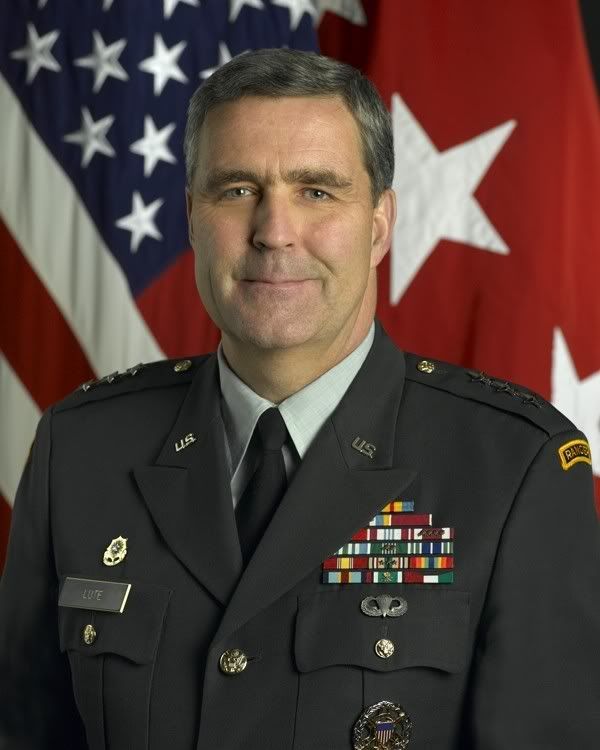
Douglas E. Lute, originally from Michigan City, Indiana, graduated from the United States Military Academy at West Point in 1975. His first assignment was to the Second Armored Cavalry Regiment in Bindlach, Germany, where he commanded C Troop. He received a master's degree from Harvard University and taught in the Social Sciences department at West Point.
Following attendance at the British Army Staff College, he returned to the Second Cavalry as operations officer, serving both at the squadron and regimental levels. In 1990-91 he deployed and fought with the Regiment in Operation DESERT STORM, and later served on the staff of the Chief of Staff of the Army.
He commanded 1st Squadron, 7th Cavalry at Fort Hood, Texas from 1992-94. He then served on the Joint Staff in the Directorate for Strategic Plans and Policy, J-5, and held a War College Fellowship at the Atlantic Council in Washington.
From 1998-2000 he commanded the Second Cavalry Regiment, part of XVIII Airborne Corps, at Fort Polk, Louisiana. He served next as the executive assistant to the Chairman of the Joint Chiefs of Staff for 14 months before joining the First Infantry Division in Schweinfurt, Germany, as the Assistant Division Commander. He commanded Multi-national Brigade East in Kosovo for 6 months in 2002 before being assigned to US European Command in January 2003 as the Deputy Director of Operations.
In June 2004, he began more than two years as Director of Operations (J-3) at US Central Command during which he oversaw combat operations in Iraq and Afghanistan as well as other operations in the Middle East, Central Asia, and the Horn of Africa. He assumed duties as Director of Operations, the Joint Staff, in September 2006.
Tuesday, May 15, 2007
| [+/-] |
Profiles: Lt. General Douglas Lute |
Monday, April 23, 2007
| [+/-] |
Profile: Ryan Crocker, U.S. Ambassador To Iraq |
A career diplomat and fluent Arabic-speaker, Mr Crocker has also served as ambassador to Lebanon, Kuwait, Syria and, most recently, Pakistan.
He knows Iraq well, having served in Baghdad in the 1970s, headed the US state department's Iraq-Kuwait Task Force during the first Gulf War, and worked for the Coalition Provisional Authority shortly after the US-led invasion in 2003.
Mr Crocker succeeded Zalmay Khalilzad - appointed the new US permanent representative to the UN - amid a sustained period of unprecedented sectarian violence.
"The road is going to be a tough one," he said.
"I don't begin my tour here with any illusions. It's going to be very, very difficult, but I certainly believe that success is possible or else I wouldn't be standing here."
'Bloodied'
Mr Crocker was born in 1949 in Spokane, in eastern Washington State.
As his father worked for the US Air Force, Mr Crocker spent a large part of his childhood abroad and attended schools in Morocco, Turkey, Canada and the US.
He returned to Washington State, however, for his higher education, to study at Whitman College in Walla Walla.
I've been impressed by the extent to which Iraqis have stood up to the challenges of building a new state; the courage, the resolve, the dedication they have demonstrated
Ryan Crocker
After graduating in 1971 with a BA in English, Mr Crocker joined the Foreign Service. He was first posted overseas a year later, when he worked at the US consulate in Khorramshahr in Iran.
Mr Crocker undertook his first assignment in Iraq in 1979, the same year in which Saddam Hussein became president.
It was also when he first met his wife, Christine, a former secretary in the Foreign Service.
The couple were posted together to Beirut in 1981 at the height of the Lebanese civil war.
They witnessed the Israeli invasion of Lebanon in 1982 and, in 1983, were in the US embassy when a suicide truck bomb exploded outside, killing 63 people. According to the Washington Post, the blast left Mr Crocker "bloodied, but not seriously injured".
His first senior diplomatic posting came seven years later, when he returned to Beirut as US ambassador. He served later as ambassador to Kuwait and Syria.
The ambassador has spent time talking to Baghdad residents
Mr Crocker returned to Washington in August 2001, when was appointed deputy assistant secretary of state for Near Eastern affairs.
In this role, he made a number of visits to the north of Iraq before the US-led invasion in 2003 to help co-ordinate efforts with Kurdish leaders who also opposed the central government.
After the overthrow of Saddam Hussein, Mr Crocker spent three months as the first director of governance for the Coalition Provisional Authority.
He was responsible for setting up the 25-member Iraqi Governing Council (IGC), which helped the CPA administer Iraq until an interim government was appointed a year later.
In 2004, Mr Crocker became the US ambassador to Pakistan.
While based in Islamabad, he resisted calls in the US to increase pressure on Pakistan's President, Pervez Musharraf, to act decisively against Islamist militants operating near the country's border with Afghanistan.
Instead, Mr Crocker insisted President Musharraf was a solid US ally in its "war on terror".
'Buying time'
In a news conference marking Mr Crocker's first month in Baghdad, the new ambassador said he had been struck by the impact violence had had on Iraq, but nevertheless was impressed by what had been achieved.
"When I left in 2003, there was no constitution, there was no Council of Representatives, there was no sovereign government," he said.
"All of these things are now in place. And I've been impressed by the extent to which Iraqis have stood up to the challenges of building a new state; the courage, the resolve, the dedication they have demonstrated."
He said the next few months were critical in the effort to reconcile Iraq's warring communities and urged the government to make use of a US-led security plan in the capital.
"I think the Baghdad Security Plan led by Iraq, supported by the coalition, can buy time," he explained.
"But what it does is buy time for what ultimately has to be a set of political understandings among Iraqis."
| [+/-] |
U.S. Scandal Threatens Alaska's Prosecutor |
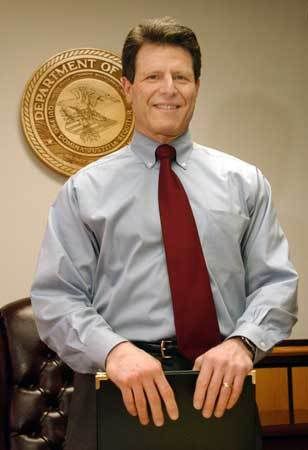 Nelson Cohen was appointed U.S. attorney for Alaska in August 2006.
The Anchorage Daily News reports:
The state’s chief federal prosecutor, Pittsburgh native Nelson Cohen, owes his job to the U.S. attorney in his hometown, who succeeded in getting him the Anchorage post over Alaskans nominated by Sens. Lisa Murkowski and Ted Stevens.
But now, the U.S. attorney scandal threatening to topple Attorney General Alberto Gonzales may cost Cohen his job here. His “interim” appointment will vanish when that classification is amended out of the U.S.A. Patriot Act, which is expected to happen in the next few months.
At the same time, Mary Beth Buchanan, Cohen’s well-connected benefactor and former boss, is in trouble herself, with investigators from the House Judiciary Committee wanting to question her over what role she may have played in deciding which U.S. attorneys got fired, allegedly for partisan reasons.
There are no claims that Cohen got his job here to help or hinder political prosecutions in Alaska, as is alleged in New Mexico, San Diego and other areas where U.S. attorneys were replaced. Pittsburgh Democrats who worked with him and defended clients against him described Cohen, a registered Republican, as a skilled career prosecutor who distanced himself from the Bush administration’s agenda.
Nevertheless, Murkowski and Stevens say they are looking for an “Alaskan” to replace him.
Cohen, who spent about a decade in Alaska before returning home to Pittsburgh in 1987, said he’d like to keep the job but is not actively politicking to do so. He’d like to stay in Alaska, he said, but he still owns his house in Pennsylvania. “I did not come here seeking to be a presidential-appointed U.S. attorney,” he said.
ALASKA SENATORS BLINDSIDED
U.S. attorneys in districts across the country manage teams of prosecutors who enforce federal laws on drugs, immigration, natural resources, weapons and taxes, among others. They are also playing an increasing role in counterterrorism efforts.
The U.S. attorney position in Alaska opened Jan. 23, 2006, when Timothy Burgess left to become a U.S. district judge. His first assistant, Deborah Smith, was named acting U.S. attorney that day. U.S. attorneys are typically nominated by the president and approved by the Senate. Traditionally, Alaska’s two U.S. senators send the names of one or more Alaskans to the White House for consideration. Sen. Murkowski said her clear choice was Smith, a career prosecutor who started out in the federal prosecutor’s office in Anchorage in 1982 and worked in Boston and Washington.
Sen. Stevens wouldn’t reveal his choices.
After submitting Smith’s name, Murkowski said in a telephone interview, her legislative director periodically called the White House during the first part of 2006 to check the status of the nomination.
“We’d get these vague, 'Oh, we’re still working on it, still working on it,’ ” Murkowski said. “So it gets to the point where you’re thinking, 'Wait a minute, this has been a heck of a long time. What is happening?’ And so the response to my inquiry is, 'We still haven’t, there’s some issues,’ and ultimately what we got back was, 'The picks were not acceptable by the White House,’ and yet no explanation as to why they’re not acceptable.”
When she was in Alaska for the August 2006 recess, Murkowski’s Blackberry vibrated with a message. It was her chief aide in Alaska, Mary Hughes, citing a media report that Nelson Cohen had been named interim U.S. attorney.
“You just think, 'It can’t be, wait.’ There was no consulting, no process, no nothing. That’s where I was certainly caught blindsided,” Murkowski said.
Stevens, himself a former federal prosecutor in Alaska, was enraged. “I am just furious at the way the attorney general handled this,” he said at the time.
In an interview at his office in the Federal Building last week, Cohen said he was unaware of all the political forces that resulted in his appointment. But he knew his boss, Buchanan, was well-connected, and it was she who told him about the opening in Alaska.
HE LONGED FOR ALASKA
Through a spokeswoman, Buchanan declined a request for an interview. But the Pittsburgh Post-Gazette recently reported that she pushed the White House agenda, prosecuting such targets as famed cinematic pothead Tommy Chong, of Cheech and Chong fame, for selling bongs over the Internet. She also went after pornographers in California.
The Post-Gazette said Buchanan’s office prosecuted a host of public corruption cases - all against Democrats. One of them, former Allegheny County medical examiner Cyril Wecht, was in Anchorage last week to lecture at the University of Alaska.
Wecht, a physician and lawyer in his 70s who is awaiting trial, said it was ridiculous to think that only Democrats were worthy of public corruption cases in western Pennsylvania.
Cohen was Buchanan’s chief deputy for white-collar crime, but Wecht’s attorney, Mark Rush, said he didn’t appear to have a role in Wecht’s case.
“Nelson Cohen is a professional federal prosecutor,” Rush said. “That’s what Nelson Cohen wants to be, and that’s what I think he will do for the rest of his life. I don’t see political ambition.” Tom Farrell, another former Pittsburgh colleague, said of Cohen: “He’s smart, he’s hardworking, very fair.” Years ago, when President Clinton was in office, the attorneys sharply divided on partisan grounds about whether he should be impeached, Farrell said. Cohen was one of the few at the water cooler “who never got heated.” Farrell, a Democrat, said he hadn’t known that Cohen was a registered Republican. What he seemed to be, though, was a man longing to return to Alaska, Farrell said. His office was decorated with photographs and mementos from his 10 years in Anchorage. Cohen’s wife, Colleen, grew up in Fort Yukon and Fairbanks, the daughter of noted Wien Air bush pilot Keith Harrington. Their three children were born in Alaska.
Gonzales named Cohen to the job in Alaska under a provision inserted into the Patriot Act at the request of the White House when the law was amended by Congress in 2006. It allowed interim U.S. attorney appointments to become permanent without Senate approval.
Eight U.S. attorneys were fired, then replaced under that provision. As the scandal unfolded this year, the House and Senate passed bills restoring the previous selection method, but the bills are slightly different and need to be resolved in a conference committee before they become law. President Bush has said he would sign a final bill. According to a statement from Sen. Stevens’ office, Cohen would then lose his appointment.
“Senator Murkowski and I will continue to look for a candidate that we could nominate and who will serve Alaska with distinction,” Stevens said in a prepared statement.
Friday, March 23, 2007
| [+/-] |
Profile: Dr. Haidr al-Maliki, Iraqi Psychiatrist |
 Dr Haidr says most Iraqis now deal with each other in an aggressive way.
The BBC reports:
Dr Haidr al-Maliki was an army psychiatrist during Saddam Hussein's regime.
He now works as a child psychiatrist at Ab Ibn Rushed Hospital in Baghdad. He lives with his wife and four children.
There used to be about 80 psychiatrists in Iraq, now there are just 20 to 25.
And some of them will leave. Fifteen or so will eventually go to the UAE or to Jordan; it's difficult.
About a year ago, during Ramadan, four boys aged about 15 to 20 came into my private clinic, in front of my patient.
They asked "Are you Dr Haidr?" I said yes. And they shot me several times.
One bullet went into my right shoulder, another into my right arm. I am left with nerve injury and muscle atrophy.
Afterwards they told me I couldn't go to my clinic and that I had to leave the country. They didn't say why.
So, now I don't go out, I just stay at home. My own private jail.
During Saddam's regime we could take our families to the cinema.
Most Iraqi people ... show disturbed behaviour
I want to drink, I want to dance, I want to visit my friends. But I can't do anything. If I even think about going for a drink in my club 500m from my house, I will be killed.
Iraqi people are living in difficult times. Most of us have been exposed to aggression: attacks in the street, car bombings, kidnappings.
Most Iraqi people now deal with each other in an aggressive way; they show disturbed behaviour; they have lost their civility.
We don't know how to treat these problems really.
But I can't leave Iraq. If I and my friends leave, who will help our people?
Limitations of care
I was asked to open the child psychiatry centre in Ab Ibn Rushed hospital, but I have no training in children, really.
I read books and I try to help.
Most of the children are suffering from post-traumatic stress disorder, especially those who have been exposed to kidnapping.
Most of the children I see are bedwetting. They have disturbed behaviour or epilepsy.
We treat them with simple medication; it is very difficult.
Most of the families come here for help and sometimes we can do nothing for them, except offer support and advice.
Thursday, March 22, 2007
| [+/-] |
Profile: Baghdad Baker |

The BBC reports:
Some of our customers come from as far away as Jordan, Syria and Lebanon.
We make sure our sweets have a good flavour. We make our baklava with animal fat and we flavour it with cardamom. We use good quality pistachio nuts.
If we don't think it's good enough, we throw it away immediately. We won't sell sub-standard baklava to our customers.
Iraqis are very fond of sweet things, especially during special occasions such as the month of Ramadan.
One of the changes we have seen since 2003 is the rise in the price of fuel. This has affected the price of our products.
We need liquid gas for the cookers and kerosene for the ovens. And we need diesel fuel for the generators.
The other thing is that we have quite limited working hours.
We used to start at eight in the morning and close at midnight. Now we close at five in the evening.
But we struggle on.
Customer loyalty
We have more customers than we did four years ago.
We used to sell between 20-25 trays of baklava a day - now it's more than 50 a day.
People can't go out in the evening anymore, so they tend to stay at home and eat sweet things.
That's one way they can still enjoy themselves - through what they eat.
Some bakers have started to cheat in the way they make sweets. They have started to mix vegetable oil with the animal fat.
Customers travel long distances to buy Abdul's sweets

But we have stuck to the traditional recipes and ingredients.
Once we finish work we go straight home. I don't allow any member of my family to go out because we would worry about them. I don't go anywhere either.
The presence of coalition troops is not in our interest.
They attack many people. Once they hit my car, but I didn't say anything to them.
And they speak rudely - Iraqis don't approve of that. I would rather they speak softly to people.
It's true they helped rid us of the old regime and of that criminal Saddam. But now they've made things worse.
Tuesday, January 9, 2007
| [+/-] |
Iraqis Escaping Abroad |
The United Nations estimates two million Iraqis have fled to neighbouring countries to escape sectarian violence. It's estimated that 50,000 Iraqis flee the country every month. Many of them choose Syria and Jordan, where they often face extreme hardship. Their refugee status gives them no automatic benefits.
With help from the charity, Refugees International, the BBC spoke to four Iraqis about fleeing religious and professional persecution in their country:
FATIMA, DAMASCUS
Fatima is a single woman working as a hairdresser in Damascus.
She fled Baghdad three years ago after armed militants attacked the salon where she worked.
They disapproved of women having their hair cut in a public place.
They had also threatened to attack the building where she lived with several other women. The militiamen disapprove of women living alone.
"It's impossible to live as a single woman in Iraq; you are treated very badly and it's dangerous," says Fatima, a Shia Muslim.
She sold her jewellery to raise cash, and together with three other women, headed for Damascus.
"In Syria it's OK. Nobody interferes with my life if I just do my job and go home."
Fatima styles hair for women in their own homes; most of her customers are Iraqi. But she says her earnings barely cover the rent.
Every six months she has to leave Syria to renew her tourist visa. She hires a taxi to take her to the border.
"One taxi driver wanted to charge me 25,000 Syrian Lira (about US $480) for the journey. I said that was too much.
"He said that I must be making lots of money, that as an Iraqi woman in Syria, I must be working in a nightclub."
Some Iraqi women in Damascus have turned to prostitution to make ends meet.
"People judge me because of what they see in clubs in Syria, they assume every Iraqi woman is doing the same thing."
Fatima has no family to help her out so she feels isolated - especially in a society which is sceptical of single women.
"I want to be independent. I don't want to be judged badly; I don't want to be humiliated by anything.
"I just want to feel settled and to know I can survive."
KHALIL AND DALAL, DAMASCUS
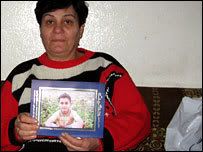 Dalal holds a photo of a nephew who was killed in Iraq
Only Dalal agreed to be photographed. Khalil, a painter, was afraid the people who attacked him would find out he is now in Syria.
In 2004 he began to receive anonymous threats from someone who objected to his painting of a woman, calling it blasphemous.
He was also threatened because he had been asked to paint portraits for American troops in Baghdad.
Three weeks after the first threat, his gallery was burned to the ground. Shortly afterwards, someone threw a firebomb into the couple's living room in the middle of the night, while they slept upstairs.
It took them two months to raise the money to leave.
The couple have three grown up children. Their youngest son lives with them and their daughter lives in Canada.
Their oldest son, Ziad, lives in Sweden. He was visiting his parents for the first time in five years and explained, from Damascus, their situation:
"They can't work and they don't have much money. They have a little from what they brought over from Iraq, but there's not much left because they have to pay for their food and rent out of it."
The couple know a few Iraqi families in Damascus and Ziad says his 19-year-old brother plays football in the street with some Iraqi friends.
But, he says his mother misses having her wider family around her and "feels lonely inside".
The couple appear to have taken on the informal role of community activists in Damascus. Khalil teaches art at the local church and Dalal helps orient new arrivals from Iraq to life in Syria.
Ziad says his parents cannot return to Iraq and are trying to move either to Canada, or Sweden, to join one of their other children.
AHMED and MAYYADA ABDEL SALAM, AMMAN
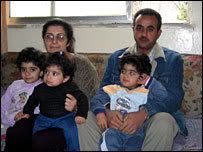
Ahmed is a doctor and his wife Mayyada is a pharmacist. They belong to the Sabian faith, a monotheistic non-Muslim minority in Iraq.
They left Baghdad in 2005 after Mayyada's pharmacy was attacked when she refused to wear a headscarf.
Ahmed explains: "One of the radical Muslims came into the pharmacy and asked Mayyada why she was unveiled. She explained she was not Muslim and that there was no hijab in her religion.
"He told her she was an infidel and that she should leave Iraq."
A few days later the radicals targeted the pharmacy in a drive-by shooting. Ahmed says they had a lucky escape.
"I, my wife and children were in the pharmacy when the attack happened. They shot several rounds, smashing the shop window and the shelves of drugs.
"We were terrified. My wife was injured in the leg, but only superficially."
The family didn't return to the pharmacy, but stayed at home preparing to leave Iraq.
They arrived in Jordan less than two months later. Ahmed says they chose Jordan because it was close and at the time it was easy to get to.
But life is difficult in Amman.
"We arrived as refugees; we have no rights. We can't work and we can't send the children to school. We have three daughters, aged six, three and one. We are considered illegal residents in Amman, although we are refugees."
They arrived with their life savings which Ahmed reckons will last another four or five months. After that, they will have to ask for help from relatives abroad.
Ahmed's parents are living in their family home in Baghdad.
"We speak to them on the phone, we are very anxious about them because it is so dangerous."
They family is renting a two-bedroom apartment in Amman and educating their six-year-old at home.
They are in touch with other Iraqis in the city and they also know a few Jordanians.
"We do have some contact with them, but it's usually superficial. There's no time for anything deeper and we are not in the right frame of mind to reach out to others.
"We keep it superficial because we are depressed and we don't know what the future holds."
Ahmed and his wife want to move to Australia. They have already had one application rejected, but they are putting in another.
"We want to start a new life for our children. They are more important than us."
SAAD MOHAMED AND FAMILY, AMMAN
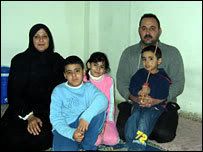
Saad brought his family to Jordan in June 2006, after narrowly escaping two direct attempts on his life.
Under Saddam's regime Saad, a Sunni, was a soldier in the army and his ID card identifies him as a veteran of the Iran-Iraq war. He is therefore considered a "Saddamist".
"I received letters at my house, telling me to leave within 24 hours or be killed.
"One time, I was driving the car - with our three young children - and somebody started shooting at us. I managed to drive away quickly and we escaped. That was in Baghdad."
The family fled with no possessions. They had money sent from home after they arrived in Amman - but it was stolen within 24 hours.
Saad believes someone followed them from Iraq and stole the money as soon as it was safe to do so.
He has no work permit and was unemployed for the first five months in Jordan.
"About three weeks ago someone gave me a job. I'm working as a porter, guarding a building. The pay barely covers the rent, food and water. It's hardly enough to live on."
After Saddam's regime was toppled, Saad used to work in a shop, selling electric cables and lighting equipment.
He has no friends or family in Jordan. He says he chose Amman because it was the only place he could escape to.
"Our children are aged seven, six and four. They need to go to school, but I can't afford to send them."
Saad is applying for asylum in Europe. He says he has contacted the Spanish embassy, but he hasn't heard from them yet.
One of his children was born with a disability and has already had several operations. Saad has applied to children's organisations to see if his son can be offered a place in school.
He says he has no idea what happened to his house in Baghdad.
"All I know is that the Mehdi Army have now got hold of many houses in the area where I used to live."
Would he ever think of going back?
"I don't even think about it. It's highly unlikely. I have a psychological block about it.
"Five of my cousins were killed in front of my eyes immediately before I left."
Saad says he conjures up the memory of Iraq to try to get his children to behave: "If they're playing up, I threaten them with moving back to Iraq."
Sunday, October 8, 2006
| [+/-] |
Profile: Brian Schweitzer, Democratic Governor of Montana |
The NYT reports:
It’s fun being governor of Montana. Just watch Brian Schweitzer bouncing around the streets of Helena in the passenger seat of the state’s official S.U.V., fumbling with wires, trying to stick the flashing police light on the roof. When he spots some legislators on the sidewalk, he blasts them with the siren, then summons them by name on the loudspeaker. The men jump, and the governor tumbles out of the car, doubled in laughter, giving everyone a bear hug or a high-five or a soft slap on the cheek. Schweitzer, a Democrat in his first term, marches into a barroom in blue jeans and cowboy boots and a beaded bolo tie, and his border collie, Jag, leaps out of the vehicle and follows him in. The governor throws back a few pints of the local brew and introduces himself to everyone in the place, down to the servers and a small girl stuck there with her parents. He takes time from the backslapping to poach cubes of cheese from the snack platter and sneak them to the girl, who is now chasing his dog around the bar. “This is how you make friends with Jag,” he advises her. “Just hold it in your hand and let him take it.”
As soon as Schweitzer was elected in 2004 — the same night that George W. Bush carried Montana by 20 percentage points — pundits began declaring him the future of the Democratic Party. Never mind that it was his first elected office: the 51-year-old farmer and irrigation contractor had folksy charm and true-grit swagger. He shot guns, rode horses, took his dog to work and decimated his opponents with off-the-cuff one-liners heavy on the bull-and-horse metaphors. He didn’t act like a Democrat, in other words, and to many Democrats, reeling from consecutive losses to Bush, that seemed like a pretty good thing.
Schweitzer’s grandparents were homesteaders who immigrated to Montana from Ireland and Germany. His parents were ranchers who never completed high school. And until 2000, Schweitzer and his wife, Nancy, were farming in Whitefish and raising their three children. And then, despite the fact that he was a virtual unknown in politics, Schweitzer began a quixotic bid to oust Conrad Burns, a two-term incumbent Republican senator. To the surprise of Montana’s political class, he came within four percentage points of succeeding. Almost immediately, he began campaigning for what would be an open governor’s seat. Even after choosing a Republican as his running mate, he thumped his primary opponent by a 52-point margin, then won the general election by four points.
Within months of his election, bloggers were clamoring for a presidential run, and his popularity transcended the wonk journals to include coronation as “Hot Governor” by Rolling Stone magazine, while “60 Minutes” called him the Coal Cowboy. On camera he persuaded Lesley Stahl to take a whiff from a vial of diesel fuel synthesized from coal — a product that Schweitzer claims will not only fill Montana’s coffers but also help end the nation’s dependence on foreign oil peddled by “sheiks, rats, crooks, dictators.”
Schweitzer’s “Montana miracle,” in which Democrats took back the governor’s seat after 16 years and ended 12 years of Republican majorities in both state chambers, has been cited as evidence that the Republican bastions in the Western states are losing ground to a new, Democratic brand of libertarian-tinged prairie populism. No fewer than four recent books by Democratic strategists have mentioned Schweitzer as the kind of guy Democrats need to win back rural America. A fifth book, Tom Schaller’s “Whistling Past Dixie,” published earlier this month, also singles out Schweitzer and makes the previously heretical claim that the Democrats’ future lies in ignoring the South and embracing the West and Midwest, where voters are less evangelical and more independent.
“He’s one of the new stars in the party,” Gov. Bill Richardson of New Mexico, chairman of the Democratic Governors’ Association, told me recently. “We’re highlighting him wherever we can.” Indeed, just 54 days into his term, Schweitzer was chosen to deliver the Democrats’ weekly radio address, and he has been attracting notice from the party faithful ever since — like when he compared the president to a shifty cattle auctioneer hawking lousy bulls to dubious ranchers.
Six-foot-two and a beefy 205 pounds, Schweitzer has seized the heartland imagery generally monopolized by Republicans. “Schweitzer is the antithesis of the Democrat stereotype,” Markos Moulitsas Zuniga, of dailykos.com, the partisan Democratic blog, told me. “Too many Democrats look like targets for the school bully. Schweitzer is a tough guy. And people like guys who will bar-fight their way across a state.”
Schweitzer veers right on many economic and social issues: he opposes gun control, favors the death penalty and preaches about lowering taxes and balancing budgets. At the same time, he leans left on some issues that matter to progressives: championing energy conservation and environmental regulation, opposing governmental restrictions on abortion and criticizing free-trade deals. “He’s as much a prairie centrist as he is a prairie populist,” Bruce Reed of the Democratic Leadership Council told me. Schweitzer has the ability to reduce a complicated issue to a few sharp lines, reframing it with themes of patriotism and underdog know-how. “I was a critic of Nafta, I was a critic of Cafta and I’ll be a critic of Shafta,” he says of free-trade agreements, long the hobgoblin of even the most articulate liberal politicians. “Why is it that America supposedly creates the best businessmen in the world, but when we go to the table with the third world, we come away losers?”
The Democrats’ enthusiasm for their new hero seemed to overlook the fact that the governor of a state as sparsely populated as Montana simply does not wield a lot of national clout. Schweitzer governs fewer than a million people, in a state with a single Congressional representative, only three electoral votes and a Legislature that meets for just 90 days, every other year. Indeed, Schweitzer’s national celebrity has less to do with the way he has governed and more to do with Democrats’ perception — or their hope — that he is leading a Western resurgence.
The elections next month will test that theory. Schweitzer has been campaigning for the two Western Democrats best poised to replace powerful Republicans. In Montana, a populist farmer named Jon Tester is posing a serious challenge to Senator Conrad Burns, whose close ties to the lobbyist Jack Abramoff have made him an attractive target for Democrats trying to paint the Republicans as corrupt insiders. A Tester victory would solidify Montana as a Democratic stronghold, marking the first time since 1989 that the state’s two senators and governor were all Democrats. (Montana’s other senator, Max Baucus, a Democrat, has held his seat since 1978.) In Colorado, meanwhile, Schweitzer has been stumping for Bill Ritter, the former Denver district attorney, who grew up on a farm with 11 brothers and sisters, began working construction at age 14 and is now running for governor. A Ritter win would complete what Schweitzer calls a “blue bridge from Alberta to Mexico,” a string of Democratic governorships stretching across Montana, Wyoming, Colorado, New Mexico and Arizona — states that all broke for Bush in 2004.
Some of this has to do with demographics. In the last three decades, professional and service jobs have boomed in the Rocky Mountain states, and farming and mining jobs have not; those two sectors, once the mainstay of the region, now make up just 5 percent of all jobs. In Nevada, Arizona and Colorado, a sharp rise in the Hispanic population in the last decade may also have helped tilt the voting base to the left. But Governor Schweitzer says he believes that his success points to something more significant. “Is it that the population in the West is trending toward the traditional Democratic Party?” Schweitzer asked. “Or is it possible that some leaders in the Rocky Mountains are on the vanguard of realigning what the Democrats stand for?”
The Interior West has long been seen by Democrats on election night as simply a disheartening wall of big red blocks. Idaho, Utah and Wyoming haven’t voted for a Democratic presidential candidate since Lyndon Johnson in 1964, and Montana, Colorado and Arizona have all gone Republican in 9 of the last 10 presidential elections. But below the surface, the map of the West is slowly becoming a little less red and a little more blue. In 2000, Democrats had not a single governor in the interior West states; now they have four. Democrats have gradually been picking up House seats, too. In 1996, they won 4 of 24 House seats in the region. But they’ve managed to pick up 1 or 2 seats in each of the last four elections and have now clawed their way up to 8 of 28. In 2004, the party’s only bright spot besides Montana was Colorado, where Ken Salazar won a Republican Senate seat; his brother, John, picked up a House seat; and the Democrats took control of both state chambers.
“The pan-Western states — in an arc from Ohio, west to Montana and south to Arizona — are where the low-hanging and most-ripe-for-the-plucking electoral fruit for Democrats is to be found,” writes Tom Schaller in “Whistling Past Dixie.” The midterm election outlook seems to support Schaller’s thesis. None of the region’s eight Democratic representatives — the so-called Coyote Caucus — are considered at serious risk in 2006. But 10 of the 20 Republican-held seats are included in the list of 56 potential Democratic pickups compiled by Larry Sabato at the University of Virginia’s Center for Politics. The Democratic Senate candidate in Arizona is putting up a surprising fight against the Republican incumbent, and the race for Nevada governor, an open seat vacated by a Republican, is listed by the Cook Report, an influential Washington political newsletter, as a tossup.
Local Democrats portray this trend as a grass-roots, homegrown phenomenon. “These advances were not the results of any national organization,” Jim Farrell, executive director of the Montana Democratic Party, told me, “but of the emergence of great local leadership like Schweitzer and Salazar. The D.S.C.C.” — the Democratic Senatorial Campaign Committee, led by Charles Schumer of New York — “and other national groups have recognized the potential for gain, but they’re chasing after a train that began rolling in the last two cycles here in the West.”
It would seem to be true that Democrats in Washington long ignored the mountain states. As Pat Williams, a Montana Democrat who served in the House from 1979 to 1996, told me, “In 2000 you literally couldn’t get an Al Gore button in Montana.” But in recent years, the national Democratic Party has made some small but significant organizational shifts to increase the West’s political brawn. In August, the Democratic National Committee inserted a Nevada caucus into the 2008 presidential primary schedule, between Iowa and New Hampshire, in recognition that the Southwest is the nation’s fastest-growing region. The West has also gained influence through the elevation of Senator Harry Reid, a pro-gun, pro-life Nevada Mormon, to Senate minority leader. Democrats have chosen Denver as one of two finalists to be host of their 2008 convention (the other is New York). If Denver is selected, it will mark the first time in a century that Democrats have held a convention in the interior West. The D.N.C. has hired as its Northwest political director Brad Martin, who as executive director of the Montana Democratic Party oversaw its 2004 gains, and Howard Dean has dispatched more than 30 staff members to the Western states as part of his “50-state strategy.”
Still, Democrats hasten to assure the region’s notoriously prickly and independent voters that the national party’s new Western focus doesn’t mean that Washington will exercise any control over candidates in the region. “We’re not trying to be a top-down organization like the Republicans,” says Karen Finney, spokeswoman of the D.N.C. In the West, of course, being seen as refusing to take orders is a way to demonstrate your frontier spirit. Williams offers this advice to any Western candidate wondering whether to employ a regional strategy: “If it doesn’t exist, create it. And then be against it.”
As fertile as the West may seem for Democrats, some in the party remain skeptical that it matters much. “The problem with the Democrats is that they can’t count,” Dave (Mudcat) Saunders, a Democratic campaign strategist, told me. Saunders’s book, “Foxes in the Henhouse,” argues that the party would be wrong to focus on the West and ignore the South. He notes that 30 percent of the country’s electoral votes come from the South, and that by 2025 that percentage will be 40. “Georgia and Florida have as many votes as all the West put together,” Saunders points out.
Montana Republicans don’t concede that the 2004 results show a Democratic trend in Montana — much less the rest of the West. Roy Brown, the leader of the Republican caucus in the statehouse, says that the Democrats’ pickup of seats in the Legislature was not due to a sea change in the electorate but a result of gerrymandering perpetrated by a Montana Supreme Court that is “in bed with the Democrats.” Although Montana does not require voters to identify party affiliation, Brown estimates that 40 percent are Republicans, 35 percent are Democrats and 25 percent are independents. He concedes that in recent years the independents have been leaning toward the Democrats, but he says that’s not a consequence of a true shift in voter attitudes but a result of a “filter-down” effect from unpopular Republican candidates at the top of the ticket. (Schweitzer’s Republican predecessor famously declared herself a “lap dog of industry.”) In any event, the Democrats’ success in 2004 was not an aberration; the party had been steadily gaining seats in the state chambers for the previous three elections.
Schweitzer agrees that Democrats should be careful about trying to extrapolate Montana’s political trends to other states. “Montana ought not serve as a metaphor for the entire West,” he told me. Indeed, Montana is the West’s answer to New Hampshire: independent, contrary and unpredictable. Its demographic trends do not match that of the Southwest. The state’s population is growing, but not skyrocketing the way it is in Arizona and Nevada, and with no city larger than 100,000 residents, Montana essentially does not have suburbs or exurbs like those spreading around Phoenix, Las Vegas and Denver. Hispanics account for less than 3 percent of the population; Montana’s most sizable ethnic minority is Native American, at 6 percent of the population. And the state’s voters have always been less conservative than their neighbors in Idaho, Utah and Wyoming. While it’s true that Montanans voted for a Democratic president only twice in the past 50 years, they’ve often elected Democrats to the House and Senate. In fact, Max Baucus’s Senate seat has been held by a Democrat since 1913. The meaning of the 2004 race is further complicated by the fact that Schweitzer chose a Republican — albeit a moderate of the Jim Jeffords variety — as his running mate.
Within the state, politics have historically been split between east and west. Western Montana, with two college towns, Missoula and Bozeman; the unionized mining town Butte; and the capital, Helena, tends to vote more like the liberal Pacific Northwest. The east is more like the Great Plains, with vast ranches, farms, strip mines and oil fields. When the state had two Congressional districts (they were folded into one in 1993), the western one was consistently held by a Democrat and the eastern one by a Republican. According to David Sirota, who was a strategist for Schweitzer in both 2000 and 2004 and who now lives in Helena, the swing vote in the state is in and around Billings, the state’s largest city. (“It is Yellowstone County that is Montana’s own Ohio,” he says, “and Billings the state’s Columbus.”) But unlike the rest of the nation, where swing voters are generally characterized as socially conservative suburbanites, Sirota says that many Montana swing voters are rural and libertarian.
Marc Racicot, who served two terms as Montana’s governor before he went on to be chairman of the Republican National Committee and President Bush’s 2004 campaign committee, says his fellow Montanans are unpredictable voters. “You simply can’t classify them,” he told me, pointing out that in 2004 they simultaneously voted to ban gay marriage and to legalize medical marijuana. “They are conservative in some ways, but ruggedly independent and populist in others. Party affiliation isn’t necessarily the dominant characteristic they consider.” Montanans are more mistrustful of large institutions like government and corporations than their counterparts on the coasts, while less religious than the South. Fifty-three percent of Montanans say they are pro-abortion rights. In foreign policy they can be rather isolationist: a poll in September showed that Montanans break with the national trend and rank the economy as more important than national security or the Iraq war. They take a libertarian approach to homeland security that is rarely heard nationally; Jon Tester, in a recent debate, said, “With things like the Patriot Act, we’d damn well better keep our guns.” And, contrary to the myth that Westerners are opposed to all environmental regulation, they tend to be conservationists. About 60 percent of Montanans favored the Roadless Area Conservation Rule, which protected land from logging; it was signed by Bill Clinton and overturned by George W. Bush. Bush’s recent plan to auction off public lands was so unpopular in Montana that even Conrad Burns opposed it.
Montana’s populist streak dates back more than a century to the mining labor movement, and it surfaced again in 1992, when Ross Perot captured more than a quarter of the vote, allowing Clinton to win the state. As the Republicans honed their populist message in the 1990’s, their fortunes improved in Montana. Now, some say, the tide is turning. “The appeal of populism never changed,” Sirota says. “The parties changed. The Republicans were the populists. Now the Democrats have learned that they can be populists, too.”
It was a sunny day in June, and Brian Schweitzer and Max Baucus were flanked by Cessnas and helicopters, rallying with Jon Tester. Political rallies in other states might take place in hotel ballrooms; here in Montana everyone was gathered in an aircraft hangar outside Missoula. The place smelled like jet fuel. Corralling the top-ticket Montana Democrats in one place can resemble a “Bonanza” cast reunion, albeit with two Hosses and no Little Joe. Tester is a third-generation wheat farmer, president of the State Senate and a lumbering tank of a guy with a big gut and a flattop haircut. You want prairie authenticity? Have Tester show you his hand with just a thumb and a pinkie; the other three fingers were chopped off in a meat grinder when he was a boy. Tester, a progressive type, ran in the primary against a better-financed centrist, a career politician supported by the Democratic Leadership Council, and as soon as he won, Schweitzer leapt in to claim him as a brother. Onstage at the airport, Schweitzer played the down-home card. “Jon’s grandparents homesteaded just 20 miles from my grandparents,” he hollered, to a roar of approval from the hangar. “He and I were born in the same tiny hospital, up in Havre!”
Other than the fact that they grew up on farms, it’s not immediately clear what unites Schweitzer and Tester, Ritter and the Salazars. With his outspoken criticism of the war in Iraq — “I was very public before we went in that it was a bad idea, and history has borne that out,” he told me — Schweitzer has become a hero to progressives, while Ken Salazar has infuriated liberals with his support of Alberto Gonzalez’s nomination for attorney general and his endorsement of Joe Lieberman’s independent re-election bid. Governor Richardson of New Mexico suggests that such differences are evidence that the movement has no overarching strategy. “It’s happening from the bottom up,” he told me. “This is a natural evolution. It’s no grand design.” Or maybe it’s that the region’s Democrats simply don’t have many core beliefs in common. Schweitzer remains an iconoclast; he says he supported John McCain’s presidential bid in 2000, though he has since soured on McCain because of the way he has courted the religious right, and he says he is now intrigued by the possibility of a presidential run by Mitt Romney, the Republican governor of Massachusetts, in 2008. “If he gets the nomination, I might support him,” Schweitzer told me.
Much of Schweitzer’s attraction to voters lies in the fact that he doesn’t seem like a politician. “I’m just a rancher who ended up governor of Montana,” he likes to say. But Schweitzer is not a politician only in the sense that the young Cassius Clay was not a boxer; by the time his opponent realized he’d been hit, he was already on the mat. And since it’s accepted in the West that politicians are generally not to be trusted, Schweitzer’s greatest talent may be his endless insistence that he’s not one, all the while winning your vote and changing your opinion to agree with his. Which is, of course, what a politician does. His success is not the happy accident of a novice or a rube or a cowpoke who happened to ride his donkey into the halls of power — but rather the work of an expert, a virtuoso or, perhaps, a natural.
Besides getting elected and getting on television, what has Schweitzer actually accomplished? Much of the attention he has received came from positions he has taken on national issues: writing an Op-Ed for The Times about the miracle of coal-to-gas liquefaction, or requesting that President Bush return the Montana National Guardsmen from Iraq to fight summer forest fires. His agenda for his first legislative session was hardly radical: it included an increase in education financing, setting a goal to produce more wind power and a tax-reform bill that favored small business over big by eliminating the tax on business equipment valued at less than $20,000, while withdrawing a pending cut on more expensive equipment. He introduced an ultimately unsuccessful plan to prevent government officials from moving directly into lobbying jobs. Still, Schweitzer bristles at the suggestion that he was not sufficiently tested by his first session. “I had 90 days to pass my agenda,” he told me. “It was my first day on the job, and I was working with lobbyists and legislators who’d been there for years. We had a State Assembly that was deadlocked. But I pushed through the most progressive legislative agenda in the country. It was not easy. I took on the lobbyists. I wrestled them to the ground, and now I’m kicking them in the ribs.”
Despite the boots and bluster, at his core Brian Schweitzer is something of a policy wonk and a science whiz. He says he sleeps no more than five hours a night, and he is at his computer well before dawn, consuming a host of newspapers and a string of political blogs. His true passion is energy independence. On his desk is a contraption of tubes and coils that, as he enthusiastically explains, convert sunlight into hydrogen. In addition to his horsemanship and riflery, Schweitzer likes to tinker with gadgets, and he holds degrees in both soil science and agronomy. He will preach to anyone who will listen about the Fischer-Tropsch process of coal liquefaction, or about his recent switch from a Tahoe S.U.V. to a biodiesel Volkswagen Jetta.
Schweitzer fancies that he will solve the energy crisis the Montana way, which is to say, with ethanol and syn-fuels and wind power, all readily available in a state that has more grain, coal and wind than it does people. He says he believes that he is setting an example for the rest of the world, and that tends to infuse even the most mundane details of his legislative work with a certain fervor.
When I was visiting with Schweitzer one day during the legislative session, an aide rushed into his office with news that a group of Democratic state representatives from the Great Falls area were threatening to withdraw their support from the governor’s ethanol bill. Schweitzer was leaning back in his chair, beneath an oil painting of a Native American woman playing a flute, beside a window opening onto a view of snow-covered mountains. If Schweitzer is, as his critics contend, mostly a showman, he has chosen the perfect stage. Helena’s domed State Capitol is a transcendent gallery of marble columns and stained-glass atria, a temple so sincere in its exultation of frontier democracy that, for the cynical, it may resemble a Frank Capra movie version of government more than it resembles the real thing. Citizens wander freely in the corridors of power and, from the Senate gallery, can observe their lawmakers beneath frescoes of Lewis and Clark meeting Sacagawea, and of General Custer about to take a dagger to the gut at Little Bighorn.
The Great Falls representatives refused to come meet Schweitzer in the governor’s office — located about 800 steps from their chamber — because they were upset that the governor canceled a meeting with them earlier that day. “That’s it,” Schweitzer said, leaping up. “I’m taking ’em to the woodshed.” In an instant he was stomping down the corridor to the rotunda, his dog at his heels, and charging up the staircase to the House chamber. The governor corralled the Great Falls representatives in a meeting room and listened to their grievances. He leaned forward intently, his head bobbing almost imperceptibly, his eyes wide open and blinking in a strict cadence, receiving and processing data as if it were an electrical current. He clutched the edge of the table, and I suspected that if he let go, the rotors spinning in his skull would have broken the pull of gravity and sent him spiraling into orbit.
Sufficiently charged, the governor whirred into action. His monologue combined pep talk and sales pitch, threats and promises, science lecture and economic briefing. He spoke at length on the difference between malt barley and high-protein wheat, and on the profit margin of ethanol refineries, pounding his finger on the tabletop for emphasis. He went on uninterrupted for seven minutes, and when the fusillade was over, one of the representatives voiced a small objection from an industry lobbyist that Montana wheat would make for low-grade ethanol.
“Now that,” said the governor, slapping the table in triumph, almost evangelically, as if the Republic itself depended on this vote, “that sounds like somebody who didn’t take a single class in agronomy!”
Later that day, everyone at the meeting voted yes on ethanol, and in the evenly split House, the bill passed 52-48.
Hungry and emboldened, Democrats are already looking past 2006. A few stalwart Western Republicans who have been in the Senate since the Nixon years are rumored to be contemplating retirement in 2008. Pete Domenici of New Mexico will be 76, and Ted Stevens of Alaska will be 84. In Colorado, Democrats are so eager to oust Senator Wayne Allard that Representative Mark Udall has declared his candidacy a full three years before the election. Udall comes from the political dynasty that has spawned an Arizona Supreme Court justice and a handful of Democratic congressmen, and as a world-class mountaineer who says he is the only member of Congress to have made an attempt on Mount Everest, he fits the bill of an iconic Westerner.
As Democrats look to Montana to try to figure out how to replicate Governor Schweitzer’s success, they can’t help noticing one recent poll number: in August, 66 percent of Montana Republicans said they approved of Schweitzer, the same portion who said they approved of Conrad Burns, their own party’s incumbent senator. It may be that this sort of popularity comes only to a larger-than-life personality like Schweitzer.
Democrats will be wise not to try to replicate Schweitzer himself. When non-Schweitzers try to act like Schweitzer, it usually doesn’t work. In his book, Schaller recalls “campaign images of Al Gore wearing cowboy boots with his belt-clipped Blackberry, or a barn-jacket-clad John Kerry buying a goose-hunting license.” Schaller goes on to write that these gestures force “liberals to avert their eyes in horror, while conservatives look on from afar with a mixture of disdain and disbelief.”
As for Schweitzer’s own future plans, he dismisses questions about further political ambitions with one of his trademark similes — something about having spent more days in a saddle than having been governor. Nonetheless, the scope of his battle is larger than Montana. In addition to campaigning for Jon Tester in Montana and Bill Ritter in Colorado, he also stumped recently at a fund-raiser in Jackson Hole, Wyo., for a singularly non-Western candidate: Eliot Spitzer of New York.
Tuesday, December 6, 2005
| [+/-] |
Patron Saints of Right Wing Think Tanks Acquire Georgia Pacific Corp |
Oil barons Charles and David Koch, two of the nation's worst environmental criminals, now control the country's largest privately held company
Media Transparency reports:
In a move that does not bode well for the nation's forests, last month the Koch brothers of Kansas engineered a $13.2 billion buyout of forest products producer Georgia Pacific Corporation, making Koch Industries the nation's largest privately held company. The purchase includes Koch's assumption of $7.8 billion in Georgia Pacific debt, making the total purchase price $21 billion.
The Kochs are smart, focused, and incredibly wealthy. For years they've been pushing both a libertarian and free-market agenda through tens of millions of dollars in contributions to conservative causes, candidates and organizations.
During the late 1980s and early 1990s, Congress investigated their company over allegations that they had stolen over $30 million worth of oil from Indian tribes in Oklahoma. In January 2000, the Environmental Protection Agency leveled "the largest civil fine ever imposed on a company under any federal environmental law to resolve claims related to more than 300 oil spills from its pipelines and oil facilities in six states," according to Justice Department press release; the fine was severely reduced after John Ashcroft became Attorney General.
One of the brothers was recently honored (scroll down for pix) for his generous support of the American Ballet Theatre's production of Raymonda. Who are these men with deep right-wing ties who own a company that will soon become the nation's largest privately held corporation? They're the Kochs from Kansas, and they control Koch Industries.
According to the Toronto Globe and Mail, Koch's purchase of Georgia Pacific would vault Koch past food producer Cargill Inc. as the largest privately held company in the United States, with $80-billion in revenue and 85,000 employees in 50 countries.
In a way, the Georgia Pacific acquisition "completes the circle" for Koch, Scott Silver told Media Transparency. "The ideologues running the land management agencies are the product of the think tanks created by, and funded by, the Koch family," Silver, the executive director of the environmental group Wild Wildnerness, pointed out. "Those ideologues are now in a position to permit Koch's newest acquisition, Georgia-Pacific, to further rape and pillage the public's lands. These think tanks promote the Free-Market ideal when it serves their interests to do so, but in reality, they are firmly committed to the ideal of enriching private interests at enormous direct cost to the American taxpayer."
The Koch (pronounced "coke") brothers, Charles, David, William and Frederick are sons of Kansas. Thirty-eight years ago, Charles took over the company from his father, company founder Fred Koch. According to a recent piece in Business Week, Charles, 70, and David, 65, now "own the bulk of the company after elbowing out their other brothers ... in 1983," buying out William and Frederick for $470 million and $320 million, respectively. In 1998, in a chilling display of family disunity, "the two sets of brothers walked silently past one another in court as William and Frederick lost a lawsuit to extract more money from Charles and David."
In 1940, Fred Koch founded the company as an oil refiner. A graduate of MIT, he was an original member of the anticommunist ultra-conservative John Birch Society, founded in 1958. The sons did not fall far from the tree: Both Charles and David graduated from MIT and have been deeply involved in conservative politics.
According to "Axis of Ideology," (PDF Executive Summary) a 2004 report by the National Committee on Responsive Philanthropy, the two dominant Koch boys have "a combined net worth of approximately $4 billion, placing them among the top 50 wealthiest individuals in the country and among the top 100 wealthiest individuals in the world in 2003, according to Forbes."
Between 1999 and 2001, they gave more than $20 million to a host of conservative organizations; "most of their contributions go[ing] to support organizations and groups advancing libertarian theory, privatization, entrepreneurship and free enterprise," "Axis of Ideology" pointed out (click here to see aggregated grants from the three Koch foundations).
"David, who is executive vice-president and a board member, ran for Vice-President on the Libertarian Party ticket in 1980 and both Charles and David are directors of the free-market advocating Cato Institute and Reason Foundation," Business Week recently pointed out. In an interview with National Journal, David Koch described his philosophy this way: "My overall concept is to minimize the role of government and to maximize the role of the private economy to maximize personal freedoms."
According to SourceWatch, a project of the Center for Media & Democracy, the brothers are "leading contributors to the Koch family foundations, which supports a network of Conservative organizations and think tanks, including Citizens for a Sound Economy, the Manhattan Institute, the Heartland Institute, and the Democratic Leadership Council."
Charles Koch co-founded the Cato Institute in 1977, while David helped launch Citizens for a Sound Economy [http://www.mediatransparency.org/story.php?storyID=40" target="_blank"] in 1986. Over the years, they have given more than $12 million to each, according to the NCRP report. George Mason University is also a well-funded recipient of Koch largesse; receiving more than $23 million from the family's foundations between 1985 and 2002, according to the NCRP.
Charles and David Koch control several family foundations including the Charles G. Koch Foundation, the David H. Koch Foundation and the Claude R. Lambe Foundation. Koch money also flows through Triad Management Services, "an advisory service to conservative donors on groups and candidates to support." Put more precisely, SourceWatch notes that Triad "is a Tom Delay-affiliated organization that launders money from large corporations into congressional campaigns."
Originally and perhaps not surprisingly given their libertarian bent, the brothers were not aficionados of former Republican Kansas Senator Bob Dole. Some reports have it that they considered him more or less as just another spineless politician. In 1986, however, "the Kochs' disdain for Dole began to dissipate when Koch Industries sought financial advantage under 'technical corrections' to a tax revision act," veteran reporter Robert Parry wrote in an extensive investigative report for The Nation magazine. "The Washington Post," Parry noted, "reported that Koch Industries approached Dole and secured the Senator's aid in inserting an exemption from a new real-estate depreciation schedule, a change that was worth several million dollars to the company."
"As a Senate leader ... [Dole] appeared willing to trade his influence for the keys to the Koch political money vault," Parry pointed out in "D(OIL)E: What Wouldn't Bob Do For Koch Oil?" David Koch became "a national vice chairman of the Dole presidential campaign's finance committee ... [and] lin[ed] up deep-pocket contributors for his candidate and the G.O.P." Koch "also helped Dole achieve majority leader status through his checkbook, contributed mightily to a Dole foundation and even turned his Gatsbyish estate in Southampton, New York, into the site for celebrating Dole's 72nd birthday in July 1995, raising $150,000 for his campaign."
One of the strangest aspects of the Koch story is how little the general public knows about the brothers or the company. "Koch is a huge company -- bigger than Microsoft, but few people have heard of it," said Bob Williams, a project manager at the Center for Public Integrity, and the co-author of the report "Koch's Low Profile Belies Political Power: Private Oil Company Does Both Business and Politics With the Shades Drawn."
"Despite its size and political largesse, Koch is able to dodge the limelight because it is privately-held, meaning that nearly all of its business dealings are known primarily only by the company and the Internal Revenue Service," Williams and Kevin Bogardus, co-author of the report, wrote. The company "has spent nearly $4 million on direct lobbying on more than 50 pieces of legislation before Congress, helping shape the debate on everything from limiting class action lawsuits to repealing the estate tax," William and Bogardus pointed out.
In a November 15 News Release issued by the Institute for Public Accuracy, Williams pointed out that the company is "politically active, in campaign contributions, lobbying and, probably most importantly, founding and funding right-leaning libertarian think tanks." The acquisition could have profound effects since both the oil and lumber industries have significant environmental ramifications. "Koch is very solicitous of its many friends in Washington; and when it gets in an environmental bind, it is not shy about calling on those friends in Washington," Williams added.
Williams' 2004 "Koch's Low Profile Belies Political Power" noted that:
"Despite its size and political largess, Koch is able to dodge the limelight because it is privately held, meaning that nearly all of its business dealings are known primarily only by the company and the Internal Revenue Service."
"Although it is both a top campaign contributor and spends millions on direct lobbying, Koch's chief political influence tool is a web of interconnected, right-wing think tanks and advocacy groups funded by foundations controlled and supported by the two Koch brothers."
"Koch has had plenty of run-ins with government regulators and other legal problems in recent years. Through it all, the company has shown a remarkable knack for getting criminal charges dropped and huge potential penalties knocked down."
"Koch has also shown a remarkable ability to get rid of or modify environmental policies and other government rules it doesn't like."
"Amongst the most important, visible and powerful proponents of public lands privatization are the Cato Institute, the Property and Environment Research Center (formerly known as Political Economy Research Center) and the Reason Institute," said Scott Silver, the executive director of Wild Wilderness, a Bend, Oregon-based grassroots environmental organization. "Koch funds have played a major role in the operation of each of these organizations."
The Koch family "is amongst the most powerful and influential movers and shakers promoting privatization in America," Silver added. Over the past several decades, "their money created an extensive infrastructure of Libertarian and Free-Market think tanks from which President Bush has drawn to staff the highest rungs of the land management agencies."
The acquisition of Georgia-Pacific, which "does extensive logging on public lands" and "is a heavily subsidized form of corporate welfare," could accelerate the trend toward the privatization of our national forests Silver argued. "Logging companies such as Georgia-Pacific strip lands bare, destroy vast acreages and pay only a small fee to the federal government in proportion to what they take from the public. They do not operate in the Free-Market when they log public forests."
Over the years, Koch has been "a major polluter," SourceWatch reported. "During the 1990s, its faulty pipelines were responsible for more than 300 oil spills in five states, prompting a landmark penalty of $35 million from Environmental Protection Agency (EPA). In Minnesota, it was fined an additional $8 million for discharging oil into streams. During the months leading up to the 2000 presidential elections, the company faced even more liability, in the form of a 97-count federal indictment charging it with concealing illegal releases of 91 metric tons of benzene, a known carcinogen, from its refinery in Corpus Christi, Texas."
After Bush took office in 2000, the 97-count indictment was reduced by 88. The balance was then settled when, "two days before the trial" then- Attorney General John Ashcroft "settled for a plea bargain in which Koch pled guilty to falsifying documents. All major charges were dropped, and Koch and Ashcroft settled the lawsuit for a fraction" of the possible $350 million in fines. (According to SourceWatch, Koch had contributed $800,000 to the Bush election campaign and other Republican candidates.)
That did not stop the company from polluting: In 2003, Koch bought Invista, the world's largest fibers company (which owns brands such as Lycra and Teflon) from DuPont for more than $4 billion in cash. According to a November 11 report in The News Virginian -- serving Waynesboro, Staunton and Augusta County, Va. -- "the Virginia Department of Environmental Quality log[ed] 16 spills by the textiles plant this year [and] warned Invista in a Nov. 9 violation notice that 'civil charges' and 'corrective action' might be on the way."
A follow-up editorial two days later pointed out that Dupont, which previously owned the plant, used "the South River as a toilet for nearly 75 years," but when the operation "employed 4,000-plus locals in high-paying jobs, the powers-that-be here seemed to ignore the mercury the plant dumped into our river." Before the acquisition by Koch, the plant employed about 1,000 workers; now the workforce numbers about 700.
Tuesday, June 18, 2002
| [+/-] |
Profile: Robert Mueller |
Too Much A Company Man?
Salon.com reports:
As FBI director Robert Mueller takes on the daunting task of reforming his agency, some of the criticisms he's faced from FBI whistleblower Coleen Rowley and congressional inquisitors echo charges that arose more than 10 years ago during Mueller's handling of the investigation into the Bank of Credit and Commerce International.
At the time, the criticism of Mueller focused on his willingness to defend the Justice Department and its employees, and his refusal to admit error in an investigation that, critics alleged, went awry.
As assistant attorney general in charge of the Justice Department's criminal division in the early 1990s, Mueller oversaw the department's investigation into BCCI, which was eventually found to be involved in a host of criminal activities, including international money laundering, the support of global terrorism, and the selling of nuclear technology, according to a 1992 congressional report on the bank.
Mueller came to the Justice Department after U.S. attorneys in Tampa, Fla., had brought an indictment against BCCI in 1988 for laundering drug money. Congressional critics, including Sen. John Kerry, D-Mass., argued Tampa investigators "failed to recognize the importance of information they received concerning BCCI's other crimes, including its apparent secret ownership of First American," then the largest bank in the Washington area. Kerry and his investigators said the Justice Department failed to connect the dots and allowed BCCI to continue its illegal operations in the United States and abroad.
A 1992 report by a Senate Foreign Relations subcommittee, chaired by Kerry and Sen. Hank Brown, R-Colo., stated that "the decision to stop investigating BCCI appears to be an example of poor communication, overwork, under-staffing, inadequate understanding of the meaning of information in the possession of Justice, and a flawed prosecutorial and investigative strategy" -- a summary that sounds as though it could come from a congressional report about the FBI and Sept. 11.
"Mueller back then was faced with a very similar situation," says Jim Winer, a Washington lawyer who served as a congressional investigator into the BCCI probe. "The prosecutors in Tampa had made a very narrow case against BCCI, when BCCI was a much more substantial, international problem. They indicted local money-laundering accounts without looking at the fact that the bank actually had $4 billion missing and was engaged in massive fraud all over the world, including its secret and illegal ownership of what was then the largest bank in Washington, D.C., First American Bank.
"There was a failure of coordination between FBI and CIA that was very substantial, and allowed a criminal enterprise to take over the largest bank in the Washington metro area," he says. "And what Bob Mueller perceived his job to be was to defend the department for institutional reasons."
Kerry, who has known Mueller since their New Hampshire prep school days, now downplays his confrontation with him over the BCCI probe 10 years ago, noting that he supported Mueller's nomination last summer to be FBI director. "I don't think you would call it a dust-up, and I don't think anyone characterized it as such at the time," Kerry says. "It was a difference of opinion over prosecutorial judgment about a particular case. It's just one of those things that happen around here."
But Kerry was severely critical of the department's handling of the BCCI investigation, and a report by his committee castigated the Justice Department for "failing to provide adequate support and assistance to investigators and prosecutors working on the case against BCCI in 1988 and 1989," a year before Mueller took his position at the department.
Back then, testifying before the Senate about charges that his new subordinates had botched the job, Mueller staunchly defended his people.
"The allegation that prosecutors have deliberately failed to do their duty is absolutely and categorically false," said Mueller, under questioning by Kerry at a contentious hearing in November 1991. "The department has been criticized for reported delays in bringing indictments against BCCI and its officers. And I must say that the claim is simply untrue."
Defending the institution was also Mueller's first instinct when the FBI came under criticism last month. After a pair of memos -- one from before Sept. 11 from Arizona FBI agent Kenneth Williams, and another written last month by Minnesota agent Coleen Rowley -- raised doubts about the FBI's performance both before and after Sept. 11, Mueller went on the defensive.
"The agent in Minneapolis did a terrific job in pushing as hard as he could to do everything we possibly could with Moussaoui," Mueller said at a May 8 hearing of the Judiciary Committee. "But did we discern from that that there was a plot that would have led us to Sept. 11? No. Could we have? I rather doubt it."
That led Rowley to charge "that a delicate and subtle shading/skewing of the facts by [Mueller] and others at the highest levels of FBI management has occurred." She also claimed that certain facts "have, up to now, been omitted, downplayed, glossed over and/or mischaracterized in an effort to avoid or minimize personal and/or institutional embarrassment on the part of the FBI and/or perhaps even for improper political reasons."
Mueller initially marked Rowley's letter confidential, but copies were sent to senators, and an edited version was obtained by Time magazine. Only after the memo was made public did Mueller concede, "I cannot say for sure that there wasn't a possibility we could have come across some lead that would have led us to the hijackers."
He made a similarly steadfast defense when Sen. John Edwards, D-N.C., a member of the Senate Judiciary committee, complained that his staff was not told of Williams' memo -- which urged the counterterrorism unit to probe flight schools for possible al-Qaida terrorists -- or concerns from the Minnesota office about the FBI's handling of the Zacarias Moussaoui case when the staff was briefed in January by FBI counterterrorism chief David Frasca and Spike Bowman, the FBI's associate general counsel for national security affairs.
Winer says it is not surprising that Mueller, a former Marine who earned a bronze star in Vietnam, offered a steadfast defense of Bowman and Frasca. "The first thing, he was going to defend his people against what he perceived to be political attacks," Winer says. "It so happened that the political attacks were utterly accurate and fair, but he was still going to defend his people as an institutional matter, because Marines defend their people."
Mueller has repeatedly assured members of Congress that the FBI is conducting a thorough review of its shortcomings leading up to the Sept. 11 attacks. Of course, the overhaul of the FBI is a much larger task than the one Mueller faced as assistant attorney general a decade ago. But as he was in the BCCI case of more than 10 years ago, Mueller is being called on by Congress to clean up a mess made on somebody else's watch, and so far, as it was then, Mueller's instinct seems to be to defend his institution before all else.
Friday, September 28, 2001
| [+/-] |
Profile: FBI Chief Robert Mueller |
The BBC reports:
President George Bush's decision to nominate Robert Mueller for director of the Federal Bureau of Investigation came as no surprise.
He had long been considered the most likely choice to replace Louis Freeh, who announced his retirement in May, well ahead of the end of his term in 2003.
But Mr Mueller faces the task of rehabilitating the public image of a badly battered FBI.
Many questions about the efficiency of the security services have been raised in the wake of the devastating attacks on the World Trade Center and the Pentagon.
When the hijacked planes were deliberately crashed into the buildings the agency was still reeling from the Robert Hanssen spy scandal and a last-minute revelation that it failed to turn over thousands of pages of documents to lawyers defending Oklahoma bomber Timothy McVeigh.
Important backing
Mr Mueller gained the backing of Attorney-General John Ashcroft after serving as acting deputy attorney-general from January to May this year.
Mr Ashcroft's support was key because the Bush administration wants to bring the FBI under tighter control of the Justice Department.
The FBI made a blunder in the McVeigh case
Mr Mueller, a decorated Vietnam War veteran, is known as a strong manager, a trait the administration saw as necessary in rehabilitating the FBI.
He also is well respected in federal law enforcement circles, and he would bring a wide range of legal experience to the post.
Although a conservative Republican, he is known for his ability to win support from both parties.
California Senator Barbara Boxer, a liberal Democrat, recommended him for his previous post as the US Attorney for the Northern District of California.
He began his law career at a private law firm in San Francisco in 1973, and he took his first public post in 1976 when he became an assistant US attorney in San Francisco, where he served until 1982.
He then moved to Boston where he held several positions in the US Attorney's office there, including criminal division chief and deputy United States attorney.
Investigative experience
After spending 1988 and 1989 in private practice, he joined the staff of Attorney-General Richard Thornburgh, and his star rose at the Justice Department as the head of the criminal division under President George Bush's father from 1990 to 1993.
He supervised such high profile cases as the prosecution of Panamanian strongman Manuel Noriega and organised crime boss John Gotti.
And he led the investigations of the 1991 collapse of the Bank of Credit and Commerce International banking and the 1988 bombing of Pan Am 103.
He joined a private Washington firm in 1993, but in 1995, he left private practice, joining the US Attorney's Office for the District of Columbia as a senior litigation counsel in the homicide section.
Thursday, January 4, 2001
| [+/-] |
Forbes' Faces: The Koch Brothers |
Forbes' reports:
When the federal government drops 86 felony charges against your company, it should be cause for celebration. Not so for brothers Charles and David Koch, who run family oil conglomerate Koch Industries.
When prosecutors reduced a list of the company's alleged environmental crimes from 97 to 11 items on Wednesday, the move generated little cheer from company headquarters in Wichita, Kans. Koch Industries still faces the harshest of the government's criminal charges, in which the petroleum giant is accused of spewing the toxic chemical benzene into the environment in 1995 and then trying to hide it from government investigators.
A federal grand jury indicted the privately held company and four of its employees in September on 97 related charges for alleged violations that took place at the company's refinery in Corpus Christi, Tex. Founded in 1940 by the late Fred Koch, father of Charles and David, Koch Industries faces up to $502 million in fines. Four former company executives face fines and possible prison terms.
It's just the latest in a string of mishaps for Charles, 64, the company's chairman, and David, 60, the executive vice president. In September 1999, Koch Industries paid $8 million in damages after a Minnesota oil spill. In January 2000, the company was slapped with the largest civil penalty ever against one company. It was forced to pay a $35 million settlement for 300 separate oil spills in six states, leaking 3 million gallons of crude oil from corroded pipelines into local waters.
Adding to all this is the backstabbing within the Koch family. Estranged brother William blew the whistle on the company for stealing oil from federal and American Indian lands in the 1970s; an Oklahoma jury found the company guilty last year and slapped it with a half million-dollar fine. Charles bought out William's shares in the company in 1983.
President-elect George W. Bush cooperated with the Justice Department's investigation of Koch Industries while serving as governor of Texas. But even though company executives contributed heavily to Bush's presidential campaign, they are unlikely to see benefits from having friends in high places.
U.S. District Judge Janis Jack of Corpus Christi prodded government lawyers to streamline their charges against Koch Industries, but that's not necessarily a good thing. Prosecutors dropped 86 relatively petty allegations--including charges that the Koch refinery used improper equipment to handle benzene--and in doing so may have strengthened their broader pollution case against the company.
Charles and David both have degrees from MIT and a net worth of over $3 billion each, but their continual brushes with the law lend an ironic tone to their company's slogan: "You know us better than you think."
