The Hill reports:
The Pentagon pays an average of $400 to put a gallon of fuel into a combat vehicle or aircraft in Afghanistan.
The statistic is likely to play into the escalating debate in Congress over the cost of a war that entered its ninth year last week.
Pentagon officials have told the House Appropriations Defense Subcommittee a gallon of fuel costs the military about $400 by the time it arrives in the remote locations in Afghanistan where U.S. troops operate.
“It is a number that we were not aware of and it is worrisome,” Rep. John Murtha (D-Pa.), the chairman of the House Appropriations Defense panel, said in an interview with The Hill. “When I heard that figure from the Defense Department, we started looking into it.”
The Pentagon comptroller’s office provided the fuel statistic to the committee staff when it was asked for a breakdown of why every 1,000 troops deployed to Afghanistan costs $1 billion. The Obama administration uses this estimate in calculating the cost of sending more troops to Afghanistan.
The Obama administration is engaged in an internal debate over its future strategy in Afghanistan. Part of this debate concerns whether to increase the number of U.S. troops in that country.
The top U.S. general in Afghanistan, Stanley McChrystal, reportedly has requested that about 40,000 additional troops be sent.
Democrats in Congress are divided over whether to send more combat troops to stabilize Afghanistan in the face of waning public support for the war.
Any additional troops and operations likely will have to be paid for through a supplemental spending bill next year, something Murtha has said he already anticipates.
Afghanistan — with its lack of infrastructure, challenging geography and increased roadside bomb attacks — is a logistical nightmare for the U.S. military, according to congressional sources, and it is expensive to transport fuel and other supplies.
A landlocked country, Afghanistan has no seaports and a shortage of airports and navigable roads. The nearest port is in Karachi, Pakistan, where fuel for U.S. troops is shipped.
From there, commercial trucks transport the fuel through Pakistan and Afghanistan, sometimes changing carriers. Fuel is then transferred to storage locations in Afghanistan for movement within the country. Military transport is used to distribute fuel to forward operating bases. For many remote locations, this means fuel supplies must be provided by air.
One of the most expensive ways to supply fuel is by transporting it in bladders carried by helicopter; the amount that can be flown at one time can barely satisfy the need for fuel.
The cheapest way to transport fuel is usually by ship. Other reasonable methods to provide fuel are by rail and pipeline. The prices go up exponentially when aircraft are used, according to congressional sources.
The $400 per gallon reflects what in Pentagon parlance is known as the “fully burdened cost of fuel.”
“The fully burdened cost of fuel is a recognition that there are a lot of other factors that come into play,” said Mark Iden, the deputy director of operations at the Defense Energy Support Center (DESC), which provides fuel and energy to all U.S. military services worldwide.
The DESC provides one gallon of JP8 fuel, which is used for both aircraft and ground vehicles, at a standard price of $2.78, said Iden.
The Commandant of the Marine Corps, Gen. James Conway, told a Navy Energy Forum this week that transporting fuel miles into Afghanistan and Iraq along risky and dangerous routes can raise the cost of a $1.04 gallon up to $400, according to Aviation Week which covered the forum.
“These are fairly major problems for us,” Conway said, according to the publication.
The fully burdened cost of fuel accounts for the cost of transporting it to where it is needed, said Kevin Geiss, program director for energy security in the Office of the Assistant Secretary of the Army for Installations and Environment.
And moving fuel by convoy or even airlift is expensive, according to the Army news release from July 16, which quoted Geiss. In some places, Geiss said, analysts have estimated the fully burdened cost of fuel might even be as high as $1,000 per gallon.
Energy consumed by a combat vehicle may not even be for actual mobility of the vehicle, Geiss said, but instead to run the systems onboard the vehicle, including the communications equipment and the cooling systems to protect the electronics onboard.
Some 8o percent of U.S. military casualties in Afghanistan are due to improvised explosive devices, many of which are placed in the path of supply convoys — making it even more imperative to use aircraft for transportation.
According to a Government Accountability Office report published earlier this year, 44 trucks and 220,000 gallons of fuel were lost due to attacks or other events while delivering fuel to Bagram Air Field in Afghanistan in June 2008 alone.
High fuel demand, coupled with the volatility of fuel prices, also have significant implications for the Department of Defense’s operating costs, the GAO said. The fully burdened cost of fuel — that is, the total ownership cost of buying, moving and protecting fuel in systems during combat — has been reported to be many times higher than the price of a gallon of fuel itself, according to the report.
The Marines in Afghanistan, for example, reportedly run through some 800,000 gallons of fuel a day. That reflects the logistical challenges of running the counterinsurgency operations but also the need for fuel during the extreme weather conditions in Afghanistan — hot summers and freezing winters.
With the military boosting the number of the all-terrain-mine resistant ambush-protected vehicles (M-ATVs) in Afghanistan meant to survive roadside bombs, the fuel consumption will likely rise even higher, since those vehicles are considered gas-guzzlers.
The Pentagon comptroller’s office did not return requests for comment by press time.
Friday, October 16, 2009
| [+/-] |
$400 Per Gallon Gas To Drive Debate Over Cost Of War In Afghanistan |
Saturday, November 10, 2007
| [+/-] |
2007 Deadliest for U.S. in Afghanistan |
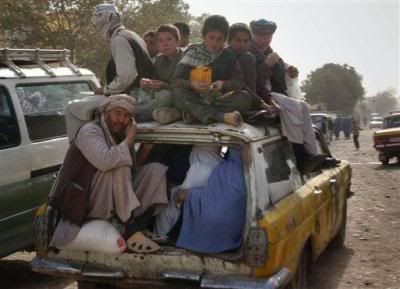 Afghan passengers are seen transported by a taxi vehicle in Mazar-e- Sharif the provincial capital of Balkh province, north of Kabul, Afghanistan on Saturday, Nov. 10, 2007. (AP Photo/Sameer Najafizada)
The San Jose Mercury News reports:
Six U.S. troops were killed when insurgents ambushed their foot patrol in the high mountains of eastern Afghanistan, officials said Saturday. The attack, the most lethal against American forces this year, made 2007 the deadliest for U.S. troops in Afghanistan since the 2001 invasion.
The troops were returning from a meeting with village elders late Friday afternoon in Nuristan province when militants attacked them with rocket propelled grenades and gunfire, Lt. Col. David Accetta told The Associated Press.
"They were attacked from several enemy positions at the same time," said Accetta, a spokesman for NATO's International Security Assistance Force and the U.S. military. "It was a complex ambush."
The six deaths brings the total number of U.S. troops killed in Afghanistan this year to at least 101, according to a count by the AP. That makes this year the deadliest for Americans here since the 2001 invasion, a war initially launched to oust Taliban and al-Qaida fighters after the terror attacks of Sept. 11, but one that has evolved into an increasingly bloody counterinsurgency campaign.
The death toll mirrors the situation in Iraq, where U.S. military deaths this month surpassed 850, a record high since the 2003 invasion there.
Three Afghan soldiers were also killed in Friday's ambush, while eight Americans and 11 Afghans were wounded. The 14 total U.S. casualties was the highest number of wounded and killed from a battle in Afghanistan this year, Accetta said.
"With Sunday being Veterans Day, this is a reminder of the sacrifices that our troops and our Afghan partners make for the peace and stability of the Afghan people," Accetta said.
Overall violence in Afghanistan this year has been the deadliest since the Taliban's ouster. More than 5,800 people, mostly militants, have died in insurgency-related violence, according to an AP count based on figures from Afghan and Western officials.
In Friday's fight, aircraft and troops using artillery or mortars at nearby outposts fired on the militants' positions, Accetta said. It wasn't immediately clear how many militants were involved in the ambush, he said.
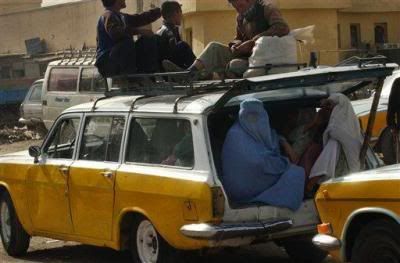 Afghan passengers are seen transported by a taxi vehicle in Mazar-e- Sharif the provincial capital of Balkh province, north of Kabul, Afghanistan on Saturday, Nov. 10, 2007. (AP Photo/Sameer Najafizada)
Mohammad Daoud Nadim, Nuristan deputy police chief, said the ambush happened in the remote province's Waygal district, about 40 miles from the border with Pakistan, which militants are known to use as a sanctuary. Nadim said he had no information on any casualties among the militants.
Arabs and other foreign fighters from Chechnya and Uzbekistan are known to operate in the Nuristan region, but the region's governor, Tamin Nuristani, blamed the attack on Taliban militants. Nuristani said the combined troops searched two houses after the meeting with village elders and were ambushed after while walking to their base afterward.
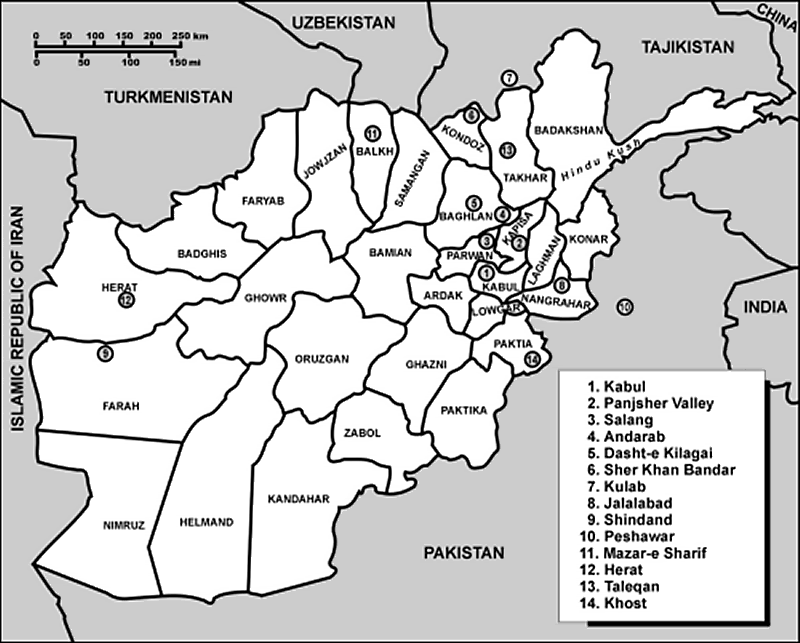
Nuristan province has seen heavy fighting in recent months. Two U.S. soldiers were killed and 13 wounded by a militant ambush in July, while militants disguised in Afghan army uniforms wounded 11 U.S. troops and killed two Afghan soldiers in August.
The attack on Friday was the deadliest incident for U.S. troops in Afghanistan since a Chinook crashed in February in Zabul province, killing eight Americans. Officials ruled out enemy fire as the cause of that crash.
Wednesday, October 10, 2007
| [+/-] |
The Discount War |
ISAF Is Failing in Effort to Secure Afghanistan on the Cheap
Der Spiegel reports:
Germany's parliament votes this Friday on whether to extend Berlin's participation in the military mission in Afghanistan. The country is on the brink of disaster, but German politicians have chosen to ignore Afghanistan's real problems.
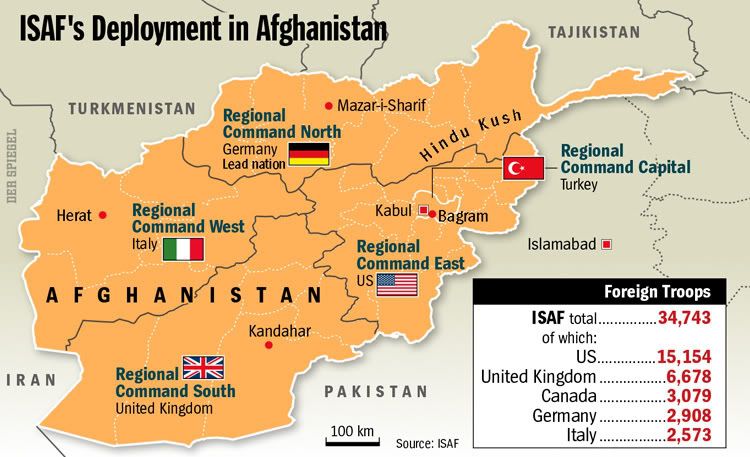
Italian Brigadier General Fausto Macor is the ideal star witness to make the situation in Afghanistan dramatically clear to German politicians. The wiry general from the northern Italian city of Turin has been in charge of the Regional Command West of the NATO-led International Security Assistance Force (ISAF) in Afghanistan since July. He and his men are deployed in what is considered the quietest and safest part of the country.
Macor and his men are barricaded into an area near the airport in Herat, an old trading city of 250,000 inhabitants that has long served as a gateway to nearby Iran. Heavily armed Albanian soldiers guard the entrance to the camp, which is protected against enemy fire by a 1-meter-thick wall of boulders.
On Tuesday of last week, the general met with Eckart von Klaeden, the foreign policy spokesman of Germany's Christian Democratic Union (CDU). Von Klaeden had traveled to the city with the German ambassador to Afghanistan, Hans-Ulrich Seidt.
The general is slightly delayed, having attended a memorial service for two Spanish soldiers who were killed the day before in a bomb attack 80 kilometers (50 miles) to the south. The service was broadcast live on Italian television to a distressed nation. NATO troops have just liberated two kidnapped Italian intelligence officers from Macor's contingent. One of the Italians suffered serious injuries during the raid.
The commander sits in a chair, his back to the television set, and points to a military map on the wall. "You see," he says, "I am responsible for an area half the size of Italy." Then he rattles off the relevant statistics. Of the 1,800 soldiers under his command, only 270 can go on patrol. If he sends two units out on patrol, they can easily find themselves operating 400 kilometers (249 miles) apart. "It's as if one of them were in Turin and the other in Venice," says the general.
He can expect little support from the Afghan army, which has only 400 armed troops in the western sector. As a result, the general is left to his own resources as far as entire regions are concerned. He has no illusions. There is no power vacuum in Afghanistan: Taliban fundamentalists, armed tribal warlords or criminal gangs control the areas where there are no international troops.
In fact, the rule of law ends only a few hundred meters from Macor's headquarters, where the commander of the Herat airport complains about his situation. Outside, the warm late autumn sun shines on the Italians' gray Hercules transport aircraft. The mustachioed police colonel keeps his office cooled to a chilly 19 degrees Celsius (61 degrees Fahrenheit). The law requires that no armed soldiers be allowed on the airport grounds. The police colonel complains that his men, armed with only 30 old Kalashnikov automatic rifles, are poorly equipped to uphold the law at the airport.
This isn't nearly enough firepower to deter the city's powerful men, who often appear on the tarmac with scores of bodyguards armed with pistols, rifles and mobile grenade launchers. In front of the parked aircraft, rival private armies occasionally engage in violent gun battles, while the airport commander's men are forced to look on helplessly.
Welcome to Afghanistan in the sixth year following the Western intervention. Welcome to a country that ranks, sadly, in eighth place in the 2007 edition of the "Failed States Index" compiled by the US magazine Foreign Policy -- just behind Sudan, Iraq, Somalia and Zimbabwe. Welcome to Afghanistan, the country NATO Secretary General Jaap de Hoop Scheffer has proclaimed a test case for the future operability of the world's most powerful military alliance.
A troop withdrawal would be a "serious defeat for international law and the international community," warns Peter Struck, the floor leader of Germany's Social Democratic Party (SPD), while German Chancellor Angela Merkel believes that her country's commitment to the operation in Afghanistan is "the only way to demonstrate that we fight terrorists, and that we do so with great resolve." Welcome to one of the most controversial issues in German foreign policy.
This Friday, Germany's parliament, the Bundestag, will vote on whether to extend two of the three German military mandates in Afghanistan, currently the Bundeswehr's most dangerous mission. Twenty-one German soldiers have already lost their lives in Afghanistan, and last Friday three Germans were lucky to escape from a suicide attack with only minor injuries. The Bundestag will decide the fate of up to 3,500 soldiers and six Tornado reconnaissance aircraft operating in Afghanistan under the auspices of NATO's ISAF force.
Parliament's approval of the mission is considered a done deal, with a broad majority in both the ruling grand coalition and the liberal Free Democratic Party (FDP) likely to vote in favor of keeping the troops in Afghanistan. Even a number of Green parliamentarians intend to support the measure, despite the party's recent decision not to. Only the Left Party is strictly opposed to the Bundeswehr's Afghanistan mission.
The future of Germany's more controversial involvement in the US-led antiterrorism Operation Enduring Freedom (OEF) will not be decided until November, after the SPD convention in Hamburg.
Part 2: An Unpopular Issue
Relatively few members of parliament have traveled to Afghanistan in recent months to get a first-hand impression of the situation in the war-torn country, despite the fact that members of the German Bundestag are normally known for their love of travel. Apparently only very few of Germany's elected representatives feel that Afghanistan is worth a visit.
The ones who choose to stay at home are acutely aware of why they do not want to be associated with the country. The mood among the German public has changed dramatically since the grand coalition took office two years ago. Whereas 60 percent of poll respondents approved of the Bundeswehr's Afghanistan mission in the past, considerably more than half are openly pushing for a withdrawal today.
Although officials at the Chancellery insist that the country is at the top of the chancellor's agenda, Angela Merkel studiously avoids being tainted by unpopular issues like Afghanistan. She expresses her support for Germany's commitment to the shattered country from time to time, perhaps out of a sense of duty, but she has already withdrawn to the sidelines of the debate.
Her predecessor, former Chancellor Gerhard Schröder, made two trips to the crisis-plagued region. Photo ops from Afghanistan were still considered desirable at the time. Merkel, on the other hand, prefers being portrayed as a climate change crusader, posing for the cameras in front of a glacier in Greenland or visiting a school in Ethiopia. But she has yet to make an appearance in Afghanistan. There have been many excuses for her apparent decision to shun the country, ranging from kidnappings to SPD conventions to a busy schedule.
The news that reaches Berlin from Afghanistan these days is simply too horrific. Members of parliament who have visited the country describe a place on the verge of collapse. Instead of declining, the problems of poverty, corruption, violence and sheer hopelessness are on the rise. Government institutions are virtually nonexistent in many parts of the country, the police are corrupt and overworked and the military isn't in much better shape. The effects of Western development aid go largely unnoticed by much of the population.
The security situation is also becoming more and more precarious. More than 5,000 people were killed in attacks or combat during the first nine months of this year alone. According to a United Nations report, acts of violence have increased by close to 30 percent this year. Three-quarters of the attacks are directed against Afghan soldiers, police officers and foreign troops, "in a deliberate and calculated effort to impede the establishment of legitimate government institutions," the UN report states.
The situation on the military front is unclear. In a Sep. 18 classified report labeled "Urgent" to the governments of European Union member states, the EU's special envoy in Kabul, Spain's Francesc Vendrell, identifies a "paradoxical trend." "While ISAF is achieving significant military successes against the insurgents, especially as a result of targeted attacks on Taliban commanders," Vendrell writes, "the unsafe zone in which the insurgents operate is growing." Even a weak Taliban presence is sufficient, Vendrell continues, to bring "normal government activities to an end" and to bring large segments of the population under the influence of the insurgents.
Vendrell's conclusions coincide with the results of a study by the Senlis Council, an international think tank, which conducted a survey in March of 12,000 Afghan men in the southern and eastern sections of the country, regions which have seen fierce fighting. The study's conclusions were devastating. In late 2001, the vast majority of Afghans believed that the Taliban had been defeated once and for all. Today only half of those surveyed are convinced that international forces will win the war against the insurgents in southern Afghanistan. It appears that although the Taliban is unlikely to win the war militarily, it is increasingly emerging victorious in the battle for public opinion.
The loss of confidence in and respect for the international community has political consequences. EU envoy Vendrell reports, with some concern, on a written memo from the Afghan interior minister to all provincial governors and police commanders, in which they were instructed to refrain from visiting international aid organizations and civilian and military reconstruction teams in the future.
Although the consequences of the order would not be significant in practice, writes Vendrell, many of his Afghan contacts are concerned about the impression it conveys, namely that the level of trust between the government and the international community is declining. They also fear that "officials with connections to organized crime could gather incriminating material against non-corrupt officials because of harmless contacts."
There is an odd disparity between the reality in Afghanistan and the political debate in Germany. Seemingly oblivious to the information coming from the country, both the Bundestag and the political parties become embroiled in heated debates over technical details that are in fact irrelevant in Afghanistan. The Green Party and the SPD, in particular, spent weeks in an enthusiastic debate about OEF, ISAF and the Tornado jets.
For many Greens and Social Democrats, the OEF anti-terrorism operation is the epitome of a merciless US-led bombing war that they claim is practically driving Afghans into the arms of the Taliban. At the Green Party convention in the central German city of Göttingen, the party base decided that it would no longer vote in favor of extending the Bundeswehr's Afghanistan mission. The SPD's leadership has scheduled the discussion of Afghanistan at its upcoming convention in Hamburg in late October for Saturday evening, timed to coincide with the popular sports broadcast "Sportschau" -- apparently in an attempt to divert delegates' attention away from the debate over OEF and the ISAF.
The debates being conducted in Berlin are essentially ersatz discussions -- a not-uncommon tactic among German politicians. Last year, a swarm of self-proclaimed naval experts spent weeks debating the marginal issue of whether the German navy's deployment off the Lebanese coast should remain outside a three-mile or a six-mile zone.
Part 3: Redefining Goals
The important questions in the Afghanistan debate are also being ignored. For instance, how does one define success for the mission? Can a discount war -- one that is being waged with a relatively minimal financial commitment -- succeed in the long run? Shouldn't the West, including Germany, increase its commitment to the mission? Should its goals be redefined? Or is it enough to provide the Afghan people with electricity, running water and a little freedom of opinion?
At least some politicians -- those who focus on foreign affairs -- are offering clear answers to many of these questions. Foreign Minister Frank-Walter Steinmeier, for example, says that the goal in Afghanistan is, of course, not to establish a "Westminster democracy" with the corresponding benefits of a social welfare state. Christian Democratic parliamentarian Ruprecht Polenz, the chairman of the Bundestag's Committee on Foreign Affairs, consciously sets the bar low when he says: "The goal is to ensure that no more threats originate from within the Afghan state."
In truth, this objective would represent a dramatic reversal of German policy. In 2002, then Chancellor Schröder insisted that the Afghans ought to be compensated for their "return to the civilized world" by providing them with an adequate "prosperity dividend." The goal of the intervention, the Schröder administration explained, was to achieve human rights, democracy and prosperity for Afghanistan.
These noble objectives are rarely mentioned today. But which criteria must be fulfilled before the mission can be considered a success and the German troops and their allies can return home? No one knows. An exit strategy is "currently not in sight," says one German NATO general.
"We won't let the foreigners leave until our roads are built, our schools, electricity are built, until our police and army are better," Afghan President Hamid Karzai said recently. Some at NATO perceive this statement as a threat. "Our assistance ends," says German Defense Minister Franz Josef Jung, "when Afghanistan can find its way to a positive future on its own two feet."
"NATO will have successfully completed its mission when the Afghan government and its security forces can take responsibility throughout the entire country," NATO Secretary General Jaap de Hoop Scheffer told SPIEGEL in a recent interview (more...). But Scheffer is unwilling to make any predictions, except to say: "NATO will have to stay for the foreseeable future."
Faced with a difficult situation, the allies are now placing their hopes on the plan to train 70,000 soldiers and 82,000 police officers by the next parliamentary election, in three years. The new mantra of the NATO member states, says Scheffer, is "training, training, training." "Those who do not invest in training now," says German General Egon Ramms, who runs the ISAF mission from the NATO command center in the Dutch town of Brunssum, "will have to stay that much longer."
The Germans are eager to distance themselves from the United States in public debates, insisting that, unlike the Americans, the Germans are mainly involved in civilian reconstruction assistance. But this is precisely where Germany has failed miserably -- in developing the Afghan police force (more...), for example, for which Berlin has assumed primary responsibility. After visiting Afghanistan in the summer, a delegation of members of the Bundestag concluded that the work of the German contingent has been disastrous.
Germany, supposedly a "lead nation" in ISAF, has taken a leisurely approach to the Afghanistan effort. In January 2002, a team of high-ranking experts traveled to Afghanistan and recommended sending three German officials to Kabul to serve as advisors to the Afghan interior ministry. The German team, apparently convinced that this would be sufficient, envisioned the trio developing courses for senior bureaucrats and helping the Afghans improve their police academy. It recommended a one-year stint for the three officials. Aside from that, the experts concluded, the Afghans lacked equipment, cars and, most of all, weapons.
But weapons were precisely what the Afghans eventually acquired in abundance. It was an "absurdity," said FDP parliamentarian Elke Hoff, that Berlin planned to supply Afghanistan with up to 100,000 firearms while denying the Afghan police simple equipment like handcuffs. Germany's interior and foreign ministries refused to provide countries that fail to fully satisfy German constitutional standards with equipment designed to "exercise direct coercion."
This defect is only being remedied now -- a full five years after Germany launched its Afghan police training program. According to an internal report by the German foreign ministry, "500 officers of the Kabul riot police will soon be equipped with body armor, helmets, shields, gloves, batons and pepper spray."
Even when the German team of advisors was later expanded to include 60 officials, generally only 40 of them were actually at work at any one time. In the wake of this embarrassing staffing debacle, officials at the interior ministry and chancellery are now quietly examining the possibility of developing a permanent team of specially trained police officers, federal prosecutors and administrative experts that could quickly be deployed to failed states to deal with similar crises. But this is little more than a pipe dream at this point.
Besides, the Americans aren't interested in waiting for Germany to get its act together and have already taken over from the Germans in many respects. While Berlin agonized over the "further training of mid-level and senior officials" and "salary and rank reforms," Washington deployed 2,500 troops as police trainers, backed up with hundreds of contractors working for DynCorp, a private security firm.
Managed by retired US generals, the DynCorp employees are training illiterate Afghans to work as police deputies in paramilitary crash courses. Their goal is to ensure that the men will be passable marksmen by the end of the training. The fact that many desert as soon as they complete the courses is seen as an unpleasant fact of life -- but not as a blemish on DynCorp's training statistics.
Part 4: 'Like a Band-Aid on a Chest Wound'
In the wake of their failures, the Germans are now trying to shift the responsibility for police training to the EU and distribute it among more countries. In May the EU formed its own police training mission, dubbed EUPOL, which has been managed so far by Friedrich Eichele, a German police general. Eichele, the former head of GSG 9, the counterterrorism unit of the German federal police, is a man of few words. His command of the English language is rudimentary and his diplomatic skills are considered limited.
Given such leadership, within only a few months EUPOL has already deteriorated into a directionless tangle of bureaucracy and financial weakness. EUPOL's 195 EU police officers from 17 countries are not even scheduled to assume their new posts until next March. According to officials, this is the earliest possible date, since the group must first build new, and appropriately comfortable, lodgings for its officers.
All of two German police officers are currently assigned to assist the German reconstruction team in the provincial city of Kunduz, which includes more than 400 soldiers. EUPOL plans to replace the pair with five of its team members soon. The new team will be responsible for the training of 7,500 Afghan police officers in two provinces. In the face of such realities, Guido Westerwelle, the head of the FDP, couldn't help but comment sarcastically on the program while visiting Afghanistan two weeks ago: "Well, that certainly takes care of police development."
Despite the efforts of German and British advisors, the interior ministry in Kabul is considered a hotbed of corruption. It costs up to $150,000 in bribes to secure a position as a district police chief. But the investment is worthwhile. Once on the job, a police chief can easily recoup the money from his subordinates.
General Dan McNeill (more...), the American commander of ISAF, likes to entertain visitors to his headquarters in Kabul with small anecdotes from the everyday lives of the Afghan police. He recently instructed his Afghan underlings to set up 20 checkpoints along the road between Kabul and Kandahar. "Which police checkpoints?" a wide-eyed Afghan asked McNeill a few weeks after the initial order. "Oh," the Afghan quickly realized, "you mean the new tollbooths."
Wherever one looks in Afghanistan, officials are busy skimming off their cuts. In fact, police officers often exist only on paper. Local police chiefs line their pockets by collecting funds from the international community's coffers to pay the salaries of nonexistent officers. To add insult to injury, the officers that do exist are paid miserably to perform their life-threatening jobs. At the paltry salary of $70 a month, many police officers complete basic training and then promptly desert to join the private militias of wealthy warlords and drug barons, or even the Taliban. At $400 to $600 a month, the competition pays a lot more than the police.
The situation is hardly any better in the military. According to NATO statistics, 38,000 soldiers have already been trained with Western assistance, a process that will take years and is expected to eventually produce 70,000 soldiers. But these figures do not reflect the real situation.
Last Wednesday, for example, the US commander in charge of training gave a memorable performance at the NATO Council in Brussels. The NATO ambassadors attending the meeting asked Major General Robert Cone, who was in Kabul but was taking part in the session via videoconference, how many men in the Afghan army are now ready for combat.
The general responded that while the goal was to train 70,000 men, 50,000 are already being paid. But, he added, many of these men are simply AWOL ("absent without leave"). In other words, they are either deserters or men who occasionally choose to stay at home instead of appearing for duty. Besides, Cone added, he is having trouble retaining the men who have been trained. The actual force, he told the NATO officials, presumably consists of about 30,000 men, but he was unable to provide them with a more precise figure.
But the ambassadors were insistent. How many of those men are ready for combat? "I really can't say," the general said. Finally he admitted the truth: "To be perfectly honest -- zero."
In fact, Cone continued, not a single Afghan unit is capable of independently running an operation. According to Cone, the Afghan military lacks everything from artillery to helicopters, military hospitals, reconnaissance equipment and support personnel.
This explains why Afghan Defense Minister Abdul Rahim Wardak tells every Western visitor that what he needs most are weapons. A few Leopard 1 tanks would be nice, the portly general told CDU parliamentarian von Klaeden two weeks ago in an effort to solicit more German support, but the modern Leopard 2 wouldn't be so bad, either.
For NATO officers, Wardak's tank fantasies are nothing short of ridiculous. The general, they complain, only wants the expensive combat machinery so that he can stage an impressive military parade. Besides, they add, experience has shown that most Western weapons deliveries to the Afghan army quickly end up on the black market.
The results of the international community's reconstruction efforts have been so sobering that many, including Foreign Minister Steinmeier, are calling for a rethink of Germany's commitment in Afghanistan. Berlin cannot afford to continue its current policy, he explained in the summer. He called for a stronger German commitment, saying that more troops, more police officers and more development aid are necessary.
But such calls for action have done nothing to change the situation. The state of the police training effort remains miserable, while Defense Minister Jung is obstructing efforts to increase the Bundeswehr contingent from 4,000 to 5,000 men -- a move both the Foreign Ministry and the Chancellery have endorsed. The team of 400 military trainers Steinmeier wants to see sent to Afghanistan will likely be reduced to no more than 180. But he does see progress in reconstruction aid: The German government has increased its annual funding of the program from €80 million to €125 million.
For Bruce Riedel, a member of the National Security Council at the White House until 2002, all of these efforts, including those of other Western nations, are a disgrace. "We have tried to rebuild a country devastated by a quarter century of wars, invasion and terror on the cheap," he said in a recent interview. "Instead of a massive economic reconstruction effort akin to the Marshall Plan of the 1940s, Afghans have gotten less economic aid on a per capita basis than Haitians or Bosnians."
His verdict on the Bush administration's approach? "Like trying to put a Band-Aid on a chest wound."