Deep Sea News reports:
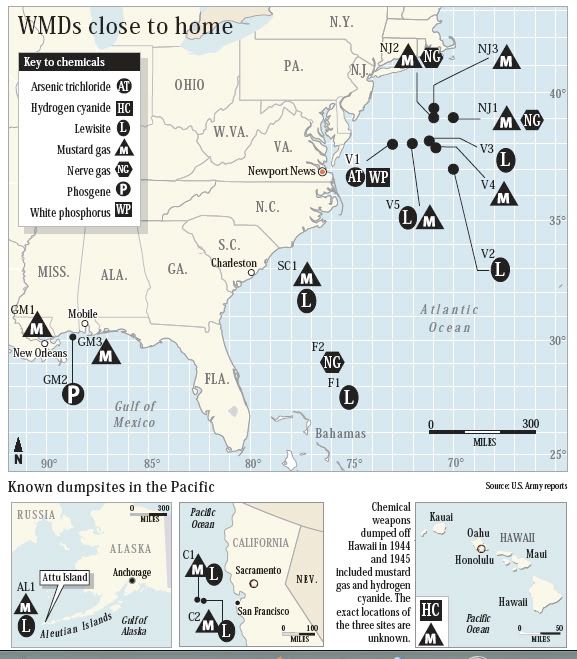
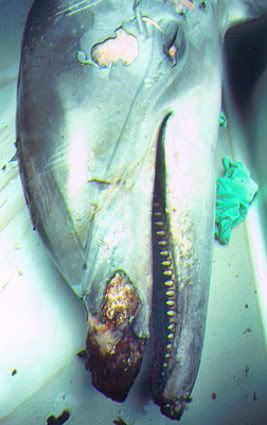
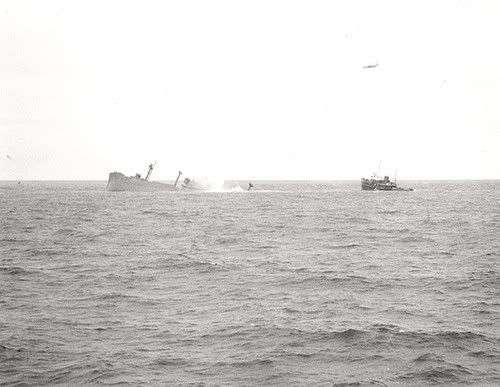
It is no secret that the U.S. military has used the ocean as trashcan for munitions in the past. Peter discussed at the Old DSN how federal lawmakers were pressing the US Army to reveal everything it knows about a massive international program to dump chemical weapons off homeland and foreign shores. "The Army now admits that it secretly dumped 64 million pounds of nerve and mustard agents into the sea, along with 400,000 chemical-filled bombs, land mines and rockets and more than 500 tons of radioactive waste - either tossed overboard or packed into the holds of scuttled vessels." Brian pointed me to the Daily Press's in depth coverage of this whole issue. Registration is free and only takes a minute or two and is extremely worthwhile. Included at the site are maps of disposal sites (downloadable as pdfs), stories, descriptions of items dumped including nerve and mustard gas, and rather depressing pictures some are below the fold (all from Daily Press).
Monday, June 11, 2007
| [+/-] |
Toxic (WMD) Munitions Dumping At Sea |
Thursday, May 17, 2007
| [+/-] |
Gulf War 1 Troops Exposed To Sarin Risk Brain Damage |
Reuters reports:
Scientists have found evidence that the kind of low-level exposure to sarin gas experienced by more than 100,000 U.S. troops in the first Gulf war can cause "lasting brain deficits," The New York Times reported on Wednesday.
While the results are preliminary, scientists working with the U.S. Department of Defense said they found apparent changes in the brain's connective tissue -- known as white matter -- in soldiers exposed to the gas.
The extent of the changes -- less white matter and slightly larger brain cavities -- correspond to the extent of exposure, the Times reported on its Web site. The results are to be published in the June issue of the journal NeuroToxicology, it said.
The report is likely to revive the debate over why so many troops returned from the 1991 Gulf conflict with unexplained physical problems. Many scientists have questioned whether Gulf war-related illnesses have a physiological basis.
Far more research will have to be done before it is known whether those illnesses can be traced to exposure to sarin, the Times reported, and the long-term effects of sarin exposure on the brain are not well understood.
The Times said several lawmakers briefed on the study say the Department of Veterans Affairs is obligated to provide increased neurological care to veterans who may have been exposed to sarin gas.
The article named Sen. Patty Murray, a Washington state Democrat, and Christopher Bond, a Missouri Republican.
Approximately one in seven of the 700,000 troops deployed in the first Gulf war experienced a mysterious set of ailments, with problems including persistent fatigue, chronic headaches, joint pain and nausea, the paper noted in the story to appear in Thursday's print edition.
The Veterans Affairs department says those symptoms persist today for more than 150,000 troops, more than the number of troops exposed to the gases.
In a companion study, researchers tested 140 troops thought to have experienced differing degrees of exposure to the chemical agents to check their fine motor coordination.
Individuals with potentially greater exposure had a deterioration in fine motor skills, performing the tests at a level similar to people 20 years their senior, the Times said.
Wednesday, September 6, 2006
| [+/-] |
What Valerie Plame Really Did At The CIA |
From the Nation, David Corn reports:
In the spring of 2002 Dick Cheney made one of his periodic trips to CIA headquarters. Officers and analysts were summoned to brief him on Iraq. Paramilitary specialists updated the Vice President on an extensive covert action program in motion that was designed to pave the way to a US invasion. Cheney questioned analysts about Saddam Hussein's weapons of mass destruction. How could they be used against US troops? Which Iraqi units had chemical and biological weapons? He was not seeking information on whether Saddam posed a threat because he possessed such weapons. His queries, according to a CIA officer at the briefing, were pegged to the assumptions that Iraq had these weapons and would be invaded--as if a decision had been made.
Though Cheney was already looking toward war, the officers of the agency's Joint Task Force on Iraq--part of the Counterproliferation Division of the agency's clandestine Directorate of Operations--were frantically toiling away in the basement, mounting espionage operations to gather information on the WMD programs Iraq might have. The JTFI was trying to find evidence that would back up the White House's assertion that Iraq was a WMD danger. Its chief of operations was a career undercover officer named Valerie Wilson.
Her specific position at the CIA is revealed for the first time in a new book, Hubris: The Inside Story of Spin, Scandal, and the Selling of the Iraq War, by the author of this article and Newsweek's Michael Isikoff. The book chronicles the inside battles within the CIA, the White House, the State Department and Congress during the run-up to the war. Its account of Wilson's CIA career is mainly based on interviews with confidential CIA sources.
In July 2003--four months after the invasion of Iraq--Wilson would be outed as a CIA "operative on weapons of mass destruction" in a column by conservative journalist Robert Novak, who would cite two "senior administration officials" as his sources. (As Hubris discloses, one was Richard Armitage, the number-two at the State Department; Karl Rove, Bush's chief strategist, was the other. I. Lewis "Scooter" Libby, Cheney's chief of staff, also talked to two reporters about her.) Novak revealed her CIA identity--using her maiden name, Valerie Plame--in the midst of the controversy ignited by former Ambassador Joseph Wilson, her husband, who had written a New York Times op-ed accusing the Bush Administration of having "twisted" intelligence "to exaggerate the Iraqi threat."
The Novak column triggered a scandal and a criminal investigation. At issue was whether Novak's sources had violated a little-known law that makes it a federal crime for a government official to disclose identifying information about a covert US officer (if that official knew the officer was undercover). A key question was, what did Valerie Wilson do at the CIA? Was she truly undercover? In a subsequent column, Novak reported that she was "an analyst, not in covert operations." White House press secretary Scott McClellan suggested that her employment at the CIA was no secret. Jonah Goldberg of National Review claimed, "Wilson's wife is a desk jockey and much of the Washington cocktail circuit knew that already."
Valerie Wilson was no analyst or paper-pusher. She was an operations officer working on a top priority of the Bush Administration. Armitage, Rove and Libby had revealed information about a CIA officer who had searched for proof of the President's case. In doing so, they harmed her career and put at risk operations she had worked on and foreign agents and sources she had handled.
Another issue was whether Valerie Wilson had sent her husband to Niger to check out an intelligence report that Iraq had sought uranium there. Hubris contains new information undermining the charge that she arranged this trip. In an interview with the authors, Douglas Rohn, a State Department officer who wrote a crucial memo related to the trip, acknowledges he may have inadvertently created a misimpression that her involvement was more significant than it had been.
Valerie Plame was recruited into the CIA in 1985, straight out of Pennsylvania State University. After two years of training to be a covert case officer, she served a stint on the Greece desk, according to Fred Rustmann, a former CIA official who supervised her then. Next she was posted to Athens and posed as a State Department employee. Her job was to spot and recruit agents for the agency. In the early 1990s, she became what's known as a nonofficial cover officer. NOCs are the most clandestine of the CIA's frontline officers. They do not pretend to work for the US government; they do not have the protection of diplomatic immunity. They might claim to be a businessperson. She told people she was with an energy firm. Her main mission remained the same: to gather agents for the CIA.
In 1997 she returned to CIA headquarters and joined the Counterproliferation Division. (About this time, she moved in with Joseph Wilson; they later married.) She was eventually given a choice: North Korea or Iraq. She selected the latter. Come the spring of 2001, she was in the CPD's modest Iraq branch. But that summer--before 9/11--word came down from the brass: We're ramping up on Iraq. Her unit was expanded and renamed the Joint Task Force on Iraq. Within months of 9/11, the JTFI grew to fifty or so employees. Valerie Wilson was placed in charge of its operations group.
There was great pressure on the JTFI to deliver. Its primary target was Iraqi scientists. JTFI officers, under Wilson's supervision, tracked down relatives, students and associates of Iraqi scientists--in America and abroad--looking for potential sources. They encouraged Iraqi émigrés to visit Iraq and put questions to relatives of interest to the CIA. The JTFI was also handling walk-ins around the world. Increasingly, Iraqi defectors were showing up at Western embassies claiming they had information on Saddam's WMDs. JTFI officers traveled throughout the world to debrief them. Often it would take a JTFI officer only a few minutes to conclude someone was pulling a con. Yet every lead had to be checked.
"We knew nothing about what was going on in Iraq," a CIA official recalled. "We were way behind the eight ball. We had to look under every rock." Wilson, too, occasionally flew overseas to monitor operations. She also went to Jordan to work with Jordanian intelligence officials who had intercepted a shipment of aluminum tubes heading to Iraq that CIA analysts were claiming--wrongly--were for a nuclear weapons program. (The analysts rolled over the government's top nuclear experts, who had concluded the tubes were not destined for a nuclear program.)
The JTFI found nothing. The few scientists it managed to reach insisted Saddam had no WMD programs. Task force officers sent reports detailing the denials into the CIA bureaucracy. The defectors were duds--fabricators and embellishers. (JTFI officials came to suspect that some had been sent their way by Ahmad Chalabi's Iraqi National Congress, an exile group that desired a US invasion of Iraq.) The results were frustrating for the officers. Were they not doing their job well enough--or did Saddam not have an arsenal of unconventional weapons? Valerie Wilson and other JTFI officers were almost too overwhelmed to consider the possibility that their small number of operations was, in a way, coming up with the correct answer: There was no intelligence to find on Saddam's WMDs because the weapons did not exist. Still, she and her colleagues kept looking. (She also assisted operations involving Iran and WMDs.)
When the war started in March 2003, JTFI officers were disappointed. "I felt like we ran out of time," one CIA officer recalled. "The war came so suddenly. We didn't have enough information to challenge the assumption that there were WMDs.... How do you know it's a dry well? That Saddam was constrained. Given more time, we could have worked through the issue.... From 9/11 to the war--eighteen months--that was not enough time to get a good answer to this important question."
When the Novak column ran, Valerie Wilson was in the process of changing her clandestine status from NOC to official cover, as she prepared for a new job in personnel management. Her aim, she told colleagues, was to put in time as an administrator--to rise up a notch or two--and then return to secret operations. But with her cover blown, she could never be undercover again. Moreover, she would now be pulled into the partisan warfare of Washington. As a CIA employee still sworn to secrecy, she wasn't able to explain publicly that she had spent nearly two years searching for evidence to support the Administration's justification for war and had come up empty.
Valerie Wilson left the CIA at the end of 2005. In July she and her husband filed a civil lawsuit against Cheney, Rove and Libby, alleging they had conspired to "discredit, punish and seek revenge against" the Wilsons. She is also writing a memoir. Her next battle may be with the agency--over how much of her story the CIA will allow the outed spy to tell.
For more information about Hubris: The Inside Story of Spin, Scandal, and the Selling of the Iraq War by Michael Isikoff and David Corn, go to Amazon.com and Corn's blog at www.davidcorn.com.
Sunday, September 11, 2005
| [+/-] |
Pentagon Revises Nuclear Strike Plan |
Weapons could be used to preempt terror attack, document says
At the Washington Post, Walter Pincus reports:
The Pentagon has drafted a revised doctrine for the use of nuclear weapons that envisions commanders requesting presidential approval to use them to preempt an attack by a nation or a terrorist group using weapons of mass destruction. The draft also includes the option of using nuclear arms to destroy known enemy stockpiles of nuclear, biological or chemical weapons.
The document, written by the Pentagon's Joint Chiefs staff but not yet finally approved by Defense Secretary Donald H. Rumsfeld, would update rules and procedures governing use of nuclear weapons to reflect a preemption strategy first announced by the Bush White House in December 2002. The strategy was outlined in more detail at the time in classified national security directives.
At a White House briefing that year, a spokesman said the United States would "respond with overwhelming force" to the use of weapons of mass destruction against the United States, its forces or allies, and said "all options" would be available to the president.
The draft, dated March 15, would provide authoritative guidance for commanders to request presidential approval for using nuclear weapons, and represents the Pentagon's first attempt to revise procedures to reflect the Bush preemption doctrine. A previous version, completed in 1995 during the Clinton administration, contains no mention of using nuclear weapons preemptively or specifically against threats from weapons of mass destruction.
Titled "Doctrine for Joint Nuclear Operations" and written under the direction of Air Force Gen. Richard B. Myers, chairman of the Joint Chiefs of Staff, the draft document is unclassified and available on a Pentagon Web site. It is expected to be signed within a few weeks by Air Force Lt. Gen. Norton A. Schwartz, director of the Joint Staff, according to Navy Cmdr. Dawn Cutler, a public affairs officer in Myers's office. Meanwhile, the draft is going through final coordination with the military services, the combatant commanders, Pentagon legal authorities and Rumsfeld's office, Cutler said in a written statement.
Congressional reluctance
A "summary of changes" included in the draft identifies differences from the 1995 doctrine, and says the new document "revises the discussion of nuclear weapons use across the range of military operations."
The first example for potential nuclear weapon use listed in the draft is against an enemy that is using "or intending to use WMD" against U.S. or allied, multinational military forces or civilian populations.
Another scenario for a possible nuclear preemptive strike is in case of an "imminent attack from adversary biological weapons that only effects from nuclear weapons can safely destroy."
That and other provisions in the document appear to refer to nuclear initiatives proposed by the administration that Congress has thus far declined to fully support.
Last year, for example, Congress refused to fund research toward development of nuclear weapons that could destroy biological or chemical weapons materials without dispersing them into the atmosphere.
The draft document also envisions the use of atomic weapons for "attacks on adversary installations including WMD, deep, hardened bunkers containing chemical or biological weapons."
But Congress last year halted funding of a study to determine the viability of the Robust Nuclear Earth Penetrator warhead (RNEP) -- commonly called the bunker buster -- that the Pentagon has said is needed to attack hardened, deeply buried weapons sites.
The Joint Staff draft doctrine explains that despite the end of the Cold War, proliferation of weapons of mass destruction "raises the danger of nuclear weapons use." It says that there are "about thirty nations with WMD programs" along with "nonstate actors [terrorists] either independently or as sponsored by an adversarial state."
To meet that situation, the document says that "responsible security planning requires preparation for threats that are possible, though perhaps unlikely today."
Used to deterrence
To deter the use of weapons of mass destruction against the United States, the Pentagon paper says preparations must be made to use nuclear weapons and show determination to use them "if necessary to prevent or retaliate against WMD use."
The draft says that to deter a potential adversary from using such weapons, that adversary's leadership must "believe the United States has both the ability and will to pre-empt or retaliate promptly with responses that are credible and effective." The draft also notes that U.S. policy in the past has "repeatedly rejected calls for adoption of 'no first use' policy of nuclear weapons since this policy could undermine deterrence."
Rep. Ellen Tauscher (D-Calif.), a member of the House Armed Services Committee who has been a leading opponent of the bunker-buster program, said yesterday the draft was "apparently a follow-through on their nuclear posture review and they seem to bypass the idea that Congress had doubts about the program." She added that members "certainly don't want the administration to move forward with a [nuclear] preemption policy" without hearings, closed door if necessary.
A spokesman for Sen. John W. Warner (R-Va.), chairman of the Senate Armed Services Committee, said yesterday the panel has not yet received a copy of the draft.
Hans M. Kristensen, a consultant to the Natural Resources Defense Council, who discovered the document on the Pentagon Web site, said yesterday that it "emphasizes the need for a robust nuclear arsenal ready to strike on short notice including new missions."
Kristensen, who has specialized for more than a decade in nuclear weapons research, said a final version of the doctrine was due in August but has not yet appeared.
"This doctrine does not deliver on the Bush administration pledge of a reduced role for nuclear weapons," Kristensen said. "It provides justification for contentious concepts not proven and implies the need for RNEP."
One reason for the delay may be concern about raising publicly the possibility of preemptive use of nuclear weapons, or concern that it might interfere with attempts to persuade Congress to finance the bunker buster and other specialized nuclear weapons.
In April, Rumsfeld appeared before the Senate Armed Services panel and asked for the bunker buster study to be funded. He said the money was for research and not to begin production on any particular warhead. "The only thing we have is very large, very dirty, big nuclear weapons," Rumsfeld said. "It seems to me studying it [the RNEP] makes all the sense in the world."
Wednesday, October 6, 2004
| [+/-] |
Iraq Survey Group Final Report |
Key Findings:
Saddam never abandoned his intentions to resume a CW effort when sanctions were lifted and conditions were judged favorable:
* Saddam and many Iraqis regarded CW as a proven weapon against an enemy’s superior numerical strength, a weapon that had saved the nation at least once already—during the Iran-Iraq war—and contributed to deterring the Coalition in 1991 from advancing to Baghdad.
While a small number of old, abandoned chemical munitions have been discovered, ISG judges that Iraq unilaterally destroyed its undeclared chemical weapons stockpile in 1991. There are no credible indications that Baghdad resumed production of chemical munitions thereafter, a policy ISG attributes to Baghdad’s desire to see sanctions lifted, or rendered ineffectual, or its fear of force against it should WMD be discovered.
* The scale of the Iraqi conventional munitions stockpile, among other factors, precluded an examination of the entire stockpile; however, ISG inspected sites judged most likely associated with possible storage or deployment of chemical weapons.
Iraq’s CW program was crippled by the Gulf war and the legitimate chemical industry, which suffered under sanctions, only began to recover in the mid-1990s. Subsequent changes in the management of key military and civilian organizations, followed by an influx of funding and resources, provided Iraq with the ability to reinvigorate its industrial base.
* Poor policies and management in the early 1990s left the Military Industrial Commission (MIC) financially unsound and in a state of almost complete disarray.
*Saddam implemented a number of changes to the Regime’s organizational and programmatic structures after the departure of Husayn Kamil.
*Iraq’s acceptance of the Oil-for-Food (OFF) program was the foundation of Iraq’s economic recovery and sparked a flow of illicitly diverted funds that could be applied to projects for Iraq’s chemical industry.
The way Iraq organized its chemical industry after the mid-1990s allowed it to conserve the knowledge-base needed to restart a CW program, conduct a modest amount of dual-use research, and partially recover from the decline of its production capability caused by the effects of the Gulf war and UN-sponsored destruction and sanctions. Iraq implemented a rigorous and formalized system of nationwide research and production of chemicals, but ISG will not be able to resolve whether Iraq intended the system to underpin any CW-related efforts.
* The Regime employed a cadre of trained and experienced researchers, production managers, and weaponization experts from the former CW program.
* Iraq began implementing a range of indigenous chemical production projects in 1995 and 1996. Many of these projects, while not weapons-related, were designed to improve Iraq’s infrastructure, which would have enhanced Iraq’s ability to produce CW agents if the scaled-up production processes were implemented.
* Iraq had an effective system for the procurement of items that Iraq was not allowed to acquire due to sanctions. ISG found no evidence that this system was used to acquire precursor chemicals in bulk; however documents indicate that dual-use laboratory equipment and chemicals were acquired through this system.
Iraq constructed a number of new plants starting in the mid-1990s that enhanced its chemical infrastructure, although its overall industry had not fully recovered from the effects of sanctions, and had not regained pre-1991 technical sophistication or production capabilities prior to Operation Iraqi Freedom (OIF).
* ISG did not discover chemical process or production units configured to produce key precursors or CW agents. However, site visits and debriefs revealed that Iraq maintained its ability for reconfiguring and ‘making-do’ with available equipment as substitutes for sanctioned items.
* ISG judges, based on available chemicals, infrastructure, and scientist debriefings, that Iraq at OIF probably had a capability to produce large quantities of sulfur mustard within three to six months.
* A former nerve agent expert indicated that Iraq retained the capability to produce nerve agent in significant quantities within two years, given the import of required phosphorous precursors. However, we have no credible indications that Iraq acquired or attempted to acquire large quantities of these chemicals through its existing procurement networks for sanctioned items.
In addition to new investment in its industry, Iraq was able to monitor the location and use of all existing dual-use process equipment. This provided Iraq the ability to rapidly reallocate key equipment for proscribed activities, if required by the Regime.
* One effect of UN monitoring was to implement a national level control system for important dual-use process plants.
Iraq’s historical ability to implement simple solutions to weaponization challenges allowed Iraq to retain the capability to weaponize CW agent when the need arose. Because of the risk of discovery and consequences for ending UN sanctions, Iraq would have significantly jeopardized its chances of having sanctions lifted or no longer enforced if the UN or foreign entity had discovered that Iraq had undertaken any weaponization activities.
* ISG has uncovered hardware at a few military depots, which suggests that Iraq may have prototyped experimental CW rounds. The available evidence is insufficient to determine the nature of the effort or the timeframe of activities.
* Iraq could indigenously produce a range of conventional munitions, throughout the 1990s, many of which had previously been adapted for filling with CW agent. However, ISG has found ambiguous evidence of weaponization activities.
Saddam’s Leadership Defense Plan consisted of a tactical doctrine taught to all Iraqi officers and included the concept of a “red-line” or last line of defense. However, ISG has no information that the plan ever included a trigger for CW use.
* Despite reported high-level discussions about the use of chemical weapons in the defense of Iraq, information acquired after OIF does not confirm the inclusion of CW in Iraq’s tactical planning for OIF. We believe these were mostly theoretical discussions and do not imply the existence of undiscovered CW munitions.
Discussions concerning WMD, particularly leading up to OIF, would have been highly compartmentalized within the Regime. ISG found no credible evidence that any field elements knew about plans for CW use during Operation Iraqi Freedom.
* Uday—head of the Fedayeen Saddam—attempted to obtain chemical weapons for use during OIF, according to reporting, but ISG found no evidence that Iraq ever came into possession of any CW weapons.
ISG uncovered information that the Iraqi Intelligence Service (IIS) maintained throughout 1991 to 2003 a set of undeclared covert laboratories to research and test various chemicals and poisons, primarily for intelligence operations. The network of laboratories could have provided an ideal, compartmented platform from which to continue CW agent R&D or small-scale production efforts, but we have no indications this was planned. (See Annex A.)
* ISG has no evidence that IIS Directorate of Criminology (M16) scientists were producing CW or BW agents in these laboratories. However, sources indicate that M16 was planning to produce several CW agents including sulfur mustard, nitrogen mustard, and Sarin.
* Exploitations of IIS laboratories, safe houses, and disposal sites revealed no evidence of CW-related research or production, however many of these sites were either sanitized by the Regime or looted prior to OIF. Interviews with key IIS officials within and outside of M16 yielded very little information about the IIS’ activities in this area.
* The existence, function, and purpose of the laboratories were never declared to the UN.
* The IIS program included the use of human subjects for testing purposes.
ISG investigated a series of key pre-OIF indicators involving the possible movement and storage of chemical weapons, focusing on 11 major depots assessed to have possible links to CW. A review of documents, interviews, available reporting, and site exploitations revealed alternate, plausible explanations for activities noted prior to OIF which, at the time, were believed to be CW-related.
* ISG investigated pre-OIF activities at Musayyib Ammunition Storage Depot—the storage site that was judged to have the strongest link to CW. An extensive investigation of the facility revealed that there was no CW activity, unlike previously assessed.
Thursday, February 27, 2003
| [+/-] |
Iraq: Declassified Documents of U.S. Support for Hussein |
Joyce Battle, Middle East analyst at the National Security Archive at George Washington University, on the series of declassified U.S. documents detailing U.S. support of Saddam Hussein in the early 1980’s:
The National Security Archive at George Washington University has published a series of declassified U.S. documents detailing the U.S. embrace of Saddam Hussein in the early 1980’s. The collection of documents, published on the Web, include briefing materials, diplomatic reports of two Rumsfeld trips to Baghdad, reports on Iraqi chemical weapons use during the Reagan administration and presidential directives that ensure U.S. access to the region's oil and military expansion.The transcript follows:washingtonpost.com: Hi Joyce. Welcome. Before we could begin maybe you could give our readers a little background about Donald Rumsfeld's visits to Iraq in 1983 and 1984. What was he doing and why is this information relevant today?
Joyce Battle: Hello. I'm very pleased to have this opportunity to discuss some of the historical background to the U.S.'s present policy toward Iraq.
Donald Rumsfeld was sent to the Middle East as a special envoy for President Reagan in December 1983 and March 1984. At the time, he was a private citizen, but had been a high-ranking official with several Republican administrations. He had a number of items on his agenda, including conflict in Lebanon. However, one of his main objectives was to establish direct contact between President Reagan and Iraqi President Saddam Hussein -- he carried a letter from Reagan to Saddam to further this process.
His trip, and other overtures by the U.S., were necessary because the Reagan administration had decided to assist Iraq in its war against Iran in order to prevent an Iranian victory, which the administration saw as contrary to U.S. interests. But until the early 1980s, U.S.-Iraqi relations had been frosty -- Iraq broke off formal diplomatic relations in 1967. So in order to enable the U.S. to set up the mechanisms needed to provide Iraq with various forms of assistance, contacts had to be established, Iraq had to be removed from the State Department's list of countries supporting terrorism, and diplomatic relations needed to be re-established (which occurred in November 1984.)
Derwood, Md.: Who cares what these documents say? Iraq is the enemy of the day and needs to be dealt with.
Joyce Battle: I respectfully disagree with your point of view. In a democracy, citizens are expected to be informed about decisions that affect their own lives and that of their neighbors. If the U.S. goes to war with Iraq, many people will be put in harm's way, and I think that we all should seek some understanding of earlier developments and policies that led us to the current situation.
Wheaton, Md.: I hear pro-Saddam activists often claim that Reagan supplied Hussein with chemical weapons. I've seen no evidence to support these claims. Is there any truth to this?
Joyce Battle: I have not personally seen documents that indicate that the Reagan administration supplied Iraq with chemical weapons. However, the documents we recently posted on the Internet demonstrate that the administration had U.S. intelligence reports indicating that Iraq was using chemical weapons, both against Iran and against Iraqi Kurdish insurgents, in the early 1980s, at the same time that it decided to support Iraq in the war. So U.S. awareness of Iraq's chemical warfare did not deter it from initiating the policy of providing intelligence and military assistance to Iraq. There were shipments of chemical weapons precursors from several U.S. companies to Iraq during the 1980s, but the U.S. government would deny that it was aware that these exports were intended to be used in the production of chemical weapons.
Chicago, Ill.: Greetings, This might be slightly off point but I'll submit it for discussion.
The current administration has made a point of keeping all information that it can close to the vest. Not just secret information (which is understandable), but also material this is simply unflattering.
Examples: Energy documents from Cheney's summits; instructing DoJ to find reasons to reject even the most legit FOIA requests
Does a pattern of Secretizing Everything result in greater public skepticism when the administration pulls the "Trust Me" card in its discussions of the potential war in Iraq?
Joyce Battle: I agree with you. Strangely, one of the earliest responses of the current Bush administration to the events of September 11 was to begin efforts to vastly augment the ability of the government to limit the availability of information about its activities to the public. In particular, it attempted to impede the release of documents from the Reagan and Bush administrations, which were to be declassified under existing guidelines for making historical documents available. I considered this suspicious, since at that time questions were being raised as to the extent to which U.S. support for Islamist militants, in Afghanistan and elsewhere, had helped in creating the infrastructure used by al-Qaeda. I believe that government efforts to control and/or conceal information contribute not only to skepticism but to paranoia on the part of those who see contradictions between government rhetoric and policy.
Maryland: The Sun in London recently published a photo of Chirac shaking hands with Saddam in 1984. Do the archives have any photos of current US officials shaking hands with Saddam?
Joyce Battle: Our website displays an image of current Defense Secretary Donald Rumsfeld shaking hands with Saddam during this 1983 visit. You can also view a short video (silent) clip of Rumsfeld's meeting with Saddam. To locate our website, just use a search engine to find "national security archive."
Arlington, Va.: Ms. Battle,
Do the declassified documents you've seen reveal much detail of the U.S. policy toward Iran, and the extent to which Saudi influence and an Arabist-heavy State Dept. caused us to take sides in a Sunni-Shiite, Arab-Persian conflict? It seems that our willingness to accept Saudi influence with regard to two policy areas during the 80s (supporting Afghan resistance against the Russians, supporting Saddam against Iran) has caused enormous "blowback" today.
Joyce Battle: Based on the documents I have seen, I don't believe that Saudi Arabia was the tail that wagged the American dog. The U.S. and Saudi Arabia have had mutually supportive relations for some 70 years, and particularly since World War II. For decades, the U.S. believed that it was in its interest to support Saudi Arabia and other conservative Gulf monarchies. Despite their differences with the U.S. over issues like the Arab-Israeli dispute, these monarchies have on the whole been very supportive of U.S. political and economic interests. The U.S. was as fearful of the possible consequences of the expansion of revolutionary ideas from Iran as the Saudis were.
The U.S., for many years, held the view that promoting Islamist beliefs would effectively counter the spread of communist ideology in the Middle East, South Asia, and Africa, and was not at all opposed to Saudi support for conservative Islamist movements. In return, the U.S. presence in various military facilities in Saudi Arabia is widely viewed as the ultimate guarantor of the Saudi royal family's continuing rule. Again, these two countries' policies have always been based on mutual self-interest.
Cumberland, Md.: Do you believe that the US should have stayed neutral in the Iran-Iraq war thereby allowing Iran and the Ayatollahs to win thereby enlarging their influence in the region?
Joyce Battle: It is obviously very difficult to second-guess history, and I won't attempt to do so. I believe that when the U.S. became aware of Iraq's chemical weapons use it should have used what influence it had to stop it. Doing so was actually incumbent upon the U.S. under international law. I believe the U.S. should have used its international influence, which is enormous, to do everything it could to end this war. It was an atrocity, resulting in hundreds of thousands of casualties. Too many countries had ulterior motives and did not do enough to cut off arms shipments to the two combattants. I think that U.S. support for Iraq, despite its public condemnation of chemical warfare, encouraged Saddam Hussein to believe that the U.S. did not really believe, or act on, its public posture.
Ocean Pines, Md.: We often hear that Saddam Hussein gassed his own people in 1988. It is reported by Stephen Pelletiere that most of the civilians killed at that time were killed by Iranian poison gas. Do you know anything about this?
Joyce Battle: I have seen one analysis that makes this claim. Most of the government documents I have seen from this time period (1987-1989) indicate that the U.S. believed that Iraq had used chemical weapons against the Kurds. This was part of a series of measures undertaken by Iraq to punish Kurdish insurgents for allying with Iran during the war.
Alexandria, Va.: Are you arguing that the policies of the early 80's were correct? Or that they were mistaken? Or just that we need to know? Personally, while I would wish that the policies of the early 80's had turned out differently, the goal appears to have been to establish a working relationship with Iraq. That goal obviously was not reached, and Saddam took the wrong message, that we were not bothered by his use of chemical weapons.
Times change; it could be argued that the current Bush administration is being more realistic than were the Reagan and Bush 1 administrations.
Joyce Battle: Mostly, I think that we need to know. We try to make documents available to the public to help them reach their own conclusions. Before making the decision as to whether they support or oppose war with Iraq, people should learn as much as they can about the issues and about the history of our relations with that country. The Bush administration, in attempting to persuade the public to support the war, presents an overly simplistic case. The problems of the Middle East are enormously complex. The Reagan administration's policies toward the Iran-Iraq war show that international relations are conducted not in black-and-white but in shades of gray.
Joyce Battle: It's time for me to go -- thank you all very much for your questions and for your interest in this very important topic.