The Christian Science Monitor reports:
American officials have detained thousands of insurgents in the months since the surge of forces began this spring, in an effort that most agree has improved security in Iraq. But now the commander of the American detention facilities in Iraq is wondering aloud if holding all those detainees is breeding a "micro-insurgency" and asking whether it's time to begin releasing thousands of people.
The two main detention facilities operated by the US military in Iraq, at Camp Bucca near Basra and Camp Cropper in Baghdad, have swollen to hold nearly 30,000 detainees. That's not the 40,000 individuals Army Gen. David Petraeus allotted for when American forces began to implement the Baghdad security plan this spring. But it may be too many, says Marine Maj. Gen. Doug Stone, who oversees detainees for the US-led force.
Holding thousands of "moderate detainees," marked by green jumpsuits at Camp Bucca, runs counter to the notion of winning over a population in a classic counterinsurgency, he says. General Stone believes many of these Iraqi insurgents were never motivated by anything more than money and most only desire to live peacefully. Many can be safely released back to society, back to their families and in their neighborhoods without straining security or their communities, he says.
Stone believes that there should be debate about how many detainees US forces continue to hold and how many should now be freed.
"I am of the strong viewpoint that there is [now] enough confidence in the process that I'm a champion for releasing those for whom the process has worked and who are essentially a reduced security threat to the coalition," says Stone in a phone interview from Camp Bucca.
Indeed, the nature of the war may be shifting. The Pentagon's quarterly assessment of security and stability in Iraq, released on Tuesday, shows that violence is down across the country. Roadside bombings, for example, have dropped by 68 percent since June.
Stone, a Marine reservist who has headed a number of software development firms, is known for his passion and deliberate approach to understanding the nature of insurgencies. He is calling attention to the issue because he thinks it's time to rethink holding so many detainees at this phase of the war. As the commander of detention operations, he can provide input on the release of detainees through a new board process, but the commanders in the field who send individuals to him have the ultimate input on whether someone should be held or let go. But some commanders are resistant to letting detainees go.
Stone, who doesn't participate in field operations, recognizes that his perspective is from "inside the wire."
Commanders whose troops detain insurgents and other criminals for activities against their own men may have another way of looking at it.
"I'm not on the ground looking at their situation, and they're not in the detention facility seeing these people," says Stone.
He made an impassioned plea recently when Marine Commandant Gen. James Conway paid a visit to Bucca in November. General Conway came away impressed with the programs Stone has implemented there and is concerned that the growing number of detainees doesn't make sense anymore.
"If you roll up 150 guys in a village and you don't have probable cause, you've just created 150 little terrorists," says Conway, who says the US must review the process.
"I think there has to be more of a reason to hold a detainee or, send them away," says Conway.
In many ways, Iraq's increased security could be attributed to higher numbers of detainees. But much of the success stems from the changing attitudes of Iraqi citizens toward their own security and, to a lesser extent, their views of the American presence.
"You're always worried about 'Do you have the right guys?'" says Brig. Gen. Joe Anderson, chief of staff for the Multi-National Corps Iraq. The American military has been releasing as many as 80 detainees per week, and is looking to release more, says General Anderson, who notes that releasing detainees and getting them back to where they belong is "a major logistical task."
"You don't just open the gates and let them go," he says. "It is a deliberate methodical operation."
General Petraeus is deeply concerned about fighting the insurgency in Iraq, both on the ground and inside the walls of detainee facilities, says a senior military official in Baghdad. In the meantime, holding Iraqis is all about "legitimacy," says the official.
"We're not out arresting Iraqis [at random], we're out detaining individuals for whom we have reasonable grounds [to believe] that they are an imperative for security in Iraq," says the official, who asked not to be named due to the sensitivity of the issue. "Everything we do is within the law."
After the Abu Ghraib prison scandal, the US military transferred many detainees to Bucca and set about creating a model prison system.
Since arriving in April, Stone is credited for spearheading an innovative detainee program in which education, respect, and vocational and religious programs are a primary focus.
Stone brought imams from Baghdad to teach detainees, many of whom are illiterate, about the teachings of the Koran with the aim to foster a more moderate outlook among the population.
For the first time, detainees participate in boards that allow them to better understand why they are being held under lock and key, Stone says, to getting them to learn how their conduct affects their situation.
Stone says that on his watch, more than 3,000 detainees have been released using his methods. So far, he's seen a very slight recidivism rate and only a few former detainees were recaptured and brought back to the detention facility.
There are still hard-core insurgents and terrorists living inside the yards. In contrast to the green-clad detainees determined to be more moderate, those individuals are given red jumpsuits to wear and are largely segregated from the rest of the detainee population. Amber-colored jumpsuits indicate the wearer is "changing" to a more moderate stance.
But Bucca has had its problems, giving rise to Stone's concern that if not done right, a microinsurgency could be growing within the American-run facility, an irony that has emerged as the facility grows.
Before Stone took command, there was a riot in March, followed by another in May, that may have involved as many as 10,000 detainees. There are also a series of tunnels that have been dug in and outside the facility that have been used, in some cases, to target guards, Stone says.
Showing posts with label Iraq occupation. Show all posts
Showing posts with label Iraq occupation. Show all posts
Thursday, December 20, 2007
| [+/-] |
Do U.S. Prisons in Iraq Breed Insurgents? |
Friday, August 3, 2007
| [+/-] |
At U.S. Base, Iraqis Must Use Separate Latrine |
FORWARD OPERATING BASE WARHORSE, Iraq — The sign taped to the men's latrine is just five lines:
"US MILITARY CONTRACTORS CIVILIANS ONLY!!!!!"
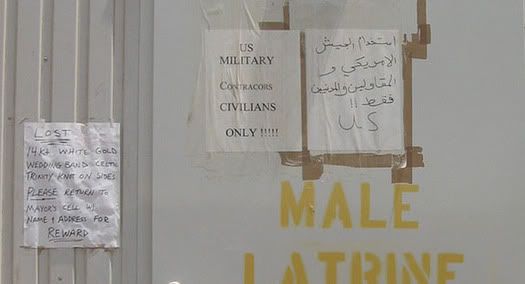 It needed only one: "NO IRAQIS."
McClatchy reports:
Here at this searing, dusty U.S. military base about four miles west of Baqouba, Iraqis — including interpreters who walk the same foot patrols and sleep in the same tents as U.S. troops — must use segregated bathrooms.
Another sign, in a dining hall, warns Iraqis and "third-country nationals" that they have just one hour for breakfast, lunch or dinner. American troops get three hours. Iraqis say they sometimes wait as long as 45 minutes in hot lines to get inside the chow hall, leaving just 15 minutes to get their food and eat it.
It's been nearly 60 years since President Harry Truman ended racial segregation in the U.S. military. But at Forward Operating Base Warhorse it's alive and well, perhaps the only U.S. military facility with such rules, Iraqi interpreters here say.
It's unclear precisely who ordered the rules. "The rule separating local national latrines from soldiers was enacted about two to three rotations ago," Maj. Raul Marquez, a spokesman for the 3rd Brigade Combat Team of the 1st Cavalry Division, from Fort Hood, Texas, wrote in an e-mail. That was before his brigade or the 3rd Stryker Combat Brigade of the 2nd Infantry Division, from Fort Lewis, Wash., the other major combat force here, was based at Warhorse.
There's also disagreement on the reason.
Marquez cited security. "We are at war, and operational security (OPSEC) and force protection are critical in this environment," Marquez wrote. "We screen all our local nationals working and living in the FOB, however, you can never know what's in their mind."
Other soldiers traced the regulations to what they called cultural differences between the Iraqis and the Americans.
"We've had issues with locals," said Staff Sgt. Oscar Garcia, who mans Warhorse's administrative hub. "It's not because we're segregating."
Garcia said some Iraqis squatted on the rims of unfamiliar American-style toilets or had used showers as toilets, forcing private contractors who maintain the facilities to clean up after them.
Another soldier at the administrative hub who declined to give his name or rank cited conflicts over hygiene habits. "We can't accept people washing their feet where I brush my teeth," he said.
"It's to keep problems from happening," said Army Capt. Janet Herrick, a public affairs officer. "It's a preventive measure . . . so no one gets belittled."
But the Iraqis who're paid $80,000 to $120,000 a year for their interpreting services are offended.
"It sucks," Ahmed Mohammed, 30, said of the latrine policy. He called the signs — in English and Arabic — "racist."
He's worked as an interpreter for the U.S. military since 2004. He's college educated and well versed in the ways of Western plumbing. He said Warhorse was the only American base where he'd encountered U.S.-only signs on latrines and country-of-origin restrictions on dining hours.
"I live in the same tent with 80 Americans," he said.
Mohammed works for L-3 Titan Group, a unit of New York-based L-3 Communications. He declined to have his picture taken for publication. He fears for his life. He said his brother was killed last year in Baghdad for working for an American company.
Mohammed has sold his house and has squirreled away enough money to buy visas for his family of four. He said he intended to quit soon and emigrate to Germany. The latrine policy is part of the reason, he said.
L-3 officials didn't respond to a request for comment.
"On one hand we're asking Iraqis to help us," often at great risk, said Laila al Qatami, spokeswoman for the American-Arab Anti-Discrimination Committee in Washington. "But at the same time we're saying, 'We want to keep you at a distance.' It's a mixed message we're sending.
"I don't understand having separate bathrooms. It seems to go against everything that the United States stands for."
Subscribe to:
Posts (Atom)
