Golden Gate district seeks public input on five suicide-barrier designs
The Press Democrat reports:
The Golden Gate Bridge is one step closer to a historic safety makeover as public comment begins on a project intended to stop people from taking their lives by leaping over the iconic orange railings.
"This is a milestone," said Bridge District spokeswoman Mary Currie. "This is something that has been discussed since the first suicide the year the bridge was built."
But with current costs for the project estimated to be as much as $50 million, the barriers are still far from a reality.
"From here it will be about fund raising," Currie said.
The district released an environmental impact report Monday that shows five possible barrier designs.
Four of the five designs would use additional fencing along the bridge's walkways to dissuade potential jumpers and get in the way of those who might try.
A fifth design places a retracting net 20 feet under the bridge, to catch and restrain jumpers.
With an estimated cost of $25 million, a stainless steel cable net is the least expensive of the options studied in the report. The other designs are in the $40 million to $50 million range.
Costs of all possible designs are expected to grow in the time leading up to construction because of the rising costs of steel, Currie said.
Currie said the possible designs all meet specific standards, including maintaining the bridge's cultural and historic status.
But that does not mean they would not have an impact on the bridge's appearance.
Four of the designs -- those involving taller railings -- could significantly alter views from the bridge, a major draw for tourists.
A fifth design -- the netting -- alters the profile of the bridge from viewing points on either side.
"We are introducing new elements, a big railing or a big net," Currie said. "We are changing the visitor's experience."
Tourists taking in the sights Monday were cautious of any plans that would impede their views and photo opportunities.
"Any barrier would dramatically change the charm of the bridge," said Jimmy Castillo, visiting from Los Angeles. "And I doubt it would prevent them from committing suicide another way. They should keep the bridge as it is, a historical site."
While camera-toting tourists bristled at the thought of a changed bridge, suicide-prevention advocates cheered what they saw as a momentous move toward addressing a major safety issue.
"Anything that gets in someone's way buys them time and saves their life," said Eve Meyer, executive director of San Francisco Suicide Prevention. "Suicide in the entire area will drop."
This year, 10 people have committed suicide by jumping off the bridge, and 29 people have been stopped in the process of attempting to jump. Thirty-eight suicides were committed last year, 31 in 2006 and 23 in 2005, according to the bridge district.
Eighty barrier designs were originally proposed and tested for various factors. From those, five designs were chosen, including a sixth "no build" option. The report, completed by DMJM Harris Inc. of Oakland, does not include any recommendations to the district.
The report is available online at www.ggbsuicidebarrier.org, and public comment is open through Aug. 25.
After public comment is collected, bridge directors will hold hearings on how to proceed.
Currie said the district's desire is to select a locally preferred plan, vetted through public comment, possibly by the end of the year.
Fund raising the millions needed for construction would be the next goal, Currie said.
In the past, board members have resisted the idea of a barrier, saying such a project would cost too much, would alter the majestic crossing and might not work.
Barrier supporters hope attention from a 2006 film "The Bridge," which featured the startling images of people jumping from the Golden Gate Bridge, might change their opinions.
Saturday, July 5, 2008
| [+/-] |
Bridge Makeover |






Sunday, November 18, 2007
| [+/-] |
Love in the Time of Dementia |
So this, in the end, is what love is.
The NY Times reports:
Former Justice Sandra Day O’Connor’s husband, suffering from Alzheimer’s disease, has a romance with another woman, and the former justice is thrilled — even visits with the new couple while they hold hands on the porch swing — because it is a relief to see her husband of 55 years so content.
What culture tells us about love is generally young love. Songs and movies and literature show us the rapture and the betrayal, the breathlessness and the tears. The O’Connors’ story, reported by the couple’s son in an interview with a television station in Arizona, where Mr. O’Connor lives in an assisted-living center, opened a window onto what might be called, for comparison’s sake, old love.
Of course, it illuminated the relationships that often develop among Alzheimer’s patients — new attachments, some call them — and how the desire for intimacy persists even when dementia steals so much else. But in the description of Justice O’Connor’s reaction, the story revealed a poignancy and a richness to love in the later years, providing a rare model at a time when people are living longer, and loving longer.
“This is right up there in terms of the cutting-edge ethical and cultural issues of late life love,” said Thomas R. Cole, director of the McGovern Center for Health, Humanities and the Human Spirit at the University of Texas, and author of a cultural history of aging. “We need moral exemplars, not to slavishly imitate, but to help us identify ways of being in love when you’re older.”
Historically, love in older age has not been given much of a place in culture, Dr. Cole said. It once conjured images that were distasteful or even scary: the dirty old man, the erotic old witch.
That is beginning to change, Dr. Cole said, as life expectancy increases, and a generation more sexually liberated begins to age. Nursing homes are being forced to confront an increase in sexual activity.
And despite the stereotypes, researchers who study emotions across the life span say old love is in many ways more satisfying than young love — even as it is also more complex, as the O’Connors’ example shows.
“There’s a difference between love as it is presented in movies and music as this jazzy sexy thing that involves bikini underwear and what love actually turns out to be,” said the psychologist Mary Pipher, whose book “Another Country” looked at the emotional life of the elderly. “The really interesting script isn’t that people like to have sex. The really interesting script is what people are willing to put up with.”
“Young love is about wanting to be happy,” she said. “Old love is about wanting someone else to be happy.”
That’s one way to look at it, at any rate. And it’s not just that relationships are seasoned by time and shared memories — although that’s part of it, as is the inertia the researchers call the familiarity effect, which keeps people from leaving a longtime relationship even though he nags and she won’t ask for directions.
It’s also that brain researchers say older people may simply be better able to deal with the emotional vicissitudes of love. As it ages, the brain becomes more programmed to be happy in relationships.
Researchers trying to understand aging and emotion performed brain scans on people across a range of ages, gauging their reactions to positive and negative scenes. Young people tended to respond to the negative scenes. Those in middle age took in a better balance of the positive. And older people responded only to the positive scenes.
“As people get older, they seem to naturally look at the world through positivity and be willing to accept things that when we’re young we would find disturbing and vexing,” said John Gabrieli, a professor of cognitive neuroscience at the Massachusetts Institute of Technology and one of the researchers.
It is not rationalization: the reaction is instantaneous. “Instead of what would be most disturbing for somebody, feeling betrayed or discomfort, the other thoughts — about how from his perspective it’s not betrayal — can be accommodated much more easily,” Dr. Gabrieli said. “It paves the way for you to be sympathetic to the situation from his perspective, to be less disturbed from her perspective.”
Young brains tend to go to extremes — the swooning or sobbing so characteristic of young love. Old love puts things in soft focus.
“As you get older you begin to recognize that this isn’t going to last forever, for better or for worse,” said Laura L. Carstensen, director of the Stanford Center on Longevity and a research counterpart of Dr. Gabrieli’s in the brain imaging research. “You understand that the bad times pass, and you understand that the good times pass,” Dr. Carstensen said. “As you experience them, they’re more precious, they’re richer.”
Of course, not everyone would show the emotionally generous response that Justice O’Connor did. As Dr. Cole said, “I have many examples in my mind of people who are just as jealous, just as infantile, just as filled with irrationality when they fall in love in their 70s and 80s as she is self-transcendent.”
And it still is possible to have a broken heart in old age. But in general, Dr. Carstensen said: “A broken heart looks different in somebody old. You don’t yell and scream and cry all day long like you might if you were 20.”
In one of the few cultural examples exploring old love — the film “Away From Her,” based on an Alice Munro short story and released in the spring — the starting point is similar to the O’Connors’ story. A man who cannot imagine life without his sparkling wife of some decades watches her slip into Alzheimer’s and then a romance with another patient in a nursing home. In the fictional example, the spousal devotion is such that he arranges for her new boyfriend to return to the nursing home after seeing how crushed she is when the man moves away.
But the story is more complex. The husband had a series of affairs years earlier, so what seems like devotion is also a desire to pay her back and to ease his own remorse.
For Olympia Dukakis, whose mother had Alzheimer’s and who played the wife of the other man in the film, that wrinkle explains the resonance of Ms. Munro’s story.
“She was very aware that contradictory things live together,” Ms. Dukakis said. “You can’t look at it and say he did it purely for love. It’s a complicated issue, because there’s a lot of life that has been lived. It’s not going to be simple.”
Still, for all those kinds of complications, those who study aging can only smile at young lovers who say they never want to become like an old married couple. Despite the popular preference for young love, the O’Connors’ example suggests that we should all aspire to old love, for better and for worse.
“Young love is very privileged, and as a culture that may be a mistake,” Dr. Pipher said. “If you want a communal culture where people make sacrifices for each other and work for the common good, you would have a culture that privileges the stories of older people.”
Those stories would not be without their troubles. But nor would they be without rewards. “If you stay married,” Dr. Pipher said, “there’s riches in store that nobody 25 years old can imagine.”
Wednesday, November 14, 2007
| [+/-] |
Seized by Alzheimer's, Then Love |
Sometimes Alzheimer’s disease means losing a loved one twice.
The NY Times reports:
As the disease ravages the brain and erases memory, patients who have been married for years, even most of their lives, may stop recognizing their spouses. And sometimes, in a phenomenon rarely discussed, husbands and wives find they must watch helplessly as patients fall in love with someone entirely new.
The romantic lives of Alzheimer’s patients made headlines this week with news that the 77-year-old husband of retired Supreme Court Justice Sandra Day O’Connor, John Jay O’Connor III, has found companionship with a woman in the nursing home in which he lives. The two patients reportedly spend time together and hold hands, even in the presence of Justice O’Connor.
Although no research has tracked how often people with Alzheimer’s disease develop new romances, doctors say it’s not particularly unusual for married patients to bond with someone new. Although the disease may steal the memories of past lives, it doesn’t take away the desire for love and companionship.
“Imagine if all the people you know and loved disappeared,’’ said Dr. Richard Powers, chairman of the medical advisory board of the Alzheimer’s Foundation of America. “Wouldn’t you want to find someone who was your friend, who would hold your hand and watch old television shows with you? The person with Alzheimer’s still searches for joy.’’
Family members often aren’t sure how to regard such a liaison. The children of Alzheimer’s patients often find the adjustment difficult, said Dr. Powers, while many spouses actually are heartened to see a husband or wife comforted by a new friend. Although Justice O’Connor hasn’t commented, her son was quoted as saying that the family is happy that Mr. O’Connor seems to have found rays of contentment in the darkness of his disease.
“It’s not uncommon at all for families and spouses to allow this to go on, because it sustains a person’s happiness,’’ said Dr. Powers. “Those of us who have had this disease in our families know you just have to roll with these changes. Let them have a friend, if it buys them a day of happiness.’’
Tuesday, October 30, 2007
| [+/-] |
Kucinich Questions Bush's Mental Health Over Iran |
Reuters reports:
Democratic presidential candidate Dennis Kucinich on Tuesday mockingly questioned President George W. Bush's mental health for saying Iran's nuclear ambitions might trigger World War III.
"I seriously believe we have to start asking questions about his mental health," Kucinich, a quirky, long-shot candidate in the race for his party's presidential nomination in the November, 2008 election. "There's something wrong. He does not seem to understand his words have real impact."
Kucinich spoke to the editorial board of The Philadelphia Inquirer ahead of a Democratic debate in Philadelphia.
Bush told a news conference two weeks ago: "I've told people that if you're interested in avoiding World War III, it seems like you ought to be interested in preventing them (Iran) from having the knowledge necessary to make a nuclear weapon."
Kucinich, a member of the U.S. Congress from Ohio, has tried in the past to convince his colleagues to impeach both Bush and Vice President Dick Cheney, to no avail.
He told The Inquirer he did not believe his remarks about Bush's mental stability were irresponsible.
"You cannot be a president of the United States who's wanton in his expression of violence," Kucinich said. "There's a lot of people who need care. He might be one of them. If there isn't something wrong with him, then there's something wrong with us. This, to me, is a very serious question."
Thursday, August 16, 2007
| [+/-] |
The Caged Life |
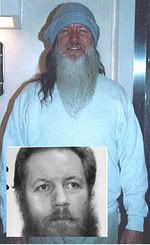 Is Thomas Silverstein a prisoner of his own deadly past — or the first in a new wave of locked-down lifer
For Denver's Westword News, Alan Prendergast writes:
When the goon squad showed up at his place at five in the morning, Tommy Silverstein knew something was up. He wasn't accustomed to greeting guests at such an ungodly hour — much less a team of corrections officers, helmeted and suited up for action.
In fact, Silverstein wasn't used to company at any hour. His home was a remote cell, known as the Silverstein Suite, in the special housing unit of the federal penitentiary at Leavenworth, Kansas. He'd been cut off from other inmates and all but a few emissaries from the outside world for more than two decades.
He stayed in the Silverstein Suite 23 hours a day. His interactions with staff typically amounted to some tight-lipped turnkey delivering his food through a slot in the cell door. The only change of scenery came when an electronic door slid open, allowing him an hour's solitary exercise in an adjoining recreation cage. Visitors were rarely permitted, and entire years had gone by during which he never left the cell.
But this day was different. Silverstein could think of only a couple of reasons why so many well-padded, well-equipped officers would be at his door, ordering him to strip for a search. Cell shakedown? Time for a game of hockey, with Tommy as the puck? No, that was a captain leading the squad. Something big.
A transfer.
So it came to pass that on July 12, 2005, U.S. Bureau of Prisons inmate #14634-116 left his cage in Kansas for one in Colorado. Security for the move was tighter than Borat's Speedo — about what you'd expect for a former Aryan Brotherhood leader convicted of killing four men behind prison walls. (One conviction was later overturned; Silverstein disputes the second slaying but admits the other two.) The object of all this fuss didn't mind the goon squad. He was enjoying the view — and hoping that the move signaled the end to his eight-thousand-plus days of solitary confinement. Maybe, just maybe, his decades of uneventful good behavior had paid off.
"They said for me to keep my nose clean, and maybe one day it'd happen," he recalled recently. "So I foolishly thought this was it. If you saw me in that van, you'd think I was Disneyland-bound, smiling all the way."
But the smile vanished after Silverstein reached his destination: the U.S. Penitentiary Administrative Maximum, better known as ADX. Located two miles outside of the high-desert town of Florence, ADX is the most secure prison in the country, a hunkered-down maze of locks, alarms and electronic surveillance, designed to house gang leaders, terrorists, drug lords and other high-risk prisoners in profound isolation. Its current guest list is a who's who of enemies of the state, including Unabomber Ted Kaczynski, shoe bomber Richard Reid, plane bomber Dandenis Muñoz Mosquera, abortion clinic bomber Eric Rudolph and double-agent Robert Hanssen.
When it opened in 1994, ADX was hailed as the solution to security flaws at even the highest levels of the federal prison system. Much of the justification for building the place stemmed from official outrage at the brutal murders of two guards in the control unit of the federal pen in Marion, Illinois, during a single 24-hour period in 1983. The first of those killings was committed by Thomas Silverstein, who was already facing multiple life sentences for previous bloodshed at Marion. The slaying of corrections officer Merle Clutts placed Silverstein under a "no human contact" order that's prevailed ever since, and it gave the Bureau of Prisons the perfect rationale for building its high-tech supermax. Although he never bunked there until 2005, you could call ADX the House that Tommy Built.
What greeted Silverstein two years ago was nothing like Disneyland. His hosts hustled him down long, sterile corridors with gleaming black-and-white checkerboard floors that reminded him of A Clockwork Orange or some other cinematic acid trip. One set of doors, then another and another, until he finally arrived at the ass-end of Z Unit, on a special range with only four cells, each double-doored. His new home was less than half the size of the Silverstein Suite and consisted of a steel slab with a thin mattress, a steel stool and desk, a steel sink-and-toilet combination, a steel shower and a small black-and-white TV.
Stripped of most of his small store of personal belongings, Silverstein had little to do besides take stock of his eighty-square-foot digs. The Silverstein Suite was a penthouse at the Plaza compared to this place. There were steel rings on the sides of the bed platform, ready for "four-pointing" difficult inmates. A camera mounted on the ceiling to record his every move. If he stood on the stool and peered out the heavily meshed window, he could get a glimpse of a concrete recreation cage and something like sky. So this was his reward for all those years of following the rules — 24-hour surveillance in his own desolate corner of the Alcatraz of the Rockies. He was no longer simply in the belly of the beast. He was, he would later write, "stuck in its bowels, with no end/exit in sight."
The double doors muffled sound from outside. But over time, Silverstein realized that there was one other prisoner on the range. He shouted greetings. The man shouted back. He asked the man how long he'd been in the unit. Four years, the man said.
Silverstein told the man his name. His neighbor introduced himself: Yousef. Ramzi Yousef. Convicted of the 1993 World Trade Center bombing, the one that killed six people and injured a thousand. Nephew of Khalid Sheikh Mohammed, the al-Qaeda leader who recently confessed to planning that failed effort to bring down the towers as well as the 9/11 attacks.
His keepers had put Silverstein in the beast's bowels, all right — right next to the one man in the entire federal system more loathed than he was. Still, it was somebody to talk to. Shouting to Yousef was the first conversation with another inmate that Silverstein had managed in almost twenty years.
But talking wasn't allowed. Within days, a new barrier was erected in the corridor outside his cell, preventing any further communication between the two residents of the range. Inmate #14634-116's transfer to ADX was now complete.
Entombed, Terrible Tommy was alone again. Naturally.
In the late 1980s, Pete Earley, a former Washington Post reporter, persuaded Bureau of Prison officials to grant him an unprecedented degree of access to inmates and staff at the Leavenworth penitentiary. Earley was allowed to walk the yard without an escort, to interview inmates without official monitoring, to talk candidly with veteran corrections officers about the dangers and frustrations of their work.
The resulting book, The Hot House: Life Inside Leavenworth Prison, is one of the most vivid works of prison reportage ever published. Among several unsettling portraits of career criminals and their keepers, the most memorable character is probably one Thomas Silverstein, who was then being housed, a la Hannibal Lecter, in a zoo-like cage in Leavenworth's basement, where the fluorescent lights stayed on around the clock to make it easier to watch him. Wild-haired and bearded — the BOP would not allow him a razor or a comb — Silverstein spent hours talking into Earley's tape recorder, describing his violent past and the petty torments he claimed the guards were putting him through in an effort to drive him insane.
Earley's book made Leavenworth's dungeon monster seem not only rational but quite possibly human. Granting a journalist unfettered access to him was a public relations blunder the BOP has been unwilling to repeat. Silverstein hasn't been allowed to have a face-to-face interview with a reporter for the past fifteen years. When Westword recently asked to visit him, ADX warden Ron Wiley promptly denied the request, citing "continued security concerns." But then, Wiley and his predecessors haven't let any journalist inside ADX to interview any inmate since 2001 because of "continued security concerns" (see related story).
Although he readily agreed to an interview with Westword, Silverstein isn't a huge fan of the press, either. He remains friendly with Earley, but he's learned to be wary of hit-and-run tabloid writers following in his wake, eager to write about "the most dangerous prisoner in America." Most of what the outside world knows about him, if it pays any attention at all, is the fragmentary image presented in The Hot House; he's a captive of his own legend, like some prehistoric insect trapped in amber. His letters seethe with contempt for lazy "plagiarists" who have simply appropriated snatches of Earley's account as well as for those who've produced long magazine pieces or cheeseball cable programs about the Aryan Brotherhood that largely rely on the lurid tales of government snitches.
"For some odd reason the media pees when Master snaps his fingers," he wrote recently. "I wouldn't call 'em 'mainstream' any more cuz there isn't anything mainstream about 'em. They're just lackeys for the powers that be."
Silverstein's response to the "injurious lies" spread about him has been to launch his own information campaign at www.tommysilverstein.com. That's right — America's most solitary prisoner, a man who's been inside since before the personal computer was invented and has never been allowed near one, has his own website, maintained by outside supporters who forward messages to him and post his responses.
"He's got a pretty impressive network," says Terry Rearick, a California private investigator who has communicated with Silverstein by letter and phone over several years. After the two lost touch for a time, Rearick got a call from a woman in England on Silverstein's behalf.
The same woman posts regularly on the website, where Silverstein himself duels at length with his detractors. (A similarly heated debate has ignited over the wording of Silverstein's entry on Wikipedia; his defenders and his critics alternately revise the account to suit their competing versions of his crimes.) Some visitors to his site dismiss him as a textbook psychopath. But Silverstein contends that if people understood the grim context in which the killings at Marion took place, the snitch games and psychological warfare and organized violence of prison life, they wouldn't be so quick to demonize him.
It's a strangely disconnected argument — a garbled dialogue between cultures on different planets. Most of the visitors to his website know little about Silverstein's world, just as he knows little about theirs. He's been in prison for the past 32 years, and much of what he's learned about life on the street since he was put in solitary in 1983 has come from reading or watching television. No American prisoner, not even Robert Stroud, the Birdman of Alcatraz, has ever been condemned to such a walled-off existence for such a long period of time. Many of Stroud's years of solitary confinement were spent in relative ease at Leavenworth; he had not only frequent visitors, but also a full-time secretary. Even his seventeen-year stretch in Alcatraz allowed for much more daily communication with others than Silverstein has had.
"I'm amazed that he's not stark, raving mad," says Paul Wright, the editor of Prison Legal News, who's corresponded with Silverstein for years and published some of his writing. "He's been in total isolation for almost 25 years. The only people I can think of that have been held in anything remotely like this in modern times are some of the North Korean spies held in South Korea."
Yet the no-contact conditions imposed on Silverstein are becoming less unique by the day. There are now 31 supermax prisons in the country, with more under construction, including Colorado's own 948-bed sequel to the current state supermax, known as Colorado State Penitentiary II. They are costly on several levels — the operational expense per cell can be double that of a less-secure prison, and the rate of mental illness in solitary confinement far exceeds that of the general prison population — but lockdown prisons are all the rage with a vengeful public. Increasingly, they are being used not for short-term punishment (disciplinary segregation) but for long-term confinement of hard-to-manage inmates (administrative segregation), whose privileges keep shrinking. Colorado, for example, no longer allows journalists to interview its supermax inmates except by mail.
"The phenomenon is disturbingly common," says David Fathi, a staff attorney for the ACLU's National Prison Project. "If it's disciplinary confinement, it's finite — when you're done, you're done. But with administrative segregation, there's a real lack of transparency about what a prisoner can do to earn his way out."
In the federal system, the past decade has seen the rise of "special administrative measures," or SAMs, which are imposed on terrorists or other inmates whose communications with the outside world "could result in death or serious bodily injury to persons." There are now at least two dozen SAMs cases in federal prisons, including Yousef and Zacarias Moussaoui, whose access to mail, phone calls, media interviews or other visits are extremely limited or banned outright. At present the restrictions must be approved by the U.S. Attorney General, but the Bush administration is considering changes that would allow wardens at ADX or other high-security prisons to designate inmates as terror threats and thus ban them from all media contact — even if they haven't been convicted on terrorism charges yet, Fathi notes.
Silverstein isn't a SAMs case. He still has his website and his mail (although he claims it's frequently withheld or "messed with" in other ways). But he may be the prototype of what the government has in mind for other infamous prisoners — to bury them in strata of supermax security to the point of oblivion.
Responding in letters to questions about the psychological impact of his isolation, Silverstein struggles to find the right words. "Trying to explain it is like trying to explain what an endless toothache feels like," he writes. "I wish I could paint what it's like."
In an article a few years ago, he called solitary confinement "a slow constant peeling of the skin, stripping of the flesh, the nerve-wracking sound of water dripping from a leaky faucet in the still of the night while you're trying to sleep. Drip, drip, drip, the minutes, hours, days, weeks, months, years, constantly drip away with no end or relief in sight."
In a Darwinian world, predators have to adapt or die, just like their prey. Tommy Silverstein arrived in the federal prison system at a critical phase of its evolution, when the number of inmate assaults on other inmates and staff was rising sharply and officials were looking at the idea of control units as a way to neutralize the growing threat posed by prison gangs. Silverstein quickly became a symbol of the problem — and the inadequacy of the proposed solution. It's not a stretch to say that the Marion control unit helped to make him what he became, just as the mayhem that erupted there helped to reshape the American prison system.
Before he reached the nether regions of the BOP, Silverstein's criminal career had been thoroughly unremarkable. Born in 1952 in California, he'd grown up in a middle-class neighborhood in Long Beach, but he was bullied by other kids who thought he was Jewish. (According to The Hot House, Silverstein's biological father was a man named Thomas Conway, whom his mother divorced when Tommy was four years old; she later married a man named Silverstein.) As a teenager, he ripped off houses for money to buy drugs; his sister, Sydney McMurray, says he was battling a heroin addiction and problems with his volatile, controlling mother.
"We were taught never to throw the first punch, but never to walk away from a fight," McMurray recalls. "My brother started getting into trouble because he was running away from a violent environment at home. Then he got into drugs, and he became a brother I never knew."
At nineteen, Silverstein landed in San Quentin for armed robbery. Paroled, he was soon arrested again for series of robberies — pulled with Conway and another relative — that yielded less than $1,400. This time, he went into the federal system on a fifteen-year jolt. He was 23 years old, and his life on the streets was already over.
At Leavenworth Silverstein became closely associated with Aryan Brotherhood members who allegedly controlled the heroin trade inside the prison — close enough that when convict Danny Atwell was found stabbed to death, supposedly because he'd refused to be a mule for the heroin business, Silverstein and two other AB members were charged with the murder. In 1980, he was convicted at trial on the basis of shifting testimony from other inmates and sentenced to life in prison. A federal appeals court later ruled that much of the testimony should never have been allowed and threw out the conviction. But by that time, Silverstein was in the Marion penitentiary and facing more murder charges.
Marion opened in 1963, the same year that Alcatraz closed. It was intended to be not just a replacement for the Rock but an improvement, with a more open design and modern rehabilitation programs. Yet by the late 1970s, it had the most restrictive segregation unit in the BOP; not coincidentally, it was also the most violent prison in America, a dumping ground for gang leaders and crazies. Between 1979 and 1983, the prison logged 81 inmate assaults on other inmates and 44 on staff; 13 prisoners were killed. BOP reports issued in 1979 and 1981 proposed turning the entire facility into a "closed-unit operation."
Confined to a one-man cell in the control unit 23 hours a day, Silverstein says he spent much of his time learning how to draw and paint. [Silverstein's artwork.] "I could hardly read, write or draw when I first fell," he explains. "But most of us lifers are down for so long and have so much time to kill that we actually fool around and discover our niche in life, often in ways we never even dreamt possible on the streets. We not only find our niche, we excel."
Prison officials worried that Silverstein was finding his niche in other areas, too. Long-simmering disputes between white and black gangs had a way of coming to a boil in the control unit. In 1981, D.C. Blacks member Robert Chappelle was found dead in his cell. He'd apparently been sleeping with his head close to the bars and had been strangled with a wire slipped around his neck, plied by someone exercising on the tier. Silverstein and another convicted killer, Clayton Fountain, received life sentences for the crime; inmates who testified for the prosecution claimed the two had boasted of it.
Silverstein has always denied killing Chappelle. (Another inmate later claimed to have done the deed, but investigators found his confession at odds with the facts.) Yet even if he hadn't been convicted in court, the suspicion that he was responsible was sufficient to trigger more violence. Shortly after the slaying, the BOP saw fit to transfer one of Chappelle's closest friends, D.C. Blacks leader Raymond "Cadillac" Smith, to the Marion control unit from another prison. Within days, Smith had tried to stab Silverstein and shoot him with a zip gun. Silverstein and Fountain responded by cutting their way out of an exercise cage with a piece of hacksaw blade and paying a visit to Smith while he was in the shower. Smith was stabbed 67 times, in what Silverstein still describes as an act of convict self-defense.
"Everyone knew what was going on and no one did anything to keep us apart," he told Earley. "The guards wanted one of us to kill the other."
At the time, there was no federal death penalty for inmate homicides — and not much the system could do to Silverstein, who was already serving multiple life sentences in the worst unit of the worst prison the BOP had to offer. But some staffers, concerned about Silverstein's outsized rep among white inmates, apparently did their best to keep him in check. In the months that followed Cadillac's death, Silverstein began to regard Officer Merle Clutts, a bull-headed regular of the control unit, as his chief tormentor.
Silverstein has given different explanations about what Clutts did to deserve such attention. Clutts trashed his cell during shakedowns and withheld mail; he smudged his artwork and taunted him; he even tried to set him up for attack by other inmates, Silverstein has suggested. Silverstein claims he told Earley "the whole story," but only pieces made it into The Hot House. Earley won't comment, saying he no longer discusses Silverstein with other reporters because of past misunderstandings.
The BOP has denied that Clutts harassed Silverstein. Whatever the source of the feud might have been, there's no question that Silverstein became fixated on Clutts. One study by Harvard psychiatrist Stuart Grassian suggests that prisoners in control units sometimes experience "the emergence of primitive, aggressive fantasies of revenge, torture, and mutilation" of the guards who watch over them.
Silverstein thought about Clutts, and he thought about the difficulties involved in getting to his enemy when he was allowed out of his cell only one hour a day, shackled, escorted by three guards.
Locked down for life, he had a mountain of time to consider the problem.
One day in solitary is pretty much like another. Prisoners have different strategies for filling up their days, but there are always more days to come.
In his cell at Florence, 54-year-old Tom Silverstein usually rises before dawn, catches up on letters and reads, waiting for the grand event that is the delivery of his breakfast. He goes to rec for an hour, comes back to the grand event that is lunch, showers and cleans his cell. Time for some channel-flipping on the small black-and-white TV, in search of something fresh amid the religious chatter and educational programs he's watched over and over. More reading, some yoga. Then dinner, more TV - he's a sucker for Survivor, Big Brother and other "reality-type shows" — and so to bed.
When he was in the Silverstein Suite at Leavenworth, Silverstein had access to paintbrushes, pens and other art supplies. At ADX, he's only permitted pastels, colored pencils and "cheap-ass paper," he reports; consequently, he hasn't drawn a lick since he's been there. He says that every few weeks, he's moved from the cell with the heavily meshed window to one with no window at all, then back again a few weeks later. There are rare, glorious interruptions in the routine — a visit with sister Sydney last May, an occasional lawyer checking in. Visitors sit in a booth outside the cell and talk to him on a phone; he sits shackled on the other side of a glass partition and talks back. But these dazzling bursts of conversation quickly fade into a muddle. Did the last lawyers come before or after his sister? Silverstein isn't sure.
"It's all a blur, a dream state of mind," he writes. "Like my memories. When I venture back to my yesterdays, it's hard to distinguish fact from fiction."
Yet there is one memory, one day that stands out from all the rest — the day that started it all. Twenty-four years later, Silverstein is still in the position of analyzing, defending and regretting the act that has defined his fate. But nothing can explain away the act itself, a murder that was meticulously planned and ruthlessly executed.
Marion wasn't designed to be a supermax. Control unit prisoners had to be shackled and escorted to the shower every day, and the guards permitted them to have brief conversations with other inmates in cells along the way. On October 22, 1983, Silverstein was on his way back from his shower when another inmate in a rec cage called over one of his three escorts — Merle Clutts. Now flanked by only two guards, Silverstein paused at the cell of one of his buddies, Randy Gometz, and struck up a conversation.
Before the guards knew what was happening, Gometz had reached through the bars, uncuffed Silverstein with a hidden key — and supplied him with a shank. Silverstein broke away from the guards and headed toward Clutts, now isolated at the far end of the tier. "This is between me and Clutts!" he shouted.
He stabbed the officer forty times before the dying Clutts could make it off the tier. Hours later, Silverstein's friend Clayton Fountain pulled the same handcuff trick and attacked three more guards in the control unit, fatally wounding Robert L. Hoffman Sr.
Two federal officers slaughtered in one day, on what was supposed to be the most secure unit in the entire BOP, sent the system into shock. The bureau's response was to forge ahead with the long-considered plan to turn all of Marion into a control unit while whisking Silverstein and Fountain into even more restricted quarters. (Fountain died in 2004 at the age of 48).
For years prison activists attempted to challenge the Marion lockdown in court, charging that the prison staff set about beating other prisoners and subjecting them to "forced rectal searches" as payback for the deaths of Clutts and Hoffman. In 1988, a federal judge ruled that the inmate accounts of staff brutality were simply not credible.
By that point, Silverstein and the bureau were already on the road that would lead to ADX — a place where communication among inmates, and physical contact between inmates and staff, could be strictly controlled and all but eliminated.
If the guard killings in Marion happened at any federal prison today, the perpetrators would almost certainly face the death penalty. Silverstein has suggested more than once that death would have been a more merciful option in his case.
"Even though we may not execute people by the masses, as they do in other countries, our government leaders bury people alive for life in cement tombs," he writes. "It's actually more human to execute someone than it is to torture them, year, after year, after year."
Silverstein's last taste of some kind of freedom came in the fall of 1987. Rioting Cuban prisoners broke into his special cell in the Atlanta federal penitentiary and set him loose. For one surreal week, he was able to roam the yard while the riot leaders dickered with federal negotiators over the release of more than a hundred prison staffers who'd been taken hostage.
Then the Cubans jumped him, shackled him and turned him over to the feds. Surrendering Silverstein had been high on the BOP's list of demands for resolving the situation, right up there with releasing all hostages unharmed.
Contrary to the bureau's expectations, Silverstein didn't butcher any guards during his precious days of liberty. He didn't harm anyone. He suggests the episode shows that he's not the killing machine the BOP says he is, and that he could exist in a less restrictive prison without resorting to violence.
The bureau isn't convinced. He killed Clutts.
Terrible Tommy says he's changed. He claims to have gone 21 years without a disciplinary writeup. Other long-term solitaries go berserk, smearing their cells with feces and "gassing" their captors with shit-piss cocktails. Not him.
"The BOP shrinks chalk it up as me being so isolated I haven't anyone to fight with," he writes, "but they're totally oblivious to all the petty BS that I could go off on if I chose to. I can toss a turd and cup of piss with the best of 'em if I desired. What are they going to do, lock me up?
"But I just have more self-control now, after 25 years of yoga, meditation, studying Buddhism and taking some anger-management courses. All that goes unacknowledged."
McMurray says her brother has learned a great deal about patience and suffering over the years. "He's more like the brother I knew on the outside years ago," she says. "I have spoken with the guards who deal with him every day, and they don't have a bad thing to say about him. It's the ones in administration who are trying to make it as difficult as they can for him.
"But my brother has a spirit that is unbreakable. In Leavenworth, at least he could draw. It's been more of a challenge for him in this situation, but he hasn't let it break his spirit."
The bureau doesn't care about his spiritual progress. He killed Clutts.
Silverstein has told reporters that he wants to apologize to the families of the men he killed, "even though it was in self-defense." He has recanted some oft-quoted lines from his interviews with Earley about "smiling at the thought of killing Clutts" and feeling the hatred grow every time he was denied a phone call or a visit. He says he regrets the grief he's caused and no longer seethes with hatred.
The bureau is unmoved by his repentance. He killed Clutts.
Silverstein has been cut off from the operations of the Aryan Brotherhood for decades. His story is still told among the faithful, in an effort to keep his memory alive among the younger members, but he disputes that the group is a white supremacist organization. His own paintings include an ethnically diverse array of portraits. "I think it's worth noting that Tommy is no longer a racist, if he ever was," says Prison Legal News editor Wright.
The bureau could give fuck-all. He killed Clutts.
Twice a year, prison officials hold a brief hearing to review Silverstein's placement in administrative segregation. For many years, the hearings were held in the corridor outside the Silverstein Suite in Leavenworth. Silverstein stopped attending because the result was always the same: no change. At ADX, he's taken to filing grievances, claiming that the move has left him more isolated, with fewer privileges than ever before.
"I am being punished for good conduct under ploy of security reasons," he wrote last year in a formal appeal of his situation. "The goal of these units is clearly to disable prisoners through spiritual, psychological and/or physical breakdown."
In his response, Warden Wiley pointed out that Silverstein is provided with food and medical care, "daily contact with staff members" and access to television, radio and reading materials.
"It's ridiculous to call a nameless guard that shoves a food tray through the hole in the door...a source of meaningful 'human contact,'" Silverstein fired back. "I request placement in general population."
He took his appeal to the regional office, then to headquarters, where it was swiftly denied. "You are serving three consecutive life terms plus 45 years for bank robbery and murder, including the murder of Bureau of Prisons staff," an administrator noted. "You are a member of a disruptive group and an escape risk. Your heinous criminal and institutional behavior warrant a highly individualized and restrictive environment."
Wiley declines to comment on Silverstein's treatment at his prison. Last spring, a group from Human Rights Watch was allowed to tour certain areas of ADX. The group wasn't let in Z-Unit, where Silverstein lives, or anywhere near A-Unit — the "hole," where most disciplinary cases are housed. But they saw enough to realize that the staffers who bring meals "do not converse regularly, if at all, with the inmates." Despite claims that clinical psychologists checked on prisoners every other week, "several inmates said they had not spoken to a psychologist in many months," and such conversations tended to be brief.
The group also reported that many ADX prisoners are trapped in a catch-22 predicament — they've been sent there directly after sentencing but have never been provided any opportunity to "progress" to a less restrictive setting because of the nature of their crime. Every placement review finds that the "reason for placement at ADX has not been sufficiently mitigated."
"No matter how well they behave in prison, they cannot undo the past crimes that landed them in prison, generally, and then ADX, specifically," Human Rights Watch director Jamie Fellner wrote to BOP director Harley Lapin.
Some crimes, it seems, are beyond redemption.
Silverstein got a copy of the do-gooders' report and immediately fired off a letter to the group, suggesting that they come see him in Z-Unit if they want the real story about the government's "failed and draconian penal system."
No one from the group has come to see him yet. Silverstein waits for them in his box within a box. He knows that the bureau just wants to bury him and that he turned the key himself. But he also knows he didn't build that box all on his own.
His earliest possible date of release is eighty-eight years away. He has nothing but time.
Saturday, July 14, 2007
| [+/-] |
State Dept. Orders Flak Jackets In Baghdad's Green Zone |
McClatchy reports:
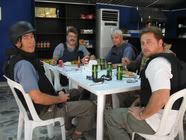
The dress code at the Blue Star restaurant inside Baghdad's Green Zone now calls for vest and hat.
Flak vest and Kevlar helmet, to be precise. And it's a good thing.
At least four mortar rounds hit inside the Green Zone about 1:30 p.m. Saturday, killing two Iraqi civilians, according to a U.S. soldier who could not speak for attribution because he's not authorized to talk to reporters.
Meanwhile, a State Department official, after initially denying that State had ordered its 1,000 Baghdad personnel to wear protective gear, said that a copy of the order obtained by McClatchy Newspapers was an undiscussable security breach.
Saturday's attack followed a barrage of up to 35 mortars and rockets that slammed into the Green Zone - considered the safest place in Baghdad - on Wednesday.
The embassy issued its memo later that day.
"As a result of the recent increase of indirect fire attacks on the International Zone, outdoor movement is restricted to a minimum," it states. "Remain within a hardened structure to the maximum extent possible and strictly avoid congregating outdoors. Personal protective equipment (PPE) is mandatory until further notice.
"Public places that are not in a hardened structure - such as the Blue Star Restaurant - should be frequented only in conjunction with the use of your PPE."
An embassy spokesman on Saturday initially denied that State now requires workers to wear body armor in the Green Zone.
He got upset when shown the memo.
"You're asking me to comment on an internal document?" he said, refusing to give his name. "How did you get it? We don't talk to what our security posture is."
Saturday's attack, which, like most of the rest, came from the east, the stronghold of Shiite Mahdi Army militia members loyal to anti-American cleric Muqtada al-Sadr, closed the Blue Star for lunch. But it reopened at 6 p.m. for dinner.
The place features white plastic tables and chairs, a magnum bottle of Johnny Walker Red scotch on the bar, plastic fish squirming in a faux aquarium and bootleg DVDs in a rack. All beneath a blue-and-white striped canvas tent.
Research Triangle Institute, of Durham, N.C., runs the compound where the Blue Star's located. The institute is helping local governments ramp up utilities and other projects in Iraq's provinces.
Five contract workers from the Research Triangle Institute filtered in. All wore flak vests and helmets. Mark Grubb, the first to arrive, ordered a 16.9-ounce Carlsberg beer. A choice of spaghetti, kebabs and burgerish meat lay ahead.
"A (mortar) round landed here in the compound," Grubb said. The blast severed a water line and the Internet cable. It also hit where the compound's security chief resides. "You could see it on the closed-circuit camera," Grubb said.
There were no injuries.
While some 100 British embassy workers and about 55 United Nations personnel living in the Green Zone sleep in hardened housing, State Department personnel sleep unprotected.
Asked how State could require workers to walk around outdoors in body armor while making them sleep in unprotected quarters, the embassy official said: "I wouldn't characterize it as being a mixed message."
U.S. embassy workers, speaking on condition of anonymity, have told McClatchy that they're angry and scared.
They'll get hardened sleeping quarters when construction of the new American embassy compound is complete. That's expected to be this fall.
Friday, July 13, 2007
| [+/-] |
Baghdad Diarist: Shock Troops |
At TNR, Scott Thomas writes:
I saw her nearly every time I went to dinner in the chow hall at my base in Iraq. She wore an unrecognizable tan uniform, so I couldn't really tell whether she was a soldier or a civilian contractor. The thing that stood out about her, though, wasn't her strange uniform but the fact that nearly half her face was severely scarred. Or, rather, it had more or less melted, along with all the hair on that side of her head. She was always alone, and I never saw her talk to anyone. Members of my platoon had seen her before but had never really acknowledged her. Then, on one especially crowded day in the chow hall, she sat down next to us.
We were already halfway through our meals when she arrived. After a minute or two of eating in silence, one of my friends stabbed his spoon violently into his pile of mashed potatoes and left it there.
"Man, I can't eat like this," he said.
"Like what?" I said. "Chow hall food getting to you?"
"No--with that fucking freak behind us!" he exclaimed, loud enough for not only her to hear us, but everyone at the surrounding tables. I looked over at the woman, and she was intently staring into each forkful of food before it entered her half-melted mouth.
"Are you kidding? I think she's fucking hot!" I blurted out.
"What?" said my friend, half-smiling.
"Yeah man," I continued. "I love chicks that have been intimate--with IEDs. It really turns me on--melted skin, missing limbs, plastic noses...."
"You're crazy, man!" my friend said, doubling over with laughter. I took it as my cue to continue.
"In fact, I was thinking of getting some girls together and doing a photo shoot. Maybe for a calendar? IED Babes.' We could have them pose in thongs and bikinis on top of the hoods of their blown-up vehicles."
My friend was practically falling out of his chair laughing. The disfigured woman slammed her cup down and ran out of the chow hall, her half-finished tray of food nearly falling to the ground.
Am I a monster? I have never thought of myself as a cruel person. Indeed, I have always had compassion for those with disabilities. I once worked at a summer camp for developmentally disabled children, and, in college, I devoted hours every week to helping a student with cerebral palsy perform basic tasks like typing, eating, and going to the bathroom. Even as I was reveling in the laughter my words had provoked, I was simultaneously horrified and ashamed at what I had just said. In a strange way, though, I found the shame comforting. I was relieved to still be shocked by my own cruelty--to still be able to recognize that the things we soldiers found funny were not, in fact, funny.
Not everyone was capable of such distinctions. About six months into our deployment, we were assigned a new area to patrol, southwest of Baghdad. We spent a few weeks constructing a combat outpost, and, in the process, we did a lot of digging. At first, we found only household objects like silverware and cups. Then we dug deeper and found children's clothes: sandals, sweatpants, sweaters. Like a strange archeological dig of the recent past, the deeper we went, the more personal the objects we discovered. And, eventually, we reached the bones. All children's bones: tiny cracked tibias and shoulder blades. We found pieces of hands and fingers. We found skull fragments. No one cared to speculate what, exactly, had happened here, but it was clearly a Saddam-era dumping ground of some sort.
One private, infamous as a joker and troublemaker, found the top part of a human skull, which was almost perfectly preserved. It even had chunks of hair, which were stiff and matted down with dirt. He squealed as he placed it on his head like a crown. It was a perfect fit. As he marched around with the skull on his head, people dropped shovels and sandbags, folding in half with laughter. No one thought to tell him to stop. No one was disgusted. Me included.
The private wore the skull for the rest of the day and night. Even on a mission, he put his helmet over the skull. He observed that he was grateful his hair had just been cut--since it would make it easier to pick out the pieces of rotting flesh that were digging into his head.
Funny? Of course not. But many of my friends were laughing anyway. That is how war works: It degrades every part of you, and your sense of humor is no exception.
I know another private who really only enjoyed driving Bradley Fighting Vehicles because it gave him the opportunity to run things over. He took out curbs, concrete barriers, corners of buildings, stands in the market, and his favorite target: dogs. Occasionally, the brave ones would chase the Bradleys, barking at them like they bark at trash trucks in America--providing him with the perfect opportunity to suddenly swerve and catch a leg or a tail in the vehicle's tracks. He kept a tally of his kills in a little green notebook that sat on the dashboard of the driver's hatch. One particular day, he killed three dogs. He slowed the Bradley down to lure the first kill in, and, as the diesel engine grew quieter, the dog walked close enough for him to jerk the machine hard to the right and snag its leg under the tracks. The leg caught, and he dragged the dog for a little while, until it disengaged and lay twitching in the road. A roar of laughter broke out over the radio. Another notch for the book. The second kill was a straight shot: A dog that was lying in the street and bathing in the sun didn't have enough time to get up and run away from the speeding Bradley. Its front half was completely severed from its rear, which was twitching wildly, and its head was still raised and smiling at the sun as if nothing had happened at all.
I didn't see the third kill, but I heard about it over the radio. Everyone was laughing, nearly rolling with laughter. I approached the private after the mission and asked him about it.
"So, you killed a few dogs today," I said skeptically.
"Hell yeah, I did. It's like hunting in Iraq!" he said, shaking with laughter.
"Did you run over dogs before the war, back in Indiana?" I asked him.
"No," he replied, and looked at me curiously. Almost as if the question itself was in poor taste.
Thursday, June 21, 2007
| [+/-] |
Defense Secretary Gates Says, "Military Mental Health System 'Will Get Fixed'" |
The AP reports:
Defense Secretary Robert Gates promised Thursday to speed up changes to the military's much-criticized mental health system, declaring "this is something that we can, must and will get fixed."
A study released last week said more money and people are needed to care for troops suffering depression, anxiety, post-traumatic stress symptoms and other mental health problems because of their war experiences. It also said the Pentagon needs to build a culture of support throughout the military to help remove the stigma of asking for and getting psychological help.
Gates told a Pentagon press conference that one proposal to give troops time off from the battle in Iraq might be hard to do. But he said he supports another proposal that would do away with the practice of asking troops about previous mental health treatment when they apply for a security clearance.
"Too many avoid seeking mental health help because of the fear of losing their security clearance," he said.
The Associated Press reported last week that the department is studying a proposal to change a questionnaire required by the Office of Personnel Management, the agency that does the majority of investigations for granting military and civilian government security clearances. It asks if applicants have gotten mental health care in the last seven years and asks them to list the names, addresses and dates they saw a doctor or therapist — a practice that critics say sends a mixed message in that it discourages troops from seeking treatment.
Gates said Thursday he would work "very aggressively" to get the question removed.
The Pentagon has been working for some time to end the stigma of counseling. Studies indicate that soldiers most in need of post-combat health care are the least likely to get it because they fear that others will have less confidence in them, that it will threaten career advancement and that it could result in the loss of their security clearance and possibly removal from their unit.
The yearlong study released last week was required by Congress, which wants a corrective action plan within six months. "I have no intention of waiting that long," said Gates, adding that he'd directed a plan be finished in 60 to 90 days.
A separate mental health report, released last month, recommended that after 90 days of combat, troops should get 30 days off. Some commanders have said it is difficult to spare the troops, and Gates was asked if the recommendation would be followed.
"I think, to be honest, it would be a challenge to manage that" with the number of troops in Iraq, Gates said, adding that it would be studied.
Moving troops off and onto the battlefield may not be the best solution, said Gen. Peter Pace, chairman of the Joint Chiefs of Staff, who appeared at the press conference with Gates.
Normally, the highest casualties in a unit are in the first period of a deployment and in the last period, said Pace. "And a lot of it has to do with mind-set and having total focus. And the numbers of times that you put yourself into and out of a combat situation changes how you're thinking, what you're mentally prepared to do," he said.
On a recent visit to the Army's Landstuhl Regional Medical Center in Germany, Gates presented six Purple Hearts — decorations for the war wounded — including one to a soldier who was still unconscious and on a respirator, he recalled Thursday.
"It was a starkly moving and emotionally powerful reminder of the sacrifices these young men and women are making on our behalf," Gates said. "It is our moral obligation and duty to ensure that they are properly cared for in mind, body and spirit when they return from the battlefield to the homeland that they have pledged to defend.
"They have done their duty, we must do ours," he said
Friday, April 20, 2007
| [+/-] |
Colleges Face Surge of Troubled Students |
The Seattle Post Intelligencer reports:
Across America, college counseling centers are strained by rising numbers of mentally ill students and surging demand for mental health services - a challenging trend as campus officials try to identify potential threats like the unstable Virginia Tech gunman.
And even when serious emotional problems are detected, university officials often feel constrained in how they respond due to an array of laws and policies protecting students' rights and privacy.
"The number of people coming to colleges who've had psychiatric treatment has increased tremendously," said Dr. Gerald Kay, a psychiatry professor at Wright State University and chair of the American Psychiatric Association committee on college mental health.
"Now they're able to come to college - that would not have been the case earlier," Kay said. "You've got a very large number of people who may have some vulnerabilities. It has stressed the availability of resources."
Reasons for the surge include the Americans with Disabilities Act, which gives mentally ill students the right to be at college, and increasingly sophisticated medications which enable them to function better than in the past.
Recent surveys and studies underscore the scope of the increase.
A survey last year by the American College Health Association found that 8.5 percent of students had seriously considered suicide, and 15 percent were diagnosed for depression, up from 10 percent in 2000. The Anxiety Disorders Association of America found that 13 percent of students at major universities and 25 percent at liberal arts colleges are using campus mental health services.
Dr. Chris Flynn, director of Virginia Tech's counseling center, has declined to discuss details of gunman Cho Seung-Hui's case, but said the center's staff - which includes a psychiatrist and 11 psychologists - treats about 2,000 students per school year.
In December 2005, a magistrate ordered Cho to undergo an evaluation at a private psychiatric hospital after two women complained about annoying calls from him, and an acquaintance reported he might be suicidal. An initial evaluation found probable cause that Cho was a danger to himself or others as a result of mental illness, but court papers indicate he was free to leave the hospital within days - a step allowed only if hospital officials judged him no longer a danger.
"We have to provide services to students with mental illness - it's not grounds to exclude them from our property," Flynn said. "We cannot discriminate against the mentally ill, nor do we want to."
He said the type of complaints lodged against Cho by the two women are a common and challenging phenomenon on campuses nationwide.
"It is very difficult to predict when what someone perceives as stalking is stalking, and then how it might translate into violence later," Flynn said. "Clearly, if anyone had any warning about a violent incident, people would have stepped in and acted."
Psychologist Sherry Benton, assistant director of counseling services at Kansas State University, has conducted research concluding that students' mental health problems are more complex and severe than 20 years ago.
"We're well aware that problems are getting worse, but what hasn't happened is increasing funding for mental health services," she said. "Most centers are now overwhelmed. Business has gone up and up, but budgets have remained the same or been cut, and that's a huge problem."
One factor, Benton said, is that mental health services are usually not among the categories assessed during colleges' periodic accreditation reviews. If schools needed good services to remain accredited, they might invest more, she said.
Benton views the rising demand for campus mental health services as a good news-bad news development.
"We do get a lot more students into college who have mental illness but are no problem whatsoever," she said. "They do need support and use medication; they go on to lead full, productive lives."
On the downside, she and her colleagues see stress levels among students far higher than a generation ago due to increased workloads and financial strains, often coupled with lack of healthy lifestyles.
Complicating the overall picture is a web of laws and policies that limit the options for worried staff members. Troubled students generally can't be forced to obtain treatment, and privacy laws may limit sharing information about them, even to the extent that some parents have sued schools - including the Massachusetts Institute of Technology and the Oregon Institute of Technology - for not advising them of their children's serious disorders.
Nonetheless, officials on many campuses have set up committees to pool information about students with emotional or behavioral problems so patterns can be detected in what might otherwise be seen as isolated incidents. The trick, officials say, is to find the proper balance between respecting a student's rights and protecting the university.
"That's the tightrope administrators have to walk," said Wright State's Gerald Kay.
"The issue in most instances is how do you bring these people into some sort of treatment."
Benton said any student who issues threats should be dealt with forcefully, regardless of privacy guidelines.
"Safety trumps confidentiality every time," she said. "If someone is a danger to themselves or others, then confidentiality is out the window and you notify who you need to notify to ensure the safety of them and those around them."
Peter Lake, a law professor at Stetson University, contends that officials on many campuses have been too deferential to privacy concerns, at the risk of safety at their schools.
"There's a false consciousness of privacy in higher education - as an institution, we don't like to share information," he said.
"Now, you're going to be seeing a greater emphasis on a management team or a safety czar - someone whose job it is to look at students' overall profiles," Lake said. "It's not only a good idea - it's an idea we can't live without."
Friday, March 23, 2007
| [+/-] |
Profile: Dr. Haidr al-Maliki, Iraqi Psychiatrist |
 Dr Haidr says most Iraqis now deal with each other in an aggressive way.
The BBC reports:
Dr Haidr al-Maliki was an army psychiatrist during Saddam Hussein's regime.
He now works as a child psychiatrist at Ab Ibn Rushed Hospital in Baghdad. He lives with his wife and four children.
There used to be about 80 psychiatrists in Iraq, now there are just 20 to 25.
And some of them will leave. Fifteen or so will eventually go to the UAE or to Jordan; it's difficult.
About a year ago, during Ramadan, four boys aged about 15 to 20 came into my private clinic, in front of my patient.
They asked "Are you Dr Haidr?" I said yes. And they shot me several times.
One bullet went into my right shoulder, another into my right arm. I am left with nerve injury and muscle atrophy.
Afterwards they told me I couldn't go to my clinic and that I had to leave the country. They didn't say why.
So, now I don't go out, I just stay at home. My own private jail.
During Saddam's regime we could take our families to the cinema.
Most Iraqi people ... show disturbed behaviour
I want to drink, I want to dance, I want to visit my friends. But I can't do anything. If I even think about going for a drink in my club 500m from my house, I will be killed.
Iraqi people are living in difficult times. Most of us have been exposed to aggression: attacks in the street, car bombings, kidnappings.
Most Iraqi people now deal with each other in an aggressive way; they show disturbed behaviour; they have lost their civility.
We don't know how to treat these problems really.
But I can't leave Iraq. If I and my friends leave, who will help our people?
Limitations of care
I was asked to open the child psychiatry centre in Ab Ibn Rushed hospital, but I have no training in children, really.
I read books and I try to help.
Most of the children are suffering from post-traumatic stress disorder, especially those who have been exposed to kidnapping.
Most of the children I see are bedwetting. They have disturbed behaviour or epilepsy.
We treat them with simple medication; it is very difficult.
Most of the families come here for help and sometimes we can do nothing for them, except offer support and advice.
Tuesday, December 31, 2002
| [+/-] |
Not Just Salsa and Cigars |
In the Psychiatric Bulletin, "Mental Health Care in Cuba" (S.R. Collinson, Lecturer, Bartholomew's and the London Medical School, West Smithfield, EC1A 7BE, T. H. Turner, Consultant Psychiatrist and Honorary Senior Lecturer, Homerton Hospital):
Given the marginal nature of psychiatry in terms of Western health priorities, it is always worth reviewing how countries with clearly different political systems treat their mentally ill. The 40-year economic embargo imposed by the USA on Cuba, the effects of which have been compounded by the hardships suffered during the ‘Special Period’ from 1989 onwards when the collapse of the Soviet Union left the island's economy in ruins (Pilling, 2001), is one of the most stringent of its kind. It prohibits the sale of food, and sharply restricts the sale of medicines and medical equipment, which, given the USA's pre-eminence in the pharmaceutical industry, effectively bars Cuba from purchasing nearly half of the new world class drugs on the market (Rojas Ochoa, 1997). Between 1989 and 1993, Cuba's gross domestic product fell by 35% and exports declined by 75% (Pan American Health Organisation, 1999). This has reduced the availability of resources and has adversely affected some health determinants and certain aspects of the population's health status. Despite this, however, Cuba has developed a system prioritised to primary and preventive care, with an infant mortality rate half that of the city of Washington, DC (World Health Organization & Pan American Health Organization, 1997; Casas et al, 2001). Furthermore, biotechnology and family medicine are being developed by Cuba as a human resource for other developing countries. Cuban medical schools also train physicians specifically for many developing countries around the world (Waitzkin et al, 1997).
The Cuban constitution makes health care a right of every citizen and the responsibility of the government. The national health system is based on universal coverage and comprehensive care, with free preventive, curative and rehabilitation services. Drugs and medical aids are charged for, but prices are low and subsidised by the state. Despite the imposition of the US embargo in 1961, Castro's Government has consistently invested both human and financial resources in the health care system. Thus, the doctor per population ratio has risen steadily during the past 25 years, with 60 000 now in practice: one doctor for every 214 Cubans, the world's best doctor—patient ratio (Garfield & Santana 1997). Family medicine specialists practising in the local community serve more than 90% of the population. There are currently 272 hospitals and 442 poly-clinics. New health projects for 2001 include the development of four mental health centres and a psychiatric occupational health therapy complex. In general, and in keeping with the tenets of ‘revolutionary medicine’ (Guevara, 1987), mental health services are oriented not only toward the biomedical aspects of mental health, but also toward promotion of health, prevention of mental illness and, importantly, social rehabilitation. It was against this context that in January 2001 we accepted an invitation to visit the Hospital Psiquiátrico de la Habana (HPH), known locally as Mazorra, located in a western suburb of the capital, Havana.
Historical background
The original hospital was founded in 1853 and, as with European asylums, was designed to be outside the city. On our arrival, we approached the hospital along a wide avenue that led to the main building, which was dated 1930, and displayed the legend Casa de Dementes above the entrance door. The hospital itself covers some 7 hectares and consists in the main of single storey buildings surrounded by spacious lawns and flowerbeds. A band was playing underneath a pergola, and apparently practises there regularly, although its members are not part of the patient population. The layout of the hospital is reminiscent of the ‘pavilion’ system of, for example, the Bethlem Royal Hospital in England, and of colonial asylums around the world.
Until 1959, HPH was the only public psychiatric hospital in Cuba. Prior to that time the only other psychiatric facilities were private clinics. The doctors we met were reluctant to talk about the pre-1959 era, as this was considered a dark time, when the hospital was compared to a lunatic house, or even a concentration camp. We were, however, shown around an extensive archive of the hospital's history, and photographs and artefacts from this time certainly bore out these statements. The photographs of the hospital from 1859 onwards formed an anthology that moved from images of colonial paternalism, through the neglect and despair of the Batista years, to the humanitarian transformation that took place under Castro's régime. The photographs from 1959 onwards show clean, white-clothed patients helping to build their own new hospital.
The transformation of the hospital was deemed a priority by the new Castro Government, and the current Director, Dr Eduardo B. Ordaz Ducungè (now aged 78), was chosen for this task because of his ‘very humane behaviour’. Originally an anaesthetist, he had been fighting with Che Guevara in the jungles of the Sierra Maestra, and the day after arriving in Havana with the victorious guerrillas, after the collapse of the Batista régime, Fidel Castro put him in charge of the hospital. When the Director and his team arrived at the hospital on 9 January 1959, they found 6000 ‘unclassified’ patients, that is to say, none of them had a clear diagnosis. Furthermore, these 6000 patients were incarcerated in a 2000-bed hospital, with the result that many of them were living on the floors of the wards and corridors. As was evident from the photographs in the archive, conditions were clearly atrocious. Patients were tied to beds with ropes and manacles, and most of the beds were iron-framed and without mattresses. Many patients were locked away behind iron bars. Few had adequate clothing; some had none. A range of physical disorders, including leprosy, were endemic, and there was, of course, a wide mix of psychiatric presentations (learning disability, neurological conditions, psychosis, etc). There was also a special ward for the children of patients (who were actively procreating).
Under the leadership of Dr Ducungè, a team of psychiatrists and psychologists set about trying to classify the patients and reform the hospital, and in the 1960s a group went to Europe, to acquire expertise in new treatment approaches. A particular innovation they picked up on was the rehabilitation model, principally because of their experiences in France and Spain. It is clear that these are the two European countries that have developed the closest professional contacts with psychiatrists in Cuba. There is in fact a Cuban—French Psychology and Psychiatry Association, which holds regular meetings to promote exchanges between specialists in the two countries, and to encourage scientific cooperation.
The current situation
We were told that today HPH has some 2000 in-patients, and about another 2000 attending on a day or community basis. It is one of the three major psychiatric hospitals in Cuba, the others (in Camaguey and Santiago de Cuba) both having about 500-600 beds each. Each of Cuba's 14 regions also have a psychiatric unit, attached to the general hospital, and usually with about 20-30 beds. Most of the patients in HPH had long-term schizophrenic illnesses, requiring rehabilitation, and that was very much the kind of patient we saw.
Altogether, there are about 1000 psychiatrists in Cuba, about 200 of whom are child psychiatrists. The training programme involves 6 years as a medical student, 3 years of general medicine (internships), followed by 3 years of specialist psychiatric training. There are also a number of grades among the psychiatrists themselves, and presently there are eight professors of psychiatry in Cuba, with two senior ‘titular’ professors based in Havana. There are 150 doctors working in HPH, 50 of whom are non-psychiatrists. It was noteworthy that the hospital had its own ‘somatic’ clinic. Facilities included X-ray, electrocardiogram, electroencephalogram and other physical assessments, but patients needing an operation required transfer to a general hospital. The psychiatric hospital itself covers all specialities, including acute and emergency, as well as forensic and rehabilitation. It does not take older patients (over 65), but does quite clearly receive a significant forensic load. Our senior guide was actually a forensic psychiatrist.
In terms of the general treatment approach, it seems that most patients in the hospital were there on a non-voluntary basis (brought in under the Cuban version of the Mental Health Act), although there were some voluntary patients. The reverse is true for the psychiatric units attached to the general hospitals, in which most of the patients are voluntary. The process of bringing someone into hospital is very similar to that in the UK. It requires the signatures of two psychiatrists, one of whom must be the psychiatrist in the receiving hospital, and a family member. Initially an order is for 72 hours. A commission reviews those patients detained for a longer period every third month. The last Cuban Mental Health Act was passed in 1983, with an enhancement in 1984. Our guides mentioned that their process was modelled on the Canadian system. They also talked about the ethical background to their legislation, and referred to a list of patients' rights and the principle of consent.
Therapeutic approaches
Treatment was generally eclectic, combining rehabilitation, social therapies, occupational therapy and medication (Pan American Health Organization & World Health Organization, 1998). Our guides talked of ‘social therapy linked to the pharmacotherapies’, as well as socialist transformation and other Marxist accounts that informed their understanding of mental illness. They felt that their occupational therapy, for example, went beyond mere ‘ergotherapy’, and was aimed at generating both emotional and social benefits, a major improvement, in their view, over the more limited approaches used in North America or Europe. They also use electroconvulsive therapy (ECT), considering it to be a very effective therapy, although they agreed that the profession in Cuba was quite divided about ECT (‘50/50’), not unlike the profession elsewhere.
The drugs available to them seem to be general (e.g. standard antipsychotics and antidepressants), but they have only a very limited number of atypicals. They mentioned olanzapine, but seem to have to rely on help from certain hospitals and institutions in France and Spain, who channel medications to them. They do seem to have fluoxetine regularly available as an antidepressant, as well as the usual tricyclics. It should also be noted that the hospital has a high staff—patient ratio with, in total, about 2000 members of staff. These seemed to be well-trained and interacting enthusiastically with the patients. We saw occupational therapists and nurses engaged in a range of activities, including sports, music therapy (psycho-ballet), hair-dressing, language and numeracy classes, foot massage and handicrafts. We also attended a musical show put on by the patients.
In relation to other diagnoses apart from the psychoses, they see little anorexia or bulimia nervosa. The hospital has a drug dependency unit (DDU), but this is largely for foreigners. Most of the patients in the DDU are Spanish speakers, from countries such as Venezuela and Colombia. This seems to be a way of bringing in an additional income. There is apparently not much drug misuse in Cuba (antidrug laws are very severe), but recently the doctors have begun to see cocaine-dependent patients. Inevitably, their biggest problem is alcohol, as rum is widely available and quite cheap. The regimen in the DDU is based on intensive group therapy, a model used elsewhere in the world.
Social impact
In terms of community outreach, a number of patients go home at the weekends, and many others come in as day patients, for occupational therapy and other activities. There was also a ‘night ward’, where patients who went off site during the day — often because they had jobs — would return to sleep. It seems that there are community-based teams throughout the Havana region (consisting of some 3 million people) who do most of the community care. Each patient does have an assigned social worker, but it was difficult to clarify the actual training of these. It is also of note that medical students come and live on site for 2 months, in one of the pavilions, when they do their psychiatry firm. Typically, however, psychiatry is not a high status specialism within the medical profession.
When asked about ‘untoward incidents’ in the community, the doctors said that these were not really a problem for psychiatrists. They said at first that this was because ‘we don't have lawyers to attack the psychiatrists’. They conceded that there might be a problem if a forensic patient was let out without full consultation with the whole team, and in defiance of the legal ruling. They mentioned the notion of a patient not being evaluated correctly, and of the importance of ethical practices. They felt there was a difference between their approach and that of psychiatrists in a capitalist society, in so far as in the latter any decision about discharge implied some sort of ‘responsibility’.
They discharge patients into the community, and the community organises follow-up and tries to prevent relapse in the usual way. They mentioned a recent famous case that had involved a well-known actress killing her daughter and then killing herself while actually being ‘evaluated’ (presumably while in hospital). She was, it emerged, suffering from a psychotic illness. However, these tragic events did not provoke a huge outbreak in the press. They gave as reasons for this: first the fact that their press ‘does not want that, and it's not a big scandal’; but also that there was a sense that they did not let ‘the media take power’ in terms of what happens. Thus, it simply was not ‘a matter of news’.
Health tourism
While at HPH, we walked past a half-built building, originally planned as a new forensic unit. The money for this had, however, run out, and the building was going to be completed, at a reduced cost, as a theatre for the patients' use. There is a visible lack of resources throughout Cuba, but the Cuban government has begun to address this with great resourcefulness. It has realised the marketable value of a highly trained medical workforce situated in a beautiful location. Cubanacan, the state tourism company, has openly developed a thriving health tourism service, which has turned into a tourist sub-system in itself. It provides primary care in the form of physicians at hotels and international clinics; secondary care in clinics and hospitals offering specialised medical care in a wide range of disciplines, including surgery and dentistry; and a large number of goods in the field of medical products, pharmacology and optics.
Among the clinics and centres promoted by Cubanacan are several that specialise in the treatment of drug and alcohol misuse; and of degenerative and neurological conditions. The health tourism industry also offers ‘centres to improve the quality of life’. These include `thermal centres, aesthetic centres and thalassotherapy centres, where tourists can receive ‘executive checkups, stress control, general biological restoration, and sleeping disorders control’. Although a majority of the health tourists are from Spanish speaking countries, an increasing number are arriving from North America.
Summary
Our general impression from the visit to HPH was of a positive attitude towards mental health, with much work being done in order to destigmatise those with mental illness. However, it was agreed by the doctors that some families did still cover up mental illness, and that others would resort to traditional remedies if they felt that conventional medicine was not working. The doctors themselves were enthusiastic about their work, although biologically orientated. The sceptical Westerner might consider whether we were being presented with a ‘show piece’, but the overall feel of the hospital was of a caring and well-organised institution. Fidel Castro's 42-year régime has been notable for its drive to eradicate poverty, hunger and disease through a comprehensive social welfare programme. For this psychiatric hospital, having one of Castro's oldest comrades as Director may well have further ensured that vital resources were forthcoming. A lesson perhaps in realpolitik for mental health workers of the world?
References
CASAS, J. A., DACHS, J. N. W. & BAMBAS, A. (2001). Health disparities in Latin America and the Caribbean: the role of social and economic determinants. In Equity and Health: Views from the Pan American Sanitary Bureau. Occasional Publication No. 8. Washington, DC: PAHO.
GARFIELD, R. & SANTANA, S. (1997) The impact of the economic crisis and the US embargo on health in Cuba. American Journal of Public Health, 87(1), 15-20.[Abstract]
GUEVARA, E. C. (1987) Speech on ‘Revolutionary Medicine’ given in Havana, August 19, 1960. In Che Guevara and the Cuban Revolution: Writings and Speeches of Ernesto Che Guevara. New York: Pathfinder/Pacific & Asian Press.
PAN AMERICAN HEALTH ORGANIZATION (1999) Improving the health of the peoples of the Americas. Epidemiological Bulletin, 21(4), 206-219.
PAN AMERICAN HEALTH ORGANIZATION & WORLD HEALTH ORGANIZATION (1998) Health in the Americas: Improving the Health of the Peoples of the Americas. Technical Report. Washington, DC: PAHO & WHO.
PILLING, D. (2001) Cuba's medical revolution. Financial Times Weekend, January 13-14, p. 10.
ROJAS OCHOA, F. (1997) Economy, politics and health status in Cuba. International Journal of Health Services, 27(4), 791-807.[Medline]
WAITZKIN, H., WALD, K., KEE, R., et al (1997) Primary care in Cuba: low- and high-technology developments pertinent to family medicine. Journal of Family Practice, 45(3), 250-258.[Medline]
WORLD HEALTH ORGANIZATION & PAN AMERICAL HEALTH ORGANIZATION (1997) American Association for World Health Report Executive summary. Denial of food and medicine: the impact of the US embargo on the health and nutrition in Cuba. American Association for World Health Quarterly, 1-11.
