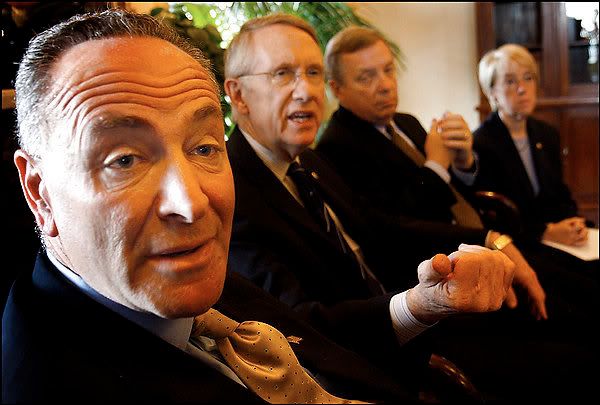
The Senate Judiciary Committee met to question Attorney General Alberto Gonzales. Committee members in attendance were Senators Patrick Leahy (D-VT), Ted Kennedy (D-MA), Herb Kohl (D-WI), Dianne Feinstein (D-CA), Russ Feingold (D-WI), Chuck Schumer (D-NY), Dick Durbin (D-IL), Sheldon Whitehouse (D-RI), Ben Cardin (D-MD), Arlen Specter (R-PA), Orrin Hatch (R-Utah), Chuck Grassley (R-IO), Jon Kyl (R-AZ), Jeff Sessions (R-AL).
Committee members not attending: Joe Biden (D-DE), Lindsey Graham (R-SC), John Cornyn (R-TX), Sam Brownback (R-KS), Tom Coburn (R-OK).
Transcript:LEAHY: Good morning.
I'd ask those who are standing in the back to show courtesy to the people who are -- who stood in line to be here to sit down. Everybody is welcome here who's here. But I would expect all those who are in here for the hearing to respect the rights of everybody who's here and to not stand and block those who are trying to watch the proceedings and have a right to be here.
Three months ago, when Attorney General Gonzales last appeared before this committee, I said that the Department of Justice was experiencing a crisis of leadership perhaps unrivaled during its history. Unfortunately, the crisis has not abated. Until there is independence and transparency and accountability, the crises will continue.
The attorney general's lost the confidence of the Congress and the American people. But through oversight we hope to restore balance and accountability to the executive branch.
The Department of Justice must be restored to being worthy of its name. It should not be reduced to another political arm of the White House; it was never intended to be that. Trust and confidence of the American people in federal law enforcement must be restored.
With the department shrouded in scandal, the deputy attorney general's announced his resignation. The nominee to become associate attorney general requested that his nomination be withdrawn, rather than testify under oath at a confirmation hearing. The attorney general's chief of staff, the deputy attorney general's chief of staff, the department's White House liaison and the White House political director have all resigned, as have others.
I would joke that the last one out the door should turn out the lights, but the Department of Justice is too important for that. We need to shine more light there, not less.
LEAHY: Investigation into the firing for partisan purposes of United States attorneys who had been appointed by this president, along with an ever-growing series of controversies and scandals, have revealed an administration driven by a vision of an all-powerful executive over our constitutional system of checks and balances, one that values loyalty over judgment, secrecy over openness and ideology over competence.
The accumulated and essentially uncontroverted evidence is that political considerations factored into the unprecedented firing of at least nine United States attorneys last year. Testimony and documents show that the list was compiled based on input from the highest political ranks in the White House, that senior officials were apparently focused on the political impact of federal prosecutions and whether federal prosecutors were doing enough to bring partisan voter fraud and corruption cases, and that the reasons given for these firings were contrived as part of a cover-up.
What the White House stonewalling is preventing is conclusive evidence for who made the decision to fire these federal prosecutors. We know from the testimony that it was not the president. Everyone who's testified has said that he was not involved. None of the senior officials at the Department of Justice could testify how people were added to the list or the real reasons that people were included among the federal prosecutors to be replaced. Indeed, the evidence we've been able to collect points to Karl Rove and the political operatives at the White House.
The stonewalling by the White House raises the question, what is it that the White House is so desperate to hide?
The White House has asserted blanket claims of executive privilege despite officials' contention that the president was not involved. They refuse to provide any factual basis for their blanket claims, have instructed former White House officials not to testify about what they know and then instructed Harriet Miers to refuse even to appear as required by a House Judiciary Committee subpoena.
Now, anonymous officials are claiming that the statutory mechanism to test White House assertions of executive privilege no longer govern. In essence, the White House asserts its claim of privilege is the final word, the Congress may not review it and, of course, there's no court dare review it. Here again, this White House claims to be above the law.
My oath, unlike those who have apparently sworn their allegiance to the president, is to the United States Constitution. I believe in checks and balances and in the rule of law.
Despite the stonewalling and obstruction, we've learned that Todd Graves, U.S. attorney in the Western District of Missouri, was fired after he expressed reservations about a lawsuit that would have stripped many African-American voters from the rolls in Missouri. When the attorney general replaced Mr. Graves with Bradley Schlozman, the person pushing the lawsuit, that case was filed and ultimately, of course, was thrown out of court.
LEAHY: Once in place in Missouri, though, Mr. Schlozman also brought indictments on the eve of a closely contested election, despite a Justice Department policy -- longstanding policy not to do so.
This is what happens when a responsible prosecutor is replaced by one considered a, quote, "loyal Bushie," for partisan political purposes.
Mr. Schlozman also bragged about hiring ideological soul-mates.
Monica Goodling, likewise, admitted crossing the line when she used a political litmus test for career prosecutors and immigration judges.
And rather than keep federal law enforcement above politics, this administration is more intent on placing its actions above the law.
The attorney general admitted recently in a video for Justice employees that injecting politics into the department's hiring is unacceptable. But is he committed to corrective action and rooting out the partisanship in federal law enforcement?
His lack of independence and tendency to act as if he were the president's lawyer rather than the attorney general of the United States makes that doubtful.
From the infamous torture memo to Mr. Gonzales' attempt to prevail on a hospitalized Attorney General Ashcroft to certify an illegal eavesdropping program to the recent opinion seeking to justify Harriet Miers' contemptuous refusal to appear before the House Judiciary Committee, the Justice Department has been reduced to the role of an enabler for this administration.
What we need instead is genuine accountability and real independence.
We learned earlier this year of systematic misuse and abuse of national security letters, a powerful tool for the government to obtain personal information without the approval of a court or a prosecutor.
The attorney general has said he had no inkling of these or other problems with vastly expanded investigative powers. But now we know otherwise. Recent documents obtained through the Freedom of Information Act lawsuits and reported in The Washington Post indicate that the attorney general was receiving reports in 2005 and 2006 of violations in connection with the Patriot Act and abuses of national security letters.
Yet, when the attorney general testified under oath before the Senate Select Committee on Intelligence in April 2005, he said that the track record established over the past three years has demonstrated the effectiveness of the safeguards of civil liberties put in place when the act was passed.
Earlier this month, in response to written questions I sent to the attorney general about when he first learned of problems with national security letters, he once again failed to mention these reports of problems.
LEAHY: Only with the openness and honesty that brings true accountability will the department begin to move forward and correct the problems of the last few years.
Instead we have leadership at the Department of Justice who, when expressions of concerns and admissions of mistakes were made, only follow public revelations, and amount to regrets, really, not that mistakes and excesses were made but apparently regrets that somebody found out about those excesses.
In the wake of growing reports of abuses of national security letters, the attorney general announced a new internal program. This supposed self-examination, with no involvement by the courts, no reports to Congress, no other outside check, essentially translates to "trust us."
Well, with a history of civil liberty abuses and cover-ups, this administration has squandered our trust. I am not willing to accept a simple statement of "trust us." I don't trust you.
Early Internal Revenue reviews, like the Intelligence Oversight Board and the Privacy and Civil Liberties Oversight Board have been ineffective and inactive, failing to take action on the violations reported to them. Only with a real check from outside on the executive branch could we have any confidence that abuses will be curbed and balance restored.
And the tragic dimension of the ongoing crisis of leadership at the Justice Department is the undermining of good people and the crucial work that the department does.
Thousands of honest, hardworking prosecutors and agents and other civil servants labor every day to detect and prevent crime, uncover corruption, promote equality and justice, and keep all Americans safe from terrorism.
LEAHY: But sadly, prosecutions will now be questioned as politically motivated. Evidence will be suspected of having been obtained in violation of laws and civil liberties.
Once the government shows a disregard for the independence of the justice system and the rule of law, it's very hard to restore the people's faith. And it's going to be very hard to restore my trust in what is going on.
This committee will do its best to try to restore independence, accountability and commitment to the rule of law to the operations of the Justice Department. That is something that both Republicans and Democrats can agree on.
Senator Specter?
SPECTER: Thank you, Mr. Chairman.
Attorney General Gonzales, I direct the remarks in my opening statement to you.
Your photo appears in the morning press with the caption, "I accept full responsibility." Let me suggest to you that that is not enough. The question is whether the Department of Justice is functioning as it must in order to protect the vital interests of the American people.
Next to the Department of Defense, the Department of Justice has the major responsibility for protecting American security: investigation of terrorism, dealing with drug sales, dealing with organized crime, violent crime. And the issues relating to the resignations of the U.S. attorneys has placed a very heavy cloud over the department. There is evidence of low morale -- very low morale, lack of credibility -- candidly, your personable credibility.
The department is dysfunctional, as so many items have arisen where there is a substantial basis to conclude that there's a preoccupation with the investigation on the resignations of the attorneys.
And I have asked you, both formally in this room and in our private conversations, to give us an explanation as to why each one of these U.S. attorneys was asked to resign, and that has not been done.
We have sought an accommodation to question the remaining witnesses, and I believe that the administration has not had any significant degree of flexibility in trying to work it out with congressional oversight.
I believe we're prepared to concede that there won't be an oath, because there are penalties otherwise; prepared to concede that they could be in private, although they ought to be public, it's the public's business; prepared to concede that both houses wouldn't have to engage in the questioning of these witnesses, that a representative group from the House Judiciary Committee and the Senate Judiciary Committee -- bipartisan, bicameral -- would do the questioning.
SPECTER: But not to have a transcript, I think is patently unreasonable.
But I'm prepared even to do that, if we could get on with this matter, reserving the right for Congress to come back if the informal interviews are unsatisfactory, then to proceed with our authorities under subpoenas. And we were met with a response, "No, if you question these witnesses under our unilateral terms, you can't come back later."
Well, that's simply going too far. I do not believe that the Congress has the right to give up our power. We cannot delegate them, we cannot abrogate them. They are our responsibilities. And we cannot give them up as part of an arrangement with the administration.
And now we have a very remarkable turn of events. We now have the indication -- announcement that the administration will preclude the U.S. attorney from the District of Columbia from pursuing a contempt citation.
SPECTER: Now, if that forecloses a determination of whether executive privilege has been properly imposed, then the president in that manner can stymie congressional oversight by simply saying there is executive privilege. Since we can't take it to the court, the president's word stands and the constitutional authority and responsibility for congressional oversight is gone.
Now, that is carrying this controversy to really an incredible level. If that is to happen, the president can run the government as he chooses, answer no questions, say it's executive privilege. You can't go to court, and the president's word stands.
Now, we've been exploring some alternatives. And I'll be asking you about them.
The attorney general has the authority to appoint a special prosecutor. You're recused, but somebody else could do it. You're recused because you know all of the principals. You have a conflict of interest.
SPECTER: Your recusal is understandable.
But doesn't the president have an identical conflict of interest?
Can the president foreclose the Congress for moving ahead and making an effort at having a judicial determination as to the propriety of the claim of executive privilege?
We also have the alternative of convening the Senate and having a contempt citation and trying it in the Senate. That might be productive.
We could use the precedent of the Alcee Hastings impeachment proceeding, where a committee took over. We had it in this room. I was the vice chairman. Senator Bingaman was the chairman. So we wouldn't take up the full time of the sentiment (sic) in moving for a contempt citation.
But we're going to have to move ahead on that, Mr. Attorney General.
We have so many items that every week a new issue arises. And I sent you letters advising you that we would be pursuing these matters at this hearing.
One is on the legality for the terrorist surveillance program.
You said categorically there has not been any serious disagreement about the program. And yet we know from former Deputy Attorney General James Comey exactly the opposite is true.
This is what he testified. When you and the chief of staff went to extract from then-Attorney General Ashcroft, who was in the hospital under sedation, approval of the program, Mr. Comey, quote: "I was very upset. I was angry. I thought I had just witnessed an effort to take advantage of a very sick man."
I'll be asking you about that, giving you a chance to explain that, although it bedevils me to see any conceivable explanation for your saying "No disagreement," and you're going to the hospital of the attorney general, who's no longer in power -- he's delegated his authority -- and seek to extract approval from him.
SPECTER: It seems to me that it is just decimating, Mr. Attorney General, as to both your judgment and your credibility.
But that's not all. The list goes on and on.
I wrote to you about the death penalty case, where U.S. attorney Paul Charlton could only get five to 10 minutes of the time of the deputy attorney general, who talked to you. You wouldn't talk to him. We'll give you a chance to explain that.
The Patriot Act: You testified repeatedly, no problems. And there's a wealth of information about very serious incidents.
And then this OxyContin case, which has reached the newspapers, where there was malicious, deliberate falsification of the medicine -- people died.
Is your department functioning? Do you review these matters? How many matters are there which do not come to our attention because you don't tell us and the newspapers don't disclose them?
Thank you, Mr. Chairman.
LEAHY: Thank you very much.
And I might mention Senator Specter has requested a hearing on OxyContin. And I think he's absolutely right on that.
We will have one, at your request.
Mr. Attorney General, please stand and raise your right hand. Do you solemnly swear that the testimony you will give at this time will be the truth, the whole truth, and nothing but the truth, so help you God?
GONZALES: I do.
LEAHY: Go ahead, Mr. Attorney General.
GONZALES: Thank you, Mr. Chairman.
LEAHY: I should note before you start that there will be a series of votes around 10:20 and I'll consult with Senator Specter how best to continue during that time. At most, we will try to limit the break.
Go ahead.
GONZALES: I understand, Mr. Chairman.
I do have the great pleasure to work with over 100,000 dedicated public servants at the Department of Justice. I admire the dedication to pursue justice for all Americans.
GONZALES: The department's many accomplishments are, in reality, their accomplishments. As attorney general, I have worked with these fine men and women to keep our country safe from terrorists, our neighborhoods safe from violent crime and our children safe from predators. As my written statement explains in more detail, when it comes to keeping our neighborhoods safe and protecting our children, the department has made great progress.
In my brief remarks this morning, I want to focus on the department's number one priority, keeping our country safe from terrorists and the urgent need, quite frankly, for more help from Congress in this fight.
As the recent National Intelligence Estimate has -- as well as the attempted car bombings in London and Scotland demonstrate, the threat posed to America and its allies by Al Qaida and other terrorist groups remains very strong.
To respond effectively to this threat, it is imperative that Congress modernize the Foreign Intelligence Surveillance Act of 1978, known as FISA. Doing so is critically important to intelligence gathering, and it really just makes plain sense.
When Congress drafted FISA in 1978, it defined the statute's key provisions in terms of telecommunications technologies that existed at that time. As we all know, there have been sweeping changes in the way that we communicate since FISA became law and these changes have had unintended consequences on FISA's operation.
For example, without any change in FISA, technological advancements have actually made it more difficult to conduct surveillance on suspected terrorists and other subjects of foreign intelligence surveillance overseas.
In April, at the request of the Senate Select Committee on Intelligence, the director of national intelligence transmitted a comprehensive FISA modernization proposal to Congress. The proposal builds upon thoughtful (ph) bills introduced during the last Congress, and the bill would accomplish several key objectives. Most importantly, the administration's proposal restores FISA's original focus on protecting the privacy of U.S. persons in the United States.
FISA generally should apply when conducting surveillance on those in the United States, but it should not apply when our intelligence community targets persons overseas. Indeed, it was advancements in technology and not any policy decision of Congress that resulted in wide-scale application of FISA and its requirement to go to court to overseas targets.
This unintended consequence has clogged the FISA process and, quite frankly, hurts national security and civil liberties.
GONZALES: As amended, FISA's scope would focus on the subject of the surveillance and the subject's location, rather than on the means by which the subject transmits a communication or the location where the government intercepts the communication.
FISA would become technology-neutral. Its scope would no longer be affected by changes in communications technologies.
The bill would also fill a gap in current law by permitting the government to direct communications companies to assist in the conduct of lawful communications intelligence activities that do not constitute, quote, "electronic surveillance" under FISA.
This is a critical provision that is a necessary companion to any change in FISA's scope.
Importantly, the administration's proposal would provide a robust process of judicial review for companies that wish to challenge these directives.
The administration's proposal would also provide protections from liability to companies that are alleged to have assisted the government in the wake of the September 11th terrorist attacks.
The bill also streamlines the FISA application process to make FISA more efficient, while at the same time ensuring that the FISA Court has the information it needs to make the probable cause findings required.
Finally, the administration's proposal would amend the statutory definition of an agent of a foreign power to ensure that it includes groups who are engaged in international proliferation of weapons of mass destruction or who possess or who are expected to transmit or receive foreign intelligence information while in the United States.
FISA modernization is critically important and we urge the Senate to reform this critical statute as soon as possible.
I am hopeful that this is an area that we can work together with the Congress and this committee. I think we can find common ground on the central principles underpinning the administration's proposal and in particular on the fact that we should not extent FISA's protections to terrorist suspects located overseas.
We already have had several helpful sessions with the Intelligence Committees in the Senate and House on this issue. We look forward to continuing to work with the Senate and this committee on this important endeavor.
Thank you, Mr. Chairman.
LEAHY: Thank you, Mr. Attorney General. And your full statement, of course, will be made part of the record.
We have documents that we have not in answer to a request made by this and other committees, but obtained through Freedom of Information Act lawsuits. They indicate that you received reports in 2005 and 2006 of violations in connection with the Patriot Act, abuses of national security letters. The violations apparently included unauthorized surveillance, illegal searches and improper collection of data.
LEAHY: But when you testified before the Senate Select Committee on Intelligence in April of 2005, you sought to create the impression that Americans' civil liberties and privacies were being effectively safeguarded and respected.
And you said, and I quote, "The track record established over the past three years has demonstrated the effectiveness of the safeguards of civil liberties put in place when the act was passed."
Then I sent you written questions. And earlier this month, you responded about when you first learned of problems with national security letters. But in those responses, you didn't mention these earlier reports of problems.
So my question is this. As you know, I've written a number of these questions to you in advance so that you will be able to answer. Would you like to revise or correct your April 2005 testimony to the Senate Select Committee on Intelligence, which was misleading, or your July 6, 2007, response to this committee's written questions, related?
You care to revise either of them?
GONZALES: Thank you for the question, Mr. Chairman.
And I can understand the confusion of concern about my prior statements, which, of course, were made in connection with the discussions about reauthorization of the Patriot Act, and were also made in the context of the I.G.'s investigation of abuses under the Patriot Act, exercising his authority under the Patriot Act to investigate abuses.
And my comments reflect -- are similar to comments made by the director of the FBI...
LEAHY: I don't care if they're similar to anybody else. They're your comments that I'm concerned about. I'm not concerned about somebody else's comments. I'm concerned about yours. They seemed contradictory.
GONZALES: And my comments reflected the understanding, on my part, Mr. Chairman, that IOB violations -- which is what I want to refer to these, as IOB violations, referrals or violations made to the Intelligence Oversight Board -- that these do not reflect, as a general matter, intentional abuses of the Patriot Act.
LEAHY: Are you saying they're not abuses if they're not committed without malice? Is that what you're saying?
GONZALES: That's not what I'm saying.
(CROSSTALK)
GONZALES: Obviously, they're very, very -- and every such abuse, because it does constitute abuse, is in fact referred to the IOB and also is in fact referred to the Inspection Division at the FBI.
Now, the good news is that when the referral occurs, there is an examination and appropriate action is taken.
The other bit of good news is, as I have directed, that each IOB referral to the FBI will also be made simultaneously to the National Security Division. And the National Security Division is going to study these IOBs, make a semiannual report to me, and identify whether or not there are any trends there that we identify.
LEAHY: Well, let me ask you about that. Because I understand that approximately 500 -- and if you want to go back and elaborate on your answer, I will certainly give you time, because I don't think you've answered the question I asked.
LEAHY: But you keep talking about the Intelligence Oversight Board. These things are referred to it.
I understand that approximately 500 incidents are annually referred to the Intelligence Oversight Board, but the general counsel of the FBI hasn't received a single response from the board. I mean, I thought I was the only one that didn't get responses, but apparently 500 a year you don't get back a single response. The board has not sent forward a single report of potentially unlawful intelligence activities. But you talk about oversight system and report to that same board.
I mean, I -- you know, is this, "Oh, gosh, we have a problem. We won't tell anybody about it. We'll send it to somebody who will file it away and nothing will ever be heard again, so therefore we have no problems"? It's almost an Alice in Wonderland situation.
GONZALES: I think you've misunderstood my response, Mr. Chairman.
What I said, or certainly intended to say, was the fact that it's referred to the IOB doesn't mean that it stops there. It is also sent to the Inspections Division and appropriate action is taken.
We've also instituted another check by involving the National Security Division so that they can also identify any trends and make suggestions in policies or training so that we can address these kinds of issues.
LEAHY: In April 2005, when you said, "The track record established in the past three years demonstrates the effectiveness of the safeguards" -- that there, basically there hadn't been any violations, was that correct or not? Had there been violations?
GONZALES: What I can say is...
LEAHY: Three years before you testified, had there been any violations?
GONZALES: The violations...
LEAHY: Yes or no?
GONZALES: A violation of IOB may not be a violation of the Patriot Act. In fact, the inspector general, I think, has indicated that.
And, Mr. Chairman, my view and the views of other leadership in the department is in fact when we're talking about abuses of the Patriot Act, we're talking about intentional, deliberate misuse of the Patriot Act, not when some agent writes down the wrong phone number in a national security letter.
And, of course, whenever a mistake like that happens, of course we address it and appropriate action is taken.
LEAHY: Such as?
GONZALES: We institute training for -- additional training. It's a question of providing additional guidance, providing additional training or disciplinary action against the agent.
LEAHY: Well, (inaudible) ask you this. We have 93 United States attorneys. Only 70 have been confirmed by the Senate. Any idea when we're going to get -- six have just been sent up -- when we're going to get the 17 remaining ones?
GONZALES: We are working as hard as we can with the White House and with members of Congress so that we can go through the vetting process, evaluation process, so we can make recommendations to the president.
The full intent is that, as I've committed to this committee, is that we are going to have Senate-confirmed U.S. attorneys in these positions.
LEAHY: I would hope so, because you tried to do that backdoor thing you got inserted into the law. And the Congress has repealed that because of revulsion (ph) of the use of it. The president signed that.
My last question is this: As you know, if either the Senate or House finds somebody in contempt, they have to refer it to the U.S. attorney for the District of Columbia, who has to then not necessarily prosecute, but at least present the contempt citation to a grand jury to determine whether criminal charges are appropriate.
LEAHY: Last week, the administration said that the U.S. attorney wouldn't be allowed to carry out that.
So my question to you is, if a house of Congress certified a contempt citation against former or current officials for failing to appear or comply with a congressional subpoena, would you permit the U.S. attorney to carry out the law and refer the matter to a grand jury, as required by 2 USC 194, and, therefore, fulfill the constitutional duty to faithfully execute the law, or would you block the execution of the law?
GONZALES: Mr. Chairman, your question relates to an ongoing controversy which I am recused from. I can't -- I'm not going to answer that question.
LEAHY: Is there anybody left in the Department of Justice who could answer the question?
GONZALES: Of course there is.
LEAHY: Who?
GONZALES: With respect to these kind of decisions...
LEAHY: Who?
GONZALES: ... will be made by the solicitor general.
LEAHY: Well, then we may ask him whether on this refusal to prosecute that the administration talked about, whether that extends to the executive branch lying to Congress,or perjury or destruction of evidence or obstruction of justice. Because, Mr. Attorney General, those are going to be real issues. They're not going to be -- they're not going to be just debating points.
Thank you.
Senator Specter?
SPECTER: Let me move quickly through a series of questions -- there's a lot to cover -- starting with the issue that Mr. Comey raises.
You said, quote, "There has not been any serious disagreement about the program."
Mr. Comey's testimony was that Mr. Gonzales began to discuss why they were there, to seek approval, and he then says, quote, "I was very upset. I was angry. I thought I had just witnessed an effort to take advantage of a very sick man."
SPECTER: First of all, Mr. Attorney General, what credibility is left for you when you say there's no disagreement and you're party to going to the hospital to see Attorney General Ashcroft under sedation to try to get him to approve the program?
GONZALES: The disagreement that occurred, and the reason for the visit to the hospital, Senator, was about other intelligence activities. It was not about the terrorist surveillance program that the president announced to the American people.
Now, I would like the opportunity...
SPECTER: Mr. Attorney General, do you expect us to believe that?
GONZALES: Well, may I have the opportunity to talk about another very important meeting in connection with the hospital visit that puts it into context?
It was an emergency meeting in the White House Situation Room that afternoon. It involved senior members of the administration and the bipartisan leadership of the Congress, both House and Senate, as well as the bipartisan leadership of the House and Senate Intel Committees, the gang of eight.
The purpose of that meeting was for the White House to advise the Congress that Mr. Comey had advised us that he could not approve the continuation of vitally important intelligence activities despite the repeated approvals during the past two years of the same activities.
SPECTER: OK.
Assuming you're leveling with us on this occasion...
(CROSSTALK)
SPECTER: No, I want to move to the point about how can you get approval from Ashcroft for anything when he's under sedation and incapacitated -- for anything.
GONZALES: May I continue the story, Senator?
SPECTER: No, I want you to answer my question.
GONZALES: Senator, obviously there was concern about General Ashcroft's condition.
GONZALES: And we would not have sought nor did we intend to get any approval from General Ashcroft if in fact he wasn't fully competent to make that decision.
But General -- there are no rules governing whether or not General Ashcroft can decide, "I'm feeling well enough to make this decision."
SPECTER: But, Attorney General Gonzales, he had already given up his authority as attorney general.
(CROSSTALK)
SPECTER: ... was no longer attorney general.
GONZALES: And he could always reclaim that.
There are no rules...
SPECTER: While he's in the hospital under sedation?
(LAUGHTER)
GONZALES: Again, we didn't know -- we knew, of course, that he was ill, that he'd had surgery...
SPECTER: Not making any progress here. Let me go to another topic.
(LAUGHTER)
Attorney General, I wouldn't -- and I'd like to have a lot of time, but I've got three minutes and 43 seconds left, and seven topics to cover with you.
Mr. Attorney General, do you think constitutional government in the United States can survive if the president has the unilateral authority to reject congressional inquiries on grounds of executive privilege and the president then acts to bar the Congress from getting a judicial determination as to whether that executive privilege is properly invoked?
GONZALES: Senator, you're asking me a question that is related to an ongoing controversy which I am recused -- I will say the president's tried very hard...
SPECTER: Oh, no, no. I'm not asking you a question about something you're recused. I'm asking you a question about constitutional law.
GONZALES: You're asking me a question that's related to an ongoing controversy.
SPECTER: I'm asking you whether you can have a constitutional government with the Congress exercising its constitutional authority for oversight if when the president claims executive privilege, the president then forecloses the Congress from getting a judicial determination of it. That's a constitutional law question.
GONZALES: Senator, both the Congress and the president have constitutional authorities. Sometimes they clash. In most cases, accommodations are reached. In very rare instances, they sometimes litigate it in the courts.
SPECTER: Would you focus on my question for just a minute, please?
GONZALES: Senator, I'm not going to answer this question, because it does relate to an ongoing controversy in which I am recused.
(BOOING)
LEAHY: I would note, please, we'll have decorum in here.
Senator Specter has a right to ask all the questions he has. The attorney general has a right to be heard. I have indicated to Senator Specter especially that I'm taking some of his time in saying this, so he has extra time.
But, please, let us continue without comments.
SPECTER: I'm not going to pursue that question, Mr. Attorney General, because I see it's hopeless. It's got nothing to do with your recusal.
You're the attorney general, and you're also a lawyer. And we're dealing with a very fundamental controversy, where the president is exerting executive authority under executive privilege and the Congress is exerting constitutional authority for oversight. And we're trying to take it to court.
The court decides when that conflict exists. It's got nothing to do with, necessarily, the U.S. attorneys who were asked to resign.
Let me move ahead to another subject, see if I get an answer here.
You have a conflict of interest on the matter involving the resignations of the U.S. attorneys.
GONZALES: Yes. I'm recused for that.
SPECTER: Does the president have a conflict of interest in deciding whether or not to allow a contempt citation to go forward to a former White House counsel, Harriet Miers?
GONZALES: Senator, I am not going to answer that question. Again, you're talking about -- asking me questions about a matter in which I am recused. I'm not going to answer that question.
SPECTER: Well, let's see if somehow, somewhere, we can find a question you'll answer.
(LAUGHTER)
How about the death penalty case? I wrote you about this.
Had a man who was convicted of murder. The victim's body was never recovered. There was no forensic evidence directly linking the defendant to the victim's death. The U.S. attorney, a man named Paul Charlton, contacted your office and said, "I don't think this is a proper case for the death penalty."
SPECTER: Deputy Attorney General Paul McNulty had a conversation with Mr. Charlton and had a conversation with you. And then McNulty's chief of staff, Mike Ellston, called Charlton. And this is Charlton's testimony: "Ellston indicated that McNulty had spoken to the attorney general and that McNulty wanted me to be aware of two things; first, that McNulty had spent a significant amount of time on this issue with the attorney general, perhaps as much as five or 10 minutes."
Is that accurate, factually? Will you answer a question as to a fact, as to whether you talked to McNulty about this case for as much as five or 10 minutes?
GONZALES: I have no specific recollection as to this particular case.
But I can tell you, we have a very detailed process, where hours are spent by lawyers, including the U.S. attorney, our capital case review unit, who then make recommendations to the deputy attorney general...
SPECTER: I'm not interested in that. I'm interested in an answer to my question. If you don't know, if you don't remember...
GONZALES: I don't -- I don't...
SPECTER: Wait a minute. I'm not finished asking you a question.
If you don't know or you don't remember what happened when you stood on a decision to have a man executed -- that's what you're saying.
GONZALES: I have no specific recollection about the amount of time that I talked with Paul McNulty on this particular issue.
SPECTER: Well, would you disagree with McNulty that it was five to 10 minutes?
GONZALES: I can't agree with that if I don't recall, Senator.
SPECTER: OK, you can't agree with it. I didn't ask you that. I asked you if you disagreed with it.
GONZALES: I can't agree or disagree with it.
SPECTER: Would you say that five to 10 minutes would be a, quote, "significant amount of time" for you to spend on a case involving the death penalty?
GONZALES: It would depend on the circumstances of the case and the recommendations coming up and the facts. Those would all dictate how much time I would spend, personally, on a particular case.
Because we have a very extensive review process within the department, where hours are spent analyzing what is the appropriate course of action for the department...
SPECTER: Well, Mr. Attorney General, I'm not totally unfamiliar with this sort of thing. When I was district attorney of Philadelphia, I had 500 homicides a year. I didn't allow any assistant to ask for the death penalty that I hadn't personally approved. And when I asked for the death penalty, I remembered the case.
Thank you, Mr. Chairman.
LEAHY: Thank you very much.
Senator Kohl?
KOHL: Thank you, Mr. Chairman.
Mr. Attorney General, the detention center at Guantanamo Bay continues to harm our image around the world. There's growing consensus on this. Secretary of Defense Robert Gates told the House Committee, quote, "I came to this job thinking that Guantanamo Bay should be closed."
KOHL: According to press reports, Secretary of State Rice has also supported efforts within the administration to close Guantanamo.
And former Secretary of State Colin Powell said, quote, "If it was up to me, I would close Guantanamo -- not tomorrow, but this afternoon."
Last year even the president himself recognized that Guantanamo has been the focus of international criticism and he said, I quote, "I'd like to, quote, 'close Guantanamo.'"
Recent press reports have disclosed that efforts are under way in the administration to do that. According to the New York Times, however, these efforts, quote, "were rejected after Attorney General Gonzales and some other government lawyers expressed strong objections."
So where are you on this? Do you think that we should close Guantanamo?
GONZALES: I wish we could close Guantanamo. I'm with everyone else: We should close Guantanamo.
However, a need remains -- and there are legitimate questions about what do you do with these individuals?
I guess we could turn them loose, Senator, and they could end up fighting against us again. We could bring them into the United States, although I understand the Senate recently rejected that overwhelmingly.
Bringing them into the United States raises some serious legal issues. And as the attorney general, my job was to make sure that all the policy-makers were aware that there were serious legal issues that would arise if in fact they were brought into the United States.
But if your question is, would I support closing Guantanamo? Absolutely, but not at the risk of the lives of our men and women who are fighting overseas and not at the risk of the national security of our country.
KOHL: But we can put them into the American justice system, an American justice system that you know has worked very effectively even with respect to dealing with terrorists and members of Al Qaida. There are ways in which we can restrict classified information, important information.
So if you support closing Guantanamo, then why don't you put into motion the kinds of things that will result in just that?
GONZALES: Senator, I do believe there are legitimate risks involved in bringing people into the United States and putting them into our system, quite frankly.
KOHL: What are the risks?
GONZALES: Let's say that the evidence that we have is not evidence that we want to compromise in order to bring someone to trial. Once they're into the United States, if they come from a country where if we send them back they may be tortured, they will have the right to ask for asylum. And so we may not have the ability to either hold them or to throw them out of the United States, and we have to let them go.
And so those are, sort of, the nightmare scenarios that we worry about in bringing people into the United States.
KOHL: Are you saying, therefore, that you do not support closing Guantanamo?
GONZALES: I support closing Guantanamo, Senator, but I think we need to do it with our eyes wide open.
I think we probably will come to the Congress and ask for legislation in order to ensure that we can protect this country.
KOHL: Why don't we do that?
GONZALES: That is certainly something that is of serious discussion and debate within the administration.
KOHL: So you may in fact decide to close Guantanamo and come to Congress for authorization.
GONZALES: Again, there's been no decision made by the president. My judgment is the president, like you, wants to close Guantanamo, but, like you, he doesn't want to do so if it means jeopardizing the security of our country.
And so, we're trying to work through these. And you're right, it will ultimately, in my judgment, require additional consultation with the Congress.
KOHL: Mr. Attorney General, consumers today, as you know, are suffering from near-record high gas prices, and most of this is due to the high price of crude oil.
Despite this, the administration has threatened to veto our NOPEC legislation, which would enable the Justice Department, and only the Justice Department, to sue OPEC member nations for violating U.S. antitrust law when they conspire to fix the price of oil, which they do.
This bill passed both the House and the Senate with overwhelming margins. Under this bill, the Justice Department, and only the Justice Department, could institute this kind of a proceeding. So why do you not want this authority?
GONZALES: I think cartels are bad, and we ought to prosecute them and go after them.
GONZALES: I agree with that.
The question is whether or not going after this cartel in this way, through litigation, is the right approach, because you implicate questions of sovereignty and state action. And, you know, it calls into question the fact that, you know, we have a presence overseas and does that mean that either the American government or American businesses are going to be subject to litigation and the jurisdiction of other countries overseas?
I think that that's a concern that we have is the downstream impact, or the result, the impetus that's going to arise as a result of this legislation.
And we think that a better approach is to continue to try to work through this through the Department of Energy and the Department of State, through diplomatic means.
And that's the concern that we have, Senator.
Again, cartels are bad. We'd like to deal with it. I just -- we're concerned that this may not be the best approach.
KOHL: But you don't have to use it. Because you don't -- you know that the only way in which the legislation can be effected is through the president and the Department of Justice. So if you think it's legislation that should not be used, so you won't use it.
GONZALES: But once Congress passes the legislation and puts it on the books, what's going to be the response of another country who sees this action taken by the Congress? And are they going to take some kind of action in response to simply the legislation passing?
It's hard to predict. I would simply urge the Congress to consider giving the Department of State and the Department of Energy additional time to try to work through this.
KOHL: Mr. Attorney General, since our last oversight hearing, it seems that very little has improved at the Justice Department. And many of the people in senior positions have resigned, as you know. And according to press reports, these positions have not been filled, in many cases because people have turned down these jobs. The American public has lost confidence in you according to recent polls. Morale at the Justice Department remains low. The integrity of the
Office of the Attorney General as an institution is obviously more important, I'm sure you would agree, than the person sitting in it. In other words, Mr. Attorney General, this cannot be just all about you.
And so, would you please explain to us why the administration of justice and the American people would not be better served by somebody sitting in the office who does not have all of the problems that you possess with respect to believability, credibility, confidence, trust? What keeps you in the job, Mr. Attorney General?
GONZALES: That's a very good question, Senator.
Ultimately I have to decide whether or not it would be better for me to leave or just stay and try to fix the problems. I've decided to stay and fix the problems. And that's what -- and that's what I have been doing.
You talked about vacancies. We're at a time in the administration where there are going to be vacancies in agencies. It's just natural.
Obviously there have been changes in personnel at the leadership of the department. In many ways, that is a good thing. We've just identified a new interim deputy attorney general who's a career prosecutor. I think he'll do a great job.
GONZALES: I've got a chief of staff who's also a United States attorney.
And so we've got -- we're bringing in good, experienced people into these positions, because we want to address the question about lack of leadership. I think we have some strong leadership in the Department of Justice.
We've changed policies. We've been made aware of some issues relating to some of our policies, with respect to hiring immigration judges, with respect to the honors program, with respect to hiring assistant United States attorneys, with respect to hiring in Civil Rights Division. And so we've implemented policies to address each and every one of these.
We've also worked very hard to improve communication; not with just the U.S. attorney community, but also with respect to every employee at the Department of Justice.
I think the way you measure morale is you measure output. And I think if you look at the output at the department these past six months, it's been outstanding.
Sure, we've had to deal with these issues. They're my responsibility, and I've accepted responsibility for it. But the wonderful career people at the department continue doing their job day in and day out, and justice is being served in this country.
KOHL: Thank you very much.
Thank you, Mr. Chairman.
LEAHY: Thank you.
Senator Hatch?
HATCH: Thank you, Mr. Chairman.
Well, I want to make it clear that having gone there -- one of the earliest ones to go there -- I do not agree with closing Guantanamo. The big issue is, even if we did, what do we do with them? What's the alternative? I've heard a lot of the senators around here bemoaning the fact they sure don't want these terrorists in their state. The fact of the matter is, it's a separate place where they can be contained and appropriately so.
So I'm opposed to it, closing Guantanamo. I think it's ridiculous. I think the arguments have been ridiculous. And I hope you will consider changing your mind on that, because I just think it's wrong.
But now, you may not have had -- having said that, I just thought I'd make that point.
You may not have had a full opportunity to explain what happened the day of your hospital visit to Attorney General Ashcroft. So if you would, please finish your description of those events so we can all understand just what happened there.
GONZALES: The meeting that I was referring to occurred on the afternoon of March 10th, just hours before Andy Card and I went to the hospital.
GONZALES: And the purpose of that meeting was to advise the gang of eight, the leadership of the Congress, that Mr. Comey had informed us that he would not approve the continuation of a very important intelligence activity despite the fact the department had repeatedly approved those activities over a period of over two years.
We informed the leadership that Mr. Comey felt the president did not have the authority to authorize these activities, and we were there asking for help, to ask for emergency legislation.
HATCH: Was Mr. Comey there during those two years?
GONZALES: He was not there during the entire time, no, sir.
HATCH: How much of that time?
GONZALES: I can't recall now, Senator, when Jim Comey became the deputy attorney general.
The consensus in the room from the congressional leadership is that we should continue the activities, at least for now, despite the objections of Mr. Comey.
There was also consensus that it would be very, very difficult to obtain legislation without compromising this program, but that we should look for a way ahead.
It is for this reason that within a matter of hours Andy Card and I went to the hospital. We felt it important that the attorney general knew about the views and the recommendations of the congressional leadership, that as a former member of Congress and as someone who had authorized these activities for over two years that it might be important for him to hear this information.
That was the reason that Mr. Card and I went to the hospital.
Obviously, we were concerned about the condition of General Ashcroft. We obviously knew he had been ill and had surgery. And we never had any intent to ask anything of him if we did not feel that he was competent.
When we got there, I will just say that Mr. Ashcroft did most of the talking. We were there maybe five minutes -- five to six minutes.
Mr. Ashcroft talked about the legal issues in a lucid form, as I've heard him talk about legal issues in the White House. But at the end of his description of the legal issues, he said, "I'm not making this decision. The deputy attorney general is."
And so Andy Card and I thanked him. We told him that we would continue working with the deputy attorney general and we left.
And so I just wanted to put in context for this committee and the American people why Mr. Card and I went. It's because we had an emergency meeting in the White House Situation Room, where the congressional leadership had told us, "Continue going forward with this very important intelligence activity."
I might also add...
HATCH: That was the gang of eight, you're saying.
GONZALES: Pardon me?
HATCH: That was the gang of eight.
GONZALES: This was the gang of eight.
HATCH: The two leaders in the House, the two leaders in the Senate, the two leaders of the Intelligence Committee in the House and the two leaders of the Intelligence Committee in the Senate, right?
GONZALES: That is correct.
I might also add...
HATCH: Democrats and Republicans?
GONZALES: Democrats and Republicans.
I might also add that the urgency was is that the authorities in question were set to expire the very next day.
HATCH: Right.
GONZALES: And the president believed this was a very important activity, as did the congressional leadership. In fact, the very next morning we had the Madrid bombings. And so that puts in perspective the context of the environment that we were operating under. And these are the reasons why we went to the hospital on the evening of March 10th.
HATCH: Well, thank you, sir.
The administration's made proposals to modernize FISA, of course, and is working with the Judiciary Committee to ensure that appropriate staff members have the necessary information about the terrorist surveillance plans of the administration.
However, some members of the committee have stated that they will not consider any legislation in this area until they receive additional information about the TSP. I do find this logic somewhat questionable, since this very committee not only considered but passed three different bills dealing with FISA modernization during the last Congress.
How do you view the decision to not discuss FISA modernization? Of all issues, isn't this one in which increased attention and expediency is paramount?
GONZALES: This is the most important legislative agenda item for the Department of Justice, FISA modernization.
The threats exist against the United States and we believe that FISA, while it's been a valuable tool, also has made it more difficult to engage in electronic surveillance of foreign targets overseas. We don't believe that was ever the intent of FISA.
It's a policy question. The Congress has to decide, do they want the department and the agency -- NSA, the FBI, the Department of Justice -- utilizing our resources, our agents, our analysts, our lawyers in order to make a probable cause determination and then present it to a judge in connection with a foreign terrorist who's located outside the United States?
GONZALES: Is that what the Congress wants us to do? Because if they do, we'll continue to do it, but I think it's a legitimate question to ask. Is that the right policy for the United States today.
HATCH: You've been accused of wanting to install interim U.S. attorneys to serve indefinitely without Senate confirmation. I don't think there's ever been any evidence for that, but then some accusations could be more useful than they are true.
Since you were first asked about this more than a year-and-a-half ago, you said that it is your intention to have a Senate-confirmed appointee to these positions.
Now, I raise this point to point out that we continue to see nominations to the U.S. attorney positions of men and women who have been serving in an interim capacity. This is exactly what you said the administration intended to do, if I recall it correctly. We've seen this recently in Nebraska, Puerto Rico and elsewhere.
Now, is that your continued commitment: to have Senate-confirmed U.S. attorneys in each jurisdiction?
GONZALES: It is. I believe that U.S. attorneys, quite frankly, are stronger in dealing with other law enforcement counterparts at the federal, state and local level. And it's also, I think, vitally important with respect to the deputy attorney general.
We have, I think, a very strong interim -- we will have soon a very strong interim deputy attorney general, but my intention and hope is that we have someone who is considered and confirmed by the Senate soon.
HATCH: Well, thank you.
Thank you, Mr. Chairman.
LEAHY: Are you saying that the interim attorney general who has served as an interim U.S. attorney in two different places -- his name was never sent up for confirmation for that -- his name will now probably be sent up here for confirmation for something?
GONZALES: His name -- well, I'm not saying that his name will be sent up for confirmation. After the White House has completed its very thorough background investigation and interviews of candidates, the intention is to send up someone for consideration by the Senate to confirm as the deputy attorney general.
LEAHY: He's interim, having been an interim U.S. attorney general in two different jurisdictions?
GONZALES: He is the -- he will be interim as soon as Mr. McNulty leaves.
LEAHY: Thought I'd ask. And you said that -- you spoke of how important it is to you -- to have this committee look at updates for FISA. Have you ever taking even 30 seconds or a minute to call me and tell me that? I mean, I just heard this from you for the first time here. You know, I have a listed telephone number.
GONZALES: I'm sorry. I lost my transmission.
LEAHY: You just said to Senator Hatch that it's extraordinarily important for you that this committee consider updates on FISA laws. Have you ever said that to me? Have you ever picked up the phone and called me or told me that?
GONZALES: Senator, I would be surprised if that hasn't been communicated in a letter, and certainly, it's been communicated to your staff in terms of the importance of FISA modernization.
LEAHY: I have a listed telephone number. Feel free to call anytime.
Senator Feinstein -- if it is that important to you.
FEINSTEIN: Thank you very much, Mr. Chairman.
Mr. Attorney General, I've sat here and listened particularly to the opening comment of the chairman and the ranking member, and in my time in the Senate, I have never heard comments quite like that coming from both sides of the aisle. And then I listened to your response, which was nonresponsive which went into something about FISA, unrelated to anything that had been said.
I don't think you understand what's happening in the Department of Justice, the diminution of credibility, integrity. It's almost as if the walls were actually crumbling on this huge department.
FEINSTEIN: And I listen to you. And nothing gets answered directly. Everything is obfuscated.
You can't tell me that you went up to see Mr. Comey for any other reason other than to reverse his decision about the terrorist surveillance program. That's clearly the only reason you would go to see the attorney general in intensive care.
GONZALES: May I respond to that?
FEINSTEIN: Yes, you may.
GONZALES: OK. You're right. This is an extraordinary event. But we were confronting extraordinary circumstances where we had been advised that something that the department had authorized for two years, they would no longer continue to approve.
We'd just been advised by the congressional leadership: Go forward anyway. And we felt it important that the attorney general, General Ashcroft, was aware of those facts.
Clearly, if we had been confident and understood the facts and was inclined to do so, yes, we would have asked him to reverse the DAG's position. But...
FEINSTEIN: Well, then, why would he have said Mr. Comey is in charge, if you hadn't asked him?
GONZALES: I don't understand the question.
FEINSTEIN: Well, clearly you asked him the question, because James Comey testified to us that...
GONZALES: My recollection, Senator, is -- and, of course, this happened some time ago and people's recollections are going to differ. My recollection is that Mr. Ashcroft did most of the talking. At the end, my recollection is, he said, "I've been told it would be improvident for me to sign. But that doesn't matter, because I'm no longer the attorney general."
FEINSTEIN: OK. All right.
GONZALES: And once he said that, Secretary Card and I didn't press him. We said thank you, and we left.
FEINSTEIN: OK.
GONZALES: But, again, we went there because we thought it important for him to know where the congressional leadership was on this. We didn't know whether or not he knew of Mr. Comey's position and, if he did know, whether or not he agreed with it.
FEINSTEIN: All right. I think we've taken care of this.
What I'd like to establish, once and for all, is who put the names on the list to fire what are now nine U.S. attorneys.
Since you were here last, we've had a number of your top staff appear before us. Kyle Sampson, your former chief of staff, said, "I was the aggregator of input that came in from different sources."
Paul McNulty said it was presented to me as here is the idea and here are the names of individuals that are being identified.
Jim Comey said, "I was not aware there was any kind of process going on."
FEINSTEIN: Bill Mercer said, "I didn't understand there was a list. I didn't keep a list."
Mike Battle: "A decision was made to compile a list. It was made by someone. I had no input. Nobody asked for my input."
Will Moschella: "Since I was not part of that process, I don't have firsthand knowledge."
Mike Ellston: "Kyle asked me to give him my thoughts, give him a draft list. I said, sure. I didn't actually do it. I was very busy."
Who approved those names?
GONZALES: I ultimately approved the list of recommendations that were submitted to me. I accept responsibility.
FEINSTEIN: And how many names did you approve for firing?
GONZALES: I think, on the list that was presented...
FEINSTEIN: Oh, no -- total. How many names have you approved for firing?
GONZALES: You mean total, for cause, not for cause?
I'd have to get back to you on that.
FEINSTEIN: There were seven on December 7.
GONZALES: Seven on December 7.
FEINSTEIN: We're now up to nine that we know about. How many -- this is important -- how many U.S. attorneys did you approve to be summarily fired?
GONZALES: Senator, there may have been others. I would be happy to get back to you with that kind of information about who has left. But I don't know the answer to your question. But I can certainly find out.
FEINSTEIN: You don't know, after all we've been through, the hearing after hearing after hearing?
GONZALES: Well, in connection with this review process that Mr. Sampson was coordinating, what was presented to me was a list of seven individuals, on December 7. And so those are the seven that I accepted the recommendation to ask for resignation.
FEINSTEIN: That's right. But those were the ones that were called on December 7 and told to leave by January 15.
GONZALES: Yes.
FEINSTEIN: There were others also asked to resign.
GONZALES: Yes.
FEINSTEIN: And I'm asking what the total number were.
GONZALES: Well, certainly, Mr. Cummins was asked to leave. Mr. Graves was asked to leave. I'm not aware, sitting here today, of any other U.S. attorney who was asked to leave, except there were some instances where people were asked to leave, quite frankly, because there was legitimate cause.
FEINSTEIN: So you're saying these were asked to leave because the cause was not legitimate?
GONZALES: I'm not saying -- no, what I'm saying is wrongdoing, misconduct. There may been some -- in fact, I'm sure there were others...
FEINSTEIN: What kind of misconduct?
GONZALES: Well, for -- and I'm not suggesting any of this conduct happened, but, for example, an inappropriate relationship, taking action where you have a direct conflict of interest, to help out a buddy, making a -- you know, those kinds of -- something like that, I would say, would constitute misconduct. And there...
FEINSTEIN: Were those specific things involved in any U.S. attorney that was terminated?
LEAHY: Good question.
GONZALES: No. With respect to the seven and with respect to Mr. Cummins and with respect to Mr. Graves, I am not aware that -- certainly, it wasn't, in my mind, a problem or basis to accept the recommendation that they be asked to leave.
FEINSTEIN: All right. Let me go to something else. You, of course, recognize these books, "The Federal Prosecution of Election Offenses." In prior hearings, we had the 1995 edition.
FEINSTEIN: Since May of this year, there is now a new edition. I'd like to read to you what has been dropped from the earlier edition.
The first thing that's been removed is this: "The Justice Department generally does not favor prosecution of isolated fraudulent voting transactions. This is based in part on constitutional issues that arise when federal jurisdiction is asserted in matters having only a minimal impact on the integrity of the voting process." This was removed in this new edition.
The second thing: "The Justice Department must refrain from any conduct which has the possibility of affecting the election itself." This is weakened on page 92. This language is removed. "Federal prosecutors and investigators should be extremely careful to not conduct overt investigations during the pre-election period of while the election is under way." Removed.
Then a sentence that's underlined in the '95 edition, which states thus: "Most, if not all, investigations of an alleged election crime must await the end of the election to which the allegation relates." It was removed in this new edition.
Weakened was this language: "It should also be kept in mind that any investigation undertaken during the final stages of a political contest may cause the investigation itself to become a campaign issue."
Why was it necessary to remove this language in this new edition in the Federal Prosecution of Election Offenses rules?
GONZALES: Senator, I don't -- sitting here today, I don't know the answer to that question. I would like to find out, because I am certainly committed to ensuring that we're smart in the way that we do investigations and prosecutions and we do in a way that doesn't intimidate voters, that doesn't chill potential voters from coming out and voting on Election Day.
So I would like the opportunity to look into this and respond back to you.
FEINSTEIN: Appreciate it. It becomes more relevant because two and possibly three of the fired U.S. attorneys were fired because they didn't bring those small cases that might affect an election.
And therefore, when one looks at this book now, sees a new book coming out in May '07 that deletes the very things that these U.S. attorneys were told to follow, something's rotten in Denmark.
GONZALES: Thank you for the opportunity for me to look into that.
FEINSTEIN: I appreciate that.
Thank you very much. My time is up.
LEAHY: Thank you.
Thank you very much, Senator Feinstein.
Senator Kyl?
KYL: Thank you, Mr. Chairman.
Mr. Attorney General, as I understand it -- and I'm going to ask you to correct me if I'm wrong, to your knowledge -- the administration position on Guantanamo Bay is that, while it would be nice if we didn't have the need for it and we'd like to be able to close it, we can't because the terrorists who represent a threat to the United States need to be held somewhere and there are no better alternatives.
KYL: Almost nobody wants them in the United States. You can't just let them go. Sending them to foreign countries is problematic, among other reasons for the reasons you discussed.
Is that your understanding? And, if not, what is your understanding?
GONZALES: Yes.
KYL: Do you have any different reasons for desiring to close Gitmo, for example, because to your knowledge or suspicion, is there anything going on down there that might be a violation of either U.S. law or applicable treaties or conventions?
GONZALES: Quite the contrary. I think if people who have gone down there in this body, from the House, other countries, have come away favorably impressed with what's going on down there.
KYL: I just want to associate myself with the remarks of Senator Hatch. It would be nice if we didn't have to have any prisons for that matter. And it would certainly be good if we didn't have to have a place for these threats to America. But they do have to be held somewhere, and I know of no better alternative than where they're being held right now.
Let me ask you this question about a matter that you know I'm very interested in -- and as a matter of fact in a related, potentially related, matter, there is a scandal now brewing with regard to the National Basketball Association.
Sports entities, in particularly the NFL, major league baseball, basketball, the NCAA -- amateur athletics, have for a long time been concerned about Internet betting, which is illegal under most state laws and we have our federal laws as well.
You have -- and you're aware that on October 13th the president signed into law the Unlawful Internet Gambling Enforcement Act to augment enforcement efforts by targeting offshore gambling operations that are not readily subject to U.S. prosecution.
KYL: There are additional, existing laws -- the Federal Wire Act and money laundering laws that can be and have been used to go after these Internet gambling operators.
I realize that you can't comment on any existing cases, but I'd like for you to just express to the committee generally what your views are with respect to the department's intentions with respect to going after these illegal Internet gambling operations.
GONZALES: Thank you, Senator. I appreciate your leadership on this issue.
We do believe it's a serious issue because, when you talk about Internet gambling, it's highly-addictive. Quite frankly, I think it affects our youth. I think it can be tied to money laundering and fraud, and we think it's tied to organized crime.
There are existing laws on the books, and we can and do enforce those laws. There are challenges because of the existing laws, challenges because, much of the time, the evidence is offshore. We may have difficulty in getting the evidence. Also, because it involves another country, there are sometimes serious issues of extradition.
So we appreciate the additional tools of this Unlawful Internet Gambling Act which bans certain financial payments to support Internet Gambling.
And, as you know, Treasury and the Federal Reserve have primary responsibility for the issuance of these regulations after consulting with the Department of Justice. We've provided input, and so my understanding is that those regs are moving forward.
KYL: The regs -- the proposed regs have been made public. My question really was a broader one. You have engaged in prosecutions under other laws as well, and I was simply giving you an opportunity to express your intentions to continue to enforce all of these laws to the extent that they need to be enforced.
GONZALES: We certainly intend to do that, and you have my commitment, Senator.
KYL: Incidentally, I may have not been clear in my reference to the NBA. I'm not suggesting that there's evidence of illegal Internet gambling with respect to that, but simply wanted to point out that these sports depend on the public's view that they are unadulterated, that they're clean, that they are not being affected by illegal forces.
And that's why they're so supportive of this legislation, to make sure that illegal Internet gambling does not, in any way, intrude into those sports. And I think Americans have a right to have that assurance.
Mr. Attorney General, the FBI is facing a mounting caseload of applications from foreign nationals seeking to enter the United States or to adjust status. The FBI, of course, does background checks, but there is a huge backlog, as you know.
What technologies or resources can Congress secure for the FBI to ensure that's it's able to timely process applications without compromising the safety and security of the American people?
GONZALES: This is a problem that I have discussed with the director. You're talking about background checks, individuals from other countries. It does take us a long time in some cases, because of the fact it requires us to get information and records from other countries.
I know that the director is focused on trying to get additional resources, additional individuals, maybe contract work out to helping in this endeavor. And so he's also looking at new computer system technology, taking advantage of technology...
KYL: Let me just interrupt because of the time.
There's a huge backlog. It shouldn't exist. Do we need to provide additional resources, Congress?
GONZALES: I don't know whether or not additional resources are required from the Congress. I do know that additional resources within the bureau have to be focused on this issue. And it may be -- the director may come to me and say, "Well, if we do that, we're not going to be able to protect America from terrorism the way we ought to be in other areas."
And so I don't know the answer to that. But certainly more resources are necessary. We may already have the resources within the bureau. I suspect the director will say no.
KYL: We need to know if there's something else we can do, because you cannot compromise security and we cannot tolerate the long backlogs that currently exist. So something needs to give here. And if it is that we need more resources, Congress needs to be advised.
Let me quickly, while I have just a second, ask one final question. A U.S. Customs and Border Protection -- DHS reports that 16 percent of foreign nationals apprehended illegally crossing the southern border have criminal histories. That's about 140,000 individuals in the year 2005.
And if that's not alarming enough, DOJ and the GAO indicate that criminal aliens in the U.S. are re-arrested on an average of six to eight times per offender, which puts a huge strain on both federal, state and local law enforcement officers, prosecutors, courts and our jails.
Is the Department of Justice undertaking any initiatives with DHS to proactively identify and prosecute and remove criminal aliens? And, here again, is there any authority or resource that Congress needs to provide to DOJ to assist in the prosecution of these criminal aliens?
GONZALES: I think that, quite candidly, Senator, if you were to talk to my board of U.S. attorneys, they would say we need more resources. And so, we're always looking at ways to try to find those resources within the existing budget.
Obviously the president has to consider a number of priorities with respect to the budget that he submits to the Congress. And the Congress, of course, ultimately makes the decision as to where those priorities should come out.
But we're having to be smart. We're trying to have -- to be more efficient. But it does present or has presented some challenges for us.
KYL: In effect -- Mr. Chairman, could I just do one follow-up question?
In effect, are you saying...
LEAHY: Go ahead.
KYL: ... you understand the president's budget priorities and needs all across the government but, if more resources could be made available to you, you could certainly take advantage of them, could certainly use them?
GONZALES: We certainly would put them to good use.
LEAHY: Of course, you're also aware that the president said if we put any money in there beyond what he's asked for, he'll veto the bill?
Senator Cardin?
CARDIN: Thank you very much, Mr. Chairman.
General Gonzales, I want to return to the U.S. attorney issue, because I think there is a great deal of concern and a lot of questions that have not been answered, and I want to give you a chance to do that.
You have offered conflicting testimonies as to who was responsible for the firing of the U.S. attorneys. We still don't know. And Senator Feinstein's questions really weren't answered. We don't know who was responsible for a particular name ending up being fired.
So let me just go over the U.S. attorneys who were fired and the concern that I think Americans have that your commitment to make sure the Department of Justice is not politicized is exactly what happened with the U.S. attorneys that were fired.
Mr. Iglesias was involved in New Mexico as U.S. attorney investigating certain Democratic -- Democrats. The prominent Republicans were very unhappy with the timing of that investigation, which I think has now become public. So there was a concern that the U.S. attorney wasn't doing what the local political establishment -- Republican establishment -- wanted.
In Nevada, there was an investigation of the Republican governor by the U.S. attorney, which certainly didn't make the local political establishment happy.
In Arizona, there was an investigation of two Republican members of Congress, which was not happy with the local Republican establishment in Arizona.
In Arkansas, there was an investigation by Mr. Cummings in regards to a Republican governor that was creating a lot of controversy.
In California, with Ms. Lam, there was the indictment and conviction of Duke Cunningham, but then the expansion of that investigation, which had Republicans concerned.
CARDIN: In Washington, the U.S. attorney declined to intervene in a disputed gubernatorial election, which angered the local Republican establishment.
And then, of course, Mr. Graves in Missouri -- we've already talked about the voter fraud investigations and the fact that the local political establishment was unhappy with that.
Here we have an unprecedented removal of U.S. attorneys without a change in party in the White House. And we look at those who were removed and find, in almost all cases, they were involved in highly visible political issues that were unpopular to the Republican establishment.
What is one to think?
And we don't have the answers from the White House. We don't have the answers from you. And we're having a very difficult time getting the information without the exertion of executive privilege.
So where do we go, in our -- what comfort can you give me that, in fact, these U.S. attorneys were fired for legitimate reasons and not because of political considerations, which all of us agree would be outrageous and wrong, if not illegal.
GONZALES: Well, Senator, I have already said repeatedly that I did not accept these recommendations with the understanding that this was to punish or interfere with an investigation for purely partisan reasons.
I accept responsibility for this. Senator Feinstein asked me: Who put the names on the list?
Quite frankly, I'm assuming this committee has talked to everyone involved in putting those names on the list and has asked that question.
CARDIN: But you haven't talked to the people in the White House?
GONZALES: I did not put the names on the list. I accepted the recommendations. There were some names on the list, the recommendations made to me, that didn't surprise me, based upon my -- what I'd heard of performance during my tenure as attorney general.
But no one, as far as I know, placed anyone on the list -- and I certainly did not accept the recommendation -- in order to punish someone because they -- they -- they...
CARDIN: But you don't know who put the names on the list?
At least, haven't quite figured out who put the names on the list...
GONZALES: That is correct.
CARDIN: So how do you know someone didn't put the names on the list because of partisan political...
GONZALES: Based on what I know, Senator -- that's what I know. You've had the opportunity, I think, to talk to everyone involved, or ask questions of those involved, more so than I.
The Office of Inspector General and OPR -- they're doing an investigation as well, to try to find out exactly how these names got on the list.
CARDIN: Let me move on to a second issue that troubles me, from your testimony today. And that is, you have talked about your visit to the hospital, the preliminary meetings with the leadership in Congress.
Those meetings are not public meetings, are they?
GONZALES: Well, what do you mean, with Congress?
CARDIN: With the gang of eight?
GONZALES: Well, I'm not sure that this meeting has been talked about, although I'm told this meeting has been -- information about the existence of this meeting has been transmitted to the Congress, I think, in a communication from the administration.
CARDIN: When you briefed the leadership of Congress and the leadership on the Intelligence Committee, are those briefings done in open session?
When you seek their advice, are they in open session?
GONZALES: No.
CARDIN: And are those proceedings kept confidential?
GONZALES: In most cases...
CARDIN: And the advice that the Congress gives you at those meetings are not released or made public?
GONZALES: In most cases, that is true.
CARDIN: And I would just suggest to you, to the extent that there is importance of confidence in working with the congressional leadership, the president's using the executive privilege to not make information available to Congress, it seems to me that you're being very selective in what information you're making available publicly.
GONZALES: Senator, I believe it's important, when people question and wonder what in the world were Andy Card and I doing going to the hospital, that it be placed in the appropriate context.
CARDIN: You're exactly right. And we want the appropriate context of the firing of the U.S. attorneys. We're entitled -- we have a responsibility to get that information.
CARDIN: And the White House -- when Sara Taylor testified, she was very clear about being able to give information that was self- serving to the White House but when we're trying to get independent information, we can't get it.
Do you understand our frustration?
GONZALES: I do understand your frustration.
CARDIN: Let me just -- I have only a few seconds left. I want to make sure I cover this last point, which is the hiring in the U.S. attorney's office.
And I very much appreciate your statement in your prepared testimony where you say, "There is no place for political considerations in the hiring of our career employees or in the administration of justice." You further assert that you plan to remain in office to fix the problem. I'm pleased that you acknowledge a problem.
We had a hearing in the Judiciary Committee with the Civil Rights Division in which the way career attorneys are now hired has been changed. It used to be that there was a -- career attorneys that reviewed those applications and made recommendations for the hiring of U.S. attorneys for the Civil Rights Division. That was taken over by political appointees.
I hope in your efforts to fix the problem that you will go back to a nonpartisan environment for selecting the career attorneys in the Department of Justice. We've had testimony here from Monica Goodling and others about White House interference and political interference that crosses the line.
And I hope as part of your efforts to fix the problem that you'll remove the political appointees from making certain recommendations or standards on bringing in career attorneys or firing or removing or repositioning career attorneys.
GONZALES: Thank you, Senator. I think we have taken those kinds of steps.
CARDIN: Thank you, Mr. Chairman.
LEAHY: Thank you.
Senator Grassley was actually the first one here, but is, like all of us, juggling more than one committee assignment. I'll recognize him now.
GRASSLEY: Thank you.
I was sharing my time with the Finance Committee.
Mr. Chairman, I have a list of outstanding requests and documents and information from the FBI, and I'm going to ask that this be put in the record and I'm going to refer to it.
LEAHY: Without objection, all the material will be part of the record.
And also without objection, opening statements by various senators who have asked be put in the record will be placed in the record as though read.
GRASSLEY: Thank you.
Mr. Attorney General, the request for documents and information relate to the oversight involving Special Agent Jane Turner, Special Agent Cecilia Woods, the Amerask (ph) investigation and e-mails relating to exigent letters that we detailed in the national security letters report.
I continue to wait for these responses, some of them months overdue. And as the FBI is a component of the Department of Justice and I'm doing it here at this hearing, to ask if you would personally ensure the prompt delivery of all information requested.
GONZALES: I'll personally assure you of the prompt delivery of the appropriate information requested.
GRASSLEY: I want to refer to the False Claims Act and its use in Iraq contracting.
GRASSLEY: I am referring to a Boston Globe, June 20th, 2007, entitled, "Justice Department Opts Out of Whistleblower Suits, Cases Alleged Fraud in Iraq Contract."
The article noted that the department declined to intervene in 10 false claims act -- whistleblower cases raising allegations of fraud, waste and abuse in contracts during reconstruction in Iraq.
Further, the article states that the department has only reached two civil settlements with contractors in Iraq, totalling $6.10 million. Congress has appropriated hundreds of billions of dollars to fund our troops and to support contractors as well as reconstruction projects, so I find it hard to believe that only $6.10 million has been lost to fraud and abuse by government contractors.
For instance, in government programs such as Medicaid, we know that fraud in program is around 5 percent and maybe higher. It's hard to imagine that fraud in Iraq would be less, but I'll leave the numbers to experts.
In addition, April 19th, 2006, a Wall Street Journal quotes critics of the department as saying, "The current administration's use of judicial seal of False Claims Act cases is unprecedented. Its critics argue that the department is using the judicial seal as a means to mask the true extent of possible fraud in Iraq."
So, General Gonzales, how many -- I want to ask -- well, let me ask a couple of questions at a time. I've got six questions in this series.
How many False Claims Act cases alleging fraud in Iraq has the department joined since 2003?
GONZALES: I think the answer to that -- I think there were 26, but I'd like to confirm that if I can. I think that's in the neighborhood.
GRASSLEY: OK.
Is the Boston Globe article accurate in stating that the department has declined intervention in 10 false claims cases alleging contract fraud in Iraq, and if so, why?
GONZALES: I don't know if that number is correct. But I will tell you, of course, the fact that we make -- we decline doesn't mean that we don't follow the case. We still remain the real party in interest, and so we closely monitor these cases. And we may decide to intervene at a later point in time. We may decide to file an amicus to protect the interest of the United States.
And so the fact that we have declined doesn't mean that we're not going to get involved in any way going forward.
GRASSLEY: Well, for the public and Chuck Grassley, it seems to me that declination of intervention does signal an unwillingness to pursue Iraq contracting fraud cases.
GONZALES: No, what it means is that we have to look at the cases and decide is there now, at this time, a judgment that we can prosecute these cases.
We have been very, very successful in those cases where we decide to join, because we evaluate the cases carefully and we think, "OK, there's something there. We can win this case."
In those cases where we don't join, the relator (ph) doesn't fare nearly as well, because they are taking on cases that are very, very difficult and they can't prove them. And so, we're trying to be smart in utilizing the resources that we have and prosecuting those cases where we think the evidence will support the charge.
GRASSLEY: OK.
Are there currently any FCA cases under seal relating to Iraq fraud contracting?
GONZALES: I believe the answer to that is yes, because, again, these are difficult cases and it takes us a period of time -- sometimes people would argue too long -- to decide whether or not we're going to intervene and join the case.
GRASSLEY: Let me ask you lastly on this point: How do you respond to the criticism outlawed -- outlined in the Wall Street Journal article? Is the department trying to escape accountability by using the seal as a shield? That's what was stated.
GONZALES: No. Far from it.
In fact, we want to expose fraud and mismanagement and waste, quite frankly, I think. And we have a special obligation at the department. If people are going to contract with the United States, they ought to be held to the highest standard.
And so, again, we use it as a way to protect the interests of the United States in litigation.
GRASSLEY: I want to go to the United States DRC, Inc. v. Custer Battles.
February 17th, 2005, I wrote you regarding this case, urging the department to comply with the request of district judge to file a brief on the issue of whether the Coalition Provisional Authority -- I'm going to refer to that as CPA -- was a government entity under the False Claims Act.
GRASSLEY: On April the 1st, 2005, the department filed a brief stating the government's position that knowingly false claims presented to the CPA by Custer Battles, if proven, would violate the False Claims Act.
The department also stated that, notwithstanding the brief, they declined to intervene with the whistleblowers.
Ultimately, the jury found Custer Battles violated the FCA and should return $10 million to the U.S. government. However, the judge overturned the verdict and dismissed the case, finding that the plainees (ph) failed to prove the false claims were actually submitted to the government. The department has filed a brief supporting the whistleblowers' position on appeal to the Fourth Circuit.
Why did the department decline to intervene in district court, yet continue to support to support the appellate litigation?
And lastly, is the department concerned that failing to intervene at an earlier time may lead to decisions that are detrimental to the False Claims Act?
GONZALES: It is a pending case, Senator, so I'm limited about what I can say.
But going back to a response to an earlier question, the fact that we don't intervene at the initial stages -- I mean, that we don't follow the case and we do have the opportunity, like we see in this case, of filing an amicus in the Fourth Circuit in order to protect the interests of the United States.
And so clearly, when we make a decision not to intervene, that doesn't mean that the interests of the United States are going to be jeopardized downstream. We do have the opportunity to file something to ensure that the interests of the United States are protected.
As to the individual decision, as to why we didn't get involved in the case in the first place, I don't have an answer to you but I'd be happy to go back and look at it.
GONZALES: If there's something we could provide to you, I'd be happy to do so.
GRASSLEY: I would like to have you provide that in writing.
Thank you, Mr. Chairman.
LEAHY: Thank you very much.
The attorney general has asked if we might take a brief break, and I should have asked for that before. But, yes, we'll stand in recess briefly.
GONZALES: Thank you, Mr. Chairman.
PROTESTER: Fire him. (OFF-MIKE)
LEAHY: You know, we're going to have quiet. We're going to have quiet in this committee room.
PROTESTER: (OFF-MIKE)
LEAHY: We're also going to have people stop blocking -- stop blocking others who are here. And, in one instance, I have been told of a person who was here who was harassed because somebody else wanted her seat. There will be none of that, or I will have the police remove those doing it.
Just want to make it clear.
(RECESS)
LEAHY: I have been advised that the vote originally scheduled on the Senate floor will be somewhat later; probably in about an hour there'll be a couple votes. I'm hoping we can finish the first round before then.
And, Senator Whitehouse, you're now recognized.
WHITEHOUSE: Thank you, Mr. Chairman.
Mr. Gonzales, just before our little break, you indicated, in describing your reason for visiting the stricken attorney general in his hospital room was to alert him to the change in the Department of Justice view of the program at issue.
And you testified that Attorney General Ashcroft -- and these are the words that I wrote down -- quote, "Authorized these activities for over two years."
Is it your testimony, under oath, that Attorney General Ashcroft was read into and authorized the program at issue for two years prior to your visit to him in that hospital?
GONZALES: I want to be very careful here, because it's fairly complicated.
What I can say is I'm referring to intelligence activities that existed for a period of over two years and what we were asking the Department of Justice to do was -- which they had approved and what we...
WHITEHOUSE: "They had approved" I guess is the point that I'm getting at.
GONZALES: General Ashcroft, yes.
WHITEHOUSE: You're saying that Attorney General Ashcroft...
GONZALES: Yes.
WHITEHOUSE: ... had authorized this program for over two years prior to that day...
GONZALES: General Ashcroft had authorized these very important intelligence activities for a period of two years. We had gone -- we had gone to the deputy attorney general and asked him to reauthorize these same activities.
But there are facts here, and I want to be fair to everyone involved. They're complicated. And we have had discussions in the Intel Committees about this issue. I'll try to be as forthcoming as we can.
Let me just say I believe everyone acted in good faith here. All the lawyers worked as hard as they could to try to find a way forward, the right solution.
But, yes. I mean, the view was is that these activities had been authorized.
GONZALES: We informed...
WHITEHOUSE: By Attorney General Ashcroft?
GONZALES: By Attorney General Ashcroft. But there are additional facts here that -- I want to be fair. And it's complicated, but...
WHITEHOUSE: I'm just trying to nail that one fact down. I'm not trying to...
GONZALES: Well, I'm not sure that I...
(CROSSTALK)
GONZALES: I'm not sure I can give you complete comfort -- I'm not sure I want to give you complete comfort on that point, out of fairness to others involved in what happened here.
I want to be very fair to them. But what I'm -- what we are talking about...
WHITEHOUSE: (inaudible) different question.
LEAHY: Why not just be fair to the truth?
Just be fair to the truth and answer the question.
(APPLAUSE)
WHITEHOUSE: Was Attorney General Ashcroft read into, and did he approve the program at issue from its inception?
GONZALES: General Ashcroft was read into these activities, and did approve these activities...
WHITEHOUSE: Beginning when?
GONZALES: From the very beginning. I believe, from the very beginning.
WHITEHOUSE: All right.
GONZALES: But, well...
WHITEHOUSE: I'm sorry? My question...
(CROSSTALK)
GONZALES: Again, it's very complicated. And I want to be fair to General Ashcroft and others involved in this. And it's hard to describe this in this open setting. We've tried to be -- we've tried to discuss -- we have discussed in the Intel Committees, in terms of exactly what happened here.
But I can't get into the fine details, quite frankly, because I want to be fair to General Ashcroft.
WHITEHOUSE: And I think it's also important that people know whether or not a program was run with or without the approval of the Department of Justice but without the knowledge and approval of the attorney general of the United States, if that was ever the case.
GONZALES: We believe we had the approval of the attorney general of the United States for a period of two years.
WHITEHOUSE: For a period of two years?
GONZALES: That is what...
(CROSSTALK)
WHITEHOUSE: Also from the inception of the program?
GONZALES: From the very -- from the inception, we believed that we had the approval of the attorney general of the United States for these activities, these particular activities.
WHITEHOUSE: Would that be reflected in any document?
GONZALES: Yes, it would.
WHITEHOUSE: We'll pursue the document later.
When you went into the attorney general's room at the hospital that night, what document did you have in your hand?
GONZALES: I had in my possession a document to reauthorize the program.
WHITEHOUSE: Where is it now?
GONZALES: I'm assuming the document is at the White House. It was a White House document.
WHITEHOUSE: And it would be covered by presidential records laws?
GONZALES: It is a White House document.
WHITEHOUSE: Director Mueller was involved that evening. Do you consider Director Mueller to be reasonable, sober and level-headed?
GONZALES: Yes.
WHITEHOUSE: He's a former deputy attorney general, former United States attorney?
GONZALES: Yes.
WHITEHOUSE: Why would he tell FBI agents not to allow you and Andy Card to throw the acting attorney general out of the attorney general's hospital room?
GONZALES: I don't know that he did that, and I can't respond to your question. I'm not Director Mueller.
WHITEHOUSE: But we have direct testimony that he did. You can't -- is there any series of events that led up to this that would so provoke him...
GONZALES: I wasn't aware of that comment until I read Mr. Comey's testimony.
WHITEHOUSE: Is there some background to this that would help elaborate why he would have that feeling?
I mean, when the FBI director considers you so nefarious that FBI agents had to be ordered not to leave you alone with the stricken attorney general, that's a fairly serious challenge.
GONZALES: Well, again, I'm not sure that the director knew at the time of the meeting and a conversation that we had had with the congressional leaders.
We were -- again, we were there following an emergency meeting in the White House Situation Room with the gang of eight, who said, "Despite the recommendation of the attorney general, go forward with very important intelligence activities for now and we'll see about moving forward some legislation." And that was important information that led us to go to the hospital room.
The director, I'm quite confident, did not have that information when he made those statements, if he made those statements.
WHITEHOUSE: Is it awkward to supervise the FBI after this piece of history has come out, that the director didn't feel comfortable leaving you alone with the attorney general?
GONZALES: I can't speak for the director's feelings about me. But I still have a great deal of confidence and admiration and respect for Bob Mueller.
WHITEHOUSE: Separate topic: Will you allow the White House to direct United States attorneys how to conduct litigation to which the White House is itself a party?
GONZALES: Would I...
WHITEHOUSE: Would you allow the White House to direct United States attorneys how to conduct litigation to which the White House is a party?
GONZALES: I don't believe so.
Again, you're asking me a hypothetical. But my reaction to that is no.
WHITEHOUSE: Is there any matter -- any matter that the Department of Justice is involved in in which you would allow the Department of Justice to agree to the investigative terms set by the White House for this committee: no transcript, closed-door interviews, one round of questions only and then nevermore?
WHITEHOUSE: Is there any matter in the department's jurisdiction where you would allow your lawyers to subject themselves to that kind of a restriction in doing their duties?
GONZALES: You know I can't answer that question.
I mean, I don't know. There may be a matter, but I don't know. I don't know.
WHITEHOUSE: Can you think of one...
GONZALES: Again, I mean, I could probably think of one, so...
WHITEHOUSE: ... where you would allow your lawyers to be subject to those restrictions?
GONZALES: Senator, again, you're asking me is it possible? I'd say virtually anything is possible. But, obviously, that's something we'd have to look at.
WHITEHOUSE: My time has expired, Mr. Chairman.
LEAHY: Thank you very much, Senator Whitehouse.
Senator Sessions?
SESSIONS: Thank you, Mr. Chairman.
Mr. Attorney General, on the question Senator Feinstein asked you about the voting rights changes, some of those are probably changes that need to be done, but they're very -- they're, I would say, controversial, within the group of people that practice in that area of the law.
I'm curious as to your statement saying that you were not aware of that.
As to those policies, who signs off on that and who approved a policy that significantly, at least in certain specific areas, alters the policies of the Department of Justice if you don't?
GONZALES: It would be the deputy attorney general, who is the chief operating officer of the department. And so in some -- certain cases, it would be certain policies that would be adopted by the deputy attorney generals. In other cases, depending on what we're talking about, it would be something that I would approve of.
SESSIONS: Is that a delegated in -- the policy for the voting rights section of the Department of Justice, something you've delegated to the deputy attorney general?
GONZALES: I can't answer that question, Senator, but I would be happy to give you that answer.
SESSIONS: Well, I think it's something the attorney general should do.
SESSIONS: I think that's a significant policy. There were several responsibilities I think you have. And to set major policy decisions ultimately should be your responsibility.
GONZALES: And I believe that that would be my responsibility, but I just want to confirm that with you.
SESSIONS: Mr. Attorney General, with regard to some of the immigration questions that we're facing, there's so many matters that are within the jurisdiction of the Department of Justice. The effectiveness of our immigration enforcement policies depend on good policies within the Department of Justice.
And I was recently reminded of a serious problem we have with regard to aliens who have been convicted of crimes in the United States. Mr. Harley Lappin, director of the Federal Bureau of Prisons, recently told us and this committee within the last year, I believe, that 27 percent of the federal prison population is foreign-born.
We have laws that I think authorize the removal from our country of persons who are convicted of crimes immediately upon the completion of their sentence, as I recall the statutes.
I would note the article by Michelle Malkin (ph) quoting some of the examples we've had here, where Mr. Adhahn was convicted of -- relating to his involvement in the kidnapping and murder of 12-year- old Zina Linnik in Tacoma, Washington, on July 4th.
SESSIONS: He had been convicted, apparently, of incest in 1990 and had sexually assaulted his 16-year-old relative, got that pleaded down to second-degree rape.
Two years later, he was convicted of intimidation with a dangerous weapon, and the law calls for -- says that anyone convicted of a weapons offense is deportable. But he wasn't deported, and that's how, apparently, this murder occurred.
Another instance was Mwenda Murithi, arrested 27 times without deportation before being arrested in the shooting death of a 13-year- old innocent bystander, Schanna Gayden, last month in Illinois.
So I guess I'm asking you about this whole policy, whether or not you have taken a lead to see that it's carried out. Do you believe it should be systematically and regularly carried out? And if there are any statutory weaknesses, do you have any suggestions about how they should be improved?
GONZALES: I think it should be carried out.
I am aware that probably the level of cooperation that exists between the department and DHS on this issue is not as good as it should be, Senator.
What I would like to do is have the opportunity -- maybe have a conversation with Secretary Chertoff -- to see whether or not we can do something to improve the situation.
Legislation may not be necessary, but, obviously, it may turn out to be the case that we may need to have some help from Congress.
SESSIONS: As I understand, the Department of Homeland Security I.G. estimated last year that half of the 650,000 foreign-born inmates in prisons and jails won't be removed because they say that, quote, "Does not have the resources to identify, detain and remove them."
Is that true?
GONZALES: I've heard that as a possible complaint or challenge. That very well may be the case.
Again, what I'd like to do is have the opportunity to sit down with Secretary Chertoff. I have not spoken with the secretary about this particular issue. I would be happy to do so.
And if there is something that would be helpful from the Congress, I'd like to have the opportunity to talk to you about.
SESSIONS: Well, I hope that you would, because I think that's a major issue here. People are concerned when we pass laws in Congress and then our law enforcement officials don't enforce them and don't execute them and leaving criminals in the United States in large numbers.
Now, I understand there are a number of prisons that do not participate in the institutional removal program. Do you think it would be beneficial to expand this program to all federal prisons?
GONZALES: I can see very good arguments why that would make sense. And I plan on speaking with Harley Lappin, the director, and see what the status is and the challenges that exist with respect to implementing in all the prisons.
SESSIONS: I understand there's a pilot program ongoing, I believe maybe in El Paso, in which persons who enter the country illegally, in violation of our laws, are being prosecuted before they're deported. And as a result there's been a significant reduction in the number of people attempting to enter that area of the border.
Is that true? And what are your plans to consider expanding that?
GONZALES: It is true.
It requires the cooperation of the judge, quite frankly. And so I've had -- we've had discussions with judges along the border to see whether or not they would be agreeable to such a process.
And so we'd like to expand it. There are challenges. And, again, it does require the cooperation of the judge.
SESSIONS: Well, I would hope that the judges would cooperate.
I mean, they don't get to decide who gets charged. They don't get to make the deciding function. Their responsibility is to enforce -- to give a fair trial to whoever is brought before them by the prosecutor. Isn't that right?
GONZALES: Yes, but they will insist on certain processes, that it follow certain timetables. And so unless a judge is willing to agree to an expedited process in the manner that we're seeing with respect to this particular judge, it can present some challenges for us.
SESSIONS: Well, I understand it's worked well. I think it's something that ought to be replicated. And I would expect that federal judges, if they understand the national interest in seeing that laws get enforced, would cooperate.
I hope that you will pursue that. Will you pursue that?
GONZALES: We'll certainly do that, yes.
SESSIONS: I wrote you a letter in April. My time is out, I'll just briefly...
LEAHY: Go ahead and finish your question, Senator.
SESSIONS: ... in April, asking for a response regarding prosecution of criminal immigration cases.
Two questions that -- you gave me a response to one of my questions -- but two questions that were unanswered are these: I asked what the official policy of each district office was in determining whether to prosecute immigration-related violations; and, two, the declination rate for immigration cases referred to each southwest border district by the Department of Homeland Security, with an explanation as to some of the reasons given for that decision.
We've not yet received response from that. Will you give me a response to that?
GONZALES: If I can.
The second one may require information from the Department of Homeland Security. But, I mean, if we can provide the information, we'll certainly try to do so.
SESSIONS: Thank you, Mr. Chairman.
LEAHY: Thank you.
On my list, the next senator to question would be Senator Schumer.
SESSIONS: Can I ask one quick question? I hate...
LEAHY: Go ahead, Senator Sessions. Feel free.
SESSIONS: Thank you, Mr. Chairman. You're most gracious.
Senators Salazar, Cornyn, Pryor and I, former attorney generals, have introduced legislation again to reduce some of the crack penalties and alter the balance between crack and powder cocaine. Has the Department of Justice taken a position on that as of this year?
SESSIONS: And will you?
GONZALES: Well, we think -- be happy to have continued dialogue with you.
Personally, as I sit here today, I'd say that where we're at today is certainly reasonable. We think crack is more dangerous. It's related to, I think, addiction more quickly. It's more related to more dangerous crimes. The effects of it, I think, are more dangerous. So from a law enforcement perspective, it makes sense to have the kind of sentences that exist today.
But what we're -- obviously, have a great deal of respect for all...
SESSIONS: I think it's time to review that.
(CROSSTALK)
GONZALES: And we'd be happy to review it.
LEAHY: I might note that I think it's...
SESSIONS: Past time.
LEAHY: ... long past time to review it. There's more and more a growing feeling that crack cocaine carries the highest penalties. It's also the people you're apt to see in the poorer neighborhoods.
Powder cocaine, which is in some of the board rooms and some of the yachts and some of the Hollywood parties of others who have a lot more money to hire lawyers and everything else, that gets a lower penalty.
But be that as it may, that will be time. We will have hearings on that. I've told the senator from Alabama we will look into this issue. I think it's long past looking into. I know the Sentencing Commission has worked hard on it, and we will want an answer for the Department of Justice on its position.
I started to say the order on our side will be Senator Schumer, Senator Durbin, Senator Feingold, Senator Kennedy and Senator Biden. And, of course, we'll interpose Republican senators if they come, but so far, we've heard from all of the Republican senators who have showed up today.
Senator Schumer?
SCHUMER: Well, thank you, Mr. Chairman.
And thank you, Mr. Attorney General.
SCHUMER: I'd like to just pick up where Senator Specter left off, about the TSP program. Just a few preliminaries.
First, I take it that there was just one program that the president confirmed in 2005. There was not more than one.
GONZALES: He confirmed one, yes, intelligence activity. Yes, one program.
SCHUMER: Thank you. OK.
Now, you -- and you've repeatedly referred to the, quote, "program," that the president confirmed in December 2005. Let me just -- I'm going to put up a chart here.
Here's what you said before this committee on February 6th of 2006. You said, quote, "There has not been any serious disagreement about the program the president has confirmed. With respect to what the president has confirmed, I do not believe that these DOJ officials that you were identifying had concerns about this program."
This was in reference to a question I asked you, "Was there any dissent here?" This was before Comey came to testify. It was in February. But we had some thoughts that maybe that happened.
And now, of course, we know from Jim Comey that virtually the entire leadership of the Justice Department was prepared to resign over concerns about a classified program. Disagreement doesn't get more serious than that.
And what program was the ruckus all about? And this is the important point here.
At your press conference on June the 5th, it was precisely the program that you testified had caused no serious dissent. You said, "Mr. Comey's testimony" -- and he only testified once -- "related to a highly classified program which the president confirmed to the American people some time ago."
SCHUMER: Those are your words, sir.
So please help us understand how you didn't mislead the committee.
You just admitted to me there was only one program that the president confirmed in December of 2005. I asked you, "Was there dissent?" You said no.
Now you're saying -- you said in a letter to me there was -- well, there was -- there was dissent over other intelligence activities. But your June 5th statement confirms that what Comey was testifying about, because he had then testified, was the very program, sir -- the very program that you said there was no dissent to.
How can you say you haven't deceived the committee?
GONZALES: Well, I stand by what I said to the committee. This press conference is one that I would like to look at the question, I would like to look at my response.
SCHUMER: OK, we're going to bring it up to you right now, sir. OK?
(CROSSTALK)
GONZALES: Good.
SCHUMER: These are your words, right? You don't deny that these are your words. This was a public press conference.
GONZALES: I'm told that in fact here in the press conference I did misspeak, but I also went back and clarified it with the reporter.
SCHUMER: You did misspeak?
GONZALES: Yes. But I went back and clarified it with the reporter...
SCHUMER: When was that? And which -- what was the reporter's name?
GONZALES: At The Washington Post two days later.
(CROSSTALK)
GONZALES: Dan Egan (ph) was the reporter.
SCHUMER: OK. Well, we'll want to go follow up with him.
But the bottom line is this: You just admitted there was just one program that the president confirmed in December...
GONZALES: The president...
SCHUMER: ... just one. Is that correct, sir?
GONZALES: The president talked about a set of activities...
SCHUMER: No, I am just asking you a yes-or-no simple question, just as Senator Specter has. And just like Senator Specter and others here, I'd like to get an answer to that question.
You just said there was one program. Are you backing off that now?
GONZALES: The president...
SCHUMER: Was there one program or was there not that the president confirmed?
GONZALES: The president confirmed the existence of one set of intelligence activities.
SCHUMER: Fine.
Now let's go over it again, sir, because I think this shows clear as could be that you're not being straightforward with this committee; that you're deceiving us.
You then -- then you said in testimony to this committee in response to a question that I asked, "There has not been any disagreement about the program the president confirmed."
Then Jim Comey comes and talks about not just mild dissent, but dissent that shook the Justice Department to the rafters.
SCHUMER: And here, on June 5th, you say that Comey was testifying about the program the president confirmed.
You, sir...
GONZALES: And I've already said...
SCHUMER: Sir.
GONZALES: ... I have clarified my statement on June 5th. Mr. Comey was talking about a disagreement that existed with respect to other intelligence activities.
SCHUMER: How can we -- this is constant, sir, in all due respect with you. You constantly make statements that are clear on their face that you're deceiving the committee. And then you go back and say, "Well, I corrected the record two days later."
How can we trust your leadership when the basic facts about serious questions that have been in the spotlight, you just constantly change the story, seemingly to fit your needs to wiggle out of being caught, frankly, telling mistruths?
It's clear here. It's clear. One program. That's what you just said to me. That's what locks this in. Because before that, you were, sort of, alluding -- in your letter to me on May 17th, you said, "Well, there was one program," -- you said there was the program, TSP, and then there were other intelligence activities.
GONZALES: That's correct.
SCHUMER: You wanted us to go away and say, "Well, maybe it was other" -- wait a second, sir. Wait a second.
GONZALES: And the disagreements related to other intelligence activities.
SCHUMER: I'll let you speak in a minute, but this is serious, because you're getting right close to the edge right here.
You just said there was just one program -- just one. So the letter, which was, sort of, intended to deceive, but doesn't directly do so, because there are other intelligence activities, gets you off the hook, but you just put yourself right back on here.
GONZALES: I clarified my statement two days later with the reporter.
SCHUMER: What did you say to the reporter?
GONZALES: I did not speak directly to the reporter.
SCHUMER: Oh, wait a second -- you did not.
(LAUGHTER)
OK. What did your spokesperson say to the reporter?
GONZALES: I don't know. But I told the spokesperson to go back and clarify my statement...
SCHUMER: Well, wait a minute, sir. Sir, with all due respect -- and if I could have some order here, Mr. Chairman -- in all due respect, you're just saying, "Well, it was clarified with the reporter," and you don't even know what he said. You don't even know what the clarification is.
Sir, how can you say that you should stay on as attorney general when we go through exercise like this, where you're bobbing and weaving and ducking to avoid admitting that you deceived the committee? And now you don't even know.
I'll give you another chance: You're hanging your hat on the fact that you clarified the statement two days later. You're now telling us that is was a spokesperson who did it. What did that spokesperson say?
Tell me now, how do you clarify this?
GONZALES: I don't know, but I'll find out and get back to you.
SCHUMER: How do you clarify this? This is serious, because it looks like you've deceived us.
GONZALES: Well...
LEAHY: In your own words, how would you clarify it?
SCHUMER: How would you clarify it? You don't need to -- if you, sir...
GONZALES: What I would -- what I would say -- let me answer the question.
SCHUMER: If you want to be attorney general, you should be able to clarify it yourself, right now, and not leave it to a spokesperson who you don't know what he said.
Tell me how you clarify it.
GONZALES: Mr. Comey's testimony about the hospital visit was about other intelligence activities -- disagreement over other intelligence activities.
GONZALES: That's how we'd clarify it.
SCHUMER: That is not what Mr. Comey says. That is not what the people in the room say.
GONZALES: That's how we clarify it.
SCHUMER: Explain that again, because it still doesn't add up.
(CROSSTALK)
SCHUMER: You said there's one program the president confirmed.
Are you saying Mr. Comey didn't disagree with the program that the president confirmed in December?
GONZALES: What I'm saying is...
SCHUMER: That's what you're saying here.
GONZALES: ... the disagreement which Mr. Comey testified about was about other intelligence activities.
SCHUMER: Mr. Chairman, I think we have to pursue this at some point. Because this is -- I've never heard anything quite like this.
LEAHY: Could I ask, if I might, you said you made a clarification to some -- to a reporter. This is such a significant and major point. Did you ever offer such a clarification to either Senator Specter or myself?
GONZALES: You mean in terms of what was said at the press conference?
LEAHY: Yes.
GONZALES: I don't believe so. But I think my correspondence and testimony is accurate. The statement at the press conference was not accurate, and I corrected it. That was corrected.
SCHUMER: But, Mr. Chairman, if I might, now what the attorney general is saying the way this is clarified is that Jim Comey was not talking about the program the president...
LEAHY: I'm going to ask for a review of the transcript, both of what Mr. Comey said...
SCHUMER: Everyone knows that's not true.
LEAHY: ... and what Mr. Gonzales said. There's a discrepancy here in sworn testimony. We're going to have to ask who's telling the truth, who's not.
Mr. Durbin? Senator Durbin?
SCHUMER: Thank you, Mr. Chairman.
DURBIN: Thank you, Mr. Chairman.
Thank you, Mr. Attorney General.
There are many controversial issues that have been raised in this hearing: warrantless wiretapping, the political dismissal of U.S. attorneys and the like. I think that this administration and your tenure as attorney general will be haunted in history by another issue, and that's the issue of torture.
DURBIN: It is the reason I couldn't vote for your confirmation, the role that you played as counsel to the president in saying that we as a nation did not have to follow the torture statute and the provisions of the Geneva Conventions.
Now, last Friday, President Bush signed an executive order interpreting Common Article 3 of the Geneva Conventions for the purposes of CIA secret detention and interrogation techniques.
The executive order rejected your earlier position and acknowledges that the CIA must follow applicable law, including Common Article 3 of the Geneva Conventions, the torture statute and the McCain torture amendment, which I was happy to cosponsor.
Do you now agree that Common Article 3 applies to all detainees held by the United States?
GONZALES: What I can say is is that certainly Common Article 3 applies to all detainees held by the United States in our conflict with Al Qaida.
DURBIN: In -- I'm sorry, what's...
GONZALES: In our conflict with Al Qaida, yes.
DURBIN: Well, I'm worried about the qualification at the end. Are you suggesting that other terrorist conflicts are not covered by Common Article 3 in terms of the treatment of detainees?
GONZALES: Sir, you know, we have to look at the words of Common Article 3.
The Supreme Court rendered a decision about the application of Common Article 3 with respect to our conflict with Al Qaida only. And so -- I believe, if I recall correctly.
If that were the case, if there were a different kind of conflict that on its face isn't covered by Common Article 3, then obviously we would not be legally bound by Common Article 3, although I think the president has said we're going to treat people humanely, nonetheless.
DURBIN: So let me get into a specific here.
Last year, the highest-ranking attorneys in each of the four military services -- Army, Navy, Air Force and Marines -- the judge advocates general, testified before this committee. And I sent them follow-up questions asking their opinion about specific abusive interrogation techniques that this administration has reportedly authorized.
I received their responses this morning.
And, Mr. Chairman, I ask consent that those responses be made a part of the record.
LEAHY: They will be made part of the record.
DURBIN: Mr. Attorney General, the opinion of the judge advocates general was unanimous. They all agreed that the following interrogation techniques violate Common Article 3 of the Geneva Conventions -- and there are five -- painful stress positions, threatening detainees with dogs, forced nudity, waterboarding and mock execution.
Do you agree?
GONZALES: Senator, I'm not going to get in a public discussion here about possible techniques that may be used by the CIA to protect our country.
What I can say is the executive order lays out a very careful framework to ensure that those agents working for the CIA trying to get information about the next attack do so in a way that is consistent with our legal obligations.
And so, again, without commenting on specific techniques, we understand what the rules of the road are.
DURBIN: Mr. Attorney General, do you know what you are saying to the world about the United States when you refuse to acknowledge that these techniques are beyond the law, beyond the tradition of America?
DURBIN: These judge advocates general have a responsibility as well. They have been explicit and unanimous. The problem with your statement, Mr. Attorney General, is that you are leaving room for the possibility that you disagree with them.
GONZALES: And, of course, those in the military are subject to the Army Field Manual. It's a standard of conduct that is way above Common Article 3. And so they come at it from a different perspective, quite frankly, Senator.
And, again, I wish I could talk in more detail about specific actions, but I cannot do that in an open setting.
DURBIN: But let me just ask you to consider this for a moment.
Aside from the impact of what you've just said on America's reputation in the world, aside from the fact that we have ample record that you have disagreed with the use of Geneva Convention standards and have pushed the torture issue beyond where the courts and the congress would take it, would it be legal for a foreign government to subject a United States citizen to these so-called enhanced interrogation techniques which I just read?
GONZALES: Would it be legal for the United States government to subject...
DURBIN: No, for a foreign government...
GONZALES: For a foreign government.
DURBIN: ... to subject a United States citizen to the five -- any of the five interrogation techniques which I read to you?
GONZALES: Well, again, Senator, we would take the position if you're talking about an American soldier who fights pursuant to the rules of the Geneva Convention...
DURBIN: No, no, no. That's a different story. That's a uniformed person. I'm talking about a U.S. citizen.
GONZALES: Would it be legal under their laws? Would it be legal under international standards? What do you mean by, "Would it be legal?"
We obviously would demand humane treatment and treatment for our U.S. citizens consistent with international legal obligations.
DURBIN: And would you put...
GONZALES: And that's what this president expects of those of us who work in this government.
DURBIN: And do you believe these techniques which I have read to you would be beyond the laws and the international standards if they were used against an American citizen?
GONZALES: Senator, you're asking me to answer a question which, I think, may provide insight into activities that the CIA may be involved with in the future.
DURBIN: No, I'm asking you a hypothetical question. Any time we get close to a specific issue, an investigation, you recuse yourself.
GONZALES: Every time you...
DURBIN: Now, I'm asking you for a general observation.
Mr. Attorney General, the point I'm making to you is if you cannot be explicit about the standards of conduct and the values of this country when it comes to the use of torture, you create an ambiguity which, unfortunately, reflects badly on America around the world, and invites those who would take American citizens as captives and detainees to also suggest, "Well, there's an ambiguity. We can go a little forth than perhaps international law allows."
GONZALES: Well, what's prohibited would be grave breaches which are set forth...
DURBIN: What about these five specifics?
GONZALES: ... in the Military Commissions Act.
There's also violations of the DTA, which would be violation of the cruel, inhumane, degrading standard, which is tied to our constitutional standards of shocking the conscience.
And then there are prohibited actions which would be covered by the president's executive order. And, again, it would depend on circumstances, quite frankly.
DURBIN: Well, that's the kind of ambiguity which allows many people to conclude that you personally and this administration, whether by signing statements or Bybee memos, are really trying to leave a little opening in a door for the United States to engage in conduct which we condemn around the world.
The last question I want to ask is this. The latest national intelligence estimate suggests that Al Qaida's stronger today than they were on 9/11. It suggests, as we all know, that Obama -- or Osama bin Laden -- excuse me -- is still at large. And it suggests that Guantanamo has become a symbol of injustice around the world.
Can you explain to me, why five years after the Guantanamo detention situation has been created, there still has been -- hasn't been a single conviction of any of these detainees or combatants for any wrongdoing?
GONZALES: It's not for lack of trying on the government's part, Senator, it's because...
DURBIN: Could be lack of competence.
GONZALES: ... these individuals have been provided process and they're taking advantage of that process.
GONZALES: And I don't begrudge them for it, for hiring good lawyers and defending their interests in the courts.
And so we're slugging it out in the courts.
And, you know, I'd like to get all these issues resolved. I'd like to bring all these individuals to justice. So we're doing our best, but we're doing it in a way that reflects the reality that these individuals have the opportunity and the means to go into court to contest what we're doing.
DURBIN: I would suggest five years ago Senator Specter and I proposed legislation to create military commissions which we thought would have given you that opportunity, and the administration was not receptive.
Thank you, sir.
LEAHY: As I recall, I was among those who joined with you on that proposal.
It was almost an arrogant rejection of our proposal. Basically the White House -- you were then White House counsel -- said, well, you know better; we don't need it. And rejected it out of hand. Of course, when the Supreme Court came down -- a Republican-dominated Supreme Court came down, said you were wrong, we were right, but we've wasted years, which I think was Senator Durbin's point.
Senator Feingold?
FEINGOLD: Thank you, Mr. Chairman.
I will be shortly introducing a resolution to censure the president and senior members of his administration for undermining the rule of law.
From authorizing an illegal wiretapping program to claiming the power to detain U.S. citizens indefinitely without charging them, I think this administration has shown disdain for the Constitution and the laws of the land.
You have played a central role in that effort, so I'd like to give you an opportunity to defend your actions.
With respect to the NSA's illegal wiretapping program, last year in hearings before this committee and the House Judiciary Committee, you stated that, quote, "There has not been any serious disagreement about the program that the president has confirmed," unquote, that any disagreement that did occur, quote, "did not deal with the program that I am here testifying about today," unquote and that, quote, "The disagreement that existed does not relate to the program the president confirmed in December to the American people," unquote.
FEINGOLD: Two months ago, you sent a letter to me and other members of this committee defending that testimony and asserting that it remains accurate. And I believe you said that again today.
Now, as you probably know, I'm a member of the Intelligence Committee. And therefore, I'm one of the members of this committee who has been briefed on the NSA wiretapping program and other sensitive intelligence programs.
I've had the opportunity to review the classified matters at issue here. And I believe that your testimony was misleading, at best.
I am prevented from elaborating in this setting, but I intend to send you a classified letter explaining why I have come to that conclusion.
Mr. Attorney General, the integrity of the congressional testimony of the highest law enforcement official in this country is an extremely important matter. I'd therefore ask that after reviewing that letter, you provide clarification in a classified setting.
But also please consider how you can address this issue publicly to dispel the doubts about your veracity that this episode has raised.
Will you agree to do that?
GONZALES: I certainly would endeavor to do that, Senator.
I guess I'm very surprised at your conclusion that I may have been misleading, if, in fact, you understood the briefings in the Intel Committees, quite frankly.
I find your statement surprising, so I look forward to your correspondence.
FEINGOLD: I look forward to your -- the information in the classified setting and to your public attempts to set this straight. And I strongly disagree with your analysis of how somebody would come down as to whether you were misleading.
And, in fact, I'm appalled in addition by your efforts today to try to shift responsibility for the effort to strong-arm Attorney General Ashcroft.
First, given your history of misleading this committee, I don't know why we should trust your account of the situation.
Secondly, unless you're talking about a covert action, the limited gang of eight briefing itself was a violation of the National Security Act.
And, third, it was you, Mr. Attorney General, who visited the hospital to try to strong-arm a sick man who had temporarily relinquished his responsibility. You -- you are responsible for those actions.
PROTESTER: You are shameful!
FEINGOLD: At your confirmation hearing in January, 2005, I asked you whether the president has the power to authorize warrantless wiretapping under the theories of the torture memo, and you called my question, quote, "hypothetical," unquote, when you knew full well -- full well -- that this had been going on for years.
You could have spoken to me after the hearing and told me that there was something I should know that you couldn't explain in open session, but you did not.
Then, during your campaign to reauthorize the Patriot Act, you told Congress that there were no abuses of that law that we needed to worry about, even though you had documents showing there had actually been problems with the Patriot Act and other surveillance authorities.
FEINGOLD: Then again last year you came to this committee and told us that there had not been any serious disagreement about the warrantless wiretapping program the president confirmed in late 2005, a statement I believe was misleading at best.
In every case you somehow managed to come up with some convoluted theory for why your statement was technically accurate. When you look at all these incidents together, it's hard to see anything but a pattern of intentionally misleading Congress again and again.
Shouldn't the attorney general of the United States meet a higher standard?
GONZALES: The attorney general of the United States should try to meet the highest standard. And I have tried to meet that standard, Senator.
FEINGOLD: Do you feel you've met that standard?
GONZALES: Obviously, there have been instances where I have not met that standard, and I've tried to correct that.
When those standards have not been met, I've tried to make amends and try to clarify to the committee and to the American people about statements that I've made.
FEINGOLD: You state in your testimony that the administration has transmitted to Congress a proposal to modernize the Foreign Intelligence Surveillance Act. And yet your department still refuses to share with this committee and with the Intelligence Committee basic information about the evolution of the department's legal justifications for the illegal wiretapping program from 2001 to the present.
And your legislative proposal contains a provision that would grant blanket immunity to individuals who cooperate with the government for participating in certain unidentified intelligence activities.
How can you come to Congress with a straight face and ask for this immunity provision, yet at the same time refuse to tell most members of Congress what they would be granting immunity for?
GONZALES: Well, of course, we have provided briefings to the Intel Committees.
And, again, we don't think -- you know, we went to companies for help. They provided help in trying to protect this country. And we think that's appropriate for the Congress to consider.
FEINGOLD: But I'm asking you how you can say that in light of the fact that most members of the Congress won't even be told what they're being granted immunity for.
GONZALES: Well, again, we have provided what is in the judgment of the administration the appropriate briefings to the Congress about these activities.
FEINGOLD: I don't think that cuts it for most people who are going to be voting on this.
Do you agree that the potential liability of private entities for failing to follow the law is an important part of the enforcement of our privacy laws?
GONZALES: If I understand your question, yes.
FEINGOLD: I'm not asking whether you think there was an illegal activity in any particular instance. I'm asking you whether you think private liability is an important part of the enforcement scheme of our privacy laws.
GONZALES: I think as a general matter that would be true, yes.
FEINGOLD: Thank you, Mr. Chairman.
LEAHY: Thank you.
And Senator Kennedy?
KENNEDY: Thank you.
Thank very much, Mr. Chairman. Thank you.
Welcome, General.
Just to come back for a moment or two on the issue of torture, as you are aware the executive order has been published. It was published on July 20th, 2007.
Did the department review the executive order...
GONZALES: Yes.
KENNEDY: ... (inaudible) put out?
GONZALES: As a matter of custom we would do that, yes.
KENNEDY: OK.
And did you produce any memoranda or any other documents assessing the legality of the order?
GONZALES: Senator, I don't know.
We certainly provided advice, yes, about the order. I can't tell you whether or not we provided a legal document...
(CROSSTALK)
KENNEDY: Can you make those available to the committee? Can you make those available about the department's analysis of...
GONZALES: I will take that back and see what we can do, Senator.
KENNEDY: In the particular document, at paragraph E, it mentions certain activities by definition that violate human decency. It specifies those.
It says in paragraph E, "outrageous acts of personal abuse, done for the purpose of humiliating or degrading the individual in a manner so serious that any reasonable person, considering the circumstances, would deem the acts to be beyond the bounds of human decency."
Then it specifically prohibits certain activities. Certain activities are prohibited in the executive order.
KENNEDY: It says, "such as sexual or sexual indecent acts undertaken for the purposes of humiliation." Those are prohibited. It says, "forcing the individual to perform sexual acts or to pose sexually." Those are prohibited. "Threatening the individual or sexual mutilation, or using the individual as a human shield," those are prohibited. "Acts intended to denigrate the religion, religious practices or religious option," they are prohibited.
So the question is, why aren't you willing -- if those are prohibited, why aren't you willing to prohibit the other kinds of activities that were outlined earlier in terms of the waterboarding, in terms of stress, dogs, nudity, mock executions?
GONZALES: Senator...
KENNEDY: If you prohibit these activities, why don't you prohibit those?
GONZALES: Senator, there are certain activities that are clearly beyond the pale and that everyone would agree should be prohibited. And so, obviously, the president is very, very supportive of those actions that are identified by its terms in the executive order.
There are certain other activities where it is not so clear, Senator. And, again, it's for those reasons that I can't discuss them in the public...
KENNEDY: Well, the only point -- and it's been made superbly by my colleague, Senator Durbin -- what you're basically saying to this committee and the rest of the world that these acts which are mentioned in the executive are prohibited, but these other activities -- the five other activities which have been the subject of a good deal of our own hearings and we talked about your confirmation problems -- are not. They don't rise to the point where they are prohibited.
GONZALES: I'm not saying that they're not. What I'm saying is...
KENNEDY: But they weren't of sufficient importance to list them as you did list these activities.
GONZALES: I wouldn't say it's importance. But clearly, these activities are ones that are clearly beyond the pale, and everyone agrees the United States government should not be engaged in.
With respect to whether or not other activities should be prohibited, that'll be determined based upon the parameters set forth in the executive order and for the director of the CIA to make sure that certain standards are met before authorizing any activity that -- to ensure that it complies with the requirements of the order.
KENNEDY: This past Sunday, Admiral McConnell was on "Meet the Press," and he was asked about some of these activities. He indicated that he was not going to comment specifically on them.
Is it lawful to leave the threat of torturing hanging out there?
GONZALES: No.
KENNEDY: Is the threat of torture violation of the Geneva?
GONZALES: Well, of course, the president said we're not going to torture. We're bound by both the international law -- we don't engage in torture.
So I'm not sure -- I don't think we've left the threat out there. We have said we're not going to engage in torture.
KENNEDY: OK.
Well, the point that -- the point that has been mentioned here about these five items which the -- Admiral McConnell indicated in response to a question that he wasn't going to comment on, the question is is whether that's extreme psychological harm; whether the threat, the fact that you won't indicate that those are off the table poses a violation of the Geneva Convention.
Let me go to another issue.
This morning a newspaper had this story on the front page: "The Diplomats Received Political Briefings -- Diplomats Received Political Briefings." They were done, evidently, at the Peace Corps -- the Peace Corps.
Now, we've already had some 15 federal agencies and departments were subject to briefing by Karl Rove's political office at the White House. These briefings focused on the key electoral contests.
There's an additional story and pictures inside the newspaper.
And according to The Post today, even diplomats and the Peace Corps have been given briefings that went so far as to identify Democrats targeted for defeat in 2008.
Has Karl Rove or anyone from his office given similar briefings to the leadership in the Department of Justice?
GONZALES: Not that I'm aware of.
KENNEDY: Well, you would know if he had.
GONZALES: I would think so. But I don't believe so, sir.
KENNEDY: And is it your legal opinion that these briefings given in the Peace Corps which target the Democrats for defeat, is that consistent with the Hatch Act? Is that a violation of the Hatch Act?
GONZALES: I don't know. I haven't studied this article and I'm not aware of what happened in the briefings. I certainly wouldn't rely upon the article in making...
KENNEDY: Well, it raises serious questions, does it not?
GONZALES: ... reaching a conclusion as to whether or not...
KENNEDY: You're going to look into it?
GONZALES: We'll look to see whether or not there's something there.
KENNEDY: Whether it's a violation, whether they in these briefings were targeting on government property to these officials in the Peace Corps -- going in the Peace Corps that they should be -- Democrats should be defeated in the next election.
GONZALES: Let me try to get more information about this.
(CROSSTALK)
KENNEDY: Well, if this story is true, would it appear to you -- then would it be a violation?
GONZALES: Again, Senator, I would like to have the opportunity to find out what happened.
KENNEDY: Let me go quickly in the last seconds to the Civil Rights Division in the Justice Department.
We had the -- Wan Kim, who was here, asked about the number of voting discrimination against African-American based on race. The Bush administration has filed only two voting rights cases on race discrimination against -- and it took until 2006 to file these.
They found time to clear Tom DeLay's Texas redistricting and the Georgia photo ID; just two cases on this.
(CROSSTALK)
KENNEDY: ... voting rights against African-Americans, two cases; dramatically less than the previous administration.
Do you think that this really reflects what's happening out there in terms of voter discrimination against African-Americans?
GONZALES: No, I still believe we have a problem and we have an obligation to try to address it.
I read with great interest the testimony -- I think it was Dr. Norton -- and the panel that followed Mr. Kim's testimony, in terms of the allegation that the numbers across the board are down. And I questioned Mr. Kim about that, and we talked about the numbers and the cases.
And so I think the person that testified was either mistaken or just -- I mean, just plain wrong.
And so we have provided a lot of information to this committee about the successes of the Civil Rights Division. And I can tell you, sir, I am firmly committed to protecting the civil rights of all Americans.
KENNEDY: My time is up, Mr. Chairman. I'd like to just provide information to the -- at this point in the (inaudible).
LEAHY: Thank you.
And I would expect an answer to the question on the Hatch Act that Senator Kennedy spoke about.
When Monica Goodling testified under oath before the House Judiciary Committee, she crossed the line with the unprecedented vetting of potential career hires for political allegiances throughout the department, including apparently for career assistant U.S. attorney positions. I'm not talking about political positions, but for career ones.
She testified under oath that she crossed the line.
Were you aware that Ms. Goodling was doing so?
GONZALES: That she was crossing the line? No.
LEAHY: Were you aware that she was asking about political allegiances in vetting career Justice Department?
GONZALES: I don't recall being aware of that. If I'd been aware of that, that would have been troubling to me.
LEAHY: Do you know whether other officials at the White House were aware she was doing that?
GONZALES: Not that I'm aware.
Let me just mention I'm aware -- and I think I became aware after the U.S. attorneys were asked to resign -- there was an issue that I became aware of where Ms. Goodling apparently asked a potential career hire into the D.C. U.S. attorney's office improper questions.
So at some point I did become aware of that. But otherwise I can't recall being aware of other instances where she may have asked improper questions.
LEAHY: So when you consider, recommend or approve candidates for appointment to career positions at the department, do you ever consider their political party affiliation or ideology or membership in nonprofit organizations or demonstrated loyalty to the president or any of those matters?
GONZALES: Did I? No.
LEAHY: Do you ever?
GONZALES: Do I ever? No.
LEAHY: Do you know whether anybody else in the department does that?
GONZALES: Well, again, apparently, based upon the testimony, it appears that Ms. Goodling, as she testified, may have cross the line.
LEAHY: Have you made it clear that people cannot do that?
GONZALES: Yes. We have now revised policies both with respect to immigration judges, with respect to Civil Rights Division, with respect to career assistant United States attorneys, with respect to the honors programs. We've changed our policies to make it clear.
LEAHY: Do you make that clear, that nobody at the White House can do that either?
GONZALES: In terms of?
LEAHY: Those hires.
GONZALES: I don't know whether or not I have not communicated with the White House about that, no.
LEAHY: It might not be a bad idea.
(LAUGHTER)
They also have -- they're also in the book. Feel free to contact them.
You testified to both the Senate and House Judiciary Committee that you didn't speak with anyone involved in the firings of the U.S. attorneys about that process because you didn't want to interfere with the investigation.
LEAHY: But on May 23rd, Monica Goodling testified under oath before the House Judiciary Committee that she had an uncomfortable conversation with before shortly before she left the department during which you outlined your recollection of what happened and asked for her reaction.
Which one of you is telling the truth?
GONZALES: I did have that conversation with her in the context of trying to console and reassure an emotionally distraught woman that she had done something wrong. And I tried to reassure her, as far as I knew, no one had done anything intentionally wrong. And that was the basis of the conversation that I had.
She came to my office -- this was March 15th, just days after this really became a big story. And she came in and she was emotionally distraught and...
LEAHY: But, you know, we sent you written questions on this yesterday -- so on the eve of this, we got answers and no place in there did you make reference to that.
So it's your statement now that she did come and you did talk with her?
GONZALES: Again, we had the conversation for the purpose of -- I had a -- my conversation with her, she was seeking to get a transfer. I was simply trying to console this very emotionally distraught woman.
LEAHY: You did say that, in your estimation, nothing wrong was ever done?
GONZALES: It was my -- and I might add, Mr. Chairman, that I had committed to you that we would make these people available as witnesses, that the department would be forthcoming in turning over documents. As far as I knew, nothing had -- improper, nothing illegal had happened here.
LEAHY: So your earlier testimony was wrong.
GONZALES: Senator, I wouldn't say that it was wrong.
What I want to do is put it in context that, again, my conversation with her was not to shape her testimony. My conversation with her was to simply reassure her that as far as I knew no one had done anything intentionally wrong here.
Mr. Sampson had just resigned. She reported to Mr. Sampson. And I think she was confused and I think needed reassurance.
LEAHY: Let me ask you about just how the department is administered. You said you do administer it, and I understand that.
In 2003, Congress unanimously -- unanimously -- passed the Hometown Heroes Act. This would extend federal survivor benefits to the families of firefighters and police officers, emergency workers that have a heart attack or a stroke in the line of duty.
And more than three and a half years after that, the Justice Department used its regulatory authority to shift the burden of proof from the government to the families.
So there's been 260 applications. You approved only 14 claims out of those 260, denied 47 others. People are really concerned. It seems like a stall. It took three years to write the regulation. Nothing gets approved.
Now let me just give you one example of what your department denied.
You denied benefits to a U.S. Forest Service firefighter in Arizona. He was standing closer than I am to you behind a fireline with a shovel in his hand, working to contain that. And your department said, well, they couldn't determine whether he was engaged in strenuous activity at the time of his heart attack.
I don't know what you consider strenuous activity, but I think if I was standing this close to a fireline with a shovel in my hand trying to contain a forest fire, I would certainly could consider it more strenuous than my normal day's activities.
What are you going to do to knock down some these kind of bureaucratic delays? This is picayune, petty. And it's wrong to the families of some very, very brave people.
And it makes many of us who feel -- many, in both parties, feel the president may have signed this law. He may not have put a signing statement in, which he often does to ignore the law. But, by God, he's going to make sure the bureaucracy ignores it.
What are you going to do to clear that up?
GONZALES: Thank you for that question, Senator.
You're right. It's taken us too long, and I apologize to the families.
There are two reasons for the delay. One is, of course, the regulations, which took us much too long -- three years. Part of the fact is that we wanted to consult the medical community and with law enforcement to ensure that we had the right regulatory framework in place. But it still took us too long.
GONZALES: The second area of delay is the actual processing of claims, and we have to do a better job of...
LEAHY: Clear it up, clear it up...
GONZALES: That's what I've said, yes, sir. I agree.
LEAHY: Report back to Senator Specter and I on that, please.
Senator Specter?
SPECTER: Thank you, Mr. Chairman.
Attorney General Gonzales, does Solicitor General Paul Clement now have the unquestioned authority to appoint a special prosecutor since you and the deputy attorney general are recused?
GONZALES: It would be his decision, yes.
SPECTER: Just to be abundantly clear, so that if a request were made to him to appoint special prosecutor to handle the contempt proceedings arising out of this entire matter, it would be his decision?
GONZALES: Yes.
SPECTER: His sole decision?
GONZALES: I would not be involved with it; neither would the deputy attorney general.
SPECTER: Or nobody else would be involved in it, because it's the attorney general's responsibility under the statute?
GONZALES: Ultimately, he would make the decision, yes, sir.
SPECTER: Going back to the question about your credibility on whether there was dissent within the administration as to the terrorist surveillance program, was there any distinction between the terrorist surveillance program in existence on March 10th, when you and the chief of staff went to see Attorney General Ashcroft, contrasted with the terrorist surveillance program which President Bush made public in December of 2005?
GONZALES: Senator, this is a question that I should answer in a classified setting, quite frankly, because now you're asking me to hint or talk -- to hint about our operational activities. And I'd be happy to answer that question, but in a classified setting.
SPECTER: Well, if you won't answer that question, my suggestion to you, Attorney General Gonzales, is that you review this transcript very, very carefully. I do not find your testimony credible, candidly.
When I look at the issue of credibility, it is my judgment that when Mr. Comey was testifying he was talking about the terrorist surveillance program and that inference arises in a number of ways, principally because it was such an important matter that led you and the chief of staff to Ashcroft's hospital room.
When you say that you were going to get Ashcroft's approval on another intelligence matter, it's strains credulity that it would be other than the foremost program to go to his hospital room when he's under sedation. And when you testified here this morning earlier that you were looking to see if Attorney General Ashcroft had sufficient capacity to answer the question as to the -- as to his giving his approval, the man was under sedation.
SPECTER: It just -- all the attendant circumstances make it appear, lead to the inference that we're dealing with the terrorist surveillance program.
So my suggestion to you is that you review your testimony very carefully. The chairman's already said that the committee's going to review your testimony very carefully to see if your credibility has been breached to the point of being actionable.
I'd asked you about the case involving United States Attorney Charlton. Are you aware of the fact that with respect to the defendant for whom you're seeking the death penalty, Jose Rios, that the testimony against him was mostly from addicts and drug dealers?
GONZALES: Sitting here today, I have no specific recollection of that. No, sir.
SPECTER: Well...
GONZALES: But again, this is an ongoing case, Senator. And we're going to try to make this case in the courts. And so the more criticism there is of the government's position, the harder it's going to be for the United States government to prevail in court. And I would just simply urge that we try not to criticize the government's position in this case in connection with an ongoing matter.
SPECTER: Well, I disagree with you categorically. I think the government's position ought to be reevaluated.
SPECTER: I do not know whether it's a proper case for the death penalty or not sitting here. But I do know that if you spent only five to 10 minutes on it, you haven't made a reflected, mature, sensible judgment on that. The procedures haven't been followed.
I also know that when the U.S. attorney who handles the case makes a request to the attorney general, he's one man and you're another man. You're dealing with the death penalty for a third man.
But you owe the process more than five to 10 minutes or you ought to be in the position to say to this committee, "It wasn't five to 10 minutes. I don't function that way. I don't make the decision on the death penalty in five to 10 minutes."
But you can't say that because you don't know. So what I would say to you to try to simplify is, go back and take another look at this case.
GONZALES: I will do that.
SPECTER: And I'd also suggest to you that you go back and take a look at all the other cases where you have pressed for the death penalty, especially the ones where your United States attorneys have recommended against it.
Well, time is almost up and we're about to have a vote. We are having a vote, but let me cover one more subject very briefly, and that is the issue on OxyContin.
This is a matter, Attorney General Gonzales, where your department entered into a plea agreement with the Purdue Frederick Company, where scores of people died as a result of OxyContin abuse, and even a greater number became addicted.
And the situation arose where there was an acknowledgment where there was an intense to mislead. Now, that is -- that constitutes malice. Reckless disregard for the life of somebody else would support a common law prosecution for murder in second degree.
Now, the question is: Why does the Department of Justice enter into a plea agreement for a fine?
SPECTER: No jail times. The cost of doing business. The only way to deter white collar crime is if there is a penalty involved, if people go to jail who acknowledge that they deliberately misled to sell a product.
What was the reason for that?
GONZALES: Senator, it was the considered judgment of the prosecutor that it would be -- he was not confident that the evidence would support the intent, the individual intent or malice of the corporate executives, and that he took advantage of the statute passed by Congress to hold these individuals liable without having to show intent. And, as a consequence, they're paying $30 million in fines.
This was a very difficult and very complex case. And so I think that the prosecutors here looked at the evidence...
SPECTER: How many deaths were there?
GONZALES: I can't answer that question.
SPECTER: Would you answer it? Did you review this case?
GONZALES: I did not review this case.
SPECTER: Do you know much money is involved for this corporation to sell this product?
GONZALES: I don't know the answer to that question.
SPECTER: $30 million may be a cheap license.
GONZALES: Well, the $600 million for the company.
SPECTER: $600 million may be a slightly more expensive cheap license.
LEAHY: Are you finished?
SPECTER: Well, I'm not finished, but I'll conclude.
Thank you.
LEAHY: I'm not trying to cut him off, but I just -- we have to vote in about four or five minutes after this, so we will recess for 20 minutes.
We will recess for 20 minutes so Senator Schumer can vote. Senator...
PROTESTER: Oh, we'll wait!
LEAHY: Ssshhhhhh!
SCHUMER: He's voted. I have.
LEAHY: We won't have to recess unless the attorney general wants a break. I'll turn the gavel over to Senator Whitehouse.
WHITEHOUSE: Thank you, Mr. Chairman.
WHITEHOUSE: Mr. Gonzales, let me just follow up briefly on what Senator Feingold was saying, because I'm also a member of both committees. And I have to tell you, I have the exact same perception that he does.
And that is that if there is a kernel of truth in what you've said about the program which we can't discuss but we know it to be the program at issue in your hospital visit to the attorney general, the path to that kernel of truth is so convoluted and is so contrary to the plain import of what you said, that I, really, at this point have no choice but to believe that you intended to deceive us and to lead us or mislead us away from the dispute that the deputy attorney general subsequently brought to our attention.
So you may act as if he's behaving, you know, in a crazy way to even think this, but at least count two of us and take it seriously.
When we first spoke sometime ago, we talked about communications about cases between your office and the White House.
In that context, let me ask you, sort of, a background question or a context question.
And that is if you want an independent Department of Justice, one that is protected from improper political influence, as you're assaying the different places from which improper political influence might come to affect the Department of Justice, what do you think would be the locus most presenting that risk?
GONZALES: I'm sorry Senator. I don't understand the question.
WHITEHOUSE: Well, if you're setting up barriers, for instance -- administrative barriers, to protect the department from improper influence, where would you be looking to have the department -- I mean, the Boy Scouts of America, not a major risk, wouldn't you say?
GONZALES: Of course.
WHITEHOUSE: Mayors, city councils around the country, not probably a major risk.
GONZALES: We'd be concerned, of course -- I think where you're leading -- trying to lead me to is the White House.
WHITEHOUSE: Isn't the White House the number one locus of general concern that's persisted through many administrations as to where political influence coming into the Department of Justice improperly is going to come from?
GONZALES: Obviously, that would be certainly a key source of concern.
WHITEHOUSE: The key -- the key, right?
GONZALES: Probably the key source of concern.
WHITEHOUSE: OK.
And in response to that, as we discussed in the last hearing -- I'd like to remind you there was the 1994 letter from Janet Reno to Lloyd Cutler.
And in response to that concern, which we agree is a very real one, the letter announced -- and I believe that the letter -- I wasn't here at the time, but I believe the letter was actually reduced to writing at the direction and instigation of then-Judiciary Chairman Orrin Hatch, who saw this as a significant concern.
And the letter said this: "Initial communications between the White House and the Justice Department regarding any pending department investigation or criminal or civil case should involve only the White House counsel or deputy counsel (or the president or vice president) and the attorney general or deputy or associate attorney general" -- seven people.
As you'll recall, I showed you a graph of what had been done since.
And in response to that, you seemed to agree that I had a somewhat legitimate concern that I was pursuing. You said -- and this is from your transcript -- "I remain concerned as attorney general in terms of making sure that communications from the White House and the Department of Justice remain in the appropriate channels."
You further said, "I agree with you, it is important to you to try to limit the communications about specific criminal cases between the counsel's office and the Department of Justice."
You specifically said, "I think the safeguards that you're referring to I think are very, very important."
WHITEHOUSE: And then you said, "I, like you, am concerned about the level of contacts in ensuring that the communications from the White House and the Department of Justice occur at the appropriate -- within the appropriate channels."
GONZALES: Channels.
WHITEHOUSE: Now, I then showed you the letter that Attorney General -- the memorandum that Attorney General Ashcroft prepared. And that's the document that, sort of, kicked open the door from seven to hundreds of people to be involved and have discussions about ongoing criminal/civil investigative matters. And that's what led to our discussion about all of this.
Now, you've had some time to think about this. You've indicated desire to clean up the mess at the department. I would like to bring to your attention a May 4th, 2006, memorandum that is a subsequent document to the Ashcroft memorandum. This one is signed by you.
Here's what concerns me. In the Ashcroft memorandum, which was a subject of concern before, at the very, very end of the Ashcroft memorandum, as you'll remember, there was that paragraph under asterisks that changes the whole memorandum in front of it.
It says, "Notwithstanding any procedures, limitations set forth above, the attorney general may communicate directly with the president, vice president, counsel to the president, assistant to the president for national security affairs, and various others." And then it provides who the staff members can consult with: "directly with officials and staff of the Office of President, Office of the Vice President, Office of the Counsel to the president, National Security Council" and so forth.
Now, I took the position that that was pretty much kicking down a very important door that had protected the department from political influence, but I see in your May 4th, 2006, memorandum a number of things that concern me even more.
The first is at the bottom of the first page where there is an asterisked footnote, which says at the bottom, "For convenience, the executive functions of the vice presidency are referred to in this document as the Office of the Vice President or OVP, and the provisions of this memorandum that apply with respect to communications with the EOP" -- Executive Office of the President, I assume that is -- "will apply in parallel fashion to communications with the Office of the Vice President."
WHITEHOUSE: Let me ask you first, what on Earth business does the Office of the Vice President have in the internal workings of the Department of Justice with respect to criminal investigations, civil investigations, ongoing matters?
GONZALES: As a general matter, I would say that that's a good question.
(LAUGHTER)
WHITEHOUSE: Why is it here then?
GONZALES: I'd have to go back and look at this.
WHITEHOUSE: I'd like to know where this came from and how that addition was made.
Then, if you look at the very back, the very last paragraph, once again there's a final paragraph set off by asterisks that pretty much undercuts everything that was said in the previous enumerated paragraphs.
And here, you can see the difference. It's almost identical with the previous memorandum, only it adds some things: "Notwithstanding any procedure or limitations set forth above, the attorney general may communicate directly with the president, vice president" -- so far, same as the Ashcroft memorandum. Then you add, "their chiefs of staff, counsel to the president," then you add "or vice president."
Somebody took the trouble to write in "counsel to the vice president" and provide that individual access to ongoing criminal investigations, ongoing civil investigations and ongoing other investigative matters.
GONZALES: Which -- I don't know whether or not that, in fact, has happened, so I want to -- I want to (inaudible)...
WHITEHOUSE: Part of what we do around here is to prevent things from happening.
GONZALES: Exactly, exactly.
WHITEHOUSE: And when you kick down doors, you invite people to do it whether or not it's been done.
GONZALES: And I agree.
WHITEHOUSE: OK.
GONZALES: And on its face, I must say, sitting here, I'm troubled by this.
WHITEHOUSE: Yes.
GONZALES: I will say...
WHITEHOUSE: And if you can continue -- just let me finish, because we're not done with the paragraph.
GONZALES: All right.
WHITEHOUSE: If you go further on down, what was the staff of the Office of the President has become the staff of the White House Office and the entire Office of Management and Budget has been thrown in.
So you come here today with, I think, to put it mildly, highly diminished credibility, asserting to us that you want to bring -- to restore the Department of Justice.
And yet here, where there is something that you could do about it, since our past discussion, nothing has been done, the memo that has your signature makes it worse, and we've agreed that this connection between the White House and the Department of Justice is the most dangerous one from a point of view of the potential for the infiltration of political influence into the department.
How, in the light of all those facts, can I give you any credibility for being serious about the promises you've made that you intend to clean up the mess you've made?
GONZALES: Well, because we have taken -- I've taken several steps to clean up, to address some of the mistakes that have been made, Senator.
I can say that I have directed my staff to try to understand what happened with respect to the Ashcroft memo, what was the genesis of it. And in fact, we went back and talked to a former member of the Ashcroft leadership team to understand what was the basis of the change? What caused this to happen? And so we have been looking at this issue because I am concerned about it.
And with respect to this memo, quite frankly, I'd have to look at it. And I would be concerned about inappropriate access to ongoing investigations. And it's something that -- if that's encouraged by this kind of memorandum, I think it's something that we ought to rethink.
WHITEHOUSE: I would just mention to you that Senator Leahy and I, the chairman and I, have a piece of legislation that would restrict the department back to the original seven unless a notification were made to this committee about other contacts that were actually made.
WHITEHOUSE: And I hope you'll consider that and support it as well.
It is very difficult at this point to take seriously your promises, however well you might mean them subjectively, to restore the Department of Justice. There are a lot of people here who love it, there are a lot of people here who think very highly of it.
Everywhere I go, I find, you know, increased concern about it. People that I used to work with, people who are friends and family of people who work in the Department of Justice right now.
We have seven U.S. attorneys or more dismissed. You have the Deputy Attorney General McNulty gone, Acting Associate Attorney General Mercer gone, your chief of staff Kyle Sampson gone, White House Liaison Monica Goodling gone, chief of staff to Deputy Attorney General Michael Ellston gone, Director of EOUSA Mike Battle gone.
And in addition to hearing it wherever I go, you get things like the recent op-ed in the Denver Post written by an active USA.
"As a longtime attorney at the U.S. Department of Justice, I can honestly say that I have never been as ashamed of the department and government that I serve as I am at this time.
"The public record now plainly demonstrates that both the DOJ and the government as a whole have been thoroughly politicized in a manner that is inappropriate, unethical and indeed unlawful."
WHITEHOUSE: "In more than a quarter of a century at the Department of Justice, I have never before seen such consistent and marked disrespect on the part of the highest-ranking government policymakers for both law and ethics.
"I realize that this constitutionally protected statement subjects me to a substantial risk of unlawful reprisal from extremely ruthless people who have repeatedly taken such action in the past. But I am confident that I'm speaking on behalf of countless thousands of honorable public servants at Justice and elsewhere who take their responsibilities seriously and share these views and some things must be said, whatever the risk."
As you know, this is not an isolated feeling. And I just -- I don't know how you can say that you can help solve the problem. It appears to a lot of people that you, sir, are in fact the problem.
GONZALES: Senator, I think that's a -- I understand that statement. I disagree. I think the morale at the department I think is good if you look at the output. Clearly, the U.S. attorney situation has not been helpful to the morale of the department. But with respect to the mistakes that have been identified, we have taken steps to address them.
GONZALES: The fact that there's been a change in the personnel, some people would say that's a good thing. It's good we have these changes. It's good these people have left.
Some people, like Mike Battle, you cite in that list, Mike was planning on leaving and leaving because of personal reasons that had nothing to do with any of this. It's unfair to include him in this.
And so, I am working as hard as I can to work with the members of this committee to make improvements in the Department of Justice.
Responding to Senator Feinstein's earlier comment about how, after hearing the opening statements of Senator Leahy and Senator Specter, why I would talk about FISA, the reason I would is because I'm focused on doing the work of the people in this country, who care most about making sure the country's safe from terrorism, who care most about making sure their neighborhood's are safe from gangs and drugs and violent crime, and who care most about that their children are protected from predators.
That's what I'm primarily focused on. But I'm also, at the same time, trying to address these problems. I feel that's my obligation as attorney general.
WHITEHOUSE: Senator Cardin?
CARDIN: Thank you.
I want to just raise one -- come back to the concerns I have about selective release of information.
Our responsibility is to do the oversight to make sure that things are done according to law, that you're held accountable, and that we carry our responsibilities as a legislative branch of government. We need a complete record in order to do that. And my concern is we get selective release of information.
And today you released some information concerning the congressional advice to you in regards to an intelligence briefing at the White House. My understanding is that the details of those types of briefings are classified information that can be released by the president.
You released information concerning the advice given to you by the congressmen who are there, the senators who were there. We don't know who was there, we don't have those details. We're not entitled to the details if I understand correctly the ground rules for these types of briefings.
So can you just -- first of all was a conscientious decision made to release that information by the White House?
GONZALES: I had -- no, there was no approval by the White House.
Listen. People make statements about my conduct in connection with the hospital visit.
GONZALES: And I think it's important for the American people and for this committee to understand the context of that visit.
CARDIN: I agree with you completely. But we should have all the information. We should have all the information with the White House. We should be able to have independent review of all the information. For example, can we get the details of that briefing supplied to this committee?
GONZALES: Senator, you're asking me questions that really touch upon White House equities, and that will be a decision made at the White House, a decision that I won't -- in most cases, will not be able to control.
CARDIN: This committee has gotten selective information. The same thing happened with Sara Taylor when she was here. She told us information. She said, "I can't tell you anything about my conversations with the White House because we have executive presidential privilege, but however, I can tell you things that I think make us look good."
GONZALES: Senator, I don't know if that's to be the case or not. My understanding appeared to have been...
CARDIN: review the testimony.
GONZALES: ... that Ms. Taylor was trying to be as helpful to the committee as she could, but there were certain lines which she was...
CARDIN: The problem is, she sees it helpful when she can advance the cause of the White House. She doesn't think it's helpful giving us objective information to make our own judgments.
GONZALES: Senator...
CARDIN: Same thing about your -- we need to get a complete record, and we're going to get a complete record and courts will ultimately make these judgments. But I just question -- we're trying to find out the details of what happened at the hospital, and you give us some information about a briefing. And we don't have the rest of it.
I just think it puts us in a very difficult position. You may not have intended that to be the case but I would certainly think that the attorney general of the United States would want to make sure that this committee had a complete record and that we don't have to take just selective information in making judgments.
GONZALES: It was certainly my intent to make sure the committee had a more complete record than the testimony that's been provided, in terms of what happened during that period in...
CARDIN: But you didn't clear your testimony about that briefing with anyone in the White House? That was your judgment, to talk about the briefing?
GONZALES: The White House was advised that this was what I was going to be talking about. I did not seek their approval, and nor did I get guidance in terms of what to say.
WHITEHOUSE: Thank you. I don't believe that -- let me just find out whether the chairman wants the hearing to continue or we are all right to recess.
Oh, the committee will stand in brief recess. My understanding is other senators will be returning.
(RECESS)
LEAHY: The audience will be in order, and the committee be back in order.
For those who have spent much time watching Senate procedures, we know that we sometimes get interrupted by votes, and I am trying to (inaudible) this hearing to a conclusion, although I expressed my appreciation both to the majority leader and to Senator Kennedy for dealing the votes as long as they could.
Senator Schumer has asked for a little bit more time, and I will yield to Senator Schumer. And if there is -- if there are no other questions, we'll then conclude this hearing.
Of course, all senators have the right to submit questions for the record, and the witness has the right, of course, to look at the record, and should he want to change or amplify any answers, he can.
I'll be looking at that transcript. He may want to look at it very, very carefully.
GONZALES: I will look at it very carefully, Mr. Chairman.
LEAHY: I would recommend you look at it extremely carefully.
Senator Schumer?
SCHUMER: Thank you, Mr. Chairman. I appreciate your waiting for the votes.
I have just a few quick questions that I hope you'll be able to answer quickly and concisely.
First, Mr. Attorney General, at the time you went to Mr. Ashcroft's hospital bed, did you know that power had been transferred to Jim Comey?
GONZALES: I think there were newspaper accounts, and the fact that Mr. Comey was the acting attorney general is probably something that I knew of.
SCHUMER: Probably you know of it?
GONZALES: Well, again sitting here today, I can't tell you, yes, absolutely I knew. But let me make an important point here. The fact the transfer had -- let's assume the transfer had occurred.
There's no governing legal principle that says that Mr. Ashcroft, if he decided he felt better, could decide, "I'm feeling better and I could make this decision and I'm going to make this decision." But to answer your question, I'm...
SCHUMER: But you believe you knew? That's how -- is that a fair characterization?
GONZALES: I would say that -- let's just assume that I knew but, again, I'm not sure that's the main point.
SCHUMER: And at the time you went to Mr. Ashcroft's hospital bed -- you touched on this -- what was your understanding of Mr. Ashcroft's authority?
GONZALES: My understanding -- sitting here today, my understanding is that -- the main focus was -- is that Mr. Comey would be making the decision with respect to this matter.
SCHUMER: All right. When you went to the hospital room, what was your understanding of Mr. Ashcroft's condition?
GONZALES: I don't know if I can recall exactly my understanding. I suspect it was that, of course, he was sick, had had surgery. I may have understood that he was in intensive care. I may have -- from newspaper accounts, may have understood, in fact, that he had problems with his pancreas or gallstones or something...
SCHUMER: Did you know that all visitors had been barred by his wife because of how ill he was?
GONZALES: I don't know if I knew that. Subsequently, I've certainly been made aware of the fact that she was being very, very careful in terms of who could visit with him and who could speak with him.
SCHUMER: The facts have come out that all visitors were barred by her. OK.
Next, do you have documents in your possession reflecting the transfer of power or authority from Ashcroft to Comey?
GONZALES: I do have them now, yes.
SCHUMER: You didn't have them then?
GONZALES: I don't recall having -- personally having them. There is some question, as I understand it, about whether they came to the White House and who at the White House had them. But, again, I'll just...
SCHUMER: Counsel -- wouldn't the counsel have gotten such documents?
GONZALES: I would think so, yes.
SCHUMER: So you probably had them. Is that -- would that be fair?
GONZALES: I would say that they may have come in. I have no recollection of that, Senator.
SCHUMER: Could you go through your records and produce for this committee any documents in your possession at that time or in your offices -- the Office of Council's possession at the time?
GONZALES: I'd be happy to take that back and see if that can be done.
SCHUMER: Why couldn't it be done?
GONZALES: Well, I don't know, Senator. If we can do it, we'll produce it.
SCHUMER: OK. Could you give them to our committee by Friday?
GONZALES: We'll certainly do our best.
SCHUMER: Thank you. Did you discuss classified information in front of Mrs. Ashcroft, who did not have a security clearance?
GONZALES: It's my recollection that the answer to that question is no. General Ashcroft did virtually all of the talking, and he did all the talking with respect to the legal issues. I can't, sitting here today -- I don't believe that he disclosed classified information in the hospital room.
SCHUMER: OK. Let me ask you this. Who sent you to the hospital?
GONZALES: Senator, what I can say is we'd had a very important meeting at the White House over one of the most...
SCHUMER: I didn't ask that. I didn't ask...
GONZALES: Well...
SCHUMER: You've discussed the meeting...
GONZALES: I'm answering your question, Senator...
SCHUMER: Who sent you?
GONZALES: ... if I could.
SCHUMER: Did anyone tell you to go?
GONZALES: It was one of the most important programs for the United States. It was important -- had been authorized by the president.
I'll just say that the chief of staff to the president of the United States and the counsel to the president of the United States went to the hospital on behalf of the president of the United States.
SCHUMER: Did the president ask you to go?
GONZALES: We were there on behalf of the president of the United States.
SCHUMER: I didn't ask you that.
GONZALES: I understand...
SCHUMER: Did the president ask you to go?
GONZALES: Senator, we were there on behalf of the president of the United States.
SCHUMER: Why can't you answer that question?
GONZALES: That's the answer that I can give you, Senator.
SCHUMER: Well, can you explain to me why you can't answer it directly?
GONZALES: Senator, again, we were there on an important program for this president, on behalf of the president of the United States.
SCHUMER: Did you talk to the president about it beforehand?
GONZALES: Senator, obviously, there were a lot of discussions that happened during that period of time. This involved one of the president's premier programs...
SCHUMER: I understand. But, sir, you're before this committee. You are before this committee. You're supposed to answer questions. You've not claimed any privilege. I don't think there is any here. And I asked you a question. And you refuse to answer it.
GONZALES: Senator, if...
SCHUMER: Why?
GONZALES: I'll go back -- if I can answer the question, I will answer the question...
SCHUMER: I know. But could you tell me why you can't answer this question?
GONZALES: Senator, because, again, this relates to activities that existed when I was in the White House. And because of that, with respect to your specific questions, I will go back and see whether or not I can answer the question.
SCHUMER: Did the vice president send you?
GONZALES: Senator, we were there on behalf of the president.
SCHUMER: Did you talk to the vice president about it?
GONZALES: We were there on behalf of the president.
SCHUMER: You will not answer that question as well. Is that correct?
GONZALES: We were there on behalf of -- if I can -- I'd be happy to take back your question. If we can respond to it, we will.
SCHUMER: OK. Now, you kept referring to this meeting of the gang of eight. Did any member of the gang of eight direct you to go to Ashcroft's hospital bed?
GONZALES: Oh, no. In fact...
SCHUMER: Was there any discussion...
GONZALES: No. I'm not sure that they knew that we went.
SCHUMER: So they had no knowledge you were doing that?
GONZALES: I'll put it this way. I did not tell them that we are going to do it.
SCHUMER: OK. Did every member of the gang of eight know that Comey, Ashcroft, Mueller and others were prepared to resign over the program?
GONZALES: Well, first of all, I'm not aware that that's true, that the statement is true. But in terms of -- I'm not sure that we got into discussions about any resignations. The discussion centered on the fact that Mr. Comey was unwilling to authorize the continuation of this very important intelligence activity, and that we were there to seek help from the Congress for legislation.
SCHUMER: Understood. But you didn't -- did they know that there was dissent within the administration on this, within the Justice Department?
GONZALES: I was pretty clear, quite frankly, in making sure that they understood that the deputy attorney general did not believe that the president had the authority to authorize these activities.
I tried to paint -- I didn't want to be accused of, in any way, not presenting, in the most forceful way that I could, the disagreement that existed. And so I -- yes, I think that they understood that there was serious dissent.
SCHUMER: OK. But you testified to us that you didn't believe there was serious dissent on the program that the president authorized. And now you're saying they knew of the dissent and you didn't?
GONZALES: The dissent related to other intelligence activities. The dissent was not about the terrorist surveillance program that the president confirmed and...
SCHUMER: So if we asked eight who were there, they would say that's the case, either -- would they say that?
Would they say it was not about the TSP, that it was about other issues?
I thought you just testified that you brought them to talk about that issue because you needed legislation. Now you're saying...
GONZALES: I can't tell you what they would say if you asked them a question, Senator. I'm just telling what I recall.
SCHUMER: Wait, sir. We're going back to the -- we're back in the same conundrum as always, where it just doesn't seem that you're leveling here with the American people or the committee.
GONZALES: I don't see how it could be more clear.
SCHUMER: You said, sir -- sir, you said that they knew that there was dissent. But when you testified before us, you said there has not been any serious disagreement. And it's about the same program. It's about the same exact program. You said the president authorized only one before.
And the discussion -- you see, it defies credulity to believe that the discussion with Attorney General Ashcroft or with this group of eight, which we can check on -- and I hope we will, Mr. Chairman; that will be yours and Senator Specter's prerogative -- was about nothing other than the TSP.
And if it was about the TSP, you're dissembling to this committee. Now was it about the TSP or not, the discussion on the eighth?
GONZALES: The disagreement on the 10th was about other intelligence activities.
SCHUMER: Not about the TSP, yes or no?
GONZALES: The disagreement and the reason we had to go to the hospital had to do with other intelligence activities.
SCHUMER: Not the TSP?
Come on. If you say it's about "other," that implies not. Now say it or not.
(LAUGHTER)
GONZALES: It was not. It was about other intelligence activities.
SCHUMER: Was it about the TSP? Yes or no, please?
That's vital to whether you're telling the truth to this committee.
GONZALES: It was about other intelligence activities.
(PROTESTER SHOUTS OFF-MIKE)
SCHUMER: OK. All right, let me ask you this. Did they gang of eight have access to the Office of Legal Counsel opinions expressing concerns about the program's legality?
Did they know that the Justice Department office in charge of saying whether this program was legal or not had said it's not?
GONZALES: In essence, what they understood was that the Department of Justice, Mr. Comey, was unwilling to approve the continuation...
SCHUMER: I know that.
GONZALES: ... of these intelligence activities.
SCHUMER: Did they have any access -- you're having a discussion here, you're asking them -- you're asking them to approve new legislation. Don't you think it would be extremely logical and fair to tell them that the Office of Legal Counsel disagreed?
GONZALES: I think it would be equally logical for them to assume that if the deputy attorney general took that position, that perhaps the Office of Legal Counsel might also have that same position.
SCHUMER: All right. Just one -- I know chairman wants to wrap up, and I appreciate that. Just one other quick question here.
Senator Leahy -- Chairman Leahy and Senator Specter and I have discussed some idea -- they would have to go ahead with this -- of having the special prosecutor, Patrick Fitzgerald, come testify before the committee.
Now, just last week, on July 17th, the department made available to the committee Texas U.S. Attorney Johnny Sutton, who's in exact same position as Fitzgerald is. In other words, Sutton testified at length about the case about Border Agents Ramos and Compean. In that case, as in this, the trial is over. In that case, as is this, their appeals are pending. Mr. Sutton testified about issues that will not affect the appeal.
So my question to you is, should this committee -- and that decision is not mine -- but should this committee, and given the public interest in this case, wish to bring Patrick Fitzgerald before us, would you have any objection?
GONZALES: Senator, you know, I'm recused from Mr. Fitzgerald's investigation and so I'm not sure that I'd be in a position to say one way or the other.
SCHUMER: Who would make that decision?
GONZALES: It would be the deputy attorney general.
SCHUMER: So the acting deputy attorney general would make that decision?
GONZALES: No, the deputy attorney general. Paul McNulty...
SCHUMER: Paul McNulty. OK. But you are not going to opine whether that would be OK?
GONZALES: I don't believe so. Again, I was recused from that investigation.
SCHUMER: OK.
Thank you, Mr. Chairman.
LEAHY: Senator Specter?
SPECTER: Just a few concluding comments.
Attorney General Gonzales, I would ask you to take a close look at the functioning of your department or perhaps consult with others to give you an objective view as to what is happening.
The consensus appears to be that the morale is at an all-time low from what has happened. The U.S. attorneys around the country don't know when the next shoe is going to drop, although perhaps replacements or requests for resignations have been tempered or slowed down or perhaps even eliminated because of the focus of this committee's inquiry.
But I would ask you to take a look at that morale issue.
GONZALES: I will do so.
SPECTER: And then I'd ask you to take a look at how the department is functioning generally. I mentioned the OxyContin case only because it received a lot of newspaper publicity.
SPECTER: And the case involving the homicide where you asked for the death penalty also received a lot of publicity.
But it looks to me candidly, Attorney General Gonzales, as if the department's dysfunctional. When you have many people killed and many people addicted from a dangerous drug, where there is malicious misleading of the consumers, that constitutes malice. That's criminal conduct.
And the profits that are made from these drugs are in the billions. So when you have even $600 million -- I don't know all the details and this committee can't possibly run your department. We can't possibly run your department. And I know you're recused technically, but you're still the attorney general.
And we really ought to reach an accommodation with the administration on finishing up this investigation. And I think you would obviously be as anxious to have it finished as anyone, perhaps more so. And we've made concessions to what the president has proposed and I wrote to White House counsel -- you're not White House counsel anymore -- and talked to Mr. Fielding about a meeting where Chairman Conyers, Chairman Leahy and I might talk to the president.
I find dealing with the president when you move above the levels of bureaucracy to be able to come to conclusions and come to judgments. And the transcript issue seems to me fundamental. I don't know why any witness would want to appear before a committee on an informal basis and not have a transcript so that someone might contend at a later time that a false official statement was made which carries the same penalty as perjury, five years. I don't know why anyone would want that. But if they insist on it, I'd even take that.
I think that John Conyers and Pat Leahy and Chuck Schumer and Arlen Specter and others could find out a lot of information even on an informal basis. But I won't give up the Senate's right to pursue a subpoena if we feel it necessary. We cannot delegate that.
I think back to the great attorneys general in our history: Edmund Randolph, Washington's attorney general; Harlan Fiske Stone, later chief justice of the Supreme Court; Robert Jackson, FDR's attorney general -- still citing his opinions on a wide variety of subjects. And I would just ask you to consider the interests of the Department of Justice and the interests of the American people because your department, next to the Department of Defense, is the most important department in the government.
Thank you, Mr. Chairman.
LEAHY: Thank you, Senator Specter.
I find this frustrating. I have a lot more questions. I find it so difficult to get answers that I'm not going -- I may or may not submit them for the record.
But I think the tragic thing here is the ongoing crisis -- in the ongoing crisis of leadership of the Justice Department is the undermining of good people and the crucial work the department does. There are thousands of honest, hard-working prosecutors and civil servants. They work every day. They deter crime or prevent crime or uncover crime.
I know in my years as a prosecutor the admiration I had for them.
LEAHY: I've work with them for decades since, both Republican and Democrat administrations. With these -- I speak of the professionals, the career people. I've never had any one of them say anything to me that indicates one way or the other what their political leanings are. I've just gotten straightforward answers.
But you say morale is good. It is not. I'm not trying to put words in your mouth. Let me just say this. You've come here seeking our trust. Frankly, Mr. Attorney General, you've lost mine. You've lost mine. And this is something I've never -- this is something I've never said to any cabinet member before, even some of whom I've disagreed with greatly.
I hope you can regain the trust of the hard-working men and women who are at the department. They deserve better. You know, once the government shows a disregard for the independence of the justice system and the rule of law, it's very hard to restore people's faith.
Any prosecutor will tell you, when they go into court, what they carry with them is the credibility of their office. If that credibility is lost, it's an uphill battle the whole way through.
I know this committee will do its best to try to restore independence and accountability and commitment to the rule of law to the operations of the Justice Department. I know I'll be joined by a lot of senators, Republican and Democratic, in that. I take no pleasure in saying this, but I'm seriously, gravely disappointed.
Thank you.
If you wish to say something -- then we stand adjourned.
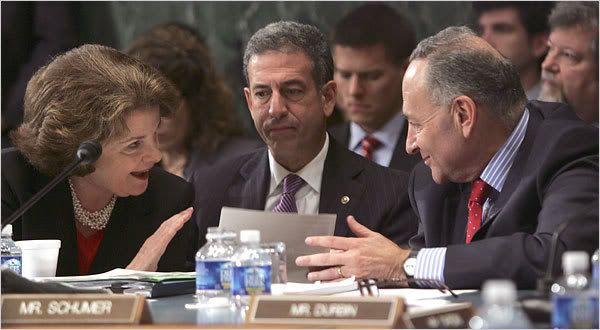 Senators Dianne Feinstein, Russ Feingold and Chuck Schumer after the vote on Tuesday.