The New York Times reports:
Governors of both parties strongly objected on Saturday to a half-dozen new federal Medicaid regulations that they said would shift billions of dollars in costs to the states, forcing them to consider cutbacks in services.
The rules, scheduled to take effect in the next few months, would reduce federal payments for public hospitals, teaching hospitals and services for the disabled, among others.
State officials voiced their concerns as they arrived here for the winter meeting of the National Governors Association.
Federal health officials said the new rules were needed to end creative financing techniques that states had used to obtain excessive amounts of federal Medicaid money.
But governors said the Bush administration was unilaterally reshaping Medicaid in ways that would harm some of their most vulnerable citizens. Moreover, they said, the rules are taking effect at a time when the national economic slowdown is cutting into state tax revenues.
“Governors strongly oppose the changes,” said Gov. Jim Douglas of Vermont, a Republican who is chairman of the association’s Health and Human Services Committee. “The timing could not be worse.”
One of the rules would ban the use of federal Medicaid money to help pay for the training of doctors, a use that has been allowed since the inception of Medicaid more than 40 years ago. Another would set new limits on Medicaid payments to hospitals and nursing homes operated by states, cities, counties and other units of government.
A third rule would limit Medicaid coverage of rehabilitation services for people with disabilities, including serious mental illnesses.
Federal officials estimate that the rules will save the federal government $15 billion over five years. But that figure may be low. California alone says it could lose $12 billion over five years.
Congress delayed some of the rules last year, but they will soon take effect unless Congress intervenes again.
Gov. Arnold Schwarzenegger of California, a Republican, said the rule changes “would effectively end the federal government’s participation in many crucial components of the Medicaid program.”
Dr. Rhonda M. Medows, commissioner of the Georgia Department of Community Health, said: “We understand the need for financial safeguards, but these rules, taken together, would have a tremendous adverse impact. They would undermine the health care safety net for the entire state of Georgia, reducing federal Medicaid payments for hospitals, nursing homes and school clinics.”
The National Conference of State Legislatures joined governors in criticizing what it described as “the regulatory activism” displayed in the new rules.
The federal government and the states share the cost of Medicaid, which provides health insurance to more than 60 million low-income people, including 30 million children.
Dennis G. Smith, director of the federal Center for Medicaid and State Operations, said the rules were needed to “protect the fiscal integrity of the Medicaid program.” Since 2003, he said, federal officials have persuaded 30 states to end “questionable Medicaid financing arrangements.” The purpose of such arrangements is to maximize the use of federal money while holding down the use of state and local revenue.
Although the most blatant problems have been corrected, the administration says, many states still use federal Medicaid money for purposes unrelated to Medicaid.
“We believe that paying for graduate medical education is outside the scope of Medicaid’s role, which is to provide medical care to low-income people,” Mr. Smith said. “There is no explicit authorization under the Medicaid statute to subsidize the training of physicians.”
Robert M. Dickler, chief health care officer at the Association of American Medical Colleges, said, “It’s a little surprising that the federal government would just now discover that there’s no legal basis for the Medicaid payments it’s been making for medical education since 1965.”
Stan Rosenstein, the Medicaid director in California, said the payments were justified because “interns and residents provide a tremendous amount of care to Medicaid beneficiaries.”
The federal government says this rule would save $1.8 billion over five years. But New York, which trains 15 percent of the nation’s doctors, says it would lose more than that alone. State officials are also concerned about a rule that would eliminate federal contributions for a whole category of public spending on health care for the poor — specifically, spending by autonomous units of local government like the Denver Health and Hospital Authority.
“As a result of this rule, we will lose $60 million a year,” said Dr. Patricia A. Gabow, chief executive of the Denver agency, which operates a 477-bed public hospital, the city’s public health department and its ambulance service. “We were part of the city government for more than 130 years. In 1997, we became an independent governmental entity, but we don’t have taxing authority. So we don’t qualify as a public provider, and we can’t draw down critically important subsidies for services we provide to the entire community.”
Larry S. Gage, president of the National Association of Public Hospitals, said the rule’s importance went far beyond Medicaid because it would compromise the ability of public hospitals to provide vital services like trauma care and burn treatment.
New York City Health and Hospitals Corporation, the largest municipal health care system in the country, which gets 60 percent of its budget from Medicaid, said the rules would have “a potentially devastating impact” and could force cutbacks in services.
A group of 17 states, including Connecticut, Michigan and New Jersey, told the administration that the new restrictions were “simply awful public policy.” Senators Jeff Bingaman, Democrat of New Mexico, and Elizabeth Dole, Republican of North Carolina, are fighting the rule on public hospitals.
The rule “would have a devastating effect on North Carolina’s Medicaid system, costing our hospitals hundreds of millions of dollars annually,” Mrs. Dole said.
The Medicaid rules were overshadowed last year by a battle over insurance for children.
“We can have a legitimate discussion about expanding the Children’s Health Insurance Program,” said Governor Douglas of Vermont. “But the Medicaid rules are different. They renege on commitments already made.”
In Vermont, Mr. Douglas said, “we’ve come to rely on Medicaid to help pay for special education and other services to children with disabilities.”
Medicaid is a crucial part of the foundation on which many states were planning to build coverage for the uninsured.
Deborah S. Bachrach, a deputy commissioner in the New York State Health Department, said, “The new Medicaid rules make it difficult to pay for current programs and nearly impossible to expand coverage to all.”
Saturday, February 23, 2008
| [+/-] |
Governors Oppose New Medicaid Rules |
Wednesday, February 20, 2008
| [+/-] |
Record U.S. Beef Recall A Wake-Up Call |
Reuters reports:
A California meatpacker caught torturing cattle and processing the unfit animals for human consumption is provoking calls for reform that could prove hard to ignore.
The Hallmark/Westland Meat Packing Co announced on Sunday it wanted back nearly 143 million pounds (65 million kilograms) of meat -- enough to feed more than 2.2 million Americans for a year -- that it had shipped out since February 2006.
But the wrongdoings at the plant were not exposed under the watchful eye of inspectors from the U.S. Department of Agriculture. Instead, the Humane Society of the United States captured employees in a gruesome, undercover videotape that was made after an apparent random decision to investigate the plant located in Chino, California.
While the recall was a record and dwarfs all previous orders by the department, the USDA said most of the meat has probably been consumed and that the risk to the public was minimal. USDA has estimated at least 37 million lbs of the meat were bought for school lunches and other federal nutrition programs.
But the USDA now faces growing calls for a better system since the violations of using sick or "downer" cattle occurred under the noses of the department's inspectors.
"I know USDA is doing a really good job downplaying what happened here," said Caroline Smith DeWall, a director of food safety at the nonprofit Center for Science in the Public Interest. "This isn't a little thing. This was a fundamental failure of their inspection program."
DeWall and a number of experts worry the California case was not an isolated incident in the 6,000 federally inspected U.S. plants, involving some 7,800 inspectors.
"It really demonstrates how our food safety inspection system has collapsed," U.S. House of Representative Rosa DeLauro, and Chairwoman of the Agriculture Appropriations Subcommittee, said on a teleconference call.
Bob Stallman, president of the American Farm Bureau, the nation's largest farm group, said the meat recall should only be the first step as the USDA works to ensure that safeguards are followed to protect the food supply.
"This situation is not acceptable and should not be tolerated at any facility processing beef for human consumption," said Stallman.
VIDEO UPROAR
USDA maintains the U.S. still enjoys one of the safest food systems in the world and the recall was made because of a violation of the rules, rather than an immediate health risk.
"Our FSIS inspectors are present, not only daily in this plant, but continuously as they are at all beef slaughter facilities, to assure among other things that ... specified risk materials are removed in compliance with our regulations," Agriculture Undersecretary Richard Raymond told reporters shortly before announcing the recall.
Hallmark/Westland has been closed since early February. Since the video was released, USDA has put a "hold" on all of its products and suspended the company indefinitely as a supplier to federal nutrition programs.
Beef is America's top choice for protein and the country consumed some 28.1 billion lbs worth of beef in 2007.
But confidence in the industry has been shaken at home and worldwide. The world shut its doors to U.S. beef when the country discovered its first case of mad cow in 2003. And last year, there was a sharp rise in meat recalls in the United States involving a deadly strain of E. Coli.
The Humane Society of the United States sparked an uproar over the meatpacking plant when it released the lurid videotape showing plant workers were gouging, kicking and forcing water into the noses of cattle in order to get the animals upright.
Only cattle that can stand are considered fit to be inspected, a rule considered especially critical in preventing processing of cows infected with mad cow disease.
Humane Society President Wayne Pacelle said he has long been concerned that the use of downer cattle was a widespread industry practice and now is more worried after the group found such abuse despite picking the California plant at random.
"If this was our first deep dive into a cattle slaughter plant and we found these gross abuses, then it would be highly unlikely that we would not find similar abuses at some of the of the plants," Pacelle told Reuters.
Pacelle said tough measures are needed to overhaul the inspections system, including closing a loophole that allows the use of some downer cattle and he urged Congress to pass already proposed legislation to cement the policy. He said the next step will be to revamp the inspection process.
"We need more boots on the ground in the handling and pre-slaughter areas of the plant. We need a more unpredictable presence, rather than showing up at standard times so the plant personnel know exactly when they are coming."
Some critics contend inspections should be handed to another agency as the USDA has a conflict of interest as it is also a promoter of agriculture products. And the USDA might be increasingly busy shoring up confidence in the sector.
"I think it was meant to be a shock to industry, a wake-up call that says 'hey there is apparent abuse of animals in the slaughter operations and this has to be addressed and fixed," said Michael Doyle, Director of the Center for Food Safety at the University of Georgia.
Saturday, November 10, 2007
| [+/-] |
Seattle Crowd Blasts FCC On Big Media |
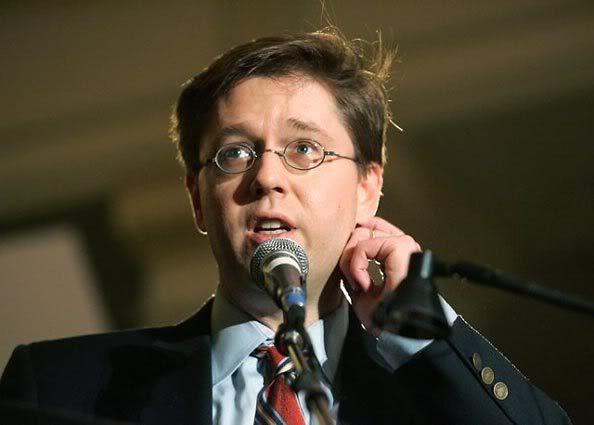 FCC Chairman Kevin Martin, who has voted in the past for more media consolidation, was met with boos and catcalls when he opened hearings at Seattle's Town Hall on Friday.
The Seattle Times reports:
That was the overwhelming message an overflow crowd delivered to the Federal Communications Commission Friday night at a hearing on media ownership at Seattle's Town Hall.
Four FCC commissioners heard it from Gov. Christine Gregoire and Attorney General Rob McKenna, and from young media-reform activists costumed as "media-consolidation zombies" — a dig at what many perceive as the FCC's willingness to do industry's bidding.
"You become a zombie when your voice isn't heard," said Monica Olsson, dressed as a zombie. "That's what we're here to stop."
The FCC is reviewing rules that restrict how many local media outlets a single company can own. Among them: a 32-year-old regulation barring a company from owning a daily newspaper and TV or radio station in the same market.
Most media companies say the restrictions should be eased or eliminated. Many people who spoke Friday said they're certain that's what the FCC's Republican majority already has decided to do.
If the FCC quickly proposes new rules, "you know your input was dismissed," said Jonathan Adelstein, one the five-member commission's two Democrats.
More than 200 people signed up to testify, almost all of them opposed to the proposed rules.
They included directors of several cable-access channels in smaller markets, such as South King County, Olympia and Salem, Ore., where local news and issues rarely get mentioned on TV news channels based in Seattle, Portland or Eugene.
"These markets that everybody mentions, these are towns, cities, communities, full of people," said Chris Miller, operations director of Puget Sound Access in Kent.
Miller recounted growing up in a small South Dakota town where local media were bought out by corporate interests. He said he learned about it the hard way as a 17-year-old, calling his favorite radio station to request a song, only to discover the station no longer employed a local disc jockey.
The FCC adopted looser rules in 2003 over the objection of the commission's two Democratic members, touching off widespread protests. A federal appeals court struck down the changes, ruling the commission had not adequately justified them.
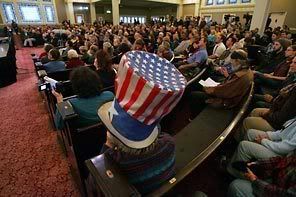 More than 200 people signed up to testify at Friday's hearing; almost all opposed new rules that would relax restrictions on how many local media outlets a company can own.
Last year, however, the commission announced it would take up the issue again. Chairman Kevin Martin, who supported the 2003 changes, indicated recently he wants a vote next month.
The FCC gave just one week's advance notice for the Seattle hearing. Many who attended cited that as evidence the commission majority isn't really interested in the public's views.
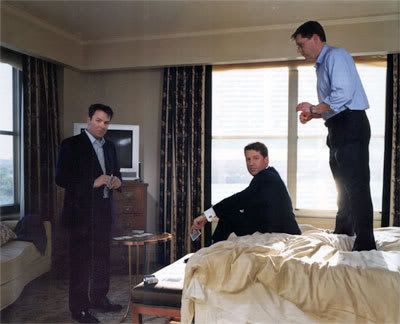 FCC Chairman and former lobbyist, Kevin Martin (right) playing cards with a telecom lobbyist (center) and a radio industry executive (left).
The general managers of Seattle's KING-TV and KCPQ-TV were among the handful of witnesses who did not call for preserving the current media-ownership rules. Their respective owners, Dallas-based Belo and Chicago-based Tribune, already own newspaper-TV combinations in other cities that predate the FCC ban.
KCPQ's Pamela Pearson said she had worked in two of those markets, Chicago and Los Angeles. "We do not combine our newsrooms or smoosh them together. They run independently to produce the best journalism," she said.
Major media companies say the ownership restrictions no longer are needed because new technology — the Internet, cable TV, satellite radio — has produced new media voices.
But Ian Page-Echols, a Seattle documentary filmmaker and artist, said unbridled access to the Internet is threatened by media conglomerates who could control the Internet and restrict access to it.
Seattle Times Publisher Frank Blethen, an outspoken foe of more consolidation, urged the commission to not only maintain existing restrictions, but adopt new ones — including a ban on cross-ownership of national print and broadcast outlets to supplement the existing prohibition on local cross-ownership.
Rupert Murdoch's News Corp., which owns the Fox network, recently acquired The Wall Street Journal.
Concentrated absentee media ownership has resulted in "a disinvestment in journalism, causing serious erosion in America's public-policy literacy and civic engagement," Blethen said.
Mark Allen, president and chief executive of the Washington State Association of Broadcasters, disagreed. "It is simply not true that fewer owners equals less service and more owners equals more service in every instance," he said.
John Carlson, KVI-AM talk show host and former Republican candidate for governor, said chains aren't necessarily bad, but since a limited number of radio and TV frequencies are available, "a referee must protect the ability of local, smaller media companies to compete."
Diana Kramer, associate publisher of Renton Magazine and The Business Report, sounded a similar note.
"I do not want one company to provide all my food or all my fuel. And I do not want one company to provide all my news," she said.
When Martin, the FCC chairman, rose to deliver opening remarks, he was greeted with catcalls and boos.
He said Blethen is in the minority among newspaper publishers in supporting the current rules. Most, he said, say they need more opportunities to diversify to avoid more newsroom cuts.
Since last summer, according to a database on the FCC's Web site, Washington residents have submitted more than 6,000 comments on media-ownership rules. Almost all oppose looser restrictions.
"With local consolidation, you simply have fewer original voices and fewer innovative voices being heard," said Lynn Ziegler, a local advocate for quality children's television. "That already is happening."
Friday, November 9, 2007
| [+/-] |
Q&A with FCC Commissioner Michael Copps |
Michael Copps, who is in his second term on the Federal Communications Commission,
is in Seattle, with the other four commissioners, for the final FCC media ownership hearing at 4 p.m. Friday at Town Hall. Copps has been a voice against media concentration since being named to the commission in 2001. He answers questions from the Seattle Times' readers.
Q: Commissioner Copps, thanks for your very important stance against media concentration exclusively in the hands of a few. -- Just a question and a couple of comments. Do you think it is in the public interest for the FCC to silently
consent to the Hearst Corp. gobbling up ownership interest of numerous radio and TV
stations in the same media market? If not, what can the average citizen do?
Is it better to write FCC Chair Kevin Martin or should we be really writing our Senators & Congresspersons? Do we have to cite specific examples of anti-competitive practices used by these mega-owners?
In case you're keeping tally, I'll share with you the feelings of people on my block in Wallingford and nearby Fremont. We need independent radio, independent newspapers and independent local stations to keep America vibrant! Many of us who are age 30 & above REMEMBER the days before TV and newspaper consolidation. The FCC, all the way through the Clinton era under the wonderful leadership of FCC Chair Reed Hundt, protected a media marketplace where there was and could be a variety of views and opinions. The FCC guarded the "public interest" from monopolization and collusion with rules that limited media ownership. Then, the radical right took over the White House and used their FCC appointments to dismantle ownership rules. As a result, we are blasted Rupert's views and political agenda through the New York Post, on FOX TV and Fox Cable. News Corp just bought the internet portal MySpace and have recently gobbled up the Wall Street Journal.
Murdoch's News Corp & others like Hearst leverage market power to offer advertising deals that underbid market competitors. There are MANY examples of those outlets
underselling competitors because they can afford to absorb reduced rates and their mom and pop competitors cannot.
Seattle is already a one-paper town, and that's a paper owned by the Hearst mega-corporation. The corporations have little regard for localism and for a diversity of views.
A: I've been reading the Seattle Times coverage of tonight's hearing, and it years-long coverage of how media conslidation has diminished localism and diversity, so this area is more fortunate than most in having that information available to it. Just yesterday, Frank Blethen of the Times testified before the United States Senate on this issue, and I suspect you would agree with much that he said, judging from your message today. You ask what a citizen can do. Just what you're doing--make your feelings known, from your house to the White House. Tell the FCC how you feel. If you cannot attend tonight (I hope you can!), then go to www.fcc.gov and let us know. Don't foregt your elected respresentatives, although I must say Washington has some really outstanding leaders in Congress. You might want to thank those folks.
Q: When is the FCC going to approve the Sirius and XM merger? I think it is in the consumers best interest if the merger is approved. Satelite radio will always compete with terestrial radio and so the merger is not going to reduce the consumers choices. With the merger, the consumer will get more channels and the difficult business of providing satelite radio may someday be profitable.
A: That's pretty much up to the Chairman, who controls the agenda. But just recently the Commission requested additional information and data from the companies, so final action may be slowed a bit. One of the questions we need to answer is whether satellite radio is a separate market with separate characteristics and just two players, or is it part of a larger media competition with free over-the-air programming. We must also deal with a current rule that prescribes that there be at least two players in satellite radio. Merger approval would require us to change that rule in the process. So the Commissioners are working our way through these issues.
Q: I think the reason our country rushed to war in Iraq was due in large part to the misinformation about WMD echoed by our corporate media. Doesn’t it suggest that further consolidation of corporate media would only exacerbate the problem of combating misinformation about such important and weighty matters?
A: I think the danger is when just a few companies are controlling the gateways and the content that we see every day on teleivison, contrary thoughts and other perspectives get lost. That's been costly for us! Further consolidation can only make a bad problem worse.
Q: What is the threat Bell forbearance efforts pose to Seattle?
A: I am willing to look at these items pending before us and am not able to say much about such active petitions. But, as I said earlier, forbearance is not the vehicle we should so often turn to and, when we do, there has to be a granular analysis accurately depicting conditions in specific telecom markets, such as Seattle. The lack of such records is one major reason why I have not been enthusiastic about some other companies' petitions in the past. For example, they sometimes focus on broadband as a national market and ignore the local competitive implications.
Q: Why should we let Comcast have a monopoly on Cable use?
The cable system should be allowed to have competition for better rates for the consumers.
A: I believe in encouraging more competition in all of our communications and media platforms. Unfortunaely, we have been going in exactly the wrong direction for quite a few years now. The big get bigger, competition is diminished, and the people end up paying the price. There isn't much competition in cable in the vast majority of markets. That's bad.
Q: What are the benefits that the members of the commission who favor further consolidation recieve for accomodating consolidation. They must be getting something for thier corrupt behavior.
A: I think that my colleagues are generally sincere in what they believe. It's not that they are bad people; it's just that their mind-sets lead to some very bad results. I believe they are wrong on the merits of the argument, but I try not to impugn anyone's motives.
Q: First, let me thank you for standing against the insanity of further media consolidation. If in fact, "we the people" still own the public airwaves and the FCC is the agency empowered to protect the public interest, how can the FCC justify this trend? We used to endure advertising to fund programing. Now, so much of the programing exists only as a backgound for adverising with no public benefit at all. There is no argument that justifies media concentration to a handful of companies as representing the public interest. How can "we the people" hold the FCC accountable to its original mandate?
A: I haven't heard anything remotely resembling such a justification. The people do own the airwaves, but if we don't reassert our ownership rights, the claim to ownership doesn't accomplish much. The FCC is supposed to be the public's protector and the agency which ensures that broadcasters live up to their obligation to serve the public interest.
Q: Qwest has filed a "forbearance" petition with the FCC asking to be free from wholesaling obligations in Seattle as early as April 2008. What effect would a grant of that petition have on my ability to obtain phone and Internet service from one of Qwest's competitors?
A: I believe their petition goes primarily to business services rather than residential. I am concerned, however, that forbearance as a process is being used to eviscerate competition and by-pass our rules. I don't believe Congress wanted the FCC to conduct its business so often via this truncated process which usually lacks adequate economic analysis and provides an insufficient record when the parties take our decisions to court--which often happens.
Q: Isn't it true that cross-ownership (newspaper/television) could have saved media diversity in many cities that used to have two newspapers, but now have only one?
A: I'm always willing to look market-by-market and if a convincing case can be made that some consolidation is all that can keep a station from shutting down and depriving a community of servce, we ought to look at that and even approve. But big media wants more than that--they want an always-on green light that assures everyone in advance that the media bazaar is open to all sorts of combinations, no questions asked. If the FCC wants localism, it ought to be willing to look at local markets and local conditions. Right now, we don't.
Q: I understand the historic duty of the FCC is to allocate frequencies within the broadcast bandwidth, so to ensure licensee's signals are not interfered with. In allocating the frequencies, I presume there's an objective & mechanism in place that attempts to ensure the use of those frequencies in any market area are adequately responsive to the public in that market.
My question is whether the definition of 'public responsiveness' encompasses the carriage of voices fairly representative of the market OR whether 'public responsiveness' simply means endowing broadcast licensees with expanded 'network power' (i.e. a larger permissible footprint in any and all markets in which they hold a license)?
I believe that's the practical challenge presently before the Commission. Can fair representation exist when today's principal allocation method simply rewards frequencies to the highest bidder?
A: The sad reality is the FCC doesn't appear to care how well the public interest is served. In 1981, a new Chairman took over at the FCC and he said a television set was just "a toaster with pictures." And that's how they proceeded to treat it--just another applicance. All the public interest guidelines we had, and which we used when a broadcaster came in to renew his or her (mostly his, because women have been excluded from owning their fair share of stations) were "deregulated" away. Broadcasters formerly had to justify their performance every three years in order to keep their licenses. Now they send in a post-card once every EIGHT years, and we never deny a license on public interest grounds. So don't blame just big media for the current excesses--blame the FCC, too.
Q: Is there any conceivable way you could persuade one of the FCC's Republican commissioners that any further broadening of ownership rules to benefit corporations as opposed to individuals or public groups goes against the American heritage? The people own the airwaves; yet a few corporations dominate them and disseminate their points of view only. But the American heritage is one of democracy and local inventiveness.
Perhaps you could remind your Republican colleagues that domination by one corporate point of view is far more similar to Soviet totalitarianism.
A: I'm trying, I'm trying! Maybe tonight's hearing can succeed more effectively than me. But, to be frank, my fear is that the fix is in insorfar as loosening the limits on newspaper-broadcast cross ownership. The result of that will be more newspaper-broadcast combinations in lots of markets and that translates into fewer voices, less news, and a diminished civic dialogue. I think that's too costly a price to pay, don't you?
Q: A few years ago we saw the music group called the Dixie Chicks be boycotted by over 200 radio stations, all under one ownership. Wasn't that a prime example of censorship and the affects of multiple media outlets with one ownership?
A: Yes, and it's not the only one, either. That's what happens when too much power in cocentrated in too few hands. In previous years we had enough diversity and local control that if someone committed some sort of act like you mention, it didn't affect the whole nation. Now it does.
Q: I have been in radio since I was a kid. I'm now 55. Radio is at an all time low with bad product and poor community service. Plus the lost of jobs has been shocking. Why hasn't the FCC talked to any of us who are in the talent end of broadcasting? Granted, a lot of folks would not want to come forward for fear of loss of their job. Why not put us under oath and make us tell you and the others on the commission about the damage done by media concentration? I might lose my job just for asking this question. But it's worth the gamble because I care about radio and my country.
A: You know, I have talked to many people in the creative community who feel like you do but who are still trying to eke out a living and many are afraid to testify and go public. So in 2003, I asked then-Chairman Michael Powell to set up some kind of process where we could receive such testimony anonymously. He replied with all sorts of excessively legalistic arguments why this couldn't be done. The result--we don't have nearly enough of that kind of testimony on the public record.
Q: Hello and thank you for coming to listen to folks in our city.
Do you think that all cable providers should be required to provide, on basic cable, public access stations and governmental proceedings (city, county, state and CSPAN)?
When I was a child, this kind of thing was provided often by the networks. My mother made us watch current events on television and always set the standard for us of being an active informed citizen. She spent the summer watching the Watergate hearings on network TV. Later, she was an avid CSPAN watcher, and she and her sister and friends would comment on what they say Congress doing on CSPAN coverage in thier weekly letters to each other.
With that upbringing I find myself watching these channels more than broadcast or other cable. It's the only way I have of seeing my local government at work as I can tape the City Council meetings while I am at my job during the day.
A: I think you and I have some similar viewing habits! I am a huge supporter of PEG channels and public access. I am disappointed that, just very recently, the Commission voted to remove much of the negotiating power that Local Franschising Authorities had to demand these and other services from cable as a condition of their being able to build out and provide service to customers. These local authroties understand what is needed in a community better than we in Washington do, so to preempt them is another mistaken FCC decision against localism, diversity and competition.
Q: What is the FCC progress or assessment of the 800MHz rebanding with SPRINT NEXTEL frequency spectrum? They have been very slow to implement rebanding in key cities across the USA delaying civic efforts to protect their citizens. It is imperative for first responders to be able to communicate in these frequencies.
A: We really need to approach this with urgency, and I believe that my colleagues are now doing that. You are correct that there have been too many delays, and I have been pushing the Commission to keep the parties working hard to make this transition work well and quickly. I have also talked with the private parties concerned to make sure they understand the FCC is not going to tolerate unending delay.
Q: What is the FCC doing to assure fairness and accessibility to high speed internet for individuals and small companies. I have a concern that large "internet / communication companies" will begin limiting access and/or start charging premiums for the internet that should be readily available with a high quality of service for all.
Electric Power companies do not charge (for all practical purposes) for "higher quality" power - the standard power to everyone is of high quality; this is the same for Natural Gas companies, water companies, and other basic utilities.
A: I share your concern and have labored hard to have the Commission adopt serious and enforceable network neutrality rules. I succeeded only insofar as getting a statement of Internet principles adopted: freedom to access content of your choice, to attach devices of your choice, to run applications of your choice, and to enjoy the benefits of competition. But these principles need to be backed up by enforceable rules and the present Commission is not inclined to do that. We did get some enforceability attached to the AT&T/Bell South merger, but this is something we need industry-wide. Congress may have to legislate on this issue. The Internet has so much potential, so we need to ensure it openess and guarantree that it doesn't become a gated community controlled by a few telecom behemoths.
Q: How is it that the issue of cross-ownership is up for consideration again after there was such a huge outcry from the public against further consolidation on this same issue within the last two years? America’s airwaves and broadcast entities are supposed to be held in the public trust. Meaning, very simply, that the American people own the airwaves. And the programming sent over those airwaves is entrusted to be in the public’s best interest. If that is the case, why is this being brought up again for consideration? The lobbying efforts and influence of big business on the FCC seem all too apparent. Futhermore, media consolidation is an encroachment on our rights: Freedom of the Press.
A: Another good question I hope the FCC is asked tonight. I'm with you in believing the people's airwaves should be used to add diverse voices and to encourage local content, rather than bringing in more homogenized, nationalized and sterile corporate "entertainment" and letting Big Media shut down the civic dialogue upon which the future of our democracy rests.
Q: Given that this country's political roots are in dissent, why is the FCC even considering increasing the power of media/communications companies to dominate a political point of view and way of looking at the world?
A: Good question. Come out to the hearing tonight and ask some of my colleagues why they would want to foist additional consolidation on our media environment and what public inrterest good they see in diminishing the number of viewpoints available in our media markets.
Q: I want a choice in providers of content and service – please do your job to ensure that happens.
I have two questions for the FCC,
First how can you possibility justify endorsing the AT&T - SBC take over.
This is possibly the single worst decision in term of competition in the past decade in my opinion.
Second why are you allowing companies to own more media outlets?
Do you not think that this leads to a mind share issue where the relatively few can impact public opinion with a narrow point of view?
A: I don't like consolidation any more in telecom companies than I do with media companies. The result on the AT&T merger you mention was pretty much preordained, but I worked hard to attach some conditions to it--such as enforceable netweork neutrality provisions. On your second question, I have been an outspoken opponent of the excess media consolidation we have had to endure in recent years. I want to avoid encouraging more consolidation through ill-advised new rules and then revisit the current rules that got us into our present mess.
Q: In your opinion, what can we, as citizens and consumers, do to assure that the we develop more diversity in the media?
A: Any satisfactory outcome to this issue will be in large part grassroots-driven. So people need to make their opinions felt. Hearings like tonight's Seattle venue are one vehicle. But we should all be speaking out; talking to friends, family and community; writing letters to the editor; talk radio; write the FCC Commissioners; contact your elected representatives. Elected officials need to know that your opinions on this issue count as you judge their campaigns for office.
Thursday, October 11, 2007
| [+/-] |
ConAgra Recalls Pot Pies |
Business Week reports:
ConAgra Foods Inc. recalled all its Banquet pot pies and store brand varieties Thursday after the products were linked to a nationwide salmonella outbreak.
The company included beef pot pies in the recall after initially saying only the chicken and turkey pot pies should not be eaten.
ConAgra issued a consumer alert Tuesday and asked stores nationwide to stop selling the poultry pot pies, but the company stopped short of a recall until Thursday evening.
ConAgra spokeswoman Stephanie Childs said the decision to recall the pies wasn't based on new information, but an abundance of caution.
"We want to make sure there's no confusion with consumers, that these pot pies shouldn't be eaten," Childs said.
She said she knew of no indication of a link between cases of salmonella and the beef pot pies, but the company wanted to be careful as it collects information.
The pot pies made by ConAgra have been linked to at least 165 cases of salmonella in 31 states. The federal Centers for Disease Control and Prevention said at least 30 people have been hospitalized as part of the ongoing outbreak, but so far no deaths have been linked to the pot pies.
The company and federal officials warned customers not to eat the pot pies and to throw them away, and ConAgra is offering refunds. The store brand versions are sold under the names of Albertson's, Hill Country Fare, Food Lion, Great Value (sold at Wal-Mart stores), Kirkwood, Kroger, Meijer and Western Family.
Childs said she could not say how many pot pies are affected by the recall or how many ConAgra produces.
ConAgra officials have said some of the illnesses may be linked to undercooked pot pies, but Childs said the pot pies should not be eaten even if consumers think they have cooked them correctly. The company is revising the cooking directions on its pot pie packages to clarify how long the pies should be cooked in different microwaves.
Amanda Eamich, a spokeswoman for the USDA's Food Safety and Inspection Service, said three investigators are at the ConAgra plant looking for problems with a specific product or production date. ConAgra's recall is voluntary, and Eamich said without a specific connection, a recall wouldn't be ordered.
ConAgra shut down the pot pie production line at its Marshall, Mo., plant, but the rest of the plant, which employs about 650 people, has continued operating, Childs said Wednesday.
Salmonella sickens about 40,000 people a year in the U.S. and kills about 600. Most of the deaths are among people with weaker immune systems such as the elderly or very young.
Salmonella poisoning can cause diarrhea, fever, dehydration, abdominal pain and vomiting. Most cases are caused by undercooked eggs and chicken.
A Minnesota couple sued ConAgra Foods Inc. Thursday for selling the pot pies they believe made their young daughter ill with salmonella. The federal suit, filed in U.S. District Court in St. Paul, seeks damages of more than $75,000 and reimbursement for medical costs.
Consumers who want a refund for their pot pie should send the side panel of the package that contains the UPC code to the following address: ConAgra Foods, Dept. BQPP, P.O. Box 3768, Omaha, NE 68103-0768. Consumers with questions can call the company toll free at 866-484-8671.
| [+/-] |
ConAgra Asks Stores to Quit Selling Pies |
The AP reports:
ConAgra Foods Inc. has asked stores to stop selling pot pies linked to a salmonella outbreak and is offering refunds for the turkey and chicken-filled meals.
The company and the U.S. Department of Agriculture on Wednesday defended their decision not to immediately recall the product.
ConAgra asked stores nationwide to pull the Banquet and generic brand chicken and turkey pot pies after two East Coast grocery chains made their own choice to remove the product from their shelves.
The pot pies made by ConAgra have been linked to at least 152 cases of salmonella in 31 states. The federal Centers for Disease Control and Prevention said at least 20 people have been hospitalized as part of the ongoing outbreak, but so far no deaths have been linked to the pot pies.
The company and federal officials warned customers not to eat the pot pies and to throw them away, and ConAgra is offering refunds.
ConAgra spokeswoman Stephanie Childs said the Omaha-based company decided with USDA officials that the consumer alert they issued Tuesday would be more appropriate than a recall.
"From the consumer perspective, there's not much difference," Childs said.
Even though the pot pies have not been recalled, Childs said ConAgra asked stores to pull all the pies with the identifying "P-9" code on them from store shelves and not sell them.
"We've taken this step knowing that we may need to take additional measures as we learn more from the ongoing investigation that is being led by the USDA," Childs said.
ConAgra officials have said they believe the pot pies are safe when they are thoroughly cooked according to the package directions. The company is revising the cooking directions on its pot pie packages to clarify how long the pies should be cooked in different microwaves.
The Giant Food and Stop & Shop supermarket chains said Wednesday that they were pulling the questionable pot pies from their stores' shelves as a precaution. Giant Food has 186 stores in Virginia, Maryland, Delaware and Washington, D.C., while Stop & Shop has 389 stores in seven northeastern states.
Amanda Eamich, a spokeswoman for the USDA's Food Safety and Inspection Service, said three investigators are at the ConAgra plant looking for problems with a specific product or production date, and without that connection, a recall wouldn't be ordered.
"As we continue our investigation, we felt it would be the best thing to do is get the word out," Eamich said.
ConAgra shut down the pot pie production line at its Marshall, Mo., plant, but the rest of the plant, which employs about 650 people, has continued operating, Childs said Wednesday. All of the pot pies made at the plant in question have "P-9" printed on the side of the box as part of a code above the use-by date.
The way the USDA has handled the pot pie concern highlights inconsistencies in the nation's food safety system.
Earlier this year, when the CDC linked ConAgra peanut butter to a salmonella outbreak that eventually sickened at least 625 people in 47 states, the company recalled all of its peanut butter. But peanut butter is regulated by the Food and Drug Administration, while pot pies are regulated by the USDA.
Salmonella sickens about 40,000 people a year in the U.S. and kills about 600. Most of the deaths are among people with weaker immune systems such as the elderly or very young.
Salmonella poisoning can cause diarrhea, fever, dehydration, abdominal pain and vomiting. Most cases are caused by undercooked eggs and chicken.
A Minnesota couple sued ConAgra Foods Inc. Thursday for selling the pot pies they believe made their young daughter ill with salmonella. The federal suit, filed in U.S. District Court in St. Paul, seeks damages of more than $75,000 and reimbursement for medical costs.
Consumers who want a refund for their pot pie should send the side panel of the package that contains the "P-9" location code to the following address: ConAgra Foods, Dept. BQPP, P.O. Box 3768, Omaha, NE 68103-0768. Consumers with questions can call the company toll free at 866-484-8671.
| [+/-] |
ConAgra Refuses to Recall Pot Pies |
Despite pleas from Oregon and Minnesota, the company issues consumer alerts for poultry, but not beef, varieties
The Oregonian reports:
ConAgra Foods Inc. is refusing to recall Banquet-brand and other potpies tied to a national salmonella outbreak, rejecting direct pleas by Oregon and Minnesota health officials.
The state officials say the company needs to recall all of its potpies because the source of the salmonella has not been identified. Doing anything less, they say, allows potentially dangerous food to remain on the market and confuses consumers.
The company says a recall is unnecessary. It contends that contamination is limited to its poultry potpies. Risks can be eliminated, the company says, by instructing consumers to cook the pies thoroughly enough to kill salmonella bacteria.
The dispute highlights a long-standing limitation in America's system for safeguarding the food supply: State officials who most frequently unearth the cause of foodborne illness have no regulatory authority over food makers. Federal officials can ask companies to recall food, but that process can take days or weeks.
For example, the U.S. Department of Agriculture has come under fire for waiting 18 days last month to request a recall after E. coli was discovered in Topps Meat Co. ground beef.
This has been a year of a number of high-profile domestic food recalls, as well as food and consumer-product warnings on imports from China. In the spring, ConAgra issued a massive recall of its Peter Pan and Great Value peanut butter brands after a multistate salmonella outbreak.
Public-health officers in both Oregon and Minnesota said they urged a potpie recall in phone conversations with ConAgra executives Monday and Tuesday. Instead, the Nebraska-based company, with annual sales of more than $12 billion, halted production and issued a consumer alert for its frozen potpies containing chicken and turkey.
States, on the other hand, are telling consumers to throw out every potpie under the Banquet brand as well as store brands including Great Value (sold at Wal-Mart) and Kroger. All are made at ConAgra's Marshall, Mo., plant.
Pies tied to illness
In a conference call Wednesday among state and federal health officials, several state representatives said potpies could still be found in stores, said Dr. William E. Keene, a senior communicable disease epidemiologist at the Oregon Public Health Division.
"A lot of people were saying that this alert was not adequate because consumers were not getting the kind of unambiguous message they'd get if there was a recall," Keene said.
The potpies have been tied to at least 139 illnesses in 30 states, including two confirmed Oregon cases. Keene said a third Oregon case is suspected but not confirmed and for every confirmed case, two dozen or more go unreported.
Salmonella infections can cause severe diarrhea and fever.
In Oregon and across the country, health investigators had searched in vain since May for the outbreak's cause.
But last Thursday, a Minnesota state epidemiologist, Steph Meyer, tied three salmonella cases to the potpies. Two previous victims were re-interviewed and recalled eating the pies, which are enormously popular because they are cheap (50 cents or so), can stay in the freezer for ages and be microwaved in a few minutes.
The same day, Minnesota health officials notified other states and the federal government of their findings.
On Monday, after federal officials said it might take a day or more to go through channels and ask ConAgra for a recall -- nearly all food recalls are voluntary -- Meyer's boss and Keene of Oregon decided to take their concerns directly to the source.
In conference calls Monday and Tuesday, Keene and Dr. Kirk Smith, supervisor of the foodborne diseases unit of the Minnesota Department of Health, made their case for a recall.
"In effect, they turned us down," Keene said.
Smith said the company did not want to include its beef products in the consumer alert it elected to send, instead arguing that poultry -- notorious for salmonella problems -- was to blame. ConAgra said the solution would be to ensure that consumers cooked the pies longer.
"A fear out there"
Smith and Keene contended, though, that all pies are at risk because the source of contamination remains unclear.
"We don't know if it's in the uncooked dough or where it is," Smith said. "What we tried to impress on them was that we thought they'd want to be as inclusive as possible."
In other words, a total recall, which Smith and Keene say remains warranted.
"I don't think it was a good decision on their part," Keene said. "But it's their decision."
In the meantime, a ConAgra spokeswoman said the company is cooperating with the U.S. Department of Agriculture to determine the cause.
Spokeswoman Stephanie Childs said ConAgra's decision to alert consumers and not recall all potpies was consistent with the company's plans to change labeling on how to cook the pies.
"All of the information provided to us indicates that this is related to a certain type of potpie," she said. "We're moving forward with plans to enhance our cooking directions."
The company has not decided exactly how to change those directions, she said. Instructions vary depending upon microwave power, for example. In any case, the pie's interior temperature must reach 165 degrees to be fully cooked.
Childs said she was unsure what information ConAgra had pointing to poultry as the contamination source.
At Portland-area grocery stores, consumers started returning potpies early Wednesday morning. James Grant, manager of Gresham's Food 4 Less, said employees first removed turkey and chicken pies from freezers after a supplier notice was sent out.
Later, Grant said, he had the meat pies removed as consumers asked about whether they were safe.
"There's a fear out there because of what has happened in spinach and other foods," Grant said, referring to an E. coli outbreak last year. "We took all the potpies out basically just to not have to field the questions."
Monday, October 8, 2007
| [+/-] |
The Pollution Policy Song: Same Tune, Second Verse |
In the Star-Telegram, James D. Marston, the director of the climate program in the Texas office of Environment Defense in Austin, writes:
First, the good news: President Bush acknowledged to the world Sept. 28 that global warming is real and that human activity is contributing to it.
And the president told international representatives at a U.S.-hosted climate meeting that he wants nations to set an "aspirational long-term goal" for reducing global warming pollution and to start a fund to help poorer countries pay for new emissions-cutting technologies.
The bad news is that the president again rejected mandatory cuts in global warming pollution. He instead urged voluntary measures to deal with the problem.
To Texans, Bush's newly restated commitment to voluntarism evoked Yogi Berra's famous line "It's déjà vu all over again."
Been there. Done that. Didn't work.
In a sacred Texas anecdote, a besieged Col. William Travis drew a line in the sand with his sword and asked that volunteers willing to defend the Alamo step across it. Nearly all did.
The late-1990s response to Gov. George W. Bush's call for volunteers was less inspiring.
The story starts back in 1971, when the Texas Legislature passed a Clean Air Act but, for political reasons, grandfathered polluting facilities already in operation. The thinking was that power plants, refineries and other factories that were subsequently upgraded would be subject to the new, tighter restrictions; other aging plants would simply be retired.
It didn't work out that way. A quarter-century later, 828 grandfathered plants were still going strong -- and still spewing pollution into the air. Tired of breathing air that you could literally taste, Texans began demanding that the Legislature either clean up the old plants or shut them down.
In late 1997, when Bush was governor of Texas, he headed off a tough, mandatory cleanup requirement by proposing an alternative: a voluntary emission-reduction program.
In return for making voluntary reductions, Bush proposed a weaker standard based upon decades-old technology. What he tried was a voluntary approach dangling a carrot: If you do a little, we won't make you do a lot.
A year and a half after Bush announced his voluntary plan, the Legislature enacted it. (Electric utilities had to clean up their plants, but lawmakers passed a separate, voluntary plan for chemical plants, refineries and other plants.)
So what happened? Very little.
In 2000, Bush's people claimed that the voluntary program had produced 124 permits for cleanup measures. But an analysis at the time by the nonprofit organization Environmental Defense showed that 31 of those were applied for before the governor announced the plan. And 104 of them were applied for before the program was enacted into law.
Of the 124 permits issued that were claimed to have been voluntary, 99 of them were for facilities that had emissions so low that the state environmental agency didn't require them to report their emissions as part of the 1997 Emissions Inventory.
Only seven of the permits actually represented voluntary action not mandated by the federal Clean Air Act or other legal mandates, and only one plant in the entire state could be fairly said to have responded to Bush's 1997 voluntary initiative.
Legislators knew that the voluntary approach wasn't working, and when Bush left to go to Washington, they replaced the voluntary plan with mandates.
Six years later, the president, still defiantly opposed to mandatory measures, is once again pitching his voluntary approach.
His voluntary plan didn't work in Texas. A voluntary emission reduction plan has never worked anywhere. And just as the Texas Legislature rode to the rescue in 2001 to cap pollution from the grandfathered polluting facilities, it's time for Congress to take the reins.
Texans know that global warming is already happening. We don't have time to wait out another failure. America needs to lead the way. It's time for Congress to cap the pollution that causes global warming, and to do it now.
Friday, October 5, 2007
| [+/-] |
"My Beef About Bad Beef & Weak Regulations" |
At NJVoices, Drew Harris writes:
If you think good regulations are too expensive, try bad regulations. The Topps Meat Company is recalling a year's worth of ground beef -- 21.7 million pounds -- produced in it's Elizabeth, New Jersey processing plant because they can't be sure it wasn't contaminated with the deadly bacteria, E. coli O157. Assuming ground beef is $2.50 a pound, this recall could cost Topps over $54 million in refunds to consumers. Several aspects of this story illustrate how a weak regulatory system not only threatens public health but is also bad for business.
A published report says it was over 18 days from the time the contamination was confirmed by the USDA laboratory before Topps went public and began the voluntary recall. Unfortunately, it wasn't the company or USDA that discovered the problem. People up and down the east coast had been getting sick for months, but until the E. coli was found in hamburger patties taken from a victim's refrigerator no one knew the source. Only later were samples from the plant checked.
We have a crazy-quilt food safety system. The Federal Food and Drug Administration (FDA) oversees most foods except meat, poultry and eggs, which fall under the purview of the US Department of Agriculture (USDA) unless meat, poultry or eggs are less than 2 to 3 percent of the product's content.
The US Centers for Disease Control and Prevention (CDC) is responsible for tracking diseases caused by food consumption. State agencies are responsible for regulating businesses that sell directly to consumers. Our food safety net is full of holes.
USDA is also the federal agency that helps promotes the consumption of US farm products, supports farmers, and ensures international regulations favorable to these products. It has been said that this is an inherent conflict of interest leading to lax oversight and an unwillingness to aggressively regulate an industry the agency is supposed to promote.
Topps had a USDA inspector on site every day like every meat processing plant. When an additional inspection was ordered in the wake of the mass recall, the new inspectors found violations so severe that they suspended the plant's ground beef processing. Why did the regular inspector miss these problems? Because the bad practices went back for months, there was no way to be sure the meat packaged on any given day was safe.
Amazingly, even when a problem is discovered, the USDA can only ask a meat processor to recall its product. Once the processor sends out the press release about the recall, they notify their primary customers who may be many steps removed from the actual consumer. You -- pardon the expression -- are at the end of the food chain and could be the last to know.
I have no doubt that Topps will be severely punished for this episode. The recall will cost them. Attorneys are already putting together the class-action law suits. They are subject to heightened scrutiny and are sure to lose market share. All of this was so unnecessary.
With stronger regulations, there would be tougher inspections, 100% testing of the end product for bacterial contamination, and better tracking of the product in the food distribution system. Thus, the harm could have been limited or even eliminated. Instead of recalling a year's worth of production, it might have been a day or two. Instead of dozens sickened, it could have been no one.
It's time to beef up weak regulations.
UPDATE: 10/5/07 2:11
Topps Meat Company announced today that it is closing its doors. The 67 year-old Elizabeth firm will lay off 77 workers in the wake of the massive recall of its frozen hamburger patties linked to an E. coli outbreak.
This is a cautionary tale for any business that doesn't pay strict attention to proper public health procedures. Shortchanging health and safety is bad for business, while appropriate and effective public health regulations are good for the bottom line.
Saturday, June 16, 2007
| [+/-] |
Globalization In Every Loaf |

The New York Times reports:
In a glassed-off area in the headquarters of Sara Lee, a handful of specialists study computer screens and flat-screen televisions beaming the latest weather reports and commodity prices. They are sourcing ingredients from all over the world to make Sara Lee’s assortment of breads, deli meats and microwaveable desserts.
The lowering of trade barriers more than a decade ago has pushed food companies to scour the globe for more exotic — or the cheapest — ingredients to compete in a more global marketplace, not unlike automakers shipping in parts from all over. But with America’s relatively permissible food-import rules and weak inspection regime, is the trend to assemble food from so many far-flung locations heightening the risks of contamination?
“Once ingredients are incorporated into processed foods, it is hard to check whether they come from overseas or to verify if there are any unsafe contaminants in the products,” said Michael F. Jacobson, executive director of the Center for Science in the Public Interest, a Washington lobby group. “This is increasing the chances that people will get unsafe food.”
The concerns of Mr. Jacobson and some in Congress are being stoked by the recent scandal involving pet food contaminated with an industrial chemical called melamine and imported from China, which has resulted in thousands of pets being sickened or killed.
Food industry executives say they understand the risks of foreign sourcing and are taking pains to mitigate them.
“Ingredients from overseas are not the issue,” said Robert Earl, senior director of nutrition policy at the Grocery Manufacturers of America, a trade group that represents many of the largest food processors. “The problem comes from incorrect practices from manufacturers that happen to be in another country.”
David L. Brown, Sara Lee’s vice president for procurement, said consumers should not be concerned. “We are going to do our homework,” he said, including vetting foreign factories and in some cases investing money to improve food-safety standards. “It is our responsibility to make sure what we are feeding people is safe. But the more variables you enter into, the more risk you have naturally. It is all about how you address those unknowns.”
The controls in place to ensure that foreign-sourced ingredients are safe “are evolving as the world changes,” Mr. Brown said.
Some people say they still have a long way to go. In the weeks since the pet food controversy broke, federal investigators have also discovered toxic toothpaste exported from China and melamine-laced ingredients for fish feed manufactured in Toledo, Ohio. The discoveries have prompted new calls by Congress to overhaul responsibility for America’s food-safety system, which is currently shared by the Food and Drug Administration, the Department of Agriculture and a grab bag of other agencies.
Critics say the F.D.A., which bears the bulk of the food-safety load, is woefully underfinanced and understaffed, and they note that fewer than 1 percent of imported food shipments undergo laboratory analysis. The number of food inspectors has decreased in the last five years.
The F.D.A. is exploring ways to use risk analysis to try to pinpoint food shipments that might pose hazards, The Wall Street Journal reported this week. Under the approach, countries and private companies might be required to provide the F.D.A. with more information about imported food.
The rise in imported ingredients has been accompanied by an explosion in imported food generally: food imports more than doubled in the last decade, to $79.9 billion, according to the United States International Trade Commission. Consumers can only guess from reading most labels that individual food products today contain ingredients from a handful of continents.
Despite having the world’s most expansive and efficient agricultural sector, America is hardly the only place where large food processors like Sara Lee, Kraft and General Mills have looked to acquire the dozens of ingredients that make up their microwaveable meals, processed cheeses, baked snack foods and breakfast cereals.
What trade commission figures show is that ingredients are streaming in from more than 100 countries, including China, India, the Philippines and countries in sub-Saharan Africa. In some cases, consumer demand for more ethnic foods in the United States is pushing companies to import harder-to-find foods from exotic locales, but in other cases the phenomenon is simply a function of the way modern processed foods are assembled. The imported ingredients include caseins and caseinates (enzymes found in milk that are used as milk protein substitutes for pizza cheeses) and gums and resins that are used as binders to, for example, give chicken nuggets a certain consistency.
The scope of the global food marketplace is evident on the Web site of the Institute of Food Technologists. There, for the last six years, the Food Technology Buyer’s Guide has offered places to buy ingredients from around the world.
Looking for stabilizers or thickeners? The buyer’s guide offers more than 100 companies that sell those products, including a dozen manufacturers in China. There are 27 companies that offer “release agents,” a food additive, based everywhere from India to Illinois, and the same number of manufacturers peddling “foaming agents,” available in Canada, China and the Netherlands, to name a few.
The food industry bristles at the notion that a greater diversity of foreign ingredient suppliers could increase risks for consumers. Executives at food companies say that they willingly bear the burden of ensuring the safety of their suppliers’ plants and products.
“It’s on us,” said Mr. Brown of Sara Lee. “We can’t sit around and wait for government to iron these things out. We have a responsibility to our consumers. We are the ones that have to step up and make the assurances.”
Representative Rosa L. DeLauro, a Connecticut Democrat, said that the discovery of melamine in pet food illustrated how standards are not being uniformly enforced in foreign plants. With the F.D.A.’s resources overtaxed and with the agency lacking much authority to regulate overseas practices, the responsibility does fall mostly to the food companies, she said. She has been pushing to establish a more powerful food safety agency separate from the F.D.A.
“We need to modernize our food safety system,” Representative DeLauro said in an interview. “The risks are only going to get greater with increased globalization.”
The demand for more imported ingredients has also been propelled by the quest of chain stores and food manufacturers to offer replicable taste. “If you are Pizza Hut, you want consumers in China to be able to taste the same exact pizza in Chicago,” said Catherine Donnelley, a microbiologist at the University of Vermont’s nutrition and food science department. “That kind of uniformity requires that you modify food. You can’t make a natural cheese and expect it to melt and brown consistently.”
Sara Lee’s push some five years ago to establish a national brand of bread helped spur the company to centralize its global ingredient purchasing. Different enzymes and protein sources, for example, are used to make the company’s popular “soft & smooth” breads, which are intended to deliver whole grain nutrition but have the taste and texture of traditional white bread.
In Sara Lee’s purchasing pit, called the “nerve center,” Mr. Brown encourages the team of 20 or so procurement specialists to engage in high-level discussions about energy prices, weather and agricultural commodity trends (like the ethanol boom) in charting purchasing strategies.
Two years ago, separate procurement operations in several cities were centralized here in Downers Grove. Today, up to a third of the hundreds of suppliers Sara Lee uses are based overseas or have foreign operations. Mr. Brown’s group focuses on about 30 countries. Cocoa comes from Africa, wheat gluten from Europe and, increasingly, China. Many of the food chemicals come from Asia, as does most of the honey.
“We could make a case for having something on every continent other than Antarctica,” he said.
Wednesday, June 13, 2007
| [+/-] |
There May Be As Many Rent-A-Troops In Iraq As U.S. Military |
The Bushites have outsourced our government to their pals.
The Hightower Lowdown reports:
The sprawling $43 billion Homeland Security Department (HSD) is known chiefly for being the agency in charge of America's color-coded terrorist-threat alarm system ("Good morning, Americans. Today is Yellow. Be vigilant. Report all suspicious people.") It's boogeyman nonsense, of course, doing absolutely nothing to make our country safe. But such falderal helps those in charge obscure HSD's real mission: to serve as a giant federal cookie jar for corporate America. Go to HSD's website, and you'll find a prominent section called "Open For Business." There, on any given day, corporate shoppers can scroll through the hundreds of contracts and grants available to them. Just dip in and grab some cookies, each one worth from $50,000 to more than $80 million. Like the department's color codes, the vast majority of these projects do nothing to make our country safe. Instead, they are make-work studies, silly technologies, and useless systems that essentially serve as mediums for transferring billions of our tax dollars to a few corporate big shots. Ever helpful to its clients, HSD also maintains a private-sector office, headed by an assistant secretary who is not a security expert but a former banker from JP Morgan Chase. This office provides concierge service for cookie grabbers. For example, it recently held a corporate seminar, entitled "The Business of Homeland Security," offering "tips, hints, and directions" on how to grab the latest contracts and grants. Lest you think that patriotism or even national security might be the motivating force behind these government-industry confabs, a Sikorksy Helicopters executive who attended the session bluntly explained why he was there: "To us contractors, money is always a good thing."
Government by corporation
A monumental shift has quietly and quickly been taking place in the way the public's business is done--and We the People have not even been informed about it, much less been asked to discuss and okay it. Corporations are taking over our government. No longer is it just a matter of big business's lobbyists and campaign donations perverting public policy. Now, politically connected corporations are also seizing day-to-day governmental operations for their own profit.
Since the Carter years, Washington has drifted toward more and more outsourcing of public functions to private contractors, but Bush Incorporated has turned that gradual increase into a fullblown, jet-powered rush to privatization. The shadowy and highly lucrative world of government contracting has boomed under George W, rising 86% since he's been in office and now totaling nearly $400 billion a year. Get this: There are now more people doing federal jobs under corporate contracts than there are people employed directly by the government. In other words, in today's government, corporate servants outnumber civil servants.
Bush likes to claim that he has cut the federal bureaucracy. In fact, he's increased it, but most of the people working in his government wear corporate logos. The New York Times recently reported that contract employees are in practically every agency, not merely doing perfunctory chores, but sitting in on policy sessions and drawing up agency budgets. "Even government's online database for tracking contracts, the Federal Procurement Data System, has been outsourced," says the Times.
This phenomenal change is the product not of managerial rationality, but of nonsensical anti-government ideology. Like the Iraq invasion, which was on the international agenda of the rabid neocons from Day One of Bush's tenure, privatization has long been on the domestic agenda of the laissez faire ideologues. A January 10, 2001, report from the right-wing Heritage Foundation provided the roadmap. Titled "Taking Charge of Federal Personnel," it showed the Bushites how to storm into office and seize control of every agency. It stressed that they "must make appointment decisions based on loyalty first and expertise second," that "the whole governmental apparatus must be managed from this perspective," and that they should use "contracting out as a management strategy."
The official rationale for this privatization surge is that corporations are inherently more efficient than government and save the taxpayer oodles of money. Nice theory, but they aren't…and they haven't. Start with this ideological assertion's most obvious flaw: By their very nature, corporations are loyal to their own bottom line, not to the country or to the common good. Any "efficiency" that they produce is derived from paying workers less (hardly a morale booster) and by taking shortcuts on the services or products they deliver. These "savings" are more than eaten up by the high profits, extravagant executive salaries, and other compensation that corporations demand-- costs that are not incurred when government does the job.
Another flaw in this privatization push is that Bush & Company are unabashedly running it as a crony program. An analysis by the Times found that more than half of their outsourcing contracts are not open to competition. In essence, the Bushites choose the company and award the money without getting other bids. Prior to Bush, only 21% of federal contracts were awarded on a no-bid basis.
Also, if privatization is so good, why is there no ongoing analysis of the costs and quality of service being delivered? This is an administration that demands a cost-benefit analysis of even the smallest government regulation of business, yet it is throwing trillions of our tax dollars into the coffers of corporate contractors without monitoring whether the outsourcing is costing us more and producing less than if the work were done by government employees.
Meanwhile, as the number of contracts has skyrocketed, the number of contract supervisors in federal agencies has remained the same, which means that the supposed overseers can't keep an eye on the performance of the profiteers. Whenever agencies or members of Congress do try to probe, the corporations simply claim that their financial and performance records are proprietary. While agencies are accountable to the public and subject to the Freedom of Information Act, corporate contractors are not.
Even when it's known in advance that a privatization project will be a rip-off, ideology has trumped integrity. Last fall, for example, Congress rubberstamped a Bush initiative requiring the IRS to outsource the collection of certain taxes to three private debt collectors. The collection agencies will pocket about 24 cents of every dollar they recover. But if the IRS were simply allowed to hire more revenue agents, it could collect these same debts for only 3 cents of every dollar brought in. Over 10 years, the three companies expect to reap $330 million from this deal.
A corporatized war
As we've learned during the last four-plus years, George W's Iraq war is run by a bumbling triumvirate composed of the White House, the Pentagon, and the Department of Halliburton.
This massive military contractor has done awfully well the past few years, thanks to its old CEO, "Buckshot" Cheney. Since the BushCheney regime took office, Halliburton's government contracts have increased by a stunning 600%, including more than $10 billion in Pentagon contracts--many of them awarded without the fuss and muss of competitive bidding.
In return, Halliburton has delivered gas-price gouging, contaminated food and water, and a consis- These are our "savings" from privatization A 2006 federal audit of $1.7 billion in Pentagon purchases found that taxpayers were soaked for excessive fees from contractors and for tens of millions of dollars in waste. One reason was "poor contracting practices." Such as? The audit reports that 92% of the contracts were awarded without verifying that the contractors provided accurate cost estimates, and 96% of the work was inadequately monitored. 2 Hightower Lowdown June 2007 tent pattern of overcharges. It has been caught hiring Third World laborers to do its grunt work in Iraq, paying them as little as $5 a day, and then billing Uncle Sam more than $50 a day for each worker. In a February analysis of $10 billion in waste and overcharges by various contractors in Iraq, federal investigators found Halliburton responsible for $2.7 billion.
The corporation's 2006 profits were $2,348,000,000, and its overall profits have increased over 368% since the Bushites have been in office. Meanwhile, Halliburton has now outsourced itself, announcing this year that its top executives will move from Houston to palatial new corporate headquarters in Dubai. But don't worry--the executives are keeping enough of a corporate presence in the good ol' USA to qualify for more government contracts.
People see Halliburton as the face of the privatized war in Iraq, but that's hardly the whole story. Indeed, there's a dirty little fact that Washington's warmongers don't tout: Bush has put almost as many private contractors in the Iraq war as U.S. troops.
Prior to Bush's "surge," there were about 140,000 American troops in Iraq and about 100,000 contract employees there. Contrast this to only 9,200 privatized troops sent to the Gulf war by George's daddy in 1991. And the 100,000 number doesn't count subcontractors, which would add an estimated 20,000 to 40,000 more private troops (no one knows for sure, since the Pentagon doesn't keep track of them). In addition, while the surge will put another 22,000 military troops in Iraq, it will also increase the private forces by an untold number.
Outfits like Halliburton, DynCorp, Blackwater, L-3, Titan, Custer Battles, Triple Canopy, and Wackenhut are reaping billions of our tax dollars doing military work that the Bush-Cheney Pentagon has outsourced. Not coincidentally, nearly all of these corporations are big-dollar donors to Republicans and/or are run by executives with tight GOP ties.
In part, corporate Iraq assignments provide support services-- laundry, meals, delivery of water and gasoline, etc. But a huge part of the military function itself has been privatized in this war--such things as interrogating prisoners (including in the infamous Abu Ghraib prison), training the Iraqi army, guarding the Green Zone and the Baghdad airport, protecting military convoys, analyzing intelligence, and providing paramilitary security forces.
The personnel performing these tasks are not soldiers but hired hands, most of whom lack the training needed to make proper combat judgments, and they operate independently of the military command. "They shoot people, and someone else has to deal with the aftermath," says a frustrated U.S. officer.
They also get shot, bombed, maimed, and killed. Yet the Bushites, wanting to downplay the negatives, don't count such people in casualty reports. The official number of 3,400 troops killed in Iraq doesn't include any from Bush's contract army. How many of them have died? No one knows the real number, but the Labor Department, which tracks workers compensation claims, has silently recorded 917 contractor deaths. More than 12,000 have been wounded in battle or on the job. These casualties are a hidden toll of this awful war, another measure of its deceit and immorality.
Contractors galore
Washington is under assault by hordes of corporations that are eagerly dicing up our government into digestible segments and then consuming them through either contracts or outright privatization.
Here are some examples:
* WALL STREET BANKING conglomerates leer lasciviously at our Social Security Fund, eager to grab the hundreds of billions of dollars in fees they could assess for "managing" our accounts in a privatized system.
* BUSH HAS REDUCED FEMA, a onceproud and strong government responder to natural disasters, to a haven for political hacks hurling billions of dollars in no-bid contracts to Halliburton and its ilk for the rescue and rehab of New Orleans-- only to see the money disappear and the wreckage remain.
* WHEN THE PENTAGON DECREED a few years ago that the esteemed Walter Reed Army Medical Center was to be substantially privatized, the treatment of wounded vets quickly deteriorated to scandalous levels. The politically connected IAP Worldwide Services company--run by two former Halliburton executives and boasting of having Dan Quayle on its board--was handed a $120 million contract to manage the place (even though IAP had previously botched the delivery of ice to the Gulf Coast after Hurricane Katrina --a job that it was contracted to do by FEMA).
* THE CURRENT COLLEGE-LOAN scandal is not merely a matter of some financial-aid offices at universities taking gifts, consulting fees, and stock from big private lenders. Rather, the entire system is scandalous--it's an artificial, privatized lending structure that adds nothing of value to students but greatly increases the cost and complexity of getting student loans that could be made cheaply, simply, honestly, and directly by the Department of Education.
* FEDEX, UPS and the giant corporate mailers are trying to privatize the U.S. Postal Service piece by piece by deregulating the entire postal market, outsourcing the most lucrative postal functions, and abandoning America's principle of universal service for everyone.
Lurita's lurid tale
Lurita Doan, who ran a federal contracting company in Virginia and who has been a six-figure donor to Bush and the GOP, was chosen by George last year to head the General Services Administration (GSA). This agency doles out some $56 billion annually in federal contracts and is in charge of policing the contractors. At her confirmation hearing, Doan said she wanted to prove she can run a federal agency like a business--and she has. She's run GSA like Enron.
Just two months after taking office, Doan made a robust attempt to hand a $20,000 no-bid contract to a friend and former business associate, even going so far as to sign the deal personally. Ultimately, GSA's general counsel had to step in and nix this obvious conflict-of-interest gaffe.
But Doan kept playing loose with the people's money. Last year, when a technology contract with Sun Microsystems was up for renewal, two GSA contract officers rejected it on the grounds that the corporation was overcharging taxpayers. Doan personally intervened, suggesting that one of the officers was "stressed." She brought in another officer, who promptly approved the renewal--and got a long-coveted transfer to GSA's Denver office.
Then Doan got paranoid, apparently feeling that the agency's independent inspector general (IG) was foiling her enthusiastic efforts to "streamline" the contract-awarding process and to loosen up audits on corporations getting contracts. She chided the IG and, according to notes taken in a staff meeting, compared him and his staff to terrorists! Doan has now proposed cutting $5 million from the IG's audit budget, which is used to detect corporate fraud and waste, and shifting some of his duties to--are you ready for this?--private contractors.
Coalition of greed
Why is this happening? Paul Light, a New York University professor and expert on public service, points to a coalition of the greedy fueling the growth of what he calls "the hidden workforce of contractors." The contractors, of course, love privatization. Many corporations have been formed (often by former officials in the military or government) just to sup at the federal trough and many subsist wholly on government contracts. Pentagon contractors have grown especially fat on our tax dollars, with the largest, Lockheed-Martin, now receiving more federal funds than the Department of Justice.
At the same time, a huge lobbying force has been built to keep the cash flowing. Each corporation has its own lobbyists, and the contracting industry as a whole has an additional lobbying group, the Professional Services Council, which pushes for still more corporatization of government.
Then there are the politicos in both parties who're eager to show that they are reigning in big government. They shove public tasks into corporate hands in order to create what Light calls "the illusion that [government] is smaller than it actually is." And, of course, there are the political ideologues who push privatization simply as a matter of faith and political correctness, even though there's no evidence that it is cheaper--much less better.
It's on this last point that corporatization ultimately founders. For contractors, the concept of "better" applies strictly to their bottom lines--not to the country. They are out to get theirs, no matter what happens to the rest of us. This is why they've kept the size and scope of the corporate takeover hidden from us. It's also why there's no accountability, no public scrutiny, no analysis of public benefits built into the privatization push--the contractors know that corporatization is not better for America.
Our government is not meant to be a marketplace. It is intended as a democratic forum where the needs and aspirations of ALL the people are addressed. The corporations' grab-all-you-can, survival-ofthe- fattest ethos is about serving their interest, not the public's. This is why We the People must expose, challenge, stop, and reverse the corporatization of our public institutions.
Not only are corporations taking over government functions, they are also moving rapidly to take over our essential public assets--from highways to airports.
Wednesday, June 6, 2007
| [+/-] |
China to Revise Food and Drug Safety Rules |
The NYT reports:
Responding to growing international concerns about tainted food and counterfeit drugs, China said late Tuesday that it was overhauling its food and drug safety regulations and would introduce nationwide inspections.
The announcement, from the State Council, the nation’s highest administrative body, is the strongest signal yet that Beijing is moving to crack down on the sale of dangerous food and medicine and also trying to calm fears that some of its exports pose health problems.
The move follows a series of embarrassing episodes this year involving China’s export of contaminated pet food ingredients and toothpaste. The shipments of tainted pet food ingredients set off one of the largest pet food recalls in United States history.
Last month, an article in The New York Times revealed that at least 100 people had died in Panama after taking medicine containing a toxic chemical called diethylene glycol that had been produced in China and exported as the harmless syrup glycerine.
And in recent weeks, several countries, including the United States, Panama and Nicaragua, recalled or issued warnings about toothpaste made in China because it contained diethylene glycol.
While Beijing has strongly defended the quality and safety of its food and drug exports, and even denied that toothpaste it exported was unsafe, government regulators at the same time have stepped up safety inspections and shut down companies accused of producing unsafe food or counterfeit drugs.
But with pressure growing from regulators in the United States, Europe and other parts of the world, and international food companies expressing concern about the risks of importing Chinese-made food and feed ingredients, Beijing is pushing for a more forceful response to the crisis.
In its announcement on Tuesday, which was posted on a government Web site, China said that the state council had approved a new food and drug safety guarantee system on April 17 and that an outline of the new program was being distributed to government agencies nationwide.
The government said in its announcement that it planned by 2010 to place new controls on food and drug imports and exports, to step up random testing on medicines and have inspection information on 90 percent of all food products.
It said it also planned safety checks on a large majority of food makers and said that regulators would crack down on the sale of counterfeit drugs and medical devices.
The government did not indicate whether it would provide more funds for the efforts or which agencies would carry out the bulk of the functions.
But in announcing the new measures, the government hinted at its weaknesses in enforcement, saying that after five years one goal was that “100 percent of the significant food safety accidents are investigated and dealt with” and that “80 percent of the food that needs to be recalled is recalled.”
A few weeks ago, the government had announced that it was planning to set up a food recall system.
On Tuesday, the General Administration of Quality Supervision, Inspection and Quarantine, which oversees food and drug exports, also posted statements on its Web site about the issue.
“Recently, our country has had a series of export food problems, and that has triggered a lot of overseas attention about China’s food safety,” said Wei Chuanzhong, deputy director of the agency. “This has put us on high alert, and led us to seriously look into the reasons for the problem.”
Food and drug safety experts have complained for years about an incredibly flawed system that has led to food scares or mass poisonings tied to counterfeit or substandard medicines on the market.
Much of the blame has centered on weak enforcement of the nation’s food and drug regulations, as well as corruption, bribery and a business culture where counterfeiting thrives.
China’s food and drug administration, which is supposed to safeguard the nation’s health, has also been implicated.
Last week, a Chinese court handed down a death sentence against Zheng Xiaoyu, the head of the Food and Drug Administration in China from 1998 to 2005, after he pleaded guilty to bribery and corruption. The government also said that he took bribes to approve drug production licenses and that it was reviewing production licenses the agency had issued.
Some experts say the new food and drug safety program suggests that the nation’s top leaders are taking up the call for reforms and new enforcement measures.
“There’s been concern for a while about food safety in this country, and now that there are growing concerns about China’s international image, the state council has decided to act,” said Russell Leigh Moses, an analyst of Chinese politics who is based in Beijing. “This may be a sign that everyone in the government ought to get in line.”
But the challenges facing China are enormous because its regulatory system is weak and enforcement is particularly difficult, partly because the economy is growing so fast and also because local officials accept bribes and sometimes allow small companies to flout regulations.
Also, regulators here say many exporters of food and medicines are mislabeling goods and shipping them illegally.
Two weeks ago, food and drug safety issues were even on the table in Washington during the strategic economic dialogue hosted by Treasury Secretary Henry M. Paulson Jr.
“These are issues China has to deal with over time,” says Rio D. Praaning, secretary general of the Public Advice International Foundation in Belgium, an advisory group that is working on food and drug safety issues around the world. “But we can’t wait. We have interim developments. We have patience, but frankly patience is out the window when people start dying.”
Friday, June 1, 2007
| [+/-] |
Salmonella Cases Linked to Peanut Butter Top 600 |
Centers for Disease Control: 628 cases of salmonella illness in 47 states linked to tainted peanut butter
• Outbreak traced to ConAgra Foods plant; all company's peanut butter recalled
• CDC: Reported new salmonella cases dropped substantially after recall
• ConAgra plans to reintroduce Peter Pan brand in July
Out of Omaha, Nebraska, the AP reports:
The number of people sickened since August by peanut butter tainted with salmonella has grown by more than 200, according to a new federal report.
The outbreak, first reported in February, now includes 628 cases in 47 states, the Centers for Disease Control and Prevention said Thursday. It is the first update on the number of cases linked to the outbreak since early March, when officials said 425 cases had been confirmed in 44 states.
ConAgra Foods Inc. recalled all its peanut butter after government investigators linked the bacteria outbreak to the Omaha, Nebraska-based company's Peter Pan and Great Value peanut butter.
The CDC said the number of new salmonella cases dropped substantially after the peanut butter was recalled.
The states with no illnesses reported are Hawaii, New Hampshire and Utah, the CDC said.
Wal-Mart has continued selling Great Value peanut butter -- its store brand -- that is made by different suppliers, but Peter Pan has yet to return to stores.
ConAgra plans to reintroduce Peter Pan in July. Initially, another company will produce the peanut butter because ConAgra does not expect to be able to resume production at its Sylvester, Georgia, plant until sometime in August, after renovations.
ConAgra officials have said they believe moisture in the plant most likely helped bacteria to grow and later infect the finished product.
Consumers who had jars of Peter Pan and Great Value peanut butter with a product code on the lid beginning with "2111" were urged to throw out the peanut butter. The jars or their lids can be returned to the store where they were purchased for a refund.
