The NYTimes reports:
John Ashcroft was “barely articulate,” “feeble” and “clearly stressed” as he sat in a hospital room chair in March 2004 when top White House aides unsuccessfully tried to persuade him, as the Attorney General, to sign an extension for warrantless domestic eavesdropping on Americans, according to notes made by Robert S. Mueller III, the director of the F.B.I.
Mr. Mueller’s notes [.pdf] of his visit to Mr. Ashcroft’s hospital room provide another eyewitness account of the dramatic confrontation over the secret surveillance program. They confirm an account of the encounter given by James B. Comey, the former deputy attorney general, who testified before the Senate Judiciary Committee about it in May.
Mr. Mueller’s typed notes, which are undated, also reveal a series of meetings earlier and later that month between the F.B.I. director and other administration officials, including Mr. Comey, Alberto R. Gonzales, then White House Counsel and General Michael V. Hayden, then the director of the National Security Agency, which conducted the electronic monitoring program.
At one point in a meeting with Mr. Mueller, the notes show, Mr. Gonzales said that even he was “barred” from getting as much information as he wanted about the highly classified eavesdropping program, because of strict White House secrecy rules.
Mr. Mueller’s notes, which have been turned over to the House Judiciary Committee, were described by two officials who had reviewed them. The notes recount Mr. Mueller’s arrival at the hospital after Mr. Gonzales and Andrew H. Card Jr., then the White House chief of staff, had attempted to persuade Mr. Ashcroft to sign a presidential order reauthorizing the program. Mr. Comey, who was acting as attorney general during Mr. Ashcroft’s hospitalization, had declined to sign the reauthorization because he believed that part of the program was unlawful.
Mr. Mueller said he went to the hospital after receiving a phone call from Mr. Comey, arriving there at 7:40 p.m; he stayed until 8:20 pm. His notes said that Mr. Comey told him that Mr. Ashcroft, who had undergone gall bladder surgery the previous day, was in “no condition” to receive visitors.
Mr. Mueller’s notes were turned over to the committee with some of the entries deleted or heavily edited, including virtually all of Mr. Mueller’s notations about his White House meeting with President Bush on March 12, when the F.B.I. Director intervened to head off threatened resignations by himself, Mr. Ashcroft, Mr. Comey and a number of other Justice Department officials.
After speaking with Mr. Comey and Mr. Mueller, the president agreed to permit changes in the N.S.A. activities to satisfy the legal objections. Current and former government officials have said the legal dispute involved data mining, meaning computer searches of large volumes of electronic records of telephone calls and e-mail messages.
Appearing before the House Judiciary Committee on July 26, Mr. Mueller gave a sparse description of the hospital encounter that generally accorded with Mr. Comey’s account. But he declined to describe his conversation with Mr. Ashcroft in any detail.
In response to a question about the attorney general’s condition that night, he replied only that he knew Mr. Ashcroft “had gone through a difficult operation and was being closely monitored in the hospital.”
Pressed by committee Democrats for a fuller description of the scene, a seemingly reluctant Mr. Mueller would say only that the hospital visit was “out of the ordinary.”
Thursday, August 16, 2007
| [+/-] |
FBI Director's Notes Detail Visit To Ashcroft's Room |
Thursday, May 17, 2007
Tuesday, May 15, 2007
| [+/-] |
Comey Testifies, "Bush Assured Me He'd Do The Right Thing On Warrantless Wiretaps " |
CNN reports:
Former Deputy Attorney General James Comey Tuesday disclosed new information Tuesday concerning attempts by the White House to get Justice Department approval for the National Security Agency's domestic surveillance program.
Comey also said he had considered resigning after disagreements about the surveillance program.
Calling it "the most difficult time in my period of life," Comey discussed publicly for the first time a hospital visit then-White House chief of staff Andrew Card and then-White House Counsel Alberto Gonzales made to Attorney General John Ashcroft on March 10, 2004.
Ashcroft had become sick the week before, and Comey had been designated the acting attorney general.
Comey refused to say publicly that the White House officials came to the hospital to discuss the NSA program. However, government officials previously confirmed to CNN that Comey had "vigorously opposed" aspects of the surveillance program and refused to sign off on its continued use, prompting Card and Gonzales to make the hospital visit.
Comey's revelations came before the Senate Judiciary Committee as part of its investigation into the firing of eight U.S. attorneys last year.
In his testimony Tuesday, Comey recounted Ashcroft's wife calling a Justice Department official that night informing her Card and Gonzales were on their way to see him. She had banned all outside phone calls and visitors, Comey said.
He immediately headed to the hospital and soon after he got there, the White House officials entered. He said Ashcroft, who had been weak from gall bladder surgery, "very strongly expressed himself" regarding his objections to a classified program, but added that his views didn't matter because he was, temporarily, not the attorney general.
'An effort to take advantage of a very sick man'
Comey said Card and Gonzales then left the hospital room without acknowledging him.
"I was very upset. I was angry. I thought I had just witnessed an effort to take advantage of a very sick man who did not have the powers of the attorney general because they had been transferred to me. I thought he had conducted himself -- and I said to the attorney general -- in a way that demonstrated a strength that I had never seen before, but still I thought it was improper," Comey told the committee.
Comey told the committee that he and Ashcroft the week before had determined the classified program he declined to name Tuesday should not be authorized and had communicated that to the White House.
Comey said some time after the hospital visit he got a call from Card, who was very upset, asking him to come to the White House. He responded that after what he had seen, he would not meet with White House officials without a witness and said he wanted to bring Solicitor General Ted Olson.
Later that night, Comey said, he did go to the White House, but he said the issue was not resolved then.
Program authorized without Justice Department approval
Comey said the program was reauthorized the next day without a Justice Department signature, and he then prepared a letter of resignation. However, he said he did not hand that letter in because the Justice Department's chief of staff asked him to delay it until Ashcroft could also resign.
Card told CNN he had no comment on the information.
Ashcroft turned in his resignation in November 2004; Comey announced his resignation in March 2005.
The former deputy attorney general then told the committee about separate meetings he and FBI Director Robert Mueller had on March 12, 2004, with President Bush. Comey met with the president first, he said, but would not disclose what was said during their meeting.
After Mueller's session with President Bush, Mueller told Comey the president had given them "direction to do the right thing," Comey said Tuesday. "We could certify its legality and then set out to do that," he said, in reference to altering the NSA program so that it satisfied the Justice Department's requirements for legality.
Attorney General Gonzales has been accused of removing the U.S. attorneys because of partisan concerns that they were either not doing enough to prosecute Democrats on voter fraud charges or doing too much in pressing corruption charges against Republicans. The White House denied the charges.
Gonzales has appeared before the Senate and House Judiciary committees as members of Congress investigate the accusations.
| [+/-] |
Tony Snow Defends Bush Administration Pressuring Hospitalized Ashcroft On Warrantless Wiretaps Certification |
The AP reports:
President Bush's warrantless wiretapping program was so questionable that a top Justice Department official refused for a time to reauthorize it, sparking a standoff with top White House officials that culminated at the bedside of an ailing attorney general, a Senate panel was told Tuesday.
Former Deputy Attorney General James Comey told the Senate Judiciary Committee that he refused to recertify the program because Attorney General John Ashcroft had reservations about its legality just before falling ill with pancreatitis in March 2004.
The White House, Comey said, recertified the program without the Justice Department's signoff, allowing it to operate for about three weeks without concurrence on whether it was legal. Comey, Ashcroft, FBI Director Robert Mueller and other Justice Department officials at one point considered resigning, Comey said.
"I couldn't stay, if the administration was going to engage in conduct that the Department of Justice had said had no legal basis," Comey told the panel.
A day after the March 10, 2004 incident at Ashcroft's hospital bedside, President Bush ordered changes to the program to accommodate the Justice Department's concerns. Ashcroft signed the presidential order to recertify the program about three weeks later.
But that resolution came after a dramatic confrontation between Comey, the acting attorney general during Ashcroft's absence, and a White House team that included Bush's then-counsel, Alberto Gonzales, and former White House Chief of Staff Andy Card, Comey said. Gonzales later succeeded Ashcroft as attorney general.
Senior government officials had expressed concerns about whether the National Security Agency, which administered the warrantless eavesdropping program, had the proper oversight in place. Other concerns included whether any president possessed the legal and constitutional authority to authorize the program as it operated at the time.
Comey testified Tuesday that when he refused to certify the program, Gonzales and Card headed to Ashcroft's sick bed in the intensive care unit at George Washington University Hospital.
When Gonzales appealed to Ashcroft, the ailing attorney general lifted his head off the pillow and in straightforward terms described his views of the program, Comey said. Then he pointed out that Comey, not Ashcroft, held the powers of the attorney general at that moment.
Gonzales and Card then left the hospital room, Comey said.
"I was angry," Comey told the panel. "I thought I had just witnessed an effort to take advantage of a very sick man who did not have the powers of the attorney general."
Comey's testimony revived one of the Bush administration's most bitter internal fights just as Gonzales appeared less under siege about the firings of several U.S. attorneys last year. As Bush has stood solidly by his longtime counselor's side; calls for Gonzales' resignation have waned in recent weeks.
Asked about Comey's testimony, White House press secretary Tony Snow said he didn't know anything about the conversation at Ashcroft's bedside. But he defended the program.
"Because he had an appendectomy, his brain didn't work?" Snow said of Ashcroft. "Jim Comey can talk about whatever reservations he may have had. But the fact is that there were strong protections in there, this program has saved lives and it's vital for national security and furthermore has been reformed in a bipartisan way."
Dean Boyd, a Justice Department spokesman, said he couldn't comment on "internal discussions that may or may have not taken place concerning classified intelligence activities." But he said the program succeeded in helping detect and prevent terrorist attacks and was always subject to rigorous oversight and review.
Democrats pounced on Comey's testimony as evidence of what they say is Gonzales' tendency to put loyalty to Bush ahead of most everything - including Justice's tradition of independence from the politics of the White House.
"What happened in that hospital room crystallized Mr. Gonzales' view about the rule of law: that he holds it in minimum low regard," said Sen. Chuck Schumer, D-N.Y.
Under questioning by Sen. Arlen Specter, R-Pa., Comey said he was not threatened by Vice President Dick Cheney or other White House officials who disagreed with him on the legality of the eavesdropping program.
Comey recalled that after the bedside incident he started to offer his resignation and was persuaded to wait a few days until Ashcroft could resign with him. "Mr. Ashcroft's chief of staff asked me something that meant a great deal to him, and that is that I not resign until Mr. Ashcroft was well enough to resign with me," Comey said.
On March 12 at their daily briefing of the president, Bush asked Comey and Mueller for separate private conversations on Justice's concerns about the eavesdropping program. There, Comey said, Bush agreed to do "the right thing."
"We had the president's direction to do what we believed, what the Justice Department believed, was necessary to put this matter on a footing where we could certify to its legality," Comey said of the period after those private meetings. "We did that."
Through a spokeswoman, Ashcroft refused to comment. Mueller did not immediately respond to requests for comment.
| [+/-] |
White House Pressured Ashcroft On Warrantless Wiretaps |
Former Deputy James Comey Says Program Implemented Despite Objections
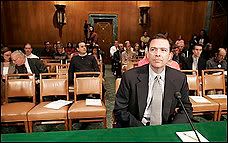 Former Deputy Attorney General James Comey waits to testify on Capitol Hill in Washington, Tuesday, May 15, 2007, before the Senate Judiciary Committee hearing regarding the fired prosecutors. (AP Photo/Susan Walsh)
The Washington Post reports:
The White House three years ago briefly implemented a classified program, parts of which the Justice Department found to be illegal, overriding the objections of top department officials after failing to get a seriously ill attorney general John D. Ashcroft to sign off on it from his hospital bed, Ashcroft's former deputy told a Senate panel today.
Former deputy attorney general James B. Comey testified under oath that Alberto R. Gonzales and Andrew H. Card Jr., at the time President Bush's White House counsel and chief of staff respectively, went to see Ashcroft in intensive care at George Washington University Hospital in March 2004 in an effort to "do an end run" around Comey, who was then acting attorney general, and obtain recertification of the highly sensitive program. Under the presidential directive then in effect, the legality of the program was to be certified by the Justice Department every 45 days.
Comey declined to identify the program, but members of the Senate Judiciary Committee indicated at today's hearing that it was the National Security Agency's controversial warrantless eavesdropping effort that the White House called the "terrorist surveillance program."
The secret program was authorized by Bush shortly after the Sept. 11, 2001, terrorist attacks to monitor communications between suspects abroad and persons in the United States without obtaining warrants from a special court under provisions of the Foreign Intelligence Surveillance Act. The program came to light in late 2005.
In January, Gonzales, who succeeded Ashcroft as attorney general in February 2005, informed the Senate that Bush would not reauthorize the program but would submit electronic surveillance requests for approval by the Foreign Intelligence Surveillance Court.
In his testimony today, Comey described publicly for the first time the tense confrontation between the White House and the Justice Department over the program in 2004, a dispute that he said was settled when Bush was confronted with the imminent prospect of mass resignations, including those of Ashcroft and Comey.
He said he had been angered by the visit of Gonzales and Card to Ashcroft's hospital room after the Justice Department had refused to recertify the program for reasons that he declined to explain publicly.
"I was very upset," Comey told the committee. "I was angry. I thought I just witnessed an effort to take advantage of a very sick man, who did not have the powers of the attorney general because they had been transferred to me."
The testimony appeared to add more fuel to calls for the resignation of Gonzales, who is under fire for the controversial dismissals last year of nine U.S. attorneys. At today's hearing, Sen. Arlen Specter (R-Pa.), the only Republican present, joined Democrats in saying he was troubled by the testimony and that he thought Gonzales should step down.
Wednesday, March 21, 2007
| [+/-] |
How U.S. Attorneys Were Used To Spread Voter-Fraud Fears |
At Salon.com, Mark Follman, Alex Koppelman and Jonathan Vanian write:
Under intense criticism for firing eight United States attorneys, the Bush administration has spent the past few weeks casting about for an explanation for the dismissals that involves performance rather than politics. On March 13, White House spokesman Dan Bartlett tried to come up with one. "Over the course of several years, we have received complaints about U.S. attorneys," he insisted, "particularly when it comes to election fraud cases." On Tuesday, President Bush pressed home this claim with a similar statement during his defense of embattled Attorney General Alberto Gonzales. "We did hear complaints and concerns about U.S. attorneys," said Bush. "Some complained about the lack of vigorous prosecution of election fraud cases."
Bush and Bartlett were arguing that some of the fired attorneys had underperformed by failing to prosecute the raft of offenses that make up voter fraud -- things like vote buying, double voting, and voting by felons, illegal aliens and the deceased. And it is true that at least two of the prosecutors who were let go might not have pursued voter fraud cases to the satisfaction of their bosses at the Department of Justice. But under the Bush administration, pursuing voter fraud is not always about performance. It's often about politics.
A belief in rampant voter fraud in Democratic strongholds -- big cities, minority neighborhoods -- is widespread among Republicans, and claims of vote buying and the like have long been a mainstay of GOP rhetoric. The party has used these claims of voter fraud to help build public support for what it considers electoral reforms, like requiring voters to show photo ID -- reforms that also tend to suppress Democratic turnout on Election Day.
During the Bush administration, a rhetorical tool became public policy. The Republicans could not get a photo ID law through the Senate, but they were able to enlist the 93 United States attorneys in their crusade against voter fraud. In 2002, then-Attorney General John Ashcroft announced an initiative that required "all components of the [Justice] Department" to "place a high priority on the investigation and prosecution of election fraud."
Five years later, Ashcroft's initiative hasn't produced all that much in the way of convictions, at least relative to the overall Department of Justice caseload. Prosecutions for electoral fraud remain a minuscule part of the federal criminal docket. In 2002 alone, there were 80,424 criminal cases concluded nationwide in the 94 U.S. District Courts. By comparison, according to a DOJ document, between the fall of 2002 and the fall of 2005, there were only 95 defendants charged with federal election-fraud-related crimes in the whole country.
After all, election fraud on the federal level can be hard to prove, since proving it often requires that the fraud was committed with the intent of preventing a "fair and impartially conducted election." In New Mexico in 2004, U.S. Attorney David Iglesias, one of the two fired U.S. attorneys who allegedly failed to pursue electoral fraud cases, took a pass on an especially dubious prosecution. A swing state that Gore won by 366 votes in 2000 and Kerry lost by fewer than 7,000, New Mexico is also the site of a long, bitter and ongoing battle between Republicans and Democrats over requiring voters to show photo ID. In 2004, state Republicans pressured Iglesias to file charges in the case of a 13-year-old boy who was illegally registered to vote. The boy had been registered without his or his parents' knowledge, and Iglesias declined to indict anyone. In an interview with Salon, Iglesias conceded that some local Republicans may have been especially disappointed to learn he would not be pursuing criminal charges for election fraud because they would have liked the extra political ammunition.
But sometimes pursuing an investigation can be just as effective as a conviction in providing that ammunition and creating an impression with the public that some sort of electoral reform is necessary. The battle between Democrats and Republicans over photo ID has been most contentious in so-called battleground states like New Mexico. In one such purple state, the GOP used repeated and very public accusations of fraud to ram a photo ID law through the state legislature. In Missouri, Republicans have been accusing Democrats of fraud since the 2000 election. During the Bush administration, three different U.S. attorneys have launched investigations into electoral fraud in Missouri, indicting nine people. Last year, prior to the midterm elections, the administration even dispatched a key voting fraud expert from Washington to assume the job of U.S. attorney in Missouri's Eastern District.
It all began in November of 2000, when then-Sen. John Ashcroft lost a close election to a dead man, Democrat Mel Carnahan. That election was a controversial one in Missouri -- polls remained open past the official closing time in St. Louis, a city dominated by African-American Democrats. This infuriated Republicans, especially Sen. Kit Bond, who delivered a podium-pounding denunciation of alleged voter fraud at the Missouri GOP's victory party on election night. Bond later spearheaded calls for an investigation, pushing Republican lawyers to put together a dossier of allegations that was then delivered to the outgoing, Clinton-appointed U.S. attorney for the Eastern District.
When Bush appointee Raymond W. Gruender took over as U.S. attorney for the St. Louis-based Eastern District, a federal grand jury was hearing testimony about electoral fraud by Gruender's third day on the job. However, before long the grand jury apparently shifted its emphasis from the 2000 race to improprieties in yet another election, the March 2001 Democratic mayoral primary. Investigation of the 2000 election became the province of DOJ lawyers in Washington. Ultimately, neither Gruender nor his superiors in D.C. filed any charges, but after Gruender kicked the investigation of the mayoral primary back to St. Louis city officials, eight individuals were convicted in state court. Gruender was later named to the U.S. Court of Appeals for the 8th Circuit.
Missouri Republicans used the multiple investigations, which together lasted more than a year, as evidence in a push for tougher election laws. By spring of 2002, they were proposing a law requiring that voters show photo ID. The state Legislature finally passed a Republican-sponsored photo ID law four years later, in May 2006. Helping the Republican cause was yet another major investigation of voter fraud by the state's other U.S. attorney, Todd P. Graves of Missouri's Western District, headquartered in Kansas City. In 2004 and 2005 he prosecuted and convicted four people for voting in both Missouri and neighboring Kansas.
Missouri's photo ID law was struck down by the state Supreme Court in October 2006, just before the midterm elections. But by then, the Bush administration had used a loophole in the Patriot Act to appoint Bradley Schlozman, who had supervised the voting section of the Civil Rights Division of the DOJ at headquarters in Washington, as Graves' successor in the Western District. The loophole was closed by a vote of the Senate on Tuesday, but in March of 2006 Alberto Gonzales was able to make Schlozman a U.S. attorney without seeking confirmation from the Senate.
The appointment, the first under the controversial Patriot Act provision, raised eyebrows at DOJ, one former senior Justice Department official told Salon. "Schlozman was one of Gonzales' guys," the former senior official said, "but several of us were scratching our heads when we heard about it because he was not a very well-regarded trial attorney."
Schlozman, who graduated from law school in 1996, was a clerk for three years and an appellate attorney in Washington for two years before joining the Department of Justice. He certainly had less experience (PDF) as a criminal prosecutor than many of his fellow U.S. attorneys. But as the head of the voting section of the DOJ's civil right division, he knew a lot about election fraud. In 2005, he had penned an editorial for the Atlanta Journal-Constitution supporting a bill passed by the Republican-dominated Georgia state Legislature requiring voters to show photo ID. Schlozman argued that the bill would not be an impediment to minority voters.
Less than a week before the 2006 midterm election, in which Missouri was the scene of one of the year's tightest Senate contests, Schlozman announced the indictment of four people for voter fraud. The four had allegedly submitted false voter registrations while working for the group ACORN in the inner city of Kansas City. An organization that conducts registration drives in poor and minority urban neighborhoods, i.e., areas of Democratic strength, ACORN has often been a target of fraud accusations by the right. "This national investigation is very much ongoing," said Schlozman in a statement issued Nov. 1. The indictments were trumpeted by myriad conservative blogs and such national outlets as Fox News, the Wall Street Journal and the Washington Times.
More than four months after he announced them -- and after incumbent Republican Sen. Jim Talent lost a close election to Democrat Claire McCaskill -- Schlozman's four indictments have produced one guilty plea. An indictment against a fifth person was dropped. In the wake of the U.S. attorneys scandal, meanwhile, Schlozman is suddenly on his way out. On Jan. 16, two days before he gave his annual testimony to Congress, during which Democrats questioned him about the mass firing of U.S. attorneys, Attorney General Gonzales announced that John Wood would be taking Schlozman's place in Kansas City. "Schlozman had [only] been there for 10 months," the former senior Justice Department official told Salon. Until the firings became an issue, "They weren't going to replace him."
Political considerations aside, are the types of prosecutions pursued by Schlozman and his peers valid? Is real fraud actually common? As Bud Cummins, one of the eight U.S. attorneys just fired by the Bush administration, tells Salon, cases involving registration drives by groups like ACORN do crop up. But Cummins notes that when there is fraud connected to groups like ACORN, it is often perpetrated upon them, not by them. The groups sometimes pay workers by the number of registrations they turn in, which can lead some of the workers to falsify registrations to earn more money. Others, paid by the hour, falsify registrations so they can appear to have logged extra time.
The "voters" whose names wind up on the phony registrations are usually oblivious. "Those people that are registered in those ways either don't exist or don't know they're registered," said Cummins, who was U.S. attorney for the Eastern District of Arkansas. He also notes that most of these fraudulent registrations will never be used to vote. He provided one example of a case he investigated, in which a registration worker had simply used a phone book to pick out names at random. "You'd see something like Bud Smith, then Kate Smith," he recalled, "and then there was Smith Auto Body."
More generally, there seems to be little statistical basis for the Republican fixation on voter fraud. The few studies that have been done show fraud to be insignificant to the outcome of elections; it has been measured at levels as low as .0004 percent (PDF) of all ballots cast. Loraine Minnite, an assistant professor of political science at Barnard College, conducted a study of elections from 1992 to 2002 for Demos, a London- and New York-based public-policy think tank. Her analysis of the numbers showed that "the incidence of election fraud in the United States is low and that fraud has had a minimal impact on electoral outcomes." A 2006 report from the United States Election Assistance Commission, an independent agency created by Congress to "[conduct] research on election administration issues," calls Minnite's study the "most systematic look at fraud" (PDF).
The problem with the data cited by Minnite and other researchers is that it only counts people who were caught. And for people who believe that voter fraud is widespread, meaning Republicans, the other problem is the source. Numeric research on voter fraud tends to be conducted by and for people who don't believe it's widespread, meaning liberals. Demos, the think tank for which Minnite conducted her study, is progressive. Minnite also just wrote a new paper debunking voter fraud for Project Vote -- a group affiliated with ACORN. Despite a federal agency's endorsement, don't expect Republicans to read and heed Minnite's "systematic study" or to believe anyone else who suggests voter fraud is less than rampant. In fact, the USEAC report that includes an endorsement of Minnite's study was initially withheld. The USEAC delayed releasing it, according to the agency's chairman, a Bush appointee, because of "a division of opinion." The report had failed to give much credence to the issue of voter fraud.
Tuesday, December 6, 2005
| [+/-] |
Patron Saints of Right Wing Think Tanks Acquire Georgia Pacific Corp |
Oil barons Charles and David Koch, two of the nation's worst environmental criminals, now control the country's largest privately held company
Media Transparency reports:
In a move that does not bode well for the nation's forests, last month the Koch brothers of Kansas engineered a $13.2 billion buyout of forest products producer Georgia Pacific Corporation, making Koch Industries the nation's largest privately held company. The purchase includes Koch's assumption of $7.8 billion in Georgia Pacific debt, making the total purchase price $21 billion.
The Kochs are smart, focused, and incredibly wealthy. For years they've been pushing both a libertarian and free-market agenda through tens of millions of dollars in contributions to conservative causes, candidates and organizations.
During the late 1980s and early 1990s, Congress investigated their company over allegations that they had stolen over $30 million worth of oil from Indian tribes in Oklahoma. In January 2000, the Environmental Protection Agency leveled "the largest civil fine ever imposed on a company under any federal environmental law to resolve claims related to more than 300 oil spills from its pipelines and oil facilities in six states," according to Justice Department press release; the fine was severely reduced after John Ashcroft became Attorney General.
One of the brothers was recently honored (scroll down for pix) for his generous support of the American Ballet Theatre's production of Raymonda. Who are these men with deep right-wing ties who own a company that will soon become the nation's largest privately held corporation? They're the Kochs from Kansas, and they control Koch Industries.
According to the Toronto Globe and Mail, Koch's purchase of Georgia Pacific would vault Koch past food producer Cargill Inc. as the largest privately held company in the United States, with $80-billion in revenue and 85,000 employees in 50 countries.
In a way, the Georgia Pacific acquisition "completes the circle" for Koch, Scott Silver told Media Transparency. "The ideologues running the land management agencies are the product of the think tanks created by, and funded by, the Koch family," Silver, the executive director of the environmental group Wild Wildnerness, pointed out. "Those ideologues are now in a position to permit Koch's newest acquisition, Georgia-Pacific, to further rape and pillage the public's lands. These think tanks promote the Free-Market ideal when it serves their interests to do so, but in reality, they are firmly committed to the ideal of enriching private interests at enormous direct cost to the American taxpayer."
The Koch (pronounced "coke") brothers, Charles, David, William and Frederick are sons of Kansas. Thirty-eight years ago, Charles took over the company from his father, company founder Fred Koch. According to a recent piece in Business Week, Charles, 70, and David, 65, now "own the bulk of the company after elbowing out their other brothers ... in 1983," buying out William and Frederick for $470 million and $320 million, respectively. In 1998, in a chilling display of family disunity, "the two sets of brothers walked silently past one another in court as William and Frederick lost a lawsuit to extract more money from Charles and David."
In 1940, Fred Koch founded the company as an oil refiner. A graduate of MIT, he was an original member of the anticommunist ultra-conservative John Birch Society, founded in 1958. The sons did not fall far from the tree: Both Charles and David graduated from MIT and have been deeply involved in conservative politics.
According to "Axis of Ideology," (PDF Executive Summary) a 2004 report by the National Committee on Responsive Philanthropy, the two dominant Koch boys have "a combined net worth of approximately $4 billion, placing them among the top 50 wealthiest individuals in the country and among the top 100 wealthiest individuals in the world in 2003, according to Forbes."
Between 1999 and 2001, they gave more than $20 million to a host of conservative organizations; "most of their contributions go[ing] to support organizations and groups advancing libertarian theory, privatization, entrepreneurship and free enterprise," "Axis of Ideology" pointed out (click here to see aggregated grants from the three Koch foundations).
"David, who is executive vice-president and a board member, ran for Vice-President on the Libertarian Party ticket in 1980 and both Charles and David are directors of the free-market advocating Cato Institute and Reason Foundation," Business Week recently pointed out. In an interview with National Journal, David Koch described his philosophy this way: "My overall concept is to minimize the role of government and to maximize the role of the private economy to maximize personal freedoms."
According to SourceWatch, a project of the Center for Media & Democracy, the brothers are "leading contributors to the Koch family foundations, which supports a network of Conservative organizations and think tanks, including Citizens for a Sound Economy, the Manhattan Institute, the Heartland Institute, and the Democratic Leadership Council."
Charles Koch co-founded the Cato Institute in 1977, while David helped launch Citizens for a Sound Economy [http://www.mediatransparency.org/story.php?storyID=40" target="_blank"] in 1986. Over the years, they have given more than $12 million to each, according to the NCRP report. George Mason University is also a well-funded recipient of Koch largesse; receiving more than $23 million from the family's foundations between 1985 and 2002, according to the NCRP.
Charles and David Koch control several family foundations including the Charles G. Koch Foundation, the David H. Koch Foundation and the Claude R. Lambe Foundation. Koch money also flows through Triad Management Services, "an advisory service to conservative donors on groups and candidates to support." Put more precisely, SourceWatch notes that Triad "is a Tom Delay-affiliated organization that launders money from large corporations into congressional campaigns."
Originally and perhaps not surprisingly given their libertarian bent, the brothers were not aficionados of former Republican Kansas Senator Bob Dole. Some reports have it that they considered him more or less as just another spineless politician. In 1986, however, "the Kochs' disdain for Dole began to dissipate when Koch Industries sought financial advantage under 'technical corrections' to a tax revision act," veteran reporter Robert Parry wrote in an extensive investigative report for The Nation magazine. "The Washington Post," Parry noted, "reported that Koch Industries approached Dole and secured the Senator's aid in inserting an exemption from a new real-estate depreciation schedule, a change that was worth several million dollars to the company."
"As a Senate leader ... [Dole] appeared willing to trade his influence for the keys to the Koch political money vault," Parry pointed out in "D(OIL)E: What Wouldn't Bob Do For Koch Oil?" David Koch became "a national vice chairman of the Dole presidential campaign's finance committee ... [and] lin[ed] up deep-pocket contributors for his candidate and the G.O.P." Koch "also helped Dole achieve majority leader status through his checkbook, contributed mightily to a Dole foundation and even turned his Gatsbyish estate in Southampton, New York, into the site for celebrating Dole's 72nd birthday in July 1995, raising $150,000 for his campaign."
One of the strangest aspects of the Koch story is how little the general public knows about the brothers or the company. "Koch is a huge company -- bigger than Microsoft, but few people have heard of it," said Bob Williams, a project manager at the Center for Public Integrity, and the co-author of the report "Koch's Low Profile Belies Political Power: Private Oil Company Does Both Business and Politics With the Shades Drawn."
"Despite its size and political largesse, Koch is able to dodge the limelight because it is privately-held, meaning that nearly all of its business dealings are known primarily only by the company and the Internal Revenue Service," Williams and Kevin Bogardus, co-author of the report, wrote. The company "has spent nearly $4 million on direct lobbying on more than 50 pieces of legislation before Congress, helping shape the debate on everything from limiting class action lawsuits to repealing the estate tax," William and Bogardus pointed out.
In a November 15 News Release issued by the Institute for Public Accuracy, Williams pointed out that the company is "politically active, in campaign contributions, lobbying and, probably most importantly, founding and funding right-leaning libertarian think tanks." The acquisition could have profound effects since both the oil and lumber industries have significant environmental ramifications. "Koch is very solicitous of its many friends in Washington; and when it gets in an environmental bind, it is not shy about calling on those friends in Washington," Williams added.
Williams' 2004 "Koch's Low Profile Belies Political Power" noted that:
"Despite its size and political largess, Koch is able to dodge the limelight because it is privately held, meaning that nearly all of its business dealings are known primarily only by the company and the Internal Revenue Service."
"Although it is both a top campaign contributor and spends millions on direct lobbying, Koch's chief political influence tool is a web of interconnected, right-wing think tanks and advocacy groups funded by foundations controlled and supported by the two Koch brothers."
"Koch has had plenty of run-ins with government regulators and other legal problems in recent years. Through it all, the company has shown a remarkable knack for getting criminal charges dropped and huge potential penalties knocked down."
"Koch has also shown a remarkable ability to get rid of or modify environmental policies and other government rules it doesn't like."
"Amongst the most important, visible and powerful proponents of public lands privatization are the Cato Institute, the Property and Environment Research Center (formerly known as Political Economy Research Center) and the Reason Institute," said Scott Silver, the executive director of Wild Wilderness, a Bend, Oregon-based grassroots environmental organization. "Koch funds have played a major role in the operation of each of these organizations."
The Koch family "is amongst the most powerful and influential movers and shakers promoting privatization in America," Silver added. Over the past several decades, "their money created an extensive infrastructure of Libertarian and Free-Market think tanks from which President Bush has drawn to staff the highest rungs of the land management agencies."
The acquisition of Georgia-Pacific, which "does extensive logging on public lands" and "is a heavily subsidized form of corporate welfare," could accelerate the trend toward the privatization of our national forests Silver argued. "Logging companies such as Georgia-Pacific strip lands bare, destroy vast acreages and pay only a small fee to the federal government in proportion to what they take from the public. They do not operate in the Free-Market when they log public forests."
Over the years, Koch has been "a major polluter," SourceWatch reported. "During the 1990s, its faulty pipelines were responsible for more than 300 oil spills in five states, prompting a landmark penalty of $35 million from Environmental Protection Agency (EPA). In Minnesota, it was fined an additional $8 million for discharging oil into streams. During the months leading up to the 2000 presidential elections, the company faced even more liability, in the form of a 97-count federal indictment charging it with concealing illegal releases of 91 metric tons of benzene, a known carcinogen, from its refinery in Corpus Christi, Texas."
After Bush took office in 2000, the 97-count indictment was reduced by 88. The balance was then settled when, "two days before the trial" then- Attorney General John Ashcroft "settled for a plea bargain in which Koch pled guilty to falsifying documents. All major charges were dropped, and Koch and Ashcroft settled the lawsuit for a fraction" of the possible $350 million in fines. (According to SourceWatch, Koch had contributed $800,000 to the Bush election campaign and other Republican candidates.)
That did not stop the company from polluting: In 2003, Koch bought Invista, the world's largest fibers company (which owns brands such as Lycra and Teflon) from DuPont for more than $4 billion in cash. According to a November 11 report in The News Virginian -- serving Waynesboro, Staunton and Augusta County, Va. -- "the Virginia Department of Environmental Quality log[ed] 16 spills by the textiles plant this year [and] warned Invista in a Nov. 9 violation notice that 'civil charges' and 'corrective action' might be on the way."
A follow-up editorial two days later pointed out that Dupont, which previously owned the plant, used "the South River as a toilet for nearly 75 years," but when the operation "employed 4,000-plus locals in high-paying jobs, the powers-that-be here seemed to ignore the mercury the plant dumped into our river." Before the acquisition by Koch, the plant employed about 1,000 workers; now the workforce numbers about 700.
