The Washington Post reports:
Corn farmer Jim Handsaker has found a slew of ways to ride the heartland boom in biofuels that is reshaping the economy of rural Iowa.
He sold some of his 2006 crop this year for more than $4 a bushel, the highest price in a decade. His stake in two nearby ethanol plants brought in several thousand dollars more in dividends. Meanwhile, soaring farmland prices have pushed the value of the 400 acres he owns to around $2 million.
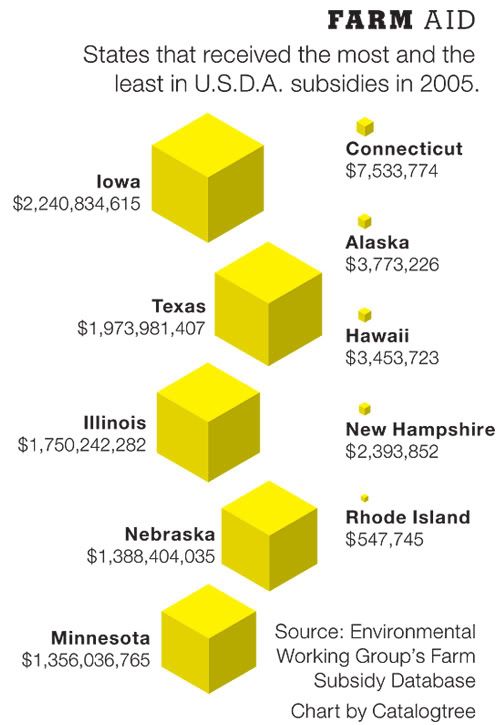
Even so, come October he will get a subsidy check from the government, part of a $1.6 billion installment that the U.S. Department of Agriculture will send to corn farmers.
Those annual automatic payments to Handsaker and thousands of other prospering corn growers have long been controversial. But coming at a time when taxpayers are already subsidizing the ethanol industry to the tune of $3 billion a year, the double-barreled support system for those who grow corn and those who turn it into fuel has begun to draw fire in Congress.
"Federal farm subsidies are already narrowly focused on certain crops and are excessive," said Sen. Richard G. Lugar (R-Ind.), a farmer and former chairman of the Senate agriculture committee. "They become ridiculous given the exploding possibilities to grow crops for biofuels production."
So far, Congress has shown little inclination to adjust the subsidies to account for the new energy-driven rural economy.
A House-passed farm bill would give corn growers $10.5 billion over the next five years, even if prices stay high. These "direct payments," a kind of annual allowance, are set by formula and go out automatically, regardless of prices, profits, yields or weather.
At the same time, a Senate-approved energy bill would double the federal requirement for the use of ethanol from corn -- a move that should further buttress corn prices.
Handsaker, a Republican who keeps a framed picture of President and Mrs. Bush in his office, argues that such farm subsidies help keep agricultural land in the hands of family farmers and away from corporate monopolies.
Handsaker is not banking on the ethanol boom lasting. "We've all been down the road of price plateaus," he said.
But he acknowledges that justifying the payments is not easy in the midst of an energy renaissance in the heartland. Country roads are dotted with signs advertising "ethanol corn" -- genetically engineered seeds with the high starch content ideal for making 200-proof, high-octane ethanol.
Just weeks before the October harvest, Hardin County, Handsaker's home in central Iowa, was a sea of corn rolling southwest from Iowa Falls. Handsaker once grew a mix of corn and soybeans on the farmland he and his brothers own or rent. "Now we're 100 percent corn," he said.
On a once quiet highway west of Iowa Falls, a constant stream of tractor-trailers pound the road, hauling corn to the Hawkeye Renewables ethanol refinery and soybeans to Cargill Inc.'s biodiesel plant.
To celebrate a banner year, Hawkeye founder and chief executive Bruce Rastetter pulled out the stops for his annual midsummer bash. Several hundred politicians, businessmen and farmers mingled at his richly landscaped hilltop estate, and Sen. Charles E. Grassley (R-Iowa) made his entrance in a wagon pulled by Rastetter's team of Percheron draft horses.
"It's a great country," said Rastetter, a Hardin County native who started with a few acres of farmland and a small feed business 20 years ago. He recently pledged $1.75 million to Iowa State University. In addition to his Iowa Falls plant, he operates a second one in a nearby county and has two more under construction.
The boom has helped push shares in Iowa ethanol plants to double or triple the initial price. Bill Couser, a corn grower and cattleman who was a driving force behind a new ethanol plant in neighboring Story County, says a grateful local school bus driver who bought shares "waves and honks every time she drives by."
"That's the secret of this ethanol industry," Couser said. "It's keeping the dollars at home."
In July, Pine Lake Corn Processors, the second Hardin County plant after Hawkeye's, announced profits for the previous eight months of $3,800 a share, more than the $3,250 cost of the initial investment. "It's worked out better than my wildest dreams," said Pine Lake President Larry Meints, a corn grower who pushed for the new plant after becoming fed up with hauling grain to distant elevators.
The new market means corn-rich Hardin County has to import the crop even though it grows 35 million bushels a year. The county can't supply its two ethanol refineries and its thriving pork, beef and poultry industries.
"Things are good here," said Howard B. Wenger, president of Iowa Falls State Bank, who reviews the balance sheets of hundreds of farmers.
He estimates that most farmers earned between $100 and $400 an acre on their 2006 crop after expenses, depending on whether they owned or rented their land. That translates into profits of $100,000 to $400,000 on a 1,000-acre farm. The USDA predicts that net farm income will be $87.1 billion this year, up nearly 50 percent over 2006.
Iowa farmland values are up 18 percent in the past 12 months, according to Federal Reserve Board surveys, making millionaires on paper out of any farmers owning 200 acres free and clear.
The rural prosperity is due in large measure to billions of dollars in federal subsidies and incentives for corn-based energy. These include a 51-cent tax credit that gasoline manufacturers get on every gallon of ethanol they mix with their blends, and more than $500 million in federal cash to ethanol refiners between 2001 and 2006.
In 2005, Congress required the use of at least 7.5 billion gallons of ethanol a year by 2012. Then in 2006 came new demand for ethanol as a pollution-curbing additive, along with a jump in gasoline prices that made the corn-based fuel competitive.
"We're harvesting the sun out here," said Handsaker, a genial man who typifies the new breed of businessman-farmer. "We're creating something with sun and chemicals and water and making a renewable product instead of unloading an oil tanker."
When he started in 1971, he recalled, farmers sold their crops to the local livestock industry or sent them "down the river" to volatile export markets.
Prices soared when the Soviet harvest failed or Argentina's corn crop fell short. In between, government payments bridged the gap between solvency and bankruptcy. From 2001 through 2005, Handsaker and his two brothers collected more than $500,000, according to USDA records.
Now four ethanol plants have sprouted within easy trucking distance of their farms and will get about half the 450,000 bushels they produce.
Still, the three brothers stand to collect about $45,000 in direct payments this year, based solely on their previous crop acreage and yields, according to USDA records. Congress created the payments in 1996 as part of a plan to temporarily buttress farm incomes while other traditional subsidies were eliminated. They were supposed to be phased out. Instead, the 2002 farm bill continued them.
"It's a bonus program, not a safety net," said Sen. Richard J. Durbin (D-Ill.). "Farmers I talk to know it's not politically sustainable to ask taxpayers to make payments to them in highly profitable years."
Durbin plans to offer a farm bill amendment that would gradually replace the automatic payments with a program to compensate growers when statewide farm revenues fall below the norm. The National Corn Growers Association embraces a similar plan. This week, the Senate agriculture committee's chairman, Tom Harkin (D-Iowa), circulated a proposal to cut direct payments by $4.5 billion over five years.
The American Farm Bureau Federation, the country's largest farm organization, opposes any changes, but the National Farmers Union, the nation's second-largest, supports an overhaul of direct payments. "It's the most costly and inefficient method for providing a safety net," said the union's president, Tom Buis.
Lugar, the senator from Indiana, favors scrapping the current farm program and using crop insurance and tax-exempt savings accounts to tide farmers over in bad years.
"A farmer's best friend in Iowa is the energy bill," said Bruce Babcock, a professor of economics at Iowa State. "What do you need the direct payments for? It's money for nothing."
Rastetter, along with most others in the ethanol industry, argues that increasing requirements for ethanol use would do more for corn growers than farm programs would. If the government expands its support for ethanol, he said, "then the market price of corn will support farmers and provide the safety net."
But relying on energy policy instead of the traditional farm program worries many in rural Iowa who remember previous bubbles.
The bank still holds a mortgage on his land, Handsaker notes.
Ethanol prices have been tumbling recently as supply catches up with demand. Some ethanol companies, including Rastetter's, have put plans for new refineries on hold pending action by Congress to expand required use.
But such action faces stiff opposition from the livestock industry, which contends that the added demand for corn could mean higher feed and food costs. Environmental groups say it could jeopardize water supplies and sensitive lands in exchange for only minimal savings in the use of fossil fuels, given the amounts of gasoline and chemical fertilizer needed to raise corn.
Meanwhile, the prices of fertilizer, seed and land have been rising rapidly as landlords and corporations move to capture their share of higher grain prices. "As far as the bioeconomy, I don't think any of us thinks it's the golden egg," said April Hemmes, who owns 1,000 acres of prime farmland near Iowa City.
Thursday, September 27, 2007
| [+/-] |
Corn Farms Prosper, But Subsidies Still Flow |
Thursday, August 2, 2007
| [+/-] |
Despite Democratic Promises of Reform, Big Ag Wins Again |
In the San Jose Mercury News, Daniel Weintraub writes:
House Speaker Nancy Pelosi could have listened to Berkeley chef Alice Waters, or to the University of California-Berkeley's Michael Pollan, author of "The Omnivore's Dilemma." Instead, she went with the Farmers Rice Co-op, King Ranch and Buttonwillow Land and Cattle Co.
Waters and Pollan were among those urging Pelosi and the House of Representatives she leads to overhaul the nation's farm policy, shifting billions of dollars from subsidies for corporate agribusiness to a means-tested safety net for real family farmers, plus policies to promote healthier foods and sound stewardship of the land.
But Pelosi last week turned back their pleas and sided with big agriculture - and her political instincts. She is supporting a farm bill that would preserve the worst parts of U.S. policy and, perhaps, help farm-state Democratic incumbents maintain their tenuous hold on districts they captured in the 2006 elections.
Pelosi says that the bill she supports includes the "first steps" toward reform. But at best those steps are tiny. And since the United States sets farm policy only once every five years, this was a rare opportunity for Democrats to show that their newly ascendant leadership in Congress will fight for real change. They've failed that test.
U.S. farm policy is a remnant from the Great Depression, when more than a quarter of Americans made their living from the land and were vulnerable to changes in the weather and market conditions.
Today, farming is a big business increasingly dominated by large corporations. But the subsidies originally adopted for the family farmer continue and have been warped to favor the largest companies at the expense of the little guy.
According to Environmental Defense, 10 percent of farming operations now collect more than 60 percent of direct subsidies paid under the farm bill. And according to OxFam America, a non-profit organization working to end world hunger, 92 percent of the subsidies go to the growers of just five commodities: corn, wheat, cotton, soybeans and rice.
California ranked 10th in the nation in payments received from 1995-2005, but 91 percent of California farmers and ranchers do not get any payments at all, according to the Environmental Working Group, which tracks the subsidies and publishes a database of the recipients. The Rice Co-op was the biggest California recipient last year, with payments of more than $5 million spread among its members. Texas-based King Ranch, with operations in California, and the Buttonwillow Land and Cattle Co. were not far behind.
The subsidies encourage farmers to grow big-volume crops, flooding world markets at the expense of small farmers in other countries and drawing complaints against U.S. policy at the World Trade Organization. The current subsidies also lower the cost of raw materials for the processed food companies that rely on corn syrup and soy, while doing almost nothing for the growers of fresh fruits and vegetables and the consumers who want to buy them.
While it would be better to phase out all subsidies, that isn't feasible in today's political climate. The next best thing might be the idea pushed by the movement Waters and Pollan helped lead. Their coalition is pushing for a third way - not ending the subsidies but overhauling them to put them in the service of a different set of policy goals.
Those goals were reflected in an amendment offered by Wisconsin Democrat Ron Kind and Arizona Republican Jeff Flake. Their proposal would have replaced price guarantees and direct payments with a safety net to protect farmers from declines in prices and crop yields. It would have denied subsidies to farms making more than $500,000 a year (or $250,000 per person), and it would have shifted some of that money into programs to preserve fragile land and promote specialty crops, organic foods and farmers' markets.
But with the House Agriculture committee dominated by farm-state Democrats, including nine freshmen looking to strengthen their holds on their seats, it would have taken strong leadership from Pelosi to steer the debate toward reform. Kind's proposal failed, and the bill that resulted protects the status quo. While it purports to limit payments to $1 million per person or $2 million per farm, critics say that it opens new loopholes that will actually let some operations collect more than ever.
The irony is that the reform proposal would have distributed more money than current policy to the vast majority of congressional districts. That's because the farmers in just 20 districts now collect more than half the subsidies. According to Environmental Defense, 36 of 55 freshmen would have seen their farmers do better under the Kind amendment, with only seven doing worse. For the others it would have been a wash.
But in each district, large and powerful farm operations would have suffered at the expense of smaller, less influential growers. Thus the vote in favor of Big Ag.
Fortunately, the House won't have the last word on this matter. The Senate has yet to act, and House Democrats might have overreached when they included a last-minute tax increase to help pay for programs they added to their bill to buy off the opposition. This is one food fight that is likely to continue all summer.
Sunday, July 8, 2007
| [+/-] |
The Debate Over Agriculture Subsidies |
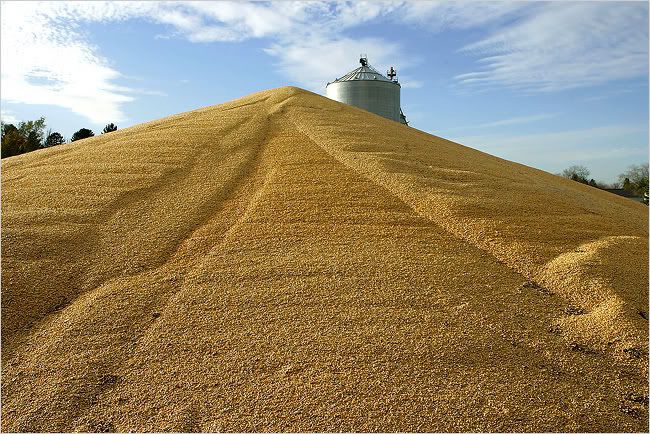 Who gets what? Large subsidies used to go to farms that grow corn, piled high in Minnesota, above, while growers of fruit, like California cherries, get none.
This year is different.
The New York Times reports:
Every five years the farm bill comes up for renewal and, usually, the only people paying attention are the farmers, their lobbyists and a few outraged groups who think subsidies are a big waste of taxpayers’ money.
Increasingly, people are blaming the farm bill, and the longstanding agriculture policy it embodies, for some of the problems afflicting the country: the growth in obesity, the increase in food poisonings, and the disappearance of the family farm. Payments for farmers were started in the 1930s during the Depression to help save family farms; now the program costs billions and benefits about one-third of the nation’s farmers.
Changes in the farm bill are being supported by the Bush administration and an unusual alliance that includes the American Heart Association, Environmental Defense, Taxpayers for Common Sense and GMA/FPA, a food industry association. They agree that some subsidies should be cut and money spent instead to help fruit and vegetable growers, protect farmland, support small farmers and promote healthier eating.
For the first time, lobbyists for farm subsidies are facing off in the halls of Congress against hundreds of activists.
There is still formidable opposition to the proposed changes, particularly among representatives in the 19 districts that received half the crop subsidies in 2005, according to Ken Cook, president of the Environmental Working Group, a nonprofit group which has just released details of who receives what payments, drawn from Agriculture Department computer files. But many experts think this new alliance, which spans the political spectrum, could bring about significant changes in the bill.
“I am more optimistic this year that we can see significant reform for farm policy because of a coalition of diverse interests,” said Cal Dooley, president of GMA/FPA. Senator Tom Harkin, Democrat of Iowa and chairman of the Senate Agriculture Committee, said: “This is not just a farm bill. It’s a food bill, and Americans who eat want a stake in it.”
The 2002 farm bill provided $143.3 billion for nutrition programs like Food Stamps, $16.8 billion for conservation and $67.6 billion to subsidize the planting of certain crops. Almost all of the subsidies usually go to growers of five commodities: soybeans, corn, rice, wheat and cotton. Fruit and vegetable farmers do not get subsidies.
Supporters say the subsidies have kept food affordable for Americans. Critics disagree and say the subsidies lead to cheap snack foods and soft drinks, made from ingredients like high fructose corn syrup and partially hydrogenated soybean oil. Meanwhile, the lack of subsidies for fruits and vegetables makes them expensive by comparison.
Between 1985 and 2000 the cost of fresh fruits and vegetables increased nearly 40 percent while the price of soft drinks decreased by almost 25 percent, adjusted for inflation, according to a study done by the Institute for Agriculture and Trade Policy, a group in Minneapolis set up to help save family farms and rural communities.
Health professionals say calories from those subsidized foods are partly responsible for the epidemic of childhood obesity and the increased incidence of diabetes.
Some of the bills before Congress are aimed at helping growers of fruits and vegetables and adding to the supply of local food.
One goal is helping to pay for new processing plants and slaughterhouses so that small farms could more easily market their products in their regions rather than sending them long distances. Many regional plants went out of business when the food industry became more concentrated.
Another is setting up more farmers’ markets and helping farmers sell to nearby schools, hospitals and other institutions, and helping low-income older people buy from small farmers.
Other ideas include giving grants, loans and technical assistance to beginning, immigrant and minority farmers to start new farms or to keep small struggling farms in business, and providing money for farmers who want to convert to organic methods.
Spending money on researching the cultivation of fruits and vegetables would help farmers find more efficient ways to irrigate and fertilize crops and deal with pests while cutting back on pesticides. Greenhouses would also be built to extend growing seasons.
Food Stamp benefits would be increased so that a family of three would receive $317 a month, up by $10.
Some bills would expand farm and ranchland preservation programs, restore and protect more wetlands, grasslands and watersheds, and improve water quality by cutting back on pesticides and preventing nutrients and pesticides from washing off farms and into streams and lakes.
Others include money for research and incentives for renewable energy on farms and ranches for wind power, biofuels from crops other than corn and for equipment to capture the methane from manure and turn it into an energy source.
The House requires that any new program be paid for either by cutting an existing program or specifying a new source of revenue, both difficult prospects.
On Friday, Representative Collin Peterson, Democrat of Minnesota and chairman of the House Agriculture Committee, is expected to announce two bills: the first will propose marginal cuts in subsidies and call for a number of proposals, including some money for fruits and vegetables, organic farming, farmers’ market promotions, novice farmers, and additional energy and conservation programs. It would retain current levels of funding for nutrition programs. But supporters of those programs say the bill does not provide enough funding for them.
The second bill will propose programs for which no money has been allocated, including some additional funds for nutrition programs and conservation money to reward farmers who are already using what are considered the best environmental practices.
The House leadership has already indicated it doesn’t want a floor fight and may try to force both sides to compromise on the depth of cuts in subsidies and on the level of new spending.
Whatever the House passes has to be reconciled with the Senate bill. Senator Harkin wants to cut some subsidies. The most likely cuts are what are called “fixed direct payments,” $5.2 billion per year paid to farmers even if they grow nothing, based on what they had raised in the past.
“You don’t have to sit on a tractor seat, visit the tractor seat, you don’t even have to be alive to get a fixed payment,” said Mr. Cook of the Environmental Working Group. “We have fixed payments to dead people all over the place. It’s ridiculous.”
Tom Buis, president of the National Farmers Union, the second largest organization for farmers in the country, said, “It is hard to defend direct payments.” But he added, “You can write a safety net that protects farmers and ranchers when times are tough.”
The Bush administration, as well as many alliance members, wants to eliminate subsidy payments for farmers who have an adjusted gross income of more than $200,000 a year. And some in Congress want to limit subsidies entirely. House Speaker Nancy Pelosi has supported limits on subsidies in the past and some Congressional bills would prohibit any farmer from getting more than $200,000 a year in subsidies.
According to the subsidy data from the Environmental Working Group, one giant cotton farm collected $2.95 million through crop subsidies in 2005, nearly as much money as the federal government spent on its primary research program for organic agriculture last year — $3 million.
Mary Kay Thatcher, a policy specialist with the American Farm Bureau Federation, the largest farm lobbying group, said current subsidies, which the federation supports, might be tweaked, but added, “I think it is highly unlikely that we will see huge changes.”
That may depend on whether the new activists can counteract the power of lobbyists who make large campaign contributions.
“Congress and the administration have a unique opportunity to begin reforms providing a sustainable, community-linked food system,” said Gus Schumacher, a consultant to the Kellogg Foundation for its food and society initiative and a former under secretary of agriculture. “Will they take this opportunity to start or will it be business as usual?”
Sunday, April 22, 2007
| [+/-] |
You Are What You Grow |
In the NYT, Michael Pollan writes:
A few years ago, an obesity researcher at the University of Washington named Adam Drewnowski ventured into the supermarket to solve a mystery. He wanted to figure out why it is that the most reliable predictor of obesity in America today is a person’s wealth. For most of history, after all, the poor have typically suffered from a shortage of calories, not a surfeit. So how is it that today the people with the least amount of money to spend on food are the ones most likely to be overweight?
Drewnowski gave himself a hypothetical dollar to spend, using it to purchase as many calories as he possibly could. He discovered that he could buy the most calories per dollar in the middle aisles of the supermarket, among the towering canyons of processed food and soft drink. (In the typical American supermarket, the fresh foods — dairy, meat, fish and produce — line the perimeter walls, while the imperishable packaged goods dominate the center.) Drewnowski found that a dollar could buy 1,200 calories of cookies or potato chips but only 250 calories of carrots. Looking for something to wash down those chips, he discovered that his dollar bought 875 calories of soda but only 170 calories of orange juice.
As a rule, processed foods are more “energy dense” than fresh foods: they contain less water and fiber but more added fat and sugar, which makes them both less filling and more fattening. These particular calories also happen to be the least healthful ones in the marketplace, which is why we call the foods that contain them “junk.” Drewnowski concluded that the rules of the food game in America are organized in such a way that if you are eating on a budget, the most rational economic strategy is to eat badly — and get fat.
This perverse state of affairs is not, as you might think, the inevitable result of the free market. Compared with a bunch of carrots, a package of Twinkies, to take one iconic processed foodlike substance as an example, is a highly complicated, high-tech piece of manufacture, involving no fewer than 39 ingredients, many themselves elaborately manufactured, as well as the packaging and a hefty marketing budget. So how can the supermarket possibly sell a pair of these synthetic cream-filled pseudocakes for less than a bunch of roots?
For the answer, you need look no farther than the farm bill. This resolutely unglamorous and head-hurtingly complicated piece of legislation, which comes around roughly every five years and is about to do so again, sets the rules for the American food system — indeed, to a considerable extent, for the world’s food system. Among other things, it determines which crops will be subsidized and which will not, and in the case of the carrot and the Twinkie, the farm bill as currently written offers a lot more support to the cake than to the root. Like most processed foods, the Twinkie is basically a clever arrangement of carbohydrates and fats teased out of corn, soybeans and wheat — three of the five commodity crops that the farm bill supports, to the tune of some $25 billion a year. (Rice and cotton are the others.) For the last several decades — indeed, for about as long as the American waistline has been ballooning — U.S. agricultural policy has been designed in such a way as to promote the overproduction of these five commodities, especially corn and soy.
That’s because the current farm bill helps commodity farmers by cutting them a check based on how many bushels they can grow, rather than, say, by supporting prices and limiting production, as farm bills once did. The result? A food system awash in added sugars (derived from corn) and added fats (derived mainly from soy), as well as dirt-cheap meat and milk (derived from both). By comparison, the farm bill does almost nothing to support farmers growing fresh produce. A result of these policy choices is on stark display in your supermarket, where the real price of fruits and vegetables between 1985 and 2000 increased by nearly 40 percent while the real price of soft drinks (a k a liquid corn) declined by 23 percent. The reason the least healthful calories in the supermarket are the cheapest is that those are the ones the farm bill encourages farmers to grow.
A public-health researcher from Mars might legitimately wonder why a nation faced with what its surgeon general has called “an epidemic” of obesity would at the same time be in the business of subsidizing the production of high-fructose corn syrup. But such is the perversity of the farm bill: the nation’s agricultural policies operate at cross-purposes with its public-health objectives. And the subsidies are only part of the problem. The farm bill helps determine what sort of food your children will have for lunch in school tomorrow. The school-lunch program began at a time when the public-health problem of America’s children was undernourishment, so feeding surplus agricultural commodities to kids seemed like a win-win strategy. Today the problem is overnutrition, but a school lunch lady trying to prepare healthful fresh food is apt to get dinged by U.S.D.A. inspectors for failing to serve enough calories; if she dishes up a lunch that includes chicken nuggets and Tater Tots, however, the inspector smiles and the reimbursements flow. The farm bill essentially treats our children as a human Disposall for all the unhealthful calories that the farm bill has encouraged American farmers to overproduce.
To speak of the farm bill’s influence on the American food system does not begin to describe its full impact — on the environment, on global poverty, even on immigration. By making it possible for American farmers to sell their crops abroad for considerably less than it costs to grow them, the farm bill helps determine the price of corn in Mexico and the price of cotton in Nigeria and therefore whether farmers in those places will survive or be forced off the land, to migrate to the cities — or to the United States. The flow of immigrants north from Mexico since Nafta is inextricably linked to the flow of American corn in the opposite direction, a flood of subsidized grain that the Mexican government estimates has thrown two million Mexican farmers and other agricultural workers off the land since the mid-90s. (More recently, the ethanol boom has led to a spike in corn prices that has left that country reeling from soaring tortilla prices; linking its corn economy to ours has been an unalloyed disaster for Mexico’s eaters as well as its farmers.) You can’t fully comprehend the pressures driving immigration without comprehending what U.S. agricultural policy is doing to rural agriculture in Mexico.
And though we don’t ordinarily think of the farm bill in these terms, few pieces of legislation have as profound an impact on the American landscape and environment. Americans may tell themselves they don’t have a national land-use policy, that the market by and large decides what happens on private property in America, but that’s not exactly true. The smorgasbord of incentives and disincentives built into the farm bill helps decide what happens on nearly half of the private land in America: whether it will be farmed or left wild, whether it will be managed to maximize productivity (and therefore doused with chemicals) or to promote environmental stewardship. The health of the American soil, the purity of its water, the biodiversity and the very look of its landscape owe in no small part to impenetrable titles, programs and formulae buried deep in the farm bill.
Given all this, you would think the farm-bill debate would engage the nation’s political passions every five years, but that hasn’t been the case. If the quintennial antidrama of the “farm bill debate” holds true to form this year, a handful of farm-state legislators will thrash out the mind-numbing details behind closed doors, with virtually nobody else, either in Congress or in the media, paying much attention. Why? Because most of us assume that, true to its name, the farm bill is about “farming,” an increasingly quaint activity that involves no one we know and in which few of us think we have a stake. This leaves our own representatives free to ignore the farm bill, to treat it as a parochial piece of legislation affecting a handful of their Midwestern colleagues. Since we aren’t paying attention, they pay no political price for trading, or even selling, their farm-bill votes. The fact that the bill is deeply encrusted with incomprehensible jargon and prehensile programs dating back to the 1930s makes it almost impossible for the average legislator to understand the bill should he or she try to, much less the average citizen. It’s doubtful this is an accident.
But there are signs this year will be different. The public-health community has come to recognize it can’t hope to address obesity and diabetes without addressing the farm bill. The environmental community recognizes that as long as we have a farm bill that promotes chemical and feedlot agriculture, clean water will remain a pipe dream. The development community has woken up to the fact that global poverty can’t be fought without confronting the ways the farm bill depresses world crop prices. They got a boost from a 2004 ruling by the World Trade Organization that U.S. cotton subsidies are illegal; most observers think that challenges to similar subsidies for corn, soy, wheat or rice would also prevail.
And then there are the eaters, people like you and me, increasingly concerned, if not restive, about the quality of the food on offer in America. A grass-roots social movement is gathering around food issues today, and while it is still somewhat inchoate, the manifestations are everywhere: in local efforts to get vending machines out of the schools and to improve school lunch; in local campaigns to fight feedlots and to force food companies to better the lives of animals in agriculture; in the spectacular growth of the market for organic food and the revival of local food systems. In great and growing numbers, people are voting with their forks for a different sort of food system. But as powerful as the food consumer is — it was that consumer, after all, who built a $15 billion organic-food industry and more than doubled the number of farmer’s markets in the last few years — voting with our forks can advance reform only so far. It can’t, for example, change the fact that the system is rigged to make the most unhealthful calories in the marketplace the only ones the poor can afford. To change that, people will have to vote with their votes as well — which is to say, they will have to wade into the muddy political waters of agricultural policy.
Doing so starts with the recognition that the “farm bill” is a misnomer; in truth, it is a food bill and so needs to be rewritten with the interests of eaters placed first. Yes, there are eaters who think it in their interest that food just be as cheap as possible, no matter how poor the quality. But there are many more who recognize the real cost of artificially cheap food — to their health, to the land, to the animals, to the public purse. At a minimum, these eaters want a bill that aligns agricultural policy with our public-health and environmental values, one with incentives to produce food cleanly, sustainably and humanely. Eaters want a bill that makes the most healthful calories in the supermarket competitive with the least healthful ones. Eaters want a bill that feeds schoolchildren fresh food from local farms rather than processed surplus commodities from far away. Enlightened eaters also recognize their dependence on farmers, which is why they would support a bill that guarantees the people who raise our food not subsidies but fair prices. Why? Because they prefer to live in a country that can still produce its own food and doesn’t hurt the world’s farmers by dumping its surplus crops on their markets.
The devil is in the details, no doubt. Simply eliminating support for farmers won’t solve these problems; overproduction has afflicted agriculture since long before modern subsidies. It will take some imaginative policy making to figure out how to encourage farmers to focus on taking care of the land rather than all-out production, on growing real food for eaters rather than industrial raw materials for food processors and on rebuilding local food economies, which the current farm bill hobbles. But the guiding principle behind an eater’s farm bill could not be more straightforward: it’s one that changes the rules of the game so as to promote the quality of our food (and farming) over and above its quantity.
Such changes are radical only by the standards of past farm bills, which have faithfully reflected the priorities of the agribusiness interests that wrote them. One of these years, the eaters of America are going to demand a place at the table, and we will have the political debate over food policy we need and deserve. This could prove to be that year: the year when the farm bill became a food bill, and the eaters at last had their say.
Friday, December 30, 2005
| [+/-] |
We Are What We Eat |
Michael Pollan writes:
If you are what you eat, and especially if you eat industrial food, as 99 percent of Americans do, what you are is corn. During the last year I've been following a bushel of corn through the industrial food system. What I keep finding in case after case, if you follow the food back to the farm — if you follow the nutrients, if you follow the carbon — you end up in a corn field in Iowa, over and over and over again.
Take a typical fast food meal. Corn is the sweetener in the soda. It's in the corn-fed beef Big Mac patty, and in the high-fructose syrup in the bun, and in the secret sauce. Slim Jims are full of corn syrup, dextrose, cornstarch, and a great many additives. The “four different fuels” in a Lunchables meal, are all essentially corn-based. The chicken nugget—including feed for the chicken, fillers, binders, coating, and dipping sauce—is all corn. The french fries are made from potatoes, but odds are they're fried in corn oil, the source of 50 percent of their calories. Even the salads at McDonald's are full of high-fructose corn syrup and thickeners made from corn.
Corn is the keystone species of the industrial food system, along with its sidekick, soybeans, with which it shares a rotation on most of the farms in the Midwest. I'm really talking about cheap corn — overproduced, subsidized, industrial corn — the biggest legal cash crop in America. Eighty million acres — an area twice the size of New York State — is blanketed by a vast corn monoculture like a second great American lawn.
I believe very strongly that our overproduction of cheap grain in general, and corn in particular, has a lot to do with the fact that three-fifths of Americans are now overweight. The obesity crisis is complicated in some ways, but it's very simple in another way. Basically, Americans are on average eating 200 more calories a day than they were in the 1970s. If you do that and don't get correspondingly more exercise, you're going to get a lot fatter. Many demographers are predicting that this is the first generation of Americans whose life span may be shorter than their parents'. The reason for that is obesity, essentially, and diabetes specifically.
Where do those calories come from? Except for seafood, all our calories come from the farm. Compared with the mid-to-late 1970s, American farms are producing 500 more calories of food a day per American. We're managing to pack away 200 of them, which is pretty heroic on our part. A lot of the rest is being dumped overseas, or wasted, or burned in our cars. (That's really how we're trying to get rid of it now: in ethanol. The problem is that it takes almost as much, or even more, energy to make a gallon of ethanol than you get from that ethanol. People think it's a very green fuel, but the process for making it is not green at all.)
Overproduction sooner or later leads to overconsumption, because we’re very good at figuring out how to turn surpluses into inexpensive, portable new products. Our cheap, value-added, portable corn commodity is corn sweetener, specifically high-fructose corn syrup. But we also dispose of overproduction in corn-fed beef, pork, and chicken. And now we're even teaching salmon to eat corn, because there's so much of it to get rid of.
There is a powerful industrial logic at work here, the logic of processing. We discovered that corn is this big, fat packet of starch that can be broken down into almost any basic organic molecules and reassembled as sweeteners and many other food additives. Of the 37 ingredients in chicken nuggets, something like 30 are made, directly or indirectly, from corn.
Now, how do you get people to eat so much of this reengineered surplus corn? That took the ingenuity of American marketing. One example is supersizing. When I was a kid, Coke came in these lovely little eight-ounce glass containers. Today, a 20-ounce container is the standard size for soda. The idea that you could sell soda that way was an invention. It has a history, and you can find the individual responsible, an ingenious movie theater manager named David Wallerstein, who invented the idea of supersizing and sold it to Ray Kroc, founder of McDonald's.
Before you go out and sue McDonald's over the size of your waistline, consider that overproduction of cheap corn is government policy. It's done in the name of the public interest, using our taxpayer dollars. American taxpayers subsidize every bushel of industrial corn produced in this country, at a cost of some four billion dollars a year (out of a total of 19 billion dollars in direct payments to farmers).
But before you blame subsidies for all these problems keep in mind that agricultural overproduction is an ancient problem that long predates subsidies. In any other business, when the price of the commodity you're selling falls, the smart thing to do is to curtail production until demand raises prices. But farmers don't do that, because there are so many of them, and because they all operate as individuals, without any coordination. So when prices fall farmers actually expand production, in order to keep their cash flow from falling. This economically and environmentally disastrous phenomenon has resulted in an increase in the American corn harvest from four billion to ten billion bushels since the 1970s.
How do we begin to change this system? First, we all need to begin to pay attention to the Farm Bill, working to develop farm programs that allow farmers to stay in business without falling into the trap of overproduction. Most city people don't realize the stake they have in it. They assume it's a parochial concern of members of Congress from farm states, but it's not. If it were called the Food Bill, I think we would all pay a lot more attention to it, and get a saner result. The Farm Bill sets out the rules of the game that everyone is playing in, whether you're an industrial or an organic farmer, whether you're eating industrially or not.
The other thing we can do is become responsible consumers. I’ve never liked the word "consumer." It sounds like a character who’s using up the world, rather than creating anything. I was at a gathering in Italy last October where Carlos Petrini, the founder and president of Slow Food International, offered a wonderful redefinition of the word. He called the consumer a “cocreator.” I think that’s exactly right, and we’ve seen why: with the organic movement, consumers and farmers have shown how they can work together as cocreators of an alternative food system. We need to join together now, to recruit a larger and larger army of cocreators, to rewrite the rules of the game — and “cocreate” a different kind of food system.
