For 5 1/2 years, not one violation was passed along to the Attorney General.
The Houston Chronicle reports:
An independent oversight board created to identify intelligence abuses after the CIA scandals of the 1970s did not send any reports to the attorney general of legal violations during the first 5 1/2 years of the Bush administration's counterterrorism effort, the Justice Department has told Congress.
Although the FBI told the board of a few hundred legal or rules violations by its own agents after the Sept. 11, 2001, attacks, the board did not identify which of them were indeed legal violations. This spring, it forwarded reports of violations in 2006, officials said.
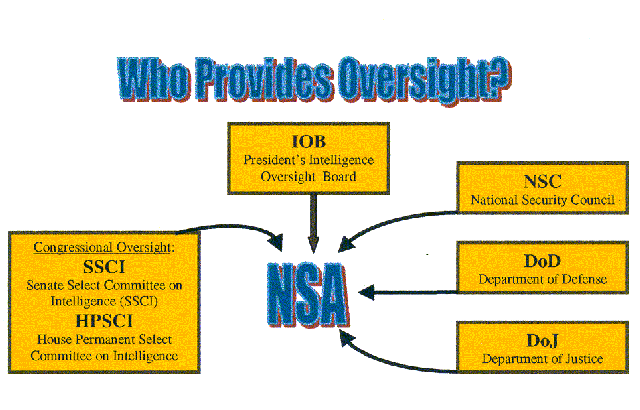
The President's Intelligence Oversight Board — the principal civilian watchdog of the intelligence community — is obligated under a 26-year-old executive order to tell the attorney general and the president about any intelligence activities it believes "may be unlawful." The board was vacant for the first two years of the Bush administration.
The FBI sent copies of its violation reports directly to Attorney General Alberto R. Gonzales. But the board's mandate was to provide independent oversight, so the absence of such communications has prompted critics to question whether the board was doing its job.
"It's now apparent that the IOB was not actively employed in the early part of the administration. And it was a crucial period when its counsel would seem to have been needed the most," said Anthony Harrington, who served as the board's chairman for most of the Clinton administration.
"The White House counsel's office and the attorney general should have known and been concerned if they did not detect an active and effective IOB," Harrington said. Senate Judiciary Committee chairman Patrick J. Leahy, D-Vt., added: "It is deeply disturbing that this administration seems to spend so much of its energy and resources trying to find ways to ignore any check and balance on its authority and avoid accountability to Congress and the American public."
White House spokeswoman Dana Perino said Friday that "the president expects every single person working in counterterrorism and intelligence strictly to follow the law — and if there are instances where that has not occurred, either intentionally or non-intentionally, he expects it promptly to be corrected." She said the White House was relying on the presidentially appointed director of national intelligence to monitor problems.
Through five previous administrations, members of the board — all civilians not employed by the government — have been privy to some of America's most secret intelligence operations and have served as a private watchdog against unpublicized abuses. The subjects of their investigations and the resulting reports are nearly all classified.
The Bush administration first appointed board members in 2003. Since then, the CIA and the National Security Agency have been caught up in controversy over interrogation tactics at secret prisons, the transfer of prisoners to countries that use torture, and domestic wiretapping not reviewed by federal courts.
Until recently, the board had not told the attorney general about any wrongdoing. "The Attorney General has no record of receiving reports from the IOB regarding intelligence activities alleged to be potentially unlawful or contrary to Executive Order or Presidential directive," the Justice Department told the House Judiciary Committee in a May 9 letter.
White House officials said the board began forwarding reports of problems shortly thereafter. White House officials declined to discuss the board's interactions with President Bush, and said its members could not be interviewed for this report.
President Gerald R. Ford created the board in the mid-1970s after the Church Committee identified numerous abuses by U.S. intelligence agencies. President Ronald Reagan made the board permanent with an executive order in 1981 and gave it the mission to identify legal violations.
Harrington said that under President Clinton, the board sent reports of legal violations by intelligence agencies promptly to the attorney general. Officials said it concluded that the administration showed poor judgment in supporting Iranian arms shipments to Bosnia, and it complained about the CIA's policy of employing known torturers or killers as informants in Latin America.
Perino said that during the first two years of the Bush administration, a career intelligence officer at the White House collected and reviewed reports in which the FBI and other intelligence agencies self-disclosed violations of civil liberties and privacy safeguards.
The board's three or four members — it has alternated over the years — are usually drawn from the larger President's Foreign Intelligence Advisory Board, which advises the commander in chief on U.S. intelligence policy and performance. The oversight board has been a mix of intelligence experts, such as George H.W. Bush's choice of former Air Force Gen. Lew Allen, and civilians from other walks of life, such as Bill Clinton's choice of Philadelphia investment banker Harold Pote.
The board now in place is led by former Bush economic adviser Stephen Friedman. It includes Don Evans, friend of the president and a former commerce secretary, former Adm. David Jeremiah and lawyer Arthur B. Culvahouse.
Perino said the board's "original unique mission and primary oversight role has been supplemented" in recent years by new layers of government. The administration now relies on the director of national intelligence — a job created in 2005 — to watch for abuses, along with presidentially appointed inspector generals. As a result, Bush is considering changes to Reagan's executive order, she said.
Clinton-era deputy national security adviser James B. Steinberg said, however, that "you have to have a civilian proxy who on one hand can be trusted with these secrets and can still call the operator on the carpet when they go astray. If you neuter these internal mechanisms, then you are basically saying there is no one watching the henhouse."
On Friday, the FBI and the Justice Department announced several reforms meant to strengthen internal oversight, including the creation of a legal "compliance office" inside the bureau and a review office inside the department that will regularly examine all violations.
Separately, Gonzales wrote the top Republican on the Senate Judiciary Committee, Sen. Arlen Specter of Pennsylvania, to defend his 2005 testimony that there had been no verified civil liberties abuses during the first three years of the efforts against terrorism. The Post reported last week that the FBI had sent Gonzales a half-dozen reports of violations of civil liberties and privacy safeguards before his testimony.
Gonzales wrote Friday that he did not consider the conduct in those reports to be abuses because the violations involved mistakes, not deliberate misconduct. "My testimony was completely truthful, and I stand by that testimony," he wrote.
Leahy scoffed at Gonzales' explanation. "The American people deserve an attorney general who will fully and accurately inform the Senate and the public about violations of civil liberties. Instead, they have one who misleads Congress and then hides behind dictionary definitions," he said.
Saturday, July 14, 2007
| [+/-] |
DoJ: "Oversight Board Failed To Report Intelligence Violations" |
Friday, May 25, 2007
| [+/-] |
Pinpointing Crucial Moments in The History That Got Us Into The Iraq War |
Congressional Quarterly reports:
Hearing horror stories about the manipulation of Iraq intelligence is like watching “The Exorcist” again and again: Each time you see something new and laugh at the parts that used to make your hair go up straight.
Patrick Lang told a hilarious story the other night, for example, about a job interview he had with Douglas Feith, a key architect of the invasion of Iraq.
It was at the beginning of the first Bush term. Lang had been in charge of the Middle East, South Asia and terrorism for the Defense Intelligence Agency in the 1990s. Later he ran the Pentagon’s worldwide spying operations.
In early 2001, his name was put forward as somebody who would be good at running the Pentagon’s office of special operations and low-intensity warfare, i.e., counterinsurgency. Lang had also been a Green Beret, with three tours in South Vietnam.
One of the people he had to impress was Feith, the Defense Department’s number three official and a leading player in the clique of neoconservatives who had taken over the government’s national security apparatus.
Lang went to see him, he recalled during a May 7 panel discussion at the University of the District of Columbia.
“He was sitting there munching a sandwich while he was talking to me,” Lang recalled, “ which I thought was remarkable in itself, but he also had these briefing papers — they always had briefing papers, you know — about me.
“He’s looking at this stuff, and he says, ‘I’ve heard of you. I heard of you.’
“He says, ‘Is it really true that you really know the Arabs this well, and that you speak Arabic this well? Is that really true? Is that really true?’
“And I said, ‘Yeah, that’s really true.’
‘That’s too bad,” Feith said.
The audience howled.
“That was the end of the interview,” Lang said. “I’m not quite sure what he meant, but you can work it out.”
Feith, of course, like the administration’s other Israel-connected hawks, didn’t want “Arabists” like Lang muddying the road to Baghdad, from where — according to the Bush administration theory — overthrowing Saddam Hussein would ignite mass demands for Western-style, pro-U.S. democracies across the entire Middle East.
Lang’s story is merely an illumination of what the Senate Intelligence Committee said in drier language May 25, that the White House was warned before invading Iraq that creating a stable democracy there “would be a long, difficult and probably turbulent process.”
Suddenly the Cassandras are everywhere. These days you can’t drop a Blackberry between Capitol Hill and Dupont Circle without it being stepped on by a former intelligence official with prepared testimony or a book proposal.
For those of us who have been around Washington for more than awhile, it’s unprecedented.
There were defections from the Johnson administration over Vietnam, more with the Nixon administration’s invasion of Cambodia — and of course there were Daniel Ellsberg and the Pentagon Papers, which exposed a historical record of official deceit on Indochina.
But back then intelligence officials didn’t quit one day and the next day write real-time books exposing the machinations of current, or near-current, defense and intelligence leaders.
When one did in 1974 — dissident CIA executive Victor Marchetti, who wrote “The CIA and the Cult of Intelligence,” an expose of how the agency overthrew governments, etc. (with John Marks, a former State Department intelligence analyst), there was an uproar.
Shrugs
Today, there are fewer uproars than shrugs, weekend news blips. Even George Tenet’s memoir has already started falling down the rungs of The New York Times nonfiction best-seller list.
One reason might be that readers don’t think he’s telling the truth — and too late, at that.
But another may be that the public has already concluded that, at least when it comes to the Middle East, the president and his men are — not to put too fine a point on it — dopes. Or worse.
As Colin Powell’s former chief of staff Lawrence Wilkerson, appearing on the same panel with Lang, put it, “This is the most colossally inept and incompetent administration in American history.”
And Wilkerson spent more than three decades in the Army. Even coming from the right hand man to the Bush administration’s former secretary of State, however, who was at the center of every intelligence controversy related to Iraq, that’s hardly news anymore.
Still, with the added value of hindsight, their anecdotes still have a fresh punch.
Here’s Another From Lang
“I remember talking to [Paul] Wolfowitz, in his office, in the Pentagon, and telling him — this was after the propaganda build up had started, before the war. I said, ‘You know, these guys are not going to welcome you.’
“He said, ‘Why?’ I said, ‘For one thing, these guys detest foreigners, and the few who really like you are the least representative of the various breeds of people there. They’re going to fight you, then, if you occupy the place there’s going to be a massive insurgency.’”
“He said, ‘No, no, they’ll be glad to see us,’” Lang continued. “This will start the process of revolution around the Middle East that will transform everything.’
No, Lang told Wolfowitz, “that’s not gonna happen. It’s just an impossibility. They’re not like that. They don’t want to be us.”
Not everyone agrees with all of Lang’s views about the Arab world, but on this issue he was prescient, of course, as were almost all experts on the region outside of the neocon faithful.
How come we learned so much of this dispute only after the war?
Face Time
Wilkerson provides a damning clue.
In February 2003, Powell’s top aide relates, he “spent five of the most intimate days of my life, and five nights, without sleeping, as did my team, staring into . . . the face” of George Tenet, Tenet’s deputy John McLaughlin, and other top CIA officials working on Iraq, at the agency’s headquarters at Langley.
It was the eve of Powell’s now infamous speech at the United Nations detailing Iraq’s alleged biological, chemical and nuclear programs.
“One of the things Secretary Powell and I told Mr. Tenet and Mr. McLaughlin at the outset of our frenetic five or six days, trying to get ready for the U.N., was ‘multiple sources.’ We will not take anything and put it in this presentation, unless there are multiple, independently corroborated sources for the items we’re putting in the testimony,” Wilkerson said.
“That was the going-in position.”
Subsequently, he learned that there was but “a single source for the mobile biological laboratories; that his code name was Curveball; and that there were several very key dissents as to this individual’s testimony, during or before the preparation of the secretary of State.”
Curveball, an Iraqi refugee, turned out to be a liar.
“None of that, ladies and gentlemen, none of that was revealed to the secretary of State, or to me, or to any member of my team, by either John McLaughlin or George Tenet,” Wilkerson said.
Tenet says in his memoir that he never heard of any serious questions about Curveball.
As readers of this column know , however, Tenet’s chief of European operations, Tyler Drumheller, insists he sent a flurry of warnings about Curveball to Tenet’s deputies.
Both can’t be right.
“Either George Tenet is lying through his teeth, or Tyler Drumheller is lying through his teeth,” Wilkerson says, “with regard to one of the most important pillars of Secretary Powell’s presentation at the United Nations: the mobile biological laboratories.”
We’re waiting now for a third CIA official to come forth with an answer.
Duped
The other “pillar” for the invasion, of course, was Saddam Hussein’s alleged connection to al Qaeda.
Now everybody knows that, too, was bogus.
But in Wilkerson’s hands this “old news” seems fresh — like watching Tony Perkins creep up on Janet Leigh in “Psycho” again.
Wilkerson relates how he and Powell were dubious about the Saddam-al Qaeda link the White House was pushing, and were trimming back that section of Powell’s draft on the eve of the speech.
“All of a sudden, we were told that a high-level al Qaeda operative . . . had been interrogated and . . . revealed that there was major training going on by . . . Saddam Hussein’s people — of al Qaeda operatives in how to use chemical and biological weapons,” Wilkerson said.
“This was quite a revelation, and, as you can imagine, changed the secretary’s mind about how much he was going to include about contacts between al Qaeda and Iraq in his presentation.”
But that, too, it turned out, was phony.
“One definition of news,” a mentor told me long ago, “is what people have forgotten.”
If that’s so, then the horror stories of Iraq can be told again and again.
And here’s one reason why they should be: CIA veterans are leaving in droves.
The other night I was talking with a recently retired top CIA operations officer, a man who had been a station chief in several foreign capitals.
“This government — what have they done to themselves?” he vented.
“They took a fine intelligence service,” he said, “and managed to destroy it in two administrations.”
I’m probably way out of step, but to me that’s still news.
Monday, May 24, 2004
| [+/-] |
New Questions For Abu Ghraib Prison Commander |
 Miller meets with Defense Secretary Donald Rumsfeld during a tour of Abu Ghraib prison on May 13
Newsweek reports:
Things may be heating up in the prison abuse scandal for Maj. Gen. Geoffrey Miller, the former Guantanamo Bay commander who is now in charge of detainees in Iraq. In a harshly worded letter, the senior Democrat on the House Intelligence committee questioned the "candor and accuracy" of Miller’s responses in a classified briefing to the committee last week.
The May 21 letter to Miller from Rep. Jane Harman, the ranking minority member on the House Permanent Select Committee on Intelligence, chastises the general for "gaps and discrepancies in your presentation" and for selectively withholding information. "If information is only provided in response to a question that is phrased in precisely the right way, it is virtually impossible for Congress to fulfill its constitutional oversight responsibility," Harman writes.
In her letter, Harman refers to new details about interrogation policies at the Gitmo detention facility that became public less than 24 hours after Miller’s May 20 testimony. "I am dismayed that information emerging immediately after your briefing raises questions about the candor and accuracy of your statements," she says. A copy of the letter was obtained by NEWSWEEK.
Harman cites a recent Pentagon briefing and press reports, in The Washington Post and elsewhere, that documented deep misgivings by military lawyers and other legal experts over the interrogation policies at Gitmo overseen by Miller. She also expresses her chagrin that the committee has not received a copy of an Oct. 12, 2003, interrogation policy at Abu Ghraib prison in Iraq that was reportedly issued by Iraq commander Lt. Gen. Ricardo Sanchez. That policy, Harman says, "seems to indicate a role for military police that goes well beyond the passive intelligence collection role that you have described."
NEWSWEEK also confirmed Monday an Associated Press report that Vice Adm. Albert Church III, the Navy inspector general, has recommended a more in-depth look at the interrogation practices initiated by Miller at Gitmo. Church inspected Gitmo during a brief visit in early May. Lt. Chris Servello, a Navy IG spokesman, said Church’s recommendation has been passed up to Defense Secretary Donald Rumsfeld’s office.
Miller’s performance at Gitmo and in Iraq has come under increasing scrutiny as the scandal has widened. Brig. Gen. Janis Karpinski, commander of the 800th Military Police Brigade that once ran Abu Ghraib, has accused Miller of exporting interrogation practices directed at alleged al Qaeda and Taliban suspects at Gitmo--which a Pentagon spokesman called "more rigorous"--to Abu Ghraib prison in Iraq, possibly in violation of Geneva Convention protections. The Gitmo prisoners were deemed to be "unlawful combatants" not subject to the Geneva Conventions, though the admininstration maintained a policy of treatment loosely consistent with the Conventions.
Miller has denied that any systemic abuse occurred at Gitmo. And he has insisted that he only intended for members of the military police (MPs) at Abu Ghraib to play a "passive" role by passing on information about prisoners to interrogators with Military Intelligence (MI).
But a number of MPs at Abu Ghraib have said that MI interrogators encouraged them to soften up prisoners with physically and psychologically abusive practices. Even though the Iraq war was nominally fought in observance of the Geneva conventions, which forbid torture or inhumane and degrading treatment of detainees, Miller brought with him to Iraq a "matrix" of such practices modeled on Gitmo’s interrogation techniques. These included the use of harsh heat or cold, withholding food or altering a prisoner's diet, isolation, threatening prisoners with dogs, and limited use of "stress positions" to cause discomfort or pain.
Congressional leaders, including some Republicans in both houses, have grown increasingly infuriated over what Harman calls "a breakdown in congressional oversight in addition to the breakdown of the chain of command" in the prison abuse scandal. Harman says she was not aware that interrogation practices were being questioned even though she visited both Iraq and Gitmo--the latter three times--and spoke with Miller in December 2003.
A spokesman for Joint Task Force 7 in Iraq, Capt. Mark Doggett, said he was unaware of the letter and had no immediate response to it.
