At AlterNet.org, Tara Lohan writes:
From Chile to the Philippines to South Africa to her home country of Canada, Maude Barlow is one of a few people who truly understands the scope of the world's water woes. Her newest book, Blue Covenant: The Global Water Crisis and the Coming Battle for the Right to Water, details her discoveries around the globe about our diminishing water resources, the increasing privatization trend and the grassroots groups that are fighting back against corporate theft, government mismanagement and a changing climate.
If you want to know where the water is running low (including 36 U.S. states), why we haven't been able to protect it and what we can do to ensure everyone has the right to water, Barlow's book is an essential read. It is part science, part policy and part impassioned call. And the information in Blue Covenant couldn't come from a more reliable source. Barlow is the national chairperson of the Council of Canadians and co-founder of the Blue Planet Project, which is instrumental in the international community in working for the right to water for all people. She also authored Blue Gold: The Fight to Stop Corporate Theft of the World's Water with Tony Clarke. And she's the recipient of the Right Livelihood Award (known as the "Alternative Nobel") for her global water justice work.
She took a moment to talk to AlterNet in between the Canadian and U.S. legs of a book tour for Blue Covenant:Tara Lohan: This year in the U.S. there has been a whole lot press about the drought in Atlanta and the Southeast, and I think for a lot of people in the U.S. it is the first they are hearing about drought, but the crisis here in North America is really pretty extreme isn't it?
Maude Barlow: It really is, and it kind of surprises me when I hear people, for instance in Atlanta say, "We didn't know it was coming." I don't know how that could be possible, and I do have to say that I blame our political leaders. I don't understand how they could not have been reading what I've been reading and what anyone who is watching this has been reading.
I remember attending a conference in Boise, Idaho, three years ago and hearing a lot of scientists get up and say, "Read my lips, this isn't a drought, this is permanent drying out." We are overpumping the Ogallala, Lake Powell and Lake Meade. The back up systems are now being depleted. This is by no means a drought ...
The thing that I'm trying to establish with the first chapter, which is called "Where Has All the Water Gone," is that what we learned in grade five about the hydrologic cycle being a closed, fixed cycle that could never be interrupted and could never go anywhere, is not true. They weren't lying to us, but they weren't aware of the human capacity to destroy it, and the reality is that we've interrupted the hydrologic cycle in many parts of the world and the American Southwest is one of them.
TL: How is this happening?
MB: By farming in deserts and taking up water from aquifers or watersheds. Or by urbanizing -- massive urbanization causes the hydrologic cycle to not function correctly because rain needs to fall back on green stuff -- vegetation and grass -- so that the process can repeat itself. Or we are sending huge amounts of water from large watersheds to megacities and some of them are 10 to 20 million people, and if those cities are on the ocean, some of that water gets dumped into the ocean. It is not returned to the cycle.
We are massively polluting surface water, so that the water may be there, but we can't use it. And we are also mining groundwater faster than it can be replenished by nature, which means we are not allowing the cycle to renew itself. The Ogallala aquifer is one example of massive overpumping. There are bore wells in the Lake Michigan shore that go as deep into the ground as Chicago skyscrapers go into the ground and they are sucking groundwater that should be feeding the lake so hard that they are pulling up lake water now, and they are reversing the flow of water in Lake Michigan for the first time.
We are interrupting the natural cycle. And another thing we are doing is something called virtual water trade. That is where you send water out of the watershed in the form of products or agriculture. You've used the water to produce something and then you export it, and about 20 percent of water used in the world is exported out of watershed in this way, because so much of our economy is about export. In the U.S. you are sending about one-third of your water out of watersheds -- it is not sustainable.
This is not a cyclical drought. We are actually creating hot stains, as I and some scientists call them, around the world. These are parts of the world that are running out of water and will be, or are, in crisis. Which means that millions more people will be without water. I argue that this is one of the causes of global warming. We usually hear water being a result of climate change, and it is, particularly with the melting of the glaciers. But our abuse, mismanagement and treatment of water is actually one of the causes, and we have not placed that analysis at the center of our thinking about climate change and environmental destruction, and until we do, we are only addressing half the question.
I do blame in a very big way, the political leadership in most of our countries for having failed to heed the call of scientists and ecologists and water managers who've been telling us for years now there is a crisis coming -- there are 36 states in the U.S. in some form of water stress, from serious to severe. Thirty-six states! Most Americans don't know this -- why is this not part of people's everyday concerns? That is what I'm hoping this book will help do.
TL: Do you think governments, like the U.S. or Canada, have any kind of a contingency plan?
MB: No. There are people in the U.S. who believe Canada is the contingency plant. Or Northeast water or Alaska water. So, moving water is one of the contingency plans, likely by pipeline. You could also ship it by tanker. Other than that, no. And not only are there no backup plans, but there is not even an understanding that you've got to stop increasing the demand on water. In the U.S., people are moving into the very area of the country that has no water -- a huge migration is taking place to to the American Southwest where they're building more golf courses.
I just read about a new water theme park in Arizona that will have waves so big you can have serious surfers, like real surfing in the desert. There is just this lack of understanding about how nature works, how the hydrologic cycle needs to be protected and how watersheds need to be protected, and when you start playing god by moving this stuff around like this we are just creating this massive crisis. There is not enough water for the demands being made on it in the American Southwest.
TL: You said 36 states in the U.S. are water stressed -- what does that actually mean for the people who live there?
MB: Well, in a dire case, literally running out of water. In many other cases, the predictions are that the demand will increase seriously and they've got to start planning. I quote in the book that the demand in Florida is growing so much and overpumping is happening so much that there are actually sink holes opening up and swallowing homes and streets and sometimes whole shopping centers. It is called subsidence. Mexico City is sinking in on itself because all the water under the city has been taken out and now they are going farther afield pumping water.
It can go from that kind of crisis, or as in some communities in the Midwest, you face having no water to the Chicago area, where the demand is going to grow hugely, and therefore the demand will be on the Great Lakes, which are already in trouble. There are four trillion liters taken out of the Great Lakes every single day and believe me, nature is not putting a trillion gallons back in. It is not rocket science that we are not allowing nature to refill and replenish. And now there are new demands on the Great Lakes because communities and industries off the basin are now demanding access to it.
TL: You mentioned global warming earlier, and I just want to come back to that for a moment. Are we approaching climate change in the wrong way by not recognizing its connection to water?
MB: Yes.
TL: So what should we be doing?
MB: Well, we have to put it into the equation. I've found that some politicians are actually using global warming as an excuse not to do anything, and I'll give you an example. It is the polar opposite of the Bush administration, which is that global warming doesn't exist. In Australia, which thankfully has gone through a government change, they are disengaging the water from the countryside and letting farmers sell it through brokers, they are disrupting streams and aquifers. They are draining the wetlands. They are privatizing. They are doing all sorts of things wrong, including overusing and polluting it, and so on. And what did the prime minister say? "It's got nothing to do with anything we're doing; it's global warming, and it blew here from away -- we didn't even create it."
I think global warming is becoming a little bit of a catch all for some governments to do nothing or to put off a solution to other things until they find a solution to global warming, and there is no excuse. Right now we have got to stop the abuse of water. The single most important thing that we can do for global warming, aside from stopping the overpumping of greenhouse gas emissions, but the twin to that is to retain water in watersheds. Because the hydrologic cycle is what cools the temperature.
Global warming can be averted through a great extent if we could maintain watersheds and maintain the cycle in its purest form. That means keeping green spaces, building green rings around urban centers -- everything from parks and gardens -- stop polluting, stop overmining groundwater and retain water in watersheds, which means we have to live more sustainably, we have to grow our food differently, we have to stop believing in unlimited growth and more stuff and more competition, and all of that.
I find that global warming is such a crisis that we won't do anything on any other front because all our attention is going there. I think we are terribly missing the boat on this, and I'm very interested in getting a debate going on this in the climate-change community so that when people are talking about the causes of climate change, our drying up of the earth from below will be considered as serious a cause as the trapping of heat from greenhouse gas emissions. It is not only part of the analysis we are missing, but part of the solution.
TL: That is interesting. I haven't heard a lot of people talking about it from that angle.
MB: Nobody.
I'm working with a group of scientists in Slovakia and a few other places, voices in the wilderness, but when you start putting it together, honestly, it makes such sense. I mean if you start to look at the growth of deserts -- in the last 30 years we've doubled the growth of deserts in the world, and it will double again in 20 years. Well, if you are creating deserts and you've got heat rising from the earth with urban heat islands, the inability for the hydrologic cycle to be maintained because of urbanization, it makes a lot of sense. Of course that is all exacerbated by melting glaciers and the lowering of the ice packs, which protects from evaporation. It is kind of a deadly combination. I spoke at a conference about this recently in London, England, and was received by people from the climate change world, really, really well, and I thought "This is a good sign."
TL: You spent a lot of time in this book, and also in Blue Gold, talking about privatization. Can you talk a little about why we should be concerned about it?
MB: Well, as water dwindles in the world and available fresh water is becoming more scarce, the demand is growing, water is becoming a commodity, it is becoming valuable to those who want to put a price on it, which is why I called the first book Blue Gold. And this blue gold is attracting private sector interest in many, many ways, and there is a private sector interest coming together to control every level of water, from when we take it out of the ground, bottle it, to how we deliver it, to wastewater treatment, and now the biggest and newest is water reuse and recycling. That sounds benign at first, but when you really start to look at it, really it is about big, big corporations like GE, Dow Chemical, Proctor & Gamble getting into the ownership, control, and recycling of dirty water, which because there are billions of dollars at stake, in my opinion, becomes a disincentive to protect source water. And you can start to understand why governments, in collusion with these companies, are starting to spend millions of dollars on cleanup technology but will not enforce rules to stop pollution in the first place.
And then we have desalination. There are 30 desal plants planned for California alone. They are now talking about nuclear-powered desalination. They are talking about building those plants as we speak. The people in the anti-nuclear movement had better dust off and come back because it is all coming back with desalination. And then there is nanotechnology, which they want to be totally deregulated. I've got a great quote in the book where this guy says, "We are going to do to water what we did to telecommunications in the 1990s," which is total deregulation. They want governments out of the business of water.
I have a whole section in the book on how water has become such a hot commodity. When I wrote Blue Gold there was no water being exchanged on the Stock Exchange, now there are over a dozen indexes just for trading water. It has become a multi-multibillion-dollar industry just overnight. A lot of it is this water reuse -- it is the fast-growing section of the water industry. I argue that there is a race going on over who's going to control water, whether it will be seen as a public commons, a public trust, and part of our collective heritage that also belongs to the earth -- or whether it will be controlled by private corporations, and I don't know who will win.
TL: But it is not all bad news.
MB: No, we are making good inroads in the bottled water area -- a lot of universities, high schools, are having drives to reject bottled water. We're getting restaurants now taking the challenge up to not serve bottled water, and we're getting people to take a pledge not to drink bottled water.
There has been a huge fight back from the big utility companies, particularly in the global south, to the extent that Suez has basically announced it is going to leave Latin America because people are so furious with them, which has been the result of fabulous grass-roots activism. So, it is not that this is a done deal, but most of the our governments are supportive of these private-sector incursions.
It is all about technology and not about lifestyle and alternative ways and decreasing growth and stuff -- they are saying we are not going to challenge the model, it is unlimited growth, continued competition, continued economical globalization, continued privatization, continued deregulation -- we'll just continue to find ways to clean up the mess as we go along.
TL: Water is not just an environmental issue, but a national security issue, you discovered with this book.
MB: Yes, water has become an issue of national security in the U.S. Six years ago I couldn't find any inkling at the national level -- the Pentagon or White House -- of a coming water crisis, either globally or in the U.S. But in the last, two to three years, this has been hugely changed. There is now a consortium advising the Bush administration and the Pentagon -- it is called Global Water Futures. It is made up of this think tank called the Center for International Studies and Sandia Laboratories. Then I dug deeper and found it is being contracted out to be run by Lockheed Martin. And this consortium involves Coke and Proctor & Gamble and others. So you finally have the U.S. government saying, "Holy crap, we're in trouble here, you can't be a super power if you don't have energy and water." Now they've got this advisory body that not only has this think tank and the corporate side too, and the high technology side, and the military side. It becomes very clear what you are dealing with.
TL: Can you talk more about the grass-roots resistance to all of this?
MB: The thing that is so stunning, especially in the global south, is that when you are dealing with water, you are dealing with life and death. For a lot of people it is like, "Well, we didn't know what to do when they privatized our education or shut down our public hospitals -- but water is different." They are willing to go the wall for it -- as one person said to me, "You may as well kill me with a bullet as dirty water." People just take a stand and are determined they are not going to compromise.
We took the time as a movement ... whenever anybody always asks me how to build a campaign, I always include these steps. We took the time to find language that we all jointly agreed on -- that water is not a commodity, that it belongs to the earth and all species, it is a public trust and human right, and so on. We've taken the time to work this out so that if you ask any of us around the world, you are going to hear the same kind of language. There is a trust that we have built in this shared philosophy and shared vision.
TL: How is it that you've managed to create such as worldwide message and come together?
MB: Part of the origin was when I wrote a report for the International Forum on Globalization back in 1999. It was called Blue Gold: The Global Water Crisis and the Commodification of the World's Water Supply. It took off, and a bunch of people from around the world started reading it. We got it translated into many, many languages, and I started hearing from people saying, "I thought this was personal and we were fighting this particular company in our community, and we didn't know that this was a global fight."
So, to my knowledge, that was the first analysis, and that morphed into the book. I started traveling and meeting people and Food & Water Watch got set up in the U.S. And then there was meeting people in Europe who were fighting big water companies, coming together at the big World Water Forum and bringing folks together from the global south to challenge what we call the "lords of water." And, of course, technology has been incredible. You don't have to have a computer in every house -- you just have to have somebody on the other end who has the capacity to receive this information.
TL: What else do we need to be doing?
MB: We need laws. Martin Luther King Jr. said, "Legislation won't change the heart, but it will restrain the heartless." We need legislation at every level of our government. It is all well for grass-roots people to do all their wonderful work -- but they shouldn't have to do all the work. We need laws at every level, from municipal up to state to national to international, that protect water ecologically on one hand and protect the notion of a human right and right of the earth, and not a commodity, and that is so fundamental.
That is why I call the book "blue covenant" -- we need a covenant of three parts -- from humans to the earth to stop destroying the lifeblood of the earth, from the rich to the poor (global north to the south) for water justice, not charity -- justice. Water should be a fundamental right for all generations, and no one should be allowed to sell it for profit. We want this right up to the United Nations. It is a struggle at every level. But we just keep going. The fight back around the world is claiming space, but we have to have the weight of law behind us. We have to make, as a society, decisions about what matters. And if we believe that people shouldn't die because they can't afford water, then we have to bring things to bear to make that happen -- we have to change things. If the World Bank has money to give to Suez or Veolia, they've got the money to give to a public agency.
TL: So are you hopeful we can move change in the right direction?
MB: I'm always hopeful -- it is part of my job. I consider hope to be a moral imperative, and I also don't think you have any right to go around alarming people with these facts unless you are also prepared to talk about what needs to be done, and success stories, and be hopeful. I am very very hopeful that we can collectively do this.
If I'm worried -- it is about the exponential abuse of water -- can we catch this and stop it fast enough?
List of stops and dates for Barlow's book tour.
Thursday, February 14, 2008
| [+/-] |
The Growing Battle for the Right to Water |
Wednesday, January 23, 2008
| [+/-] |
Drought Could Shut Down Nuclear Power Plants |
Southeast water shortage a factor in huge cooling requirements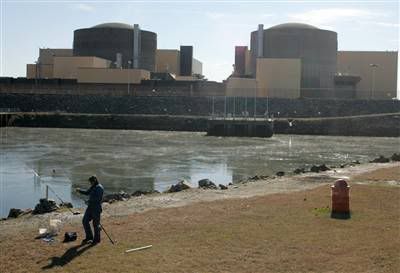
MSNBC reports:
Nuclear reactors across the Southeast could be forced to throttle back or temporarily shut down later this year because drought is drying up the rivers and lakes that supply power plants with the awesome amounts of cooling water they need to operate.
Utility officials say such shutdowns probably wouldn’t result in blackouts. But they could lead to shockingly higher electric bills for millions of Southerners, because the region’s utilities could be forced to buy expensive replacement power from other energy companies.
Already, there has been one brief, drought-related shutdown, at a reactor in Alabama over the summer.
“Water is the nuclear industry’s Achilles’ heel,” said Jim Warren, executive director of N.C. Waste Awareness and Reduction Network, an environmental group critical of nuclear power. “You need a lot of water to operate nuclear plants.” He added: “This is becoming a crisis.”
An Associated Press analysis of the nation’s 104 nuclear reactors found that 24 are in areas experiencing the most severe levels of drought. All but two are built on the shores of lakes and rivers and rely on submerged intake pipes to draw billions of gallons of water for use in cooling and condensing steam after it has turned the plants’ turbines.
Because of the yearlong dry spell gripping the region, the water levels on those lakes and rivers are getting close to the minimums set by the Nuclear Regulatory Commission. Over the next several months, the water could drop below the intake pipes altogether. Or the shallow water could become too hot under the sun to use as coolant.
“If water levels get to a certain point, we’ll have to power it down or go off line,” said Robert Yanity, a spokesman for South Carolina Electric & Gas Co., which operates the Summer nuclear plant outside Columbia, S.C.
Limits on intake pipes
Extending or lowering the intake pipes is not as simple at it sounds and wouldn’t necessarily solve the problem. The pipes are usually made of concrete, can be up to 18 feet in diameter and can extend up to a mile. Modifications to the pipes and pump systems, and their required backups, can cost millions and take several months. If the changes are extensive, they require an NRC review that itself can take months or longer.
Even if a quick extension were possible, the pipes can only go so low. It they are put too close to the bottom of a drought-shrunken lake or river, they can suck up sediment, fish and other debris that could clog the system.
An estimated 3 million customers of the four commercial utilities with reactors in the drought zone get their power from nuclear energy. Also, the quasi-governmental Tennessee Valley Authority, which sells electricity to 8.7 million people in seven states through a network of distributors, generates 30 percent of its power at nuclear plants.
While rain and some snow fell recently, water levels across the region are still well below normal. Most of the severely affected area would need more than a foot of rain in the next three months — an unusually large amount — to ease the drought and relieve pressure on the nuclear plants. And the long-term forecast calls for more dry weather.
Lakes nearing their minimums
At Progress Energy Inc., which operates four reactors in the drought zone, officials warned in November that the drought could force it to shut down its Harris reactor near Raleigh, according to documents obtained by the AP. The water in Harris Lake stands at 218.5 feet — just 3½ feet above the limit set in the plant’s license.
Lake Norman near Charlotte is down to 93.7 feet — less than a foot above the minimum set in the license for Duke Energy Corp.’s McGuire nuclear plant. The lake was at 98.2 feet just a year ago.
“We don’t know what’s going to happen in the future. We know we haven’t gotten enough rain, so we can’t rule anything out,” said Duke spokeswoman Rita Sipe. “But based on what we know now, we don’t believe we’ll have to shut down the plants.”
During Europe’s brutal 2006 heat wave, French, Spanish and German utilities were forced to shut down some of their nuclear plants and reduce power at others because of low water levels — some for as much as a week.
If a prolonged shutdown like that were to happen in the Southeast, utilities in the region might have to buy electricity on the wholesale market, and the high costs could be passed on to customers.
“Currently, nuclear power costs between $5 to $7 to produce a megawatt hour,” said Daniele Seitz, an energy analyst with New York-based Dahlman Rose & Co. “It would cost 10 times that amount that if you had to buy replacement power — especially during the summer.”
At a nuclear plant, water is also used to cool the reactor core and to create the steam that drives the electricity-generating turbines. But those are comparatively small amounts of water, circulating in what are known as closed systems — that is, the water is constantly reused. Water for those two purposes is not threatened by the drought.
Instead, the drought could choke off the billions of gallons of water that pass through the region’s reactors every day to cool used steam. Water sucked from lakes and rivers passes through pipes, which act as a condenser, turning the steam back into water. The outside water never comes into direct contact with the steam or any nuclear material.
At some plants — those with tall, Three Mile Island-style cooling towers — a lot of the water travels up the tower and is lost to evaporation. At other plants, almost all of the water is returned to the lake or river, though significantly hotter because of the heat absorbed from the steam.
Progress spokeswoman Julie Hahn said the Harris reactor, for example, sucks up 33 million gallons a day, with 17 million gallons lost to evaporation via its big cooling towers. Duke’s McGuire plant draws in more than 1 billion gallons a day, but most of it is pumped back to its source.
Nuclear plants are subject to restrictions on the temperature of the discharged coolant, because hot water can kill fish or plants or otherwise disrupt the environment. Those restrictions, coupled with the drought, led to the one-day shutdown Aug. 16 of a TVA reactor at Browns Ferry in Alabama.
The water was low on the Tennessee River and had become warmer than usual under the hot sun. By the time it had been pumped through the Browns Ferry plant, it had become hotter still — too hot to release back into the river, according to the TVA. So the utility shut down a reactor.
David Lochbaum, nuclear project safety director for the Union of Concerned Scientists, warned that nuclear plants are not designed to take the wear and tear of repeatedly stopping and restarting.
“Nuclear plants are best when they flatline — when they stay up and running or shut down for long periods to refuel,” Lochbaum said. “It wears out piping, valves, motors.”
Both the industry and NRC spokesman Scott Burnell said plants can shut down and restart without problems.
Saturday, December 29, 2007
| [+/-] |
Pricey Hay Imperils Horses |
Neglected horses abound as drought shrivels supply, spikes price
The News & Observer reports:
Rescue agencies are taking in record numbers of horses across the state, many emaciated because of the drought-related hay shortage.
In the most recent case, a Randolph County woman was charged Thursday with 11 counts of animal abuse and eight counts of disposing of a dead animal improperly, after county officials investigated separate reports of a large number of dead horses scattered on the ground and of 11 live horses jammed into an undersize corral with no water and little hay.
The U.S. Equine Rescue League normally accepts about 100 neglected or abused horses a year in the three states where it operates, which include North Carolina. This year, the agency has taken in about 170 -- 90 in this state alone -- said Jennifer Malpass, director of the league's Triangle chapter.
Horse rescue groups nationally -- even those in states not stricken with a severe drought -- are being inundated with pleas to take neglected horses.
One group in Florida is fielding daily calls, up from bimonthly requests early this year. A rescue group in south central Kentucky had to turn away 13 horses this month. Kathy Grant, an equine cruelty investigator who runs a rescue group, says the rural roads in her eastern Tennessee community are lined with pastures dotted with emaciated horses.
"A lot of the farmers around here have hay, but they're holding on to it," said Grant. "When they're releasing it, they're charging exorbitant rates. A normal person can't afford it."
A round bale jumped from $12 to $100 since the summer, Grant said. In South Carolina, rescue volunteers noticed the price triple. In Texas, struck by a severe drought last year, hay prices haven't leveled off; horse owners are paying double what they did three years ago.
High prices are leaving owners with tough choices. Some are voluntarily forfeiting their animals. In other cases, horses are seized after county officials determine they have been abused or neglected.
County officials typically don't have holding facilities for large animals and so depend on agencies such as the rescue league to assume responsibility for horses. The league nurses them back to health, then places them in foster homes until someone adopts them, Malpass said.
The flood of rescues this year is a double blow to the volunteers.
Even before the drought, they were struggling to find space for foster horses. Now, they not only have to find shelter for more horses but also feed them when hay is expensive and scarce, Malpass said.
Hay donations drop
Her chapter normally receives about 300 bales of donated hay before winter, mostly from big horse operations clearing spring hay from their storage barns to make room for the fall cutting. But there was so little to spare that hay donations this year were only about a third the normal amount.
That means the volunteer rescuers are having to pull money out of their own pockets -- and a lot of it -- for hay, which has doubled in price in many areas.
The hay crisis also has increased the severity of the cases they are seeing, said Amy Woodard, a volunteer who leads the league's efforts in the northeastern corner of the state.
As the expense of feeding them has risen, the selling prices of horses have dropped. That has made purchase possible for people who might not be able to afford proper food and health care, or who didn't have the knowledge to keep horses healthy, Malpass said.
'Pieces everywhere'
The horse owner in the Randolph County case, Jauvanna Craven, 51, of Groom Road, Sophia, surrendered her horses. That saved time in court and allowed the county to get the surviving horses more quickly into the hands of rescuers.
Randolph County Health Director MiMi Cooper was so shocked at the animals' condition that she went to Craven to issue the charges herself. Craven could have faced more counts of improper disposal, said Cooper, who owns four horses herself.
"There were probably more than eight, but there were pieces [of dead horses] everywhere," she said. "Do you know what I had to do? I had to count heads."
Craven could not be reached for comment.
She had kept the horses on a 22-acre tract but sold it recently, Cooper said. The new owners discovered a number of horse carcasses and called the health department Dec. 21 to report them.
On the same day, the department got what it thought was an unrelated call about the 11 living horses, which were in a different location. They were confined in a pen that was big enough for only one or two horses, Cooper said. The horses were clearly starving, with every rib showing and their hip and shoulder bones jutting. One had an injury and had to be euthanized.
"She said that she was running a rescue operation," Cooper said. "That's not how you rescue horses."
The Equine Rescue League's Triad chapter took four of the horses, and another agency took three. The other three were apparently owned by someone else, who hadn't known about their health problems, and he took them away.
Shortage hits everyone
The hay shortage is so bad, though, that even conscientious owners are getting into trouble, Malpass said.
Marilyn Kille, who is taking care of three foster horses just outside Chapel Hill, said that people who own only one or two horses don't often have the massive dry storage space required for a whole winter supply of hay.
Normally, hay is abundant enough that suppliers keep plenty on hand, and horse owners can drop by every couple of weeks to buy more. Now, horse owners are competing for the scant supply against beef and dairy operations. Often, the only way to get it is to buy full truckloads from as far away as Ohio or New York.
Randolph County has fielded at least half a dozen calls this year from owners who didn't know where to turn, Cooper said, and area veterinarians have been getting similar calls.
Depending on the situation, Cooper said, the county steers them to hay sources like the on-line list kept by the state agriculture department, or links them with a rescue agency. Instead of suggesting that owners give up horses, the rescue agency prefers to teach them how to keep horses healthy, Malpass said.
Usually that approach works, she said. When it doesn't, the county or the rescuers ask the owner to give up the horse, or the county takes the owner to court to force the issue.
Normally rescues taper off in summer, when horses can graze. That's when the rescuers get a breather and start to build up their stores of hay.
This past summer, though, there was no break in rescues and the hay donations didn't come. So now, Malpass' group finds itself starting winter -- when livestock rely more on hay and less on grazing -- with an unusual number of horses to feed, not nearly enough hay and predictions that hay crops next year might be poor, too.
"It's really worrying because it can only get worse from here," she said.
Monday, December 3, 2007
| [+/-] |
Nevada Learns to Cash In on Sales of Federal Land |
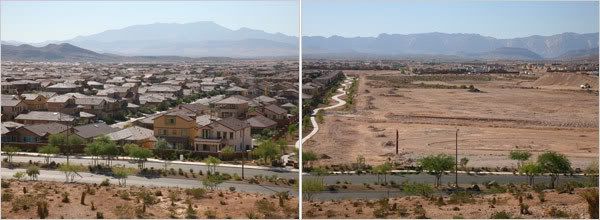 The Mountain’s Edge development sits on land once owned by the federal government in the Las Vegas Valley.
The New York Times reports:
When it opens in 2009, the Clark County Shooting Park will be something to behold, through a scope or otherwise: hundreds of acres devoted to all things gun and bow, complete with a rifle range, a skeet center and an R.V. “host area.”
Las Vegas and other local governments in Nevada quickly caught on that the sales of lands on their outskirts could be used to improve life in the heart of their cities. Local officials find that arrangement fair, but not everyone does.
The coming Craig Ranch Regional Park, due in 2010, should be impressive too, with plans calling for an amphitheater, an aquatics center and sand volleyball courts, all wound around native gardens and wetlands.
Much of the financing for the projects has not come from familiar sources, like local taxes, bond issues or private donations. Instead, they are being paid for through the sales of public lands owned by the federal government.
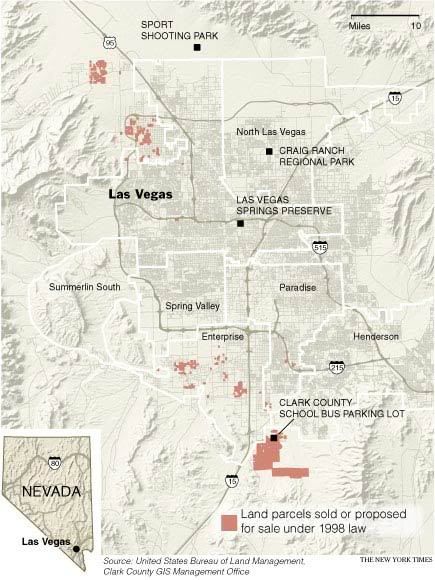
Tens of thousands of acres of federal lands in the Las Vegas area have been sold under an unusual law pushed through Congress nearly a decade ago by the Nevada delegation. The sales have grossed nearly $3 billion and counting.
Because of a stipulation created by the Nevada legislators, the money has not been deposited into the general federal Treasury, but rather put in a special Treasury account to be spent almost exclusively in Nevada on a something-for-everyone collection of projects.
The money has bought environmentally sensitive land and paid for conservation projects, a central purpose of the law and its amendments, as well as improvements in national recreation and refuge areas. But it has also been allocated to such nuts-and-bolts governmental services as education and water projects, and a variety of local perks, including boat ramps, nature trails and community parks complete with tennis courts, dog runs and barbecue pits.
Supporters say the law, which authorized competitive auctions, has been a godsend for a region dealing with rampant population growth, limited room to grow, scarce water and facilities overwhelmed by their own popularity. But critics see it as having created a limitless federal bank account that has encouraged and subsidized unbridled growth at the expense of taxpayers from the 49 other states, all while Nevada continues to draw new residents as a low-tax state disinclined to pay for such projects itself.
Even some ardent fans of the law say the infusion of cash has led to overreaching on the part of some municipalities in Clark County, the mother ship for three growing cities: Las Vegas, North Las Vegas and Henderson.
“We’ve gotten a bit greedy,” said Michael L. Montandon, the mayor of North Las Vegas, which has had $176 million worth of projects approved, including $85.3 million for Craig Ranch. “When your neighboring cities are asking for five times what you are, it tends to make your staff run around looking for projects.”
To gauge the law’s impact since its passage in 1998, The New York Times analyzed data from the United States Bureau of Land Management, the landlord for the federally owned lands. The analysis covered the more than 29,000 acres sold under the law as of Nov. 1, as well as the $2.3 billion in expenditures allocated to projects as of Aug. 31 by the Department of the Interior, which oversees distribution of the money.
The examination found the following:
More than $1 billion in proceeds from the federal land sales have been allocated for parks, trails and nature areas that often amount to public amenities — many of which elected officials say they would not have been able to pay for otherwise. The projects have enhanced property values, and benefited big-name developers, including Focus Property Group, the American Nevada Company, the Del Webb Corporation and the Olympia Development Group, all of which have bought large parcels of arid public lands and turned them into elaborate housing tracts.
Nevada’s schools, which have long sought more money from state lawmakers who resisted raising taxes as enrollment mushroomed, have received $150 million from the sale of the federal lands. The interest on that money has paid for expenses including teachers’ salaries, utility bills and textbooks, which in other states would usually be underwritten by local property taxes.
 Las Vegas and other local governments in Nevada quickly caught on that the sales of lands on their outskirts could be used to improve life in the heart of their cities. Local officials find that arrangement fair, but not everyone does.
The 1998 law uses the same legal framework as a 1920s land act under which the Clark County School District has bought some 685 acres through noncompetitive direct sales for an average of $10 an acre since 2004 to provide land for public schools.
The Southern Nevada Water Authority, the agency that has long provided cheap water to the valley’s two million residents, has received $285 million from the federal land sales, which it has used on a variety of water treatment, testing and transport projects, including facilities at drought-plagued Lake Mead. Plans for revenue from future land sales, water officials say, could include work on a pipeline to import water from 250 miles away.
The acquisition and protection of environmentally sensitive land in private hands was a central element of the law’s purpose, but allocations for those purchases have accounted for only about 15 percent ($346.1 million) of the $2.3 billion in approved spending. Moreover, there has been a net loss of protected land: thus far, some 34,468 acres of public land have been sold or exchanged, while a little more than 20,000 acres of environmentally sensitive land have been bought, though federal officials say other big deals are pending.
Spending on conservation projects, a focus of an amendment to the law in 2002, has also lagged behind other construction-heavy categories. Some $180 million has been allocated for continuing projects like programs to fight litter and dumping, studies of off-road vehicle and water strategies, and wild horse and burro management.
Still, some expenditures designated as conservation have been so broadly defined that they resemble traditional pork. Among them are a mobile fire education trailer ($132,000), an interagency Web site ($269,000), and several plans devoted to safety programs for the region’s abandoned mines ($3 million).
Millions of dollars from the sale of federal lands has been set aside to meet federal requirements — typically the responsibility of local governments — to offset environmental damage from the city’s sprawling growth. Under the act, $53 million has been allocated to help communities in Clark County and the Nevada Department of Transportation to conform with requirements of the Endangered Species Act when development encroaches on native habitats.
Critics argue that the sales help pay for the infrastructure that then supports more expansion.
“Fundamentally, we’re talking about selling public lands which belong to all Americans and giving the proceeds back to local counties for what would ostensibly be conservation projects,” said Myke Bybee, public lands representative for the Sierra Club in Washington. “But those projects,” Mr. Bybee said, are not always “in keeping with conservation.”
That said, in Nevada the law is widely seen by Republicans and Democrats alike as paying off for most everyone at the table, a rarity in a gambling town. Among the winners are developers — who now have access to lands long deemed off-limits — and municipalities, which have added dozens of new recreational amenities, thousands of new residents to tax rolls, and improved the quality of life, all without raising taxes.
“This bill has been across the board incredible for the entire state, for quality of life, for economic development, for managing growth,” said Senator John Ensign, a Republican, who was the bill’s author while serving in the House of Representatives. “And for doing things to make Nevada a better place.”
The law’s original boundary for eligible federal land sales was expanded by Congress in 2002, and some groups, including the Las Vegas Chamber of Commerce, are lobbying to expand it even farther. The allowable area has grown by about 40 percent, or 22,000 acres more than the original 52,000 approved by Congress.
Spreading the Wealth
More and more local officials now want a piece of the land pie. In recent years, Congress has authorized the sale of up to 135,000 acres of public land in White Pine and Lincoln Counties in eastern Nevada. Another later law was enacted in 2000 that requires 80 percent of proceeds from federal land sales be spent in the states where the land is located. And there are similar proposals in other Western states, including land hand-overs to localities in central Idaho and land sales in Washington County, Utah, another fast-growing desert area.
Moreover, local authorities are getting ever bolder in using the proceeds from the federal land sales for expenses not traditionally covered by money from federal taxpayers. More recent bills, authorizing the sales in eastern Nevada, funnel 10 percent of federal proceeds back into law enforcement, fire protection and transportation, traditionally the bailiwick of local governments.
Efforts to redirect at least some of the proceeds from the sales of federal lands into the general federal Treasury have repeatedly been beaten back by the politically connected Nevada delegation, which is now headed by the Senate majority leader, Harry Reid, a Democrat. In recent years, the Bush administration twice failed in efforts to take back some of the payout for the Treasury.
In many ways the law, formally known as the Southern Nevada Public Land Management Act of 1998, has created a new model for managing much of the federally owned land in the West, which encompasses more than 80 percent of the state of Nevada and huge chunks of Utah, Idaho, Wyoming, Arizona, California and Oregon. That model provides a faster way of moving public lands into private hands, and encouraging growth into inhospitable places, in this case, the Mojave Desert.
That local and federal governments work together on such deals is remarkable considering the historic tension between federally owned public lands and the all-American desire for private property. The centuries-old debate has resonated from the high-mindedness of Manifest Destiny’s westward push in the early 1800s to the frenzied scramble of Civil-War-era homesteaders to the defiance of the Sagebrush Rebellion of the 1970s and ’80s, in which ranchers and local officials in the West wanted federal lands transferred to local governments or sold to private owners.
In each case, the central question has been what exactly do America’s national lands represent: Are they expendable, tradeable, and now, salable resources meant to be made private for the sake of progress and individual gain? Or are they public treasures to be protected at all costs, even when they are essentially arid wastelands?
In the Las Vegas area, the answer has increasingly been to sell. The first of a wave of omnibus lands bills passed by a Republican-led Congress, the Nevada law of 1998 was viewed as a pragmatic compromise by environmental groups eager to guarantee the purchase and exchange of fragile habitat.
Subsequent laws affecting other parts of Nevada — which brought environmental groups, land owners and others into negotiations — have coupled land sales with the designation of hundreds of thousands of acres as wilderness. Those wilderness designations, which ban development, were trumpeted by local lawmakers and welcomed even by those who worried about land sales.
“We had a decision to make: Do we pursue this opportunity to protect these special places or do we not?” said Jeremy Garncarz, the associate director of wilderness support at the Wilderness Society. “And we made the decision to pursue the opportunity to protect these places.”
But as the 1998 law has played out, some of its early supporters among environmentalists have also soured on it. The Office of Management and Budget, an arm of the White House, assessed the program in 2004 and said that while it had been “fairly well run,” its revenues were “increasingly being dedicated to low-priority activities.”
Original Intent
“The original concept was to allow private, environmentally sensitive land to be bought more readily,” Jeff Van Ee, a longtime Nevada environmentalist who helped lawmakers draw up the law. “But over the years, what we’ve seen is the money going all over the place, and too much money going to projects that should be funded through more conventional means.”
Sales at auction have accounted for the vast majority of the law’s proceeds, with more than $2.7 billion in sales from 13,000 acres, much of it situated on the edge of cities and primed for development. In a federal-local dance officially known as joint selection, municipalities nominate land for sale once they have determined their infrastructure can support them, said Steve Tryon, assistant field manager for the Las Vegas office of the Bureau of Land Management.
“The cities of Las Vegas and North Las Vegas and Henderson are kind of driving the show,” he said of the selection process, also mentioning that Clark County was very active.
Mr. Tryon said the 1998 law had increased the use of sales provisions in the Federal Land Policy and Management Act of 1976, resulting in more than 14,000 acres sold via direct sale to developers, localities and individuals who owned property adjacent to federal lands. Those sales grossed only a small fraction of the auction sales, bringing in only $114 million.
Nevada lawmakers say it is unfair to view expenditures under the law as a raid on the federal Treasury since the federal government is the largest landowner in Nevada and should be expected to contribute to the state’s economic well-being, just as big private land owners do in other states.
Senator Reid also said that the improvements, including the money spent on parks, trails and natural areas, were on facilities that the general public could use. “All the money is used on public land,” he said. “It doesn’t go onto the Las Vegas Strip.”
Before the 1998 public lands law, the government often converted land to private hands through land exchanges. The deals were regularly criticized by lawmakers and taxpayers, who thought the government gave too much, and wilderness lovers, who thought they got too little.
Land sales, through acts like the 1980 Santini-Burton Act (which sold small tracts of Las Vegas-area land to finance land purchases in the Tahoe basin), were also laborious and the take often meager. A report in September 2001 by the General Accounting Office found that the Bureau of Land Management had sold 79,000 acres between 1991 and 2000 and received just $3 million.
Under the 1998 act, the sales have grossed nearly 1,000 times that figure in the same amount of time — with less than half as much land. One reason is timing: the auctions began just as the Las Vegas real estate market heated up.
The proceeds took the law’s architects by surprise. The Congressional Budget Office estimated in 1998 that the sales would gross some $350 million over seven years. But developers spent more than twice that on a single day in November 2005, when 2,887 acres brought a record $783 million in bids. The majority of auction offerings have been parcels of 10 acres or less. But by 2002, a few large swaths of public lands, more than 100 acres each, were starting to attract bids. At auctions in 2004 and 2005, three bidders bought a combined 10 square miles of land for $1.7 billion for master-planned communities. These developments, often with tens of thousands of units, effectively convert desert into suburbia, complete with parks, artificial lakes, and preternaturally green golf courses.
One of those master builders is John Ritter, chief executive of Focus Property Group, who called the act “a tremendous success,” adding that the fact that sale proceeds would be spent near the communities his company built was an added bonus.
“It’s a well-thought-out way to release land,” said Mr. Ritter, whose company paid $557 million for 1,940 acres at an auction in 2004.
Boat Ramps and Toilets
As quick as money flowed in to the special account, it flowed out. All spending requires authorization by the secretary of the interior from money held in an interest-bearing account, with recommendations from a four-member committee representing four major agencies that receive money from the act, the National Park Service, the United States Forest Service, the Fish and Wildlife Service and the Bureau of Land Management.
Purchases receiving a green light have included a handsome array of land considered environmentally sensitive, which can be recommended by any interested group in the state, including nonprofit organizations and private landholders.
Among the highlights are the planned purchase of Incline Lake near Lake Tahoe, an $83 million project headed by the United States Forest Service, which plans to open it to the public.
But other approved projects read like a Christmas list drafted in Carson City, the state capital: $50.3 million for erosion control and fire prevention programs at Lake Tahoe; $28.8 million in improvements to the picturesque and increasingly popular Red Rock Canyon conservation area; $49.4 million for trails and other amenities at the Springs Preserve, a new environmentally friendly tourist attraction in downtown Las Vegas; and $495,900 for 30 “premier” toilets, complete with “flush technology and solar lighting” at nearby Lake Mead.
This summer, ground was also broken on a tract of low-cost housing in southern Las Vegas, land sold to nonprofit developers at 5 percent of its appraised value.
More than $400 million has also been allocated for building projects on federal lands for the four agencies represented on the executive committee. The law has also been amended six times, and 10 federal agencies, including the Highway Administration and the Army Corps of Engineers, now receive money through it.
Many projects have been focused on Lake Mead, on water pipes, boat ramps and restrooms, as well as pleasantries like picnic tables and campgrounds. But the land sales have also helped federal agencies subsidize basic infrastructure needs, including phone lines, housing, equipment shelters, road construction, fire stations, parking lots, fencing and power supply.
A report last year by the Office of Management and Budget also raised questions about some of the spending, saying too much money went to “purely local projects, which do not reflect the highest priorities of the nation.”
Easing the Burden
Sure enough, the biggest category of approved spending by far has been the urban and suburban projects nominated by local governments, which quickly caught on that the sales of lands on their outskirts could be used to improve life in the heart of their cities. Local officials say that is only fair, arguing that the opening of the lands — and subsequent population growth — increases the stress on local governments to provide services and infrastructure.
The public expenditure, said Erik Pappa, a spokesman for Clark County, in an e-mail message, “relieves some of that burden by providing funding for amenities to improve our quality of life.”
Amendments to the original law have also opened up more categories of spending, including up to $300 million to be set aside for restoration programs in the Lake Tahoe basin, and new counties and groups eligible for money, including fire-safe councils and the Washoe Indian tribe. Some money has also started to be allocated for projects in California, as part of fire prevention programs in the Lake Tahoe region, which includes both states.
In 2006, $476 million was allocated to parks, trails and natural areas throughout the state, a category that has included such cherries as a $1.4 million softball complex in Caliente, a $10 million Las Vegas park with boccie and shuffleboard courts and a $1.5 million planning grant for picnic grounds in Alamo.
P. Lynn Scarlett, the deputy secretary of the interior, defended her agency’s performance, saying the Bureau of Land Management “has very vigorously and carefully selected projects” for the various categories approved by Congress. Ms. Scarlett also said that the disparity between land sold and land bought would most likely equalize as pending purchases of tens of thousands of acres of environmentally sensitive land went through.
For now, with the real estate market here and nationally in a tailspin, the flow of new financing has slowed. Likewise, sales at auctions so far this year have brought in only $20 million.
At the most recent auction, on Nov. 1, the average price per acre topped $500,000, though only one parcel — of 31 offered — sold. In the early days, an acre typically fetched less than $100,000.
Both developers and local politicians have blamed the auction system for inflating land values in the Las Vegas Valley, and some groups have started to push for the boundary to be expanded even farther to lower those costs.
Steve Hill, a major concrete supplier and the chairman of the governmental affairs committee of the Las Vegas Chamber of Commerce, said the lack of available land was making it hard for housing projects to make financial sense, a situation made worse by the mortgage crisis. As such the law was unintentionally encouraging the growth of far-flung suburbs throughout Southern Nevada, Mr. Hill said. Because Las Vegas is encircled by federal lands, these suburbs are forced miles away.
“There are those that feel that land constraint is part social engineering, but the idea that we’re going to squeeze people outside the disposal boundary and push them 50 miles away has social and environmental consequences as well,” he said. “It would be like saying, you can live on the island of Manhattan or you have to live 50 miles away.”
Defenders of the growth of Las Vegas, which is expected to devour its available land by 2017, say the city is in fact very dense, not sprawling. They often refer to the “Manhattanization” of the city, with more and more vertical developments planned, making even more urgent the demand for public parks and other amenities.
“I believe in 100 years they’ll be studying this as a great piece of public policy,” Mr. Montandon, the North Las Vegas mayor, said of the 1998 law. “I think it will go right up beside Robert Moses building New York.”
Meanwhile, plans for similar land sales are moving forward elsewhere in the West. A bill to sell land in fast-growing Washington County in southwestern Utah stalled in Congress last year. But its author, Senator Robert F. Bennett of Utah, said he would introduce another version this year.
Both of Nevada’s senators, Mr. Ensign and Mr. Reid, are circumspect about the spoils or the concept being expanded elsewhere.
“Nevada is doing just fine,” said Mr. Reid, who posed at the ground-breaking for the $64 million shooting range in October 2006. “But I’m not going to be trying to be a missionary for people doing this in other states.”
Public Lands: Treasure or Commodity?
The federal government has sold nearly $3 billion of federal land in the Las Vegas area under a law pushed through Congress nearly a decade ago by Nevada legislators. Some of the projects funded by the proceeds.
Sunday, November 4, 2007
| [+/-] |
Atlanta Water Use is Called 'Shortsighted' |
The rapidly growing metropolis' 'cavalier' attitude toward conservation is the real problem, critics say.
The LA Times reports:
When Rick McKee, the editorial cartoonist of the Augusta Chronicle newspaper, set out to capture the historic and severe drought that is afflicting the Southeast, he did not draw parched rivers or shriveled crops or brown lawns: He drew an oafish, bloated hulk of a boy holding up a straw to slurp up water from a smaller boy's water fountain.
Above the larger boy, a sign reads "Atlanta," above the other, "Everybody else."
It is, in many ways, a cartoon that sums up feelings across the Southeast now that Lake Lanier, the reservoir that supplies drinking water to most of metropolitan Atlanta's 5 million residents, is draining to historic lows. With government officials issuing stark projections that Atlanta could run out of water within three months, Georgia politicians have pleaded with the U.S. Army Corps of Engineers to decrease the amount of water being released. The flow has been required to save two species of mussels 200 miles downriver.
Yet while Georgia's leaders try to cast the water shortage as a battle between 5 million people and a few mussels -- with the message that greater priority should be given to Atlanta residents -- there is a growing sense that the metropolis itself is the problem: Critics say Atlanta's rapid population growth, coupled with blithe disregard for water conservation, is straining the region's ecosystem.
A break came Thursday in Georgia's 17-year water war with Florida and Alabama: The GOP governors of the three states agreed to reduce by 16% the amount of water released downriverfrom Lake Lanier, which would slow the drain on Atlanta's main water source.
But experts say the Southeast's struggles over water resources are far from over.
"What was not on the table, and what has got to be on the table, is Atlanta's unrestricted growth and cavalier attitude to water use," said Sally Bethea, executive director of Upper Chattahoochee Riverkeeper, a watchdog group.
Such concerns are not coming just from environmental lobbyists, who have long argued that Atlanta must do more to conserve water.
Florida Gov. Charlie Crist, in opposing a request by Georgia Gov. Sonny Perdue to President Bush to permit a reduced downstream flow, wrote in his own letter to Bush that Florida's $134-million commercial seafood industry depended on the water. Crist added that his state had acted responsibly in enacting water legislation. Alabama Gov. Bob Riley argues that downstream communities and a nuclear power plant in his state require water too.
Even within Georgia, the drought has brought to the fore long-simmering resentment against the booming capital of the New South. About 140 miles east in Augusta, which sits on the Savannah River, there is concern that Atlanta could slake its thirst on Augusta's water supplies. Last month, Atlanta Mayor Shirley Franklin suggested that Atlanta explore piping in water from the Savannah or Tennessee rivers.
"Atlanta is a greedy, poorly designed behemoth of a city incapable of hearing the word 'no' and dealing with it," said a recent editorial in the Valdosta (Ga.) Daily Times.
The editorial said Atlanta's "politicians can't bring themselves to tell their greedy constituents complaining about the low flows in their toilets this week that perhaps if they didn't have six bathrooms, it might ease the situation a bit."
Atlanta is not the only city grappling with water shortages. In 2003, a Government Accountability Office report on the nation's freshwater supply found that 36 states anticipated water shortages in the next decade.
Two months ago, a federal judge in California ordered protective measures for the tiny endangered smelt fish in the Sacramento-San Joaquin River Delta, a mandate that water officials said could cut by a third the flow of water to Southern California from the north.
Yet while cities such as Los Angeles, Las Vegas and Denver have ushered in water conservation measures -- including offering incentives, installing high-efficiency toilets and low-flow shower heads, and increasing monthly water bills for big water users -- experts say Atlanta, one of the fastest-growing metropolitan regions in the country, has been particularly shortsighted.
Atlanta was founded far from any major river or lake. The metro area had a population of 2.9 million in 1990 and 4.1 million in 2000, and its daily draw on the water reserve was 320 million gallons in 1990 and 420 million in 2000.
With 2 million more residents projected by 2030, water use is expected to rise to more than 700 million gallons a day.
For its drinking water, Atlanta relies almost entirely on Lake Lanier, a 38,000-acre reservoir in northern Georgia built in the 1950s.
"If your population is growing, you cannot expect to do the same old things you did a decade ago," said Chris Brown, executive director of the California Urban Water Conservation Council. "You have to change the way you behave."
This has not happened in Atlanta, conservationists say. In 2003, the area's 16-county Metropolitan North Georgia Water Planning District adopted a water conservation plan. Yet most counties have not implemented the recommendations, such as reducing leaks and raising billing rates for those who use more water.
Last year, a bill failed in the state House of Representatives that would have required older homes to be retrofitted with low-flow fixtures before they were resold.
Some environmentalists are questioning whether Atlanta can handle 2 million more people.
"Conservation may not be the answer in and of itself," said Elizabeth Nicholas, general counsel for Upper Chattahoochee Riverkeeper. "There just isn't enough fresh water here to support major growth. We need to be smarter about how and where we're growing."
Conservationists' suggestion that the state should prohibit building if no water is available rankles developers and the business community.
"People are coming to this state whether environmentalists like it or not," said Ed Phillips, executive vice president of the Home Builders Assn. of Georgia. "What are we going to do? Put up a fence?"
Many of Georgia's political leaders say the solution to the drought is not to stop developing but to manage water more efficiently, building more reservoirs to enhance water storage.
"We have not consumed our way into drought," said Carol Couch, director of the Environmental Protection Division of the Georgia Department of Natural Resources. She said there must be planning to accommodate growth, including building more reservoirs and encouraging residents to conserve and reuse water.
Conservationists have traditionally opposed additional reservoirs, arguing they would lead to much water loss through evaporation and would severely affect the environment.
Last month, Georgia Republicans Lt. Gov. Casey Cagle and House Speaker Glenn Richardson proposed legislation that would commit millions of dollars in the 2008 session to build reservoirs and enlarge existing ones.
For now, as water levels at Lake Lanier drop about a foot a week, Atlantans have been urged to shorten showers and to report neighbors who violate the ban on outdoor watering. Businesses have been asked to cut water use by 10%.
Last week's tri-state compromise is awaiting approval by the U.S. Fish and Wildlife Service. The agency is expected to issue its opinion by the middle of this month after assessing how the reduced flows could affect the endangered fat threeridge and threatened purple bankclimber mussels in Florida's Apalachicola River. The U.S. Army Corps of Engineers would execute any change.
Saturday, November 3, 2007
| [+/-] |
Bush Vetoes $23 Billion Water Bill |
Congress is expected to override the president next week in a bipartisan vote.
The LA Times reports:
President Bush delivered his threatened veto of a $23-billion water bill Friday, but Congress is virtually certain to reverse it in the first override of a Bush veto.
And Bush and the Democratic-controlled Congress are moving closer to a federal budget showdown that could result in more vetoes.
The House and Senate are expected to move swiftly next week to override Bush's veto of a bill loaded with water-related projects sought by members of both parties, from shoring up California's levees to protecting the Gulf Coast from hurricanes.
In a statement accompanying his veto, Bush said, "This bill lacks fiscal discipline."
On Capitol Hill, Sen. David Vitter (R-La.) said, "I am 100% confident that we can override this veto."
The defiant bipartisan response to the veto underscores the difficulty the president faces in his new zeal to hold down federal spending, especially when it affects highly visible construction projects cherished by lawmakers.
"This will be the first veto this Congress has overridden, and it was all about getting parochial water projects back to their home districts," said Steve Ellis of Taxpayers for Common Sense, a watchdog group.
The bill would authorize more than 900 projects, such as restoration in the Florida Everglades and the replacement of seven Depression-era locks on the Upper Mississippi and Illinois rivers that farm groups say is crucial for shipping grain.
For California, the bill authorizes $1.3 billion for 54 projects, including $106 million to strengthen the Sacramento-San Joaquin Delta levees, $25 million for revitalizing the concrete-bound Los Angeles River and $38 million for replenishing sand at Imperial Beach in San Diego County, a project that supporters say would protect coastal residents from storms.
It is the fifth bill that Bush has vetoed -- the fewest by any president since James A. Garfield, who was shot in 1881 after four months in office and died weeks later. Bush has vetoed two bills that would have expanded federal support for embryonic stem cell research, a bill to pay for the Iraq war that included a timeline for withdrawing troops, and a bill that would have expanded a children's health insurance program. The four vetoes were sustained.
The Water Resources Development Act passed the House 381-40 and the Senate 81-12, far more than the two-thirds needed to make the measure law over the president's objections. The override would be the first since 1998, when Congress reversed President Clinton's veto of $287 million worth of military construction projects from a spending bill.
"Nothing seems as dear to members of Congress as their water projects," said Robert L. Bixby, executive director of the Concord Coalition, a budget watchdog group.
Bixby expects that Bush, with support from congressional Republicans, will wield more influence over the appropriations bills. "Bush has a willing and sufficient minority with him to sustain his vetoes -- so long as it isn't a water project," he said.
Rep. Jeb Hensarling (R-Texas), leader of a group of House conservatives, said he expected the water-bill veto to be overridden. "I plan to vote to sustain the veto, and I assume it will be a very small group of us," he said. "When the appropriations bills come . . . that's where the real fight on fiscal responsibility will be, and my guess is we'll have enough Republicans to sustain" a veto.
The water bill is supported by a number of Bush's usual allies, including business and farm groups. The measure even brought together Sen. Barbara Boxer (D-Calif.), chairwoman of the Senate Environment and Public Works Committee, and Sen. James M. Inhofe (R-Olka.), the panel's ranking member, who rarely agree. Inhofe had appealed to Vice President Dick Cheney and White House Budget Director Jim Nussle to urge the president not to veto the bill, and he vowed to lead the fight to override the veto.
"I share the president's concerns on excessive spending," said Republican bill supporter Sen. Mel Martinez. "There are some things in this bill that are not pretty in terms of government spending. But at the end of the day, as a Floridian, Everglades restoration is such an integral part of this WRDA bill we have to take the good with the bad."
Democrats pounced on the veto to portray Bush as out of touch with domestic priorities.
"When we override this irresponsible veto, perhaps the president will finally recognize that Congress is an equal branch of government and reconsider his many other reckless veto threats," said Senate Majority Leader Harry Reid (D-Nev.).
Next week, the House is expected to take up the first of a string of spending bills that could face Bush vetoes: a $215-billion bill that combines Democratic-sought funding increases for health and education programs with spending for popular veterans programs.
Although the fiscal year began Oct. 1, Congress has yet to send Bush a spending bill.
Bush, signaling a new determination to erase the red ink in the budget, has complained that Congress added $22 billion to his budget and seemed addicted to earmarks. In the first six years of his administration, federal spending soared. Bush never vetoed a GOP-written spending bill. His administration inherited a budget surplus and has presided over six years of deficits, including a record $412.7 billion in fiscal 2004.
On Friday in his veto statement, Bush noted that the House originally approved a $15-billion water bill and the Senate approved a $14-billion measure, but instead of the customary splitting the difference during negotiations, they "emerged with a Washington compromise that costs over $23 billion."
"This is not fiscally responsible," he said.
The water bill authorizes projects, but the funds must be provided through the separate appropriations process.
Bush complained that some of the projects fall outside the main mission of the Army Corps of Engineers: "facilitating commercial navigation, reducing the risk of damage from floods and storms, and restoring aquatic ecosystems."
Saturday, October 20, 2007
| [+/-] |
Georgia Governor Declares State of Emergency Due to Drought |
The Atlanta Journal-Constitution reports:
Gov. Sonny Perdue declared a state of emergency in most of Georgia on Saturday, and called on President Bush to recognize that the historic drought had created a disaster for 85 counties.
In a defiant plea Saturday at Lake Lanier, Perdue asked Bush to issue a federal disaster designation that would:
• Empower the president to order less water released from Lake Lanier.
• Make federal funds available to state and local governments.
• Offer low-interest loans to Georgia businesses hurt by the drought.
"We will continue to conserve," the governor said, "but we have to have help."
Perdue's actions came as the federal government continued to release water from Lake Lanier to protect endangered mussels in Florida at the expense of water-starved North Georgia.
The governor, lieutenant governor, two congressmen and several legislators and state officials gathered at the top of a trio of now-landlocked boat ramps at Lake Lanier to deride the U.S. Army Corps of Engineers and the U.S. Department of Fish and Wildlife for "putting mussels in front of people."
They also accused the federal agencies of endangering one of the country's most populated areas, which is seeing its drinking water disappear down the Chattahoochee River for the Gulf of Mexico.
Perdue's state of emergency declaration and request of a federal disaster declaration are the latest tactics in the escalating war between Georgia and the federal government over how much water can be released from Lake Lanier.
"The actions of the Army Corps of Engineers and the Fish and Wildlife Service are not only irresponsible, they are downright dangerous," Perdue said at Saturday's news conference at Mary Alice Park, just yards from the retreating lake.
"If the Corps and the Fish and Wildlife Service do not act now, I will hold them fully responsible for endangering the people of Georgia. Any harm that comes to humans is 100 percent on their hands."
Perdue said he had asked for the federal disaster designation because "we need the president to cut through the tangle of unnecessary bureaucracy to manage our resources prudently so that, in the long term, all species may have access to clean water."
Until now, Georgia's efforts to ride out the dry spell and a shrinking water source have focused on conservation. But Perdue insisted conservation was not enough.
Georgia on Friday filed a federal lawsuit in Jacksonville, asking the court to force the Corps to reduce releases from Lake Lanier until March 1.
"We are experiencing the single worst drought in Georgia history," Perdue said. "On top of that, we are mired in a manmade disaster of federal bureaucracy."
Officials estimate Lake Lanier will be at the "dead pool level" within 80 days. At that point, also known as the "bottom of the conservation pool," the water level will be below pipes used to remove the water. Special equipment will be needed to retrieve it.
"Is there water in there that can be use? Yes. But it's not high quality," said Carol Couch, director of the Georgia Environmental Protection Division.
That water will contain more sediment and minerals, some of which are difficult to remove, and likely will have a different taste and color even after treatment, Couch said.
Col. Byron Jorns — head of the U.S. Army Corps of Engineers' Mobile District, which oversees Lake Lanier — insisted the Atlanta area is not at immediate risk of running out of drinking water.
"There is water available for the drinking water needs of metro Atlanta for the next several months and well beyond," Jorns said. "The bottom of the conservation pool does not mean the bottom of the lake."
"That water is still available. In terms of folks going thirsty, that is an event that is well into the future."
Tuesday, October 16, 2007
| [+/-] |
Drought Tightens Its Grip on Southeast U.S. |
The Associated Press reports:
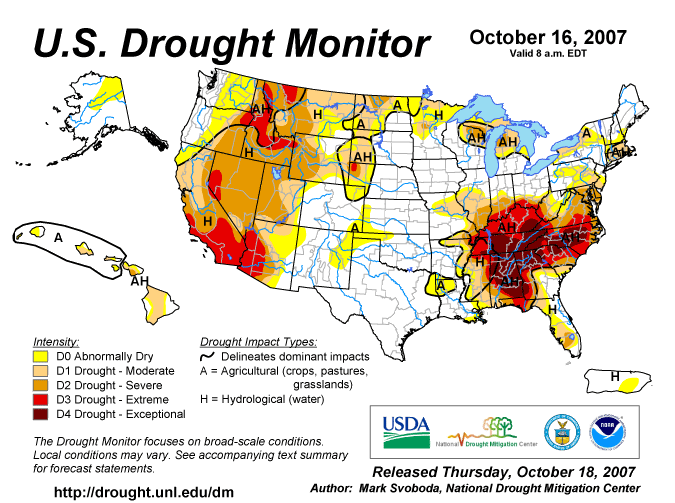
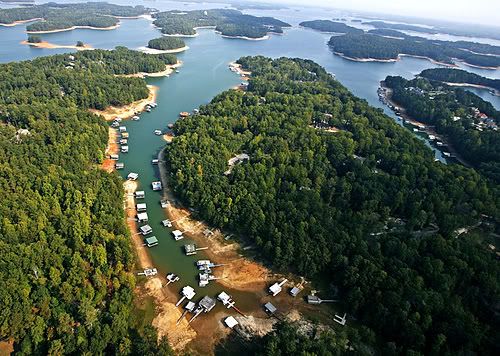
If there's a ground zero for the epic drought that's tightening its grip on the South, it's once-mighty Lake Lanier, the Atlanta water source that's now a relative puddle surrounded by acres of dusty red clay.
Tall measuring sticks once covered by a dozen feet of water stand bone dry. "No Diving" signs rise from rocks 25 feet from the water. Crowds of boaters have been replaced by men with metal detectors searching the arid lake bed for lost treasure.
"This lake is a survivor," Jeff "Buddha" Powell told a worried customer at his bait shop along the barren banks.
"If you panic, you don't help Mother Nature," he added. "It's going to rain when it rains."
But little rain is in the forecast, and without it climatologists say the water source for more than 3 million people could run dry in just 90 days.
That dire prediction has some towns considering more drastic measures than mere lawn-watering bans, including mandatory rationing that would penalize homeowners and businesses if they don't reduce water usage.
"We're way beyond limiting outdoor water use. We're talking about indoor water use," said Jeff Knight, an environmental engineer for the college town of Athens, 60 miles northeast of Atlanta, which is preparing a last-ditch rationing program as its reservoir dries up.
"There has to be limits to where government intrudes on someone's life, but we have to impose a penalty on some people," he added. "The problem is how much and who. That gets political. But it's going to hurt everyone. We're all going to share the pain."
About 26 percent of the Southeast is covered by an "exceptional" drought — the National Weather Service's worst drought category. The affected area extends like a dark cloud over most of Tennessee, Alabama and the northern half of Georgia, as well as parts of North and South Carolina, Kentucky and Virginia.
The only spots in the region not suffering from abnormally dry conditions are parts of southern and eastern Florida and southeast Georgia.
Government forecasters say the drought started in parts of Georgia and Alabama in early 2006 and spread quickly. Sweltering temperatures and a drier-than-normal hurricane season contributed to the parched landscape.
Now residents are starting to feel the pinch.
Restaurants are being asked to serve water only at a customer's request, and Gov. Sonny Perdue has called on Georgians to take shorter showers. The state could also impose more limits within the next two weeks, possibly restricting water for commercial and industrial users.
In North Carlina, Gov. Mike Easley stopped short of imposing statewide water rationing but asked people to stop watering lawns and washing cars.
"A bit of mud on the car or patches of brown on the lawn must be a badge of honor," Easley said today. "It means you are doing the right thing for your community and our state."
As conditions worsen, the Army Corps of Engineers has become a favorite target of lawmakers in Georgia, Florida and Alabama, where the drought has intensified a decades-old feud involving how the Corps manages water rights.
"I particularly am disappointed that the Corps has allowed so much water to drain out of our reservoirs, out of our lakes, as they have," said Georgia Lt. Gov. Casey Cagle, a Republican. "It's not that we haven't had enough water. It's more a function of allowing so much of it to go downstream."
On Friday, Perdue threatened to take legal action if the Corps continued to let more water out of a north Georgia water basin than it collects. And the president of the Metro Atlanta Chamber of Commerce said that businesses could also line up behind a legal challenge.
"We have an ongoing water crisis in metro Atlanta. And it is the biggest and most imminent economic threat to our region," said Sam Williams, the chamber's president.
Scientists have little reason to hope the drought will ease anytime soon.
The Southeast Climate Consortium warns that a La Nina weather system is forming, which could bring drier and warmer weather for Florida and most parts of Alabama and Georgia.
"When we need to recharge our water system, this is what we don't want," said state climatologist David Stooksbury, who predicted that it will take months of above-average rainfall to recoup the losses.
In Atlanta, officials are nervously watching the dropping level of Lake Lanier, the sprawling north Georgia reservoir that provides water for 1 in 3 Georgia residents. The latest measurements have become a fixture on nightly television newscasts in Atlanta, where the drought is often the top story.
There is a silver lining of sorts in the middle of the drought: Guides say the lake's fishing is as good as ever, if not better.
"Less water, less places to hide, I guess," said Chuck Biggers, a guide who has roamed the lake's waters for four years.
Wednesday, August 1, 2007
| [+/-] |
Transcript of 'Democracy Now!' For August 1, 2007 |
Stockton, California City Council Reverses Water Privatization - It Passed Over Widespread Local Opposition
Part 2
Transcript of Democracy Now!, August 1, 2007:
AMY GOODMAN: We end today’s show with a major victory for the opponents of water privatization. I’m talking about Stockton, California, a place that’s long been at the center of California’s water wars.
In late 2003, despite concerted efforts by a wide coalition of groups, the Stockton City Council voted in favor of a $600 million twenty-year water privatization agreement. The deal gave a multinational consortium, made up of the Colorado-based OMI and the London-based Thames Water, full control over Stockton’s water, sewage and storm water systems.
Well, two weeks ago, the City of Stockton reversed its earlier position and voted unanimously to undo the privatization deal and resume control of its water utilities. Before we go to the current victory, let’s go back in time to the Stockton City Council vote in favor of privatization in February of 2003. I want to play a clip from the PBS documentary Thirst that brought national attention to the struggle in Stockton.
DON EVANS: To safeguard the water of Stockton, you have the absolute commitment of our company and you have the commitment of Thames Water to deliver this contract effectively. That’s also, as the president, my personal commitment to you.
STOCKTON RESIDENT: It is clear that the decision to privatize has been made covertly without a public vote.
STOCKTON RESIDENT: I don't think the people at home realize how many hundreds of people were here and that it's all filled up back here and downstairs, and that it was hard to hear, so I appreciate [inaudible].
DEZARAYE BAGALAYOS: City Council Members, by signing this contract without the vote of the people, you will be betraying the people you supposedly represent. Water is life. This company, OMI-Thames, wants to profit from our water. Water for life, not for profit.
STOCKTON RESIDENT: I'm ashamed that we’ve followed this path and have gone down the road at making something happen that was not consensus building, not citizen-involved. It was basically handed down as a dictate. This is not the principle of an All-America City.
MAYOR PODESTO: OK, Council Member Giovanetti.
COUNCIL MEMBER GIOVANETTI: Thank you. I'm prepared to approve this contract tonight, ahead of the so-called vote of the people.
COUNCIL MEMBER: There comes a time when the people become so involved in an issue that it is important that they be heard by way of the ballot.
COUNCIL MEMBER NOMURA: As a Christian, I’ve always felt that prayer is very powerful. And when this process began, I’ve always prayed for guidance in what I should do. It says that in the Constitution, that you will elect representatives to vote and to make decisions that are best for you.
COUNCIL MEMBER MARTIN: We've not been elected to babysit and maintain the city until a vote can be taken by the citizens on major issues.
COUNCIL MEMBER: I do not feel they are too dumb to understand.
COUNCIL MEMBER MARTIN: Nobody said that.
COUNCIL MEMBER: And you know, the people who founded this republic obviously didn't think the people were too dumb to run it.
COUNCIL MEMBER MARTIN: Neither Lorrie and I or anyone on this council believes that the people are too dumb to resolve or to understand the issue. That's not -- that's not what we've said.
MAYOR PODESTO: Alright, quiet down. Officers, close the door, please. Tonight I want to thank the council for their indulgence and their endurance and their hard work to come up with whatever their answers are tonight. Do I believe that this should go to a vote of the people? Absolutely not. And that’s for no more reason than I can think any government by initiative is good. There's been a motion and a second. I'm calling for the question. Please cast your votes. Carries 4-3. Thank you all for your hard work.
AMY GOODMAN: With that, in 2003, the Stockton City Council voted for the privatization of their water supply. This, an excerpt of the award-winning PBS documentary Thirst, on water privatization in Bolivia, India and the United States. Alan Snitow is its co-director, also a board member of Food and Water Watch, and recently co-wrote the book that delves deeper into the implications of water privatization in the United States. It's called Thirst: Fighting the Corporate Theft of Our Water. Alan Snitow joins us from San Francisco. Welcome, Alan, to Democracy Now!
ALAN SNITOW: Thanks, Amy. Thanks for having me.
AMY GOODMAN: Talk about what happened since 2003 in Stockton, California.
ALAN SNITOW: Well, what's happened in Stockton is really quite an extraordinary victory and transformation. It proves that privatization is really fundamentally flawed as a model for something like an essential service like water.
What we’ve seen in the past four years, since the private consortium took over, have been spills -- sewage spills, with a failure to inform people at the height of the summer when the river was being -- when people were using it for recreation and swimming. There was a pass of who was going to tell people that the water actually had fecal matter in it. You're talking about a series of problems, in which you brought in a lot of temp workers, non-union contractors. There were spills into irrigation ditches. There were fines. There was lack of transparency. People couldn't find out what was going on. The rates went up.
There's a series of problems, one after the other, so that in the end you got not only unanimous city council reversal of its decision four years earlier, but even the mayor who had been pushing this in the past, the former mayor, said he agreed with the council decision. The city newspaper, the Stockton Record, which had been a supporter of privatization, said they supported the council decision. There was no one willing to go to bat for this consortium, OMI-Thames, and the only reason that people are not really getting down on them in public is that they signed a no disparagement agreement.
This is the way things work when you make a contract with a private company for something that's really an essential service that people have a right to have. You know, this is something that is too key. It is really -- you know, they say that police and fire and schools have to be something that's in the public sector, that's run for the people. Well, you know, there's something else that also has to go in there, and water -- and some of us would also say, I suppose, healthcare.
AMY GOODMAN: But how did Stockton get out of it? It was a twenty-year deal. And how did this consortium approach Stockton?
ALAN SNITOW: You know, when people say that there's a contract -- “Oh, it's a safe thing to do a privatization, because you have a contract that's hard and fast” -- contracts are changed. That's what lawyers are for. And when you have certain kinds of noncompliance, when the company is not making money, it's always possible to say, “Hey, look, guys, you guys are not doing a good job here, and you're not even making that much money. Let's make a deal to cut you out and get rid of you and return it to public control.” So that's what's happened in this particular case.
And the reason why the company would let it go was that they were not even making money. They realized they were not fulfilling their obligations. But they're going to take an enormous hit, because Stockton was the largest privatization in the western half of the United States. After Atlanta's failure by Suez in the 2002, when they were kicked out of Atlanta, you now got another major failure. This is a real blow to the idea that a private company, a contractor, can come in and take over your water supply and do a better job than public employees.
AMY GOODMAN: In your book and also in your documentary -- in your book, Alan, Nestle -- you talk about Wisconsin, you talk about Michigan. You're speaking to us from San Francisco, where the mayor has banned the flow of money to buy bottled water. Talk about these local initiatives and where you see them going right now. I think, for most people, this is way below the radar screen. They think of bottled water, one thing, as healthy, and people don't realize that water supplies are being taken over.
ALAN SNITOW: Well, you know, people have a visceral response to the loss of control of their water. But water is a local issue. So when you hear about Stockton, it's pretty unusual that you'd hear about Stockton in New York or Michigan or Florida. And the same is true that a small local battle in Massachusetts or in Wisconsin rarely is going to get national press. And the result is that water is a watershed issue. It's both essential, but it's also something that you're not going to hear about outside of the local area.
So what we've found is that all over the country, in towns and cities, you're getting these local movements, visceral upsurges of community reaction to the loss of control of their water services or their water supplies. And supplies -- I know that the folks from Corporate Accountability and Michael Blanding were all talking about the bottled water -- they're also having the same kind of reaction of loss of control of their utility. And this has brought now a kind of emerging movement to try to make it not only that bottled water is something that we're not focusing on, that we're not going to be drinking, but also that we're going to actually provide the money that is necessary to make public water universal, affordable and clean.
And to do that, because you have hundred-year-old pipes in the ground, there needs to be federal investment. And the Bush administration has cut back investment in water by billions of dollars every year. And there's now a fight that's going on in Washington to create a federal trust fund for water, the way we have for highways or building airports, so that you actually can have a clean water trust fund that makes it possible for local areas, for states and cities, to be able to upgrade their water systems so that they won't have to have this kind of situation in which the bottled water companies are implying that their water is pure, when actually they're getting the same source of water, they're using tap water themselves.
AMY GOODMAN: Back on the issue of Stockton, I mean, didn’t -- we're talking about the state weighing in here, too, a judge saying that the Stockton City Council actually violated the Environmental Protection Act -- the state won -- by not doing an environmental assessment. And you had the former mayor, Podesto, or the former head of the city council, who voted for the privatization, turning around. How does that all take place?
ALAN SNITOW: Well, when they passed the privatization, they were in a real rush to do it, because the Citizens Coalition, this amazing and tenacious citizens group in Stockton, had gotten 18,000 signatures from people in the city to put a referendum on the ballot to require a public vote for the privatization. The city council voted to approve the privatization just thirteen days before that vote was to take place. And in order to do that, they had to put in a line saying, “We are exempting this decision from the California Environmental Quality Act.” That was patently illegal. And the result was that two judges have ruled against the privatization and said to the city that they have to reverse it.
The city had a choice that they could have appealed it; they decided not to. They had a choice to take it to the referendum vote and revote on the issue; they decided not to. So what was really going on here was that the privatization hadn't worked on the ground, to some extent. It hadn't worked for the river, it hasn't worked for the water. And so, they decided unanimously to reverse it.
And one of the things that happens is happening here and around the country, this question about preempting the vote in the referendum. One of the things that we found in the movie and in our book Thirst was that you have a constant drumbeat by these companies to undermine democratic input in order to be able to take control of water supplies, because people want it to be a public service.
AMY GOODMAN: Alan Snitow, we only have a few minutes, so I want to just -- bullet points on these struggles that you've documented around the country. For example, Nestle comes to Wisconsin Dells in Wisconsin; what happened?
ALAN SNITOW: There, a series of groups got together and battled against the company and drove Nestle out of the state of Wisconsin, an amazing victory there. But Nestle then moved into the state of Michigan, where the Michigan Citizens for Water Conservation has been fighting against their taking water out of aquifers and streams in Michigan. And they just had a Supreme Court decision in the state of Michigan, which was denying citizens’ groups the right to intervene on certain environmental issues. Again, Nestle trying to intervene against the possibility of people taking a direct role in the future of their water.
AMY GOODMAN: And Nestle, which owns among other water brands, Poland Spring, Arrowhead, Deer Park.
ALAN SNITOW: Ice Mountain. Yeah, Deer Park.
AMY GOODMAN: What about Lee, Massachusetts and Holyoke?
ALAN SNITOW: In Massachusetts, there was a real battle, because there's a state law that allows cities, if they apply for it, to be able to do single-bidder kinds of contracts on essential services. And in Lee, again, a citizens’ movement, sort of spontaneous from below, fought against Veolia North America, a major French-based company, taking over their water. And they fought it successfully.
In Holyoke, they did not succeed. It was very much a parallel case to Stockton, in which Aquarion took over the water system in the city of Holyoke, Massachusetts, again going around the process.
AMY GOODMAN: Lexington, Kentucky?
ALAN SNITOW: Lexington, Kentucky, there, the citizens’ group lost a vote to take back water that was owned by the American Water Company, a part of a big multinational consortium, one of the hundred largest companies in the world, after a multi-year fight. But now it's coming back to haunt the city. And the fight is once again on the agenda over the future of the water in Lexington, Kentucky.
AMY GOODMAN: And Atlanta, Georgia?
ALAN SNITOW: Atlanta was one of the biggest scandals. The mayor who brought in the privatization was indicted. There were charges that he went to Paris on an all-expenses-paid trip with his mistress, paid for by the water company, and then signed off on massive increases in money going to the water company in Atlanta. They were thrown out by the current mayor, Shirley Franklin, because there was brown water, because there was constant eruptions.
AMY GOODMAN: Alan, we're going to have to leave it there.
ALAN SNITOW: All right. Thanks so much.
AMY GOODMAN: I want to thank you very much for being with us, Alan Snitow, co-director of the PBS documentary Thirst, author of Thirst, as well, Fighting the Corporate Theft of our Water.
