Transcript:
THE PRESIDENT: Good morning. It's been a difficult time for many American families who are coping with declining housing values and high gasoline prices. This week my administration took steps to help address both these challenges.
To help address challenges in the housing and financial markets, we announced temporary steps to help stabilize them and increase confidence in Fannie Mae and Freddie Mac. These two enterprises play a central role in our housing finance system, so Treasury Paulson has worked with the Federal Reserve Chairman Bernanke so that the companies and the government regulators -- put the companies and the government regulators on a plan to strengthen these enterprises. We must ensure they can continue providing access to mortgage credit during this time of financial stress.
I appreciate the positive reaction this plan has received from many members of Congress. I urge members to move quickly to enact the plan in its entirety, along with the good oversight legislation that we have recommended for both Fannie Mae and Freddie Mac. This is a part of a -- should be part of the housing package that is moving its way through the Congress. And I hope they move quickly. The newly proposed authorities will be temporary and used only if needed. And as we work to maintain the health of Fannie Mae and Freddie Mac, we'll work to ensure that they remain shareholder-owned companies.
To help address the pressure on gasoline prices my administration took action this week to clear the way for offshore exploration on the Outer Continental Shelf. It's what's called OCS. Congress has restricted access to key parts of the OCS since the early 1980s; I've called on Congress to remove the ban. There was also an executive prohibition on exploration, offshore exploration. So yesterday, I issued a memorandum to lift this executive prohibition. With this action, the executive branch's restrictions have been removed, and this means that the only thing standing between the American people and these vast oil resources is action from the U.S. Congress. Bringing OCS resources online is going to take time, which means that the need for congressional action is urgent. The sooner Congress lifts the ban, the sooner we can get these resources from the ocean floor to refineries, to the gas pump.
Democratic leaders have been delaying action on offshore exploration and now they have an opportunity to show that they finally heard the frustrations of the American people. They should match the action I have taken, repeal the congressional ban and pass legislation to facilitate responsible offshore exploration.
Congress needs also to pass bills to fund our government in a fiscally responsible way. I was disappointed to learn the Democratic leaders in the House postponed committee consideration of the defense appropriations bill, and they did so yesterday. They failed to get a single one of the 12 annual appropriations bills to my desk. In fact, this is the latest that both the House and the Senate have failed to pass any of their annual spending bills in more than two decades.
There are just 26 legislative days left before the end of the fiscal year. This means that to get their fundamental job done, Congress would have to pass a spending bill nearly every other day. This is not a record to be proud of, and I think the American people deserve better.
Our citizens are rightly concerned about the difficulties in the housing markets and high gasoline prices and the failure of the Democratic Congress to address these and other pressing issues. Yet despite the challenges we face, our economy has demonstrated remarkable resilience. While the unemployment rate has risen, it remains at 5.5 percent, which is still low by historical standards. And the economy continued to grow in the first quarter of this year. The growth is slower than we would have liked, but it was growth nonetheless.
We saw the signs of a slowdown early and enacted a bipartisan economic stimulus package. We've now delivered more than $91 billion in tax relief to more than 112 million American households this year. It's going to take some time before we feel the full benefit of the stimulus package, but the early signs are encouraging. Retails sales were up in May and June, and should contribute, and will contribute, to economic growth. In the months ahead we expect more Americans to take advantage of these stimulus payments and inject new energy into our economy.
The bottom line is this: We're going through a tough time, but our economy has continued growing, consumers are spending, businesses are investing, exports continue increasing, and American productivity remains strong. We can have confidence in the long-term foundation of our economy, and I believe we will come through this challenge stronger than ever before.
And now I'll be glad to take some questions from you. Mr. Hunt.
Q Mr. President, are America's banks in trouble? And does the rescue of Freddie Mae and Fannie Mac [sic] make more bailouts inevitable by sending the message that there are some institutions that are too big to fail and that it's okay to take risks?
THE PRESIDENT: First, let me talk about Fannie Mae and Freddie Mac. A lot of people in the country probably don't understand how important they are to the mortgage markets. And it's really important for people to have confidence in the mortgage markets and that there be stability in the mortgage markets. And that's why Secretary Paulson announced the plan this weekend, which says that he needs authorities from the Congress to come up with a line of credit for these institutions, if needed, and that he ought to have the authority to invest capital, if needed.
And so the purpose was to send a clear signal that, one, we understand how important these institutions are to the mortgage markets, and two, to kind of calm nerves. The truth of the matter is, by laying this out, it is -- makes it less likely we'll need to use this kind of authority to begin with, which, by the way, is temporary authority.
As you -- talked about banks. Now, if you're a commercial bank in America and your deposit -- and you have a deposit in a commercial bank in America, your deposit is insured by the federal government up to $100,000. And so, therefore, when you hear nervousness about your bank, you know, people start talking about how nervous they are about your bank's condition -- the depositor must understand that the federal government through the FDIC stands behind the deposit up to $100,000. And therefore, which leads me to say that if you're a depositor, you're in -- you're protected by the federal government.
I happened to witness a bank run in Midland, Texas, one time. I'll never forget the guy standing in the bank lobby saying, your deposits are good. We got you insured. You don't have to worry about it if you got less than $100,000 in the bank. The problem was, people didn't hear. And there's a -- became a nervousness. My hope is, is that people take a deep breath and realize that their deposits are protected by our government.
So these are two different instances -- mortgage markets on the one hand, banking on the other.
Q And banking -- do you think the system is in trouble?
THE PRESIDENT: I think the system basically is sound, I truly do. And I understand there's a lot of nervousness. And -- but the economy is growing, productivity is high, trade is up, people are working. It's not as good as we'd like, but -- and to the extent that we find weakness, we'll move. That's one thing about this administration, we're not afraid of making tough decisions. And I thought the decision that Secretary Paulson recommended on Fannie Mae and Freddie Mac was the right decision.
Matt.
Q Mr. President, you mentioned the latest retail sales, but they actually show a smaller boost than economists had expected from the government rebate -- rebate checks. Given the latest economic data, are you still insisting that the United States is not headed for a recession? And are you willing to consider a second stimulus package if needed?
THE PRESIDENT: Matt, all I can tell you is we grew in the first quarter. I can remember holding a press conference here and that same question came about, assuming that we weren't going to grow. But we showed growth. It's not the growth we'd like; we'd like stronger growth. And there are some things we can do. One is wait for the stimulus package to fully kick in and not raise taxes. If the Democratic leaders had their way in Congress, they would raise taxes, which would be the absolute wrong thing to do.
Secondly, they can pass housing legislation that reforms FHA, as well as Fannie Mae and Freddie Mac. And by the way, a part of that, as I mentioned in my opening statement, a part of that reform will be a strong regulator to help these institutions stay focused on the core mission, which is mortgages.
They can pass energy legislation. I readily concede that, you know, it's not going to produce a barrel of oil tomorrow, but it is going to change the psychology that demand will constantly outstrip supply. As I said in my remarks, it's going to take a while to get these reserves on line. But it won't take a while to send a signal to the world that we're willing to use new technologies to find oil reserves here at home.
And the other thing Congress can do is work on trade legislation. One of the positives in the economy right now is the fact that we're selling more goods overseas, and they need to open up markets to Colombia and South Korea and Panama.
John.
Q Mr. President, just to follow up with Terry's question a little bit. You talked about the mortgage markets and banks. Are there other entities in the economy that are so crucial to the stability and confidence in the economy -- I'm thinking particularly of General Motors, which today is cutting jobs, announcing they're going into the credit market to raise billions of dollars -- are there other entities that are so crucial to stability that require government action to show support for them?
THE PRESIDENT: Government action -- if you're talking about bailing out -- if your question is, should the government bail out private enterprise, the answer is, no, it shouldn't. And by the way, the decisions on Fannie Mae and Freddie Mac -- I hear some say "bailout" -- I don't think it's a bailout. The shareholders still own the company. That's why I said we want this to continue to be a shareholder-owned company.
In this case, there is a feeling that the government will stand behind mortgages through these two entities. And therefore, we felt a special need to step up and say that we are going to provide, if needed, temporary assistance through either debt or capital.
In terms of private enterprises, no, I don't think the government ought to be involved with bailing out companies. I think the government ought to create the conditions so that companies can survive. And I've listed four. And one of the things I'm deeply troubled about is people who feel like it's okay to raise taxes during these times. And it would be a huge mistake to raise taxes right now.
Plante.
Q Mr. President, you just said twice that the -- Fannie Mae and Freddie Mac should remain shareholder-owned companies. If that's the case, because of the implicit government guarantee that they have, or that is understood, and has been understood by the markets, their exposure is higher and their reserves are lower than any normal business's. Should they be privatized altogether and be subject to normal business rules?
THE PRESIDENT: Well, the first step is to make sure that there's confidence and stability in the mortgage markets through the actions that we have taken. Secondly, we strongly believe there ought to be a regulator. That's something -- this is the position I have been advocating for a long time. And the reason why is it's going to be very important for these institutions to focus on their core mission, which is to provide refinancing for the mortgage industry. And hopefully these measures will instill the confidence in the people. And we'll see how things go.
Q But they should still have that public guarantee then?
THE PRESIDENT: You know, there is an implicit guarantee, as you said. They ought to be focusing on the missions they're expected to do. We have advocated reform for a long period of time. But these need to remain private enterprises, and that's what our message is.
Q Mr. President, in February you were asked about Americans facing the prospect of $4 a gallon gasoline and you said you hadn't heard of that at the time. Gas prices --
THE PRESIDENT: Aware of it now.
Q Gas prices are now approaching $5 a gallon in some parts of the country. Offshore oil exploration is obviously a long-term approach. What is the short-term advice for Americans? What can you do now to help them?
THE PRESIDENT: First of all, there is a psychology in the oil market that basically says, supplies are going to stay stagnant while demand rises. And that's reflected somewhat in the price of crude oil. Gasoline prices are reflected -- the amount of a gasoline price at the pump is reflected in the price of crude oil. And therefore, it seems like it makes sense to me to say to the world that we're going to use new technologies to explore for oil and gas in the United States -- offshore oil, ANWR, oil shale projects -- to help change the psychology, to send a clear message that the supplies of oil will increase.
Secondly, obviously good conservation measures matter. I've been reading a lot about how the automobile companies are beginning to adjust -- people -- consumers are beginning to say, wait a minute, I don't want a gas guzzler anymore, I want a smaller car. So the two need to go hand in hand. There is no immediate fix. This took us a while to get in this problem; there is no short-term solution. I think it was in the Rose Garden where I issued this brilliant statement: If I had a magic wand -- but the President doesn't have a magic wand. You just can't say, low gas. It took us a while to get here and we need to have a good strategy to get out of it.
Q But you do have the Strategic Oil Petroleum Reserve. What about opening that?
THE PRESIDENT: The Strategic Oil Petroleum Reserve is for, you know, emergencies. But that doesn't address the fundamental issue. And we need to address the fundamental issue, which I, frankly, have been talking about since I first became President -- which is a combination of using technology to have alternative sources of energy, but at the same time finding oil and gas here at home. And now is the time to get it done. I heard somebody say, well, it's going to take seven years. Well, if we'd have done it seven years ago we'd be having a different conversation today. I'm not suggesting it would have completely created -- you know, changed the dynamics in the world, but it certainly would have been -- we'd have been using more of our own oil and sending less money overseas.
Yes, Ed.
Q Thank you, Mr. President. Good morning.
THE PRESIDENT: Thank you. It is a good morning.
Q It is.
THE PRESIDENT: Every day is a good morning when you get to serve the country.
Q Absolutely. And we know you prize loyalty, so I wonder whether you felt betrayed by Scott McClellan's assessment of the war in Iraq? And moving forward, since there have been positive signs on the ground in Iraq, Senator Obama is about to take a trip there -- what would be your advice to him as he tries to assess the situation on the ground?
THE PRESIDENT: I have had no comment on -- no comment now on Scott's book.
Secondly, I would ask him to listen carefully to Ryan Crocker and General Petraeus. It's -- there's a temptation to let the politics at home get in the way with the considered judgment of the commanders. That's why I strongly rejected an artificial timetable of withdrawal. It's kind of like an arbitrary thing, you know -- "We will decide in the halls of Congress how to conduct our affairs in Iraq based upon polls and politics, and we're going to impose this on people" -- as opposed to listening to our commanders and our diplomats, and listening to the Iraqis, for that matter. The Iraqis have invited us to be there. But they share a goal with us, which is to get our combat troops out, as conditions permit. Matter of fact, that's what we're doing. Return on success has been the strategy of this administration, and our troops are coming home, but based upon success.
And so I would ask whoever goes there, whatever elected official goes there, to listen carefully to what is taking place, and understand that the best way to go forward is to listen to the parties who are actually on the ground. And that's hard to do. I understand for some in Washington there's a lot of pressure; you got these groups out there -- MoveOn.org, you know, banging away on these candidates, and it's hard to kind of divorce yourself from the politics.
And so I'm glad -- I'm glad all the -- a lot of these elected officials are going over there, because they'll get an interesting -- they'll get an interesting insight, something that you don't get from just reading your wonderful newspapers or listening to your TV shows.
John.
THE PRESIDENT: You call them TV shows? Newscasts, yes.
Q Following up on the question about oil, in the past, when oil prices have gone up a lot, they've wound up going down a lot afterward. But I wonder if you're able to say that oil prices in the future are going to come down a lot.
THE PRESIDENT: I can't predict, John. I mean, look, my attitude is, is that unless there is a focused effort -- in the short term -- unless there's a focused effort to bring more supplies to market, there's going to be a lot of upward pressure on price. We got 85 million barrels a day and -- of demand and 86 million barrels of production. And it's just -- it's too narrow a spread, it seems like to me.
Now, I'm encouraged by, you know, the Caspian Basin exploration. I'm encouraged that the Saudis are reinvesting a lot into their older fields. And remember, some of these oil fields get on the decline rate, which requires a lot of investment to keep their production up to previous levels. So one thing we look at is how much money is being reinvested in some of those fields. I'm encouraged by that.
I am discouraged by the fact that some nations subsidize the purchases of product, like gasoline, which, therefore, means that demand may not be causing the market to adjust as rapidly as we'd like. I was heartened by the fact that the Chinese the other day announced that they're going to start reducing some of their subsidies, which all of a sudden you may have some, you know, demand-driven changes in the overall balance.
But, look, if we conserve and find more energy, we will done -- have done our part to address, you know, the global market right now. And the other thing is that this is just a transition period. I mean, all of us want to get away from reliance upon hydrocarbons, but it's not going to happen overnight. One of these days people are going to be using battery technologies in their cars. You've heard me say this a lot. I'm confident it's going to happen. And the throw-away line, of course, is that your car won't have to look like a golf cart.
But the question then becomes, where are we going to get electricity? And that's why I'm a big believer in nuclear power, to be able to make us less dependent on oil and better stewards of the environment. But there is a transition period during the hydrocarbon era, and it hasn't ended yet, as our people now know. Gasoline prices are high.
Again, I don't want to be a "I told you so," but if you go back and look at the strategy we put out early on in this administration, we understood what was coming. We knew the markets were going to be tight. And therefore, we called for additional exploration at home, plus what has been happening, which is an acceleration of new technologies -- including ethanol technologies -- to get us less dependent on crude oil from overseas.
Let's see here, Steven Lee. Steven Lee.
Q Mr. President, thank you. I wonder in light of the Supreme Court's decision if you could tell us what you plan to do with Guantanamo?
THE PRESIDENT: Steven Lee, we're still analyzing -- "we" being the Justice Department -- are still analyzing the effects of the decision, which, as you know, I disagreed with. And secondly, we're working with members of Congress on a way forward. This is a very complicated case; it complicated the situation in Guantanamo.
My view all along has been either send them back home, or give them a chance to have a day in court. I still believe that makes sense. We're just trying to figure out how to do so in light of the Supreme Court ruling.
Eggen.
Q Mr. President, last week China joined Russia in blocking the sanctions -- Mugabe and Zimbabwe. I can't imagine it's pleased you very much. Do you have any reaction to -- particularly the Chinese move? And also, where do you go from here to try to make sure that the regime doesn't --
THE PRESIDENT: You read my reaction right, I was displeased. We spent a lot of time on this subject at the G8, and there was great concern by most of the nations there -- well, with the G8 nations that were there -- about what was taking place in Zimbabwe. And it's, frankly, unacceptable, and it should be unacceptable to a lot of folks.
And so we discussed the need for, you know, U.N. Security Council resolutions. And I was disappointed that the Russians vetoed. I didn't -- I hadn't spent any time with the Chinese leader talking about -- specifically talking about any Security Council resolutions; I had with President Medvedev.
And so I think the thing we need to do now is for us to analyze whether or not we can have some more bilateral sanctions on regime leaders. After all, these sanctions were not against the Zimbabwe people; these were against the people that -- in the Mugabe regime that made the decisions it made. We got the Treasury Department and State Department -- are now working on a potential -- potential U.S. action.
Bret.
Q Thank you, Mr. President. I have a two-part question on the war, in light of increasing violence in Afghanistan. Do you believe current U.S. troop levels in Iraq are hindering efforts to put more U.S. troops into Afghanistan?
And secondly, this morning in his prepared remarks, Senator Obama will say this: "By any measure, our single-minded, open-ended focus on Iraq is not a sound strategy for keeping America safe. In fact, as should have been apparent to President Bush and Senator McCain, the central front in the war on terror is not Iraq and it never was."
THE PRESIDENT: Well, as you know, I'm loathe to respond to a particular presidential candidate, and so I will try not to. My view is, is that the war on terror is being fought out on two simultaneous fronts that are noted -- noticeable to the American people, and on other fronts that aren't. And so the first question that anybody running for President gets: Is this a war? Or is this like law enforcement? Is it a -- does this require full use of U.S. assets in order to protect the American people? As you know, I made the decision that it does require those assets.
Secondly, that these are two very important fronts, both of which are important to the future of the country. And therefore, we got to succeed in both. Thirdly, one front right now is going better than the other, and that's Iraq, where we're succeeding, and our troops are coming home based upon success. And Afghanistan is a tough fight. It's a tough fight because, one, this is a state that had been just ravaged by previous wars, and there wasn't a lot of central government outreach to the people.
Secondly, there is a tough enemy, and they're brutal, and they kill at the drop of a hat in order to affect behavior. It's a little bit reminiscent of what was taking place in Iraq a couple of years ago, where the enemy knows that they can affect the mentality of the American people if they just continue to kill innocent folks. And they have no disregard [sic] for human life. And it's really important we succeed there, as well as in Iraq. We do not want the enemy to have safe haven. Of course -- unless, of course, your attitude is, this isn't a war. So if that's the case, it wouldn't matter whether we succeed or not.
But it is a two-front war. And I say there's other fronts, but there's other fronts where we're taking covert actions, for example.
Go ahead.
Q Should Americans expect a troop surge in Afghanistan?
THE PRESIDENT: We are surging troops in Afghanistan this way, and committed --
Q Even more?
THE PRESIDENT: Well, we'll analyze the situation, of course, make a determination based upon the conditions on the ground. But we did surge troops. We surged troops. France surged troops. I said in Bucharest, we'll add more troops. And then, of course, we got to make sure the strategy works -- you know, have a counter-insurgency strategy that not only provides security but also provides economic follow-up after the security has been enhanced.
The question really facing the country is, will we have the patience and the determination to succeed in these very difficult theaters? And I understand exhaustion and I understand people getting tired and -- but I would hope that whoever follows me understands that we're at war, and now is not the time to give up in the struggle against this enemy; and that while there hasn't been an attack on the homeland, that's not to say people don't want to attack us. And safe havens become very dangerous for the American people, and we've got to deny safe haven, and at the same, win the struggle by advancing democracy.
This is an ideological struggle we're involved in. These people kill for a reason. They want us to leave. They want us to -- you know, not push back. They don't want democracy to succeed. And yet if given a chance, democracy will succeed. And so these two theaters are the big challenge of the time and the war itself is the challenge.
Yes, Roger.
Q Thank you, sir. I want to follow up on Matt's question about a second economic stimulus --
THE PRESIDENT: On whose question?
Q Matt's question about a second economic stimulus package.
THE PRESIDENT: Brilliant question. Now they're going to start quoting you, you know. Congratulations. (Laughter.)
Q Maybe I missed it, but did you rule out one or --
THE PRESIDENT: I said we ought to see how this one, first one works. Let it run its course.
Q Is it too late to consider a second one in your administration?
THE PRESIDENT: You know, we -- we're always open-minded to things, but I -- let's see how this stimulus package works and let us deal with the housing market with a good piece of housing legislation, and the energy issue with good energy legislation, and the trade issue with good trade legislation.
People say, aww, man, you're running out of time, nothing is going to happen. I'll remind people what did happen: We got a good troop funding bill with no strings; got a GI Bill; we got FISA. What can we get done? We can get good housing legislation done. We can get good energy legislation done. We can get trade bills done. I mean, there's plenty of time to get action with the United States Congress, and they need to move quickly. We can get judges approved.
And so I'm -- we'll see what happens up there. I'm confident if they put their mind to it we can get good legislation.
Let's see here -- yes, Mark.
Q Mr. President, understanding what you say about energy supplies being tight and the debate over energy, which has gone on for years and will continue long through the campaign and into the next administration -- one thing nobody debates is that if Americans use less energy the current supply/demand equation would improve. Why have you not sort of called on Americans to drive less and to turn down the thermostat?
THE PRESIDENT: They're smart enough to figure out whether they're going to drive less or not. I mean, you know, it's interesting what the price of gasoline has done, is it caused people to drive less. That's why they want smaller cars, they want to conserve. But the consumer is plenty bright, Mark. The marketplace works.
Secondly, we have worked with Congress to change CAFE standards, and had a mandatory alternative fuel requirement.
So no question about what you just said is right. One way to correct the imbalance is to save, is to conserve. And as you notice my statement yesterday, I talked about good conservation. And people can figure out whether they need to drive more or less; they can balance their own checkbooks.
Q But you don't see the need to ask -- you don't see the value of your calling for a campaign --
THE PRESIDENT: I think people ought to conserve and be wise about how they use gasoline and energy. Absolutely. And there's some easy steps people can take. You know, if they're not in their home, they don't keep their air-conditioning running. There's a lot of things people can do.
But my point to you, Mark, is that, you know, it's a little presumptuous on my part to dictate to consumers how they live their lives. The American people are plenty capable and plenty smart people and they'll make adjustments to their own pocketbooks. That's why I was so much in favor of letting them keep more of their own money. It's a philosophical difference: Should the government spend their money, or should they spend their own money? And I've got faith in the American people.
And as much as I regret that the gasoline prices are high -- and they are -- I also understand that people are going to make adjustments to meet their own needs. And I suspect you'll see, in the whole, Americans using less gasoline. I bet that's going to happen. And in the meantime, technologies will be coming on the market that will enable them to drive and save money, compared to the automobiles they're using before. And as you notice, the automobile industry is beginning to adjust here at home as consumer demand changes. And the great thing about our system, it is the consumer that drives our system; it's the individual American and their collection that end up driving the economy.
Yes, Ann.
Q Could I follow up on a couple of points, please?
THE PRESIDENT: Okay.
Q `You never mention oil companies. Are you confident that American oil producers are tapping all of the sources they have out there, including offshore? And on Iraq, will you sign an interim agreement with Prime Minister Maliki on American operations in Iraq, leaving it to your successor to do a more permanent agreement?
THE PRESIDENT: There are -- let me start with Iraq. We're in the process of working on a strategic framework agreement with the Iraqi government that will talk about cooperation on a variety of fronts -- diplomacy, economics, justice. Part of that agreement is a security agreement, and I believe that -- you know, they want to have an aspirational goal as to how quickly the transition to what we have called overwatch takes place. Overwatch will mean that the U.S. will be in a training mission, logistical support as well as special ops.
In order for our troops to be in a foreign country, there must be an understanding with the government. There must be authorities to operate, as well as protections for our troops. We're in the process of negotiating that, as well. And it needs to be done prior to the year because -- unless, of course, the U.N. mandate is extended. And so there are two aspects to the agreement -- people seem to conflate the two -- and we're working both of them simultaneously.
Let's see here.
Q American oil producers?
THE PRESIDENT: Oh, what was the question again on that?
Q You talked about offshore --
THE PRESIDENT: What about them -- do I think they're investing capital to find more reserves with the price at $140 a barrel? Absolutely. Take an offshore exploration company. First of all, it costs a lot of money to buy the lease, so they tie up capital. Secondly, it takes a lot of money to do the geophysics, to determine what the structure may or may not look like. That ties up capital. Then they put the rig out there. Now, first of all, in a federal offshore lease, if you're not exploring within a set period of time, you lose your bonus; you lose the amount of money that you paid to get the lease in the first place.
And once you explore, your first exploratory, if you happen to find oil or gas, it is -- you'll find yourself in a position where a lot of capital is tied up. And it becomes in your interest, your economic interest, to continue to explore so as to reduce the capital costs of the project on a per-barrel basis. And so I -- I think -- I think they're exploring. And hopefully a lot of people continue to explore so that the supply of oil worldwide increases relative to demand.
Now, people say, what about the speculators? I think you can't help but notice there is some volatility in price in the marketplace, which obviously there are some people in the -- buying and selling on a daily basis. On the other hand, the fundamentals are what's really driving the long-term price of oil, and that is, demand for oil has increased, and supply has not kept up with it. And so part of our strategy in our country has got to be to say, okay, here are some suspected reserves and that we ought to go after them in an environmentally friendly way.
A buddy of mine said, well, what about the reefs? So I'm concerned about the reefs. I'm a fisherman, I like to fish, reefs are important for fisheries. But the technology is such that you can protect the reefs. You don't have to drill on top of a reef. You can drill away from a reef and then have a horizontal hole to help you explore a reservoir.
It's like in Alaska. You know, in the old days, you would have had to have -- if you ever go out to West Texas, you'll see, there's like a rig every 20 acres, depending upon the formation. In Alaska you can have one pad with a lot of horizontal drilling, which enables you to exploit the resources in a way that doesn't damage the environment. These are new technologies that have come to be, and yet we've got an old energy policy that hasn't recognized how the industry has changed. And now is the time to get people to recognize how the industry has changed.
April.
Q Mr. President --
THE PRESIDENT: Yes.
Q Two questions. One on energy and another on Sudan.
THE PRESIDENT: On what?
Q Not energy, I'm sorry, the economy. When, in your guesstimation, will this country see a turnaround as relates to the softening economy? When will it become strong again?
And also, on the Sudan, the Sudanese government is looking to the United Nations for help in this situation with the ICC. And this is a body that they have ignored before. What are your thoughts about what's happening with the Sudan?
THE PRESIDENT: Well, we're not a member of the ICC, so we'll see how that plays out.
My thought on Sudan is, is that the United Nations needs to work with this current government to get those troops in to help save lives -- AU hybrid force. I talked to Williamson, who's the Special Envoy to Sudan, yesterday. There's two aspects to the Sudanese issue. One is the north-south agreement, and he was talking about the need to make sure that there is a clear understanding about how oil revenues will be shared between north and south in a certain part of the border region there, so as to make sure that there is -- that this agreement that Ambassador Danforth negotiated stays intact and stays full.
And the other aspect, obviously, is Darfur. And that's a very, very complex issue. We're trying to make -- we're trying to work with the rebel groups so that they speak more with one voice. We're trying to work with Bashir to make sure he understands that there will be continued sanctions if he doesn't move forward. We're trying to help get this -- AU troops in Africa, throughout Africa into Sudan. And we're working with the French on the issue of Chad.
And it's a complex situation, and sadly enough, innocent people are being displaced and are losing their life. And it's very difficult and unacceptable. And as you know, I made the decision not to unilaterally send troops. Once that decision was made, then we had to reply upon the United Nations. And I brought this issue up at the G8 with our partners there. There's the same sense of consternation and the same sense of frustration that things haven't moved quicker. I talked to Ban Ki-moon about the issue and he told me -- I think he told me that by the end of this year a full complement of AU troops will be there. Then the question is, will the government help expedite the delivery of humanitarian aid?
Anyway, the other question?
Q Yes, the other question --
THE PRESIDENT: When will the economy turn around?
Q Yes.
THE PRESIDENT: I'm not an economist, but I do believe that we're growing. And I can remember this press conference here where people yelling "recession this, recession that" -- as if you're economists. And I'm an optimist. I believe there's a lot of positive things for our economy. But I will tell you it's not growing the way it should and I'm sorry people are paying as high gasoline prices as they are. And all I know is good policy will help expedite a -- will strengthen our economy.
Q Do you think it will change before you leave office?
THE PRESIDENT: I certainly hope it changes tomorrow. But it's -- I'm also realistic to know things don't change on a dime. But nevertheless, the economy is growing. There's obviously financial uncertainty. We've talked about the decisions on the GSEs here. People need to know that if they've got a deposit in a commercial bank the government will make good up to $100,000 worth of their deposit. There's no question it's a time of uncertainty. There's a lot of events taking place at the same time. But we can pass some good law to help expedite the recovery.
One such law is a good piece of housing legislation. The Congress needs to get moving on it. Another such law is to send a signal that we're willing to explore for oil here at home. I fully understand that this is a transition period away from hydrocarbon, but we ought to be wise about how we use our own resources. I think it would be a powerful signal if we announce that we're going to really get after it when it comes to oil shale. There's enormous reserves in the western states. And I think if the world saw that we're willing to put a focused, concerted effort on using new technologies to bring those reserves to bear, which would then relieve some pressure on gasoline prices, it would have an impact.
The other thing is, is that -- I'm sure you know this, April, but we haven't built a refinery, a new refinery in the United States since the early '70s. It makes no sense. And yet you try to get one permitted, it is unbelievably difficult to do. People aren't willing to risk capital if they're deeply concerned about how their capital is going to be tied up in lawsuits or regulations. And we import a lot of gasoline, refined product from overseas.
So there's some things we can do to send signals that it's important that we can get the economy -- take advantage of the positive aspects and get it moving stronger again.
The other thing is trade. It is -- I don't understand the decision on the Colombia free trade market -- free trade agreement. The Congress has given preferential treatment to goods coming out of Colombia through the Andean Trade Preference Act. In other words, Colombia businesses can sell into our country relatively duty free. And yet we don't have the same -- we don't get the same treatment. Now, why does that make sense? It doesn't.
Trade, our trade or exports have helped keep the economy growing, April, as paltry as it may be. Doesn't it make sense for us to continue to open up further opportunities to sell goods? I think it does. I do not understand why it's okay for Colombia to be able to sell into our country close to duty free, and we don't have the same advantage. And secondly, turning our back on somebody like Uribe makes no sense at all. He is a courageous fighter against terrorists. And yet our Congress won't even bring up a free trade agreement with Colombia.
Anyway, it's -- politics is just choking good sense. And the other thing is, is that once we get moving on Colombia, we need to get moving on Panama and South Korea. It's in our country's interest we do that.
Olivier. Olivier.
Q Yes, sir. Can I follow up on --
MS. PERINO: He looks like -- (Laughter.)
Q Following up on Bret Baier's question --
MS. PERINO: -- Olivier. (Laughter.)
THE PRESIDENT: I know who Olivier is. I was just winking at Myers, you know. (Laughter.) Yes, Olivier.
Q Thank you, sir. Following up on Bret Baier's question --
THE PRESIDENT: What was the question, Olivier? I'm 62, I'm having trouble remembering a lot of things.
Q It was about Afghanistan, sir.
THE PRESIDENT: Good, yes.
Q Okay. Afghan President --
THE PRESIDENT: I remember it now.
Q Afghan President Hamid Karzai has blamed Pakistan's intelligence services for a recent terrorist attack in his country, and recent reporting suggests that al Qaeda has regrouped to pre-September 11th levels along the border between Pakistan and Afghanistan. Is President Karzai correct, and do you think the new President -- the new government in Pakistan is willing and is able to fight the terrorists?
THE PRESIDENT: First of all, we'll investigate his charge and we'll work with his service to get to the bottom of his allegation. No question, however, that some extremists are coming out of parts of Pakistan into Afghanistan. And that's troubling to us, it's troubling to Afghanistan, and it should be troubling to Pakistan. We share a common enemy: That would be extremists who use violence to either disrupt democracy or prevent democracy from taking hold.
Al Qaeda is -- they're there. We have hurt al Qaeda hard -- hit them hard, and hurt them in -- around the world, including in Pakistan. And we will continue to keep the pressure on al Qaeda -- with our Pakistan friends.
I certainly hope that the government understands the dangers of extremists moving in their country. I think they do. As a matter of fact, we'll have an opportunity to explore that further on Monday with the Prime Minister of Pakistan. Pakistan is an ally, Pakistan is a friend. And I repeat: All three countries, United States, Pakistan and Afghanistan, share a common enemy.
I remember very well the meeting I had at the White House with President Musharraf and President Karzai. And we talked about the need for cross-border cooperation to prevent dangerous elements from training and coming into Afghanistan, and then, by the way, returning home with a skill level that could be used against the government.
And there was some hopeful progress made. Obviously it's still a tough fight there. And we were heartened by the provincial elections in that part of the world. We will continue to work to help the government, on the one hand, deal with extremists; and on the other hand, have a counter -- effective counterinsurgency kind of strategy that uses aid to foster economic development. And it's a challenge. And the three of us working together can deal with the challenge a lot better than if we don't work together.
Okay, I've enjoyed it. Thank you very much for your time. Appreciate it.
Tuesday, July 15, 2008
| [+/-] |
Transcript of Presidential Press Conference for July 15, 2008 |
Sunday, November 4, 2007
| [+/-] |
Pollution From China's Coal-Fired Plants Take Only 5 To 10 Days To Reach U.S. |
World's growing dependence on coal leaving a trail of environmental devastation
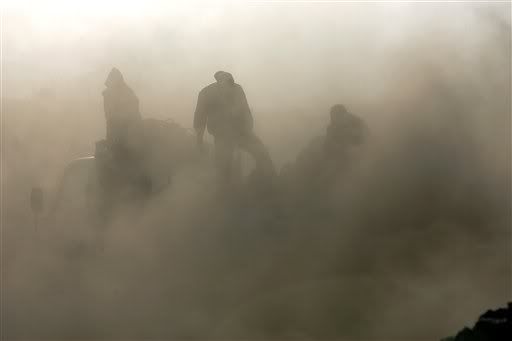 Chinese coal workers load coal unto trucks in Baotou, nestled in the sand-sculpted ravines of Inner Mongolia, China, Tuesday, May 8, 2007. (AP Photo/Elizabeth Dalziel)
The Associated Press reports:
It takes five to 10 days for the pollution from China's coal-fired plants to make its way to the United States, like a slow-moving storm.
It shows up as mercury in the bass and trout caught in the Willamette River in the western U.S. state of Oregon. It increases cloud cover and raises ozone levels. And along the way, it contributes to acid rain in Japan and South Korea and health problems everywhere from Taiyuan to the United States.
This is the dark side of the world's growing use of coal.
Cheap and abundant, coal has become the fuel of choice in much of the world, powering economic booms in China and India that have lifted millions of people out of poverty. Worldwide demand is projected to rise by about 60 percent through 2030 to 6.9 billion tons a year, most of it going to electrical power plants.
But the growth of coal-burning is also contributing to global warming, and is linked to environmental and health issues ranging from acid rain to asthma. Air pollution kills more than 2 million people prematurely, according to the World Health Organization.
"Hands down, coal is by far the dirtiest pollutant," said Dan Jaffe, an atmospheric scientist at the University of Washington who has detected pollutants from Asia at monitoring sites on Mount Bachelor in Oregon and Cheeka Peak in Washington state. "It is a pretty bad fuel on all scores."
To understand the conflict over coal, look at Taiyuan and the surrounding Shanxi Province, the country's top coal-producing region — and one of its most polluted.
Almost overnight, coal has turned poor farmers in this city of 3 million people into Mercedes-driving millionaires, known derisively as "baofahu" or the quick rich. Flashy hotels display chunks of coal in the lobby, and sprawling malls advertise designer goods from Versace and Karl Lagerfeld. Real estate prices have doubled, residents say, and construction cranes fill the skyline.
A museum in Taiyuan celebrates all things coal. Amid photos of smiling miners, coal is presented as the foundation of the country's economic development, credited with making possible everything from the railroad to skin care products.
"Today, coal has penetrated into every aspect of people's lives," the museum says in one of many cheery pronouncements. "We can't live comfortably without coal."
Yet the cornstalks lining a highway outside the city 410 kilometers (255 miles) southwest of Beijing are covered in soot. The same soot settles on vegetables sold at the roadside, and the thick, acrid smoke blots out the morning sun. At its worst, the haze forces highway closures and flight delays.
With pressure to clean up major cities such as Shanghai and Beijing, particularly in the run-up to next year's Beijing Olympics, the central government is turning increasingly to provinces such as Shanxi to meet the country's power demands.
"They look at polluted places like Taiyuan and say it's so polluted there so it doesn't matter if they have another five power plants," said Ramanan Laxminarayan, a senior fellow at Resources For the Future, an American think tank that found links between air pollution and rising hospital admissions in Taiyuan.
"I visited these power plants and there is no concept of pollution control," he said. "They sort of had a laugh and asked, 'Why would you expect us to install pollution control equipment?'"
China is home to 20 of the world's 30 most polluted cities, according to a World Bank report.
Health costs related to air pollution total US$68 billion (€47 billion) a year, nearly 4 percent of the country's economic output, the report said. And acid rain has contaminated a third of the country, Sheng Huaren, a senior Chinese parliamentary official, said last year. It is said to destroy some US$4 billion (€2.8 billion) worth of crops every year.
"What we are facing in China is enormous economic growth, and ... China is paying a price for it," said Henk Bekedam, the country representative for the World Health Organization. "Their growth is not sustainable from an environmental perspective. The good news is that they realize it. The bad news is they're dependent on coal as an energy source."
But the costs go far beyond China. The soot from power plants boosts global warming because coal emits almost twice as much carbon dioxide as natural gas. And researchers from Texas A&M University found that air pollution from China and India has increased in cloud cover and major Pacific Ocean storms by 20 percent to 50 percent over the past 20 years.
"We know dust from factories in China, India, Mexico and Africa does not simply disappear; the wind brings it here," said the U.S. Chamber of Commerce's Bill Kovacs.
Kovacs said overseas dust is adding to the number of counties that do not qualify for federal transportation funds because they are out of compliance with ozone standards. More than 100 counties do not meet the limit of 84 parts per billion. China alone contributes 3 to 5 parts per billion, estimates Daniel J. Jacob, professor of atmospheric chemistry and environmental engineering at Harvard University.
Mercury, a byproduct of some coal-mining, is another major concern. The potent toxin falls into waterways and shows up in fish. Asia's contribution to U.S. mercury levels has shot up over the past 20 years. Jacob estimated half of the mercury in the United States comes from overseas, especially China.
"It's a global problem and right now China is a source on the rise," he said. "If we want to bring down mercury levels in fish, then we have to go after emissions in East Asia."
A fifth of the mercury in the Willamette River came from China and other foreign sources, said Bruce K. Hope of the Oregon Department of Environmental Quality. Pregnant or nursing women who eat the fish put their babies at risk of neurological damage.
"It's frustrating to realize that part of your problem is someone else's behavior and you can't really go to them and say, 'Can you do something different?'" Hope said.
China has closed some polluting factories and says it will retire 50 gigawatts of inefficient power plants, or 8 percent of the total power grid, by 2010, according to the Pew Center for Global Climate Change. The government has also mandated that solar, wind, hydroelectric and other forms of renewable energy provide 10 percent of the nation's power by 2010, and ordered key industries to reduce energy consumption by 20 percent.
President Hu Jintao, in a speech to a key party congress last month, promised a cleanup. But China has fallen short of its national targets for using energy more efficiently, and coal remains a major energy source.
"Everyone knows coal is dirty, but there is no way that China can get rid of coal," the World Bank's Zhao Jianping said in Beijing. "It must rely on it for years to come, until humans can find a new magic solution."
Robert N. Schock, the director of studies for the World Energy Council, agreed that coal, cheap and abundant, will remain a crucial source of energy for many years and be crucial to improving living standards in developing countries.
"Twenty-five percent of the world's electric power is now generated by coal, and those plants are not likely to disappear overnight," Schock said.
In Shanxi province, authorities have pledged to close 900 coal mines and dozens of makeshift factories that process coal for the steel industry, according to the official Xinhua News Agency. The Asian Development Bank is providing more than US$200 million (€139 million) in loans to improve air quality in the province, through programs to shift to cleaner-burning natural gas for household heating and a demonstration project to capture methane, a greenhouse gas released in coal mining.
Taiyuan, dubbed the world's most polluted city in the 1990s, is no longer thought to be the worst, thanks to various efforts including phasing out coal-burning boilers. But the level of pollutants in the air remains five to 10 times higher than levels in New York or London. Residents say they see blue skies fewer than 120 days a year.
Australians Paul and Helen Douglas, who work for Evergreen in Taiyuan, an American social service agency, said their 21-month-old daughter Rose has been found in tests to have elevated lead levels. She has developed a chronic cough, Paul Douglas said, and the family will likely return to Australia before their contract ends if their daughter's toxin levels rise further.
"People say we are irresponsible and that we are making decisions that are injuring our children," he said of coming under fire from relatives and church members for staying in Taiyuan.
Taiyuan residents, though, shrug wearily when the talk turns to pollution, fearful that speaking out could get them in trouble. But when pressed, the complaints tumble forth and expose a community held hostage by the soot.
Residents seal their windows to keep out the dirty air. Parents are warned not to let their toddlers play outside, for fear of being covered in coal dust. Fruits and vegetables must be washed in detergent.
"I'm worried about my children," said a woman who lives in the shadow of a power plant and fertilizer factory. She would only give her surname, Zhang. "We worry about everything. If you get sick seriously, you will die."
Many complain of chronic sore throats, bronchitis, lung cancer and pulmonary fibrosis. One study, by researchers at Norway's Center for International Climate and Environmental Research, found Taiyuan's pollution increased death rates by 15 percent and chronic respiratory ailments by 40 to 50 percent.
"I feel terrible and I'm coughing all the time," said William Li, a retired engineer from Taiyuan. His father died of lung cancer and his son has tracheitis, an upper respiratory condition. "The coal, it produces electric power that we send to other provinces. But we are left with the pollution."
Thursday, September 27, 2007
| [+/-] |
Corn Farms Prosper, But Subsidies Still Flow |
The Washington Post reports:
Corn farmer Jim Handsaker has found a slew of ways to ride the heartland boom in biofuels that is reshaping the economy of rural Iowa.
He sold some of his 2006 crop this year for more than $4 a bushel, the highest price in a decade. His stake in two nearby ethanol plants brought in several thousand dollars more in dividends. Meanwhile, soaring farmland prices have pushed the value of the 400 acres he owns to around $2 million.
Even so, come October he will get a subsidy check from the government, part of a $1.6 billion installment that the U.S. Department of Agriculture will send to corn farmers.
Those annual automatic payments to Handsaker and thousands of other prospering corn growers have long been controversial. But coming at a time when taxpayers are already subsidizing the ethanol industry to the tune of $3 billion a year, the double-barreled support system for those who grow corn and those who turn it into fuel has begun to draw fire in Congress.
"Federal farm subsidies are already narrowly focused on certain crops and are excessive," said Sen. Richard G. Lugar (R-Ind.), a farmer and former chairman of the Senate agriculture committee. "They become ridiculous given the exploding possibilities to grow crops for biofuels production."
So far, Congress has shown little inclination to adjust the subsidies to account for the new energy-driven rural economy.
A House-passed farm bill would give corn growers $10.5 billion over the next five years, even if prices stay high. These "direct payments," a kind of annual allowance, are set by formula and go out automatically, regardless of prices, profits, yields or weather.
At the same time, a Senate-approved energy bill would double the federal requirement for the use of ethanol from corn -- a move that should further buttress corn prices.
Handsaker, a Republican who keeps a framed picture of President and Mrs. Bush in his office, argues that such farm subsidies help keep agricultural land in the hands of family farmers and away from corporate monopolies.
Handsaker is not banking on the ethanol boom lasting. "We've all been down the road of price plateaus," he said.
But he acknowledges that justifying the payments is not easy in the midst of an energy renaissance in the heartland. Country roads are dotted with signs advertising "ethanol corn" -- genetically engineered seeds with the high starch content ideal for making 200-proof, high-octane ethanol.
Just weeks before the October harvest, Hardin County, Handsaker's home in central Iowa, was a sea of corn rolling southwest from Iowa Falls. Handsaker once grew a mix of corn and soybeans on the farmland he and his brothers own or rent. "Now we're 100 percent corn," he said.
On a once quiet highway west of Iowa Falls, a constant stream of tractor-trailers pound the road, hauling corn to the Hawkeye Renewables ethanol refinery and soybeans to Cargill Inc.'s biodiesel plant.
To celebrate a banner year, Hawkeye founder and chief executive Bruce Rastetter pulled out the stops for his annual midsummer bash. Several hundred politicians, businessmen and farmers mingled at his richly landscaped hilltop estate, and Sen. Charles E. Grassley (R-Iowa) made his entrance in a wagon pulled by Rastetter's team of Percheron draft horses.
"It's a great country," said Rastetter, a Hardin County native who started with a few acres of farmland and a small feed business 20 years ago. He recently pledged $1.75 million to Iowa State University. In addition to his Iowa Falls plant, he operates a second one in a nearby county and has two more under construction.
The boom has helped push shares in Iowa ethanol plants to double or triple the initial price. Bill Couser, a corn grower and cattleman who was a driving force behind a new ethanol plant in neighboring Story County, says a grateful local school bus driver who bought shares "waves and honks every time she drives by."
"That's the secret of this ethanol industry," Couser said. "It's keeping the dollars at home."
In July, Pine Lake Corn Processors, the second Hardin County plant after Hawkeye's, announced profits for the previous eight months of $3,800 a share, more than the $3,250 cost of the initial investment. "It's worked out better than my wildest dreams," said Pine Lake President Larry Meints, a corn grower who pushed for the new plant after becoming fed up with hauling grain to distant elevators.
The new market means corn-rich Hardin County has to import the crop even though it grows 35 million bushels a year. The county can't supply its two ethanol refineries and its thriving pork, beef and poultry industries.
"Things are good here," said Howard B. Wenger, president of Iowa Falls State Bank, who reviews the balance sheets of hundreds of farmers.
He estimates that most farmers earned between $100 and $400 an acre on their 2006 crop after expenses, depending on whether they owned or rented their land. That translates into profits of $100,000 to $400,000 on a 1,000-acre farm. The USDA predicts that net farm income will be $87.1 billion this year, up nearly 50 percent over 2006.
Iowa farmland values are up 18 percent in the past 12 months, according to Federal Reserve Board surveys, making millionaires on paper out of any farmers owning 200 acres free and clear.
The rural prosperity is due in large measure to billions of dollars in federal subsidies and incentives for corn-based energy. These include a 51-cent tax credit that gasoline manufacturers get on every gallon of ethanol they mix with their blends, and more than $500 million in federal cash to ethanol refiners between 2001 and 2006.
In 2005, Congress required the use of at least 7.5 billion gallons of ethanol a year by 2012. Then in 2006 came new demand for ethanol as a pollution-curbing additive, along with a jump in gasoline prices that made the corn-based fuel competitive.
"We're harvesting the sun out here," said Handsaker, a genial man who typifies the new breed of businessman-farmer. "We're creating something with sun and chemicals and water and making a renewable product instead of unloading an oil tanker."
When he started in 1971, he recalled, farmers sold their crops to the local livestock industry or sent them "down the river" to volatile export markets.
Prices soared when the Soviet harvest failed or Argentina's corn crop fell short. In between, government payments bridged the gap between solvency and bankruptcy. From 2001 through 2005, Handsaker and his two brothers collected more than $500,000, according to USDA records.
Now four ethanol plants have sprouted within easy trucking distance of their farms and will get about half the 450,000 bushels they produce.
Still, the three brothers stand to collect about $45,000 in direct payments this year, based solely on their previous crop acreage and yields, according to USDA records. Congress created the payments in 1996 as part of a plan to temporarily buttress farm incomes while other traditional subsidies were eliminated. They were supposed to be phased out. Instead, the 2002 farm bill continued them.
"It's a bonus program, not a safety net," said Sen. Richard J. Durbin (D-Ill.). "Farmers I talk to know it's not politically sustainable to ask taxpayers to make payments to them in highly profitable years."
Durbin plans to offer a farm bill amendment that would gradually replace the automatic payments with a program to compensate growers when statewide farm revenues fall below the norm. The National Corn Growers Association embraces a similar plan. This week, the Senate agriculture committee's chairman, Tom Harkin (D-Iowa), circulated a proposal to cut direct payments by $4.5 billion over five years.
The American Farm Bureau Federation, the country's largest farm organization, opposes any changes, but the National Farmers Union, the nation's second-largest, supports an overhaul of direct payments. "It's the most costly and inefficient method for providing a safety net," said the union's president, Tom Buis.
Lugar, the senator from Indiana, favors scrapping the current farm program and using crop insurance and tax-exempt savings accounts to tide farmers over in bad years.
"A farmer's best friend in Iowa is the energy bill," said Bruce Babcock, a professor of economics at Iowa State. "What do you need the direct payments for? It's money for nothing."
Rastetter, along with most others in the ethanol industry, argues that increasing requirements for ethanol use would do more for corn growers than farm programs would. If the government expands its support for ethanol, he said, "then the market price of corn will support farmers and provide the safety net."
But relying on energy policy instead of the traditional farm program worries many in rural Iowa who remember previous bubbles.
The bank still holds a mortgage on his land, Handsaker notes.
Ethanol prices have been tumbling recently as supply catches up with demand. Some ethanol companies, including Rastetter's, have put plans for new refineries on hold pending action by Congress to expand required use.
But such action faces stiff opposition from the livestock industry, which contends that the added demand for corn could mean higher feed and food costs. Environmental groups say it could jeopardize water supplies and sensitive lands in exchange for only minimal savings in the use of fossil fuels, given the amounts of gasoline and chemical fertilizer needed to raise corn.
Meanwhile, the prices of fertilizer, seed and land have been rising rapidly as landlords and corporations move to capture their share of higher grain prices. "As far as the bioeconomy, I don't think any of us thinks it's the golden egg," said April Hemmes, who owns 1,000 acres of prime farmland near Iowa City.
Thursday, May 17, 2007
| [+/-] |
Solar Park |
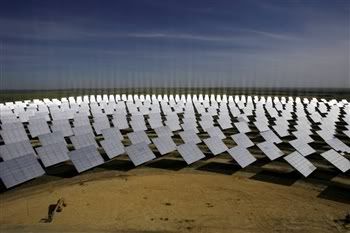 A general view shows a soon-to-be completed solar park at Sanlucar La Mayor, near Seville, Spain. The first of two solar thermal power plants uses mirrors to concentrate the sun's rays onto the top of a 100 metre (300 foot) tower where it produces steam to drive a turbine. The lines in the photograph are due to reflections on the solar panels. REUTERS/Javier Barbancho
Saturday, April 28, 2007
| [+/-] |
Bush's Interior Department To Announce Plans To Drill For Oil & Gas In Virginia, Alaska & Gulf of Mexico Waters |
U.S. Proposal Would Allow Oil Drilling Off Virginia - Five-Year Plan Would Also Open Alaskan, Gulf Waters:
The Interior Department will announce a proposal Monday to allow oil and gas drilling in federal waters near Virginia that are currently off-limits and permit new exploration in Alaska's Bristol Bay and the Gulf of Mexico, according to people who have seen or been told about drafts of the plan.
The department issued a news release yesterday that was lacking details but said that it had finished a five-year plan that will include a "major proposal for expanded oil and natural gas development on the U.S. Outer Continental Shelf." Department officials declined to describe the plan.
Congress would still have to agree to open areas currently off-limits before any drilling could take place off Virginia's coast. Every year since 1982, after an oil spill off Santa Barbara, Calif., Congress has reaffirmed a moratorium on drilling off the nation's Atlantic and Pacific coasts. Last year, after a vigorous push by drilling advocates, Congress opened new waters in the Gulf of Mexico.
The Interior Department might still go ahead with environmental and geological seismic studies off Virginia, but the plan does not envision drilling there before 2011, according to a congressional source who saw an earlier version of the proposal. The sources who described the plan spoke on the condition of anonymity because they didn't want to compromise relationships with people who showed them drafts.
Environmental groups said yesterday that they were troubled by the idea of oil exploration and drilling so near the wildlife refuge on Assateague Island and in an area closely linked to the Chesapeake Bay. Some of the bay's best-known species, such as blue crabs and rockfish, migrate to the ocean.
Activists said that simply looking for oil and gas could cause environmental harm if waste products used to lubricate or cool drill bits are cast overboard. Such materials are often toxic, and could threaten marine life in the area, said Richard Charter of Defenders of Wildlife.
Richard Ayers of the environmental group Virginia Eastern Shorekeeper said he was concerned about development along the state's lightly populated Atlantic shoreline. He said he was worried that oil drilling would create boomtowns, a new influx of people and pollution.
The Virginia shore is dotted with barrier islands and lagoons, most of them largely unspoiled. The Virginia coast has been designated a World Biosphere Reserve by the United Nations, and a National Natural Landmark by the Interior Department.
"This is one of the few places on the East Coast that just never got developed," Ayers said. "A disturbance of any magnitude would be something the place hasn't seen since the '30s," when a hurricane hit the area.
Many drilling advocates say that the oil industry has had a good environmental record in the Gulf of Mexico and that the nation needs to develop domestic oil and gas reserves to bring down prices and reduce reliance on foreign oil.
Advocates of increased drilling have campaigned in several states, many of which are attracted to the prospect of negotiating shares of federal royalties. Bills endorsing more drilling have twice passed the Virginia legislature.
Kevin Hall, a spokesman for Virginia Gov. Timothy M. Kaine (D), said Kaine was "supportive of exploration to see what, if anything, is out there." But Hall said Kaine had received "assurances" from federal officials that the proposed exploration would not violate state law. Last year, the General Assembly and Kaine agreed on a bill to prohibit drilling within 50 miles of Virginia's shoreline.
One place that doesn't need approval from Congress is the area north of the Alaska Peninsula near the Aleutian Islands, known as Bristol Bay. Home to one of the world's largest salmon runs, according to the Sierra Club, Bristol Bay was not covered by the same ban on drilling.
President Bush used his executive power to lift the ban in January. Congress has 60 days to reimpose it, or else drilling preparations could start in Bristol Bay as soon as July 1.
Athan Manuel, offshore drilling expert at the Sierra Club, said, "We need to do more to drill in Detroit by finding more oil efficiency in our cars and trucks rather than drilling off of some of our most sensitive coasts that are important environmentally, but also economically in driving billion-dollar fishing and tourist industries."
Thursday, April 12, 2007
| [+/-] |
Battling Over The World's Oil Reserves |
Alistair Tice looks at the rivalry for access to the world's oil supplies and assesses the likely consequences for the world economy, and the continued dominance of US imperialism.
Alistair Tice reports:
George Bush invaded Iraq for power, prestige and oil. Whilst the catastrophe of the occupation has dealt a huge blow to the prestige of US imperialism around the world and its power in the Middle East has been severely undermined, US and British oil companies are still set to get their hands on Iraq's oil.
Iraq's pro-western cabinet has approved a Hydrocarbon Law that will hand over long-term control of the country's untapped energy fields to foreign multinationals, with profit rates of up to 75 per cent! Iraq has the world's second largest known oil reserves and the Middle East currently supplies two-thirds of the world's oil.
Bush's war for oil was driven by his administration's close links to the major oil companies and by the United States' oil import needs. US oil production peaked in 1970 at ten million barrels per day (bpd); today it is less than five million bpd and the US consumes 20 million bpd. That is 25% of the world's oil consumption, yet the US only has 5% of the world's reserves.
Imports have risen from 36% of its oil needs in 1970 to two-thirds today. A recent submission to the Senate Committee on Energy and Natural Resources stated "there is no economically plausible scenario for a strategically meaningful reduction in the dependence of the Unites States and its allies on imported hydrocarbons during the next quarter century."
The major oil companies, mostly US-owned, are collectively known as 'Big Oil'. Closely connected to the Bush regime, many were originally based in the key oil state of Texas and are an essential element in the 'military-industrial complex'. Their profit-driven objectives have played a decisive role in Bush's aggressive, interventionist policy in the Middle East and Central Asia. Big Oil makes huge profits. In 2005, ExxonMobil became the world's biggest company, overtaking Wal-Mart. Five of the world's top ten corporations are now oil majors.
However, they face long term problems. Last year, the private oil corporations only replaced 75% of their reserves and now they only control 10% of world oil reserves.
State ownership
Despite two decades of neo-liberalism, national oil companies (wholly or partly state owned) control 90% of world oil reserves. And that share is rising.
On 1 May 2006, Evo Morales, the recently elected leftist president, announced the nationalisation of Bolivia's gas industry. Whilst it ended up as only partial state ownership, it was hugely significant after two decades of privatisation and was referred to as "the first nationalisation of the 21st century." Hugo Chávez, the radical president of Venezuela, has announced that by 1 May 2007, PDVSA (the Venezuelan state oil company) will take a 60% majority stake in the extra-heavy oil fields in the Orinoco Basin.
Vladimir Putin, the Russian president, has taken state-capitalist measures against the oil multinationals to increase his government's revenues and standing internationally.
Shell was forced to accept reduced shares in joint ventures in the giant Sakhalin oilfield. And now BP is under pressure from Gazprom, the Russian state gas company, over a new gas field project in Eastern Siberia.
The oil companies are having to accept lesser shares in future profits or risk expropriation and miss out altogether.
Even in the central African country Chad, last year the government created a new national oil company and threatened to expel Chevron for not paying taxes. In less than three years of exploitation of Chad's recently discovered oil resources, in a deal brokered by the World Bank, the foreign consortium had earned $5 billion for a $3 billion investment and Chad only got $588 million!
Globalisation
This retrenchment from globalisation is likely to increase with more governments nationalising or at least taking majority state holdings in their energy resources. Russia is now the world's biggest oil exporter (it overtook Saudi Arabia last year) and Gazprom is now the highest valued company outside the US.
But the Big Oil companies, and through them US imperialism, still control the international oil market: trading, transportation (tankers and pipelines) and refining. So Russia and China are trying to challenge their domination, and their state-owned energy companies could even make hostile takeover bids for Big Oil companies.
These would not be successful for political reasons. Last year for example, the US Congress blocked an attempted take-over of US energy company Unocal by the Chinese state oil company.
However, Russia and China have made a number of bilateral energy agreements and are planning to open their own oil and gas market exchanges to rival the US.
The world oil price peaked at around $80 per barrel last year but has now fallen back to $50-$60, still way above the $20 per barrel before the Iraq war started four years ago.
In the coming world economic slowdown or recession, the oil price is likely to fall further as energy demand falls, although probably not back to $20. However, any significant fall in the oil price below $50 a barrel will cause big economic and social problems for producer countries. It would also lead to another slump (as in the 1990s) in oil exploration and production (the economic viability of reserves is very much conditioned by the oil price) - paving the way for further shortages of supply and refining capacity later.
Would the leftist governments in Bolivia and Venezuela cut back on their social programmes for the poor or would they be forced into more radical policies of expropriation of capitalist interests?
Similarly, would Putin threaten to cut off western energy supplies if the west did not pay more for its gas and oil?
70% of Iran's state revenues comes from its oil exports so any fall in price would undermine President Ahmadinejad's already failing social promises and popular support. Saudi Arabia and the Gulf states too would face big social upheavals.
Whilst these would be the likely consequences of a fall in oil prices in the short term, in the longer run the price is likely to increase and could jump dramatically in response to internal crises.
The four biggest oilfields in the world (which account for 14% of world supplies) are all over 30 years old and in decline.
Saudi Arabia's Ghawar field, the world's largest, is over 50 years old and over half depleted (some observers say 90% depleted but the Saudi oil industry is shrouded in secrecy).
Daqing is the largest oil field in China and its major source of domestic oil; its decline will only make China even more desperate for imports. China is now the world's second biggest oil importer after the US, hence its deals with Iran, Sudan and Venezuela.
Last year, two senior US senators initiated a computerised simulation exercise called ShockWave to study the effects on the US economy if the oil price rose to $100 a barrel. Their inescapable conclusion was that it would lead to recession.
Many analysts believe that due to 'Peak Oil', prices could rise as high as $125-$150 a barrel. The Peak Oil theory is that a time will come when half the discovered and produced oil in the world has been consumed and after then the oil supply will decline. Some oil experts believe that time has already come, others that it may not be for another 30 years.
Either way, the reaction against neo-liberalism already evident in Latin America will spread to other continents as workers and poor people demand action against the super-profits of Big Oil.
There will be pressure from the masses for more windfall taxes and outright nationalisation.
The intensified rivalry between the declining and desperate US empire and energy-rich Russia and energy-hungry China will intensify, most immediately over Iran, and in Central Asia and Africa, leading to trade wars and further military conflicts.
As a consequence oil prices will become increasingly volatile, with falls and big rises, each with the potential to cause economic crises and social upheaval.
Just before the invasion of Iraq, media magnate Rupert Murdoch expressed his support for war to maintain oil prices at $20 a barrel and help sustain world economic growth (and his profits!). Like most things in his media, Murdoch got that one wrong and Iraq and oil will prove to be sources of world economic and political instability for years to come.
Tuesday, March 13, 2007
| [+/-] |
Whose Oil Is It, Anyway? |
Today more than three-quarters of the world’s oil is owned and controlled by governments. It wasn’t always this way. Until about 35 years ago, the world’s oil was largely in the hands of seven corporations based in the United States and Europe. Those seven have since merged into four: ExxonMobil, Chevron, Shell and BP. They are among the world’s largest and most powerful financial empires. But ever since they lost their exclusive control of the oil to the governments, the companies have been trying to get it back.
In the NYTimes, Antonia Juhasz writes:
Iraq’s oil reserves — thought to be the second largest in the world — have always been high on the corporate wish list. In 1998, Kenneth Derr, then chief executive of Chevron, told a San Francisco audience, “Iraq possesses huge reserves of oil and gas — reserves I’d love Chevron to have access to.” A new oil law set to go before the Iraqi Parliament this month would, if passed, go a long way toward helping the oil companies achieve their goal. The Iraq hydrocarbon law would take the majority of Iraq’s oil out of the exclusive hands of the Iraqi government and open it to international oil companies for a generation or more.
In March 2001, the National Energy Policy Development Group (better known as Vice President Dick Cheney’s energy task force), which included executives of America’s largest energy companies, recommended that the United States government support initiatives by Middle Eastern countries “to open up areas of their energy sectors to foreign investment.” One invasion and a great deal of political engineering by the Bush administration later, this is exactly what the proposed Iraq oil law would achieve. It does so to the benefit of the companies, but to the great detriment of Iraq’s economy, democracy and sovereignty.
Since the invasion of Iraq, the Bush administration has been aggressive in shepherding the oil law toward passage. It is one of the president’s benchmarks for the government of Prime Minister Nuri Kamal al-Maliki, a fact that Mr. Bush, Secretary of State Condoleezza Rice, Gen. William Casey, Ambassador Zalmay Khalilzad and other administration officials are publicly emphasizing with increasing urgency. The administration has highlighted the law’s revenue sharing plan, under which the central government would distribute oil revenues throughout the nation on a per capita basis. But the benefits of this excellent proposal are radically undercut by the law’s many other provisions — these allow much (if not most) of Iraq’s oil revenues to flow out of the country and into the pockets of international oil companies.
The law would transform Iraq’s oil industry from a nationalized model closed to American oil companies except for limited (although highly lucrative) marketing contracts, into a commercial industry, all-but-privatized, that is fully open to all international oil companies. The Iraq National Oil Company would have exclusive control of just 17 of Iraq’s 80 known oil fields, leaving two-thirds of known — and all of its as yet undiscovered — fields open to foreign control. The foreign companies would not have to invest their earnings in the Iraqi economy, partner with Iraqi companies, hire Iraqi workers or share new technologies. They could even ride out Iraq’s current “instability” by signing contracts now, while the Iraqi government is at its weakest, and then wait at least two years before even setting foot in the country. The vast majority of Iraq’s oil would then be left underground for at least two years rather than being used for the country’s economic development.
The international oil companies could also be offered some of the most corporate-friendly contracts in the world, including what are called production sharing agreements. These agreements are the oil industry’s preferred model, but are roundly rejected by all the top oil producing countries in the Middle East because they grant long-term contracts (20 to 35 years in the case of Iraq’s draft law) and greater control, ownership and profits to the companies than other models. In fact, they are used for only approximately 12 percent of the world’s oil. Iraq’s neighbors Iran, Kuwait and Saudi Arabia maintain nationalized oil systems and have outlawed foreign control over oil development. They all hire international oil companies as contractors to provide specific services as needed, for a limited duration, and without giving the foreign company any direct interest in the oil produced.
Iraqis may very well choose to use the expertise and experience of international oil companies. They are most likely to do so in a manner that best serves their own needs if they are freed from the tremendous external pressure being exercised by the Bush administration, the oil corporations — and the presence of 140,000 members of the American military. Iraq’s five trade union federations, representing hundreds of thousands of workers, released a statement opposing the law and rejecting “the handing of control over oil to foreign companies, which would undermine the sovereignty of the state and the dignity of the Iraqi people.” They ask for more time, less pressure and a chance at the democracy they have been promised.
Wednesday, December 27, 2006
| [+/-] |
Gail Norton To Join Royal Dutch Shell |
The Denver Post reports:
Former Interior Secretary Gale Norton will join oil giant Royal Dutch Shell as a general counsel in its exploration and production business in mid-January, working primarily out of Colorado.
Norton, who stepped down from Interior in March, is a longtime Colorado resident who served two terms as state attorney general in the 1990s. During her tenure at Interior, she drew fire from environmentalists and praise from industry groups.
Shell said in a statement Wednesday that Norton, 52, will "provide and coordinate legal services" for its unconventional-resources unit, which is developing and testing proprietary technology to recover oil from shale and extra-heavy oils.
Colorado, Utah and Wyoming have massive oil- shale deposits, with as much as 1.1 trillion barrels of oil technically recoverable.
Shell owns 40,000 acres of oil-shale deposits near Meeker on which it hopes to begin commercial production by about 2015.
When Norton left Interior after five years, she said her primary reason was so she and her husband, John Hughes, could return to "the mountains we love in the West," as well as return to the private sector.
Norton could not be reached for comment.
Royal Dutch Shell is a multinational oil company with corporate headquarters in The Hague, Netherlands. Its U.S. subsidiary, Shell Oil Co., is based in Houston. The Forbes Global 2000 ranked Royal Dutch Shell as the seventh-largest company in the world in 2006. Its revenues in 2005 were $307 billion.
As Interior secretary, Norton was attacked by environmentalists for her pro-development policies regarding oil and gas, coal and timber. She also reopened Yellowstone National Park to snowmobiles.
Matt Baker, director of Environment Colorado, said he was disheartened by Shell's hiring of Norton.
He said his organization has done a lot of work with Shell on sustainability issues, particularly development of wind-powered energy resources.
"I think it's unsettling if she's going to be working on oil shale. Shell has cultivated an image as a good environmental steward who wants to take its time and do it right," he said. "For them to hire someone like Gale Norton undermines that claim."
Industry advocates and Norton's fellow Republicans, however, have praised her as a realist willing to open public lands to drilling during a time of energy shortages that threatened the economy.
Before moving to Interior, Norton was senior counsel at Denver law firm Brownstein, Hyatt & Farber.
Steve Farber, one of the firm's founding partners, said Norton's move is win-win: Shell will benefit from Norton's skills, and Norton will have the opportunity to return to Colorado.
"She (has) a wonderful wealth of knowledge and experience, and she will be a great asset to the team at Shell," he said.
Sunday, October 8, 2006
| [+/-] |
Profile: Brian Schweitzer, Democratic Governor of Montana |
The NYT reports:
It’s fun being governor of Montana. Just watch Brian Schweitzer bouncing around the streets of Helena in the passenger seat of the state’s official S.U.V., fumbling with wires, trying to stick the flashing police light on the roof. When he spots some legislators on the sidewalk, he blasts them with the siren, then summons them by name on the loudspeaker. The men jump, and the governor tumbles out of the car, doubled in laughter, giving everyone a bear hug or a high-five or a soft slap on the cheek. Schweitzer, a Democrat in his first term, marches into a barroom in blue jeans and cowboy boots and a beaded bolo tie, and his border collie, Jag, leaps out of the vehicle and follows him in. The governor throws back a few pints of the local brew and introduces himself to everyone in the place, down to the servers and a small girl stuck there with her parents. He takes time from the backslapping to poach cubes of cheese from the snack platter and sneak them to the girl, who is now chasing his dog around the bar. “This is how you make friends with Jag,” he advises her. “Just hold it in your hand and let him take it.”
As soon as Schweitzer was elected in 2004 — the same night that George W. Bush carried Montana by 20 percentage points — pundits began declaring him the future of the Democratic Party. Never mind that it was his first elected office: the 51-year-old farmer and irrigation contractor had folksy charm and true-grit swagger. He shot guns, rode horses, took his dog to work and decimated his opponents with off-the-cuff one-liners heavy on the bull-and-horse metaphors. He didn’t act like a Democrat, in other words, and to many Democrats, reeling from consecutive losses to Bush, that seemed like a pretty good thing.
Schweitzer’s grandparents were homesteaders who immigrated to Montana from Ireland and Germany. His parents were ranchers who never completed high school. And until 2000, Schweitzer and his wife, Nancy, were farming in Whitefish and raising their three children. And then, despite the fact that he was a virtual unknown in politics, Schweitzer began a quixotic bid to oust Conrad Burns, a two-term incumbent Republican senator. To the surprise of Montana’s political class, he came within four percentage points of succeeding. Almost immediately, he began campaigning for what would be an open governor’s seat. Even after choosing a Republican as his running mate, he thumped his primary opponent by a 52-point margin, then won the general election by four points.
Within months of his election, bloggers were clamoring for a presidential run, and his popularity transcended the wonk journals to include coronation as “Hot Governor” by Rolling Stone magazine, while “60 Minutes” called him the Coal Cowboy. On camera he persuaded Lesley Stahl to take a whiff from a vial of diesel fuel synthesized from coal — a product that Schweitzer claims will not only fill Montana’s coffers but also help end the nation’s dependence on foreign oil peddled by “sheiks, rats, crooks, dictators.”
Schweitzer’s “Montana miracle,” in which Democrats took back the governor’s seat after 16 years and ended 12 years of Republican majorities in both state chambers, has been cited as evidence that the Republican bastions in the Western states are losing ground to a new, Democratic brand of libertarian-tinged prairie populism. No fewer than four recent books by Democratic strategists have mentioned Schweitzer as the kind of guy Democrats need to win back rural America. A fifth book, Tom Schaller’s “Whistling Past Dixie,” published earlier this month, also singles out Schweitzer and makes the previously heretical claim that the Democrats’ future lies in ignoring the South and embracing the West and Midwest, where voters are less evangelical and more independent.
“He’s one of the new stars in the party,” Gov. Bill Richardson of New Mexico, chairman of the Democratic Governors’ Association, told me recently. “We’re highlighting him wherever we can.” Indeed, just 54 days into his term, Schweitzer was chosen to deliver the Democrats’ weekly radio address, and he has been attracting notice from the party faithful ever since — like when he compared the president to a shifty cattle auctioneer hawking lousy bulls to dubious ranchers.
Six-foot-two and a beefy 205 pounds, Schweitzer has seized the heartland imagery generally monopolized by Republicans. “Schweitzer is the antithesis of the Democrat stereotype,” Markos Moulitsas Zuniga, of dailykos.com, the partisan Democratic blog, told me. “Too many Democrats look like targets for the school bully. Schweitzer is a tough guy. And people like guys who will bar-fight their way across a state.”
Schweitzer veers right on many economic and social issues: he opposes gun control, favors the death penalty and preaches about lowering taxes and balancing budgets. At the same time, he leans left on some issues that matter to progressives: championing energy conservation and environmental regulation, opposing governmental restrictions on abortion and criticizing free-trade deals. “He’s as much a prairie centrist as he is a prairie populist,” Bruce Reed of the Democratic Leadership Council told me. Schweitzer has the ability to reduce a complicated issue to a few sharp lines, reframing it with themes of patriotism and underdog know-how. “I was a critic of Nafta, I was a critic of Cafta and I’ll be a critic of Shafta,” he says of free-trade agreements, long the hobgoblin of even the most articulate liberal politicians. “Why is it that America supposedly creates the best businessmen in the world, but when we go to the table with the third world, we come away losers?”
The Democrats’ enthusiasm for their new hero seemed to overlook the fact that the governor of a state as sparsely populated as Montana simply does not wield a lot of national clout. Schweitzer governs fewer than a million people, in a state with a single Congressional representative, only three electoral votes and a Legislature that meets for just 90 days, every other year. Indeed, Schweitzer’s national celebrity has less to do with the way he has governed and more to do with Democrats’ perception — or their hope — that he is leading a Western resurgence.
The elections next month will test that theory. Schweitzer has been campaigning for the two Western Democrats best poised to replace powerful Republicans. In Montana, a populist farmer named Jon Tester is posing a serious challenge to Senator Conrad Burns, whose close ties to the lobbyist Jack Abramoff have made him an attractive target for Democrats trying to paint the Republicans as corrupt insiders. A Tester victory would solidify Montana as a Democratic stronghold, marking the first time since 1989 that the state’s two senators and governor were all Democrats. (Montana’s other senator, Max Baucus, a Democrat, has held his seat since 1978.) In Colorado, meanwhile, Schweitzer has been stumping for Bill Ritter, the former Denver district attorney, who grew up on a farm with 11 brothers and sisters, began working construction at age 14 and is now running for governor. A Ritter win would complete what Schweitzer calls a “blue bridge from Alberta to Mexico,” a string of Democratic governorships stretching across Montana, Wyoming, Colorado, New Mexico and Arizona — states that all broke for Bush in 2004.
Some of this has to do with demographics. In the last three decades, professional and service jobs have boomed in the Rocky Mountain states, and farming and mining jobs have not; those two sectors, once the mainstay of the region, now make up just 5 percent of all jobs. In Nevada, Arizona and Colorado, a sharp rise in the Hispanic population in the last decade may also have helped tilt the voting base to the left. But Governor Schweitzer says he believes that his success points to something more significant. “Is it that the population in the West is trending toward the traditional Democratic Party?” Schweitzer asked. “Or is it possible that some leaders in the Rocky Mountains are on the vanguard of realigning what the Democrats stand for?”
The Interior West has long been seen by Democrats on election night as simply a disheartening wall of big red blocks. Idaho, Utah and Wyoming haven’t voted for a Democratic presidential candidate since Lyndon Johnson in 1964, and Montana, Colorado and Arizona have all gone Republican in 9 of the last 10 presidential elections. But below the surface, the map of the West is slowly becoming a little less red and a little more blue. In 2000, Democrats had not a single governor in the interior West states; now they have four. Democrats have gradually been picking up House seats, too. In 1996, they won 4 of 24 House seats in the region. But they’ve managed to pick up 1 or 2 seats in each of the last four elections and have now clawed their way up to 8 of 28. In 2004, the party’s only bright spot besides Montana was Colorado, where Ken Salazar won a Republican Senate seat; his brother, John, picked up a House seat; and the Democrats took control of both state chambers.
“The pan-Western states — in an arc from Ohio, west to Montana and south to Arizona — are where the low-hanging and most-ripe-for-the-plucking electoral fruit for Democrats is to be found,” writes Tom Schaller in “Whistling Past Dixie.” The midterm election outlook seems to support Schaller’s thesis. None of the region’s eight Democratic representatives — the so-called Coyote Caucus — are considered at serious risk in 2006. But 10 of the 20 Republican-held seats are included in the list of 56 potential Democratic pickups compiled by Larry Sabato at the University of Virginia’s Center for Politics. The Democratic Senate candidate in Arizona is putting up a surprising fight against the Republican incumbent, and the race for Nevada governor, an open seat vacated by a Republican, is listed by the Cook Report, an influential Washington political newsletter, as a tossup.
Local Democrats portray this trend as a grass-roots, homegrown phenomenon. “These advances were not the results of any national organization,” Jim Farrell, executive director of the Montana Democratic Party, told me, “but of the emergence of great local leadership like Schweitzer and Salazar. The D.S.C.C.” — the Democratic Senatorial Campaign Committee, led by Charles Schumer of New York — “and other national groups have recognized the potential for gain, but they’re chasing after a train that began rolling in the last two cycles here in the West.”
It would seem to be true that Democrats in Washington long ignored the mountain states. As Pat Williams, a Montana Democrat who served in the House from 1979 to 1996, told me, “In 2000 you literally couldn’t get an Al Gore button in Montana.” But in recent years, the national Democratic Party has made some small but significant organizational shifts to increase the West’s political brawn. In August, the Democratic National Committee inserted a Nevada caucus into the 2008 presidential primary schedule, between Iowa and New Hampshire, in recognition that the Southwest is the nation’s fastest-growing region. The West has also gained influence through the elevation of Senator Harry Reid, a pro-gun, pro-life Nevada Mormon, to Senate minority leader. Democrats have chosen Denver as one of two finalists to be host of their 2008 convention (the other is New York). If Denver is selected, it will mark the first time in a century that Democrats have held a convention in the interior West. The D.N.C. has hired as its Northwest political director Brad Martin, who as executive director of the Montana Democratic Party oversaw its 2004 gains, and Howard Dean has dispatched more than 30 staff members to the Western states as part of his “50-state strategy.”
Still, Democrats hasten to assure the region’s notoriously prickly and independent voters that the national party’s new Western focus doesn’t mean that Washington will exercise any control over candidates in the region. “We’re not trying to be a top-down organization like the Republicans,” says Karen Finney, spokeswoman of the D.N.C. In the West, of course, being seen as refusing to take orders is a way to demonstrate your frontier spirit. Williams offers this advice to any Western candidate wondering whether to employ a regional strategy: “If it doesn’t exist, create it. And then be against it.”
As fertile as the West may seem for Democrats, some in the party remain skeptical that it matters much. “The problem with the Democrats is that they can’t count,” Dave (Mudcat) Saunders, a Democratic campaign strategist, told me. Saunders’s book, “Foxes in the Henhouse,” argues that the party would be wrong to focus on the West and ignore the South. He notes that 30 percent of the country’s electoral votes come from the South, and that by 2025 that percentage will be 40. “Georgia and Florida have as many votes as all the West put together,” Saunders points out.
Montana Republicans don’t concede that the 2004 results show a Democratic trend in Montana — much less the rest of the West. Roy Brown, the leader of the Republican caucus in the statehouse, says that the Democrats’ pickup of seats in the Legislature was not due to a sea change in the electorate but a result of gerrymandering perpetrated by a Montana Supreme Court that is “in bed with the Democrats.” Although Montana does not require voters to identify party affiliation, Brown estimates that 40 percent are Republicans, 35 percent are Democrats and 25 percent are independents. He concedes that in recent years the independents have been leaning toward the Democrats, but he says that’s not a consequence of a true shift in voter attitudes but a result of a “filter-down” effect from unpopular Republican candidates at the top of the ticket. (Schweitzer’s Republican predecessor famously declared herself a “lap dog of industry.”) In any event, the Democrats’ success in 2004 was not an aberration; the party had been steadily gaining seats in the state chambers for the previous three elections.
Schweitzer agrees that Democrats should be careful about trying to extrapolate Montana’s political trends to other states. “Montana ought not serve as a metaphor for the entire West,” he told me. Indeed, Montana is the West’s answer to New Hampshire: independent, contrary and unpredictable. Its demographic trends do not match that of the Southwest. The state’s population is growing, but not skyrocketing the way it is in Arizona and Nevada, and with no city larger than 100,000 residents, Montana essentially does not have suburbs or exurbs like those spreading around Phoenix, Las Vegas and Denver. Hispanics account for less than 3 percent of the population; Montana’s most sizable ethnic minority is Native American, at 6 percent of the population. And the state’s voters have always been less conservative than their neighbors in Idaho, Utah and Wyoming. While it’s true that Montanans voted for a Democratic president only twice in the past 50 years, they’ve often elected Democrats to the House and Senate. In fact, Max Baucus’s Senate seat has been held by a Democrat since 1913. The meaning of the 2004 race is further complicated by the fact that Schweitzer chose a Republican — albeit a moderate of the Jim Jeffords variety — as his running mate.
Within the state, politics have historically been split between east and west. Western Montana, with two college towns, Missoula and Bozeman; the unionized mining town Butte; and the capital, Helena, tends to vote more like the liberal Pacific Northwest. The east is more like the Great Plains, with vast ranches, farms, strip mines and oil fields. When the state had two Congressional districts (they were folded into one in 1993), the western one was consistently held by a Democrat and the eastern one by a Republican. According to David Sirota, who was a strategist for Schweitzer in both 2000 and 2004 and who now lives in Helena, the swing vote in the state is in and around Billings, the state’s largest city. (“It is Yellowstone County that is Montana’s own Ohio,” he says, “and Billings the state’s Columbus.”) But unlike the rest of the nation, where swing voters are generally characterized as socially conservative suburbanites, Sirota says that many Montana swing voters are rural and libertarian.
Marc Racicot, who served two terms as Montana’s governor before he went on to be chairman of the Republican National Committee and President Bush’s 2004 campaign committee, says his fellow Montanans are unpredictable voters. “You simply can’t classify them,” he told me, pointing out that in 2004 they simultaneously voted to ban gay marriage and to legalize medical marijuana. “They are conservative in some ways, but ruggedly independent and populist in others. Party affiliation isn’t necessarily the dominant characteristic they consider.” Montanans are more mistrustful of large institutions like government and corporations than their counterparts on the coasts, while less religious than the South. Fifty-three percent of Montanans say they are pro-abortion rights. In foreign policy they can be rather isolationist: a poll in September showed that Montanans break with the national trend and rank the economy as more important than national security or the Iraq war. They take a libertarian approach to homeland security that is rarely heard nationally; Jon Tester, in a recent debate, said, “With things like the Patriot Act, we’d damn well better keep our guns.” And, contrary to the myth that Westerners are opposed to all environmental regulation, they tend to be conservationists. About 60 percent of Montanans favored the Roadless Area Conservation Rule, which protected land from logging; it was signed by Bill Clinton and overturned by George W. Bush. Bush’s recent plan to auction off public lands was so unpopular in Montana that even Conrad Burns opposed it.
Montana’s populist streak dates back more than a century to the mining labor movement, and it surfaced again in 1992, when Ross Perot captured more than a quarter of the vote, allowing Clinton to win the state. As the Republicans honed their populist message in the 1990’s, their fortunes improved in Montana. Now, some say, the tide is turning. “The appeal of populism never changed,” Sirota says. “The parties changed. The Republicans were the populists. Now the Democrats have learned that they can be populists, too.”
It was a sunny day in June, and Brian Schweitzer and Max Baucus were flanked by Cessnas and helicopters, rallying with Jon Tester. Political rallies in other states might take place in hotel ballrooms; here in Montana everyone was gathered in an aircraft hangar outside Missoula. The place smelled like jet fuel. Corralling the top-ticket Montana Democrats in one place can resemble a “Bonanza” cast reunion, albeit with two Hosses and no Little Joe. Tester is a third-generation wheat farmer, president of the State Senate and a lumbering tank of a guy with a big gut and a flattop haircut. You want prairie authenticity? Have Tester show you his hand with just a thumb and a pinkie; the other three fingers were chopped off in a meat grinder when he was a boy. Tester, a progressive type, ran in the primary against a better-financed centrist, a career politician supported by the Democratic Leadership Council, and as soon as he won, Schweitzer leapt in to claim him as a brother. Onstage at the airport, Schweitzer played the down-home card. “Jon’s grandparents homesteaded just 20 miles from my grandparents,” he hollered, to a roar of approval from the hangar. “He and I were born in the same tiny hospital, up in Havre!”
Other than the fact that they grew up on farms, it’s not immediately clear what unites Schweitzer and Tester, Ritter and the Salazars. With his outspoken criticism of the war in Iraq — “I was very public before we went in that it was a bad idea, and history has borne that out,” he told me — Schweitzer has become a hero to progressives, while Ken Salazar has infuriated liberals with his support of Alberto Gonzalez’s nomination for attorney general and his endorsement of Joe Lieberman’s independent re-election bid. Governor Richardson of New Mexico suggests that such differences are evidence that the movement has no overarching strategy. “It’s happening from the bottom up,” he told me. “This is a natural evolution. It’s no grand design.” Or maybe it’s that the region’s Democrats simply don’t have many core beliefs in common. Schweitzer remains an iconoclast; he says he supported John McCain’s presidential bid in 2000, though he has since soured on McCain because of the way he has courted the religious right, and he says he is now intrigued by the possibility of a presidential run by Mitt Romney, the Republican governor of Massachusetts, in 2008. “If he gets the nomination, I might support him,” Schweitzer told me.
Much of Schweitzer’s attraction to voters lies in the fact that he doesn’t seem like a politician. “I’m just a rancher who ended up governor of Montana,” he likes to say. But Schweitzer is not a politician only in the sense that the young Cassius Clay was not a boxer; by the time his opponent realized he’d been hit, he was already on the mat. And since it’s accepted in the West that politicians are generally not to be trusted, Schweitzer’s greatest talent may be his endless insistence that he’s not one, all the while winning your vote and changing your opinion to agree with his. Which is, of course, what a politician does. His success is not the happy accident of a novice or a rube or a cowpoke who happened to ride his donkey into the halls of power — but rather the work of an expert, a virtuoso or, perhaps, a natural.
Besides getting elected and getting on television, what has Schweitzer actually accomplished? Much of the attention he has received came from positions he has taken on national issues: writing an Op-Ed for The Times about the miracle of coal-to-gas liquefaction, or requesting that President Bush return the Montana National Guardsmen from Iraq to fight summer forest fires. His agenda for his first legislative session was hardly radical: it included an increase in education financing, setting a goal to produce more wind power and a tax-reform bill that favored small business over big by eliminating the tax on business equipment valued at less than $20,000, while withdrawing a pending cut on more expensive equipment. He introduced an ultimately unsuccessful plan to prevent government officials from moving directly into lobbying jobs. Still, Schweitzer bristles at the suggestion that he was not sufficiently tested by his first session. “I had 90 days to pass my agenda,” he told me. “It was my first day on the job, and I was working with lobbyists and legislators who’d been there for years. We had a State Assembly that was deadlocked. But I pushed through the most progressive legislative agenda in the country. It was not easy. I took on the lobbyists. I wrestled them to the ground, and now I’m kicking them in the ribs.”
Despite the boots and bluster, at his core Brian Schweitzer is something of a policy wonk and a science whiz. He says he sleeps no more than five hours a night, and he is at his computer well before dawn, consuming a host of newspapers and a string of political blogs. His true passion is energy independence. On his desk is a contraption of tubes and coils that, as he enthusiastically explains, convert sunlight into hydrogen. In addition to his horsemanship and riflery, Schweitzer likes to tinker with gadgets, and he holds degrees in both soil science and agronomy. He will preach to anyone who will listen about the Fischer-Tropsch process of coal liquefaction, or about his recent switch from a Tahoe S.U.V. to a biodiesel Volkswagen Jetta.
Schweitzer fancies that he will solve the energy crisis the Montana way, which is to say, with ethanol and syn-fuels and wind power, all readily available in a state that has more grain, coal and wind than it does people. He says he believes that he is setting an example for the rest of the world, and that tends to infuse even the most mundane details of his legislative work with a certain fervor.
When I was visiting with Schweitzer one day during the legislative session, an aide rushed into his office with news that a group of Democratic state representatives from the Great Falls area were threatening to withdraw their support from the governor’s ethanol bill. Schweitzer was leaning back in his chair, beneath an oil painting of a Native American woman playing a flute, beside a window opening onto a view of snow-covered mountains. If Schweitzer is, as his critics contend, mostly a showman, he has chosen the perfect stage. Helena’s domed State Capitol is a transcendent gallery of marble columns and stained-glass atria, a temple so sincere in its exultation of frontier democracy that, for the cynical, it may resemble a Frank Capra movie version of government more than it resembles the real thing. Citizens wander freely in the corridors of power and, from the Senate gallery, can observe their lawmakers beneath frescoes of Lewis and Clark meeting Sacagawea, and of General Custer about to take a dagger to the gut at Little Bighorn.
The Great Falls representatives refused to come meet Schweitzer in the governor’s office — located about 800 steps from their chamber — because they were upset that the governor canceled a meeting with them earlier that day. “That’s it,” Schweitzer said, leaping up. “I’m taking ’em to the woodshed.” In an instant he was stomping down the corridor to the rotunda, his dog at his heels, and charging up the staircase to the House chamber. The governor corralled the Great Falls representatives in a meeting room and listened to their grievances. He leaned forward intently, his head bobbing almost imperceptibly, his eyes wide open and blinking in a strict cadence, receiving and processing data as if it were an electrical current. He clutched the edge of the table, and I suspected that if he let go, the rotors spinning in his skull would have broken the pull of gravity and sent him spiraling into orbit.
Sufficiently charged, the governor whirred into action. His monologue combined pep talk and sales pitch, threats and promises, science lecture and economic briefing. He spoke at length on the difference between malt barley and high-protein wheat, and on the profit margin of ethanol refineries, pounding his finger on the tabletop for emphasis. He went on uninterrupted for seven minutes, and when the fusillade was over, one of the representatives voiced a small objection from an industry lobbyist that Montana wheat would make for low-grade ethanol.
“Now that,” said the governor, slapping the table in triumph, almost evangelically, as if the Republic itself depended on this vote, “that sounds like somebody who didn’t take a single class in agronomy!”
Later that day, everyone at the meeting voted yes on ethanol, and in the evenly split House, the bill passed 52-48.
Hungry and emboldened, Democrats are already looking past 2006. A few stalwart Western Republicans who have been in the Senate since the Nixon years are rumored to be contemplating retirement in 2008. Pete Domenici of New Mexico will be 76, and Ted Stevens of Alaska will be 84. In Colorado, Democrats are so eager to oust Senator Wayne Allard that Representative Mark Udall has declared his candidacy a full three years before the election. Udall comes from the political dynasty that has spawned an Arizona Supreme Court justice and a handful of Democratic congressmen, and as a world-class mountaineer who says he is the only member of Congress to have made an attempt on Mount Everest, he fits the bill of an iconic Westerner.
As Democrats look to Montana to try to figure out how to replicate Governor Schweitzer’s success, they can’t help noticing one recent poll number: in August, 66 percent of Montana Republicans said they approved of Schweitzer, the same portion who said they approved of Conrad Burns, their own party’s incumbent senator. It may be that this sort of popularity comes only to a larger-than-life personality like Schweitzer.
Democrats will be wise not to try to replicate Schweitzer himself. When non-Schweitzers try to act like Schweitzer, it usually doesn’t work. In his book, Schaller recalls “campaign images of Al Gore wearing cowboy boots with his belt-clipped Blackberry, or a barn-jacket-clad John Kerry buying a goose-hunting license.” Schaller goes on to write that these gestures force “liberals to avert their eyes in horror, while conservatives look on from afar with a mixture of disdain and disbelief.”
As for Schweitzer’s own future plans, he dismisses questions about further political ambitions with one of his trademark similes — something about having spent more days in a saddle than having been governor. Nonetheless, the scope of his battle is larger than Montana. In addition to campaigning for Jon Tester in Montana and Bill Ritter in Colorado, he also stumped recently at a fund-raiser in Jackson Hole, Wyo., for a singularly non-Western candidate: Eliot Spitzer of New York.
