Rice Criticizes Putin's Concentration of Power, Says It Interferes With Move to Democracy
ABC News reports:
The Russian government under Vladimir Putin has amassed so much central authority that the power-grab may undermine Moscow's commitment to democracy, Secretary of State Condoleezza Rice said Saturday.
"In any country, if you don't have countervailing institutions, the power of any one president is problematic for democratic development," Rice told reporters after meeting with human-rights activists.
"I think there is too much concentration of power in the Kremlin. I have told the Russians that. Everybody has doubts about the full independence of the judiciary. There are clearly questions about the independence of the electronic media and there are, I think, questions about the strength of the Duma," said Rice, referring to the Russian parliament.
Telephone messages left with Kremlin spokesman Dmitry Peskov were not immediately returned Saturday evening.
The top American diplomat encouraged the activists to build institutions of democracy. These would help combat arbitrary state power amid increasing pressure from the Kremlin, she said.
The U.S. is concerned about the centralization of power and democratic backsliding ahead of Russia's legislative and presidential elections in December and March. Putin will step down next year as president. He has said he would lead the ticket of the main pro-Kremlin party in the parliamentary elections and could take the prime minister's job later.
Rice sought opinions and assessments of the situation from eight prominent rights leaders.
"I talked to people about the coming months and how they see the coming months. How these two elections are carried out will have an effect on whether Russia is making the next step on toward democracy," Rice said after the private sessions at Spaso House, the residence of the U.S. ambassador in Moscow.
Rice and Defense Secretary Robert Gates on Friday received a chilly reception from Putin and senior Russian officials on U.S. proposals for cooperating on a missile defense system in Eastern Europe that Russia vehemently opposes.
But as she has in the past, Rice declined comment on Putin's possible political future and said she did not raise the matter in her official discussions.
Although she would not speculate about Putin's ambitions, Rice said there were signs that whatever transition occurs could be smooth.
"To the degree that anyone can predict, it looks like it will be fairly stable," she said. "But, I would just caution that change is change."
Earlier, Rice said she hoped the efforts of rights activists would promote universal values of "the rights of individuals to liberty and freedom, the right to worship as you please, and the right to assembly, the right to not have to deal with the arbitrary power of the state."
In the meeting with business, media and civil society leaders, Rice said she was "especially interested in talking about how you view (the) political evolution of Russia, the economic evolution of Russia."
"Russia is a country that's in transition and that transition is not easy and there are a lot of complications and a lot of challenges," Rice said. "If Russia is to emerge as a democratic country that can fully protect the rights of its people, it is going to emerge over years and you have to be a part of helping the emergence of that Russia."
Participants in the meetings said they outlined their concerns but that she did not offer any judgments about the state of human rights and democracy under Putin.
Lyudmila Alexeyeva of the Moscow Helsinki Group told the Interfax news agency her organization sees "the purposeful construction of an authoritarian society and an onslaught on the people's rights, elections are being turned into farce, and human rights and opposition organizations are experiencing pressure."
Alexander Brod, head of the Moscow Human Rights Bureau, said the discussions touched on "authoritarianism and the crisis of human rights." He said he disagreed with "the opinion that we had a flourishing democracy in the 1990s and that we have a setback now."
"Not all is ideal in America, either. We see protests against the war in Iraq and violations of human rights on the part of security services and violations of human rights in countering terrorism," Brod said.
Vladimir Lukin, the government-appointed human rights ombudsman, was quoted by Interfax as saying he told Rice that human rights should be discussed in a dialogue rather lecturing in a "doomsday" style.
The State Department frequently has criticized what Washington regards as creeping authoritarianism among Putin and other top Russian leaders.
Its most recent human-rights report on Russia notes continuing centralization of power in the Kremlin, a compliant legislature, political pressure on the judiciary, intolerance of ethnic minorities, corruption and selectivity in enforcement of the law, and media restrictions and self-censorship.
Rice and Gates later met with Prime Minister Viktor Zubkov for talks on trade and economic relations, including negotiations for Russia's accession to the World Trade Organization.
Moscow and Washington signed a trade agreement last November that removed the last major obstacle in Moscow's 13-year journey to join the 149-member group. Moscow must still conclude other outstanding bilateral deals and assuage the European Union's concerns about energy supplies.
The Russian government press service said Zubkov also pressed the Americans to work to abolish the Jackson-Vanik amendment. The 1974 measure ties Russia's trade status to whether it freely allows Jewish emigration.
Saturday, October 13, 2007
| [+/-] |
Rice Worried by Putin's Broad Powers |
Sunday, July 1, 2007
| [+/-] |
Protest Marches Follow Bush To Kennebunkport |
The AP reports:
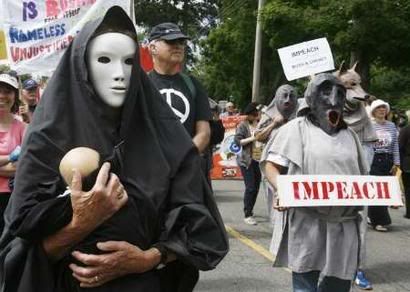
Hundreds of demonstrators calling for the impeachment of President Bush marched Sunday to within a half mile of the site of the summit between Bush and Russian President Vladimir Putin.
Protesters chanting slogans including "impeach now, impeach now!" carried colorful signs and pulled a wagon with a 7-foot-tall replica of the Statue of Liberty in a coffin, representing the perceived loss of liberties under the Bush administration.
Four demonstrators wearing orange jumpsuits, like those worn by detainees at the U.S. Navy base in Guantanamo Bay, Cuba, kneeled on the ground near a police roadblock. Two demonstrators who crossed the police line were arrested.
The crowd estimated by police at 1,700 criticized both world leaders -- Bush for the war in Iraq and Putin for his hard line in Chechnya.
Jamilla El-Shafei, one of the organizers, said Bush and Putin have inflamed tensions that are already running high in the Muslim world. In particular, she zeroed in on Bush and Vice President Cheney over their handling of the war in Iraq.
"We want the troops home now. We want permanent bases out of Iraq. And we want to hold Bush and Cheney accountable for deceiving the people into an immoral and unjust war, for mutilation of the Constitution and the evisceration of habeas corpus," she said.
The protest began in the morning at the Village Green, a park not far from the center of town with its many tourist shops and restaurants.
The demonstration was organized by the Kennebunk Peace Department and the Maine Campaign to Impeach. But demonstrators represented a wide variety of causes that included ending the genocide in Darfur, fighting corporate greed and improving the environment.
The event featured music, chants and speeches before demonstrators and a small marching band paraded down Ocean Avenue toward the Bush summer home at Walker's Point.
Included in the demonstration was a rolling memorial for Marine Lance Cpl. Alexander Arredondo, who was killed in Iraq on Aug. 25, 2004. His father's pickup truck had a flag-draped coffin with Arredondo's boots and camouflage shirt bearing a purple heart.
"This is my pain. This is my loss," said Carlos Arredondo, who became so upset when he learned of his son's death in Hollywood, Fla., that he tried to destroy a military van and was burned in the process. He now lives in the Boston area.
The demonstrators' main target was Bush, whose unpopular policy in Iraq has come under widespread and growing criticism.
"Outrage and anger isn't enough," said John Kaminski of Maine Lawyers for Democracy, a group of 80 attorneys pushing for impeachment proceedings. "We have a job to do and that job is to hold this administration accountable and take this country back."
But some protesters didn't spare his guest, Putin, who came into office as the Chechnya conflict was flaring. Critics have accused him of human rights violations in suppressing mostly Muslim, separatist rebels in the breakaway region.
Victoria Poupko, who moved from Moscow to Boston 17 years ago, said Bush and Putin are "both criminals" for torture, war crimes and abuse of power, among other things. She carried a sign that said, "Stop imperialism. Bush out of Iraq. Putin out of Chechnya."
"Withdraw from Chechnya, let them have their independence," she said.
While marching down Ocean Avenue, the group encountered a couple of dozen counter-demonstrators waving signs in support of Bush. One of them jumped into the parade and shouted slogans, shouting at one point "liars, liars, liars."
The event was peaceful but two demonstrators who insisted on crossing a police line on Ocean Avenue were arrested and charged with trespassing.
"I pay taxes. I can walk on the street if I want to," one of the protesters, Lynn Curit-Smith of Portland, told Kennebunkport Police Chief Joseph Bruni before crossing the line with two others, one of whom was released because she was a minor.
Bush arrived in Kennebunkport on Thursday at the seaside home that has been in the Bush family for a century. His father, former President George H.W. Bush, has spent at least part of every summer since childhood here except when he served in the Navy during World War II.
Putin planned to spend the night at the home before both leaders' departure on Monday, less than 24 hours later.
Thursday, April 12, 2007
| [+/-] |
Battling Over The World's Oil Reserves |
Alistair Tice looks at the rivalry for access to the world's oil supplies and assesses the likely consequences for the world economy, and the continued dominance of US imperialism.
Alistair Tice reports:
George Bush invaded Iraq for power, prestige and oil. Whilst the catastrophe of the occupation has dealt a huge blow to the prestige of US imperialism around the world and its power in the Middle East has been severely undermined, US and British oil companies are still set to get their hands on Iraq's oil.
Iraq's pro-western cabinet has approved a Hydrocarbon Law that will hand over long-term control of the country's untapped energy fields to foreign multinationals, with profit rates of up to 75 per cent! Iraq has the world's second largest known oil reserves and the Middle East currently supplies two-thirds of the world's oil.
Bush's war for oil was driven by his administration's close links to the major oil companies and by the United States' oil import needs. US oil production peaked in 1970 at ten million barrels per day (bpd); today it is less than five million bpd and the US consumes 20 million bpd. That is 25% of the world's oil consumption, yet the US only has 5% of the world's reserves.
Imports have risen from 36% of its oil needs in 1970 to two-thirds today. A recent submission to the Senate Committee on Energy and Natural Resources stated "there is no economically plausible scenario for a strategically meaningful reduction in the dependence of the Unites States and its allies on imported hydrocarbons during the next quarter century."
The major oil companies, mostly US-owned, are collectively known as 'Big Oil'. Closely connected to the Bush regime, many were originally based in the key oil state of Texas and are an essential element in the 'military-industrial complex'. Their profit-driven objectives have played a decisive role in Bush's aggressive, interventionist policy in the Middle East and Central Asia. Big Oil makes huge profits. In 2005, ExxonMobil became the world's biggest company, overtaking Wal-Mart. Five of the world's top ten corporations are now oil majors.
However, they face long term problems. Last year, the private oil corporations only replaced 75% of their reserves and now they only control 10% of world oil reserves.
State ownership
Despite two decades of neo-liberalism, national oil companies (wholly or partly state owned) control 90% of world oil reserves. And that share is rising.
On 1 May 2006, Evo Morales, the recently elected leftist president, announced the nationalisation of Bolivia's gas industry. Whilst it ended up as only partial state ownership, it was hugely significant after two decades of privatisation and was referred to as "the first nationalisation of the 21st century." Hugo Chávez, the radical president of Venezuela, has announced that by 1 May 2007, PDVSA (the Venezuelan state oil company) will take a 60% majority stake in the extra-heavy oil fields in the Orinoco Basin.
Vladimir Putin, the Russian president, has taken state-capitalist measures against the oil multinationals to increase his government's revenues and standing internationally.
Shell was forced to accept reduced shares in joint ventures in the giant Sakhalin oilfield. And now BP is under pressure from Gazprom, the Russian state gas company, over a new gas field project in Eastern Siberia.
The oil companies are having to accept lesser shares in future profits or risk expropriation and miss out altogether.
Even in the central African country Chad, last year the government created a new national oil company and threatened to expel Chevron for not paying taxes. In less than three years of exploitation of Chad's recently discovered oil resources, in a deal brokered by the World Bank, the foreign consortium had earned $5 billion for a $3 billion investment and Chad only got $588 million!
Globalisation
This retrenchment from globalisation is likely to increase with more governments nationalising or at least taking majority state holdings in their energy resources. Russia is now the world's biggest oil exporter (it overtook Saudi Arabia last year) and Gazprom is now the highest valued company outside the US.
But the Big Oil companies, and through them US imperialism, still control the international oil market: trading, transportation (tankers and pipelines) and refining. So Russia and China are trying to challenge their domination, and their state-owned energy companies could even make hostile takeover bids for Big Oil companies.
These would not be successful for political reasons. Last year for example, the US Congress blocked an attempted take-over of US energy company Unocal by the Chinese state oil company.
However, Russia and China have made a number of bilateral energy agreements and are planning to open their own oil and gas market exchanges to rival the US.
The world oil price peaked at around $80 per barrel last year but has now fallen back to $50-$60, still way above the $20 per barrel before the Iraq war started four years ago.
In the coming world economic slowdown or recession, the oil price is likely to fall further as energy demand falls, although probably not back to $20. However, any significant fall in the oil price below $50 a barrel will cause big economic and social problems for producer countries. It would also lead to another slump (as in the 1990s) in oil exploration and production (the economic viability of reserves is very much conditioned by the oil price) - paving the way for further shortages of supply and refining capacity later.
Would the leftist governments in Bolivia and Venezuela cut back on their social programmes for the poor or would they be forced into more radical policies of expropriation of capitalist interests?
Similarly, would Putin threaten to cut off western energy supplies if the west did not pay more for its gas and oil?
70% of Iran's state revenues comes from its oil exports so any fall in price would undermine President Ahmadinejad's already failing social promises and popular support. Saudi Arabia and the Gulf states too would face big social upheavals.
Whilst these would be the likely consequences of a fall in oil prices in the short term, in the longer run the price is likely to increase and could jump dramatically in response to internal crises.
The four biggest oilfields in the world (which account for 14% of world supplies) are all over 30 years old and in decline.
Saudi Arabia's Ghawar field, the world's largest, is over 50 years old and over half depleted (some observers say 90% depleted but the Saudi oil industry is shrouded in secrecy).
Daqing is the largest oil field in China and its major source of domestic oil; its decline will only make China even more desperate for imports. China is now the world's second biggest oil importer after the US, hence its deals with Iran, Sudan and Venezuela.
Last year, two senior US senators initiated a computerised simulation exercise called ShockWave to study the effects on the US economy if the oil price rose to $100 a barrel. Their inescapable conclusion was that it would lead to recession.
Many analysts believe that due to 'Peak Oil', prices could rise as high as $125-$150 a barrel. The Peak Oil theory is that a time will come when half the discovered and produced oil in the world has been consumed and after then the oil supply will decline. Some oil experts believe that time has already come, others that it may not be for another 30 years.
Either way, the reaction against neo-liberalism already evident in Latin America will spread to other continents as workers and poor people demand action against the super-profits of Big Oil.
There will be pressure from the masses for more windfall taxes and outright nationalisation.
The intensified rivalry between the declining and desperate US empire and energy-rich Russia and energy-hungry China will intensify, most immediately over Iran, and in Central Asia and Africa, leading to trade wars and further military conflicts.
As a consequence oil prices will become increasingly volatile, with falls and big rises, each with the potential to cause economic crises and social upheaval.
Just before the invasion of Iraq, media magnate Rupert Murdoch expressed his support for war to maintain oil prices at $20 a barrel and help sustain world economic growth (and his profits!). Like most things in his media, Murdoch got that one wrong and Iraq and oil will prove to be sources of world economic and political instability for years to come.
