Reuters reports:
A California meatpacker caught torturing cattle and processing the unfit animals for human consumption is provoking calls for reform that could prove hard to ignore.
The Hallmark/Westland Meat Packing Co announced on Sunday it wanted back nearly 143 million pounds (65 million kilograms) of meat -- enough to feed more than 2.2 million Americans for a year -- that it had shipped out since February 2006.
But the wrongdoings at the plant were not exposed under the watchful eye of inspectors from the U.S. Department of Agriculture. Instead, the Humane Society of the United States captured employees in a gruesome, undercover videotape that was made after an apparent random decision to investigate the plant located in Chino, California.
While the recall was a record and dwarfs all previous orders by the department, the USDA said most of the meat has probably been consumed and that the risk to the public was minimal. USDA has estimated at least 37 million lbs of the meat were bought for school lunches and other federal nutrition programs.
But the USDA now faces growing calls for a better system since the violations of using sick or "downer" cattle occurred under the noses of the department's inspectors.
"I know USDA is doing a really good job downplaying what happened here," said Caroline Smith DeWall, a director of food safety at the nonprofit Center for Science in the Public Interest. "This isn't a little thing. This was a fundamental failure of their inspection program."
DeWall and a number of experts worry the California case was not an isolated incident in the 6,000 federally inspected U.S. plants, involving some 7,800 inspectors.
"It really demonstrates how our food safety inspection system has collapsed," U.S. House of Representative Rosa DeLauro, and Chairwoman of the Agriculture Appropriations Subcommittee, said on a teleconference call.
Bob Stallman, president of the American Farm Bureau, the nation's largest farm group, said the meat recall should only be the first step as the USDA works to ensure that safeguards are followed to protect the food supply.
"This situation is not acceptable and should not be tolerated at any facility processing beef for human consumption," said Stallman.
VIDEO UPROAR
USDA maintains the U.S. still enjoys one of the safest food systems in the world and the recall was made because of a violation of the rules, rather than an immediate health risk.
"Our FSIS inspectors are present, not only daily in this plant, but continuously as they are at all beef slaughter facilities, to assure among other things that ... specified risk materials are removed in compliance with our regulations," Agriculture Undersecretary Richard Raymond told reporters shortly before announcing the recall.
Hallmark/Westland has been closed since early February. Since the video was released, USDA has put a "hold" on all of its products and suspended the company indefinitely as a supplier to federal nutrition programs.
Beef is America's top choice for protein and the country consumed some 28.1 billion lbs worth of beef in 2007.
But confidence in the industry has been shaken at home and worldwide. The world shut its doors to U.S. beef when the country discovered its first case of mad cow in 2003. And last year, there was a sharp rise in meat recalls in the United States involving a deadly strain of E. Coli.
The Humane Society of the United States sparked an uproar over the meatpacking plant when it released the lurid videotape showing plant workers were gouging, kicking and forcing water into the noses of cattle in order to get the animals upright.
Only cattle that can stand are considered fit to be inspected, a rule considered especially critical in preventing processing of cows infected with mad cow disease.
Humane Society President Wayne Pacelle said he has long been concerned that the use of downer cattle was a widespread industry practice and now is more worried after the group found such abuse despite picking the California plant at random.
"If this was our first deep dive into a cattle slaughter plant and we found these gross abuses, then it would be highly unlikely that we would not find similar abuses at some of the of the plants," Pacelle told Reuters.
Pacelle said tough measures are needed to overhaul the inspections system, including closing a loophole that allows the use of some downer cattle and he urged Congress to pass already proposed legislation to cement the policy. He said the next step will be to revamp the inspection process.
"We need more boots on the ground in the handling and pre-slaughter areas of the plant. We need a more unpredictable presence, rather than showing up at standard times so the plant personnel know exactly when they are coming."
Some critics contend inspections should be handed to another agency as the USDA has a conflict of interest as it is also a promoter of agriculture products. And the USDA might be increasingly busy shoring up confidence in the sector.
"I think it was meant to be a shock to industry, a wake-up call that says 'hey there is apparent abuse of animals in the slaughter operations and this has to be addressed and fixed," said Michael Doyle, Director of the Center for Food Safety at the University of Georgia.
Wednesday, February 20, 2008
| [+/-] |
Record U.S. Beef Recall A Wake-Up Call |
Monday, February 18, 2008
| [+/-] |
10 Things Your Restaurant Won't Tell You |
Competition is fierce, and eateries work every angle to capture your dining dollars. Here are some angles for you to work.
From Smart Money:
1. "It's more about the sizzle than the steak."
Business is good for the restaurant industry. Americans now spend roughly half their food budget dining out, and restaurants expect revenue of more than $537 billion in 2007. That's a 67% increase since 1997.
But it's not just our collective avoidance of the kitchen that's pumping profits: Restaurants work every angle these days, using marketing psychology to get you to spend more.
At legendary Aureole Las Vegas, spandex-clad "wine angels" retrieve bottles from a 42-foot-tall spirits tower. The thinking behind the spectacle: "Anything that gets patrons' attention will get them to spend," says restaurant designer Mark Stech-Novak.
Fast-food outlets use a high-stimulus environment to maximize the source of their profit: "It encourages faster turnover," says Stephani Robson, a senior lecturer at the Cornell School of Hotel Administration. "Specifically, the use of bright light, bright colors, upbeat music and seating that does not encourage lolling."
Even menus are rigged. "We list the item that makes the most profit first so it catches your eye," says restaurant consultant Linda Lipsky, "and bury the highest-cost item in the middle."
2. "Eating here could make you sick."
The 2006 E. coli outbreak that started at a New Jersey Taco Bell and sickened more than 60 people was traced to green onions. But food-borne illness isn't the only cause for concern: In a separate December incident, 373 people in Indianapolis got sick after eating at an Olive Garden where three employees tested positive for the highly contagious norovirus.
"You don't call out (sick) unless you're on your deathbed," says freelance chef Leah Grossman. Indeed, according to a recent study, 58% of salaried New York City restaurant workers reported going to work when sick; the number is even higher for those without benefits.
"A lot of poor, transient people work in restaurants," says Peter Francis, a co-author of industry exposé "How to Burn Down the House." "They're not giving up the $100 they'd make in a shift because they're sick."
How can you protect yourself? Check inspection results, which are often posted online by local departments of public health. Or just visit the restroom; it "tells you everything you need to know about a restaurant," Francis says.
3. "Our markups are ridiculous."
It's no secret that restaurants enjoy huge markups on certain items: Coffee, tea and sodas, for example, typically cost restaurants 15 to 20 cents per serving, and pasta, which costs pennies, can be dressed up with more expensive fare and sold for $25 a dish or more. At a fine-dining restaurant, the average cost of food is 38% to 42% of the menu price, says Kevin Moll, the CEO and president of National Food Service Advisors. In other words, most restaurants are making roughly 60% on anything they serve.
It's not all gravy though. Restaurants keep only 4 cents of every dollar spent by a customer, says Hudson Riehle, the vice president of research and information services at the National Restaurant Association. The remainder of the money, he says, is divided among food and beverage purchases, payroll, occupancy and other overhead costs.
Given the slim profit margin, many restaurants rely on savvy pricing to create the illusion of value. Putting a chicken dish on the menu for $21 will make a $15 pasta dish, where the restaurant is making a big profit, seem like a bargain, says Gregg Rapp, the owner of consulting firm MenuTechnologies.net.
4. "Big Brother is watching you . . . eat."
No one likes having their every move scrutinized, but that may be just what's happening at your favorite restaurant. Cameras are popping up everywhere, from four-star eateries to the place where you grab your lunchtime sandwich.
At historic Randy's Steakhouse in Frisco, Texas, where checks average $45 to $50, co-owner Don Burks has installed 12 cameras around the premises. Of those, two pick up activity in the dining rooms, and two are aimed at the bar.
"We've had customers stand on chairs to try to take out a camera," Burks says. "But the cameras aren't even pointed at them; they're pointed at the wine rack." Their primary purpose: deterring employee theft.
At some restaurants, however, the cameras are indeed trained on the tables. At New York City's four-star Daniel, for example, four closed-circuit cameras monitor the dining rooms, offering a bird's-eye view of every plate.
"It's about maintaining a quality of service," says Daniel spokeswoman Georgette Farkas. "With the cameras, the chef can tell when each course needs to be plated and served." So much for that romantic dinner for two.
Yelling may feel good, but when it comes to getting resolution to your consumer complaint, there are better ways to succeed.
5. "There's something fishy about our seafood."
Even when you pay top dollar for a seafood dish, you might not get what you're expecting. About 70% of the time, for example, those Maryland crab cakes on the menu weren't made using crabs from Chesapeake Bay, says James Anderson, the chairman of the Department of Environmental and Natural Resource Economics at the University of Rhode Island. Because of high demand, crabs are often from other Eastern states or imported from Thailand and Vietnam. (Look closely at the menu: "Maryland-style" crab is the giveaway.)
There's also the problem of outright substitution -- inexpensive fish, such as pollack, getting passed off as something pricier, like cod. How widespread is the problem? In 2006 the Daytona Beach (Fla.) News-Journal sent fish samples to a lab to prove that four out of 10 local restaurants were pawning a cheaper fish as grouper. The same lab also checked seafood from 24 U.S. cities and found that, overall, consumers have less than a 50-50 shot at being served the fish they ordered.
What can you do? Ask where the fish comes from. "If they're not sure if the fish is from Alaska or Asia, I order the beef," Anderson says.
6. "Reservation? What reservation?"
When Timothy Dillon, 34, showed up at new Chicago trattoria Terragusto for his friend's birthday, he wasn't expecting a wait. He'd made a reservation for four, then called the day of to confirm and add one more. The restaurant told him no problem, but when the party showed up, they were met with a long wait.
"After almost an hour of standing by the bar being ignored, we ended up leaving for another restaurant," Dillon says. Terragusto says it was its first week open: "We were probably working out a lot of glitches," a spokesperson says.
As Dillon discovered, a reservation isn't a guarantee. "Overbooking is almost a necessary evil," says John Fischer, associate professor of table service at the Culinary Institute of America. Restaurants calculate their average no-show percentage for any given night, then overbook the restaurant by that much, hoping it will come out even.
How to avoid Dillon's fate? It's considered poor taste to offer a tip before you're seated, Fischer says, so if it's your first time, inquire politely after 15 minutes. But go ahead and slip the manager or maître d' $10 or $20 on the way out; it should ensure you're seated promptly next time.
7. "Our specials are anything but."
"I'm very careful about ordering my food," says Rick Manson, the owner of Chef Rick's restaurant in Santa Maria, Calif. If he orders oysters, Manson says, he'll offer multiple dishes on the menu that use oysters, "to make sure I use every one of them." Nonetheless, countless variables can leave surplus ingredients at the end of the day -- which often become tomorrow's special.
"It could be the chef legitimately wants to try out something new," says Stephen Zagor, the founder of consulting firm Hospitality & Culinary Resources. "But it could also be something nearing the end of its shelf life that needs to get out of the kitchen."
How can you tell a good special from a bad one? Watch out for "an expensive item used in a way that's minimizing its flavor," Zagor says, such as a lamb chop that's been cut, braised and put into a dish where it's a supporting player.
Pastas, stews and soups containing expensive meats are also suspect. "There's an old saying in the restaurant industry," says David A. Holmes, the vice president and director of Out East Restaurant Consultants. "'Sauce and gravy cover up a lot of mistakes.'"
8. "There's no such thing as too much butter."
Think that salmon fillet you ordered for dinner is good for you? Think again. Restaurants load even their healthiest fare with butter and other calorie-heavy add-ons. Restaurant meals average 1,000 to 1,500 calories, says Milton Stokes, a registered dietitian and spokesman for the American Dietetic Association. That's roughly two-thirds of the daily average calories recommended by the U.S. Department of Agriculture. And according to a recent study, women who eat out five times a week consume an average of 290 additional calories per day.
Though most Americans assume that fast food is the worst offender, similar fare at casual sit-down restaurants can be even more caloric. The classic burger at Ruby Tuesday, for example, has a whopping 1,013 calories and 71 grams of fat. The McDonald's Big Mac, with its 540 calories and 29 grams of fat, seems downright diet-worthy by comparison.
"We butter our hamburger buns," says Julie Reid, the vice president of culinary for Ruby Tuesday, "so we tell people if they're looking to cut calories, they shouldn't eat the bun." If that sounds less than appetizing, try splitting an entrée with someone, or order an appetizer instead of a main dish.
9. "Nice tip -- too bad your waiter won't get it."
Just because you tip your waitress 10 bucks, it doesn't mean she's going home with that money. More than likely, she'll have to pass on some of it to the people who helped her serve you: The bartender might get $2, and the busboy $3 to $5. It's called a tip pool, and it's becoming standard practice in many restaurants. "It happens often that if someone leaves a voluntary tip (for their server), a significant portion of that money is going to other people," Zagor says.
According to federal law, only employees who customarily receive tips -- wait staff, hosts, bartenders and bussers -- can participate in the tip pool. But sometimes management takes a cut. In 2006, waitstaff from the Hilltop Steak House in Saugus, Mass., won $2.5 million in damages after complaining that managers dipped into their tips.
Mandatory gratuities are also divvied up. At high-end restaurants such as New York City's Per Se and Napa Valley's French Laundry, both owned by chef Thomas Keller, the practice is called service compris.
"The 20% service charge is clearly stated on the menu, and it's equally divided among the staff," says a spokesperson for both restaurants. Though the tip pool is designed to foster a team environment among staff, for customers it means something else entirely: that your gratuity isn't specifically rewarding the waiter or sommelier who provided you with exemplary service.
Tuesday, January 22, 2008
| [+/-] |
High Mercury Levels Are Found in Tuna Sushi |
The New York Times reports:
Recent laboratory tests found so much mercury in tuna sushi from 20 Manhattan stores and restaurants that at most of them, a regular diet of six pieces a week would exceed the levels considered acceptable by the Environmental Protection Agency.
Sushi from 5 of the 20 places had mercury levels so high that the Food and Drug Administration could take legal action to remove the fish from the market. The sushi was bought by The New York Times in October.
“No one should eat a meal of tuna with mercury levels like those found in the restaurant samples more than about once every three weeks," said Dr. Michael Gochfeld, professor of environmental and occupational medicine at the Robert Wood Johnson Medical School in Piscataway, N.J.
Dr. Gochfeld analyzed the sushi for The Times with Dr. Joanna Burger, professor of life sciences at Rutgers University. He is a former chairman of the New Jersey Mercury Task Force and also treats patients with mercury poisoning.
The owner of a restaurant whose tuna sushi had particularly high mercury concentrations said he was shocked by the findings. “I’m startled by this,” said the owner, Drew Nieporent, a managing partner of Nobu Next Door. “Anything that might endanger any customer of ours, we’d be inclined to take off the menu immediately and get to the bottom of it.”
Although the samples were gathered in New York City, experts believe similar results would be observed elsewhere.
“Mercury levels in bluefin are likely to be very high regardless of location,” said Tim Fitzgerald, a marine scientist for Environmental Defense, an advocacy group that works to protect the environment and improve human health.
Most of the restaurants in the survey said the tuna The Times had sampled was bluefin.
In 2004 the Food and Drug Administration joined with the Environmental Protection Agency to warn women who might become pregnant and children to limit their consumption of certain varieties of canned tuna because the mercury it contained might damage the developing nervous system. Fresh tuna was not included in the advisory. Most of the tuna sushi in the Times samples contained far more mercury than is typically found in canned tuna.
Over the past several years, studies have suggested that mercury may also cause health problems for adults, including an increased risk of cardiovascular disease and neurological symptoms.
Dr. P. Michael Bolger, a toxicologist who is head of the chemical hazard assessment team at the Food and Drug Administration, did not comment on the findings in the Times sample but said the agency was reviewing its seafood mercury warnings. Because it has been four years since the advisory was issued, Dr. Bolger said, “we have had a study under way to take a fresh look at it.”
No government agency regularly tests seafood for mercury.
Tuna samples from the Manhattan restaurants Nobu Next Door, Sushi Seki, Sushi of Gari and Blue Ribbon Sushi and the food store Gourmet Garage all had mercury above one part per million, the “action level” at which the F.D.A. can take food off the market. (The F.D.A. has rarely, if ever, taken any tuna off the market.) The highest mercury concentration, 1.4 parts per million, was found in tuna from Blue Ribbon Sushi. The lowest, 0.10, was bought at Fairway.
When told of the newspaper’s findings, Andy Arons, an owner of Gourmet Garage, said: “We’ll look for lower-level-mercury fish. Maybe we won’t sell tuna sushi for a while, until we get to the bottom of this.” Mr. Arons said his stores stocked yellowfin, albacore and bluefin tuna, depending on the available quality and the price.
At Blue Ribbon Sushi, Eric Bromberg, an owner, said he was aware that bluefin tuna had higher mercury concentrations. For that reason, Mr. Bromberg said, the restaurant typically told parents with small children not to let them eat “more than one or two pieces.”
Koji Oneda, a spokesman for Sushi Seki, said the restaurant would talk to its fish supplier about the issue. A manager at Sushi of Gari, Tomi Tomono, said it warned pregnant women and regular customers who “love to eat tuna” about mercury levels. Mr. Tomono also said the restaurant would put warning labels on the menu “very soon.”
Scientists who performed the analysis for The Times ran the tests several times to be sure there was no mistake in the levels of methylmercury, the form of mercury found in fish tied to health problems.
The work was done at the Environmental and Occupational Health Sciences Institute, in Piscataway, a partnership between Rutgers and the Robert Wood Johnson Medical School.
Saturday, January 19, 2008
| [+/-] |
A New, Global Quandary: Costly Fuel Means Costly Calories |
The New York Times reports:
Rising prices for cooking oil are forcing residents of Asia’s largest slum, in Mumbai, India, to ration every drop. Bakeries in the United States are fretting over higher shortening costs. And here in Malaysia, brand-new factories built to convert vegetable oil into diesel sit idle, their owners unable to afford the raw material.
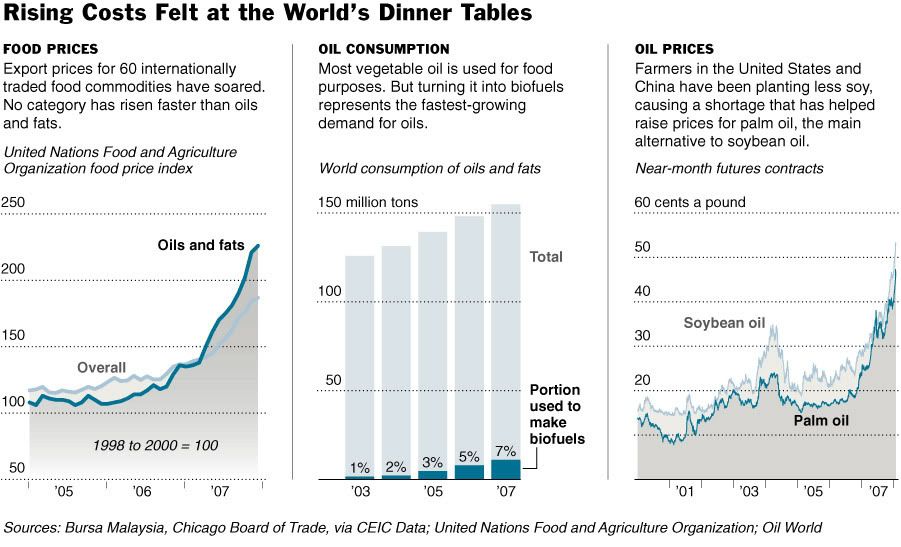
The food price index of the Food and Agriculture Organization of the United Nations, based on export prices for 60 internationally traded foodstuffs, climbed 37 percent last year. That was on top of a 14 percent increase in 2006, and the trend has accelerated this winter.
In some poor countries, desperation is taking hold. Just in the last week, protests have erupted in Pakistan over wheat shortages, and in Indonesia over soybean shortages. Egypt has banned rice exports to keep food at home, and China has put price controls on cooking oil, grain, meat, milk and eggs.
According to the F.A.O., food riots have erupted in recent months in Guinea, Mauritania, Mexico, Morocco, Senegal, Uzbekistan and Yemen.
“The urban poor, the rural landless and small and marginal farmers stand to lose,” said He Changchui, the agency’s chief representative for Asia and the Pacific.
A startling change is unfolding in the world’s food markets. Soaring fuel prices have altered the equation for growing food and transporting it across the globe. Huge demand for biofuels has created tension between using land to produce fuel and using it for food.
A growing middle class in the developing world is demanding more protein, from pork and hamburgers to chicken and ice cream. And all this is happening even as global climate change may be starting to make it harder to grow food in some of the places best equipped to do so, like Australia.
In the last few years, world demand for crops and meat has been rising sharply. It remains an open question how and when the supply will catch up. For the foreseeable future, that probably means higher prices at the grocery store and fatter paychecks for farmers of major crops like corn, wheat and soybeans.
There may be worse inflation to come. Food experts say steep increases in commodity prices have not fully made their way to street stalls in the developing world or supermarkets in the West.
Governments in many poor countries have tried to respond by stepping up food subsidies, imposing or tightening price controls, restricting exports and cutting food import duties.
These temporary measures are already breaking down. Across Southeast Asia, for example, families have been hoarding palm oil. Smugglers have been bidding up prices as they move the oil from more subsidized markets, like Malaysia’s, to less subsidized markets, like Singapore’s.
No category of food prices has risen as quickly this winter as so-called edible oils — with sometimes tragic results. When a Carrefour store in Chongqing, China, announced a limited-time cooking oil promotion in November, a stampede of would-be buyers left 3 people dead and 31 injured.
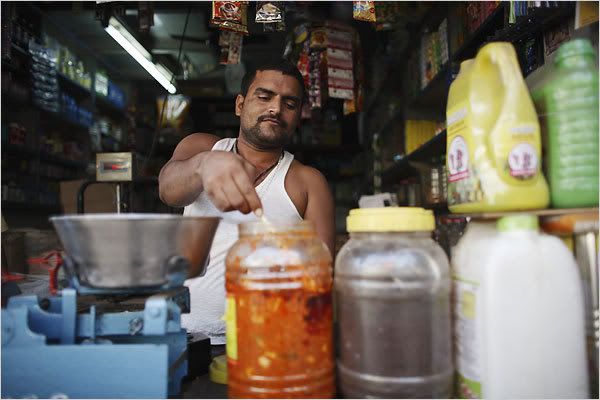
Cooking oil may seem a trifling expense in the West. But in the developing world, cooking oil is an important source of calories and represents one of the biggest cash outlays for poor families, which grow much of their own food but have to buy oil in which to cook it.
Few crops illustrate the emerging problems in the global food chain as well as palm oil, a vital commodity in much of the world and particularly Asia. From jungles and street markets in Southeast Asia to food companies in the United States and biodiesel factories in Europe, soaring prices for the oil are drawing environmentalists, energy companies, consumers, indigenous peoples and governments into acrimonious disputes.
The oil palm is a stout-trunked tree with a spray of frilly fronds at the top that make it look like an enormous sea anemone. The trees, with their distinctive, star-like patterns of leaves, cover an eighth of the entire land area of Malaysia and even greater acreage in nearby Indonesia.
An Efficient Producer
The palm is a highly efficient producer of vegetable oil, squeezed from the tree’s thick bunches of plum-size bright red fruit. An acre of oil palms yields as much oil as eight acres of soybeans, the main rival for oil palms; rapeseed, used to make canola oil, is a distant third. Among major crops, only sugar cane comes close to rivaling oil palms in calories of human food per acre.
Palm oil prices have jumped nearly 70 percent in the last year because supply has grown slowly while demand has soared.
Farmers and plantation companies are responding to the higher prices, clearing hundreds of thousands of acres of tropical forest to replant with rows of oil palms. But an oil palm takes eight years to reach full production. A drought last year in Indonesia and flooding in Peninsular Malaysia helped constrain supply. Worldwide palm oil output climbed just 2.7 percent last year, to 42.1 million tons.
At the same time, palm oil demand is growing steeply for a variety of reasons around the globe. They include shifting decisions among farmers about what to plant, rising consumer demand in China and India for edible oils, and Western subsidies for biofuel production.
American farmers have been planting more corn and less soy because demand for corn-based ethanol has pushed up corn prices. American soybean acreage plunged 19 percent last year, producing a drop in soybean oil output and inventories.
Chinese farmers also cut back soybean acreage last year, as urban sprawl covered prime farmland and the Chinese government provided more incentives for grain.
Yet people in China are also consuming more oils. China not only was the world’s biggest palm oil importer last year, holding steady at 5.2 million tons in the first 11 months of the year, but it also doubled its soybean oil imports to 2.9 million tons, forcing buyers elsewhere to switch to palm oil.
Concerns about nutrition used to hurt palm oil sales, but they are now starting to help. The oil was long regarded in the West as unhealthy, but it has become an attractive option to replace the chemically altered fats known as trans fats, which have lately come to be seen as the least healthy of all fats.
New York City banned trans fats in frying at food service establishments last summer and will ban them in bakery goods this summer. Across the country, manufacturers are trying to replace trans fats. American palm oil imports nearly doubled in the first 11 months of last year, rising by 200,000 tons.
“Four years ago, when this whole no-trans issue started, we processed no palm here," said Mark Weyland, a United States product manager for Loders Croklaan, a Dutch company that supplies palm oil. “Now it’s our biggest seller.”
Last year, conversion of palm oil into fuel was a fast-growing source of demand, but in recent weeks, rising prices have thrown that business into turmoil.
Here on Malaysia’s eastern shore, a series of 45-foot-high green and gray storage tanks connect to a labyrinth of yellow and silver pipes. The gleaming new refinery has the capacity to turn 116,000 tons a year of palm oil into 110,000 tons of a fuel called biodiesel, as well as valuable byproducts like glycerin. Mission Biofuels, an Australian company, finished the refinery last month and is working on an even larger factory next door at the base of a jungle hillside.
But prices have spiked so much that the company cannot cover all its costs and has idled the finished refinery while looking for a new strategy, such as asking a biodiesel buyer to pay a price linked to palm oil costs, and someday switching from palm oil to jatropha, a roadside weed.
“We took a view that palm oil prices were already high; we didn’t think they could go even higher, and then they did,” said Nathan Mahalingam, the company’s managing director.
Growth in Biofuels
Biofuels accounted for almost half the increase in worldwide demand for vegetable oils last year, and represented 7 percent of total consumption of the oils, according to Oil World, a forecasting service in Hamburg, Germany.
The growth of biodiesel, which can be mixed with regular diesel, has been controversial, not only because it competes with food uses of oil but also because of environmental concerns. European conservation groups have been warning that tropical forests are being leveled to make way for oil palm plantations, destroying habitat for orangutans and Sumatran rhinoceroses while also releasing greenhouse gases.
The European Union has moved to restrict imports of palm oil grown in unsustainable ways. The measure has incensed the Malaysian palm oil industry, which had plunged into biofuel production in part to satisfy European demand.
Another controversy involves the treatment of indigenous peoples whose lands have been seized by oil plantations. This has been a particular issue on Borneo.
Anne B. Lasimbang, executive director of the Pacos Trust in the Malaysian state of Sabah in northern Borneo, said that while some indigenous people had benefited from selling palm oil that they grow themselves, many had lost ancestral lands with little to show for it, including lands that used to provide habitats for endangered orangutans.
“Finally, some of the pressures internationally have trickled down. Some of the companies are more open to dialogue; they want to talk to communities,” said Ms. Lasimbang, a member of the Dusun indigenous group. “On our side, we are still suspicious.”
Demand Outstrips Supply
As the multiple conflicts and economic pressures associated with palm oil play out in the global economy, the bottom line seems to be that the world wants more of the oil than it can get.
Even in Malaysia, the center of the global palm oil industry for half a century, spot shortages have cropped up. Recently, as wholesale prices soared, cooking oil refiners complained of inadequate subsidies and cut back production of household oil, sold at low, regulated prices.
Street vendors in the capital, Kuala Lumpur, complain that they cannot find enough cooking oil to prepare roti canai, the flatbread that is the national snack. “It’s very difficult; it’s hard to find,” said one vendor who gave only his first name, Palani, after admitting that he was secretly buying cooking oil intended for households instead of paying the much higher price for commercial use.
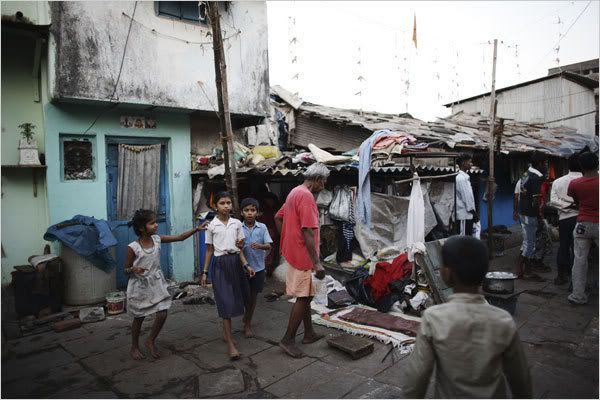
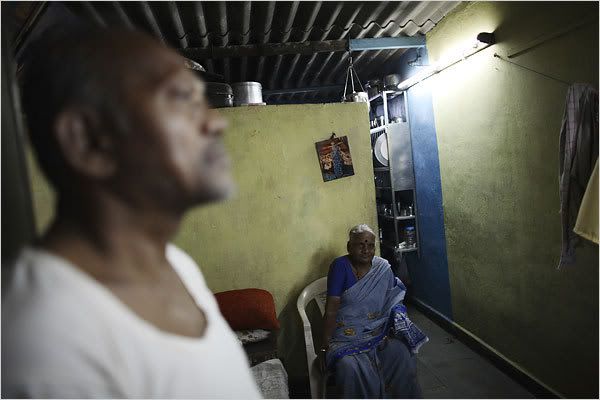
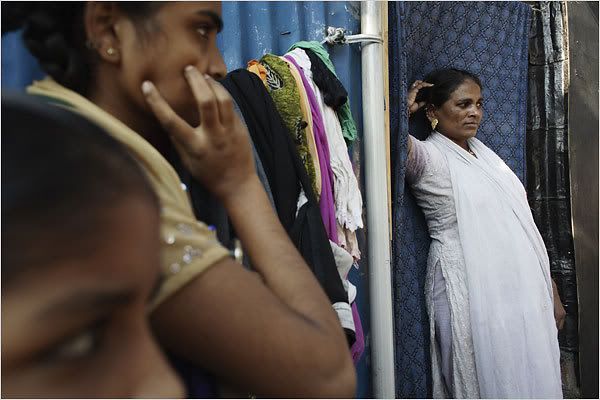
Many of the hardest-hit victims of rising food prices are in the vast slums that surround cities in poorer Asian nations. The Kawle family in Mumbai’s sprawling Dharavi slum, a household of nine with just one member working as a laborer for $60 a month, is coping with recent price increases for palm oil.
The family has responded by eating fish once a week instead of twice, seldom cooking vegetables and cutting its monthly rice consumption. Next to go will be the weekly smidgen of lamb.
“If the prices go up again,” said Janaron Kawle, the family patriarch, “we’ll cut the mutton to twice a month and use less oil.”"The Struggle for Palm Oil" (photos by Michael Rubenstein for The New York Times) In the developing world, cooking oil is an important source of calories and represents one of the biggest cash outlays for poor households. A steep rise in prices for palm oil has forced many families in Dharavi, a sprawling slum in Mumbai, India, to use less oil or even cut back on food:




Saturday, December 29, 2007
| [+/-] |
Pricey Hay Imperils Horses |
Neglected horses abound as drought shrivels supply, spikes price
The News & Observer reports:
Rescue agencies are taking in record numbers of horses across the state, many emaciated because of the drought-related hay shortage.
In the most recent case, a Randolph County woman was charged Thursday with 11 counts of animal abuse and eight counts of disposing of a dead animal improperly, after county officials investigated separate reports of a large number of dead horses scattered on the ground and of 11 live horses jammed into an undersize corral with no water and little hay.
The U.S. Equine Rescue League normally accepts about 100 neglected or abused horses a year in the three states where it operates, which include North Carolina. This year, the agency has taken in about 170 -- 90 in this state alone -- said Jennifer Malpass, director of the league's Triangle chapter.
Horse rescue groups nationally -- even those in states not stricken with a severe drought -- are being inundated with pleas to take neglected horses.
One group in Florida is fielding daily calls, up from bimonthly requests early this year. A rescue group in south central Kentucky had to turn away 13 horses this month. Kathy Grant, an equine cruelty investigator who runs a rescue group, says the rural roads in her eastern Tennessee community are lined with pastures dotted with emaciated horses.
"A lot of the farmers around here have hay, but they're holding on to it," said Grant. "When they're releasing it, they're charging exorbitant rates. A normal person can't afford it."
A round bale jumped from $12 to $100 since the summer, Grant said. In South Carolina, rescue volunteers noticed the price triple. In Texas, struck by a severe drought last year, hay prices haven't leveled off; horse owners are paying double what they did three years ago.
High prices are leaving owners with tough choices. Some are voluntarily forfeiting their animals. In other cases, horses are seized after county officials determine they have been abused or neglected.
County officials typically don't have holding facilities for large animals and so depend on agencies such as the rescue league to assume responsibility for horses. The league nurses them back to health, then places them in foster homes until someone adopts them, Malpass said.
The flood of rescues this year is a double blow to the volunteers.
Even before the drought, they were struggling to find space for foster horses. Now, they not only have to find shelter for more horses but also feed them when hay is expensive and scarce, Malpass said.
Hay donations drop
Her chapter normally receives about 300 bales of donated hay before winter, mostly from big horse operations clearing spring hay from their storage barns to make room for the fall cutting. But there was so little to spare that hay donations this year were only about a third the normal amount.
That means the volunteer rescuers are having to pull money out of their own pockets -- and a lot of it -- for hay, which has doubled in price in many areas.
The hay crisis also has increased the severity of the cases they are seeing, said Amy Woodard, a volunteer who leads the league's efforts in the northeastern corner of the state.
As the expense of feeding them has risen, the selling prices of horses have dropped. That has made purchase possible for people who might not be able to afford proper food and health care, or who didn't have the knowledge to keep horses healthy, Malpass said.
'Pieces everywhere'
The horse owner in the Randolph County case, Jauvanna Craven, 51, of Groom Road, Sophia, surrendered her horses. That saved time in court and allowed the county to get the surviving horses more quickly into the hands of rescuers.
Randolph County Health Director MiMi Cooper was so shocked at the animals' condition that she went to Craven to issue the charges herself. Craven could have faced more counts of improper disposal, said Cooper, who owns four horses herself.
"There were probably more than eight, but there were pieces [of dead horses] everywhere," she said. "Do you know what I had to do? I had to count heads."
Craven could not be reached for comment.
She had kept the horses on a 22-acre tract but sold it recently, Cooper said. The new owners discovered a number of horse carcasses and called the health department Dec. 21 to report them.
On the same day, the department got what it thought was an unrelated call about the 11 living horses, which were in a different location. They were confined in a pen that was big enough for only one or two horses, Cooper said. The horses were clearly starving, with every rib showing and their hip and shoulder bones jutting. One had an injury and had to be euthanized.
"She said that she was running a rescue operation," Cooper said. "That's not how you rescue horses."
The Equine Rescue League's Triad chapter took four of the horses, and another agency took three. The other three were apparently owned by someone else, who hadn't known about their health problems, and he took them away.
Shortage hits everyone
The hay shortage is so bad, though, that even conscientious owners are getting into trouble, Malpass said.
Marilyn Kille, who is taking care of three foster horses just outside Chapel Hill, said that people who own only one or two horses don't often have the massive dry storage space required for a whole winter supply of hay.
Normally, hay is abundant enough that suppliers keep plenty on hand, and horse owners can drop by every couple of weeks to buy more. Now, horse owners are competing for the scant supply against beef and dairy operations. Often, the only way to get it is to buy full truckloads from as far away as Ohio or New York.
Randolph County has fielded at least half a dozen calls this year from owners who didn't know where to turn, Cooper said, and area veterinarians have been getting similar calls.
Depending on the situation, Cooper said, the county steers them to hay sources like the on-line list kept by the state agriculture department, or links them with a rescue agency. Instead of suggesting that owners give up horses, the rescue agency prefers to teach them how to keep horses healthy, Malpass said.
Usually that approach works, she said. When it doesn't, the county or the rescuers ask the owner to give up the horse, or the county takes the owner to court to force the issue.
Normally rescues taper off in summer, when horses can graze. That's when the rescuers get a breather and start to build up their stores of hay.
This past summer, though, there was no break in rescues and the hay donations didn't come. So now, Malpass' group finds itself starting winter -- when livestock rely more on hay and less on grazing -- with an unusual number of horses to feed, not nearly enough hay and predictions that hay crops next year might be poor, too.
"It's really worrying because it can only get worse from here," she said.
Tuesday, December 4, 2007
| [+/-] |
World is Facing Food Shortages |
The AAP reports:
The world is eating more than it produces and food prices may climb for years because of the expansion of farming for fuel and climate change, new reports say.
Biofuel expansions alone could push maize prices up over two-thirds by 2020 and increase oilseed costs by nearly half, with subsidies for the industry effectively constituting a tax on the poor, the International Food Policy Research Institute said.
Global cereal stocks, a key buffer used to fight famines around the world, have sunk to their lowest level since the 1980s because of reduced plantings and poor weather, said the institute's director general, Joachim von Braun.
"The world eats more than it produces currently, and over the last five or six years that is reflected in the decline in stocks and storage levels. That cannot go on, and exhaustion of stocks will be reached soon," he told a conference in Beijing.
Countries such as Mexico have already experienced food riots over soaring prices, von Braun added in a report released at the same meeting, held by the Consultative Group on International Agricultural Research.
"The days of falling food prices may be over," said von Braun, lead author of the World Food Situation report.
"Surging demand for food, feed and fuel have recently led to drastic price increases ... climate change will also have a negative impact on food production," he added.
Growing financial investor interest in commodity markets as prices climb is fuelling price volatility, and world cereal and energy prices are increasingly closely linked.
With oil prices hovering around $US90 a barrel, this is bad news for the poor, who have already suffered "quite dramatic" impacts from a tripling in wheat prices and near-doubling in rice prices since 2000, the report said.
More investment in agricultural technology, a stronger social welfare net with particular support for children, an end to trade barriers and improved infrastructure and finance opportunities in less developed countries, could all help improve food security.
Although increased trade, a key demand of many developing world nations in global talks, would bring economic gains, in many cases it would not significantly reduce poverty, the report added.
Global warming could cut worldwide income from agriculture by 16 per cent by 2020, despite the potential for increased yields in some colder areas and the fertilising impact on plants of having higher carbon dioxide concentrations in the atmosphere.
"With the increased risk of droughts and floods due to rising temperatures, crop-yield losses are imminent," the report said.
It warned that Africa would be hit particularly hard by changes in weather patterns, in which scientists say man-made gases pumped into the atmosphere are an important factor.
"When taking into account the effects of climate change, the number of undernourished people in Sub-Saharan Africa may triple between 1990 and 2080," the report said.
Biofuels also threaten nutrition for the poor. Under current investment plans, and assuming expansion in nations with high potential but without detailed plans, maize prices would rise a quarter by the end of the next decade.
Under a more dramatic expansion, prices could climb up to 72 per cent for maize and 44 per cent for oilseeds, the report said.
Even when next-generation biofuels that use feedstocks such as wood and straw become commercially viable, competition for resources from water to investment capital may continue.
Global food demand is shifting towards higher-value vegetables, diary, fruits and meat as a result of rapid economic growth in developing countries including China and India.
But it can be difficult for smaller farmers to take advantage of the trend because of large retailers' growing grip on the market and their high safety, quality and other requirements.
Thursday, October 11, 2007
| [+/-] |
ConAgra Recalls Pot Pies |
Business Week reports:
ConAgra Foods Inc. recalled all its Banquet pot pies and store brand varieties Thursday after the products were linked to a nationwide salmonella outbreak.
The company included beef pot pies in the recall after initially saying only the chicken and turkey pot pies should not be eaten.
ConAgra issued a consumer alert Tuesday and asked stores nationwide to stop selling the poultry pot pies, but the company stopped short of a recall until Thursday evening.
ConAgra spokeswoman Stephanie Childs said the decision to recall the pies wasn't based on new information, but an abundance of caution.
"We want to make sure there's no confusion with consumers, that these pot pies shouldn't be eaten," Childs said.
She said she knew of no indication of a link between cases of salmonella and the beef pot pies, but the company wanted to be careful as it collects information.
The pot pies made by ConAgra have been linked to at least 165 cases of salmonella in 31 states. The federal Centers for Disease Control and Prevention said at least 30 people have been hospitalized as part of the ongoing outbreak, but so far no deaths have been linked to the pot pies.
The company and federal officials warned customers not to eat the pot pies and to throw them away, and ConAgra is offering refunds. The store brand versions are sold under the names of Albertson's, Hill Country Fare, Food Lion, Great Value (sold at Wal-Mart stores), Kirkwood, Kroger, Meijer and Western Family.
Childs said she could not say how many pot pies are affected by the recall or how many ConAgra produces.
ConAgra officials have said some of the illnesses may be linked to undercooked pot pies, but Childs said the pot pies should not be eaten even if consumers think they have cooked them correctly. The company is revising the cooking directions on its pot pie packages to clarify how long the pies should be cooked in different microwaves.
Amanda Eamich, a spokeswoman for the USDA's Food Safety and Inspection Service, said three investigators are at the ConAgra plant looking for problems with a specific product or production date. ConAgra's recall is voluntary, and Eamich said without a specific connection, a recall wouldn't be ordered.
ConAgra shut down the pot pie production line at its Marshall, Mo., plant, but the rest of the plant, which employs about 650 people, has continued operating, Childs said Wednesday.
Salmonella sickens about 40,000 people a year in the U.S. and kills about 600. Most of the deaths are among people with weaker immune systems such as the elderly or very young.
Salmonella poisoning can cause diarrhea, fever, dehydration, abdominal pain and vomiting. Most cases are caused by undercooked eggs and chicken.
A Minnesota couple sued ConAgra Foods Inc. Thursday for selling the pot pies they believe made their young daughter ill with salmonella. The federal suit, filed in U.S. District Court in St. Paul, seeks damages of more than $75,000 and reimbursement for medical costs.
Consumers who want a refund for their pot pie should send the side panel of the package that contains the UPC code to the following address: ConAgra Foods, Dept. BQPP, P.O. Box 3768, Omaha, NE 68103-0768. Consumers with questions can call the company toll free at 866-484-8671.
| [+/-] |
ConAgra Asks Stores to Quit Selling Pies |
The AP reports:
ConAgra Foods Inc. has asked stores to stop selling pot pies linked to a salmonella outbreak and is offering refunds for the turkey and chicken-filled meals.
The company and the U.S. Department of Agriculture on Wednesday defended their decision not to immediately recall the product.
ConAgra asked stores nationwide to pull the Banquet and generic brand chicken and turkey pot pies after two East Coast grocery chains made their own choice to remove the product from their shelves.
The pot pies made by ConAgra have been linked to at least 152 cases of salmonella in 31 states. The federal Centers for Disease Control and Prevention said at least 20 people have been hospitalized as part of the ongoing outbreak, but so far no deaths have been linked to the pot pies.
The company and federal officials warned customers not to eat the pot pies and to throw them away, and ConAgra is offering refunds.
ConAgra spokeswoman Stephanie Childs said the Omaha-based company decided with USDA officials that the consumer alert they issued Tuesday would be more appropriate than a recall.
"From the consumer perspective, there's not much difference," Childs said.
Even though the pot pies have not been recalled, Childs said ConAgra asked stores to pull all the pies with the identifying "P-9" code on them from store shelves and not sell them.
"We've taken this step knowing that we may need to take additional measures as we learn more from the ongoing investigation that is being led by the USDA," Childs said.
ConAgra officials have said they believe the pot pies are safe when they are thoroughly cooked according to the package directions. The company is revising the cooking directions on its pot pie packages to clarify how long the pies should be cooked in different microwaves.
The Giant Food and Stop & Shop supermarket chains said Wednesday that they were pulling the questionable pot pies from their stores' shelves as a precaution. Giant Food has 186 stores in Virginia, Maryland, Delaware and Washington, D.C., while Stop & Shop has 389 stores in seven northeastern states.
Amanda Eamich, a spokeswoman for the USDA's Food Safety and Inspection Service, said three investigators are at the ConAgra plant looking for problems with a specific product or production date, and without that connection, a recall wouldn't be ordered.
"As we continue our investigation, we felt it would be the best thing to do is get the word out," Eamich said.
ConAgra shut down the pot pie production line at its Marshall, Mo., plant, but the rest of the plant, which employs about 650 people, has continued operating, Childs said Wednesday. All of the pot pies made at the plant in question have "P-9" printed on the side of the box as part of a code above the use-by date.
The way the USDA has handled the pot pie concern highlights inconsistencies in the nation's food safety system.
Earlier this year, when the CDC linked ConAgra peanut butter to a salmonella outbreak that eventually sickened at least 625 people in 47 states, the company recalled all of its peanut butter. But peanut butter is regulated by the Food and Drug Administration, while pot pies are regulated by the USDA.
Salmonella sickens about 40,000 people a year in the U.S. and kills about 600. Most of the deaths are among people with weaker immune systems such as the elderly or very young.
Salmonella poisoning can cause diarrhea, fever, dehydration, abdominal pain and vomiting. Most cases are caused by undercooked eggs and chicken.
A Minnesota couple sued ConAgra Foods Inc. Thursday for selling the pot pies they believe made their young daughter ill with salmonella. The federal suit, filed in U.S. District Court in St. Paul, seeks damages of more than $75,000 and reimbursement for medical costs.
Consumers who want a refund for their pot pie should send the side panel of the package that contains the "P-9" location code to the following address: ConAgra Foods, Dept. BQPP, P.O. Box 3768, Omaha, NE 68103-0768. Consumers with questions can call the company toll free at 866-484-8671.
| [+/-] |
ConAgra Refuses to Recall Pot Pies |
Despite pleas from Oregon and Minnesota, the company issues consumer alerts for poultry, but not beef, varieties
The Oregonian reports:
ConAgra Foods Inc. is refusing to recall Banquet-brand and other potpies tied to a national salmonella outbreak, rejecting direct pleas by Oregon and Minnesota health officials.
The state officials say the company needs to recall all of its potpies because the source of the salmonella has not been identified. Doing anything less, they say, allows potentially dangerous food to remain on the market and confuses consumers.
The company says a recall is unnecessary. It contends that contamination is limited to its poultry potpies. Risks can be eliminated, the company says, by instructing consumers to cook the pies thoroughly enough to kill salmonella bacteria.
The dispute highlights a long-standing limitation in America's system for safeguarding the food supply: State officials who most frequently unearth the cause of foodborne illness have no regulatory authority over food makers. Federal officials can ask companies to recall food, but that process can take days or weeks.
For example, the U.S. Department of Agriculture has come under fire for waiting 18 days last month to request a recall after E. coli was discovered in Topps Meat Co. ground beef.
This has been a year of a number of high-profile domestic food recalls, as well as food and consumer-product warnings on imports from China. In the spring, ConAgra issued a massive recall of its Peter Pan and Great Value peanut butter brands after a multistate salmonella outbreak.
Public-health officers in both Oregon and Minnesota said they urged a potpie recall in phone conversations with ConAgra executives Monday and Tuesday. Instead, the Nebraska-based company, with annual sales of more than $12 billion, halted production and issued a consumer alert for its frozen potpies containing chicken and turkey.
States, on the other hand, are telling consumers to throw out every potpie under the Banquet brand as well as store brands including Great Value (sold at Wal-Mart) and Kroger. All are made at ConAgra's Marshall, Mo., plant.
Pies tied to illness
In a conference call Wednesday among state and federal health officials, several state representatives said potpies could still be found in stores, said Dr. William E. Keene, a senior communicable disease epidemiologist at the Oregon Public Health Division.
"A lot of people were saying that this alert was not adequate because consumers were not getting the kind of unambiguous message they'd get if there was a recall," Keene said.
The potpies have been tied to at least 139 illnesses in 30 states, including two confirmed Oregon cases. Keene said a third Oregon case is suspected but not confirmed and for every confirmed case, two dozen or more go unreported.
Salmonella infections can cause severe diarrhea and fever.
In Oregon and across the country, health investigators had searched in vain since May for the outbreak's cause.
But last Thursday, a Minnesota state epidemiologist, Steph Meyer, tied three salmonella cases to the potpies. Two previous victims were re-interviewed and recalled eating the pies, which are enormously popular because they are cheap (50 cents or so), can stay in the freezer for ages and be microwaved in a few minutes.
The same day, Minnesota health officials notified other states and the federal government of their findings.
On Monday, after federal officials said it might take a day or more to go through channels and ask ConAgra for a recall -- nearly all food recalls are voluntary -- Meyer's boss and Keene of Oregon decided to take their concerns directly to the source.
In conference calls Monday and Tuesday, Keene and Dr. Kirk Smith, supervisor of the foodborne diseases unit of the Minnesota Department of Health, made their case for a recall.
"In effect, they turned us down," Keene said.
Smith said the company did not want to include its beef products in the consumer alert it elected to send, instead arguing that poultry -- notorious for salmonella problems -- was to blame. ConAgra said the solution would be to ensure that consumers cooked the pies longer.
"A fear out there"
Smith and Keene contended, though, that all pies are at risk because the source of contamination remains unclear.
"We don't know if it's in the uncooked dough or where it is," Smith said. "What we tried to impress on them was that we thought they'd want to be as inclusive as possible."
In other words, a total recall, which Smith and Keene say remains warranted.
"I don't think it was a good decision on their part," Keene said. "But it's their decision."
In the meantime, a ConAgra spokeswoman said the company is cooperating with the U.S. Department of Agriculture to determine the cause.
Spokeswoman Stephanie Childs said ConAgra's decision to alert consumers and not recall all potpies was consistent with the company's plans to change labeling on how to cook the pies.
"All of the information provided to us indicates that this is related to a certain type of potpie," she said. "We're moving forward with plans to enhance our cooking directions."
The company has not decided exactly how to change those directions, she said. Instructions vary depending upon microwave power, for example. In any case, the pie's interior temperature must reach 165 degrees to be fully cooked.
Childs said she was unsure what information ConAgra had pointing to poultry as the contamination source.
At Portland-area grocery stores, consumers started returning potpies early Wednesday morning. James Grant, manager of Gresham's Food 4 Less, said employees first removed turkey and chicken pies from freezers after a supplier notice was sent out.
Later, Grant said, he had the meat pies removed as consumers asked about whether they were safe.
"There's a fear out there because of what has happened in spinach and other foods," Grant said, referring to an E. coli outbreak last year. "We took all the potpies out basically just to not have to field the questions."
Saturday, October 6, 2007
| [+/-] |
The Price of a Four-Star Rating |
Katy McLaughlin explains how chefs and restaurant owners are paying more attention to food bloggers these days, and in some cases showing respect -- or fear. Plus, see a list of Web sites that can be useful guides to good food and restaurants -- especially if you know where each site stands on graft.
The WSJ reports:
Dine, a contemporary American restaurant in Chicago, has been open for less than two years. But on one popular Web site, it is already rated half a star shy of Charlie Trotter's.
How did Dine garner such favorable reviews? One thing that probably didn't hurt: It fed many of the reviewers free. Last August, Dine spent about $1,500 on an event for members of Yelp, a Web site where consumers post reviews and rate restaurants. The nearly 100 members were treated to an open bar, duck roulade appetizers and red velvet cupcakes for dessert. As a bonus, they all received certificates for discounts on subsequent meals. The result: a torrent of favorable reviews on Yelp. Most reviewers mentioned that they attended a Yelp event, though few highlighted that the food and drink was free.
"I think if I was picking up the tab I wouldn't enjoy it as much," says Leigh Kelsey, a 28-year-old Chicago file clerk at a law firm who attended the event and posted positive comments on Yelp. A spokeswoman for Dine says attendees were not required to write reviews of any nature, positive or negative.
As online food sites become increasingly influential in the restaurant business, chefs and owners are plying bloggers with free meals to get good write-ups. Some are also posting favorable reviews about themselves on popular Web sites or becoming Internet scribes.
Among those using the tactics are some of the biggest names in the business. Terrance Brennan, co-owner and chef of New York's Artisanal Bistro and Picholine, hosted a cheese class for bloggers last year, waiving the usual $75-a-person fee. Bill Telepan, chef and co-owner of Telepan in New York, donated a $200, four-course meal to one influential blogger's online contest. And in Washington, the Park Hyatt's Blue Duck Tavern says it invited a customer back for a free Father's Day meal after she posted a negative comment on the Washington Post's Web site. (In a follow-up post, the diner wrote, "We will definitely return to Blue Duck Tavern," not mentioning that she had been invited free.)
Traditionally, top critics for magazines and newspapers have tried to dine anonymously and paid their own way. The goal: to ensure that the review reflects the way average customers can expect to be treated. Some prominent reviewers have even donned wigs to conceal their identities.
In recent years, online reviews written by the masses have emerged as an alternative. They promised honest, unbiased recommendations free from the potential snobbery and insider-ism of professional food writers. But now, restaurateurs are trying to woo the people who write about food online, creating a new crop of insiders.
Yelp CEO Jeremy Stoppelman says that "Elite Squad" events, such as the one hosted by Dine, don't guarantee positive reviews, and that attendees are asked to disclose any freebies. Still, Mr. Stoppelman is concerned that some reviews could appear influenced by the events. Yelp is now testing a system in which reviews of events are posted separately from regular reviews, so that readers will clearly understand when the consumer didn't pay. In addition to restaurants, Yelp visitors can review many other services, from dentists to beauty salons.
There are now some 21,000 food blogs, according to Technorati, a company that tracks and analyzes blogs; in August, 40.5 million people visited the top 25 food-related Web sites, according to comScore, an Internet analyst. These include sites like Chow, which has a message board, Chowhound, that allows people to share tips with each other. On eGullet, foodies share pictures of their latest meals and debate issues like how to behave in a three-star French restaurant.
There are food sites for every gastronomic obsession, from Curdnerds, founded by a Brooklyn cheese enthusiast, to Chocolateandzucchini, the food diary of a young French woman. There are blogs hosted by self-appointed critics, like Restaurantgirl or Amateur Gourmet in New York, and gossipy blogs like Tablehopper, based in San Francisco. Many bloggers don't hide who they are, actively seek out relationships with chefs and accept free meals.
"I accept the comps because I don't have a budget," says Marcia Gagliardi, who writes Tablehopper. She says she eats free about two-thirds of the time, and that complimentary meals do not sway her opinion, writing on the site: "Just because a restaurant is hosting me...it doesn't mean I will write a glowing review."
Traditional critics often say they won't write a review until a restaurant has been open at least a month or so, and then only after dining multiple times. But blogs and message-board postings can turn one bad meal into a public fiasco.
Last fall, Amateur Gourmet blogger Adam Roberts slammed the New York restaurant Le Cirque in a blog entry entitled "Only a Jerk Would Eat at Le Cirque." Mr. Adams, who was dining with his parents, recounted how he felt snubbed when the restaurant gave them a remote table at the back and the owner refused to hobnob with his mother. Readers responded with their own tales of unpleasant meals at Le Cirque and sympathy for Mr. Adams.
To manage the debacle, the restaurant tracked down Mr. Roberts' parents in Boca Raton, Fla., and mailed them an invitation to return for a meal on the house. Le Cirque co-owner Marco Maccioni says he wanted to make up for the bad experience.
Mr. Adams then penned another column about Le Cirque, and posted it on a blog called Serious Eats. In it, he described how the family was pampered during their subsequent meal. He also disclosed that the meal was free.
About three years ago, Mr. Adams, 28, was an unhappy law school student with a hankering to write and an interest in food. He started writing blog posts from the perspective of a wide-eyed innocent in the world of gourmet cooking and dining, and says he was stunned when the blog became popular. He now lives off of advertising income from it, as well as free-lance writing jobs and a recently published book titled "The Amateur Gourmet."
Bill Telepan says donating a free meal last October to the blog Restaurantgirl was his way of saying thank you. The blog was launched last year by food enthusiast Danyelle Freeman. Ms. Freeman, says Mr. Telepan, had "been very nice to me. She did an interview with me, she's mentioned me in good terms." Mr. Telepan says he regularly contributes his time and energy to food magazines, and considered his donation to Restaurantgirl part of these promotional activities.
Ms. Freeman is one of a growing number of bloggers who have crossed the line into print media. In August, the New York Daily News hired her as its new restaurant critic. She says she stopped taking free meals before getting the new job to give her reviews more credibility.
Chefs say there's another upside to getting chummy with bloggers: advice on improving the food. In San Francisco, Chef Robbie Lewis of Bacar restaurant says he considers Ms. Gagliardi, of Tablehopper, "a friend" at this point. After hosting her at a "friends and family dinner" -- a meal to try out new dishes on close associates about a month after starting as the executive chef at the restaurant -- Mr. Lewis took her advice. He changed the way he plated a roasted baby leek dish, so it was easier for diners to get a taste of poached egg and sauce with each bite.
"I can't get feedback from other critics before publication," says Mr. Lewis. Ms. Gagliardi didn't write a subsequent review, but frequently mentions events at Bacar on her site.
It's relatively easy for restaurants to ingratiate themselves to key food bloggers. Publicists across the industry say they now include bloggers and food Web site forum hosts on their media lists, and regularly invite them to opening parties, free meals and other events.
Sites that rely on consumers to post reviews and rate restaurants are vulnerable to another concern: positive comments written by restaurant employees who don't disclose their affiliation with the restaurant they're writing about. Zagat Survey, for instance, has been criticized for a system that could potentially allow staffers of a restaurant to submit positive reviews. Co-founders Tim and Nina Zagat say methods have been implemented to make sure this doesn't happen. They will not disclose what these methods are, but say they have dropped restaurants from guides when they discover that the owners have asked staff to submit reviews.
Ed Levine, CEO of Left Bank Brasserie Group, which owns six restaurants in the San Francisco Bay Area, says he was delighted when he read a Yelp post about Tanglewood, his year-old upscale American restaurant in San Jose. The reviewer wrote that he was "pleasantly surprised" that "portion size has changed dramatically," and service had improved. Previously, the restaurant had been blasted by Yelpers complaining about high prices and small portions. As a result, Mr. Levine lowered the cost of entrees and beefed up portions.
"I read it and said, 'Oh my God, the changes we made have really paid off! We nailed it!' " Mr. Levine recalls. However, he says he was later tipped off by a senior staff member that the review was posted by a waiter at the restaurant. Mr. Levine says he doesn't ask staff to post positive reviews on Web sites, though he does ask them to fill out Zagat surveys about the restaurant.
Scott Rodrick, president of Rodrick Management Group, which owns and operates 20 restaurants on the East and West Coast, says that a couple of months ago he noticed several Yelp postings about how friendly the bar staff is at one of his restaurants. That struck him as suspicious: Only a short while before, he'd reprimanded the bartending team for being aloof to customers. "I'm sure it's a case where they told their friends that 'my boss sat me down,' " Mr. Rodrick says.
Tom Walton, a San Francisco Bay Area restaurant publicist, says he encourages his clients to enlist their staff, friends and family to "stuff the ballot box to counter bad Web reviews." It is the only way, Mr. Walton says, to fight back against anonymous reviews that assail a business, whether justified or not.
One Web site set says it has set up a system for policing postings. Eater, a restaurant news and gossip site, posts reviews it suspects of coming from restaurateurs themselves in its "Adventures in Shilling" feature. Editors then assign passages a "shill probability" rating, up to 100%.
Eater says it does not allow writers to accept free meals when they are reviewing a restaurant. It does allow them to accept free food, including appetizers served at opening parties or meals eaten with a publicist, if they are not specifically writing a review of the restaurant. The site requires writers to disclose when they get something free. EGullet says it asks its forum hosts to disclose when they got anything free from a restaurant.
Chowhound says it does not allow posts from anyone connected to a restaurant or from consumers who have received complimentary meals. Staff writers for Chow can accept a free meal from a restaurant, though not when they're writing a review of the restaurant, says Jane Goldman, the site's editor in chief. Ms. Goldman says it isn't financially feasible for the site to do otherwise. She says if she had the resources, she wouldn't allow contributors to accept free goods or services, "because it subtly influences the recipient."
Recently, a handful of restaurateurs have become outspoken critics of what they view as unfair posts. David Haskell, managing director of West Hollywood's BIN 8945, which specializes in wine pairings, says that about six months ago he attempted to respond to what he viewed as incorrect comments posted about his restaurant on Chowhound. One diner said the restaurant was "way too overpriced" while another called it "snooty for what it is."
But his posting was deleted by the site. Mr. Haskell then posted a letter on Eater's Los Angeles site announcing that he has officially "banned Chowhound." The ban is unenforceable, Mr. Haskell says, but expresses his disapproval of Chowhound's policy.
For Mario Batali, the tipping point was an article on Eater about a dispute between him and one of his restaurant's landlords. In response, he wrote an article for the site titled, "Why I Hate Food Bloggers," in which he decried blogs as bastions of "untruths, lies and malicious and personally driven dreck."
Jeffrey Chodorow, the managing partner behind 28 upscale restaurants around the world, including Asia de Cuba and China Grill, says food bloggers are "aggravating," because, he says, they base much of their reportage on unconfirmed rumor. Some of his restaurants have been panned in postings on Eater.
To create a platform to respond to critics and review other restaurants, Mr. Chodorow recently did the logical thing: He started his own food blog.
Friday, October 5, 2007
| [+/-] |
"My Beef About Bad Beef & Weak Regulations" |
At NJVoices, Drew Harris writes:
If you think good regulations are too expensive, try bad regulations. The Topps Meat Company is recalling a year's worth of ground beef -- 21.7 million pounds -- produced in it's Elizabeth, New Jersey processing plant because they can't be sure it wasn't contaminated with the deadly bacteria, E. coli O157. Assuming ground beef is $2.50 a pound, this recall could cost Topps over $54 million in refunds to consumers. Several aspects of this story illustrate how a weak regulatory system not only threatens public health but is also bad for business.
A published report says it was over 18 days from the time the contamination was confirmed by the USDA laboratory before Topps went public and began the voluntary recall. Unfortunately, it wasn't the company or USDA that discovered the problem. People up and down the east coast had been getting sick for months, but until the E. coli was found in hamburger patties taken from a victim's refrigerator no one knew the source. Only later were samples from the plant checked.
We have a crazy-quilt food safety system. The Federal Food and Drug Administration (FDA) oversees most foods except meat, poultry and eggs, which fall under the purview of the US Department of Agriculture (USDA) unless meat, poultry or eggs are less than 2 to 3 percent of the product's content.
The US Centers for Disease Control and Prevention (CDC) is responsible for tracking diseases caused by food consumption. State agencies are responsible for regulating businesses that sell directly to consumers. Our food safety net is full of holes.
USDA is also the federal agency that helps promotes the consumption of US farm products, supports farmers, and ensures international regulations favorable to these products. It has been said that this is an inherent conflict of interest leading to lax oversight and an unwillingness to aggressively regulate an industry the agency is supposed to promote.
Topps had a USDA inspector on site every day like every meat processing plant. When an additional inspection was ordered in the wake of the mass recall, the new inspectors found violations so severe that they suspended the plant's ground beef processing. Why did the regular inspector miss these problems? Because the bad practices went back for months, there was no way to be sure the meat packaged on any given day was safe.
Amazingly, even when a problem is discovered, the USDA can only ask a meat processor to recall its product. Once the processor sends out the press release about the recall, they notify their primary customers who may be many steps removed from the actual consumer. You -- pardon the expression -- are at the end of the food chain and could be the last to know.
I have no doubt that Topps will be severely punished for this episode. The recall will cost them. Attorneys are already putting together the class-action law suits. They are subject to heightened scrutiny and are sure to lose market share. All of this was so unnecessary.
With stronger regulations, there would be tougher inspections, 100% testing of the end product for bacterial contamination, and better tracking of the product in the food distribution system. Thus, the harm could have been limited or even eliminated. Instead of recalling a year's worth of production, it might have been a day or two. Instead of dozens sickened, it could have been no one.
It's time to beef up weak regulations.
UPDATE: 10/5/07 2:11
Topps Meat Company announced today that it is closing its doors. The 67 year-old Elizabeth firm will lay off 77 workers in the wake of the massive recall of its frozen hamburger patties linked to an E. coli outbreak.
This is a cautionary tale for any business that doesn't pay strict attention to proper public health procedures. Shortchanging health and safety is bad for business, while appropriate and effective public health regulations are good for the bottom line.
Thursday, October 4, 2007
| [+/-] |
U.S.D.A. Took 18 Days to Recall Meat |
The Chicago Tribune reports:
The U.S. Department of Agriculture waited 18 days after learning that millions of pounds of ground beef made by Topps Meat Co. could be contaminated with E. coli bacteria before it concluded that a recall was necessary, an e-mail from an agency inspection official shows.
The Topps hamburger recall, which is now the third largest hamburger recall in USDA history, was first announced Sept. 25. The Elizabeth, N.J., company initially recalled 331,000 pounds of hamburger, but on Saturday expanded the recall to include 21.7 million pounds of frozen hamburger.
The timing of the Topps recall and its rapid expansion are bound to raise more questions about the nation's food safety system. So far, 28 people in eight states -- most in the Northeast -- have fallen ill from eating the hamburger, according to the federal Centers for Disease Control and Prevention in Atlanta.
Yet at the USDA, tests confirmed the presence of the E. coli bacteria strain O157:H7 in the Topps hamburgers on Sept. 7, according to an e-mail from Kis Robertson, an employee of the USDA's Food Safety Inspection Service.
Robertson, who declined comment, sent the e-mail to Scott Schlesinger, an attorney for Samantha Safranek, a Florida teenager who fell ill in August after eating a Topps hamburger.
Robertson's e-mail states: "The patties taken from the Safraneks were confirmed positive for E. coli O157:H7 by FSIS on 9/07/07. The leftover product samples are still at Eastern Laboratory in Athens, GA. The decision to release these has to come from Agency leadership and I don't know what has been decided."
Safranek and her parents, Anna and David, sued Wal-Mart Stores Inc., where they bought the 3-pound box of frozen Topps hamburger patties. In Newark, N.J., a lawyer representing four people who said they ate the Topps meat filed a class-action lawsuit on Wednesday seeking unspecified monetary compensation for anyone who bought or was sickened by the Topps hamburgers and sold by Wal-Mart, Pathmark Stores Inc., ShopRite and Rastelli Fine Foods.
The USDA also announced its recall only as New York state published its own Sept. 25 consumer alert regarding possible E. coli contamination in Topps hamburger. Claudia Hutton, a spokeswoman for the New York Department of Health, said that state investigators confirmed the E. coli in Topps beef on Sept. 24 during tests in its Wadsworth Center Laboratories.
New York state actually issued its Sept. 25 consumer alert before the Topps recall was announced by the company and the USDA, according to Jessica Chittenden, a New York Department of Agriculture and Markets spokewoman. Chittenden said once state tests confirm a single case of food contamination, her department is required to immediately notify the public. It has now found eight instances of contamination in New York.
"We do not have the authority to recall product," Chittenden said, "but we do have the authority to quarantine, seize and embargo a product."
Of those who have fallen ill, the CDC reports that "the first reported illness began on July 5, 2007, and the last began on September 11, 2007. Among fifteen ill persons for whom hospitalization status is known, ten (67%) patients were hospitalized."
The states affected by the E. coli outbreak, according to the CDC, are Connecticut, Florida, Indiana, Maine, New Jersey, New York, Ohio and Pennsylvania.
Despite CDC evidence of an E. coli outbreak as early as July, USDA officials said they could not definitively link the illnesses to any one food early on.
The Florida case, however, appeared to do that on Sept. 7.
Yet one top USDA official said that the agency needed more evidence before considering a recall.
'Many steps along they way'
"We gather information from various sources, including our public health partners in the states," said David Goldman, assistant administrator of the Office of Public Health at the USDA's inspection service. "Once we have enough information that we have a basis for taking action, then we convene a group of people here in the agency to consider taking that action -- in this case, take it to the company and request a recall.
"There are many steps along the way to get to that point."
Goldman said that one of those steps is an important test to confirm that the strain of E. coli found in a piece of meat is the same strain that caused a human illness. The test is known as pulsed field gel electrophoresis, and it wasn't initially performed in the Topps meat investigation, he said.
But a Sept. 14 Broward County, Fla., Health Department report states that such a test was performed. The report notes: "Based on the information regarding the indistinguishable PFGE pattern of the clinical and food isolates as well as the information reported in the case investigation, it appears that the Topps Frozen Ground Beef Patties is the most likely source of illness."
The report's text also notes that the Broward report was sent to the USDA.
Amanda Eamich, a USDA spokeswoman, said that the USDA's recall committee first met on Sept. 25 to consider the Topps case, 18 days after E. coli was confirmed in a Topps hamburger, according to Robertson's e-mail, which was provided to the Tribune.
The committee, comprised of department officials, concluded then that it should request a Class I recall of the Topps meat, she said.
Class I is the USDA's most serious. It means that there is "a reasonable probability that eating the food will cause health problems or death."
Company learned in August
Topps first learned from a consumer of an illness that was possibly caused by its meat on Aug. 30, according to Michele Williams, a company spokeswoman. She said the company provided the USDA with meat samples from the same production date and also meat obtained from the customer's freezer.
"We've been cooperating fully with the USDA to make sure we've been doing everything to ensure the safety of our customers," Williams said.
The USDA and Food and Drug Administration have been harshly criticized recently in Congress and by safety groups for their slow responses to food-borne illnesses and recalls.
Neither agency has the legal authority to force makers to recall food, but they can recommend a recall. The USDA has the authority to remove items from store shelves if a company refuses to conduct a recall that the agency deems necessary.
Several members of Congress have offered legislation that would give the USDA and FDA the legal authority to order recalls. One of them, Sen. Sherrod Brown (D-Ohio), introduced a bill on Monday to bolster the USDA's recall ability, saying that, "When something does go wrong, USDA needs to be able to act and act quickly. Neither consumers nor producers are helped by foot-dragging."
The USDA notes in its recall announcements that Topps acted voluntarily. The initial Sept. 25 recall was expanded, however, after USDA inspectors visited the Topps production facility in New Jersey and discovered safety violations.
USDA's Eamich said the agency won't disclose those violations, but it suspended Topps raw ground beef operations because of them.
The safety violations were discovered even though the USDA has previously maintained a meat safety inspector within the Topps plant.
The Florida case began to unfold Aug. 17, when Samantha Safranek made a hamburger for herself and two friends on the family's George Foreman grill, according to the report from the Broward County Department of Public Health.
"According to the patient's mother, the patty consumed by the patient was still pink in the middle upon consumption," the Broward report states. Thoroughly cooking meats kills E. coli bacteria.
While Samantha's friends did not fall ill, she did. Within three days, she was experiencing stomach cramps. When she suffered from bloody diarrhea and urine, she was hospitalized.
Doctors quickly confirmed that Samantha was suffering from E. coli, said Schlesigner, her attorney. She contracted a form of kidney failure known as hemolytic uremic syndrome. Samantha Safranek eventually went through six kidney dialysis sessions before recovering, Schlesinger said.
E. coli poisoning, according to the USDA, is especially hard on children and the elderly and can cause severe kidney damage.
The Sept. 14 Broward County report notes that samples of the meat were taken from the girl's home in Pembroke Pines, near Ft. Lauderdale, for testing by the USDA. They proved positive for E. coli, it states.
The USDA notices explaining the Topps recall, however, do not mention the Florida case. Instead, they state that the recall occurred because of three cases in New York.
Friday, July 20, 2007
| [+/-] |
Global Warming Threatens Chesapeake Bay |
The Washington Post reports:
Climate change has already begun to alter the Chesapeake Bay, warming and raising its waters in a way that could unbalance delicate ecosystems and doom low-lying islands, according to a report released yesterday by the Chesapeake Bay Foundation.
The report, citing scientific research from around the bay, sketched a prognosis that was troubling even by the standards of the Chesapeake -- a beautiful but polluted estuary that environmentalists have spent decades trying to save.
It found that some of the bay's oldest problems, such as low-oxygen "dead zones," could get worse as the bay's water slowly warms. And, the study found, new problems are cropping up, as key plants and animal species show signs that they are uncomfortably warm.
"We know that the bay is in trouble today, and we know that climate change will make the bay worse in the future," said William C. Baker, president of the foundation, an environmental group based in Annapolis.
The report said warming temperatures could be forestalled by cutbacks in emissions of carbon dioxide and other greenhouse gases. Some of the measures proposed to clean up the bay's water could actually help in this effort, it said. One example was the planting of forested buffers along streams. These filter pollution out of runoff, and also provide trees to absorb carbon dioxide from the air, the study said.
Yesterday's report summarized what bay scientists have been learning over the last decade: The Chesapeake seems to showing the first signs of impact from a warming climate. The changes might not seem drastic. Since 1930, the average water temperature off Solomons Island has risen by about 2 degrees. The bay's water rose about a foot in the last century.
But shifts like these can have sweeping consequences, scientists say, for both the wildlife in the bay and the people living around it.
Warming water, for instance, is a problem because the Chesapeake's ecosystem is a blend of southern, heat-tolerant species, and cold-tolerant ones whose real heartland lies farther north. When water heats up, cold-tolerant species can suffer.
One prime example, cited in yesterday's study, is an underwater plant called eelgrass that provides crucial habitat for animals such as blue crabs. It cannot live long in water much warmer than 80 degrees. During a long warm spell in the summer of 2005, huge tracts of eelgrass were wiped out.
"In the fall, basically what we saw was nothing," said Robert Orth, a professor at the Virginia Institute of Marine Science who surveyed areas where the grass had been. "The plants basically just totally died."
In the two summers since, Orth said yesterday in a telephone interview, some of the eelgrass has grown back. But he said he fears what could happen if temperatures warm in the future. A recent study by a commission of the United Nations predicted that global temperatures might increase by 0.7 degrees by 2027.
"If you have two back-to-back really hot years," Orth said, "you could lose all the eelgrass in the bay."
Yesterday's report also cited striped bass -- one of the bay's most beloved fish for food and sport -- as a creature under pressure from the heat. Foundation officials said the bass, also called rockfish, cannot tolerate water temperatures much above 76 degrees.
But when the water near the surface gets that hot, they sometimes cannot dive to cooler water because, as a result of the bay's existing pollution problems, there is often little oxygen at lower depths.
"It's like the old horror movies where the floor is rising, and the ceiling is lowering," Baker said. "They're getting squeezed."
Though many of yesterday's predictions were dire, scientists say it is exceedingly difficult to forecast exactly what the future will bring for a system as complex as the bay. Its health depends on a tangle of factors: development across the massive Chesapeake watershed, changes in temperature and rainfall, currents and winds that stir the water.
That makes it hard, for instance, to say precisely what will happen with the bay's dead zones. Foundation officials said yesterday that they believed hotter weather would make them worse.
Dave Jasinski, a water-quality analyst at the University of Maryland Center for Environmental Science, said climate change could cause changes across the bay and its watershed. "I don't know that anybody has any conclusive idea" what all the changes would add up to, he said.
Another problem laid out in the report is that as temperatures increase, global sea levels are expected to rise 7 to 23 inches by 2100. The rise is expected to be more severe in this area because land around the Chesapeake is slowly sinking, thanks to a complex geological process that began after the last Ice Age.
On low-lying Smith Island, in the Maryland section of the bay, waves are now just a quarter-mile away from the village of Rhodes Point, said Rick Edmund, the minister of Smith Island's three Methodist churches. He said residents are hoping Congress will approve a $9.4 million plan, proposed by Sen. Benjamin L. Cardin (D-Md.), to build artificial breakwaters offshore.
But Edmund said island residents know that their problems will probably get worse.
"Climate change," he said in a telephone interview yesterday, "will get us in the long run."
