The NY Times reports:
A little over three years after Pan Am Flight 103 blew up over Lockerbie, Scotland, Fred D. Thompson provided advice to a colleague about one of his law firm’s new clients: The man representing the two Libyan intelligence officials charged in the terrorist bombing.
The colleague, John Culver, a partner at the Washington firm of Arent Fox Kintner Plotkin & Kahn began advising the two suspects’ Libyan lawyer in February 1992. Mr. Thompson, according to a memorandum from that era written by his secretary, held “discussions with Culver re: Libya” that same month.
At the time, Libya was facing international outrage for refusing to comply with a United Nations demand that the two suspects be extradited to the West for trial in the 1988 bombing, which killed 270 people. Revelations that American firms were representing Libyan interests provoked a furor among the Pan Am victims’ families. Some law firms refused to represent the country or the suspects, while others withdrew.
The involvement of Mr. Thompson, who worked part-time for Arent Fox as a lawyer and lobbyist from 1991 until shortly before his election to the Senate in 1994, never became public. But Arent Fox’s chairman, Marc L. Fleischaker, confirmed that Mr. Thompson, who is now seeking the Republican presidential nomination, briefly provided Mr. Culver with advice about the suspects’ case, billing the firm for 3.3 hours of his time.
The firm was hired to provide guidance on the tense questions surrounding where the two men should be tried, Mr. Fleischaker said, and Mr. Thompson’s background as a former prosecutor, as well as his government relations experience — he had close ties to senior officials in the first Bush administration — “gave him insight on jurisdictional issues such as that.”
Karen Henretty, a spokeswoman for his presidential campaign, said that Mr. Thompson had no authority to decide which clients the firm represented. Mr. Thompson has faced questions about his work for two other Arent Fox clients. He initially denied working on behalf of a family planning group seeking to overturn an abortion counseling ban at federally financed clinics, but billing records showed that he spent nearly 20 hours on the matter. His work on behalf of Jean-Bertrand Aristide, the deposed Haitian leader — a phone call to John Sununu, then the White House Chief of Staff — has also become fodder for his rivals because of human-rights abuses during Mr. Aristide’s presidency.
The memorandum by Mr. Thompson’s secretary reviewing his work for Arent Fox, compiled in 1993 as he was running for the Senate, was buried among thousands of Mr. Thompson’s papers archived at the University of Tennessee, and casts new light on his time there, beyond his work on the Libya case.
It lists the clients he brought into the firm, which included construction firms and a Texas chemical company embroiled in a case involving the illegal dumping of hazardous waste.
Mr. Thompson also helped others at Arent Fox, the memorandum shows. He met, for instance, with the Chilean ambassador in 1991 and then traveled to Chile to try to garner business for the law firm from that country’s government. He consulted with one of the firm’s partners about a Mexican trade agreement and helped other lawyers with introductions to important Republican officials.
Mr. Thompson has said he makes no apologies for his legal and lobbying work, emphasizing in one online essay that every person, no matter how unpopular, is entitled to representation and that lawyers’ work on behalf of a client is no indication of their own personal views.
Asked about Mr. Thompson’s participation in the Libya case, James Kreindler, a lawyer who represents 130 of the victims’ families, said: “Pan Am 103 was really an attack on the United States, so while some families understood the concept that everyone deserves a defense, a number were offended and angered that American lawyers were willing to earn fees by doing anything to help this pariah nation or the two bombing suspects.”
Today, in the post-Sept. 11 political climate, all the presidential candidates are jockeying to prove their antiterrorism credentials, with Mr. Thompson vowing last week to fight “radical Islamic terrorism” vigorously. Yesterday, his campaign noted that during his eight years in the Senate, Mr. Thompson supported sanctions against Libya.
In 1992, Libya was among those countries the United States listed as state sponsors of terrorism for acts that included the 1989 bombing of a French airliner and the 1986 bombing of a Berlin disco that killed two American soldiers.
Arent Fox, in papers it was required to file with the federal government, reported that from February 1992 to August 1993, it provided advice on American and international law to Ibrahim Legwell, the Libyan lawyer appointed by the Libyan Bar Association to represent the two intelligence officials charged with the Flight 103 bombing. Arent Fox received $833,960 in fees and expenses for its work on the case.
Mr. Legwell, reached in Tripoli, said his main goal was to see that his clients were tried in Libya or in a neutral country. He said Arent Fox “contributed a lot” to the defense effort. Mr. Legwell said he had no record of ever speaking with Mr. Thompson but noted: “I remember that this name was mentioned.”
Mr. Culver, a former Democratic senator from Iowa, said that Mr. Thompson was not a primary member of his team, and that his contribution amounted to “a couple of conversations.”
“In a large firm, you frequently consult with people who have experience” in the field of law at hand, he said. In the end, after protracted negotiations with the United Nations, Libya agreed in 1999 to hand over the two men for trial by a special court in the Netherlands. One of the men was convicted and is serving his sentence in a Scottish jail.
In 2003, Libya accepted responsibility for the Pan Am bombing and agreed to pay the victims $2.7 billion in compensation. After Mr. Qaddafi’s renunciation of terrorism and his agreement to end programs to develop unconventional weapon, the United States last year removed Libya from its list of state sponsors of terrorism.
Sunday, September 9, 2007
| [+/-] |
Fred Thompson Provided Legal Counsel For Pan Am 103 Terrorists |
Wednesday, September 5, 2007
| [+/-] |
Transcript of 'Leno' - Fred Thompson's Announcement |
Fred Thompson announces his candidacy for the 2008 Republican Presidential ticket.
Transcript:
FRED THOMPSON: Thank you.
JAY LENO: Thanks for coming. I hope you didn't hear the monologue.
FRED THOMPSON: I did. We'll let the Tennessee joke slide until after the election.
JAY LENO: Right.
FRED THOMPSON: You know, I appreciated that last segment you did, though. Every once in a while I need something that just makes me glad I got out of television. (Laughter.)
JAY LENO: Oh, really. Thanks. That's very kind of you. I've got to ask you something. You were here in June. You said then you were testing the water. You've been in the water for a while now. Are you starting to get a little wrinkly? (Laughter.)
FRED THOMPSON: These wrinkles don't come from the water. (Laughter.)
JAY LENO: They don't come from the water. All right. What's the temperature? Is it tepid? What does the water tell you.
FRED THOMPSON: Nice and warm.
JAY LENO: Nice and warm?
FRED THOMPSON: It hasn't been that long really. We've done it a few months, where a lot of people have been working on it since they were in the choir in high school. So we're where we need to be right now, and that's one of the things I wanted to talk to you about. I'm running for President of the United States.
JAY LENO: All right. (Applause.)
FRED THOMPSON: Thank you.
JAY LENO: I'm excited. Wow.
FRED THOMPSON: Thank you.
JAY LENO: Well, that's very exciting. Now, it took a long time to decide this.
FRED THOMPSON: Not really. We started ‑‑ we mentioned it the first time in March. A lot of people have been, of course, running for some time. Everybody kind of changed the rules. Usually you don't announce until after Labor Day, but they started running a lot earlier, spending millions of dollars and so forth, and everyone said that you couldn't run this year without raising a hundred million dollars and starting much earlier. I don't believe that. I wasn't in the room when they made the rules; so I had to kind of follow my own lead. So we started around the kitchen table in late March talking about it, thinking about it, thinking about what kind of world and what kind of country our kids were going to grow up in and how many people have a chance to do something about it. And I decided that it was time for me to step up. So I did. (Applause.)
JAY LENO: A lot of the pundits say, "Oh, well, you waited too long."
FRED THOMPSON: No, I don't think so. Of course, we'll find out, but I don't think people are going to say, you know, "That guy would make a very good President, but he just didn't get in soon enough." (Laughter.) Communications being what they are nowadays, if you can't get your message out in a few months, you're probably not ever going to get it out. Most people don't start paying attention to these elections until they get a little closer. They treat politicians kind of like the dentist ‑‑ they don't have anything to do with them until they have to, until the election is near. (Laughter.)
JAY LENO: Well, you haven't spent any money yet, and you're second in the polls. There must be something to the theory.
FRED THOMPSON: Not too bad. Well, you can't tell much by polls these days, but obviously the people are going to give me an opportunity to talk to them about the things that I think are important. I think there will be decisions made in the next few years that are going to impact our lives and the lives of our kids and grandkids for a long, long time. They're going to determine whether or not we're a weaker, less prosperous, more‑divided nation than we have been. We can't let that happen on our watch.
JAY LENO: Now, if you ‑‑ Giuliani, Romney, McCain ‑‑ which of those guys is the toughest opponent? Which do you fear the most?
FRED THOMPSON: I don't know. I know them all to a certain extent. John McCain and I sit side by side on the Senate floor. He's a good friend and will be after this is over with unless, of course, he beats me.
JAY LENO: Right. (Laughter.)
FRED THOMPSON: Then I'll have to take another look at it, but I can't gauge them. I still think it's kind of early. You know, if you look back in history, some of these primary states, early primary states, have changed from what the polls were from like three weeks out.
JAY LENO: Right.
FRED THOMPSON: They're all formidable, but I think I will be, too. So the nation is not going to be hurt by having one more good person step into the race.
JAY LENO: Now you're on the cover of "Newsweek." It says "Lazy Like a Fox," which is ‑‑ I used to get this in school. "Jay has the ability but does not apply himself. (Laughter.) "If Jay spent as much time" ‑‑ Do you consider yourself a good ‑‑ do you like to campaign, or is it one of those necessary evils?
FRED THOMPSON: No, I like the part where you get out with the people.
JAY LENO: Right.
FRED THOMPSON: That's kind of been my history, you know, the red pick‑up truck and all, you know, more than just symbolism. First of all, it got me away from the staff. They couldn't ride along in the truck. It also got me out with the people.
JAY LENO: You took a truck and drove around?
FRED THOMPSON: Took my truck and with one guy. A lot of times he drove; sometimes I drove. We'd go from town to town and announce ahead of time we were showing up, pull up in the square. I'd get in the back of the truck in the bed and make a speech, and we'd move on. And we went from 20 points down against a popular incumbent congressman to 20 points ahead on election night. And then, two years later, we ran again in another contested race, won by another 20 points. I won in Tennessee ‑‑ if I can brag a little bit on myself politically ‑‑ by 20 points in two races in a state that Bill Clinton carried twice. So I must like campaigning enough to get the job done. And the same thing is true with regard to what we're facing now. Of course, the stakes are much more important, I think, much more serious when you're running for President, and I take it that way. I'm going to do my dead‑level best to make sure that the people get an opportunity to make the decision. You know, the pundits have all decided one way or another. The media and a lot of people make their living off of politics nowadays, and that's fine. But if I can get out with the folks, sometimes I'll communicate to them on the air waves, where tonight, I think, right after the show is over, we're going to have on our website ‑‑ Fred08.com ‑‑ I'm on for about 15 minutes telling the folks what I'm doing and why I'm doing it. So we're using that. And then we're going tonight, Jeri and the kids are backstage here. We're going to go to Iowa. So we'll do that plus grassroots campaigning which is what we're going to do in Iowa and New Hampshire and South Carolina for the next, oh, seven days.
JAY LENO: You mentioned New Hampshire now. Your fellow Republicans are debating tonight, and they're a little miffed at you for being here instead of being there. What do you say?
FRED THOMPSON: Well, we'll have an opportunity to debate a lot. I've been debating in courtrooms in the country since I was 28 years old and political forums and so forth. So they're fine, and we'll do our fair share.
JAY LENO: What do you think of them? As someone who watches these debates, I must admit it's a little thirty‑second ‑‑
FRED THOMPSON: I don't think much of them.
JAY LENO: How would you like to debate? FRED THOMPSON: I would do it in small groups preferably one‑on‑one and set aside a segment of time ‑‑ Newt Gingrich has a good idea. He talks about the Lincoln‑Douglas debates. The circumstances are different, but the principal is still the same: A thoughtful discussion over a period time to get to know what people are really thinking and what they're really like. The segments now, you know, you've got ten guys if everybody shows up, you know, with 30, 40 second sound bites. It's not designed to enlighten the American people. It's more designed for the people who are putting the debates on, and you run from one to another to another to another, and that's all well and good. I'll do my share, but I don't think it's a very enlightening forum to tell you truth. And I'll tell you something else. For those who talk about that New Hampshire situation, I'm certainly not disrespecting them, but it's a lot more difficult to get on the "Tonight Show" than it is to get into a presidential debate. (Applause.)
JAY LENO: Exactly. We'll be right back with Fred Thompson right after this. (Commercial break.)
JAY LENO: We're back with newly announced Presidential candidate Fred Thompson. And that is the most presidential suit I've ever seen.
FRED THOMPSON: Thank you very much.
JAY LENO: That's the one they issue when you're going to run?
FRED THOMPSON: The official Presidential suit.
JAY LENO: Let me ask you. I've got some bumper stickers. Let's see if you like any of these here. "Fred Thompson Because Giuliani is Too Hard to Spell." (Laughter.) I like this one, "Fred Thompson. He has a narrow stance." (Laughter.) Probably can't comment on that one.
FRED THOMPSON: Uh‑uh.
JAY LENO: We'll try one more. "Because I'm not Dr. Phil." (Laughter.)
FRED THOMPSON: I have been mistaken for Dr. Phil.
JAY LENO: Really.
FRED THOMPSON: Yes.
JAY LENO: If it works, use it.Let me ask you about some serious matters. The Iraq war, obviously the biggest issue in the campaign ‑‑ were you for it?
FRED THOMPSON: Yeah.
JAY LENO: You were for it.
FRED THOMPSON: I think we got to remember what it would be like if we had not done what we did. Saddam would still be there, having defeated the United Nations, all the resolutions. It would have defeated the United States in effect. It would have been in a position to continue its nuclear weapons program. His two sons would still have been doing what they were doing ‑‑ putting people in human shredders and attacking their neighbors. And I think, especially in light of what Iran is doing right now, they certainly would have been in a nuclear competition in that part of the world, sitting on those oil reserves. To think that, had we not gone in there, we wouldn't have any problems or anything, I think is dead wrong.
JAY LENO: Do we stay?
FRED THOMPSON: I think we stay until we get the job done, Jay. I don't think ‑‑
JAY LENO: What is the definition of "get the job done"? I think that's the part that is confusing people.
FRED THOMPSON: Until it is pacified enough for those people who walk through those lines with people shooting at them in some cases who voted, put their finger in the ink and so forth, the first time in that part of the world, in the history of the world, until they have an opportunity to have a free life and to not be killed by al‑Qaeda and others fighting in that part of the world. I think that's doable. I think it's tough, but I think we can't afford to go into a situation and not show resolve. I think the most dangerous thing in the world that could happen to the United States of America is for people to think we're weak and divided. Iraq is a part of a much bigger picture ‑‑ Iraq and Afghanistan. There's a global war going on. We are the main target and those who would befriend us. The enemy is ruthless. Al‑Qaeda is here in this country. National intelligence estimates tell us that. They are strong. They're trying to get their hands on nuclear weapons and other weapons of mass destruction. I don't know how much ‑‑ how more stark the situation could be. That's going to be the situation we're going to have to deal with for sometime regardless of what happens in Iraq, but if the wrong result happens in Iraq and we're perceived the wrong way by friends and enemies alike, it's going to make the situation more difficult, and we're going to be more vulnerable. It's a tough deal, but a it's a choice of two bad choices. It's not a good and a bad.
JAY LENO: Well, how about Iran? Do you see possible military action there as well? I mean, at what point does it stop?
FRED THOMPSON: You can't ever tell what the facts on the ground are going to be a year or two years from where we're sitting here. Obviously our intelligence know some things that you and I don't know. I was chairman of a committee that dealt with some of these issues for the Secretary of State until I resigned to do this. I had a high security clearance, but I don't know exactly where they are in their nuclear program. I don't think our intelligence knows precisely, but they're moving in that direction, and they're clearly responsible for more and more of our problems. They are sending in these improvised explosive devices. They're training Iraqi militants in Iran and sending them back in to Iraq. They're sponsoring Hezbollah and probably as we speak are planning another attack on Israel. They support Hamas. They support terrorism all around the world. They've got a fellow who is not put together well upstairs running the country and has threatened the destruction of Israel. I mean, sometimes, when these maniacs make threats, they mean it, and it comes to pass later on. So we've got to take that situation very seriously, but obviously a military attack is the last thing in the world that you want to have to do, and there's some things that we can do that probably will not necessitate that.
JAY LENO: I just wonder what we do to get a ‑‑ I grew up ‑‑ when I was a kid, John F. Kennedy was President. It was the Peace Corps, and we would send American college students to these countries, and they would love us. I think we made friendships that were good for 25, 30 years because Americans had befriended these countries. And it seems like we are not well‑liked around the world. Maybe I'm naive and maybe because I'm in show business, but it seems like I would want people to like us as a country because they think we're a ‑‑ I know we're a good country, but I wonder what we have to do to get these allies, these other countries to maybe ‑‑ what are we doing wrong?
FRED THOMPSON: Well, part of that comes with being the strongest, most powerful, most prosperous country in the history of the world. I think that goes with the territory. We're more unpopular than we need to be. That's for sure, but our people have shed more blood for the liberty and freedom of other peoples in this country than all the other countries put together. (Applause.) And I don't feel any need to apologize for the United States of America. We don't make ‑‑
JAY LENO: I wasn't suggesting that ‑‑
FRED THOMPSON: I know you weren't. We make mistakes. I think we can do some things better. I think part of what we've got to do with regard to the global terrorist problem I talked about is for all the forces of civilization, all of our friends and people who love freedom need to understand that this is a battle against freedom and tyranny worldwide, that the good guys need to be on one side. To the extent that we can do better in reaching out and convincing people, sharing intelligence and sharing military operations and so forth and equipment and know‑how and technology, we certainly need to do that. We have shown how difficult it is to shoulder these burdens or the greatest share of these burdens by ourselves, and we need to do that. But we need to keep it in perspective. We're probably never going to be loved by everyone as long as we're that way. Look, on the other hand, at a place like France. We've gotten more criticism probably from French leaders and French people or press than anybody else; yet they elected a person that came over here, shook President Bush's hand before the election, went back, and said, "We want to be friends with the United States," and they elected him. (Applause.) So we may have misjudged ‑‑ we may have taken some of that rhetoric coming from the leaders of that country from what the real people think. So it's not a totally clear picture.
JAY LENO: So you're off to Iowa tonight?
FRED THOMPSON: Off to Iowa.
JAY LENO: It starts right now.
FRED THOMPSON: It starts right now. (Applause.)
JAY LENO: Senator, good luck in your campaign, sir. (Applause.) Come back and see us any time.
FRED THOMPSON: Appreciate it. Thank you.
Saturday, July 7, 2007
| [+/-] |
Will Her Face Determine His Fortune? |
The NYTimes reports:
As the election of 2008 approaches with its cast of contenders who bring unprecedented diversity to the quest for the White House, the voting public has been called on to ponder several questions: Is America ready for a woman to be president? What about a black man? A Mormon?
Now, with the possible candidacy of Fred D. Thompson, the grandfatherly actor and former Republican senator from Tennessee, whose second wife is almost a quarter-century his junior, comes a less palatable inquiry that is spurring debate in Internet chat rooms, on cable television and on talk radio: Is America ready for a president with a trophy wife?
The question may seem sexist, even crass, but serious people — as well as Mr. Thompson’s supporters — have been wrestling with the public reaction to Jeri Kehn Thompson, whose youthfulness, permanent tan and bleached blond hair present a contrast to the 64-year-old man who hopes to win the hearts of the conservative core of the Republican party. Will the so-called values voters accept this union?
Mr. Thompson, who needs the support of early primary voters, is expected to formally announce his candidacy any day now. Meanwhile, much of the brouhaha around Mrs. Thompson, 40, is being stirred by photos of her in form-fitting gowns circulating on the Internet.
“You have a situation where a candidate happens to have an attractive wife, therefore it’s open season for smutty thoughts and lowbrow humor, and no concern for the fact that this is a wife and mother, a professional woman?” said Mark Corallo, a former Justice Department official who is a consultant and the chief media adviser to the Thompson campaign. “One picture on the Internet and all of a sudden she’s reduced to being a bimbo?”
On a morning cable news show last month, Joe Scarborough, the commentator and former Republican congressman from Florida, compared Mrs. Thompson to a stripper. The comment came after a segment on the use of stripper poles in exercise routines, but it still stung. It is hard to imagine a man, however handsome, suffering similar insult.
THE term “trophy wife” was coined by Fortune magazine in 1989 and immediately entered the language. Although it often has a pejorative spin, the term originally meant the second (or third) wife of a corporate titan, who was younger, beautiful and — equally important — accomplished in her own right, which describes Mrs. Thompson.
She is a former Senate aide and a spokeswoman for the Republican National Committee. And she is not a home wrecker. Mr. Thompson had been divorced from his first wife for almost two decades before he remarried in 2002.
But so far it is her youth and appearance that have trumped her résumé. It is unclear how that reality will play out with voters.
“It’s unprecedented so it’s almost unpredictable,” said Susan J. Carroll, a professor of political science at the Center for American Women and Politics at the Eagleton Institute of Politics at Rutgers University. “I think it depends a lot on how the campaign deals with it, and how she and Thompson deal with it.”
So far, they have not dealt with it, which is perhaps fueling the fire of speculation. Both Thompsons declined requests for interviews about their marriage. The details of Mrs. Thompson’s résumé have not been officially distributed. And unlike other potential presidential spouses like Elizabeth Edwards and Michelle Obama, Mrs. Thompson lets her husband do most of the political talking. In public appearances recently, her most dramatic statements have been sartorial, like gold-lamé wedge sandals on a campaign stop, or a plunging neckline for a Washington dinner.
She will not be able to avoid the spotlight once her husband declares his candidacy. Will she be a help or a hindrance?
Frank Luntz, the consultant who helped write the language of the Contract With America, a manifesto of conservative principles that helped the Republicans win the House of Representatives in 1994, falls into the “no consequence” contingent.
“The spouse of the candidate matters in less than 1 out of 100 votes,” Mr. Luntz said. “It’s not relevant. It will have no impact whatsoever.”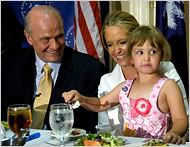
Her style could, of course, help him. The Thompsons’ young daughter and infant son also help humanize the candidate as a family man. (Mr. Thompson has adult children from a previous marriage.)
On the Web site Footballguystalk.com, Mr. Thompson not only won votes thanks to his wife, but one anonymous poster said, “I think he’s my new idol!”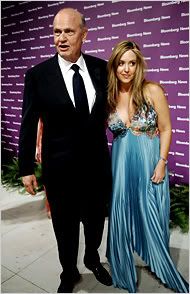
Mr. Thompson’s supporters, on their Web site draftthompson08.blogspot.com, put it this way: “It couldn’t hurt diplomatic relations to have a smart, pretty blonde as first lady.”
But that comment was quickly attacked. One writer described the May-December marriage as “gross,” while others said Mrs. Thompson was an outright liability.
Political analysts said there is very little evidence to suggest that candidates’ spouses affect their electoral outcomes. But one political scientist, Karen O’Connor, the director of the Women & Politics Institute at American University, said Mr. Thompson may lose with one key group whose support he needs: Republican women.
“I think women have an innate ‘ick’ reaction when they see a wife so much younger and vital than her husband,” Professor O’Connor said.
Wes Thornburg, a Republican financier in Chicago who has not yet committed himself to a candidate, said that Mr. Thompson has an issue that could be the envy of every campaign.
“If I were in his camp, I would love for this to be the main criticism from the press or opposition because it’s so easy to defend,” Mr. Thornburg said. “He’ll come back and say, ‘It’s not that unusual and the key is we have a great marriage.’ The determinate issues will be defense, taxes and his ability to communicate.”
It is too early to know what kind of role Mrs. Thompson would play in a Thompson administration. Or, for that matter, what role any other first lady or first gentleman would play.
“In all likelihood we’re going to have something quite different as a presidential spouse this time,” Professor Carroll said, “whoever wins.”
Wednesday, July 4, 2007
| [+/-] |
Fred Thompson's Watergate Role Nothing To Spark Pride |
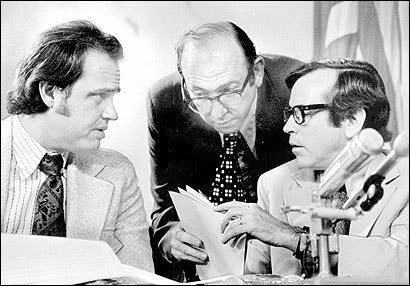 The Senate Watergate Committee chief counsel, Samuel Dash, crouched to confer with Fred Thompson (left) minority counsel, and Senator Howard Baker during a July 1973 hearing.
(James Atherton/Washington Post/File)
The Boston Globe reports:
The day before Senate Watergate Committee minority counsel Fred Thompson made the inquiry that launched him into the national spotlight -- asking an aide to President Nixon whether there was a White House taping system -- he telephoned Nixon's lawyer.
Thompson tipped off the White House that the committee knew about the taping system and would be making the information public. In his all-but-forgotten Watergate memoir, "At That Point in Time," Thompson said he acted with "no authority" in divulging the committee's knowledge of the tapes, which provided the evidence that led to Nixon's resignation. It was one of many Thompson leaks to the Nixon team, according to a former investigator for Democrats on the committee, Scott Armstrong, who remains upset at Thompson's actions.
"Thompson was a mole for the White House," Armstrong said in an interview. "Fred was working hammer and tong to defeat the investigation of finding out what happened to authorize Watergate and find out what the role of the president was."
Asked about the matter this week, Thompson -- who is preparing to run for the 2008 Republican presidential nomination -- responded via e-mail without addressing the specific charge of being a Nixon mole: "I'm glad all of this has finally caused someone to read my Watergate book, even though it's taken them over thirty years."
The view of Thompson as a Nixon mole is strikingly at odds with the former Tennessee senator's longtime image as an independent-minded prosecutor who helped bring down the president he admired. Indeed, the website of Thompson's presidential exploratory committee boasts that he "gained national attention for leading the line of inquiry that revealed the audio-taping system in the White House Oval Office." It is an image that has been solidified by Thompson's portrayal of a tough-talking prosecutor in the television series "Law and Order."
But the story of his role in the Nixon case helps put in perspective Thompson's recent stance as one of the most outspoken proponents of pardoning I. Lewis "Scooter" Libby, the former chief of staff to Vice President Dick Cheney. Just as Thompson once staunchly defended Nixon, Thompson urged a pardon for Libby, who was convicted in March of obstructing justice in the investigation into who leaked a CIA operative's name.
Thompson declared in a June 6 radio commentary that Libby's conviction was a "shocking injustice . . . created and enabled by federal officials." Bush on Monday commuted Libby's 30-month sentence, stopping short of a pardon.
The intensity of Thompson's remarks about Libby is reminiscent of how he initially felt about Nixon. Few Republicans were stronger believers in Nixon during the early days of Watergate.
Thompson, in his 1975 memoir, wrote that he believed "there would be nothing incriminating" about Nixon on the tapes, a theory he said "proved totally wrong."
"In retrospect it is apparent that I was subconsciously looking for a way to justify my faith in the leader of my country and my party, a man who was undergoing a violent attack from the news media, which I thought had never given him fair treatment in the past," Thompson wrote. "I was looking for a reason to believe that Richard M. Nixon, President of the United States, was not a crook."
Thompson was a little-known assistant US attorney in Tennessee when the Watergate investigation in Congress got underway. He had served as campaign manager for the successful 1972 reelection of Senator Howard Baker, a powerful Tennessee Republican.
When the Senate Watergate Committee was established in 1973, Baker became the ranking Republican member and brought Thompson to Washington to serve as minority counsel. Baker, who has been among those now urging Thompson to seek the presidency, did not return a call seeking comment.
John Dean , Nixon's former White House counsel, who was a central witness at the hearings, said he believed that Baker and Thompson were anything but impartial players. "I knew that Thompson would be Baker's man, trying to protect Nixon," Dean said in an interview.
The website of Thompson's presidential exploratory committee, imwithfred.com, suggests that Thompson helped reveal the taping system and expose Nixon's role in the Watergate coverup. And while Thompson's question to presidential aide Alexander Butterfield during a Watergate hearing unveiled the existence of the taping system to the outside world, it wasn't Thompson who discovered that Nixon was taping conversations. Nor was Thompson the first to question Butterfield about the possibility.
On July 13, 1973, Armstrong, the Democratic staffer, asked Butterfield a series of questions during a private session that led up to the revelation. He then turned the questioning over to a Republican staffer, Don Sanders, who asked Butterfield the question that led to the mention of the taping system.
To the astonishment of everyone in the room, Butterfield admitted the taping system existed.
When Thompson learned of Butterfield's admission, he leaked the revelation to Nixon's counsel, J. Fred Buzhardt.
"Even though I had no authority to act for the committee, I decided to call Fred Buzhardt at home" to tell him that the committee had learned about the taping system, Thompson wrote. "I wanted to be sure that the White House was fully aware of what was to be disclosed so that it could take appropriate action."
Armstrong said he and other Democratic staffers had long been convinced that Thompson was leaking information about the investigation to the White House. The committee, for example, had obtained a memo written by Buzhardt that Democratic staffers believed was based on information leaked by Thompson.
Armstrong said he thought the leaks would lead to Thompson's firing. "Any prosecutor would be upset if another member of the prosecution team was orchestrating a defense for Nixon," said Armstrong, who later became a Washington Post reporter and currently is executive director of Information Trust, a nonprofit organization specializing in open government issues.
Baker, meanwhile, insisted that Thompson be allowed to ask Butterfield the question about the taping system in a public session on July 16, 1973, three days after the committee had learned about the system.
The choice of Thompson irked Samuel Dash, the Democratic chief counsel on the committee, who preferred that a Democrat be allowed to ask the question. "I personally resented it and felt cheated," Dash wrote in his memoirs. But he said he felt he had "no choice but to let Fred Thompson develop the Butterfield material" because the question initially had been posed by Sanders, a Republican staffer.
When Dash told Thompson on the day of the hearing that he had agreed to let Thompson ask the question that would change US history, Thompson replied: "That's right generous of you, Sam."
So it was, at the hearing, that Thompson leapt into the national spotlight:
"Are you aware of the installation of any listening devices in the Oval Office of the president?" he asked Butterfield during the national televised hearings.
"I was aware of listening devices, yes, sir," Butterfield responded.
Even as he quizzed Butterfield during the hearing, Thompson said later, he believed the tapes would exonerate Nixon, so he saw no problem in pressing for their release. It was after Thompson heard Nixon incriminate himself on the tapes that Thompson finally decided that Nixon was a crook -- and stopped being a Nixon apologist.
"Looking back, I wonder how I could have failed to realize at once . . . the significance of the tapes," Thompson wrote. "I realized that I would probably be thinking about the implications of Watergate for the rest of my life."
Monday, June 4, 2007
| [+/-] |
Key Bush Backers Rally To Fred Thompson |
Politico.com reports:
George P. Bush, a nephew of President Bush, has contributed to the prospective presidential campaign of Fred Thompson and signed an e-mail asking friends and associates to do the same, The Politico has learned.
"In a field of candidates without a clear favorite among our fellow Republicans, my sincere hope is that you consider joining us in this effort to encourage Fred to run," the e-mail says.
The involvement of a Bush family member highlights a stream of former Bush-Cheney aides and supporters who are signing on with Thompson, in some cases quietly. Thompson, the "Law & Order" actor and former Tennessee senator, filed papers Friday that allowed him to begin raising money. Aides say he remains on track to formally announce his candidacy the week of the Fourth of July, although they say no date is set in stone.
Mary Matalin, the former counselor to Vice President Cheney, says she will be advising Thompson. A campaign source says she will be an unpaid adviser. Matalin is friends with Thompson and his wife, Jeri, and her involvement began informally, the source says.
Advisers say the head of economic policy for Thompson's fledgling team will be Lawrence B. Lindsey, who was President Bush's first economic policy adviser and an architect of his tax cuts. Lindsey was chief economic adviser to Bush's first presidential campaign and is a former member of the Board of Governors of the Federal Reserve System. Lindsey will also have a hand in the campaign's broader policy formulation, sources say.
The head of domestic policy is to be David M. McIntosh, a lawyer and former congressman from Indiana who was an official in the Ronald Reagan and George H.W. Bush administrations, according to the sources. The chief foreign policy adviser will be chosen soon, the sources say.
Adding to the Bush-Cheney ties, the campaign has said that the chief operating officer will be Thomas J. Collamore, a former aide to the older Bush when he was vice president and also an official in the Reagan administration.
And Michael Turk, e-campaign director for George W. Bush's reelection campaign, will take a leave of absence from his current job with the National Cable & Telecommunications Association to assist in getting the Thompson website off the ground. He may continue in a webmaster capacity for the campaign.
George P. Bush, the chief operating officer of a real estate development firm in Fort Worth, Texas, sent the appeal Friday afternoon along with Timothy P. Berry, the firm's president. The e-mail closes "Devotedly," then has both of their signatures.
"Friends and Colleagues," the e-mail begins. "We are writing you on behalf of Sen. Fred Thompson to ask for your support as he considers running for president. As you know, Sen. Thompson has generated buzz this election cycle because of his likable personality and approachable brand of politics, which, consequently, has attracted tremendous grassroots support of his potential candidacy. Additionally, his consistent record in public service and sincere vision to pursue a reform-based agenda in Washington, D.C., has primarily contributed to strong national polling numbers without having even announced."
George P. Bush was unavailable to discuss the e-mail, although associates confirm its authenticity. He is a son of former Florida Gov. Jeb Bush and was a popular surrogate for his uncle's first presidential campaign, drawing comparisons to John F. Kennedy Jr. when he spoke to the Republican National Convention. Since then, he has served as a clerk for a federal judge, married and become involved in several business and charitable groups. In March, he joined the Navy Reserve as an intelligence officer.
Using language similar to other appeals for Friends of Fred Thompson, the e-mail continues: "As a 'Friend of Fred Thompson,' your support will finance Sen. Thompson's efforts to test the political waters starting on June 4, 2007. If Sen. Thompson decides not to seek the presidency, any unspent funds that you contribute will be returned to your attention. Donations must not exceed federal contribution limits; therefore, an individual may contribute up to $2,300. If a joint checking account is used, the total can be $4,600, but both individuals must sign the check. Corporate and foreign national contributions are prohibited. It is very important that your check be dated June 4, 2007, even if you make out your check before this date."
Thursday, May 17, 2007
| [+/-] |
Michael Moore: "Sicko" is Completed and We're Off to Cannes! |
Michael Moore writes:Friends,
It's a wrap! My new film, "Sicko," is all done and will have its world premiere this Saturday night at the Cannes Film Festival. As with "Bowling for Columbine" and "Fahrenheit 9/11," we are honored to have been chosen by this prestigious festival to screen our work there.
My intention was to keep "Sicko" under wraps and show it to virtually no one before its premiere in Cannes. That is what I have done and, as you may have noticed if you are a recipient of my infrequent Internet letters, I have been very silent about what I've been up to. In part, that's because I was working very hard to complete the film. But my silence was also because I knew that the health care industry -- an industry which makes up more than 15 percent of our GDP -- was not going to like much of what they were going to see in this movie and I thought it best not to upset them any sooner than need be.
Well, going quietly to Cannes, I guess, was not to be. For some strange reason, on May 2nd the Bush administration initiated an action against me over how I obtained some of the content they believe is in my film. As none of them have actually seen the film (or so I hope!), they decided, unlike with "Fahrenheit 9/11," not to wait until the film was out of the gate and too far down the road to begin their attack.
Bush's Treasury Secretary, Henry Paulson, launched an investigation of a trip I took to Cuba to film scenes for the movie. These scenes involve a group of 9/11 rescue workers who are suffering from illnesses obtained from working down at Ground Zero. They have received little or no help with their health care from the government. I do not want to give away what actually happens in the movie because I don't want to spoil it for you (although I'm sure you'll hear much about it after it unspools Saturday). Plus, our lawyers have advised me to say little at this point, as the film goes somewhere far scarier than "Cuba." Rest assured of one thing: no laws were broken. All I've done is violate the modern-day rule of journalism that says, "ask no questions of those in power or your luncheon privileges will be revoked."
This preemptive action taken by the Bush administration on the eve of the "Sicko" premiere in Cannes led our attorneys to fear for the safety of our film, noting that Secretary Paulson may try to claim that the content of the movie was obtained through a violation of the trade embargo that our country has against Cuba and the travel laws that prohibit average citizens of our free country from traveling to Cuba. (The law does not prohibit anyone from exercising their first amendment right of a free press and documentaries are protected works of journalism.)
I was floored when our lawyers told me this. "Are you saying they might actually confiscate our movie?" "Yes," was the answer. "These days, anything is possible. Even if there is just a 20 percent chance the government would seize our movie before Cannes, does anyone want to take that risk?"
Certainly not. So there we were last week, spiriting a duplicate master negative out of the country just so no one from the government would take it from us. (Seriously, I can't believe I just typed those words! Did I mention that I'm an American, and this is America and NO ONE should ever have to say they had to do such a thing?)
I mean, folks, I have just about had it. Investigating ME because I'm trying to help some 9/11 rescue workers our government has abandoned? Once again, up is down and black is white. There are only two people in need of an investigation and a trial, and the desire for this across America is so widespread you don't even need to see the one's smirk or hear the other's sneer to know who I am talking about.
But no, I'm the one who now has to hire lawyers and sneak my documentary out of the country just so people can see a friggin' movie. I mean, it's just a movie! What on earth could I have placed on celluloid that would require such a nonsensical action against me?
Ok. Scratch that.
Well, I'm on my way to Cannes right now, a copy of the movie in my bag. Don't feel too bad for me, I'll be in the south of France for a week! But then it's back to the U.S. for a number of premieres and benefits and then, finally, a chance for all of you to see this film that I have made. Circle June 29th on your calendar because that's when it opens in theaters everywhere across the country and Canada (for the rest of the world, it opens in the fall).
I can't wait for you to see it.
Yours,
Michael Moore
P.S. I will write more about what happens from Cannes. Stay tuned on my website, MichaelMoore.com.
Tuesday, May 15, 2007
| [+/-] |
Michael Moore Challenges Alleged Presidential Wannabe Fred Thompson |
Letter from Michael Moore to ex-Senator Fred Thompson:May 15, 2007
Senator Fred Thompson
American Enterprise Institute
1150 Seventeenth Street, N.W.
Washington, DC 20036
Dear Senator Thompson,
Given that it has been publicly reported in The Weekly Standard, a leading neo-conservative publication, that you support Fidel Castro and the Cuban regime by being a purveyor of fine Cuban exports despite the trade embargo, I was surprised to see your recent op ed in a more traditional conservative outlet, The National Review, regarding my trip to Cuba (I suspect you choose The National Review in an effort to pander to an outlet that had criticized you for your opposition to medical malpractice legislation).
In your May 2, 2007 National Review article, “Paradise Island,” you specifically raised concerns about whether my trip to Cuba with 9/11 heroes, who have suffered serious health problems as a result of their exposure to toxic substances at Ground Zero that have gone untreated, was somehow going to support Castro and the Cuban government:“It always leaves me shaking my head when I read about some big-time actor or director going to Cuba and gushing all over Castro.”
Putting aside the fact that you, like the Bush Administration, seem far more concerned about the trip to Cuba than the health care of these 9/11 heroes, I was struck by the fact that your concerns (including comments about Castro's reported financial worth) apparently do not extend to your own conduct, as reported in The Weekly Standard's April 23, 2007 story, “From the Courthouse to the White House Fred Thompson auditions for the leading role” (emphasis added):“Thompson's work space looks just like what the home office of a successful politician or CEO should look like--though a little messier: a large desk, dark wood, leather furniture, lots of books and magazines and newspapers, a flat-screen TV, and box upon box of cigars--Montecristos from Havana.”
In light of your comments regarding Cuba and Castro, do you think the “box upon box of cigars – Montecristos from Havana” that you have in your office have contributed to Castro's reported wealth?
While I will leave it up to the conservatives to debate your hypocrisy and the Treasury Department to determine whether the “box upon box of cigars” violates the trade embargo, I hereby challenge you to a health care debate.
Survey after survey has indicated that health care is one of the top issues to the American voters. Today, more than 46 million people lack health care coverage, including 9 million children. We pay significantly more than any other country in the world - and get less back. Americans life expectancy is lower than other developed countries and our infant mortality rates are higher. And our heroic Ground Zero 9/11 workers live in a society where the Bush Administration has shown more concern about their travel than about their health.
Our debate would provide you an opportunity to appeal to the right wing of the Republican Party by continuing to attack me; it would give me a chance to discuss health care and tell you exactly what happened in Cuba, given your apparent interest; and it would provide the American people an opportunity to see just how serious Hollywood can be, with a purported conservative and an avowed progressive Hollywood personality on stage.
Over the course of the debate, we could specifically address the following issues:
(1) Your work as a lobbyist in light of the fact that the health care and insurance industries have maintained the current health care system through their effective control of the political establishment.
(2) The fact that you raised hundred of thousands of dollars in campaign contributions from the health care and insurance industries.
(3) Discuss the fact, highlighted in yet another conservative outlet The New York Sun, that you inexplicably wanted to cut funding for AIDS research.
(4) Your relationship with the Frist family and by extension HCA, one of the nation's largest for-profit hospital chains. It has been reported that former Senate Majority Leader Bill Frist (who was renowned for his over-the-television-screen Schiavo diagnosis) is serving as one of your confidantes on your potential presidential campaign. The Frist family has historically controlled HCA, which paid a record $1.7 billion in civil and criminal fines, including a $631 million penalty for Medicaid fraud – in other words, ripping off the taxpayers.
(5) Discussing whether Arthur Branch, as the District Attorney of Manhattan, supports a woman's right to choose, gun safety reforms, gay marriage, the trans fat ban and anti-smoking laws (which would impact Cuban cigars, including your Montecristos).
Like American Idol, we could even have the country vote to determine which one of us wins the debate. Though in the spirit of full disclosure, I feel obligated to forewarn you that I was the winner of the 1971-72 Detroit Free Press Debate Award for the state of Michigan.
The winner of our health care debate could even light a victory cigar with one of your Montecristos (though we may want to consider shipping them to the safe house where I have put a master copy of SiCKO in the event that the Bush Administration tries to seize the film).
Sincerely,
Michael Moore
Thursday, May 10, 2007
| [+/-] |
Michael Moore Faces U.S. Treasury Probe |
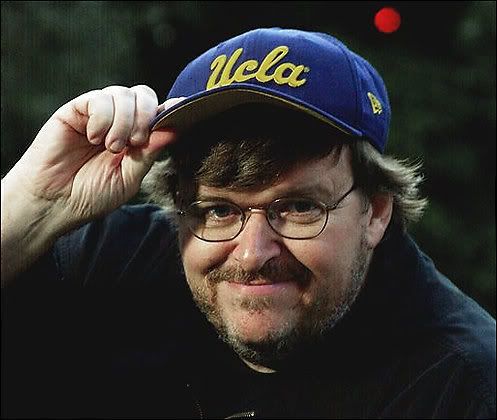
The Washington Post reports:
The investigation provides another contentious lead-in for a provocative film by Moore, a fierce critic of President Bush. In the past, Moore's adversaries have fanned publicity that helped the filmmaker create a new brand of opinionated blockbuster documentary.
"Sicko" promises to take the health-care industry to task the way Moore confronted America's passion for guns in "Bowling for Columbine" and skewered Bush over his handling of Sept. 11 in "Fahrenheit 9/11."
The Treasury Department's Office of Foreign Assets Control notified Moore in a letter dated May 2 that it was conducting a civil investigation for possible violations of the U.S. trade embargo restricting travel to Cuba. A copy of the letter was obtained Tuesday by the AP.
"This office has no record that a specific license was issued authorizing you to engage in travel-related transactions involving Cuba," Dale Thompson, OFAC chief of general investigations and field operations, wrote in the letter to Moore.
In February, Moore took about 10 ailing workers from the Ground Zero rescue effort in Manhattan for treatment in Cuba, said a person working with the filmmaker on the release of "Sicko." The person requested anonymity because Moore's attorneys had not yet determined how to respond.
Moore, who scolded Bush over the Iraq war during the 2003 Oscar telecast, received the letter Monday, the person said. "Sicko" premieres May 19 at the Cannes Film Festival and debuts in U.S. theaters June 29.
Moore declined to comment, said spokeswoman Lisa Cohen.
After receiving the letter, Moore arranged to place a copy of the film in a "safe house" outside the country to protect it from government interference, said the person working on the release of the film.
Treasury officials declined to answer questions about the letter. "We don't comment on enforcement actions," said department spokeswoman Molly Millerwise.
The letter noted that Moore applied Oct. 12, 2006, for permission to go to Cuba "but no determination had been made by OFAC." Moore sought permission to travel there under a provision for full-time journalists, the letter said.
According to the letter, Moore was given 20 business days to provide OFAC with such information as the date of travel and point of departure; the reason for the Cuba trip and his itinerary there; and the names and addresses of those who accompanied him, along with their reasons for going.
Potential penalties for violating the embargo were not indicated. In 2003, the New York Yankees paid the government $75,000 to settle a dispute that it conducted business in Cuba in violation of the embargo. No specifics were released about that case.
"Sicko" is Moore's followup to 2004's "Fahrenheit 9/11," a $100 million hit criticizing the Bush administration over Sept. 11. Moore's "Bowling for Columbine" won the 2002 Oscar for best documentary.
A dissection of the U.S. health-care system, "Sicko" was inspired by a segment on Moore's TV show "The Awful Truth," in which he staged a mock funeral outside a health-maintenance organization that had declined a pancreas transplant for a diabetic man. The HMO later relented.
At last September's Toronto International Film Festival, Moore previewed footage shot for "Sicko," presenting stories of personal health-care nightmares. One scene showed a woman who was denied payment for an ambulance ride after a head-on collision because it was not preapproved.
Moore's opponents have accused him of distorting the facts, and his Cuba trip provoked criticism from conservatives including former Republican Sen. Fred Thompson, who assailed the filmmaker in a blog at National Review Online.
"I have no expectation that Moore is going to tell the truth about Cuba or health care," wrote Thompson, the subject of speculation about a possible presidential run. "I defend his right to do what he does, but Moore's talent for clever falsehoods has been too well documented."
The timing of the investigation is reminiscent of the firestorm that preceded the Cannes debut of "Fahrenheit 9/11," which won the festival's top prize in 2004. The Walt Disney Co. refused to let subsidiary Miramax release the film because of its political content, prompting Miramax bosses Harvey and Bob Weinstein to release "Fahrenheit 9/11" on their own.
The Weinsteins later left Miramax to form the Weinstein Co., which is releasing "Sicko." They declined to comment on the Treasury investigation, said company spokeswoman Sarah Levinson Rothman.
Monday, May 7, 2007
| [+/-] |
Fred Thompson's Positions On The Issues |
At the NY Sun, Ryan Sager writes:
Project Vote Smart, which compiles voting records and other background materials on politicians, has finally put up its page on Fred Thompson (OK, maybe "finally" isn't exactly the fairest word when Mr. Thompson hasn't even announced for president — but I've been eager to see it).
Anyway, it seems Mr. Thompson filled out a survey for Project Vote Smart back in 1994, when he was running for Senate. While it's mostly pretty predictable (boo foreign aid, yay low taxes), there are a few parts worth scrutinizing... (see: abortion, education, AIDS)
* Under health care: Mr. Thompson's already gotten in a scrape with National Review for not supporting federal medical malpractice reform while in Congress. In this survey, he notes his opposition to it — so, at least he was consistent. He also declined to check the box supporting deregulation of private health care.
* Under unemployment: He doesn't support Jack Kemp-style "enterprise zones," with low taxes to attract businesses, in urban areas.
* Under trade: He does not support expanding NAFTA to the rest of Latin America. He does, however, want to open up markets on the Pacific Rim.
* Under education: He does not support nationwide standards, such as those that would later be included in No Child Left Behind. He does, on the other hand, support vouchers. (He also declined to check the box for "Eliminate the U.S. Department of Education." Back in 1994, plenty of Republicans still did want to eliminate it. Some of us would still like to do so today.)
* Under abortion: He checked the box for: "Abortions should be legal in all circumstances as long as the procedure is completed within the first trimester of the pregnancy." He did, however, support a number of restrictions on abortion: requiring parental notification, allowing states to impose waiting periods, and eliminating all federal funding of abortion. Lastly, he said Congress should leave legislation on abortion to the states.
* Under minimum wage: He said he was undecided.
* Under spending priorities: He said one thing that really stands out: He would slightly decrease funding for AIDS research — along with foreign aid and job retraining. Conservatives, of course, typically oppose foreign aid and job retraining. But I doubt there was some specific judgment made here by Mr. Thompson that too much was being spent on AIDS research. This seems more like a pure sop to reflexive anti-gay bigotry in the Republican Party. I haven't seen a lot of such pandering from Mr. Thompson (he's taken a cultural-federalism approach to social issues so far in his proto-campaign). But this strikes me as a relevant data point.
Wednesday, May 2, 2007
| [+/-] |
Fred Thompson On Cuban Medical Care |
At ABC radio networks, Fred Thompson writes, "The Myth of Cuban Health Care":You might have read the stories about filmmaker Michael Moore taking ailing workers from Ground Zero in Manhattan to Cuba for free medical treatments. According to reports, he filmed the trip for a new movie that bashes America for not having government-provided health care.
Now, I have no expectation that Moore is going to tell the truth about Cuba or health care. I defend his right to do what he does, but Moore's talent for clever falsehoods has been too well documented. Simply calling his movies documentaries rather than works of fiction, I think, may be the biggest fiction of all.
While this PR stunt has obviously been successful -- here I am talking about it -- Moore's a piker compared to Fidel Castro and his regime. Moore just parrots the story they created -- one of the most successful public relations coups in history. This is the story of free, high quality Cuban health care.
The truth is that Cuban medical care has never recovered from Castro's takeover -- when the country’s health care ranked among the world's best. He won the support of the Cuban people by promising to replace Batista’s dictatorship with free elections, and to end corruption. Once in power, though, he made himself dictator and instituted Soviet-style Communism. Cubans not only failed to regain their democratic rights, their economy plunged into centrally planned poverty.
As many as half of Cuba's doctors fled almost immediately -- and defections continue to this day. Castro won't allow observers in to monitor his nation's true state, but defectors tell us that many Cubans live with permanent malnutrition and long waits for even basic medical services. Many treatments we take for granted aren't available at all -- except to the Communist elite or foreigners with dollars.
For them, Castro keeps "show" clinics equipped with the best medicines and technologies available. It was almost certainly one of these that Moore went to, if the stories in the NY Post and The Daily News are true.
Nothing about this story inspires doubt, though. Elements in Hollywood have been infatuated with the Cuban commander for years. It always leaves me shaking my head when I read about some big-time actor or director going to Cuba and gushing all over Castro. And, regular as rain, they bring up the health care myth when they come home.
What is it that leads people to value theoretically "free" health care, even when it's lousy or nonexistent, over a free society that actually delivers health care? You might have to deal with creditors after you go to the emergency ward in America, but no one is denied medical care here. I guarantee even the poorest Americans are getting far better medical services than many Cubans.
According to Forbes magazine, by the way, Castro is now personally worth approximately $900 million. So when he desperately needed medical treatment recently, he could afford to fly a Spanish surgeon, with equipment, on a chartered jet to Cuba. What does that say about free Cuban health care?
The other thing that irks me about Moore and his cohort in Hollywood is their complete lack of sympathy for fellow artists persecuted for opposing the Castro regime. Pro-democracy activists are routinely threatened and imprisoned, but Castro remains a hero to many here. According to human rights organizations, these prisoners of conscience are often beaten and denied medical treatment, sanitation or even adequate nutrition.
If Moore wants a subject for a real documentary, I would suggest looking into the life of Cuban painter and award-winning documentarian Nicolás Guillén Landrián. He was denied the right to practice his art for using the Beatles' song, "The Fool on the Hill," as background music behind footage of Castro climbing a mountain. Later, he was given plenty of free Cuban health care when he was confined for years in a "mental institution" and given devastating, repeated electroshock "treatments."
There are many other artists and activists who have enjoyed similar treatment. I suspect we'll see movies with sympathetic portrayals of terrorists held in Guantanamo before we ever hear about the torture of true Cuban heroes. Even Andy Garcia's brilliant fictionalized movie about the real Cuban experience, "The Lost City," was given the Hollywood silent treatment. My bet, though, is that we'll hear lots about how Michael Moore showed that Cuba's socialized medicine is better than ours.
So go ahead and start working on the Oscar speech, Michael.
| [+/-] |
Fred Thompson on K Street |
At the Nation, Ari Berman writes:
David Sirota has a good post up about how the media is overlooking Fred Thompson's lucrative stint as a lobbyist. In a profile of the possible presidential candidate yesterday, the New York Times mentioned that during the eighteen year gap between working as a Congressional staffer and winning a Senate seat in 1994, Thompson "took on some lobbying clients." Who those clients were and what the work entailed, goes unmentioned. It's a mere throwaway in the larger narrative of the Reagan Republican returning to save the GOP.
In case you were curious, Thompson represented Westinghouse and General Electric in the deregulation of the savings and loan industry, which eventually led to the S&L crisis of the 1980s. After leaving the Senate in 2002, he was paid $760,000 to protect the British reinsurance company Equitas from asbestos claims. He registered to represent foreign clients such as deposed Haitian leader Jean Baptiste Aristide, Toyota and a German mining company.
Thompson's all-but-announced campaign has downplayed this history. "It being so far back, that's an awful undue pressure, burden for the senator to have to go dragging back through records," spokesman Mark Corallo (who recently worked for Karl Rove) told the Politico when asked to provide more information on Thompson's lobbying days. It may behoove his campaign to dust off those records. In 1994, Thompson's Democratic opponent, Congressman Jim Cooper, called him "a Gucci-wearing, Lincoln-driving, Perrier-drinking, Grey Poupon-spreading millionaire Washington special interest lobbyist." It's not hard to imagine a Republican rival saying nearly the same thing.
| [+/-] |
The Shadow Candidates |
At New York magazine, John Hellemann writes:
For hard-core political junkies, few pleasures compare to those afforded by the official release of presidential fund-raising numbers. Here we have an opportunity to indulge in an orgy of the picayune (How much does Hillary Clinton pay Mark Penn? How much has John McCain spent on flowers?) and also to speculate feverishly about what the buck-raking totals mean for the future of the race. And yet, last week, when the numbers came out, I found myself thinking less about their implications for the crop of announced aspirants than about what they might portend for a pair of current sideline-dwellers—two men whose much-mooted entry into the fray would, as they say, change everything.
The men in question, you might have guessed, are Fred Thompson and Al Gore, both Tennesseans whose political histories are intertwined. It was Gore’s elevation to the vice-presidency that opened up the Senate seat that Thompson claimed in 1994. And it was Thompson who later led the (largely futile) investigation of Clintonian campaign-fund-raising misdeeds, in which Gore, with his cash-trawling trip to a Buddhist temple, had an infamous part. Now, after restorative stints in private life—Thompson focusing on his work as a screen actor and Gore on his as a global-warming Jeremiah—both are hovering in the wings, being begged by advisers and acolytes to take center stage again.
The most fervent pleading appears to be directed at Thompson. Until early last month, his name was rarely mentioned as a conceivable candidate, but then he turned up on Fox News Sunday and declared that he was giving a run “serious consideration.” Suddenly, a Thompson boomlet was inflating faster than the body count in Iraq. In polls of Republican-primary voters, he vaulted instantly into third place; and by early April, a Los Angeles Times/Bloomberg survey put him in second, behind Rudy Giuliani but ahead of the foundering McCain. Meanwhile, Thompson has stoked the flames: meeting last week with dozens of House Republicans, heading to California next month to speak at a splashy GOP rah-rah dinner—and possibly to schmooze Jay Leno. (Stop the presses!)
Thompson’s rapid ascent in the polls owes much to his celebrity. For the past four years, he has played the hangdog, hard-line prosecutor Arthur Branch on Law & Order and any number of its offspring. His film résumé is long, if unvaried, studded with roles that are mostly variations on one theme: grave authority. (He has played a president, a White House chief of staff, a CIA director, an FBI director, and a wide array of military officers.) Before he began to dabble in acting, Thompson was a lawyer—he served as the minority counsel to the Senate Watergate committee—and his account of his movie and television career has always been charmingly self-deprecating. “When they needed some middle-aged guy who worked cheap, they’d call me,” he once told Sam Donaldson.
Thompson’s thespianism often earns him comparisons to Ronald Reagan—and, as anyone who witnessed up close his 1994 Senate race (as I did) knows, he’s a similarly gifted politician. In that campaign, Thompson’s challenger, Jim Cooper, was a popular conservative Democratic congressman who led the race by nearly twenty points in the early going. But Thompson came up with a genius gimmick: driving around the state in a red pickup truck, delivering speeches from the flatbed in which he assailed his opponent as an elitist who had “never seen the inside of a pickup.” Thompson ultimately won with a staggering 61 percent of the vote.
Critics point out that Thompson’s aw-shucks, shit-kicker populism is more than a little bit phony. That he spent eighteen years as a registered Washington lobbyist, doing the bidding of such high-powered clients as General Electric and Westinghouse, pushing for the passage of the deregulatory legislation that led to the savings-and-loan crisis of the eighties. They note that as a bachelor senator, Thompson developed a reputation for being lazy—for spending more time chasing skirts around the capital than crafting legislation. (“Really lovely women just seem to like Fred,” Senator Orrin Hatch remarked memorably years ago.)
Thompson’s friends say that his skirt-chasing days are behind him. (He’s married now to his second wife, who, according to columnist Robert Novak, is urging him to run.) And heaven knows that faux populism, convincingly executed, has never hurt anyone with the Republican-primary electorate. What matters instead to that electorate is that Thompson is a real-deal conservative. And while his record here isn’t quite spotless—his support of the McCain-Feingold campaign-finance law, in particular, rankles the right—it’s pretty freaking close. He has declared himself to be ardently pro-life and adamantly anti–gun control, and he’s one of the louder proponents of the notion that George W. Bush should (must) pardon Scooter Libby.
More to the point, Thompson’s conservative credentials put to shame those of his putative rivals. Across the country, there’s a palpable sense of dismay on the right with the extant Republican menu: Giuliani is (correctly) viewed as an out-front social liberal; McCain is seen as a hypocrite, a phony, never to be trusted; and Romney is perceived as a patent flip-flopper, who has changed his views on subjects from abortion to gay rights more readily (and less convincingly) than other people change their socks. As for the genuine conservatives in the race, such as Sam Brownback and Mike Huckabee, even the fringiest movement voters have (ahem) questions about their viability.
The lack of enthusiasm among Republicans for the current crop of candidates is more than anecdotal. A recent CBS/New York Times poll found that nearly six in ten GOP voters were unsatisfied with the options now before them. Thus does Thompson find himself staring at an opening as wide as the Grand Canyon.
Can anything similar be said of Gore? As recently as six months ago, countless Democrats would have answered yes. With their party still in the minority before last year’s congressional elections, and with Hillary Clinton—despite her muddled position on the war and worrying electability issues—apparently on track to march to the nomination anyway, there was, in many party circles, pining for Gore redux. And, no doubt, this sentiment hasn’t fully disappeared. Gore’s Oscar victory for his documentary, An Inconvenient Truth, ratified his status as the leading voice in the emerging green-politics movement. His nomination for a Nobel Prize only further enhanced his stature. His forthcoming book, The Assault on Reason, and his LiveEarth concerts this summer are sure to keep him in the headlines.
Gore, of course, has consistently maintained that his global-warming crusade is not a precursor to a presidential run. As he told me last year, “This is a different kind of campaign—politics is behind me.” Yet Gore is hardly deaf to the entreaties of his fans. He knows that occupying the White House would put him in the most powerful position to advance his cause. And, according to whispers I’ve been hearing, he increasingly believes that a green platform would be a potent one in a presidential election.
Gore, however, is also a man who understands the art of the possible—which brings us back to those first-quarter numbers and their implications. By any standard, the sums raised by the Democratic candidates were astonishing: a grand total of $78 million, more than triple the amount ginned up in a similar span of time in any previous election season. And the totals racked up by Clinton, Barack Obama, and John Edwards were beyond the expectations of anyone sensible, say, a year ago.
What the figures reinforce is the pervasive sense that Democrats, by and large, are happy with their field—and thus no longer craving a savior. Moreover, the success of Obama strikes me as being of particular consequence for Gore. Even more than his leadership on global warming, it was Gore’s prescient opposition to the Iraq war that provided a rationale for his late entry into the race. But now the Democrats possess a plausible candidate who occupied the same early antiwar position—and one who has demonstrated a capacity to go toe-to-toe with Clinton.
But if the results of the first round of the money primary represent a stop sign for Gore, for Thompson they’re a bright green light, flashing go-go-go. Among the three top-tier GOP candidates, only Romney’s $21 million fund-raising total was impressive in the least—and his obvious flaws as a candidate and his failure to catch fire with voters so far are impossible to overlook. (Indeed, whereas Romney once seemed to me likely to be the Pete Wilson of 2008, he now seems poised to become this year’s incarnation of Phil Gramm.) What the Republican first-quarter numbers reflect is a profoundly unsettled field—and a party in which many big-dollar donors are still holding back, perhaps in the hope that a new, fresh face will capture their attention.
Will Thompson try to do so? We’ll know soon enough—likely in the next few weeks. Just recently, though, Thompson returned to Fox News to announce that he had suffered from lymphoma, a condition that he’d kept secret for more than two years. (The cancer is now in remission.) Among insiders, the immediate conclusion was that the disclosure was the clearest indication yet that Thompson will jump in the race. The logic made sense: Why would Thompson go public now, if he planned to remain in private life? But this was still guesswork. Then, last week, his friend and adviser, former senator Bill Frist, told the Weekly Standard, “We thought we had to get it out early, in the sense that he’s going to be announcing.”
Just a slip of the tongue? You never know. But don’t be surprised if you soon start seeing that red pickup truck in Iowa.
Monday, April 23, 2007
| [+/-] |
From The CourtHouse To The White House |
At the Weekly Standard, Stephen F. Hayes writes:
A strange thing happened a few weeks back when I went to the Café Promenade at the Mayflower Hotel for an off-the-record interview with an unpaid adviser to the non-campaign of unannounced presidential candidate Fred Thompson.
Fred Thompson showed up.
Thompson was there to have lunch with Ed Gillespie, former chairman of the Republican National Committee and a powerhouse consultant with ties to the White House. The two men worked together in the fall of 2005 on the confirmation of Supreme Court nominee John Roberts. Thompson had invited Gillespie to lunch to discuss a potential presidential bid.
On March 11, just a week before, Thompson had appeared on Fox News Sunday and told Chris Wallace that he was giving "serious consideration" to running for the 2008 Republican presidential nomination. Ever since, advisers on other campaigns have tried to figure out how he'll affect the race if he runs.
Several patrons in the restaurant recognized Thompson. One well-dressed man with thick white hair approached him for an autograph. It's possible that this man wanted the autograph because Thompson served for eight years as a senator from Tennessee. But it's more likely that he wanted a memento of the day he ate at the same restaurant as Arthur Branch, the sagacious district attorney on Law & Order; Law & Order: Special Victims Unit; Law & Order: Criminal Intent; Law & Order: Trial by Jury; and Conviction, a spin-off of, well, you can probably guess. The same man returned to the table twice more. Each time Thompson put his conversation on hold and graciously tolerated the interruption.
After an hour, Thompson and Gillespie--currently chairman of the Republican party of Virginia--rose and left the restaurant. Ten minutes later, Thompson walked back in with former senator Bill Frist. They were led to a different table, but Thompson's waitress was the same. She laughed as she took his new order. Thompson says this second lunch was unplanned. Although he and Frist talk daily, the two Tennesseans met this time by chance. Finding they both had gaps in their schedules, they spent the next two hours at Café Promenade talking about a Fred Thompson for President campaign.
There is some discontent among Republicans with the current choices for the party's nominee in 2008. The complaints are well known: Senator John McCain, the maverick Republican, is too much maverick and not enough Republican. Former New York City mayor Rudy Giuliani is thought to be too willful and too liberal: He recently suggested he would allow his new wife to attend cabinet meetings and reaffirmed his support for federal funding of abortion. Mitt Romney seems pleasant and competent, but pleasant and competent doesn't beat Hillary Clinton. Senator Sam Brownback is unknown and uncharismatic. And former Arkansas governor Mike Huckabee is from Arkansas.
According to an adviser to one of the leading candidates, the rationale for a Thompson run is best illustrated--as so many things are--by The Simpsons. In one episode, Homer Simpson's civic-minded neighbor Ned Flanders tells a large crowd of fellow Springfield citizens that they must choose someone to lead an anticrime campaign in the town.
"Who should lead the group?"
"You," shouts a man from the crowd. The entire mob begins to chant.
"Flanders! Flanders! Flanders!"
When Flanders humbly begins to explain that he doesn't have much experience in such matters, Moe the Bartender cuts him off.
"Someone else!"
The crowd joins in.
"Someone else! Someone else! Someone else!"
One obvious advantage Fred Thompson has is that he's someone else.
In recent Republican presidential preference polls, Thompson tends to run third, behind Giuliani and McCain but ahead of Romney and the rest of the field. In a Bloomberg/Los Angeles Times poll released last week, Thompson came in second, just ahead of McCain, with support from 15 percent of those surveyed. In late March, Thompson won a straw poll of Republicans in conservative Gwinnett County, Georgia, earning more votes than all of the other candidates combined. And Iowa Republican party executive director Chuck Laudner told the Washington Times, "He's the biggest buzz in the state."
Representative Zach Wamp, a fellow Tennesseean who is running an effort to "Draft Fred," tells me he expects 60 congressional Republicans to show up early next week at a meet-and-greet with Thompson. Mark Corallo, who has volunteered to answer press inquiries for Thompson, has been getting dozens of calls each day--not only from reporters, but from Republicans around the country who have seen his name in the newspaper and tracked him down at his private consulting firm to sign up for a Thompson campaign. Politicians are reaching out to Bill Frist to offer their support. Says Frist: "I have governors who have called me, fundraisers I've known from my days as majority leader who are ready to go."
All of this, for a candidate who has not yet announced for anything.
Last week, I went to Thompson's home in the verdant Washington suburb of McLean, Virginia, to talk to him about his prospective presidential run. We spoke for more than four hours about his life in Tennessee, his family, his acting career, his foray into politics, and his future.
I was 30 minutes late. Thompson, who was on the phone with Howard Baker, his political mentor, didn't seem to care. He hung up, extended his large hand, offered a friendly greeting, and led me to his office. We were alone. Thompson's work space looks just like what the home office of a successful politician or CEO should look like--though a little messier: a large desk, dark wood, leather furniture, lots of books and magazines and newspapers, a flat-screen TV, and box upon box of cigars--Montecristos from Havana.
The presence of the cigars and the absence of a press chaperone were clues that Thompson is taking a different approach to his potential candidacy. A campaign flack would have insisted on hiding the cigars--Senator, how did you get those Cuban cigars? Isn't there a trade embargo?--and might have dampened Thompson's natural candor. On subjects ranging from Social Security to abortion, the CIA and to Iran, there would be lots of candor over the next several hours.
And by the end of the conversation, two unexpected realities had emerged. If he joins the race for the Republican nomination, and if he campaigns the same way he spoke to me last week, Fred Thompson, a mild-mannered, slow-talking southern gentleman, will run as the politically aggressive conservative that George W. Bush hasn't been for four years. And the actor in the race could well be the most authentic personality in the field.
Thompson seems to recognize that he wins the guy-I'd-want-to-get-a-beer-with primary the moment he announces. He comes across as a regular guy--"folksy" will be the political cliché that attaches to his candidacy--and punctuates explanations of his positions with the kind of off-the-cuff homespun witticisms that Dan Rather spent a career trying to come up with.
We sat facing each other in leather armchairs, and after some small talk I asked him what life was like growing up in Lawrenceburg, Tennessee. He began talking, and about 30 minutes later it was already 1994 and he was about to be elected to the U.S. Senate. I'd tried to interrupt with questions here and there, but he had a story he was determined to tell.
It's a good story. Thompson was born in Alabama and lived for most of his young life in Middle Tennessee. His father sold used cars and his mother took care of the house. Neither one graduated from high school, although Thompson's father earned his high school equivalency certificate later in life. His family ate dinner every night at 6:00 P.M. "It was like clockwork," he says. Thompson was not a great student in high school. At one point, he says, several of his teachers worked together to strip him of the title given to him by a vote of his peers--Most Athletic--because his grades were substandard. His father was something of a jokester, but also when necessary a disciplinarian.
"I grew up not having anything to live up to from an economic or professional standpoint, but having a lot to live up to from a growing-up and becoming-a-man standpoint," says Thompson.
That example would be important at a young age. Thompson married his high school sweetheart at 17, and together they enrolled at Memphis State University, where he studied philosophy and political science. Thompson worked several jobs to put himself through college and support a growing family.
"I sold clothing," he says. "I sold shoes. I sold baby shoes. I sold ladies shoes. I worked in a factory."
His wife's uncle and grandfather were both lawyers, and Thompson says he wanted to live up to the professional standards of her family. The law school at Vanderbilt University had seemed an unattainable goal for an underachieving high school student from a family without means. But it was a goal nonetheless. Thompson got serious academically as an undergraduate, and won admission.
Once a lawyer, he had a brief stint with the U.S. attorney's office, then went into private practice--"hung out my shingle," he says--and volunteered to work for Howard Baker's reelection campaign for Senate in 1972. Shortly after Baker returned to Washington he asked Thompson to join him for what he thought would be a short-term project. A special committee had been established to look into the Committee to Reelect President Richard M. Nixon, and Baker, the panel's top Republican, asked Thompson to serve as minority counsel. Thompson could often be seen at Baker's side as the investigation grew from a routine oversight hearing into the proceedings that would cause a president to resign. Thompson, who wrote a book about his experiences called At That Point in Time: The Inside Story of the Senate Watergate Committee, asked the question that led to the revelation of the White House taping systems. "Mr. Butterfield, are you aware of the installation of any listening devices in the Oval Office of the President?" And Thompson is often credited with feeding Baker the line that would become one of the most famous of an era: "What did the president know and when did he know it?"
Thompson says he passed up several offers with big Washington law firms to return to Nashville, where he entered a private practice with two law school classmates. He took the case of Marie Ragghianti, the head of Tennessee's Parole and Pardons Board. Ragghianti had grown concerned about what she saw as a pattern of suspicious pardons ordered from the office of Governor Ray Blanton. Her suspicions were later confirmed and Blanton was forced from office in a cash-for-clemency scandal that continued until his last day.
Peter Maas, author of Serpico, turned Marie Ragghianti's story into a book creatively titled Marie and published in 1983. Director Roger Donaldson bought the movie rights and came to Nashville to interview the major players. After meeting Thompson, Donaldson asked him if he'd like to play himself in the movie. Thompson agreed.
Over the next two decades, Thompson would appear in dozens of films and television shows as a character actor, often one who personifies government strength. It is a role that seems to fit. "Literally, I don't think Fred ever acts," says Tom Ingram, a longtime friend from Tennessee who now serves as chief of staff to Senator Lamar Alexander. "He played himself in Marie, and he's been playing himself ever since."
When Donaldson needed someone to play the role of CIA director in his next film, No Way Out, he turned to Thompson. A string of movies followed: The Hunt for Red October, Days of Thunder, Die Hard 2, Curly Sue, Cape Fear, In the Line of Fire. And there were cameo appearances on TV's Matlock and later Sex and the City.
Thompson never moved to Hollywood, choosing to stay in Tennessee, where he continued to practice law and remained involved in Republican politics. When Al Gore was elected vice president, Tennessee's Democratic governor, Ned McWherter, appointed one of his top advisers to serve until the 1994 elections, when a replacement would be elected to fill the final two years of Gore's term. Thompson's name came up early, and eventually, in July 1993, he filed papers for an exploratory committee.
Thompson knew from the beginning that it would be a difficult race. His opponent was Jim Cooper, a popular conservative Democrat who had developed a national reputation as a legislative expert on health care, widely considered one of the country's most important issues. Thompson started the race well behind Cooper. He told the Memphis Commercial-Appeal that he was a moderate Republican. The reporter who interviewed Thompson described him as "pro-choice," but noted that he supported restrictions on abortion at the state level and opposed federal funding. (A 1994 story in National Review also described Thompson as pro-choice.)
In a poll taken in February 1994, 36 percent of those surveyed said they would vote for Cooper, while just 17 percent supported Thompson. The Hotline, a Washington-based digest on campaigns and elections, reported the poll results under the headline: "They Know Thompson's Face, But Not His Name." It would prove to be an accurate diagnosis of Thompson's difficulties.
"For a year, I didn't scratch," Thompson says, looking back.
At the low point, Thompson met at a Cracker Barrel with Ingram. Thompson told his friend that he wasn't having any fun campaigning and was pessimistic about his chances to win. He was considering dropping out. Thompson had had it with the rubber-chicken Republican dinners and the rigors of campaigning across the state. "Fred was beleaguered by the traditional way of running for office," Ingram remembers. "He was expressing his misery over things."
Ingram had a question for Thompson: What would you do if you ran the way you wanted to run? Thompson thought for a minute, then said he'd shed as much of the campaign apparatus as possible and drive around the state in a pick-up truck. Ingram suggested he do just that, and Thompson thought it a good recommendation. Thompson would soon be known for his red pick-up truck. Cooper's campaign complained that it was a Hollywood-style gimmick designed to make Thompson look down to earth, and it surely was that. "But it was more than a device," Ingram insists. "It made Fred comfortable as a candidate. He felt liberated to just be himself."
Thompson ran on a strong small-government--even antigovernment--message. "America's government is bringing America down, and the only thing that can change that is a return to the basics," he said. "We will get back to basics and make the sacrifices and once again amaze the world at how, in America, ordinary people can do very extraordinary things." Thompson emphasized issues that would appeal to disaffected voters--making laws apply to the members of Congress who pass them; congressional pay raises; entitlement reform.
It was a message that began to resonate. Two months before the election, a poll by national Republicans put the race dead even. And as Thompson increased his advertising--allowing voters to put his famous face together with his name--he took the lead, and it grew. "Some people knew me and knew my face, but I started out 20 points behind" he says. "I just had to work at it until I raised enough money to go on television and then I went up pretty fast." Cooper asked for and was given free air-time for his ads after stations played movies starring Thompson. But it was too late.
Thompson won 61 percent of the vote, Cooper just 39 percent. Part of the explanation was that Thompson was swept along in the historic Republican tide of 1994. But Cooper would later say that he'd underestimated the political importance of Thompson's film career. "He was in so many movies," Cooper told the Nashville Tennesseean in 2002. "I should have been more worried than I was because that is a powerful way to present yourself to the public."
Thompson's new colleagues in Washington immediately tried to capitalize on his ability to communicate. Bob Dole, recently elevated to Senate majority leader, picked Thompson to present the televised Republican response to a national address by President Bill Clinton.
On Christmas Day, 1994, Thompson was a guest on ABC's This Week. Sam Donaldson opened the interview by telling viewers that while they might not know the name Fred Thompson, they might recognize his face. "I want to just show people how accomplished you are, because if they have been sitting at home saying, 'You know, I know this guy, I know this guy,' there's a reason," he said, before playing clips of the actor.
Thompson was at his most self-deprecating. "When they needed some middle-aged guy who'd work cheap, they'd call me for a little part and I'd go out there two or three weeks and knock one out," he explained to Donaldson.
Donaldson asked Thompson why he was chosen to give the GOP response to Clinton. "I want to keep boring in on this question of--perhaps you were chosen because the Republican leaders said, 'Fred Thompson is not just another pretty face.' I mean, Fred Thompson--"
"That's for sure."
Then Donaldson asked Thompson about presidential politics. "Who are the Republicans going to put up to run for the presidency in two years?"
"I think that it's going to be wide open," Thompson replied. "I think that there's at least a half a dozen people out there. There might be someone that hasn't been mentioned."
"Let me give you a name," Donaldson pressed. "Let me give you a name: Fred Thompson. Senator Fred Thompson."
Thompson found the suggestion amusing. "There's one thing, I think, for certain that I've observed around here over the period of time that I've been here, and watching all this for years, and that is when people come to town, somewhere along the line, if they do anything at all, if they're shown to be able to put one foot in front of the other, they're mentioned for the national ticket. So now you've mentioned me, and I appreciate it, so we can move on to more serious topics."
Thompson had not yet been sworn in.
In eight years in the Senate, Thompson developed a reputation for an independent streak, yet he compiled a voting record more conservative than one might expect of one who had described himself as a moderate in his first campaign. Over the course of his time in Congress he earned a lifetime rating by the American Conservative Union of 86 percent. He was not quite as conservative (using 2002 numbers) as Rick Santorum (87), Strom Thurmond (91), Trent Lott (93), or Jesse Helms (99), but more conservative than Arlen Specter (42), Olympia Snowe (52), John Warner (82), and John McCain (84).
His voting record suggests a strong belief in federalism. Thompson was frequently a lonely voice opposing the federalization of what in his view were state issues. His unwillingness to compromise on that principle even put him on the losing end of a 99-to-1 vote on the so-called Good Samaritan law, legislation that protected individuals from being sued if their good faith efforts to help someone in distress were unsuccessful. He thought it should have been left to the states.
Thompson also served as chairman of the Senate Government Relations Committee, which he used to investigate fundraising irregularities in the 1996 presidential election cycle. Republicans had high hopes that Thompson's inquiry would add to the political difficulties of the Clinton White House stemming from its malfeasance on campaign financing.
After the hearings ended, Fox News Channel's Brit Hume described Thompson as "flying high before his hearings . . . and shot down once they started and all the way through them."
Thompson says "the congressional investigative function is not a prosecutorial function" and acknowledges that the hearings produced "mixed result in many respects." He believes the criticism stems from the fact that "few people went to jail."
As Thompson considered his future, he began telling friends that he was not certain he wanted to seek reelection in 2002. He changed his mind after the attacks of September 11. Thompson, who served at the time on the Senate Intelligence Committee, announced in late September that he would run again. "Now is not the time for me to leave," he said. "This is the way now, it's perfectly clear, for me to contribute the most." He spent the next several weeks traveling to churches throughout Tennessee talking about the attacks and the coming U.S. response to them.
At a hearing of the Senate Governmental Affairs Committee on October 4, 2001, Thompson sounded a skeptical note about the prospect of reorganizing the federal homeland security bureaucracy. "The government, basically, cannot manage large projects very well," he said. "Maybe we can learn from our past experience with other government agencies and other crises and things of that nature and not make the same mistakes as we go about trying to rearrange these boxes and decide who reports to who and who has what authority. And maybe we'll take the lessons that we've learned from our other management problems in particular."
Then in late January 2002, his daughter Elizabeth Panici died suddenly following a heart attack. She was only 38. Thompson's friends say he was devastated. A month later he announced that he had changed his mind--he would not seek reelection. "I simply do not have the heart for another six-year term."
At a press conference after his announcement, he lashed out at the media for their intrusive coverage of his private life. "Every public official has to understand that he or she is a public official and that's the price you pay. For the most part, that's appropriate," he said. "That's the price your whole family pays. There are lines to be drawn. I think it's extremely unfortunate and uncalled for for the local newspaper to discuss the details of this. Her death obviously played in my decision, but the details of all of that, what news value does that have? Why did she have to pay that price? Why does her little five-year-old boy have to pay that price because her daddy chose to try to serve his state and his country? It's over the line and more like the National Enquirer-type stuff than anything else."
In his final months in the Senate, Thompson concentrated his efforts on legislation that would create the Department of Homeland Security. He fought efforts by Democrats to subject the new workforce to union and collective bargaining rules that apply to federal employees more broadly. The bill passed two weeks after the 2002 midterm elections, on a vote of 90-9.
"This is the most significant thing I've been involved in and certainly the most significant thing I've had my name on because it involves the main function of government, and that is protecting its citizens."
More than four years later, munching on a turkey sandwich and sour cream and onion potato chips at his dining room table, he displays an unusual willingness to second-guess his own decision. After Thompson criticized the growth of bureaucracy under the new director of national intelligence, I asked him why the new bureaucracy under Department of Homeland Security is any different.
"Well, to tell you the truth, in retrospect, we may conclude that it wasn't any different. But it got to the point where almost anything would have been an improvement," he says. "A lot of those agencies were in and of themselves dysfunctional, so bringing them together was not going to make everybody greater. . . . But you've got to start somewhere and you can't wait until everything is just right until you start coordinating. So we were kind of jumping aboard a moving train."
It was an admirably honest appraisal of what he once pointed to as the crowning achievement of his career in Congress. As we spoke, I was struck by the fact that Thompson didn't seem to be calibrating his answers for a presidential run. On issue after contentious issue, I got the sense from both his manner and the answers he gave me that he was just speaking extemporaneously. Many of his answers would drive a poll-watching political consultant nuts.
My suspicions were confirmed when Thompson asked at one point if he could have a transcript of our interview. "I found myself talking on some subjects that I haven't really thought that much about," he explained. "Oh, so this is what I think, huh?"
* Thompson says he came to respect George W. Bush during the 2000 campaign because of his plan to reform Social Security. Congressional Republicans considered the plan a political liability, and it went nowhere. Thompson says that although it was only tinkering on the margins of real reform, it was a good start. He won't share his own plan--"I'll roll that out at the appropriate time"--but the general principle he articulates sounds like a political risk.
"It's based upon the proposition that granddad and grandmom will be willing to sacrifice a little bit if they feel like it helps their grandkids avoid financial disaster, and that their sacrifice is not going to be wasted down some government rathole," he explains. "Under most plans, most good plans, you know current retirees probably would not be affected that much at all. . . . We've been operating under the assumption in this country that it's the third rail and that if you talk about it, those people who are most concerned about retirement programs will kill you. I don't think that's true."
* He believes that elements of the CIA were out to get Scooter Libby and his boss, Vice President Dick Cheney. Libby, though not the original leaker of the identity of CIA employee Valerie Plame, was convicted of lying and obstructing justice. "It makes me mad as the devil just to think about it," Thompson says. He had never met Libby when he volunteered to serve on the advisory board of the Scooter Libby Legal Defense Trust. Is Libby innocent? Thompson answers with one word. "Yes."
Do you think there will be negative political fallout from defending the convicted former chief of staff to an unpopular vice president?
"I have no idea. I have a hard time seeing it. If I'm wrong about the temperature of the American people on this, then I'm wrong about a lot of things about the American people. And we might as well find out."
* I asked him about his vote for the Iraq war and the Bush administration's failure to explain to the American public the real story of the prewar intelligence on Iraq. I ask Thompson how it is possible that a majority of the country believes the Bush administration lied about Iraqi WMD, when the U.S. intelligence community and the world consensus was that Saddam Hussein had these weapons.
"Part of it had to do with what has become almost a knee-jerk suspicion on the part of a lot of people with regards to anybody in authority," he says. And then he directly faults the Bush administration. "A part of it has been the administration's inability to sufficiently communicate the reality of the situation. It's not just the president. . . . You have to have an organized, pervasive ability to get your message across and rebut erroneous misstatements of the history. It is amazing to me how something like this could be perceived so erroneously by so many people. Because we all
know what the facts are. We've all seen the statements and the comments of Hillary Clinton and Bill Clinton, and the ranking Democrat on the intelligence committee, and the list goes on and on and on."
Thompson slips into sarcasm. "It is amazing to me how a man that they say is so dumb fooled so many real smart people. But that's what they're saying about Bush. Bush
canoodled the entire Democratic establishment. Absurd on its face, and yet some people want to believe that sort of thing."
Then he goes on to give a better defense of the White House than anything that has come out of the White House communications shop in four years.The irony here is that intelligence services had consistently over the years understated the capabilities of enemies and potential enemies. Now, here there was unanimity among the intelligence services, some of whom are supposed to be better than ours. . . . People don't understand intelligence. They don't understand. It's seldom clear. It's often caveated. It's sometimes flat-out wrong. Different people often have different ideas. That's what a president is faced with. And some today would say that politically a president has got to have unanimity before he can make a choice. And then they say that if he has that unanimity, the president has to make that choice--at the same time talking about how deficient our capabilities are. But if those deficient capabilities produced a recommendation, the president of the United States and leader of the free world has to take that recommendation. That has been so faulty in the past. It's absurd. Presidents in the future, as always, have to make a determination based on a lot of things, and intelligence is one of them. And the president not only has the right to evaluate the intelligence that he's receiving, he has a duty to do that. He listens to the British. I mean, if history was any judge, I don't know about now, but if the Brits tell me that there's an [Iraqi] deal with Niger and our guys don't know whether there was or not, I tend to rely on the Brits. I mean, those are the calls the president's got to make, and the question is really: Which way do you want the president to lean? Caution--that it's probably not so? When bad news is delivered, he gets mixed messages, he gets various intelligence reports of various kinds. Did you want him all balled up in all of that, you know, trying to apply some kind of a scientific equation to it for fear that somebody in an intelligence committee is going to wave it around at a hearing later on or something like that? Is that what it's come to? If so, the world is going to be a lot more dangerous than it otherwise already is. You've got to exercise the authority and the responsibilities that you've been given. I mean, in this debate over intelligence and what it is and what it ought to be and how it's used and all of that, you know, [it] needs to be dealt with and laid out in a way that people can understand it. . . . The next report says somebody's got weapons of mass destruction, you know what're we going to do with that? You know, just because history--a cat won't sit on a hot stove twice, but he won't sit on a cold stove either.
* He is equally blunt about Iran. Thompson says that the actions of the Iranian regime--harboring senior al Qaeda leaders, funding and training Iraqi insurgents, supplying terrorists in Iraq with devices that are killing American soldiers--are acts of war. He stops short of calling for a military response, but seems to suggest that he would be saying something different if circumstances were different.
"Unfortunately, today it can't be considered in isolation, so you have to take into consideration our capabilities and our priorities worldwide right now. And unfortunately we're stretched too thin." Nonetheless, he says, the long-term objective in Iran is the same one that led to the Iraq war. "I think the bottom line with Iran is that nothing is going to change unless there is a regime change."
* In the days since Thompson allowed that he was thinking about running for president, his views on abortion have come under scrutiny. Thompson finds the news reports from his first run for Senate perplexing.
"I have read these accounts and tried to think back 13 years ago as to what may have given rise to them. Although I don't remember it, I must have said something to someone as I was getting my campaign started that led to a story. Apparently, another story was based upon that story, and then another was based upon that, concluding I was pro-choice."
But, he adds: "I was interviewed and rated pro-life by the National Right to Life folks in 1994, and I had a 100 percent voting record on abortion issues while in the Senate."
Darla St. Martin, associate executive director of National Right to Life, supports Thompson on those claims. She traveled to Tennessee in 1994 to meet with him. "I interviewed him and on all of the questions I asked him, he opposed abortion," she told the American Spectator's Philip Klein.
Thompson says he thinks Roe v. Wade is bad law and should be overturned, but he says he does not support a Human Life Amendment.
One of the few times Thompson was unwilling to share his thoughts came when I asked him if he thought Rudy Giuliani was too liberal to win the Republican nomination and if Hillary Clinton could make a good president. The only question he would answer about his potential rivals concerned John McCain.
Thompson was one of four senators to support McCain in 2000 and served as the national co-chairman of his campaign. So I asked him why he's not supporting McCain again.
"You know the old joke about--what about me? As self-centered as that sounds, and it is, that ought to be the way it is." He adds: "Besides, you can't predict what's going to happen anyway, with any of them. Anybody could implode. Anybody could take off."
Before his appearance on Fox News Sunday, Thompson called McCain to let him know that he would announce that he was seriously considering a presidential bid. The conversation was friendly. "If we do this," he says, "we'll remain friends and we'll be friends after this."
There is considerable talk among the other Republican campaigns that the Thompson boomlet is driven by little more than celebrity. Maybe. But history suggests that Thompson may actually be underpolling right now. As was the case when he ran for office in Tennessee, he has a very recognizable face but his national name identity is actually quite low.
Gallup conducted a survey in late March asking respondents an open-ended question: "What comes to your mind when you think about former Tennessee senator Fred Thompson?" Sixty-seven percent of Republicans responded that they had no opinion of Thompson or were not familiar with him. And yet he shows up in the top three choices of potential Republican nominees in most of the polling that includes his name. As voters come to associate that name with a familiar and well-liked face, and if they get to see the personable Thompson on TV, Thompson strategists assume those polling numbers can only go up.
When Thompson met with Bill Frist at the Mayflower Hotel, they had important business to discuss. More than two years ago, Thompson had been diagnosed with non-Hodgkin's lymphoma. It is "indolent" lymphoma, a slow-growing form of the disease that is not usually symptomatic. If you're going to have one of the 33 varieties of lymphoma, Thompson says, this is the one you want. "It's easy to diagnose, easy to treat and easy to live with," Frist, a physician, confirms. But it sounds scary, the kind of thing that might spook potential primary voters if it were disclosed by an announced candidate.
"We thought we had to get it out early," says Frist, "in the sense that he's going to be announcing."
If Frist's acknowledgment that Thompson was going to run may have been a slip, Thompson's own words also suggest he's running. He says he understands "how hard it is, how difficult it is, how embarrassing it is, how intrusive it is." And he knows that as a candidate he could be subject to harsh attacks.
"That's the least of it anymore," he says. "It's not pleasant, but it's not that important anymore because you're straight with your family, you have a level of understanding and knowledge about your family, and they with you, and with the man upstairs, and that's that. You know, ain't really much past that. And it kind of frees you up in a way."
Yes, it does.
