Congressman John Conyers: "Join Me in Calling on President Bush to Respect Congress’ Exclusive Power to Declare War"
CASMII reports:
Dear Democratic Colleague:
As we mark five years of war in Iraq, I have become increasingly concerned that the President may possibly take unilateral, preemptive military action against Iran. During the last seven years, the Bush Administration has exercised unprecedented assertions of Executive Branch power and shown an unparalleled aversion to the checks and balances put in place by the Constitution’s framers. The letter that follows asks President Bush to seek congressional authorization before launching any possible military strike against Iran and affirms Senator Biden’s statement last year that impeachment proceedings should be considered if the President fails to do so.
I hope that you will join me in calling on the President to respect Congress’ exclusive power to declare war. To sign the letter below, please contact the Judiciary Committee staff at 225-3951.
Sincerely,
John Conyers, Jr.
Chairman
May 8, 2008
The Honorable George W. Bush
President of the United States
1600 Pennsylvania Avenue, N.W.
Washington, D.C. 20500
Dear Mr. President:
We are writing to register our strong opposition to possible unilateral, preemptive military action against other nations by the Executive Branch without Congressional authorization. As you know, Article I, Section 8 of the U.S. Constitution grants Congress the power “to declare war,” to lay and collect taxes to “provide for the common defense” and general welfare of the United States, to “raise and support armies,” to “provide and maintain a navy,” to “make rules for the regulation for the land and naval forces,” to “provide for calling forth the militia to execute the laws of the Union, suppress insurrections and repel invasions,” to “provide for organizing, arming, and disciplining, the militia,” and to “make all laws necessary and proper for carrying into execution ... all ... powers vested by this Constitution in the Government of the United States.” Congress is also given exclusive power over the purse. The Constitution says, “No money shall be drawn from the Treasury but in consequence of appropriations made by law.”
By contrast, the sole war powers granted to the Executive Branch through the President can be found in Article II, Section 2, which states, “The President shall be the Commander-in-Chief of the Army and Navy of the United States, and of the Militia of the several States, when called into actual Service of the United States.” Nothing in the history of the “Commander-in-Chief” clause suggests that the authors of the provision intended it to grant the Executive Branch the authority to engage U.S. forces in military action whenever and wherever it sees fit without any prior authorization from Congress. In our view, the founders of our country intended this power to allow the President to repel sudden attacks and immediate threats, not to unilaterally launch, without congressional approval, preemptive military actions against foreign countries. As former Republican Representative Mickey Edwards recently wrote, “[t]he decision to go to war ... is the single most difficult choice any public official can be called upon to make. That is precisely why the nation’s Founders, aware of the deadly wars of Europe, deliberately withheld from the executive branch the power to engage in war unless such action was expressly approved by the people themselves, through their representatives in Congress.”1
Members of Congress, including the signatories of this letter, have previously expressed concern about this issue. On April 25, 2006, sixty-two Members of Congress joined in a bipartisan letter that called on you to seek congressional approval before making any preemptive military strikes against Iran.2 Fifty-seven Members of Congress have co-sponsored H. Con. Res. 33, which expresses the sense of Congress that the President should not initiate military action against Iran without first obtaining authorization from Congress.3
Our concerns in this area have been heightened by more recent events. The resignation in mid-March of Admiral William J. “Fox” Fallon from the head of U.S. Central Command, which was reportedly linked to a magazine article that portrayed him as the only person who might stop your Administration from waging preemptive war against Iran,4 has renewed widespread concerns that your Administration is unilaterally planning for military action against that country. This is despite the fact that the December 2007 National Intelligence Estimate concluded that Iran had halted its nuclear weapons program in the fall of 2003, a stark reversal of previous Administration assessments.5
As we and others have continued to review troubling legal memoranda and other materials from your Administration asserting the power of the President to take unilateral action, moreover, our concerns have increased still further. For example, although federal law is clear that proceeding under the Foreign Intelligence Surveillance Act (FISA) “shall be the exclusive means by which electronic surveillance” can be conducted within the U.S. for foreign intelligence purposes, 18 U.S.C. 2511(2)(f), the Justice Department has asserted that the National Security Agency’s warrantless wiretapping in violation of FISA is “supported by the President’s well-recognized inherent constitutional authority as Commander in Chief and sole organ for the Nation in foreign affairs”.6 As one legal expert has explained, your Administration’s “preventive paradigm” has asserted “unchecked unilateral power” by the Executive Branch and violated “universal prohibitions on torture, disappearance, and the like.”7
Late last year, Senator Joseph Biden stated unequivocally that “the president has no authority to unilaterally attack Iran, and if he does, as Foreign Relations Committee chairman, I will move to impeach” the president. 8
We agree with Senator Biden, and it is our view that if you do not obtain the constitutionally required congressional authorization before launching preemptive military strikes against Iran or any other nation, impeachment proceedings should be pursued. Because of these concerns, we request the opportunity to meet with you as soon as possible to discuss these matters. As we have recently marked the fifth year since the invasion of Iraq, and the grim milestone of 4,000 U.S. deaths in Iraq, your Administration should not unilaterally involve this country in yet another military conflict that promises high costs to American blood and treasure.
Sincerely,
1. Mickey Edwards, Dick Cheney’s Error, Wash. Post, March 22, 2008, at A13.
2. Letter from Rep. Peter DeFazio, Rep. John Conyers, Jr., and 60 other Members of Congress, to President George W. Bush (Apr. 25, 2006) (on file with the Committee on the Judiciary).
3. H. Con. Res. 33, 110th Cong. (2008)
4. Thomas E. Ricks, Top U.S. Officer in Mideast Resigns, Wash. Post, March 12, 2008, at A1.
5. Dafna Linzer and Joby Warrick, U.S. Finds That Iran Halted Nuclear Arms Bid in 2003, Wash. Post, Dec. 4, 2007, at A1.
6. Department of Justice, Legal Authorities Supporting the Activities of the National Secuirty Agency Described by the President, Jan. 19, 2006 at 1.
7. David Cole, Less Safe, Less Free: Why America is Losing the War on Terror, 2007 at 2.
8. Adam Leach, Biden: Impeachment if Bush Bombs Iran, PORTSMOUTH HERALD, Nov. 29, 2007.
Wednesday, May 14, 2008
| [+/-] |
Letter To Bush About A Preemptive Strike on Iran |
Friday, September 28, 2007
| [+/-] |
Iraq Leader Rejects Division of Nation |
The Associated Press reports:
Prime Minister Nouri al-Maliki on Friday rejected a Senate proposal calling for the decentralization of Iraq's government and giving more control to the country's ethnically divided regions, calling it a "catastrophe."
The measure, whose primary sponsors included presidential hopeful Sen. Joseph Biden, D-Del., calls for Iraq to be divided into federal regions for the country's Shiite, Sunni and Kurdish communities in a power-sharing agreement similar to Bosnia in the 1990s.
In his first comments since the measure passed Wednesday, al-Maliki strongly rejected the idea, echoing the earlier sentiments of his vice president.
"It is an Iraqi affair dealing with Iraqis," he told The Associated Press while on a return flight to Baghdad after appearing at the U.N. General Assembly in New York. "Iraqis are eager for Iraq's unity. ... Dividing Iraq is a problem and a decision like that would be a catastrophe."
Iraq's constitution lays down a federal system, allowing Shiites in the south and Kurds in the north to set up regions with considerable autonomous powers. But Iraq's turmoil has been fueled by the deep divisions among politicians over the details of how it work, including the division of lucrative oil resources.
Many Shiite and Kurdish leaders are eager to implement the provisions. But the Sunni Arab minority fears being left in an impoverished central zone without resources. Others fear a sectarian split-up would harden the violent divisions among Iraq's fractious ethnic and religious groups.
On Thursday, Vice President Adel Abdul-Mahdi said decisions about Iraq must remain in the hands of its citizens and the spokesman for the supporters of radical Shiite cleric Muqtada al-Sadr agreed.
"We demand the Iraqi government to stand against such project and to condemn it officially," Liwa Semeism told the AP. "Such a decision does not represent the aspirations of all Iraqi people and it is considered an interference in Iraq's internal affairs."
A spokesman for Grand Ayatollah Ali al-Sistani, the Shiite spiritual leader, dismissed the proposal during Friday prayers in Karbala.
"The division plan is against Iraqi's interests and against peaceful living in one united Iraq," Sheik Abdul Mahdi al Karbalaei told worshippers. "Any neighboring country supporting this project will pay the price of instability in the region."
Al-Maliki said he discussed the role of U.S. troops and private security contractors in the country, stressing that Iraq is a sovereign nation and it should have control over its own security.
Security "is something related to Iraq's sovereignty and its independence and it should not be violated," he said.
Al-Maliki's comments follow a Sept. 16 shooting in central Baghdad that killed 11 Iraqi civilians allegedly at the hands of Blackwater USA guards providing security for U.S. diplomats.
The Moyock, N.C.-based company said its employees were acting in self-defense against an attack by armed insurgents. Iraqi officials and witnesses have said the guards opened fire randomly, killing a woman and an infant along with nine other people, but details have widely diverged.
The Washington Post reported Friday that a preliminary U.S. Embassy report found the shooting involved three Blackwater teams.
It said one was ambushed near a traffic circle and returned fire before fleeing the scene, another was surrounded by Iraqis when it went to the intersection and had to be extracted by the U.S. military and a third came under fire from eight to 10 people in multiple locations.
The report said the three teams had been trying to escort a senior U.S. official who had been visiting a "financial compound" back to the U.S.-protected Green Zone when a car bomb struck about 25 yards outside the entrance. The official was unharmed, it said.
An unidentified State Department official described the report to the newspaper and stressed it was only an initial account.
The New York Times also reported Friday that the shootings occurred as Blackwater was trying to evacuate senior U.S. officials with the United States Agency for International Development after an explosion occurred near the guarded compound where they were meeting.
Participants in the operation said at least one guard continued firing on civilians while colleagues called for the shooting to stop, according to the newspaper's account, which cited American officials who have been briefed on the investigation.
It also said those involved have told U.S. investigators they believed they were firing in response to enemy gunfire but at least one guard also drew a weapon on a colleague who did not stop shooting.
American officials have publicly remained mum on their findings pending the results of a series of investigations.
Also Friday, U.S. Army Spc. Jorge G. Sandoval was acquitted of charges he killed two unarmed Iraqis. He was convicted of a lesser charge of planting evidence on one of the bodies to cover up the crime. Sandoval, 22, of Laredo, Texas, was expected to be sentenced Saturday.
In other violence, 10 civilians were killed and 12 others were wounded Friday in an attack on an apartment complex in a primarily Sunni neighborhood in southern Baghdad. And north of Baghdad, at least six people were killed in a busy cafe late Thursday and people celebrated the end of the dawn-to-dusk fast during the Islamic holy month of Ramadan.
Australia, meanwhile, said it has taken command of the multinational naval task force guarding Iraq's two oil terminals in southern Iraq for the third time. The job protecting the vital facilities rotates between Australia, Britain and the United States.
Wednesday, August 1, 2007
| [+/-] |
Transcript & Video of 'Hardball', Mike Barnicle Interviews Joe Biden, August 1, 2007 |
Transcript of entire segment with Joe Biden:
BARNICLE: Senator Joe Biden of Delaware is running for president. He‘s the chairman of the Foreign Relations committee and the author of new book called “Promises to Keep.” Senator, before we get to the book and your candidacy, I was watching you as you watched David‘s film piece, and when they showed General Myers and General Abizaid and former secretary of defense Rumsfeld testifying, you had sort of a—what I would consider a sad look on your face. What was going through your mind when you were watching that?
SEN. JOE BIDEN (D-DE), PRESIDENTIAL CANDIDATE: No accountability. This is the only administration that no one‘s ever made a mistake in the face of constant disaster. You know, it used to be—my grandpop used to talk about you got to stand up. I mean, it used to be an honorable thing that somebody‘s come forward and say, Hey, I screwed up. That was me. I mean, think of the fact—I mean, who has been held accountable for anything in this administration? They attorney general, the secretary of defense, secretary of state, vice president, national security adviser, chairman of the Joint Chiefs of Staff? What‘d this all happen on the watch of privates?
I mean, I just find it incredible, the lack of—I don‘t know. My grandpop would call it honor.
BARNICLE: How frustrated is it for you, as a United States senator, never mind being out on the campaign trail, running for president—you‘re a United States senator. You‘ve been there since 1970. How frustrating is it for you that you have this going on, what you consider to be this lack of accountability, and yet you can‘t get people to be held accountable?
BIDEN: Well, you can‘t. You know, it‘s all about elections. You know, we barely have control of the Senate. We have 50 votes. One of our colleagues has still not been able to vote because he‘s still ill. And the House doesn‘t have effective control. It‘s frustrating as the devil.
And what‘s even more frustrating, the people who voted to send the Democrats to Congress last time out expected that somehow we were going to be able to really, you know, have a—you know, operational control, really call people to task. But it‘s—it‘s just really frustrating.
What‘s most frustrating, Mike, is that you got all these folks out there who‘re just losing confidence in the government, losing confidence anything that‘s going on. And you got 160,000 families implicated by having folks over there in Iraq. They don‘t see any plan. They don‘t know what these guys are doing. I mean, it really is. It‘s—it‘s sad.
BARNICLE: What do you think General Petraeus is going to do when he comes back and speaks to you people, speaks to us in September, September 15?
BIDEN: I know General Petraeus well. I‘m in constant contact with him the last four-and-a-half years. I disagree with his plan on the surge, but I think he‘s an honorable guy. I think he‘ll come back and say two things. You‘re going to have to read between the lines. And one‘s going to be we‘ve made some progress in the surge. We‘ve made some military progress. But I think he‘ll be honest enough to say we‘ve made no political progress.
And absent some political accommodation—you just showed—you had the Sunnis getting up and walking out of the cabinet. They continued to adhere, as a lot of my Democratic colleagues do, Mike, to this flawed—fundamentally flawed premise that somehow, you can establish a strong unity government in Baghdad that can control the country. It‘s not going to happen in anybody‘s lifetime.
BARNICLE: You know, I can‘t recall a war that‘s been as difficult for reporters to cover as this war. It‘s so lethal to anybody on the ground working for any news organization.
BIDEN: Absolutely.
BARNICLE: And yet you keep hearing anecdotal information that seems so at odds with what you get out of the White House or the Pentagon in terms—fine, military success in Ramadi. I understand that. I accept that. I believe that. And yet when you hear people who continue to come back, United State senators, as well as regular soldiers, saying they can‘t get the lights on in Baghdad, they can‘t get the water running...
BIDEN: They can‘t. They can‘t. I‘ve been there seven times. I‘m heading back in a couple weeks—actually, a month. I‘m heading back for my eighth trip. And let me tell you something. I‘ve been in and out of the Green Zone, been to Muradi (ph) -- excuse me—I‘ve been down to Basra. I‘ve been out in Anbar Province. I‘ve flown over most of it in a helicopter. I‘ve been up as—far us as—I mean, the idea that somehow there‘s any cohesion here is absolutely fanciful.
What has happened here is, to the extent that Petraeus has concentrated on certain areas and localized—localized—the conflict—that is, let local tribal chiefs have local police forces and local control. To the extent that‘s happened, there‘s been some progress. But absent a larger political agreement here—as soon as we leave—remember Tal Afar?
BARNICLE: Yes.
BIDEN: You know how you learn all these—all these names, you know, average Americans learn them. Well, you know, a year-and-a-half ago, we heralded this as a great example. We had 10,000 combined troops in there. We cleaned out the city. We rebuilt the schools and the city facilities, et cetera. And then we had to leave, and a town of 250,000 people once again became basically a ghost town of 80,000 people.
I mean, same thing‘s going to happen. Same thing‘s going to happen if we leave absent giving local control, local police, local regional power...
BARNICLE: So is this hopeless?
BIDEN: It‘s hopeless absent doing what—I‘m going to say bluntly what Les Gelb and I have been talking about for well over a year. I did on your radio program up in Boston, you know? And now everybody‘s coming around to it. You have General Garner now saying—quoting—I‘m paraphrasing, Biden and Gelb are right.
The only way this ends without the whole thing splintering apart—meaning the whole country—and it‘s not going to just break up in three pieces, Mike. It‘s going to break up not on just a religious basis but tribal basis. You‘re going to see this civil war metastasize into Turkey, into affecting Iran and Syria. And we have a real problem now, it‘s going to get a lot worse. And why they continue to adhere to the prospect that Maliki can put together a unity government that can control the country is just beyond my comprehension.
BARNICLE: So what you‘re talking about, what you‘re saying is not only something that‘s going to be handed off to the first term of the next president, it sounds like the next two terms and perhaps...
BIDEN: Well, let me tell you something...
BARNICLE: ... two presidents.
BIDEN: Yes. I think that‘s—look, Mike, what happens—what happens when, in fact, we leave? We have to leave. We have our commanding general saying you can‘t—the new chief of the Army is saying you can‘t keep 160,000 troops there next year. We don‘t have the troops to do it. We can‘t do it. So everybody knows we‘re going to be leaving, Mike, and you either leave with putting together a political settlement, bringing in the international community that‘s ready to come in—because, look, the French aren‘t looking to help us, the Russians, the Chinese, but they know things are really bad for them if this place fractures.
BARNICLE: You know, back on the point of—the larger point of David‘s piece on the death of Private (SIC) Tillman—do you think Rumsfeld was telling the truth? I mean, how could it be that the secretary of defense could sit there and not find out for several weeks that someone as famous as Corporal Tillman was killed and how he was killed?
BIDEN: I find it absolutely improbable. I—look, they‘re so good at plausible denial. They‘re so good at kicking the can down the road. It‘s a little bit like—go back to Abu Ghraib. Abu Ghraib was a disaster. I went down to see the president right after Abu Ghraib. I said, Mr. President, you got to do something drastic. You got to literally bulldoze the place down, build a hospital, demonstrate our overwhelming distaste for what happened. It‘s not part of us. Nothing happened.
So we go back. I called for Rumsfeld‘s resignation years ago. I go back. I‘m sitting with the president of the United States of America and the secretary—then national security adviser, and the vice president. He said, What‘s this stuff about picking on Rummy? I said, Mr. President, I have to be honest with you. And I turned to the vice president. I said, Mr. Vice president, were you not a constitutional officer, I‘d call for your resignation, too. And the president looked and said, Why? I said, Name me one piece of advice you‘ve been given on Iraq from either the secretary of defense or the vice president that‘s turned out to be correct? Name me one.
BARNICLE: That‘s all in the book.
BIDEN: Well, but also...
(CROSSTALK)
BARNICLE: We‘re going to get to the book.
BIDEN: No, no. But it‘s beyond the book. It goes to your essential point, I think, Mike, and that is these guys just never level. They just never level.
BARNICLE: Senator Biden is staying with us to talk more about his bid for the White House and his new book and his confrontations in the White House.
And coming up later, more on Don Rumsfeld‘s testimony today with two veterans of the Iraq war. Has Pat Tillman‘s death and the Pentagon‘s handling of it hurt our armed forces?
You‘re watching HARDBALL, only on MSNBC.
(COMMERCIAL BREAK)
BARNICLE: Welcome back to HARDBALL. We‘re back with Democratic presidential candidate Senator Joe Biden, author of the new book “Promises to Keep.” I read it. It‘s interesting. It‘s you. It‘s about your life.
And now, at this stage of your life, you‘re running for president again. And let me ask you—you‘ve been in the United States Senate for a long time. You‘ve been on TV for a long time, chairman of the Senate Foreign Relations committee. A lot of people know you. You‘re at 4 points in the polls.
Do you think that the country might be just going someplace else, might be saying, you know, No, I want to look at a woman for president, or a black man for president. I‘m tired of the old Irish guys—not that you‘re old.
(LAUGHTER)
BARNICLE: But where do you think the country‘s at on this?
BIDEN: Well, there may be a piece of that, but I think part of it that—what we find out in our polling, no one really knows me at all. They think, as my pollster said—I think it was she that said that they think I‘m this guy that‘s born behind a podium, went to Yale, is a wealthy guy, and knows a lot about foreign policy.
And so, you know, whereas, ironically, 22 years ago when I looked at this, you know, they knew everything about me personally, didn‘t know anything about what I thought. Now it‘s the flip. And—but I think it‘s early, Mike. I mean, when was the last time any of these polls have made a difference this early out? The polls up in your neck of the woods, out in New Hampshire, show that only 8 percent of the people in New Hampshire has made up their mind, have a definite choice. Nationally, it‘s about the same.
And it‘s an old thing. You know, recognition gets money, money gets recognition, gets coverage and press. So I don‘t think people begin to make up their mind yet. And as long as—as long as national security and foreign policy is a central issue, I think I‘m in the game.
BARNICLE: You know, when I listen to the debates, when I listen to each of the candidates, and when it comes down to issues of national security—well, today, you know, Senator Obama talking about—you‘re smiling. What are you smiling at? You thought he was trying to be General Obama when he was talking about Pakistan and everything? Sounded too much like you? What are you saying?
BIDEN: Well, you know, look...
BARNICLE: Come on!
BIDEN: Look, the truth is the four major things that he called for—and I‘m glad he did, but one of them is a surge in Afghanistan. Well, hell, that‘s what I called for when I was in Afghanistan in 2003, and Hagel and I wrote the legislation adding money. We have new money for Afghanistan in here.
The second thing he called for was, you know, aid to Pakistan be conditional. Well, Tom Lantos and I wrote that into the bill when we passed the 9/11 bill. It‘s law. I mean, it‘s already there. It happened weeks ago.
And he talked about the idea of U.S. troops in Afghanistan (SIC) if there‘s actionable intelligence. Well, that‘s our policy. The only thing you do is you don‘t go and announce it. You don‘t talk about it. But it is our—it is our stated policy.
And so I guess what I‘m trying to say is that I‘m glad that he‘s talking about these things, but there‘s—there‘s not a single thing that I heard of that he spoke about that isn‘t either already policy, already done, or has been spoken to at length before by myself and others.
BARNICLE: I get the impression, when you‘re all on the stage, that you kind of like Senator Clinton. You respect Senator Clinton.
BIDEN: Well, do like her. I do like her. I really like Dodd a lot. I—I mean, there‘s—no, there‘s people you know because you work with...
BARNICLE: Yes.
BIDEN: .. and you are certain of who they are.
I am certain of who Dodd is. He‘s a stand-up guy and he‘s knowledgeable. I‘m certain of who, you know, the governor is, because I have been with him a long time. And I know Senator Clinton a long time.
I don‘t know Barack as well. I have served with him. I respect him.
And I don‘t John Edwards as well. I know him, and I respect him.
And—but I‘m really for a ticket of Kucinich and—and Gravel.
(LAUGHTER)
BARNICLE: Senator Joe Biden, the book is “Promises to Keep.”
(CROSSTALK)
BARNICLE: Senator Biden, Scranton, Pennsylvania, this Saturday. All you Irish guys and Irish women, get up there and buy that book.
(LAUGHTER)
Saturday, June 16, 2007
| [+/-] |
Pentagon Balked At Pleas For Safer Vehicles |
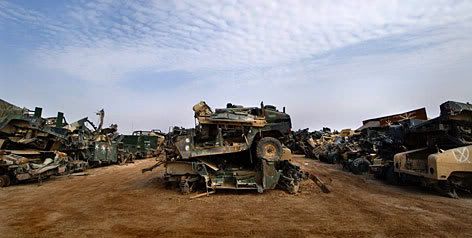
USA Today reports:
Pfc. Aaron Kincaid, 25, had been joking with buddies just before their Humvee rolled over the bomb. His wife, Rachel, later learned that the blast blew Kincaid, a father of two from outside Atlanta, through the Humvee's metal roof.
Army investigators who reviewed the Sept. 23 attack near Riyadh, Iraq, wrote in their report that only providence could have saved Kincaid from dying that day: "There was no way short of not going on that route at that time (that) this tragedy could have been diverted."
A USA TODAY investigation of the Pentagon's efforts to protect troops in Iraq suggests otherwise.
Years before the war began, Pentagon officials knew of the effectiveness of another type of vehicle that better shielded troops from bombs like those that have killed Kincaid and 1,500 other soldiers and Marines. But military officials repeatedly balked at appeals — from commanders on the battlefield and from the Pentagon's own staff — to provide the life-saving Mine Resistant Ambush Protected vehicle, or MRAP, for patrols and combat missions, USA TODAY found.
In a letter to Defense Secretary Robert Gates late last month, two U.S. senators said the delays cost the lives of an estimated "621 to 742 Americans" who would have survived explosions had they been in MRAPs, rather than Humvees.
The letter, from Sens. Joseph Biden, D-Del., and Kit Bond, R-Mo., assumed the initial calls for MRAPs came in February 2005, when Marines in Iraq asked the Pentagon for almost 1,200 of the vehicles. USA TODAY found that the first appeals for the MRAP came much earlier.
As early as December 2003, when the Marines requested their first 27 MRAPs for explosive disposal teams, Pentagon analysts sent detailed information about the superiority of the vehicles to the Joint Chiefs of Staff, e-mails obtained by USA TODAY show. Later pleas came from Iraq, where commanders saw that the approach the Joint Chiefs embraced— adding armor to the sides of Humvees, the standard vehicles in the war zone — did little to protect against blasts beneath the vehicles.
Despite the efforts, the general who chaired the Joint Chiefs until Oct. 1, 2005, says buying MRAPs "was not on the radar screen when I was chairman." Air Force general Richard Myers, now retired, says top military officials dealt with a number of vehicle issues, including armoring Humvees. The MRAP, however, was "not one of them." Something related to MRAPs "might have crossed my desk," Myers says, "but I don't recall it."
Why the issue never received more of a hearing from top officials early in the war remains a mystery, given the chorus of concern. One Pentagon analyst complained in an April 29, 2004, e-mail to colleagues, for instance, that it was "frustrating to see the pictures of burning Humvees while knowing that there are other vehicles out there that would provide more protection."
The analyst was referring to the MRAP, whose V-shaped hull puts the crew more than 3 feet off the ground and deflects explosions. It was designed to withstand the underbelly bombs that cripple the lower-riding Humvees. Pentagon officials, civilians and military alike, had been searching for technologies to guard against improvised explosive devices, or IEDs. The makeshift bombs are the No. 1 killer of U.S. forces.
The MRAP was not new to the Pentagon. The technology had been developed in South Africa and Rhodesia in the 1970s, making it older than Kincaid and most of the other troops killed by homemade bombs. The Pentagon had tested MRAPs in 2000, purchased fewer than two dozen and sent some to Iraq. They were used primarily to protect explosive ordnance disposal teams, not to transport troops or to chase Iraqi insurgents.
The goal: Iraqis 'stand up' so U.S. can 'stand down'
Even as the Pentagon balked at buying MRAPs for U.S. troops, USA TODAY found that the military pushed to buy them for a different fighting force: the Iraqi army.
On Dec. 22, 2004 — two weeks after President Bush told families of servicemembers that "we're doing everything we possibly can to protect your loved ones" — a U.S. Army general solicited ideas for an armored vehicle for the Iraqis. The Army had an "extreme interest" in getting troops better armor, then-brigadier general Roger Nadeau told a subordinate looking at foreign technology, in an e-mail obtained by USA TODAY.
In a follow-up message, Nadeau clarified his request: "What I failed to point out in my first message to you folks is that the US Govt is interested not for US use, but for possible use in fielding assets to the Iraqi military forces."
In response, Lt. Col. Clay Brown, based in Australia, sent information on two types of MRAPs manufactured overseas. "By all accounts, these are some of the best in the world," he wrote. "If I were fitting out the Iraqi Army, this is where I'd look (wish we had some!)"
The first contract for what would become the Iraqi Light Armored Vehicle — virtually identical to the MRAPs sought by U.S. forces then and now, and made in the United States by BAE Systems — was issued in May 2006. The vehicles, called Badgers, began arriving in Iraq 90 days later, according to BAE. In September 2006, the Pentagon said it would provide up to 600 more to Iraqi forces. As of this spring, 400 had been delivered.
The rush to equip the Iraqis stood in stark contrast to the Pentagon's efforts to protect U.S. troops.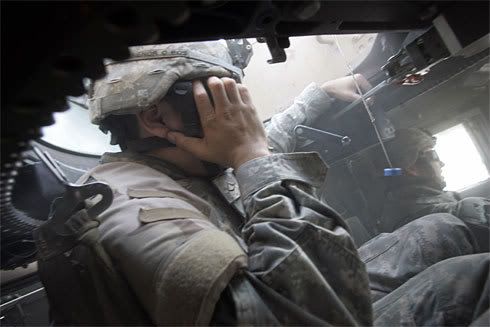
In February 2005, two months after Nadeau solicited ideas for better armor for the Iraqis and was told MRAPs were an answer, an urgent-need request for the same type of vehicle came from embattled Marines in Anbar province. The request, signed by then-brigadier general Dennis Hejlik, said the Marines "cannot continue to lose … serious and grave casualties to IEDs … at current rates when a commercial off-the-shelf capability exists to mitigate" them.
Officials at Marine headquarters in Quantico, Va., shelved the request for 1,169 vehicles. Fifteen months passed before a second request reached the Joint Chiefs and was approved. Those vehicles finally began trickling into Anbar in February, two years after the original request. Because of the delay, the Marines are investigating how its urgent-need requests are handled.
The long delay infuriates some members of Congress. "Every day, our troops are being maimed or killed needlessly because we haven't fielded this soon enough," says Rep. Gene Taylor, D-Miss. "The costs are in human lives, in kids who will never have their legs again, people blind, crippled. That's the real tragedy."
Not until two months ago did the Pentagon champion the MRAP for all U.S. forces. Gates made MRAPs the military's top priority. The plan is to build the vehicles as fast as possible until conditions warrant a change, according to a military official who has direct knowledge of the program but is not authorized to speak on the record. Thousands are in the pipeline at a cost so far of about $2.4 billion.
Gates said he was influenced by a press report — originally in USA TODAY — that disclosed Marine units using MRAPs in Anbar reported no deaths in about 300 roadside bombings in the past year. His tone was grave. "For every month we delay," he said, "scores of young Americans are going to die."
One reason officials put off buying MRAPs in significant quantities: They never expected the war to last this long. President Bush set the tone on May 1, 2003, six weeks after the U.S. invasion, when he declared on board the aircraft carrier Abraham Lincoln that "major combat operations in Iraq have ended."
Gen. George Casey, the top commander in Iraq from June 2004 until February this year, repeatedly said that troop levels in Iraq would be cut just as soon as Iraqi troops took more responsibility for security. In March 2005, he predicted "very substantial reductions" in U.S. troops by early 2006. He said virtually the same thing a year later.
Casey wasn't the only optimist. In May 2005, Vice President Cheney declared that the insurgency was "in its last throes."
Given the view that the war would end soon, the Pentagon had little use for expensive new vehicles such as the MRAP, at least not in large quantities. The MRAPs ordered for the Iraqis were intended to speed the day when, to use Bush's words, Iraqi forces could "stand up" and the United States could "stand down."
Nadeau, who wrote the e-mail that led to MRAPs for the Iraqis, explains why he did so: "The U.S. government knows that eventually we're going to get out" of Iraq. The United States wants "to help get (the Iraqis) in a position to take care of themselves."
For U.S. forces, however, the answer was something else: adding armor to Humvees. Nadeau and others say the choice made sense because Humvees were already in Iraq and the improvements — adding steel to the sides, upgrading the windows and replacing the canvas doors — could be made quickly, and far more cheaply. Adding armor to a Humvee cost only $14,000; a Humvee armored at the factory cost $191,000; today, an MRAP costs between $600,000 and $1 million, though some foreign models cost only about $200,000 in 2004.
The solution to the IED problem in 2003 had to be "immediate," says retired vice admiral Gordon Holder, director for logistics for the Joint Chiefs until mid-2004. "We had to stop the bleeding." Holder says MRAPs seemed impractical for the immediate need: "We shouldn't take four years to field something the kids needed yesterday."
Would it actually have taken four years? That depends upon how much urgency the Pentagon and Congress attached to speeding production. Force Protection Inc., the small South Carolina company that landed the first significant MRAP contracts, was criticized this month by the Pentagon's inspector general for failing to deliver its vehicles on time. But bigger defense contractors were available then — and have secured MRAP contracts in recent weeks that call for deliveries in as little as four months.
A bigger obstacle might have been philosophical: The MRAP didn't fit the Pentagon's long-term vision of how the military should be equipped.
Then-Defense secretary Donald Rumsfeld regarded the Iraq war "as a means to change" the military, "make it lighter, make it more responsive, make it more agile," Holder says. The MRAP, heavier and slower than the Humvee, wouldn't have measured up, he says.
The commander 'My No. 1 threat'
By June 2004, the military had lost almost 200 U.S. troops to the homemade bombs. Gen. John Abizaid, then head of U.S. Central Command, told the Joint Chiefs that "IEDs are my No. 1 threat." He called for a "mini-Manhattan Project" against IEDs, akin to the task force that developed the atomic bomb during World War II.
The Pentagon organized a small task force that, two years later, morphed into a full-fledged agency — the Joint IED Defeat Organization, or JIEDDO. Its leader, Montgomery Meigs, is a retired four-star general. Its annual budget totals $4.3 billion. Its mission: to stop IEDs from killing U.S. troops.
In one of its PowerPoint presentations, JIEDDO made its priorities clear. First, prevent IEDs from being planted by attacking the insurgency. Then, if a device is planted, prevent it from exploding. "When all Else Fails," reads another slide, "Survive the blast." That put solutions such as the MRAP into the category of last resorts.
JIEDDO did spend its own money for 122 MRAPs, but it primarily focused on electronic jammers to prevent bombs from being remotely detonated, unmanned surveillance aircraft to catch insurgents putting bombs along roads and better intelligence on who was building and planting bombs.
The agency has claimed some successes. Insurgents in 2007 had to plant six times as many bombs as they did in 2004 to inflict the same number of U.S. casualties, Meigs said in an interview.
But the insurgents — Sunnis loyal to the deposed leader Saddam Hussein, Shiites who hated the U.S. occupiers and foreigners aligned with al-Qaeda — often managed to stay one step ahead of JIEDDO. They changed the kind of explosives they planted and varied the locations of the devices and the way they detonated them.
When the Pentagon added armor to the sides of Humvees to guard against bombs planted along roadsides, the insurgents responded by burying bombs in the roads. The bombs could blast through the vulnerable underbelly of the Humvees. The insurgents also moved to larger, more sophisticated bombs, some packed with as much as 100 pounds of explosives.
Deputy Secretary of Defense Gordon England, the No. 2 official at the Pentagon, testified on Capitol Hill in June that "as the threat has evolved, we have evolved. We work very, very hard to be responsible to our troops."
Taylor, the Democratic congressman from Mississippi, pressed England about why the Pentagon waited until May to request substantial numbers of MRAPs. "Are you telling me no one could see that (need) coming, no one could recognize that the bottom of the Humvee" didn't protect troops, and "that's why the kids inside are losing their legs and their lives?" Taylor asked.
"That is too simplistic a description," England replied. "People have not died needlessly, and we have not left our people without equipment."
To Pentagon decision-makers, the Humvee seemed able to handle the threat early in the war — roadside bombs, rather than those buried in the roads. "If anybody could have guessed in 2003 that we would be looking at these kind of (high-powered, buried) IEDs that we're seeing now in 2007, then we would have been looking at something much longer" term as a solution, Holder says. "But who had the crystal ball back then?"
Nadeau, now a major general in charge of the Army's Test and Evaluation Command in Alexandria, Va., also defends the Pentagon's choices. He says buried IEDs did not become a serious threat to the armored Humvees until 2006. Critics might say, " 'Why didn't you guys buy 16,000 MRAPs a decade ago?' " Nadeau says today. "You know, I didn't need them."
Six officers interviewed by USA TODAY say the threat to the Humvees surfaced sooner. Lt. Col. Dallas Eubanks, chief of operations for the Army's 4th Infantry Division in 2003-04, says IEDs became more menacing before he left Iraq. "We were certainly seeing underground IEDs by early 2004," he says.
In mid-2005, two top Marines — Gen. William Nyland, assistant Marine commandant, and Maj. Gen. William Catto, head of Marine Corps Systems Command — testified before Congress that they were seeing an "evolving" threat from underbelly blasts. They said at the time that armored Humvees remained their best defense.
The congressman MRAP's 'simple' advantage
Just after lunch on June 27, 2004, a group of enlisted men parked a handful of armored vehicles near a cinderblock building at Marine headquarters in Fallujah, Iraq.
The day had turned sweltering, like every summer afternoon in central Iraq. But this day was special. A congressional delegation had arrived, and among the dignitaries was Rep. Duncan Hunter, then the chairman of the House Armed Services Committee. Hunter wasn't just a powerful congressman. He was a Vietnam War veteran, and his son, then a 27-year-old Marine lieutenant also named Duncan, was stationed at the base.
More important to most of the Marines, the California Republican had been instrumental in pushing the Pentagon to get better armor for them. Humvees with cloth doors — canvas, like the crusher hat that Hunter wore that day — had been standard issue when the war began. The fabric worked well to shield the sun; it offered no protection against explosives.
Then, as now, Hunter was impatient with the pace of procurement in Iraq. That winter, he had dispatched his staff to steel mills, where they persuaded managers and union leaders to set aside commercial orders to expedite steel needed to armor the Humvees. He also worked with the Army and its contractors to expand production.
In Fallujah, Hunter recognized the Humvees. He couldn't identify the two vehicles next to them. One was called a Cougar, the other a Buffalo. Both were MRAPs, made by Force Protection Inc., and both, he was told, were coveted. They were used by explosives disposal teams, but combat units "looked at them and said, 'We want those,' " Hunter recalls.
Throughout most of Iraq, they still haven't arrived.
Despite requests from the field, Pentagon officials decided to ration the vehicle. In 2003 and 2004, they bought about 55, and only for explosives disposal units. But they chose a different approach for protecting the rest of the troops: adding armor to Humvees. The choice was problematic. The Humvee's flat bottom channels an explosion through the center of the vehicle, toward the occupants.
Memos and e-mails obtained by USA TODAY show a stream of concerns about the decision to armor the Humvee. Most went up the chain of command and withered:
•December 2003: At the direction of then-deputy Defense secretary Paul Wolfowitz, who was troubled by the mounting death toll from IEDs, the Joint Chiefs began to explore options for giving troops better armor. Detailed information on the Wer'Wolf, an MRAP made in the African country of Namibia, was passed from analysts in the Pentagon to Lt. Col. Steven Ware, an aide collecting information for the Joint Chiefs.
•March 30, 2004: Gen. Larry Ellis, in charge of U.S. Forces Command in Atlanta, sent a memo to the Army's chief of staff, Gen. Peter Schoomaker. He complained that "some Army members and agencies are still in a peacetime posture." U.S. commanders in Iraq told him that the armored Humvee "is not providing the solution the Army hoped to achieve." He didn't recommend MRAPs but rather suggested accelerating production of a combat vehicle called the Stryker. In response, the military said new Humvee armor kits would suffice.
•April 28-29, 2004: Duncan Lang, a Pentagon analyst who worked in acquisition and technology, suggested purchasing the Wer'Wolf, the MRAP put before the Joint Chiefs in December 2003. In an e-mail to colleagues and supervisors, Lang said "a number could be sent to Iraq "as quickly as, or even more quickly than, additional armored Humvees." He called it "frustrating to see the pictures of burning Humvees while knowing that there are other vehicles out there that would provide more protection."
•April 30, 2004: Another Pentagon analyst, Air Force Lt. Col. Bob Harris, forwarded details about MRAP options to a member of the IED task force. The list included a variety of MRAPs, among them the Wer'Wolf and Force Protection's Cougar. "There was no great clarity as to why they didn't pursue these options," Harris says. "I saw it as my job to educate." Harris is now an acquisition officer at Hanscom Air Force Base in Massachusetts.
Hunter says the advantages the MRAP had on the Humvee were clear. "It's a simple formula," Hunter says. "A vehicle that's 1 foot off the ground gets 16 times that (blast) impact that you get in a vehicle that's 4 feet off the ground," like the MRAP.
Although Hunter favored adding armor to Humvees, he now calls the military's devotion to that approach a costly mistake. "It's true that they saved more lives by moving first on up-armoring the Humvees," he says. "The flaw is that they did nothing on MRAPs. The up-armoring of Humvees didn't have to be an exclusive operation."
Holder dismisses the idea that the Pentagon could have moved on a dual track: armoring Humvees while ordering up MRAPs. He doubts Congress would have funded both at the time. But that's exactly what Congress is doing now — buying both vehicles.
"We probably should've had the foresight" to start buying MRAPs earlier, says Ware, the Joint Chiefs aide (now retired) who passed the information to superiors and counterparts in the Army and Marines. But "we just couldn't get them there fast enough." Adding armor to the Humvee, Ware says, "was better than nothing."
The lieutenant colonel 'Hope no one gets wasted'
A PowerPoint presentation, dated Aug. 25, 2004, shows wounded troops lying in hospital beds. Most are bandaged. One is bloody. His left eye is barely open, his injured right is covered by a patch. Each was maimed by an IED. Each, save one, was in a Humvee.
On another slide: "Numerous vehicles on the market provide far superior ballistic protection" than the Humvee, wrote then-lieutenant colonel Jim Hampton, the man who prepared the presentation for the operations staff of the U.S. Army Corps of Engineers in Baghdad.
Safety is a passion for Hampton. He's so concerned with security that he asks his wife, Kate, to take her pistol when she goes for walks on their 80 acres in rural Mississippi. When he got to Iraq in early 2004, he was tasked with looking at armor options to protect the Corps of Engineers, the agency sent to help with rebuilding efforts. For weeks, he studied armor options. His conclusion: The corps should get MRAPs to protect its people, specifically Wer'Wolves. Hampton says he asked for 53 Wer'Wolves. The corps got four.
Hampton couldn't have been more opposed to up-armoring the Humvees and warned his superiors. He even e-mailed his wife from Iraq. "Hey Babe," his e-mail read. "Just a little aggravated with the bureaucracy. It is simply beyond my comprehension why we're having to go through such (an ordeal) to order confounded hard vehicles. I sure hope no one gets wasted before the powers-that-be get off their collective fat asses."
Finally, he wrote his congressman, Rep. Chip Pickering, R-Miss., urging him to investigate deaths involving the Humvee. "We would never consider sending troops" in Humvees "up against armor or artillery," Hampton wrote, "but this is tantamount to what we're doing because these vehicles are being engaged with the very ordnance delivered by artillery in the form of improvised explosive devices."
By November 2004, Pentagon analyst Lang had grown discouraged, an e-mail shows. "I have found that you can never put the word out too many times," he wrote on Nov. 17. "I send it on to (the Secretary of Defense's office), Army and (Marine Corps) contacts I have. Some of it is getting to the rapid fielding folks and force protection folks that are looking at Iraq issues. I do not see much action."
Lang closed the message with a variation on his earlier plea: "For the life of me, I cannot figure out why we have not taken better advantage of the sources of such vehicles," he wrote. "We should be buying 200, not 2, at a time. These things work, they save lives and they don't cost much, if any, more than what we are using now." At the time, a basic Wer'Wolf cost about the same as a factory-made armored Humvee: around $200,000.
In December 2004, at a town hall meeting with troops in Kuwait, a soldier asked Rumsfeld about the lack of armor on military vehicles. Rumsfeld explained the situation this way: "You go to war with the Army you have. They're not the Army you might want or wish to have at a later time."
The concerns troops voiced at the meeting might have had an impact. Within a week, the Marine Corps Systems Command in Quantico posted its first notice seeking information on MRAPs from potential contractors.
Back in Fallujah, the desire for the Cougar had grown. By February 2005, the Marines were formally asking for more. Field commanders sent their first large-scale request for MRAPs, seeking 1,169 vehicles with specifications that closely mirrored those of the Cougar. They no longer envisioned the vehicle as limited to explosives disposal teams; they wanted MRAPs for combat troops, too.
Roy McGriff III, then a major, drafted the request signed by Brig. Gen. Hejlik. "MRAP vehicles will protect Marines, reduce casualties, increase mobility and enhance mission success," the request read. "Without MRAP, personnel loss rates are likely to continue at their current rate." In spring 2005, he would have a chance to argue his case before top generals.
The Marine major 'Unnecessary' casualties
They convened March 29-30, 2005, at the Marine Corps Air Station in Miramar, Calif. The occasion: a safety board meeting, a regular gathering to address safety issues across the Corps. In attendance: five three-star generals, four two-stars, seven one-stars and McGriff.
McGriff knew the MRAP's history and the Pentagon's reluctance to invest in the vehicle. He had learned about the vehicle from a fellow Marine, Wayne Sinclair. Sinclair, then a captain, wrote in the July 1996 issue of the Marine Corps Gazette that "an affordable answer to the land mine was developed over 20 years ago. It's time that Marines at the sharp end shared in. .. this discovery."
Addressing the generals, McGriff recommended analyzing every incident involving Marine vehicles the same way investigators probe aircraft crashes. Look at the vehicle for flaws, McGriff recalls telling the officers, and examine the tactics used to defeat it.
Lt. Gen. Wallace Gregson, commander of Marine Corps Forces in the Pacific, and Lt. Gen. James Mattis, leader of the Marine Combat Development Command, listened and then conferred for a moment.
The room grew quiet. "Then they said, 'OK, what do you want to do?' " McGriff remembers.
He recited the very plan that the Pentagon, under a new Defense secretary, would embrace in 2007: "A phased transition. Continue to armor Humvees. At the same time, as quickly and as expeditiously as possible, purchase as many MRAPs as possible. Phase out Humvees."
According to McGriff, the room again grew silent. Then, Mattis finally spoke: "That's exactly what we're going to do." Mattis' words failed to translate into action. The urgent-need request McGriff drafted went unfulfilled at Marine headquarters in Quantico. A June 10, 2005, status report on the request indicated the Marine Corps was holding out for a "future vehicle," presumably the Joint Light Tactical Vehicle — more mobile than the MRAP, more protective than the Humvee, and due in 2012. In practical terms, that meant no MRAPs immediately.
McGriff foresaw some of the turmoil over vehicles in a prophetic 2003 paper for the School for Advanced Warfighting in Quantico.
"Currently, our underprotected vehicles result in casualties that are politically untenable and militarily unnecessary," his paper read. "Failure to build a MRAP vehicle fleet produces a deteriorating cascade of effects that will substantially increase" risks for the military while "rendering it tactically immobile." Mines and IEDs will force U.S. troops off the roads, he wrote, and keep them from aggressively attacking insurgents.
The words were strong and the conclusions were damning. Rhodesia, a nation with nothing near the resources of the U.S. military, had built MRAPs more than a quarter-century earlier that remained "more survivable than any comparable vehicle produced by the U.S. today," McGriff wrote.
Despite his views then, McGriff, now a lieutenant colonel, says he understands the delays. MRAPs needed to be tested to ensure they could perform in combat. "Nothing happens fast enough when people are fighting and dying," he says today. "But amidst the chaos, you still have to make the right choices. In the end, I think the Marines got the MRAP capability as quickly and safely as possible."
Others disagree.
Marine Maj. Franz Gayl, now retired, was science adviser to the 1st Marine Expeditionary Force in Iraq. He saw how Marines were still being killed or maimed in Anbar in the fall of 2006. If the Marine Corps had decided MRAPs were a top priority, he says, it could and should have pursued them with the same urgency the Pentagon is now showing.
"The ramp-up of industry capacity was delayed by over 1½ years," Gayl says, "until it became the dire emergency that it is today."
Bureaucrats didn't want the MRAP sooner "because it would compete against" armored Humvees and "many other favored programs" for funding, Gayl says. Gayl, who works as a civilian for the Marines at the Pentagon, has filed for federal whistle-blower protection because he fears retaliation for speaking out about the failure to get MRAPs sooner.
Defense Secretary Gates 'Lives are at stake'
After McGriff addressed the generals in March 2005, another 15 months passed. Then the Marines in Iraq reiterated the request for MRAPs. This time, they sent the request directly to the Joint Chiefs. This time they were successful.
In December 2006, after insurgent bombs had killed almost 1,200 U.S. troops in Iraq, the Joint Chiefs validated requests from Iraq for 4,060 MRAPs, and the formal MRAP program was launched.
By March 2007, Marine Corps Commandant James Conway called the vehicle his "No. 1 unfilled warfighting requirement."
In part, that's because he saw it save lives in Anbar province. Brig. Gen. John Allen, deputy commander of coalition forces there, says the Marines tracked attacks on MRAPs since January 2006. The finding: Marines in armored Humvees are twice as likely to be badly wounded in an IED attack as those in MRAPs.
Perhaps more convincing: No Marines have been killed in more than 300 attacks on MRAPs there.
The news, revealed in USA TODAY on April 19, drew the attention of Defense Secretary Gates, four months into his job at the Pentagon. He was traveling in Iraq and read about the MRAP's success in the Pentagon's daily news roundup. Weeks later, at a news conference, Gates said the Pentagon would rush MRAPs to Iraq "as best we can."
Late last month, top Pentagon officials approved an Army strategy for buying as many as 17,700 MRAPs, allowing a one-for-one swap for its armored Humvees. About 5,200 MRAPs had been approved for the other services. Now, Pentagon officials decline to say exactly how many MRAPs they need.
One official says they'll build MRAPs as fast as possible, then recalibrate the military's needs as they assess operations in Iraq, a tacit acknowledgment that they may need fewer MRAPs as U.S. troops are withdrawn.
During another news conference late last month, Gates worried that the companies building the MRAP — not only Force Protection but BAE Systems, General Dynamics, Oshkosh Truck, Armor Holdings, International Military and Government and Protected Vehicles — won't be able to get the vehicles to Iraq fast enough.
"I didn't think that was acceptable," Gates said. "Lives are at stake."
The young lieutenant 'Safest vehicle ever'
As the sun began to bake the Iraqi countryside last month, Marine 2nd Lt. George Saenz headed back to his base on the outskirts in Fallujah. He felt oddly joyful.
Saenz had just spent hours leading his platoon through one of the most excruciating battlefield jobs — inching a convoy along the crumbling streets of Fallujah, searching for homemade bombs planted in the asphalt or dirt.
The night before had proved dangerous. Two bombs had blown up underneath Saenz's convoy, including one beneath his vehicle.
As Saenz turned through the gray blast walls protecting the base, he says he couldn't help but think: If I had been riding a Humvee, I wouldn't be here right now.
Saenz knew why he was alive. His platoon in the 6th Marine Regiment Combat Team had replaced its Humvees with MRAPs. The two blasts produced just one injury, a Marine whose concussion put him on light duty for a week.
"We're probably in the safest vehicle ever designed for military use," Saenz says, recalling his platoon's record: Three months. Eleven bomb attacks. No one dead.
MRAPs have become legendary in Anbar since Marines began using them on dangerous missions clearing roadside bombs. Tank commanders, radio operators and others drop by Saenz's platoon every day to do what Rep. Hunter had done three years earlier — inspect the small fleet of MRAPs, knock on the armor, sometimes crawl inside.
Scores of MRAPs are scheduled to arrive in Anbar this summer. That means they'll be available for the first time to the Marines for tasks other than clearing IEDs, says Marine Col. Mike Rudolph, logistics officer for U.S. forces in western Iraq. No one has decided how MRAPs will be used, but "everybody wants one," Rudolph says.
To be sure, the vehicle isn't perfect. Saenz's team warns that MRAPs drive like trucks, plodding and heavy. Some models are so bulky that troops struggle to see over the boxy hood and so noisy a driver has to shout at someone 2 feet away.
"They're just so heavy," Sgt. Randall Miller says. "These are virtually designed off a semi-truck platform."
After substantial testing, the military also has concluded that MRAPs are vulnerable to explosively formed projectiles, the newest and most devastating variation of the IED. More armor has been developed for the MRAPs the Pentagon ordered this spring.
Miller isn't complaining. On his first tour in Iraq in 2004-05, Miller searched for land mines in a Humvee. His detection technique was simple: "Go real slow, cross your fingers." He still drives slowly but feels safer knowing the MRAP's V-shaped hull will deflect a bomb blast. "I've seen our guys get hit and walk away," Miller says. "They're awesome, awesome vehicles."
The widow 'They should've done it' sooner
Whom or what is to blame for the delay in getting safer vehicles for the 158,000 U.S. troops in Iraq?
Jim Hampton, now a retired colonel, questions why the Pentagon and Congress didn't do more to keep the troops safe. "I have colleagues who say people need to go to jail over this, and in my mind they do," Hampton says.
Hunter, now running for President, blames the Pentagon bureaucracy, which he says "doesn't move fast enough to meet the needs of the war fighter. We have a system in which the warfighting requirements are requested from the field and the acquisition people say, 'We'll get to it on our schedule.' "
Other members of Congress blame Rumsfeld and his vision of transforming the military into a leaner, faster fighting force.
Rep. John Murtha, D-Pa., wonders if Rumsfeld's forceful personality silenced some of the generals. "Rumsfeld so intimidated the military that I've lost confidence in them telling us what they really need" in Iraq, Murtha says.
"They all knew the Rumsfeld rule: Your career is over if you say anything contrary" to his policies, Murtha says. "It's much better now that Rumsfeld is gone. The military is being much more honest."
If the Pentagon "had just listened to the guys in the field" who wanted MRAPs, Murtha says, "we'd have them in Iraq right now."
USA TODAY could not determine what role, if any, Rumsfeld played in MRAP deliberations. A spokesman for Rumsfeld, now running a foundation in Washington, said last week that the former Defense secretary would not comment.
Aaron Kincaid's widow, Rachel, doesn't know who should be held accountable. She is haunted by whether getting MRAPs to Iraq earlier might have saved her husband's life. The bomb that blew apart his Humvee lay along the path he and his unit took, and no one noticed.
Today, she wonders: Was his death really about the path that he took, or about the path the Pentagon spent years avoiding, the path that, in May, finally led them to the vehicle that might have saved her husband's life?
"You think there is always something that could've been done to prevent it," Rachel Kincaid says of her husband's death.
"If that's been around for that many years," she says of the MRAP, "why hasn't it been used? They should've done it at the beginning of the war. They should've done it three years ago, four years ago."
