The NY Times reports:
In Texas, voters were in a spending mood on Tuesday. In New Jersey and Oregon, they were not.
Five statewide bond initiatives were approved by Texas residents this week, including $3 billion for cancer research and prevention that was championed by Lance Armstrong and up to $5 billion for highway improvement projects.
But in New Jersey voters rejected $450 million in new spending for stem cell research, and in Oregon they blocked a plan for increased taxes for health care.
Backing an effort for increased fiscal restraint, Washington residents approved statewide measures to require a two-thirds vote by the Legislature for fee increases and a constitutional amendment requiring that 1 percent of general state revenue for each fiscal year be placed in a budget stabilization account.
Heading the other direction, voters in Maine approved a total of $134 million in bonds for research and development, campus improvements and land conservation.
Isolated voting problems were reported in Colorado, Georgia, Maryland and Pennsylvania because of a combination of poll worker error and machine failures.
Contests in three states offered clues to how certain hot-button issues might play in the 2008 presidential race.
In Virginia, concerns about illegal immigration did not produce the voter turnout and fervor that Republicans sought. The state has become a national testing ground for some of the strictest anti-immigration policies, and Republican lawmakers promised to crack down with plans in some counties to deny services to illegal immigrants.
But Democrats picked up four seats in the State Senate, to take the majority for the first time in more than a decade. They also gained three seats in the House, cutting into the Republican majority.
In Utah, voters resoundingly rejected a school voucher program that was supported by the Republican governor and Republican-controlled Legislature. The measure was controversial because, rather than focusing on low-income students in poor-performing schools, the program would have been available to families regardless of income or school performance.
Supporters said the measure would widen options for parents, but critics, including national teachers unions, faulted it as undercutting money for public education. Had the measure been approved, political strategists say, it would probably have been pushed in other Republican-leaning states next year.
Oregon voters approved a measure that curbs the land-use rights of developers of subdivisions and industrial and commercial sites. Supporters of the measure, especially environmental groups, raised twice as much money as opponents, who received most of their money from timber companies and related interests.
Property rights measures that empowered large landowners were blocked in 2006 in California, Idaho and Washington but passed in Arizona, according to the Ballot Initiative Strategy Center, a liberal advocacy group that tracks ballot trends.
Plenty of new spending was approved on local initiatives. For example, voters in Mecklenburg County, N.C., home of Charlotte, approved $582 million in municipal bonds for public school construction, community colleges and open-space projects.
County and city voters in Denver approved $430 million in bonds for transportation, parks, cultural centers, public safety and libraries.
For poll workers in some counties, low turnouts prevented voting problems from escalating.
The most serious failures occurred in Rockville, Md., where thousands of voters were mistakenly identified as having already voted by absentee ballot when they arrived at the polls. Poll workers kept handwritten lists of the names of everyone who voted. To ensure that no one voted twice, they said they planned to compare the list to the names of those who cast absentee ballots.
More than 60 touch-screen machines failed in Marion County, Ind., for several hours, possibly because of battery problems or the memory cards’ being inserted upside-down, election officials said.
Voting officials in southwest Fulton County, Ga., received court approval on Tuesday afternoon to extend the voting day by an hour after machines did not work because of poll workers’ error, election officials said. Eighteen to 30 voters left without voting before the machines were repaired.
Voters in Weld County, Colo., were given paper ballots for about an hour in the morning until officials repaired a handful of voting machines.
When poll workers in Denver starting falling behind deadline in counting ballots, the county called in several dozen SWAT and other police officers to help. Election officials said the police had assisted in past elections because they had undergone the background checks required to count votes.
Technicians in Bedford County, Pa., had to visit all 40 precincts to repair every optical scanning machine used to read ballots.
Saturday, November 10, 2007
| [+/-] |
Voters Split on Spending Initiatives on States' Ballots |
Friday, October 12, 2007
| [+/-] |
As Logging Fades, Rich Carve Up Open Land in West |
The NY Times reports:
William P. Foley II pointed to the mountain. Owns it, mostly. A timber company began logging in view of his front yard a few years back. He thought they were cutting too much, so he bought the land.
Mr. Foley belongs to a new wave of investors and landowners across the West who are snapping up open spaces as private playgrounds on the borders of national parks and national forests.
In style and temperament, this new money differs greatly from the Western land barons of old — the timber magnates, copper kings and cattlemen who created the extraction-based economy that dominated the region for a century.
Mr. Foley, 62, standing by his private pond, his horses grazing in the distance, proudly calls himself a conservationist who wants Montana to stay as wild as possible. That does not mean no development and no profit. Mr. Foley, the chairman of a major title insurance company, Fidelity National Financial, based in Florida, also owns a chain of Montana restaurants, a ski resort and a huge cattle ranch on which he is building homes.
But arriving here already rich and in love with the landscape, he said, also means his profit motive is different.
“A lot of it is more for fun than for making money,” said Mr. Foley, who estimates he has invested about $125 million in Montana in the past few years, mostly in real estate.
The rise of a new landed gentry in the West is partly another expression of gilded age economics in America; the super-wealthy elite wades ashore where it will.
With the timber industry in steep decline, recreation is pushing aside logging as the biggest undertaking in the national forests and grasslands, making nearby private tracts more desirable — and valuable, in a sort of ratchet effect — to people who enjoy outdoor activities and ample elbow room and who have the means to take title to what they want.
Some old-line logging companies, including Plum Creek Timber, the country’s largest private landowner, are cashing in, putting tens of thousands of wooded acres on the market from Montana to Oregon. Plum Creek, which owns about 1.2 million acres here in Montana alone, is getting up to $29,000 an acre for land that was worth perhaps $500 an acre for timber cutting.
“Everybody wants to buy a 640-acre section of forest that’s next to the U.S. Forest Service or one of the wilderness areas,” said Plum Creek’s president and chief executive, Rick Holley.
As a result, population is surging in areas surrounding national forests and national parks, with open spaces being carved up into sprawling wooded plots, enough for a house and no nosy neighbors.
Here in Flathead County, on the western edge of Glacier National Park, the number of real estate transactions, mostly for open land, rose by 30 percent from 2003 to 2006, according to state figures. The county’s population is up 44 percent since 1990.
The United States Forest Service projects that over the next 25 years, an area the size of Maine — all of it bordering the national forests and grasslands — will face development pressure and increased housing density.
But the equally important force is the change in ownership. According to a Forest Service study, not yet published, more than 1.1 million new families became owners of an acre or more of private forest from 1993 to 2006 in the lower 48 states, a 12 percent increase. And almost all the net growth, about seven million acres, was in the Rocky Mountain region.
Institutions, pension funds and real estate investment trusts have been particularly aggressive buyers. Over the last 10 years, at least 40 million acres of private forest land have changed hands nationwide, said Bob Izlar, the director of the Center for Forest Business at the University of Georgia. It is a turnover that Mr. Izlar said was unmatched at least since the Great Depression.
Here in the West, questions of clout and class have been raised by the new arrivals.
This year, the conservation group Trout Unlimited, which had been considering ending its involvement in disputes between private landowners and fishermen over public access to fishing streams, backtracked after its members rose up in protest. Some members accused the group of siding with the landowners by not fighting for fishermen’s access rights.
In parts of Colorado where communities have committed tax money to preserve open space, conflicts have erupted on the borders of the public lands over whether the programs — which in many cases buy out an owner’s right to develop property, but not the property itself — are simply enriching landowners who keep the land and the public off, too.
“When you’re there, you’re on four million acres,” said Michael Carricarte, who bought an 800-acre property in Glenwood Springs, Colo., in 2005, and now has the place, bordered on three sides by federal land, up for sale, asking $23.5 million.
“To get to where our property touched public land would take three hours by public road, but from our house it was 10 minutes by four-wheeler or Jeep," he said.
Mr. Carricarte, 39, said he was now in the process of selling a conservation easement to the Aspen Valley Land Trust that would lock 600 acres, all bordering public land, into permanent preservation.
Longtime residents tied to the old timber economy are finding it difficult to keep up. In parts of New Mexico and Colorado, the timber industry has all but collapsed; log harvests in the national forests have fallen to about one-fourth of what they were 20 years ago in the Rocky Mountain region, and less than a tenth what they were in the Pacific Northwest.
Some privately owned timberlands have increased production, but in the West, where more than two-thirds of all forest land is publicly owned (compared with about one-sixth in the eastern United States) private owners, even if they want to allow logging, cannot make up the difference.
Ronald H. Buentemeier, a second-generation forester, said he struggled every day to get enough wood to stoke the family-owned mill he runs in Montana, the F. H. Stoltze Land and Lumber Company.
“There’s not enough private land out there,” said Mr. Buentemeier, a blunt-talking 66-year-old with a flat-top crew cut. “We’ve been pulling rabbits out of the hat to keep going.”
In ways that would have been unthinkable only a few years ago, environmentalists and representatives of the timber industry are reaching across the table, drafting plans that would get loggers back into the national forests in exchange for agreements that would set aside certain areas for protection.
Both groups are feeling under siege: timber executives because of the decline in logging, and environmentalists because of the explosion of growth on the margins of the public lands.
One of the most ambitious proposals is here in Montana. It would allow some logging in the Beaverhead and Deerlodge National Forests in the state’s southwest corner in exchange for the designation of new areas within the forests as permanent wilderness.
Some timber companies say that gaining conservationists as allies may be the only way to get back into the national forests, and so stay in business. But both sides say that success will require a turn of the historical momentum against logging in the West that began in the early ’90s.
A court decision in 1991 involving the northern spotted owl required the Forest Service to manage for more than just timber production. The national forests in the northern Rockies constricted logging, fostering expansion in other forest areas like the South.
“If there’s anything the industry should have learned over the years, it’s that we can’t do this by ourselves,” said Gordy Sanders, the resource manager at Pyramid Mountain Lumber, one of the mill operators involved in the Beaverhead and Deerlodge negotiations.
Many environmentalists say they have come to realize that cutting down trees, if done responsibly, is not the worst thing that can happen to a forest, when the alternative is selling the land to people who want to build houses.
Stoltze Land and Lumber, for example, which owns about 36,000 acres near the border of Glacier National Park, has said that the failure of the logging industry would leave the company no option but to sell land into the booming development market.
That prospect chills the blood of people like Anne Dahl, the director of the Swan Valley Ecosystem Center, a conservation and education group.
“I’m a former tree hugger who was opposed to everything, every timber sale,” Ms. Dahl said, “but now I see that the worst thing you can do is lose it all to development.”
Other new partnerships are emerging. Last year, the Confederated Salish and Kootenai Indian tribes, which have a reservation south of Whitefish, joined with conservationists to buy a square mile of land from Plum Creek that was deemed crucial to the endangered bull trout.
The tribes chipped in $4.8 million, half the purchase price, and the Trust for Public Lands put together the other half. The two parties recently completed a plan to manage the property jointly, said the Salish and Kootenai tribal chairman, James Steele Jr.
Plum Creek, based in Seattle, changed its corporate structure in 1999 to become a real estate investment trust. Some Plum Creek property has been bought by conservation groups, including about 68,000 acres in the Blackfoot Valley northwest of Helena. Negotiations continue for more conservation sales, with money surging into funds organized by groups like the Nature Conservancy and the Trust for Public Lands.
Mr. Holley, the Plum Creek executive, said that his company was committed to both the timber and real estate businesses, but that only a small percentage of its land, perhaps 30,000 acres or so, had the combination of attractions — proximity to public lands but also to other amenities, like shopping and restaurants — to make sale for development feasible.
The Forest Service, meanwhile, is struggling to find its own balance. A spokesman for the agency said that the national forests across the West were increasingly tilting toward recreation and away from logging. But the growth in population on the forests’ edge also means more need than ever to thin the trees, through some logging, if only for wildfire protection.
Tom Tidwell, the regional forester for 25 million acres of national forest that includes Montana, northern Idaho, North Dakota and part of South Dakota, said the Forest Service was eager to keep timber companies in business to help with the thinning.
“We’re more in the need of the industry,” Mr. Tidwell said. “It’s essential that we have someone to do that work so that taxpayers don’t have to pay for it.”
One broiling and unresolved issue is who gets to use the land as it changes hands.
Most private timber tracts in the West, including those owned by Plum Creek, have traditionally been open to recreational use, treated as public entry ways into the vast national forests, grasslands and wilderness areas that in Montana alone add up to nearly 46,000 square miles, about the size of New York State. But in many places, the new owners are throwing up no trespassing signs and fences, blocking what generations of residents across the West have taken for granted — open and beckoning access into the woods to fish, hunt and camp.
“Part of our character is that we have so much big sky and open country,” said Gov. Brian Schweitzer of Montana, a Democrat who has publicly sparred with Plum Creek about its land sales. “We’re going to have to be creative. There’s no textbook written on how to do this.”
Thursday, August 16, 2007
| [+/-] |
Fortress of Solitude |
The Bureau of Prisons is as good at keeping prisoners in as it is at keeping reporters out.
At Denver's Westword, Alan Prendergast writes:
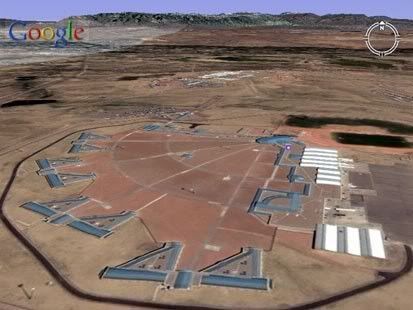
A hundred miles southwest of Denver, the U.S. Penitentiary Administrative Maximum houses a killer lineup of mobsters (Salvatore "Sammy the Bull" Gravano), gang leaders (Barry "The Baron" Mills), assassins (Colombian hit man Dandenis "La Quica" Muñoz Mosquera) and terrorists (John "American Taliban" Walker Lindh). But not to worry — despite some embarrassing security breaches and two inmate homicides in the past two years, ADX has never had anything close to a breakout. It's probably the most escape-proof prison in the world.
For almost six years, it's also been media-proof. High-security prisoners are locked away in the Florence supermax, out of sight and mind — and reporters can't get in to see them, no matter how hard they try.
According to documents obtained by Westword, ADX officials have denied every single media request for a face-to-face interview with supermax prisoners from January 2002 through May 2007. It doesn't matter if the request comes from a major news organization or a humble local TV station; it doesn't matter if the prisoner is a high-profile resident or an obscure career criminal. Contrary to bureau policy, prison brass have turned down every journalist, citing boilerplate "security concerns" if no handier excuse is available.
Blanket denial of access appears to have started after the September 11 attacks. When Westword sought an interview with inmate Thomas Silverstein last spring, ADX warden Ron Wiley refused. The BOP "makes every effort" to accommodate media requests, Wiley explained, but "granting your request at this time may disrupt the good order and security of this institution."
Silverstein hasn't been granted a face-to-face with any journalist for more than a decade. But further inquiry revealed that Wiley wasn't turning us down because of who the subject was; prison spokesman Isidro Garcia acknowledged that the cited security concerns applied to any interview with any prisoner.
So when was the last time ADX allowed a prisoner to be interviewed? Garcia said he wasn't authorized to release that information.
After months of Freedom of Information Act requests and side battles, the answer finally arrived. There have been exactly 100 media requests to visit ADX since 2002, and Wiley and his predecessors have denied every single one. In fact, one of the last interviews to be conducted inside the supermax before the total media ban was Westword's visit with La Quica in 2001, four months before the September 11 attacks ("The Hit Man Nobody Knows," May 17, 2001).
In 23 cases, the reason cited for the denial was that the inmate declined to be interviewed. Another eighteen were turned down because the inmate in question is subject to special administrative measures (SAMs), including a ban on all media contact. (The BOP blacked out the names of the inmates out of privacy concerns, but virtually all SAMs inmates are convicted terrorists.) Three were rejected because the requests came from academics or free-lancers who aren't considered legitimate journalists by the BOP. But more than 50 percent of the denials cited unspecified "security concerns" — because, well, any visit by any outsider could, in theory, disrupt the good order and security of the government's most insecure supermax.
CNN, the Washington Post, 60 Minutes, Newsday — they were all turned down flat. So was the tabloid press, both foreign and domestic, from America's Most Wanted to American Gangsters to some dubious offshoots of the BBC and the Tokyo Broadcasting System. Well-known authors of books on terrorism, including Peter Lance and Lawrence Wright, were barred from interviewing prisoners with ties to radical Islam. Even the Cañon City Record, practically the prison's hometown newspaper, couldn't get in the door.
Journalists who simply wanted a tour of the place, free of any contact with prisoners, fared no better. Fast Food Nation author Eric Schlosser, who's been working on a book about the American prison system for several years, sent a plaintive three-page letter to the warden in 2004, offering to let prison officials review "any physical description of the facility and its staff that I write" before publication. No dice.
"I think ADX Florence may be America's most important prison," Schlosser wrote. "Denying me access to ADX Florence will not prevent me from writing about the facility. It will only make it harder for me to give a fully accurate depiction of the facility's aims and practices."
Schlosser was seeking what all self-respecting journalists want — the ability to see the situation for themselves. Without any access to the country's most important prison, reporters have been reduced to repackaging accounts from the inmates themselves. Eric Rudolph, for example, has been a prolific correspondent for publications ranging from Time magazine to the Colorado Springs Gazette, giving his own take on life inside "Bomber's Row" at ADX. But the view from lockdown can be quite limited, and prisoners can be punished if they write too freely. They are not supposed to mention other prisoners or provide physical details that might mess with the good order and security of the institution.
BOP policy states that a warden can suspend all media visits during "an institutional emergency" but provides no other basis for an ongoing ban on inmate interviews. Warden Wiley refused a request for an interview about the five-year ban at ADX or when it might be lifted.