The New York Times reports:
Last May, a Saudi Arabian conglomerate bought a Massachusetts plastics maker. In November, a French company established a new factory in Adrian, Mich., adding 189 automotive jobs to an area accustomed to layoffs. In December, a British company bought a New Jersey maker of cough syrup.
For much of the world, the United States is now on sale at discount prices. With credit tight, unemployment growing and worries mounting about a potential recession, American business and government leaders are courting foreign money to keep the economy growing. Foreign investors are buying aggressively, taking advantage of American duress and a weak dollar to snap up what many see as bargains, while making inroads to the world’s largest market.
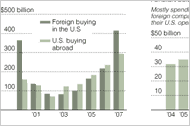
Last year, foreign investors poured a record $414 billion into securing stakes in American companies, factories and other properties through private deals and purchases of publicly traded stock, according to Thomson Financial, a research firm. That was up 90 percent from the previous year and more than double the average for the last decade. It amounted to more than one-fourth of all announced deals for the year, Thomson said.
During the first two weeks of this year, foreign businesses agreed to invest another $22.6 billion for stakes in American companies — more than half the value of all announced deals. If a recession now unfolds and the dollar drops further, the pace could accelerate, economists say.
The surge of foreign money has injected fresh tension into a running debate about America’s place in the global economy. It has supplied state governors with a new development strategy — attracting foreign money. And it has reinvigorated sometimes jingoistic worries about foreigners securing control of America’s fortunes, a narrative last heard in the 1980s as Americans bought up Hondas and Rockefeller Center landed in Japanese hands.
With a growing share of investment coming from so-called sovereign wealth funds — vast pools of money controlled by governments from China to the Middle East — lawmakers and regulators are calling for greater scrutiny to ensure that foreign countries do not gain influence over the financial system or military-related technology. On the presidential campaign trail, the Democratic candidates have begun to focus on these foreign funds, calling for international rules that would make them more transparent.
Debate is swirling in Washington about the best way to stimulate a flagging economy. Despite divided opinion about the merits, foreign investment may be preventing deeper troubles by infusing hard-luck companies with cash and keeping some in business.
The most conspicuous beneficiaries are Wall Street banks like Merrill Lynch, Citigroup and Morgan Stanley, which have sold stakes to government-controlled funds in Asia and the Middle East to compensate for calamitous losses on mortgage markets. Beneath the headlines, a more profound shift is under way: Foreign entities last year captured stakes in American companies in businesses as diverse as real estate, steel-making, energy and baby food.
The influx is the result of a confluence of factors that have made the United States both reliant on the largesse of foreigners and an alluring place for opportunistic investors. With American banks reeling from the housing downturn and loath to lend, businesses are hungry for cash.
The weak dollar has made American companies and properties cheaper in global terms, particularly for European and Canadian buyers. Even as Americans confront the prospect of a recession, economic growth remains strong worldwide, endowing oil producers like Saudi Arabia and Russia and export powers like China and Germany with abundant cash.
As the German company ThyssenKrupp Stainless broke ground in November on what is to be a $3.7 billion stainless steel plant in Calvert, Ala., its executives spoke effusively about the low cost of production in the United States and the chance to reach many millions of customers — particularly because of the North American Free Trade Agreement, which allows goods to flow into Mexico and Canada free of duty.
“The Nafta stainless steel market has great potential, and we’re committed to significantly expanding our business in this growth region,” said the company’s chairman, Jürgen H. Fechter, according to a statement.
Foreign giants like Toyota Motor and Sony have been sinking capital into American plants. Investment in the American subsidiaries of foreign companies grew to $43.3 billion last year from $39.2 billion the previous year, according to the research and consulting firm OCO Monitor.
“This is a vote of confidence in the American economy, the American marketplace and the American worker,” the deputy Treasury secretary, Robert M. Kimmitt, said. “These investments keep Americans employed and keep balance sheets strong.”
Five million Americans now work for foreign companies set up in the United States, Mr. Kimmitt said, and those jobs pay 30 percent more than similar work at domestic companies. Nearly a third of such jobs are in manufacturing, which explains why Rust Belt states have been wooing foreign investment.
“We’ve lost 400,000 manufacturing jobs,” said Michigan’s governor, Jennifer M. Granholm, a Democrat, who has traveled three times to Europe and twice to Japan in pursuit of investment since taking office in 2003. “I’ve got to get jobs for our people.”
Some labor unions see the acceleration of foreign takeovers as the latest indignity wrought by globalization.
“It’s the culmination of a series of fool’s errands,” said Leo W. Gerard, international president of the United Steelworkers. “We’ve hollowed out our industrial base and run up this massive trade deficit, and now the countries that have built the deficits are coming back to buy up our assets. It’s like spitting in your face.”
Other labor groups take a more pragmatic view.
“We need investment and we need to create good jobs,” said Thea Lee, policy director for the A.F.L.-C.I.O. in Washington. “We’re not in the position to be too choosy about where that investment comes from. But it does bring home the consequences of flawed trade policies over many, many years that we’re in this position of being dependent.”
At the center of concern is the growing influence of sovereign wealth funds, which invested $21.5 billion in American companies last year, according to Thomson. Analysts say they could skew markets by investing to improve the fortunes of their national companies or to pursue political goals.
“This is a phenomenon that could be called the growth of state capitalism as opposed to market capitalism,” said Jeffrey E. Garten, a trade expert at the Yale School of Management. “The United States has not ever been on the receiving end of this before.”
Perhaps emblematic of national ambivalence, in an appearance on CNBC last week, the voluble market analyst Jim Cramer spoke in menacing terms about the growing role of state investment funds from the Middle East and China.
“Do we want the communists to own the banks, or the terrorists?” Mr. Cramer asked. “I’ll take any of it, I guess, because we’re so desperate.”
Proponents of investment from overseas note that finance from sovereign wealth funds is a mere trickle of the overall flow from abroad. Indeed, the bulk comes from Europe, Canada and Japan. Just as Americans have scattered investments around the world in pursuit of profit — with holdings of foreign stock and debt exceeding $6 trillion in 2006, according to the Treasury Department — foreigners are looking to the United States, with their capital generating economic activity, proponents say.
If fear of foreign money now inspires Americans to erect new barriers, that would damage the economy, said Todd M. Malan, president of the Organization for International Investment, a Washington lobbying group financed by foreign companies.
“The policy choices on the negative side would have enormous economic implications that would make the current situation look like a bubble bath,” he said.
Tensions spawned by foreign investment hark back to the 1980s, when Japan snapped up prominent American businesses like Columbia Pictures, and some intoned that the American way of life was under assault. The new wave of foreign money is washing in at an even more important time, analysts say.
The United States has lost more than three million manufacturing jobs since 2001, with foreign trade often taking the blame. Foreign-made goods now account for roughly one-third of all wares consumed in the United States, roughly tripling their share over the last quarter-century. The soaring price of oil and a widening trade deficit underscore how the American economy is increasingly vulnerable to decisions made far away.
In 2005, Congressional opposition scuttled a bid by the state-owned Chinese energy company Cnooc to buy the American oil company Unocal. The following year, furor on Capitol Hill prevented DP World, a company based in the United Arab Emirates, from buying several major American ports.
No such outcry has greeted the purchase of stakes in major Wall Street banks by state investment funds in the United Arab Emirates, Kuwait, China, Singapore and South Korea. This is largely because the banks sold passive slices and ceded no formal control, which would have set off a federal review of the national security implications. But the silence also reflects the imperative that these enormous institutions swiftly secure cash.
“It would be good if these companies didn’t need all this capital and better if the capital was available in the United States,” said Senator Charles E. Schumer, Democrat of New York, who was a vocal opponent of the DP World deal. “But given the situation that these institutions find themselves in and the fact that there’s a pretty strong credit squeeze, there’s only two choices: Have foreign companies invest in these firms or have massive layoffs.”
In years past, particularly when Japanese money washed in, many foreign purchases proved not to be so prudent in the end. This time, with the dollar weak and troubled American companies in a poor bargaining position, the prices really do seem cheap, some economists say.
“They’re buying financial assets at well under book value,” said Gary C. Hufbauer, a trade expert at the Peterson Institute for International Economics.
Trade experts assume tensions will rise as developing countries — which tend to have more state companies — continue to expand their share of investment in the United States.
Canada still spends the most money buying stakes in American companies — more than $65 billion in 2007, according to Thomson. But other countries’ purchases are growing rapidly. South Korea’s investments swelled to more than $10.4 billion last year from just $5.4 million in 2000. Russia went to $572 million from $60 million in that span; India to $3.3 billion from $364 million.
But even if political tension increases, so will the flow of foreign money, some analysts say, for the simple reason that businesses need it.
“The forces sucking in this capital are much bigger than the political forces,” said Mr. Garten, the Yale trade expert. “If there is a big controversy, it will be between Washington on the one hand and corporate America on the other. In that contest, the financiers and the businessmen are going to win, as they always do.”
Sunday, January 20, 2008
| [+/-] |
Overseas Investors Buy Aggressively in U.S. |
Saturday, November 17, 2007
| [+/-] |
Oil Leaders' Private Debate Televised By Mistake |
'Kill the cable, kill the cable,' shouted the security guard as he burst through the double doors into the media room at the Intercontinental Hotel in Riyadh, followed by Saudi police. It was too late.
The Observer reports:
A private meeting of Opec leaders, gathered this weekend in Riyadh for the cartel's third meeting in its 47-year history, had just been broadcast to the world's media for more than half an hour after a technician had mistakenly plugged the TV feed into the wrong socket. The facade of unity that the cartel so carefully cultivates to a world spooked by soaring oil prices was shattered.
Sometimes, such innocent mistakes can have far-reaching economic and political consequences. Commodity and currency traders said this weekend that oil prices would surge again tomorrow - possibly breaking the $101 per barrel record set in the late 1970s - while the already battered dollar would fall further on the back of the unintentional broadcast.
On Friday night, during what the participants thought were private talks, Venezuela's oil minister Venezuela Rafael Ramirez and his Iranian counterpart Gholamhossein Nozari, argued that pricing - and selling - oil using the crippled dollar was damaging the cartel.
They said Opec should formally express its concern about the weakness of the dollar when the cartel makes its official declaration at the close of the summit today. But the Saudis, the world's largest oil producers and de facto head of Opec, vetoed the proposal. Saud al-Faisal, the Saudi foreign minister, warned that even the mere mention to journalists of the fact that leaders were discussing the weak dollar would cause the US currency to plummet.
Unfortunately his words and those of everyone at the meeting were being broadcast via a live television feed to a group of astonished reporters. 'I couldn't believe it,' said one who was there. 'When I realised they didn't know they were being broadcast live, I frantically started taking notes.'
Opec only realised that the leaders' row was being broadcast to the world when the Reuters news agency put out a report of the argument.
The weakness of the dollar is one reason why oil prices are so high, as cartel members seek to compensate for their lower earnings. This means a further drop in the dollar is likely to be accompanied by a rise in oil prices.
Friday, November 2, 2007
| [+/-] |
Sinking Currency, Sinking Country |
Pat Buchanan writes:
The euro, worth 83 cents in the early George W. Bush years, is at $1.45.
The British pound is back up over $2, the highest level since the Carter era. The Canadian dollar, which used to be worth 65 cents, is worth more than the U.S. dollar for the first time in half a century.
Oil is over $90 a barrel. Gold, down to $260 an ounce not so long ago, has hit $800.
Have gold, silver, oil, the euro, the pound and the Canadian dollar all suddenly soared in value in just a few years?
Nope. The dollar has plummeted in value, more so in Bush's term than during any comparable period of U.S. history. Indeed, Bush is presiding over a worldwide abandonment of the American dollar.
Is it all Bush's fault? Nope.
The dollar is plunging because America has been living beyond her means, borrowing $2 billion a day from foreign nations to maintain her standard of living and to sustain the American Imperium.
The prime suspect in the death of the dollar is the massive trade deficits America has run up, some $5 trillion in total since the passage of NAFTA and the creation of the World Trade Organization in 1994.
In 2006, that U.S. trade deficit hit $764 billion. The current account deficit, which includes the trade deficit, plus the net outflow of interest, dividends, capital gains and foreign aid, hit $857 billion, 6.5 percent of GDP. As some of us have been writing for years, such deficits are unsustainable and must lead to a decline of the dollar.
A sinking dollar means a poorer nation, and a sinking currency has historically been the mark of a sinking country. And a superpower with a sinking currency is a contradiction in terms.
What does this mean for America and Americans?
As nations realize that the dollars they are being paid for their products cannot buy in the world markets what they once did, they will demand more dollars for those goods. This will mean rising prices for the imports on which America has become more dependent than we have been since before the Civil War.
U.S. tourists traveling to the countries whence their ancestors came will find that the money they saved up does not go as far as they thought.
U.S. soldiers stationed overseas will find the cost of rent, gasoline, food, clothing and dining out takes larger and larger bites out of their paychecks. The people those U.S. soldiers defend will be demanding more and more of their money.
U.S. diplomats stationed overseas, students and businessmen are already facing tougher times.
U.S. foreign aid does not go as far as it did. And there is an element of comedy in seeing the United States going to Beijing to borrow dollars, thus putting our children deeper in debt, to send still more foreign aid to African despots who routinely vote the Chinese line at the United Nations.
The Chinese, whose currency is tied to the dollar, and Japan will continue, as long as they can, to keep their currencies low against the dollar. For the Asians think long term, and their goals are strategic.
China — growing at 10 percent a year for two decades and now growing at close to 12 percent — is willing to take losses in the value of the dollars it holds to keep the U.S. technology, factories and jobs pouring in, as their exports capture America's markets from U.S. producers.
The Japanese will take some loss in the value of their dollar hoard to take down Chrysler, Ford and GM, and capture the U.S. auto market as they captured our TV, camera and computer chip markets.
Asians understand that what is important is not who consumes the apples, but who owns the orchard.
Other nations that have kept cash reserves in U.S. Treasury bonds and T-bills are watching the value of these assets sink. Not fools, they will begin, as many already have, to divest and diversify, taking in fewer dollars and more euros and yen. As more nations abandon the dollar, its decline will continue.
The oil-producing and exporting nations, with trade surpluses, like China, have also begun to take the stash of dollars they have and stuff them into sovereign wealth funds, and use these immense and growing funds to buy up real assets in the United States — investment banks and American companies.
Nor is there any end in sight to the sinking of the dollar. For, as foreigners demand more dollars for the oil and goods they sell us, the trade deficit will not fall. And as the U.S. government prints more and more dollars to cover the budget deficits that stretch out — with the coming retirement of the baby boomers — all the way to the horizon, the value of the dollar will fall. And as Ben Bernanke at the Fed tries to keep interest rates low, to keep the U.S. economy from sputtering out in the credit crunch, the value of the dollar will fall.
The chickens of free trade are coming home to roost.
Friday, April 27, 2007
| [+/-] |
Dollar's Drop Challenges U.S. Power |
Steven C. Johnson at Global Policy Forum writes:
The United States may have no military equals, but the challenges to its financial power have become impossible to ignore. A stark reminder came on Friday when the weakening dollar slumped to a record low against its main rival, the euro, after the U.S. economy recorded its fourth consecutive quarter of below-trend growth. The euro hit a record high of $1.3680.
The strength of the dollar is more than just a matter of bragging rights. Experts say the consequences of its long-term decline could have deep significance - for average Americans and for the country's position as an unrivaled global power. Over time, the forces behind its decline could further marginalize the United States on the world stage, lower its standard of living and tie its hands in responding to crucial security issues or financial crises.
"We can no longer view ourselves as king of the hill," said Leo Melamed, chairman emeritus of the Chicago Mercantile Exchange and founder of the world's first market for financial futures. "There are a lot of other potential kings now vying to take our place."
For most of the 20th century, things were different. The United States was the only country that was stronger at the end of World War II than at start. Since the end of the Cold War, however, foreign rivals have knocked it off its pedestal in a host of economic rankings. Today, China is growing more rapidly than the United States, and many investors and historians alike see the European Union as its economic equal. Wall Street seems to be losing its edge, too, even though the Dow Jones industrial average of 30 major U.S. stocks closed at a record high this week. Companies that would once have turned to New York to raise money now increasingly go public on exchanges in London and Hong Kong. To students of history, the situation looks like a rerun of the decline in Britain 60 years ago, when massive postwar debt and a sharp slide in the pound forced the dissolution of the empire and marked the end of Britain's days as a major world power.
"The United States is a power, but it's hardly the only power, and it's certainly not a superpower anymore," said Jim Rogers, who co-founded the Quantum hedge fund with the billionaire investor George Soros in the 1970s. The dollar is perhaps the biggest problem. As a net debtor, the United States must attract some $3 billion every working day to finance a gaping current account deficit that in 2006 amounted to 6.5 percent of gross domestic product. Economic rivals like China and Japan, on the other hand, boast massive surpluses.
Since Americans also spend more than they save, the money to cover the U.S. deficit must come from foreign lenders like central banks. China, which holds more than $1 trillion in foreign currency reserves, is one of the biggest creditors. As the dollar has steadily weakened over the past year, the value of the dollar-denominated assets held by central banks has also declined. The trend may motivate foreigners to start holding more euros instead, exacerbating pressure on the dollar and leading to faster U.S. inflation rates and a declining standard of living. That is increasingly possible because euro-denominated debt today accounts for a bigger share of the international bond market than do dollar-based securities.
That also means that oil exporters could find it easier to start pricing crude in euros, Rogers said, adding to the financial burden on the United States, the world's biggest consumer of oil. While a weaker dollar may bolster U.S. exports and the profits of American companies with overseas operations, weaker foreign demand for U.S. Treasury bonds would push up long-term interest rates, raising mortgage payments for U.S. homeowners and borrowing costs for an indebted government.
"I don't see that it's possible to avoid a weakening of a country's power projection if it doesn't have the fiscal muscle to sustain that power," said Paul Kennedy, history professor at Yale University and author of "The Rise and Fall of the Great Powers." There is a potential upside to the dollar's fall. For one thing, its decline would help shrink the massive U.S. trade deficit. Some economists also argue that competition between countries is part of globalization's rising tide that will eventually lift all boats.
"If China does well, it doesn't put the United States out of business but creates opportunities to sell to richer Chinese consumers," said Sebastian Mallaby, senior fellow for International Economics at the Council on Foreign Relations in Washington. Others worry about America's global reach, especially as the war in Iraq strains both U.S. finances and credibility.
"We are doing terrible damage to ourselves , and the Chinese, who are more patient and much shrewder than we are, are simply sitting back and acting in many parts of the world with increasing influence," said Zbigniew Brzezinski, a former national security adviser under President Jimmy Carter. Indeed, the economic leverage China holds over the United States may one day allow it to absorb Taiwan without a fight, said H.W. Brands, a University of Texas history professor and author of "The Money Men: Capitalism, Democracy, and the Hundred Years' War Over the American Dollar."
A similar scenario, he said, played out during the U.S. Civil War in the 1860s, when the British government opted against intervening on behalf of the breakaway Confederate states because the country depended on American grain to feed its populace. Of course, the ebb and flow of global power is a slow process. Kennedy noted that "it took the Ottoman Empire 450 years to decline, and the Hapsburgs 300." But the sweep of history can be difficult to avoid. "Historically, no country that has gotten itself into this situation has ever come out without a crisis," Rogers said. "We're in a great amount of trouble."
