From the Daily Sundial:
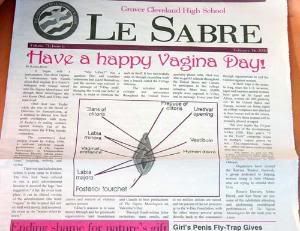
Vagina, a six-letter word that has caused an uproar at Cleveland High School. The school's administration has deemed the word "obscene." This is an accreditation year for the school, which is why such a commotion is not surprising.
A special Vagina Day edition of the school's newspaper Le Sabre was distributed on Feb. 14. The newspapers were dispensed during first period, with one headline reading, "Have a Happy Vagina Day!" Administration officials intercepted the stack of papers from being delivered to the rest of the school.
Immediately following, Principal Robert Marks spoke with Editor in Chief Richard Edmond to discuss why he was pulling the paper. He claimed Edmond's own political agenda was a factor in why the paper in itself was so "obscene."
Edmond said that Marks told him the paper was "a piece of shit" that should be handed out on Hollywood Boulevard."
Edmond said the staff understands that they are producing a newspaper for a high school audience, but they are also aware that an anatomical diagram of the vagina is something each high school student has seen in their Los Angeles Unified School District mandated Health class.
An announcement was made during second period instructing teachers to not pass out the paper, as remaining papers were to be collected by the deans and vice principals. However, supportive teachers passed out the papers willingly, seeing no problem with the articles.
During third and fourth period, newspapers were still in circulation despite the efforts made by teachers and the administration.
The faculty was divided in their initial reaction to the issue. Some teachers were reported to have been ripping up the issue in front of their classes, even taking issues already in the possession of students to do so.
A number of students were passing out stacks of papers during lunch as administrators were ripping papers out of the hands of interested students as they were reading them.
Journalism advisor Coleen Bondy, who didn't want to be quoted, was instructed by Marks to not distribute any remaining issues she had in her classroom during fifth period.
Monday, February 18, 2008
| [+/-] |
V-Day Censored At A Local High School |
Tuesday, February 5, 2008
| [+/-] |
Election Officials Probe Use of 'Magic' Invisible Ink Pens in 49th Ward |
The Chicago-Tribune reports:
Chicago election officials Tuesday afternoon were trying to unravel the mystery of the incredible invisible ink.
It's no Agatha Christie novel but a real case for election investigators sent to the 49th Ward's 42nd precinct Tuesday morning, after 20 ballots were cast with "magic" invisible ink pens.
Election officials just smirked, shook their heads in disbelief and called it the most bizarre election snafu in recent memory.
Apparently, said city election board spokesman James Allen, the poll workers told incredulous voters—including one spouse of an election judge—that the stylus used for touch-screen voting was actually an inkless pen to fill out paper ballots.
"You spend months trying to prepare for every contingency," Allen said. "Trying to anticipate every possible way people might be confused . . . then this? Incredible."
Even the ballot scanning machine knew better, he said, rejecting all 20 ballots as blank.
"Each time, the judges overrode the scanner and recorded the vote," he said.
By 3 p.m., only five of the 20 voters had been contacted to return to recast their votes.
"I'm incredibly angry, and I feel so dumb," said Amy Carlton, 38, of Rogers Park. "And I am not a dumb person."
Carlton said all the judges at the polling place insisted that they had been trained in the use of the "magic" pens.
"I've voted before," Carlton said. "I was thinking, 'This is crazy,' but when someone in authority insists, what are you supposed to do?"
Election officials were encouraging any affected voters to call 312-269-7870. They said those voters can recast their votes if they return to the polling place.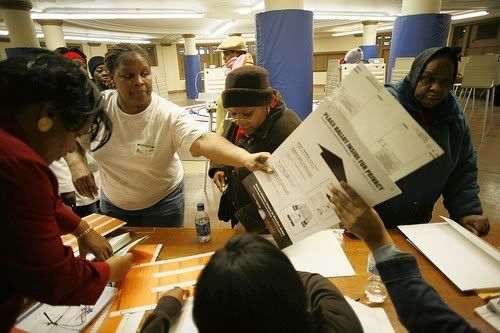

Sunday, January 27, 2008
| [+/-] |
Why Congress Didn't Bring The Troops Home |
The Democratic majority squandered chances to work with Republicans unhappy with Bush and tried to bully their rivals.
(Dennis Cook / Associated Press)
The Los Angeles Times reports:
To a crescendo of clicking cameras, House Speaker Nancy Pelosi stepped before a row of shimmering U.S. flags last March to make an announcement Americans had been waiting four months to hear.
November's elections had swept Democrats into power on a wave of frustration with the Iraq war. Now, flanked by three committee chairmen in her ceremonial Capitol office, the San Francisco congresswoman prepared to unveil the party's plan to bring the troops home.
"The American people called for a new direction," the speaker said, trying to give voice to the historic moment. "That's what this bill does."
There was just one problem. Pelosi had no answer for a simple question: Would the plan get any GOP support?
"I'm the last person to ask about Republican votes," she said curtly.
The speaker's dismissive comment drew little attention that morning. But it was telling. Today, the legislative drive against the war -- the most intense on Capitol Hill since the Vietnam era -- is all but over. As Wisconsin Sen. Russ Feingold, a leading antiwar Democrat, bluntly put it: "We have made no progress."
What happened?
The answer lies partly in the slim Democratic majority and a determined Republican president.
But it was the new Democratic majority's inability to work across the aisle that ultimately ensured failure.
Like the Republicans they had replaced, senior Democrats chose confrontation over cooperation.
They squandered opportunities to work with Republicans unhappy with the president.
And, under pressure from their antiwar base, they tried to bully their rivals.
"Even now, I fail to understand how we think we can stop the war unless we bring in Republicans," said Hawaii Rep. Neil Abercrombie, one of the liberal Democrats who challenged his party's strategy.
Unintended outcome
Democrats -- and even many Republicans -- had expected a far different result.
When GOP senators sat down for a tense luncheon in the Capitol's wood-paneled Mansfield Room last January, their party was in turmoil.
President Bush's decision to send additional troops to Iraq, combined with the party's election losses, infuriated many lawmakers. As Vice President Dick Cheney sat silently, a heated debate erupted.
Virginia Sen. John W. Warner, a white-haired veteran of two wars, rose to express deep concern that the U.S. military was caught in a civil war in Iraq. On the other side, Arizona's John McCain and South Carolina's Lindsey Graham passionately warned that retreat would spell disaster.
"It was a very difficult time," recalled Graham, who struggled that afternoon to prevent a full-scale revolt. "Republicans wanted to drop Iraq like a hot potato."
Senate Democrats were trying to capitalize on the dissent with a resolution that would simply express opposition to the troop buildup.
Senate Majority Leader Harry Reid, a conservative Democrat from Nevada who had worked often with Republicans, turned to Warner.
His decision to effectively cede control of the war debate to a lawmaker from the president's party was the calculation of a veteran tactician. Democrats had taken control of the Senate by the narrowest of margins, 51-49. (The chamber's two independents typically side with the Democrats.) If they wanted to force the president to do anything, they would need as many as a dozen Republicans to overcome a filibuster.
But Reid, a former boxer, was also a fierce partisan who had excelled as a leader by keeping Democrats together. That impulse would be decisive.
As Warner walked the hallways of the Senate trying to find GOP votes and proposed weakening the resolution, the staunchest antiwar members of Reid's caucus grew increasingly restive.
Within days, Feingold said he would oppose the resolution. So too did Connecticut's Christopher J. Dodd, another liberal Democrat. Reid, who was skeptical that Warner could deliver enough Republicans, cut off debate. GOP senators killed the measure on a procedural vote.
After just four weeks, the drive to build consensus was effectively over.
"It changed the political complexion of the debate and the environment," said Maine Sen. Olympia J. Snowe, a moderate Republican who had worked on the resolution.
The quick demise of the anti-surge resolution prompted Democrats to focus inward. The party, which had done little to develop a consensus antiwar strategy, was in turmoil.
Grass-roots groups that had helped elect Democrats were clamoring for legislation to restrict war funding and compel a swift withdrawal. So, too, was the nearly 80-strong House Out of Iraq caucus, one of whose leaders, Rep. Maxine Waters (D-Los Angeles), would get in a shouting match with Pelosi at a packed Democratic caucus meeting.
Other Democrats were reluctant to try to end the war by limiting money. "We didn't want to send a message that we weren't going to fund the troops," said Michigan Sen. Carl Levin, the Senate Armed Services Committee chairman.
Pelosi turned to House Appropriations Chairman David R. Obey to write a bill that would bring Democrats together.
Obey, an old-school liberal from rural northern Wisconsin, was a fierce critic of the war. But the 38-year veteran was also someone who could cut deals with Republicans. Obey scorned doctrinaire antiwar Democrats who "didn't want to get any specks on those white robes of theirs." In one confrontation with a soldier's mother who asked Obey to stop paying for the war, the lawmaker exploded in a rant against "idiot liberals."
Republican leaders -- still struggling to keep their caucus from splintering -- worried that Obey would reach out to GOP moderates. "If they had put their hands out . . . there were probably 50 or 60 of my members who could have been there," House Minority Leader John A. Boehner of Ohio said recently. "It could have been a very different outcome."
That was not the task Pelosi handed Obey.
The new speaker, who like Reid had united her party against hard-nosed GOP majorities, had never chaired a committee or drafted major legislation that required bipartisan compromise. She had a frosty relationship with Republican lawmakers. Now, she made it clear to Obey that she wanted a withdrawal timeline.
Drafts upon drafts
Obey and his staff hunkered down in his office for weeks, poring over scores of Democratic proposals. With Obey dictating language over his senior aide's shoulder, they produced draft after draft. Most of them went into a shredder.
Then, over the first weekend in March, they reached for a little-noticed bill filed just days earlier by Rep. Howard Berman (D-Valley Village) that linked pullout dates to the performance of the Iraqi government.
The war-funding bill that Pelosi announced at the March news conference would require the administration to begin withdrawing troops no later than March 2008, and to complete the pullout by August.
Democrats would triumphantly pass the most sweeping antiwar legislation since the Vietnam War. But it had attracted just two Republican votes in the Senate and two in the House, not nearly enough to override a presidential veto.
The Democratic response was to threaten to bury their Republican foes at the polls.
New York Sen. Charles E. Schumer, the combative head of the Democratic Senatorial Campaign Committee, gleefully touted plummeting GOP poll numbers. "They're going to have to break because they're going to have to look . . . extinction in the eye."
Democratic leaders now openly ridiculed compromise proposals from Republicans.
When Indiana Sen. Richard G. Lugar, a soft-spoken Republican and former Foreign Relations chairman, in late June made an earnest call for withdrawing troops, he got a visit from Bush's national security advisor within 48 hours. Democratic leaders ignored him and shut down debate on his proposal to require the Bush administration to submit a withdrawal plan.
Senior Democrats insisted the measure was too weak and would give Republicans political cover.
On the other side of the Capitol, Democrats were attacking their own. Hawaii's Abercrombie, a former Vietnam War protester, was shouted down at a meeting with fellow antiwar Democrats to discuss a similar bill he drafted.
"This was taken as a sign that suddenly I wasn't on the road to Damascus anymore. I had fallen from the true path," Abercrombie said. Pelosi, under pressure from the Out of Iraq caucus, prevented his bill from ever coming up for a vote.
A whiff of revenge
Many Democrats wrongly believed Republicans would break over the August recess when a well-funded antiwar campaign would target many in their districts. This heavy-handed approach had been a hallmark of the way Republicans had run Capitol Hill. Now, GOP lawmakers recoiled at the withdrawal timeline and the smash-mouth tactics.
No Democratic withdrawal measure ever won more than four GOP votes in the House or Senate.
By September, when Army Gen. David H. Petraeus gave Congress an upbeat report about diminishing violence, the Democratic legislative campaign against the war was effectively dead.
Today, Pelosi professes surprise that so few GOP lawmakers joined the Democratic antiwar effort. "I didn't foresee that," she said.
But neither she nor Reid express any regrets.
"We tried everything except yoga," Reid said recently, sitting by a fire in his office on the other side of the Capitol. "Republicans weren't looking for middle ground. . . . We felt we were on track with what the American people wanted."
But, the Congress that began 2007 with a relatively high 35% approval rating now rates just 22%, according to Gallup surveys.
"One of the many messages sent by voters in 2006 was that they were unhappy with the war in Iraq," said Maine Sen. Susan Collins, a moderate Republican. "Another message that was sent and not heard was that they were tired of partisan gridlock."
noam.levey@latimes.com
Sunday, January 20, 2008
| [+/-] |
Overseas Investors Buy Aggressively in U.S. |
The New York Times reports:
Last May, a Saudi Arabian conglomerate bought a Massachusetts plastics maker. In November, a French company established a new factory in Adrian, Mich., adding 189 automotive jobs to an area accustomed to layoffs. In December, a British company bought a New Jersey maker of cough syrup.
For much of the world, the United States is now on sale at discount prices. With credit tight, unemployment growing and worries mounting about a potential recession, American business and government leaders are courting foreign money to keep the economy growing. Foreign investors are buying aggressively, taking advantage of American duress and a weak dollar to snap up what many see as bargains, while making inroads to the world’s largest market.
Last year, foreign investors poured a record $414 billion into securing stakes in American companies, factories and other properties through private deals and purchases of publicly traded stock, according to Thomson Financial, a research firm. That was up 90 percent from the previous year and more than double the average for the last decade. It amounted to more than one-fourth of all announced deals for the year, Thomson said.
During the first two weeks of this year, foreign businesses agreed to invest another $22.6 billion for stakes in American companies — more than half the value of all announced deals. If a recession now unfolds and the dollar drops further, the pace could accelerate, economists say.
The surge of foreign money has injected fresh tension into a running debate about America’s place in the global economy. It has supplied state governors with a new development strategy — attracting foreign money. And it has reinvigorated sometimes jingoistic worries about foreigners securing control of America’s fortunes, a narrative last heard in the 1980s as Americans bought up Hondas and Rockefeller Center landed in Japanese hands.
With a growing share of investment coming from so-called sovereign wealth funds — vast pools of money controlled by governments from China to the Middle East — lawmakers and regulators are calling for greater scrutiny to ensure that foreign countries do not gain influence over the financial system or military-related technology. On the presidential campaign trail, the Democratic candidates have begun to focus on these foreign funds, calling for international rules that would make them more transparent.
Debate is swirling in Washington about the best way to stimulate a flagging economy. Despite divided opinion about the merits, foreign investment may be preventing deeper troubles by infusing hard-luck companies with cash and keeping some in business.
The most conspicuous beneficiaries are Wall Street banks like Merrill Lynch, Citigroup and Morgan Stanley, which have sold stakes to government-controlled funds in Asia and the Middle East to compensate for calamitous losses on mortgage markets. Beneath the headlines, a more profound shift is under way: Foreign entities last year captured stakes in American companies in businesses as diverse as real estate, steel-making, energy and baby food.
The influx is the result of a confluence of factors that have made the United States both reliant on the largesse of foreigners and an alluring place for opportunistic investors. With American banks reeling from the housing downturn and loath to lend, businesses are hungry for cash.
The weak dollar has made American companies and properties cheaper in global terms, particularly for European and Canadian buyers. Even as Americans confront the prospect of a recession, economic growth remains strong worldwide, endowing oil producers like Saudi Arabia and Russia and export powers like China and Germany with abundant cash.
As the German company ThyssenKrupp Stainless broke ground in November on what is to be a $3.7 billion stainless steel plant in Calvert, Ala., its executives spoke effusively about the low cost of production in the United States and the chance to reach many millions of customers — particularly because of the North American Free Trade Agreement, which allows goods to flow into Mexico and Canada free of duty.
“The Nafta stainless steel market has great potential, and we’re committed to significantly expanding our business in this growth region,” said the company’s chairman, Jürgen H. Fechter, according to a statement.
Foreign giants like Toyota Motor and Sony have been sinking capital into American plants. Investment in the American subsidiaries of foreign companies grew to $43.3 billion last year from $39.2 billion the previous year, according to the research and consulting firm OCO Monitor.
“This is a vote of confidence in the American economy, the American marketplace and the American worker,” the deputy Treasury secretary, Robert M. Kimmitt, said. “These investments keep Americans employed and keep balance sheets strong.”
Five million Americans now work for foreign companies set up in the United States, Mr. Kimmitt said, and those jobs pay 30 percent more than similar work at domestic companies. Nearly a third of such jobs are in manufacturing, which explains why Rust Belt states have been wooing foreign investment.
“We’ve lost 400,000 manufacturing jobs,” said Michigan’s governor, Jennifer M. Granholm, a Democrat, who has traveled three times to Europe and twice to Japan in pursuit of investment since taking office in 2003. “I’ve got to get jobs for our people.”
Some labor unions see the acceleration of foreign takeovers as the latest indignity wrought by globalization.
“It’s the culmination of a series of fool’s errands,” said Leo W. Gerard, international president of the United Steelworkers. “We’ve hollowed out our industrial base and run up this massive trade deficit, and now the countries that have built the deficits are coming back to buy up our assets. It’s like spitting in your face.”
Other labor groups take a more pragmatic view.
“We need investment and we need to create good jobs,” said Thea Lee, policy director for the A.F.L.-C.I.O. in Washington. “We’re not in the position to be too choosy about where that investment comes from. But it does bring home the consequences of flawed trade policies over many, many years that we’re in this position of being dependent.”
At the center of concern is the growing influence of sovereign wealth funds, which invested $21.5 billion in American companies last year, according to Thomson. Analysts say they could skew markets by investing to improve the fortunes of their national companies or to pursue political goals.
“This is a phenomenon that could be called the growth of state capitalism as opposed to market capitalism,” said Jeffrey E. Garten, a trade expert at the Yale School of Management. “The United States has not ever been on the receiving end of this before.”
Perhaps emblematic of national ambivalence, in an appearance on CNBC last week, the voluble market analyst Jim Cramer spoke in menacing terms about the growing role of state investment funds from the Middle East and China.
“Do we want the communists to own the banks, or the terrorists?” Mr. Cramer asked. “I’ll take any of it, I guess, because we’re so desperate.”
Proponents of investment from overseas note that finance from sovereign wealth funds is a mere trickle of the overall flow from abroad. Indeed, the bulk comes from Europe, Canada and Japan. Just as Americans have scattered investments around the world in pursuit of profit — with holdings of foreign stock and debt exceeding $6 trillion in 2006, according to the Treasury Department — foreigners are looking to the United States, with their capital generating economic activity, proponents say.
If fear of foreign money now inspires Americans to erect new barriers, that would damage the economy, said Todd M. Malan, president of the Organization for International Investment, a Washington lobbying group financed by foreign companies.
“The policy choices on the negative side would have enormous economic implications that would make the current situation look like a bubble bath,” he said.
Tensions spawned by foreign investment hark back to the 1980s, when Japan snapped up prominent American businesses like Columbia Pictures, and some intoned that the American way of life was under assault. The new wave of foreign money is washing in at an even more important time, analysts say.
The United States has lost more than three million manufacturing jobs since 2001, with foreign trade often taking the blame. Foreign-made goods now account for roughly one-third of all wares consumed in the United States, roughly tripling their share over the last quarter-century. The soaring price of oil and a widening trade deficit underscore how the American economy is increasingly vulnerable to decisions made far away.
In 2005, Congressional opposition scuttled a bid by the state-owned Chinese energy company Cnooc to buy the American oil company Unocal. The following year, furor on Capitol Hill prevented DP World, a company based in the United Arab Emirates, from buying several major American ports.
No such outcry has greeted the purchase of stakes in major Wall Street banks by state investment funds in the United Arab Emirates, Kuwait, China, Singapore and South Korea. This is largely because the banks sold passive slices and ceded no formal control, which would have set off a federal review of the national security implications. But the silence also reflects the imperative that these enormous institutions swiftly secure cash.
“It would be good if these companies didn’t need all this capital and better if the capital was available in the United States,” said Senator Charles E. Schumer, Democrat of New York, who was a vocal opponent of the DP World deal. “But given the situation that these institutions find themselves in and the fact that there’s a pretty strong credit squeeze, there’s only two choices: Have foreign companies invest in these firms or have massive layoffs.”
In years past, particularly when Japanese money washed in, many foreign purchases proved not to be so prudent in the end. This time, with the dollar weak and troubled American companies in a poor bargaining position, the prices really do seem cheap, some economists say.
“They’re buying financial assets at well under book value,” said Gary C. Hufbauer, a trade expert at the Peterson Institute for International Economics.
Trade experts assume tensions will rise as developing countries — which tend to have more state companies — continue to expand their share of investment in the United States.
Canada still spends the most money buying stakes in American companies — more than $65 billion in 2007, according to Thomson. But other countries’ purchases are growing rapidly. South Korea’s investments swelled to more than $10.4 billion last year from just $5.4 million in 2000. Russia went to $572 million from $60 million in that span; India to $3.3 billion from $364 million.
But even if political tension increases, so will the flow of foreign money, some analysts say, for the simple reason that businesses need it.
“The forces sucking in this capital are much bigger than the political forces,” said Mr. Garten, the Yale trade expert. “If there is a big controversy, it will be between Washington on the one hand and corporate America on the other. In that contest, the financiers and the businessmen are going to win, as they always do.”

Saturday, January 19, 2008
| [+/-] |
A New, Global Quandary: Costly Fuel Means Costly Calories |
The New York Times reports:
Rising prices for cooking oil are forcing residents of Asia’s largest slum, in Mumbai, India, to ration every drop. Bakeries in the United States are fretting over higher shortening costs. And here in Malaysia, brand-new factories built to convert vegetable oil into diesel sit idle, their owners unable to afford the raw material.
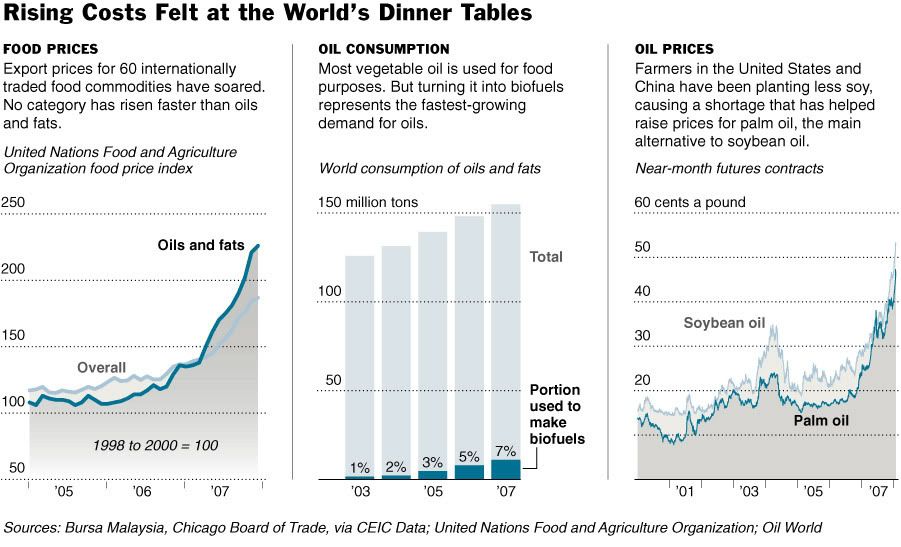
The food price index of the Food and Agriculture Organization of the United Nations, based on export prices for 60 internationally traded foodstuffs, climbed 37 percent last year. That was on top of a 14 percent increase in 2006, and the trend has accelerated this winter.
In some poor countries, desperation is taking hold. Just in the last week, protests have erupted in Pakistan over wheat shortages, and in Indonesia over soybean shortages. Egypt has banned rice exports to keep food at home, and China has put price controls on cooking oil, grain, meat, milk and eggs.
According to the F.A.O., food riots have erupted in recent months in Guinea, Mauritania, Mexico, Morocco, Senegal, Uzbekistan and Yemen.
“The urban poor, the rural landless and small and marginal farmers stand to lose,” said He Changchui, the agency’s chief representative for Asia and the Pacific.
A startling change is unfolding in the world’s food markets. Soaring fuel prices have altered the equation for growing food and transporting it across the globe. Huge demand for biofuels has created tension between using land to produce fuel and using it for food.
A growing middle class in the developing world is demanding more protein, from pork and hamburgers to chicken and ice cream. And all this is happening even as global climate change may be starting to make it harder to grow food in some of the places best equipped to do so, like Australia.
In the last few years, world demand for crops and meat has been rising sharply. It remains an open question how and when the supply will catch up. For the foreseeable future, that probably means higher prices at the grocery store and fatter paychecks for farmers of major crops like corn, wheat and soybeans.
There may be worse inflation to come. Food experts say steep increases in commodity prices have not fully made their way to street stalls in the developing world or supermarkets in the West.
Governments in many poor countries have tried to respond by stepping up food subsidies, imposing or tightening price controls, restricting exports and cutting food import duties.
These temporary measures are already breaking down. Across Southeast Asia, for example, families have been hoarding palm oil. Smugglers have been bidding up prices as they move the oil from more subsidized markets, like Malaysia’s, to less subsidized markets, like Singapore’s.
No category of food prices has risen as quickly this winter as so-called edible oils — with sometimes tragic results. When a Carrefour store in Chongqing, China, announced a limited-time cooking oil promotion in November, a stampede of would-be buyers left 3 people dead and 31 injured.
Cooking oil may seem a trifling expense in the West. But in the developing world, cooking oil is an important source of calories and represents one of the biggest cash outlays for poor families, which grow much of their own food but have to buy oil in which to cook it.
Few crops illustrate the emerging problems in the global food chain as well as palm oil, a vital commodity in much of the world and particularly Asia. From jungles and street markets in Southeast Asia to food companies in the United States and biodiesel factories in Europe, soaring prices for the oil are drawing environmentalists, energy companies, consumers, indigenous peoples and governments into acrimonious disputes.
The oil palm is a stout-trunked tree with a spray of frilly fronds at the top that make it look like an enormous sea anemone. The trees, with their distinctive, star-like patterns of leaves, cover an eighth of the entire land area of Malaysia and even greater acreage in nearby Indonesia.
An Efficient Producer
The palm is a highly efficient producer of vegetable oil, squeezed from the tree’s thick bunches of plum-size bright red fruit. An acre of oil palms yields as much oil as eight acres of soybeans, the main rival for oil palms; rapeseed, used to make canola oil, is a distant third. Among major crops, only sugar cane comes close to rivaling oil palms in calories of human food per acre.
Palm oil prices have jumped nearly 70 percent in the last year because supply has grown slowly while demand has soared.
Farmers and plantation companies are responding to the higher prices, clearing hundreds of thousands of acres of tropical forest to replant with rows of oil palms. But an oil palm takes eight years to reach full production. A drought last year in Indonesia and flooding in Peninsular Malaysia helped constrain supply. Worldwide palm oil output climbed just 2.7 percent last year, to 42.1 million tons.
At the same time, palm oil demand is growing steeply for a variety of reasons around the globe. They include shifting decisions among farmers about what to plant, rising consumer demand in China and India for edible oils, and Western subsidies for biofuel production.
American farmers have been planting more corn and less soy because demand for corn-based ethanol has pushed up corn prices. American soybean acreage plunged 19 percent last year, producing a drop in soybean oil output and inventories.
Chinese farmers also cut back soybean acreage last year, as urban sprawl covered prime farmland and the Chinese government provided more incentives for grain.
Yet people in China are also consuming more oils. China not only was the world’s biggest palm oil importer last year, holding steady at 5.2 million tons in the first 11 months of the year, but it also doubled its soybean oil imports to 2.9 million tons, forcing buyers elsewhere to switch to palm oil.
Concerns about nutrition used to hurt palm oil sales, but they are now starting to help. The oil was long regarded in the West as unhealthy, but it has become an attractive option to replace the chemically altered fats known as trans fats, which have lately come to be seen as the least healthy of all fats.
New York City banned trans fats in frying at food service establishments last summer and will ban them in bakery goods this summer. Across the country, manufacturers are trying to replace trans fats. American palm oil imports nearly doubled in the first 11 months of last year, rising by 200,000 tons.
“Four years ago, when this whole no-trans issue started, we processed no palm here," said Mark Weyland, a United States product manager for Loders Croklaan, a Dutch company that supplies palm oil. “Now it’s our biggest seller.”
Last year, conversion of palm oil into fuel was a fast-growing source of demand, but in recent weeks, rising prices have thrown that business into turmoil.
Here on Malaysia’s eastern shore, a series of 45-foot-high green and gray storage tanks connect to a labyrinth of yellow and silver pipes. The gleaming new refinery has the capacity to turn 116,000 tons a year of palm oil into 110,000 tons of a fuel called biodiesel, as well as valuable byproducts like glycerin. Mission Biofuels, an Australian company, finished the refinery last month and is working on an even larger factory next door at the base of a jungle hillside.
But prices have spiked so much that the company cannot cover all its costs and has idled the finished refinery while looking for a new strategy, such as asking a biodiesel buyer to pay a price linked to palm oil costs, and someday switching from palm oil to jatropha, a roadside weed.
“We took a view that palm oil prices were already high; we didn’t think they could go even higher, and then they did,” said Nathan Mahalingam, the company’s managing director.
Growth in Biofuels
Biofuels accounted for almost half the increase in worldwide demand for vegetable oils last year, and represented 7 percent of total consumption of the oils, according to Oil World, a forecasting service in Hamburg, Germany.
The growth of biodiesel, which can be mixed with regular diesel, has been controversial, not only because it competes with food uses of oil but also because of environmental concerns. European conservation groups have been warning that tropical forests are being leveled to make way for oil palm plantations, destroying habitat for orangutans and Sumatran rhinoceroses while also releasing greenhouse gases.
The European Union has moved to restrict imports of palm oil grown in unsustainable ways. The measure has incensed the Malaysian palm oil industry, which had plunged into biofuel production in part to satisfy European demand.
Another controversy involves the treatment of indigenous peoples whose lands have been seized by oil plantations. This has been a particular issue on Borneo.
Anne B. Lasimbang, executive director of the Pacos Trust in the Malaysian state of Sabah in northern Borneo, said that while some indigenous people had benefited from selling palm oil that they grow themselves, many had lost ancestral lands with little to show for it, including lands that used to provide habitats for endangered orangutans.
“Finally, some of the pressures internationally have trickled down. Some of the companies are more open to dialogue; they want to talk to communities,” said Ms. Lasimbang, a member of the Dusun indigenous group. “On our side, we are still suspicious.”
Demand Outstrips Supply
As the multiple conflicts and economic pressures associated with palm oil play out in the global economy, the bottom line seems to be that the world wants more of the oil than it can get.
Even in Malaysia, the center of the global palm oil industry for half a century, spot shortages have cropped up. Recently, as wholesale prices soared, cooking oil refiners complained of inadequate subsidies and cut back production of household oil, sold at low, regulated prices.
Street vendors in the capital, Kuala Lumpur, complain that they cannot find enough cooking oil to prepare roti canai, the flatbread that is the national snack. “It’s very difficult; it’s hard to find,” said one vendor who gave only his first name, Palani, after admitting that he was secretly buying cooking oil intended for households instead of paying the much higher price for commercial use.
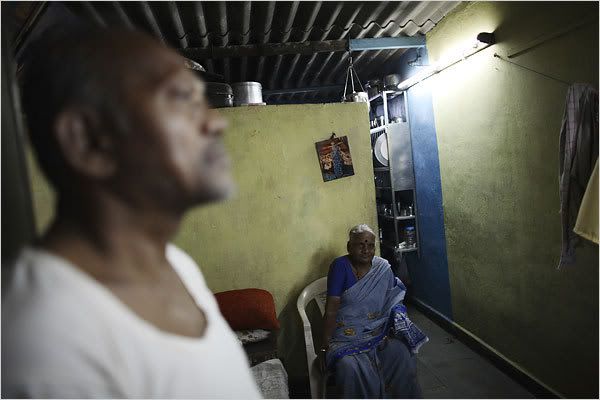
Many of the hardest-hit victims of rising food prices are in the vast slums that surround cities in poorer Asian nations. The Kawle family in Mumbai’s sprawling Dharavi slum, a household of nine with just one member working as a laborer for $60 a month, is coping with recent price increases for palm oil.
The family has responded by eating fish once a week instead of twice, seldom cooking vegetables and cutting its monthly rice consumption. Next to go will be the weekly smidgen of lamb.
“If the prices go up again,” said Janaron Kawle, the family patriarch, “we’ll cut the mutton to twice a month and use less oil.”"The Struggle for Palm Oil" (photos by Michael Rubenstein for The New York Times) In the developing world, cooking oil is an important source of calories and represents one of the biggest cash outlays for poor households. A steep rise in prices for palm oil has forced many families in Dharavi, a sprawling slum in Mumbai, India, to use less oil or even cut back on food:







Tuesday, January 15, 2008
| [+/-] |
The Story Behind CIA Tapes' Destruction |
Official Had Implicit Approval, Lawyer Says
 Jose A. Rodriguez Jr. is a key figure in the CIA tape case. (AP)
The Washington Post reports:
In late 2005, the retiring CIA station chief in Bangkok sent a classified cable to his superiors in Langley asking if he could destroy videotapes recorded at a secret CIA prison in Thailand that in part portrayed intelligence officers using simulated drowning to extract information from suspected al-Qaeda members.
The tapes had been sitting in the station chief's safe, in the U.S. Embassy compound, for nearly three years. Although those involved in the interrogations had pushed for the tapes' destruction in those years and a secret debate about it had twice reached the White House, CIA officials had not acted on those requests. This time was different.
The CIA had a new director and an acting general counsel, neither of whom sought to block the destruction of the tapes, according to agency officials. The station chief was insistent because he was retiring and wanted to resolve the matter before he left, the officials said. And in November 2005, a published report that detailed a secret CIA prison system provoked an international outcry.
Those three circumstances pushed the CIA's then-director of clandestine operations, Jose A. Rodriguez Jr., to act against the earlier advice of at least five senior CIA and White House officials, who had counseled the agency since 2003 that the tapes should be preserved. Rodriguez consulted CIA lawyers and officials, who told him that he had the legal right to order the destruction. In his view, he received their implicit support to do so, according to his attorney, Robert S. Bennett.
In a classified response to the station chief, Rodriguez ordered the tapes' destruction, CIA officials say. The Justice Department and the House intelligence committee are now investigating whether that deed constituted a violation of law or an obstruction of justice. John A. Rizzo, the CIA's acting general counsel, is scheduled to discuss the matter in a closed House intelligence committee hearing scheduled for today.
According to interviews with more than two dozen current and former U.S. officials familiar with the debate, the taping was conducted from August to December 2002 to demonstrate that interrogators were following the detailed rules set by lawyers and medical experts in Washington, and were not causing a detainee's death.
The principal motive for the tapes' destruction was the clandestine operations division's worry that the tapes' fate could be snatched out of their hands, the officials said. They feared that the agency could be publicly shamed and that those involved in waterboarding and other extreme interrogation techniques would be hauled before a grand jury or a congressional inquiry -- a circumstance now partly unfolding anyway.
"The professionals said that we must destroy the tapes because they didn't want to see the pictures all over television, and they knew they eventually would leak," said a former agency official who took part in the discussions before the tapes were pulverized. The presence of the tapes in Bangkok and the CIA's communications with the station chief there were described by current and former officials.
Congressional investigators have turned up no evidence that anyone in the Bush administration openly advocated the tapes' destruction, according to officials familiar with a set of classified documents forwarded to Capitol Hill. "It was an agency decision -- you can take it to the bank," CIA Director Michael V. Hayden said in an interview on Friday. "Other speculations that it may have been made in other compounds, in other parts of the capital region, are simply wrong."
Many of those involved recalled conversations in which senior CIA and White House officials advised against destroying the tapes, but without expressly prohibiting it, leaving an odd vacuum of specific instructions on a such a politically sensitive matter. They said that Rodriguez then interpreted this silence -- the absence of a decision to order the tapes' preservation -- as a tacit approval of their destruction.
"Jose could not get any specific direction out of his leadership" in 2005, one senior official said. Word of the resulting destruction, one former official said, was greeted by widespread relief among clandestine officers, and Rodriguez was neither penalized nor reprimanded, publicly or privately, by then-CIA Director Porter J. Goss, according to two officials briefed on exchanges between the two men.
"Frankly, there were more important issues that needed to be focused on, such as trying to preserve a critical [interrogation] program and salvage relationships that had been damaged because of the leaks" about the existence of the secret prisons, said a former agency official familiar with Goss's position at the time.
Rodriguez, whom the CIA honored with a medal in August for "Extraordinary Fidelity and Essential Service," declined requests for an interview. But his attorney said he acted in the belief that he was carrying out the agency's stated intention for nearly three years. "Since 2002, the CIA wanted to destroy the tapes to protect the identity and lives of its officers and for other counterintelligence reasons," Bennett said in a written response to questions from The Washington Post.
"In 2003 the leadership of intelligence committees were told about the CIA's intent to destroy the tapes. In 2005, CIA lawyers again advised the National Clandestine Service that they had the authority to destroy the tapes and it was legal to do so. It is unfortunate," Bennett continued, "that under the pressure of a Congressional and criminal investigation, history is now being revised, and some people are running for cover."
Recorded on the tapes was the coercive questioning of two senior al-Qaeda suspects: Zayn al-Abidin Muhammed Hussein, known as Abu Zubaida, and Abd al-Rahim al-Nashiri, who were captured by U.S. forces in 2002. They show Zubaida undergoing waterboarding, which involved strapping him to a board and pouring water over his nose and mouth, creating the sensation of imminent drowning. Nashiri later also underwent the same treatment.
Some CIA officials say the agency's use of waterboarding helped extract information that led to the capture of other key al-Qaeda members and prevented attacks. But others, including former CIA, FBI and military officials, say the practice constitutes torture.
The destruction of the tapes was not the first occasion in which Rodriguez got in trouble for taking a provocative action to help a colleague. While serving as the CIA's Latin America division chief in 1996, he appealed to local Dominican Republic authorities to prevent a childhood friend, and CIA contractor, who had been arrested in a drug investigation, from being beaten up, according to a former CIA official familiar with the episode.
Such an intervention was forbidden by CIA rules, and so Rodriguez was stripped of his management post and reprimanded in an inspector general's report. But shortly after the reprimand, he was named station chief in Mexico City and, after the Sept. 11, 2001, terrorist attacks, was promoted to deputy director of the fast-expanding counterterrorism center. He served under the center's director then, J. Cofer Black, who had been his subordinate in the Latin America division.
When Black -- who played a key role in setting up the secret prisons and instituting the interrogation policy -- left the CIA in December 2002, Rodriguez took his place. Colleagues recall that even in the deputy's slot, Rodriguez was aware of the videotaping of Zubaida, and that he later told several it was necessary so that experts, such as psychologists not present during interrogations, could view Zubaida's physical reactions to questions.
By December 2002, the taping was no longer needed, according to three former intelligence officials. "Zubaida's health was better, and he was providing information that we could check out," one said.
An internal probe of the interrogations by the CIA's inspector general began in early 2003 for reasons that have not been disclosed. In February of that year, then-CIA General Counsel Scott W. Muller told lawmakers that the agency planned to destroy the tapes after the completion of the investigation. That year, all waterboarding was halted; and at an undisclosed time, several of the inspector general's deputies traveled to Bangkok to view the tapes, officials said.
In May 2004, CIA operatives became concerned when a Washington Post article disclosed that the CIA had conducted its interrogations under a new, looser Bush administration definition of what legally constituted torture, several former CIA officials said. The disclosure sparked an internal Justice Department review of that definition and led to a suspension of the CIA's harsh interrogation program.
The tapes were discussed with White House lawyers twice, according to a senior U.S. official. The first occasion was a meeting convened by Muller and senior lawyers of the White House and the Justice Department specifically to discuss their fate. The other discussion was described by one participant as "fleeting," when the existence of the tapes came up during a spring 2004 meeting to discuss the Abu Ghraib prison abuse scandal, the official said.
Those known to have counseled against the tapes' destruction include John B. Bellinger III, while serving as the National Security Council's top legal adviser; Harriet E. Miers, while serving as the top White House counsel; George J. Tenet, while serving as CIA director; Muller, while serving as the CIA's general counsel; and John D. Negroponte, while serving as director of national intelligence.
Hayden, in an interview, said the advice expressed by administration lawyers was consistent. "To the degree this was discussed outside the agency, everyone counseled caution," he said. But he said that, in 2005, it was "the agency's view that there were no legal impediments" to the tapes' destruction. There also was "genuine concern about agency people being identified," were the tapes ever to be made public.
Hayden, who became CIA director last year, acknowledged that the questions raised about the tapes' destruction, then and now, are legitimate. "One can ask if it was a good idea, or if there was a better way to do it," he said. "We are very happy to let the facts take us where they will."
| [+/-] |
FBI Wants Instant Access to British Identity Data |
Americans seek international database to carry iris, palm and finger prints
 Each person's iris is as individual as their fingerprint, but with 266 identifiable features is much more detailed. Photograph: Science Photo Library
The Guardian reports:
Senior British police officials are talking to the FBI about an international database to hunt for major criminals and terrorists.
The US-initiated programme, "Server in the Sky", would take cooperation between the police forces way beyond the current faxing of fingerprints across the Atlantic. Allies in the "war against terror" - the US, UK, Australia, Canada and New Zealand - have formed a working group, the International Information Consortium, to plan their strategy.
Biometric measurements, irises or palm prints as well as fingerprints, and other personal information are likely to be exchanged across the network. One section will feature the world's most wanted suspects. The database could hold details of millions of criminals and suspects.
The FBI is keen for the police forces of American allies to sign up to improve international security. The Home Office yesterday confirmed it was aware of Server in the Sky, as did the Metropolitan police.
The plan will make groups anxious to safeguard personal privacy question how much access to UK databases is granted to foreign law enforcement agencies. There will also be concern over security, particularly after embarrassing data losses within the UK, and accuracy: in one case, an arrest for a terror offence by US investigators used what turned out to be misidentified fingerprint matches.
Britain's National Policing Improvement Agency has been the lead body for the FBI project because it is responsible for IDENT1, the UK database holding 7m sets of fingerprints and other biometric details used by police forces to search for matches from scenes of crimes. Many of the prints are either from a person with no criminal record, or have yet to be matched to a named individual.
IDENT1 was built by the computer technology arm of the US defence company Northrop Grumman. In future it is expected to hold palm prints, facial images and video sequences. A company spokeswoman confirmed that Northrop Grumman had spoken to the FBI about Server in the Sky. "It can run independently but if existing systems are connected up to it then the intelligence agencies would have to approve," she said.
The FBI told the Guardian: "Server in the Sky is an FBI initiative designed to foster the advanced search and exchange of biometric information on a global scale. While it is currently in the concept and design stages, once complete it will provide a technical forum for member nations to submit biometric search requests to other nations. It will maintain a core holding of the world's 'worst of the worst' individuals. Any identifications of these people will be sent as a priority message to the requesting nation."
In London, the NPIA confirmed it was aware of Server in the Sky but said it was "too early to comment on what our active participation might be".
The FBI is proposing to establish three categories of suspects in the shared system: "internationally recognised terrorists and felons", those who are "major felons and suspected terrorists", and finally those who the subjects of terrorist investigations or criminals with international links. Tom Bush, assistant director at the FBI's criminal justice information service, has said he hopes to see a pilot project for the programme up and running by the middle of the year.
Although each participating country would manage and secure its own data, the sharing of personal data between countries is becoming an increasingly controversial area of police practice. There is political concern at Westminster about the public transparency of such cooperation.
A similar proposal has emerged from the EU for closer security cooperation between the security services and police forces of member states, including allowing countries to search each other's databases. Under what is known as the Prum treaty, there are plans to open up access to DNA profiles, fingerprints and vehicle registration numbers.
Friday, January 4, 2008
| [+/-] |
Strikers Complain as Leno Dominates Late-Night |
The New York Times reports:
Jay Leno made a triumphant return to late-night television Wednesday night, easily dominating the ratings competition over his chief rival, David Letterman, and delivering a traditional full-length monologue — even though he was performing without his team of 19 writers.
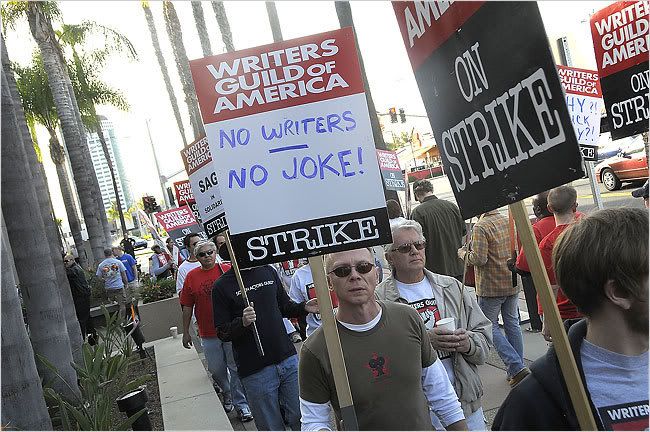
Members of the Writers Guild picketed the NBC studio in Burbank, Calif.
But how Mr. Leno was able to accomplish that feat has become the subject of an increasingly fractious dispute between the NBC star and the Writers Guild of America, which has been on strike against the movie studios and television networks for the past two months.
The Writers Guild of America West and the Writers Guild of America East moved Thursday to prevent Mr. Leno from performing any more monologues, while NBC executives said Mr. Leno would ignore the strike rules set up by the writers and would tell his scripted jokes as planned on Thursday’s broadcast of “The Tonight Show.”
The dispute could affect the other late-night shows that are without writers because of the strike. Both “Late Night with Conan O’Brien” on NBC and “Jimmy Kimmel Live” on ABC returned to the air this week, and their hosts did not perform scripted monologues.
Two shows on Comedy Central, “The Daily Show with Jon Stewart” and “The Colbert Report” with Stephen Colbert, are scheduled to return Monday. If Mr. Leno is able to continue to perform material he writes for himself, it might open the door for the other hosts to do the same.
The clash over Mr. Leno’s monologue comes at a critical time in the two-month strike for the networks and the guilds. Ratings for the highly lucrative late-night talk shows rose sharply on Wednesday, bringing smiles to the faces of network and advertising executives.
The shows had experienced steep declines in viewership when the guild began to strike in early November, halting production on the shows of Mr. Leno, Mr. Letterman, Mr. O’Brien, Mr. Kimmel and Craig Ferguson.
“Everybody’s happy that the late-night shows are back,” said Steve Lanzano, the chief operating officer of MPG, a division of Havas, the global communications agency. “It’s going to mean more ratings points in the marketplace, which has taken a real hit in the past year.”
Late-night talk shows are also an important beachhead for the striking writers, who see the hosts, particularly Mr. Letterman, as sympathetic to their cause.
In a telephone interview Thursday night, Patric M. Verrone, the president of the Writers Guild of America West, said that with strike talks at a standstill, there had been some hope that the deal that allowed Mr. Letterman to return with writers would help move the situation toward a settlement. But, he said, “instead the companies are choosing to pit these guys against us.”
The conflict seems about to play out on late-night’s biggest show, “The Tonight Show.” Mr. Leno said on the air Wednesday that he was following the rules set down by the writers before the strike and was writing his own jokes for the monologue. In their outline of what could be permitted during the strike, the writers expressly excluded guild members from writing any material for use by any of the companies affected by the strike, even material written for their own use.
NBC executives said Thursday that Mr. Leno and his writers held a meeting on Monday with Mr. Verrone and that Mr. Leno had told Mr. Verrone he was going to write his monologue material himself. According to the NBC executives, Mr. Verrone gave Mr. Leno his approval.
But Thursday the guild challenged that interpretation of what had happened in the meeting. Mr. Verrone said, “The sense of it was, Jay was going to play by the book.” He said that Mr. Leno had brought up his work as a guest host in a strike in 1988, and “I can understand that there may have been some confusion for Jay about that.”
He said that he had a telephone conversation with Mr. Leno on Thursday, and “I made it absolutely clear that he cannot write for the show.”
One of Mr. Leno’s writers who attended the meeting with Mr. Verrone supported Mr. Leno’s version that he had been given some assurance that he could write his monologue.
“Jay said, ‘Let me get this clear: I’m allowed to write my monologue,’” said the writer, who asked not to be identified because he was a strike supporter and did not want publicly to challenge the guild’s version of events. “Verrone said, ‘Well, since you are taking one for the team, we won’t hassle you about that.’”
The writer added, “There was no way Jay could have misinterpreted what was being said.”
Neal Sacharow, a spokesman for the Writers Guild of America West, said that after Mr. Verrone clarified the strike rules, it would be “a clear violation” if Mr. Leno wrote and performed a monologue on Thursday night’s show.
Asked what the guild would do if Mr. Leno performed a monologue anyway, Mr. Verrone said any violation of strike rules would be brought before a Strike Rules Compliance Committee.
NBC executives said Thursday evening that Mr. Leno, who was scheduled to tape his show at 8:30 p.m. Eastern time, would continue to write and perform his monologue based on the contract between the guild and all production companies that was in effect when the strike began. That contract cannot be superseded by the strike rules imposed by the guild, said Andrea Hartman, executive vice president and deputy legal counsel of NBC.
“The strike rules cannot contradict the scope and express terms of the overall agreement,” Ms. Hartman said.
According to an appendix in the contract, which NBC said remained in effect during the strike, the definition of “literary material” specifically excludes “material written by the person who delivers it on the air.”
Mr. Verrone said the guild interpreted that rule differently, saying that it covered only performers who were not also hired as writers for a production and that Mr. Leno was listed as a writer on his own show.
Media buyers and network representatives said movie studios and other advertising clients were enthusiastic about the return of original programming. Among the studios, Walt Disney Pictures, Warner Brothers, Lionsgate Entertainment Corporation and the Weinstein Company advertised Wednesday during “The Late Show.”
The late-night shows enjoyed significant viewership increases on Wednesday, presumably because viewers were curious about how Mr. Leno would perform and what Mr. Letterman would say about the strike.
“The Tonight Show” averaged 7.2 million viewers, almost three million more than its season-to-date average, and “The Late Show” averaged 5.5 million viewers, nearly two million more than its average.
The strong ratings for the hosts’ returns belie the sagging advertising market for late-night television. Before the strike began the late-night shows had shed approximately 10 percent of their viewers. Two months of forced repeats — at one point NBC showed an episode of “The Tonight Show” from 1992 — exacerbated the declines.
The income from late-night TV is significant. A 30-second commercial on Mr. Leno’s show costs roughly $50,000, according to media buyers. Both “The Tonight Show” and “The Late Show” were expected to earn more than $200 million in ad revenue in 2007, according to estimates by TNS Media Intelligence.
Mr. Leno has led Mr. Letterman since 1995. Some observers expect Mr. Letterman’s access to writers and ability to book prominent entertainers to increase his viewership. Media buyers said the greater test for both hosts would come later this month.
“In the coming weeks, if Leno is unable to secure guests, I think there could be a narrowing of the gap between the two shows,” said Shari Anne Brill, senior vice president of the media agency Carat USA.
Other late-night shows also showed ratings gains on Wednesday. “Late Night with Conan O’Brien” averaged 2.8 million viewers, up 55 percent from the season averages. “The Late Late Show with Craig Ferguson” averaged 2.2 million viewers, up 31 percent. The ABC show “Jimmy Kimmel Live,” with 1.8 million viewers, was down slightly from its season average.
Wednesday, January 2, 2008
| [+/-] |
A Vast Right-Wing Hypocrisy |
Richard Mellon Scaife, billionaire bankroller of conservative crusades, spent heavily to expose Bill Clinton’s “Troopergate” misbehavior. Now Scaife’s divorce from his second wife, Ritchie, is providing another unsavory saga—adultery! addiction! assault! dognapping!?!—as both parties let loose to Vanity Fair
For Vanity Fair, Michael Joseph Gross writes:
Over many years, in the five households the couple shared, the wife hired scores of servants to help take care of her rich husband. Then, in 2005, she hired someone to tail him. Margaret Ritchie Rhea Battle Scaife (whose friends call her Ritchie) suspected Richard Mellon Scaife (whose friends call him Dick) of committing adultery, so she enlisted the services of an investigator. It was a private act that would have very public consequences. Richard Mellon Scaife is the best-known living member of Pittsburgh’s storied Mellon clan, whose eponymous bank made the family a 19th-century fortune, which grew steadily with diversified investments, including major coal, steel, and real-estate interests, and Gulf Oil Corporation. Scaife, who owns several newspapers, is a major backer of conservative causes; his political donations fueled the rise of the New Right and its moral crusade against Bill Clinton, making Scaife the central figure in Hillary Clinton’s “vast right-wing conspiracy.” In the 1990s, his gift of $1.8 million to The American Spectator funded investigations into Whitewater and Bill Clinton’s personal life, including David Brock’s notorious “Troopergate” exposé, which led to Paula Jones’s sexual-harassment suit against the president.
Ritchie and Richard Mellon Scaife’s 2005 Christmas card. Even as the holiday greetings went out, a private detective was confirming Ritchie’s suspicions. Courtesy of Pamela Bryan.
In December of 2005, the private detective proved Ritchie’s fears to have been well founded: he took pictures showing the reclusive 75-year-old billionaire with a woman named Tammy Vasco, a tall, blonde 43-year-old whose criminal history includes two arrests for prostitution. The pair was photographed at Doug’s Motel, a roadside establishment near Pittsburgh, where rooms rent for $49 a night, or $31 for three hours.
Dick and Ritchie’s relationship, which began when they were married to other people, was always unconventional. During their decade-long courtship, Dick bought Ritchie a house in Pittsburgh’s wealthy Shadyside neighborhood, a few blocks from his own—a domestic arrangement that didn’t change when they were married, in 1991. Yet they moved easily back and forth between the homes until, the week after Ritchie discovered Dick’s betrayal, a servant refused to let Ritchie enter her husband’s Georgian mansion—and Ritchie saw Vasco’s Jeep parked in the garage. Ritchie demanded to be let in, banging on windows and doors. Dick called the police, who told Ritchie she was trespassing and had to leave.
She got in her car, drove to a neighbor’s driveway, then crept back to Dick’s dining-room window (inside, the table was set with candelabras for a “romantic dinner”), hoping to document her husband’s dalliance by using the camera on her cell phone. But when she set off the security lights in the yard, the police handcuffed her and charged her with “defiant trespass.” The 60-year-old socialite spent that night—three days before Christmas—in a holding cell at the Allegheny County Jail, where her fellow prisoners passed the time by petting the fur collar of her coat.
Ritchie was released the next morning, and the defiant-trespass charge was eventually dismissed. But as her lawyer announced several months later in a divorce filing, “The marriage was over!”
Some details of the Scaifes’ split were reported in local newspapers (the first account appeared in Richard Scaife’s own paper the Pittsburgh Tribune-Review), but the legal filings were sealed by the court. Then, last August, owing to an apparent clerical error, the filings were posted on a court Web page. Poring over them, Dennis Roddy, of the Pittsburgh Post-Gazette—the city’s oldest newspaper, and the liberal rival to Scaife’s conservative Tribune-Review—disclosed previously unknown financial details about Richard Scaife’s $1.4 billion fortune and about Ritchie’s jaw-dropping, court-ordered interim support payments of $725,000 a month. (This stream of income, Scaife’s lawyers noted, “produces an amount so large that just the income from it, invested at 5%, is greater each year than the salary of the President of the United States.” Unconfirmed reports suggest that Ritchie’s interim monthly payments have since increased, to more than $1 million.) The Post-Gazette posted the court documents on its own Web site; locals took rooting interest in the story’s many subplots (alleged hair-pulling fights with the help, dognapping, and battles royal over a 94-page itemized list of art and objets, from a million-dollar Magritte to an $1,800 set of asparagus tongs), which almost make one pray for Aaron Spelling’s resurrection from the dead.
What, exactly, is at stake in the war of Scaife versus Scaife? Money, to be sure. Astonishingly, the Scaifes were married without a pre-nuptial agreement, so Pennsylvania statutes automatically entitle Ritchie to 40 percent of Dick’s net monthly income, but only until the divorce is final. Ritchie won’t have any legal claim on the core of Dick’s inherited wealth—but she is entitled to claim part of the appreciation in value of most of the assets he held during their marriage. According to Pennsylvania law, “marital misconduct” does not affect the equitable division of property in a divorce. Instead, settlements are determined by factors such as length of marriage, income disparity between spouses, employability, and “liabilities and needs of each of the parties.” Ritchie, who spent the better part of 14 years running Dick’s households, has a comparatively minuscule income of her own (and, as a 60-year-old, has less than stellar employment prospects), which might incline a judge to give her a hefty settlement. State guidelines for distribution of assets in a divorce are so broad, though, as to make it impossible to predict such decisions. Albert Momjian, a leading Philadelphia divorce lawyer, says that out-of-court settlements are usually preferable where fortunes are in play. In a case like Dick and Ritchie’s, he says, “so much depends on the reasonableness of the parties.”
Reputations are also at stake, and Ritchie, Dick, and their respective defenders are squaring off with rival narratives. In the first interviews he has given in eight years, Richard Scaife spoke with Vanity Fair about the divorce saga, depicting his estranged wife as conniving, greedy, and abusive. Through one of her attorneys, William Pietragallo II, Ritchie Scaife at first declined to be interviewed. On her behalf the lawyer told a simple story of “a woman scorned,” a “very supportive and caring” wife who saved a husband from his “demons,” only to be thrown over for a harlot.
Later, Ritchie changed her mind and agreed to what turned out to be a long and highly animated interview. Seated between Pietragallo and another of her attorneys, Eddie Hayes (the model for the scrappy defense lawyer in Tom Wolfe’s The Bonfire of the Vanities), Ritchie described a marriage that swung between emotional extremes, from the days when “I always called him ‘my snuggle bunny’ … and he called me his ‘precious’ ” to the public embarrassments brought on by their breakup, which she compares to “the tortures of the damned.”
The estranged couple and their intimates aren’t the only ones with an interest in this divorce. Richard Mellon Scaife is the man who funded the movement that made “family values” a watchword of the right and badly damaged the Clinton presidency. Many would now dearly love to hang him in the gallery of hypocrites whose Dickensian comeuppance exposes the moral bankruptcy of the culture wars.
The Angora Sweater
Richard Mellon Scaife is an uncommonly boyish 75-year-old, with riveting pale-blue eyes and a sharp, lopsided grin that brings to mind Jack Nicholson’s wily poise and Paul Lynde’s smirking bitterness. An enthusiastic conversationalist, he comes across as more intuitive than intellectual, and he can be candid about his own blind spots. Asked whether a book has ever changed his life, he thinks a moment, shrugs, and, with a disarming smile, answers, “I guess the quick answer to that question is ‘No!’ ”
Two hours later, in the course of the same interview, without a hint of guile or self-awareness, he abruptly names John O’Hara as his favorite writer, and Appointment in Samarra as his favorite book. Appointment in Samarra is the story of a rich young man who yields to the temptation of his most self-sabotaging urges—but whose private fear of judgment and retribution for his rashness drives him to a self-destruction that neither he nor anyone who knows him ever fully understands. (And the rich young man is from Pennsylvania.)
Scaife’s charm has an odd sweetness to it (he recalls a period of unhappiness when his favorite TV show, The Simpsons, began running at the same time as Lou Dobbs, who took precedence), but he also takes petty swipes (his favorite characters on The Simpsons, he says, are Marge’s cynical and trashy sisters, Patty and Selma, “because they remind me of Ritchie”). A curvature of the spine gives Scaife a shuffling gait, and since undergoing cochlear-implant surgery he has worn two bulky, high-tech hearing aids. But he remains a courtly presence in bespoke suits and with impeccably groomed snow-white hair.
Dick and his sister, Cordelia, spent most of their formative years in the gilded cage of Penguin Court, a family estate in Ligonier that was designed by an architect better known for building prisons. The gloom of the mansion was compounded by the family’s isolation from Pittsburgh’s larger Mellon clan: Sarah Mellon’s decision to marry Alan Scaife, the scion of a Pittsburgh steel family, was never fully embraced by the Mellons. Her father, Richard Beatty Mellon, is said to have quietly answered “No” when Alan asked for Sarah’s hand, and her brother, Richard King Mellon, the man who led Pittsburgh’s renaissance in the 1940s, treated Alan with disdain, and seems never to have been close to Dick.
Alan joined the O.S.S., the precursor of the C.I.A., when Dick was young, and returned from his travels with gifts for the boy: newspapers from around the world, which Dick organized on racks of wooden poles in the family library. At the age of nine Dick was severely injured when his horse, Newsgirl, fell on him, and he spent his fourth-grade year in bed, reading newspapers. Another childhood enthusiasm was politics: he told the Mellon-family biographer, Burton Hersh, that, when the family lived in Washington, D.C., for a while, “I made it a kind of hobby to meet as many senators and congressmen as I could.”
Dick caught what he calls “the Irish disease” of alcoholism early. (Both his mother and his sister also had drinking problems.) After it got him kicked out of Yale, he returned, flunked out, spent six months pumping gas, and eventually took his degree from the University of Pittsburgh. In 1956 he married Frances Gilmore, and they had two children (David, 41, now a Pittsburgh Porsche dealer, and Jennie, 44, who lives in Palm Beach). But he kept drinking, and his name and fortune alone were not enough to win Pittsburgh’s respect. Kicked off the board of the Carnegie Museum of Art, he patronized small regional museums such as the Brandywine, in Chadds Ford. Marginalized within the family banking and oil businesses, Dick started buying small newspapers, and made one of them, the Tribune-Review, in Greensburg, into a conservative alternative to Pittsburgh’s Post-Gazette.
With Franny, as his first wife is known, Dick became involved in Republican politics during Barry Goldwater’s 1964 presidential campaign. Later disillusioned by Watergate (after he’d given more than $1 million to Richard Nixon’s 1972 campaign), he focused his donations on conservative think tanks such as the Heritage Foundation (an incubator of Reagan’s foreign policy, supply-side economics, and Newt Gingrich’s “Contract with America”) and later the Federalist Society (a legal network formed to combat what its members see as a liberal bias in elite law schools and the legal establishment). The aim was to provide intellectual infrastructure and train policymakers for the contemporary conservative movement.
Around the time that these investments started bearing fruit, he met Ritchie Battle, the charming, gorgeous southern wife of a young lawyer named Turner Westray Battle II, at a 1979 Pittsburgh dinner party for Jack Heinz II, the father of the late senator John Heinz.
Ritchie’s friends, and even many of her enemies, describe her as fiery, fun, brash, and resourceful—comparisons to Scarlett O’Hara are common. In high school, the young beauty and her boyfriend were voted “Most Attractive Couple” by her senior class; she remains exceptionally alluring today, dressed for an interview in a green cashmere turtleneck and plaid Oscar de la Renta suit, with brown suede Manolo Blahniks. Her manner, like her dress, embraces the earthy and the immaculate. Her face is elegant but elastic, often stretching into imitations of the people she talks about. Her anecdotes are peppered with cinematic allusions. “She’s Mrs. Danvers,” Ritchie says of a hyper-officious servant; “Think of ‘Rosebud,’ ” she explains after suggesting that Dick sold most of his parents’ furniture from Penguin Court—“but kept all the maple furniture that was the help’s.” (Dick says he kept a lot of his parents’ furniture.) To her lawyers’ consternation, she seems to take pleasure in speaking about the forbidden. “It’s a man’s world, darling,” she purrs, after being chastised by one attorney for off-the-record remarks about jewelry and divorce law.
Ritchie’s father was a Georgetown, South Carolina, bank examiner who died of a heart attack during a family day at the beach, when Ritchie was 10 years old. After his death, Ritchie’s mother worked as a secretary to support her three children; she committed suicide when Ritchie was 21. In high school, Ritchie worked at a department store selling Avon products. Later she studied at Queens University of Charlotte, where she met and married Battle, then a Davidson undergraduate. (Their son, Turner Westray Battle III, 33, is a navy lieutenant who has twice been deployed to the Persian Gulf.)
Ritchie’s dark doe eyes flit among a disparate swarm of emotions when she describes her “terrible” first marriage and the “torrid love affair” with Dick that swept her out of it. Some in Pittsburgh say that Ritchie was socially ambitious and that the dinner party was a setup. But the party’s hostess, Pamela Bryan, the whispery-voiced ex-wife of Houston department-store magnate Bob Sakowitz, says her intentions were innocent. There were too many men coming to the party, and too few women, “and it was beginning to look like a stag dinner. So I remember speaking to Westray and saying, you know, ‘Would it be all right … ?’ So I put her next to Dick.”
The place card, Ritchie remembers, came with a warning from the hostess: “I’ve got a job for you. I know that if you sit next to him, he won’t leave.” Leaning forward, as if confiding, Ritchie explains, “I think he had a reputation of leaving dinner parties if he was bored.” A beat. “Well!” she sighs. “I didn’t get rid of him for many years after that.” The tone has both rue and triumph in it, as does the slender, red-lipped smile with which she underlines such interjections.
Ritchie says Dick started pursuing her immediately. Dick himself says that he didn’t see Ritchie again for another six months. Then one day she came to his office, soliciting for a charity; he couldn’t take his eyes off her white angora sweater. That afternoon, he adds with a wink, “we did what comes naturally.”
“Never owned an angora sweater,” Ritchie protests, aghast and lilting. “I’m allergic to things like that!”
Ritchie and Westray were divorced in 1981. Her alimony and child support, combined, amounted to a scant $1,200 a month. She didn’t have to worry. Dick bought Ritchie a condominium, and then the house, and their affair grew increasingly public. They started socializing as a couple when he took her to Alcoa heir Alfred Hunt’s Christmas party in 1984, and then to a reception for the Hoover Institution at the White House. “He was forcing the point with Franny,” Bryan explains.
By then, he had been forcing it for a while. The first time Dick’s son, David, laid eyes on Ritchie was in 1982, when, after a night out, he says, Dick tried to drop her off but she refused to get out of his car. Drunk, he drove her home, where 16-year-old David, from inside the house, heard what he remembers as “yelling and screaming and all sorts of noise, and Dad came to the door and said, ‘Get your mother.’ I saw this woman, lying on the ground. I couldn’t even decipher what she was saying. My mother came down. She had always sort of suspected that something was going on, but this was the first time that she had really confronted this person.” David goes on: “I had always seen my mother act ladylike,” but that night, David says, Franny walked out of the house, “kicked her, and called her a guttersnipe.”
When asked about the incident, Ritchie says it “never happened.” Two days later, she calls from one of her lawyers’ offices in Pittsburgh. She wants to say that, in 1981, she did go to the door of Dick’s house on a day when Dick wasn’t home, to speak with Franny face-to-face: “I said, ‘If I have to know about you, you have to know about me.’ I later learned that her daughter was at the top of the stairs. My intention was never, ever—and I had had too much to drink—my intention was never to hurt anybody.”
David says that Ritchie soon won him over: “My grades were so bad at school at that point, I just thought, Well, instead of getting yelled at,” siding with Dick against Franny could be “a new chapter to our friendship. All of a sudden, he and I were drinking buddies.” When Dick and Ritchie visited him at Deerfield Academy, David claims, Ritchie brought pot for them to smoke together, and his father bought him alcohol.
“To take marijuana to a child? To a prep school?,” Ritchie marvels, when asked about the story. “Never,” she declares, her petite hands holding one another in her lap. “And how dare anyone even make a comment like that?”
Dick, who regretfully confirms the details of his son’s story, says that he did not inhale.
Pre-nup? What Pre-nup?
Franny filed for divorce in 1985, but a final settlement (sealed by the court but reliably rumored to be about $35 million) was not reached until 1991. Dick and Ritchie’s relationship remained outrageously volatile; Ritchie once kicked Dick in the crotch, according to a friend, and his testicles swelled to such a size that he had to be taken to the emergency room. Asked about the incident, Dick chuckles and says, almost plaintively, “I’d forgotten.” Ritchie issues another denial: “I don’t remember ever kicking him!”
In 1987, according to Dick, the two went to the Betty Ford Center together. He calls his estranged wife “a total pill popper,” who had to be taken to “the loony bin” after a suicide attempt.
Wearily, deliberately, Ritchie says the only reason she went to Betty Ford was to support Dick in the “family program.” Has she ever had any kind of substance-abuse problem? “Never,” she says, four times.
Dick and Ritchie’s wedding, planned on two days’ notice, took place the same week that Dick’s divorce was finalized. His lawyer Yale Gutnick prepared a pre-nuptial agreement, which Scaife refused to sign. “I was a fool!” Scaife says. “I begged him,” Gutnick adds, explaining that Ritchie threatened to leave Dick if there was a pre-nup.
Ritchie laughs out loud at Gutnick’s suggestion that she threatened to call off the marriage over this issue. She says she actually asked for a pre-nup, after witnessing the bitterness of his split with Franny. “I mean, you think I’m going to kick them both in the you-know-what to make him marry me? It wasn’t very difficult,” she scoffs. “He wanted to marry me.”
And again, a second later, bemused, on velvet: “It wasn’t difficult, darling.”
For the exchange of vows, on the old Penguin Court property (Dick had had the gloomy mansion torn down after his mother died, in 1965), Ritchie wore a short white dress. For the reception, at Ligonier’s Rolling Rock Club, the new wife surprised her husband, a fireworks aficionado, by hiring Zambelli, which is responsible for the July Fourth shows on the Mall in Washington, to create a blazing sign on the lawn that proclaimed, in sparkling letters, ritchie loves dick. Even today, a certain set of Pittsburgh women, including wives of some of the country’s most brass-knuckled industrialists, speak of Ritchie’s flaming double entendre as among the most shocking moments of their lives.
It was not a double entendre, Ritchie says, with tears in her eyes: “My mind doesn’t work that way. Please. His name is Dick. His name is Dick, and I thought of the human being. And how evil of them, because I was saying I loved my husband.”
Many say marriage to Ritchie mellowed Dick. They say that Ritchie was instrumental in reconciling Dick with his sister, though Dick denies this. (Cordelia did not speak to him for more than 25 years after the death of her husband—ruled a suicide—on the day he was indicted for tax fraud, just after a blowup in his friendship with Dick, according to news reports.) They also say that she encouraged his sobriety, though in 1994 he started drinking again. By his own account, Dick has been sober since 2003.
“Ritchie was always ironical about her position” as Dick’s consort-cum-wife, according to Ed Harrell, a close friend of the couple’s and the former president of Dick’s publishing company, Tribune-Review. Playing off her husband’s fabled middle name, Ritchie carried a jeweled Judith Leiber bag in the shape of a melon. She teasingly begged Dick for gifts, according to a friend, calling him “the Prince of Pittsburgh” and pleading, “Daddy, you’re so rich, you can afford it. Daddy, you could buy me anything.” She once told the friend that she was planning to build an extra guest room for her son at the Scaife house on Nantucket; when the friend asked, “What will Dick think?,” she says, Ritchie answered, “He’ll never notice”—and he apparently didn’t.
In happy moments, their hedonism could attain a Zen-like plane: when Ritchie fell in love with a 2,800-square-foot Sol LeWitt mural on exhibit at the Carnegie Museum of Art, a friend overheard him tell her, “It’s yours,” and Dick in fact bought the painting (as a gift to the museum) in her honor.
Another of Dick’s gentler interludes, in Ritchie’s account, sounds a bit like the last reel of Citizen Kane. The couple lived at the Hotel Bel-Air while Dick recovered from ear surgery, and at his insistence they watched, again and again, How Green Was My Valley, John Ford’s melodrama, in which a coal-mining family dreams of a better life in a fast-changing world that defeats their traditional ideals. During that time, Ritchie says, her voice distant and soft, Dick also “liked to watch trolley videos … just trolleys …a trolley car, going down the road, for hours.”
He could also be cruel. Dick lost most of his hearing in the late 1990s, and when Ritchie suggested that they learn sign language together, one friend says, “he told her, ‘I’ll give you sign language’ ”—and raised his middle finger. (“No, that didn’t happen,” Dick says, laughing, “but I wish it did.”)
Yet Ritchie, by many accounts, has the more unpredictable temper. Several associates and friends of the Scaifes shudder when they speak of “Ritchie moments.” These are high-decibel events—such as the afternoon on Nantucket when she allegedly warned the staff that she would walk into the ocean if a misplaced set of winter slipcovers for the summer furniture wasn’t located right now.
“I think this is just the stupidest thing I’ve ever heard,” Ritchie says. “Please. Do I look like somebody who’d walk into the ocean over curtains? Please.”
Jewelry, Dick says, reliably restored her equilibrium. After an ultimatum delivered in the kitchen of their Pebble Beach estate, he bought her a ring from Borsheim’s, Warren Buffett’s Omaha jewelry store—a $600,000, 10-carat diamond that, Scaife recalls, was delivered to his office “by a very nice lady from Rhodesia, very pretty, with two armed guards.”
“It was a 55th-birthday present!” Ritchie cries, and produces a handwritten love note from Dick that she says accompanied the gift.
Dick and Ritchie grew increasingly isolated, and, Dick says, Ritchie intentionally drove a wedge between him and his son. A few months after David Scaife married Sara Deutsch, Dick and Ritchie visited them to look at wedding pictures and presents. The couple say Ritchie disapproved of them from the start. On this day, Sara says, Ritchie was drunk and dropped all pretense of discretion when they found themselves alone. “It was literally like I’m showing her, like, a china pattern or something, and then she just turned on me with ‘And, by the way, you’re a nobody from nowhere,’ berating me and yelling at me.”
After Dick and Ritchie separated, Sara says, Dick told her that “ ‘Ritchie would take photographs of you out of a newspaper or a magazine, and she would stick pins in them.’ He said, ‘It was so disturbing, it was so horrible.’ ” Sara adds, “You want to say to him, ‘But, Dick, did you do anything at the time?’ ”
Ritchie denies every detail of this story. There was an altercation, she admits, but she says it was Sara who “went berserk.”
And did she stick those pins in the pictures?
“No, Dick did.”
Her lawyer interrupts: “—Ehh—”
“It’s true!,” Ritchie says.
Pietragallo: “Stop. Stop.”
Sara’s story of their altercation sounds much like the judgment an element of Pittsburgh society passed on Ritchie when she married Dick. During the marriage, they mostly kept their opinions to themselves as Ritchie took her place on the boards of the Pittsburgh Symphony Orchestra, Opera, and Parks Conservancy (whose director of development calls her “a God’s blessing” to the group, for which she helped launch a version of the New York Central Park Conservancy’s traditional Hat Luncheon). Eventually she was even admitted to the holy of holies, the Carnegie Museum of Art Women’s Committee.
Ritchie says that she was aware of some resistance to her arrival on the scene “in the beginning. But once I was Mrs. Scaife, listen, they were falling all over me.”
Sipping a martini at four p.m., the decorator Louis Talotta, who worked for the Scaifes during Dick’s first marriage, says that when he met Ritchie “I think she cut her own hair. She didn’t have art. She didn’t have anything. She was just a dumb southern girl.” From the tip of his Marlboro, an ash falls toward the pale upholstery of his 18th-century Jacob chair. “She couldn’t even set a table.”
(At this, Ritchie laughs mirthlessly. Setting a table is “one thing a southern girl knows how to do, if she’s lived with her grandmother, and I don’t care how little money you had in the South, you had your silver. I never saw stainless steel till I moved to Pittsburgh with all those rich folks.”)
And there are ladies in bouclé (asking not to be named, because they’d “hate to hurt anybody”) eager to tell their story of how Ritchie never wanted anything but Dick’s money and his name. Pursing their lips, they say, one after another, that “Do you know who I am?” was Ritchie’s signature line.
(Ritchie, bewildered: “Never. Never. If anything, I said, ‘Call me Ritchie,’ because that’s the name I know I’ll always have.”)
Still, for all the stories of Ritchie’s behavior, it seems impossible to separate most of the moral assessments by detractors from their quiet rage over this outsider, this nobody from nowhere, having dared to dream that she could walk among them.
Battle over Beauregard
This same tone, transposed a few octaves bassward, colors William Pietragallo’s voice when, in a conference room in a Pittsburgh skyscraper—coincidentally, directly beneath Richard Mellon Scaife’s office—the lawyer asks, “Have you seen Miss Vasco?,” and, with one eyebrow raised, produces a photocopied enlargement of Tammy Vasco’s driver’s-license photograph, thumping his index finger on the page. In Pietragallo’s account of the marriage, there were no troubles until Dick met Tammy—whose purported arrest history he rattles off in detail (and lards with defensive provisos: “I don’t know this.…I’m not telling you this as a fact”). Quite the contrary. Pietragallo claims that, except for the times when Ritchie nursed Dick back to health from alcoholism (“She slept on the hospital floor, she slept on a chair”), their life was an exercise of shared passions for antiques and travel. “Flowers were a really important part of their life together,” Pietragallo says. He describes Ritchie as “a sensible, grounded individual” who in her life with Dick was “a giver, a non-taker.”
Precisely how Dick became involved with Tammy remains something of a mystery. This was the only personal question that Scaife’s lawyer would not let him answer. Certainly since Ritchie discovered Dick’s relationship with Tammy, she and Dick have been playing the emotional equivalent of Australian Rules football. The whole imbroglio has begun to resemble a Christopher Guest parody.
After Dick had Ritchie arrested and thrown in jail (and stories about it appeared in his newspaper), Ritchie and the Scaife’s three dogs—including Dick’s favorite, a yellow Lab named Beauregard (Dick says Beauregard was a gift from Ritchie; Ritchie says the couple owned the dog together)—moved in with Pietragallo and his wife, Helena, who is one of her oldest friends. Then, in March 2006, Dick arranged for a sign to be made and placed on his front lawn: wife and dog missing—reward for dog.
Beauregard, who is said to be a descendant of a dog that belonged to a King of England, is the only member of his species to have had his portrait painted by Chas Fagan, an artist perhaps best known for the official White House portrait of Barbara Bush. Soon after the missing sign appeared in Dick’s front yard, Beauregard disappeared from the Pietragallos’ backyard—“snatched” by an employee “who was actually a double agent” working for Dick, Pietragallo says. Not long afterward the sign on Dick’s lawn was replaced by a new one that said, welcome home, beauregard.
Then, on April 6, 2006, Ritchie was driving down Dick’s street and saw Sue Patterson, Scaife’s 54-year-old housekeeper, walking the dog. According to court documents, Ritchie stopped the car in the street, got out, and ran toward Beauregard, screaming “He’s taking everything from me; I’m taking his dog.” She then allegedly beat the woman about the head and neck, pulled her hair, pushed her down, and kicked her—leaving a footprint on her white blouse. When Genevieve Still, Dick’s head housekeeper, came to Patterson’s aid, she claims, Ritchie kicked her too. (“And she knows I have cancer,” says Still, who is 79.) Dennis Bradshaw, a former Secret Service officer now in charge of Scaife’s security, attempted to break up the fight. Ritchie allegedly scratched his face and broke his glasses and threw them on the ground.
Ritchie was arrested again, this time for assault. Again the charges were eventually dismissed, after a hearing where a bystander testified that Ritchie, while wrestling for the dog, also hollered, “ ‘Keep the prostitute,’ or something like that.” (From a distance, the witness said, the clash over Beauregard “looked like two kids fighting over a toy.”) The ruling magistrate in the case said, “They should’ve given her the dog,” adding, “This is nonsense. I’m not going to participate in this. This is absolute, total nonsense.” With personal-injury lawsuits against Ritchie by all three employees pending, Pietragallo forbade Ritchie to answer questions about the incident.
Ritchie’s next reported legal entanglement came when Vasco’s daughter filed a criminal-harassment complaint, which has also been dismissed, after finding a note in her mailbox that said, according to Dick, “God will get you” and “All whores go to hell.”
(Coincidentally, after interviewing Ritchie Scaife, I found an anonymous letter in my mailbox: a Christmas card emblazoned with the greeting “Have a Ho Ho Ho!” In imitation of a child’s scrawl, someone wrote, “Hope you can use this!,” evidently referring to the color snapshot of Dick and Tammy that was included with the card. A printed slip of paper provided the photo’s caption: “Richard Mellon Scaife and Tammy Sue / On the waterfront terrace of Wit’s End / Pebble Beach, California.” Wit’s End is Dick’s estate there.)
For his part, Dick does not believe that any of his efforts to humiliate Ritchie were excessive. Erecting those signs in his front yard, he says, was just plain “fun.” Do the end of the marriage, its escalating vindictiveness, and the ongoing consequences of such anger make him in any way sad? His eyes go blank, and he says, “No, I don’t think about that. I just don’t want her near me. That’s all I think about.”
Asked whether his infidelity is hypocritical, in light of his political commitments, he refers not to a moral principle but to his own personal history. “My first marriage ended with an affair,” he says, amused. And monogamy is not, he continues, an essential part of a good marriage. “I don’t want people throwing rocks at me in the street. But I believe in open marriage.” Philandering, Scaife says with a laugh, “is something that Bill Clinton and I have in common.”
Lunch with Bill
Those are surprising words indeed to hear from a man who spent so lavishly to uncover Bill Clinton’s sexual peccadilloes and to advance the movement fueled by family values. But it would be a mistake to read the saga of Richard Mellon Scaife’s divorce as simply a story of moral hypocrisy. His treatment of women, especially his first wife, suggests a high regard for his own gratification. His commitment to conservative politics has never been primarily about upholding traditional morality; it has been about promoting policies that help to preserve his own wealth and that of people like himself. On the subject of Clinton his weather vane is now spinning wildly. Scaife speaks of a “very pleasant” two-hour-and-fifteen-minute private lunch with Bill Clinton at the former president’s New York office last summer. “I never met such a charismatic man in my whole life,” Scaife says, glowing with pleasure at the memory. “To show him that I wasn’t a total Republican libertarian, I said that I had a friend named Jack Murtha,” a Democratic member of the House of Representatives from Pennsylvania. “He said, ‘Oh, Jack Murtha. You’re talking about my golfing partner!’ ” In the midst of these backslapping memories, though, Scaife goes carbuncle-eyed and refuses to answer on the record when asked if he still thinks Vince Foster’s suicide was, as he once told The New York Times, “the Rosetta Stone to the Clinton Administration.”
Scaife left the meeting with an autographed copy of Bill Clinton’s My Life and a head full of thoughts about the “scourge of aids” in Africa, which the two had discussed in detail—though Scaife emphasizes, twice, that Clinton “did most of the talking.” Back in Pittsburgh, Scaife decided to send a $100,000 personal check to the Clinton Global Initiative. That got him thinking about aids locally, he says, and so when he found a direct-mail solicitation for persad, Pittsburgh’s aids service center, in his mailbox, he wrote that group a check, too. Does he think his best gay friends should be able to get married? Scaife throws his hand in the air and exclaims, “Yes, I do!” A moment later he adds, “I haven’t really thought about it. But if they want to get married, that’s their business. I couldn’t care less.”
It is this contradictory bundle of a human being who arrives on a rainy November evening at the mahogany-paneled Duquesne Club, in downtown Pittsburgh, the sanctuary of that city’s upper crust, to be honored with the Speaker Franklin Award at a fund-raising dinner for the Commonwealth Foundation, a Pennsylvania think tank affiliated with the Heritage Foundation. An invocation praises Scaife as a selfless “servant-leader” who, like Joseph in the book of Genesis, “could have just worried about himself. But like Joseph,” he worried about his country. In a video tribute, former attorney general Edwin Meese calls Richard Mellon Scaife “the unseen hand behind so many important causes,” the man who brought “balance and sound principles back to the public arena” and “quietly helped to lay the brick and mortar for an entire movement.” Scaife’s donations to conservative causes, the crowd seems to agree, are the best measure of his character, because, as another speaker declares, “checkbooks are the most accurate account of a person’s values and priorities.”
The drive from the Duquesne Club to Doug’s Motel (recently renamed the Huntingdon Inn), where Ritchie’s private detective photographed Dick and Tammy, takes about half an hour. Behind the river-stone exterior of Room 5, where the two are said to have dallied, is a small rectangular space containing a queen-size bed with a thin, soft mattress, two lumpy pillows, and a push-button phone on the brown bedside table. To match the brown bedspread, there is brown wood paneling, a brown carpet with its nap rubbed away, a brown dresser, and a chair with little nicks in the veneer. There is despairingly little else to describe.
It’s All About Dignity
The Mellon-family fortune was assembled largely by Andrew Mellon, the banker and industrialist who served as secretary of the Treasury under Presidents Harding, Coolidge, and Hoover. Richard Mellon Scaife is Andrew’s great-nephew. “The first time the Mellons have ever been ‘in print,’ ” Andrew Mellon himself once ruefully noted, was in 1910, when his divorce from Nora McMullen (an unsuitable young Englishwoman whom he’d married on a whim) made Pittsburgh “ring with scandal.” For Andrew, divorce brought embarrassing public revelations about his wife’s infidelities and his own foolishness. Yet Mellon controlled the damage to the best of his ability. To ensure that his divorce would not be tried by jury, which would have exposed even more of his private life, he arranged for Pennsylvania’s legislature to outlaw jury trials for divorce.
The story of Andrew Mellon comes to an end in the 1930s, with his gift to the American people of the National Gallery of Art. The final chapter for Ritchie and Dick foretells no such grandeur. Richard Mellon Scaife, who vows he will never be married again (“too many responsibilities,” he says with a sigh), is still dating Tammy Vasco, and in what may be the most emotional moment of a long conversation, he voices distress that she has been publicly drawn into this situation. “Miss Vasco is a very loving individual,” he says with tears in his eyes. Her depiction in the press, he goes on, “really troubles me.”
As for Ritchie, “after the night she was put in jail by her husband, from that day forward she wanted to get on with a new life,” Pietragallo says. Her new life, he adds, will focus on charitable involvements and “starting a foundation” whose goals have yet to be defined. Perhaps that night in the holding cell holds the answer. Ritchie emerged, Pietragallo says, with a passion to “do something to improve conditions for women in prison.”
Ritchie affirms all of this, and, mustering a bright face, adds, “I want you to know I’m not bitter. I’m not an embittered person. You know, it is what it is, and life has to go on, and there are a lot more issues in this world that have relevance, and this really has no relevance on the face of the earth when you think of all the issues that are in the world right now, the problems. I have no bitterness. I just want to go forward. And I hope that he is happy. I don’t wish anything bad to happen to him. And it’s just sad for me that we couldn’t end our marriage in a dignified way.”
Gravely, Pietragallo reminds her: “We still can.”
Ritchie says, “Because dignity’s very important to me.”

