At IPSnews.net, Mohammed Omer reports:
A stream of dark and putrid sludge snakes through Gaza's streets. It is a noxious mix of human and animal waste. The stench is overwhelming. The occasional passer-by vomits.
Over recent days this has been a more common sight than the sale of food on the streets of Gaza, choked by a relentless Israeli siege.
Hundreds of thousands of Gazans, almost all of its able male adults among a population of 1.5 million, crossed over into Egypt last week to buy essential provisions - and a new lease of life. That has staved off starvation. But streets continue as sewers.
The rain has not helped. The sludge has spread, and the stench with it. Starved of timely income and essential supplies, municipal services have all but ceased.
"The smell," says Ayoub al-Saifi, 56, grimacing as he holds a handkerchief over his nose and mouth. "The stench of the sewage ... my wife has asthma, and she can't breathe."
Saifi lives next to what has become a newly formed pool of waste. This used to be the street leading to home. "It's getting worse day by day," says neighbour Said Ammar, an engineer, and father of four.
The sewage treatment plant in al-Zaytoun neighbourhood in Gaza City requires 20,000 litres of fuel a day. Last week Israel ceased delivery of all fuel and supplies to Gaza. The consequences have been catastrophic.
Without fuel to pump it away, the waste backs up, flooding the streets and clogging the plumbing. The local ministry of health has declared this an environmental catastrophe.
Doctors have warned that a medical catastrophe could follow by way of spread of cholera and other diseases. That is at a time when not even life-saving medical services are on offer any more.
"We have to choose between cutting the electricity on babies in the maternity ward, cutting it to heart patients, or shutting down our operating rooms," says Dr. Mawia Hasaneen, director of emergency at al-Shifa Hospital, the largest in Gaza.
The World Health Organisation released a statement Jan. 22 warning of serious health difficulties arising in Gaza Strip, isolated by the Israeli siege, the Egyptian border and the Mediterranean Sea.
"Frequent electricity cuts and the limited power available to run hospital generators are of particular concern, as they disrupt the functioning of intensive care units, operating theatres, and emergency rooms," the WHO said. "In the central pharmacy, power shortages have interrupted refrigeration of perishable medical supplies, including vaccine."
Christine McNab, acting director in the communications department in Geneva adds that "our current concerns are about the supply of electricity to health facilities, the ability to move medical supplies into the region, and the ability of people to seek care outside of Gaza."
McNab notes that even if the full blockade is lifted, additional measures would need to be taken by the international community against any further disruptions.
Israel has blocked off fuel and supplies to Gaza because it says it faces rocket attacks from the Palestinian area, which elected Hamas, the Palestinian party that does not recognise Israel.
Official Israeli sources say that about 150 homemade rockets have been fired from Gaza into Israel since Israel commenced this latest raid. Two Israelis have been slightly wounded and several others treated for shock.
Israel has retaliated with firing from tanks and attacks by F-16 aircraft firing Hellfire missiles into Gaza's neighbourhoods. At least 76 Palestinians have been killed, and another 293 injured since Jan. 1, officials here say.
Through the suffering, many Palestinians still do not blame Hamas.
"Hamas has never been the problem. The occupation has always been the big problem," says Ammar. He instead blames Palestinian Authority President Mahmoud Abbas, who administers the West Bank Palestinian area, and who has been in talks with Israel.
"Abbas doesn't deserve one percent of the respect that (former Palestinian leader Ysser) Arafat earned. Israel will never find someone as good as Arafat. He gave them a historical chance at two states. Yet despite this, they (Israel) laid siege to him."
Rajaa Shalil, 38, and mother of four in Rafah at the Egyptian border, says "my respect for Hamas has increased more than ever. I love them for their empathy for the weak."
But not all of Gaza's residents feel this way. "Both Israel and Hamas are the reason for this," says resident Abu Mohammed. "Before, we were all in better conditions, but since Hamas took over Gaza they have been unable to handle it."
Monday, January 28, 2008
| [+/-] |
Feces Change the Face of Gaza |
Sunday, December 16, 2007
| [+/-] |
5 Million Iraqi Orphans, Anti-Corruption Board Reveals |
Uruknet.info reports:
Iraq's anti-corruption board revealed on Saturday that there were five million Iraqi orphans as reported by official government statistics, urging the government, parliament, and NGOs to be in constant contact with Iraq's parentless children.
"The government should set up an institutional or legislative program to help the Iraqi orphans. Iraqi is an oil-rich country and it is not acceptable that its orphans remain groaning in this tragedy," the anti-corruption board chief, Moussa Faraj, said during a conference in Baghdad dedicated to orphans in Iraq.
"The board on its own cannot meet the Iraqi orphans' needs, but there should be an organization or even a ministry to provide care for orphans," he said.
The Iraqi parliament's women & family committee had proposed a draft law to set up a fund for the orphans.
During the conference, Wijdan Salem Mikhail, the Iraqi minister of human rights, said in a speech that the phenomenon "is one of the most passive things that grew immensely during the past few years due to destructive wars and unbridled violence in the country to unprecedented heights."
"These factors have logically caused the number of widows and orphans to greatly increase," she said.
Wednesday, November 7, 2007
| [+/-] |
Murder Charges Dropped in Iraqi's Death |
UPI reports:
The U.S. Army does not have enough evidence for murder charges against a U.S. soldier accused of killing a wounded Iraqi near Kirkuk, a military official ruled.
Lt. Col. Raul Gonzalez has recommended aggravated assault instead of murder charges be lodged against Spc. Christopher P. Shore, the Atlanta Journal-Constitution reported Wednesday.
During a hearing in Hawaii, Shore said his commanding officer, Sgt. 1st Class Trey A. Corrales, ordered him to "finish" a detainee who was on the ground bleeding, the newspaper said. The man died two days later.
Gonzalez, the presiding officer investigating the case, said evidence indicated Corrales -- not Shore -- shot and hit the victim multiple times with an M-4 rifle and displayed intent to kill.
Furthermore, Gonzalez said Corrales created an "unhealthy environment" for his platoon via his "abusive" and "unlawful" behavior, the newspaper said.
Shore, home in Winder, Ga., on leave, told the Journal-Constitution he was relieved by the decision.
"I think the man did the right thing," he said.
Saturday, September 29, 2007
| [+/-] |
Sniper Acquitted of Murder, Convicted of Planting Evidence in Iraq |
Killings of Iraqis led to court case.
The Boston Globe reports:
A military panel acquitted US Army Specialist Jorge G. Sandoval of two counts of murder yesterday, apparently swayed by testimony from fellow Army snipers that two Iraqi men were killed on orders from a higher-ranking soldier.
Sandoval was convicted of a less serious charge of planting detonation wire on one of the bodies to make it look like the victim was an insurgent. As a result, he still could face five years in prison. The seven-member jury deliberated less than two hours in clearing him of all but one charge.
Sandoval, 22, of Laredo, Texas, had faced five charges in the deaths of the two unidentified Iraqi men.
In dramatic testimony during the two-day court-martial, Sandoval's colleagues testified they were following orders when they shot the men during two separate events, on April 27 and May 11. The shootings took place near Iskandariyah, a volatile Sunni-dominated area 30 miles south of Baghdad.
Specialist Alexander Flores, of Hayward, Calif., who was in the same squad as Sandoval on the day of the April killing, testified their platoon leader said the suspect was "our guy" and ordered them to move in, which they interpreted as "take the target out."
The suspect, who wore dark clothing and used a sickle to cut grass in a field, matched the general description Iraqi soldiers had given the Americans of one of two insurgents they had faced earlier in the day, according to testimony.
After the killing, Flores said Staff Sergeant Michael Hensley told him to place the detonation wire on the body and in the man's pocket, which he said he did.
But prosecutors cited an interview with Sandoval immediately after his arrest in which he said he planted the wire.
Outside court, Flores stood by his testimony.
"He was just doing his job, as he was told. It's not his fault," said Flores, who, along with the rest of Sandoval's sniper platoon, greeted him with hugs and well wishes.
In the May shooting, Sergeant Evan Vela said Hensley told him to shoot a man who had stumbled upon their snipers' hideout, although he was not armed and had his hands in the air when he approached the soldiers.
"He [Hensley] asked me if I was ready. I had the pistol out. I heard the word shoot. I don't remember pulling the trigger. It took me a second to realize that the shot came from the pistol in my hand," Vela testified, crying.
Sandoval, who was charged with murder because prosecutors said he did nothing to stop the killing, also was acquitted yesterday of charges he planted the weapon on the second man's body.
Vela of Rigby, Idaho, and Hensley of Candler, N.C., are both charged in the case and will be tried separately.
All three soldiers are part of the 25th Infantry Division at Fort Richardson, Alaska.
Friday, September 28, 2007
| [+/-] |
More Iraqi Civilians Killed in U.S. Raid in Baghdad |
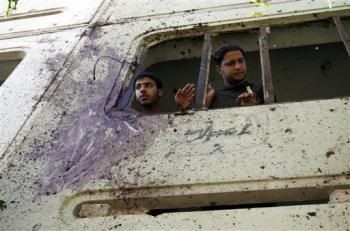 Two Iraqi men look out from a damaged window, from where the body of a civilian was recovered, at an apartment building after a U.S airstrike in the Sihha district in Dora southern Baghdad, Iraq, early Friday, Sept. 28, 2007. Iraqi police and witnesses said U.S. troops backed by helicopter gunships raided an apartment building in a primarily Sunni neighborhood in southern Baghdad on killing at list 10 civilians and wounding 12. The U.S. military said it was checking into the report. (AP Photo/Loay Hameed)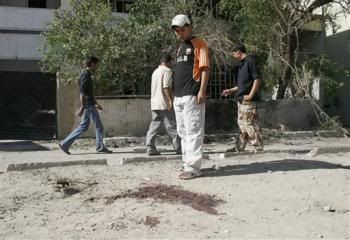
 Iraqi women react during a funeral after a U.S airstrike in the Sihha district in Dora southern Baghdad, Iraq, early Friday, Sept. 28, 2007. Iraqi police and witnesses said U.S. troops backed by helicopter gunships raided an apartment building in a primarily Sunni neighborhood in southern Baghdad on killing at list 10 civilians and wounding 12. The U.S. military said it was checking into the report. (AP Photo/Loay Hameed )
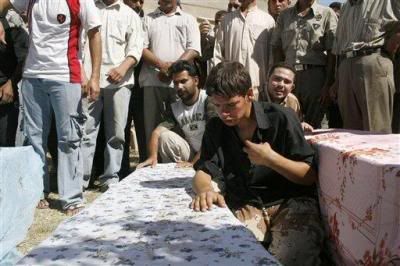 Iraqi men stand in front of three coffins during a funeral of victims after a U.S. air strike in the Sihha district in Dora southern Baghdad, Iraq, early Friday, Sept. 28, 2007. Iraqi police and witnesses said U.S. troops backed by helicopter gun ships raided an apartment building in a primarily Sunni neighborhood in southern Baghdad on killing at list 10 civilians and wounding 12. The U.S. military said it was checking into the report. (AP Photo/Loay Hameed )
The International Herald Tribune reports:
Iraqi police and witnesses said U.S. troops backed by helicopter gunships raided an apartment building in a primarily Sunni neighborhood in southern Baghdad on Friday, killing 10 civilians and wounding 12. The U.S. military said it was checking into the report.
An unknown number of people also were detained after the 2 a.m. incident in the Sihha district in Dora where clashes took place between U.S. helicopters and gunmen, said a police officer who spoke on condition of anonymity because he was not authorized to release the information.
Shaheed Abdul-Al, a 42-year-old metal worker who lives in the area, said his family was awakened by the sound of helicopters, heavy gunfire and bombing.
"We saw a big spark of light with bombing sounds come from the direction of the (targeted) building," he said. "We were horrified and still awake at sunrise."
Ahmed Salim, a 16-year-old student who lives near the targeted complex, said he saw U.S. military vehicles through his window.
"When the Americans left, I and others rushed to the site where people began to rescue victims," he said. "I saw some injured ones and dead bodies."
In violence north of Baghdad, at least six people were killed when four gunmen with long beards wearing military uniforms barged into a busy cafe late Thursday as people were playing a popular game to celebrate the end of the dawn-to-dusk fast during the Islamic holy month of Ramadan.
The men arrived in a Russian-made military vehicle used by the Saddam Hussein-era army and opened fire, shouting, "God is great," according to a provincial police officer who asked that his name not be used for fear of reprisals.
The six killed included three off-duty police officers and eight other people were wounded, the officer said.
The attack occurred in Sadiyah, a town some 95 kilometers (60 miles) north of Baghdad in the volatile Diyala province.
Thursday, September 27, 2007
| [+/-] |
Sniper Describes Killing Captive |
Testimony in Court-Martial Describes a Sniper Squad Pressed to Raise Body Count
The New York Times reports:
An Army sniper is taught to kill people “calmly and deliberately,” even when they pose no immediate danger to him. “A sniper,” Army Field Manual 23-10 goes on to state, “must not be susceptible to emotions such as anxiety or remorse.”
But in a crowded military courtroom seemingly stunned into silence on Thursday, Sgt. Evan Vela all but broke down as he described firing two bullets into an unarmed Iraqi man his unit arrested last May.
In anguished, eloquent sentences, Sergeant Vela, a member of an elite sniper scout platoon with the First Battalion, 501st Infantry Regiment, quietly described how his squad leader, Staff Sgt. Michael A. Hensley, cut off the man’s handcuffs, wrestled him to his feet and ordered Sergeant Vela, standing a few feet away, to fire the 9-millimeter service pistol into the detainee’s head.
“I heard the word ‘Shoot,’” Sergeant Vela recalled. “I don’t remember pulling the trigger,” he said. “I just came through and the guy was dead, and it just took me a second to realize the shot had come from the pistol.”
Then, Sergeant Vela said, as the man, a suspected insurgent, convulsed on the ground, Sergeant Hensley kicked him in the throat and told Sergeant Vela to shoot him again. Sergeant Vela, who is not on trial but faces murder charges in connection with the killing, said he fired a second time.
His testimony on Thursday, in the court-martial of Specialist Jorge G. Sandoval Jr., another sniper who is accused of murder, provided a glimpse into the dark moments of a platoon exhausted, emotionally and physically, by days-long missions in the region south of Baghdad that soldiers call the “triangle of death.” In their testimony, Sergeant Vela and other soldiers described how their teams were pushed beyond limits by battalion commanders eager to raise their kill ratio against a ruthless enemy.
During a separate hearing here in July, Sgt. Anthony G. Murphy said he and other First Battalion snipers felt “an underlying tone” of disappointment from field commanders seeking higher enemy body counts.
“It just kind of felt like, ‘What are you guys doing wrong out there?’” he said at the time.
That attitude among superiors changed earlier this year after Sergeant Hensley, an expert marksman, became a team leader, according to soldiers’ testimony. Though sometimes unorthodox, soldiers said, Sergeant Hensley and other snipers around him began racking up many more kills, pleasing the commanders.
Soldiers also testified that battalion commanders authorized a classified new technique that used fake explosives and detonation wires as “bait” to lure and kill suspected insurgents around Iskandariya, a hostile Sunni Arab region south of Baghdad.
As their superiors sought less restrictive rules of engagement — to legalize the combat killing of anyone who made a soldier “feel threatened,” for example, instead of showing hostile intent or actions — the baiting program, as it was known, succeeded in killing more Iraqis suspected of being terrorists, soldiers testified.
But testimony in proceedings for Sergeant Hensley and, on Thursday, for Specialist Sandoval, both of whom face murder charges in connection with separate killings of Iraqi men last spring, suggest that as the integrity of the battalion’s secret baiting program began to crack, so did Sergeant Hensley.
Only a select group of snipers in the battalion were told of the program, but many more were ordered, without explanation, to carry the baiting items on missions, creating rumors that the items were intended to be planted on victims of unjustified killings, soldiers testified.
Sergeant Hensley, according to several snipers, added to such suspicions when he told a junior member of his team to plant a roll of copper wire — clear contraband — on a suspected insurgent that Specialist Sandoval killed on April 27 after being authorized to shoot by his platoon commander.
On a separate mission two weeks earlier, Sergeant Hensley had killed another Iraqi man he said appeared to be “laying wire” near an irrigation ditch, as the man’s wife and children worked and played nearby.
Then on May 11, Sergeant Vela killed the unarmed man. Afterward, as he testified Thursday, Sergeant Hensley pulled an AK-47, a weapon favored by insurgents, out of his pack and placed it on the body, telling his team that the gun would “say” what happened.
Specialist Sandoval’s court-martial on murder charges began here on Wednesday, and is scheduled to conclude Friday. Sergeant Hensley’s court-martial on murder charges is scheduled to begin here Oct. 22.
An evidentiary hearing for Sergeant Vela, who took the stand on Thursday in the Sandoval court-martial after being granted immunity from incriminating himself in that case, is expected later this year.
Sergeant Murphy has been investigated for a killing of another Iraqi man on April 7. Prosecutors have warned two more battalion members that they are also suspected of committing possible crimes as accomplices in the murder cases.
Struggling to explain why a highly trained Army sniper unit, renowned for its lethal economy of patience and discipline, would bog down under a cloud of murder investigations, some soldiers in interviews faulted commanders for pushing units to keep their kill counts high.
Others pointed toward the outsized influence on the unit by Sergeant Hensley, who, according to other soldiers’ testimony, was dealing with two recent deaths: that of a close friend, killed in a roadside bomb, and also the suicide of his girlfriend back home.
“Staff Sgt. Hensley just continued to drive on,” said Specialist Joshua Lee Michaud, in testimony at the July hearing about the sergeant’s toughness. “Both of them didn’t even faze him.”
A trainer of snipers, Sgt. First Class Terrol Peterson, testified Thursday that the very emotions a sniper must control to do his job properly — anxiety and remorse — sometimes emerge in unexpected and painful ways. “When a sniper breaks, he breaks bad,” Sergeant Peterson said.
Tuesday, September 25, 2007
| [+/-] |
U.S. Snipers Accused of 'Baiting' Iraqis |
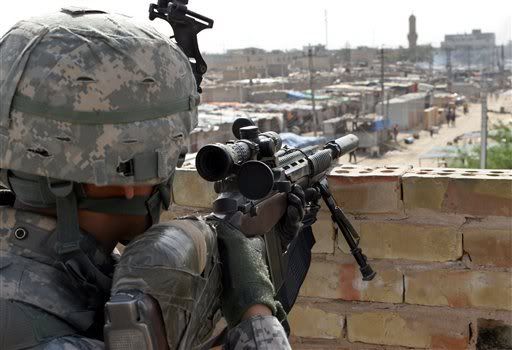 A U.S. soldier holds his sniper position on a rooftop in a Shiite enclave of Sadr City in Baghdad, Iraq, in this April file photo. Army snipers hunting insurgents in Iraq were under orders to "bait" their targets with suspicious materials, such as detonation cords, and then kill whoever picked up the items, according to the defense attorney for a soldier accused of planting evidence on an Iraqi he killed. (AP photo)
The New York Times reports:
Under a program developed by a Defense Department warfare unit, Army snipers have begun using a new method to kill Iraqis suspected of being insurgents, using fake weapons and bomb-making material as bait and then killing anyone who picks them up, according to testimony presented in a military court.
The existence of the classified “baiting program,” as it has come to be known, was disclosed as part of defense lawyers’ efforts to respond to murder charges the Army pressed this summer against three members of a Ranger sniper team. Each soldier is accused of killing an unarmed Iraqi in three separate shootings between April and June near Iskandariya, and with planting “drop weapons” like detonation wires or other incriminating evidence on the bodies of the victims.
In sworn statements, soldiers testifying for the defense have said the sniper team was employing a “baiting program” developed at the Pentagon by the Asymmetrical Warfare Group, which met with Ranger sniper teams in Iraq in January and gave equipment to them.
The Washington Post described the baiting program on Monday.
An Army spokesman, Paul Boyce, said Monday that the Army did not publicly discuss specific methods for “targeting enemy combatants,” and that no classified program authorized the use of “drop weapons” to make a killing appear justified. Army officers involved in evidentiary hearings in Baghdad in July did not dispute the existence or use of a baiting program.
The court-martial of one accused soldier, Specialist Jorge G. Sandoval Jr., is scheduled to begin in Baghdad on Wednesday. The two other soldiers facing premeditated murder charges are Staff Sgt. Michael A. Hensley, the sniper team squad leader, and Sgt. Evan Vela. All three are part of the headquarters of the First Battalion, 501st Infantry Regiment, Fourth Brigade (Airborne), 25th Infantry Division, based at Fort Richardson, Alaska.
None of the soldiers deny that they killed the three Iraqis they are charged with murdering. Through their lawyers and in court documents, the soldiers say the killings were legal and authorized by their superiors. But defense lawyers raised the issue of the baiting program in response to prosecutors’ allegations that the soldiers had planted items, like wire for making bombs, on the bodies of the victims.
A transcript of the hearing was provided by a family member of an accused soldier.
Snipers are among the most specialized of soldiers, using camouflage clothing and makeup to infiltrate enemy locations, and high-powered rifles and scopes to stalk and kill enemy fighters. The three snipers accused of murder had for months ventured into some of the most dangerous areas of Iraq, said lawyers for Sergeant Vela.
“Snipers are special people who are trained to shoot in a detached fashion, not to see their targets as human beings,” said James D. Culp, one of Sergeant Vela’s lawyers. “Snipers have split seconds to take shots, and he had a split second to decide whether to shoot.”
After visiting the sniper unit in Iraq, members of the Asymmetrical Warfare Group gave soldiers ammunition boxes containing so-called “drop items” like bullets, plastic explosives and bomb detonation cords to use to pinpoint Iraqis involved in insurgent activity, according to Capt. Matthew P. Didier, a sniper platoon leader who gave sworn testimony in the accused soldiers’ court hearings.
Captain Didier, in a sworn statement about the program that was obtained by The New York Times, described baiting as “putting an object out there that we know they will use, with the intention of destroying the enemy.”
After placing the bait, snipers observed the area around it, Captain Didier said in his statement. “If someone found the item, picked it up and attempted to leave with the item,” he said, “we would engage the individual, as I saw this as a sign that they would use the item against U.S. forces.” (Engage is a military euphemism for firing on or killing an enemy.)
The Asymmetrical Warfare Group, based at Fort Meade, Md., grew out of a task force created after the American invasion of Iraq in 2003 to develop methods to defeat roadside bombs. Not all of the group’s tactics were meant for sniper units, and most of them have not been publicly disclosed.
For instance, the group last year advised “kill teams” from the Third Brigade, Second Infantry Division, to dig holes resembling those used by insurgents to hide roadside bombs, and to shoot Iraqis who tried to place things in the holes, said a soldier who was briefed on the program and who spoke on condition of anonymity to avoid retribution.
The kill teams used the tactic not to kill people, but to wound them with gunshots and then capture and interrogate them, the soldier said. “It’s pretty common, and it’s pretty effective,” the soldier said in an interview. The soldier lamented the disclosure of the baiting and other anti-insurgent combat tactics because “it’s probably saving a lot of soldiers’ lives.”
James Ross, the legal and policy director for Human Rights Watch, said using fake weapons and ammunition as bait to attract and kill insurgents creates blurry ethical boundaries for soldiers fighting in Iraq, and great risk to civilians who are not legal targets in war. International law recognizes that killing “any individual who is directly or indirectly taking part in hostilities” can be justified, Mr. Ross said, but it is not precise about how such distinctions should be applied.
Mr. Ross said the dispersal of ammunition and explosives by American forces as part of an effort to attract insurgents would present obvious human rights problems.
“It seems to me that there are all sorts of reasons that civilians would want to pick up ammunition that is sitting on the ground,” he said.
Specialist Sandoval is the first of the three suspects to be tried in a court-martial. He and Sergeant Hensley were accused of leaving a spool of wire that could be used to detonate roadside bombs in a pocket of the man whom Specialist Sandoval shot in April, on Sergeant Hensley’s command.
Thursday, August 23, 2007
| [+/-] |
British Army Deploys New Weapon Based on Mass-Killing Technology |
Parliament not told, minister says
Raw Story reports:
A new 'super-weapon' being supplied to British soldiers in Afghanistan employs technology based on the "thermobaric" principle which uses heat and pressure to kill people targeted across a wide air by sucking the air out of lungs and rupturing internal organs.
The so-called "enhanced blast" weapon uses similar technology used in the US "bunker busting" bombs and the devastating bombs dropped by the Russians to destroy the Chechen capital, Grozny.
Such weapons are brutally effective because they first disperse a gas or chemical agent which is lit at a second stage, allowing the blast to fill the spaces of a building or the crevices of a cave. When the US military deployed a version of these weapons in 2005, DefenseTech wrote an article titled, "Marines Quiet About Brutal New Weapon."
According to the US Defense Intelligence Agency, which released a study on thermobaric weapons in 1993, "The [blast] kill mechanism against living targets is unique--and unpleasant.... What kills is the pressure wave, and more importantly, the subsequent rarefaction [vacuum], which ruptures the lungs.… If the fuel deflagrates but does not detonate, victims will be severely burned and will probably also inhale the burning fuel. Since the most common FAE fuels, ethylene oxide and propylene oxide, are highly toxic, undetonated FAE should prove as lethal to personnel caught within the cloud as most chemical agents."
A second DIA study said, "shock and pressure waves cause minimal damage to brain tissue... it is possible that victims of FAEs are not rendered unconscious by the blast, but instead suffer for several seconds or minutes while they suffocate."
"The effect of an FAE explosion within confined spaces is immense," said a CIA study of the weapons. "Those near the ignition point are obliterated. Those at the fringe are likely to suffer many internal, and thus invisible injuries, including burst eardrums and crushed inner ear organs, severe concussions, ruptured lungs and internal organs, and possibly blindness."
British defense officials told the UK Guardian that British bombs were "different."
"They are optimized to create blast [rather than heat]", one said, speaking on the standard condition of anonymity in Britain. The official added that it would be misleading to call them "thermobaric."
Officials told the Guardian the new weapon was classified as a soldier launched "light anti-structure munition" and that the bombs would be more effective because "even when they hit the damage is limited to a confined area."
"The continuing issue of civilian casualties in Afghanistan has enormous importance in the battle for hearts and minds," said Liberal Democrat leader Sir Menzies Campbell in the article. "If these weapons contribute to the deaths of civilians then a primary purpose of the British deployment is going to be made yet more difficult."
According to Campbell, the deployment of the weapons was not announced to Parliament.
Tuesday, July 3, 2007
| [+/-] |
3rd American Soldier Charged in Murder of an Iraqi Civilian |
The New York Times reports:
A third American soldier has been charged with murdering an Iraqi civilian and planting a weapon in a shooting that the soldiers tried to cover up, the United States military said Monday.
The soldier, Sgt. Evan Vela, of Phoenix, Idaho, served in the headquarters unit of the First Battalion, 501st Infantry, of the 25th Infantry Division, based at Fort Richardson, Alaska. That is the same unit as Staff Sgt. Michael A. Hensley and Specialist Jorge G. Sandoval Jr., who were charged last week with killing three Iraqis and placing weapons near their bodies to make it seem as though they were combatants.
Sergeant Vela is charged with one count of premeditated murder, and also of placing a weapon with the body, obstruction of justice and making a false statement, according to a statement by the military.
The killings happened near Iskandariya, south of Baghdad, between April and June, the military said in a statement. All three soldiers have been detained and are awaiting trial.
The military said two soldiers and one marine were killed in western Anbar Province on Sunday, in addition to two soldiers whose deaths were reported earlier. Those follow 101 American military deaths in June, according to figures from the Iraq Coalition Casualty Count, making the 331 fatalities from April through June the deadliest quarter yet for United States forces.
In Diyala Province, the scene of heavy recent fighting between Sunni militants and American forces, an Iraqi police official in Muqdadiya said the civilian death toll from terrorist attacks in the Sherween area on Sunday night had reached 16, with 30 wounded. However, Maj. Gen. Abdul Karim al-Rubaie, the Iraqi commander of operations in Diyala, said coalition and Iraqi forces had made significant advances during the recent large-scale operation to clear Al Qaeda from Baquba.
“The terrorists even targeted schools, as they wanted to halt the progress of science in these areas,” he said Monday. “Life has gradually started to go back to normality in these areas, and residents were happy with the military operations.”
In Baghdad, Brig. Gen. Qassim Atta, an Iraqi military spokesman, said the security crackdown there had led to a reduction in attacks on civilians but an increase in attacks on American-led forces. However, hours later a car bomb in Binouk, a district in northern Baghdad, killed four people and wounded 25, an Interior Ministry official said last night.
Farther south, American F-16s bombed buildings in Diwaniya after insurgents launched 75 rockets and mortar shells at a coalition base. Iraqi officials said the jets killed 10 civilians, including women and children, wounded 30 others and destroyed several houses.
A statement from the United States military said the jets “targeted and bombed the insurgent launch sites.” Accusing insurgents of using civilians as human shields, it said coalition forces were “reviewing the incident to ensure that appropriate and proportionate force was used.”
The strike led to a protest march by residents, some of whom opened fire on a government building, leading to an exchange in which a 17-year-old demonstrator and two security guards were killed.
Sunday, July 1, 2007
| [+/-] |
2 U.S. Soldiers Charged With Murder of 3 Iraqis |
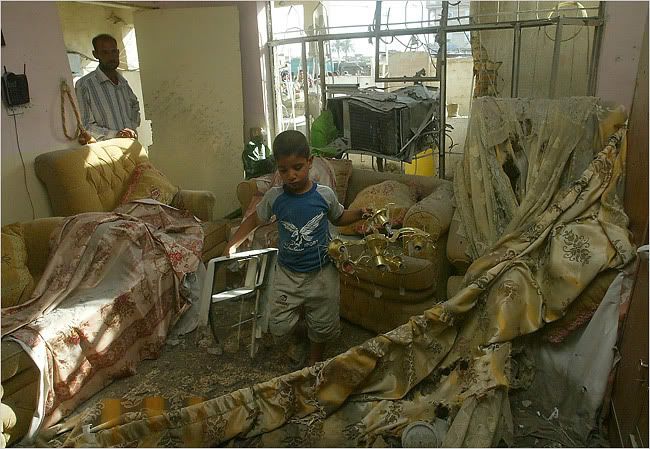 Officials of American-led forces said soldiers killed 26 militants in a raid in Sadr City Saturday, but some residents said civilians were killed. [Kareen Raheem, Reuters]
The New York Times reports:
Two American soldiers have been charged with premeditated murder and planting weapons on dead Iraqis, the United States military said Saturday.
Officials of American-led forces said soldiers killed 26 militants in a raid in Sadr City Saturday, but some residents said civilians were killed.
The soldiers, Staff Sgt. Michael A. Hensley and Specialist Jorge G. Sandoval Jr., were detained after fellow soldiers reported they had been involved in the deaths of three Iraqis near Iskandariya, a stronghold of the Sunni Arab insurgency south of Baghdad, in separate events between April and June this year.
Also on Saturday, the United States military mounted an early morning raid into the Shiite district of Sadr City in Baghdad. Officials with the American-led forces said soldiers had killed 26 militants, but some residents and Mahdi Army militia commanders accused them of killing civilians.
In the murder case, American military officials said Sergeant Hensley, 27, from Candler, N.C., faces three charges of premeditated murder, obstruction of justice and wrongfully placing weapons with the remains of deceased Iraqis. Specialist Sandoval, 20, faces one charge of premeditated murder and one of wrongfully placing a weapon on one of the three Iraqis killed.
Both were serving with the First Battalion, 501st Infantry, of the 25th Infantry Division, which has its headquarters at Fort Richardson, Alaska. Specialist Sandoval was picked up while at home on a two-week leave in Laredo, Tex., the military said. Charges were filed Thursday, and both men are in confinement in Kuwait.
The military said in a statement that an investigation was under way.
The area, part of the so-called Sunni Triangle, is no stranger to controversy.
Two American soldiers have admitted to raping a 14-year-old and killing her and her family in Mahmudiya, a town near Iskandariya, in March 2006, and others also face trial in the killings. Tension has been high since May 12, when an insurgent ambush on a patrol near Mahmudiya killed four American soldiers and one Iraqi, and led to the abduction of three Americans. One soldier’s body was later found but the other two soldiers are still missing.
In Baghdad, Lt. Col. Christopher Garver, an American military spokesman, said the raid in Sadr City on Saturday was against a militant cell that was smuggling weapons, explosively formed penetrators, a particularly lethal type of bomb, and money from Iran to aid Iraqi militias.
He said soldiers killed about 26 fighters and detained 17 suspects, but came under attack from small arms, rocket-propelled grenades and roadside bombs as they withdrew from the area. The Americans returned fire against militants shooting from behind buildings and cars.
“Everyone who got shot was shooting at U.S. troops at the time,” Colonel Garver said. “It was an intense firefight.”
But Iraqi officials said that the death toll was much lower, around eight, and some said that civilians were killed, including a man, his wife and their daughter, who had left their home to check on the disturbance.
Sadr City residents said the American operation was directed at more than one part of the district. Abu Jamal, 50, said he heard troops outside his house in the Sabee Qusoor area early in the morning.
“We were sitting on the roof, all of a sudden the helicopters started throwing flares,” he said. “We were afraid, so we left and went downstairs. The whole family went into one room because we started hearing the sound of firing from the helicopters. We couldn’t hear any firing from machine guns, only the aircraft firing. It was a horrible night.”
In Najaf, a spokesman for the anti-American cleric Moktada al-Sadr, the nominal leader of the Mahdi Army, condemned the raid Saturday and insisted that the militia was not involved in the fight.
“We reject these repeated assaults against civilians. The allegation that Mahdi Army members were the only ones targeted is baseless and wrong,” said the spokesman, Sheik Salah al-Obaidi. “The bombing hurt only innocent civilians.”
The battle prompted an immediate statement from the office of Prime Minister Nuri Kamal al-Maliki, saying that he would demand clarification from the military.
On the political front, Mr. Maliki appealed for Iraq’s largest Sunni bloc, the Iraqi Consensus Front, to end its boycott of his Shiite-dominated government. The boycott began last week as a protest of an arrest warrant issued against one of its members, Culture Minister Asad al-Hashimi, in a murder investigation.
Mr. Maliki said boycotts would only “complicate” matters, and urged them to embrace dialogue as “the only way to solve all the problems now and in the future.”
In Diyala Province, a suicide bomber killed three police recruits and wounded 34 lined up outside a police station in Muqdadiya.
Meanwhile, the American military said it killed Abu Abdel Rahman al-Masri, a senior figure in Al Qaeda in Mesopotamia, in a raid east of Falluja on Friday. Colonel Garver said that Mr. Masri, an Egyptian, had worked closely with Abu Ayyub al-Masri, the military leader of the group, and that his body had been identified by known associates.
American commanders also said that on Friday night a tip from an Iraqi led them to a grave containing dozens of bodies near Ferris, 20 miles south of Falluja. The military said in a statement: “Coalition forces uncovered 35 to 40 bodies at the site. The remains were bound and had gunshot wounds. This incident is currently under investigation.” It is unclear when or how the victims were killed.
Separately, an American command sergeant major, the most senior enlisted member serving in a major command, was sentenced to four months in detention after being convicted of possessing alcohol and pornography, engaging in an inappropriate relationship with a female soldier in his unit, and maltreating a soldier.
The command sergeant major, Edward Ramsdell, of the 411th Engineer Brigade, was working in Diyala Province at the time, and he was given a court-martial in October. Prosecutors said he had possessed a “large quantity” of alcohol and pornography in his quarters, tried to conceal the evidence when discovered and then tried to escape from investigating officers.
Thursday, April 26, 2007
| [+/-] |
From The White House To Abu Ghraib |
The creator of the famous Stanford prison experiment says the Bush administration is responsible for the US army's abuse and torture in Iraq
In the Guardian, Sasha Abramsky writes:
From White House to Abu Ghraib
The creator of the famous Stanford prison experiment says the Bush administration is responsible for the US army's abuse and torture in Iraq.
Thirty-six years ago, Philip Zimbardo, a young psychologist at Stanford University, set up an experiment intended to explore how normal young men would behave if put into a prison setting.
Zimbardo's team advertised for paid volunteers, screened the applicants for mental abnormalities and personality disorders, divvyed up the chosen ones into guards and prisoners, and then kicked off the experiment.
Over the next few days, in the basement lab of the psychology building, the uniformed "guards" - getting increasingly caught up in their role - thought up ever-more creative ways to assert their dominance over the jumpsuit-wearing "prisoners". They paraded them around with bags over their heads; removed the prisoners' clothing as punishment; took away their bedding; made them scrub toilets with their bare hands; insisted they do huge numbers of press ups, sometimes with other prisoners sitting on their backs; threw them into a dark, locked closet that was supposed to serve as an isolation unit; made them scream obscenities at each other; even forced them to pretend to be engaged in sexual activity with other brutalized prisoners.
The experiment was supposed to last two weeks. By day five, however, four of the prisoners had begun showing signs of nervous collapse; and by day six, the "Stanford Prison" had to be closed. What had started out as a low-key academic project had degenerated, in a remarkably short space of time, into a real-life version of William Golding's book Lord of the Flies.
Sound familiar? Over 30 years later, many of the same techniques, amplified by the horrors of war and the terrors of guerilla insurgency - some of them simply bizarre demonstrations of sadism, others clumsily thought-through control strategies - surfaced in the Abu Ghraib prison in Iraq.
Zimbardo has long been haunted by the events that his experiment precipitated. The realization that he and his fellow-experiment designers had created an utterly toxic environment, in which decent people playing guards speedily degenerated into brutes and decent people playing prisoners became abject, cowering, hysterical captives, has informed Zimbardo's career ever since.
Now, he has finally written a book on the Stanford Prison Experiment, tying it in with the slide toward torture that has occurred in Guantanamo and Abu Ghraib. Titled The Lucifer Effect, Zimbardo's volume argues that it's futile to put all of the blame for these violent episodes on "bad apples" in an otherwise good barrel. Quite the opposite, he writes. If senior political, military or correctional officials create a "bad barrel," signify to underlings that abuse will be tolerated, turn a blind-eye to wanton acts of humiliation, then the chances are pretty high that many "good apples" that get dumped into the situation will swiftly go rotten.
A few years back, Zimbardo was approached by the defense team for Sergeant Ivan "Chip" Frederick, one of the reservists on trial for the Abu Ghraib abuses. Frederick was in charge of Tier 1A, the infamous tier in which men were electric-shocked, had attack dogs set on them, and were made to engage in various humiliating sexual rituals. He wasn't one of the prime abusers, but he was responsible for letting the cycle of brutality go unchecked. He was also a man of limited initiative, used to taking orders, and desperate to fit in, to be one of the boys.
Zimbardo came to believe that Frederick was, essentially, a fall-guy for "The System" (his capital letters, not mine). After 9/11, he argues, the higher ups in that system, whether it be political leaders, top military brass or shadowy intelligence bosses, were all giving a nod-and-a-wink to acts designed to physically and mentally break detainees. As the editors of the book The Torture Papers documented, getting "actionable intelligence" from suspects being interrogated came to be more important than respecting the niceties of the Geneva Convention or the various prohibitions on torture signed onto by congress over the years.
In the second half of The Lucifer Effect, Zimbardo develops arguments for why Bush, Cheney, then-CIA chief Tenet and Geoffrey Miller - the major general who arrived in Abu Ghraib determined to have the prison there implement Guantanamo methods of interrogation - should stand trial for the atrocities that occurred in Abu Ghraib. If a man like Frederick is going to go to prison for years for his actions, Zimbardo argues, then the higher-ups who allowed this to happen on their watch should most assuredly be held accountable too.
Of course, Bush isn't about to stand trial anytime soon. Congress isn't going to muster the cajones to impeach the man, let alone hand him over to any international court of justice. But that doesn't make Zimbardo's line of reasoning any less valid: bad situations or systems do lead to atrocious actions, not by every participant but by enough to cause tremendous damage. Political climates created by those in power do have a trickle-down impact throughout society, rendering previously unthinkable acts normal.
In the long-run, President Bush's casual acceptance of the need for the state-as-torturer, his willingness to embrace a means-justifies-the-ends philosophy, will likely be his most shameful legacy.
George W's poll numbers are now so utterly dismal that it's hard to work out which actions are most repellant to ordinary voters. I'd like to think - though, admittedly, without the data to back up the hunch - that his and Cheney's implicit condoning of a climate in which torture has flourished ranks up there. After all, most Americans, like most people everywhere, are not innately bad. Maybe for a while they accepted the notion that Abu Ghraib was the product solely of a few twisted, amped-up lowly reservists. Not anymore. Zimbardo and others have done too good a job of showing up the connections, of insisting we look at the nudge-nudge, wink-wink nature of the Bush administration's relationship to torture.
Monday, April 16, 2007
| [+/-] |
Heroes and Villains |
Among the things I hate most about the nature of the woebegone wars we're fighting now is how easily our troops can become the bad guys. The New York Times recently reported on yet another collateral damage incident, this time in Afghanistan.
At Military.com, Jeffrey Huber writes:
American marines reacted to a bomb ambush with excessive force in eastern Afghanistan last month, hitting groups of bystanders and vehicles with machine-gun fire in a series of attacks that covered 10 miles of highway and left 12 civilians dead, including an infant and three elderly men, according to a report published by an Afghan human rights commission on Saturday… …One victim, a newly married 16-year-old girl, was cut down while she was carrying a bundle of grass to her family’s farmhouse, according to her family and the report. A 75-year-old man walking to his shop was hit by so many bullets that his son said he did not recognize the body when he came to the scene.
The incident took place on March 4 in Nangarhar Province. The military began an investigation shortly afterwards, and is now considering criminal charges against the Marines involved. I have no interest in condemning or condoning those Marines, and have no means of doing so. The Afghan Independent Human Rights Commission report on the incident condemned the suicide bomb attack that started things, but also said that: “In failing to distinguish between civilians and legitimate military targets, the U.S. Marine Corps Special Forces employed indiscriminate force. Their actions thus constitute a serious violation of international humanitarian standards.”
That might be true, but it appears that the Commission's report is largely based on anecdotal evidence from eyewitnesses. Eyewitness reports are seldom reliable, and we have no way of knowing the underlying motives of these particular eyewitnesses, most of whom are families and friends of the victims and who may or may not have direct or indirect connections with al-Qaeda and/or the Taliban.
That the U.S. military is in the final stages of approving condolence payments to the families of the killed and wounded doesn't tell us much. We've been doing that sort of thing for a long, long time. But the outrage among Afghanis seems to be genuine.
“This is not an isolated case,” said Nader Nadery, deputy director of the human rights commission. Nadery said this incident and others like it are defeating the U.S. goal of winning the hearts and minds of the Afghani people away from the Taliban. I'll second that sentiment.
The Afghan commission's report has been forwarded to Admiral William Fallon, chief of Central Command, for review. That's just the kind of administrative headache Fallon and his staff need right now. They're already presiding over two failed wars, some kind of murky monkey business or other in Somalia, plus the possibility of an air and maritime operation against Iran.
The Marines involved in the Nangarhar Province incident are still in theater, but the rest of their 120-man company has been pulled out of the country. The entire company will no doubt be subjected to intense scrutiny over the affair, and its morale and readiness will suffer for it. Platoons of rear echelon merry fellows will wipe out mighty forests coming up with lessons learned and corrective training syllabi that no one will ever read.
The Marines under investigation may get a fair shake from the military justice system and they may not. Military justice is always a crapshoot. You could be Private Lynndie England, who got 36 months in the Naval Brig in San Diego for her part in the Abu Ghraib scandal. Or you could be Major General Geoffrey Miller, Donald Rumsfeld's interrogation czar at Guantanamo Bay, Abu Ghraib and elsewhere, who was allowed to retire as a two-star. Or you could be Donald Rumsfeld, the man perhaps most singularly responsible for every crime and disaster committed in our Middle East misadventure, and retire as Secretary of Defense to a life of luxury that very few of us dare to dream of.
Funny how that works, isn't it? Lynndie England will be lucky to get back her civilian job at a fast food joint. Miller and Rumsfeld will never have to eat at one.
Like I said, I can't condone or condemn the Marines in this story because I don't really know what happened. But I find myself sympathizing with them because it's a travesty that they were in Afghanistan in the first place.
The fourth anniversary of the Mesopotamia Mistake took most of the public's eye off the fact that we've been flopping around in Afghanistan since October of 2001. Five and a half years later, Afghanistan is a narco-state, the Taliban are launching a spring offensive, the Karzai government is a joke and, oh yeah, the tallest Arab ever wanted dead or alive by an American president is still on the loose.
None of that is the fault of the Marines under investigation for using "indiscriminate force" at Nangarhar Province. None of those Marines concocted the elaborate hoax that led to our invasion of Iraq, none of them lied to us year after year about how well things were going there, and none of them tried to blame the "hostile media" or "Defeato-crats" for their own culpability in running two of the most mismanaged wars in U.S. history.
Nor will they live comfortably the rest of their lives on the cushion of their war profits. Whatever the results of their investigation or trials, none of those Marines will land seven-figure book deals, or cushy fellowships with neoconservative think tanks, or high dollar jobs as pundits in Rupert Murdoch's right wing media empire, and they're not likely to pick up executive positions with big profile defense contractors.
And come January 2009, none of them will retire to their ranches in Texas and erect libraries dedicated to the redemption of their legacies.
Friday, April 13, 2007
| [+/-] |
Payouts Reveal Iraq Civilian Toll |
The BBC reports:
A civil liberties group has obtained files from the US Army on compensation claims to Iraqi and Afghan civilians killed and hurt by coalition forces.
The American Civil Liberties Union received the records in response to a Freedom of Information Act request.
Of the 496 claims, 164 resulted in cash payments to families, the ACLU says. Many files relate to civilian deaths at checkpoints or near US convoys.
The military only pays compensation in cases not involving combat activity.
If it does not accept responsibility for the civilian's death, the military can make a discretionary "condolence" payment, which is offered without admission of fault and is capped at $2,500.
In the 164 claims resulting in payments, about half were for compensation and the remainder condolence payments.
The New York-based ACLU believes the files it has received are a very small proportion of those held by the defence department, and is pressing it to disclose them all.
Civilian 'burden'
Jameel Jaffer, an attorney for the ACLU, told the BBC News website it was the first time the US government had released records of this kind.
They allow the public to understand the burden that has been borne by civilians in Iraq and Afghanistan
Jameel Jaffer, ACLU
"For the first time they give the public access to very detailed information about the human costs of war," he said.
"They allow the public to understand the burden that has been borne by civilians in Iraq and Afghanistan."
The details published by the ACLU are summaries of claims submitted to the US Foreign Claims Commission by the relatives of civilians said to have been killed as a result of actions by coalition forces.
Some 479 of the claims relate to incidents in Iraq, dating from May 2003 to late 2006 with the majority in 2005, and 17 to Afghanistan, most dating from 2006.
Many deaths occur as a result of confusion at checkpoints
One file records a payment of $35,000 made to a family in Hib Hib, Iraq, after US forces "accidentally discharged 155 mm rounds", killing three children aged five, 16 and 18 and damaging their home.
Another, dating from February 2006, describes how a fisherman in Tikrit was shot as he reached down to switch off the engine of his boat. He had been shouting "fish, fish" and pointing to his catch.
The US Army refused to compensate his family for his death, ruling that it was the result of combat activity, but paid $3,500 for the loss of his boat - which drifted off - net and mobile phone.
In a third file, a civilian states that US forces opened fire with more than 100 rounds on his sleeping family, killing his mother, father and brother. He was also hurt and 32 of the family's sheep killed.
The US Army paid $11,200 compensation and made a $2,500 condolence payment. It had been responding to an attack from the direction of the village.
Mother killed
About a fifth of the claims - 92 of the 496 files - relate to deaths at checkpoints or near US convoys, the ACLU points out.
In one case, a civilian records how his mother was killed and his sister and four-year-old brother injured after the taxi in which they were travelling ran through a checkpoint in the Iraqi town of Baquba.
An Army memo states: "There is evidence to suggest that the warning cones and printed checkpoint signs had not yet been displayed in front of the checkpoint, which may be the reason why the driver of the taxi did not believe he was required to stop."
A condolence payment of $7,500 was suggested but it is not known if it was paid.
Hearts and minds
Incidents that have not been logged in the US military's "significant act" database are generally denied compensation for lack of evidence, despite eyewitness statements. Condolence payments may be made.
The US Army says coalition forces try hard to avoid civilian casualties
Some letters sent to notify denial of a claim conclude with the phrase "I wish you well in a Free Iraq".
Mr Jaffer fears such platitudes and some instances of claims being denied may be damaging US efforts to win "hearts and minds" in Iraq and Afghanistan.
"It's extremely important from a policy point of view that the US compensates people in these kinds of claims and that the system is fair and not arbitrary," he said.
And while very many civilian casualties are caused by insurgents, the 1,700 pages of files received by the ACLU tell the stories of those killed by coalition forces in "very human detail".
Many prove to be the tragic result of miscommunication and misunderstanding on both sides, Mr Jaffer added.
The US defence department has said it regrets any civilian deaths and strives to prevent them.
"Any loss of life is tragic and our forces, as well as the forces we serve with, take every available means to limit the effects of combat on civilians," defence department spokesman Todd Wician told the BBC.
Wednesday, March 15, 2006
| [+/-] |
U.S. Raid On Home Kills 11 Family Members |
Reuters reports:
Eleven members of an Iraqi family were killed in a U.S. raid on Wednesday, police and witnesses said. The U.S. military said two women and a child died during the bid to seize an al Qaeda militant from a house.
A senior Iraqi police officer said autopsies on the bodies, which included five children, showed each had been shot in the head. Community leaders said they were outraged at the killings and demanded an explanation from the U.S. military.
Television footage showed the bodies in the Tikrit morgue -- five children, two men and four women. Their wounds were not clear though one infant had a gaping head wound.
A freelance photographer later saw them being buried by weeping men in Ishaqi, the town 100 km (60 miles) north of Baghdad where the raid took place.
The U.S. military said in a statement its troops had attacked a house in Ishaqi early on Wednesday to capture a "foreign fighter facilitator for the al Qaeda in Iraq network".
"Troops were engaged by enemy fire as they approached the building," spokesman Major Tim Keefe said. "Coalition Forces returned fire utilising both air and ground assets.
"There was one enemy killed. Two women and one child were also killed in the firefight. The building ... (was) destroyed."
Keefe said the al Qaeda suspect had been captured and was being questioned.
RUBBLE
Major Ali Ahmed of the Ishaqi police said U.S. forces had landed on the roof of the house in the early hours and shot the 11 occupants, including the five children.
"After they left the house they blew it up," he said.
Another policeman, Colonel Farouq Hussein, said autopsies had been carried out at Tikrit hospital and found "all the victims had gunshot wounds to the head".
The bodies, their hands bound, had been dumped in one room before the house was destroyed, Hussein said. Police had found spent American-issue cartridges in the rubble.
"It's a clear and perfect crime without any doubt," he said.
Police in Salahaddin province, a heartland of the Sunni Arab insurgency and the home region of Saddam Hussein, have frequently criticised U.S. military tactics in the area.
Police officers said the U.S. military had asked for a meeting with local tribal leaders. The Joint Co-ordination Centre in Tikrit which coordinates between U.S. and Iraqi security forces said later the meeting would happen on Friday.
Ishaqi's town administrator, Rasheed Shather, said the town was shocked: "Everyone went to the funeral. We want the Americans to give us an explanation for this horrible crime."
Photographs of the funeral showed men crying as five children, who all looked under the age of five, were wrapped in blankets and then lined up in a row. One man who described himself as a relative said one was just seven months old.
"They killed these innocent children. Are these considered terrorists? Is a seven-month-old child a terrorist?" he said angrily, speaking close to the remains of the house.
Local teacher Faeq Nsaef was also outraged: ""An entire family was killed. It's a barbarian act."
In January a U.S. air strike on a house in Baiji, further north, killed several members of a family. In December U.S. fighter jets dropped two 500-pound bombs on a village, also in the region, killing 10 people. The U.S. military said the people targeted had been suspected of planting roadside bombs. (Additional reporting by Ghazwan al-Jibouri in Tikrit and Aseel Kami in Baghdad)
Wednesday, February 15, 2006
| [+/-] |
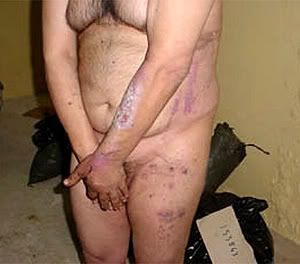
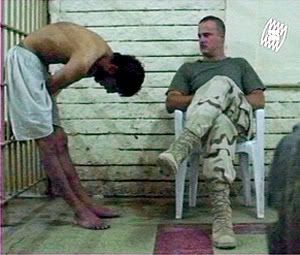
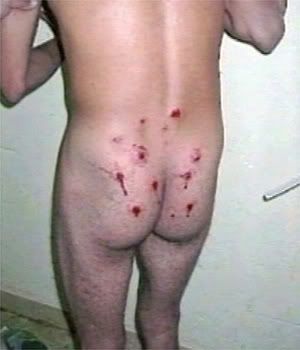
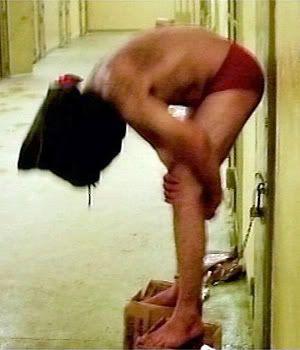
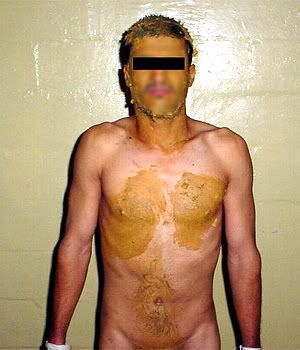
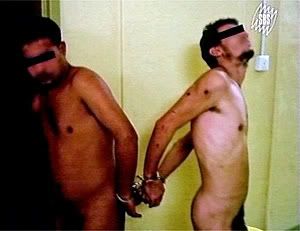
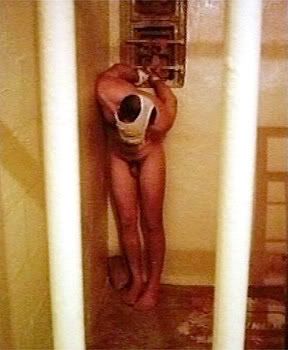
Abu Ghraib, Revisited |
Abu Ghraib, in pictures:

Wednesday, March 30, 2005
| [+/-] |
Children 'Starving' in New Iraq |
The BBC reports:
Increasing numbers of children in Iraq do not have enough food to eat and more than a quarter are chronically undernourished, a UN report says.
Malnutrition rates in children under five have almost doubled since the US-led invasion - to nearly 8% by the end of last year, it says.
The report was prepared for the annual meeting of the UN Human Rights Commission in Geneva.
It also expressed concern over North Korea and Sudan's Darfur province.
Jean Ziegler, a UN specialist on hunger who prepared the report, blamed the worsening situation in Iraq on the war led by coalition forces.
The silent daily massacre by hunger is a form of murder - it must be battled and eliminated
Jean Ziegler
He was addressing a meeting of the 53-nation commission, the top UN rights watchdog, which is halfway through its annual six-week session.
When Saddam Hussein was overthrown, about 4% of Iraqi children under five were going hungry; now that figure has almost doubled to 8%, his report says.
Governments must recognise their extra-territorial obligations towards the right to food and should not do anything that might undermine access to it of people living outside their borders, it says.
That point is aimed clearly at the US, but Washington, which has sent a large delegation to the Human Rights Commission, declined to respond to the charges, says the BBC's Imogen Foulkes in Geneva.
Increasing hunger
Mr Ziegler also said he was very concerned about the lack of food in North Korea, where there are reports that UN food aid is not being distributed fairly.
In Darfur, the continuing conflict has prevented people from planting vital crops, he said.
Overall, Mr Ziegler said he was shocked by the fact that hunger is actually increasing worldwide.
Some 17,000 children die every day from hunger-related diseases, the report claims, calling the situation a scandal in a world that is richer than ever before.
"The silent daily massacre by hunger is a form of murder," Mr Ziegler said. "It must be battled and eliminated."
