The Washington Post:
The U.S. government is collecting electronic records on the travel habits of millions of Americans who fly, drive or take cruises abroad, retaining data on the persons with whom they travel or plan to stay, the personal items they carry during their journeys, and even the books that travelers have carried, according to documents obtained by a group of civil liberties advocates and statements by government officials.
The personal travel records are meant to be stored for as long as 15 years, as part of the Department of Homeland Security's effort to assess the security threat posed by all travelers entering the country. Officials say the records, which are analyzed by the department's Automated Targeting System, help border officials distinguish potential terrorists from innocent people entering the country.
But new details about the information being retained suggest that the government is monitoring the personal habits of travelers more closely than it has previously acknowledged. The details were learned when a group of activists requested copies of official records on their own travel. Those records included a description of a book on marijuana that one of them carried and small flashlights bearing the symbol of a marijuana leaf.
The Automated Targeting System has been used to screen passengers since the mid-1990s, but the collection of data for it has been greatly expanded and automated since 2002, according to former DHS officials.
Officials yesterday defended the retention of highly personal data on travelers not involved in or linked to any violations of the law. But civil liberties advocates have alleged that the type of information preserved by the department raises alarms about the government's ability to intrude into the lives of ordinary people. The millions of travelers whose records are kept by the government are generally unaware of what their records say, and the government has not created an effective mechanism for reviewing the data and correcting any errors, activists said.
The activists alleged that the data collection effort, as carried out now, violates the Privacy Act, which bars the gathering of data related to Americans' exercise of their First Amendment rights, such as their choice of reading material or persons with whom to associate. They also expressed concern that such personal data could one day be used to impede their right to travel.
"The federal government is trying to build a surveillance society," said John Gilmore, a civil liberties activist in San Francisco whose records were requested by the Identity Project, an ad-hoc group of privacy advocates in California and Alaska. The government, he said, "may be doing it with the best or worst of intentions. . . . But the job of building a surveillance database and populating it with information about us is happening largely without our awareness and without our consent."
Gilmore's file, which he provided to The Washington Post, included a note from a Customs and Border Patrol officer that he carried the marijuana-related book "Drugs and Your Rights." "My first reaction was I kind of expected it," Gilmore said. "My second reaction was, that's illegal."
DHS officials said this week that the government is not interested in passengers' reading habits, that the program is transparent, and that it affords redress for travelers who are inappropriately stymied. "I flatly reject the premise that the department is interested in what travelers are reading," DHS spokesman Russ Knocke said. "We are completely uninterested in the latest Tom Clancy novel that the traveler may be reading."
But, Knocke said, "if there is some indication based upon the behavior or an item in the traveler's possession that leads the inspection officer to conclude there could be a possible violation of the law, it is the front-line officer's duty to further scrutinize the traveler." Once that happens, Knocke said, "it is not uncommon for the officer to document interactions with a traveler that merited additional scrutiny."
He said that he is not familiar with the file that mentions Gilmore's book about drug rights, but that generally "front-line officers have a duty to enforce all laws within our authority, for example, the counter-narcotics mission." Officers making a decision to admit someone at a port of entry have a duty to apply extra scrutiny if there is some indication of a violation of the law, he said.
The retention of information about Gilmore's book was first disclosed this week in Wired News. Details of how the ATS works were disclosed in a Federal Register notice last November. Although the screening has been in effect for more than a decade, data for the system in recent years have been collected by the government from more border points, and also provided by airlines -- under U.S. government mandates -- through direct electronic links that did not previously exist.
The DHS database generally includes "passenger name record" (PNR) information, as well as notes taken during secondary screenings of travelers. PNR data -- often provided to airlines and other companies when reservations are made -- routinely include names, addresses and credit-card information, as well as telephone and e-mail contact details, itineraries, hotel and rental car reservations, and even the type of bed requested in a hotel.
The records the Identity Project obtained confirmed that the government is receiving data directly from commercial reservation systems, such as Galileo and Sabre, but also showed that the data, in some cases, are more detailed than the information to which the airlines have access.
Ann Harrison, the communications director for a technology firm in Silicon Valley who was among those who obtained their personal files and provided them to The Post, said she was taken aback to see that her dossier contained data on her race and on a European flight that did not begin or end in the United States or connect to a U.S.-bound flight.
"It was surprising that they were gathering so much information without my knowledge on my travel activities, and it was distressing to me that this information was being gathered in violation of the law," she said.
James P. Harrison, director of the Identity Project and Ann Harrison's brother, obtained government records that contained another sister's phone number in Tokyo as an emergency contact. "So my sister's phone number ends up being in a government database," he said. "This is a lot more than just saying who you are, your date of birth."
Edward Hasbrouck, a civil liberties activist who was a travel agent for more than 15 years, said that his file contained coding that reflected his plan to fly with another individual. In fact, Hasbrouck wound up not flying with that person, but the record, which can be linked to the other passenger's name, remained in the system. "The Automated Targeting System," Hasbrouck alleged, "is the largest system of government dossiers of individual Americans' personal activities that the government has ever created."
He said that travel records are among the most potentially invasive of records because they can suggest links: They show who a traveler sat next to, where they stayed, when they left. "It's that lifetime log of everywhere you go that can be correlated with other people's movements that's most dangerous," he said. "If you sat next to someone once, that's a coincidence. If you sat next to them twice, that's a relationship."
Stewart Verdery, former first assistant secretary for policy and planning at DHS, said the data collected for ATS should be considered "an investigative tool, just the way we do with law enforcement, who take records of things for future purposes when they need to figure out where people came from, what they were carrying and who they are associated with. That type of information is extremely valuable when you're trying to thread together a plot or you're trying to clean up after an attack."
Homeland Security Secretary Michael Chertoff in August 2006 said that "if we learned anything from Sept. 11, 2001, it is that we need to be better at connecting the dots of terrorist-related information. After Sept. 11, we used credit-card and telephone records to identify those linked with the hijackers. But wouldn't it be better to identify such connections before a hijacker boards a plane?" Chertoff said that comparing PNR data with intelligence on terrorists lets the government "identify unknown threats for additional screening" and helps avoid "inconvenient screening of low-risk travelers."
Knocke, the DHS spokesman, added that the program is not used to determine "guilt by association." He said the DHS has created a program called DHS Trip to provide redress for travelers who faced screening problems at ports of entry.
But DHS Trip does not allow a traveler to challenge an agency decision in court, said David Sobel, senior counsel with the Electronic Frontier Foundation, which has sued the DHS over information concerning the policy underlying the ATS. Because the system is exempted from certain Privacy Act requirements, including the right to "contest the content of the record," a traveler has no ability to correct erroneous information, Sobel said.
Zakariya Reed, a Toledo firefighter, said in an interview that he has been detained at least seven times at the Michigan border since fall 2006. Twice, he said, he was questioned by border officials about "politically charged" opinion pieces he had published in his local newspaper. The essays were critical of U.S. policy in the Middle East, he said. Once, during a secondary interview, he said, "they had them printed out on the table in front of me."
Saturday, September 22, 2007
| [+/-] |
Collecting Details on Travelers Documented |
Tuesday, June 19, 2007
| [+/-] |
Report: Iraq Violence Leading to Abortions, Drug Abuse Among Civilians |
ABC News reports:
Pregnant Iraqi women who have been forced from their homes by worsening violence are obtaining illegal abortions because they are unable to get medical care for themselves and their unborn, according to a new report by a national humanitarian group.
A record number of Iraqis -- most of them women and children -- are fleeing their homes to escape the bloodshed of sectarian violence and anti-U.S. attacks, according to a new report by the Iraqi Red Crescent organization, the largest aid group operating in Iraq.
Health care is inadequate and difficult to access for those people, according to the IRC report.
"Pregnant women, infants and children are unable to get...required medical care," states the report, which was translated from Arabic, "and criminal abortion became [sic] the norms."
Rape, theft and drug addiction have also become "commonplace" among the displaced, who live in government buildings, at relatives' homes, tents, or squat in abandoned homes or makeshift huts on empty land, according to the report, which was first noted on the Iraq news site Iraqslogger.com.
The number of "internally displaced persons" -- refugees who leave their homes but remain in the country -- has quadrupled since January, the group found. As of May 2007, 1,024,430 Iraqis have left their neighborhoods to live in safer regions, the group reported, with more than 400,000 people pouring out of the areas around Baghdad and Mosul, which have been plagued by sectarian violence and anti-U.S. attacks.
More than 1.8 million Iraqis have fled the country entirely, according to the United Nations.
The report by Iraqi Red Crescent, which says its personnel reach every village in Iraq, comes on the heels of a May report from the International Committee of the Red Cross, which warned of the "immense suffering" caused by the ongoing conflict.
"Shootings, bombings, abductions, murders, military operations and other forms of violence are forcing thousands of people to flee their homes and seek safety elsewhere in Iraq or in neighbouring countries," the group said, noting that food is scarce in some regions, and power shortages are worsening.
"The outlook is bleak," the Red Cross noted, and "likely to worsen."
Friday, February 17, 2006
| [+/-] |
Transcript of Democracy Now: Expose' of CIA's History of Torture & Interrogation, From Cold War to War on Terror |
Democracy Now! takes a look at what lies behind the shocking images of torture at Abu Ghraib prison by turning to the history of the CIA and torture techniques. The International Committee of the Red Cross, Amnesty International and other human rights groups say the recently released images of abuse of Iraqi prisoners at Abu Ghraib show a clear violation of international humanitarian law. The U.S. made a pledge against torture when Congress ratified the UN Convention Against Torture in 1994 - but it was ratified with reservations that exempted the CIA’s psychological torture method.
Alfred McCoy, professor of history at the University of Wisconsin-Madison. Author of “A Question of Torture: CIA Interrogation, From the Cold War to the War on Terror,” a startling expose of the CIA development of psychological torture from the Cold War to Abu Ghraib, and also “The Politics of Heroin: CIA Complicity in the Global Drug Trade.” CIA mercenaries attempted to assassinate McCoy more than 30 years ago.
[see video of broadcast-256k stream or 128k stream]
Transcript:
AMY GOODMAN: A new expose gives an account of the C.I.A.’s secret efforts to develop new forms of torture, spanning half a century. It reveals how the C.I.A. perfected its methods, distributing them across the world, from Vietnam to Iran to Central America, uncovering the roots of the Abu Ghraib and Guantanamo torture scandals. The book is called A Question of Torture: C.I.A. Interrogation, from the Cold War to the War on Terror, and we're joined by its author, Alfred McCoy, professor of history at the University of Wisconsin, Madison. We welcome you to Democracy Now!
ALFRED McCOY: Thank you, Amy.
AMY GOODMAN: And glad to have you with us, especially in light of your history. I first learned of you with your first book The Politics of Heroin: C.I.A. Complicity in the Global Drug Trade, for which you almost died. What happened then?
ALFRED McCOY: Oh, when I was researching that book in the mountains of Laos, hiking from village to village, interviewing Laotian farmers about their opium harvest, and they were telling me that they took it down to the local helicopter pad where Air America helicopters would land, Air America being a subsidiary of the C.I.A., and officers, tribal officers in the C.I.A.’s secret army would buy the opium and fly it off to the C.I.A.’s secret compound, where it would be transformed into heroin and ultimately wound up in South Vietnam. And while I was doing that research, hiking from village to village, interviewing farmers, we were ambushed by a group of C.I.A. mercenaries. Fortunately, I had five militiamen from the village with me, and we shot our way out of there, but they came quite close. Then later on, a C.I.A. operative threatened to murder my interpreter unless I stopped doing that research. And then when --
AMY GOODMAN: How did you know they were C.I.A.?
ALFRED McCOY: Oh, look, in the mountains of Laos, there aren’t that many white guys, okay? I mean, the mercenaries? First of all, the C.I.A. ran what was called the “Army Clandestine.” They had a secret army, and those soldiers that ambushed us were soldiers in the secret army. That, we knew.
AMY GOODMAN: The Laotian army?
ALFRED McCOY: The C.I.A.’s secret army.
AMY GOODMAN: The Laotian mercenaries?
ALFRED McCOY: Laotian mercenaries. That, everybody was clear about that. Nobody denied that. They said it was sort of an accident, but, no, it was very clear that it was intentional. And ultimately, when the book was in press, the head of covert operations for the C.I.A. called up my offices and my publisher in New York and suggested that the publisher suppress the book. They then got the right to prior review -- the publisher compromised.
AMY GOODMAN: C.I.A. prior review.
ALFRED McCOY: Prior review of the manuscript, and they issued a 14-page critique. The publisher’s legal department, HarperCollins’s legal department reviewed the critique, reviewed the manuscript, published the book unchanged, not a word changed.
AMY GOODMAN: And the contention of that book was that the C.I.A. was complicit in the global drug trade?
ALFRED McCOY: Right. In the context of conducting covert operations around the globe, particularly in the Asian opium zone, which stretched from the Golden Triangle of Vietnam and Laos all the way to Afghanistan, that in those mountains far away from home, when the C.I.A. had to mobilize tribal armies, the only allies were warlords, and when the C.I.A. formed an alliance with them, the warlords used this alliance to become drug lords, and the C.I.A. didn't stop them from their involvement in the traffic.
AMY GOODMAN: Well, as a professor at the University of Wisconsin, Madison, you have not stopped looking at the C.I.A., and now you've written this new book. It's called A Question of Torture: C.I.A. Interrogation, from the Cold War to the War on Terror. Give us a history lesson.
ALFRED McCOY: Well, if you look at the most famous of photographs from Abu Ghraib, of the Iraqi standing on the box, arms extended with a hood over his head and the fake electrical wires from his arms, okay? In that photograph you can see the entire 50-year history of C.I.A. torture. It's very simple. He's hooded for sensory disorientation, and his arms are extended for self-inflicted pain. And those are the two very simple fundamental C.I.A. techniques, developed at enormous cost.
From 1950 to 1962, the C.I.A. ran a massive research project, a veritable Manhattan Project of the mind, spending over $1 billion a year to crack the code of human consciousness, from both mass persuasion and the use of coercion in individual interrogation. And what they discovered -- they tried LSD, they tried mescaline, they tried all kinds of drugs, they tried electroshock, truth serum, sodium pentathol. None of it worked. What worked was very simple behavioral findings, outsourced to our leading universities -- Harvard, Princeton, Yale and McGill -- and the first breakthrough came at McGill. And it's in the book. And here, you can see the -- this is the -- if you want show it, you can. That graphic really shows -- that's the seminal C.I.A. experiment done in Canada and McGill University --
AMY GOODMAN: Describe it.
ALFRED McCOY: Oh, it's very simple. Dr. Donald O. Hebb of McGill University, a brilliant psychologist, had a contract from the Canadian Defense Research Board, which was a partner with the C.I.A. in this research, and he found that he could induce a state of psychosis in an individual within 48 hours. It didn't take electroshock, truth serum, beating or pain. All he did was had student volunteers sit in a cubicle with goggles, gloves and headphones, earmuffs, so that they were cut off from their senses, and within 48 hours, denied sensory stimulation, they would suffer, first hallucinations, then ultimately breakdown.
And if you look at many of those photographs, what do they show? They show people with bags over their head. If you look at the photographs of the Guantanamo detainees even today, they look exactly like those student volunteers in Dr. Hebb’s original cubicle.
Now, then the second major breakthrough that the C.I.A. had came here in New York City at Cornell University Medical Center, where two eminent neurologists under contract from the C.I.A. studied Soviet K.G.B. torture techniques, and they found that the most effective K.G.B. technique was self-inflicted pain. You simply make somebody stand for a day or two. And as they stand -- okay, you're not beating them, they have no resentment -- you tell them, “You're doing this to yourself. Cooperate with us, and you can sit down.” And so, as they stand, what happens is the fluids flow down to the legs, the legs swell, lesions form, they erupt, they suppurate, hallucinations start, the kidneys shut down.
Now, if you look at the other aspect of those photos, you’ll see that they're short-shackled -- okay? -- that they're long-shackled, that they're made -- several of those photos you just showed, one of them with a man with a bag on his arm, his arms are straight in front of him, people are standing with their arms extended, that's self-inflicted pain. And the combination of those two techniques -- sensory disorientation and self-inflicted pain -- is the basis of the C.I.A.'s technique.
AMY GOODMAN: Who has pioneered this at the C.I.A.?
ALFRED McCOY: This was done by Technical Services Division. Most of the in-house research involved drugs and all of the LSD experiments that we heard about for years, but ultimately they were a negative result. When you have any large massive research project, you get -- you hit dead ends, you hit brick walls, you get negative results. All the drugs didn’t work. What did work was this.
AMY GOODMAN: But when you talk about the ‘everyone knows the LSD experiments,’ I don't think everyone knows. In fact, I would conjecture that more than 90% of Americans don't know that the C.I.A. was involved with LSD experiments on unwitting Americans. Can you explain what they did?
ALFRED McCOY: Oh, sure. As a part of this comprehensive survey of human consciousness, the C.I.A. tried every possible techniques. And one of the things that they -- at the time that this research started in the 1940s, a Swiss pharmaceutical company developed LSD.
AMY GOODMAN: Which one?
ALFRED McCOY: I forget now. One of the major Swiss pharmaceutical companies. And Dr. Hoffman there was the man who developed it. The C.I.A. bought substantial doses, and they conducted experiments. One of the most notorious experiments was that Dr. Sidney Gottlieb, inside the agency, spiked the drinks of his co-workers, and one of those co-workers suffered a breakdown, Dr. Frank Olson, and he either was -- I don't know whether he was pushed or jumped from a hotel here in New York City --
AMY GOODMAN: His son has never stopped pursuing this case?
ALFRED McCOY: Right, his son Eric Olson insists that his father was murdered by the C.I.A. Eric Olson believes that his father did a tour of Europe, and he visited the ultimate Anglo-American test site, black site near Frankfurt, where they were doing lethal experiments, fatal experiments, on double agents and suspected double agents, and that his father returned enormously upset by the discovery that this research was actually killing people, and that, therefore, Eric Olson argues his father was killed by the C.I.A., that he was pushed.
AMY GOODMAN: And didn't they do experiments in brothels in the San Francisco area?
ALFRED McCOY: They had two kind of party houses. They had one in the San Francisco Bay Area, another in New York City. And what they did in San Francisco was they had prostitutes who go out to the streets, get individuals, bring them back, give them a drink, and there would be a two-way mirror, and the C.I.A. would photograph these people.
AMY GOODMAN: So, the C.I.A. were running the brothel.
ALFRED McCOY: They were running the brothel. They were running all of these experiments, okay? They did that on Army soldiers through the Army Chemical Warfare Division.
AMY GOODMAN: What did they do there?
ALFRED McCOY: Again, they gave them LSD and other drugs to see what effect they would have.
AMY GOODMAN: And what did the soldiers think they were getting?
ALFRED McCOY: They were just told they were participating in an experiment for national defense.
AMY GOODMAN: Prisoners?
ALFRED McCOY: No, these were --
AMY GOODMAN: Right, but also on prisoners, were there experiments?
ALFRED McCOY: There were some in prisons in the United States and also the Drug Treatment Center in Lexington, Kentucky. The Federal Drug Treatment Center in Lexington, Kentucky, had this. All of this research, all this very elaborate research --
AMY GOODMAN: On unwitting Americans?
ALFRED McCOY: Unwitting Americans, produced nothing, okay? What they found time and time again is that electroshock didn't work, and sodium pentathol didn't work, LSD certainly didn't work. You scramble the brain. You got unreliable information. But what did work was the combination of these two rather boring, rather mundane behavioral techniques: sensory disorientation and self-inflicted pain.
And in 1963, the C.I.A. codified these results in the so-called KUBARK Counterintelligence Manual. If you just type the word “KUBARK” into Google, you will get the manual, an actual copy of it, on your computer screen, and you can read the techniques [Read the report. But if you do, read the footnotes, because that's where the behavioral research is. Now, this produced a distinctively American form of torture, the first real revolution in the cruel science of pain in centuries, psychological torture, and it's the one that's with us today, and it's proved to be a very resilient, quite adaptable, and an enormously destructive paradigm.
Let’s make one thing clear. Americans refer to this often times in common parlance as “torture light.” Psychological to torture, people who are involved in treatment tell us it’s far more destructive, does far more lasting damage to the human psyche than does physical torture. As Senator McCain said, himself, last year when he was debating his torture prohibition, faced with a choice between being beaten and psychologically tortured, I'd rather be beaten. Okay? It does far more lasting damage. It is far crueler than physical torture. This is something that we don't realize in this country.
Now, another thing we see is those photographs is the psychological techniques, but the initial research basically developed techniques for attacking universal human sensory receptors: sight, sound, heat, cold, sense of time. That's why all of the detainees describe being put in dark rooms, being subjected to strobe lights, loud music, okay? That’s sensory deprivation or sensory assault. Okay, that was sort of the phase one of the C.I.A. research. But the paradigm has proved to be quite adaptable.
Now, one of the things that Donald Rumsfeld did, right at the start of the war of terror, in late 2002, he appointed General Geoffrey Miller to be chief at Guantanamo, alright, because the previous commanders at Guantanamo were too soft on the detainees, and General Miller turned Guantanamo into a de facto behavioral research laboratory, a kind of torture research laboratory. And under General Miller at Guantanamo, they perfected the C.I.A. torture paradigm. They added two key techniques. They went beyond the universal sensory receptors of the original research. They added to it an attack on cultural sensitivity, particularly Arab male sensitivity to issues of gender and sexual identity.
And then they went further still. Under General Miller, they created these things called “Biscuit” teams, behavioral science consultation teams, and they actually had qualified military psychologists participating in the ongoing interrogation, and these psychologists would identify individual phobias, like fear of dark or attachment to mother, and by the time we're done, by 2003, under General Miller, Guantanamo had perfected the C.I.A. paradigm, and it had a three-fold total assault on the human psyche: sensory receptors, self-inflicted pain, cultural sensitivity, and individual fears and phobia.
AMY GOODMAN: And then they sent General Miller to, quote, "Gitmo-ize" Abu Ghraib. Professor McCoy, we’re going to break for a minute, and then we'll come back. Professor Alfred McCoy, professor of history at the University of Wisconsin, Madison. His latest book is called A Question of Torture: C.I.A. Interrogation, from the Cold War to the War on Terror.
[break]
AMY GOODMAN: We are talking to Alfred McCoy, professor of history at the University of Wisconsin, Madison, author of a number of books. The Politics of Heroin: C.I.A. Complicity in the Global Drug Trade almost had him killed. Afterwards, the C.I.A. tried to have the book squelched, but ultimately it was published. Then A Question of Torture: C.I.A. Interrogation from the Cold War to the War On Terror is his latest book, and we're talking about the history of torture. Continue with what you were saying, talking about the Biscuit teams, the use of psychologists in Guantanamo, and then Geoffrey Miller, going from Guantanamo to, quote, “Gitmo-ize” Abu Ghraib.
ALFRED McCOY: In mid-2003, when the Iraqi resistance erupted, the United States found it had no intelligence assets; it had no way to contain the insurgency, and they -- the U.S. military was in a state of panic. And at that moment, they began sweeping across Iraq, rounding up thousands of Iraqi suspects, putting many of them in Abu Ghraib prison. At that point, in late August 2003, General Miller was sent from Guantanamo to Abu Ghraib, and he brought his techniques with him. He brought a CD, and he brought a manual of his techniques. He gave them to the M.P. officers, the Military Intelligence officers and to General Ricardo Sanchez, the U.S. Commander in Iraq.
In September of 2003, General Sanchez issued orders, detailed orders, for expanded interrogation techniques beyond those allowed in the U.S. Army Field Manual 3452, and if you look at those techniques, what he's ordering, in essence, is a combination of self-inflicted pain, stress positions and sensory disorientation, and if you look at the 1963 C.I.A. KUBARK Counterintelligence Interrogation Manual, you look at the 1983 C.I.A. Interrogation Training Manual that they used in Honduras for training Honduran officers in torture and interrogation, and then twenty years later, you look at General Sanchez's 2003 orders, there's a striking continuity across this forty-year span, in both the general principles, this total assault on the existential platforms of human identity and existence, okay? And the specific techniques, the way of achieving that, through the attack on these sensory receptors.
AMY GOODMAN: And Rumsfeld's comment, when asked if it was torture, when people were forced to stand hours on end, that he stands at his desk?
ALFRED McCOY: Right, he wrote that in one of his memos. When he was asked to review the Guantanamo techniques in late 2003 or early 2004, he scribbled that marginal note and said, you know, “I stand at my desk eight hours a day.” He has a designer standing desk. “How come we're limiting these techniques of the stress position to just four hours?” So, in other words, that was a clear signal from the Defense Secretary. Now, one of the problems beyond the details of these orders is torture is an extraordinarily dangerous thing. There's an absolute ban on torture for a very good reason. Torture taps into the deepest recesses, unexplored recesses of human consciousness, where creation and destruction coexist, where the infinite human capacity for kindness and infinite human capacity for cruelty coexist, and it has a powerful perverse appeal, and once it starts, both the perpetrators and the powerful who order them, let it spread, and it spreads out of control.
So, I think when the Bush administration gave those orders for, basically, techniques tantamount to torture at the start of the war on terror, I think it was probably their intention that these be limited to top al-Qaeda suspects, but within months, we were torturing hundreds of Afghanis at Bagram near Kabul, and a few months later in 2003, through these techniques, we were torturing literally thousands of Iraqis. And you can see in those photos, beyond the details of the techniques that we've described, you can see how that once it starts, it becomes this Dantesque hell, this kind of play palace of the darkest recesses of human consciousness. That’s why it’s necessary to maintain an absolute prohibition on torture. There is no such thing as a little bit of torture. The whole myth of scientific surgical torture, that torture advocates, academic advocates in this country came up with, that's impossible. That cannot operate. It will inevitably spread.
AMY GOODMAN: So when, Professor McCoy, you started seeing these images, the first photos that came out at Abu Ghraib, the pictures we showed of the, you know, hooded man, electrodes coming out of his fingers, standing on the box, your response?
ALFRED McCOY: Oh, I mean, the reason I wrote this book is when that photo came out in April 2004 on CBS news, at the Times, William Safire, for example, writing in the New York Times said this was the work of creeps. Later on, Defense Secretary Schlesinger said that this was just abuse by a few people on the night shift. There was another phrase: “Recycled hillbillies from Cumberland, Maryland.” In other words, this was the bad apple thesis. We could blame these bad apples. I looked at those photos, I didn't see individual abuse. What I saw was two textbook trademark C.I.A. psychological interrogation techniques: self-inflicted pain and sensory disorientation.
AMY GOODMAN: We read our first headline today. It was about Maher Arar and the case – the judge has thrown out against him, the Canadian-Syrian man who was sent back to Syria -- the U.S. government calls it “extraordinary rendition,” and he was kept in an underground “grave-like” cell, he described, very small. He was held for almost a year. As you showed, and I looked at the book, the pictures of the places where prisoners are kept, and in speaking to Maher, he’s described this level of sensory deprivation. What about the shape and the size and the coffin-like nature of these rooms?
ALFRED McCOY: The details are often left to the individual interrogators, but the manuals basically describe how you control the process, you control the environment right from the start when you pick somebody up. So, for example, often times we see in Iraq of people when they're arrested, their arms are behind their back. They're made to kneel in very uncomfortable positions, and they're hooded right away. That's one of the things they always specify is the time and conditions of arrest. You begin to break them down. You create this artificial environment of control, and then the techniques always vary. It can be extreme darkness or it can be extreme light; it can be absence of sound or a bombardment of sound.
AMY GOODMAN: And that bombardment of sound is often joked about. ‘Oh, we played Britney Spears really loud,’ or whatever it is. I don't know if it was her. But that's become a joke when soldiers play loud music.
ALFRED McCOY: Well, though, actually, that's one of the problems of talking about this topic in the United States, is that we regard all of this panoply of psychological techniques as “torture light,” as somehow not really torture. Okay? And we're the only country in the world that does that. The U.N. convention bars – defines torture as the infliction of severe psychological or physical pain. The U.N. convention which bans torture in 1984 gives equal weight to psychological and physical techniques. We alone as a society somehow exempt all of these psychological techniques. That dates back, of course, to the way we ratified the convention in the first place.
Back in the early 1990s, when the United States was emerging from the Cold War, and we began this process of, if you will, disarming ourselves and getting beyond all of these techniques, trying to sort of bring ourselves in line with rest of the international community, when we sent that -- when President Clinton sent the U.N. Anti-Torture Convention to the U.S. Congress for ratification in 1994, he included four detailed paragraphs of reservation that had, in fact, been drafted by the Reagan administration, and he adopted them without so much as changing a semicolon. And when you read those detailed paragraphs of reservation, what you realize is this, is that the United States Congress ratified the treaty, but basically we outlawed only physical torture. Those photographs of reservation are carefully written to avoid one word in the 26 printed pages of the U.N. convention. That word is "mental." Basically, we exempted psychological torture.
Now, another problem for the United States, as well, was when the U.S. Army re-wrote the Army Field Manual in 1992, the same period, while, although let’s say the civil authorities were sort of skirting the law by exempting psychological techniques, the U.S. Army re-wrote their field manual with the intention of strictly observing the letter and the spirit of the U.N. Anti-Torture Convention and other similar treaties. So what happened is that when the Defense Department gave orders for extreme techniques, when General Sanchez gave orders for his techniques beyond the Army Field Manual, what that meant is when the soldiers were actually investigated, they had committed crimes under the Uniform Code of Military Justice. They would be prosecuted, and they’re all being sent to jail.
AMY GOODMAN: Professor McCoy, you wrote a piece, “Why the McCain Torture Ban Won't Work: The Bush Legacy of Legalized Torture.”
ALFRED McCOY: Right. Most Americans think that it's over, that in last year, December 2005, the U.S. Congress passed the Detainee Treatment Act 2005, which in the language of Senator McCain, who was the original author of that amendment to the defense appropriation, the author of that act, it bars all inhumane or cruel treatment, and most people think that’s it, that it’s over, okay? Actually, what has happened is the Bush administration fought that amendment tooth and nail; they fought it with loopholes. Vice President Cheney went to Senator McCain and asked for a specific exemption for the C.I.A. McCain refused. The National Security Advisor went to McCain and asked for certain kinds of exemptions for the C.I.A. He refused.
So then they started amending it. Basically what happened is, through the process, they introduced loopholes. Look, at the start of the war on terror, the Bush administration ordered torture. President Bush said right on September 11, 2001, when he addressed the nation, “I don't care what the international lawyers say. We’re going to kick some ass.” Those were his words, and then it was up to his legal advisors in the White House and the Justice Department to translate his otherwise unlawful orders into legal directives, and they did it by crafting three very controversial legal principles. One, that the President, as Commander-in-Chief, could override laws and treaties. Two, that there was a possible defense for C.I.A. interrogators who engage in torture, and the defenses were of two kinds. First of all, they played around with the word "severe," that torture is the infliction of severe pain. That's when Jay Bybee, who was Assistant Attorney General, wrote that memo in which he said, “’severe’ means equivalent to organ failure,” in other words, right up to the point of death. The other thing was that they came up with the idea of intentionality. If a C.I.A. interrogator tortured, but the aim was information, not pain, then he could say that he was not guilty. The third principle, which was crafted by John Yoo, was Guantanamo is not part of the United States; it is exempt from the writ of U.S. courts. Now, in the process of ratifying – sorry, passing the McCain torture – the torture prohibition, McCain’s ban on inhumane treatment, the White House has cleverly twisted the legislation to re-establish these three key principles. In his signing statement on December 30, President Bush said --
AMY GOODMAN: This was the statement that he signed as he signed the McCain so-called ban on torture?
ALFRED McCOY: Right, he emailed it at 8:00 at night from his ranch in Crawford on December 30th, that he was signing this legislation into law. He said, “I reserve the right, as Commander-in-Chief and as head of the unitary executive, to do what I need to do to defend America.” Okay, that was the first thing. The next thing that happened is that McCain, as a compromise, inserted into the legislation a provision that if a C.I.A. operative engages in inhumane treatment or torture but believes that he or she was following a lawful order, then that's a defense. So they got the second principle, defense for C.I.A. torturers. The third principle was – is that the White House had Senator Lindsey Graham of South Carolina amend McCain’s amendment by inserting language into it, saying that for the purposes of this act, the U.S. Navy base at Guantanamo Bay is not on U.S. territory, and last month --
AMY GOODMAN: Ten seconds.
ALFRED McCOY: So, and then in the last month, the Bush administration has gone to federal courts and said, “Drop all of your habeas corpus suits from Guantanamo.” There are 160 of them. They've gone to the Supreme Court and said, “Drop your Guantanamo case.” They have, in fact, used that law to quash legal oversight of their actions.
AMY GOODMAN: We have to leave it there. I want to thank you very much, Professor Al McCoy, for speaking with us, professor of history at University of Wisconsin, Madison, his book A Question of Torture: C.I.A. Interrogation, from the Cold War to the War On Terror.
Wednesday, March 30, 2005
| [+/-] |
U.S. Scatters Bases To Control Eurasia |
Asia Times Online reports:
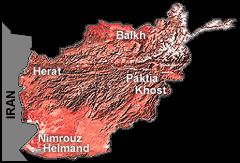
The United States is beefing up its military presence in Afghanistan, at the same time encircling Iran. Washington will set up nine new bases in Afghanistan in the provinces of Helmand, Herat, Nimrouz, Balkh, Khost and Paktia.
Reports also make it clear that the decision to set up new US military bases was made during Secretary of Defense Donald Rumsfeld's visit to Kabul last December. Subsequently, Afghan President Hamid Karzai accepted the Pentagon diktat. Not that Karzai had a choice: US intelligence is of the view that he will not be able to hold on to his throne beyond June unless the US Army can speed up training of a large number of Afghan army recruits and protect Kabul. Even today, the inner core of Karzai's security is run by the US State Department with personnel provided by private US contractors.
Admittedly, Afghanistan is far from stable, even after four years of US presence. Still, the establishment of a rash of bases would seem to be overkill. Indeed, according to observers, the base expansion could be part of a US global military plan calling for small but flexible bases that make it easy to ferry supplies and can be used in due time as a springboard to assert a presence far beyond Afghanistan.
Afghanistan under control?
On February 23, according to the official Bakhter News Agency, 196 American military instructors arrived in Kabul. These instructors are scheduled to be in Afghanistan until the end of 2006. According to General H Head, commander of the US Phoenix Joint Working Force, the objective of the team is to expedite the educational and training programs of Afghan army personnel. The plan to protect Karzai and the new-found "democracy" in Afghanistan rests on the creation of a well-trained 70,000-man Afghan National Army (ANA) by the end of 2006. As of now, 20,000 ANA personnel help out 17,000-plus US troops and some 5,000-plus North Atlantic Treaty Organization (NATO) troops currently based in Afghanistan.
In addition, on February 28, in a move to bring a large number of militiamen into the ANA quickly, Karzai appointed General Abdur Rashid Dostum, a regional Uzbek-Afghan warlord of disrepute, as his personal military chief of staff. The list of what is wrong with Dostum is too long for this article, but he is important to Karzai and the Pentagon.
Dostum has at least 30,000 militiamen, members of his Jumbush-e-Milli, under him. A quick change of their uniforms would increase the ANA by 30,000 at a minimal cost. Moreover, Dostum's men do not need military training (what they do need is some understanding of and respect for law and order). Another important factor that comes into play with this union is the Pentagon-Karzai plan to counter the other major north Afghan ethnic grouping, the Tajik-Afghans.
Since the presidential election took place in Afghanistan last October, Washington has conveyed repeatedly that the poison fangs of al-Qaeda have been uprooted and the Taliban is split. There was also reliable news suggesting that a section of Taliban leaders have accepted the leadership of two fellow Pashtuns, Karzai and US Ambassador Zalmay Khalilzad, and are making their way into the Kabul government.
With al-Qaeda defanged and the Taliban split, one would tend to believe that the Afghan situation is well under control. But then, how does one explain that a bomb went off in the southern city of Kandahar, killing five people on March 17, the very day US Secretary of State Condoleezza Rice landed in Kabul on her first visit to Afghanistan? And why has Karzai pushed back the dates for Afghanistan's historical parliamentary elections, originally planned for 2004, and then to May 2005, now to September 2005?
One thing that is certainly not under control, and is surely the source of many threats to the region, is opium production. During the US occupation, opium production grew at a much faster rate than Washington's, and Karzai's, enemies weakened. In 2003, US-occupied Afghanistan produced 4,200 tons of opium. In 2004, US-occupied and semi-democratic Afghanistan produced a record 4,950 tons, breaking the all-time high of 4,600 tons produced under the Taliban in the year 2000.
Though the problem is known to the world, the Pentagon refuses to deal with it. It is not the military's job to eradicate poppy fields, says the Pentagon. Indeed, it would antagonize the warlords who remain the mainstays of the Pentagon in Afghanistan, say observers.
Back on the base
When all is said and done, one cannot but wonder why the new military bases are being set up. Given that al-Qaeda is only a shadow of the past, the Taliban leaders are queuing up to join the Kabul government, and the US military is not interested in tackling the opium explosion, why are the bases needed?
A ray of light was shed on this question during the recent trip to Afghanistan by five US senators, led by John McCain. On February 22, McCain, accompanied by Senators Hillary Clinton, Susan Collins, Lindsey Graham and Russ Feingold, held talks with Karzai.
After the talks, McCain, the No 2 Republican on the Senate Armed Services Committee, said he was committed to a "strategic partnership that we believe must endure for many, many years". McCain told reporters in Kabul that America's strategic partnership with Afghanistan should include "permanent bases" for US military forces. A spokesman for the Afghan president told news reporters that establishing permanent US bases required approval from the yet-to-be-created Afghan parliament.
Later, perhaps realizing that the image that Washington would like to project of Afghanistan is that of a sovereign nation, McCain's office amended his comments with a clarification: "The US will need to remain in Afghanistan to help the country rid itself of the last vestiges of Taliban and al-Qaeda." His office also indicated that what McCain meant was that the US needs to make a long-term commitment, not necessarily "permanent" bases.
On March 16, General Richard Myers, chairman of the US Joint Chiefs of Staff, said no decision had been reached on whether to seek permanent bases on Afghan soil. "But clearly we've developed good relationships and good partnerships in this part of the world, not only in Afghanistan," he added, also mentioning existing US bases in Uzbekistan and Kyrgyzstan.
A military pattern
But this is mere word play. Media reports coming out of the South Asian subcontinent point to a US intent that goes beyond bringing Afghanistan under control, to playing a determining role in the vast Eurasian region. In fact, one can argue that the landing of US troops in Afghanistan in the winter of 2001 was a deliberate policy to set up forward bases at the crossroads of three major areas: the Middle East, Central Asia and South Asia. Not only is the area energy-rich, but it is also the meeting point of three growing powers - China, India and Russia.
On February 23, the day after McCain called for "permanent bases" in Afghanistan, a senior political analyst and chief editor of the Kabul Journal, Mohammad Hassan Wulasmal, said, "The US wants to dominate Iran, Uzbekistan and China by using Afghanistan as a military base."
Other recent developments cohere with a US Air Force strategy to expand its operational scope across Afghanistan and the Caspian Sea region - with its vital oil reserves and natural resources: Central Asia, all of Iran, the Persian Gulf, the Strait of Hormuz and the northern Arabian Sea up to Yemen's Socotra Islands. This may also provide the US a commanding position in relation to Pakistan, India and the western fringes of China.
The base set up at Manas outside Bishkek, the capital of Kyrgyzstan - where, according to Central Asian reports, about 3,000 US troops are based - looks to be part of the same military pattern. It embodies a major commitment to maintain not just air operations over Afghanistan for the foreseeable future, but also a robust military presence in the region well after the war.
Prior to setting up the Manas Air Base, the US paid off the Uzbek government handsomely to set up an air base in Qarshi Hanabad. Qarshi Hanabad holds about 1,500 US soldiers, and agreements have been made for the use of Tajik and Kazakh airfields for military operations. Even neutral Turkmenistan has granted permission for military overflights. Ostensibly, the leaders of these Central Asian nations are providing military facilities to the US to help them eradicate the Islamic and other sorts of terrorists that threaten their nations.
These developments, particularly setting up bases in Manas and Qarshi Hanabad, are not an attempt by the US to find an exit strategy for Afghanistan, but the opposite: establishing a military presence.
Encircling Iran
On February 28, Asia Times Online pointed out that construction work had begun on a new NATO base in Herat, western Afghanistan (US digs in deeper in Afghanistan ). Another Asia Times Online article said US officials had confirmed that they would like more military bases in the country, in addition to the use of bases in Pakistan (see The remaking of al-Qaeda , February 25).
Last December, US Army spokesman Major Mark McCann said the United States was building four military bases in Afghanistan that would only be used by the Afghan National Army. On that occasion, McCann stated, "We are building a base in Herat. It is true." McCann added that Herat was one of four bases being built; the others were in the southern province of Kandahar, the southeastern city of Gardez in Paktia province, and Mazar-i-Sharif, the northern city controlling the main route to central Afghanistan.
The US already has three operational bases inside Afghanistan; the main logistical center for the US-led coalition in Afghanistan is Bagram Air Field north of Kabul - known by US military forces as "BAF". Observers point out that Bagram is not a full-fledged air base.
Other key US-run logistical centers in Afghanistan include Kandahar Air Field, or "KAF", in southern Afghanistan and Shindand Air Field in the western province of Herat. Shindand is about 100 kilometers from the border with Iran, a location that makes it controversial. Moreover, according to the US-based think-tank Global Security, Shindand is the largest air base in Afghanistan.
The US is spending US$83 million to upgrade its bases at Bagram and Kandahar. Both are being equipped with new runways. US Brigadier General Jim Hunt, the commander of US air operations in Afghanistan, said at a news conference in Kabul Monday, "We are continuously improving runways, taxiways, navigation aids, airfield lighting, billeting and other facilities to support our demanding mission."
The proximity of Shindand to Iran could give Tehran cause for concern, says Paul Beaver, an independent defense analyst based in London. Beaver points out that with US ships in the Persian Gulf and Shindand sitting next to Iran, Tehran has a reason to claim that Washington is in the process of encircling Iran. But the US plays down the potential of Shindand, saying it will not remain with the US for long. Still, it has not been lost on Iranian strategists that the base in the province of Herat is a link in a formidable chain of new facilities the US is in the process of drawing around their country.
Shindand is not Tehran's only worry. In Pakistan, the Pervez Musharraf government has allowed the commercial airport at Jacobabad, about 420km north of Karachi and 420km southeast of Kandahar, as one of three Pakistani bases used by US and allied forces to support their campaign in Afghanistan. The other bases are at Dalbandin and Pasni. Under the terms of an agreement with Pakistan, the allied forces can use these bases for search and rescue missions, but are not permitted to use them to stage attacks on Taliban targets. Both Jacobabad and Pasni bases have been sealed off and a five-kilometer cordon set up around the bases by Pakistani security forces.
Reports of increased US operations in Pakistan go back to March 2004, when two air bases - Dalbandin and Shahbaz - in Pakistan were the focus for extensive movements to provide logistical support for Special Forces and intelligence operations. Shahbaz Air Base near Jacobabad appeared to be the key to the United States' 2004 spring offensive. At Jacobabad, C-17 transports were reportedly involved in the daily deliveries of supplies. A report in the Pakistani newspaper the Daily Times on March 10, 2004, claimed that the air base was under US control, with an inner ring of facilities off limits to Pakistan's military.