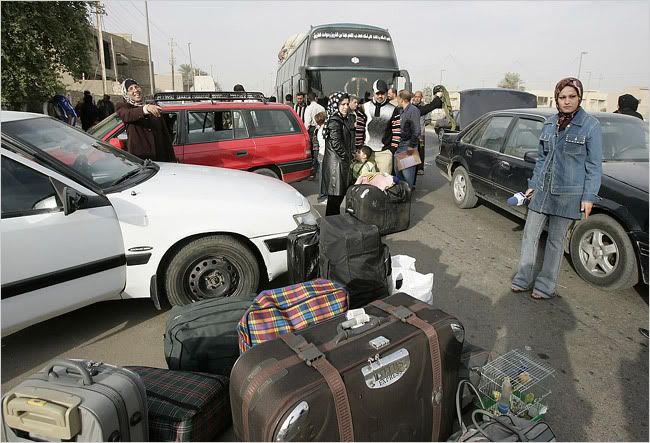
The NY Times reports:
At a row of travel agencies near the highway to Syria, the tide of migration has reversed: the buses and GMC Suburban vans filled with people heading to Damascus run infrequently, while those coming from the border appear every day.
By all accounts, Iraqi families who fled their homes in the past two years are returning to Baghdad.
The description of the scope of the return, however, appears to have been massaged by politics. Returnees have essentially become a currency of progress.
Under intense pressure to show results after months of political stalemate, the government has continued to publicize figures that exaggerate the movement back to Iraq and Iraqis’ confidence that the current lull in violence can be sustained.
On Nov. 7, Brig. Gen. Qassim al-Moussawi, the Iraqi spokesman for the American-Iraqi effort to pacify Baghdad, said that 46,030 people returned to Iraq from abroad in October because of the “improving security situation.”
Last week, Iraq’s minister of displacement and migration, Abdul-Samad Rahman Sultan, announced that 1,600 Iraqis were returning every day, which works out to a similar, or perhaps slightly larger, monthly total.
But in interviews, officials from the ministry acknowledged that the count covered all Iraqis crossing the border, not just returnees. “We didn’t ask them if they were displaced and neither did the Interior Ministry,” said Sattar Nowruz, a spokesman for the Ministry of Displacement and Migration.
As a result, the tally included Iraqi employees of The New York Times who had visited relatives in Syria but were not among the roughly two million Iraqis who have fled the country.
The figures apparently also included three people suspected of being insurgents arrested Saturday near Baquba in Diyala Province. The police described them as local residents who had fled temporarily to Syria, then returned.
Some Iraqi lawmakers said that overly broad figures were being used intentionally.
“They are using this number because they want to show that Maliki is succeeding,” said Salim Abdullah, a lawmaker and member of the largest Sunni bloc, known as the Accordance Front, referring to Prime Minister Nuri Kamal al-Maliki. “But this does not make the number correct. I think dozens of Iraqis return home daily, but not 1,600.”
A half-dozen owners of Iraqi travel agencies and drivers who regularly travel to Syria agreed that the numbers misrepresented reality.
They said that the flow of returnees peaked last month, with more than 50 families arriving daily from Syria at Baghdad’s main drop-off point. Since Nov. 1, they said, the numbers have declined, and on Sunday morning, during a period when several buses used to appear, only one came.
The travel agents said that they believed that Iraqis would continue to return to Baghdad from Syria and Jordan but that the initial rush appeared to be over.
A United Nations survey released last week, of 110 Iraqi families leaving Syria, also seemed to dispute the contentions of officials in Iraq that people are returning primarily because they feel safer.
The survey found that 46 percent were leaving because they could not afford to stay; 25 percent said they fell victim to a stricter Syrian visa policy; and only 14 percent said they were returning because they had heard about improved security.
Underscoring a widely held sense of hesitation, many of those who come back to Iraq do not return to their homes. Clambering off the bus on Sunday, a woman who gave her name as Um Dima, mother of Dima, said that friends were still warning her not to go back to her house in Dora, a violent neighborhood in south Baghdad. So for now, she said, she will move in with her parents in southern Iraq.
Raad al-Kihani, a prominent Shiite tribal leader in Baghdad and supporter of the prime minister, said that most people returning were still restricted by the fear of sectarian violence. “There are no Shiite families moving back to Sunni neighborhoods and no Sunnis moving back to Shiite neighborhoods,” he said.
The Iraqi government is using incentives and aggressive public relations to try to bring more people home. Iraqi officials plan to pay for buses to transport Iraqis from Syria. Prominent government figures recently visited Saab al-Bor, a largely abandoned town near Baghdad, to emphasize that families should feel safe enough to return.
The Displacement Ministry offers 1 million Iraqi dinar, about $800, to internally displaced families who can prove they have returned home with a letter from the police and their neighborhood council. But the movement has been limited. As of Thursday, 4,358 internally displaced families, about 25,000 people, had returned to their homes in Baghdad, the ministry’s registry of payments to returnees said.
Furthermore, people are still leaving their homes — 28,017 were internally displaced in October, according to the latest United Nations figures. In all, the United Nations estimates that 2.4 million Iraqis are still internally displaced, with many occupying someone else’s home.
Greater numbers will not return to their neighborhoods, some Iraqi lawmakers and independent migration specialists say, until a clear legal framework has been established to help them get their houses back without evicting other displaced families.
“The actions are slow and so many things needs to be done, said Ayaed al-Sammaraie, a member of Parliament and a leader of its largest Sunni Arab bloc. “The main thing people would like is to return to their spots, and it seems there isn’t a plan for that.”
Monday, November 26, 2007
| [+/-] |
Numbers of Iraqi Refugees Returning Home Exaggerated |
Saturday, November 17, 2007
| [+/-] |
Bush Failed to See Musharraf's Faults, Critics Contend |
The NY Times reports:
In the six years since Pakistan’s president, Gen. Pervez Musharraf, joined President Bush in the fight against Al Qaeda, it has been an unlikely partnership: a president intent on promoting democracy and a military commander who seized power in a bloodless coup.
Mr. Bush has repeatedly called Gen. Musharraf “a friend.” In 2003, the president invited the general to Camp David, a presidential perk reserved for the closest of allies. Last year, at the general’s insistence, Mr. Bush risked a trip to Pakistan, jangling the nerves of the Secret Service by spending the night in the country presumed to be home to Osama bin Laden.
But now that the general has defied the White House, suspending Pakistan’s Constitution and imposing martial law, old tensions are flaring anew. Mr. Bush is backing away from the leader he once called a man of “courage and vision,” and critics are asking whether the president misread his Pakistani counterpart.
They said Mr. Bush — an ardent believer in personal diplomacy, who once remarked that he had looked into the eyes of President Vladimir V. Putin of Russia and had gotten “a sense of his soul” — was taken in by the general, with his fluent English and his promises to hold elections and relinquish military power. They said Mr. Bush looked at General Musharraf and saw a democratic reformer when he should have seen a dictator instead.
“He didn’t ask the hard questions, and frankly, neither did the people working for him,” said Husain Haqqani, an expert on Pakistan at Boston University who has advised two previous Pakistani prime ministers, Nawaz Sharif and Benazir Bhutto. “They bought the P.R. image of Musharraf as the reasonable general. Bush bought the line — hook, line and sinker.”
White House aides said Mr. Bush is clear-eyed about his pact with the general, a pact that was sealed on a Saturday evening in November 2001, over an intimate dinner at the Waldorf-Astoria Hotel in New York. They had just met face-to-face for the first time, during a meeting of the United Nations, and, despite past tensions between their countries, an air of cozy familiarity filled the room.
“It was a lovely dinner, very sociable,” said Wendy J. Chamberlin, the former ambassador to Pakistan, who attended. “I wasn’t nervous, because I knew Musharraf and I knew how charming he is, and I could see that they would get along fine. And besides, the mood was exuberant. Musharraf was like a conquering hero, Musharraf had done the right thing. He was the man of the day.”
Today, of course, the general is hardly the man of the day. On Friday, Deputy Secretary of State John D. Negroponte — who was the host at the Waldorf dinner as the ambassador to the United Nations then — arrived in Pakistan to press General Musharraf to end Pakistan’s state of emergency. Back in Washington, Mr. Bush was close-mouthed, saying little about the man he once praised as “a courageous leader and friend of the United States.”
The two have spoken just once, on Nov. 7 by telephone, in the two weeks since General Musharraf imposed de facto military rule. Mr. Bush, who initiated the call, termed it “a very frank discussion” — Washington code for a pointed airing of differences.
“My message was very, very plain, very easy to understand,” the president said. “And that is: the United States wants you to have elections as scheduled and take your uniform off.”
The “Bush-Mush relationship,” as some American scholars call it, has always been complicated, more a bond of convenience than a genuine friendship, some experts said. When he was running for office in 2000, Mr. Bush didn’t even know General Musharraf’s name; he couldn’t identify the leader of Pakistan for a reporter’s pop quiz during an interview that was widely replayed on late-night television.
Relations between the nations had been tense over Pakistan’s nuclear ambitions even before Mr. Bush took office, and American aid to Pakistan had been all but cut off. But Sept. 11 threw the United States and Pakistan together. Mr. Bush demanded General Musharraf’s allegiance in pursuing Al Qaeda — and got it. General Musharraf demanded military aid that could help him maintain power — and got it.
Experts in United States-Pakistan relations said General Musharraf has played the union masterfully, by convincing Mr. Bush that he alone can keep Pakistan stable. Kamran Bokhari, an analyst for Stratfor, a private intelligence company, who met with General Musharraf in January, said the general views Mr. Bush with some condescension.
“Musharraf thinks that Bush has certain weaknesses that can be manipulated,” Mr. Bokhari said, adding, “I would say that President Musharraf doesn’t think highly of President Bush, but his interests force him to do business with the U.S. president.”
In his autobiography, “In the Line of Fire,” General Musharraf writes glowingly of the trust Mr. Bush placed in him. But he passed up a chance to praise Mr. Bush on “The Daily Show with Jon Stewart,” where he was promoting the book. Mr. Stewart asked who would win a hypothetical contest for mayor of Karachi, Mr. Bush or Mr. bin Laden.
“I think they’ll both lose miserably,” the general replied.
Mr. Bush, by contrast, was “favorably impressed” with General Musharraf, according to Ari Fleischer, the president’s former press secretary. Mr. Fleischer recounted one session where the general had been warned in advance not to ask the president for F-16 fighter jets, because the answer would be no.
“Musharraf brought it up anyway,” Mr. Fleischer said, “and Bush told him the answer is no. But I think Bush liked the fact that he does what he wants to do, and says what’s on his mind.”
Their ties have not always helped General Musharraf; critics in Pakistan have accused him of being a tool of the United States, and derisively call him “Busharraf.” In Washington, Mr. Bush has faced criticism as well, from those who say he should have been tougher on General Musharraf, especially with top Al Qaeda operatives like Osama bin Laden still on the loose.
Richard C. Holbrooke, the ambassador to the United Nations under President Clinton, said one of Mr. Bush’s biggest mistakes was not pressing General Musharraf to turn over A. Q. Khan, the former chief of Pakistan’s nuclear program, to American interrogators.
“I don’t see that the Bush administration was wrong in 2001 to put its chips on Musharraf, who promised democracy and who promised to take off his uniform, but something has gone very badly wrong,” Mr. Holbrooke said, adding, “The question is, is this because Bush was soft on Musharraf the way he was soft on Putin?”
As the state of emergency drags on, the administration has begun thinking about alternatives to General Musharraf, and is reaching out to generals who might replace him. Mr. Haqqani, the Boston University professor, and Ms. Chamberlin, the former ambassador, said the effort was long overdue.
Mr. Haqqani has been cautioning the administration for years not to “personalize this relationship,” while Ms. Chamberlin said it is a mistake to view General Musharraf as indispensable. “Our relationship with the army and with the people of Pakistan is indispensable,” she said, “but it is not based on one man.”
Yet, having declared General Musharraf a friend and an ally, Mr. Bush is not ready to give up on him. The president places a high premium on loyalty; when top aides like Donald H. Rumsfeld, the former defense secretary, and Alberto R. Gonzales, the former attorney general, disappointed him, he was reluctant to cut them loose. So it is with General Musharraf.
“President Musharraf made a decision the president didn’t agree with,” said Dana Perino, the White House press secretary. “We are disappointed with it, but the president doesn’t want to pre-emptively throw up his hands. He wants to help him get back on track.”
| [+/-] |
U.S. Secretly Aids Pakistan in Guarding Nuclear Arms |
The NY Times reports:
Over the past six years, the Bush administration has spent almost $100 million so far on a highly classified program to help Gen. Pervez Musharraf, Pakistan’s president, secure his country’s nuclear weapons, according to current and former senior administration officials.
But with the future of that country’s leadership in doubt, debate is intensifying about whether Washington has done enough to help protect the warheads and laboratories, and whether Pakistan’s reluctance to reveal critical details about its arsenal has undercut the effectiveness of the continuing security effort.
The aid, buried in secret portions of the federal budget, paid for the training of Pakistani personnel in the United States and the construction of a nuclear security training center in Pakistan, a facility that American officials say is nowhere near completion, even though it was supposed to be in operation this year.
A raft of equipment — from helicopters to night-vision goggles to nuclear detection equipment — was given to Pakistan to help secure its nuclear material, its warheads, and the laboratories that were the site of the worst known case of nuclear proliferation in the atomic age.
While American officials say that they believe the arsenal is safe at the moment, and that they take at face value Pakistani assurances that security is vastly improved, in many cases the Pakistani government has been reluctant to show American officials how or where the gear is actually used.
That is because the Pakistanis do not want to reveal the locations of their weapons or the amount or type of new bomb-grade fuel the country is now producing.
The American program was created after the Sept. 11, 2001, attacks, when the Bush administration debated whether to share with Pakistan one of the crown jewels of American nuclear protection technology, known as “permissive action links,” or PALS, a system used to keep a weapon from detonating without proper codes and authorizations.
In the end, despite past federal aid to France and Russia on delicate points of nuclear security, the administration decided that it could not share the system with the Pakistanis because of legal restrictions.
In addition, the Pakistanis were suspicious that any American-made technology in their warheads could include a secret “kill switch,” enabling the Americans to turn off their weapons.
While many nuclear experts in the federal government favored offering the PALS system because they considered Pakistan’s arsenal among the world’s most vulnerable to terrorist groups, some administration officials feared that sharing the technology would teach Pakistan too much about American weaponry. The same concern kept the Clinton administration from sharing the technology with China in the early 1990s.
The New York Times has known details of the secret program for more than three years, based on interviews with a range of American officials and nuclear experts, some of whom were concerned that Pakistan’s arsenal remained vulnerable. The newspaper agreed to delay publication of the article after considering a request from the Bush administration, which argued that premature disclosure could hurt the effort to secure the weapons.
Since then, some elements of the program have been discussed in the Pakistani news media and in a presentation late last year by the leader of Pakistan’s nuclear safety effort, Lt. Gen. Khalid Kidwai, who acknowledged receiving “international” help as he sought to assure Washington that all of the holes in Pakistan’s nuclear security infrastructure had been sealed.
The Times told the administration last week that it was reopening its examination of the program in light of those disclosures and the current instability in Pakistan. Early this week, the White House withdrew its request that publication be withheld, though it was unwilling to discuss details of the program.
The secret program was designed by the Energy Department and the State Department, and it drew heavily from the effort over the past decade to secure nuclear weapons, stockpiles and materials in Russia and other former Soviet states. Much of the money for Pakistan was spent on physical security, like fencing and surveillance systems, and equipment for tracking nuclear material if it left secure areas.
But while Pakistan is formally considered a “major non-NATO ally,” the program has been hindered by a deep suspicion among Pakistan’s military that the secret goal of the United States was to gather intelligence about how to locate and, if necessary, disable Pakistan’s arsenal, which is the pride of the country.
“Everything has taken far longer than it should,” a former official involved in the program said in a recent interview, “and you are never sure what you really accomplished.”
In recent days, American officials have expressed confidence that Pakistan’s nuclear arsenal is well secured. “I don’t see any indication right now that security of those weapons is in jeopardy, but clearly we are very watchful, as we should be,” Adm. Mike Mullen, chairman of the Joint Chiefs of Staff, told a Pentagon news conference on Thursday.
Admiral Mullen’s carefully chosen words, a senior administration official said, were based on two separate intelligence assessments issued this month that had been summarized in briefings to Mr. Bush. Both concluded that Pakistan’s nuclear arsenal was safe under current conditions, and one also looked at laboratories and came to the same conclusion.
Still, the Pakistani government’s reluctance to release information has limited efforts to assess the situation. In particular, some American experts say they have less ability to look into the nuclear laboratories where highly enriched uranium is produced — including the laboratory named for Abdul Qadeer Khan, the man who sold Pakistan’s nuclear technology to Iran, North Korea and Libya.
So far, the amount the United States has spent on the classified nuclear security program, less than $100 million, amounts to slightly less than one percent of the roughly $10 billion in known American aid to Pakistan since the Sept. 11 attacks. Most of that money has gone for assistance in counterterrorism activities against the Taliban and Al Qaeda.
The debate over sharing nuclear security technology began just before then-Secretary of State Colin L. Powell was sent to Islamabad after the Sept. 11 attacks, as the United States was preparing to invade Afghanistan.
“There were a lot of people who feared that once we headed into Afghanistan, the Taliban would be looking for these weapons,” said a senior official who was involved. But a legal analysis found that aiding Pakistan’s nuclear weapons program — even if it was just with protective gear — would violate both international and American law.
General Musharraf, in his memoir, “In the Line of Fire,” published last year, did not discuss any equipment, training or technology offered then, but wrote: “We were put under immense pressure by the United States regarding our nuclear and missile arsenal. The Americans’ concerns were based on two grounds. First, at this time they were not very sure of my job security, and they dreaded the possibility that an extremist successor government might get its hands on our strategic nuclear arsenal. Second, they doubted our ability to safeguard our assets.”
General Musharraf was more specific in an interview two years ago for a Times documentary, “Nuclear Jihad: Can Terrorists Get the Bomb?” Asked about the equipment and training provided by Washington, he said, “Frankly, I really don’t know the details.” But he added: “This is an extremely sensitive matter in Pakistan. We don’t allow any foreign intrusion in our facilities. But, at the same time, we guarantee that the custodial arrangements that we brought about and implemented are already the best in the world.”
Now that concern about General Musharraf’s ability to remain in power has been rekindled, so has the debate inside and outside the Bush administration about how much the program accomplished, and what it left unaccomplished. A second phase of the program, which would provide more equipment, helicopters and safety devices, is already being discussed in the administration, but its dimensions have not been determined.
Harold M. Agnew, a former director of the Los Alamos weapons laboratory, which designed most of the United States’ nuclear arms, argued that recent federal reluctance to share warhead security technology was making the world more dangerous.
“Lawyers say it’s classified,” Dr. Agnew said in an interview. “That’s nonsense. We should share this technology. Anybody who joins the club should be helped to get this.”
“Whether it’s India or Pakistan or China or Iran,” he added, “the most important thing is that you want to make sure there is no unauthorized use. You want to make sure that the guys who have their hands on the weapons can’t use them without proper authorization.”
In the past, officials say, the United States has shared ideas — but not technologies — about how to make the safeguards that lie at the heart of American weapons security. The system hinges on what is essentially a switch in the firing circuit that requires the would-be user to enter a numeric code that starts a timer for the weapon’s arming and detonation.
Most switches disable themselves if the sequence of numbers entered turns out to be incorrect in a fixed number of tries, much like a bank ATM does. In some cases, the disabled link sets off a small explosion in the warhead to render it useless. Delicate design details involve how to bury the link deep inside a weapon to keep terrorists or enemies from disabling the safeguard.
The most famous case of nuclear idea sharing involves France. Starting in the early 1970s, the United States government began a series of highly secretive discussions with French scientists to help them improve the country’s warheads.
A potential impediment to such sharing was the 1968 Nuclear Nonproliferation Treaty, which bars cooperation between nations on weapons technology.
To get around such legal prohibitions, Washington came up with a system of “negative guidance,” sometimes called “20 questions,” as detailed in a 1989 article in Foreign Policy. The system let United States scientists listen to French descriptions of warhead approaches and give guidance about whether the French were on the right track.
Nuclear experts say sharing also took place after the cold war when the United States worried about the security of Russian nuclear arms and facilities. In that case, both countries declassified warhead information to expedite the transfer of safety and security information, according to federal nuclear scientists.
But in the case of China, which has possessed nuclear weapons since the 1960s and is a signatory to the Nuclear Nonproliferation Treaty, the Clinton administration decided that sharing PALS would be too risky. Experts inside the administration feared the technology would improve the Chinese warheads, and could give the Chinese insights into how American systems worked.
Officials said Washington debated sharing security techniques with Pakistan on at least two occasions — right after it detonated its first nuclear arms in 1998, and after the terrorist attack on the United States in 2001.
The debates pitted atomic scientists who favored technical sharing against federal officials at such places as the State Department who ruled that the transfers were illegal under the Nuclear Nonproliferation Treaty and under United States law.
In the 1998 case, the Clinton administration still hoped it could roll back Pakistan’s nuclear program, forcing it to give up the weapons it had developed. That hope, never seen as very realistic, has been entirely given up by the Bush administration.
The nuclear proliferation conducted by Mr. Khan, the Pakistani metallurgist who built a huge network to spread Pakistani technology, convinced the Pakistanis that they needed better protections.
“Among the places in the world that we have to make sure we have done the maximum we can do, Pakistan is at the top of the list,” said John E. McLaughlin, who served as deputy director of the Central Intelligence Agency at the time, and played a crucial role in the intelligence collection that led to Mr. Khan’s downfall.
“I am confident of two things,” he added. “That the Pakistanis are very serious about securing this material, but also that someone in Pakistan is very intent on getting their hands on it.”
Friday, November 2, 2007
| [+/-] |
Sinking Currency, Sinking Country |
Pat Buchanan writes:
The euro, worth 83 cents in the early George W. Bush years, is at $1.45.
The British pound is back up over $2, the highest level since the Carter era. The Canadian dollar, which used to be worth 65 cents, is worth more than the U.S. dollar for the first time in half a century.
Oil is over $90 a barrel. Gold, down to $260 an ounce not so long ago, has hit $800.
Have gold, silver, oil, the euro, the pound and the Canadian dollar all suddenly soared in value in just a few years?
Nope. The dollar has plummeted in value, more so in Bush's term than during any comparable period of U.S. history. Indeed, Bush is presiding over a worldwide abandonment of the American dollar.
Is it all Bush's fault? Nope.
The dollar is plunging because America has been living beyond her means, borrowing $2 billion a day from foreign nations to maintain her standard of living and to sustain the American Imperium.
The prime suspect in the death of the dollar is the massive trade deficits America has run up, some $5 trillion in total since the passage of NAFTA and the creation of the World Trade Organization in 1994.
In 2006, that U.S. trade deficit hit $764 billion. The current account deficit, which includes the trade deficit, plus the net outflow of interest, dividends, capital gains and foreign aid, hit $857 billion, 6.5 percent of GDP. As some of us have been writing for years, such deficits are unsustainable and must lead to a decline of the dollar.
A sinking dollar means a poorer nation, and a sinking currency has historically been the mark of a sinking country. And a superpower with a sinking currency is a contradiction in terms.
What does this mean for America and Americans?
As nations realize that the dollars they are being paid for their products cannot buy in the world markets what they once did, they will demand more dollars for those goods. This will mean rising prices for the imports on which America has become more dependent than we have been since before the Civil War.
U.S. tourists traveling to the countries whence their ancestors came will find that the money they saved up does not go as far as they thought.
U.S. soldiers stationed overseas will find the cost of rent, gasoline, food, clothing and dining out takes larger and larger bites out of their paychecks. The people those U.S. soldiers defend will be demanding more and more of their money.
U.S. diplomats stationed overseas, students and businessmen are already facing tougher times.
U.S. foreign aid does not go as far as it did. And there is an element of comedy in seeing the United States going to Beijing to borrow dollars, thus putting our children deeper in debt, to send still more foreign aid to African despots who routinely vote the Chinese line at the United Nations.
The Chinese, whose currency is tied to the dollar, and Japan will continue, as long as they can, to keep their currencies low against the dollar. For the Asians think long term, and their goals are strategic.
China — growing at 10 percent a year for two decades and now growing at close to 12 percent — is willing to take losses in the value of the dollars it holds to keep the U.S. technology, factories and jobs pouring in, as their exports capture America's markets from U.S. producers.
The Japanese will take some loss in the value of their dollar hoard to take down Chrysler, Ford and GM, and capture the U.S. auto market as they captured our TV, camera and computer chip markets.
Asians understand that what is important is not who consumes the apples, but who owns the orchard.
Other nations that have kept cash reserves in U.S. Treasury bonds and T-bills are watching the value of these assets sink. Not fools, they will begin, as many already have, to divest and diversify, taking in fewer dollars and more euros and yen. As more nations abandon the dollar, its decline will continue.
The oil-producing and exporting nations, with trade surpluses, like China, have also begun to take the stash of dollars they have and stuff them into sovereign wealth funds, and use these immense and growing funds to buy up real assets in the United States — investment banks and American companies.
Nor is there any end in sight to the sinking of the dollar. For, as foreigners demand more dollars for the oil and goods they sell us, the trade deficit will not fall. And as the U.S. government prints more and more dollars to cover the budget deficits that stretch out — with the coming retirement of the baby boomers — all the way to the horizon, the value of the dollar will fall. And as Ben Bernanke at the Fed tries to keep interest rates low, to keep the U.S. economy from sputtering out in the credit crunch, the value of the dollar will fall.
The chickens of free trade are coming home to roost.
