At BuzzFlash, Christine Bowman writes:
BuzzFlash and a few other progressive news sites have noted that the Obama Administration is not in the least free yet of the legacy of the US attorney firing scandal of 2007 known as Prosecutorgate. Sure, Attorney General Alberto Gonzales was forced to exit in disgrace. Bradley Schlozman, Monica Goodling and Kyle Sampson also gained notoriety due to Congressional hearings. But the legacy of a deeply politicized Department of Justice (DOJ) remains. More independent-minded former US attorneys David Iglesias and Carol Lam
, who failed to target Democrats for prosecution, are out. Prosecutors like Mary Beth Buchanan and Leura Canary, who have energetically targeted Democratic office holders, are in and still causing trouble.
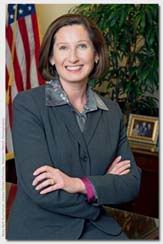
US Attorney Mary Beth Buchanan, still heading up the Western District of Pennsylvania office, certainly personifies the problem if any one attorney does. In December 2008, having served since September 2001, Buchanan declared herself unwilling to give up her office -- Alice Martin of Birmingham, AL also refuses to bow out -- in defiance of the long-standing tradition that US Attorneys tender their resignations at the start of every new administration.
Yet Scott Horton writing at The Daily Beast notes:In the key period of 2004-05, while groundwork was laid for what later became the U.S. attorney's scandal, Buchanan served as director of the Executive Office for U.S. Attorneys, the key position at Justice that oversaw all the 94 U.S. attorneys. A later internal Justice Department probe, in which Buchanan figures prominently, highlights the role played by that office in Karl Rove’s plan to sack U.S. attorneys.
What is Buchanan's agenda as a prosecutor? From the get-go in 2001, she pursued obscenity cases and chased down marijuana dealers -- and high-profile drug paraphernalia vendor Tommy Chong, as BuzzFlash reported -- very publicly and aggressively advancing a right-wing "values" agenda. She "took the directives from Washington to heart," as Charlie Deitch, writing for the Pittsburgh City Paper, put it.
The Pittsburgh Post-Gazette further describes Buchanan as a person of "hard-driving ambition," and quotes Thomas J. Farrell, a former assistant federal prosecutor, as saying, "whether you like her or not, she probably will end up being one of the most influential U.S. attorneys we've had."
Reagan and G. H. W. Bush Attorney General and former PA Governor Dick Thornburgh saw problems with Buchanan's partisan approach when he was on the defense team of one of her Democratic targets, Allegheny County Coroner Dr. Cyril H. Wecht. In addition to Wecht, Buchanan has tenaciously pursued a Democratic Pittsburgh mayor, a Democratic sheriff, and a Democratic county judge, but not Republicans -- not even former Senator Rick Santorum, whose several ethics issues helped him lose his reelection bid. (Santorum had enthusiastically supported Buchanan's nomination and confirmation as a US attorney.)
Buchanan's current passion is apparently to chip away at privacy protections that are guaranteed by the Fourth Amendment. She's all for warrantless wiretapping, but also for using cell-site location information (CSLI) -- in other words, accessing cell phone company records to pinpoint any cell-phone user's past or present whereabouts. Talk Left reports that Buchanan wants that power not only in national security or terrorism-related cases, but for just any old criminal prosecution like a narcotics case.At issue in the Pennsylvania case is "historical" cell phone location records. Buchanan argues it's no different than pen registers and trap and traces because it doesn't intercept the voice. Scholars and many other judges have disagreed, saying when you use the cell phone to determine location, it's like a tracking device. The law requires probable cause for tracking devices....
The Electronic Frontier Foundation, American Civil Liberties Union, and Center for Democracy and Technology have argued that a showing of probable cause is needed before a cell phone service provider could be compelled to disclose geographic data about a subscriber, according to arstechnica.com.
It should be a no-brainer that when the Government seeks information about your location from your cell phone they need a warrant based on probable cause, not some boiler-plate statement to the judge that the information is relevant to an ongoing investigation.
The lower court's opinion in the Pennsylvania case is here (pdf). The Obama Justice Department briefs, filed by Buchanan, are here (pdf) and here (pdf). The second was filed just last week.
Meanwhile, prominent and powerful Western PA US Representative John Murtha, a Democrat, is finding himself, or at least his friends, the target of investigations, as David D. Kirkpatrick reported in The New York Times April 25. Not only have prosecutors "raided the offices of the PMA Group — a lobbying firm founded by a former Murtha associate" [but] ... "Reports of the PMA investigation coincided with the news that federal agents had also raided Kuchera Industries, a Johnstown, Pa., company built on Mr. Murtha’s patronage whose owners held a fund-raiser for him on their private game ranch." Murtha is the top Democrat on the House Defense Appropriations Committee which oversees huge earmarks for military spending.
A writer at Firedoglake speculated in February that Buchanan intends to hang on beyond her welcome as US attorney in order to get Rep. Murtha:But I think she's got much bigger Democratic fish she wants to stick around to fry: Jack Murtha. The NYT follows up on what ABC reported earlier: that investigators conducted two raids on entities associated with Murtha. ...
As yet there seems to be no news to contradict the "Get Murtha" theory. Of course, Rep. Murtha became a magnet for right-wing hate when he called for bringing American troops home from the Iraq War in 2005. That seems as likely an underlying reason for a sudden attack as earmarks or campaign contributions.
Note the timing: Murtha wins his closest election in years in November. And then the Feds raid a lobbying firm closely connected to him. In December, Buchanan refuses to step down. And in January the FBI raids Kuchera--a company that has no clear ties to PMA, but is closely associated with Murtha.
Mind you, Murtha has long been acknowledged to be one of the most corrupt Democrats in Congress. I'm sure there's at least something that Buchanan used to justify this investigation.
But just as Murtha has long been acknowledged to be one of the most corrupt Dems, Buchanan has been acknowledged to be one of the most corrupt US Attorneys. Which means, given Buchanan's obstinate refusal to leave, this one may blow up into a full-fledged political witch hunt.
Will Eric Holder's Justice Department bring Buchanan's anti-Democratic, anti-progressive era to an end? The Pittsburgh Tribune-Review reported on several possible replacements for her back in March. How about picking one and moving on? Justice still has lots of repairs to its integrity to undertake.
Monday, April 27, 2009
| [+/-] |
What Is US Attorney Mary Beth Buchanan Still Doing in Obama's Justice Department? Using Cell Phones To Track People |
Monday, April 23, 2007
| [+/-] |
U.S. Scandal Threatens Alaska's Prosecutor |
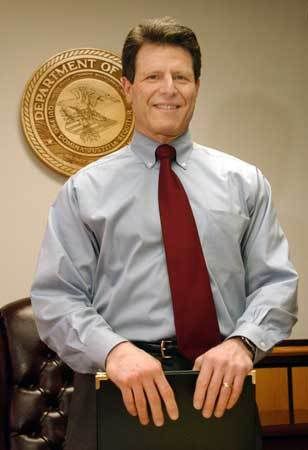 Nelson Cohen was appointed U.S. attorney for Alaska in August 2006.
The Anchorage Daily News reports:
The state’s chief federal prosecutor, Pittsburgh native Nelson Cohen, owes his job to the U.S. attorney in his hometown, who succeeded in getting him the Anchorage post over Alaskans nominated by Sens. Lisa Murkowski and Ted Stevens.
But now, the U.S. attorney scandal threatening to topple Attorney General Alberto Gonzales may cost Cohen his job here. His “interim” appointment will vanish when that classification is amended out of the U.S.A. Patriot Act, which is expected to happen in the next few months.
At the same time, Mary Beth Buchanan, Cohen’s well-connected benefactor and former boss, is in trouble herself, with investigators from the House Judiciary Committee wanting to question her over what role she may have played in deciding which U.S. attorneys got fired, allegedly for partisan reasons.
There are no claims that Cohen got his job here to help or hinder political prosecutions in Alaska, as is alleged in New Mexico, San Diego and other areas where U.S. attorneys were replaced. Pittsburgh Democrats who worked with him and defended clients against him described Cohen, a registered Republican, as a skilled career prosecutor who distanced himself from the Bush administration’s agenda.
Nevertheless, Murkowski and Stevens say they are looking for an “Alaskan” to replace him.
Cohen, who spent about a decade in Alaska before returning home to Pittsburgh in 1987, said he’d like to keep the job but is not actively politicking to do so. He’d like to stay in Alaska, he said, but he still owns his house in Pennsylvania. “I did not come here seeking to be a presidential-appointed U.S. attorney,” he said.
ALASKA SENATORS BLINDSIDED
U.S. attorneys in districts across the country manage teams of prosecutors who enforce federal laws on drugs, immigration, natural resources, weapons and taxes, among others. They are also playing an increasing role in counterterrorism efforts.
The U.S. attorney position in Alaska opened Jan. 23, 2006, when Timothy Burgess left to become a U.S. district judge. His first assistant, Deborah Smith, was named acting U.S. attorney that day. U.S. attorneys are typically nominated by the president and approved by the Senate. Traditionally, Alaska’s two U.S. senators send the names of one or more Alaskans to the White House for consideration. Sen. Murkowski said her clear choice was Smith, a career prosecutor who started out in the federal prosecutor’s office in Anchorage in 1982 and worked in Boston and Washington.
Sen. Stevens wouldn’t reveal his choices.
After submitting Smith’s name, Murkowski said in a telephone interview, her legislative director periodically called the White House during the first part of 2006 to check the status of the nomination.
“We’d get these vague, 'Oh, we’re still working on it, still working on it,’ ” Murkowski said. “So it gets to the point where you’re thinking, 'Wait a minute, this has been a heck of a long time. What is happening?’ And so the response to my inquiry is, 'We still haven’t, there’s some issues,’ and ultimately what we got back was, 'The picks were not acceptable by the White House,’ and yet no explanation as to why they’re not acceptable.”
When she was in Alaska for the August 2006 recess, Murkowski’s Blackberry vibrated with a message. It was her chief aide in Alaska, Mary Hughes, citing a media report that Nelson Cohen had been named interim U.S. attorney.
“You just think, 'It can’t be, wait.’ There was no consulting, no process, no nothing. That’s where I was certainly caught blindsided,” Murkowski said.
Stevens, himself a former federal prosecutor in Alaska, was enraged. “I am just furious at the way the attorney general handled this,” he said at the time.
In an interview at his office in the Federal Building last week, Cohen said he was unaware of all the political forces that resulted in his appointment. But he knew his boss, Buchanan, was well-connected, and it was she who told him about the opening in Alaska.
HE LONGED FOR ALASKA
Through a spokeswoman, Buchanan declined a request for an interview. But the Pittsburgh Post-Gazette recently reported that she pushed the White House agenda, prosecuting such targets as famed cinematic pothead Tommy Chong, of Cheech and Chong fame, for selling bongs over the Internet. She also went after pornographers in California.
The Post-Gazette said Buchanan’s office prosecuted a host of public corruption cases - all against Democrats. One of them, former Allegheny County medical examiner Cyril Wecht, was in Anchorage last week to lecture at the University of Alaska.
Wecht, a physician and lawyer in his 70s who is awaiting trial, said it was ridiculous to think that only Democrats were worthy of public corruption cases in western Pennsylvania.
Cohen was Buchanan’s chief deputy for white-collar crime, but Wecht’s attorney, Mark Rush, said he didn’t appear to have a role in Wecht’s case.
“Nelson Cohen is a professional federal prosecutor,” Rush said. “That’s what Nelson Cohen wants to be, and that’s what I think he will do for the rest of his life. I don’t see political ambition.” Tom Farrell, another former Pittsburgh colleague, said of Cohen: “He’s smart, he’s hardworking, very fair.” Years ago, when President Clinton was in office, the attorneys sharply divided on partisan grounds about whether he should be impeached, Farrell said. Cohen was one of the few at the water cooler “who never got heated.” Farrell, a Democrat, said he hadn’t known that Cohen was a registered Republican. What he seemed to be, though, was a man longing to return to Alaska, Farrell said. His office was decorated with photographs and mementos from his 10 years in Anchorage. Cohen’s wife, Colleen, grew up in Fort Yukon and Fairbanks, the daughter of noted Wien Air bush pilot Keith Harrington. Their three children were born in Alaska.
Gonzales named Cohen to the job in Alaska under a provision inserted into the Patriot Act at the request of the White House when the law was amended by Congress in 2006. It allowed interim U.S. attorney appointments to become permanent without Senate approval.
Eight U.S. attorneys were fired, then replaced under that provision. As the scandal unfolded this year, the House and Senate passed bills restoring the previous selection method, but the bills are slightly different and need to be resolved in a conference committee before they become law. President Bush has said he would sign a final bill. According to a statement from Sen. Stevens’ office, Cohen would then lose his appointment.
“Senator Murkowski and I will continue to look for a candidate that we could nominate and who will serve Alaska with distinction,” Stevens said in a prepared statement.
Tuesday, January 3, 2006
| [+/-] |
U.S. Attorneys Discuss Patriot Act Meeting with the President |
Six United States attorneys met with President Bush to discuss the Patriot Act prior to Congress vote this week to reauthorize it. After their meeting, they held a press conference:
Ken Wainstein, U.S. Attorney, District of Columbia
Carol Lam, U.S. Attorney, Southern District of California
Michael Garcia, U.S. Attorney, Southern District of New York
Roslynn Mauskopf, U.S. Attorney, Eastern District of New York
Mary Beth Buchanan, U.S. Attorney, Western District of Pennsylvania
Debra Wong Yang, U.S. Attorney, Central District of CaliforniaTranscript:WAINSTEIN: Good afternoon.
My name is Ken Wainstein. I'm the U.S. attorney here in Washington, D.C., and I'm here with a number of my U.S. attorney colleagues from around the country. And we just had a meeting with the president about the Patriot Act.
He asked us to give him our input about the importance of the Patriot Act to our investigations and our criminal cases and national security cases around the country.
We told him that we use it each and every day to protect our country against terrorists and criminals, and though there are only 20 of us here today, I can assure you that every other one of the 93 U.S. attorneys uses the Patriot Act tools each and every day in his or her efforts.
The president -- we are very grateful that the president heard out our concerns and we're very grateful that he appreciates the vitality, the centrality of these authorities and importance of these authorities in our efforts to protect the country against terrorists.
It's also important to note, and he recognizes as well, that the Patriot Act has been critical in other non-terrorist criminal cases around the country.
And to give you some anecdotes about how important the Patriot Act has been over the last few years, some of my colleagues are going to tell you about some of the cases in their districts.
Thank you.
Carol Lam, U.S. attorney in the Southern District of California.
LAM: Good morning.
This morning I briefed the president on a case that we have in San Diego involving a weapons-for-drugs deal that was taken down in an undercover operation.
As many of you know, before the Patriot Act, sharing was not permitted between an ongoing foreign intelligence wiretap and criminal prosecution. This created, unfortunately, a situation where people had to choose, law enforcement had to choose between either pursuing an intelligence investigation or a criminal investigation.
With the Patriot Act, we are now permitted to share that information so if an intelligence investigation is going on and evidence of a crime is revealed, that information can be shared with criminal investigators and criminal prosecutors so that, that information and evidence can be used in a criminal prosecution.
In San Diego, this case involved three individuals, weapons dealers who were interested in taking Stinger missiles from undercover FBI agents and reselling them to Al Qaida and the Taliban. In return, they were going to give 600 pounds of heroin and five metric tons of hashish to the undercover FBI agents. As weapons for drug deals shows the narcoterrorism that's going on in the world today.
With Section 218, the information-sharing provisions of the Patriot Act, we were able to share information and that resulted in the undercover operation that took these dangerous individuals out of commission.
Thank you very much.
GARCIA: Thank you.
Mike Garcia from the Southern District of New York.
I spoke to the president this morning about cases that we had in New York back in the 1990s, and I was a prosecutor then and I saw firsthand the effect of the wall, the wall between the intelligence investigations and the criminal investigations, when we were prosecuting some of the major terrorism cases at that time.
Specifically, we spoke about the Rahman case, the blind cleric who was charged with a plot to blow up landmarks in New York City.
When that investigation was launched, it was an intelligence investigation and the prosecutors and the criminal agents were walled off from that information until the last minute when, by luck and extraordinary effort, enough information came over that wall to enable us to prosecute Sheikh Rahman and his followers and to convict them of terrorism charges.
And I contrasted the rules that we had to operate under in the '90s in the Sheikh Rahman case with the rules that we have today under the Patriot Act, where sharing is the rule and not the exception that comes about by luck and personal relationships, that somebody mentions something and, by hard work, you can follow up and get enough information.
Now, we have a process for sharing information.
And that was evident in the case that involved Sheikh Rahman's attorney, Lynn Stewart, his translator, and another associate, Sitar (ph), that was recently prosecuted in the Southern District under the new sharing rules of the Patriot Act, where we can expend our energy actually investigating and prosecuting terrorists and not trying to determine how agents of the same government can share information about terrorists.
Thank you very much.
MAUSKOPF: I'm Roslynn Mauskopf, the United States Attorney for the Eastern district of New York.
In addition to bullets and bombs, money is the lifeblood of terrorists. And, in the Eastern district of New York, we have used the Patriot Act and many of its provisions to choke off the supply of money to terrorists.
In one case prosecuted in the Eastern District of New York, we used the Patriot Act to secure convictions of Mohammed Al-Moayad and Mohammed Zayed.
Both of these individuals were Yemeni citizens. And Mohammed Al- Moayad was the self-proclaimed spiritual adviser to Osama bin Laden.
Using the provisions of the Patriot Act, we were able to convict these two individuals of material support of terrorism, for funneling over $20 million to Al Qaida and Hamas.
And these two individuals didn't stop there. They were seeking to raise millions of dollars more in support of terrorism.
With the help of the Patriot Act provisions, these two terrorists financiers are now in federal prison, each serving 75 and 45 years in prison, respectively.
Without the provisions of the Patriot Act, we would not have been able to build and prove this case against these two master terrorist financiers.
BUCHANAN: Today, we met with the president and we talked about cases ranging from international terrorism to criminal activity throughout our country. We talked about narcotics trafficking cases. We talked about child exploitation and domestic terrorism.
Section 212 of the Patriot Act was used in Western Pennsylvania -- and I am Mary Beth Buchanan, the U.S. attorney for Western Pennsylvania -- we used Section 212 of the Patriot Act to rescue a 13- year-old child who had been taken from her home in Pittsburgh and abducted by a 38-year-old child molester.
Without the Patriot Act, we would not have been able to get critical information that we needed from an Internet service provider, who in the middle of the night was able to give us information on an emergency basis to help us to rescue this child from her captor's home in Virginia.
We also talked about a domestic terrorism case involving an imperial wizard of the Ku Klux Klan who had obtained explosive bombs and devices, and he planned to obtain hand grenades and blow up abortion clinics.
Without the Patriot Act, we would not have been able to get a wiretap to get evidence against this individual to successfully prosecute him.
As you can see, the Patriot Act is extremely vital to United States attorneys across the country to protect our nation from terrorism and from criminal activity of every type.
At this time, we're happy to take your questions.
QUESTION: The administration has portrayed this as somewhat of a partisan debate. And, obviously, all of you are here in support of the provisions in question. Do you feel like there are any legitimate issues when it comes to some of these provisions, that they go beyond the protection of civil liberties, that some of your colleagues who aren't here do have a legitimate case to bring up those concerns?
BUCHANAN: We support the conference report. We believe that this report gives us the adequate tools that we need to investigate terrorism and to protect the people from criminal activity. We believe that this provides adequate safeguards in every respect, and we fully support this report. And we would ask Congress to enact this legislation and to make the Patriot Act permanent to give us the tools that we need.
QUESTION: Is there anything in the Senate bill that would make that version unworkable from your perspective?
WAINSTEIN: We're just going to say that as to the conference report, we support it fully. We support the tools it provides, how it builds on the original Patriot Act and the safeguards that are included in it, and we're fully in support of it.
QUESTION: I have a question for Debra Wong Yang. When the Patriot Act was originally passed in 2002, it beefed up the FISA court. It streamlined it. It tripled the amount of time that was available from 24 to 72 hours for prosecutors who had to go to the FISA court to get the permission for wiretaps. It (inaudible) there were a number of ways in which it strengthened and streamlined and made more agile the FISA court.
Does the president's willingness to go around the FISA court since then bypass the FISA court and entirely make it more difficult to pass this reauthorization, in your opinion, of the Patriot Act? Has the Patriot Act addressed the problems that you all as prosecutors had with FISA courts?
YANG: Well, I think that the Patriot Act does address all the problems that we need to and with all the changes and safeguards. I mean, there are other mechanism that are in place because we are in the midst of doing a number of things and looking at a number of individuals.
I don't want to say, in particular to that particular issue. But with respect to the Patriot Act, I don't think it's harmed us at all. In fact, his support has been a great -- I guess a great thing that we can use in trying to fight the war on crime in all aspects.
QUESTION: Are you as a prosecutor comfortable with the notion of warrantless wiretapping that on one end involves somebody who's an American citizen or somebody in the United States?
YANG: I think that there are certain things that we need to do, given the time and the place that are in history, if we want to protect our country and we want to do it adequately.
QUESTION: Was there any discussion of that issue in your meeting with the president?
YANG: I'm not at liberty to answer that, sir.
QUESTION: I'm sorry?
YANG: I'm not at liberty to answer that.
QUESTION: Can I ask (inaudible) from the White House, Fran Townsend invited you down, (inaudible)?
WAINSTEIN: We coordinated this through the Department of Justice. We talked to them last week and we were all very grateful to have this indication and to have the opportunity to talk to the president about our concerns about how important the Patriot Act is to us and our colleagues at the U.S. Attorneys Offices.
QUESTION: Did you reach (inaudible) at the Justice Department?
WAINSTEIN: It was just -- I got an e-mail from the folks in the department who arranged things, and I called back and we got it all set up just as we set up any meetings.
QUESTION: Can I ask why you feel like you're not at liberty to talk about whether the issue of (inaudible) surveillance program was talked about? Why do you not feel free to talk about that?
(UNKNOWN): (OFF-MIKE)
WAINSTEIN: Let's just say we're here today to talk about the Patriot Act. It's very important to our operations. We're focused on that. We want the country to be focused on it. We want the government to be focused on it. We want Congress to be focused on it.
So we really want to stick with the Patriot Act and how important it is to us.
Thank you.
