New executive orders tell CIA which torture techniques are allowable; list of permitted and forbidden techniques remains classified.
The Boston Globe reports:
President Bush yesterday issued public orders to the CIA outlining what kinds of interrogation techniques it can use against suspected terrorists, opening a new chapter in the long-running debate over the use of harsh tactics against detainees in the war on terrorism.
Bush's executive order laid out broad guidelines for how the CIA must treat detainees in its secret overseas prisons, where the administration has held some suspects without giving them access to the Red Cross. The document prohibits a range of abuses, including "intentionally causing serious bodily injury" and "forcing the individual to perform sexual acts," as well as mistreating the Koran.
The order also said the CIA director must personally approve the use of extraordinary interrogation practices against any specific detainee. Detainees must also receive "adequate food and water, shelter from the elements, necessary clothing, protection from extremes of heat and cold, and essential medical care," it said.
But most of the president's executive order is written in generalities, leaving unanswered whether the CIA will be free to subject prisoners to a range of specific techniques it has reportedly used in the past, including long-term sleep disruption, prolonged shackling in painful stress positions, or "waterboarding," a technique that produces the sensation of drowning.
The administration is separately crafting a list of permitted and forbidden tactics that it said will comply with Bush's executive order, but the list is classified. In a background conference call with reporters yesterday, a senior administration official declined to say whether the new guidelines will permit tactics such as waterboarding.
"I am not in a position to talk about any specific interrogation practices," the official said. "It is impossible for us, consistent with the objectives of such a program, to publicize to the enemy what practices may be on the table and what practices may be off the table. That will only enable Al Qaeda to train against those that are on or off."
Human rights activists immediately denounced the administration's public silence about specific techniques. Leonard Rubenstein of Physicians for Human Rights said the executive order was "equivocation" that rings hollow without an explicit "repudiation of brutal and cruel interrogation methods."
He said, "The only way to restore international credibility and confidence that the US respects human rights is to specifically prohibit techniques that have been used in the past: waterboarding, sleep deprivation, isolation, death threats, use of dogs, stress positions, and temperature manipulation."
Tom Malinowski of Human Rights Watch said that while "there aren't any obvious loopholes" in the order, he questioned whether the administration would live up to its spirit in the classified list of approved interrogation techniques. "In effect the administration is still asking us to trust it despite all the evidence that on the question of interrogation standards, they are not particularly trustworthy," he said.
The debate over interrogations dates to the months after the Sept. 11, 2001, terrorist attacks. Hoping to gather intelligence from prisoners it suspected of knowing about Al Qaeda operations, the Bush administration crafted a series of secret memos asserting that the president had the power as commander in chief of the military to authorize interrogators to bypass laws and treaties against torture.
The administration's aggressive view of that power came to light in 2004 in the aftermath of the Abu Ghraib scandal. Although the administration contended that it had not authorized "torture," several secret memos were leaked in which the administration discussed ways to circumvent anti abuse laws. The news ignited widespread controversy.
In December 2005, Congress passed a law clarifying that it was illegal for US officials to inflict torture or any other form of cruel, inhuman, or degrading treatment on prisoners held anywhere in the world. Bush signed the new law, but then issued a signing statement asserting that he could still authorize harsh questioning because he is the commander in chief.
Still, in June 2006, the Supreme Court held that the Geneva Conventions' basic protections for all wartime detainees covered suspected members of Al Qaeda. The court's ruling, which rejected the Bush administration's view, meant that any US officials who continued to use harsh interrogation tactics on prisoners would face the possibility of prosecution for war crimes under US law.
Because of the ruling, the CIA temporarily closed its overseas prisons and sent detainees to military custody at Guantanamo. In September 2006, Bush publicly acknowledged that the CIA had run secret prisons and subjected detainees to an "alternative set of procedures."
He called on Congress to pass a law outlining what interrogators could do under the Geneva Conventions.
In October, the then-Republican-led Congress addressed Bush's request in the Military Commissions Act. The legislation listed a specific set of practices banned by the Geneva Convention's requirements of humane treatment, including murder, rape, and biological experiments.
The act also gave the president the power to decide for himself whether the Geneva Conventions prohibit other forms of aggressive interrogation techniques. In the ensuing nine months, the National Security Council has been leading a process of developing the new interrogation rules, which were released yesterday.
At the CIA, Director Michael Hayden told agency employees that the executive order, and the accompanying set of classified instructions, would enable the agency's interrogation program at prisons to go forward.
"Bottom line: We can focus on our vital work, confident that our mission and authorities are clearly defined," Hayden said. "Throughout the long fight ahead against Al Qaeda and its affiliates, we will exploit every opportunity to expand our understanding of the enemy and his plans and use that knowledge to protect our republic."
Saturday, July 21, 2007
| [+/-] |
Bush Issues New Orders For Torture |
Friday, July 20, 2007
| [+/-] |
Bush Signs New CIA Interrogation Rules |
The LATimes reports:
President Bush signed an order Friday that clears the way for the CIA to resume some of the harsh interrogation methods it has used against terrorism suspects, but the order prohibits techniques that had caused an international outcry, including sexual humiliation and the denigration of religious symbols.
The executive order ends months of legal skirmishing in the government over how to comply with laws barring mistreatment of detainees and a Supreme Court ruling last year requiring the government to treat terrorism prisoners in accordance with the Geneva Convention.
In practical terms, the document places significant new limits on the CIA while making it clear that the agency will continue to operate under special rules that set it apart from the rest of the government. The order places no restriction on employing coercive methods — such as sleep deprivation and the use of so-called stress positions — that are expressly off-limits for the military and domestic law enforcement agencies.
On another level, the order represents an attempt by the Bush administration to straddle two competing mandates by bringing the CIA program into line with court rulings and legislative requirements without disabling an operation that Bush and Vice President Dick Cheney have defended as one of the most valuable weapons in the war on terrorism.
The order does not specifically address one of the most controversial methods employed by the CIA: water-boarding, a technique in which a prisoner is strapped to a board and doused with water to simulate the sensation of drowning. A separate document spelling out specific techniques remains classified.
Human rights groups said the order brought the United States closer to international standards on the treatment of prisoners but still gave the CIA significant latitude to employ methods that other countries and organizations had condemned.
"It certainly was a positive thing to see express prohibitions on things like sexual humiliation," said Jumana Musa, advocacy director for Amnesty International in Washington. "But the places where [the document] is silent speak volumes."
In a statement issued to the CIA workforce Friday, agency Director Michael V. Hayden said that because of the order, "we can focus on our vital work, confident that our mission and authorities are clearly defined."
The agency suspended its use of harsh methods three years ago as the Bush administration's legal justifications for them began to crumble and CIA operatives working in secret detention facilities abroad became worried that they might face lawsuits or even criminal prosecution for the techniques they were being told to use.
Bush administration officials involved in drafting the order said it was designed to preserve flexibility for the CIA and to avoid spelling out boundaries that might be studied by Al Qaeda or other terrorist organizations.
In a telephone briefing with reporters, an administration official refused to elaborate on what the order will allow CIA interrogators to do, saying: "That will only enable Al Qaeda to train against those [methods] they know are on or off." The official, who spoke on condition of anonymity when discussing the internal development of the policy, stressed that the order contained "red lines which I think we can all agree are beyond the pale," but acknowledged that there were no provisions for allowing the Red Cross to visit CIA facilities or allowing prisoners to be in contact with their families.
The order prohibits acts deemed "beyond the bounds of human decency, such as sexual or sexually indecent acts undertaken for the purpose of humiliation." It forbids "acts intended to denigrate the religion, religious practices or religious objects of the individual," a provision that appears designed to address complaints that U.S. interrogators at Guantanamo Bay in Cuba had mistreated prisoners' copies of the Koran.
It also requires that detainees "receive the basic necessities of life, including adequate food and water, shelter from the elements, necessary clothing, protection from extremes of heat and cold, and essential medical care." Asked what might constitute extreme heat or cold, the administration official said, "We're not talking about forcibly induced hypothermia or any use of extreme temperatures as a practice in a program like this."
The provision requiring "essential medical care" might have applied to Abu Zubayda, an Al Qaeda operative who reportedly was denied pain medication after he was badly injured in a shootout during his capture in Pakistan in 2002.
Former U.S. intelligence officials have acknowledged that water-boarding was used on Sept. 11 mastermind Khalid Shaikh Mohammed after he was taken into custody in Pakistan in 2003. But officials have said the method was abandoned years ago.
Critics called Bush's order frustratingly vague and said its most specific language addressed abuses that occurred at Abu Ghraib and other military facilities that were never part of the CIA's interrogation program.
"The stuff they rule out is stuff they've always been willing to rule out," said Tom Malinowski, Washington director of Human Rights Watch.
U.S. officials said the executive order was accompanied by a separate document prepared by the Justice Department that spelled out the specific interrogation methods and procedures that the CIA would be allowed to use in the secret detention program. That document is classified and will not be released to the public, officials said.
"The White House is basically saying: 'Trust us. Everything in that other document we're not showing you is legal,' " Malinowski said. "But the people in charge of interpreting this document don't have a particularly good track record of reasonable legal analysis."
The executive order is designed to bring the CIA program into compliance with the Supreme Court ruling last year in Hamdan vs. Rumsfeld.
In that case, which was brought against the government by a detainee, the court said that even if detainees did not deserve full status as prisoners of war, they still must be treated in accordance with the Geneva Convention's Common Article 3, which prohibits, among other things, "outrages upon personal dignity, in particular, humiliating and degrading treatment."
The executive order released Friday represents the Bush administration's effort to spell out what the CIA must do to comply with Common Article 3.
The Bush administration previously had contended that terrorism suspects were unlawful combatants and did not warrant the protections of the Geneva Convention.
In the wake of the Hamdan ruling, Bush declared that all of the prisoners in CIA custody had been transferred to the U.S. military facility at Guantanamo Bay, Cuba.
The agency has since taken other prisoners into custody, including an alleged Al Qaeda operative named Abd al-Hadi al-Iraqi, who was transferred to Guantanamo in April. U.S. officials declined to say whether other prisoners were being held by the CIA now.
In his statement Friday, Hayden stressed that the CIA program "always operated in strict accord with American law," that "fewer than 100 hardened terrorists" had been held in the program and that "well under half" were ever subjected to "enhanced" interrogation methods.
Congress has also sought to bring the CIA program under greater scrutiny. The Senate Intelligence Committee passed a measure this year questioning whether a CIA detention program that operated under different rules than those applicable to military and U.S. law enforcement was "necessary, lawful and in the best interests of the United States."
Committee Chairman John D. "Jay" Rockefeller IV (D-W.Va.) said in a statement Friday that the committee would evaluate how Bush's order would "translate into actual conduct by the CIA" and would seek information from the Justice Department on the legal analysis underpinning the order.
Thursday, July 19, 2007
| [+/-] |
Old-Line Republican Warns "Something's In The Works" To Trigger A Police State |
Raw Story reports:
Thom Hartmann began his program on Thursday by reading from a new Executive Order which allows the government to seize the assets of anyone who interferes with its Iraq policies.
He then introduced old-line conservative Paul Craig Roberts -- a former Assistant Secretary of the Treasury under Reagan who has recently become known for his strong opposition to the Bush administration and the Iraq War -- by quoting the "strong words" which open Roberts' latest column: "Unless Congress immediately impeaches Bush and Cheney, a year from now the US could be a dictatorial police state at war with Iran."
"I don't actually think they're very strong," said Roberts of his words. "I get a lot of flak that they're understated and the situation is worse than I say. ... When Bush exercises this authority [under the new Executive Order] ... there's no check to it. It doesn't have to be ratified by Congress. The people who bear the brunt of these dictatorial police state actions have no recourse to the judiciary. So it really is a form of total, absolute, one-man rule.... The American people don't really understand the danger that they face."
Roberts said that because of Bush's unpopularity, the Republicans face a total wipeout in 2008, and this may be why "the Democrats have not brought a halt to Bush's follies or the war, because they expect his unpopular policies to provide them with a landslide victory in next year's election."
However, Roberts emphasized, "the problem with this reasoning is that it assumes that Cheney and Rove and the Republicans are ignorant of these facts, or it assumes that they are content for the Republican Party to be destroyed after Bush has his fling." Roberts believes instead that Cheney and Rove intend to use a renewal of the War on Terror to rally the American people around the Republican Party. "Something's in the works," he said, adding that the Executive Orders need to create a police state are already in place.
"The administration figures themselves and prominent Republican propagandists ... are preparing us for another 9/11 event or series of events," Roberts continued. "Chertoff has predicted them. ... The National Intelligence Estimate is saying that al Qaeda has regrouped.... You have to count on the fact that if al Qaeda's not going to do it, it's going to be orchestrated.... The Republicans are praying for another 9/11."
Hartmann asked what we as the people can do if impeachment isn't about to happen. "If enough people were suspicious and alert, it would be harder for the administration to get away with it," Roberts replied. However, he added, "I don't think these wake-up calls are likely to be effective," pointing out the dominance of the mainstream media.
"Americans think their danger is terrorists," said Roberts. "They don't understand the terrorists cannot take away habeas corpus, the Bill of Rights, the Constitution. ... The terrorists are not anything like the threat that we face to the Bill of Rights and the Constitution from our own government in the name of fighting terrorism. Americans just aren't able to perceive that."
Roberts pointed out that it's old-line Republicans like himself, former Reagan associate deputy attorney general Bruce Fein, and Pat Buchanan who are the diehards in warning of the danger. "It's so obvious to people like us who have long been associated in the corridors of power," he said. "There's no belief in the people or anything like that. They have agendas. The people are in the way. The Constitution is in the way.... Americans need to comprehend and look at how ruthless Cheney is.... A person like that would do anything."
Roberts final suggestion was that, in the absence of a massive popular outcry, "the only constraints on what's going to happen will come from the federal bureaucracy and perhaps the military. They may have had enough. They may not go along with it."
The full audio of Thom Hartmann's interview with Paul Craig Roberts can be found here.
Tuesday, July 17, 2007
| [+/-] |
A New Executive Order |
Message to the Congress of the United States Regarding International Emergency Economic Powers Act
Executive Order: Blocking Property of Certain Persons Who Threaten Stabilization Efforts in Iraq
Pursuant to the International Emergency Economic Powers Act, as amended (50 U.S.C. 1701 et seq.)(IEEPA), I hereby report that I have issued an Executive Order blocking property of persons determined to have committed, or to pose a significant risk of committing, an act or acts of violence that have the purpose or effect of threatening the peace or stability of Iraq or the Government of Iraq or undermining efforts to promote economic reconstruction and political reform in Iraq or to provide humanitarian assistance to the Iraqi people. I issued this order to take additional steps with respect to the national emergency declared in Executive Order 13303 of May 22, 2003, and expanded in Executive Order 13315 of August 28, 2003, and relied upon for additional steps taken in Executive Order 13350 of July 29, 2004, and Executive Order 13364 of November 29, 2004. In these previous Executive Orders, I ordered various measures to address the unusual and extraordinary threat to the national security and foreign policy of the United States posed by obstacles to the orderly reconstruction of Iraq, the restoration and maintenance of peace and security in that country, and the development of political, administrative, and economic institutions in Iraq.
My new order takes additional steps with respect to the national emergency declared in Executive Order 13303 and expanded in Executive Order 13315 by blocking the property and interests in property of persons determined by the Secretary of the Treasury, in consultation with the Secretary of State and the Secretary of Defense, to have committed, or to pose a significant risk of committing, an act or acts of violence that have the purpose or effect of threatening the peace or stability of Iraq or the Government of Iraq or undermining efforts to promote economic reconstruction and political reform in Iraq or to provide humanitarian assistance to the Iraqi people. The order further authorizes the Secretary of the Treasury, in consultation with the Secretary of State and the Secretary of Defense, to designate for blocking those persons determined to have materially assisted, sponsored, or provided financial, material, logistical, or technical support for, or goods or services in support of, such an act or acts of violence or any person designated pursuant to this order, or to be owned or controlled by, or to have acted or purported to act for or on behalf of, directly or indirectly, any person whose property and interests in property are blocked pursuant to this order.
I delegated to the Secretary of the Treasury, in consultation with the Secretary of State and the Secretary of Defense, the authority to take such actions, including the promulgation of rules and regulations, and to employ all powers granted to the President by IEEPA as may be necessary to carry out the purposes of my order. I am enclosing a copy of the Executive Order I have issued.
GEORGE W. BUSH
The White House,
July 17, 2007.
The White House announcement:
Executive Order: Blocking Property of Certain Persons Who Threaten Stabilization Efforts in Iraq
Message to the Congress of the United States Regarding International Emergency Economic Powers Act
By the authority vested in me as President by the Constitution and the laws of the United States of America, including the International Emergency Economic Powers Act, as amended (50 U.S.C. 1701 et seq.)(IEEPA), the National Emergencies Act (50 U.S.C. 1601 et seq.)(NEA), and section 301 of title 3, United States Code,
I, GEORGE W. BUSH, President of the United States of America, find that, due to the unusual and extraordinary threat to the national security and foreign policy of the United States posed by acts of violence threatening the peace and stability of Iraq and undermining efforts to promote economic reconstruction and political reform in Iraq and to provide humanitarian assistance to the Iraqi people, it is in the interests of the United States to take additional steps with respect to the national emergency declared in Executive Order 13303 of May 22, 2003, and expanded in Executive Order 13315 of August 28, 2003, and relied upon for additional steps taken in Executive Order 13350 of July 29, 2004, and Executive Order 13364 of November 29, 2004. I hereby order:
Section 1. (a) Except to the extent provided in section 203(b)(1), (3), and (4) of IEEPA (50 U.S.C. 1702(b)(1), (3), and (4)), or in regulations, orders, directives, or licenses that may be issued pursuant to this order, and notwithstanding any contract entered into or any license or permit granted prior to the date of this order, all property and interests in property of the following persons, that are in the United States, that hereafter come within the United States, or that are or hereafter come within the possession or control of United States persons, are blocked and may not be transferred, paid, exported, withdrawn, or otherwise dealt in: any person determined by the Secretary of the Treasury, in consultation with the Secretary of State and the Secretary of Defense,
(i) to have committed, or to pose a significant risk of committing, an act or acts of violence that have the purpose or effect of:
(A) threatening the peace or stability of Iraq or the Government of Iraq; or
(B) undermining efforts to promote economic reconstruction and political reform in Iraq or to provide humanitarian assistance to the Iraqi people;
(ii) to have materially assisted, sponsored, or provided financial, material, logistical, or technical support for, or goods or services in support of, such an act or acts of violence or any person whose property and interests in property are blocked pursuant to this order; or
(iii) to be owned or controlled by, or to have acted or purported to act for or on behalf of, directly or indirectly, any person whose property and interests in property are blocked pursuant to this order.
(b) The prohibitions in subsection (a) of this section include, but are not limited to, (i) the making of any contribution or provision of funds, goods, or services by, to, or for the benefit of any person whose property and interests in property are blocked pursuant to this order, and (ii) the receipt of any contribution or provision of funds, goods, or services from any such person.
Sec. 2. (a) Any transaction by a United States person or within the United States that evades or avoids, has the purpose of evading or avoiding, or attempts to violate any of the prohibitions set forth in this order is prohibited.
(b) Any conspiracy formed to violate any of the prohibitions set forth in this order is prohibited.
Sec. 3. For purposes of this order:
(a) the term "person" means an individual or entity;
(b) the term "entity" means a partnership, association, trust, joint venture, corporation, group, subgroup, or other organization; and
(c) the term "United States person" means any United States citizen, permanent resident alien, entity organized under the laws of the United States or any jurisdiction within the United States (including foreign branches), or any person in the United States.
Sec. 4. I hereby determine that the making of donations of the type specified in section 203(b)(2) of IEEPA (50 U.S.C. 1702(b)(2)) by, to, or for the benefit of, any person whose property and interests in property are blocked pursuant to this order would seriously impair my ability to deal with the national emergency declared in Executive Order 13303 and expanded in Executive Order 13315, and I hereby prohibit such donations as provided by section 1 of this order.
Sec. 5. For those persons whose property and interests in property are blocked pursuant to this order who might have a constitutional presence in the United States, I find that, because of the ability to transfer funds or other assets instantaneously, prior notice to such persons of measures to be taken pursuant to this order would render these measures ineffectual. I therefore determine that for these measures to be effective in addressing the national emergency declared in Executive Order 13303 and expanded in Executive Order 13315, there need be no prior notice of a listing or determination made pursuant to section 1(a) of this order.
Sec. 6. The Secretary of the Treasury, in consultation with the Secretary of State and the Secretary of Defense, is hereby authorized to take such actions, including the promulgation of rules and regulations, and to employ all powers granted to the President by IEEPA as may be necessary to carry out the purposes of this order. The Secretary of the Treasury may redelegate any of these functions to other officers and agencies of the United States Government, consistent with applicable law. All agencies of the United States Government are hereby directed to take all appropriate measures within their authority to carry out the provisions of this order and, where appropriate, to advise the Secretary of the Treasury in a timely manner of the measures taken.
Sec. 7. Nothing in this order is intended to affect the continued effectiveness of any rules, regulations, orders, licenses, or other forms of administrative action issued, taken, or continued in effect heretofore or hereafter under 31 C.F.R. chapter V, except as expressly terminated, modified, or suspended by or pursuant to this order.
Sec. 8. This order is not intended to, and does not, create any right, benefit, or privilege, substantive or procedural, enforceable at law or in equity by any party against the United States, its departments, agencies, instrumentalities, or entities, its officers or employees, or any other person.
GEORGE W. BUSH
THE WHITE HOUSE,
July 17, 2007.
Saturday, July 14, 2007
| [+/-] |
DoJ: "Oversight Board Failed To Report Intelligence Violations" |
For 5 1/2 years, not one violation was passed along to the Attorney General.
The Houston Chronicle reports:
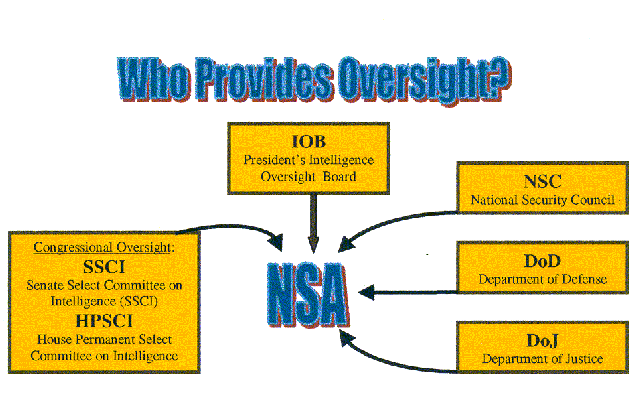
An independent oversight board created to identify intelligence abuses after the CIA scandals of the 1970s did not send any reports to the attorney general of legal violations during the first 5 1/2 years of the Bush administration's counterterrorism effort, the Justice Department has told Congress.
Although the FBI told the board of a few hundred legal or rules violations by its own agents after the Sept. 11, 2001, attacks, the board did not identify which of them were indeed legal violations. This spring, it forwarded reports of violations in 2006, officials said.
The President's Intelligence Oversight Board — the principal civilian watchdog of the intelligence community — is obligated under a 26-year-old executive order to tell the attorney general and the president about any intelligence activities it believes "may be unlawful." The board was vacant for the first two years of the Bush administration.
The FBI sent copies of its violation reports directly to Attorney General Alberto R. Gonzales. But the board's mandate was to provide independent oversight, so the absence of such communications has prompted critics to question whether the board was doing its job.
"It's now apparent that the IOB was not actively employed in the early part of the administration. And it was a crucial period when its counsel would seem to have been needed the most," said Anthony Harrington, who served as the board's chairman for most of the Clinton administration.
"The White House counsel's office and the attorney general should have known and been concerned if they did not detect an active and effective IOB," Harrington said. Senate Judiciary Committee chairman Patrick J. Leahy, D-Vt., added: "It is deeply disturbing that this administration seems to spend so much of its energy and resources trying to find ways to ignore any check and balance on its authority and avoid accountability to Congress and the American public."
White House spokeswoman Dana Perino said Friday that "the president expects every single person working in counterterrorism and intelligence strictly to follow the law — and if there are instances where that has not occurred, either intentionally or non-intentionally, he expects it promptly to be corrected." She said the White House was relying on the presidentially appointed director of national intelligence to monitor problems.
Through five previous administrations, members of the board — all civilians not employed by the government — have been privy to some of America's most secret intelligence operations and have served as a private watchdog against unpublicized abuses. The subjects of their investigations and the resulting reports are nearly all classified.
The Bush administration first appointed board members in 2003. Since then, the CIA and the National Security Agency have been caught up in controversy over interrogation tactics at secret prisons, the transfer of prisoners to countries that use torture, and domestic wiretapping not reviewed by federal courts.
Until recently, the board had not told the attorney general about any wrongdoing. "The Attorney General has no record of receiving reports from the IOB regarding intelligence activities alleged to be potentially unlawful or contrary to Executive Order or Presidential directive," the Justice Department told the House Judiciary Committee in a May 9 letter.
White House officials said the board began forwarding reports of problems shortly thereafter. White House officials declined to discuss the board's interactions with President Bush, and said its members could not be interviewed for this report.
President Gerald R. Ford created the board in the mid-1970s after the Church Committee identified numerous abuses by U.S. intelligence agencies. President Ronald Reagan made the board permanent with an executive order in 1981 and gave it the mission to identify legal violations.
Harrington said that under President Clinton, the board sent reports of legal violations by intelligence agencies promptly to the attorney general. Officials said it concluded that the administration showed poor judgment in supporting Iranian arms shipments to Bosnia, and it complained about the CIA's policy of employing known torturers or killers as informants in Latin America.
Perino said that during the first two years of the Bush administration, a career intelligence officer at the White House collected and reviewed reports in which the FBI and other intelligence agencies self-disclosed violations of civil liberties and privacy safeguards.
The board's three or four members — it has alternated over the years — are usually drawn from the larger President's Foreign Intelligence Advisory Board, which advises the commander in chief on U.S. intelligence policy and performance. The oversight board has been a mix of intelligence experts, such as George H.W. Bush's choice of former Air Force Gen. Lew Allen, and civilians from other walks of life, such as Bill Clinton's choice of Philadelphia investment banker Harold Pote.
The board now in place is led by former Bush economic adviser Stephen Friedman. It includes Don Evans, friend of the president and a former commerce secretary, former Adm. David Jeremiah and lawyer Arthur B. Culvahouse.
Perino said the board's "original unique mission and primary oversight role has been supplemented" in recent years by new layers of government. The administration now relies on the director of national intelligence — a job created in 2005 — to watch for abuses, along with presidentially appointed inspector generals. As a result, Bush is considering changes to Reagan's executive order, she said.
Clinton-era deputy national security adviser James B. Steinberg said, however, that "you have to have a civilian proxy who on one hand can be trusted with these secrets and can still call the operator on the carpet when they go astray. If you neuter these internal mechanisms, then you are basically saying there is no one watching the henhouse."
On Friday, the FBI and the Justice Department announced several reforms meant to strengthen internal oversight, including the creation of a legal "compliance office" inside the bureau and a review office inside the department that will regularly examine all violations.
Separately, Gonzales wrote the top Republican on the Senate Judiciary Committee, Sen. Arlen Specter of Pennsylvania, to defend his 2005 testimony that there had been no verified civil liberties abuses during the first three years of the efforts against terrorism. The Post reported last week that the FBI had sent Gonzales a half-dozen reports of violations of civil liberties and privacy safeguards before his testimony.
Gonzales wrote Friday that he did not consider the conduct in those reports to be abuses because the violations involved mistakes, not deliberate misconduct. "My testimony was completely truthful, and I stand by that testimony," he wrote.
Leahy scoffed at Gonzales' explanation. "The American people deserve an attorney general who will fully and accurately inform the Senate and the public about violations of civil liberties. Instead, they have one who misleads Congress and then hides behind dictionary definitions," he said.
Wednesday, July 11, 2007
| [+/-] |
Clampdown on Funding Cheney in Peril |
The Hill reports:
Senate Democratic appropriators’ clampdown on funding for Vice President Cheney may not survive a likely test today, as two centrists remain undecided on whether to prod Cheney to comply with an executive order on safeguarding classified information.
Majority Whip Dick Durbin (D-Ill.), chairman of the appropriations panel in charge of Cheney’s office, added to his subcommittee’s spending bill a provision freezing money for the vice president until Cheney stops resisting a mandate that executive-branch entities report on their handling of classified data.
Cheney initially argued that his office is not part of the executive branch, garnering snickers from Democrats. Sen. Sam Brownback (R-Kan.) is likely to seek a vote on removing the funding freeze today, meaning that Sens. Ben Nelson (D-Neb.) and Mary Landrieu (D-La.) would need to vote with their party to keep the provision alive.
Landrieu spokeswoman Stephanie Allen said her boss “is weighing her decision until the full committee markup, but she is hoping the administration and Congress can work out this dispute.”
Nelson, who supported Durbin’s provision in a Tuesday vote, declined to say whether he would continue voting to keep it alive. Instead, Nelson urged the administration to intercede by clarifying the executive order at issue, specifically exempting Cheney.
Durbin said he has spoken with senators hesitant about the funding curb and hopes that fellow Democrats continue their support.
Tuesday, June 5, 2007
| [+/-] |
Video: What We Choose To Ignore |
A brief summary of presidential directives, executive orders, and congressionaly approved bills that where signed into law over the last 40ish years.
Friday, June 1, 2007
| [+/-] |
White House Follows New Path To Secrecy |
The AP reports:
In the past year, lawyers for President Bush and Vice President Dick Cheney directed the Secret Service to maintain the confidentiality of visitor logs, declaring them to be presidential records.
The drive to keep secret the lists of visitors to the White House complex and Cheney's home, the administration says, is essential to ensuring the president and vice president receive candid advice to carry out their duties. The decision made the logs exempt from a law requiring their disclosure to whoever asks to see them.
The latest part of the strategy emerged this week when the government disclosed a letter from Cheney's counsel placing visitor logs for his personal residence on the Naval Observatory grounds in the category of presidential records.
Lawsuits are bringing to light new details about the White House push to make sure the public doesn't learn who has been meeting with top Bush administration officials.
Cheney's counsel wrote the Secret Service last September, instructing the agency not to preserve copies of visitor data for the vice president's personal residence. The Secret Service has been giving the originals to the vice president's office since the start of the Bush administration.
A week ago, the government filed court papers stating that the Secret Service is retaining copies of the visitor logs because of pending lawsuits, and that Cheney's office agrees with the decision.
A private group, Citizens for Responsibility and Ethics in Washington, has filed two lawsuits under the Freedom of Information Act seeking Secret Service visitor logs. But the FOIA does not apply to presidential records.
The Bush administration has exploited that different treatment of records between the two laws, which prompted the fight in federal court. The administration is seeking dismissal of the lawsuits.
In trying to get the cases thrown out, the Justice Department has filed documents in court outlining a behind-the-scenes debate over whether Secret Service records are subject to public disclosure. The discussions date back at least to the administration of President Bush's father and involve the Justice Department and the National Archives as well as the White House and Secret Service.
The government's court filings show that the Bush White House focused on the issue in the months before Election Day 2004.
Discussions moved into high gear when the Jack Abramoff lobbying scandal prompted news organizations and private groups to demand that the administration release Secret Service records of visitors to the White House complex and the vice president's residence.
There was precedent for the demands.
During the Clinton administration, Republican-controlled congressional committees obtained Secret Service visitor logs while conducting investigations of the president and first lady.
Christopher Lehane, a former special assistant counsel to President Clinton and press secretary to then-Vice President Al Gore, points out the political implications of the Bush administration campaign to close off access to the records.
``The question it raises is 'What are these guys hiding?''' said Lehane, now a Democratic consultant. ``They can live with it because they've only got a year or so left, but it doesn't do a lot for public confidence in open government.''
White House spokesman Tony Fratto said Thursday, ``I can't comment on a case in litigation, and I can't speak to the decisions made by other administrations.''
The Bush administration says it is standing on principle.
``It is important that the president be able to receive candid advice from his staff and other members of the administration,'' Fratto said. ``To ensure that he receives candid advice, it is essential as a general matter that the advice remains confidential.''
In a declaration filed in court a week ago, Cheney's deputy chief of staff, Claire O'Donnell, said that ``systematic public release of the information regarding when and with whom the vice president and vice presidential personnel conduct meetings would impinge on the ability of the OVP (office of the vice president) to gather information in confidence and perform its essential functions, including assisting the vice president in his critical roles of advising and assisting the president.''
In May 2006, the Secret Service and the White House signed a memorandum of understanding designating visitor records as presidential.
They are ``not the records of an 'agency' subject to the Freedom of Information Act,'' says the agreement that was not disclosed until months later, in late 2006. The records are ``at all times under the exclusive legal custody and control of the White House.''
Four months after the memorandum of agreement, Cheney's counsel wrote to the Secret Service, stating that visitor records for the vice president's personal residence ``are and shall remain subject to the exclusive ownership, custody and control of OVP.''
The Sept. 13, 2006, date on the Cheney letter coincides with requests by The Washington Post seeking records on the vice president's visitors under the Freedom of Information Act.
The law enforcement agency ``shall not retain any copy of these documents and information upon return to OVP,'' said the letter to the Secret Service's chief counsel.
``If any documents remain in your possession, please return them to OVP as soon as possible,'' the letter added.
The Justice Department filed the Cheney letter last Friday in one of the lawsuits brought by Citizens for Responsibility and Ethics in Washington, which is invoking the FOIA law in seeking the identities of conservative religious leaders who visited the White House complex and the vice president's residence.
The group, which represents Valerie Plame and her husband in their lawsuit against Cheney and other key administration figures in the leak of Plame's CIA identity, also is seeking White House visitor logs in the Abramoff scandal.
According to government documents, the Secret Service routinely destroyed five of eight categories of information relating to visitors to Cheney's residence. Of the records it retained, the Secret Service regularly turned over handwritten visitor logs to Cheney's office.
The Secret Service stopped the destruction in June 2006 because of lawsuits by various groups, according to the court papers. The law enforcement agency also is retaining copies of the material, contrary to the directive in the September 2006 letter from Cheney's counsel.
The court filings by the government show that:
-On three occasions late in the administration of the first President Bush and during the first term of President Clinton, the Secret Service proposed treating copies of White House visitor documents as non-presidential records. In its court filings, the current Bush administration opposes releasing details of the Secret Service proposals, saying this ``poses a substantial risk of creating public confusion'' because the proposals were never adopted.
-In January 2001, as Clinton prepared to leave office, White House lawyers proposed the transfer of visitor records from the Secret Service to the White House. The proposal was entitled ``Disposition of certain presidential records created by the USSS,'' or the Secret Service. The records are now at the Clinton library in Little Rock, Ark., the National Archives confirmed Thursday.
-In September 2004, a lawyer for the Bush White House and a special assistant to the director of the Secret Service proposed ``informal views on one way to address the disposition'' of visitor records, according to court documents. The unnamed associate White House counsel and the Secret Service assistant jointly authored a July 29, 2004, document bearing the same title as the Clinton administration document from 3 years earlier.
-In July 2005, the Secret Service gave a presentation on the issue to the White House counsel's office, the Justice Department and the National Archives.
-On May 11, 2006, the Justice Department's Office of Legal Counsel provided a legal opinion on the issue, which is among the many documents the government is refusing to disclose. Six days later, the White House and the Secret Service signed the agreement designating the records as presidential.
Presidential records are released starting five years after a president leaves office. Under the Presidential Records Act of 1978, nonclassified material is disclosed first, with classified documents and advice to the president released later after review by federal agencies, the White House and the former president.
Under an executive order President Bush signed in 2001, the archivist of the United States cannot unilaterally release the records without the permission of the current president, former presidents and their representatives.
``The scary thing about this move by the vice president's office is the power grab part of it,'' said Tom Blanton, head of the National Security Archive, a private group that uses the FOIA law to pierce government secrecy.
``We're looking at a huge problem if the White House can reach into any agency and say certain records have something to do with the White House and they are presidential from now on,'' Blanton said. ``This White House has been infinitely creative in finding new ways and new forms of government secrecy.''
