The Star-Telegram reports"
The Secret Service told Dallas police to stop screening for weapons while people were still arriving at a campaign rally for Barack Obama, a report said.
Police stopped checking people for weapons at the front gates of Reunion Arena more than an hour before the Democratic presidential hopeful appeared on stage Wednesday, the Fort Worth (Texas) Star-Telegram reported.
Police said the order to stop using metal detectors and checking purses and laptop bags constituted a security lapse, the newspaper reported.
Dallas Deputy Police Chief T.W. Lawrence -- who heads the department's homeland security and special operations divisions -- told the Star-Telegram the order had been intended to speed up seating of the more than 17,000 people who came to hear the candidate speak.
Lawrence said he was concerned about the large number of people being let in without being screened, but that the crowd seemed "friendly," the newspaper said.
Several Dallas police officers -- speaking on condition of anonymity because the order came from federal officers -- told the newspaper it was worrying to see so many people get it without even a cursory inspection.
The Star-Telegram said the Secret Service did not return a call seeking comment.
Thursday, February 21, 2008
| [+/-] |
Police Concerned About Order To Stop Weapons Screening At Obama Rally |
Sunday, January 27, 2008
| [+/-] |
And The Wind Waits ... And Waits ... |
The waiting list for proposed wind energy projects in the state is 612 years. But changes are afoot.
The Star Tribune reports:
To anyone who wants to join the wind energy movement, Ryan Wolf says: Get in line.
Wolf, of Le Sueur, Minn., has been waiting almost two years for the go-ahead to build 27 wind turbines in the southwest part of the state.
It's anyone's guess how much longer he'll be waiting, given a backlog of applications that technically could take more than 600 years to clear at the federal agency that stands between him and the renewable energy marketplace.
"The queue is the biggest problem we're struggling with," agreed Clair Moeller, a vice president at that gatekeeper agency in St. Paul, the Midwest Independent Transmission System (Midwest ISO).
While the national mood has shifted to embrace renewable energy, and states including Minnesota have pledged increased usage, conditions on the ground are not making it easy. Developers point to shortages of the wind turbines, engineers to run them and transmission lines to carry the electricity they produce.
But many say the biggest immediate problem is the bottleneck at the regional agencies of the Federal Energy Regulatory Commission -- Midwest ISO, in 15 Upper Midwest states -- that give projects permission to connect to existing power lines.
And the Midwest is in the worst shape, they say, because its windy plains are prompting more project proposals than anywhere else.
Moeller's staff has adapted new procedures -- one is clustering several proposals into a single study -- so they expect to be able to clear the queue in 50 years instead of 600. And this spring he will ask federal regulators to approve more adaptations to further speed the process.
But every passing year drives up the cost of the projects -- which is passed on to consumers. And the backlog stands in the way of Minnesota's pledge to get 25 percent of its electricity from renewable sources by 2025.
"You simply can't get there on time," Moeller said.
Midwest ISO is like a combined roadway planner and traffic cop for the 94,000 miles of power lines within its borders. Moeller runs one of its two central offices out of a one-story, warehouse-type building in a residential St. Paul neighborhood.
Engineers there control the minute-to-minute activity of every utility that sends electricity through the area's power grid.
The agency also vets all the requests by new power projects to connect to the already congested transmission system.
Each request takes about two years to process, because Midwest ISO's obligations include locating any point along the grid that's already maxed out -- even hundreds of miles away. Then it has to put a dollar figure on the work needed at those points -- something similar to adding two lanes to an overloaded four-lane highway -- and then give that bill to the developer.
Federal regulators set up that process as first-come, first-served, in part because everything is so interconnected. Also, by regulation, all requests must be handled one at a time. So, technically, Moeller's staff should spend two years on the project at the top of the list before proceeding to the second one, for two years, and so on. That comes to 612 years for the 306 requests now in the Midwest ISO queue.
The system functioned better when it handled the few, big coal or nuclear power plants that came along. But wind projects are small, and there are many more of them -- three of every four proposals now on the list. And they take about as long to study as do the big projects.
Don't mess with Texas
Texas has found a better way, in the view of Rob Gramlich, policy director at the American Wind Energy Association, a Washington-based industry group.
That state, which is an ISO unto itself, has completely separated grid issues from its vetting process. So, when Texas ISO processes power project applications, all it has to price for them is their "driveways" -- the new power lines to run between them and the grid.
That helped Texas connect three times more wind energy than any other state last year, Gramlich said.
That kind of arrangement works better in a one-state ISO, Moeller said. It's a different proposition to get the legislatures and utilities commissions in 15 states agreed and organized to maintain one another's grids, he said.
Instead, Midwest ISO has gotten permission from federal regulators to consider a "cluster" of several geographically close proposals at once, Moeller said. It also can process several proposals at the same time if they are far enough apart that they will affect different stretches of the grid.
Moeller wants the regulators to approve several more changes to the queuing system. For example, he would like some remedy to this predicament: Now, after their two-year study, project developers have three more years to decide whether to go ahead and build. In the meantime, everybody behind them in line has to wait.
The biggest change Moeller wants is to flip the process from supply-driven to demand-driven. He would like the Midwest ISO states to develop plans for how much and where its future energy needs will be. Then, developers will have to plug any proposals into those plans.
Without that, developers hot on the renewable energy trend are overwhelming Midwest ISO with more proposals than are conceivably possible in the foreseeable future, Moeller said.
For example, even though Midwest ISO's states have announced a collective stretch goal of 12,600 megawatts of renewable energy over the next several years -- half of those are Minnesota's -- Moeller's agency has proposals for 55,000 more.
Another example from Moeller: The transmission system in the Buffalo Ridge area in southern Minnesota now has a customer load capacity of 40 to 50 megawatts. The windy region logically appeals to developers, and several utilities are proposing power line expansions that would add 1,900 megawatts by 2014. But Midwest ISO has proposals in its queue for 55,000 more megawatts for the region.
"That mismatch isn't always so dramatic, but there's a mismatch everywhere," he said.
As time goes by
In the meantime, all this waiting is expensive, Wolf said. He and his 14 partners submitted their proposal for a 27-turbine, 57-megawatt project in March 2006, hoping for approval by 2007, construction of one year, then opening for business this year.
"Those dates all burned by," Wolf said.
In the meantime, they have about $100,000 in expenses tied up with Midwest ISO, as well as other legal fees, permitting fees and land agreements. And they can't commit to a sales contract with a utility until they know what price they'll need to cover the costs -- turbines and transformers, for example -- that are rising between 10 and 30 percent a year.
Industry estimates now put total installation costs at about $1.8 million per megawatt of capacity.
"Those kind of delays are almost certainly going to overrun budgets," Wolf said.
"In our case, we haven't hit the point where we've decided to walk away from the project, but I could see scenarios for others where that would happen."
Saturday, November 10, 2007
| [+/-] |
Voters Split on Spending Initiatives on States' Ballots |
The NY Times reports:
In Texas, voters were in a spending mood on Tuesday. In New Jersey and Oregon, they were not.
Five statewide bond initiatives were approved by Texas residents this week, including $3 billion for cancer research and prevention that was championed by Lance Armstrong and up to $5 billion for highway improvement projects.
But in New Jersey voters rejected $450 million in new spending for stem cell research, and in Oregon they blocked a plan for increased taxes for health care.
Backing an effort for increased fiscal restraint, Washington residents approved statewide measures to require a two-thirds vote by the Legislature for fee increases and a constitutional amendment requiring that 1 percent of general state revenue for each fiscal year be placed in a budget stabilization account.
Heading the other direction, voters in Maine approved a total of $134 million in bonds for research and development, campus improvements and land conservation.
Isolated voting problems were reported in Colorado, Georgia, Maryland and Pennsylvania because of a combination of poll worker error and machine failures.
Contests in three states offered clues to how certain hot-button issues might play in the 2008 presidential race.
In Virginia, concerns about illegal immigration did not produce the voter turnout and fervor that Republicans sought. The state has become a national testing ground for some of the strictest anti-immigration policies, and Republican lawmakers promised to crack down with plans in some counties to deny services to illegal immigrants.
But Democrats picked up four seats in the State Senate, to take the majority for the first time in more than a decade. They also gained three seats in the House, cutting into the Republican majority.
In Utah, voters resoundingly rejected a school voucher program that was supported by the Republican governor and Republican-controlled Legislature. The measure was controversial because, rather than focusing on low-income students in poor-performing schools, the program would have been available to families regardless of income or school performance.
Supporters said the measure would widen options for parents, but critics, including national teachers unions, faulted it as undercutting money for public education. Had the measure been approved, political strategists say, it would probably have been pushed in other Republican-leaning states next year.
Oregon voters approved a measure that curbs the land-use rights of developers of subdivisions and industrial and commercial sites. Supporters of the measure, especially environmental groups, raised twice as much money as opponents, who received most of their money from timber companies and related interests.
Property rights measures that empowered large landowners were blocked in 2006 in California, Idaho and Washington but passed in Arizona, according to the Ballot Initiative Strategy Center, a liberal advocacy group that tracks ballot trends.
Plenty of new spending was approved on local initiatives. For example, voters in Mecklenburg County, N.C., home of Charlotte, approved $582 million in municipal bonds for public school construction, community colleges and open-space projects.
County and city voters in Denver approved $430 million in bonds for transportation, parks, cultural centers, public safety and libraries.
For poll workers in some counties, low turnouts prevented voting problems from escalating.
The most serious failures occurred in Rockville, Md., where thousands of voters were mistakenly identified as having already voted by absentee ballot when they arrived at the polls. Poll workers kept handwritten lists of the names of everyone who voted. To ensure that no one voted twice, they said they planned to compare the list to the names of those who cast absentee ballots.
More than 60 touch-screen machines failed in Marion County, Ind., for several hours, possibly because of battery problems or the memory cards’ being inserted upside-down, election officials said.
Voting officials in southwest Fulton County, Ga., received court approval on Tuesday afternoon to extend the voting day by an hour after machines did not work because of poll workers’ error, election officials said. Eighteen to 30 voters left without voting before the machines were repaired.
Voters in Weld County, Colo., were given paper ballots for about an hour in the morning until officials repaired a handful of voting machines.
When poll workers in Denver starting falling behind deadline in counting ballots, the county called in several dozen SWAT and other police officers to help. Election officials said the police had assisted in past elections because they had undergone the background checks required to count votes.
Technicians in Bedford County, Pa., had to visit all 40 precincts to repair every optical scanning machine used to read ballots.
Monday, October 29, 2007
| [+/-] |
Poor Kids Are Majority At Public Schools in South |
The Dallas Morning News reports:
For the first time in more than 40 years, the majority of children in public schools in the South are poor, according to a report being released today.
Twenty years ago, Mississippi was the only state in the country with such a high percentage of poor public school students. Now, a majority of public school students are considered low-income in 14 states, including 11 in the South, the report by the Southern Education Foundation said.
"Low-income students as a group begin school least ready," said Steve Suitts, a program coordinator with the Atlanta-based foundation. "They are the students most likely to drop out of school."
The report found that 56 percent of Texas public school students were low-income in 2006, based on their eligibility for free or reduced school lunches. That's up from 49 percent in 2000.
The report gives only state averages; the poverty levels in individual districts vary greatly.
In 2006, about 83 percent of students in the Dallas Independent School District were poor. The figure was 69 percent in Irving, 48 percent in Mesquite, 50 percent in Richardson and 21 percent in Plano, according to the Texas Education Agency.
Saturday, October 20, 2007
| [+/-] |
Texas Ranks 2nd in Teachers Sanctioned for Sexual Misconduct |
The Associated Press reports:
From Aug. 4 to Aug. 17, an assistant band director was arrested, a former substitute teacher was convicted and an ex-middle school teacher was sentenced.
The three men — one in suburban Fort Worth, one in suburban Dallas and one in Austin — each faced charges of sex crimes against students.
It was a typical two weeks in Texas.
A review by The Associated Press shows Texas is No. 2 in the nation in the number of teachers sanctioned for sexual misconduct. Texas Education Agency records indicate at least 200 teachers have active sanctions on their certifications for sexual misconduct that occurred between 2001 and 2005. At least 50 more certified teachers faced sex crime allegations, but had their sanctions lifted or have decisions pending.
More than 1,300 certified teachers in Texas received sanctions from 2001-05 because of allegations that ranged from the mundane to the macabre. They included mail fraud and violating open records, as well as kidnapping and attempted murder, according to TEA records.
"And that's just what we hear about," said Peggy Bittick, a Houston attorney whose client says she was sexually assaulted in school. "There are so many kids who never report what happens to them."
The Texas figures were gathered as part of a seven-month investigation in which AP reporters sought records on teacher discipline in all 50 states and the District of Columbia.
Across the country, sexual misconduct allegations led states to take action against the licenses of 2,570 educators from 2001 through 2005. That figure includes licenses that were revoked, denied and surrendered.
Young people were victims in at least 69 percent of the cases, and the large majority of those were students.
Nine out of 10 of those abusive educators were male. And at least 446 of the cases the AP found involved educators who had multiple victims.
There are about 3 million public school teachers in the United States.
The Texas figures seem typical of what's happening nationally. While the overall percentage remains low, sexual misconduct cases happen on a regular basis — despite legal statutes and extensive training covering ethical behavior.
"It just keeps showing up," Bittick said. "We need more and more education and more and more scrutiny. We have to have everyone be accountable."
Most states, including Texas, have legal statutes that deal with teachers who cross the line. In 2003, Texas lawmakers added a new crime to the penal code: improper relationship between an educator and student, a second-degree felony.
And almost all college education programs cover proper, ethical behavior "explicitly," said Mike Sacken, an education professor at Texas Christian University who refers to transgressions as "border crossings."
Education has helped. While they don't dismiss the problem as trivial, most experts say teachers probably are misbehaving today about as often as they did in years past.
"If you just watch Lifetime, you think this happens in every high school in America every 15 minutes," Sacken said. "The huge majority of teachers and students never experience this."
Still, such "border crossings" can have devastating consequences. Bittick, the Houston attorney, said her client was 14 at the time of her alleged assault. Her client had been a troublemaker, Bittick said, but her behavior deteriorated afterward and she ended up in Texas' youth prison system.
The trouble she experienced are "all linked to this happening," Bittick said. The teacher's aide in question was acquitted in court. Bittick's client has since filed a lawsuit, which is pending.
Such cases eventually land on the desk of Chris Jones, a senior counsel in the Office of Investigations at the TEA. His office deals with two types of cases most often, he said: ethics complaints and sexual misconduct.
"When I went to high school, the same type of misconduct went on but nobody cared," Jones said. "I think there is a lot more awareness and a lot more reporting. People are more aware, more likely to get caught and more likely to be reported."
Computers and telephones have been crucial to Jones' work as lead investigator. Electronic records — such as text messages, e-mails or phone records — are often the best evidence in sexual misconduct cases.
"Quite frankly, a lot of these cases are consensual and the student will protect the educator," Jones said. "I have prosecuted several cases where the student has denied the relationship, but we have love letters, cell phone records, computer chats, and will prosecute on that basis."
Anecdotal evidence suggests the most likely perpetrators are young teachers or those who are highly involved in sports or student groups.
Earlier this year, a suburban McKinney substitute teacher testified that he showed students pornographic pictures, took topless photos of a 15-year-old female student and romantically pursued an underaged girl. The teacher, who was convicted of indecency with a child, said it didn't occur to him that his actions were inappropriate. He said he only considered his reputation as a "cool teacher."
It is often coaches, drama teachers and club advisers, Sacken said, who face sexually charged allegations.
"You're driving in cars to places," Sacken said. "You're seeing them at school at 7 at night when nobody's there. You have to be more disciplined in making sure students know where boundaries are."
Jones, who sends his children to public schools and praises the "vast majority" of teachers as ethical, said the state must come down hard on those who are not.
"It's a tough job," he said. "I deal with some allegations that, frankly, are disturbing. As a parent, I hate to think this type of thing occurs."
Wednesday, June 27, 2007
| [+/-] |
Conspiracy Charges Dismissed Against Tom DeLay in 5-4 Ruling By All-Republican Court In Texas |
McClatchy reports:
Former U.S. House Majority Leader Tom DeLay and two associates won a big legal victory Wednesday when the state's highest criminal court ruled that they had been improperly indicted on charges of conspiracy to violate the Texas election code.
The 5-4 ruling by the all-Republican court upholds decisions by lower courts that the men had been accused of violating a law that was not on the books when the action was said to have taken place. The ruling, however, leaves intact indictments accusing DeLay and associates John Colyandro and James Ellis of money laundering and conspiring to launder money.
But DeLay, now a consultant in Washington, was quick to hail the ruling as a vindication of his long-held claim that he was the victim of a political witch hunt by Democratic District Attorney Ronnie Earle of Travis County.
"Ronnie Earle's politically motivated indictments cost Republicans the leader of their choice, and my family hundreds of thousands of dollars in legal fees," DeLay said in a statement. "The damage he has done to my family and my career cannot be rectified, but the courts have recognized a significant portion of the injustice and ruled accordingly.
"What Ronnie Earle accomplished is no rookie error -- it's a political attack using our legal system as the primary weapon."
Earle said the Texas Court of Criminal Appeals appears to have missed the mark.
"Under the rationale of today's majority opinion, the Legislature has blessed these criminal conspiracies as long as the felony they agree to commit is not in the penal code," he said. "Of course, it is illegal for them to actually commit the crime, but they can legally conspire to do it all they want. This is a tortured result."
The legal case against the once-powerful Texas Republican stems from his efforts in 2002 to end the Democrats' generations-long control of the Texas House. He was accused of improperly soliciting and accepting corporate money to help the campaigns of House GOP candidates.
Republicans swept to power in the House that year and completed the GOP takeover of every branch of state government. That allowed Republicans to redraw Texas' congressional districts in 2003, resulting in a GOP majority in the state's Washington delegation for the first time since Reconstruction.
The legal battle forced DeLay, a 21-year Washington veteran, to give up his powerful leadership post in Congress and then quit Texas politics altogether and move to Virginia before the 2006 election.
DeLay's seat was won by Democrat Nick Lampson, one of the congressmen ousted by redistricting.
DeLay and his two co-defendants are accused of illegally funneling $190,000 in banned corporate money into the 2002 elections to help Republican candidates. The three, through their attorneys, had argued from the outset that the charge of conspiring to violate the election law was bogus because no such law existed at the time. Their view prevailed in the criminal appeals court decision.
But Judge Cathy Cochran dissented, arguing that "any felony offense is subject to the Penal Code conspiracy provision."
"Thus, a person may be prosecuted for conspiring to commit any felony offense, whether that felony is defined in the Penal Code or elsewhere in Texas law," Cochran said in her written dissent. "The plain language of the conspiracy statute requires this result."
But Judge Mike Keasler, writing for the court's majority, said that for Cochran's argument to hold sway, the Legislature should have written the law to explicitly say as much.
Still pending against DeLay, Colyandro and Ellis are two charges of money laundering and one charge of making illegal contributions of corporate money.
DeLay said he is eager for the courts to settle those indictments.
"For nearly two years I have been willing and eager to go to trial," he said. "And with this ruling, we are thankfully closer to that day."
Wednesday, April 25, 2007
| [+/-] |
Who Decides? |
The Real, Unspeakable Reason For Out-Of-Control Health Costs & The Growing Numbers Of Uninsured in America
Fight over baby's life support divides ethicists:
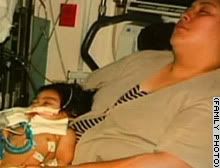
In Austin, Texas, when Emilio Gonzales lies in his mother's arms, sometimes he'll make a facial expression that his mother says is a smile.
But the nurse who's standing right next to her thinks he's grimacing in pain.
Which one it is -- an expression of happiness or of suffering -- is a crucial point in an ethical debate that has pitted the mother of a dying child against a children's hospital, and medical ethicists against each other.
Emilio is 17 months old and has a rare genetic disorder that's ravaging his central nervous system. He cannot see, speak, or eat. A ventilator breathes for him in the Pediatric Intensive Care Unit at Austin Children's Hospital, where he's been since December. Without the ventilator, Emilio would die within hours.
The hospital contends that keeping Emilio alive on a ventilator is painful for the toddler and useless against his illness -- Leigh's disease, a rare degenerative disorder that has no cure.
Under Texas law, Children's has the right to withdraw life support if medical experts deem it medically inappropriate.
Emilio's mother, Catarina Gonzales, on the other hand, is fighting to keep her son on the ventilator, allowing him to die "naturally, the way God intended."
The two sides have been in and out of courts, with the next hearing scheduled for May 8.
The case, and the Texas law, have divided medical ethicists. Art Caplan, an ethicist at the University of Pennsylvania, supports the Texas law giving the hospital the right to make life or death decisions even if the family disagrees. "There are occasions when family members just don't get it right," he said. "No parent should have the right to cause suffering to a kid in a futile situation."
But Dr. Lainie Ross, a pediatrician and medical ethicist at the University of Chicago, says she thinks Emilio's mother, not the doctors, should be able to decide whether Emilio's life is worth living. "Who am I to judge what's a good quality of life?" she said. "If this were my kid, I'd have pulled the ventilator months ago, but this isn't my kid."
The law, signed in 1999 by then-Gov. George W. Bush, gives Texas hospitals the authority to stop treatment if doctors say the treatment is "inappropriate" -- even if the family wants the medical care to continue. The statute was inspired by a growing debate in medical and legal communities over when to declare medical treatment futile.
Dr. Ross says that under the law, some dozen times hospitals have pulled the plug against the family's wishes. She says more often than not, the law is used against poor families. "The law is going to be used more commonly against poor, vulnerable populations. If this family could pay for a nurse to take care of the boy at home, we wouldn't be having this conversation," she said.
Emilio is on Medicaid, which usually doesn't pay for all hospital charges. The hospital's spokesman said that he doesn't know how much it's costing the hospital to keep Emilio alive, but that cost was not a consideration in the hospital's decision.
"[Our medical treatments] are inflicting suffering," said Michael Regier, senior vice president for legal affairs and general counsel for the Seton Family of Hospitals, of which Austin Children's is a member. "We are inflicting harm on this child. And it's harm that is without a corresponding medical benefit."
"It's one thing to harm a child and know this is something I can cure," he added. "But that's not the case here." Regier says Emilio is unaware of his surroundings, and grimaces in pain. He said the ventilator tube down his throat is painful, as is a therapy in which hospital staff beat on his chest to loosen thick secretions.
But Gonzales says her son is on heavy doses of morphine and not in pain. She said her son does react to her. "I put my finger in his hand, and I'm talking to him, and he'll squeeze it," she says. "Then he'll open his eyes and look at me."
Gonzales said she'll continue to fight for treatment for her son. "I love my kid so much, I have to fight for him," she said. "That's your job -- you fight for your son or your daughter. You don't let nobody push you around or make decisions for you."
Monday, October 16, 2006
Saturday, March 18, 2006
| [+/-] |
Landmark Towers Implosion |
Landmark Towers, Fort Worth, Texas
Friday, February 24, 2006
Tuesday, October 3, 2000
| [+/-] |
Shrub: The Short but Happy Political Life of George W. Bush |
Excerpt from the book by Molly Ivins and Lou Dubose:
Young political reporters are always told there are three ways to judge a politician. The first is to look at the record. The second is to look at the record. And third, look at the record.
The method is tried, true, time-tested, and pretty much infallible. In politics, the past is prologue. If a politician is left, right, weak, strong, given to the waffle or the flip-flop, or, as sometimes happens, an able soul who performs well under pressure, all that will be in the record.
So here we are, with a record about property-tax abatement and tort reform, and if that's not a by-God recipe for bestsellerdom, you can cut off our legs and call us Shorty. Can't you see it now, poor ol' Random House touting this book: "Read all about George W Bush's thrilling adventures with the school-equalization formula, his amazing reversals on the sales tax, and most exciting of all, his tragic failure to take a stand on the matter of 150 versus 200 percent for the CHIP program."
The political career of W Bush is a fairly funny yarn, on account of being the son of a former president is not ... how to put this ... not actually sufficient job training for the governance of a large state. Fortunately, in Texas, this makes no difference.
Unqualified to govern Texas? No problem! The single most common misconception about George W is that he has been running a large state for the past six years. Texas has what is known in political science circles as "the weak-governor system." You may think this is just a Texas brag, but our weak-governor system is a lot weaker than anybody else's.* Although the governor does have the power to call out the militia in case of an Indian uprising, by constitutional arrangement, the governor of Texas is actually the fifth most powerful statewide office: behind lieutenant governor, attorney general, comptroller, and land commissioner but ahead of agriculture commissioner and railroad commissioner. Which is not to say it's a piddly office. For one thing, it's a bully pulpit. Although truly effective governors are rare in Texas history, a few have made deep impressions and major changes. Besides, people think you're important if you're the governor, and in politics, perception rules. Of course Texans still think their attorney general, the state's civil lawyer, has something to do with law enforcement too.
During Bush's first term, the lieutenant governor was a wily old trout named Bob Bullock. By virtue of the constitution and the Senate rules, plus knowing where all the bodies were buried and outworking everyone else, Bullock was the major player in state government. Dubya got along just fine by doing pretty much what Bullock told him to; Bullock became Dubya's mentor, almost a father-son deal. The day Bullock announced his retirement, Bush stood in the back of the room with tears running down his face. Bullock, after a lifetime in the Democratic Party, endorsed Bush for reelection in 1998. Bullock died in June 1999, to mixed emotions from many. At his funeral, one fatuous commentator said of the rainy weather, "The skies of Texas are weeping because we bury Bob Bullock today." This caused a state senator to inquire sotto voce, "So what did Bullock have on the weather god?"
A political record is a flexible creature, and by custom the pol is permitted to burnish his own and to denigrate his opponent's. The record is often used to fool voters. You say your man was for a certain bill, but was he for it before the amendments or after the amendments? Did the amendments gut the bill or strengthen it? In the case of an executive, you can say your man favors such-and-such a measure, but if he does nothing to help it pass-no phone calls, no face-to-face, no threats, no promises, no pleading about how we really, really need to win this one for the Gipper or the greater good; indeed, if the pol quietly lets it be known that no mourning will ensue in his office should the thing die a premature death-then of what merit is his public statement of support?
It's not easy to find the point at which the acceptable stretcher becomes a flat-out whopper, or when emphasizing the positive goes so far it becomes a hopeless distortion of reality. In Bush's case, largely because of the weakness of his office, the hardest task is to find any footprints at all. He has walked most lightly on the political life of the state. And where one can find his mark on a bill or a policy, it often turns out to have been more strongly shaped by others.
What does emerge from Bush's record is that he has real political skills, and those are not to be despised. Politicians rank so low in the public esteem these days, practically the easiest way to get elected is by claiming you are not a politician. "I'm an undertaker! I know dog about politics! Vote for me! " Bush's resume in office may be slim, but he has worked in and around campaigns for years, knows a lot about the political side of politics, and is good at it. The extent to which credit for his performance should actually go to Karl Rove, the political consultant known as "Bush's brain," is simply unknowable.
Bush's shrewdest political stroke has been a careful wooing of the Hispanic vote. Texas becomes majority minority (now, there's a phrase) in 2008, meaning that blacks and Chicanos combined will outnumber Anglos, according to the demographers at Texas A&M. So wooing the Hispanic vote may seem like a no-brainer, but as you know, Republicans have not, traditionally, bothered much with people of hue. And as that doofus Pete Wilson proved in California, not all Republican governors are bright enough to see the opportunity there.
Bush's second masterstroke has been to straddle the divide between the Christian right and the economic conservatives in the Republican Party, and that is a doozy of a split. In Texas, the Republican Party is owned by the Christian right: the party chair, the vice chairs, and everybody on down. When they won in 1994 they kicked out all the old-guard Texas Republicans, those in the school of George Bush the Elder-somewhat patrician, WASP, faintly elitist or Eastern. On the Christian right, such folks are known sneeringly as "country club Republicans." Republicans don't like to talk about class, but there's clearly a class subtext to their internal fights.
W. Bush is himself a born-again Christian who wants a constitutional amendment outlawing abortion, although he seldom mentions that in front of a general audience. During his father's presidential campaigns, W. Bush was detailed to handle the Christian right, so he has years of experience in working with them. In addition, Rove has positioned him carefully toward the Christian right on a series of nasty but largely symbolic issues in the Texas Legislature.
On the other hand, if Bush were perceived as being a creature of the Christian right, he'd have a hard time in a general election, so the masterful straddle has been keeping a moderate face on the Texas Republican Party while keeping the Christian right happy. Bush's record is actually more to the right on social issues than his image suggests, and that includes some of his more eye-popping appointees to what would be a cabinet if we had a cabinet form of government in Texas, which we don't.
Of Bush's credentials as an economic conservative, there is no question at all-he owes his political life to big corporate money; he's a CEO's wet dream. He carries their water, he's stumpbroke-however you put it, George W. Bush is a wholly owned subsidiary of corporate America. We don't think this is a consequence of political calculation; it is more a consequence of his life experience, political thinking, and party affiliation. We can find no evidence that it has ever do what occurred to him to question whether it wise to big business wants. He is perfectly comfortable, perfectly at home, doing the bidding of big bidness. These are his friends, and he takes care of his friends-sign of a smart politician. That this matches up nicely with his major campaign contributions is a happy synergy for Governor Bush.
Where Bush is weak is on the governance side of politics. From the record, it appears that he doesn't know much, doesn't do much, and doesn't care much about governing. The exception is a sustained effort on education, with only mixed results. In fact, given his record, it's kind of hard to figure out why he wants a job where he's expected to govern. It's not just that he has no ideas about what to do with government-if you think his daddy had trouble with "the vision thing," wait till you meet this one. For a Republican, not wanting to do much with government is practically a vision in itself. Trouble is, when you aren't particularly interested in the nuts and bolts of governing, you end up with staff-driven policy. When someone comes in to see you about the gory details of home health-care payments or jobtraining outreach, it's all very well to give a disarming gesture of "I give up," as Bush is wont to do, and announce, "I don't know a thing about it; you'll have to talk to So-and-So on my staff." Delegation is a many-splendored thing for any executive, but it only works if old So-and-So understands the problem himself and has any idea what you expect him to do about it.
To this end, it is helpful if you, the chief executive officer of the political entity, do not, as a regular thing, take a couple of hours off in the middle of the day to work out and play video games.
