At IPSnews.net, Mohammed Omer reports:
A stream of dark and putrid sludge snakes through Gaza's streets. It is a noxious mix of human and animal waste. The stench is overwhelming. The occasional passer-by vomits.
Over recent days this has been a more common sight than the sale of food on the streets of Gaza, choked by a relentless Israeli siege.
Hundreds of thousands of Gazans, almost all of its able male adults among a population of 1.5 million, crossed over into Egypt last week to buy essential provisions - and a new lease of life. That has staved off starvation. But streets continue as sewers.
The rain has not helped. The sludge has spread, and the stench with it. Starved of timely income and essential supplies, municipal services have all but ceased.
"The smell," says Ayoub al-Saifi, 56, grimacing as he holds a handkerchief over his nose and mouth. "The stench of the sewage ... my wife has asthma, and she can't breathe."
Saifi lives next to what has become a newly formed pool of waste. This used to be the street leading to home. "It's getting worse day by day," says neighbour Said Ammar, an engineer, and father of four.
The sewage treatment plant in al-Zaytoun neighbourhood in Gaza City requires 20,000 litres of fuel a day. Last week Israel ceased delivery of all fuel and supplies to Gaza. The consequences have been catastrophic.
Without fuel to pump it away, the waste backs up, flooding the streets and clogging the plumbing. The local ministry of health has declared this an environmental catastrophe.
Doctors have warned that a medical catastrophe could follow by way of spread of cholera and other diseases. That is at a time when not even life-saving medical services are on offer any more.
"We have to choose between cutting the electricity on babies in the maternity ward, cutting it to heart patients, or shutting down our operating rooms," says Dr. Mawia Hasaneen, director of emergency at al-Shifa Hospital, the largest in Gaza.
The World Health Organisation released a statement Jan. 22 warning of serious health difficulties arising in Gaza Strip, isolated by the Israeli siege, the Egyptian border and the Mediterranean Sea.
"Frequent electricity cuts and the limited power available to run hospital generators are of particular concern, as they disrupt the functioning of intensive care units, operating theatres, and emergency rooms," the WHO said. "In the central pharmacy, power shortages have interrupted refrigeration of perishable medical supplies, including vaccine."
Christine McNab, acting director in the communications department in Geneva adds that "our current concerns are about the supply of electricity to health facilities, the ability to move medical supplies into the region, and the ability of people to seek care outside of Gaza."
McNab notes that even if the full blockade is lifted, additional measures would need to be taken by the international community against any further disruptions.
Israel has blocked off fuel and supplies to Gaza because it says it faces rocket attacks from the Palestinian area, which elected Hamas, the Palestinian party that does not recognise Israel.
Official Israeli sources say that about 150 homemade rockets have been fired from Gaza into Israel since Israel commenced this latest raid. Two Israelis have been slightly wounded and several others treated for shock.
Israel has retaliated with firing from tanks and attacks by F-16 aircraft firing Hellfire missiles into Gaza's neighbourhoods. At least 76 Palestinians have been killed, and another 293 injured since Jan. 1, officials here say.
Through the suffering, many Palestinians still do not blame Hamas.
"Hamas has never been the problem. The occupation has always been the big problem," says Ammar. He instead blames Palestinian Authority President Mahmoud Abbas, who administers the West Bank Palestinian area, and who has been in talks with Israel.
"Abbas doesn't deserve one percent of the respect that (former Palestinian leader Ysser) Arafat earned. Israel will never find someone as good as Arafat. He gave them a historical chance at two states. Yet despite this, they (Israel) laid siege to him."
Rajaa Shalil, 38, and mother of four in Rafah at the Egyptian border, says "my respect for Hamas has increased more than ever. I love them for their empathy for the weak."
But not all of Gaza's residents feel this way. "Both Israel and Hamas are the reason for this," says resident Abu Mohammed. "Before, we were all in better conditions, but since Hamas took over Gaza they have been unable to handle it."
Monday, January 28, 2008
| [+/-] |
Feces Change the Face of Gaza |
Thursday, December 20, 2007
| [+/-] |
A World of Pain and Abuse |
How a UNICEF Photo Makes the West's Heart Ache
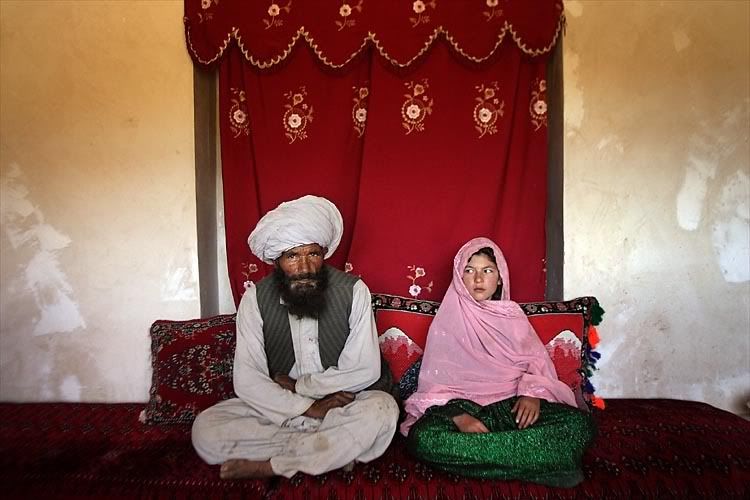 40-year-old groom sitting beside his 11-year-old future bride in Afghanistan, brought Stephanie Sinclair top honors in the annual Photo of the Year contest sponsored by the United Nations Children's Fund (UNICEF).
At Der Spiegle, Leon de Winter writes:
An 11-year-old child bride sits next to her 40-year-old fiance. For UNICEF, this was the Photo of the Year. Dutch writer Leon de Winter laments the perversity of this wedding picture and the frightening relativism of the West.
There are people who will look at this image and be able to continue with business as usual -- without disgust, nausea and rage. We are beholding the fiercest barbarism imaginable. But a carefree cultural relativism -- which this age has donned as its outward manifestation of decadent indifference -- allows many to simply look away. They turn away from the sight of an 11-year-old girl, who is about to be raped by the man sitting next to her.
The girl was sold by her parents, even if they probably wouldn't use that word. The caption that came with the photo quoted the parents as saying that they "needed the money."
The girl's soon-to-be husband promised to send his 11-year-old bride to school, but the women living there in the village of Damarda in Afghanistan's Ghor province don't believe this fairytale. They predict that the girl will bear children soon. "Our men don't need educated women," they point out.
A dowry was paid for the girl. The dowry is part of the cultural fabric of the clan-based society. As producers of newborns, women are valuable possessions. A woman can bear sons and fighters, who will defend the family and its honor. Men are only charged with protecting them against kidnappers and thieves, and women need only accept the power of the male members of the family -- "for their own benefit."
Love Is a Word from the Decadent West
It is likely that all of the female forebears of the girl in the photograph were likewise sold -- and the girl, no doubt, saw it as her fate. At the same time, she realizes that what is happening to her is not right. She might think it is "natural" for a young girl to be sold, but she also knows that it's neither good nor legitimate for her to spend the rest of her life as this man's slave. It is a type of knowledge that has little to do with experience. Rather, it is knowledge that is rooted in humanity, and in the hopes and dreams of a little girl.
The man in the image is oblivious of his wrongdoing. He's only doing what his forefathers did. Sticking to traditions increases the chances of survival. His seed will create a new person and strengthen the clan. He will impregnate this girl without love and without regret, since love is a word from far-off stories and songs, a word from the decadent West, where people have no comprehension of the harshness of life in the desert and of war without end, which is the essence of life in this part of the world.
What we witness in this photograph is an unadorned view of humanity's collective past, of the horror of our brutal nature. Love, tenderness, beauty, individuality and respect are all phenomena that we have imposed upon our nature. Since time immemorial, this nature has allowed only the strongest to survive. In our Western consciousness, we have suppressed this nature with conviction and success. This image shows a small, everyday moment that wouldn't surprise anyone in the Taliban -- but looks quite different to our eyes.
A Bold Statement in the Era of Political Correctness
Our eyes behold an abomination. Our eyes have learned to see the world from the perspective of a slowly acquired sense for humanity. And although more and more voices tell us that we -- the former colonialists and imperialists -- have lost the right to judge other cultures, we know just as well as this girl that this marriage is wrong.
I believe that there are regressive cultures. In an era of political correctness, this is a tricky statement. But there is no other statement that can be made about this image. We behold a regressive man, who is taking what he has purchased.
Many of us in the West are convinced that our presence in Afghanistan cannot be justified, that our troops should withdraw and that Afghanistan should be left to the Afghans. They ask themselves: Who are we to believe that it is inhumane to sell an 11-year-old girl? Who are we to impose our values so vehemently on the Afghans, on this man and on this girl?
I don't have a clue who we are. But I know that this universe is not only a universe of iPods, Disneylands, CO2 penalties, tax write-offs, and New Year's sales in our department stores. No, I know that this is also a universe of human rights. I know that this universe is deeply shaken -- right down to its core -- by the suffering of this lonely, lonely little girl.
 Second-place honors went to GMB Akash, of Bangladesh, whose winning photo shows a 12-year-old boy toiling in a Bangladeshi brickyard. UNICEF studies conclude that 4.7 million children between five and 14 years of age are involved in child labor in that country.
 "A Mother's Journey": The American photographer Renee C. Byer took this picture as part of a series about a single mother with five children and a son suffering from terminal cancer. He died in 2006.
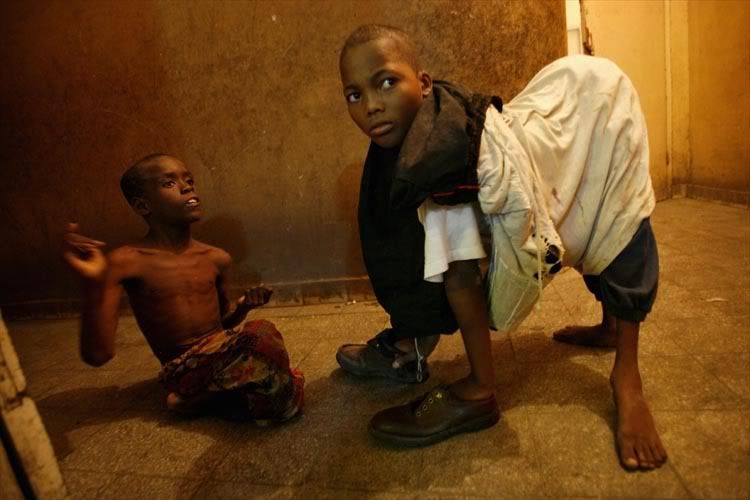 Finbarr O'Reilly recieved an honorable mention for his photo "A House of Hope," an image of Lopez Vidal, right, and Aron Masahuka, both afflicted with polio, languishing in an ill-equipped hospital in Kinshasa, Democratic Republic of Congo.
 Wolfram Hahn made a series of photos titled "A Disenchanted Playroom" to accompany a study about the television-viewing habits of German children.
 The third-place photograph was taken by German photographer Hartmut Schwarzbach. His picture depicts a nine-year-old girl jumping in glee on her birthday in the midst of a smoldering garbage dump outside of Manila.
 Hatem Moussa won an honorable mention for "Life in Gaza": Palestinian children were rushed from a car into a hospital after their homes were hit by Israeli shelling in the northern Gaza Strip town of Beit Lahiya in April, 2006. An eight-year-old child was killed in the attack and 13 other children were injured.
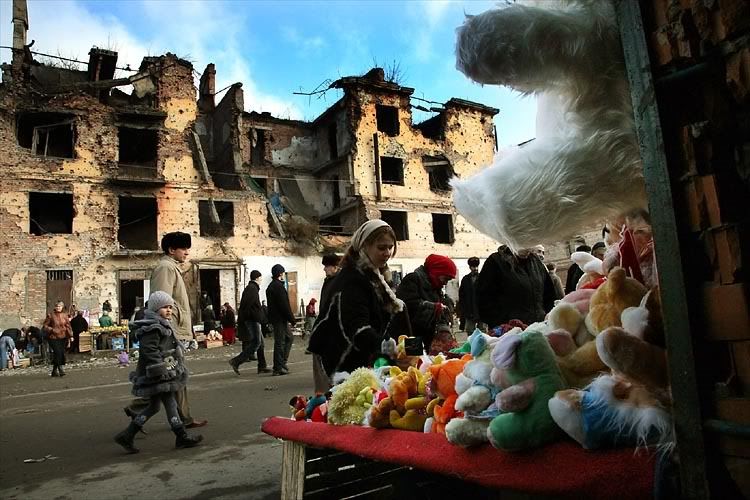 Musa Sadulayew made this photo as a part of a series called "Chechnya's Forgotten Children."
 Boys hang from a bar for five minutes as part of a physical training exercise at the Gymnastics Hall of the Shanghai University of Sports. The photo was part of Nir Elias's series "Pain Threshold -- Sports Education in China."
 "Sumo Boys in Japan": Steven Achiam took a series of pictures depicting life in the Hiragaya sumo club, where boys train until they have beaten a strong opponent 10 times.
 Joseline Ingabire, 37, an HIV-positive Rwandan woman, is pictured with her daughter Leah Batamuliza, 11. This photo by Jonathon Torgovnik accompanied a story in Newsweek magazine about women who were raped during the Rwandan civil war and their children today.
Wednesday, November 21, 2007
| [+/-] |
Israel Defying Sanctions Against Iran |
U.S. officials demanding halt to indirect Israel imports of Iranian pistachio nuts
The International Herald Tribune reports:
It's not just Iran's nuclear program that's causing problems for Israel and the U.S. — it's also Iran's pistachio nuts.
The reddish nuts are landing in Israeli shops after funneling through Turkey, violating Israeli law that bans all Iranian imports and angering American officials who are urging Israel to crack down as part of their attempt to keep Iran from acquiring nuclear weapons.
U.S. Undersecretary of Agriculture Mark Keenum said in a meeting with Israeli officials in Rome on Monday that the pistachio imports must stop, a U.S. official confirmed Wednesday. Both the U.S. and Israel have been pushing for new U.N. sanctions to persuade Iran to abandon its nuclear program. Iran insists its ambitions are peaceful.
"This causes great anger, especially since pistachios succeed in coming in through a third country," Israeli Agriculture Minister Shalom Simchon told Israeli Radio. "This has to do with the sanctions but also with the competition between American farmers and Iranian farmers, and we are trying to deal with this."
Simchon said a recent meeting with a senior U.S. agriculture official focused on using technology to detect the origin of pistachios. He said that would involve chemical testing to determine the climate and soil of where the nuts were grown.
In the mid 1990s U.S. officials pressured Israel to block the import of Iranian nuts coming through E.U. member states and winding up in Israel.
The United States has had few diplomatic and economic ties with Iran since a group of Iranian students besieged the American embassy in Tehran in 1979, holding diplomats hostage for 444 days.
Tensions since Iran started pursuing nuclear technology have only heightened, with the U.S. pushing the U.N. to enact new economic sanctions against the country until it gives up the program.
California is the second largest producer of pistachios in the world, according to the former California Pistachio Coalition. Iran is first.
"As a proud native of the golden state (California), I think Israelis should eat American pistachios, not Iranian ones," said Stewart Tuttle, spokesman for the U.S. Embassy in Tel Aviv.
Friday, November 2, 2007
| [+/-] |
'U.S. Air Force Struck Syrian Nuclear Site' |
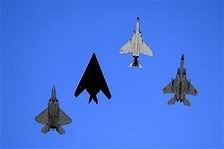 A US Air Force F-22 Raptor, an F-117 Nighthawk, an F-4 Phantom and an F-15 Eagle fly over Holloman Air Force Base, N.M. Photo: US Air Force
The Jerusalem Post reports:
The September 6 raid over Syria was carried out by the US Air Force, the Al-Jazeera Web site reported Friday. The Web site quoted Israeli and Arab sources as saying that two US jets armed with tactical nuclear weapons carried out an attack on a suspected nuclear site under construction.
The sources were quoted as saying that Israeli F-15 and F-16 jets provided cover for the US planes.
The sources added that each US plane carried one tactical nuclear weapon and that the site was hit by one bomb and was totally destroyed.
At the beginning of October, Israel's military censor began to allow the local media to report on the raid without attributing their report to foreign sources. Nevertheless, details of the strike have remained clouded in mystery.
On October 28, Prime Minister Ehud Olmert told the cabinet that he had apologized to Turkish Prime Minister Recep Tayyip Erdogan if Israel violated Turkish airspace during a strike on an alleged nuclear facility in Syria last month.
In a carefully worded statement that was given to reporters after the cabinet meeting, Olmert said: "In my conversation with the Turkish prime minister, I told him that if Israeli planes indeed penetrated Turkish airspace, then there was no intention thereby, either in advance or in any case, to - in any way - violate or undermine Turkish sovereignty, which we respect."
The New York Times reported on October 13 that Israeli planes struck at what US and Israeli intelligence believed was a partly constructed nuclear reactor in Syria on September 6, citing American and foreign officials who had seen the relevant intelligence reports.
According to the report, Israel carried out the report to send a message that it would not tolerate even a nuclear program in its initial stages of construction in any neighboring state.
On October 17, Syria denied that one of its representatives to the United Nations told a panel that an Israeli air strike hit a Syrian nuclear facility and added that "such facilities do not exist in Syria."
A UN document released by the press office had provided an account of a meeting of the First Committee, Disarmament and International Security, in New York, and paraphrased an unnamed Syrian representative as saying that a nuclear facility was hit by the raid.
However, the state-run Syrian Arab News Agency, SANA said media reports, apparently based on a UN press release, misquoted the Syrian diplomat.
Tuesday, October 30, 2007
| [+/-] |
Attacking Iran for Israel? |
At Consortium News, Ray McGovern writes:
Secretary of State Condoleeza Rice is at her mushroom-cloud hyperbolic best, and this time Iran is the target.
Her claim last week that “the policies of Iran constitute perhaps the single greatest challenge to American security interests in the Middle East and around the world” is simply too much of a stretch.
To gauge someone’s reliability, one depends largely on prior experience. Sadly, Rice’s credibility suffers in comparison with that of the head of the International Atomic Energy Agency (IAEA), Mohammed ElBaradei, who insists there is no evidence of an active nuclear weapons program in Iran.
If this sounds familiar, ElBaradei said the same thing about Iraq before it was attacked. But three days before the invasion, American nuclear expert Dick Cheney told NBC’s Tim Russert, “I think Mr. ElBaradei is, frankly, wrong.”
Here we go again. As in the case of Iraq, U.S. intelligence has been assiduously looking for evidence of a nuclear weapons program in Iran; but, alas, in vain.
Burned by the bogus “proof” adduced for Iraq—the uranium from Africa, the aluminum tubes—the administration has shied away from fabricating nuclear-related “evidence.”
Are Bush and Cheney again relying on the Rumsfeld dictum, that “the absence of evidence is not evidence of absence?” There is a simpler answer.
Cat Out of the Bag
The Israeli ambassador to the U.S., Sallai Meridor, let the cat out of the bag while speaking at the American Jewish Committee luncheon on Oct. 22. In remarks paralleling those of Rice, Meridor said Iran is the chief threat to Israel.
Heavy on the chutzpah, he served gratuitous notice on Washington that effectively countering Iran’s nuclear ambitions will take a “united United States in this matter,” lest the Iranians conclude, “come January ’09, they have it their own way.”
Meridor stressed that “very little time” remained to keep Iran from obtaining nuclear weapons. How so?
Even were there to be a nuclear program hidden from the IAEA, no serious observer expects Iran to obtain a nuclear weapon much sooner than five years from now.
Truth be told, every other year since 1995 U.S. intelligence has been predicting that Iran could have a nuclear weapon in about five years.
It has become downright embarrassing — like a broken record, punctuated only by so-called “neo-conservatives” like James Woolsey, who last summer publicly warned that the U.S. may have no choice but to bomb Iran in order to halt its nuclear weapons program.
Woolsey, self-described “anchor of the Presbyterian wing of the Jewish Institute for National Security Affairs,” put it this way: “I’m afraid that within, well, at worst, a few months; at best, a few years; they [the Iranians] could have the bomb.”
The day before Meridor’s unintentionally revealing remark, Vice President Dick Cheney reiterated, “We will not allow Iran to have a nuclear weapon.”
That remark followed closely on President George W. Bush’s apocalyptic warning of World War III, should Tehran acquire the knowledge to produce a nuclear weapon.
The Israelis appear convinced they have extracted a promise from Bush and Cheney that they will help Israel nip Iran’s nuclear program in the bud before they leave office.
Never mind that there is no evidence that the Iranian nuclear program is any more weapons-related than the one Cheney and Donald Rumsfeld persuaded President Gerald Ford to approve in 1976 for Westinghouse and General Electric to install for the Shah (price tag $6.4 billion).
With 200-300 nuclear weapons in its arsenal, the Israelis enjoy a nuclear monopoly in the Middle East. They mean to keep that monopoly and are pressing for the U.S. to obliterate Iran’s fledgling nuclear program.
Anyone aware of Iran’s ability to retaliate realizes this would bring disaster to the whole region and beyond. But this has not stopped Cheney and Bush before.
The rationale is similar to that revealed by Philip Zelikow, confidant of Condoleezza Rice, former member of the President’s Foreign Intelligence Advisory Board, and later executive director of the 9/11 Commission. On Oct. 10, 2002, Zelikow told a crowd at the University of Virginia:
“Why would Iraq attack America or use nuclear weapons against us? I’ll tell you what I think the real threat is—it’s the threat to Israel. And this is the threat that dare not speak its name...the American government doesn’t want to lean too hard on it rhetorically, because it is not a popular sell.”
Harbinger?
The political offensive against Iran coalesced as George W. Bush began his second term, with Cheney out in front pressing for an attack on its nuclear-related facilities.
During a Jan. 20, 2005, interview with MSNBC, just hours before Bush’s second inauguration, Cheney put Iran “right at the top of the list of trouble spots,” and noted that negotiations and UN sanctions might fail to stop Iran’s nuclear program.
Cheney then added with remarkable nonchalance:“Given the fact that Iran has a stated policy that their objective is the destruction of Israel, the Israelis might decide to act first, and let the rest of the world worry about cleaning up the diplomatic mess afterwards.”
Does this not sound like the so-called “Cheney plan” being widely discussed in the media today? An Israeli air attack; Iranian retaliation; Washington springing to the defense of its “ally” Israel?
A big fan of preemption, Cheney has done little to disguise his attraction to Israel’s penchant to preempt, such as Israel's air strike against the Iraqi nuclear reactor at Osirak in 1981.
Ten years after the Osirak attack, then-Defense Secretary Cheney reportedly gave Israeli Maj. Gen. David Ivri, commander of the Israeli Air Force, a satellite photo of the Iraqi nuclear reactor destroyed by U.S.-built Israeli aircraft. On the photo Cheney penned, “Thanks for the outstanding job on the Iraqi nuclear program in 1981.”
Nothing is known of Ivri’s response, but it is a safe bet it was along the lines of “we could not have done it without U.S. help.”
Indeed, though the U.S. officially condemned the attack (the Reagan administration was supporting Saddam Hussein’s Iraq at that point), the intelligence shared by the Pentagon with the Israelis made a major contribution to the success of the Israeli raid.
With Vice President Cheney calling the shots now, similar help may be forthcoming prior to any Israeli air attack on Iran.
It is no secret that former Israeli Prime Minister Ariel Sharon began to press for an early preemptive strike on Iran in 2003, claiming that Iran was likely to obtain a nuclear weapon much earlier than what U.S. intelligence estimated.
Sharon made a habit of bringing his own military adviser to brief Bush with aerial photos of Iranian nuclear-related installations.
More troubling still, in the fall of 2004, retired Gen. Brent Scowcroft, who served as national security adviser to President George H.W. Bush and as Chair of the younger Bush’s Foreign Intelligence Advisory Board, made some startling comments to the Financial Times.
A master of discretion with the media, Scowcroft nonetheless saw fit to make public his conclusion that Sharon had Bush “mesmerized;” that he had our president “wrapped around his little finger.”
Needless to say, Scowcroft was immediately removed from the advisory board.
An Unstable Infatuation
George W. Bush first met Sharon in 1998, when the Texas governor was taken on a tour of the Middle East by Matthew Brooks, then executive director of the Republican Jewish Coalition. Sharon was foreign minister and took Bush on a helicopter tour over the Israeli occupied territories.
An Aug. 3, 2006, McClatchy wire story by Ron Hutcheson quotes Matthew Brooks:
“If there’s a starting point for George W. Bush’s attachment to Israel, it’s the day in late 1998, when he stood on a hilltop where Jesus delivered the Sermon on the Mount, and, with eyes brimming with tears, read aloud from his favorite hymn, ‘Amazing Grace.’ He was very emotional. It was a tear-filled experience. He brought Israel back home with him in his heart. I think he came away profoundly moved.”
Bush made gratuitous but revealing reference to that trip at the first meeting of his National Security Council on Jan. 30, 2001.
After announcing he would abandon the decades-long role of “honest broker” between Israelis and Palestinians and would tilt pronouncedly toward Israel, Bush said he would let Sharon resolve the dispute however he saw fit.
At that point he brought up his trip to Israel with the Republican Jewish Coalition and the flight over Palestinian camps, but there was no sense of concern for the lot of the Palestinians.
In Ron Suskind’s Price of Loyalty, then-Treasury Secretary Paul O’Neill, who was at the NSC meeting, quotes Bush: “Looked real bad down there,” the president said with a frown. Then Bush said it was time to end America’s efforts in the region. “I don’t see much we can do over there at this point,” he said.
O’Neill also reported that Colin Powell, the newly minted but nominal secretary of state, was taken completely by surprise at this nonchalant jettisoning of longstanding policy.
Powell demurred, warning that this would unleash Sharon and “the consequences could be dire, especially for the Palestinians.” But according to O’Neill, Bush just shrugged, saying, “Sometimes a show of strength by one side can really clarify things.” O’Neill says that Powell seemed “startled.”
It is a safe bet that the vice president was in no way startled.
What Now?
The only thing that seems to be standing in the way of a preemptive attack on Iran’s nuclear facilities is foot-dragging by the U.S. military.
It seems likely that the senior military have told the president and Cheney: This time let us brief you on what to expect on Day 2, on Week 4, on Month 6—and on the many serious things Iran can do to Israel, and to us in Iraq and elsewhere.
CENTCOM commander Admiral William Fallon is reliably reported to have said, “We are not going to do Iran on my watch.” And in an online Q-and-A, award-winning Washington Post reporter Dana Priest recently spoke of a possible “revolt” if pilots were ordered to fly missions against Iran. She added:
“This is a little bit of hyperbole, but not much. Just look at what Gen. [George] Casey, the Army chief, has said...that the tempo of operations in Iraq would make it very hard for the military to respond to a major crisis elsewhere. Beside, it's not the ‘war’ or ‘bombing’ part that's difficult; it's the morning after and all the days after that. Haven't we learned that (again) from Iraq?”
How about Congress? Could it act as a brake on Bush and Cheney? Forget it.
If the American Israel Public Affairs Committee (AIPAC) with its overflowing coffers supports an attack on Iran, so will most of our spineless lawmakers. Already, AIPAC has succeeded in preventing legislation that would have required the president to obtain advance authorization for an attack on Iran.
And for every Admiral Fallon, there is someone like the inimitable, retired Air Force Lt. Gen. Thomas McInerney, a close associate of James Woolsey and other “neo-cons.”
The air campaign “will be easy,” says McInerney, a Fox News pundit who was a rabid advocate of shock and awe over Iraq. “Ahmadinejad has nothing in Iran that we can’t penetrate,” he adds, and several hundred bombers, including stealth bombers, will be enough to do the trick:
“Forty-eight hours duration, hitting 2,500 aim points to take out their nuclear facilities, their air defense facilities, their air force, their navy, their Shahab-3 retaliatory missiles, and finally their command and control. And then let the Iranian people take their country back.”
And the rationale? Since it will be a hard sell to promote the idea, against all evidence, of an imminent threat that Iran is about to have a nuclear weapon, the White House PR machine is likely to focus on other evidence showing that Iran is supporting those “killing our troops in Iraq.”
The scary thing is that Cheney is more likely to use the McInerneys and Woolseys than the Fallons and Caseys in showing the president how easily it can be done.
Madness
It is not as though we have not had statesmen wise enough to warn us against foreign entanglements, and about those who have difficulty distinguishing between the strategic interests of the United States and those of other nations, even allies:“A passionate attachment of one nation for another produces a variety of evils. Sympathy for the favorite nation facilitates the illusion of an imaginary common interest in cases where no real common interest exists, infuses into one the enmities of the other, and betrays the former into participation in the quarrels and wars of the latter without adequate inducement or justification.”
Friday, September 21, 2007
| [+/-] |
Netanyahu Confirms Secret Attack on Syria |
The Guardian reports:
Israel's opposition leader, Binyamin Netanyahu, has given the first confirmation from his country of a mysterious air strike on an unknown target deep in Syria earlier this month - fuelling frenzied speculation about exactly what happened.
The leader of the rightwing Likud party said he had given the prime minister, Ehud Olmert, his backing for the attack, which Damascus said took place on September 6. Before that, the Israeli government had enforced a news blackout on the story.
Asked during a TV interview, Mr Netanyahu said: "When a prime minister does something that is important and necessary to Israel's security ... I give my backing." He refused to give further details.
Syria protested to the UN about the "flagrant violation" of its airspace. Officials in Damascus have reported that their air defences forced Israeli F15 jets to flee, dropping "munitions" and fuel tanks in the desert near the Turkish border.
US and other officials have claimed that Israel hit Syrian targets that may have had links to North Korean nuclear arms - dismissed by Damascus as "a big lie".
Meanwhile, Mr Olmert last night confronted critics within his centrist Kadima party who fear he may concede too much to Palestinians, and urged them to seize an opportunity to make peace after 60 years of conflict. Mr Olmert said he would free more Palestinian prisoners as part of "measured gestures" toward President Mahmoud Abbas as they try to agree terms for a US-sponsored peace conference.
Thursday, September 20, 2007
| [+/-] |
Israel, U.S. Shared Data On Suspected Nuclear Site |
The Washington Post reports:
Israel's decision to attack Syria on Sept. 6, bombing a suspected nuclear site set up in apparent collaboration with North Korea, came after Israel shared intelligence with President Bush this summer indicating that North Korean nuclear personnel were in Syria, U.S. government sources said.
The Bush administration has not commented on the Israeli raid or the underlying intelligence. Although the administration was deeply troubled by Israel's assertion that North Korea was assisting the nuclear ambitions of a country closely linked with Iran, sources said, the White House opted against an immediate response because of concerns it would undermine long-running negotiations aimed at persuading North Korea to abandon its nuclear program.
Ultimately, however, the United States is believed to have provided Israel with some corroboration of the original intelligence before Israel proceeded with the raid, which hit the Syrian facility in the dead of night to minimize possible casualties, the sources said.
The target of Israel's attack was said to be in northern Syria, near the Turkish border. A Middle East expert who interviewed one of the pilots involved said they operated under such strict operational security that the airmen flying air cover for the attack aircraft did not know the details of the mission. The pilots who conducted the attack were briefed only after they were in the air, he said. Syrian authorities said there were no casualties.
U.S. sources would discuss the Israeli intelligence, which included satellite imagery, only on condition of anonymity, and many details about the North Korean-Syrian connection remain unknown. The quality of the Israeli intelligence, the extent of North Korean assistance and the seriousness of the Syrian effort are uncertain, raising the possibility that North Korea was merely unloading items it no longer needed. Syria has actively pursued chemical weapons in the past but not nuclear arms -- leaving some proliferation experts skeptical of the intelligence that prompted Israel's attack.
Syria and North Korea both denied this week that they were cooperating on a nuclear program. Bush refused to comment yesterday on the attack, but he issued a blunt warning to North Korea that "the exportation of information and/or materials" would affect negotiations under which North Korea would give up its nuclear programs in exchanges for energy aid and diplomatic recognition.
"To the extent that they are proliferating, we expect them to stop that proliferation, if they want the six-party talks to be successful," he said at a news conference, referring to negotiations that also include China, Japan, South Korea and Russia.
Unlike its destruction of an Iraqi nuclear reactor in 1981, Israel made no announcement of the recent raid and imposed strict censorship on reporting by the Israeli media. Syria made only muted protests, and Arab leaders have remained silent. As a result, a daring and apparently successful attack to eliminate a potential nuclear threat has been shrouded in mystery.
"There is no question it was a major raid. It was an extremely important target," said Bruce Riedel, a former intelligence officer at Brookings Institution's Saban Center for Middle East Policy. "It came at a time the Israelis were very concerned about war with Syria and wanted to dampen down the prospects of war. The decision was taken despite their concerns it could produce a war. That decision reflects how important this target was to Israeli military planners."
Israel has long known about Syria's interest in chemical and even biological weapons, but "if Syria decided to go beyond that, Israel would think that was a real red line," Riedel said.
Edward Djerejian, a former U.S. ambassador to Syria and founding director of Rice University's Baker Institute for Public Policy, said that when he was in Israel this summer he noticed "a great deal of concern in official Israeli circles about the situation in the north," in particular whether Syria's young ruler, Bashar al-Assad, "had the same sensitivity to red lines that his father had." Bashar succeeded his Hafez al-Assad as president of Syria in 2000.
The Israeli attack came just three days after a North Korean ship docked at the Syrian port of Tartus, carrying a cargo that was officially listed as cement.
The ship's role remains obscure. Israeli sources have suggested it carried nuclear equipment. Others have maintained that it contained only missile parts, and some have said the ship's arrival and the attack are merely coincidental. One source suggested that Israel's attack was prompted by a fear of media leaks on the intelligence.
The Bush administration's wariness when presented with the Israeli intelligence contrasts with its reaction in 2002, when U.S. officials believed they had caught North Korea building a clandestine nuclear program in violation of a nuclear-freeze deal arranged by the Clinton administration.
After the Bush administration's accusation, the Clinton deal collapsed and North Korea restarted a nuclear reactor, stockpiled plutonium and eventually conducted a nuclear test. Secretary of State Condoleezza Rice convinced Bush this year to accept a deal with North Korea to shut down the reactor, infuriating conservatives inside and outside the administration.
But for years, Bush has also warned North Korea against engaging in nuclear proliferation, specifically making that a red line that could not be crossed after North Korea tested a nuclear device last year. The Israeli intelligence therefore suggested North Korea was both undermining the agreement and crossing that line.
Conservative critics of the administration's recent diplomacy with North Korea have seized on reports of the Israeli intelligence as evidence that the White House is misguided if it thinks it can ever strike a lasting deal with Pyongyang. "However bad it might be for the six-party talks, U.S. security requires taking this sort of thing seriously," said John R. Bolton, the former U.S. ambassador to the United Nations who was a top arms control official in Bush's first term.
But advocates of engagement have accused critics of trying to sabotage the talks. China on Monday abruptly postponed a round of six-party talks scheduled to begin this week, but U.S. officials now say the talks should start again Thursday.
Some North Korean experts said they are puzzled why, if the reports are true, Pyongyang would jeopardize the hard-won deal with the United States and the other four countries. "It does not make any sense at all in the context of the last nine months," said Charles "Jack" Pritchard, a former U.S. negotiator with North Korea and now president of the Korea Economic Institute.
| [+/-] |
Life These Days In Gaza |
Throughout 40 years of occupation, collective punishments that violate the fourth Geneva Convention have been commonplace
The BBC's Middle East editor, Jeremy Bowen:
The other week, I sat in Gaza City with Raji Sourani, the director of the Palestinian Centre for Human Rights (PCHR).
 The Gaza Strip's economy has been hit hard by the Israeli embargo
It was a hot Gaza day, the summer was winding down to the holy month of Ramadan, and outside his office not much was moving on the street.
Why should it? The economy of the Gaza Strip is in a state of collapse. The jobs that are left - and they are few - are disappearing.
Since the militant group Hamas used force to drive out its rivals, Fatah, in June, the crossing used for the passage of goods between Gaza, Israel and the outside world has been closed.
Around 1.4 million people live in the Gaza Strip. Some 1.1 million of them receive UN food rations.
For many Palestinians, it is ironic that President Abbas will talk to representatives of the Israeli government, but not to anyone from Hamas
Israel, like most of its Western allies, regards Hamas as an unreconstructed terrorist organisation bent on the destruction of the Jewish state and believes that embargo and isolation are good ways of dispatching it to the dustbin of history.
Fatah, the other main Palestinian faction, also wants pressure on Hamas kept up.
Publicly, Fatah protests about what the embargo does to Gaza's people, privately it gives tacit approval.
For many Palestinians, it is ironic that their President, Mahmoud Abbas, will talk to representatives of the Israeli government, but not to anyone who comes from the Islamist group which won a democratic election in January 2006.
Collective punishment
Raji Sourani and I discussed all of that. Then he spoke about some orange groves his family owned.
Even though Gaza is one of the most crowded places in the world, there is a surprising amount of open agricultural land.
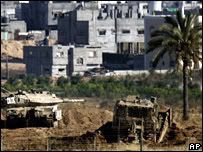 Israel wants to halt to the continued rocket attacks launched from Gaza
Mr Sourani spoke of how on hot days like the one that was sweltering all around us, they would picnic in the shade of the trees.
They could not do it anymore, he said, because Israeli bulldozers had crossed into Gaza and flattened the orange groves.
A wide strip of land along the border has been cleared, Israel says for security reasons, so its soldiers can spot Palestinian militants who want to kill Israelis.
Many Palestinians say that reasons of security can also be a cover for the collective punishment of property owners.
'Worse things happen'
I was expecting Mr Sourani to talk about the pain of losing something that was full of family memories.
He said it did hurt. But he also described the way that his elderly mother, to all and intents and purposes, had told her family to pull themselves together.
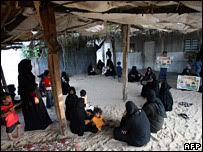 Israel has apologised for killing the three young cousins last month
Listen, she said, they were only trees. They have gone, but they can grow again.
The important thing, she told them, is that none of you are dead.
Now, what is the point of writing about all this?
As Mr Sourani's mother said, many worse things happen in Gaza. Violent death is part of everyone's life.
Later the same day, I went to the home of a family that was mourning three children, two boys aged 10 and 12, and a 12-year-old girl.
The young cousins were mistakenly killed by Israeli soldiers last month because they were playing close to rocket launchers outside Beit Hanoun.
I suppose I am mentioning Mr Sourani's mother because she displays not just a commendable sense of proportion, but also a capacity to endure. You won't get far without it in Gaza.
Israeli frustration
They need it too on the other side of the border wire in the southern Israeli town of Sderot, which is regularly rocketed from Gaza.
A couple of days after I met Mr Sourani, a rocket landed close to the town's nursery school.
 Sderot residents have protested against perceived Israeli inaction
Very fortunately, nobody was hurt in that attack. But it filled many Israelis who saw television pictures of terrified infants with rage and frustration.
Newspaper columnists asked what Israel would be doing if the children in the Sderot nursery school had been killed (their answer: re-invading Gaza) and angrily rejected the idea that Israel's policy should be dictated by the kill-rate of Palestinian rockets.
That started calls to find a way to punish Gazans for allowing rockets to be fired at Israel, which deepened after more than 60 Israeli soldiers were hurt in another attack.
This week, the Israeli government produced its answer.
It decided to classify Gaza a "hostile entity", and, pending a legal review, to reserve the right to impose collective punishments by cutting supplies of fuel and electricity, and by restricting the movement of people.
'Big prison'
Gaza's new status institutionalises methods that Israel is already using to ratchet up the pressure.
UN Secretary General Ban Ki-moon asked Israel to reconsider.
He said Gaza's people "should not be punished for the unacceptable actions of militants and extremists".
The Palestinians to whom I have spoken ask what is new.
For years, they have routinely described the Gaza Strip as a big prison and it is hard to argue with the description.
Throughout 40 years of occupation, collective punishments that violate the fourth Geneva Convention have been commonplace.
Echoing terminal
In Gaza today, supplies of everything are in short supply because of existing Israeli restrictions, and the movement of Palestinians into and out of the territory has already almost ceased.
Israel has built an enormous border terminal with sophisticated layers of security that culminate with a full body scan.
 Israel has heavily restricted movement into and out of Gaza
You enter a circular chamber, the doors of which hiss shut behind you.
A loudspeaker voice, owned by a person who presumably is watching what is happening on a TV monitor, tells you to stand with your legs apart and to raise your hands above your head.
Sensors spin and swoop round, looking for dangerous substances that you may have swallowed or inserted into your body.
It does not hurt - nothing touches you and if you pass scrutiny, you walk out into the echoing terminal, glacial with air conditioning, past security people who preside over a building that is almost empty because so few people can cross.
Perhaps the terminal is designed for a better time, of neighbourly relations between two states.
US friends only
And as life for Gaza's civilians becomes worse, Western politicians and diplomats have hopes that for the first time since the collapse of the Camp David summit in 2000, there could be a chance to restart peace talks.
For them, everything has become easier since Hamas took over in Gaza.
 Ms Rice has yet to address the problem that her strategy ignores both Hamas and the Syrian government - two entities who have the capacity to wreck anything the conference produces
 They can now deal solely with Fatah, which has set up a technocratic "government" without any Hamas participation.
The West - and the Israeli prime minister and the Palestinian Authority president - is focusing on a US plan for an international conference in November, which Secretary of State Condoleezza Rice is working towards this week as she tours the Middle East.
She has yet to address the problem that her strategy ignores both Hamas and the Syrian government - two entities who have the capacity to wreck anything the conference produces that they do not like. Only friends of the US are being invited.
An invitation arrived at Mr Sourani's office to meet the new Middle East peace envoy Tony Blair.
It would have meant going through the empty border terminal and to travel up to Jerusalem, but Mr Sourani was not granted a permit by the Israeli authorities.
He was frustrated, but he also cannot get a permit to visit his wife and children, who are in Egypt.
Guess which hurts most. As his mother said, keep everything in proportion.
| [+/-] |
Shock Waves From Syria |
Did Israel bomb a secret nuclear facility equipped by North Korea?:
There's been no official confirmation of the targets or results of an Israeli air raid in northeastern Syria on Sept. 6. Yet, like a subterranean explosion, the event is sending shock waves through the Middle East and beyond. Syria has protested to the United Nations, though it hasn't been very clear about what it's protesting. On Tuesday, a front-page editorial in Damascus's main government-run newspaper criticized the United States for not condemning the attack. An Israeli newspaper, meanwhile, noted triumphantly that no nation other than North Korea had come to Syria's defense, rhetorically or otherwise.
What happened? Media accounts are beginning to converge on a report that Israel bombed a facility where it believed Syria was attempting to hatch its own nuclear weapons program with North Korea's assistance. The Post's Glenn Kessler reported that the strike came three days after a ship carrying material from North Korea docked at a Syrian port and delivered containers that Israel believes held nuclear materials. It's not clear whether U.S. intelligence agencies concur with Israel's conclusion, and independent experts have said that Syria lacks the resources for a credible nuclear weapons program.
TOOLBOX
Resize Text
Save/Share +
Print This
E-mail This
COMMENT
washingtonpost.com readers have posted 9 comments about this item.
View All Comments »
POST A COMMENT
Your washingtonpost.com User ID, maxthesabre, will be displayed with your comment.
Discussion Policy
It nevertheless is beginning to look as if Israel may have carried out the boldest act of nuclear preemption since its own 1981 raid against Iraq's Osirak nuclear complex. If so, its silence is shrewd. It has allowed Syria to avoid a military response and every other Arab state to pretend that nothing happened. So far, the most serious fallout may be China's abrupt and unexplained postponement of scheduled "six-party" talks on North Korea's nuclear program.
The non-news has boosted the previously rock-bottom poll numbers of Israeli Prime Minister Ehud Olmert. This week he jauntily announced that he was open to peace talks with Syria. Still, the lasting repercussions of the raid have yet to become clear. One question is how the government of Bashar al-Assad will respond to what may have been a devastating Israeli blow -- coupled with what can only be interpreted as silent approval by Syria's neighbors and most of the rest of the world. Will Mr. Assad be frightened out of the cocky aggressiveness that has caused him to sponsor or facilitate terrorism in Israel, Iraq and Lebanon? Or will he choose to escalate?
Another choice is faced by the Bush administration, which hopes to complete an accord with North Korea by the end of the year under which North Korea will disclose all of its nuclear programs and disable its facilities. Secretary of State Condoleezza Rice said this week that concerns about proliferation only added to the urgency of moving ahead on the deal. That's true -- but it doesn't mean U.S. negotiators can ignore the possibility that North Korea was shipping nuclear equipment to Syria even while promising to dismantle its own program. Pyongyang's dealings with Syria are a legitimate and necessary subject of inquiry when the six-party talks resume -- and they ought to be part of North Korea's promised disclosure.
Tuesday, September 18, 2007
| [+/-] |
Syria, N. Korea Deny Nuclear Cooperation |
The Associated Press reports:
Syria and North Korea denied Tuesday they are cooperating on a Syrian nuclear program, and they accused U.S. officials of spreading the allegations for political reasons -- either to back Israel or to block progress on a deal between Washington and Pyongyang.
A front-page editorial in the government newspaper Tishrin also criticized the United States for failing to condemn a Sept. 6 Israeli air incursion, which it called a violation of international law.
Details of the incursion remain unclear. Israel clamped a news blackout on the raid, while Syria said only that warplanes entered its airspace, came under fire from anti-aircraft defenses and dropped munitions and fuel tanks to lighten their loads while they fled.
U.S. officials have said Israeli warplanes struck a target. A military officer said Israel targeted weapons being shipped to Hezbollah militants in Lebanon, but another official's comments raised speculation the Israelis targeted a nuclear installation.
Andrew Semmel, acting U.S. deputy assistant secretary of state for nuclear nonproliferation policy, said Syria may have had contacts with "secret suppliers" to obtain nuclear equipment. He did not identify the suppliers, but said that North Koreans were in Syria and that he could not exclude involvement by the network run by the disgraced Pakistan nuclear scientist A.Q. Khan.
North Korea strongly denied it secretly helped Syria develop a nuclear program, maintaining the charge was fabricated by U.S. hard-liners to block progress in the North's relations with the United States.
A Syrian Cabinet minister ridiculed the speculation about any cooperation with North Korea.
"All this rubbish is not true. I don't know how their imagination has reached such creativity," Bouthaina Shaaban said.
"Regretfully, the international press is busy justifying an aggression on a sovereign state and the world should be busy condemning it instead of inventing reasons and aims of this aggression," he told Lebanon's Hezbollah TV station Al-Manar.
Syria's nuclear program has long been considered minimal, and the country is known to have only a small research reactor.
In Vienna, Austria, officials for the International Atomic Energy Agency declined comment. But a diplomat associated with the agency said the IAEA "didn't know anything about any nuclear facility in Syria, and if there is something there, we should know."
Syria was the subject of an IAEA investigation in 2004 on suspicions it could have been a customer of the nuclear black market run by the Khan network -- the same operation that supplied Iran and Libya for their clandestine atomic projects. The diplomat in Vienna, who insisted on anonymity, said the IAEA found no concrete evidence of such activity.
Israeli incursions into Syrian airspace are uncommon, unlike in neighboring Lebanon where Israeli warplanes have regularly made reconnaissance flights since last year's war with Hezbollah. Such flights were reported late Tuesday over southern Lebanon.
W. Patrick Lang, former head of Mideast intelligence at the U.S. Defense Intelligence Agency, said Israel's incursion over Syria may have been staged to convince the Syrians that its forces are still formidable despite the inconclusive war with Hezbollah. Syria may have tempered its response for fear of escalation, he added.
"The Syrians are really worried because of the hostility of the Bush administration," said Lang. "If things degenerate, they could end up on the receiving end of a strike from Israel, with the go-ahead from the U.S."
The editorial in Tishrin, which reflects Syrian government thinking in a country where the media is tightly controlled, said the U.S. accusations show Washington's pro-Israel bias and have no credibility.
It said Washington was "busy on behalf of Israel circulating claims" that the incursion involved "possible nuclear facilities supplied by (North) Korea."
"The strange thing is that the Americans are talking on behalf of Israel and are providing excuses and concocting new false spins such as talking about presumed Syrian nuclear activity and completely turning a blind eye about the Israeli nuclear danger," the Syrian editorial said.
Israel is widely believed to have nuclear weapons but has never acknowledged it.
The Syrian newspaper said the accusations "recall those false claims that the Americans and the British circulated about Iraq's nuclear programs."
Tishrin was referring to Saddam Hussein's alleged weapons of mass destruction program, one reasons cited by the U.S. for the invasion of Iraq in 2003. No such weapons were found.
Israeli President Shimon Peres, meanwhile, sought to calm tensions with Syria.
"The nervousness in relations between Syria and ourselves is over," Peres told foreign reporters in Jerusalem. "We are clearly ready to negotiate directly with Syria for peace."
Peres' comment followed similar remarks Monday by Prime Minister Ehud Olmert, who said he has "a lot of respect for the Syrian leader (President Bashar Assad) and for Syrian behavior."
Olmert said he is prepared for peace negotiations with Syria if the conditions are right. He made the offer of peace talks before, but it was the first time he had mentioned Syria since the reported airstrike. In 2000, Israel-Syria talks neared agreement but broke down over final border and peace arrangements.
Friday, September 14, 2007
| [+/-] |
Is Serious Trouble Brewing Between Syria and Israel? |
Speculation Centers on Fears of Missiles and Nuclear Weapons
Peace Talks Seem Impossible as Tensions Grow Between Syrians and Israelis. ABC News reports:
Eight days ago, the Syrian government announced that Israeli military jets had been spotted flying through Syrian airspace. The Syrians said the jets had been fired upon and had fled. The Israelis said nothing at all.
Ever since, the region and its media have been engaged in a frenzy of speculation as to what really happened. As soon as news of the reported incident broke, the Israeli government imposed a complete media blackout.
That blackout has muzzled Israeli journalists who have been frustrated by the silence of their usually talkative defense sources. In one bulletin an Israeli radio announcer sarcastically told his audience to log onto the Web site of a government-sponsored Syrian newspaper to find out what really happened.
In the strange atmosphere that has followed last week's incident, the region's bloggers have been working overtime to fill the void. What seems clear is that something important did happen, and far from the Israeli mission being limited to probing, or reconnaissance, the consensus view is that the Israelis flew a mission that had a real target.
This speculation has been supported by a number of anonymous defense sources in the United States. One such source is quoted in The New York Times saying, "The strike I can confirm, the target, I can't."
Judging by the extraordinary secrecy attached to the target, it was highly sensitive. Another unnamed U.S. source said the Israeli strike "left a big hole in the desert." Meanwhile the Syrians are sticking to their story that the Israelis turned and ran once they were detected. Syrian U.N. ambassador Bashar al Ja'afari told reporters: "There was no target. They dropped their munitions. They were running away."
Here are the leading theories about the target, in no particular order of credibility or importance:
The Israelis, presumably with U.S. knowledge and backing, targeted a transfer of weapons destined for the Lebanese group Hezbollah. This trafficking of weapons has long been an issue for the Israelis, and now is in direct contravention of U.N. Security Council Resolution 1701, which was drawn up at the end of last year's conflict between Israel and Hezbollah. Israeli intelligence has been warning that Hezbollah is trying to rearm and the usual suspects are Syria and Iran.
The rest of this article is not available at the ABC website.
Wednesday, September 12, 2007
| [+/-] |
U.S. Official Confirm Israel Strike on Syria |
Reuters reports:
U.S. officials on Wednesday confirmed Israel launched air strikes against Syria last week and said they were to target weapons Israel believes were headed for the militant group Hezbollah.
One defense official dismissed speculation Israel had aimed for any nuclear-related target. Two others said the target included weapons Israeli and U.S. officials have said Iran provides to Hezbollah through Syria.
"They saw a weapons flow," one official said, referring to weapons caches intended for Hezbollah, which fired thousands of rockets into Israel during a 36-day conflict last year.
It was still unclear whether Israel hit its targets in the September 6 air strikes.
Israel has declined comment on the strikes. Syria says the munitions dropped by Israel did no damage.
One U.S. defense official, speaking only on condition of anonymity, said the significance of the strikes was not whether Israel hit its targets, but rather that it displayed a willingness to take military action.
Syria has protested to the United Nations about the air strikes. On Wednesday, Syria's U.N. ambassador said Israel's motive was to torpedo peace moves.
SYRIA AT U.N.
"We think the Israeli purpose behind such an aggressive act is to torpedo the peace process, to torpedo the idea of holding an international conference," Syrian Ambassador Bashar Ja'afari told reporters.
Asked about Hezbollah's weapons, Ja'afari said, "This is blah, blah. This is nonsense, this is an unfounded statement. It is not up to the Israelis or anyone else to assess what we have in Syria."
"There was no target," he added. "They dropped their munitions. They were running away after they were confronted by our air defense."
Israeli public radio stations, which like all media in the country are under military censorship, led morning news bulletins with a New York Times report that U.S. officials had said Israel carried out the strikes -- and that U.S. officials believed Syria may have obtained nuclear material.
While some officials speculated that Syria and North Korea had opened some form of cooperation on nuclear weapons, other U.S. officials and former intelligence officials told Reuters that seemed unlikely and technically difficult.
A European diplomat speaking on condition of anonymity told Reuters satellite surveillance of an alleged nuclear site in Syria had been inconclusive due to poor weather. However, he said monitoring of this site would continue.
Israeli jets last struck in 2003 across a border that remains tense but quiet 34 years after the last war between the two neighbors ended in an edgy ceasefire. In June last year Syrian guns opened fire on Israeli aircraft over Syria.
Israel has urged Syria to stop supporting militant Palestinian groups and the Lebanese movement Hezbollah.
Some Israeli intelligence officials also have suggested Syria's government might be ready to try to take by force parts of the Golan Heights captured by Israel in the war of 1967.
Syrian officials have said Syria was seeking peaceful means to recover the Golan, although some also have suggested force remained an option if diplomacy failed. Israeli-Syrian peace efforts have been stalled for seven years.
Thursday, September 6, 2007
| [+/-] |
Syria Accuses Israel of Bombing Its Territory |
Reuters reports:
Syria accused Israel of bombing its territory on Thursday and said it could respond to the Jewish state's "aggression and treachery."
Israel declined to comment on the charge by Syria, which said no casualties or damage were caused. The Syrian accusation was partly responsible for triggering a rise in world oil prices of more than $1.40 a barrel.
"It appears that the Israeli planes were on a reconnaissance mission when they got caught by Syrian defenses and were forced to drop their bombs and extra fuel tanks," said a Western diplomat in Syria's capital Damascus. He declined to be named.
After months in which talk of reviving long-stalled peace negotiations between neighboring Israel and Syria has been mixed with speculation on both sides that the other was preparing a surprise attack, Syrian officials hit out.
"This shows that Israel cannot give up aggression and treachery," Syrian Information Minister Mohsen Bilal told Al Jazeera television.
Another Syrian official said: "They dropped bombs on an empty area while our air defenses were firing heavily at them." The official news agency SANA said Syria "reserves the right to respond according to what it sees fit."
The Israeli military spokesman's office said in a statement: "It is not our custom to respond to these kinds of reports."
The office has typically commented on such charges, but a security source said the government had imposed a news blackout on the issue. A spokeswoman for Prime Minister Ehud Olmert said there would be no comment beyond the military statement.
In Washington, the White House declined to comment.
Russia urged Israel to respect international law.
"The reports have caused extreme concern in Moscow," the Russian foreign ministry said in a statement. "Particularly troubling is that this is the Middle East, a region already heavy with serious conflicts and tension."
Iran again criticized its foe Israel.
"The aims of that ... provocative move by the Zionist regime was to shift its domestic crisis into areas other than Palestine, spreading insecurity in the region and covering up its failure in the 33-day war against Lebanon," said Foreign Ministry spokesman Mohammad Ali Hosseini.
Iran's ambassador to Damascus had contacted Syrian security officials and said that "Iran is ready to provide every kind of assistance to Syria," the official IRNA news agency reported.
RECONNAISSANCE FLIGHTS
It is more than a year since Syrian guns opened fire on Israeli aircraft and Israeli jets last struck in 2003 across a border that remains tense but largely quiet 34 years after the last war between the two neighbors ended in an edgy ceasefire.
Military analysts said Israel has conducted reconnaissance flights over Syria to probe its defenses.
Witnesses said several planes crossed deep into Syrian territory and flew over the oil centre of Deir al Zor on the Euphrates river.
Residents in the Tal al-Abiad area on Syria's border with Turkey said they spotted several fuel tanks.
Turkish and Israeli officials denied a report from an Israeli military source that the Israeli air force had trained in Turkey as recently as this week. The last exercises concluded last month, officials in Ankara said.
Tensions between Israel and Syria have been high in the past few months.
Some Israeli intelligence officials have suggested Syrian President Bashar al-Assad's government might be ready to try to take by force parts of the Golan Heights, which Israel captured in the war of 1967 and held on to in fighting in 1973.
Syrian officials have said Syria was seeking peaceful means to liberate the territory, although some have also suggested force remained an option if diplomacy failed.
Some Israeli military officials have expressed alarm at what they say are reinforcements of Syrian posts and arms purchases.
But Olmert, who launched his forces against Syrian-allied Hezbollah guerrillas in Lebanon a year ago, has been at pains to say he has no hostile intentions toward Damascus.
He has also said he would like to reopen peace negotiations that have been stalled for seven years. Syrian officials too have said they would like peace. But there has been little sign of any concrete steps towards rapprochement.
Wednesday, August 1, 2007
| [+/-] |
The $63 Billion Sham |
For the Boston Globe, Derrick Jackson writes:
Secretary of State Condoleezza Rice said the United States wants to send $63 billion in military aid and weapons to the Middle East to "bolster forces of moderation and support a broader strategy to counter the negative influences of Al Qaeda, Hezbollah, Syria, and Iran."
Talk about wriggling in quicksand. Having destroyed Iraq to save us from horrors that did not exist, Rice now wants to save us from Iran's future nukes by selling American weapons of mass destruction. Over the next decade, the Bush administration wants to give Israel $30 billion in military aid, a nearly 43 percent increase over what that nation received over the last 10 years, according to The New York Times. We want to give $20 billion to Saudi Arabia, Bahrain, Kuwait, Oman, Qatar, and the United Arab Emirates. We want to give Egypt $13 billion.
Do you feel safe?
"This is throwing bad money after worse money," said Frida Berrigan, senior program associate at the Arms and Security Project of the New America Foundation. The program was formerly known as the Arms Trade Resource Center at the World Policy Institute. "You can see the whole arms package as a buyoff of Arab nations for what we've done in Iraq.
"Justifying the sales because these countries feel threatened by Iran doesn't hold water. Iran is five to 10 years away from a nuclear weapon. That gives the United States and its partners more than enough time to come up with diplomatic solutions," Berrigan said. "This is just going to reinforce Iran's desire to have a nuclear weapon."
The United States had already set records for global arms sales. The New York Times reported in November that the Bush administration and American military contractors doubled arms sales from $10.6 billion to $21 billion from September 2005 to September 2006. Berrigan estimates that the latest proposal will increase military aid and weaponry by another 25 percent.
This is a bipartisan craziness that never ended despite the end of the Cold War. Under the dual guise of national security and protecting American jobs, the first President Bush and President Clinton aggressively promoted US arms sales to more than twice their level of the last years of the Cold War.
Lawrence Korb, assistant defense secretary under President Reagan, told the Globe in 1996, "The brakes are off the system. . . . There is no coherent policy on the transfer of arms. It has become a money game; an absurd spiral in which we export arms only to have to develop more sophisticated ones to counter those spread out all over the world. . . . It is a frightening trend that undermines our moral authority in the New World Order."
The absurd spiral did nothing for regional stability, democracy or stop terrorism from spreading to American shores. Saudi Arabia was a big buyer under Clinton. It remained a "problematic ally," according to the 9/11 commission. This week, the US envoy to the United Nations, Zalmay Khalilzad, could not decide whether Saudi Arabia was "a great ally" or "undermining" the United States in Iraq.
There is no hint of a coherent policy. Under the president, 80 percent of nations that received arms from America in 2003 were classified by the State Department as being either undemocratic or having a poor human rights record, which covers all the Arab countries in the new deal. Israel is a democracy, but in its 2006 country profile, the State Department cites a source that determined that 322 of 660 Palestinians killed by the Israeli military "were not engaged in hostilities when killed and 141 were minors."
This latest deal is so over the top that Israel is not opposing the $33 billion to Arab states because it gets $30 billion to maintain its military edge. En route to the Middle East this week, Rice denied that the military package was an attempt to buy allies with bombs. She also denied that the United States was relaxing its standards for democracy and human rights.
But a report by the Economist Intelligence Unit said that "the weak response in the Middle East to pressures for democratization, as well as the experience with imported political change in Iraq, is making a mockery of George Bush's 'freedom' agenda." Reuters this week quoted Paul Salem, director of the Middle East Center at the Carnegie Endowment for International Peace, as saying that the arms deal meant Bush's effort to spread democracy in the region was "more than dead."
Berrigan said, "We've created a black hole in what used to be a country and this is supposed to be the solution? More military aid and more high-tech weaponry? The best case scenario is that Congress exercises its power and keeps this from happening."
Saturday, July 28, 2007
| [+/-] |
U.S. Plans New Arms Sales to Gulf Allies |
$20 Billion Deal Includes Weapons For Saudi Arabia
The Washington Post reports:
The Bush administration will announce next week a series of arms deals worth at least $20 billion to Saudi Arabia and five other oil-rich Persian Gulf states as well as new 10-year military aid packages to Israel and Egypt, a move to shore up allies in the Middle East and counter Iran's rising influence, U.S. officials said yesterday.
The arms deals, which include the sales of a variety of sophisticated weaponry, would be the largest negotiated by this administration. The military assistance agreements would provide $30 billion in new U.S. aid to Israel and $13 billion to Egypt over 10 years, the officials said. Both figures represent significant increases in military support.
U.S. officials said the arms sales to Saudi Arabia are expected to include air-to-air missiles as well as Joint Direct Attack Munitions, which turn standard bombs into "smart" precision-guided bombs. Most, but not all, of the arms sales to the six Gulf Cooperation Council countries -- Saudi Arabia, the United Arab Emirates, Kuwait, Qatar, Bahrain and Oman -- will be defensive, the officials said.
U.S. officials said the common goal of the military aid packages and arms sales is to strengthen pro-Western countries against Iran at a time when the hard-line regime seeks to extend its power in the region.
"This is a big development, because it's part of a larger regional strategy and the maintenance of a strong U.S. presence in the region. We're paying attention to the needs of our allies and what everyone in the region believes is a flexing of muscles by a more aggressive Iran. One way to deal with that is to make our allies and friends strong," said a senior administration official involved in the negotiations.
The arms deals have quietly been under discussion for months despite U.S. disappointment over Saudi Arabia's failure to support the Iraqi government and to bring that country's Sunni Muslims into the reconciliation process.
The administration's plans will be announced Monday in advance of trips next week to the Middle East by Secretary of State Condoleezza Rice and Defense Secretary Robert M. Gates, and are expected to be on their agenda in Egypt and Saudi Arabia. The administration has a notional list of arms to sell to the Gulf states, but there are no final agreements on quantities and specific models, U.S. officials said.
State Department and Pentagon officials started briefing key members of Congress about their intentions over the past week, U.S. officials said. The initial reception has been positive, said officials involved in those briefings. They acknowledged, however, that some parts of the deal are supported more than others. Arms sales to Gulf countries have often been controversial.
The administration hopes to provide a full rundown this fall for congressional approval.
"We want to convince Congress to continue our tradition of military sales to all six" states, the senior administration official said. "We've been helping Gulf Arabs for years, and that needs to continue."
Sunni regimes in the Gulf region have felt particularly vulnerable since the election of a pro-Iranian Shiite government in neighboring Iraq last year. "There's a sense here and in the region of the need to build up defenses against Iranian encroachment," said a U.S. official familiar with the deals.
The aid packages to Israel and Egypt are further along. A U.S.-Israel agreement, to replace a 10-year arrangement that expires this year, has been under discussion since February, U.S. officials said. The new U.S. package will include strictly military aid and would expand the U.S. contribution 25 percent over the current $2.4 billion per year; economic assistance has been discontinued now that Israel is considered a developed economy, U.S. officials said.
President Bush said last month, after meeting with Israeli Prime Minister Ehud Olmert, that he was strongly committed to a new 10-year agreement that would increase U.S. assistance "to meet the new threats and challenges [Israel] faces." Washington has long promised to help Israel sustain a so-called "qualitative military edge" over other major powers in the region.
Rice is expected to announce Monday that, after her Middle East trip, Undersecretary of State R. Nicholas Burns will finalize the agreements with Israel and Egypt.
| [+/-] |
U.S. Plans Arms Sales to Saudi Arabia |
The Washington Post reports:
The Bush administration will announce next week a series of arms deals worth at least $20 billion to Saudi Arabia and five other oil-rich Persian Gulf states as well as new 10-year military aid packages to Israel and Egypt, a move to shore up allies in the Middle East and counter Iran's rising influence, U.S. officials said yesterday.
The arms deals, which include the sales of a variety of sophisticated weaponry, would be the largest negotiated by this administration. The military assistance agreements would provide $30 billion in new U.S. aid to Israel and $13 billion to Egypt over 10 years, the officials said. Both figures represent significant increases in military support.
U.S. officials said the arms sales to Saudi Arabia are expected to include air-to-air missiles as well as Joint Direct Attack Munitions, which turn standard bombs into "smart" precision-guided bombs. Most, but not all, of the arms sales to the six Gulf Cooperation Council countries -- Saudi Arabia, the United Arab Emirates, Kuwait, Qatar, Bahrain and Oman -- will be defensive, the officials said.
U.S. officials said the common goal of the military aid packages and arms sales is to strengthen pro-Western countries against Iran at a time when the hard-line regime seeks to extend its power in the region.
"This is a big development, because it's part of a larger regional strategy and the maintenance of a strong U.S. presence in the region. We're paying attention to the needs of our allies and what everyone in the region believes is a flexing of muscles by a more aggressive Iran. One way to deal with that is to make our allies and friends strong," said a senior administration official involved in the negotiations.
The arms deals have quietly been under discussion for months despite U.S. disappointment over Saudi Arabia's failure to support the Iraqi government and to bring that country's Sunni Muslims into the reconciliation process.
The administration's plans will be announced Monday in advance of trips next week to the Middle East by Secretary of State Condoleezza Rice and Defense Secretary Robert M. Gates, and are expected to be on their agenda in Egypt and Saudi Arabia. The administration has a notional list of arms to sell to the Gulf states, but there are no final agreements on quantities and specific models, U.S. officials said.
State Department and Pentagon officials started briefing key members of Congress about their intentions over the past week, U.S. officials said. The initial reception has been positive, said officials involved in those briefings. They acknowledged, however, that some parts of the deal are supported more than others. Arms sales to Gulf countries have often been controversial.
The administration hopes to provide a full rundown this fall for congressional approval.
"We want to convince Congress to continue our tradition of military sales to all six" states, the senior administration official said. "We've been helping Gulf Arabs for years, and that needs to continue."
Sunni regimes in the Gulf region have felt particularly vulnerable since the election of a pro-Iranian Shiite government in neighboring Iraq last year. "There's a sense here and in the region of the need to build up defenses against Iranian encroachment," said a U.S. official familiar with the deals.
The aid packages to Israel and Egypt are further along. A U.S.-Israel agreement, to replace a 10-year arrangement that expires this year, has been under discussion since February, U.S. officials said. The new U.S. package will include strictly military aid and would expand the U.S. contribution 25 percent over the current $2.4 billion per year; economic assistance has been discontinued now that Israel is considered a developed economy, U.S. officials said.
President Bush said last month, after meeting with Israeli Prime Minister Ehud Olmert, that he was strongly committed to a new 10-year agreement that would increase U.S. assistance "to meet the new threats and challenges [Israel] faces." Washington has long promised to help Israel sustain a so-called "qualitative military edge" over other major powers in the region.
Rice is expected to announce Monday that, after her Middle East trip, Undersecretary of State R. Nicholas Burns will finalize the agreements with Israel and Egypt.
Sunday, July 15, 2007
| [+/-] |
Barn Owls Unite Israelis & Jordanians |
 Shaul Aviel, center, an Israeli from Kibbutz Sde Eliyahu, Jordanian veterinary surgeon Dr.Safwan Fawzi Al Hussein, right, and Jordanian agricultural engineer Baker Hasan Barakat examine a barn owl in this recent undated picture taken south of the Sea of Galilee. In the midst of seemingly endless Mideast violence, Israelis and Jordanians are sharing ideas for protecting nature, using owls instead of harmful pesticides to keep the rats out of the crops. (AP Photo)
The LATimes reports:
For years, Ibrahim Alayyan watched in frustration as rats ravaged the date crop at his lush family farm.
Having no luck with pesticides, the retired Jordanian heart surgeon was only too eager to try a pest control agent widely used in fields just across the Jordan River in Israel -- owls.
"There used to be so many rats," Alayyan said. "But after we put in the owls, thank God, this is the first time we have had a full date harvest."
To the world, the symbol of peace may be a dove, but to farmers on either side of the Jordan, it's Tyto alba, the common barn owl.
Alayyan is one of dozens of Jordanians working in cooperation with Israeli colleagues, targeting rodents with a natural predator instead of with chemicals.
The effort still faces suspicions and superstitions, but organizers hope the message of their partial success will spread to Lebanon, Syria and other Middle Eastern countries, and demonstrate the fruits of the 1994 peace treaty that ended a 46-year state of war between Israel and Jordan.
Political benefits aside, the project is driven foremost by environmental concerns.
In the late 1970s, chemicals killed hundreds of birds in northern Israel, said Yossi Leshem, an Israeli ornithologist and director of the International Center for the Study of Bird Migration.
So Leshem persuaded Sde Eliyahu, a kibbutz south of the Sea of Galilee, to try owls, which can eat up to 10 rodents a day. All the farmers needed was to build boxes where the birds could mate and raise their young.
"I put up 14 barn owl boxes, and everybody laughed at me," said Shauli Aviel, who oversees the effort at the collective farm.
A few years later, Sde Eliyahu's rat problem had vanished, he said. More than 60 nesting boxes now sit on the grounds of the kibbutz, and the technique has caught on with other farmers along the Jordan.
Yet as the owl population grew, the birds increasingly began flying -- and looking to nest -- across the nearby border with Jordan, where pesticide use remains rampant. Chemicals seeped into the water table, and owls were poisoned by eating contaminated rodents.
Then came the peace treaty, Israelis and Jordanians got used to being good neighbors, and in late 2002 Aviel and fellow Israeli farmers planned a regional conference on barn owls to explain their advantages to colleagues across the Jordan River.
The response was discouraging. Many Arabs consider owls the same way others view black cats -- as bad luck. Word came back to the Israelis that no Jordanians would attend.
So the organizers changed the title of the conference to focus on organic farming, and two dozen Jordanians turned up. Midway through the gathering they were given a demonstration on owls, and soon Jordanian farmers were asking how they could attract owls to their fields, Aviel said.
With funding from the Jewish Community Federation of Cleveland, Ohio, the kibbutz gave the Jordanians advice and building materials. More than three dozen nesting boxes have since been put up in Jordan, organizers said.
Among the most eager participants was Alayyan, a former chief of cardiovascular surgery at a Jordanian hospital. He agreed to build a nesting box at his family's farm in the village of Sheik Hussein, six miles from Aviel's kibbutz.
"For me, it was a real pleasure to find a man like that on the other side of the border," said Aviel, as he and Alayyan surveyed a group of newborn owl nestlings. Unable to communicate in their own languages, the two men spoke to each other in English, but when it came to nature and conservation, "He spoke in my language," Aviel said.
The project also has gotten support from political and former military leaders in both countries, including Mansour Abu Rashed, the former head of Jordanian intelligence.
Rashed, who heads the Amman Center for Peace and Development, said organizers are "under no illusions" the owl project will ease Mideast tensions; the goal is simply "to bring people together, to let them talk and build confidence."
But obstacles remain. After the U.S.-led invasion of Iraq in March 2003, Israeli farmers delayed the initial delivery of building materials to Jordan for the owl boxes because of the tense atmosphere. Arabic posters promoting the benefits of barn owls make no mention of Israel.
Some Israeli organizers have expressed frustration at the pace of progress in Jordan. And last month, some nesting boxes on Jordanian farms were stolen or vandalized. Although it was unclear whether the vandalism was driven by owl-phobia or by Israel's involvement, it upset Leshem, the Israeli ornithologist.
"We are wasting our money and time, coming and putting boxes -- and then, suddenly, they are destroyed," he said after a recent meeting with the Jordanians.
"It's a new project in our area," explained Abu Rashed, the retired general. "Nobody knows what's inside" the boxes.
Organizers also say the project has gained little traction among Palestinians, because of security restrictions that make it hard for them and Israelis to travel to each other's territory for meetings.
Still, even when tensions run high, the environment is one of the few areas where Israelis and Arabs cooperate. The owl conference went ahead at a time when the Palestinian uprising against Israel was at its peak, and during that uprising, Israeli and Palestinian officials maintained contacts on issues such as water quality and waste removal.
The Arava Institute for Environmental Studies in southern Israel trains Jewish and Arab students, including Jordanians and Palestinians, in solving ecological problems.
Friends of the Earth-Middle East, an organization of Israeli, Jordanian and Palestinian environmentalists, leads joint efforts to clean up the Jordan River and promote eco-tourism packages on both sides of the border.
"We're doing something our governments are not able to do," says Mira Edelstein, an organization spokeswoman. "If people know how to highlight the environmental benefits that can come out of this type of cooperation, then it's not political anymore."
