UPI reports:
A September raid near the Syrian border uncovered what U.S. military officials term "an al-Qaida Rolodex" of hundreds of foreign fighters in Iraq.
A senior U.S. military official in Baghdad has confirmed to CNN that the raid netted documents listing the identities of more than 700 foreign fighters believed to have entered the country in the past year.
The official said the documents, along with other intelligence, indicated that as many as 60 percent of the foreign fighters were from Saudi Arabia and Libya, CNN reported.
White House spokeswoman Nikki McArthur said the United States continued to work with countries in the region to stem the flow of foreign fighters into Iraq.
"These statistics remind us that extremists continue to go to Iraq because they do not want the United States nor the Iraqis to succeed in establishing a democracy there that is an ally in the way on terror," McArthur told CNN.
Friday, November 23, 2007
| [+/-] |
Al-Qaida 'Rolodex' Found in Iraq Raid |
Wednesday, November 14, 2007
| [+/-] |
Court In Saudi Arabia Sentences Rape Victim For Being In Car of Rapist Men NOT Her Relatives |
Arab News reports:
The General Court in Qatif yesterday doubled the number of lashes for a rape victim as well as jail terms for her assaulters. In its verdict, the court also suspended the victim’s lawyer from defending her.
The case was referred back to the General Court by the Appeals Court judges last summer after Abdul Rahman Al-Lahem, the victim’s lawyer, successfully contested against the initial verdict saying it too lenient for the rapists and unjust for the victim.
A year-and-a-half ago in the Eastern Province town of Qatif, a seven men gang-raped a 19-year-old girl 14 times. Three judges from the Qatif General Court sentenced the rape victim to 90 lashes for being in the car of an unrelated male at the time of the rape. The sentences for the seven rapists ranged from 10 months to five years in prison.
The Appeals Court sentenced the victim to 200 lashes and six months in prison. The seven rapists had their sentences increased to between two and nine years. The verdict came in as a shock to everybody.
A source at the Qatif General Court said that the judges had informed the rape victim that the reason behind doubling her punishment was “her attempt to aggravate and influence the judiciary through the media.”
Judge Soliman Al-Muhanna from the Qatif court told the lawyer (Al-Lahem) that the judicial committee had decided to suspend him from the case. They also confiscated his license which is granted to Saudi lawyers by the Ministry of Justice.
“I explained to them that it was my job to do everything legal in order to serve my client. But they did not listen,” he said.
To Al-Lahem’s surprise he received a call from the Judicial Investigation Department of the Ministry of Justice to inform him of a disciplinary session he should attend on 25th of the Hijra month.
“Actually this is the second time they have contacted me. They claim that I advertise my services and that that is against Saudi law,” he said.
| [+/-] |
Saudi Lawyer Reports Harassment After Defending Rape Victim |
AFP reports:
A Saudi lawyer and human rights activist said on Wednesday that a court in the ultra-conservative Muslim kingdom withdrew his licence after he objected to a ruling which penalised a female rape victim.
Abdurrahman al-Lahem told AFP that the court in the eastern town of Al-Qatif banned him from handling the rape case and confiscated his lawyer's licence because he challenged the verdict.
"The ministry of justice also summoned me to appear before a disciplinary committee" during the first week of December, Lahem said.
Last year, the court in Al-Qatif sentenced six Saudi men accused of raping the woman to between one and five years in jail while sentencing the woman to 90 lashes, Lahem said.
He said he appealed the ruling at the Higher Judicial Council, which ordered a retrial.
In a new ruling on Wednesday, the court toughened the sentences against the six men to between two and nine years in prison. But it also sentenced the woman to six months in jail and 200 lashes.
Lahem and other activists saw the sentences handed to the accused, who were armed when they assaulted the woman, as too lenient in a country where rape can carry the death penalty.
The case has angered members of Saudi Arabia's minority Shiite community, to which the woman belongs. The accused are Sunnis, the dominant community in the Gulf country which applies a rigorous Islamic doctrine known as Wahhabism.
Lahem said there was no apparent reason for the justice ministry's decision to refer him to a disciplinary committee.
He said the move might be due to his criticism of some judicial institutions, and "contradicts King Abdullah's quest to introduce reform, especially in the justice system."
Abdullah last month approved a new body of laws regulating the judicial system in Saudi Arabia, which rules on the basis of sharia, or Islamic law.
Friday, September 21, 2007
| [+/-] |
Fears of Dollar Collapse as Saudis Take Fright |
The Telegraph reports:
Saudi Arabia has refused to cut interest rates in lockstep with the US Federal Reserve for the first time, signalling that the oil-rich Gulf kingdom is preparing to break the dollar currency peg in a move that risks setting off a stampede out of the dollar across the Middle East.
Ben Bernanke has placed the dollar in a dangerous situation, say analysts
"This is a very dangerous situation for the dollar," said Hans Redeker, currency chief at BNP Paribas.
"Saudi Arabia has $800bn (£400bn) in their future generation fund, and the entire region has $3,500bn under management. They face an inflationary threat and do not want to import an interest rate policy set for the recessionary conditions in the United States," he said.
The Saudi central bank said today that it would take "appropriate measures" to halt huge capital inflows into the country, but analysts say this policy is unsustainable and will inevitably lead to the collapse of the dollar peg.
As a close ally of the US, Riyadh has so far tried to stick to the peg, but the link is now destabilising its own economy.
The Fed's dramatic half point cut to 4.75pc yesterday has already caused a plunge in the world dollar index to a fifteen year low, touching with weakest level ever against the mighty euro at just under $1.40.
There is now a growing danger that global investors will start to shun the US bond markets. The latest US government data on foreign holdings released this week show a collapse in purchases of US bonds from $97bn to just $19bn in July, with outright net sales of US Treasuries.
The danger is that this could now accelerate as the yield gap between the United States and the rest of the world narrows rapidly, leaving America starved of foreign capital flows needed to cover its current account deficit - expected to reach $850bn this year, or 6.5pc of GDP.
Mr Redeker said foreign investors have been gradually pulling out of the long-term US debt markets, leaving the dollar dependent on short-term funding. Foreigners have funded 25pc to 30pc of America's credit and short-term paper markets over the last two years.
"They were willing to provide the money when rates were paying nicely, but why bear the risk in these dramatically changed circumstances? We think that a fall in dollar to $1.50 against the euro is not out of the question at all by the first quarter of 2008," he said.
"This is nothing like the situation in 1998 when the crisis was in Asia, but the US was booming. This time the US itself is the problem," he said.
Mr Redeker said the biggest danger for the dollar is that falling US rates will at some point trigger a reversal yen "carry trade", causing massive flows from the US back to Japan.
Jim Rogers, the commodity king and former partner of George Soros, said the Federal Reserve was playing with fire by cutting rates so aggressively at a time when the dollar was already under pressure.
The risk is that flight from US bonds could push up the long-term yields that form the base price of credit for most mortgages, the driving the property market into even deeper crisis.
"If Ben Bernanke starts running those printing presses even faster than he's already doing, we are going to have a serious recession. The dollar's going to collapse, the bond market's going to collapse. There's going to be a lot of problems," he said.
The Federal Reserve, however, clearly calculates the risk of a sudden downturn is now so great that the it outweighs dangers of a dollar slide.
Former Fed chief Alan Greenspan said this week that house prices may fall by "double digits" as the subprime crisis bites harder, prompting households to cut back sharply on spending.
For Saudi Arabia, the dollar peg has clearly become a liability. Inflation has risen to 4pc and the M3 broad money supply is surging at 22pc.
The pressures are even worse in other parts of the Gulf. The United Arab Emirates now faces inflation of 9.3pc, a 20-year high. In Qatar it has reached 13pc.
Kuwait became the first of the oil sheikhdoms to break its dollar peg in May, a move that has begun to rein in rampant money supply growth.
Saturday, September 15, 2007
| [+/-] |
A Perfect Oil Storm on The Horizon |
New Europe reports:
In the 2005 television docudrama “Oil Storm,” a hurricane that destroys a vital US pipeline, a tanker collision which closes a busy port, terrorist attacks and tension with Saudi Arabia lead to wild speculation, crude oil prices around USD 150 per barrel and an oil crisis that paralyses America.
It’s just fiction, but not far from the truth!
Excessive oil market speculation, uncertainty about future supplies, increasing nationalism by major oil-producing countries, hurricanes and storms, refining capacity problems in the US and around the world, and growing demand, allowed oil to close above USD 80 per barrel for the first time on September 13, 2007.
“It’s convergence of almost a perfect storm where everything that could possibly push oil prices higher has taken place,” Fadel Gheit, a senior energy analyst at Oppenheimer in New York, told New Europe on September 14.
In London, Dr. Fadhil Chalabi, executive director of the Centre for Global Energy Studies, said the main reason for the price hike is that there hasn’t been enough oil in the market to meet world demand. “The stock build-up has been falling continuously, which means that refiners seek more crude to replenish a depleting stock,” he told New Europe on September 14.
He said Organisation of Petroleum Exporting Countries (OPEC), especially Saudi Arabia, have been cutting back their production and this has caused the high prices.
A day earlier, OPEC oil ministers agreed on a slight increase in output by 500,000 barrels per day, starting from November 1. But the increase is too little, too late to bring down oil prices. “It is not enough. The importance of this increase is that it stabilised the price at the present level. This half million barrels a day, if it is entirely pumped in the oil market, will prevent a further increase in the price, but it will not cause a decline in the price. The price may continue to be in the area of USD 75-76,” Chalabi said.
OPEC on September 13 rejected responsibility for the latest oil price hike. OPEC chief analyst Hasan Qabazard was quoted as saying by the press in Vienna other factors were also influencing the market, ranging from attacks on oil facilities in Mexico, and hurricane Humberto, to the effects of the US mortgage crisis.
The rising oil prices are also compensating for the current weakness in the dollar.
Gheit shares OPEC’s view. The US-based analyst told New Europe the oil market is very highly speculative. “I share the view of OPEC that current oil prices do not reflect the market fundamentals. There is at least a USD 25 premium in oil prices as we’ve seen them,” he said, adding that this premium is not going to disappear any time soon unless something drastic happens in the oil market like, for example, regulators scrutinise how oil is traded around the world. “For every dollar of oil consumed around the world, there is about 10 dollars traded. And this volume has increased almost tenfold in the last five years which leads me to believe it must be a very profitable operation to speculate,” he said.
Global inventories are still high, yet the market is concerned about potential supply disruption. “Assuming the largest producing country in the world -- that’s Saudi Arabia -- stops producing oil, the global market has enough inventory to make up for the short-fall for the next 15 months. If Iran chooses tomorrow to stop producing oil, hypothetically speaking, the world oil inventory will make up for the Iranian production shortfall for the next three years. So, there is no reason, in my view, for people, traders or government officials in any country around the world to really worry too much about security of supply. But in this current market, logic is not in the mix. The market is very highly speculated,” Gheit said.
Justin Urquhart Stewart, of Seven Investment Management in London, agreed there is a lot of speculation in the oil market. He said other reasons for the high oil price include constriction in terms of refining, Humberto, and “the continuing sabre-rattling that is going on with Iran.” The situation with Tehran is making the market nervous. “A lot of people don’t trust the Bush administration at the moment,” he told New Europe on September 14. “There is a very good chance we could see a flight between now and Christmas that could take it up, at least for a short time, up to close to USD 100 (per barrel).”
Wednesday, August 8, 2007
| [+/-] |
Teenage Girl Faces Beheading in Saudi Arabia |
ABC News reports:
The family of a 19-year-old Sri Lankan girl is pleading for her life after a Saudi Arabian court sentenced her to death by beheading.
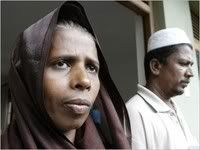
The court found Rizana Nafeek, 19, guilty of murdering a child in her care while working in the country. Her family (parents pictured above) has appealed the sentence, and human rights groups are calling for the Saudi government to overturn it.
At 17, Rizana Nafeek was sent to Saudi Arabia after the tsunami to work as a maid and make money for her family in Sri Lanka. But after only a few weeks and no child care training, her employers put her in charge of their 4-month-old baby. The baby died, and Nafeek was charged with murder, tried without an attorney and sentenced to death.
"This case raises many troubling questions about the treatment of children and foreigners in Saudi Arabia's criminal justice system," says Varia. "Foreigners simply do not receive the same treatment in the Saudi justice system. This includes having translation during the interrogation and during court proceedings and having an attorney."
About 1.5 million Sri Lankans work abroad, according to the country's labor statistics. Eighty percent of the women working abroad are employed as unskilled domestic workers, primarily in Saudi Arabia.
Varia says domestic workers are vulnerable to mistreatment. When Human Rights Watch sent a team of investigators to Saudi Arabia last year, Varia says the group found egregious abuse.
"The most commonly reported abuse is unpaid wages," she says. "It's routine for employers to take the passports of workers, and in order for the worker to leave the country, they have to get their employer to sign an exit visa."
Under Saudi Arabian law, employers have a heavy hand in how justice is served. After being charged and interrogated, Nafeek signed a guilty confession. If her former employers formally forgive her, she will be released, but they have so far refused to do so.
Nafeek's parents told local media outlets that their daughter was not trained in child care and that the baby "choked on milk." Human Rights Watch is calling for a new investigation into the case.
Varia says that because domestic workers in Saudi Arabia are not protected by labor laws, they don't have access to training, paid leave, reasonable hours or even one day off.
"They're not seen as real human beings," she says.
"It is socially accepted to lock your domestic worker inside the house. There are employers who forbid their workers to make phone calls home or write letters or talk to neighbors," says Varia, who interviewed domestic workers' employers in Saudi Arabia. "The reason they give is that, 'We paid a lot of money for this worker, and if I leave the door unlocked, she'll run away.'"
The problem is so severe that the embassies of Sri Lanka, Indonesia and the Philippines in Saudi Arabia can have as many as 150 women staying in embassy shelters because of abuse suffered at the hand of their employer, says Varia
The Saudi Arabia Embassy in the U.S. has not responded to calls and e-mails from ABCNews.com for this story, but Nafeek's case and other recent cases have drawn attention to the issue in Saudi Arabia. The Saudi government has made public statements condemning abuse of domestic workers. There also have been discussions to place domestic workers under separate labor laws.
Varia says discussions and rhetoric are not enough; the laws must change.
"There needs to be much greater efforts to punish abusive employers and to protect workers," she says. "What will really matter is if domestic workers get the same rights as all other workers in Saudi Arabia."
| [+/-] |
Studies: Suicide Bombers in Iraq Are Mostly Foreigners |
McClatchey reports:
Suicide bombers in Iraq are overwhelmingly foreigners bent on destabilizing the government and undermining American interests there, two independent studies have concluded.
The studies report that the number of suicide bombings in Iraq has now surpassed those conducted worldwide since the early 1980s. The findings suggest that extremists from throughout the region and around the world are fueling Iraq's violence.
"The war on terrorism — and certainly the war in Iraq — has failed in decreasing the number of suicide attacks and has really radicalized the Muslim world to create this concept of martyrs without borders," said Mohammed Hafez, a visiting professor at the University of Missouri in Kansas City and the author of one of the two studies.
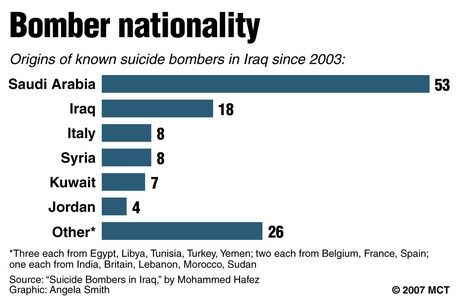
Hafez, whose new book is "Suicide Bombers in Iraq," has identified the nationalities of 124 bombers who attacked in Iraq. Of those, the largest number — 53 — were Saudis. Eight apiece came from Italy and Syria, seven from Kuwait, four from Jordan and two each from Belgium, France and Spain. Others came from North and East Africa, South Asia and various Middle Eastern and European countries. Only 18 — 15 percent — were Iraqis.
In the second study, Robert Pape, a University of Chicago professor who runs the Chicago Project on Suicide Terrorism, identified the nationalities of 55 suicide bombers in Iraq. Sixteen were Saudis, seven were Syrians and five were Algerians. Kuwait, Morocco and Tunisia each supplied three bombers. Thirteen — 24 percent — were Iraqi Sunni Muslims.
Hafez and Pape said Iraqi Shiite Muslims hadn't carried out suicide attacks so far and instead had restricted their role in the sectarian violence to militia activity.
Pinning down the nationalities of suicide bombers can be tricky because they leave few physical remains, and extremist groups often don't claim the attacks until much later. The U.S. military says it does some DNA testing to investigate the bombers' identities.
Both researchers relied on extremist Web sites, "martyr" videos, news reports and statements to compile the data on nationalities. Hafez also gathered some information from online chats and discussion forums.
U.S. intelligence estimates based on interviews with detainees and captured documents indicate that most suicide bombers in Iraq are non-Iraqi, said a senior defense official who can't be named because of departmental rules
Suicide attacks more than doubled each year from the U.S.-led invasion in 2003 to 2005, Pape said. In 2006, he said, they jumped just under a third. The American military has reported more than 1,400 since January 2004. Before the U.S.-led invasion, there had been no suicide bombings in Iraq.
Pape attributed the attacks to the presence of some 150,000 American troops in the region.
The notion that most of the suicide bombers are foreigners engaged in a global movement is exaggerated, he said, since about 75 percent come from the Arabian Peninsula, which is close to the U.S. forces in Iraq.
"The Arabian Peninsula isn't that big: It's somewhat bigger than Texas," Pape said. "The Americans have all the capability and are right there. That's what allows terrorist leaders to build a sense of urgency."
After losing safe havens in Afghanistan, Pakistan and Europe, militant organizations needed a new base for their operations, Hafez said. U.S. intelligence analysts, however, have concluded that al Qaida has built new training camps along the Afghan-Pakistani border, and that the group al Qaida in Iraq operates for the most part independently.
According to Hafez, extremist groups in Iraq conduct suicide bombings against fellow Muslims rather than U.S. troops to destabilize the fledgling government and spark sectarian warfare.
The groups' objectives in Iraq are different from "other places like in the Palestinian-Israeli conflict or in Lebanon," he said.
In Lebanon, Shiite suicide bombers helped drive U.S., British, French, Italian and Israeli troops out of the country with a series of attacks. Sunni Palestinian suicide bombers have attacked in Israel and the Palestinian territories in an effort to loosen Israel's grip on what they say are Arab lands.
There's widespread agreement that Saudis are represented more heavily than any other nationality among the bombers, said Assaf Moghadem, a research fellow at Harvard University who studies suicide bombers' motivations. Insurgent groups sometimes recruit Saudis because of their relative prosperity, he said.
The ultra-conservative brand of Sunni Islam that's prevalent in Saudi Arabia also accounts for the large number of Saudis who participate in suicide bombings and the insurgency in Iraq, said Mike Davis, a University of California at Irvine professor who wrote a recent history of car bombs.
"The religious current in modern Islam that encourages this kind of sectarian attitude toward the Shiites is the religious orthodoxy enshrined in Saudi Arabia," Davis said.
Most experts say that while the American presence in Iraq has radicalized Muslims, withdrawing the troops may not stem the number of suicide attacks, at least not right away.
Extremist groups in Iraq have a common goal of expelling foreign occupiers and destabilizing what they see as a U.S.-controlled government, Pape said. But if the U.S. withdraws, insurgent organizations probably will engage in a bloody power struggle, he added.
"If we stay, that tends to encourage people to flock to Iraq," Hafez said. "Leaving will mean genocidal violence for the Iraqi people. It will mean a failed Iraqi state. The jihadists will declare, `We drove out America.' "
Sunday, July 29, 2007
| [+/-] |
House Members Say They Will Try To Block Arms Sales To Saudis |
The Washington Post:
The Bush administration's plan to sell $20 billion in advanced weaponry to Saudi Arabia and five other Persian Gulf countries is running into congressional opposition and criticism from human rights and arms control groups.
Members of Congress vowed yesterday to oppose any deal to Saudi Arabia on grounds that the kingdom has been unhelpful in Iraq and unreliable at fighting terrorism. King Abdullah has called the U.S. military presence in Iraq an "illegitimate occupation," and the Saudis have been either unable or unwilling to stop suicide bombers who have ended up in Iraq, congressional sources say.
Human rights groups warned that new U.S. arms meant to contain Iran's rising influence could backfire, allowing President Mahmoud Ahmadinejad to rally greater support for his hard-line faction in the run-up to parliamentary elections next spring.
And arms control groups said Bush's strategy would accelerate an already-dangerous trend that could increase tensions rather than generate a greater sense of security.
The administration plans to sell advanced satellite-guided bombs, fighter aircraft upgrades and new naval vessels to six Gulf Cooperation Council countries, including Kuwait, the United Arab Emirates, Qatar, Bahrain and Oman, U.S. officials say.
U.S. officials acknowledged that congressional reaction has been mixed but cautioned that details of a broader arms package -- including $30 billion in military aid to Israel and $13 billion to Egypt over the next 10 years -- have yet to be released. "As we move forward, we will work very closely with Congress, as well as our friends and allies in the region," State Department spokesman Sean McCormack said.
But Tom Lantos (D-Calif.), chairman of the House Foreign Affairs Committee, who was briefed on the deal Tuesday, said he had several reservations. "This is not a sale at Macy's that you go in and buy a bunch of stuff. There are a complex set of relationships behind it, and while it's very desirable to have the Saudis and others recognize that Iran is an existential threat, there is also a degree of responsibility that they have to show on broader U.S. foreign policy interests," he said in an interview.
In the context of the arms deals, Lantos said the oil-rich countries should use windfall profits from high oil prices to cover the expenses of Iraqi refugees who have flooded Jordan. Saudi Arabia should not try to re-broker reconciliation between Palestinian moderates and militants, he added, and Qatar should look at the television network al-Jazeera's role in the region.
Reps. Anthony Weiner (D-N.Y.) and Robert Wexler (D-Fla.) said yesterday that they will introduce a joint resolution of disapproval to block the deals when Congress is formally notified. They have seven Democratic co-sponsors.
In an interview, Weiner said any arms proposal would find broad bipartisan opposition on the Hill. "The reputation of the Saudis has taken quite a beating since 9/11, and despite the fact that the administration has done everything to portray them as part of the moderate Arab world, members of Congress of both parties are increasingly skeptical."
Under the Arms Export Control Act of 1976, Congress must approve major arms sales. In 1986, the threat of a joint resolution of disapproval played a role in persuading the Reagan administration to cut back an arms package to Saudi Arabia.
Eliot L. Engel (D-N.Y.), a senior member of the House Foreign Relations committee who was also briefed last week, said a pivotal issue will be whether Israel maintains the "qualitative military edge" in the region.
Arms experts called for a serious debate on the quality and quantity of weapons going to the Gulf states. "This administration does not have an arms sales policy, except to sell, sell, sell," said Daryl G. Kimball of the Arms Control Association. "That approach in the Middle East can be like throwing gasoline on a brush fire."
Human Rights Watch said the arms deals would undermine long-term U.S. goals in the Middle East. "This will reduce pressure on Egypt and the Arab states to reform their politics. It's another case of trying to purchase stability at the expense of liberty," said Washington director Tom Malinowski.
Saturday, July 28, 2007
| [+/-] |
U.S. Plans New Arms Sales to Gulf Allies |
$20 Billion Deal Includes Weapons For Saudi Arabia
The Washington Post reports:
The Bush administration will announce next week a series of arms deals worth at least $20 billion to Saudi Arabia and five other oil-rich Persian Gulf states as well as new 10-year military aid packages to Israel and Egypt, a move to shore up allies in the Middle East and counter Iran's rising influence, U.S. officials said yesterday.
The arms deals, which include the sales of a variety of sophisticated weaponry, would be the largest negotiated by this administration. The military assistance agreements would provide $30 billion in new U.S. aid to Israel and $13 billion to Egypt over 10 years, the officials said. Both figures represent significant increases in military support.
U.S. officials said the arms sales to Saudi Arabia are expected to include air-to-air missiles as well as Joint Direct Attack Munitions, which turn standard bombs into "smart" precision-guided bombs. Most, but not all, of the arms sales to the six Gulf Cooperation Council countries -- Saudi Arabia, the United Arab Emirates, Kuwait, Qatar, Bahrain and Oman -- will be defensive, the officials said.
U.S. officials said the common goal of the military aid packages and arms sales is to strengthen pro-Western countries against Iran at a time when the hard-line regime seeks to extend its power in the region.
"This is a big development, because it's part of a larger regional strategy and the maintenance of a strong U.S. presence in the region. We're paying attention to the needs of our allies and what everyone in the region believes is a flexing of muscles by a more aggressive Iran. One way to deal with that is to make our allies and friends strong," said a senior administration official involved in the negotiations.
The arms deals have quietly been under discussion for months despite U.S. disappointment over Saudi Arabia's failure to support the Iraqi government and to bring that country's Sunni Muslims into the reconciliation process.
The administration's plans will be announced Monday in advance of trips next week to the Middle East by Secretary of State Condoleezza Rice and Defense Secretary Robert M. Gates, and are expected to be on their agenda in Egypt and Saudi Arabia. The administration has a notional list of arms to sell to the Gulf states, but there are no final agreements on quantities and specific models, U.S. officials said.
State Department and Pentagon officials started briefing key members of Congress about their intentions over the past week, U.S. officials said. The initial reception has been positive, said officials involved in those briefings. They acknowledged, however, that some parts of the deal are supported more than others. Arms sales to Gulf countries have often been controversial.
The administration hopes to provide a full rundown this fall for congressional approval.
"We want to convince Congress to continue our tradition of military sales to all six" states, the senior administration official said. "We've been helping Gulf Arabs for years, and that needs to continue."
Sunni regimes in the Gulf region have felt particularly vulnerable since the election of a pro-Iranian Shiite government in neighboring Iraq last year. "There's a sense here and in the region of the need to build up defenses against Iranian encroachment," said a U.S. official familiar with the deals.
The aid packages to Israel and Egypt are further along. A U.S.-Israel agreement, to replace a 10-year arrangement that expires this year, has been under discussion since February, U.S. officials said. The new U.S. package will include strictly military aid and would expand the U.S. contribution 25 percent over the current $2.4 billion per year; economic assistance has been discontinued now that Israel is considered a developed economy, U.S. officials said.
President Bush said last month, after meeting with Israeli Prime Minister Ehud Olmert, that he was strongly committed to a new 10-year agreement that would increase U.S. assistance "to meet the new threats and challenges [Israel] faces." Washington has long promised to help Israel sustain a so-called "qualitative military edge" over other major powers in the region.
Rice is expected to announce Monday that, after her Middle East trip, Undersecretary of State R. Nicholas Burns will finalize the agreements with Israel and Egypt.
| [+/-] |
U.S. Plans Arms Sales to Saudi Arabia |
The Washington Post reports:
The Bush administration will announce next week a series of arms deals worth at least $20 billion to Saudi Arabia and five other oil-rich Persian Gulf states as well as new 10-year military aid packages to Israel and Egypt, a move to shore up allies in the Middle East and counter Iran's rising influence, U.S. officials said yesterday.
The arms deals, which include the sales of a variety of sophisticated weaponry, would be the largest negotiated by this administration. The military assistance agreements would provide $30 billion in new U.S. aid to Israel and $13 billion to Egypt over 10 years, the officials said. Both figures represent significant increases in military support.
U.S. officials said the arms sales to Saudi Arabia are expected to include air-to-air missiles as well as Joint Direct Attack Munitions, which turn standard bombs into "smart" precision-guided bombs. Most, but not all, of the arms sales to the six Gulf Cooperation Council countries -- Saudi Arabia, the United Arab Emirates, Kuwait, Qatar, Bahrain and Oman -- will be defensive, the officials said.
U.S. officials said the common goal of the military aid packages and arms sales is to strengthen pro-Western countries against Iran at a time when the hard-line regime seeks to extend its power in the region.
"This is a big development, because it's part of a larger regional strategy and the maintenance of a strong U.S. presence in the region. We're paying attention to the needs of our allies and what everyone in the region believes is a flexing of muscles by a more aggressive Iran. One way to deal with that is to make our allies and friends strong," said a senior administration official involved in the negotiations.
The arms deals have quietly been under discussion for months despite U.S. disappointment over Saudi Arabia's failure to support the Iraqi government and to bring that country's Sunni Muslims into the reconciliation process.
The administration's plans will be announced Monday in advance of trips next week to the Middle East by Secretary of State Condoleezza Rice and Defense Secretary Robert M. Gates, and are expected to be on their agenda in Egypt and Saudi Arabia. The administration has a notional list of arms to sell to the Gulf states, but there are no final agreements on quantities and specific models, U.S. officials said.
State Department and Pentagon officials started briefing key members of Congress about their intentions over the past week, U.S. officials said. The initial reception has been positive, said officials involved in those briefings. They acknowledged, however, that some parts of the deal are supported more than others. Arms sales to Gulf countries have often been controversial.
The administration hopes to provide a full rundown this fall for congressional approval.
"We want to convince Congress to continue our tradition of military sales to all six" states, the senior administration official said. "We've been helping Gulf Arabs for years, and that needs to continue."
Sunni regimes in the Gulf region have felt particularly vulnerable since the election of a pro-Iranian Shiite government in neighboring Iraq last year. "There's a sense here and in the region of the need to build up defenses against Iranian encroachment," said a U.S. official familiar with the deals.
The aid packages to Israel and Egypt are further along. A U.S.-Israel agreement, to replace a 10-year arrangement that expires this year, has been under discussion since February, U.S. officials said. The new U.S. package will include strictly military aid and would expand the U.S. contribution 25 percent over the current $2.4 billion per year; economic assistance has been discontinued now that Israel is considered a developed economy, U.S. officials said.
President Bush said last month, after meeting with Israeli Prime Minister Ehud Olmert, that he was strongly committed to a new 10-year agreement that would increase U.S. assistance "to meet the new threats and challenges [Israel] faces." Washington has long promised to help Israel sustain a so-called "qualitative military edge" over other major powers in the region.
Rice is expected to announce Monday that, after her Middle East trip, Undersecretary of State R. Nicholas Burns will finalize the agreements with Israel and Egypt.
Friday, July 27, 2007
| [+/-] |
Saudis' Role in Iraq Frustrates U.S. Officials |
The NYTimes reports:
During a high-level meeting in Riyadh in January, Saudi officials confronted a top American envoy with documents that seemed to suggest that Iraq’s prime minister could not be trusted.
One purported to be an early alert from the prime minister, Nuri Kamal al-Maliki, to the radical Shiite cleric Moktada al-Sadr warning him to lie low during the coming American troop increase, which was aimed in part at Mr. Sadr’s militia. Another document purported to offer proof that Mr. Maliki was an agent of Iran.
The American envoy, Zalmay Khalilzad, immediately protested to King Abdullah of Saudi Arabia, contending that the documents were forged. But, said administration officials who provided an account of the exchange, the Saudis remained skeptical, adding to the deep rift between America’s most powerful Sunni Arab ally, Saudi Arabia, and its Shiite-run neighbor, Iraq.
Now, Bush administration officials are voicing increasing anger at what they say has been Saudi Arabia’s counterproductive role in the Iraq war. They say that beyond regarding Mr. Maliki as an Iranian agent, the Saudis have offered financial support to Sunni groups in Iraq. Of an estimated 60 to 80 foreign fighters who enter Iraq each month, American military and intelligence officials say that nearly half are coming from Saudi Arabia and that the Saudis have not done enough to stem the flow.
One senior administration official says he has seen evidence that Saudi Arabia is providing financial support to opponents of Mr. Maliki. He declined to say whether that support was going to Sunni insurgents because, he said, “That would get into disagreements over who is an insurgent and who is not.”
Senior Bush administration officials said the American concerns would be raised next week when Secretary of State Condoleezza Rice and Defense Secretary Robert M. Gates make a rare joint visit to Jidda, Saudi Arabia.
Officials in Washington have long resisted blaming Saudi Arabia for the chaos and sectarian strife in Iraq, choosing instead to pin blame on Iran and Syria. Even now, military officials rarely talk publicly about the role of Saudi fighters among the insurgents in Iraq.
The accounts of American concerns came from interviews with several senior administration officials, who spoke on the condition of anonymity because they believed that openly criticizing Saudi Arabia would further alienate the Saudi royal family at a time when the United States is still trying to enlist Saudi support for Mr. Maliki and the Iraqi government, and for other American foreign policy goals in the Middle East, including an Arab-Israeli peace plan.
In agreeing to interviews in advance of the joint trip to Saudi Arabia, the officials were nevertheless clearly intent on sending a pointed signal to a top American ally. They expressed deep frustration that more private American appeals to the Saudis had failed to produce a change in course.
The American officials said they had no doubt that the documents shown to Mr. Khalilzad were forgeries, though the Saudis said they had obtained them from sources in Iraq. “Maliki wouldn’t be stupid enough to put that on a piece of paper,” one senior Bush administration official said. He said Mr. Maliki later assured American officials that the documents were forgeries.
The Bush administration’s frustration with the Saudi government has increased in recent months because it appears that Saudi Arabia has stepped up efforts to undermine the Maliki government and to pursue a different course in Iraq from what the administration has charted. Saudi Arabia has also stymied a number of other American foreign policy initiatives, including a hoped-for Saudi embrace of Israel.
Of course, the Saudi government has hardly masked its intention to prop up Sunni groups in Iraq and has for the past two years explicitly told senior Bush administration officials of the need to counterbalance the influence Iran has there. Last fall, King Abdullah warned Vice President Dick Cheney that Saudi Arabia might provide financial backing to Iraqi Sunnis in any war against Iraq’s Shiites if the United States pulled its troops out of Iraq, American and Arab diplomats said.
Several officials interviewed for this article said they believed that Saudi Arabia’s direct support to Sunni tribesmen increased this year as the Saudis lost faith in the Maliki government and felt they must bolster Sunni groups in the eventuality of a widespread civil war.
Saudi Arabia months ago made a pitch to enlist other Persian Gulf countries to take a direct role in supporting Sunni tribal groups in Iraq, said one former American ambassador with close ties to officials in the Middle East. The former ambassador, Edward W. Gnehm, who has served in Kuwait and Jordan, said that during a recent trip to the region he was told that Saudi Arabia had pressed other members of the Gulf Cooperation Council — which includes Qatar, the United Arab Emirates, Kuwait, Bahrain and Oman — to give financial support to Sunnis in Iraq. The Saudis made this effort last December, Mr. Gnehm said.
The closest the administration has come to public criticism was an Op-Ed page article about Iraq in The New York Times last week by Mr. Khalilzad, now the United States ambassador to the United Nations. “Several of Iraq’s neighbors — not only Syria and Iran but also some friends of the United States — are pursuing destabilizing policies,” Mr. Khalilzad wrote. Administration officials said Mr. Khalilzad was referring specifically to Saudi Arabia and the United Arab Emirates.
Ms. Rice and Mr. Gates, as well as Mr. Cheney and Stephen J. Hadley, the national security adviser, have in recent months pressed their Arab counterparts to do more to encourage Iraq’s Sunni leaders to support Mr. Maliki, senior administration officials said.
“This message certainly has been made very clear in Riyadh and Abu Dhabi,” a senior administration official said. “But there is a deep reserve directed both at the person of the Maliki government but more broadly at the concept” that Iraq’s Shiites are “surrogates of Iran.” Saudi Arabia has grown increasingly concerned about the rising influence of Iran in the region.
A spokesman at the Saudi Embassy in Washington did not return telephone calls on Thursday. But one adviser to the royal family said that Saudi officials were aware of the American accusations. “As you know by now, we in Saudi Arabia have been active in having a united Arab front to, first, avoid further inter-Arab conflict, and at the same time building consensus to move toward a peace settlement between the Arabs and Israel,” he said. “How others judge our motives is their problem.”
Even as American frustration at Saudi Arabia grows, American military officials are still cautious about publicly detailing the extent of the flow of foreign fighters going to Iraq from Saudi Arabia. Earlier this month, for instance, Brig. Gen. Kevin Bergner, the top American military spokesman in Iraq, detailed the odyssey of a foreign fighter recently captured in Ramadi.
In his public account, General Bergner told reporters that the man had arrived in Syria on a chartered bus, was smuggled into Iraq by a Syrian facilitator, and was given instructions to carry out a suicide truck bombing on a bridge in Ramadi. He did not identify the man’s nationality, but American officials in Iraq say he was a Saudi.
The American officials in Iraq also say that the majority of suicide bombers in Iraq are from Saudi Arabia and that about 40 percent of all foreign fighters are Saudi. Officials said that while most of the foreign fighters came to Iraq to become suicide bombers, others arrived as bomb makers, snipers, logisticians and financiers.
American military and intelligence officials have been critical of Saudi efforts to stanch the flow of fighters into Iraq, although they stress that the Saudi government does not endorse the idea of fighters from Saudi Arabia going to Iraq.
On the contrary, they said, Saudi Arabia is concerned that these young men could acquire insurgency training in Iraq and then return home to carry out attacks in Saudi Arabia — similar to the Saudis who turned against their homeland after fighting in Afghanistan in the 1980s.
The Bush administration’s relationship with Saudi Arabia has deteriorated steadily since the United States invasion of Iraq, culminating in April when, bitingly, King Abdullah, during a speech before Arab heads of state in Riyadh, condemned the American invasion of Iraq as “an illegal foreign occupation.”
A month before that, King Abdullah effectively torpedoed a high-profile meeting between Israelis and Palestinians, planned by Ms. Rice, by brokering a power-sharing agreement between the Palestinian president, Mahmoud Abbas, and the militant Islamist group Hamas that did not require Hamas to recognize Israel. While that agreement eventually fell apart, the Bush administration, on both occasions, was caught off guard and became infuriated.
But Saudi officials have not been too happy with President Bush, either, and the plummeting of America’s image in the Muslim world has led King Abdullah to strive to set a more independent course.
The administration “thinks the Saudis are no longer behaving the role of the good vassal,” said Steve Clemons, senior fellow and director of the American Strategy Program at the New America Foundation. The Saudis, in turn, “see weakness, they see a void, and they’re going to fill the void and call their own shots.”
Sunday, July 15, 2007
| [+/-] |
Saudis' Role In Iraq Insurgency Outlined |
Sunni extremists from Saudi Arabia make up half the foreign fighters in Iraq, many suicide bombers, a U.S. official says.
The LATimes reports:
Although Bush administration officials have frequently lashed out at Syria and Iran, accusing it of helping insurgents and militias here, the largest number of foreign fighters and suicide bombers in Iraq come from a third neighbor, Saudi Arabia, according to a senior U.S. military officer and Iraqi lawmakers.
About 45% of all foreign militants targeting U.S. troops and Iraqi civilians and security forces are from Saudi Arabia; 15% are from Syria and Lebanon; and 10% are from North Africa, according to official U.S. military figures made available to The Times by the senior officer. Nearly half of the 135 foreigners in U.S. detention facilities in Iraq are Saudis, he said.
Fighters from Saudi Arabia are thought to have carried out more suicide bombings than those of any other nationality, said the senior U.S. officer, who spoke on condition of anonymity because of the subject's sensitivity. It is apparently the first time a U.S. official has given such a breakdown on the role played by Saudi nationals in Iraq's Sunni Arab insurgency.
He said 50% of all Saudi fighters in Iraq come here as suicide bombers. In the last six months, such bombings have killed or injured 4,000 Iraqis.
The situation has left the U.S. military in the awkward position of battling an enemy whose top source of foreign fighters is a key ally that at best has not been able to prevent its citizens from undertaking bloody attacks in Iraq, and at worst shares complicity in sending extremists to commit attacks against U.S. forces, Iraqi civilians and the Shiite-led government in Baghdad.
The problem casts a spotlight on the tangled web of alliances and enmities that underlie the political relations between Muslim nations and the U.S.
Complicated past
In the 1980s, the Saudi intelligence service sponsored Sunni Muslim fighters for the U.S.-backed Afghan mujahedin battling Soviet troops in Afghanistan. At the time, Saudi intelligence cultivated another man helping the Afghan fighters, Osama bin Laden, the future leader of Al Qaeda who would one day turn against the Saudi royal family and mastermind the Sept. 11 attacks on New York and the Pentagon. Indeed, Saudi Arabia has long been a source of a good portion of the money and manpower for Al Qaeda: 15 of the 19 hijackers in the Sept. 11 attacks were Saudi.
Now, a group that calls itself Al Qaeda in Iraq is the greatest short-term threat to Iraq's security, U.S. military spokesman Brig. Gen. Kevin Bergner said Wednesday.
The group, one of several Sunni Muslim insurgent groups operating in Baghdad and beyond, relies on foreigners to carry out suicide attacks because Iraqis are less likely to undertake such strikes, which the movement hopes will provoke sectarian violence, Bergner said. Despite its name, the extent of the group's links to Bin Laden's network, based along the Afghan-Pakistani frontier, is unclear.
The Saudi government does not dispute that some of its youths are ending up as suicide bombers in Iraq, but says it has done everything it can to stop the bloodshed.
"Saudis are actually being misused. Someone is helping them come to Iraq. Someone is helping them inside Iraq. Someone is recruiting them to be suicide bombers. We have no idea who these people are. We aren't getting any formal information from the Iraqi government," said Gen. Mansour Turki, spokesman for the Saudi Interior Ministry.
"If we get good feedback from the Iraqi government about Saudis being arrested in Iraq, probably we can help," he said.
Defenders of Saudi Arabia pointed out that it has sought to control its lengthy border with Iraq and has fought a bruising domestic war against Al Qaeda since Sept. 11.
"To suggest they've done nothing to stem the flow of people into Iraq is wrong," said a U.S. intelligence official in Washington, who spoke on condition of anonymity. "People do get across that border. You can always ask, 'Could more be done?' But what are they supposed to do, post a guard every 15 or 20 paces?"
Deep suspicions
Others contend that Saudi Arabia is allowing fighters sympathetic to Al Qaeda to go to Iraq so they won't create havoc at home.
Iraqi Shiite lawmaker Sami Askari, an advisor to Prime Minister Nouri Maliki, accused Saudi officials of a deliberate policy to sow chaos in Baghdad.
"The fact of the matter is that Saudi Arabia has strong intelligence resources, and it would be hard to think that they are not aware of what is going on," he said.
Askari also alleged that imams at Saudi mosques call for jihad, or holy war, against Iraq's Shiites and that the government had funded groups causing unrest in Iraq's largely Shiite south. Sunni extremists regard Shiites as unbelievers.
Other Iraqi officials said that though they believed Saudi Arabia, a Sunni fundamentalist regime, had no interest in helping Shiite-ruled Iraq, it was not helping militants either. But some Iraqi Shiite leaders say the Saudi royal family sees the Baghdad government as a proxy for its regional rival, Shiite-ruled Iran, and wants to unseat it.
With its own border with Iraq largely closed, Saudi fighters take what is now an established route by bus or plane to Syria, where they meet handlers who help them cross into Iraq's western deserts, the senior U.S. military officer said.
He suggested it was here that Saudi Arabia could do more, by implementing rigorous travel screenings for young Saudi males. Iraqi officials agreed.
"Are the Saudis using all means possible? Of course not…. And we think they need to do more, as does Syria, as does Iran, as does Jordan," the senior officer said. An estimated 60 to 80 foreign fighters cross into Iraq each month, according to the U.S. military.
"It needs to be addressed by the government of Iraq head on. They have every right to stand up to a country like Saudi Arabia and say, 'Hey, you are killing thousands of people by allowing your young jihadists to come here and associate themselves with an illegal worldwide network called Al Qaeda."
Both the White House and State Department declined to comment for this article.
Turki, the Saudi spokesman, defended the right of his citizens to travel without restriction.
"If you leave Saudi Arabia and go to other places and find somebody who drags them to Iraq, that is a problem we can't do anything about," Turki said. He added that security officials could stop people from leaving the kingdom only if they had information on them.
U.S. officials had not shared with Iraqi officials information gleaned from Saudi detainees, but this has started to change, said an Iraqi source, who asked not to be identified. For example, U.S. officials provided information about Saudi fighters and suicide bombers to Iraqi security officials who traveled to Saudi Arabia last week.
Iraqi advisor Askari asserted that Vice President Dick Cheney, in a visit to Saudi Arabia in May, pressured officials to crack down on militant traffic to Iraq. But that message has not yet produced results, Askari said.
The close relationship between the U.S. and oil-rich Saudi Arabia has become increasingly difficult.
Saudi leaders in early February undercut U.S. diplomacy in the Israeli-Palestinian dispute by brokering, in Mecca, an agreement to form a Fatah-Hamas "unity" government in the West Bank and Gaza Strip. And King Abdullah took Americans by surprise by declaring at an Arab League gathering that the U.S. presence in Iraq was illegitimate.
U.S. officials remain sensitive about the relationship. Asked why U.S. officials in Iraq had not publicly criticized Saudi Arabia the way they had Iran or Syria, the senior military officer said, "Ask the State Department. This is a political juggernaut."
Last week when U.S. military spokesman Bergner declared Al Qaeda in Iraq the country's No. 1 threat, he released a profile of a thwarted suicide bomber, but said he had not received clearance to reveal his nationality. The bomber was a Saudi national, the senior military officer said Saturday.
Would-be suicide bomber
The fighter, a young college graduate whose mother was a teacher and father a professor, had been recruited in a mosque to join Al Qaeda in Iraq. He was given money for a bus ticket and a phone number to call in Syria to contact a handler who would smuggle him into Iraq.
Once the young Saudi made it in, he was under the care of Iraqis who gave him his final training and indoctrination. At the very last minute, the bomber decided he didn't want to blow himself up. He was supposed to have been one of two truck bombers on a bridge outside Ramadi. When the first truck exploded, he panicked and chose not to trigger his own detonator, and Iraqi police arrested him.
Al Qaeda in Iraq and its affiliate groups number anywhere from 5,000 to 10,000 individuals, the senior U.S. military officer said. Iraqis make up the majority of members, facilitating attacks, indoctrinating, fighting, but generally not blowing themselves up. Iraqis account for roughly 10% of suicide bombers, according to the U.S. military.
Sunday, June 24, 2007
| [+/-] |
House Votes To Deny Aid to Saudi Arabia |
U.S. House votes to deny all aid to Saudi Arabia:
The US House of Representatives has voted to deny all aid to Saudi Arabia, despite repeated assurances by the administration the desert kingdom was cooperating with the United States in the war on terror.
The ban is contained in a little-publicized amendment quietly slipped by a bipartisan group of lawmakers into a 34.2-billion-dollar bill financing US foreign operations in fiscal 2008.
The massive bill, featuring a wide range of humanitarian programs, was approved by lawmakers in the middle of the night on Friday.
Similar measures on aid to Saudi Arabia have been passed by the House before. But the current one goes a step further by closing a legislative loophole that in the past had allowed the administration of President George W. Bush to waive these bans by invoking requirements of the war on terror.
The amendment, championed by New York Democrat Anthony Weiner, a strong supporter of Israel, states that "none of the funds appropriated or otherwise made available" by the foreign operations bill "shall be obligated or expended to finance any assistance to Saudi Arabia" or "used to execute a waiver."
While oil-rich Saudi Arabia has never been a large recipient of US aid, the Bush administration channeled a total of more than 2.5 million dollars to the kingdom in fiscal 2005 and 2006 as part of their partnership in the war on terror, congressional officials said.
Neither Saudi diplomats nor administration officials have publicly commented on the vote.
However, the sponsors of the amendment made it clear they were particularly upset by what they described as Saudi Arabia's support for the militant Palestinian group Hamas, which refuses to recognize Israel and has just taken control of the Gaza Strip.
In a fact sheet released to the media, the lawmakers pointed out that Hamas was receiving more than 50 percent of its financing from Saudi Arabia, and last May alone, the Saudi government planned to send 300 million dollars to the Islamist group.
Representative Weiner charged that Riyadh was in fact actively working against US interests.
"By cutting off aid and closing the loophole we send a clear message to the Saudi Arabian government that they must be a true ally in advancing peace in the Middle East," the congressman said.
The sponsors of the measure also accused the Saudi government of undermining US military efforts in Iraq by making "no official move" to stop about 3,000 Saudi nationals actively fighting US troops in the violence-torn country.
They said Sheik Saleh al-Liuhaidan, head of the Saudi Arabian judiciary, had approved the transfer of money and men to Abu Musab Al-Zarqawi, the now slain head of Al-Qaeda in Iraq.
As many as 61 percent of all suicide bombers in Iraq are of Saudi Arabian descent, the fact sheet claimed.
The lawmakers also argued that Saudi clerics continued to preach hate towards the United States, Israel and their allies, while the government cracked down against those calling for democratic reforms.
"By continuing to promote and finance acts of terrorism, including those targeting innocent families, the Saudis are actively undermining our efforts to promote democracy and bring stability to the Middle East," said Congresswoman Shelley Berkley, a Nevada Democrat and another sponsor of the ban.
She insisted that the United States should not be rewarding Saudi Arabia for what she called "their record of broken promises and disturbing terrorist ties."
Saudi Arabia is a leading source of imported oil for the United States, often providing about 20 percent of total US crude imports, according to State Department statistics. It is also the largest US export market in the Middle East.
The State Department describes Saudi Arabia as "an important partner in the campaign against terrorism, providing assistance in the military, diplomatic, and financial arenas."
Friday, June 8, 2007
| [+/-] |
Bandar Bush Named in British Scandal |
An aerospace company reportedly placed up to $2 billion into accounts held by a key ally of the Bush administration.
The LATimes reports:
Prince Bandar bin Sultan, the powerful former Saudi ambassador to the U.S. who has been one of the Bush administration's strongest allies in the Middle East, was publicly linked to a widening British corruption scandal Thursday with reports that a British aerospace company secretly transferred up to $2 billion into bank accounts at the Saudi Embassy in Washington.
The new allegations point a finger directly at Bandar, the son of the Saudi crown prince and a man who has been a key ally for President Bush and his father, as well as a frequent contact of Vice President Dick Cheney. For years, the prince has been considered the most important go-between in the close and often secretive relationship between the U.S. and the royal family.
According to reports by the BBC and London's Guardian newspaper, documents show that BAE Systems made cash transfers to Bandar every three months for 10 years or more, drawn from a confidential account to which British government departments had access.
The alleged payments grew out of a 20-year, $86-billion oil-for-arms deal under which Britain supplied Saudi Arabia with 120 Tornado warplanes, Hawk training jets and other military equipment. The deal, known as Yamamah ("dove" in Arabic), was Britain's largest export contract.
A former BAE official has said the company made legal payments to "agents" beginning in the 1980s. But the news reports said that money was funneled to Bandar, with some of the cash going to fund the prince's private Airbus. The money reportedly was described as fees for marketing services.
"Hundreds of thousands and millions of dollars were involved," U.S. bank investigator David Caruso told the BBC. He confirmed his account in a brief interview with the Los Angeles Times. "There wasn't a distinction between the accounts of the embassy, or official government accounts as we would call them, and the accounts of the royal family," he said.
The reports suggested for the first time that Britain's Ministry of Defense had authorized the secret payments, and they also left open the possibility that payments occurred after 2001, when Britain made it illegal to bribe foreign officials.
The Yamamah contract already was the center of a government investigation. But in December, that three-year probe was halted in the interests of Britain's "national and international security" with the approval of Prime Minister Tony Blair. The new allegations reignited controversy over that decision.
The Serious Fraud Office's decision to close its probe led to charges that Britain was attempting to shore up its negotiations to sell a $20-billion new fleet of Eurofighter Typhoon jets to the desert kingdom.
But British officials said their real fear was losing Saudi Arabia's cooperation in the war on terrorism. Atty. Gen. Peter Goldsmith told Parliament the heads of Britain's security and intelligence agencies, as well as the nation's ambassador in Riyadh, the Saudi capital, had warned that the investigation could seriously damage relations.
Blair, whose final weeks as prime minister threaten to be shadowed by talk of slush funds and coverups, again defended the decision to call off the probe.
"This investigation, if it had gone ahead, would have involved the most serious allegations and investigations being made into the Saudi royal family," Blair told reporters Thursday in Germany, where he was attending the Group of 8 summit.
"My job is to give advice as to whether that is a sensible thing in circumstances where I don't believe the investigations would have led anywhere except to the complete wreckage of a vital, strategic relationship for our country in terms of fighting terrorism," he said.
But in London there were calls for reopening the inquiry.
"What's new about these revelations are several things. First of all, it's the sheer scale of the payments: It may well be a billion pounds being paid to this one prince," Vincent Cable, a Liberal Democratic member of Parliament who earlier had identified Bandar as a possible target of the probe, said in an interview.
"Secondly, this is the first time [Bandar] has been fingered in quite such a direct and clear way," he said. "The other key point, what's really new about all this and very alarming, is that it does appear that the British government was first of all aware of these payments, and very complicit in them, and moreover, they were made until very recently."
The Ministry of Defense said it could not comment on the reports "as to do so would involve confidential information about al-Yamamah, and that would cause the damage that ending the investigation was designed to prevent."
BAE spokeswoman Lisa Hillary-Tee said in a statement that the company had already handed all information on the contract in its possession to the Serious Fraud Office. "After an exhaustive investigation, it was concluded, over and above the interests of national security, that there was and is no case to answer," she said.
"The al-Yamamah program is a government-to-government agreement, and all such payments made under those agreements were made with the express approval of both the Saudi and the UK governments," she said. "We deny all allegations of wrongdoing," she added.
Payments to foreign officials to win contracts are also illegal under U.S. law. But such payments have long been a feature of contracts in the Middle East, and have been considered an important source of revenue for the Saudi royal family.
"It's widely assumed that members of the royal family get a share in business deals whether they do anything for that share or not," said Jon Alterman, Middle East program director at the Center for Strategic and International Studies in Washington.
"It's part of the way the system works, and in return the princes are often extraordinarily generous with charities and other institutions," he added.
He said Britain's concern over jeopardizing cooperation on security issues reflects the "deep and intimate contact between the Saudi government and Western governments on counter-terrorism" that is considered vital.
"It's not only counter-terrorism inside the kingdom of Saudi Arabia. Muslims pass through Saudi Arabia to go on pilgrimage, so the Saudis have some of the best information about Muslims throughout the world. Their involvement in religious networks means they have both information and influence that reaches throughout the world."
"But to get things done, you need the cooperation of Saudi princes. And it's hard to get the cooperation of individuals who you are simultaneously investigating and accusing of crimes."
Tuesday, May 22, 2007
| [+/-] |
Seymour Hersh: "Bush Administration Arranged Support For Militants Attacking Lebanon |
Raw Story reports:
In an interview on CNN International's Your World Today, veteran journalist Seymour Hersh explains that the current violence in Lebanon is the result of an attempt by the Lebanese government to crack down on a militant Sunni group, Fatah al-Islam, that it formerly supported.
Last March, Hersh reported that American policy in the Middle East had shifted to opposing Iran, Syria, and their Shia allies at any cost, even if it meant backing hardline Sunni jihadists.A key element of this policy shift was an agreement among Vice President Dick Cheney, Deputy National Security Advisor Elliot Abrams, and Prince Bandar bin Sultan, the Saudi national security adviser, whereby the Saudis would covertly fund the Sunni Fatah al-Islam in Lebanon as a counterweight to the Shia Hezbollah.
Hersh points out that the current situation is much like that during the conflict in Afghanistan in the 1980's – which gave rise to al Qaeda – with the same people involved in both the US and Saudi Arabia and the "same pattern" of the US using jihadists that the Saudis assure us they can control.
When asked why the administration would be acting in a way that appears to run counter to US interests, Hersh says that, since the Israelis lost to them last summer, "the fear of Hezbollah in Washington, particularly in the White House, is acute."
As a result, Hersh implies, the Bush administration is no longer acting rationally in its policy. "We're in the business of supporting the Sunnis anywhere we can against the Shia. ... "We're in the business of creating ... sectarian violence." And he describes the scheme of funding Fatah al-Islam as "a covert program we joined in with the Saudis as part of a bigger, broader program of doing everything we could to stop the spread of the Shia world, and it just simply -- it bit us in the rear."
Transcript:HALA GORANI: Well, investigative journalist Seymour Hersh reported back in March that in order to defeate Hezbollah, the Lebanese government supported a Sunni militant group, the same ones they're fighting today. Seymour joins us live from Washington. Thanks for being with us. What is the source of the financing according to your reporting on these groups, such as Fatah al-Islam in these camps of Nahr el Bared, for instance? Where are they getting the money and where are they getting the arms?
SEYMOUR HERSH: The key player is the Saudis. What I was writing about was sort of a private agreement that was made between the White House, we're talking about Richard -- Dick -- Cheney and Elliott Abrams, one of the key aides in the White House, with Bandar. And the idea was to get support, covert support from the Saudis, to support various hard-line jihadists, Sunni groups, particularly in Lebanon, who would be seen in case of an actual confrontation with Hezbollah -- the Shia group in the southern Lebanon -- would be seen as an asset, as simple as that.
GORANI: The Senora government, in order to counter the influence of Hezbollah in Lebanon would be covertly according to your reporting funding groups like Fatah al-Islam that they're having issues with right now?
HERSH: Unintended consequences once again, yes.
GORANI: And so if Saudi Arabia and the Senora government are doing this, whether it's unintended or not, therefore it has the United States must have something to say about it or not?
HERSH: Well, the United States was deeply involved. This was a covert operation that Bandar ran with us. Don't forget, if you remember, you know, we got into the war in Afghanistan with supporting Osama bin Laden, the mujahadin back in the late 1980s with Bandar and with people like Elliott Abrams around, the idea being that the Saudis promised us they could control -- they could control the jihadists so we spent a lot of money and time, the United States in the late 1980s using and supporting the jihadists to help us beat the Russians in Afghanistan and they turned on us. And we have the same pattern, not as if there's any lessons learned. It's the same pattern, using the Saudis again to support jihadists, Saudis assuring us they can control these various group, the groups like the one that is in contact right now in Tripoli with the government.
GORANI: Sure, but the mujahadin in the '80s was one era. Why would it be in the best interest of the United States of America right now to indirectly even if it is indirect empower these jihadi movements that are extremists that fight to the death in these Palestinian camps? Doesn't it go against the interests not only of the Senora government but also of America and Lebanon now?
HERSH: The enemy of our enemy is our friend, much as the jihadist groups in Lebanon were also there to go after Nasrullah. Hezbollah, if you remember, last year defeated Israel, whether the Israelis want to acknowledge it, so you have in Hezbollah, a major threat to the American -- look, the American role is very simple. Condoleezza Rice, the secretary of state, has been very articulate about it. We're in the business now of supporting the Sunnis anywhere we can against the Shia, against the Shia in Iran, against the Shia in Lebanon, that is Nasrullah. Civil war. We're in a business of creating in some places, Lebanon in particular, a sectarian violence.
GORANI: The Bush administration, of course, officials would disagree with that, so would the Senora government, openly pointing the finger at Syria, saying this is an offshoot of a Syrian group, Fatah al-Islam is, where else would it get its arms from if not Syria.
HERSH: You have to answer this question. If that's true, Syria which is close -- and criticized greatly by the Bush administration for being very close -- to Hezbollah would also be supporting groups, Salafist groups -- the logic breaks down. What it is simply is a covert program we joined in with the Saudis as part of a bigger broader program of doing everything we could to stop the spread of the Shia, the Shia world, and it bit us in the rear, as it's happened before.
GORANI: Sure, but if it doesn't make any sense for the Syrians to support them, why would it make any sense for the U.S. to indirectly, of course, to support, according to your reporting, by giving a billion dollars in aid, part of it military, to the Senora government -- and if that is dispensed in a way that that government and the U.S. is not controlling extremist groups, then indirectly the United States, according to the article you wrote, would be supporting them. So why would it be in their best interest and what should it do according to the people you've spoken to?
HERSH: You're assuming logic by the United States government. That's okay. We'll forget that one right now. Basically it's very simple. These groups are seeing -- when I was in Beirut doing interviews, I talked to officials who acknowledged the reason they were tolerating the radical jihadist groups was because they were seen as a protection against Hezbollah. The fear of Hezbollah in Washington, particularly in the White House, is acute. They just simply believe that Hassan Nasrallah is intent on waging war in America. Whether it's true or not is another question. There is a supreme overwhelming fear of Hezbollah and we do not want Hezbollah to play an active role in the government in Lebanon and that's been our policy, basically, which is support the Senora government, despite its weakness against the coalition. Not only Senora but Mr. Ahun, former military leader of Lebanon. There in a coalition that we absolutely abhor.
GORANI: All right, Seymour Hersh of "The New Yorker" magazine, thanks for joining us there and hopefully we'll be able to speak a little bit in a few months' time when those developments take shape in Lebanon and we know more. Thanks very much.
HERSH: glad to talk to you.
Monday, May 14, 2007
| [+/-] |
Cheney Visits Saudi King, Hears Doubts About Iraq |
The AP: reports:
Vice President Dick Cheney worked to overcome Saudi skepticism over the U.S. military strategy to secure Baghdad and the leadership capabilities of Iraqi President Nouri al-Maliki.
Cheney met with King Abdullah at a royal palace in this northern city on Saturday. The king, while considered an important U.S. ally in the Arab world, increasingly has sent signals that he doubts the effectiveness of President Bush's troop buildup in Iraq.
Abdullah also has signaled that he sees al-Maliki as a weak leader with too many ties to pro-Iranian Shiite parties to be effective in reaching out to Iraqi's Sunni minority. Saudi Arabia has a predominantly Sunni Muslim population.
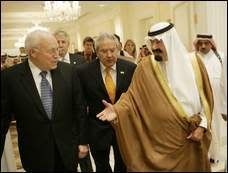
Cheney was given a red-carpet arrival ceremony at the airport. At the palace, as he and the king exchanged pleasantries, Abdullah asked about the first President Bush. The elder Bush assembled a broad international coalition, including Saudi Arabia, to confront Saddam Hussein's Iraq in the 1991 Gulf War.
Cheney is touring Saudi Arabia and the smaller Gulf states in an attempt to win wider support for ethnic reconciliation in Iraq and to counter efforts by Iran to spread its influence in the region.
After a four-hour meeting with the king that included dinner, Cheney headed for Aqaba, Jordan, to spend the evening before meetings on Sunday. He was expected to visit Egypt later on a weeklong trip that began in Iraq.
Earlier Saturday, Cheney urged greater support for U.S. policies in Iraq when he held meetings in Abu Dhabi with leaders of the United Arab Emirates.
A senior Bush administration official traveling with Cheney said afterward that the Emirates' president, Sheik Khalifa bin Zayed Al Nahyan, pledged to do as much as possible to support the struggling Iraqi government.
Iran also was a major focus of the meeting, according to the official, who spoke on condition of anonymity because he was not authorized to speak publicly.
The Emirates' leaders, the official said, were keenly aware of Iran, a large neighbor less than 100 miles away and a $20 billion a year trading partner.
Iran's president, Mahmoud Ahmadinejad, who was scheduled to visit the Emirates today, is trying to persuade the Gulf states to drop their military alliances with Washington.
Cheney's mission to Saudi Arabia included an effort to smooth over recent divisions between the oil-rich kingdom and the United States.
The kingdom has taken an aggressive leadership role in efforts to quiet Mideast troubles. In a possible attempt to gain more credibility in the region, Abdullah recently has openly challenged the U.S. military presence in Iraq, calling U.S. troops in Iraq an "illegal foreign occupation."
The king refused to see al-Maliki when the Iraqi prime minister toured Arab countries late last month.
Cheney went to Saudi Arabia last November for meetings, requested by the king, that are still shrouded in secrecy.
Reports at the time suggested the two discussed what role Saudi Arabia might play in reaching out to Iraq's Sunni minority as conditions in that country deteriorate.
This time, the king did not request the meeting. Cheney was sent to the region by Bush.
Thursday, April 12, 2007
| [+/-] |
Battling Over The World's Oil Reserves |
Alistair Tice looks at the rivalry for access to the world's oil supplies and assesses the likely consequences for the world economy, and the continued dominance of US imperialism.
Alistair Tice reports:
George Bush invaded Iraq for power, prestige and oil. Whilst the catastrophe of the occupation has dealt a huge blow to the prestige of US imperialism around the world and its power in the Middle East has been severely undermined, US and British oil companies are still set to get their hands on Iraq's oil.
Iraq's pro-western cabinet has approved a Hydrocarbon Law that will hand over long-term control of the country's untapped energy fields to foreign multinationals, with profit rates of up to 75 per cent! Iraq has the world's second largest known oil reserves and the Middle East currently supplies two-thirds of the world's oil.
Bush's war for oil was driven by his administration's close links to the major oil companies and by the United States' oil import needs. US oil production peaked in 1970 at ten million barrels per day (bpd); today it is less than five million bpd and the US consumes 20 million bpd. That is 25% of the world's oil consumption, yet the US only has 5% of the world's reserves.
Imports have risen from 36% of its oil needs in 1970 to two-thirds today. A recent submission to the Senate Committee on Energy and Natural Resources stated "there is no economically plausible scenario for a strategically meaningful reduction in the dependence of the Unites States and its allies on imported hydrocarbons during the next quarter century."
The major oil companies, mostly US-owned, are collectively known as 'Big Oil'. Closely connected to the Bush regime, many were originally based in the key oil state of Texas and are an essential element in the 'military-industrial complex'. Their profit-driven objectives have played a decisive role in Bush's aggressive, interventionist policy in the Middle East and Central Asia. Big Oil makes huge profits. In 2005, ExxonMobil became the world's biggest company, overtaking Wal-Mart. Five of the world's top ten corporations are now oil majors.
However, they face long term problems. Last year, the private oil corporations only replaced 75% of their reserves and now they only control 10% of world oil reserves.
State ownership
Despite two decades of neo-liberalism, national oil companies (wholly or partly state owned) control 90% of world oil reserves. And that share is rising.
On 1 May 2006, Evo Morales, the recently elected leftist president, announced the nationalisation of Bolivia's gas industry. Whilst it ended up as only partial state ownership, it was hugely significant after two decades of privatisation and was referred to as "the first nationalisation of the 21st century." Hugo Chávez, the radical president of Venezuela, has announced that by 1 May 2007, PDVSA (the Venezuelan state oil company) will take a 60% majority stake in the extra-heavy oil fields in the Orinoco Basin.
Vladimir Putin, the Russian president, has taken state-capitalist measures against the oil multinationals to increase his government's revenues and standing internationally.
Shell was forced to accept reduced shares in joint ventures in the giant Sakhalin oilfield. And now BP is under pressure from Gazprom, the Russian state gas company, over a new gas field project in Eastern Siberia.
The oil companies are having to accept lesser shares in future profits or risk expropriation and miss out altogether.
Even in the central African country Chad, last year the government created a new national oil company and threatened to expel Chevron for not paying taxes. In less than three years of exploitation of Chad's recently discovered oil resources, in a deal brokered by the World Bank, the foreign consortium had earned $5 billion for a $3 billion investment and Chad only got $588 million!
Globalisation
This retrenchment from globalisation is likely to increase with more governments nationalising or at least taking majority state holdings in their energy resources. Russia is now the world's biggest oil exporter (it overtook Saudi Arabia last year) and Gazprom is now the highest valued company outside the US.
But the Big Oil companies, and through them US imperialism, still control the international oil market: trading, transportation (tankers and pipelines) and refining. So Russia and China are trying to challenge their domination, and their state-owned energy companies could even make hostile takeover bids for Big Oil companies.
These would not be successful for political reasons. Last year for example, the US Congress blocked an attempted take-over of US energy company Unocal by the Chinese state oil company.
However, Russia and China have made a number of bilateral energy agreements and are planning to open their own oil and gas market exchanges to rival the US.
The world oil price peaked at around $80 per barrel last year but has now fallen back to $50-$60, still way above the $20 per barrel before the Iraq war started four years ago.
In the coming world economic slowdown or recession, the oil price is likely to fall further as energy demand falls, although probably not back to $20. However, any significant fall in the oil price below $50 a barrel will cause big economic and social problems for producer countries. It would also lead to another slump (as in the 1990s) in oil exploration and production (the economic viability of reserves is very much conditioned by the oil price) - paving the way for further shortages of supply and refining capacity later.
Would the leftist governments in Bolivia and Venezuela cut back on their social programmes for the poor or would they be forced into more radical policies of expropriation of capitalist interests?
Similarly, would Putin threaten to cut off western energy supplies if the west did not pay more for its gas and oil?
70% of Iran's state revenues comes from its oil exports so any fall in price would undermine President Ahmadinejad's already failing social promises and popular support. Saudi Arabia and the Gulf states too would face big social upheavals.
Whilst these would be the likely consequences of a fall in oil prices in the short term, in the longer run the price is likely to increase and could jump dramatically in response to internal crises.
The four biggest oilfields in the world (which account for 14% of world supplies) are all over 30 years old and in decline.
Saudi Arabia's Ghawar field, the world's largest, is over 50 years old and over half depleted (some observers say 90% depleted but the Saudi oil industry is shrouded in secrecy).
Daqing is the largest oil field in China and its major source of domestic oil; its decline will only make China even more desperate for imports. China is now the world's second biggest oil importer after the US, hence its deals with Iran, Sudan and Venezuela.
Last year, two senior US senators initiated a computerised simulation exercise called ShockWave to study the effects on the US economy if the oil price rose to $100 a barrel. Their inescapable conclusion was that it would lead to recession.
Many analysts believe that due to 'Peak Oil', prices could rise as high as $125-$150 a barrel. The Peak Oil theory is that a time will come when half the discovered and produced oil in the world has been consumed and after then the oil supply will decline. Some oil experts believe that time has already come, others that it may not be for another 30 years.
Either way, the reaction against neo-liberalism already evident in Latin America will spread to other continents as workers and poor people demand action against the super-profits of Big Oil.
There will be pressure from the masses for more windfall taxes and outright nationalisation.
The intensified rivalry between the declining and desperate US empire and energy-rich Russia and energy-hungry China will intensify, most immediately over Iran, and in Central Asia and Africa, leading to trade wars and further military conflicts.
As a consequence oil prices will become increasingly volatile, with falls and big rises, each with the potential to cause economic crises and social upheaval.
Just before the invasion of Iraq, media magnate Rupert Murdoch expressed his support for war to maintain oil prices at $20 a barrel and help sustain world economic growth (and his profits!). Like most things in his media, Murdoch got that one wrong and Iraq and oil will prove to be sources of world economic and political instability for years to come.
