At Consortium News, Robert Parry writes:
In August after the Democratic-controlled Congress caved in to George W. Bush’s demands for broader surveillance powers, I noted that the new authority went far beyond what was advertised and that the President could obtain year-long spying orders on Americans who ventured outside the United States.
My analysis, which was based on a reading of the law’s language, wasn’t shared by commentators in the major U.S. news media and even drew some reader criticism as alarmist for failing to take into account secret “minimization” provisions that supposedly would protect American citizens.
However, the Bush administration’s hostile reaction to a seemingly innocuous amendment added to a new surveillance bill by Sen. Ron Wyden, D-Oregon, suggests that targeting Americans who travel abroad was a key goal of Bush’s “Protect America Act of 2007.”
Wyden told the New York Times that his amendment would require the government to get a warrant whenever it wants to wiretap an American outside the country, such as a U.S. soldier serving overseas or an American on a business trip.
“The individual freedom of an American shouldn’t depend on their physical geography,” Wyden told the Times. He said his amendment passed on a 9-6 vote in a closed Senate Intelligence Committee meeting on Oct. 18. [NYT, Oct. 19, 2007]
After the committee vote, the Bush administration and a key Senate Republican took direct aim at Wyden’s provision.
“We have strong concerns about that amendment,” said White House spokesman Tony Fratto. “We certainly could not accept it.”
Sen. Christopher Bond of Missouri, the ranking committee Republican, said Wyden’s amendment was “problematic” and could scuttle the entire bill if not changed.
In other words, the seemingly loose phrasing of the Protect America Act wasn’t just an oversight or something that would be cleaned up with some internal technical adjustments. Rather, it was an important feature of the legislation that was slipped past the Democratic leadership and most of the Washington press corps in August.
The law states: “Notwithstanding any other law, the Director of National Intelligence and the Attorney General may for periods of up to one year authorize the acquisition of foreign intelligence information concerning persons reasonably believed to be outside the United States.”
The law’s advocates claimed that this provision was intended to intercept communications when at least one party was linked to a terrorist group or a terrorist affiliate and was outside the United States.
No Terrorist Wording
But the law’s language didn’t limit the surveillance to “terrorists” or “enemy combatants” – indeed those words were not mentioned in the legislation.
Nor does the Protect America Act, which was drafted by the Bush administration’s national security team, specify what happens to a one-year surveillance order against a target if the person then enters – or returns – to the United States.
In the rush to wrap up legislative business before the August recess – and to avoid “soft on terror” accusations – Democratic congressional leaders offered only cursory attention to what this provision meant and what new abuses might become possible.
For instance, could a one-year surveillance order be issued against an American attorney who was representing a Guantanamo detainee and who traveled to Europe for a legal conference? Could the surveillance order follow that person back home? How about an outspoken peace activist who visited a friend in Canada, or a senator meeting with a foreign leader, or a journalist filing stories from overseas?
The only limitation on the administration’s authority is the need to be seeking “foreign intelligence information.” Though the term does cover information about possible hostile acts by a foreign power or an agent of a foreign power, such as terrorism or clandestine intelligence activities, the phrase can be interpreted in a far looser way.
The term can be defined broadly as information about a foreign power that relates to U.S. national defense, national security or the conduct of foreign affairs. In today’s world, those categories could mean pretty much anything.
Other supposed safeguards in the Protect America Act might not be reassuring to its targets, either.
While the targets are kept in the dark about the surveillance, their communications providers – such as phone companies or e-mail services – can challenge the government’s order if they’re willing to absorb the expense and offend the Executive Branch, which often has giant contracts with the same providers.
Even then, the service providers, which aren't told the classified basis for the surveillance order, can only contest the surveillance on procedural grounds through the secret channels of the court created by the Foreign Intelligence Surveillance Act, with appeals of adverse rulings allowed by either side up to the U.S. Supreme Court.
Lawsuit Immunity
But service providers get a strong incentive not to challenge the government’s order. While a legal challenge on behalf of an unsuspecting client could be expensive – especially if the Bush administration retaliates by shifting contracts to a competitor – the legislation grants immunity from liability to any service provider who complies.
“Notwithstanding any other law, no cause of action shall lie in any court against any person for providing any information, facilities, or assistance in accordance with a directive under this section,” the law states.
In other words, if spying targets later discover that their service providers gave the government access to their phone calls and e-mails, they have no grounds to sue, regardless of how unjustified the surveillance may have been.
Initially, administration officials said their goal in pushing through the new law was to address a glitch related to cases in which two terror suspects, both abroad, have their communication routed through a U.S. switching point and thus might require a warrant.
Citing this vulnerability, President Bush demanded that Democrats revise FISA before leaving for the August recess. Democrats thought they had reached a compromise that would address the administration’s narrow concern, but the White House and the congressional Republicans then demanded more sweeping changes.
The Senate caved in first, voting 60-28 to authorize Bush’s broader spying powers, with many centrist Democrats joining a solid phalanx of Republicans. (Presidential contenders – Sens. Hillary Clinton, Barack Obama, Chris Dodd and Joe Biden – voted no.)
On Aug. 4, Bush then turned up the heat on the House. He called the spying powers contained in the bill crucial weapons in the fight against terrorism and declared that “protecting America is our most solemn obligation.”
Many Americans would disagree, arguing that the most solemn obligation is to protect the Constitution and the Bill of Rights. But the Democratic congressional leaders acted as if their highest priorities were getting away for the August recess and avoiding ugly attacks on their patriotism from Fox News and the right-wing media.
Instead of canceling the recess – and using the month of August to fight over both Bush’s extraordinary expansion of presidential powers and the Iraq War – House Democratic leaders brought the Senate-approved Protect America Act to the floor. It carried, 227-183, with 41 Democrats backing Bush’s bill.
Trying to put the best spin on their defeat, Democratic leaders pointed to their one concession: a sunset provision that required Bush to seek renewal of his powers in six months. Still, the Democratic “base” and many other Americans were furious at the latest cave-in, sending House Speaker Nancy Pelosi more than 200,000 angry e-mails.
Stung by the reaction, Democratic leaders promised that the spying law would be revisited immediately after the August recess, rather than waiting around for a required reauthorization in February 2008.
New Concessions
Now, however, the Senate Democrats appear headed toward another major concession to Bush, making retroactive the legal immunity for telecommunications companies that collaborated with the administration’s warrantless surveillance over the past six years.
Sen. Jay Rockefeller, D-West Virginia, Senate Intelligence Committee chairman, shepherded this new concession through his panel, which approved a revised version of the Protect America Act on a 13-2 vote with Wyden and Sen. Russ Feingold, D-Wisconsin, voting no.
The bill now goes to the Senate Judiciary Committee, which also has jurisdiction. Sen. Dodd, D-Connecticut, has vowed to put a hold on the bill to block the retroactive immunity provision.
But the Democrats will face the same dilemma that has stymied their attempts to end the Iraq War. The Republicans are in the driver’s seat because they can filibuster in the Senate, forcing the Democrats to round up 60 votes on anything that restricts the President’s powers, such as Wyden’s amendment.
The GOP also has used parliamentary maneuvers in the House to delay its consideration of a different surveillance bill that includes more constraints on Bush and leaves out the amnesty for telecommunications companies.
Even if a new bill not to Bush’s liking can clear those hurdles, he can veto it, requiring two-thirds majorities in both houses to override.
An impasse would leave the Democrats back where they started. Then, with the law set to expire in February 2008, Bush and his political allies would taunt them as “soft on terror” – and there’s little reason to believe that congressional Democrats will show more backbone in an election year.
Friday, October 19, 2007
| [+/-] |
Bush's Spying Hits Americans Abroad |
Thursday, October 18, 2007
| [+/-] |
Rockefeller, Pushing Immunity, Is Newly Flush With Telecomm Cash |
Senator Jay Rockefeller (D-West Virginia) is reportedly steering the secretive Senate Intelligence Committee to give retroactive immunity to telecoms that helped the government secretly spy on Americans.
He has also recently benefited from some interesting political contributions.
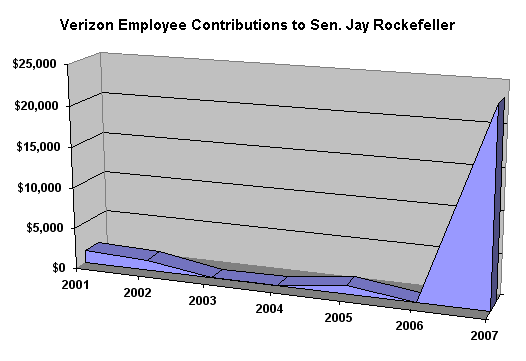
Top Verizon executives, including CEO Ivan Seidenberg and President Dennis Strigl, wrote personal checks to Rockefeller totaling $23,500 in March, 2007. Prior to that apparently coordinated flurry of 29 donations, only one of those executives had ever donated to Rockefeller (at least while working for Verizon).
In fact, prior to 2007, contributions to Rockefeller from company executives at AT&T and Verizon were mostly non-existent.
But that changed around the same time that the companies began lobbying Congress to grant them retroactive immunity from lawsuits seeking billions for their alleged participation in secret, warrantless surveillance programs that targeted Americans.
The Spring '07 checks represent 86 percent of money donated to Rockefeller by Verizon employees since at least 2001.
AT&T executives discovered a fondness for Rockefeller just a month after Verizon execs did and over a three-month span, collectively made donations totaling $19,350.
AT&T Vice President Fred McCallum began the giving spree in May with a $500 donation. 22 other AT&T high fliers soon followed with their own checks.
Prior to that burst of generosity, the only AT&T employee donation to Rockefeller was a $300 contribution in 2001. That supporter did not identify herself as a company executive.
When asked about the contributions, an AT&T spokesman told THREAT LEVEL: "AT&T employees regularly and voluntarily participate in the political process with their own funds."
Both companies are being sued for allegedly turning over billions of calling records to the government, while AT&T is also accused of letting the National Security Agency wiretap phone calls and its internet backbone. A federal judge in California allowed the suits regarding the eavesdropping to continue despite the government's attempt to have the suits thrown out on the grounds they will endanger national security. The 9th Circuit Court of Appeals reviewed that decision in August. The judges seemed reluctant to toss the cases, but have yet to issue a ruling.
On Thursday evening, the Rockefeller-led Senate Intelligence Committee is marking up a bill to re-amend the nation's spy laws. While the text of the bill has not yet been released, the bill reportedly includes a way for the telecoms to escape the litigation against them.
Rockefeller's commitment to getting the telecoms out of court surprises some who remember that Rockefeller was originally disturbed enough about the secret spying programs that he hand-wrote a letter to Dick Cheney in 2003, expressing his concerns about the program's legality.
In a fairly stunning related news, Democratic Senator Chris Dodd went all in with his political capital Thursday, announcing he would unilaterally put a hold on the bill, which would stop the bill from being voted on.
Representatives for Verizon and Rockefeller did not respond to requests for comment.
The contributions and the following tables were found thanks to OpenSecrets.org.
UPDATE: Reader Theo writes in to say why the money, though tiny in comparison to Rockefeller's fortune, is not negligible.Rockefeller is believed to have a personal fortune over $100 million. He spent $12 million of personal funds on his first Senate campaign. (http://www.encyclopedia.com/doc/1G1-3521561.html)
However "in recent campaigns, he has downplayed his personal wealth in one of the nation's poorest states. 'I will not spend one single dime of any money that I have,' he said in 2002. 'So that I if I don't raise money, I won't spend money. I am on exactly the same playing field, so to speak, with anybody else who runs for office.'" AP
He's up for election in 2008. The cost of Senate races has increased several times over the last two decades. With a serious Republican challenger in WV, which Bush won twice, such as Rep. Shelley Moore Capito, he could be forced to raise tens of millions of dollars. That, or break his promise not to use his personal fortune, which wouldn't play very well in one of the country's poorest states.
So yes, even a Rockefeller has to raise money. And in West Virginia, $50,000 is a lot of money. It's about 2% of all the money he raised last year. (But I'll bet he's slightly more worried about being red-baited for suppurtin' terrists.)

Wednesday, May 16, 2007
| [+/-] |
Wealth Is A Common Factor Among 2008 Candidates |
The NYT reports:
Former Mayor Rudolph W. Giuliani of New York, who just six years ago told a divorce court he had only $7,000 in assets under his control, has amassed a net worth of more than $30 million, much of it from paid speeches.
Former Senator John Edwards of North Carolina, who has spent the last three years crusading against poverty, also reported about $30 million in assets. His income included nearly half a million dollars for advising an elite investment fund and $40,000 for directing a poverty studies program at the University of North Carolina, Chapel Hill.
Mr. Giuliani and Mr. Edwards reported their assets in personal financial disclosure forms released Wednesday by the Federal Election Commission. Federal election laws require all the presidential candidates to file the forms. Together, they offer a glimpse of the general affluence of all the primary candidates and the truly extreme wealth of a few.
Neither Mr. Giuliani, a Republican, nor Mr. Edwards, a Democrat, is the richest of the White House hopefuls. That title belongs to Mitt Romney, a founder of the private equity firm Bain Capital, who has said he expects to report as much as $350 million in assets, including a trust for his heirs. Mr. Romney and Senator John McCain of Arizona, both Republicans, and Senator Hillary Rodham Clinton, Democrat of New York, have all received extensions of the filing deadline for their forms.
Mr. Giuliani’s $30 million fortune is the most unexpected information to emerge from the disclosure forms so far. During his divorce from Donna Hanover in June 2001, a lawyer for Mr. Giuliani said he had only $7,000 in personal money “under his control.” His salary as mayor of New York at the time was about $195,000, and his local financial disclosure forms showed less than $800,000 in deferred compensation, pension, retirement and mutual funds. He had also signed a contract to write two books for an advance of $3 million.
The latest disclosure form suggests that his biggest source of income was speeches, capitalizing on his celebrity after the terrorist attacks of Sept. 11, 2001. For the period covered by the form — roughly the calendar year 2006 — Mr. Giuliani reported making 124 speeches for as much as $200,000 each and earning a total of about $11.4 million.
Self-help and motivational rallies were his top audiences. He made about 26 speeches at events staged by Get Motivated Seminars, the company of the impresario Zig Ziglar, and 8 more at major events put on by the executive education group HSM.
Mr. Giuliani put a value of $5 million to $25 million on his stake in his consulting firm, Giuliani & Company, which he said paid him about $4.1 million last year. He said he received about $1.2 million in income from his law firm, Bracewell & Giuliani. Mr. Giuliani, who opened a New York office for what had been a Texas firm, said the $1.2 million he received reflected a guaranteed payment of $1 million a year from the firm, plus 7.5 percent of the New York office’s revenue.
Mr. Giuliani’s book has apparently sold well enough to earn royalties covering his $3 million advance; he reported $146,092 in book royalties in 2006. In addition, Mr. Giuliani reported $496 in theatrical royalties. A spokesman for his campaign said Mr. Giuliani earned that money for playing himself in the films “Anger Management” and “The Out-of-Towners,” as well as for guest appearances on the television programs “Law & Order” and “Saturday Night Live.”
Mr. Edwards, who earned his millions as a trial lawyer before running for the Senate in 1998, reported assets worth $14.3 million to $44.7 million in 2004. Since leaving office that year, he has devoted most of his energy to promoting efforts to help the poor, but he has recently faced questions about signing on part time in 2005 as an adviser to the hedge fund manager Fortress Investment Group.
Like many hedge funds — loosely regulated investment companies open only to the rich — some Fortress funds are incorporated in the Cayman Islands to avoid taxes. Fortress has invested in a firm that lent high-interest rate mortgages to low-income homeowners. A recent wave of foreclosures on such so-called subprime mortgages has elicited accusations from Mr. Edwards and others that some firms had engaged in predatory lending. Mr. Edwards has said he was not involved in any specific Fortress investments in that business.
Mr. Edwards’s financial disclosure form shows that he received $479,512 from Fortress in 2006; the forms did not cover 2005. In addition, the forms show that Mr. Edwards sold several million dollars in other assets to personally invest in Fortress funds. His disclosure form put the value of his holdings in Fortress funds at $11.2 million to $24.7 million.
Mr. Edwards has said he joined Fortress both to make money and to learn about finance.
Mr. Edwards’s campaign said he gave $350,000 to charities in 2006, including $333,334 in book royalties.
Eric Schultz, a spokesman for Mr. Edwards, said: “The bottom line is, if you look at where John Edwards comes from and his record, it’s clear what makes him tick: helping those who haven’t been as blessed as he has been. John Edwards is running for president to give every American the opportunities that he’s had.”
Senator Christopher J. Dodd of Connecticut, another Democratic candidate, also disclosed an investment of more than $50,000 in the Fortress Investment Group. Mr. Dodd reported total assets of more than $1.5 million and a cottage in County Galway, Ireland, that he valued at $100,000 to $250,000.
Not all the candidates were so flush. Representative Duncan Hunter, Republican of California, reported assets worth hundreds of thousands of dollars but also said he owed more than $30,000 in car loans and more than $75,000 in credit card debt. His was the only disclosure form to be filled out in handwriting.
Gov. Bill Richardson of New Mexico, a Democrat, reported owning more than $100,000 in stock and options worth at least $250,000 in a major oil refiner on whose board he once sat.
Former Gov. Mike Huckabee of Arkansas, a Republican, reported assets valued at less than $700,000, including his retirement benefits as a former Southern Baptist minister. He earned about $150,000 in royalties from his book about his weight loss.
Representative Ron Paul of Texas, a libertarian-minded Republican who often warns that excessive government threatens the economy, has put his pessimism into his portfolio. If the dollar collapses, Mr. Paul will be ready: his favorite investments are real estate, silver and gold.
Thursday, April 12, 2007
| [+/-] |
On Hardball with Chris Matthews, April 12, 2007 |
Guests DeForest Soaries, Carolyn Cheeks Kilpatrick, Elijah Cummings, Eugene Robinson, Pat Buchanan, Tom Oliphant, Chris Dodd talk with guest host, David Gregory
Transcript of Hardball:
DAVID GREGORY, GUEST HOST: Tonight, breaking news. CBS radio has fired Don Imus one day after NBC News decided to do the same, to take him off the air at this network. All the latest information. Let‘s play HARDBALL. Good evening once again. I‘m David Gregory, in for Chris Matthews.
This is HARDBALL.
And this is by day two a media death sentence for Don Imus. He has been fired now by CBS radio one day after MSNBC took him off the air at this network. There is a statement from CBS, which I‘m going to read, that came to us in the last 20 minutes from chief executive officer Leslie Moonves, and I‘m going to read it.
“CBS today announced its decision to cease broadcasting the ‘Imus in the Morning‘ radio program effective immediately on a permanent basis. From the outset, I believe all of us have been deeply upset and revulsed by the statements that were made on our air about the young women who represented Rutgers University in the NCAA women‘s basketball championship with such class, energy and talent.” That is a quote from CBS president and chief executive officer Leslie Moonves announcing the decision.
The statement goes on—I continue to read—“Those who have spoken out with us the last few days represent people of good will from all segments of our society, all races, economic groups, men and women alike. In our meetings with these concerned groups, there has been much discussion of the effect language like this has on our young people, particularly young women of color trying to make their way in this society. That consideration has weighed most heavily on our minds as we made our decision, as have the man e-mails, phone calls and personal discussions we have had with our colleagues across the CBS Corporation and our many other constituencies.
“ ‘Imus in the Morning‘ “—the statement goes on now—“was carried on 61 stations across the United States and distributed over the Westwood One radio network. The cancellation of the program comes after statements Mr. Imus made about the young women who comprise the Rutgers University women‘s basketball team, which reached the finals of the NCAA women‘s basketball championship this spring.”
Moonves concluded, “I want to thank all of those who came to see us to express their views. We are now presented with a significant opportunity to expand on our record on issues of diversity, race and gender. We intend to seize that opportunity.”
That is the breaking news, a statement from CBS CEO Leslie Moonves.
We‘re joined by phone now by the Reverend DeForest Soaries, who has become familiar to this audience. He is a go-between, among other hats he wears, between Don Imus and the Rutgers team. Reverend Soaries, your reaction to this? And what can you tell us about Don Imus‘s reaction, as well?
REV. DEFOREST SOARIES, MODERATING IMUS RUTGERS MEETING: Well, NBC took the lead, and I feel respect for the decision made on yesterday. CBS joined today after, I think, just overwhelming public sentiment, and quite frankly, embarrassing media exposes that made it very difficult for them to identify with...
GREGORY: Like what? Are you talking about the Bob Herbert column in “The New York Times today, which referenced...
SOARIES: I‘m talking specifically about the Bob Herbert column and...
GREGORY: All right, just so everybody knows, that referenced a “60 Minutes” piece on CBS 10 years ago, where Imus in that interview used the “N” word, and there was a question on whether he had members of his staff who are there to do jokes using the “N” word. That‘s the background on that.
So you think this became an issue today?
GREGORY: Yes. And I think—the issues of comedy, of civility, of decency are very important issues, but we cannot get to the larger discussion until we focus on the very specific but unfortunate acts of Mr. Imus last week aimed at some very specific people. We are concerned about the global issues and all of those philosophical—the things that need to happen. My concern is that a member of my church who coaches 10 fine athletes was attacked and defamed by someone without regard to the impact it would make on their lives. These young women will have to wrestle with these issues.
And so they happen to be African- American. They happen to be female. But when this kind of very focused and targeted bigotry is aimed at specific people, not large groups of people, but specific people, then I think you‘ve got to—you‘ve got to respond in kind.
GREGORY: Reverend...
SOARIES: I‘m a Christian. I believe in forgiveness, but I also believe in justice, and justice requires that consequences are attached to our behavior.
GREGORY: Reverend, have you spoken to Don Imus?
SOARIES: I have not spoken to him in the last two hours. I expect to speak to him within the next two hours because when I left him last night, the question that I had posed to him was this: Now that NBC has dropped you, if CBS also drops you before the meeting with the Rutgers women, are you still interested in having a meeting? And his response was that he definitely wanted to meet with the Rutgers women and there was nothing that could happen to prevent him from wanting to do that. And I want to confirm that before the evening ends so that I can proceed with the plans that we had agreed to just two or three hours ago.
GREGORY: Will that meeting happen today?
SOARIES: Pardon me?
GREGORY: Will the meeting between Imus and the women happen today?
SOARIES: Well, the next step for me is to talk to Mr. Imus about his desire to meet and then to talk to the team about the status of the meeting in their minds—I‘m certain that the team still wants to meet—and then take it from there. Needless to say, we have committed to this being both a private meeting and a secret meeting. We don‘t want to turn it into a public spectacle. And so when the meeting takes place and whether it will take place will not be disclosed. The fact that the meeting takes place will be announced after it‘s done.
GREGORY: There‘s going to be a lot of people, Reverend, who ask this question. They‘re going to say there has been so much hysteria about this and that the hysteria took Imus down, not specific injury against these young women, many of whom didn‘t even know who he was, some of whom, including Coach Stringer, had a much more muted reaction when this first came about. You even said in our conversations previously you waited several days until speaking about this from the pulpit. Has Don Imus been caught up in an overreaction?
SOARIES: Well, Don Imus himself said to me last night words that I think all of us should remember, and that is this. Had he not said the words, none of this would have occurred. I can‘t be more concerned about the response to the words than the fact of the words themselves.
Granted, whenever a media frenzy begins, whenever the stories begin to become indistinguishable from rumors, there‘s no doubt there are probably some things that Imus has been accused of doing that are untrue. There are probably some accusations that are unfair. But again, personal responsibility is really foundational for a mature individual, and Imus in his maturity confessed that he had brought this on himself. Now, that does not excuse people from stooping to the level of accusations that are unfounded, et cetera. But we bring things on ourselves, and the Bible says you reap what you sow.
I would hope that now that this specific focus on his status has been resolved, and once the meeting with the Rutgers women has taken place, that we can let the Rutgers women go back to school, we can pray that Imus will grow (INAUDIBLE) from this experience. And then those of us who have a sincere desire to enhance the quality of life in our communities can (INAUDIBLE) in serious dialogue away from the public eye, without the glare of the TV camera, and really attempt to build a more genuine community.
GREGORY: Reverend Soaries, as you are busy trying to put this meeting together as soon as tonight, after CBS has announced that they have now fired Don Imus, one last question for you. What do you think is—what do you think? What is your conclusion—having dealt with him and been in the middle of this, what do you think about Don Imus?
SOARIES: I think Don Imus is a professional. I think he is a mixture of comedy and satire and politics and punditry. I think he has established a brand that is in some ways genius but in other ways dangerous. And he is not likely to change. I don‘t think Mr. Imus will suffer financially. The ego will be bruised.
And my prayer is that he will seek to understand exactly what happened because he touched a nerve in this country that I have not seen since the assassination of Martin Luther King, Jr. And I‘m not trying to be over-exaggerating, but I‘ve never seen this kind of response come from such a broad (INAUDIBLE) of people who agree on the basic proposition and who are so focused on and sympathetic for these 10 young ladies.
And so I think Mr. Imus is deeply apologetic, truly regretful, and will be seeking strategies to really figure this out and to find the next chapter in his life.
GREGORY: Reverend DeForest Soaries, who is working to arrange a meeting between Don Imus and the women of Rutgers University who were the target of his comments. Reverend Soaries, thank you again for joining us.
SOARIES: Thank you.
GREGORY: I hope you‘ll keep us up to date on the meeting, when it‘s going to happen and what comes of it. Again, thank you.
SOARIES: I will definitely do that. Thank you.
GREGORY: CBS has fired Don Imus one day after MSNBC has done the same. He is off the air.
Joining us now are two members of the Congressional Black Caucus, Maryland congressman Elijah Cummings and the caucus‘s chairwoman, Michigan congresswoman Carolyn Cheeks Kilpatrick. Congresswoman Kilpatrick, I heard you on Reverend Sharpton‘s show earlier this week with Don Imus and your exchange. What is your reaction today? And I‘ll ask you pointedly, does the sentence fit the crime in this case?
REP. CAROLYN CHEEKS KILPATRICK (D-MI), CONGRESSIONAL BLACK CAUCUS
CHAIR: You know, I‘m honored today to be in New York, and earlier this morning met with both the president and the senior staff at NBC and at CBS. It‘s an awesome responsibility. We had wonderful meetings—the president of NOW, National Organization for Women, as well National Organization for Women (ph) organizations (ph), as well as Marc Morial from the Urban League. It was a cross-section. It was a good meeting.
And this is bigger than Imus. I‘m obviously delighted that he‘s been fired. I said early on he should be fired. Now we have to say the culture and talk about the culture of our communications media system in America. Do we want to build American strong families, or do we want to tear them apart? I think the acts and the steps—and I want to commend both presidents for taking that action. That was the right step to take. And...
GREGORY: But Congressman...
(CROSSTALK)
GREGORY: Can I just interject for a moment? I just want to hear on this specific case—I want to hear you articulate why you think this result is the just result.
KILPATRICK: This is the just result because this gentleman—and I have to call him a gentleman—did what was wrong. There are millions of young people, women particularly, African-Americans specifically, who marvel at who we are, who work hard every day, who sacrifice to go to Rutgers University and other universities around this country, who stay there, who achieve excellence in academics. And then to find a young man who just look out on the floor and call them something—and again, it wasn‘t just those words. They had a conversation for three or four minutes with very derogatory images and messages about a particular group of people.
We also had in our group this morning one of the psychiatrists from Rutgers University, and she talked about the damaging effect it still does yet today. You saw the women. They‘re smart. They‘re intelligent. They‘re scholastic. They‘re prodigies. They‘re still damaged. And one said she‘ll be damaged for the rest of her life.
I don‘t think you understand the far-reaching impact of the remarks. It wasn‘t just something from the hip. It was researched. Someone gave him that. And incidentally, it was absolutely the totally wrong thing to say for America at a time when we‘re fragile, we‘re at war, people are losing their jobs, children are worried about their financial aid, if they can go to school...
GREGORY: Right.
KILPATRICK: Wrong time, wrong message, and he got what he deserved.
GREGORY: OK, Congresswoman, I just want to be clear, I‘m not making a judgment about the remarks or their impact, but I‘m questioning you and others about just what you think about the outcome.
And let me turn now to Congressman Cummings. In this case, your reaction, and do you think this fit the crime?
REP. ELIJAH CUMMINGS (D-MD), CONGRESSIONAL BLACK CAUCUS: No doubt about it, it fit the crime. You got to keep in mind—and I agree with my chairlady, Ms. Kilpatrick—we had a situation here where African-American women and others were balancing a sports career at a college, and a very good one at that, very good college, with academics. I don‘t know how many people have ever tried to do it. It‘s very, very difficult. And these are young ladies that are probably going to go on to graduate from school and become professionals in our society.
And at a moment when they were in the process of celebrating, celebrating the fact that they had gotten to the Final Four, the Final Two, here comes an elderly gentleman, who comes along and ruins their moment. Anybody who‘s a parent—I‘m a parent of two daughters—I can tell you, that is what hurts. I mean, Imus had made comments about other people who were adults that could fend for themselves. But the fact is that these were our children, who, as Ms. Kilpatrick said, were giving it their very, very best, and that‘s the last thing you want to see.
Now, let me tell you something. I really—I agree that this is so much bigger than this. And I‘m sure that the—when I hear about the presidents of CBS and NBC doing what they have done, I hope they‘ll go even further than that. I don‘t want it to end here. I want to make sure that people like Tim Russert has more African-Americans and minorities on his programs. I want to make sure that there are internships for folks who want to come into the studios because, let me tell you, I think that if Imus had wonderful young ladies like this around him in his studio, perhaps working with him, interning or whatever, I don‘t think he would have made those kind of statements because he would have been more sensitive.
And we do have to do—as Ms. Kilpatrick said, we‘ve got to find a way to bring our society together. And we cannot just let this just sort of go away, as Imus may go off into the sunset. I hope he doesn‘t go into the sunset. I hope he finds a way to—just as he has raised money and wonderfully for children with cancer, I hope that he‘ll raise money for scholarships for young people because Ms. Kilpatrick will tell you that we have young brilliant kids in our communities that are sitting home or doing some job because they don‘t have the money to go to college.
GREGORY: Congresswoman...
CUMMINGS: I say to Imus, Help them.
GREGORY: Let me ask you, Congresswoman, you appeared, as I mentioned, on Reverend Sharpton‘s program earlier in the week with Don Imus. And there is no debate about the hideousness of his remark. How did you find him? Did you think his remorse was genuine, or did you find it forced?
KILPATRICK: Unfortunately, I believe the gentleman did not get the impact of what he said and how it related to the world, and particularly to America. After talking to him—and I‘ve got friends who know him and say he‘s a nice gentleman, he donates, he gives his time, he and his wife. And we thank him for that. I don‘t think he gets it. He won‘t understand, for some reason, and I hope he‘ll take this time—and I‘d be happy to work with him, and so will members of the Congressional Black Caucus—to bring him around so that we talk about how we build a stronger family, how we make access to higher education more affordable, and those kinds of things.
So I don‘t think he was malicious at all. I think he said what he said, not thinking what he was thinking, or whatever he was thinking, and God only knows that. So you know, I don‘t think it was malicious. And I did talk to him for a few minutes on Reverend Sharpton‘s show, and it was a good exchange, but I left there just knowing in my heart that he didn‘t understand the impact of what he had done.
I think after the team and the coaches and the president—and by the way, we, the members of the Congressional Black Caucus and Speaker of the House, are having the president, the team, the coaches in to Washington, D.C., in the next 10 days. We‘re also going to have a hearing. This is the 35th year of Title 9, which is federal legislation that began the equal opportunity for women in sports. And we‘re inviting the Rutgers psychiatrist, we‘re inviting the president of NOW and a couple others to talk about this so that this is the beginning and not the end.
And when we met with the two presidents today—and I feel confident that as they told us, they‘re going to work with us, that we are going to see a change in their culture. We told that they were the leaders, they were the leaders at this time of our lives, at this time in history, and they can move the country forward by using a multi-cultural staff both in front of the camera and beyond, that they would use us as a resource.
We in the caucus have five members who are chairpersons of major committees. We have 17 members who are subcommittee chairs in everything from finance to economics...
GREGORY: Right.
KILPATRICK: ... to alternative energy. And I believe, in talking to them this morning, and particularly after we‘ve seen the second action taken, you‘re going to see a different movement. Again, I commend both CBS and NBC.
GREGORY: Congressman, just a final question here, and a quick comment. Don Imus has accused some in the African-American community, particularly Civil Rights leaders, yourselves included, who have spoken to the networks and spoken out on this issue—accused them of hypocrisy. And one of the things he cites, for instance, because it‘s topical, is the outcome of the Duke lacrosse rape case. And is there condemnation for this young woman, this young African-American woman who made a case against these young white men that was unfounded, in the end? And that‘s what the courts ruled. Do you speak out in that case, as well?
CUMMINGS: I think that—I think that whenever there is injustice anywhere, it is horrible. As a lawyer, one who has gone into many, many courtrooms throughout the state of Maryland, I can tell you I think that what happened there was clearly unfair. And I think it came out and it came out in the wash.
But—and I don‘t—but understand, here we have a situation where, again, Mr. Imus has said a lot of things. But keep in mind, he has come forth and he‘s apologized. Again, Ms. Kilpatrick has heard the apology. She questions his sincerity. But the fact still remains that we have now got to take this situation and make something better of it. And one of the things that we spend a lot of time in the caucus doing is trying to take negative situations, look at them for what they are, and then make things better as a result of them. And I think that‘s exactly what is going to happen, particularly with the leadership of Ms. Kilpatrick and the members of the Congressional Black Caucus and many others.
GREGORY: We are going to leave it there for now, but I can tell you, on this network, this is a conversation that will continue. Thank you to Congressman Elijah Cummings and Congresswoman Carolyn Cheeks Kilpatrick.
KILPATRICK: Thank you.
CUMMINGS: Thank you.
GREGORY: When we return, reaction from Rutgers University. The news
CBS has now fired Don Imus. He‘s completely off the air. We‘ll have more on this.
You‘re watching HARDBALL on MSNBC.
(COMMERCIAL BREAK)
GREGORY: Coming up: Don Imus is off the air at CBS Radio and MSNBC.
Reacting from—reaction, rather, from Rutgers University—when HARDBALL returns.
(COMMERCIAL BREAK)
GREGORY: We are back on HARDBALL. I‘m David Gregory, in for Chris tonight.
We have got breaking news. CBS has fired Don Imus. He is now off the radio. That follows the decision by this network yesterday to take him off this network‘s air as well—that decision coming within the past hour, that CBS has fired Don Imus.
In political news that is related to this, we have learned that Hillary Clinton will be giving a speech at Rutgers University on Monday to talk about this controversy. So, we will continue to follow that.
Speaking of Rutgers University, that is where NBC News‘ Lisa Daniels is, with reaction to this story.
And, Lisa, you have not only gotten reaction, but, obviously, you‘re hearing the developments about whether Don Imus is going to meet with the young ladies at Rutgers, something we‘re also following.
LISA DANIELS, NBC CORRESPONDENT: Yes, we are following both.
In fact, there was a handful of students watching “Oprah” as the women‘s basketball team spoke to her. But the news about CBS has not spread here. In fact, we were the ones, like a madwoman, that were quickly trying to gauge reaction by going from table to table.
So, this mini-crowd that you see behind me was not selected based on their opinions. I just literally grabbed them, and they were kind enough to accommodate us.
So, just a quick show of hands. How many of you were surprised that CBS fired Imus?
OK, four of you?
And how many think that the crime is appropriate with the punishment?
So, you guys changed your mind as I was talking to you, because, at first, you said you think he should be fired. And now you said that he...
UNIDENTIFIED MALE: Well, I think that, you know, a lot worse things have been said on the air. And for him being fired like that, without a suspension and fine, I don‘t think it is right. I think he should have had a chance to, you know, come back and speak his piece, and maybe just fine him, so he does not lose his job.
DANIELS: But it seems like it‘s a hard decision for you, because you keep on flipping back and forth. You‘re not quite sure about it?
UNIDENTIFIED MALE: Yes, because I don‘t agree with what he said about the female basketball team. I don‘t think it is right to speak that way about—really, about anyone. As a public figure, you should watch what you say. You shouldn‘t be allowed to say anything you want, just because you have a mike.
DANIELS: OK. Let‘s get to some other people.
What about CBS and NBC? Do think they are responding to advertisers, or do you think they are responding to the community and also pressure to get rid of Imus?
UNIDENTIFIED FEMALE: I think they are responding to the community, as the—how the community responded.
At first, it was that he said it. But, then again, a lot of people didn‘t hear about it until afterwards, when the protesters came about. And now advertisers—I heard this morning Geico is pulling out and big advertisers. So, I think the response of the community and advertisers, both, as a response to what he said.
And, again, they are taking a step up, because they don‘t want to portray themselves as being, like, a negative...
UNIDENTIFIED MALE: Company?
UNIDENTIFIED FEMALE: Yes, negative company...
DANIELS: Negative company?
UNIDENTIFIED FEMALE: ... you know, backing up someone who says—is saying this about people.
DANIELS: Now, you said: This is a college campus. We have got a lot to do.
You never heard of Imus?
UNIDENTIFIED FEMALE: Not really. I never heard of him.
But I did see what he had said on the computer and then the press conference afterwards. And I‘m not sure how I feel about him being fired or not. But I think how he behaved was inappropriate and it shouldn‘t be tolerated.
DANIELS: And you watched all those clips on YouTube, right?
(CROSSTALK)
DANIELS: A lot of your friends have.
UNIDENTIFIED FEMALE: Yes.
DANIELS: And that is the first time that you actually saw him.
UNIDENTIFIED FEMALE: That‘s the first time I saw him.
DANIELS: What is your reaction?
UNIDENTIFIED MALE: Well, I think it‘s very appropriate, the way that he was fired, because CBS and NBC, they need to portray a positive image of themselves. So, they are not going to have a guy that is portraying themselves as like negative and racist and sexist, which also shows that—which also shows that—shows that racism and sexism still exist in America.
So, basically, they are not going to get let that happen. So, they have got to get rid of somebody that is like that.
DANIELS: What is the part that offends you? Is it that it‘s a racist comment or a sexist—sexist comment, or both?
UNIDENTIFIED FEMALE: I think both. I know that I fully support what the Rutgers basketball team has done. I know that it personally offended them.
I don‘t know that he should have been fired, but it‘s definitely an issue that needs to be addressed, and that I think that, if there is a person-to-person apology between the two, that action should be taken from there.
DANIELS: All right, thanks so much for running over. I really, really appreciate it.
So, David, that is just an unscientific poll. We just grabbed them.
And you can see what the gut reaction is.
GREGORY: All right.
DANIELS: Back to you.
GREGORY: Lisa Daniels, at Rutgers, thank you very much.
When we return: Don Imus was on the air this morning. We will hear what he said on what turned out to be his last show.
You‘re watching HARDBALL on MSNBC.
(COMMERCIAL BREAK)
GREGORY: Welcome back to HARDBALL.
CBS has fired Don Imus, one day after NBC News dropped the simulcast of his radio show. The action by CBS today means Don Imus is now without a broadcasting home.
This morning, before CBS let him go, Imus was on the radio doing a charity telethon. And he hit back hard at critics.
HARDBALL correspondent David Shuster has more.
(BEGIN VIDEOTAPE):DAVID SHUSTER, NBC CORRESPONDENT (voice-over): Today, Don Imus made his final departure from MSNBC studios. On the radio this morning, Imus said, it is time to move forward, but still intends to meet with the Rutgers women‘s basketball team.
(BEGIN AUDIO CLIP, “IMUS IN THE MORNING”):
DON IMUS, RADIO TALK SHOW HOST: If I had not have said it, we wouldn‘t be here.
UNIDENTIFIED MALE: No.
IMUS: So, let‘s stop whining about it. And we just have to move on, try to make things make better.
I am going to meet with the kids. And—but you got to stop complaining. I mean, friends of mine and everybody else, I mean, just—you know, I said a stupid, idiotic thing that—that—that desperately hurt these kids. I am going to apologize to them. And then we will move on.
SHUSTER: On Wednesday, several advertisers announced they were suspending their commercials from the MSNBC broadcast of the “Imus” show.
But NBC News president Steve Capus said the decision to end the television simulcast was based largely on the strong feelings expressed by NBC employees.
STEVE CAPUS, NBC NEWS PRESIDENT: I have spent an awful lot of time listening to people who work for NBC News and people on the outside. At the end of the day, the people from NBC News made it very clear that this is something they expected of this news division.
SHUSTER: While the NBC News employees were making their case to executives privately, Jesse Jackson and Al Sharpton were making their arguments for termination publicly.
This morning, on “The Today Show,” Sharpton said he was satisfied.
(BEGIN VIDEO CLIP, “THE TODAY SHOW”):
AL SHARPTON, CIVIL RIGHTS ACTIVIST: I think NBC did the right thing.
I think the advertisers and the collective voices had a lot to do with it.
SHUSTER: In the meantime, Imus when on the offensive today against Sharpton and Jesse Jackson. The activist supported the accuser in the Duke lacrosse case and joined her in alleging the players were guilty of rape. Yesterday, all of the charges against the players were dropped.
(BEGIN AUDIO CLIP, “IMUS IN THE MORNING”):
IMUS: I‘m not surprised at any of this. So—and I‘m not surprised at the hypocrisy of Al Sharpton or—or Jesse Jackson or any of these people. But you can‘t whine about it.
SHUSTER: Imus also charged after Harold Ford Jr., who he had strongly and quickly supported last fall in his Senate campaign when a racially charged ad was run on behalf of his opponent.
(BEGIN AUDIO CLIP, “IMUS IN THE MORNING”):
IMUS: Harold Ford Jr. has been disgraceful in his lack of support, because I endured death threats to support him in Tennessee. So, I mean, it is unfortunate that he has no courage.
SHUSTER: “Imus in the Morning” is the only regularly scheduled program that has aired on weekday mornings in the 11-year history of MSNBC.
And, while Imus is now nationally known for the comments that terminated his television simulcast, he has long been deeply involved in charitable work, raising millions for children‘s programs and millions more for a new treatment center in Texas helping wounded veterans.
At first this week, NBC announced Imus would be suspended. Days later, he was fired.
Friends of Imus accused NBC of mishandling him. Today, Imus encouraged everybody to let it go.
(BEGIN AUDIO CLIP, “IMUS IN THE MORNING”):
IMUS: We can talk about all the good work I have done forever. But it doesn‘t change that I said that. So, you got to remember that. I‘m not offering any excuses, just—everybody has got to stop whining.
SHUSTER: Imus acknowledged that his abrasive style is coming home to roost now, but he said, he is not done yet.
(BEGIN AUDIO CLIP, “IMUS IN THE MORNING”):
IMUS: I have dished it out for a long time. Now it is time to take it. And that‘s fine. Bring it on.
SHUSTER (on camera): At several points this morning on the radio, Don Imus called some of his critics “bastards.” That kind of back-and -forth between Imus and his detractors is one of the reasons that Imus has been such a compelling and financially successful media figure.
But it also raises the question as to whether the death penalty now by the media is appropriate for his crime.
I‘m David Shuster for HARDBALL in Washington.
GREGORY: David, thank you very much.
Coming up next: What does this incident and ensuing firestorm over it say about race in this country, race relations, and how we talk to one another?
You‘re watching HARDBALL on MSNBC.
(COMMERCIAL BREAK)
TRISH REGAN, CNBC CORRESPONDENT: I‘m Trish Regan with your CNBC “Market Wrap.”
Stocks rebounding, after yesterday‘s losses—taking a look here, the Dow Jones industrial average gained more than 68 points. The S&P 500 was up almost nine points. And the Nasdaq gained 21 points.
Stocks were helped by stronger-than-expected retail sales figures for March. Wal-Mart, Target, J.C. Penney, and Costco are those reporting strong sales. But retailers are warning that rising gasoline prices and a tougher housing market may impact sales in the coming months.
Mortgage rates rose for the second straight week, the average 30-year fixed rate nationwide inching up to 6.22 percent.
And oil prices also climbed today. Crude oil gained $1.84 in New York trading, closing at $63.84 a barrel.
And, after the closing bell, an FDA advisory panel recommended that Arcoxia, a painkiller that Merck proposed as a successor to Vioxx, should not be approved. In after-hours trading, Merck shares are down more than 1 percent.
Well, that is it from CNBC, first in business worldwide—back to
HARDBALL.
GREGORY: Welcome back to HARDBALL.
CBS has fired Don Imus, effective immediately.
In a statement, CBS president and chief executive officer Leslie Moonves said—quote—“From the outset, I believe all of us have been deeply upset and repulsed by the statements that were made on our air about the young women who represented Rutgers University in the NCAA Women‘s basketball championship with such class, energy and talent. Those who have spoken with us the last few days represent people of good will from all segments of our society, all races, economic groups, men and women alike. In our meetings with concerned groups, there has been much discussion of the effect language like this has on our young people, particularly young women of color trying to make their way in this society. That consideration has weighed most heavily on our minds as we made our decision, as have the many e-mails, phone calls and personal discussions we have with our colleagues across the CBS Corporation, and our many other constituencies.”
We are joined by the “Washington Post‘s” Eugene Robinson now, and MSNBC political analyst Pat Buchanan. In Washington, author Tom Oliphant is on the phone, of the “Boston Globe,” and I guest, as I have been frequently, on the “Imus in the Morning Program.”
Tom, let me start with you and get your reaction. Tom, are you there? Tom Oliphant, are you there? I am not sure he can hear us. We‘ll get back to him. Eugene, reaction—Robinson, this has all happened very fast. We‘ve been on the air talking about this for the last couple of days. It‘s moved very quickly.
EUGENE ROBINSON, “THE WASHINGTON POST”: Right, we were here this morning talking about the MSNBC decision. Now, much quicker than I thought was even conceivable, we have CBS.
GREGORY: What happened? Because, after all, CBS is his main employer. What happened?
ROBINSON: I think a similar dynamic played out at CBS. I mean, you had all the major advertisers pulling out of the show, and it becomes a branding question. It becomes a question of whether you want your brand associated with this show. The advertisers decided they did not. And therefore, you know, NBC had decided it did not. I think CBS kind of felt out there alone. CBS is giving up X million dollars a year in revenue from this decision, and clearly, they decided that brand and good will were worth more than whatever revenues Imus was making for them..
GREGORY: Tom Oliphant of the “Boston Globe” is on the phone with us.
Tom, hi, thanks for calling in.
TOM OLIPHANT, “THE BOSTON GLOBE”: My pleasure, and hi Gene and Pat.
ROBINSON: Hi Tom.
GREGORY: Tom, what are your thoughts about this?
OLIPHANT: Well, I do not find Les Moonves‘ statement particularly credible. It sounds looks like a very, very slow burning fuse to me, a week later. And you will have to pardon me if I do not dance on a pals grave. I do not think this -- this is an occasion for sadness for those of us who know him and who have worked with him. Some of us thought this could be worked out, and we were clearly wrong.
But I must say, I have never found the statements of media executives to be particularly credible, and this one does not fly with me at all.
GREGORY: When you thought it could be worked out—
(CROSS TALK)
OLIPHANT: If I could share a story, that maybe illustrate my point. I think one of the first suggestions made to Don, maybe as early as Monday morning, when I was on, David, was that he, himself, announce his own suspension. In other words, I am getting out of here for two weeks to work on this, think about it. I am doing this.
Unfortunately, he could not see his way through doing that. And, I think, at that point, the slope became very slippery.
GREGORY: And, in fact, Pat, let us be honest—I have been clear too. I mean, I‘m not trying just report this out straight, because I have been loyal to Don Imus and been on his show frequently, and am saddened by this all the way around. But Don got defensive about this. And his contrition was coupled with a fair dose of his own outrage, and his own kind of lashing out. Did he make things worse for himself, Pat?
PAT BUCHANAN, MSNBC POLITICAL ANALYST: Well, today, it was all over.
That‘s the only time I saw him lash out. In my judgment—I believe this:
like you, I like Don Imus. I think he has a terrific show. It is edgy. Do they cross the line? Yes. I think probably what he should have done is when you do something like this, you come forward, you admit it, you apologize. He should have called Harold Ford and had Harold Ford say let‘s go down to Rutgers. I‘m to apologize down there, get it done. Then basically, draw the wagons and stand and fight as best you can.
I agree with Brother Oliphant, I think, on the part of CBS, this is a corporate decision with CBS. You don‘t get revolution nine days later, after 10,000 shows.
(CROSS TALK)
BUCHANAN: And you are suddenly revulsed by what you have just heard.
GREGORY: Tom, this is about—and look, let‘s not excuse NBC here. NBC has made a decision. CBS has made a decision. You think we felt the heat and responded accordingly.
OLIPHANT: If you said that—if the NBC guys yesterday, and the CBS suits today had said that, then I would say then they are credible. Otherwise, I get the impression sometime that I am looking at a remake of “Bonfire of the Vanities.”
GREGORY: All right, I have to take a quick break. I‘m going to start with you, Gene, when we come back. Pat Buchanan here, and Tom Oliphant of the “Boston Globe,” and an author is also on the phone. We are going to come back. We‘re also going to be joined by Democratic presidential candidate Chris Dodd coming up. He announced his campaign for president on “Imus in the Morning,” and said that he won‘t rule out doing the show again. We are going to get caught up with him and his latest views on that when we come back. This is HARDBALL on MSNBC.
(COMMERCIAL BREAK)
GREGORY: Welcome back to HARDBALL. Chris Dodd from Iowa in just a moment. But first, Eugene Robinson of the “Washington Post.” You wanted to make a point.
ROBINSON: Yes, the point I wanted to make was the world has changed. Diversity is a fact of life in America in 2007. Thirty years ago, 40 years ago, Steve Capus would not have heard, would not have been able to hear from many women and minority employees of NBC News, who were upset at continuing to have Imus on the air, because those people did not exist. I imagine Les Moonves heard the same thing internally at CBS. And, quite likely, some the advertisers who pulled out were hearing the same thing from their own ranks. American Express, one former advertiser, was run by an African-American. So, things have changed, and Imus never caught up to that.
BUCHANAN: You know, a guy made a mistake, apologized, asked for forgiveness and he did not get it. They hung him.
GREGORY: All right, let me go to Chris Dodd. Senator Dodd of Connecticut is in Iowa today. Senator, thanks for coming on.
SEN. CHRIS DODD (D), CONNECTICUT: Thank you, David.
GREGORY: Look, you have known Imus for a long time. You‘ve been a friend of his program and of him. You announced for president. Tell me what your reaction is today.
DODD: Well look, I am a father of two young daughters. I begin there, and I have thought over the last two days, how I would feel if those comments were made about them at some point. You can‘t help but personalize it on that level, and so you have to begin by saying what‘s been said over and over again, what Don Imus has said about himself: these are totally unacceptable, deplorable comments.
He has apologized for them. I think his apology is sincere. But obviously the actions that he takes—I know the focus today is on NBC and CBS. But I want to pick up on something Mr. Robinson, one of your guest—
I can‘t see him. I‘m looking at a camera lens here. But he said something very important a second ago. If this is only about Don Imus and CBS and NBC, and a failure to recognize that while we have made significant progress over these last few years, in our lifetime, David, yours and mine, and I suspect Mr. Robinson.
When I think back on what the country was like, regarding ethnicity and racism and sexism, we have come a long way. But it also reminds us that the scars are still there. And this is an opportunity, in a way, if we look beyond these specific language and the hurt, and look at these remarkable young women at Rutgers, truly remarkable women. What they have offered Don Imus to come and meet with him is stunning. I hope he takes them up on that offer.
And I hope Don Imus sees this as an opportunity for the country to learn from this. We are a diverse people. It‘s a strength. We need a sense of community once again in this nation. While we recognize that this kind of coarseness, this language is unacceptable here.
GREGORY: Senator, did you and I and Pat Buchanan and others, Tom Oliphant, who‘s been on this program tonight, as some critics will say, did we give Imus a pass by appearing on his program for these past years?
DODD: I don‘t think so. In a way, you mentioned, I made an announced of my presidential candidacy on that program. One of the reasons is because one of the other networks, when they offered to have me on, said they would maybe give me one minute or two minutes, maybe that morning. And we talked to the Imus program. And they said, well, you can have 20 minutes here to explain why you‘re doing this, and the opportunity to get heard by a lot of people, a lot of people who don‘t listen, by the way, to “Face the Nation,” “Meet the Press,” and the other Sunday talk show.
So it‘s an opportunity with a very good period there of asking questions. So I understand that and accept that. But this has got to be dealt with in a way beyond just who is on, who is not on, what happened to the networks, and so forth. The chance to take advantage of the story and do something positive with it here, to take us closer to that step of eradicating these problems that still persist, this coarseness of language, this kind of humor, the hurtful language that can cause so much damage. And that‘s what, I think, Mr. Robinson was saying on your program. And I applaud his comments and want to be associate with them.. I think it‘s a great idea.
GREGORY: I‘m going to take a break here. We‘re going to come back for more with Senator Chris Dodd, Eugene Robinson of the “Washington Post,” Pat Buchanan, on CBS‘ firing late today of Don Imus. I think Tom Oliphant is with us still, as well. You are watching HARDBALL on MSNBC.
(COMMERCIAL BREAK)
GREGORY: We‘re back on HARDBALL with our remaining moments with the panel. CBS has fired Don Imus, the day after NBC did the same thing. I want to go around the horn here, starting with you, Senator Dodd. Do you think this was the right thing to do to fire Don Imus?
DODD: You know, David, I am not—that‘s an action, a reaction, I accept that for being what it is. My hope is the story doesn‘t end there. I think there is a story here that needs to be completed. And that is Don Imus accepting the invitation now of these students at Rutgers to meet with them, to go beyond that, and to demonstrate by actions and otherwise, we‘ve learn something from this. We are getting closer to eliminating those scars that still linger out there, of sexism and racism and bigotry. So, I hope that‘s what happens from this.
GREGORY: Final comment from you Tom, Oliphant. Not back. We will come back to him. Eugene, final thought here?
ROBINSON: It‘s different to mix the two genres, being a news interviewer and being a shock jock. Shock jocks get fired all the time. This is not the first time Don Imus has been fired in his career. Every one of them has been fired. And, you know, you dance with alligators, you‘re going to get your leg bitten of at some point.
GREGORY: It‘s not the first time he has had these racists—either.
ROBINSON: It‘s certainly not the first time.
GREGORY: Pat Buchanan?
BUCHANAN: I think Don Imus has got a good heart. He‘s a good guy. He made a mistake here. It was, I think, stupid, and, in my judgment, not premeditated, malicious mistake. I think people should have cut him some slack. I understand why our network did what it did. You had an employee rebellion. You had advertisers leaving, as Gene said. You had pressure coming from Sharpton and Jackson, and you can‘t lose the platoon for a single man. I understand why they did it. It‘s was understandable, but, in my judgment, unheroic.
GREGORY: Tom Oliphant, are you still with us? OK, we‘ve lost him. Senator Dodd, does this become a conversation, public discourse in this country, a conversation in this campaign?
DODD: I hope so. I mean, these are the kinds of moments that offer you something. If it‘s just kind of a passing quick story that this fellow lost his job, the networks fired him, and we move on to the next story, the next Anna Nicole Smith story, then we have missed an opportunity that this incident is giving us to understand that racism persists in this country. Bigotry persists. It hurts us. It deprives us of the kind of unity and sense of community I think all of us want to feel. So I hope the story goes on and actions are taken to address this.
GREGORY: Senator thank you. Eugene, Pat, thank you all very much. Thank you for watching.
