In the NYT, Michael Pollan writes:
A few years ago, an obesity researcher at the University of Washington named Adam Drewnowski ventured into the supermarket to solve a mystery. He wanted to figure out why it is that the most reliable predictor of obesity in America today is a person’s wealth. For most of history, after all, the poor have typically suffered from a shortage of calories, not a surfeit. So how is it that today the people with the least amount of money to spend on food are the ones most likely to be overweight?
Drewnowski gave himself a hypothetical dollar to spend, using it to purchase as many calories as he possibly could. He discovered that he could buy the most calories per dollar in the middle aisles of the supermarket, among the towering canyons of processed food and soft drink. (In the typical American supermarket, the fresh foods — dairy, meat, fish and produce — line the perimeter walls, while the imperishable packaged goods dominate the center.) Drewnowski found that a dollar could buy 1,200 calories of cookies or potato chips but only 250 calories of carrots. Looking for something to wash down those chips, he discovered that his dollar bought 875 calories of soda but only 170 calories of orange juice.
As a rule, processed foods are more “energy dense” than fresh foods: they contain less water and fiber but more added fat and sugar, which makes them both less filling and more fattening. These particular calories also happen to be the least healthful ones in the marketplace, which is why we call the foods that contain them “junk.” Drewnowski concluded that the rules of the food game in America are organized in such a way that if you are eating on a budget, the most rational economic strategy is to eat badly — and get fat.
This perverse state of affairs is not, as you might think, the inevitable result of the free market. Compared with a bunch of carrots, a package of Twinkies, to take one iconic processed foodlike substance as an example, is a highly complicated, high-tech piece of manufacture, involving no fewer than 39 ingredients, many themselves elaborately manufactured, as well as the packaging and a hefty marketing budget. So how can the supermarket possibly sell a pair of these synthetic cream-filled pseudocakes for less than a bunch of roots?
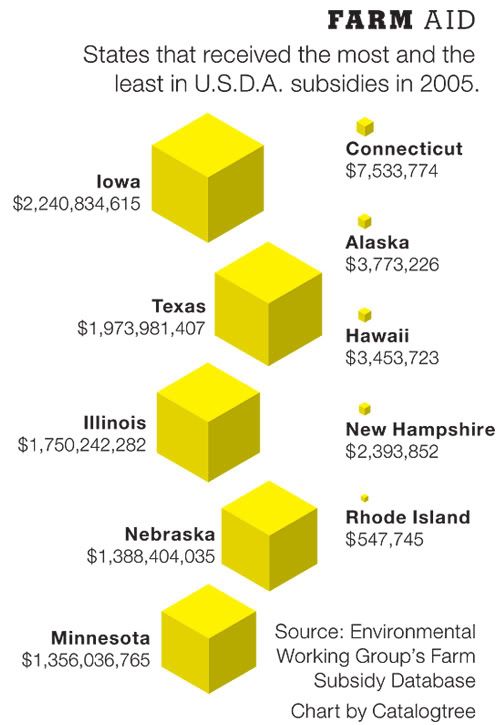
For the answer, you need look no farther than the farm bill. This resolutely unglamorous and head-hurtingly complicated piece of legislation, which comes around roughly every five years and is about to do so again, sets the rules for the American food system — indeed, to a considerable extent, for the world’s food system. Among other things, it determines which crops will be subsidized and which will not, and in the case of the carrot and the Twinkie, the farm bill as currently written offers a lot more support to the cake than to the root. Like most processed foods, the Twinkie is basically a clever arrangement of carbohydrates and fats teased out of corn, soybeans and wheat — three of the five commodity crops that the farm bill supports, to the tune of some $25 billion a year. (Rice and cotton are the others.) For the last several decades — indeed, for about as long as the American waistline has been ballooning — U.S. agricultural policy has been designed in such a way as to promote the overproduction of these five commodities, especially corn and soy.
That’s because the current farm bill helps commodity farmers by cutting them a check based on how many bushels they can grow, rather than, say, by supporting prices and limiting production, as farm bills once did. The result? A food system awash in added sugars (derived from corn) and added fats (derived mainly from soy), as well as dirt-cheap meat and milk (derived from both). By comparison, the farm bill does almost nothing to support farmers growing fresh produce. A result of these policy choices is on stark display in your supermarket, where the real price of fruits and vegetables between 1985 and 2000 increased by nearly 40 percent while the real price of soft drinks (a k a liquid corn) declined by 23 percent. The reason the least healthful calories in the supermarket are the cheapest is that those are the ones the farm bill encourages farmers to grow.
A public-health researcher from Mars might legitimately wonder why a nation faced with what its surgeon general has called “an epidemic” of obesity would at the same time be in the business of subsidizing the production of high-fructose corn syrup. But such is the perversity of the farm bill: the nation’s agricultural policies operate at cross-purposes with its public-health objectives. And the subsidies are only part of the problem. The farm bill helps determine what sort of food your children will have for lunch in school tomorrow. The school-lunch program began at a time when the public-health problem of America’s children was undernourishment, so feeding surplus agricultural commodities to kids seemed like a win-win strategy. Today the problem is overnutrition, but a school lunch lady trying to prepare healthful fresh food is apt to get dinged by U.S.D.A. inspectors for failing to serve enough calories; if she dishes up a lunch that includes chicken nuggets and Tater Tots, however, the inspector smiles and the reimbursements flow. The farm bill essentially treats our children as a human Disposall for all the unhealthful calories that the farm bill has encouraged American farmers to overproduce.
To speak of the farm bill’s influence on the American food system does not begin to describe its full impact — on the environment, on global poverty, even on immigration. By making it possible for American farmers to sell their crops abroad for considerably less than it costs to grow them, the farm bill helps determine the price of corn in Mexico and the price of cotton in Nigeria and therefore whether farmers in those places will survive or be forced off the land, to migrate to the cities — or to the United States. The flow of immigrants north from Mexico since Nafta is inextricably linked to the flow of American corn in the opposite direction, a flood of subsidized grain that the Mexican government estimates has thrown two million Mexican farmers and other agricultural workers off the land since the mid-90s. (More recently, the ethanol boom has led to a spike in corn prices that has left that country reeling from soaring tortilla prices; linking its corn economy to ours has been an unalloyed disaster for Mexico’s eaters as well as its farmers.) You can’t fully comprehend the pressures driving immigration without comprehending what U.S. agricultural policy is doing to rural agriculture in Mexico.
And though we don’t ordinarily think of the farm bill in these terms, few pieces of legislation have as profound an impact on the American landscape and environment. Americans may tell themselves they don’t have a national land-use policy, that the market by and large decides what happens on private property in America, but that’s not exactly true. The smorgasbord of incentives and disincentives built into the farm bill helps decide what happens on nearly half of the private land in America: whether it will be farmed or left wild, whether it will be managed to maximize productivity (and therefore doused with chemicals) or to promote environmental stewardship. The health of the American soil, the purity of its water, the biodiversity and the very look of its landscape owe in no small part to impenetrable titles, programs and formulae buried deep in the farm bill.
Given all this, you would think the farm-bill debate would engage the nation’s political passions every five years, but that hasn’t been the case. If the quintennial antidrama of the “farm bill debate” holds true to form this year, a handful of farm-state legislators will thrash out the mind-numbing details behind closed doors, with virtually nobody else, either in Congress or in the media, paying much attention. Why? Because most of us assume that, true to its name, the farm bill is about “farming,” an increasingly quaint activity that involves no one we know and in which few of us think we have a stake. This leaves our own representatives free to ignore the farm bill, to treat it as a parochial piece of legislation affecting a handful of their Midwestern colleagues. Since we aren’t paying attention, they pay no political price for trading, or even selling, their farm-bill votes. The fact that the bill is deeply encrusted with incomprehensible jargon and prehensile programs dating back to the 1930s makes it almost impossible for the average legislator to understand the bill should he or she try to, much less the average citizen. It’s doubtful this is an accident.
But there are signs this year will be different. The public-health community has come to recognize it can’t hope to address obesity and diabetes without addressing the farm bill. The environmental community recognizes that as long as we have a farm bill that promotes chemical and feedlot agriculture, clean water will remain a pipe dream. The development community has woken up to the fact that global poverty can’t be fought without confronting the ways the farm bill depresses world crop prices. They got a boost from a 2004 ruling by the World Trade Organization that U.S. cotton subsidies are illegal; most observers think that challenges to similar subsidies for corn, soy, wheat or rice would also prevail.
And then there are the eaters, people like you and me, increasingly concerned, if not restive, about the quality of the food on offer in America. A grass-roots social movement is gathering around food issues today, and while it is still somewhat inchoate, the manifestations are everywhere: in local efforts to get vending machines out of the schools and to improve school lunch; in local campaigns to fight feedlots and to force food companies to better the lives of animals in agriculture; in the spectacular growth of the market for organic food and the revival of local food systems. In great and growing numbers, people are voting with their forks for a different sort of food system. But as powerful as the food consumer is — it was that consumer, after all, who built a $15 billion organic-food industry and more than doubled the number of farmer’s markets in the last few years — voting with our forks can advance reform only so far. It can’t, for example, change the fact that the system is rigged to make the most unhealthful calories in the marketplace the only ones the poor can afford. To change that, people will have to vote with their votes as well — which is to say, they will have to wade into the muddy political waters of agricultural policy.
Doing so starts with the recognition that the “farm bill” is a misnomer; in truth, it is a food bill and so needs to be rewritten with the interests of eaters placed first. Yes, there are eaters who think it in their interest that food just be as cheap as possible, no matter how poor the quality. But there are many more who recognize the real cost of artificially cheap food — to their health, to the land, to the animals, to the public purse. At a minimum, these eaters want a bill that aligns agricultural policy with our public-health and environmental values, one with incentives to produce food cleanly, sustainably and humanely. Eaters want a bill that makes the most healthful calories in the supermarket competitive with the least healthful ones. Eaters want a bill that feeds schoolchildren fresh food from local farms rather than processed surplus commodities from far away. Enlightened eaters also recognize their dependence on farmers, which is why they would support a bill that guarantees the people who raise our food not subsidies but fair prices. Why? Because they prefer to live in a country that can still produce its own food and doesn’t hurt the world’s farmers by dumping its surplus crops on their markets.
The devil is in the details, no doubt. Simply eliminating support for farmers won’t solve these problems; overproduction has afflicted agriculture since long before modern subsidies. It will take some imaginative policy making to figure out how to encourage farmers to focus on taking care of the land rather than all-out production, on growing real food for eaters rather than industrial raw materials for food processors and on rebuilding local food economies, which the current farm bill hobbles. But the guiding principle behind an eater’s farm bill could not be more straightforward: it’s one that changes the rules of the game so as to promote the quality of our food (and farming) over and above its quantity.
Such changes are radical only by the standards of past farm bills, which have faithfully reflected the priorities of the agribusiness interests that wrote them. One of these years, the eaters of America are going to demand a place at the table, and we will have the political debate over food policy we need and deserve. This could prove to be that year: the year when the farm bill became a food bill, and the eaters at last had their say.
Sunday, April 22, 2007
| [+/-] |
You Are What You Grow |
Tuesday, April 11, 2006
| [+/-] |
Michael Pollan's "The Omnivore's Dilemma" |
UC Berkeley News reports on journalism professor Michael Pollan's new book on the U.S. food chain, "The Omnivore's Dilemma|A Natural History of Four Meals": Thanks to recent investigative works such as "Fast Food Nation" and "Supersize Me," a growing number of Americans are scrutinizing ingredient labels and asking, What is this stuff? Michael Pollan, Knight Professor of Journalism at UC Berkeley, can tell you. In a just-released new book, he takes readers to the feedlot, to the farm, and into the woods in search of the origins of our dinner. Will we have the nerve to follow? 'You hear plenty of explanations for humanity's expanding waistline, all of them plausible. … But it pays to go a little further, to search for the cause behind the causes. Which, very simply, is this: When food is abundant and cheap, people will eat more of it and get fat.' "I'm not an ayatollah about this stuff, I'm really not. I don't hector people," insists Pollan, who doesn't seem like a food fascist either in the book or in person. Tall and lanky, with a bald promontory of a forehead and a meter-wide grin, he manages to seem simultaneously bookish and outdoorsy. In a sense, he's the journalistic heir to English agronomist and organic agriculture pioneer Sir Albert Howard, who died in 1947: Howard, quotes Pollan, believes we should treat the "whole problem of health in soil, plant, animal, and man as one great subject." What a dollar buys in the average U.S. supermarket: To simplify Pollan's intricate, mesmerizing history drastically, the boom in synthetic fertilizer enabled farmers to grow vast quantities of corn without bankrupting their soil. Corn pushed out pasture-raised cattle and pigs and chickens, as it became more economical to warehouse them together in "Confined Animal Feeding Operations," or CAFOs, and stuff them full of corn. One hitch: the stomachs of cows, one of the few mammals evolutionarily designed to be able to eat grass, can't digest corn. It turns their stomachs acidic and makes them sick. No problem, says the machine: Just pump the cows full of antibiotics, which has the added benefit of making them grow bigger and fatter faster, so they can be slaughtered younger. At least most cattle still live outdoors, Pollan writes, albeit standing ankle-deep in their own excrement. Pigs and chickens, which can digest corn, suffer even more squalid existences, as he describes in the lone section of the book in which outrage can be detected beneath his even-handed tone. Amount of corn-derived carbon present in Pollan's McDonald's family meal, as measured by a mass spectrometer: "Corn is in the coffee whitener and Cheez Whiz, the frozen yogurt and TV dinner, the canned fruit and ketchup and candies, the soups and snacks and cake mixes…everything from the toothpaste and cosmetics to the disposable diapers, trash bags, cleansers, charcoal briquettes, matches, and batteries, right down to the shine of the magazine that catches your eye by the checkout: corn," he writes. "Indeed, even the supermarket itself — the wallboard and joint compound, the petroleum and fiberglass and adhesives out of which the building itself has been built — is in no small measure a manifestation of corn. And us?" Fossil-fuel consumption by agriculture: 20% You see, the American corn diet is really an oil diet. Corn, as Pollan puts it, "is the SUV of plants. Growing it the way we do requires it to guzzle fuel in the form of fertilizer, about a quarter to a third of a gallon of petroleum for each bushel." Processing the corn requires even more energy, as does moving those corn-derived products around the country. A diet based on cheap fossil fuel is rather vulnerable right now, Pollan points out: "If oil gets dramatically more expensive, that will change our food system as much as food policy or consumer choice." Food energy in a 1-pound box of prewashed organic lettuce: 80 calories Long before it became a USDA label — and a permission slip to charge more at the cash register — "organic" was a philosophy. The word "organic," Pollan writes, was chosen in 1942 by J.I. Rodale, the founding editor of "Organic Gardening and Farming" magazine, to emphasize that nature, not a machine, is the proper model for agriculture. Machine vs. Organism: Two ways of looking at the food chain In the second half of "The Omnivore's Dilemma," Pollan leaves the supermarket behind and goes back to the land: to a small farm in Virginia, and to the California hills to hunt wild pigs and mushrooms. On Joel Salatin's Polyface Farm, he learns how intensively grazing cattle on grass — moving them daily and following them with chickens, then pigs — can actually end up producing more topsoil and more fertility than was there before. In effect, "there can be a free lunch in nature," Pollan marvels, one powered by free solar energy captured by grass. Further reading:
"Imagine for a moment if we once again knew, strictly as a matter of course, these few unremarkable things: What it is we're eating. Where it came from. How it found its way to our table. And what, in a true accounting, it really cost," writes Pollan in "The Omnivore's Dilemma: A Natural History of Four Meals."
By the time readers reach this passage, which comes at the very end of the book, they will be able to answer at length. They will have tagged along as Pollan traces the path from earth to plate taken by four meals — from McDonald's, Whole Foods, a small Virginia farm, and a "first person" dinner that he killed, foraged, and grew himself. Pollan is a genial tour guide through a variety of disciplines. Along the way to his main destinations — the feedlot where "his" steer is being fattened, the vast facility where organic baby lettuces are being washed and bagged, the pasture in which chickens joyfully root through cow manure, or the forest where he is helping to disembowel a wild boar he has just shot — he delivers fascinating mini-lectures on agricultural history, plant biology, food chemistry, nutrition, and the animal-rights debate.
Readers of "The Omnivore's Dilemma" will learn that the bulk of the American diet comes from one plant: corn. Grown on massive farms, oceans' worth of the golden kernels and green stalks are then processed, deconstructed, and reassembled in factories into everything from a Chicken McNugget to salad dressing. We eat so much corn that, biologically speaking, most Americans are corn on two legs.
Berkeley residents and other health-conscious readers who are right now comforting themselves with the thought, "But I don't eat that stuff; I shop at Whole Foods," will learn some things about the label "organic" that will forever affect, for example, how they look at Rosie the Organic Chicken. And no reader, meanwhile, will be able to ignore any longer the fact that America's seemingly endless supply of cheap food, whether grown industrially or organically, "is floating on a sinking sea of petroleum."
Do Americans really want to know what we're eating? That's the central gamble of Pollan's book. Are we disturbed enough by mad-cow disease, E. coli outbreaks, mercury levels, and reports like last week's New York Times story on arsenic levels in chicken to look, as the old saying goes, at how the sausage is made?
Or do we just desperately want someone trustworthy to answer the question that kicks off "The Omnivore's Dilemma": "What should we have for dinner?" To tell us, once and for all, fats or carbs, McDonald's or Whole Foods, steak or tofu, sugar or high fructose corn syrup or aspartame? Such are the decisions underpinning the "omnivore's dilemma" of Pollan's title.
If you're hoping that Pollan will put an end to our food anxiety by just telling us what to eat, forget it. "I don't think it's a journalist's job to issue shopping lists or policy descriptions," Pollan explains over lunch. "We're supposed to show people how the world is, to give them the tools they need to make good decisions as citizens or consumers. Depending on what your values are — the environment, your health, animal welfare — the answers are going to be different for every person."
Defying the bread fatwa
Here's yet another tough question: Where should one take Michael Pollan for lunch? He agrees to meet at Phoenix Next Door, a few blocks from his office at the Graduate School of Journalism, which he had not yet tried since moving to Berkeley from Connecticut in 2003. For the curious, we both had the spaghetti, housemade with organic, local ingredients and topped with a spicy ragú of "naturally raised" beef, lamb, and pork. However, when ordering, neither of us asked what "naturally raised" entailed, although we both admitted later that we usually would have.
-Michael Pollan, writing in "The Omnivore's Dilemma"
"The Omnivore's Dilemma" grew out of the final section of Pollan's best-selling last book, "The Botany of Desire," which looked at apples, tulips, cannabis, and genetically modified potatoes from the evolutionary point of view of the plants. The potato chapter "was the first time I really learned how we grow food in this country," he explains. "I'd been to little hobby farms, but I hadn't seen a 10,000-acre, monoculture potato field, where the soil has been absolutely sterilized, so doused with pesticides that people can't even go into it for four days."
The other catalyst was the moment in the fall of 2002 when Americans en masse foreswore bread for bacon and embraced the Atkins diet. "All of a sudden we completely flopped the identity of good and evil in the diet we'd been eating since 1977. Carbohydrates, not fat, became the enemy," marvels Pollan. "That said to me that this is a nation with an eating disorder."
Children of the corn
The four meals in "Omnivore" — call them Industrial, Big Organic, Pastoral, and Hunter-Gatherer — seem very different, but they can be plotted on a continuum between two ways of looking at the food chain: as a machine, or as a living organism.
In Industrial, the most mechanical of the four, inputs of patented seeds and fossil energy are converted into outputs of carbohydrates and protein. This machine became truly turbocharged in 1947, Pollan writes, when the U.S. government had a huge postwar surplus of ammonium nitrate (the main ingredient in making explosives). Ammonium, it had been known for some time, is an excellent source of nitrogen for plants, which helps them convert sunlight into carbohydrates. So the government instructed an Alabama munitions plant to make chemical fertilizer from its bomb material, and modern-day fertilizer was born. (Similarly, modern pesticides were derived from poison gases first developed for wartime use.)
1,200 calories of potato chips and cookies, vs. 250 calories of carrots; 875 calories of soda, vs. 170 calories of fruit juice from concentrate.
The Industrial machine has been fine-tuned to produce vast quantities of processed cheap food. But its cheapness is deceptive. Corn, a farmer tells Pollan disdainfully, is the "welfare queen of crops." Every bushel of corn currently enjoys a 50-cent subsidy from the U.S. government, the result of a spike in food prices in the early 1970s that caused the Nixon administration to switch free-market tactics. "We've been supporting agriculture since the Depression, but we've changed the way you do it — from essentially supporting the farmers to supporting the crop," says Pollan.
Supporting the crop means supporting agribusiness, which leverages cheap ingredients into high profits. Corn is cheaper than sugar, so high fructose corn syrup replaced it as sweetener in sodas in the 1980s, and in just about everything else ever since. Corn stripped to its building blocks and reassembled is now the source for most food additives, from sweeteners to stabilizers to artificial colors and preservatives. In one of the book's most jaw-dropping statistics, Pollan writes that more than a quarter of the 45,000 items in an average American supermarket contain corn.
Soda, 100%; milk shake, 78%; salad dressing, 65%; chicken nuggets, 56%; cheeseburger, 52%; and French fries, 23%.
Yup — we're corn chips in clothes. Pollan confirmed this using a mass spectrometer operated by UC Berkeley colleague Todd Dawson. (Carbon derived from corn has a special marker that can be tracked and measured.) The McDonald's meal that the Pollan family consumed in the car for Omnivore Meal No. 1 might have looked like a hamburger, chicken nuggets, and a salad, but it was engineered overwhelmingly from corn…representing enough bushels to overflow the trunk, he calculates.
Getting out of the maize
OK. Americans are as corny as they come. So what?
"To start, it's a problem from a health point of view," says Pollan, explaining cheerfully that as omnivores, humans need about 50 different molecules and atoms — amino acids, minerals, phytochemicals, fat, sugar, etc. "A lot of people eating a fast-food diet — not just the drive-through kind, but also microwaveable and other prepackaged meals – are malnourished." Another UC Berkeley colleague, biochemistry professor Bruce Ames, is studying obese California children who have rickets, a deficiency traditionally associated with starvation. "By eating from one very narrow cut of nature's bounty, you're not going to get all the nutrients you need. We need to eat at least 10 plants to get those 50 nutrients."
Other, bigger hidden costs are also associated with corn-based cheap food. "We pay with our taxes, because it takes heavy, heavy government subsidies to produce food that cheaply," he says. "We pay with the public health system, with failing antibiotics [whose overuse in cattle has given rise to new antibiotic-resistant strains of 'super-bugs']. We pay with the miles-wide dead zone in the Gulf of Mexico [caused by nitrate-dense agricultural runoff carried out by the Mississippi River]. We pay by having to defend our high-energy food system by fighting wars in the Middle East."
Distance average item of food travels to your plate: 1,500 miles
"Once upon a time there was a happy cow…"
If industrial agriculture has turned nature into an oil-slurping machine, then surely organic agriculture, which treats the food chain more like a living organism, is better, right?
Well…as with many things in "The Omnivore's Dilemma," the answer is a little more complicated than those cartoon labels of "happy cows" frolicking on pesticide-free grass, or stories about "free-range vegetarian" chickens on egg cartons, would have us believe. Pollan calls these labels and similar conscience-appeal marketing "Supermarket Pastoral." He might as well call them fairy tales. Under his scrutiny, they hold up "about as well as you would expect anything genuinely pastoral to hold up in the belly of an $11 billion industry, which is to say not very well at all."
Fossil-fuel energy spent growing, chilling, washing, packaging, and transporting box of lettuce from California to East Coast:
More than 4,600 calories
Several decades and several food scares after "Silent Spring" and "Diet for a Small Planet" gave birth to the '60s organic movement, "organic" is now a very big tent. Under this tent are some very strange beasts, such as organic feedlots and organic high fructose corn syrup. Big Organic, represented by the companies able to supply Whole Foods and Fresh Fields outlets all around the country, has more in common with Industrial than with the quaint red barns pictured on their labels, says Pollan. (Those barns can only be honestly claimed by Pastoral, the small local farms that may or may not be organically certified, but do a much better job of mimicking nature's way of producing food.)
Grimmway and Cal-Organic, two of California's biggest organic vegetable suppliers, were started by conventional growers looking for a more profitable niche and concerned that their preferred pesticides were about to be banned by California. Horizon, the top supplier of organic milk, is owned by Dean Foods, the largest conventional milk bottler in the country; Horizon's "happy cows" rarely encounter a blade of grass, writes Pollan. Instead of gamboling in the pastures, most of them stand around in a dry lot "tethered to milking machines three times a day."
And Rosie the Organic Chicken? She lives in one of several low, football-field-sized sheds in Petaluma, Cal., with 20,000 other chickens, sipping water from tubes and eating organic corn and other feed from elevated trays. Pollan made two separate visits, wearing a special HazMat-type suit to prevent spreading infection in the crowded quarters (the birds cannot be treated with antibiotics then sold as organic). Not a single chicken ventured out one of the shed's two doors to the outside while he was there. "I think the 'free range' conecept is for our benefit," he concludes.
Right about now, many readers are probably despairing. (I was.) Pollan sympathizes: "People say, 'Now you're telling me organic is not what I thought?' There is this feeling that's it's too complicated, it's too hard. But ethical choices are hard. We like it when Whole Foods comes along and says, 'It's OK. Just shop here; we've checked everything out for you.' But have they really? You can buy farmed Atlantic salmon at the Whole Foods right here in Berkeley — one of the least sustainable foods out there."
Out to pasture
• Industrial vs. pastoral
• Annual species vs. perennial species
• Monoculture vs. polyculture
• Fossil energy vs. solar energy
• Global market vs. local market
• Specialized vs. diversified
• Mechanical vs. biological
• Imported fertility vs. local fertility
• Myriad inputs vs. chicken feed
—"The Omnivore's Dilemma"
Compared to Industrial and Big Organic, this poster child for Pastoral food is extremely labor intensive. Intentionally, it would never scale to an industrial level. Which means farms like it are few and far between; Pollan knows of no California counterpart. Since Salatin is not willing to ship his food out of state, as that would violate the principles of sustainability, most readers will never taste a meal raised quite as sustainably and ethically. Nor is the average reader likely to be able to enjoy a meal like Pollan's fourth, which he hunted (wild boar), foraged (wild mushrooms, Bing cherries, and yeast for the bread), or grew (lettuce, herbs) almost entirely himself.
So in the end, we've come full circle. What should we have for dinner, darn it? Knowing what we know, how do we navigate the sea of choices, all of which seem to be ethically compromised in some way?
"I hope the answer is not 'Ugh, this is just too complicated, I give up,'" says Pollan mock-wearily. "The answer is to figure out what your values are. You care about the environment? There's a certain way to eat. If you care about our dependence on oil, there's a certain way to eat. If you care about pesticides and your health, then going to Whole Foods will pretty much take care of you. If you care about the animals, there's another set of labels to look for."
Pollan's section on animal rights and vegetarianism, by the way, makes for very thought-provoking reading. He concludes that it's not the principle of eating animals that's wrong, but the practice: the manner in which most cows, pigs, and chickens are raised for food in this country is truly abhorrent. Healthier and more humane options do exist that are better for the animal, for our health, and for the planet. (Pollan is pretty persuasive on the ecological havoc that would be wreaked if we all became vegetarian.) "You can buy grass-fed beef right here at Berkeley Bowl. And I still buy Rosie's. I saw it, and I still eat it," offers Pollan. "Rosie chickens are not leading idyllic chicken lives, but I don’t think they're suffering" — they're not debeaked or as overcrowded as conventional birds, nor are they eating rendered chicken parts or reconstituted manure.
Ultimately, it's about incremental improvements. "I'm a half-a-loaf guy. You take it as far as you can, and inevitably you make compromises," he says. "We get three votes a day, actually more, when we eat. If we cast some of those votes with full consciousness of what's involved, and try to make better choices — which might entail spending more money or going out of our way — then that will help create the food chain we want."
He shrugs: "I'm sorry it's not easier, but it's also not that hard." And with that, Michael Pollan picks up a piece of bread and polishes off the last tasty bits of sauce from his lunch. "Mmm. This was really good."
Introduction and first chapter of "The Omnivore's Dilemma" (PDF)
Other excerpts from the book published in the New York Times Magazine
"New organic dining option a first for U.S. campuses," UC Berkeley press release, April 3, 2006
"A beacon for other businesses: Berkeley alum Daryl Ross takes budget organic mainstream," UC Berkeley NewsCenter, August 23, 2005
"Q&A: A conversation with Michael Pollan," California Monthly, December 2004
"Journalism School's Michael Pollan has a beef with McDonald's antibiotics announcement," NewsCenter, July 1, 2003
"Factory food and its consequences: These food writers don’t hype restaurants or counsel recipe-clippers — they’re too busy challenging the underpinnings of our industrial diet," The Berkeleyan, October 2, 2002
Friday, December 30, 2005
| [+/-] |
We Are What We Eat |
Michael Pollan writes:
If you are what you eat, and especially if you eat industrial food, as 99 percent of Americans do, what you are is corn. During the last year I've been following a bushel of corn through the industrial food system. What I keep finding in case after case, if you follow the food back to the farm — if you follow the nutrients, if you follow the carbon — you end up in a corn field in Iowa, over and over and over again.
Take a typical fast food meal. Corn is the sweetener in the soda. It's in the corn-fed beef Big Mac patty, and in the high-fructose syrup in the bun, and in the secret sauce. Slim Jims are full of corn syrup, dextrose, cornstarch, and a great many additives. The “four different fuels” in a Lunchables meal, are all essentially corn-based. The chicken nugget—including feed for the chicken, fillers, binders, coating, and dipping sauce—is all corn. The french fries are made from potatoes, but odds are they're fried in corn oil, the source of 50 percent of their calories. Even the salads at McDonald's are full of high-fructose corn syrup and thickeners made from corn.
Corn is the keystone species of the industrial food system, along with its sidekick, soybeans, with which it shares a rotation on most of the farms in the Midwest. I'm really talking about cheap corn — overproduced, subsidized, industrial corn — the biggest legal cash crop in America. Eighty million acres — an area twice the size of New York State — is blanketed by a vast corn monoculture like a second great American lawn.
I believe very strongly that our overproduction of cheap grain in general, and corn in particular, has a lot to do with the fact that three-fifths of Americans are now overweight. The obesity crisis is complicated in some ways, but it's very simple in another way. Basically, Americans are on average eating 200 more calories a day than they were in the 1970s. If you do that and don't get correspondingly more exercise, you're going to get a lot fatter. Many demographers are predicting that this is the first generation of Americans whose life span may be shorter than their parents'. The reason for that is obesity, essentially, and diabetes specifically.
Where do those calories come from? Except for seafood, all our calories come from the farm. Compared with the mid-to-late 1970s, American farms are producing 500 more calories of food a day per American. We're managing to pack away 200 of them, which is pretty heroic on our part. A lot of the rest is being dumped overseas, or wasted, or burned in our cars. (That's really how we're trying to get rid of it now: in ethanol. The problem is that it takes almost as much, or even more, energy to make a gallon of ethanol than you get from that ethanol. People think it's a very green fuel, but the process for making it is not green at all.)
Overproduction sooner or later leads to overconsumption, because we’re very good at figuring out how to turn surpluses into inexpensive, portable new products. Our cheap, value-added, portable corn commodity is corn sweetener, specifically high-fructose corn syrup. But we also dispose of overproduction in corn-fed beef, pork, and chicken. And now we're even teaching salmon to eat corn, because there's so much of it to get rid of.
There is a powerful industrial logic at work here, the logic of processing. We discovered that corn is this big, fat packet of starch that can be broken down into almost any basic organic molecules and reassembled as sweeteners and many other food additives. Of the 37 ingredients in chicken nuggets, something like 30 are made, directly or indirectly, from corn.
Now, how do you get people to eat so much of this reengineered surplus corn? That took the ingenuity of American marketing. One example is supersizing. When I was a kid, Coke came in these lovely little eight-ounce glass containers. Today, a 20-ounce container is the standard size for soda. The idea that you could sell soda that way was an invention. It has a history, and you can find the individual responsible, an ingenious movie theater manager named David Wallerstein, who invented the idea of supersizing and sold it to Ray Kroc, founder of McDonald's.
Before you go out and sue McDonald's over the size of your waistline, consider that overproduction of cheap corn is government policy. It's done in the name of the public interest, using our taxpayer dollars. American taxpayers subsidize every bushel of industrial corn produced in this country, at a cost of some four billion dollars a year (out of a total of 19 billion dollars in direct payments to farmers).
But before you blame subsidies for all these problems keep in mind that agricultural overproduction is an ancient problem that long predates subsidies. In any other business, when the price of the commodity you're selling falls, the smart thing to do is to curtail production until demand raises prices. But farmers don't do that, because there are so many of them, and because they all operate as individuals, without any coordination. So when prices fall farmers actually expand production, in order to keep their cash flow from falling. This economically and environmentally disastrous phenomenon has resulted in an increase in the American corn harvest from four billion to ten billion bushels since the 1970s.
How do we begin to change this system? First, we all need to begin to pay attention to the Farm Bill, working to develop farm programs that allow farmers to stay in business without falling into the trap of overproduction. Most city people don't realize the stake they have in it. They assume it's a parochial concern of members of Congress from farm states, but it's not. If it were called the Food Bill, I think we would all pay a lot more attention to it, and get a saner result. The Farm Bill sets out the rules of the game that everyone is playing in, whether you're an industrial or an organic farmer, whether you're eating industrially or not.
The other thing we can do is become responsible consumers. I’ve never liked the word "consumer." It sounds like a character who’s using up the world, rather than creating anything. I was at a gathering in Italy last October where Carlos Petrini, the founder and president of Slow Food International, offered a wonderful redefinition of the word. He called the consumer a “cocreator.” I think that’s exactly right, and we’ve seen why: with the organic movement, consumers and farmers have shown how they can work together as cocreators of an alternative food system. We need to join together now, to recruit a larger and larger army of cocreators, to rewrite the rules of the game — and “cocreate” a different kind of food system.
Friday, October 1, 2004
| [+/-] |
The Cheapest Calories Make You The Fattest |
Sierra Club interview with Michael Pollan:
Why are Americans so fat? According to Michael Pollan, it's not just supersized portions and sedentary lifestyles that make obesity the second-highest cause of preventable death in the United States. It's corn.
When exploring the causes of the obesity epidemic, Pollan, a contributing editor to the New York Times Magazine and proponent of "food-chain journalism," focused on the subsidized overproduction of corn. One result is a surfeit of high-fructose corn syrup, which accounts for 20 percent of the daily calories of many children.
Our dependence on maize, he explains, is an environmental problem as much as a public-health one: "Modern corn hybrids are the greediest of plants, demanding more nitrogen fertilizers than any other crop. Runoff from these chemicals finds its way into groundwater and into the Mississippi River and the Gulf of Mexico, where it has already killed off marine life in a 12,000-square-mile area."
Pollan's best-selling book, The Botany of Desire, was published in 2001. He teaches writing at the University of California at Berkeley Graduate School of Journalism.
Sierra: How has your work influenced your eating habits?
Pollan: When you learn about the industrial food system, certain foods become unappetizing. Now that I know how supermarket meat is made, I regard eating it as a somewhat risky proposition. I know how those animals live and what's on their hides when they go to slaughter, so I don't buy industrial meat. I won't say I don't ever eat it because I don't reject things people serve to me; I respect the host-guest relationship, to the point that it can override my environmental ethic or sense of personal safety.
At home I serve the kind of food I know the story behind. My work has also motivated me to put a lot of time into seeking out good food and to spend more money on it. It's a worthwhile thing to do from a selfish point of view--it's invariably fresher, better food--as well as from an altruistic point of view.
Sierra: It doesn't seem to be making you fat.
Pollan: High-quality food is better for your health. When you go to the grocery store, you find that the cheapest calories are the ones that are going to make you the fattest--the added sugars and fats in processed foods. The correlation between poverty and obesity can be traced to agricultural policies and subsidies.
Corn is an efficient way to get energy calories off the land and soybeans are an efficient way of getting protein off the land, so we've designed a food system that produces a lot of cheap corn and soybeans resulting in a lot of cheap fast food. The added sugar in our diet is coming from corn, and the added fat is coming partly from corn but mostly from soybean oil. Everything at McDonald's is, in some shape or form, a product of corn and/or soybeans.
Sierra: Both of those crops are now widely grown in genetically modified versions. Do they provide any benefits?
Pollan: Genetically modified organisms are a tool, and tools help you do what you want to do. So what is it we want to do? We need to stop spraying so much pesticide. Are GMOs the only way to do that? No. There are other ways: We can plant a polyculture instead of a monoculture, for instance. But Monsanto doesn't like that strategy because it wants to sell as much of its product as possible. So far, GMOs have mainly been a way to sell more Roundup herbicide.
The first generation of GMO products offered the consumer nothing. The food was not cheaper, and it was still grown with pesticides--and in some cases required even more pesticides. In the late 1990s, the companies told me about this second generation of products that was going to provide superior nutrition. Where are they?
We still have the same crops that were rolled out in 1996. It suggests that either the capital to do research and development is drying up, or they've found it's harder than they thought to make these more complex products work. Either way, the industry is on the ropes. I don't think in ten years we'll be talking about GMOs. I can easily see the industry withering away.
Sierra: Can corporate agriculture be reformed?
Pollan: There already has been reform. Perhaps more than any other, the food industry is very sensitive to consumer demand. Every major food company now has an organic division. There's more capital going into organic agriculture than ever before. If consumers make good choices, the industry will respond. Will it be everything we hope? Probably not.
They didn't come up with organic, after all. That came from small farmers and consumers working together in relative obscurity. We need to sustain a noncorporate food chain to serve as the antennae for culture and agriculture. Whatever works will be picked up by the larger companies.
Sierra: You've expressed mixed feelings, though, about large food corporations jumping on the organic bandwagon.
Pollan: It's a very mixed bag. If you have organic Coca-Cola you're still feeding people junk and making them fat. Additionally, the high-fructose corn syrup used in it would still probably come from a monoculture of corn. When you go to monoculture you've got huge problems with pests, weeds, and pathogens, so you'd become very dependent on organic pesticides and fertilizers. On the other hand, if thousands of acres of corn in America will no longer be sprayed with the notorious herbicide atrazine, that is a good thing.
The answer to either/or questions is "both": We need corporate organic and we need true organic. When Wal-Mart and McDonald's start selling organic food, it will drive down the price to farmers and risk growing a new monoculture. On the other hand, the whole country will be educated about the virtues of eating organic food. So the center will move, which is how change always comes to this country.
When the choice comes down to industrial organic or local, I opt for the local, because it supports much more than good agricultural practice. It also tends to support polyculture, since local farms are usually diversified, and it helps to stop suburban sprawl by keeping small farms in business.
Sierra: That sounds like the "Slow Food" movement.
Pollan: People in Slow Food understand that food is an environmental issue. They're interested in the biodiversity of crop plants and food animals, and understand that the culture surrounding food is vitally important, just getting people to sit down together for meals and eat as families. Why don't we pay more attention to who our farmers are? We would never be as careless choosing an auto mechanic or a babysitter as we are about who grows our food. Slow Food is nurturing a culture that demands that information.
There's been progress toward seeing that nature and culture are not opposing terms, and that wilderness is not the only kind of landscape for environmentalists to concern themselves with. That's very encouraging for someone whose stock-in-trade is ideas. It's heartening to see that these conversations, this sort of writing, can have an effect on how people look at, and decide what to do with, a piece of land. I have had the good fortune to see how my articles have directly benefited some farmers and helped build markets for their products in a way that preserves land from development. That makes me a hopeless optimist.
Thursday, October 31, 2002
| [+/-] |
When Corn Is King |
The ubiquitous vegetable is wreaking havoc on everything from public health to foreign policy, argues writer Michael Pollan
The Christian Science Monitor reports:
Food may well be one of the biggest stories of the new century.
Witness the extensive news coverage of mad cow disease and E.coli contamination, and the controversies over growth hormones and genetic engineering. Modern-day Upton Sinclairs like Eric Schlossinger have given us exposés on the beef and fast-food industries. And the organic revolution has reached adulthood, with its coming out party on the cover of Newsweek last month.
So important has the food story become that the Graduate School of Journalism at the University of California, Berkeley, recently invited scientists, farmers, and government officials to talk to journalists about industrial food production, food-borne pathogens, and other issues in food writing.
Among those panelists was Michael Pollan – well-known for his groundbreaking books that explore the relationship between humans and nature. In "The Botany of Desire," Mr. Pollan looks at his garden in Connecticut and sees scheming arugula and plotting asparagus. We humans might think we control our agriculture and engineer our environment, but Pollan argues that plants use us as much as we use them. He follows the trail of the apple and the tulip to show how they cleverly manipulated American frontiersmen and Dutch merchants to extend their domain.
One plant has gone too far, however, according to the author. Pollan accuses corn of wreaking havoc on everything from public health to foreign policy.
Corn's place in the US economy is secure, judging by Congress's approval this spring of an unprecedented $190 billion farm-subsidy package. One of its largest beneficiaries was corn growers.
In an interview, Pollan talked about why he says that this brazen vegetable is calling the shots.
What exactly led you to corn?
When you see that a plant has taken over – like grasses and lawns, and like corn – it has somehow manipulated us. We're doing its evolutionary job, spreading it around, because it's made itself attractive to us. Corn is like this second great American lawn – I mean miles and miles of it, all through the Midwest, and even where I live in Connecticut. This plant is so successful. And the productivity of corn is astonishing. The reason is that it responds very well to fertilizer. We've gotten the yield per acre from 20 bushels a hundred years ago to 160 now.
Why is the productivity of corn a problem?
We're producing way too much corn. So, we make corn sweeteners. High-fructose corn sweeteners are everywhere. They've completely replaced sugar in sodas and soft drinks. They make sweet things cheaper. We also give it to animals. Corn explains everything about the cattle industry. It explains why we have to give [cattle] antibiotics, because corn doesn't agree with their digestive system. It explains why we have this E.coli 0157 problem, because the corn acidifies their digestive system in such a way that these bacteria can survive.
And we subsidize this overproduction. We structure the subsidies to make corn very, very cheap, which encourages farmers to plant more and more to make the same amount of money. The argument is that it helps us compete internationally. The great beneficiaries are the processors that are using corn domestically. We're subsidizing obesity. We're subsidizing the food-safety problems associated with feedlot beef. It's an absolutely irrational system. The people who worry about public health don't have any control over agricultural subsidies. The USDA is not thinking about public health. The USDA is thinking about getting rid of corn. And, helping [businesses] to be able to make their products more cheaply – whether it's beef or high-fructose corn syrup. Agribusiness gives an immense amount of funding to Congress.
What about corn growers?
To pull out of that system for them is very hard. It depends on where they live. They should be diversifying and growing other things, niche crops, and getting away from commodities. It's very hard to compete with agricultural commodities. Somebody [at the Berkeley conference] said that 40 percent of farm income is represented by subsidies. Say the farmer could make more money doing strawberries. There's no subsidy for that. So he's taking an enormous risk, and he's giving up for all time his corn subsidy.
What about economies of scale? We've been able to feed more people, democratize meat.
I don't know if democratizing beef is a good thing. The industry can always make the popular arguments, because they certainly make things cheaper. But is it really cheap? Think of the taxpayer, who's actually subsidizing every one of those burgers. All that corn requires an immense amount of fossil fuel. Corn requires more fertilizers and pesticides than other crops. It takes the equivalent of half a gallon of gasoline to grow every bushel of corn. [Almost] everything we do to protect our oil supply ... is a cost of that burger.
And then there are the health costs. It's not really good for us. Corn-fed beef has much more saturated fat. So, yeah, it's cheap, if you only look at the price tag.
You talked about how you were encouraged by the idea of engineering corn so it could be a perennial.
I have no problem with interfering with nature. We live in places where we can only live by changing the environment. This is the human condition, and I don't think that's bad. It's working with nature. It's taking the prairie and figuring out a way to get food out of [it] without having to plow, without having to break the sod. If you could make corn and wheat and rice perennials rather than annuals, you would just come and mow it, and get your food that way, instead of having to tear it up every year. That could help end world hunger.
Many people read your book and think of ... Thoreau.
Like him, I'm interested in looking at my relationship with the natural world, and doing it in my backyard rather than wandering around in Yosemite or the Amazon. And he used his everyday experiences to explore his connections to the much larger world. However, I see us as having much more participation in the natural world. I don't have as much of a sense of opposition between nature and culture. At this point, I think we have more to learn by looking at the working landscape: farms and gardens. I think we have said all we can say about the 8 percent of this country that's untouched. It's still very important. However, there is this other 92 percent. We need models of how to take care of that.
You talk about ending our love affair with the lawn.
I call it in my first book a totalitarian landscape. You have wilderness on one side and the lawn on the other end. I don't think you choose between them. You work on that middle answer. Even though we think we are subjugating those lawns, we're probably doing exactly what they want us to do. Because, if you're a lawn, what do you want? You want some creature to come along every week and mow you so the trees won't come back. So, in fact we're dupes of our lawns.
Do you have any corn in your garden?
Not this year. I have a big raccoon problem. As soon as the corn gets ripe, they come in and steal it. So I guess corn isn't winning in every way. But it may be in the corn's interest to have a raccoon eat it, because they're so wasteful. They leave more seed around.
There's corn in that?
• Of 10,000 items in a typical grocery store, at least 2,500 use corn in some form during production or processing.
• Your bacon and egg breakfast, glass of milk at lunch, or hamburger for supper were all produced with US corn.
• Besides food for human and livestock consumption, corn is used in paint, paper products, cosmetics, tires, fuel, plastics, textiles, explosives, and wallboard – among other things.
• In the US, corn leads all other crops in value and volume of production – more than double that of any other crop.
• Corn is America's chief crop export, with total bushels exported exceeding total bushels used domestically for food, seed, and industrial purposes.
Sources: www.campsilos.org; www.public.iastate.edu; www.ontariocorn.org
Tuesday, April 30, 2002
| [+/-] |
Modern Meat |
Have the dramatic changes in the U.S. meat industry compromised the safety of America's beef? ...[Cows] can take this grass which we can't digest, very few creatures can digest, and turn it into [fuel]. What is so amazing about that? Pollan, a former editor at Harper's Magazine, is the author of The Botany of Desire and several other books that examine the intersections between science and culture. Here, he talks about his experience as a small-scale rancher and his decision to buy a cow and track its journey through the cattle system for The New York Times Magazine. He also discusses the widespread use of antibiotics in the meat industry, and why he thinks the system is fragile and susceptible to microbes and pathogens. What do you mean? You could not crowd animals into these feedlots or feed them this highly concentrated ration without giving them antibiotics. But the antibiotics, in turn, lead to resistance; resistant microbes that then come and infect us. So most people think of a cow as something that's out grazing, and then is taken to the slaughterhouse.
Frontline interviews Michael Pollan:
Well, a cow out on grass is just an incredible thing to behold. ... Cows and other ruminants can do things we just can't do. They have the most highly evolved digestive organ on the planet, called the rumen. And the rumen can digest grass. It takes grass, cellulose in grass, and turns it into protein, very nutritious protein.
We can't do that. We can't digest grass. So to take land that is not good enough for agriculture -- that's growing grass and nothing else, that's been doing that for 10,000 years since the buffalo -- and put a cow on it ... there's something beautiful about that, and it's just the way it was meant to be.
And I went into this story [for the New York Times] thinking, "Well, that's how we get meat." But alas, it's not true.
By the time a modern American beef cow is six months old, it has seen its last blade of grass for the rest of its life. As soon as they wean, they spend the first six months out on the pasture with their moms, nursing, nibbling grass. The mom is converting the grass's protein that's turning into milk for the animal, doing the way they've done it for millions of years. We take them off grass. We put them in pens, called backgrounding pens, and we teach them how to eat something that they are not evolved to eat, which is grain, and mostly corn.
Why do we do this? Well, it's a very good question, because it makes absolutely no sense from an ecological standpoint. From a financial standpoint, it does. It makes them grow much more quickly. It makes them get fat, and we like our meat really fat and marbled. And it allows us to speed up the lifespan. In capitalism, time is money.
We're taking cows that we used to let grow to be four or five years old before we eat them [and] we've got it down to 14 months, and we're heading toward 11 months. What allows us to do this is getting them [on] corn, getting them off this whole evolutionary relationship they've had with grass....
...No, not true. Cows see very little grass nowadays in their lives. They get them on corn as fast as they can, which speeds up their lifespan, gets them really fat, and allows you to slaughter them within 14 months.
The problem with this system, or one of the problems with this system, is that cows are not evolved to digest corn. It creates all sorts of problems for them. The rumen is designed for grass. And corn is just too rich, too starchy. So as soon as you introduce corn, the animal is liable to get sick.
It creates a whole [host] of changes to the animal. So you have to essentially teach them how to eat corn. You teach their bodies to adjust. And this is done in something called the backgrounding pen at the ranch, which is kind of the prep school for the feedlot. Here's where you teach them how to eat corn.
You start giving them antibiotics, because as soon as you give them corn, you've disturbed their digestion, and they're apt to get sick, so you then have to give them drugs. That's how you get in this whole cycle of drugs and meat. By feeding them what they're not equipped to eat well, we then go down this path of technological fixes, and the first is the antibiotics. Once they start eating the [corn], they're more vulnerable. They're stressed, so they're more vulnerable to all the different diseases cows get. But specifically they get bloat, which is just a horrible thing to happen. They stop ruminating.
You have the image of a cow on grass of the cow ruminating, which is chewing its cud and burping a lot. In fact, a lot of greenhouse gases come out of the stock as methane emerges from their mouth as they eructate -- it's a technical term. And they bring down saliva in this process, and it keeps their stomach very base rather than acid.
So you put in the corn, and this layer of slime forms over the rumen. You've got to picture the rumen. It's a 45-gallon fermentation tank. It's essentially fermenting the grass. Suddenly your slime forms and the gas can't escape, and the rumen just expands like a balloon. It's pressing against the lungs and the heart, and if nothing is done, the animal suffocates.
So what is done is, if you catch it in time, you stick a hose down the esophagus and you release the gas and maybe give the animal some hay or grass, and it's a lot healthier. But it's one of the things that happens to cows on corn. ...
Not all cows get bloat. They're prone to bloat. It's a serious problem on feedlots. They also get acidosis, which is an acidifying of the rumen. ... And when the animals get acid stomach, it's a really bad case of heartburn, and they go off their feed. Eventually, if you give them too much corn too quickly, it ulcerates the rumen; bacteria escape from the rumen into the blood stream, and end up in the liver, creating liver abscesses.
What do we do about that? Another antibiotic. ... Most cows on feedlots eating this rich diet of corn are prone to having their livers damaged. So to prevent that, or limit the incidence of liver disease, we have to give them another antibiotic.
We spoke with a guy, Bill Haw, who runs a lot of these big feedlots. I asked him about the livers. And he said, "We've learned that the livers are not very economically viable, and there's a willingness to sacrifice the liver for the overall growth, which far transcends the value of the liver that may be damaged in the process." What's he saying?
He's saying that the economic calculus justifies ruining their liver. ... The fact is, we don't eat a lot of beef liver any more. So the fact that you have to throw out a significant percentage of the liver -- I've heard between 15 percent to 30 percent of the livers are too abscessed for people to eat -- it's worth it. ...
But that's a symptom. ... It means you have a sick cow. When your liver fails, other things fail. It's simply a symptom of a sick animal. So we try to treat [it] as best we can, but we tolerate it.
I've talked to many people who've said that if you kept animals on this diet indefinitely, they couldn't survive. They're eating a diet on feedlots at 80 percent to 90 percent corn that would sooner or later, as one vet told me, blow out their liver. They could not continue that. And in fact, dairy cows, which we want to live up to 8-10 years, we don't feed them like this, because we know that it hurts their health. So yes, economically, we tolerate sick cows. ...
But the issue is, you have an economic logic, and you have an evolutionary and natural logic. And when you get to the cow, you see them come into conflict. It may well make sense economically to feed cows what we feed them, but ecologically, it's a disaster. It's a disaster for them because they're getting sick. If you look at a cow on a feedlot, it is not a happy camper. ...
Instead, we take the Midwest and we pave it essentially [with] corn and soybeans, and the environmental consequences of growing all that corn -- and most of the corn grown in this country goes to feed livestock -- is environmental degradation of the Midwest and the Gulf. There's a dead zone in the Gulf of Mexico a thousand miles wide that is the result of nitrogen runoff coming down the Mississippi and killing all the life in this zone in the Gulf. And that's coming directly from corn.
So you see the cow is connected to that dead zone in the Gulf, and the cow is connected to our health, too. All these things are connected. There is an ecological logic that is very different than the economic logic. And in that ecological logic, you can't separate the health of the cow, the health of the environment, and the health of the eater.
[Why] do we feed them corn in the first place? When did that start happening, and what was the reason for it?
We feed them corn because it's the cheapest, most convenient thing we can give them. Corn is incredibly cheap; it costs about $2.25 for a bushel of corn, which is like 50 pounds. It actually costs less to buy than it costs to grow, because of subsidy. We pay the farmer to grow the corn -- see, this is a hidden cost to this supposedly cheap feed. I think it costs about $3 to grow a bushel of corn, and the feedlots only have to pay $2.25.
It's also very compact, so corn allows you to urbanize your livestock population in America. Since the corn takes up so little space relative to its food value, you can bring all the animals into a small space, and have 50,000 or 100,000. You could never bring in that much hay -- the sheer volume of the hay would just overwhelm the shipping cost and everything. So it's very compact.
How long have we been doing it? To some extent, for a long time. In the 19th century, we would grow animals on grass up to a few months before slaughter, and then we'd give them some corn mixed in. We like meat to get fatter, and corn definitely does make the meat fatter, and it makes it more tender and tasty, in a lot of people's judgment. I'm not so sure it's true, but we've learned to think that that's how beef should taste.
But it's only post-World War II that we began putting them on feedlots in this concentrated way and giving them a diet that's quite as hot, as ranchers call it, a hot ration. And the reason for that is that's when you had the explosion of corn surpluses. That's when you've got corn that people are giving away.
The yield of an acre of American farmland went from 20 bushels ... of corn in 1900 to 138 in the 1990s. So because of the improvements in technology in American agriculture -- but specifically because of chemical agriculture, because of chemical fertilizer -- we were able to get so much corn off the land that they didn't know how to get rid of it. So the USDA made it its policy to encourage people to feed corn, not just to cows, but to chicken and even fish and now in pigs. We had to get rid of corn.
Sounds like a good idea. We had this surplus.
Yes, and economically, it is a good idea. But economics is not the measure of all things. And so we're passing half of the corn crop in America through the guts of animals, some of which are well adapted to using it. I don't know that much about chickens and pigs, but they don't seem to have the same digestive problems that cows do. Cows are ruminants; they're designed for another kind of food.
Nevertheless, [corn] has so much food energy that it does put fat on them quickly. And so it makes sense to do.
...Explain to somebody in New York City what the abbreviated life of a cow is these days.
A cow is born in the late winter on a ranch; could be the product of artificial insemination or traditional sexual reproduction. It spends the first six months of its life with its mother on pasture and grass. The American food chain, when it comes to beef, starts out like the wide end of the funnel. It's as big as the Great Plains. There are hundreds of thousands of ranchers with millions of acres. And so it starts right out in the open, grazing, ruminating, doing what cows and ruminants have always done.
At weaning, which is normally in the fall of the first year after about six months, seven months, eight months, cows are taken off the grass, moved into the backgrounding pen. They're sorted and separated from their mother. Actually [it's one of] the more traumatic [events] in a cow's life, because the mothers just bellow and look around for their calves for several days.
You separate them. You get the cows as far away as you can, so they can't hear one another. And you start them on this ration of corn. You start out, though, pretty modest, with some silage, which is whole cornstalks and everything, and some corn or other grain, and still some hay. And you start with the drugs because to get them to tolerate that diet, they must have a drug called [Rumensin], which is a kind of antibiotic, a very powerful drug. It's toxic, and therefore it's not used in human medicine. In fact, you can't even give it to dairy cows -- it's very toxic.
They spend a few months in the backgrounding pen and then they are up to, say, 600-700 pounds. I should say they start at about 80 pounds; they grow very quickly. And once they go to the backgrounding pen, they grow even more quickly. You can actually say how fast you want your animal to grow. You can say, "I want to put two pounds a day on them." You feed that into a computer. You feed in the weather, the humidity, and it will tell you exactly what to feed it to put on two pounds a day.
They're getting up to 600-700 pounds, and then the cow gets on a truck and goes to the feedlots. When it gets to the feedlot, its life changes in a substantial way. It will never see any grass ever again. ... A feedlot is a city of cows. I saw several of them in western Kansas, and it was a stunning experience. You're driving down these ramrod straight roads through Kansas, and it's just empty, empty prairie. And suddenly there was this giant subdivision, only it's a city for animals. It's cattle pens, black earth, as far as you can see. Of course it's not really earth, you learn as you get a little closer; it's manure, reaching to the horizon.
[There are] 35,000, 50,000, 100,000 animals in the space of a couple of hundred acres. And in the middle of the city is rising the single landmark, which is the feedmill. It's several stories high. It's silvery. It's sort of this cathedral in the midst of this, and everything rotates around it. ...
But they really are medieval cities in many respects, I realized, because they are cities in the days before modern sanitation. They're from the time when cities really were stinky. When they were teeming and filthy and pestilential and liable to be ridden with plague, because you had people coming from many, many different places, bringing many, many different microbes into a concentrated area where they could spread them around.
The only reason this doesn't happen in the city of animals, the modern city of animals, is of course the modern antibiotics. That is the only thing that keeps the modern feedlots from being different than the 14th-century city where everybody was dying of plague. We can, to some extent, control the disease with drugs. Absent the drugs, these places would be as plague-ridden and pestilential as a 14th-century city....
Every hour I was on this feedlot, another tanker truck came in filled with liquefied fat. Another one with liquefied protein. Every hour there was another truck with 50,000 pounds of corn. You see all the feedstuff coming into the city, and you see the waste going out. The wastes, by and large, are manure, trucks coming in from farms carrying it away. But a lot of this was pooled in these lagoons, which were just full of this.
I haven't even mentioned the smell. I mean, it is overwhelming, the smell of these places. ... You get used to it, after a couple of hours, but initially, it is [overwhelming]. And it's not the smell of a cow on a farm. This is the smell of the bus station men's room. It's fierce. And you wear it in your clothing for days afterward.
It sounds rather disgusting the way you describe it. What's the purpose, what's the advantage of the system?
It's a wonderfully efficient system; it's a factory for producing protein. What it does is, it takes in corn and fat and vitamins and drugs, passes through that mill, which in a way is the hub of this factory, and then passes it through the bovine digestive system. And these animals put on three-and-a-half to four pounds a day, half of which is edible meat.
So it is an excellent factory for producing meat. And the factory farm metaphor makes perfect sense. You've got cheap inputs, more expensive outputs, although, the margins are very tight. It costs about $1.60 a day right now to keep an animal on a feedlot, which seems pretty cheap for 32 pounds of food, all you can eat. But nevertheless, the price of meat isn't very high, either. So they operate on very tight margins.
We spoke with Bill Haw, and he said that if you could interview a cow, a cow would probably choose to be in the feedlot, because it gets all the food it wants, and it's treated if it has medical conditions.
It's treated if it has medical conditions it would not have anywhere else, that's true. You know, that's an interesting thought experiment. I would love to see one of these guys open the gate and have some green grass out beyond the feed yard, and see how many cows stick around.
My guess is, I don't know. I don't know cow psychology very well. I asked the ranchers the same question about the backgrounding pen, and their sense was that they would leave. There's a reason that you lock the gate. And they might come back to eat some food, because they're lazy. But if you compare an image of a cow on grass, and a cow on a feedlot, you don't have to be the Freud of the bovine world to say, "Well, this one is happier than that one." I think we can say that.
It's very hard to speculate about what animal happiness is. But one definition is, an animal doing what it's evolved to do. And what cows have evolved to do is be out on grass, eating grass. And they sure look happy when they're doing it.
Tell me from a personal experience the difference between what a cow looks like that you've seen grazing and a cow in a feedlot....
...The cows I saw on the feedlot looked sullen. I'm very concerned not to anthropomorphize them, but that was how they appeared to me. They're standing around in their manure all day long. Animals have evolved basically to avoid their feces. Natural selection discourages this, because there are parasites in diseases. So in general, animals will stay away from that.
They're forced to exist with their feces all the time. When they go to sleep, that's what they lie down in. The beds in these feedlots, you look and you say, "Oh, there's dirt. They're in dirt." And of course no grass could grow there. But you look a little closer and it is manure, as far as you can see. They only scrape them out between classes, which is every six months.
So I can't say that that bothers a cow. I'm speculating. My guess is that, at some level, it does. But cows are very forgetful. Cows live in the present. So whether they're nostalgic for their days on grass, I would doubt that, too. ... But they love grass. When they're sick, as soon as they get on the feedlot, they give them nice long-stem hay. And they love it. And I saw them go to that.
I was on another ranch where the rancher was giving a little bit of corn to his animals in the hopper. Then we came onto the field and we had hay in the back of the truck, and we wanted to give them some hay. And he put that down in another hopper. They all left the grain and came over to the hay. They like not just the taste of hay but what it does to their stomachs. It stimulates the rumen, allows them to ruminate, to regurgitate. They love to chew their cud, and they can't chew their cud when they're on corn.
Speculating about animal happiness is dangerous turf. But common sense tells you that animals doing what they evolved to do are the happier animals.
...First of all, why did you buy a cow?
...I decided to become a small-scale rancher basically to learn about the business. I wanted to see it from the inside. So I purchased a steer, a calf, from these ranchers in South Dakota ... and followed it through the whole process. It's now on a feedlot in southwestern Kansas. And I'm using this animal, No. 534, as the hero of my story.
I'm chronicling everything he eats, and the drugs that he gets, and how much money he brings at the end. One of the things I wanted to understand -- better than I could from outside the calculation a rancher makes when he's deciding, for instance, whether to give a hormone implant to his animal, which strikes me as a bad idea -- [is] just in a general way, [if we should] be eating meat that has residues of hormones, even though no one has proved that it's bad for you. ... Why do it?
Well, if you own a cow, you understand why. It costs $1.50, and it puts 40-50 pounds on the final weight of your animal, which is worth $25-$35. So the economic calculus is just irresistible, and it's legal. That's why you do it. And if I don't do it, I will surely lose money on this animal.
So I wanted to understand things from the cow's perspective to some extent, and from the rancher's perspective. And I figured the best way to do that was to buy a cow. And at the end of the process, I'll see whether I want to eat my cow. But that's an option.
So when will your cow meet its end?
My cow has a date with the knocker, or the stunner, in June. One day in June, he will be judged sufficiently fat, because they really do get obese. And they move around at the end with that kind of the lugubrious awkwardness of the truly obese. And the owner of the feedlot, the manager, will say, "This pen is ready."
Then they will get on another truck and travel 100 miles to Liberal, Kansas, to a National Beef plant there. They will be put in a pen in a parking lot and wait their turn, and go up the ramp, and through a blue door. I was not allowed to go through the blue door. The kill floor is not something that journalists are allowed to see, even if you own the animal, I learned.
But I have reconstructed what happens on the other side of the blue door. What happens is that the animals go in single file. At a certain point, they pass over a bar, their legs on both sides, and the floor slowly drops away, and at that point they're being carried along sort of on that bar, which is a conveyor belt, and they then pass through a station where there's a man on the catwalk above. He's holding an object that looks like a power nailing gun or something. It's a pneumatic device called a stunner.
This essentially injects a metal bolt. It's about the size and length of a thick pencil into its brain, right between the eyes, and that should render the animal brain dead.
At that point, chains will be attached to his rear legs. He will be lifted up by the chains. The chains are attached to an overhead trolley, and then he will be bled. Another person in another station will stick a long knife in and cut his aorta and bleed the animal. And then he will be completely dead.
And from there he goes through a series of stations to clean him and to remove his hide. One of the real problems is that the animals have spent their [lives] lying in their manure, are smeared and caked with the stuff, and they're entering the food plant. And so many steps are taken to make sure that the manure doesn't infect the meat, which can happen very easily.
And this is really just the source of food-safety problems in the industry, in the beef industry, is microbes in the manure getting into the meat. So how do you stop that?
...Be explicit about what it means that they have manure caked on them, and why that becomes a problem.
Well, when the animals arrive at the meatpacking plant from their homes on the feedlot, they're carrying quite a bit of manure. They've been sleeping in it and resting in it, so their bodies are caked with it. They are then, of course, passing through that door on their way to becoming food. So you need to make sure that you remove their hides in such a way that you get all of the manure, and none of it ends up on the meat. And a great deal of the effort, which is now 99.9 percent of the time successful, is essentially keeping the manure out of the meat. But it doesn't; it's not a perfect system. And it's bound to happen, and does happen.
The problem is that that manure is particularly lethal, because it contains now certain microbes like E. coli O157, is a strain of a common intestinal bacteria which is now very common in the manure of feedlot animals. It's principally a feedlot microbe. And if we ingest only 10 of those bacteria, they can kill us, because they release this lethal toxin. The great problems that you've read about, of contaminated hamburgers and the Jack in the Box episode from several years ago, are a result of this particular pathogen.
The story of this pathogen really illustrates the ecological links between the health of these animals and the health of us. I was surprised to learn that E. coli O157 is relatively new -- it wasn't isolated until the early 1980s -- and that it essentially doesn't exist in the gut of animals that eat grass. It is a problem associated with feeding animals corn.
And here's how it works. The rumen, which is not an acidic environment normally, becomes acidic when it's fed corn. These [E. coli] bacteria evolved to be able to withstand the acid of the rumen. So they are acid-tolerant bacteria. Therefore, when they get into our guts -- through the manure, onto the carcass of the animal, into the hamburger -- they can survive our digestive processes; whereas in the past, if you had an equally lethal microbe resident in the gut of a cow, it probably was not acid-tolerant, since it didn't live in such an environment, so our stomachs gave it a gastric shock.... All the acids in our stomach would just kill it off. This is one of the protections built into the food chain that we've messed with by acidifying the guts of these animals....
The industry's response -- and the industry is working very hard to keep the meat clean, there's no question about it -- is a series of high-tech solutions, such as sprays. There's a spray based on milk, made from milk, that seems to kill it. They have these steam cabinets that they pass the meat through -- bags of hot water. This kills a lot of the bacteria, or most of the bacteria.
And now irradiating it. This is why we want to irradiate meat. Make no mistake, the need to irradiate meat is because there is a certain amount of manure in the meat. So the idea is to kill the microbes in the manure rather than keep the manure out, which they're trying to do also. But better to kill it after; it's easier and cheaper.
There is, it turns out, a much simpler solution. There is research that's been done that shows simply by putting cows on grass or hay for the last several days of their life, the E. coli population in their gut plummets by as much as 80 percent because, again, they can't tolerate the change in the pH in the stomach. A scientist, a very well-respected researcher at Cornell named James Russell, has proposed this in a series of articles.
But as far as I can tell, the industry doesn't want to hear about it. It would just be too cumbersome to bring all that hay into a feedlot. They would lose gain; they would lose pounds at the end, switching them to hay, because they don't grow as fast. ... It's King Corn. King Corn runs the American cattle business. And this is considered an anti-corn message. So this research, as far as I can see, has fallen largely on deaf ears.
And it's classic, in a way. Rather than going back and fixing the system, you figure out a way to make more money solving the problem with a new technology.
What's wrong with that? If we have a system that, because of the technology, results in cheap meat and this enormous efficiency, and if we can keep that system going by introducing more technology, why not?
Well, cheap meat is a bit of a myth. Cheap feed in general is a bit of a myth. The real costs of cheap food, when you look at it, are just being borne by someone other than the consumer. There is no free lunch in nature. And what happens is our cheap meat is a product of these drugs, for instance, antibiotics. We are using so many antibiotics in livestock -- over half of the antibiotics in this country go to livestock -- that these drugs no longer work for us. The reason I have trouble finding a good antibiotic when my son has an ear infection is directly related to the cost of that cheap hamburger. There is an expense, a public health cost.
Food poisoning too.... There's another public health cost. There's the environmental cost of all of this corn, which is polluting the Gulf of Mexico. That's a cost not reflected in that cheap hamburger. And then finally there's the cost to the animals, too, and their own health. I mean, nobody counts that. So when I hear the expression, "cheap food," "cheap meat," yes, it's true in a very narrow sense. But it depends on the way you do your math. And the way we do the math, it is cheap food.
Specifically in terms of food safety, irradiating the meat is better than not doing anything. And I'm not saying we shouldn't do these technologies. But isn't it interesting that we don't go back and just look at the whole system? It's like feedlots. If you talk to environmentalists, they're very concerned about feedlots. They become a serious environmental issue, and they treat them as this point-source pollution ... because of all of the water that comes out of them. The water and the waste is also full of pharmaceuticals. There are hormones in the water. They are finding fish with strange sexual characteristics downstream from feedlots. The antibiotics get into the environment also.
But they've kind of accepted it as, "Well, this is the cost of food. We'll just deal with the effluents." Rather than [saying], "Let's step back a little further and look at the whole system and see if we can't change the system. Maybe there's a more sustainable way to do this."
...There is another cost, too, that never gets counted. When you eat meat, you're eating oil .... This goes back to the cost of corn. The reason we can grow corn so cheaply is because we give the corn chemical fertilizer that is a fossil fuel product.... So you've taken the rumen, which is this sustainable solar organ, and we've turned it into just another fossil fuel burner. Which is the last thing we need.
And working with an economist at Cornell ... I wanted to figure out how much oil it took to grow my cow to slaughter with. It turns out it's about 100 gallons of oil to grow a single animal. So there's a cost that you're not seeing. It's the cost of the oil; it's the cost of having a military to defend the Gulf. It's all there.
The great lesson of ecology is that everything is connected. And it's true. So next time you're reaching for that cheap food, you might ask, is it really so cheap?
So cheapness is one of the arguments. But also we don't have the kind of population where everyone has a few cows and can slaughter their own.... You can do this on less space. That's another argument....
There's no question that the beef industry has done something quite incredible, which is, they've taken a feed that once belonged to the upper classes -- it was a very special occasion to eat meat; not everybody got to eat beef, and those who did, just on Sundays -- ... and made it a staple for everybody.
Is that a good thing? Well, yes and no. Beef is not very good for us. Maybe we shouldn't be eating so much beef. ... Animals raised on corn produce fattier meat, but it's not just that it's fattier, it's the kinds of fats. Corn-fed beef produces lots of saturated fats. So that the heart disease we associate with eating meat is really a problem with corn-fed meat. If you eat grass-fed beef, it has much more of the nutritional profile of the wild meat. Hunter-gatherers subsisted on lots of meat, and they never had heart disease.
So the so-called diseases of civilization that we're prone to such as heart disease are really the result of what we're feeding the animals. We always say, "You are what you eat." But that's only half the story. We're also what what we eat eats, too. And cows that eat corn are different meat. So when we're eating that corn-fed, oil-fed meat, we're incurring another kind of cost as well.
But yes, we've made the meat cheaper. We've democratized meat. But in the process, we've made it a less healthy product with much more serious consequences for the environment....
So is there a clear link between the system of agriculture and beef production and the problems we have with E. coli O157 and other virulent pathogens?
Yes and no. I would say that, yes, this system of industrial meat production, there's always been food-safety problems. There has always been sloppy slaughter practices. Probably slaughterhouses are cleaner now than they've been ever. OK? Major improvements have happened as a result of these problems like the Jack in the Box incident and others.
However, the animals are coming into the slaughterhouses with these new microbes that they're picking up in the feedlots, or they're developing because of what we feed them. So there are some novel threats as a result of this.
The fact is, the incidence of food poisoning generally has gone up. Most people don't realize this, but it's a much more serious problem than it was 100 years ago. Does that have to do with industrial agriculture? In part, it does. It has to do with a lot of things. It has to do with the fact that we take food from all over the world, and we can't really inspect it very well.
But a lot of it has to do with the way we grow our food, and the fact that we mix 100 different cows in a single burger. We never used to do that. The butcher used to take the scraps from that one animal and make his hamburger right in front of your eyes. ... Now, you get one infected carcass, and that meat can spread all around the country, because we have this centralized national system.
So there is a sense in which you rationalize things when you make them bigger and more centralized. But that's an environment in which microbes can thrive and spread. The best thing that ever happened to microbes is this centralization of agriculture. ... There were very few diseases until we had cities. When people were hunter-gatherers, they didn't spend enough time close together to communicate diseases. But when you bring everything together and you make it really build and you mix up microbes from all these different places in the feedlot and then in the hamburger, then it spans out to millions of people. Yes, that's a petri dish for food poisoning.
So the efficient system is also efficient for the microbes?
Yes, the efficient system is very efficient for the microbes. It is a fragile system. The bigger any system is, the more centralized it is. You know we've learned this about all monocultures. Take a system, centralize it to that extent, and a small problem can destroy it. It's like a computer virus can take out everybody's mail system, because we all have the same program in our computers. We have Microsoft, so it's a very vulnerable system....
Let's switch over to antibiotics.... Why are we using so much antibiotics? ... And are we using a lot of them?
Well, nobody knows exactly how many antibiotics we're using in agriculture, because the industry is very tight-lipped about it. But the Union of Concerned Scientists did a study last year, and they found it was well over half the antibiotics used do go to animals, for many reasons. Some of them are to treat animals, which no one really has a problem with. Some of them, though, are for what's called growth promotion. In many animals -- and this is particularly true in chickens and pigs for reasons we don't even understand -- if you give low levels of antibiotics to an animal, it will grow more quickly. It may be that it kills off low-level disease that was harming its productivity or something like that. No one really understands why.
But in many cases -- and this is definitely true in beef -- we give them antibiotics to keep them from getting sick from other things we're doing to them. ... So a lot of it is prophylactic, is being used to prevent them from getting sick. Then you also have the antibiotics used to keep them from having liver disease because they can't digest the corn.
And so there were many, many reasons that we were using them. Very few of them have to do with treating sick animals, although the beef case kind of confounds the usual argument. If you talk to public health advocates, they say, "It's fine to use antibiotics on sick animals; we just don't want them used for growth promotion." But exactly how do you categorize an antibiotic you've giving an animal because you've made it sick? And that's what we're doing. So that kind of falls in the middle.
Why is this a problem? We exist in the same microbial environment as these animals. So whatever you do to that ecosystem of germs, to them, is going to redound to us. ... Evolution is going on, and microbes are evolving to withstand those antibiotics. This is how evolution works. When there is a threat to the survival of any population, whatever members of that population ... are not susceptible, they then grow. Their population explodes. You select for resistance.
And that's what's happening. We're selecting for resistance in the guts of these animals, in the manure on the ground, in the water downstream of these places. And microbes are evolving that can withstand Cipro, that can withstand Tetracycline, that can withstand [other antibiotics].
This is helping in hospitals, too. I mean, this is not the only cause of antibiotic resistance. But given that most of the antibiotics are used in agriculture, the belief is that a lot of these superbugs that are showing up in hospitals that are not susceptible to any antibiotics are being created by their process. ... And so you have this phenomenon [that] we simply can't treat. We're getting antibiotic-resistant gonorrhea. We're getting antibiotic-resistant tuberculosis.
Public health advocates think perhaps this is the most serious threat to our public health over the next several years, because new antibiotics are not coming along as fast as we thought they would. ...
One of the things we hear is that the industry is reducing its amounts of antibiotics.... Is it?
That's what they say. The chicken industry claims that they have reduced their use of antibiotics, which is great, if true. It's on their own say-so.... So there is an effort to do it....
For many, many years, agribusiness claimed that there was no public health problem with their use of antibiotics. But the proof had not been found; the link between human health and using antibiotics in agriculture had not been established. Nobody makes that argument any more, except some real die-hard spokesmen for the industry. The FDA, the CDC, every public health expert in the country will tell you that there is a link between human health and the use of antibiotics in agriculture.
As a result, the industry, I think in an effort to forestall regulations which are on their way, has taken voluntary steps. The chicken industry, they say, has reduced their use substantially, several companies. If true, it's terrific. And it needs to be done. Whether they can do it without changing their practices is an interesting question. Have they changed anything else? And if they can reduce antibiotic use without having epidemics of disease on their chicken farms or such loss of productivity, then why would they do it in the first place?
So there are still a lot of questions about it. But we're definitely moving in the right direction on that issue....
[How does the current system make antibiotic resistance] a bigger problem? ...
You have the system that could not survive without antibiotics. You could not crowd animals into these feedlots or feed them this highly concentrated ration without giving them antibiotics. But the antibiotics, in turn, lead to resistance; resistant microbes that then come and infect us. So they're hidden costs.
If you follow the lines, ecology teaches you to see how things are connected. And there was a direct result between feeding the animals corn, and then antibiotics, and then us developing infections that we can't treat. ... Everything is connected. ...
So with these new threats, with the globalization of the microbial threat, with these superbugs that we're creating, what are we to do?
I think it's possible to build a more sustainable food system. I think if we really tried to calculate the costs in a saner way, and realized that this was the actual cost, that there's a cost in oil, there's a cost in public health, we would redesign the food system.
Antibiotics is a great example. Let's say we banned the non-clinical use, the non-therapeutic use of antibiotics in livestock. A lot of other things would change too. You couldn't go on with the level of crowding.... So the whole system would slow down a little bit, be a little less concentrated. And it can be done. The Europeans have done it. They're not using these drugs on animals, and they're still producing food at reasonable prices. Yes, the price would go up. The price would go up 5 percent to 10 percent for beef. It seems to me that is not just a fair price, but a more accurate price of what's really involved. So the system can be made more sustainable.
Ideally, I'd like to see us go back to a system where we relied more on grass. Imagine if [some of] the Midwestern farm belt, all those millions of acres of corn and soybean ... were turned back to pasture on which animals grazed. That system worked pretty well. It makes very healthy, very healthy meat, and does a lot less environmental damage....
We've heard a lot about overgrazing on the Western range, and it certainly is an environmental problem. But in recent years, the environmentalists will tell you, that's not the big environmental impact of the cattle business. It's all on the feedlot. The reason is that the ranchers have gotten a lot better at rotational grazing. They're basically having the animals imitate the buffalo's grazing patterns, which the grasses can handle, which the waterways can handle.
This is a sustainable system if you don't overdo it. So I would like to see us take a few steps back. I think the way we were growing beef 50 years ago was much better for the environment; much better for our health; and actually, I think, tastes great. I like the taste of grass-fed meat. It is chewier, I'll own that.... The Argentines make excellent beef that's grass-fed. They've learned how to age it, and they've gotten good at it. We've forgotten how to do it. We don't age our meat any more.
You phrased it interestingly there. You'd like to take a few steps back. What do you mean?
Well, I think the whole food system in the last, say, 50 years, as it has industrialized, it has made some incredible strides in terms of productivity, efficiency, cheapness. But it has also given a system that is incredibly fragile, that is making us sick. We're not very healthy. Our diets are killing us. If the food system were to step back a few paces to the point before it was quite as industrialized, before it became as dependent on drugs, as dependent on technology, as dependent on oil.... It's a very complicated issue.
Globally, we are dependent on this efficient system.... The definition of sustainability is that it can last. This is an unsustainable system. When I say that, I mean it's going to break down. And it is already breaking down in various ways. We have symptoms of the breakdown. The breakdown is the food-safety problem, the fact that more of us are getting sick. Add Mad Cow Disease, [it's] a sign of the breakdown of the system.... So the system is showing great signs of stress. And the idea that we have a choice between going on with the current system that we have and slowing things down a bit, we may not have that choice. The industrial system may collapse of its own weight.
You make a very persuasive case for one approach, and that's stepping back just a little bit to something that's a little more tenable, a little more sustainable. There seem to be two other basic approaches out there, and I want to talk to you about them. One of them is sort of the regulatory approach, where we're trying to control the food safety issue by regulating changes that will minimize the effects of this other system.
These are Band-Aids.
What do you mean?
You have a food-safety problem that, in some part, is the product of the system. Rather than reexamining the system, it's much more appealing to put a Band-Aid on it. Now, Band-Aids are often necessary. You want to stop bleeding. If people are getting sick, you apply whatever tourniquet you can find. But Band-Aids don't solve problems, really. You need to look at the system, I think, and not just the symptoms....
Would you call the enormous effort that's going into changing the regulatory system to look for microbes, to clean carcasses, to prevent the spread of E. coli, would you call that a Band-Aid?
Yes. Yes, it is. All the regulatory efforts are Band-Aids to solve a problem that could be solved in other ways. Band-Aids aren't bad.... [But] they don't get at the underlying unsustainability of the system....
But the argument would be that even if we've done everything we can, ... given that we have this industrial system, given that people depend on this kind of fast food in their lives, that they've made those choices.
And we may have, as a society. We may have made those choices as a society by insisting on cheap food. I think it's an enormous choice with great consequences that we have made, and it's a bad choice. But some regulation I think is fundamental, and not a Band-Aid.
For instance, were we to decide that antibiotics cannot be used in livestock except when they're specifically sick, that is a systemic change. I think it would be a very healthy change, because I think it would force changes all the way back through the system. You couldn't keep so many animals so close together, because you couldn't feed the cattle quite that hard. So I think that that would be a really salutary change. ...
Industry is also making some very positive changes. McDonald's has become a force for change in the cattle business in terms of humane slaughter. ... A single company like McDonald's can get the entire industry to change its practices overnight. When they said, "We're unhappy with the way you're stunning these animals, because it's not working all the time and occasionally the animals are getting past the stun process and being skinned alive." They said, "Let's audit this process. We're going to do something about it." And the change was night and day.
So they can make changes. McDonald's is in a unique position. They can decide they don't want meat with hormones in it, and that will be the end of hormones in meat. I actually think exerting pressure on McDonald's is probably just as important as on the Department of Agriculture.
The other approach -- a smaller-scale approach, the regulatory approach -- is sort of a technological approach. The industry certainly seems to be advocating that. Isn't that where the solutions are? Dave Theno, who is the guy who changed the whole Jack in the Box food-safety system and is one of the sort of respected people in food safety, basically says, "I believe in technology. It is going to make our food safer. It is going to make our food better."
Yes and no. I don't think you can make any blanket statements about technology. There are good technologies and bad technologies. I tend not to look at technologies so much as at systems. Genetic engineering is a technology that may or may not be a good technology, depending on how it gets used in the system. So I'm not prepared to make any kind of blanket condemnation or praise of technology.
I just think it's very interesting that we have a broken system, and rather than look at the system, it's much more appealing to sort of figure out a new business: food irradiation. There's more money to be made now solving this problem for a whole set of other companies than actually [saying], "Well, let's go back and see how did we get here, and maybe we can get off that road and get on a slightly different road."
You know, that may be very utopian. But I don't have any problems with using these technologies to keep people healthy. I'd hate to say, "No, don't irradiate," because it probably will save some lives. But you must look at a situation that's gotten to the point where irradiating our food is the only way to keep us healthy. We just never should have gotten there....
[Is irradiation safe?]
It's probably fine. I don't know. It's basically bombarding food with gamma rays.... Is there a health problem with that? I don't know. Probably not. But will that system do the work? ... The agent that appears to cause Mad Cow Disease, what distinguishes it is it doesn't have any nucleic acid, so therefore it would not be helped; radiation would not kill it. Something will get through that system, too. Every technology will need another technology. Nature will outwit any technology. This is what evolution has been doing for billions of years -- figuring out ways to outwit threats to a given population.
So yes, irradiation, maybe it'll work for a few years. And then we'll need something else.