The AP reports:
Prime Minister Nouri al-Maliki agreed to give Sunnis a bigger role in security operations in their areas, lawmakers said Sunday, in a deal that staves off a threatened Sunni walkout that could have toppled the Shiite leader's embattled government.
The deal reached with Iraq's Sunni vice president could help assuage long-standing Sunni complaints that Shiite-dominated security forces unfairly target Sunni areas but avoid cracking down on Shiite militias linked to influential politicians.
The Bush administration has been pushing al-Maliki for months to reach out more to the once-dominant Sunni Arab minority, giving them a genuine role in the running of the country as part of a wider drive toward national unity that officials hope will reduce the country's rampant violence.
The lawmakers said the deal was reached in talks last week between al-Maliki and Vice President Tariq al-Hashemi, who had threatened to withdraw his bloc from the government if Sunni demands were not met. His bloc controls 44 of the 275 parliament seats.
Under the terms, al-Hashemi will have an "executive role" in the fight against insurgents in Sunni areas inside and outside the capital of Baghdad, the lawmakers said. Al-Maliki remains the armed forces' commander in chief, they said.
However, the agreement was described by lawmakers as an understanding rather than a formal pact, and similar arrangements have broken down in the past.
"The government realized that we were not just making empty threats, so they took us seriously" said Sunni lawmaker Salim Abdullah, a member of al-Hashemi's Iraqi Islamic Party, the country's biggest Sunni political group.
"The ball is now in the government's court," said Abdullah, who confirmed the deal along with a Shiite lawmaker close to al-Maliki. The Shiite spoke on condition of anonymity because he was not authorized to release information to the media.
One Sunni Arab politician, Omar Abdul-Sattar, said 11,000 volunteers from Sunni areas west of the capital have been waiting for months to hear news about their applications to join the army.
Reconciliation is a key benchmark the U.S. wants al-Maliki's government to meet at a time of growing congressional opposition to the war. Other benchmarks include a new law to distribute oil revenues equitably among all Iraqis and amendments to the constitution to address Sunni demands.
Vice President Dick Cheney pressed al-Maliki during a visit last week to reach out to the Sunnis. A government official familiar with the talks said the pressure may have brought about the deal with al-Hashemi. The official spoke on condition of anonymity because of the sensitivity of the subject.
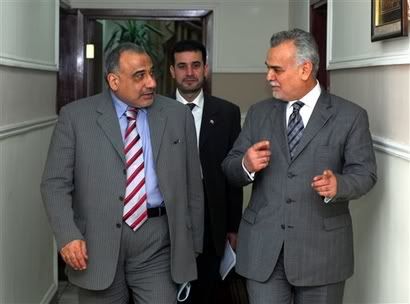
Cheney met al-Hashemi twice during his two-day stay in Iraq. He conferred with the three-man presidential council — comprising Kurdish President Jalal Talabani, Shiite vice president Adil Abdul-Mahdi and al-Hashemi — and later had a one-on-one session with al-Hashemi.
Al-Maliki's administration is supposed to be a "national unity government," with a Sunni Arab serving as his deputy for security and another in the key defense job. But Sunni Cabinet members have repeatedly complained of being marginalized and kept out of the decision-making process.
Al-Hashemi himself complained in a recent interview that al-Maliki was running the country as a "one-man show."
In the deal with al-Hashemi, al-Maliki also agreed not to stand in the way when judicial authorities release Sunni Arab detainees suspected of having links to insurgent groups, but have not been formally charged. The U.N. says more than 37,000 detainees, most of them believed to be Sunnis, were being held by Iraqi and U.S.-led forces as of March 31.
It also provides for an end to government threats to lift the parliamentary immunity of Sunni lawmakers so they can be questioned about suspected links to insurgent groups.
Al-Hashemi had wanted a halt to security raids targeting the homes and offices of Sunni lawmakers and the arrest of their personal security details, but it was unclear if al-Maliki accepted those demands.
Sunday, May 13, 2007
| [+/-] |
Iraqi Prime Minister Agrees To Bigger Sunni Role |
Wednesday, May 9, 2007
| [+/-] |
Cheney Meets With Iraqi Leaders |
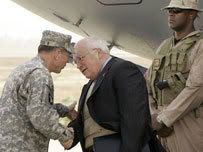
U.S. Vice President Dick Cheney has met Iraqi leaders during an unannounced visit to Baghdad, as violence continued to claim more victims in Iraq:
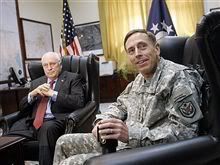
Cheney held talks with General David Petraeus, commander of U.S. troops in Iraq, before meeting with Iraqi Prime Minister Nuri al-Maliki, top government ministers, and President Jalal Talabani.
"We have got a wide range of issues here in Iraq, as well as the region, focusing, of course, on things like the Baghdad security plan, ongoing operations against the terrorists, as well as the political and economic issues that are before the Iraq government," Cheney told journalists before his meetings today.
After his meetings with Iraqi officials, Cheney spoke about the Iraqi parliament's plan to take a two-month break.
"I did make it clear that we believe it is very important to move on the issues before us in a timely fashion and that any undue delay would be difficult to explain and that we hope that they would approach these issues with all deliberate [speed]," he said.
Iraq's parliament speaker, Mahmud al-Mashhadani, condemned what he said was interference in parliamentary affairs by the Iraqi government and "the government of those who have been the cause of this mess" in Iraq.
Cheney's visit marks the first leg of his Middle East tour, which will include stopovers in the United Arab Emirates, Saudi Arabia, Egypt, and Jordan. The tour is aimed at convincing Iraq's mostly Sunni neighbors to back the 4-month-old U.S.-led crackdown on insurgents in Iraq.
Meanwhile, a car bomb has killed 19 people and wounded more than 50 in the northern Iraqi city of Irbil.
The U.S. military has also said that a U.S. attack helicopter killed five bystanders, including two children, when it fired on insurgents north of Baghdad on May 8. However, the military has denied reports that the helicopter had fired on a primary school.
The military also said three of its soldiers have been killed in Iraq over the last 24 hours.
U.S. War-Funding Debate Continues
The White House said today that U.S. President George W. Bush would veto a bill drafted by Democratic leaders in the U.S. House of Representatives that would fund the Iraq war only for three months.
The Democrats' proposal would pay for the war through July. It would then give Congress the option of cutting off money if conditions do not improve.
Bush has requested more than $90 billion to fund the war through September. Last week, Bush vetoed a bill tying war funding to a timeline to start withdrawing U.S. troops from Iraq in October.