Golden Gate district seeks public input on five suicide-barrier designs
The Press Democrat reports:
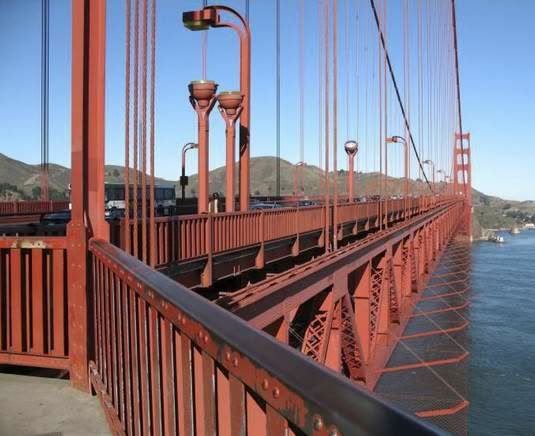
The Golden Gate Bridge is one step closer to a historic safety makeover as public comment begins on a project intended to stop people from taking their lives by leaping over the iconic orange railings.
"This is a milestone," said Bridge District spokeswoman Mary Currie. "This is something that has been discussed since the first suicide the year the bridge was built."
But with current costs for the project estimated to be as much as $50 million, the barriers are still far from a reality.
"From here it will be about fund raising," Currie said.
The district released an environmental impact report Monday that shows five possible barrier designs.
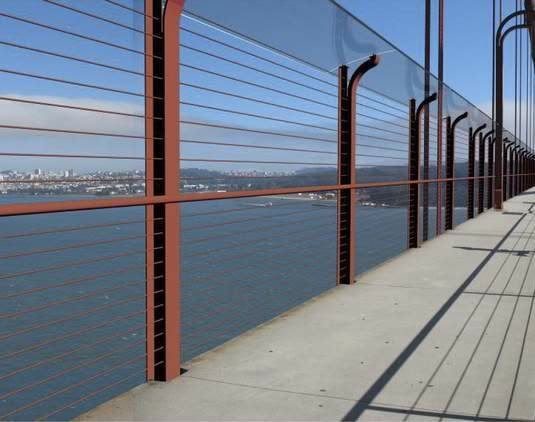
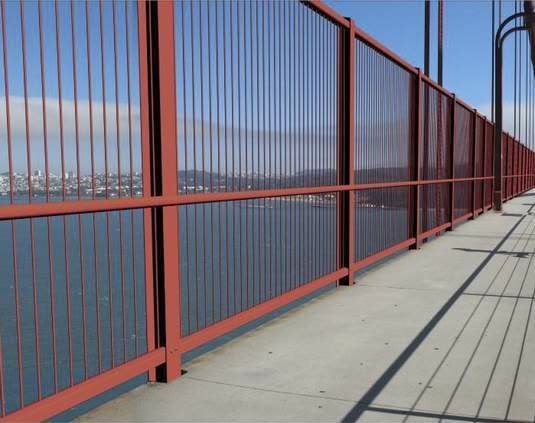
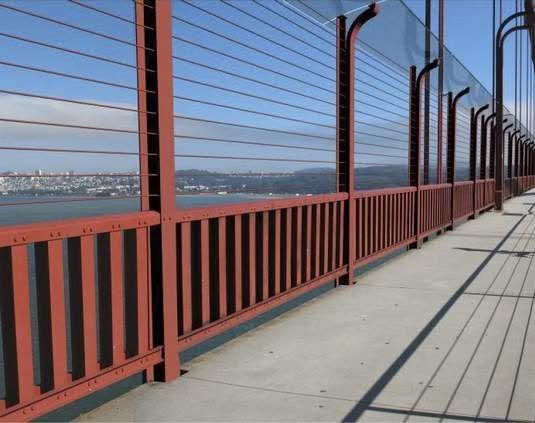
Four of the five designs would use additional fencing along the bridge's walkways to dissuade potential jumpers and get in the way of those who might try.
A fifth design places a retracting net 20 feet under the bridge, to catch and restrain jumpers.
With an estimated cost of $25 million, a stainless steel cable net is the least expensive of the options studied in the report. The other designs are in the $40 million to $50 million range.
Costs of all possible designs are expected to grow in the time leading up to construction because of the rising costs of steel, Currie said.
Currie said the possible designs all meet specific standards, including maintaining the bridge's cultural and historic status.
But that does not mean they would not have an impact on the bridge's appearance.
Four of the designs -- those involving taller railings -- could significantly alter views from the bridge, a major draw for tourists.
A fifth design -- the netting -- alters the profile of the bridge from viewing points on either side.
"We are introducing new elements, a big railing or a big net," Currie said. "We are changing the visitor's experience."
Tourists taking in the sights Monday were cautious of any plans that would impede their views and photo opportunities.
"Any barrier would dramatically change the charm of the bridge," said Jimmy Castillo, visiting from Los Angeles. "And I doubt it would prevent them from committing suicide another way. They should keep the bridge as it is, a historical site."
While camera-toting tourists bristled at the thought of a changed bridge, suicide-prevention advocates cheered what they saw as a momentous move toward addressing a major safety issue.
"Anything that gets in someone's way buys them time and saves their life," said Eve Meyer, executive director of San Francisco Suicide Prevention. "Suicide in the entire area will drop."
This year, 10 people have committed suicide by jumping off the bridge, and 29 people have been stopped in the process of attempting to jump. Thirty-eight suicides were committed last year, 31 in 2006 and 23 in 2005, according to the bridge district.
Eighty barrier designs were originally proposed and tested for various factors. From those, five designs were chosen, including a sixth "no build" option. The report, completed by DMJM Harris Inc. of Oakland, does not include any recommendations to the district.
The report is available online at www.ggbsuicidebarrier.org, and public comment is open through Aug. 25.
After public comment is collected, bridge directors will hold hearings on how to proceed.
Currie said the district's desire is to select a locally preferred plan, vetted through public comment, possibly by the end of the year.
Fund raising the millions needed for construction would be the next goal, Currie said.
In the past, board members have resisted the idea of a barrier, saying such a project would cost too much, would alter the majestic crossing and might not work.
Barrier supporters hope attention from a 2006 film "The Bridge," which featured the startling images of people jumping from the Golden Gate Bridge, might change their opinions.
Saturday, July 5, 2008
| [+/-] |
Bridge Makeover |


Saturday, December 29, 2007
| [+/-] |
Global Warming to Alter California Landscape |
The AP reports:
California is defined by its scenery, from the mountains that enchanted John Muir to the wine country and beaches that define its culture around the world.
But as scientists try to forecast how global warming might affect the nation's most geographically diverse state, they envision a landscape that could look quite different by the end of this century, if not sooner.
Where celebrities, surfers and wannabes mingle on Malibu's world-famous beaches, there may be only sea walls defending fading mansions from the encroaching Pacific. In Northern California, tourists could have to drive farther north or to the cool edge of the Pacific to find what is left of the region's signature wine country.
Abandoned ski lifts might dangle above snowless trails more suitable for mountain biking even during much of the winter. In the deserts, Joshua trees that once extended their tangled, shaggy arms into the sky by the thousands may have all but disappeared.
"We need to be attentive to the fact that changes are going to occur, whether it's sea level rising or increased temperatures, droughts and potentially increased fires," said Lisa Sloan, a scientist who directs the Climate Change and Impacts Laboratory at the University of California, Santa Cruz. "These things are going to be happening."
Among the earliest and most noticeable casualties is expected to be California's ski season.
Snow is expected to fall for a shorter period and melt more quickly. That could shorten the ski season by a month even in wetter areas and perhaps end it in others.
Whether from short-term drought or long-term changes, the ski season already has begun to shrivel in Southern California, ringed by mountain ranges that cradle several winter resorts.
"There's always plenty of snow, but you may just have to go out of state for it," said Rinda Wohlwend, 62, who belongs to two ski clubs in Southern California. "I'm a very avid tennis player, so I'd probably play more tennis."
---
Because California has myriad microclimates, covering an area a third larger than Italy, predicting what will happen by the end of the century is a challenge.
But through a series of interviews with scientists who are studying the phenomenon, a general description of the state's future emerges.
By the end of the century, temperatures are predicted to increase by 3 to 10 degrees Fahrenheit statewide. That could translate into even less rainfall across the southern half of the state, already under pressure from the increased frequency of wildfires and relentless population growth.
Small mammals, reptiles and colonies of wildflowers in the deserts east of Los Angeles are accustomed to periodic three-year dry spells. But they might not be able to withstand the 10-year drought cycles that could become commonplace as the planet warms.
Scientists already are considering relocating Joshua tree seedlings to areas where the plants, a hallmark of the high desert and namesake of a national park, might survive climate change.
"They could be wiped out of California depending on how quickly the change happens," said Cameron Barrows, who studies the effects of climate change for the Center for Conservation Biology in Riverside.
Farther north, where wet, cold winters are crucial for the water supply of the entire state, warmer temperatures will lead to more rain than snow in the Sierra Nevada and faster melting in the spring.
Because 35 percent of the state's water supply is stored annually in the Sierra snowpack, changes to that hydrologic system will lead to far-reaching consequences for California and its ever-growing population.
Some transformations already are apparent, from the Sierra high country to the great valleys that have made California the nation's top agricultural state.
The snow line is receding, as it is in many other alpine regions around the world. Throughout the 400-mile-long Sierra, trees are under stress, leading scientists to speculate that the mix of flora could change significantly as the climate warms. The death rate of fir and pine trees has accelerated over the past two decades.
In the central and southern Sierra, the giant sequoias that are among the biggest living things on Earth might be imperiled.
"I suspect as things get warmer, we'll start seeing sequoias just die on their feet where their foliage turns brown," said Nate Stephenson, a U.S. Geological Survey ecologist who is studying the effects of climate change in the Sierra Nevada. "Even if they don't die of drought stress, just think of the wildfires. If you dry out that vegetation, they're going to be so much more flammable."
Changes in the mountain snowpack could lead to expensive water disputes between cities and farmers. Without consistent water from rivers draining the melting snow, farmers in the Central and Salinas valleys could lose as much as a quarter of their water supply.
Any drastic changes to the state's $30 billion agriculture industry would have national implications, since California's fertile valleys provide half the country's fresh fruits, nuts and vegetables, according to the Union of Concerned Scientists' study.
"Obviously, it's going to mean that choices are going to be made about who's going to get the water," said Brian Nowicki, a biologist with the Center for Biological Diversity in Tucson, Ariz.
Among the biggest unknowns is what will happen along California's coast as the world's ice sheets and glaciers melt. One scenario suggests the sea level could rise by more than 20 feet.
Will the rising sea swamp the ports of Long Beach and Los Angeles, the nation's busiest harbor complex, turning them into a series of saltwater lakes? Will funky Ocean Beach, an island of liberalism in conservative San Diego County, become, literally, its own island?
Among the more sobering projections is what is in store for marine life.
The upwelling season, the time when nutrient-rich water is brought from the ocean's depths to the surface, nourishes one of the world's richest marine environments.
That period, from late spring until early fall, is expected to become weaker earlier in the season and more intense later. Upwelling along the Southern California coast will become weaker overall.
As a result, sea lions, blue whales and other marine mammals that follow these systems up and down the coast are expected to decline.
The changing sea will present trouble for much of the state's land-dwelling population, too. A sea level rise of 3 to 6 feet would inundate the airports in San Francisco and Oakland. Many of the state's beaches would shrink.
"If you raise sea level by a foot, you push a cliff back 100 feet," said Jeff Severinghaus, professor of geosciences at the Scripps Institution of Oceanography in San Diego. "There will be a lot of houses that will fall into the ocean."
Saturday, November 10, 2007
| [+/-] |
Voters Split on Spending Initiatives on States' Ballots |
The NY Times reports:
In Texas, voters were in a spending mood on Tuesday. In New Jersey and Oregon, they were not.
Five statewide bond initiatives were approved by Texas residents this week, including $3 billion for cancer research and prevention that was championed by Lance Armstrong and up to $5 billion for highway improvement projects.
But in New Jersey voters rejected $450 million in new spending for stem cell research, and in Oregon they blocked a plan for increased taxes for health care.
Backing an effort for increased fiscal restraint, Washington residents approved statewide measures to require a two-thirds vote by the Legislature for fee increases and a constitutional amendment requiring that 1 percent of general state revenue for each fiscal year be placed in a budget stabilization account.
Heading the other direction, voters in Maine approved a total of $134 million in bonds for research and development, campus improvements and land conservation.
Isolated voting problems were reported in Colorado, Georgia, Maryland and Pennsylvania because of a combination of poll worker error and machine failures.
Contests in three states offered clues to how certain hot-button issues might play in the 2008 presidential race.
In Virginia, concerns about illegal immigration did not produce the voter turnout and fervor that Republicans sought. The state has become a national testing ground for some of the strictest anti-immigration policies, and Republican lawmakers promised to crack down with plans in some counties to deny services to illegal immigrants.
But Democrats picked up four seats in the State Senate, to take the majority for the first time in more than a decade. They also gained three seats in the House, cutting into the Republican majority.
In Utah, voters resoundingly rejected a school voucher program that was supported by the Republican governor and Republican-controlled Legislature. The measure was controversial because, rather than focusing on low-income students in poor-performing schools, the program would have been available to families regardless of income or school performance.
Supporters said the measure would widen options for parents, but critics, including national teachers unions, faulted it as undercutting money for public education. Had the measure been approved, political strategists say, it would probably have been pushed in other Republican-leaning states next year.
Oregon voters approved a measure that curbs the land-use rights of developers of subdivisions and industrial and commercial sites. Supporters of the measure, especially environmental groups, raised twice as much money as opponents, who received most of their money from timber companies and related interests.
Property rights measures that empowered large landowners were blocked in 2006 in California, Idaho and Washington but passed in Arizona, according to the Ballot Initiative Strategy Center, a liberal advocacy group that tracks ballot trends.
Plenty of new spending was approved on local initiatives. For example, voters in Mecklenburg County, N.C., home of Charlotte, approved $582 million in municipal bonds for public school construction, community colleges and open-space projects.
County and city voters in Denver approved $430 million in bonds for transportation, parks, cultural centers, public safety and libraries.
For poll workers in some counties, low turnouts prevented voting problems from escalating.
The most serious failures occurred in Rockville, Md., where thousands of voters were mistakenly identified as having already voted by absentee ballot when they arrived at the polls. Poll workers kept handwritten lists of the names of everyone who voted. To ensure that no one voted twice, they said they planned to compare the list to the names of those who cast absentee ballots.
More than 60 touch-screen machines failed in Marion County, Ind., for several hours, possibly because of battery problems or the memory cards’ being inserted upside-down, election officials said.
Voting officials in southwest Fulton County, Ga., received court approval on Tuesday afternoon to extend the voting day by an hour after machines did not work because of poll workers’ error, election officials said. Eighteen to 30 voters left without voting before the machines were repaired.
Voters in Weld County, Colo., were given paper ballots for about an hour in the morning until officials repaired a handful of voting machines.
When poll workers in Denver starting falling behind deadline in counting ballots, the county called in several dozen SWAT and other police officers to help. Election officials said the police had assisted in past elections because they had undergone the background checks required to count votes.
Technicians in Bedford County, Pa., had to visit all 40 precincts to repair every optical scanning machine used to read ballots.
Friday, November 9, 2007
| [+/-] |
Oil Oozes in San Francisco Bay After Ship Hits Golden Gate Bridge |
About 58,000 gallons of heavy fuel spilled, threatening wildlife and closing beaches.
 Alcatraz is surrounded by oil slicks that leaked from a cargo ship after it bumped the San Francisco -Oakland Bay Bridge
The LA Times reports:
Crews were racing Thursday to mop up 58,000 gallons of fuel that spilled after a cargo ship bumped into the San Francisco-Oakland Bay Bridge.
Spread by the tides, the fuel slick from Wednesday's accident shut down several beaches and threatened shorebirds, seals and other marine mammals that make a home in the bay.
By Thursday afternoon, 26 oil-covered birds had been rescued by wildlife crews, while six birds were found dead. Hundreds more had been caught in the spreading slick, said Steve Edinger, assistant chief for the California Department of Fish and Game.
The slick had also spread outside the bay, as far as Tennessee Point in Marin County, 10 miles north of the Golden Gate.
"This is a significant event," Edinger said. "This is one we're very concerned about."
He said the last major oil spill in the bay occurred in 1996, when 10,000 gallons oozed out of a ship in a repair facility.
Melissa Hauck of the U.S. Coast Guard said eight oil-skimming boats were working to clean up the slick. By late afternoon, 9,500 gallons had been collected, as well as 3 cubic yards of oil in gel or solid form. The spill was of bunker fuel, a viscous fuel used on ships that is heavy and can be difficult to clean up.
Authorities also laid 11,000 feet of log booms around the 810-foot container ship Cosco Busan, which was towed to an anchorage off Candlestick Point in San Francisco after it nudged the Bay Bridge in morning fog. No more fuel was leaking from the vessel, Hauck said.
The ship struck a steel and concrete buttress that protects one of the suspension bridge's massive support towers about 8:30 a.m. Wednesday, gouging the hull on the front port side above the water line. Authorities said the bridge piling was not damaged and that the protective shield would be repaired.
Coast Guard officials said the Cosco Busan was being guided out of the bay by a pilot familiar with the waters when the accident occurred.
The spill in the bay is relatively small. The 1989 Exxon Valdez disaster dumped 11 million gallons of crude oil off Prince William Sound. A spill in 2001 off the Galapagos Islands spread more than 160,000 gallons through the ecologically fragile archipelago.
Still, public officials voiced criticism that the Coast Guard initially underestimated it.
Hours after the accident, Coast Guard officials described the fuel leak as a relatively insignificant 140 gallons. But by Thursday morning, the estimate had skyrocketed to nearly 60,000 gallons.
Sen. Barbara Boxer (D-Calif.) released a letter she wrote Thursday to the head of the Coast Guard, expressing dismay over the delay in accurately assessing the risk as well as questioning the investigation into the cause.
"Many questions remain as to why it took an entire day to determine the gravity of this spill, and whether the Coast Guard took appropriate measures to conduct drug and alcohol tests on the ship's pilot and navigators in a timely fashion," Boxer wrote to Adm. Thad W. Allen.
Coast Guard officials said the investigation was ongoing.
The fuel slick soiled at least nine beaches and parks: Muir Beach, Kirby Cove, Rodeo Beach, Black Sand Beach, Baker Beach, Crissy Field, China Beach, Angel Island and Fort Point.
Thirteen state and federal agencies set up a command center at Fort Mason in San Francisco and were meeting to discuss the mop-up.
Oil slicks create problems for shorebirds by coating their feathers, robbing them of their natural ability to stay warm in the chilly bay water.
"It's sort of like a rip in a wetsuit," Edinger said. "They get cold, they beach themselves and they start preening their feathers. They can ingest oil, and that shuts down their digestive system. They lose energy and the ability to take on water and moisture."
Birds that escape the slick can fall prey to a different peril: They can't find food, become debilitated and may die.
Edinger said most birds being treated were surf scoters, but there were reports of gulls and other shorebirds being affected. He said the next two or three days could see the numbers of imperiled birds jump significantly.
Experts from the Oiled Wildlife Care Network, a UC Davis program, have been called in by Fish and Game.
Monday, November 5, 2007
| [+/-] |
Pregnant Woman Killed in Mass L.A. Street Fight |
The Guardian reports:
A planned street fight involving 30 women in Los Angles ended in tragedy with the death of a woman who was eight months pregnant, police announced today.
She was killed in front of dozens of spectators, after another woman involved in the brawl rammed her car into her. The driver has been charged with murder.
Two other women were injured in the incident, which happened yesterday.
The driver of the car, Unique Bishop, 21, fled the scene, but she later turned herself in, police said.
"It was totally an intentional act to kill the woman. It was the driver's way of settling the dispute. It was a horrific act," said LAPD Deputy Chief Charlie Beck.
Police said the cause of the dispute is unclear, but it was part of a planned confrontation between two groups of women in their early 20s.
Witnesses told police they saw women shouting at each other and fighting in the car park of a discount store. The fight then moved on to the street and into a petrol station.
Dozens of people gathered at the petrol station and watched as Ms Bishop got into her car and drove it into the group. One of the victims was pinned against another car, police said.
It is unclear whether the dead woman's unborn baby survived. Another victim was in critical condition and expected to lose her leg, authorities said. None of the victims' identities were released.
"We have seen women around gangs before, but we haven't seen anything like this event before," said a police commander, Pat Gannon.
Saturday, October 6, 2007
| [+/-] |
The Price of a Four-Star Rating |
Katy McLaughlin explains how chefs and restaurant owners are paying more attention to food bloggers these days, and in some cases showing respect -- or fear. Plus, see a list of Web sites that can be useful guides to good food and restaurants -- especially if you know where each site stands on graft.
The WSJ reports:
Dine, a contemporary American restaurant in Chicago, has been open for less than two years. But on one popular Web site, it is already rated half a star shy of Charlie Trotter's.
How did Dine garner such favorable reviews? One thing that probably didn't hurt: It fed many of the reviewers free. Last August, Dine spent about $1,500 on an event for members of Yelp, a Web site where consumers post reviews and rate restaurants. The nearly 100 members were treated to an open bar, duck roulade appetizers and red velvet cupcakes for dessert. As a bonus, they all received certificates for discounts on subsequent meals. The result: a torrent of favorable reviews on Yelp. Most reviewers mentioned that they attended a Yelp event, though few highlighted that the food and drink was free.
"I think if I was picking up the tab I wouldn't enjoy it as much," says Leigh Kelsey, a 28-year-old Chicago file clerk at a law firm who attended the event and posted positive comments on Yelp. A spokeswoman for Dine says attendees were not required to write reviews of any nature, positive or negative.
As online food sites become increasingly influential in the restaurant business, chefs and owners are plying bloggers with free meals to get good write-ups. Some are also posting favorable reviews about themselves on popular Web sites or becoming Internet scribes.
Among those using the tactics are some of the biggest names in the business. Terrance Brennan, co-owner and chef of New York's Artisanal Bistro and Picholine, hosted a cheese class for bloggers last year, waiving the usual $75-a-person fee. Bill Telepan, chef and co-owner of Telepan in New York, donated a $200, four-course meal to one influential blogger's online contest. And in Washington, the Park Hyatt's Blue Duck Tavern says it invited a customer back for a free Father's Day meal after she posted a negative comment on the Washington Post's Web site. (In a follow-up post, the diner wrote, "We will definitely return to Blue Duck Tavern," not mentioning that she had been invited free.)
Traditionally, top critics for magazines and newspapers have tried to dine anonymously and paid their own way. The goal: to ensure that the review reflects the way average customers can expect to be treated. Some prominent reviewers have even donned wigs to conceal their identities.
In recent years, online reviews written by the masses have emerged as an alternative. They promised honest, unbiased recommendations free from the potential snobbery and insider-ism of professional food writers. But now, restaurateurs are trying to woo the people who write about food online, creating a new crop of insiders.
Yelp CEO Jeremy Stoppelman says that "Elite Squad" events, such as the one hosted by Dine, don't guarantee positive reviews, and that attendees are asked to disclose any freebies. Still, Mr. Stoppelman is concerned that some reviews could appear influenced by the events. Yelp is now testing a system in which reviews of events are posted separately from regular reviews, so that readers will clearly understand when the consumer didn't pay. In addition to restaurants, Yelp visitors can review many other services, from dentists to beauty salons.
There are now some 21,000 food blogs, according to Technorati, a company that tracks and analyzes blogs; in August, 40.5 million people visited the top 25 food-related Web sites, according to comScore, an Internet analyst. These include sites like Chow, which has a message board, Chowhound, that allows people to share tips with each other. On eGullet, foodies share pictures of their latest meals and debate issues like how to behave in a three-star French restaurant.
There are food sites for every gastronomic obsession, from Curdnerds, founded by a Brooklyn cheese enthusiast, to Chocolateandzucchini, the food diary of a young French woman. There are blogs hosted by self-appointed critics, like Restaurantgirl or Amateur Gourmet in New York, and gossipy blogs like Tablehopper, based in San Francisco. Many bloggers don't hide who they are, actively seek out relationships with chefs and accept free meals.
"I accept the comps because I don't have a budget," says Marcia Gagliardi, who writes Tablehopper. She says she eats free about two-thirds of the time, and that complimentary meals do not sway her opinion, writing on the site: "Just because a restaurant is hosting me...it doesn't mean I will write a glowing review."
Traditional critics often say they won't write a review until a restaurant has been open at least a month or so, and then only after dining multiple times. But blogs and message-board postings can turn one bad meal into a public fiasco.
Last fall, Amateur Gourmet blogger Adam Roberts slammed the New York restaurant Le Cirque in a blog entry entitled "Only a Jerk Would Eat at Le Cirque." Mr. Adams, who was dining with his parents, recounted how he felt snubbed when the restaurant gave them a remote table at the back and the owner refused to hobnob with his mother. Readers responded with their own tales of unpleasant meals at Le Cirque and sympathy for Mr. Adams.
To manage the debacle, the restaurant tracked down Mr. Roberts' parents in Boca Raton, Fla., and mailed them an invitation to return for a meal on the house. Le Cirque co-owner Marco Maccioni says he wanted to make up for the bad experience.
Mr. Adams then penned another column about Le Cirque, and posted it on a blog called Serious Eats. In it, he described how the family was pampered during their subsequent meal. He also disclosed that the meal was free.
About three years ago, Mr. Adams, 28, was an unhappy law school student with a hankering to write and an interest in food. He started writing blog posts from the perspective of a wide-eyed innocent in the world of gourmet cooking and dining, and says he was stunned when the blog became popular. He now lives off of advertising income from it, as well as free-lance writing jobs and a recently published book titled "The Amateur Gourmet."
Bill Telepan says donating a free meal last October to the blog Restaurantgirl was his way of saying thank you. The blog was launched last year by food enthusiast Danyelle Freeman. Ms. Freeman, says Mr. Telepan, had "been very nice to me. She did an interview with me, she's mentioned me in good terms." Mr. Telepan says he regularly contributes his time and energy to food magazines, and considered his donation to Restaurantgirl part of these promotional activities.
Ms. Freeman is one of a growing number of bloggers who have crossed the line into print media. In August, the New York Daily News hired her as its new restaurant critic. She says she stopped taking free meals before getting the new job to give her reviews more credibility.
Chefs say there's another upside to getting chummy with bloggers: advice on improving the food. In San Francisco, Chef Robbie Lewis of Bacar restaurant says he considers Ms. Gagliardi, of Tablehopper, "a friend" at this point. After hosting her at a "friends and family dinner" -- a meal to try out new dishes on close associates about a month after starting as the executive chef at the restaurant -- Mr. Lewis took her advice. He changed the way he plated a roasted baby leek dish, so it was easier for diners to get a taste of poached egg and sauce with each bite.
"I can't get feedback from other critics before publication," says Mr. Lewis. Ms. Gagliardi didn't write a subsequent review, but frequently mentions events at Bacar on her site.
It's relatively easy for restaurants to ingratiate themselves to key food bloggers. Publicists across the industry say they now include bloggers and food Web site forum hosts on their media lists, and regularly invite them to opening parties, free meals and other events.
Sites that rely on consumers to post reviews and rate restaurants are vulnerable to another concern: positive comments written by restaurant employees who don't disclose their affiliation with the restaurant they're writing about. Zagat Survey, for instance, has been criticized for a system that could potentially allow staffers of a restaurant to submit positive reviews. Co-founders Tim and Nina Zagat say methods have been implemented to make sure this doesn't happen. They will not disclose what these methods are, but say they have dropped restaurants from guides when they discover that the owners have asked staff to submit reviews.
Ed Levine, CEO of Left Bank Brasserie Group, which owns six restaurants in the San Francisco Bay Area, says he was delighted when he read a Yelp post about Tanglewood, his year-old upscale American restaurant in San Jose. The reviewer wrote that he was "pleasantly surprised" that "portion size has changed dramatically," and service had improved. Previously, the restaurant had been blasted by Yelpers complaining about high prices and small portions. As a result, Mr. Levine lowered the cost of entrees and beefed up portions.
"I read it and said, 'Oh my God, the changes we made have really paid off! We nailed it!' " Mr. Levine recalls. However, he says he was later tipped off by a senior staff member that the review was posted by a waiter at the restaurant. Mr. Levine says he doesn't ask staff to post positive reviews on Web sites, though he does ask them to fill out Zagat surveys about the restaurant.
Scott Rodrick, president of Rodrick Management Group, which owns and operates 20 restaurants on the East and West Coast, says that a couple of months ago he noticed several Yelp postings about how friendly the bar staff is at one of his restaurants. That struck him as suspicious: Only a short while before, he'd reprimanded the bartending team for being aloof to customers. "I'm sure it's a case where they told their friends that 'my boss sat me down,' " Mr. Rodrick says.
Tom Walton, a San Francisco Bay Area restaurant publicist, says he encourages his clients to enlist their staff, friends and family to "stuff the ballot box to counter bad Web reviews." It is the only way, Mr. Walton says, to fight back against anonymous reviews that assail a business, whether justified or not.
One Web site set says it has set up a system for policing postings. Eater, a restaurant news and gossip site, posts reviews it suspects of coming from restaurateurs themselves in its "Adventures in Shilling" feature. Editors then assign passages a "shill probability" rating, up to 100%.
Eater says it does not allow writers to accept free meals when they are reviewing a restaurant. It does allow them to accept free food, including appetizers served at opening parties or meals eaten with a publicist, if they are not specifically writing a review of the restaurant. The site requires writers to disclose when they get something free. EGullet says it asks its forum hosts to disclose when they got anything free from a restaurant.
Chowhound says it does not allow posts from anyone connected to a restaurant or from consumers who have received complimentary meals. Staff writers for Chow can accept a free meal from a restaurant, though not when they're writing a review of the restaurant, says Jane Goldman, the site's editor in chief. Ms. Goldman says it isn't financially feasible for the site to do otherwise. She says if she had the resources, she wouldn't allow contributors to accept free goods or services, "because it subtly influences the recipient."
Recently, a handful of restaurateurs have become outspoken critics of what they view as unfair posts. David Haskell, managing director of West Hollywood's BIN 8945, which specializes in wine pairings, says that about six months ago he attempted to respond to what he viewed as incorrect comments posted about his restaurant on Chowhound. One diner said the restaurant was "way too overpriced" while another called it "snooty for what it is."
But his posting was deleted by the site. Mr. Haskell then posted a letter on Eater's Los Angeles site announcing that he has officially "banned Chowhound." The ban is unenforceable, Mr. Haskell says, but expresses his disapproval of Chowhound's policy.
For Mario Batali, the tipping point was an article on Eater about a dispute between him and one of his restaurant's landlords. In response, he wrote an article for the site titled, "Why I Hate Food Bloggers," in which he decried blogs as bastions of "untruths, lies and malicious and personally driven dreck."
Jeffrey Chodorow, the managing partner behind 28 upscale restaurants around the world, including Asia de Cuba and China Grill, says food bloggers are "aggravating," because, he says, they base much of their reportage on unconfirmed rumor. Some of his restaurants have been panned in postings on Eater.
To create a platform to respond to critics and review other restaurants, Mr. Chodorow recently did the logical thing: He started his own food blog.
Thursday, September 13, 2007
| [+/-] |
Schwarzenegger Vetoes Iraq Pullout Bill |
The Sacramento Bee reports:
Gov. Arnold Schwarzenegger vetoed legislation late Tuesday to ask California voters in an advisory ballot measure if they want to withdraw United States troops from Iraq.
The Democratic-backed bill put the Republican governor in a political bind because a majority of California voters support a withdrawal of some or all troops, but Schwarzenegger has hedged his own answers on the issue and his Republican base opposes withdrawal from Iraq.
"The decision to engage in or withdraw troops from war is a federal issue, not a state issue," Schwarzenegger said in a statement. "Placing a non-binding resolution on Iraq on the (presidential primary) ballot, when it carries no weight or authority, would only further divide voters and shift attention from other critical issues that must be addressed."
Senate Bill 924 by Senate President Pro Tem Don Perata, D-Oakland, would have specifically asked voters if President Bush should "end the United States occupation of Iraq and achieve the immediate, complete, safe and orderly withdrawal of United States forces."
With anti-war activists at his side, Perata introduced the proposal in April at the Veterans Memorial Building in Berkeley, the site of what he called "the birthplace of the peace movement."
He cast the nonbinding proposal as a way for California to place political pressure on the Bush administration. But critics charged that Perata was trying to boost Democratic turnout in February to help passage of a change in term-limits law.
The measure might have intertwined with presidential politics because it would have appeared on the same ballot as next year's presidential primary in California.
"I'm disappointed," Perata told reporters early this morning. Perata said he had worked with Schwarzenegger on the issue of global warming, "and I see the war on Iraq in that very same vein."
Senate Bill 924 would have required the secretary of state to send the advisory vote results to President Bush. The legislation cited 3,700 American military deaths, 27,000 injuries, and 70,000 Iraqi civilian casualties among the reasons for seeking the vote. It noted that more than 400 Californians have died and that Iraq war costs have exceeded $350 billion.
SB 924 contained strong political statements critical of President Bush. It declared that despite a growing consensus that the United States should withdraw troops, "the Bush Administration has chosen instead to jeopardize the safety of additional personnel with an ill-conceived 'surge.' "
Most California voters support a removal of U.S. troops from Iraq -- 65 percent said they want to withdraw some or all, according to a Field Poll conducted in August. The survey also found that 58 percent of voters want Congress to set a deadline that would lead to troop withdrawal by spring 2008.
The governor may have tried to minimize negative reaction to his action by delaying his decision until late Tuesday night, shortly before a midnight deadline. At an afternoon press conference, he repeatedly dodged questions about what he would do.
Schwarzenegger had guarded his views on the ballot question ever since Perata announced his intention in April to ask California voters about Iraq. The governor cited polls showing that voters oppose the Iraq war, so he questioned why Perata needed to have an official ballot measure on the matter.
The governor has parsed his own feelings on the Iraq war. He supports a timeline for troop withdrawal, but he also has warned that a public authorization of withdrawal may not be wise because it could send a "signal to the enemy."
Schwarzenegger supported Bush's troop increase earlier this year because he said the United States "should give it everything we have," a position contrary to SB 924's language.
On other controversial issues, the governor has preferred to let the voters guide public policy. He has opposed gay marriage bills because he said the voters decided the issue in a 2000 initiative. He said last year he had no position on legalizing assisted suicide because he thought it was an issue that voters should decide for the state.
Lawmakers sent SB 924 to Schwarzenegger on Aug. 30, giving the governor 12 days to decide on the bill's fate under state law. The Senate action also gave the governor a deadline of Sept. 11, the politically sensitive six-year anniversary of the 2001 terrorist attacks.
The bill passed through the Democratic-controlled Legislature on a mostly party-line vote. No Republican lawmaker voted for the proposal, while only one moderate Democrat, Assemblywoman Nicole Parra of Hanford, voted against it.
In the Legislature, the governor's own Department of Finance opposed the bill, citing increased costs for printing ballot pamphlets. A legislative analysis estimated the proposal would cost an additional $220,000.
Sunday, August 26, 2007
| [+/-] |
Sweet Memories or Maudlin Displays? |
Opinions mixed on public tributes to victims of crashes or crimes:
It's no surprise that people have passionate opinions about the roadside memorials that dot Sonoma County.
These remembrances are a public airing of private grief, and invite reflection and comment.
We invited Press Democrat readers to offer their opinions in reaction to a story by Staff Writer Derek J. Moore about roadside memorials that have been carted away recently by an unknown person or persons.
Are they fitting tributes, or eyesores? Are they distracting to drivers, or reminders to be safe on the road?
What, if anything, should be done about them?
More than 100 readers responded in e-mails, or in online forums on pressdemocrat.com.
Here are some of your thoughts:
"I UNDERSTAND that some prefer to have these roadside memorials maintained as a reminder to others. We felt that it would only serve as a point for vandalism and decay and we could not endure that.
"I did not want my son's memory to serve as a painful ongoing reminder of the evils of speeding and alcohol. Perhaps selfish in my feelings, but I couldn't handle it."
-- Benita Jeppson, mother
of Daniel Stephens, 20, who died in a crash in Santa Rosa in April 2005
"IT'S HARD ENOUGH to lose a loved one, but it's kind of comforting in a way to pass the site and see the flowers, etc., that many people leave behind.
"I speak for my whole family when I say that I'm grateful that the business where the accident occurred allowed my family and friends to leave tributes and such."
-- Jimmy Pineda, Ukiah,
whose nephew and three of his
friends died in a 2005 car crash
"I FIND THE roadside death shrines to be morbidly offensive, horribly gross, and visually insulting. Those who elevate these scenes of life-ending trauma into places of worship are hugely insensitive to those of us who must suffer the repeated reminder and mental image of violence and gore as it occurred during the moment of a loved one's death.
"Personally, I don't know why anyone would want to constantly remind me of their loved one in that kind of context."
-- Mark Patty, Windsor
"WE ALL NEED to grieve and deal with our losses in different ways. If going to the site helps a grieving relative -- without causing anyone else danger because of the location of the parked vehicle or whatever -- I lean on the side of grace. It's got to be difficult to have a family member die in an accident. Why add to anyone's burden?"
-- Michelle Ule, Santa Rosa
"I DROVE BY a memorial south of Sebastopol on Highway 116 for several years. I often found myself saddened -- saddened for people I did not know, seeing raw grief and pain displayed there on the side of the road. Each life has enough pain of its own, I'd think, and I found myself wishing the family would pick an anniversary and take the memorial down so I would no longer have to share a stranger's sorrow."
-- Karen Jones, Sebastopol
"IT IS GETTING to the point that if you go to a cemetery, the flowers or remembrances that you have left are often taken by vandals. I know because it has happened to my husband's grave. I say, please, leave the roadside memorials alone so that I can say a prayer for those that have lost their lives to drunken drivers."
-- Peggy Krahl, Windsor
"OVERALL, I believe these are good and serve a purpose to remind us to drive safe. They are better than a billboard and take less time to 'read' (for those who think they are a distraction).
"My only suggestion is that they be uniform. There are states which have adopted a uniform white cross to represent where an accident took place and a life was lost."
-- John Doolittle,
Bodega Bay
"THE LOSS of a loved one used to be a private event, kept within the confines of the family. But like everything else in our society -- cell phone conversations, celebrity mishaps -- personal tragedy has to be advertised for all to see.
"The Christian religious movement especially finds every opportunity to proselytize their point of view and shame on them for using personal loss as a pulpit. I can't recall seeing statues of Buddha, Stars of David, or smiley faces dotting the countryside. Or is it that only Christians die on the road?"
-- Lee Hodo, Santa Rosa
"WHEN SOMEONE is cremated, we have no place to visit, and share our days. These memorials do that for us. And even if it got to one person, to remind them to be a little more careful when they drive, or remind them that life is too short, or to tell the people you care about how much they mean to you . . . you can't put a price on that."
-- Monica Alberigi,
Cazadero, who saw a friend
die after his car struck
a tree in 2004
"TO BE BLUNT, it pisses me off that they remove these without posting something so the loved ones can remove the things people left, including the things I put there like pictures.
"I don't believe they are distracting to drivers. It's a memorial. Too bad if you can't deal with seeing it. How do you think we feel?"
-- Lynne Barber, mother of Ashley Morse, 18, who
collapsed and died in July on Forest Hills Road in Forestville
"WITH SOME people finding comfort in the roadside shrines while others feel pain, and some seeing the shrines as welcome reminders to be safe while others see them as a distraction or an 'eyesore,' it seems that a compromise is needed.
"Perhaps a policy that allowed the shrines to be up for a period of up to one year with the stipulation that the shrines be removed by the people who put them up on the anniversary of the death of the loved one."
-- Teresa Martinelli,
Sonoma
"LAYING FLOWERS or a similar gesture immediately after the accident is perhaps a way of saying goodbye. Beyond that, we feel a nice tombstone at their gravesite is the appropriate memorial.
"Donate a bench at their favorite spot, plant a tree in their name, put in a nice garden. There are many possibilities."
-- Lew and Adrienne Larson, Sebastopol
| [+/-] |
Roadside Memorial Sites |
Small monuments are reminders that inattention leads to tragedy:
At the T intersection of East Washington Street and Adobe Road in Petaluma, four crosses provided a grim reminder of the risks associated with automobile travel.
No one could pass that place without noticing. No local person could pass that corner without remembering.
Four young people died here.
The four Sonoma County teenagers were killed in December of 2005 when the car in which they were riding drove into the path of a pickup truck.
Those memorials are gone now. For reasons known only to the perpetrators, these and three other roadside monuments around the county have been hauled away in recent months, as columnist Chris Smith and Staff Writer Derek J. Moore have reported.
For families and friends who honored these sites, these thefts only add to the sadness.
Technically, memorials posted on state property along public roadways are against the law, but state officials are trying to exercise common sense.
So long as the monuments don't become too large, too messy or a distraction to passing motorists, they aren't hurting anyone.
These are inevitably subjective judgments, but until this summer, no one had tried to intervene.
These tributes also serve as a signal to passersby that this intersection or this curve in the road may be dangerous if you're not driving with care.
The vandals who have deputized themselves as the roadside police apparently don't care about the heartbreak they cause families or the possibility that one of these memorials might save other lives.
Friday, August 24, 2007
| [+/-] |
Who's Removing Roadside Memorials? |
Renewed debate over whether sites are appropriate:
Pattie Hansen took comfort in the five crosses that marked the spot on a Petaluma road where her only daughter died in a crash last year.
Then one day this summer, the crosses were gone.
"I sat in the car and cried," she said.
Roadside memorials are disappearing across Sonoma County, including at the spot on Industrial Avenue in Petaluma where 43-year-old Tami Wilson was killed in October when she lost control of her pickup.
At least four memorials have been hauled away since June, including three in and near Petaluma, and a fourth in Forestville.
The removals rekindle a debate over whether the personal items left behind by loved ones are appropriate expressions of grief, or maudlin -- perhaps even dangerous -- eyesores.
Even some victims' families are torn over the issue.
Hansen said her husband has begged her not to go to the spot where the couple's daughter died, because doing so always unhinges her.
She goes anyway.
"I told my husband that's where she died. That's where her soul left her body," Hansen said.
After discovering the crosses gone in June, Hansen said she drove to city offices and the Police Department to see if anyone might know what happened to them. The crosses were on city property, but Hansen said she was told nobody knew who took them.
Officials with Caltrans and the CHP said their employees were not responsible for the removal of memorials on state property, even though the items violate state law.
"They're technically forbidden, but we try to work with families and let those be maintained by families as long as it's not imposing on anyone else's safety," said Michelle Squyer of Caltrans.
The removals have spawned any number of theories as to why someone would want to see them gone. Was someone weary of these visible displays of grief? Were they offended by the religious iconography? Was it a teenage prank?
Some have argued the memorials can be dangerous distractions for motorists -- an irony because many families say they are motivated to erect the markers in part to encourage others to be safer on the roads.
"I hope the memorials say to other people: 'Slow down. This could be you or another child,' " Patty Julius said of the two steel crosses on Valley Ford Road west of Petaluma where her 20-year-old daughter, Jessica Liparini, and a teen were killed in a 2004 car crash.
So far, Liparini's memorial has not been targeted. But four crosses on Adobe Road and East Washington Street near Petaluma that were erected shortly after a crash killed four teens in December 2005 have disappeared.
Those crosses were highly visible to motorists who have to pause at the intersection because stop signs and flashing lights were installed there in the wake of the deadly crash.
Around the time the crosses were removed, men wearing bright orange shirts were spotted working in the area. But even if they were Caltrans employees, Squyer said, they would not have simply carted the memorial away.
"Our maintenance folks are often the very first to arrive at a crash, and they are often the last to be cleaning up after it. It hits these guys in the heart," she said.
Besides safety concerns, some view the memorials as unwanted intrusions into their daily lives.
"Some of these things are bloody ugly," said David Evans, a Sebastopol graphic artist. "I think Sonoma County is a beautiful area. The sides of roads are not boneyards."
As an alternative, the state -- for a $1,000 fee -- offers a Victim Memorial Sign Program for those who are killed by a driver who is under the influence of drugs or alcohol.
One such sign on Highway 12 honors the memory of Alan Liu, a 31-year-old computer engineer from Mountain View who was riding his bicycle in April 2004 when he was killed by a drunken driver.
The sign is modest compared with some of the more elaborate roadside memorials that loved ones erect themselves.
Still, one has to wonder why someone suddenly took issue with Jaime Lunny's memorial, which was erected a decade ago after the 20-year-old Sonoma woman was killed by a drunken driver who crossed over the yellow line and hit her head-on.
The memorial on Stage Gulch Road east of Adobe Road included sunflowers, a cross and a ceramic tile with Lunny's initials that was made by her brother.
People have been passing by the memorial for years without complaint. But in late July, someone decided it was time for most of the items to go. Only the cross, which is attached to a fence, was left behind.
"I don't know if they were doing it to be mean or they were bored or they don't like those things," Diane Lunny said. "I wish they would have said something, because those things weren't mine."
The memorial was maintained by her daughter's friends and other family members. Diane Lunny said she never stopped at the site herself, although she frequently travels that road to visit her mother in Marin.
"That's not me," she said. "I wouldn't go there and dwell."
Her ambivalence raises the point of whether roadside memorials help or hinder the grieving process.
"I've heard talk around the office that we're not celebrating a person's life," CHP Officer Kimberly Lemons said. "We're celebrating the place where she died. We wonder if family members get peace out of seeing that, and if it is worth it."
Lemons recalled one instance when a woman called to complain about a memorial that had been placed at Piner and Olivet roads near Santa Rosa in honor of a 3-year-old boy and 7-year-old girl who were killed in a 2003 car crash.
"She said: 'I can't take it anymore. Two little kids died in front of my house, and that was bad enough. Now I have to look at that,' " Lemons said.
Lemons said the children's family agreed to take the memorial away. She said she wonders whether the person or persons now carting away memorials in the county could be similarly fed up with the public displays of grief.
"It makes me wonder if someone who lives locally can't take the pain anymore," she said.
Hansen said she is planning to erect another cross at the spot where her daughter died on Nov. 15, which was Wilson's birthday. But she said she'll take it down the following day.
"I sure hope nobody takes it before I get out there and get it," she said.
Thursday, August 23, 2007
| [+/-] |
"That's Where Her Soul Left Her Body" |
Missing Roadside Memorials Spark Debate
Pattie Hansen took comfort in the five crosses that marked the spot on a Petaluma road where last year her only daughter died in a crash.
Then one day this summer, the crosses were gone.
“I sat in the car and cried,” she said.
Roadside memorials are disappearing across Sonoma County, including at the spot on Industrial Drive in Petaluma where 43-year-old Tami Wilson was killed in October when she lost control of her pick-up.
At least four memorials have been hauled away since June, including three in and near Petaluma, and a fourth in Forestville.
The removals rekindle a debate whether the personal items left behind by loved ones are appropriate expressions of grief, or maudlin, perhaps even dangerous, eyesores.
Even some victims’ families are torn over the issue.
Hansen said her husband has begged her not to go to the spot where the couple’s daughter died because doing so always unhinges her.
She goes anyway.
“I told my husband that’s where she died. That’s where her soul left her body,” Hansen said.
After discovering the crosses gone in June, Hansen said she drove to city offices and the police department to see if anyone might know what happened to them. The crosses were on city property, but Hansen said she was told that nobody knew who had taken them.
Officials with Caltrans and the CHP said their employees were not responsible for the removal of memorials on state property, even though the items violate state law.
“They’re technically forbidden, but we try to work with families and let those be maintained by families as long as it’s not imposing on any one else’s safety,” said Michelle Squyer with Caltrans.
Besides safety concerns, some view the memorials as unwanted intrusions into their daily lives.
“Though we can sympathize with the bereaved families who place them there, we must ask these survivors to empathize with those of us who find roadside markers in poor taste, especially the ones that stretch beyond the Zen of simplicity into the din of excess, sporting fences and plastic flowers and personal belongings — all of which bear unsettling resemblances to cemetery plots,” Sebastopol resident David Evans wrote in a letter to the editor in February.
As an alternative, the state — for a $1,000 fee — offers a Victim Memorial Sign Program for those who are killed by a driver who is under the influence of drugs or alcohol.
Thursday, August 16, 2007
| [+/-] |
Caltrans Didn't Do It; So Who Did? |
:
It's very strange, the way crosses and other roadside memorials to crash victims suddenly disappeared from Adobe and Stage Gulch roads in southern Sonoma County and elsewhere.
I spoke to Michelle Squyer of Caltrans, and she checked with the local highway maintenance office.
"Nobody there is touching anything," Michelle said. She said Caltrans doesn't encourage the placement of roadside memorials, "but we're very sympathetic" and wouldn't simply haul them off.
One removed memorial, featuring a mosaic and a "We Love You, Jaime" sign, had been across a fence from Stage Gulch/Highway 116 for a decade -- since a wrong-way driver killed Jaime Lunny, 20, of Sonoma in July 1997.
Her mother, Diane Lunny, can't understand why someone apparently carried off the simple memorial to Jaime and a number of others.
"It's baffling," Diane said. That memorial to her daughter, she said, "was just a little reminder that life is too short."
Also taken away were four crosses that went up on Adobe Road shortly after a crash killed 17-year-old Caj'o Phelan and three other teens in December 2005.
"We are at a loss," said Caj'o's stepmother, Michelle Phelan.
She vows that her family will place new crosses. Still, she'd like to know what happened to the old ones.
Sunday, August 12, 2007
| [+/-] |
Now Ashley's Memorial Is Gone, Too |
:
A couple people asked me to look into the disappearance of some roadside crosses, including those that were at Petaluma's Adobe Road and East Washington Street, where a crash killed four teens in 2005.
"I commute from Sonoma to Rohnert Park each day and there used to be 15 or more roadside crosses," Debbie Wallman said.
"About a month ago all but three disappeared. Is the county taking them down?"
In Debbie's mind, the crosses did more than honor people who died at those spots.
"They reminded you to watch out for reckless drivers and drunk drivers, don't drive when you are tired, don't speed, don't make bad driving decisions and don't drive after you have been drinking."
I started to do some checking. A county roads employee told me his department isn't out clearing memorials from the shoulders.
Then I heard from some Forestville people heartsick over what's happened to a memorial at the spot alongside Forest Hills Road where 18-year-old Ashley Morse collapsed and died in July.
One morning, friends of Ashley said, the photos, cards, candles and other elements of the memorial were gone. "Every single thing, even the candle wax that had dripped on the ground," said friend Jamie Dwelley.
Jamie said she was going to give the items to Ashley's parents soon, once a bench is placed at the spot.
Perhaps someone thought the memorial had been there long enough and that removing it was the right thing to do. If so, Jamie wishes he'd asked first.
Just now it's hard to know what to make of the displaced crosses.
Thursday, August 9, 2007
| [+/-] |
6 War Protesters Arrested at Democratic Lawmaker's Orange County Office |
From the LATimes:
Six antiwar demonstrators were arrested Wednesday at the Garden Grove office of Rep. Loretta Sanchez (D-Santa Ana) after camping there overnight and telling her they wouldn't leave unless she promised not to approve more funding for the war in Iraq.
Most of the protesters are members of the group Military Families Speak Out, and some have relatives in the armed forces. They entered the office about 7 p.m. Tuesday during an open house. They sat on the floor in the lobby and refused to leave unless the congresswoman made the statement they wanted. Sanchez, who opposes the war, refused.
The lawmaker's staff initially chose not to call police and allowed the group to stay overnight. Police removed the protesters in handcuffs about 8:15 a.m. Wednesday, while Sanchez was attending a meeting of Orange County Latino leaders.
The protesters were taken to the Garden Grove Police Department, where they were issued misdemeanor citations for trespassing. Five were released pending an October court hearing, but Robert Dietrich was being held because he refused to sign a document promising to appear in court.
Sanchez, Orange County's only Democratic member of Congress, voted in 2002 against giving President Bush authorization to invade Iraq. More recently she voted to begin pulling troops out within 90 days.
Tuesday night Sanchez said she could not support the protesters because the $145 billion in Iraq war funding was in the same bill that would provide money to build the C-17 aircraft in California.
"I never voted for this war," she said. But "I'm not going to vote against $2.1 billion for C-17 production, which is in California. That is just not going to happen."
Protesters did not accept Sanchez's argument.
"This is a war that was made up and people are dying, and there is no reason for it," said Ed Garza, who was one of those arrested and who has a nephew in the military.
Medea Benjamin, who was not at the protest, said, "It's quite immoral for Sanchez to say she is more concerned about jobs in her district than the lives of our soldiers." Benjamin is co-founder of the national women's peace group Code Pink.
Declaring the start of the sit-in, Patricia Alviso, whose son has served two tours in Iraq, said, "We risk arrest to demonstrate the level of our commitment to peace, and we risk arrest because our children risk far more."
Once seated on the lobby floor, Alviso began reading the names of Californians killed in Iraq.
"Jeromy D. West," she said.
"God forgive us," the others responded.
"Aaron Boyles."
"God forgive us."
Such sit-ins have become more popular in the last year because of war critics' desperation over the situation in Iraq, Benjamin said
Before Congress approved $95 billion for the Iraq war in March, protesters conducted sit-ins in the offices of several Democrats, including Sen. Hillary Rodham Clinton of New York and Rep. Edward J. Markey of Massachusetts. Also targeted were the offices of Republican critics of the war, such as Sen. Olympia J. Snowe of Maine.
Democrats have been targeted more than Republicans by the nonpartisan Military Families Speak Out because they control Congress, co-founder Nancy Lessin said. Code Pink is planning to camp out and conduct a hunger strike next week at the home of House Speaker Nancy Pelosi (D-San Francisco).
When protesters refused to leave Sanchez's office Wednesday, more than a dozen police officers surrounded it.
Those arrested were Garza, 60, of Santa Ana; Alviso, 55, of Huntington Beach; Dietrich, 61, of Los Angeles; Jarret Lovell, 34, of Costa Mesa; Abraham Ramirez, 23, of Fullerton; and Tutrang Tran, 25.
Wednesday, August 1, 2007
| [+/-] |
Transcript of 'Democracy Now!' For August 1, 2007 |
Stockton, California City Council Reverses Water Privatization - It Passed Over Widespread Local Opposition
Part 2
Transcript of Democracy Now!, August 1, 2007:
AMY GOODMAN: We end today’s show with a major victory for the opponents of water privatization. I’m talking about Stockton, California, a place that’s long been at the center of California’s water wars.
In late 2003, despite concerted efforts by a wide coalition of groups, the Stockton City Council voted in favor of a $600 million twenty-year water privatization agreement. The deal gave a multinational consortium, made up of the Colorado-based OMI and the London-based Thames Water, full control over Stockton’s water, sewage and storm water systems.
Well, two weeks ago, the City of Stockton reversed its earlier position and voted unanimously to undo the privatization deal and resume control of its water utilities. Before we go to the current victory, let’s go back in time to the Stockton City Council vote in favor of privatization in February of 2003. I want to play a clip from the PBS documentary Thirst that brought national attention to the struggle in Stockton.
DON EVANS: To safeguard the water of Stockton, you have the absolute commitment of our company and you have the commitment of Thames Water to deliver this contract effectively. That’s also, as the president, my personal commitment to you.
STOCKTON RESIDENT: It is clear that the decision to privatize has been made covertly without a public vote.
STOCKTON RESIDENT: I don't think the people at home realize how many hundreds of people were here and that it's all filled up back here and downstairs, and that it was hard to hear, so I appreciate [inaudible].
DEZARAYE BAGALAYOS: City Council Members, by signing this contract without the vote of the people, you will be betraying the people you supposedly represent. Water is life. This company, OMI-Thames, wants to profit from our water. Water for life, not for profit.
STOCKTON RESIDENT: I'm ashamed that we’ve followed this path and have gone down the road at making something happen that was not consensus building, not citizen-involved. It was basically handed down as a dictate. This is not the principle of an All-America City.
MAYOR PODESTO: OK, Council Member Giovanetti.
COUNCIL MEMBER GIOVANETTI: Thank you. I'm prepared to approve this contract tonight, ahead of the so-called vote of the people.
COUNCIL MEMBER: There comes a time when the people become so involved in an issue that it is important that they be heard by way of the ballot.
COUNCIL MEMBER NOMURA: As a Christian, I’ve always felt that prayer is very powerful. And when this process began, I’ve always prayed for guidance in what I should do. It says that in the Constitution, that you will elect representatives to vote and to make decisions that are best for you.
COUNCIL MEMBER MARTIN: We've not been elected to babysit and maintain the city until a vote can be taken by the citizens on major issues.
COUNCIL MEMBER: I do not feel they are too dumb to understand.
COUNCIL MEMBER MARTIN: Nobody said that.
COUNCIL MEMBER: And you know, the people who founded this republic obviously didn't think the people were too dumb to run it.
COUNCIL MEMBER MARTIN: Neither Lorrie and I or anyone on this council believes that the people are too dumb to resolve or to understand the issue. That's not -- that's not what we've said.
MAYOR PODESTO: Alright, quiet down. Officers, close the door, please. Tonight I want to thank the council for their indulgence and their endurance and their hard work to come up with whatever their answers are tonight. Do I believe that this should go to a vote of the people? Absolutely not. And that’s for no more reason than I can think any government by initiative is good. There's been a motion and a second. I'm calling for the question. Please cast your votes. Carries 4-3. Thank you all for your hard work.
AMY GOODMAN: With that, in 2003, the Stockton City Council voted for the privatization of their water supply. This, an excerpt of the award-winning PBS documentary Thirst, on water privatization in Bolivia, India and the United States. Alan Snitow is its co-director, also a board member of Food and Water Watch, and recently co-wrote the book that delves deeper into the implications of water privatization in the United States. It's called Thirst: Fighting the Corporate Theft of Our Water. Alan Snitow joins us from San Francisco. Welcome, Alan, to Democracy Now!
ALAN SNITOW: Thanks, Amy. Thanks for having me.
AMY GOODMAN: Talk about what happened since 2003 in Stockton, California.
ALAN SNITOW: Well, what's happened in Stockton is really quite an extraordinary victory and transformation. It proves that privatization is really fundamentally flawed as a model for something like an essential service like water.
What we’ve seen in the past four years, since the private consortium took over, have been spills -- sewage spills, with a failure to inform people at the height of the summer when the river was being -- when people were using it for recreation and swimming. There was a pass of who was going to tell people that the water actually had fecal matter in it. You're talking about a series of problems, in which you brought in a lot of temp workers, non-union contractors. There were spills into irrigation ditches. There were fines. There was lack of transparency. People couldn't find out what was going on. The rates went up.
There's a series of problems, one after the other, so that in the end you got not only unanimous city council reversal of its decision four years earlier, but even the mayor who had been pushing this in the past, the former mayor, said he agreed with the council decision. The city newspaper, the Stockton Record, which had been a supporter of privatization, said they supported the council decision. There was no one willing to go to bat for this consortium, OMI-Thames, and the only reason that people are not really getting down on them in public is that they signed a no disparagement agreement.
This is the way things work when you make a contract with a private company for something that's really an essential service that people have a right to have. You know, this is something that is too key. It is really -- you know, they say that police and fire and schools have to be something that's in the public sector, that's run for the people. Well, you know, there's something else that also has to go in there, and water -- and some of us would also say, I suppose, healthcare.
AMY GOODMAN: But how did Stockton get out of it? It was a twenty-year deal. And how did this consortium approach Stockton?
ALAN SNITOW: You know, when people say that there's a contract -- “Oh, it's a safe thing to do a privatization, because you have a contract that's hard and fast” -- contracts are changed. That's what lawyers are for. And when you have certain kinds of noncompliance, when the company is not making money, it's always possible to say, “Hey, look, guys, you guys are not doing a good job here, and you're not even making that much money. Let's make a deal to cut you out and get rid of you and return it to public control.” So that's what's happened in this particular case.
And the reason why the company would let it go was that they were not even making money. They realized they were not fulfilling their obligations. But they're going to take an enormous hit, because Stockton was the largest privatization in the western half of the United States. After Atlanta's failure by Suez in the 2002, when they were kicked out of Atlanta, you now got another major failure. This is a real blow to the idea that a private company, a contractor, can come in and take over your water supply and do a better job than public employees.
AMY GOODMAN: In your book and also in your documentary -- in your book, Alan, Nestle -- you talk about Wisconsin, you talk about Michigan. You're speaking to us from San Francisco, where the mayor has banned the flow of money to buy bottled water. Talk about these local initiatives and where you see them going right now. I think, for most people, this is way below the radar screen. They think of bottled water, one thing, as healthy, and people don't realize that water supplies are being taken over.
ALAN SNITOW: Well, you know, people have a visceral response to the loss of control of their water. But water is a local issue. So when you hear about Stockton, it's pretty unusual that you'd hear about Stockton in New York or Michigan or Florida. And the same is true that a small local battle in Massachusetts or in Wisconsin rarely is going to get national press. And the result is that water is a watershed issue. It's both essential, but it's also something that you're not going to hear about outside of the local area.
So what we've found is that all over the country, in towns and cities, you're getting these local movements, visceral upsurges of community reaction to the loss of control of their water services or their water supplies. And supplies -- I know that the folks from Corporate Accountability and Michael Blanding were all talking about the bottled water -- they're also having the same kind of reaction of loss of control of their utility. And this has brought now a kind of emerging movement to try to make it not only that bottled water is something that we're not focusing on, that we're not going to be drinking, but also that we're going to actually provide the money that is necessary to make public water universal, affordable and clean.
And to do that, because you have hundred-year-old pipes in the ground, there needs to be federal investment. And the Bush administration has cut back investment in water by billions of dollars every year. And there's now a fight that's going on in Washington to create a federal trust fund for water, the way we have for highways or building airports, so that you actually can have a clean water trust fund that makes it possible for local areas, for states and cities, to be able to upgrade their water systems so that they won't have to have this kind of situation in which the bottled water companies are implying that their water is pure, when actually they're getting the same source of water, they're using tap water themselves.
AMY GOODMAN: Back on the issue of Stockton, I mean, didn’t -- we're talking about the state weighing in here, too, a judge saying that the Stockton City Council actually violated the Environmental Protection Act -- the state won -- by not doing an environmental assessment. And you had the former mayor, Podesto, or the former head of the city council, who voted for the privatization, turning around. How does that all take place?
ALAN SNITOW: Well, when they passed the privatization, they were in a real rush to do it, because the Citizens Coalition, this amazing and tenacious citizens group in Stockton, had gotten 18,000 signatures from people in the city to put a referendum on the ballot to require a public vote for the privatization. The city council voted to approve the privatization just thirteen days before that vote was to take place. And in order to do that, they had to put in a line saying, “We are exempting this decision from the California Environmental Quality Act.” That was patently illegal. And the result was that two judges have ruled against the privatization and said to the city that they have to reverse it.
The city had a choice that they could have appealed it; they decided not to. They had a choice to take it to the referendum vote and revote on the issue; they decided not to. So what was really going on here was that the privatization hadn't worked on the ground, to some extent. It hadn't worked for the river, it hasn't worked for the water. And so, they decided unanimously to reverse it.
And one of the things that happens is happening here and around the country, this question about preempting the vote in the referendum. One of the things that we found in the movie and in our book Thirst was that you have a constant drumbeat by these companies to undermine democratic input in order to be able to take control of water supplies, because people want it to be a public service.
AMY GOODMAN: Alan Snitow, we only have a few minutes, so I want to just -- bullet points on these struggles that you've documented around the country. For example, Nestle comes to Wisconsin Dells in Wisconsin; what happened?
ALAN SNITOW: There, a series of groups got together and battled against the company and drove Nestle out of the state of Wisconsin, an amazing victory there. But Nestle then moved into the state of Michigan, where the Michigan Citizens for Water Conservation has been fighting against their taking water out of aquifers and streams in Michigan. And they just had a Supreme Court decision in the state of Michigan, which was denying citizens’ groups the right to intervene on certain environmental issues. Again, Nestle trying to intervene against the possibility of people taking a direct role in the future of their water.
AMY GOODMAN: And Nestle, which owns among other water brands, Poland Spring, Arrowhead, Deer Park.
ALAN SNITOW: Ice Mountain. Yeah, Deer Park.
AMY GOODMAN: What about Lee, Massachusetts and Holyoke?
ALAN SNITOW: In Massachusetts, there was a real battle, because there's a state law that allows cities, if they apply for it, to be able to do single-bidder kinds of contracts on essential services. And in Lee, again, a citizens’ movement, sort of spontaneous from below, fought against Veolia North America, a major French-based company, taking over their water. And they fought it successfully.
In Holyoke, they did not succeed. It was very much a parallel case to Stockton, in which Aquarion took over the water system in the city of Holyoke, Massachusetts, again going around the process.
AMY GOODMAN: Lexington, Kentucky?
ALAN SNITOW: Lexington, Kentucky, there, the citizens’ group lost a vote to take back water that was owned by the American Water Company, a part of a big multinational consortium, one of the hundred largest companies in the world, after a multi-year fight. But now it's coming back to haunt the city. And the fight is once again on the agenda over the future of the water in Lexington, Kentucky.
AMY GOODMAN: And Atlanta, Georgia?
ALAN SNITOW: Atlanta was one of the biggest scandals. The mayor who brought in the privatization was indicted. There were charges that he went to Paris on an all-expenses-paid trip with his mistress, paid for by the water company, and then signed off on massive increases in money going to the water company in Atlanta. They were thrown out by the current mayor, Shirley Franklin, because there was brown water, because there was constant eruptions.
AMY GOODMAN: Alan, we're going to have to leave it there.
ALAN SNITOW: All right. Thanks so much.
AMY GOODMAN: I want to thank you very much for being with us, Alan Snitow, co-director of the PBS documentary Thirst, author of Thirst, as well, Fighting the Corporate Theft of our Water.
| [+/-] |
As Water Around The World Goes Private . . . . |
. . . . New Scrutiny Falls on the Economic and Environmental Costs of a Billion Dollar Industry
Democracy Now! reports:
AMY GOODMAN: The soft drink giant Pepsi has been forced to make an embarrassing admission: its bestselling Aquafina bottled water is nothing more than tap water. Last week, Pepsi agreed to change the labels of Aquafina to indicate the water comes from a public water source. Pepsi agreed to change its label under pressure from the advocacy group Corporate Accountability International, which has been leading an increasingly successful campaign against bottled water.
In San Francisco, Mayor Gavin Newsom recently banned city departments from using city money to buy any kind of bottled water. In New York, local residents are being urged to drink tap water. The US Conference of Mayors has passed a resolution that highlighted the importance of municipal water and called for more scrutiny of the impact of bottled water on city waste.
The environmental impact of the country's obsession with bottled water has been staggering. Each day an estimated sixty million plastic water bottles are thrown away. Most are not recycled. The Pacific Institute has estimated twenty million barrels of oil are used each year to make the plastic for water bottles.
Economically, it makes sense to stop buying bottled water, as well. The Arizona Daily Star recently examined the cost difference between bottled water and water from the city's municipal supply. A half-liter of Pepsi's Aquafina at a Tucson convenience store costs $1.39. The bottle contains purified water from the Tucson water supply. From the tap, you can pour over 6.4 gallons for a penny. That makes the bottled stuff about 7,000 times more expensive, even though Aquafina is using the same source of water.
Gigi Kellett of Corporate Accountability International joins us in Boston, the group spearheading the Think Outside the Bottle campaign. We're also joined by freelance writer Michael Blanding. Last year he wrote an article for alternet.org called “The Bottled Water Lie.” We welcome you both to Democracy Now!
I want to begin with Gigi Kellett. Talk about Pepsi's admission.
GIGI KELLETT: Well, after a couple of years of our Think Outside the Bottle campaign, we have been asking of the bottled water corporations to come clean about where they get their water, what is the source of the water that they're bottling, because most people don't know that Pepsi's Aquafina, Coke's Dasani, comes from our public water systems. And so, after thousands of phone calls, thousands of public comments submitted to the corporation, and us taking these demands directly to the corporation’s annual shareholder meeting this year, Pepsi last week made the announcement that it would reveal that it gets its water from our public water systems.
AMY GOODMAN: Now, where exactly does Pepsi get it? Which public water supply?
GIGI KELLETT: Well, that is the issue that we're really looking at next, is what cities are they bottling the water in. You know, here in Massachusetts, it's coming from Ayre, Massachusetts. So we want to make sure that on those bottles it says: “Public water source: Ayre, Massachusetts.” That way, people know exactly what they're getting when they're buying that Aquafina bottled water.
AMY GOODMAN: Ayre being the name of a town in Massachusetts.
GIGI KELLETT: Ayre is the name of a town, right. Exactly.
AMY GOODMAN: And what happens to the town? They have their public water supply, and they have the plant for Pepsi?
GIGI KELLETT: That's right. We want to make sure that -- you know, Pepsi has certainly taken a lead on this for the bottled water industry, and we want to make sure that Coke and Nestle also follow suit. One of the things that we're finding as we're talking to people about this issue on the street is that they don't know where the water is coming from. And the bottled water corporations have spent tens of millions of dollars on ads that make people think that bottled water is somehow better, cleaner, safer than our public water systems. And in reality, we know that that's not true. And so, we want to make sure that we're increasing our people's confidence in their public water systems once again and knowing that we need to be investing in our public systems.
AMY GOODMAN: Gigi, can you go further who owns what? You mention Nestle. What does Nestle own?
GIGI KELLETT: Nestle owns several dozen brands of bottled water. The bottled water brand they source from our public water systems is called Nestle Pure Life. They also own Poland Spring, Ozarka, Arrowhead. The list goes on. And regionally, it's distributed across the country. And then we also have Coca-Cola, which bottles Dasani water, and, or course, Pepsi with Aquafina.
AMY GOODMAN: And when it comes to being tap water, what is the difference between plain tap water and distilled water from these public sources.
GIGI KELLETT: Well, there's very little difference. You know, our public water systems go through a very rigorous testing and monitoring system and is tested by the Environmental Protection Agency. So we want to make sure that people know that our public water systems are much better regulated than these bottled water brands, which don't have to go through the same rigorous type of process.
AMY GOODMAN: We're talking to Gigi Kellett, associate campaigns director of Corporate Accountability International. Michael Blanding is a freelance writer, has written the piece "The Bottled Water Lie." Michael, what is the lie?
MICHAEL BLANDING: Well, there are actually several lies, I think, that the bottled water companies perpetrate, but I think the main one is exactly what Gigi said, that this image bolstered by, you know, millions and millions of dollars of advertising that bottled water is somehow better for you, it tastes better, it's more pure. And in many cases, that's simply not true. People are paying, you know, enormous premiums for bottled water and don't even realize the fact that in many cases not only does tap water taste the same, but that it's actually more tightly regulated and actually healthier for you. There have been, you know, several cases of bottled water that's actually been contaminated and found to contain hazardous chemicals. And tap water, there’s actually, you know, a rigorous testing and monitoring of the water supply that actually in many cases makes it healthier.
AMY GOODMAN: When we come back from break, I want to talk about some of those cases of contamination, but also talk about the community struggles that are working to take back their water supply. Our guests are Michael Blanding, wrote "The Bottled Water Lie," and Gigi Kellett of Corporate Accountability International. Stay with us.
[break]
AMY GOODMAN: We're talking to Gigi Kellett of Corporate Accountability International and Michael Blanding, wrote “The Bottled Water Lie” for alternet.org. They're both in the Boston studio. We're talking about the bottled water lie.
Now, Michael, you begin your piece by talking about Antonia Mahoney. Talk about who she is.
MICHAEL BLANDING: She was someone who was just walking down the street in downtown Boston when the folks at Corporate Accountability -- Gigi and the folks in her group -- were holding something called the Tap Water Challenge, which was a taste test between tap water and various bottled water brands, Aquafina and Dasani. And I stood there during the afternoon and watched, you know, many people come up who were bottled water drinkers and could swear that they could tell the difference and that they could recognize their brand.
And Antonia Mahoney was one of those who -- she actually had given off drinking bottle -- drinking tap water a few years ago and was drinking only Poland Spring and knew, you know, that she would be able to tell Poland Spring of all the other types of water that she was drinking there. And it turned out that what she thought was Poland Spring was actually the tap water from Boston, the good old tap water, which -- we actually have very good tap water that comes from western Mass here. So she was very surprised and shocked and decided right there that she was going to leave off her contract of paying $30 a month for Poland Spring water that she got delivered to her house. So it was very -- and there were other experiences like that during the day that I witnessed.
AMY GOODMAN: Michael, you write about the problems of a suspected carcinogen chemical, bromate. You talk about the contamination of Dasani water, owned by Coca-Cola, in 2004. Explain what the problems are, the contamination issues.
MICHAEL BLANDING: So, ironically, one of the processes that actually takes the tap water and purifies it -- it’s called ozonation -- can actually in some cases have a byproduct, which is bromate, which is, as you say, a suspected carcinogen. And the largest case of contamination was in the UK in 2004, right when Dasani launched in the United Kingdom. They had something like a half-million bottles of Dasani water actually found to be contaminated, and people were getting sick. And, you know, it's just indicative of the lack of controls and the lack of monitoring that you find with bottled water.
And it's not an isolated case. There have been many others that have occurred. Most recently up in Upstate New York with an independent bottled water company, there were multiple cases of bromate contamination, as well.
AMY GOODMAN: Can you talk about the issue of filtering? First of all, I don't know if people realize when something says “public water source” that it means tap water. But then, what it means for that tap water to be filtered to -- you talk about additional techniques like reverse-osmosis.
MICHAEL BLANDING: Right, yeah. So there are various techniques that the companies use, and, you know, they tout them as these proprietary techniques that, you know, they go through seven different phases of filtering, and all the rest of it. And, you know, when you look at it, though -- you know, reverse-osmosis is the main one, which is basically just pushing water through a membrane to remove contaminants, and it's actually very similar to the type of process that can be found in home water filters, just, you know, the kind that you attach to your tap for a couple of hundred bucks. So, you know, the -- it's not as sophisticated as they might, you know, pretend that it is.
AMY GOODMAN: And internationally, the movements, from Bolivia to Peru, La Paz, all over.
MICHAEL BLANDING: Yeah. What's interesting is that, you know, here in the United States there are, you know, several communities that have actually, you know, had plants take a lot of water from their groundwater up in Michigan, you know, where they can actually see the water level of one of their streams declining because of, you know, the massive amount that Nestle was taking from their water.
And it's even a more critical issue in other countries where water scarcity is a real problem, so places like India, where Coca-Cola and Pepsi have actually, you know, really depleted communities and farmers have been unable to grow their crops, it's kind of been a double whammy. They've taken the water, and then the water that they -- the waste water they've dumped back has been polluted, in many cases. And so, that's one issue, is just the depletion of water from the plants themselves.
And then the other issue, which I know Gigi could talk about, is just the perception that comes across that somehow tap water is -- you know, municipal water is somehow, you know, not as good as water that's been privatized. And so, you have -- it sort of starts this steady creep of where privatization of water sources becomes OK. And there have been many communities, like in Bolivia, where water supplies have been privatized and have been sold back to -- water that was previously free has, you know, skyrocketed in price. And people have taken to the streets and protested and actually got the private companies to leave.
AMY GOODMAN: Gigi Kellett, let's talk about the tainting of the image of the municipal water supply in this country, the effect of the bottled water advertising industry campaigns.
GIGI KELLETT: Well, this is something that’s of real concern to our organization and our members and activists across the country, because we are seeing this -- you know, who are we turning to to provide our drinking water? And there are -- these bottled water corporations are spending tens of millions of dollars every year on ads that effectively undermine people's confidence in their water. There was actually a poll done by the University of Arkansas earlier this year that found young people tend to choose bottled water over tap water, because they feel it's somehow cleaner or better than their public water systems. And as we've already mentioned here, we know that in reality that's not true. So there is a real concern about the impact that these bottled water corporations are having on the way we think about water.
And our Think Outside the Bottle campaign is aiming to change that, and we're having real success with cities like San Francisco and Ann Arbor, Michigan and New York City, taking a lead on putting their public water systems back in the forefront and not contracting with bottled water corporations, for example, like in Salt Lake City and in San Francisco. And we're seeing restaurants turn to the tap in lieu of bottled water. So there’s a lot that people are starting to look at in terms of this industry and what changes we can make to promote our own public water systems here in this country and make sure that they have the funding they need to thrive, and that also we're looking internationally to make sure that countries that may be cash-strapped also have the resources they need to have good, strong public water systems and not turn to privatization.
AMY GOODMAN: Gigi, tell us about what happened in Salt Lake City and in San Francisco, with the mayor announcing that city money cannot be used to buy bottled water.
GIGI KELLETT: That's right. You know, the mayor of San Francisco, Gavin Newsom, after we had been working with his staff there, working with the San Francisco Department of the Environment and the San Francisco Public Utilities Commission, they looked at how much money they were spending on bottled water every year. It was close to a half-million dollars. And they said, “We're the forefront. We're cities. We're the forefront of ensuring that people have access to good, safe, clean water. And we're also now at the forefront of dealing with the waste that results from the bottled water industry. So we need to take a stand as a city.” And in June, Mayor Newsom issued an executive order saying that the city would no longer be buying bottled water. And he joined with the mayor of Salt Lake City, Rocky Anderson, and also the mayor of Minneapolis, R.T. Rybak, to put forward a resolution at the US Conference of Mayors calling on a study to really look at what are the impacts of bottled water on our municipal waste. So it’s a real great leadership that we're seeing of these cities.
AMY GOODMAN: And, Gigi, what about the effect that the water in the plastic bottle has? Is there any kind of leeching out? People think that they're getting healthier water in all sorts of ways, but what about the impact of that plastic?
GIGI KELLETT: Well, there are a number of concerns about the impact of the plastic, yes, of course, in the leeching. These bottles that are made are single-serve bottles, so they're not intended to be reused, because of the potential for leeching of the plastic into -- you know, when you're drinking the water. And then, of course, there are the environmental impacts of the bottles that are ending up in our landfills and on the side of the road as litter. They're not being recycled. Only about 23% of these plastic bottles are being recycled. So it's a huge impact for our environment and, of course, for people's health. So we want people to be looking at turning back to the tap and thinking outside the bottle.
AMY GOODMAN: You talked about international, and we're going to go international now to El Salvador.
