In Meetings, Spy Panels' Chiefs Did Not Protest, Officials Say
The Washington Post reports:
In September 2002, four members of Congress met in secret for a first look at a unique CIA program designed to wring vital information from reticent terrorism suspects in U.S. custody. For more than an hour, the bipartisan group, which included current House Speaker Nancy Pelosi (D-Calif.), was given a virtual tour of the CIA's overseas detention sites and the harsh techniques interrogators had devised to try to make their prisoners talk.
Among the techniques described, said two officials present, was waterboarding, a practice that years later would be condemned as torture by Democrats and some Republicans on Capitol Hill. But on that day, no objections were raised. Instead, at least two lawmakers in the room asked the CIA to push harder, two U.S. officials said.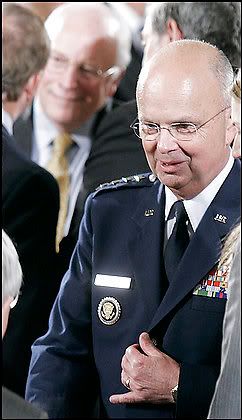
"The briefer was specifically asked if the methods were tough enough," said a U.S. official who witnessed the exchange.
Congressional leaders from both parties would later seize on waterboarding as a symbol of the worst excesses of the Bush administration's counterterrorism effort. The CIA last week admitted that videotape of an interrogation of one of the waterboarded detainees was destroyed in 2005 against the advice of Justice Department and White House officials, provoking allegations that its actions were illegal and the destruction was a coverup.
Yet long before "waterboarding" entered the public discourse, the CIA gave key legislative overseers about 30 private briefings, some of which included descriptions of that technique and other harsh interrogation methods, according to interviews with multiple U.S. officials with firsthand knowledge.
With one known exception, no formal objections were raised by the lawmakers briefed about the harsh methods during the two years in which waterboarding was employed, from 2002 to 2003, said Democrats and Republicans with direct knowledge of the matter. The lawmakers who held oversight roles during the period included Pelosi and Rep. Jane Harman (D-Calif.) and Sens. Bob Graham (D-Fla.) and John D. Rockefeller IV (D-W.Va.), as well as Rep. Porter J. Goss (R-Fla.) and Sen. Pat Roberts (R-Kan).
Individual lawmakers' recollections of the early briefings varied dramatically, but officials present during the meetings described the reaction as mostly quiet acquiescence, if not outright support. "Among those being briefed, there was a pretty full understanding of what the CIA was doing," said Goss, who chaired the House intelligence committee from 1997 to 2004 and then served as CIA director from 2004 to 2006. "And the reaction in the room was not just approval, but encouragement."
Congressional officials say the groups' ability to challenge the practices was hampered by strict rules of secrecy that prohibited them from being able to take notes or consult legal experts or members of their own staffs. And while various officials have described the briefings as detailed and graphic, it is unclear precisely what members were told about waterboarding and how it is conducted. Several officials familiar with the briefings also recalled that the meetings were marked by an atmosphere of deep concern about the possibility of an imminent terrorist attack.
"In fairness, the environment was different then because we were closer to Sept. 11 and people were still in a panic," said one U.S. official present during the early briefings. "But there was no objecting, no hand-wringing. The attitude was, 'We don't care what you do to those guys as long as you get the information you need to protect the American people.'"
Only after information about the practice began to leak in news accounts in 2005 -- by which time the CIA had already abandoned waterboarding -- did doubts about its legality among individual lawmakers evolve into more widespread dissent. The opposition reached a boiling point this past October, when Democratic lawmakers condemned the practice during Michael B. Mukasey's confirmation hearings for attorney general.
GOP lawmakers and Bush administration officials have previously said members of Congress were well informed and were supportive of the CIA's use of harsh interrogation techniques. But the details of who in Congress knew what, and when, about waterboarding -- a form of simulated drowning that is the most extreme and widely condemned interrogation technique -- have not previously been disclosed.
U.S. law requires the CIA to inform Congress of covert activities and allows the briefings to be limited in certain highly sensitive cases to a "Gang of Eight," including the four top congressional leaders of both parties as well as the four senior intelligence committee members. In this case, most briefings about detainee programs were limited to the "Gang of Four," the top Republican and Democrat on the two committees. A few staff members were permitted to attend some of the briefings.
That decision reflected the White House's decision that the "enhanced interrogation" program would be treated as one of the nation's top secrets for fear of warning al-Qaeda members about what they might expect, said U.S. officials familiar with the decision. Critics have since said the administration's motivation was at least partly to hide from view an embarrassing practice that the CIA considered vital but outsiders would almost certainly condemn as abhorrent.
Information about the use of waterboarding nonetheless began to seep out after a furious internal debate among military lawyers and policymakers over its legality and morality. Once it became public, other members of Congress -- beyond the four that interacted regularly with the CIA on its most sensitive activities -- insisted on being briefed on it, and the circle of those in the know widened.
In September 2006, the CIA for the first time briefed all members of the House and Senate intelligence committees, producing some heated exchanges with CIA officials, including Director Michael V. Hayden. The CIA director said during a television interview two months ago that he had informed congressional overseers of "all aspects of the detention and interrogation program." He said the "rich dialogue" with Congress led him to propose a new interrogation program that President Bush formally announced over the summer
"I can't describe that program to you," Hayden said. "But I would suggest to you that it would be wrong to assume that the program of the past is necessarily the program moving forward into the future."
Waterboarding as an interrogation technique has its roots in some of history's worst totalitarian nations, from Nazi Germany and the Spanish Inquisition to North Korea and Iraq. In the United States, the technique was first used five decades ago as a training tool to give U.S. troops a realistic sense of what they could expect if captured by the Soviet Union or the armies of Southeast Asia. The U.S. military has officially regarded the tactic as torture since the Spanish-American War.
In general, the technique involves strapping a prisoner to a board or other flat surface, and then raising his feet above the level of his head. A cloth is then placed over the subject's mouth and nose, and water is poured over his face to make the prisoner believe he is drowning.
U.S. officials knowledgeable about the CIA's use of the technique say it was used on three individuals -- Khalid Sheikh Mohammed, the alleged mastermind of the Sept. 11, 2001, terrorist attacks; Zayn Abidin Muhammed Hussein Abu Zubaida, a senior al-Qaeda member and Osama bin Laden associate captured in Pakistan in March 2002; and a third detainee who has not been publicly identified.
Abu Zubaida, the first of the "high-value" detainees in CIA custody, was subjected to harsh interrogation methods beginning in spring 2002 after he refused to cooperate with questioners, the officials said. CIA briefers gave the four intelligence committee members limited information about Abu Zubaida's detention in spring 2002, but offered a more detailed account of its interrogation practices in September of that year, said officials with direct knowledge of the briefings.
The CIA provided another briefing the following month, and then about 28 additional briefings over five years, said three U.S. officials with firsthand knowledge of the meetings. During these sessions, the agency provided information about the techniques it was using as well as the information it collected.
Lawmakers have varied recollections about the topics covered in the briefings.
Graham said he has no memory of ever being told about waterboarding or other harsh tactics. Graham left the Senate intelligence committee in January 2003, and was replaced by Rockefeller. "Personally, I was unaware of it, so I couldn't object," Graham said in an interview. He said he now believes the techniques constituted torture and were illegal.
Pelosi declined to comment directly on her reaction to the classified briefings. But a congressional source familiar with Pelosi's position on the matter said the California lawmaker did recall discussions about enhanced interrogation. The source said Pelosi recalls that techniques described by the CIA were still in the planning stage -- they had been designed and cleared with agency lawyers but not yet put in practice -- and acknowledged that Pelosi did not raise objections at the time.
Harman, who replaced Pelosi as the committee's top Democrat in January 2003, disclosed Friday that she filed a classified letter to the CIA in February of that year as an official protest about the interrogation program. Harman said she had been prevented from publicly discussing the letter or the CIA's program because of strict rules of secrecy.
"When you serve on intelligence committee you sign a second oath -- one of secrecy," she said. "I was briefed, but the information was closely held to just the Gang of Four. I was not free to disclose anything."
Roberts declined to comment on his participation in the briefings. Rockefeller also declined to talk about the briefings, but the West Virginia Democrat's public statements show him leading the push in 2005 for expanded congressional oversight and an investigation of CIA interrogation practices. "I proposed without success, both in committee and on the Senate floor, that the committee undertake an investigation of the CIA's detention and interrogation activities," Rockefeller said in a statement Friday.
Sen. John McCain (R-Ariz.), a former Vietnam War prisoner who is seeking the GOP presidential nomination, took an early interest in the program even though he was not a member of the intelligence committee, and spoke out against waterboarding in private conversations with White House officials in late 2005 before denouncing it publicly.
In May 2007, four months after Democrats regained control of Congress and well after the CIA had forsworn further waterboarding, four senators submitted written objections to the CIA's use of that tactic and other, still unspecified "enhanced" techniques in two classified letters to Hayden last spring, shortly after receiving a classified hearing on the topic. One letter was sent on May 1 by Sen. Russell Feingold (D-Wis.). A similar letter was sent May 10 by a bipartisan group of three senators: Dianne Feinstein (D-Calif.), Chuck Hagel (R-Neb.) and Ron Wyden (D-Ore.).
In a rare public statement last month that broached the subject of his classified objections, Feingold complained about administration claims of congressional support, saying that it was "not the case" that lawmakers briefed on the CIA's program "have approved it or consented to it."
Sunday, December 9, 2007
| [+/-] |
Hill Briefed on Waterboarding in 2002 |
Friday, October 19, 2007
| [+/-] |
Bush's Spying Hits Americans Abroad |
At Consortium News, Robert Parry writes:
In August after the Democratic-controlled Congress caved in to George W. Bush’s demands for broader surveillance powers, I noted that the new authority went far beyond what was advertised and that the President could obtain year-long spying orders on Americans who ventured outside the United States.
My analysis, which was based on a reading of the law’s language, wasn’t shared by commentators in the major U.S. news media and even drew some reader criticism as alarmist for failing to take into account secret “minimization” provisions that supposedly would protect American citizens.
However, the Bush administration’s hostile reaction to a seemingly innocuous amendment added to a new surveillance bill by Sen. Ron Wyden, D-Oregon, suggests that targeting Americans who travel abroad was a key goal of Bush’s “Protect America Act of 2007.”
Wyden told the New York Times that his amendment would require the government to get a warrant whenever it wants to wiretap an American outside the country, such as a U.S. soldier serving overseas or an American on a business trip.
“The individual freedom of an American shouldn’t depend on their physical geography,” Wyden told the Times. He said his amendment passed on a 9-6 vote in a closed Senate Intelligence Committee meeting on Oct. 18. [NYT, Oct. 19, 2007]
After the committee vote, the Bush administration and a key Senate Republican took direct aim at Wyden’s provision.
“We have strong concerns about that amendment,” said White House spokesman Tony Fratto. “We certainly could not accept it.”
Sen. Christopher Bond of Missouri, the ranking committee Republican, said Wyden’s amendment was “problematic” and could scuttle the entire bill if not changed.
In other words, the seemingly loose phrasing of the Protect America Act wasn’t just an oversight or something that would be cleaned up with some internal technical adjustments. Rather, it was an important feature of the legislation that was slipped past the Democratic leadership and most of the Washington press corps in August.
The law states: “Notwithstanding any other law, the Director of National Intelligence and the Attorney General may for periods of up to one year authorize the acquisition of foreign intelligence information concerning persons reasonably believed to be outside the United States.”
The law’s advocates claimed that this provision was intended to intercept communications when at least one party was linked to a terrorist group or a terrorist affiliate and was outside the United States.
No Terrorist Wording
But the law’s language didn’t limit the surveillance to “terrorists” or “enemy combatants” – indeed those words were not mentioned in the legislation.
Nor does the Protect America Act, which was drafted by the Bush administration’s national security team, specify what happens to a one-year surveillance order against a target if the person then enters – or returns – to the United States.
In the rush to wrap up legislative business before the August recess – and to avoid “soft on terror” accusations – Democratic congressional leaders offered only cursory attention to what this provision meant and what new abuses might become possible.
For instance, could a one-year surveillance order be issued against an American attorney who was representing a Guantanamo detainee and who traveled to Europe for a legal conference? Could the surveillance order follow that person back home? How about an outspoken peace activist who visited a friend in Canada, or a senator meeting with a foreign leader, or a journalist filing stories from overseas?
The only limitation on the administration’s authority is the need to be seeking “foreign intelligence information.” Though the term does cover information about possible hostile acts by a foreign power or an agent of a foreign power, such as terrorism or clandestine intelligence activities, the phrase can be interpreted in a far looser way.
The term can be defined broadly as information about a foreign power that relates to U.S. national defense, national security or the conduct of foreign affairs. In today’s world, those categories could mean pretty much anything.
Other supposed safeguards in the Protect America Act might not be reassuring to its targets, either.
While the targets are kept in the dark about the surveillance, their communications providers – such as phone companies or e-mail services – can challenge the government’s order if they’re willing to absorb the expense and offend the Executive Branch, which often has giant contracts with the same providers.
Even then, the service providers, which aren't told the classified basis for the surveillance order, can only contest the surveillance on procedural grounds through the secret channels of the court created by the Foreign Intelligence Surveillance Act, with appeals of adverse rulings allowed by either side up to the U.S. Supreme Court.
Lawsuit Immunity
But service providers get a strong incentive not to challenge the government’s order. While a legal challenge on behalf of an unsuspecting client could be expensive – especially if the Bush administration retaliates by shifting contracts to a competitor – the legislation grants immunity from liability to any service provider who complies.
“Notwithstanding any other law, no cause of action shall lie in any court against any person for providing any information, facilities, or assistance in accordance with a directive under this section,” the law states.
In other words, if spying targets later discover that their service providers gave the government access to their phone calls and e-mails, they have no grounds to sue, regardless of how unjustified the surveillance may have been.
Initially, administration officials said their goal in pushing through the new law was to address a glitch related to cases in which two terror suspects, both abroad, have their communication routed through a U.S. switching point and thus might require a warrant.
Citing this vulnerability, President Bush demanded that Democrats revise FISA before leaving for the August recess. Democrats thought they had reached a compromise that would address the administration’s narrow concern, but the White House and the congressional Republicans then demanded more sweeping changes.
The Senate caved in first, voting 60-28 to authorize Bush’s broader spying powers, with many centrist Democrats joining a solid phalanx of Republicans. (Presidential contenders – Sens. Hillary Clinton, Barack Obama, Chris Dodd and Joe Biden – voted no.)
On Aug. 4, Bush then turned up the heat on the House. He called the spying powers contained in the bill crucial weapons in the fight against terrorism and declared that “protecting America is our most solemn obligation.”
Many Americans would disagree, arguing that the most solemn obligation is to protect the Constitution and the Bill of Rights. But the Democratic congressional leaders acted as if their highest priorities were getting away for the August recess and avoiding ugly attacks on their patriotism from Fox News and the right-wing media.
Instead of canceling the recess – and using the month of August to fight over both Bush’s extraordinary expansion of presidential powers and the Iraq War – House Democratic leaders brought the Senate-approved Protect America Act to the floor. It carried, 227-183, with 41 Democrats backing Bush’s bill.
Trying to put the best spin on their defeat, Democratic leaders pointed to their one concession: a sunset provision that required Bush to seek renewal of his powers in six months. Still, the Democratic “base” and many other Americans were furious at the latest cave-in, sending House Speaker Nancy Pelosi more than 200,000 angry e-mails.
Stung by the reaction, Democratic leaders promised that the spying law would be revisited immediately after the August recess, rather than waiting around for a required reauthorization in February 2008.
New Concessions
Now, however, the Senate Democrats appear headed toward another major concession to Bush, making retroactive the legal immunity for telecommunications companies that collaborated with the administration’s warrantless surveillance over the past six years.
Sen. Jay Rockefeller, D-West Virginia, Senate Intelligence Committee chairman, shepherded this new concession through his panel, which approved a revised version of the Protect America Act on a 13-2 vote with Wyden and Sen. Russ Feingold, D-Wisconsin, voting no.
The bill now goes to the Senate Judiciary Committee, which also has jurisdiction. Sen. Dodd, D-Connecticut, has vowed to put a hold on the bill to block the retroactive immunity provision.
But the Democrats will face the same dilemma that has stymied their attempts to end the Iraq War. The Republicans are in the driver’s seat because they can filibuster in the Senate, forcing the Democrats to round up 60 votes on anything that restricts the President’s powers, such as Wyden’s amendment.
The GOP also has used parliamentary maneuvers in the House to delay its consideration of a different surveillance bill that includes more constraints on Bush and leaves out the amnesty for telecommunications companies.
Even if a new bill not to Bush’s liking can clear those hurdles, he can veto it, requiring two-thirds majorities in both houses to override.
An impasse would leave the Democrats back where they started. Then, with the law set to expire in February 2008, Bush and his political allies would taunt them as “soft on terror” – and there’s little reason to believe that congressional Democrats will show more backbone in an election year.
Thursday, October 18, 2007
| [+/-] |
Rockefeller, Pushing Immunity, Is Newly Flush With Telecomm Cash |
Senator Jay Rockefeller (D-West Virginia) is reportedly steering the secretive Senate Intelligence Committee to give retroactive immunity to telecoms that helped the government secretly spy on Americans.
He has also recently benefited from some interesting political contributions.
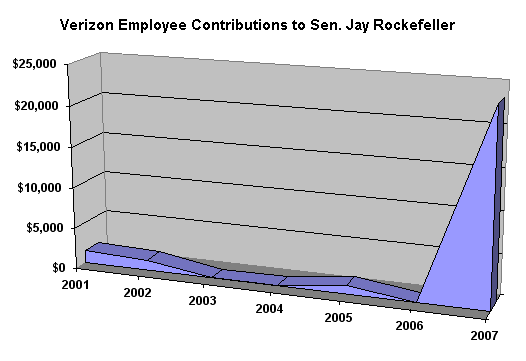
Top Verizon executives, including CEO Ivan Seidenberg and President Dennis Strigl, wrote personal checks to Rockefeller totaling $23,500 in March, 2007. Prior to that apparently coordinated flurry of 29 donations, only one of those executives had ever donated to Rockefeller (at least while working for Verizon).
In fact, prior to 2007, contributions to Rockefeller from company executives at AT&T and Verizon were mostly non-existent.
But that changed around the same time that the companies began lobbying Congress to grant them retroactive immunity from lawsuits seeking billions for their alleged participation in secret, warrantless surveillance programs that targeted Americans.
The Spring '07 checks represent 86 percent of money donated to Rockefeller by Verizon employees since at least 2001.
AT&T executives discovered a fondness for Rockefeller just a month after Verizon execs did and over a three-month span, collectively made donations totaling $19,350.
AT&T Vice President Fred McCallum began the giving spree in May with a $500 donation. 22 other AT&T high fliers soon followed with their own checks.
Prior to that burst of generosity, the only AT&T employee donation to Rockefeller was a $300 contribution in 2001. That supporter did not identify herself as a company executive.
When asked about the contributions, an AT&T spokesman told THREAT LEVEL: "AT&T employees regularly and voluntarily participate in the political process with their own funds."
Both companies are being sued for allegedly turning over billions of calling records to the government, while AT&T is also accused of letting the National Security Agency wiretap phone calls and its internet backbone. A federal judge in California allowed the suits regarding the eavesdropping to continue despite the government's attempt to have the suits thrown out on the grounds they will endanger national security. The 9th Circuit Court of Appeals reviewed that decision in August. The judges seemed reluctant to toss the cases, but have yet to issue a ruling.
On Thursday evening, the Rockefeller-led Senate Intelligence Committee is marking up a bill to re-amend the nation's spy laws. While the text of the bill has not yet been released, the bill reportedly includes a way for the telecoms to escape the litigation against them.
Rockefeller's commitment to getting the telecoms out of court surprises some who remember that Rockefeller was originally disturbed enough about the secret spying programs that he hand-wrote a letter to Dick Cheney in 2003, expressing his concerns about the program's legality.
In a fairly stunning related news, Democratic Senator Chris Dodd went all in with his political capital Thursday, announcing he would unilaterally put a hold on the bill, which would stop the bill from being voted on.
Representatives for Verizon and Rockefeller did not respond to requests for comment.
The contributions and the following tables were found thanks to OpenSecrets.org.
UPDATE: Reader Theo writes in to say why the money, though tiny in comparison to Rockefeller's fortune, is not negligible.Rockefeller is believed to have a personal fortune over $100 million. He spent $12 million of personal funds on his first Senate campaign. (http://www.encyclopedia.com/doc/1G1-3521561.html)
However "in recent campaigns, he has downplayed his personal wealth in one of the nation's poorest states. 'I will not spend one single dime of any money that I have,' he said in 2002. 'So that I if I don't raise money, I won't spend money. I am on exactly the same playing field, so to speak, with anybody else who runs for office.'" AP
He's up for election in 2008. The cost of Senate races has increased several times over the last two decades. With a serious Republican challenger in WV, which Bush won twice, such as Rep. Shelley Moore Capito, he could be forced to raise tens of millions of dollars. That, or break his promise not to use his personal fortune, which wouldn't play very well in one of the country's poorest states.
So yes, even a Rockefeller has to raise money. And in West Virginia, $50,000 is a lot of money. It's about 2% of all the money he raised last year. (But I'll bet he's slightly more worried about being red-baited for suppurtin' terrists.)

Monday, October 8, 2007
| [+/-] |
Democrats Expected To Concede on Wiretapping |
The New York Times reports:
Two months after vowing to roll back broad new wiretapping powers won by the Bush administration, Congressional Democrats appear ready to make concessions that could extend some of the key powers granted to the National Security Agency.
Bush administration officials say they are confident they will win approval of the broadened wiretapping authority that they secured temporarily in August as Congress rushed toward recess, and some Democratic officials admit that they may not come up with the votes to rein in the administration.
As the debate over the N.S.A.’s wiretapping powers begins anew this week, the emerging legislation reflects the political reality confronting the Democrats. While they are willing to oppose the White House on the conduct of the war in Iraq, they remain nervous that they will be labeled as soft on terrorism if they insist on strict curbs on intelligence gathering.
A Democratic bill to be proposed Tuesday in the House would maintain for several years the type of broad, blanket authority for N.S.A. wiretapping that the administration secured in August for just six months. But in an acknowledgment of civil liberties concerns, the measure would also require a more active role by the special foreign intelligence court that oversees the N.S.A.’s interception of foreign-based communications.
A competing proposal in the Senate, still being drafted, may be even closer in line with the administration’s demands, with the possibility of including retroactive immunity for telecommunications companies that took part in the N.S.A.’s once-secret program to wiretap without court warrants.
No one is willing to predict with certainty how the issue will play out. But some Congressional officials and others monitoring the debate over the legislation said the final result may not be much different than it was two months ago, despite Democrats’ insistence that they would not let stand the August extension of the N.S.A.’s powers.
“Many members continue to fear that if they don’t support whatever the president asks for, they’ll be perceived as soft on terrorism,” said William Banks, a professor specializing in terrorism and national security law at Syracuse University who has written extensively on federal wiretapping law.
The August bill, known as the Protect America Act, was approved by Congress in the final hours before its summer recess after heated warnings from the Bush administration that legal loopholes in wiretapping coverage had left the country vulnerable to another terrorist attack. The legislation significantly reduced the role of the foreign intelligence court and broadened the N.S.A.’s ability to listen in on foreign-based communications without a court warrant.
“We want the statute made permanent,” Dean Boyd, a spokesman for the Justice Department, said today. “We view this as a healthy debate. We also view it as an opportunity to inform Congress and the public that we can use these authorities responsibly. We’re going to go forward and look at any proposals that come forth, but we’ll look at them very carefully to make sure they don’t have any consequences that hamper our abilities to protect the country.”
House Democrats overwhelmingly opposed the interim legislation in August and believed at the time they had been forced into a corner by the Bush administration.
As Congress takes up the new legislation, a senior Democratic aide said House leaders are working hard to make sure the administration does not succeed in pushing through a bill that would make permanent all the powers it secured in August for the N.S.A. “That’s what we’re trying to avoid,” the aide said. “We have that concern too.”
The bill to be proposed Tuesday by the Democratic leaders of the House Intelligence and Judiciary Committees would impose more controls over the N.S.A.’s powers, including quarterly audits by the Justice Department’s inspector general. It would also give the foreign intelligence court a role in approving, in advance, “basket” or “umbrella” warrants for bundles of overseas communications, according to a Congressional official.
“We are giving the N.S.A. what it legitimately needs for national security but with far more limitations and protections than are in the Protect America Act,” said Brendan Daly, a spokesman for Speaker Nancy Pelosi, Democrat of California.
Perhaps most important in the eyes of Democratic supporters, the House bill would not give retroactive immunity to the telecommunications companies that took part in the N.S.A.’s domestic eavesdropping program — a proposal that had been a top priority of the Bush administration. The August legislation granted the companies immunity for future acts, but not past deeds.
A number of private groups are trying to prove in federal court that the telecommunications companies violated the law by taking part in the program. A former senior Justice Department lawyer, Jack Goldsmith, seemed to bolster their case last week when he told Congress that the program was a “legal mess” and strongly suggested it was illegal.
In the Senate, the Democratic chairman of the Intelligence Committee, John D. Rockefeller IV of West Virginia, is working with his Republican counterpart, Christopher S. Bond of Missouri, who was one of the main proponents of the August plan, to come up with a compromise wiretapping proposal. Wendy Morigi, a spokeswoman for Mr. Rockefeller, said that retroactive immunity for the telecommunications companies is “under discussion,” but that no final proposal had been developed.
The immunity issue may prove to be the key sticking point between whatever proposals are ultimately passed by the House and the Senate. Representative Jerrold Nadler, a New York Democrat who was among the harshest critics of the legislation passed in August, said he would vigorously oppose any effort to grant retroactive legal protection to telecommunications companies. “There is heavy pressure on the immunity and we should not cave an inch on that,” he said in an interview.
Mr. Nadler said he was worried that the Senate would give too much ground to the administration in its proposal, but he said he was satisfied with the legislation to be proposed Tuesday in the House.
“It is not perfect, but it is a good bill,” he said. “It makes huge improvements in the current law. In some respects it is better than the old FISA law,” referring to the Foreign Intelligence Surveillance Act.
Civil liberties advocates and others who met with House officials today about the proposed bill agreed that it was an improvement over the August plan, but they were not quite as charitable in their overall assessment.
‘This still authorizes the interception of Americans’ international communications without a warrant in far too many instances and without adequate civil liberties protections,” said Kate Martin, director of the Center for National Security Studies, who was among the group that met with House officials.
Caroline Frederickson, director of the Washington legislative office of the American Civil Liberties Union, said she was troubled by the Democrats’ acceptance of broad, blanket warrants for the N.S.A., rather than the individualized warrants traditionally required by the intelligence court.
“The Democratic leadership, philosophically, is with us, but we need to help them realize the political case, which is that Democrats will not be in danger if they don’t reauthorize this Protect America Act,” Ms. Frederickson said. “They’re nervous. There’s a ‘keep the majority’ mentality, which is understandable. But we think they’re putting themselves in more danger by not standing on principle.”
Friday, July 15, 2005
| [+/-] |
Joe Wilson's Response To The Senate Intelligence Committee Report |
Ambassador Joe Wilson forwarded to BuzzFlash his response to the Senate Select Intelligence Committee's "conclusions"* about his efforts to expose the truth about the phony Niger claims, and how he came to investigate them.
He asked that we share his evidence with our readers.
The Honorable Pat Roberts
Chairman, Senate Select Committee on Intelligence
The Honorable Jay Rockefeller
Vice Chairman, Senate Select Committee on Intelligence
Dear Senator Roberts and Senator Rockefeller,
I read with great surprise and consternation the Niger portion of Senators Roberts, Bond and Hatch "additional comments to the Senate Select Intelligence Committee's Report on the U.S. Intelligence Community's Prewar Assessment on Iraq." I am taking this opportunity to clarify some of the issues raised in these comments.
First conclusion: "The plan to send the former ambassador to Niger was suggested by the former ambassador's wife, a CIA employee."
That is not true. The conclusion is apparently based on one anodyne quote from a memo Valerie Plame, my wife sent to her superiors that says "my husband has good relations with the PM (prime minister) and the former Minister of Mines, (not to mention lots of French contacts) both of whom could possibly shed light on this sort of activity." There is no suggestion or recommendation in that statement that I be sent on the trip. Indeed it is little more than a recitation of my contacts and bona fides. The conclusion is reinforced by comments in the body of the report that a CPD reports officer stated the "the former ambassador's wife `offered up his name'" (page 39) and a State Department Intelligence and Research officer that the "meeting was `apparently convened by [the former ambassador's] wife who had the idea to dispatch him to use his contacts to sort out the Iraq-Niger uranium issue."
In fact, Valerie was not in the meeting at which the subject of my trip was raised. Neither was the CPD Reports officer. After having escorted me into the room, she departed the meeting to avoid even the appearance of conflict of interest. It was at that meeting where the question of my traveling to Niger was broached with me for the first time and came only after a thorough discussion of what the participants did and did not know about the subject. My bona fides justifying the invitation to the meeting were the trip I had previously taken to Niger to look at other uranium related questions as well as 20 years living and working in Africa, and personal contacts throughout the Niger government. Neither the CPD reports officer nor the State analyst were in the chain of command to know who, or how, the decision was made. The interpretations attributed to them are not the full story. In fact, it is my understanding that the Reports Officer has a different conclusion about Valerie's role than the one offered in the "additional comments". I urge the committee to reinterview the officer and publicly publish his statement.
It is unfortunate that the report failed to include the CIA's position on this matter. If the staff had done so it would undoubtedly have been given the same evidence as provided to Newsday reporters Tim Phelps and Knut Royce in July, 2003. They reported on July 22 that:
"A senior intelligence officer confirmed that Plame was a Directorate of Operations undercover officer who worked `alongside' the operations officers who asked her husband to travel to Niger.
"But he said she did not recommend her husband to undertake the Niger assignment. `They (the officers who did ask Wilson to check the uranium story) were aware of who she was married to, which is not surprising,' he said. `There are people elsewhere in government who are trying to make her look like she was the one who was cooking this up, for some reason,' he said. `I can't figure out what it could be.'
"We paid his (Wilson's) airfare. But to go to Niger is not exactly a benefit. Most people you'd have to pay big bucks to go there,' the senior intelligence official said. Wilson said. he was reimbursed only for expenses." (Newsday article Columnist blows CIA Agent's cover, dated July 22, 2003).
In fact, on July 13 of this year, David Ensor, the CNN correspondent, did call the CIA for a statement of its position and reported that a senior CIA official confirmed my account that Valerie did not propose me for the trip:
"'She did not propose me', he [Wilson] said--others at the CIA did so. A senior CIA official said that is his understanding too.'"
Second conclusion: "Rather that speaking publicly about his actual experiences during his inquiry of the Niger issue, the former ambassador seems to have included information he learned from press accounts and from his beliefs about how the Intelligence Community would have or should have handled the information he provided."
This conclusion states that I told the committee staff that I "may have become confused about my own recollection after the International Atomic Energy Agency (IAEA) reported that the names and dates on the documents were not correct." At the time that I was asked that question, I was not afforded the opportunity to review the articles to which the staff was referring. I have now done so.
On March 7, 2003 the Director General of the IAEA reported to the United Nations Security Council that the documents that had been given to him were "not authentic". His deputy, Jacques Baute, was even more direct, pointing out that the forgeries were so obvious that a quick Google search would have exposed their flaws. A State Department spokesman was quoted the next day as saying about the forgeries "We fell for it." From that time on the details surrounding the documents became public knowledge and were widely reported. I was not the source of information regarding the forensic analysis of the documents in question; the IAEA was.
The first time I spoke publicly about the Niger issue was in response to the State Department's disclaimer. On CNN a few days later, in response to a question, I replied that I believed the US government knew more about the issue than the State Department spokesman had let on and that he had misspoken. I did not speak of my trip.
My first public statement was in my article of July 6 published in the New York Times, written only after it became apparent that the administration was not going to deal with the Niger question unless it was forced to. I wrote the article because I believed then, and I believe now, that it was important to correct the record on the statement in the President's State of the Union address which lent credence to the charge that Iraq was actively reconstituting its nuclear weapons program. I believed that the record should reflect the facts as the US government had known them for over a year. The contents of my article do not appear in the body of the report and is not quoted in the "additional comments." In that article, I state clearly that "As for the actual memorandum, I never saw it. But news accounts have pointed out that the documents had glaring errors - they were signed, for example, by officials who were no longer in government - and were probably forged. (And then there's the fact that Niger formally denied the charges.)"
The first time I actually saw what were represented as the documents was when Andrea Mitchell, the NBC correspondent handed them to me in an interview on July 21. I was not wearing my glasses and could not read them. I have to this day not read them. I would have absolutely no reason to claim to have done so. My mission was to look into whether such a transaction took place or could take place. It had not and could not. By definition that makes the documents bogus.
The text of the "additional comments" also asserts that "during Mr. Wilson's media blitz, he appeared on more than thirty television shows including entertainment venues. Time and again, Joe Wilson told anyone who would listen that the President had lied to the American people, that the Vice President had lied, and that he had "debunked" the claim that Iraq was seeking uranium from Africa."
My article in the New York Times makes clear that I attributed to myself "a small role in the effort to verify information about Africa's suspected link to Iraq's nonconventional weapons programs." After it became public that there were then Ambassador to Niger, Barbro Owens-Kirkpatrick's report and the report from a four star Marine Corps General, Carleton Fulford in the files of the U. S. government, I went to great lengths to point out that mine was but one of three reports on the subject. I never claimed to have "debunked" the allegation that Iraq was seeking uranium from Africa. I claimed only that the transaction described in the documents that turned out to be forgeries could not have and did not occur. I did not speak out on the subject until several months after it became evident that what underpinned the assertion in the State of the Union address were those documents, reports of which had sparked Vice President Cheney's original question that led to my trip. The White House must have agreed. The day after my article appeared in the Times a spokesman for the President told the Washington Post that "the sixteen words did not rise to the level of inclusion in the State of the Union."
I have been very careful to say that while I believe that the use of the sixteen words in the State of the Union address was a deliberate attempt to deceive the Congress of the United States, I do not know what role the President may have had other than he has accepted responsibility for the words he spoke. I have also said on many occasions that I believe the President has proven to be far more protective of his senior staff than they have been to him.
The "additional comments" also assert: "The Committee found that, for most analysts the former ambassador's report lent more credibility, not less, to the reported Niger-Iraq uranium deal." In fact, the body of the Senate report suggests the exact opposite:
* In August, 2002, a CIA NESA report on Iraq's weapons of Mass Destruction capabilities did not include the alleged Iraq-Niger uranium information. (pg. 48)
In September, 2002, during coordination of a speech with an NSC staff member, the CIA analyst suggested the reference to Iraqi attempts to acquire uranium from Africa be removed. The CIA analyst said the NSC staff member said that would leave the British "flapping in the wind." (pg. 50)
The uranium text was included in the body of the NIE but not in the key judgments. When someone suggested that the uranium information be included as another sign of reconstitution, the INR Iraq nuclear analyst spoke up and said the he did not agree with the uranium reporting and that INR would be including text indicating their disagreement in their footnote on nuclear reconstitution. The NIO said he did not recall anyone really supporting including the uranium issue as part of the judgment that Iraq was reconstituting its nuclear program, so he suggested that the uranium information did not need to be part of the key judgments. He told Committee staff he suggested that "We'll leave it in the paper for completeness. Nobody can say we didn't connect the dots. But we don't have to put that dot in the key judgments." (pg. 53)
On October 2, 2002, the Deputy DCI testified before the SSCI. Senator Jon Kyl asked the Deputy DCI whether he had read the British White Paper and whether he disagreed with anything in the report. The Deputy DCI testified that "the one thing where I think they stretched a little bit beyond where we would stretch is on the points about where Iraq seeking uranium from various African locations. (pg.54)
On October 4, 2002 the NIO for Strategic and Nuclear Programs testified that "there is some information on attempts ....there's a question about those attempts because of the control of the material in those countries...For us it's more the concern that they (Iraq) uranium in country now. (pg. 54)
On October 5, 2002, the ADDI said an Iraq nuclear analyst - he could not remember who - raised concerns about the sourcing and some of the facts of the Niger reporting, specifically that the control of the mines in Niger would have made it very difficult to get yellowcake to Iraq. (pg. 55)
Based on the analyst's comments, the ADDI faxed a memo to the Deputy National Security Advisor that said, "remove the sentence because the amount is in dispute and it is debatable whether it can be acquired from this source. We told Congress that the Brits have exaggerated this issue. Finally, the Iraqis already have 550 metric tons of uranium oxide in their inventory. (pg. 56)
On October 6, 2002, the DCI called the Deputy National Security Advisor directly to outline the CIA's concerns. The DCI testified to the SSCI on July 16, 2003, that he told the Deputy National Security Advisor that the "President should not be a fact witness on this issue," because his analysts had told him the "reporting was weak." (pg. 56)
On October 6, 2002, the CIA sent a second fax to the White House which said, "more on why we recommend removing the sentence about procuring uranium oxide from Africa: Three points 1) the evidence is weak. One of the two mines cited by the source as the location of the uranium oxide is flooded. The other mine cited by the source is under the control of the French authorities. 2) the procurement is not particularly significant to Iraq's nuclear ambitions because the Iraqis already have a large stock of uranium oxide in their inventory. And 3) we have shared points one and two with Congress, telling them that the Africa story is overblown and telling them this in one of the two issues where we differed with the British." (Pg 56)
On March 8, 2003, the intelligence report on my trip was disseminated within the U.S. Government according the Senate report (pg. 43). Further, the Senate report states that "in early March, the Vice President asked his morning briefer for an update on the Niger uranium issue." That update from the CIA "also noted that the CIA would be debriefing a source who may have information related to the alleged sale on March 5." The report then states the "DO officials also said they alerted WINPAC analysts when the report was being disseminated because they knew the high priority of the issue." The report notes that the CIA briefer did not brief the Vice President on the report. (Pg. 46)
It is clear from the body of the Senate report that the Intelligence Community, including the DCI himself, made several attempts to ensure that the President not become a "fact witness" on an allegation that was so weak. A thorough reading of the report substantiates the claim made in my opinion piece in the New York Times and in subsequent interviews I have given on the subject. The sixteen words should never have been in the State of the Union address as the White House now acknowledges.
I undertook this mission at the request of my government in response to a legitimate concern that Saddam Hussein was attempting to reconstitute his nuclear weapons program. This was a national security issue that has concerned me since I was the Deputy Chief of Mission in the U.S. Embassy in Iraq before and during the first Gulf War.
At the time of my trip I was in private business and had not offered my views publicly on the policy we should adopt towards Iraq. Indeed, throughout the debate in the runup to the war, I took the position that the U.S. be firm with Saddam Hussein on the question of weapons of mass destruction programs including backing tough diplomacy with the credible threat of force. In that debate I never mentioned my trip to Niger. I did not share the details of my trip until May, 2003, after the war was over, and then only when it became clear that the administration was not going to address the issue of the State of the Union statement.
It is essential that the errors and distortions in the additional comments be corrected for the public record. Nothing could be more important for the American people than to have an accurate picture of the events that led to the decision to bring the United States into war in Iraq. The Senate Intelligence Committee has an obligation to present to the American people the factual basis of that process. I hope that this letter is helpful in that effort. I look forward to your further "additional comments."
Sincerely,
Joseph C. Wilson, IV
Washington, D.C
Wednesday, July 7, 2004
| [+/-] |
Senate Intelligence Committee Report On Pre-Iraq War Intelligence |
Report on the U.S. intelligence community's pre-war intelligence assessments on Iraq here.
