The Associated Press reports:
Al-Qaida chief Osama bin Laden called on Europeans to stop helping the United States in the war in Afghanistan, according to excerpts of a new audiotape broadcast Thursday on Al-Jazeera television.
Bin Laden said it was unjust for the United States to have invaded Afghanistan for sheltering him after the Sept. 11 terror attacks, saying he was the "only one responsible" for the deadly assaults on New York and Washington.
"The events of Manhattan were retaliation against the American-Israeli alliance's aggression against our people in Palestine and Lebanon, and I am the only one responsible for it. The Afghan people and government knew nothing about it. America knows that," the al-Qaida leader said in the five-minute tape.
The message appeared to be another attempt by bin Laden to influence public opinion in the West. In 2004, he offered Europeans a truce if they stopped attacking Muslims, then later spoke of a truce with the U.S. In both cases, al-Qaida then denounced those areas for not accepting its offer.
The terror leader said Afghans have been caught up in decades of struggle, first "at the hands of the Russians ... and before their wounds had healed and their grief had ended, they were invaded without right by your unjust governments."
He said that two separate injustices were visited upon Afghanistan as the Taliban was toppled in 2001: First, the war was "waged against the Afghans without right", and second coalition troops have not followed the "protocol of warfare," with the result that most bomb victims have been women and children.
"I have personally witnessed incidents like these, and the matter continues on an almost daily basis," he said.
State Department spokesman Sean McCormack dismissed the new tape as typical of bin Laden's tactics and expressed faith in the European allies.
"I think our NATO allies understand quite clearly what is at stake in Afghanistan as well as elsewhere around the world in fighting the war on terror," he told reporters. "It's going to require a sustained commitment over a period of time and we have seen that kind of commitment from our European allies."
FBI analysts were reviewing the tape but were not immediately able to say how long it was or when it might have been recorded nor could they provide other details. Spokesman Richard Kolko said it was being examined "to determine if it is authentic and for any intelligence value."
"As the FBI has said since 9/11, bin Laden was responsible for the attack," Kolko said in a statement. "In this latest tape, he again acknowledged his responsibility. This should help to clarify for all the conspiracy theorists, again _ the 9/11 attack was done by bin Laden and al-Qaida."
This has been the deadliest year in Afghanistan since the U.S.-led invasion in late 2001, with more than 6,100 people killed _ including more than 800 civilians _ in militant attacks and military operations, according to an Associated Press tally of figures from Afghan and Western officials.
In the new tape, bin Laden said European nations joined the U.S. invasion of Afghanistan "because they had no other alternative, only to be a follower."
"The American tide is ebbing, with God's help, and they will go back to their countries," he said, speaking of Europeans.
Bin Laden urged Europeans to pull away from the fight.
"It is better for you to stand against your leaders who are dropping in on the White House, and to work seriously to lift the injustice against the believers," he said, accusing U.S. forces and their allies of intentionally killing women and children in Afghanistan.
Al-Jazeera aired two brief excerpts of the audiotape, titled "Message to the European Peoples," which al-Qaida had announced Mondday that it would release soon.
Bin Laden issued four public statements earlier this year _ on Sept. 7, Sept. 11, Sept. 20 and Oct. 22. The Sept. 7 video was his first in three years and was issued to mark the sixth anniversary of the Sept. 11 attacks.
Al-Qaida has dramatically stepped up its messages _ a pace seen as a sign of its increasing technical sophistication and the relative security felt by its leadership. Bin Laden is believed to be hiding along the Afghan-Pakistan frontier.
Bin Laden's message was the 89th this year by Al-Qaida's media wing, Al-Sahab, an average of one every three days, double the rate in 2006, according to IntelCenter, a U.S. counterterrorism group that monitors militant messaging.
Thursday, November 29, 2007
| [+/-] |
Bin Laden: "Europeans Should End U.S. Help" |
Friday, October 26, 2007
| [+/-] |
America Could Have Killed Usama bin Laden, But Didn't Again |
Fox News military analyst Colonel David Hunt writes:
Because there is no shortage of things to yell about regarding the War on Terror, Iraq, Afghanistan, Homeland Security, and so on, deciding what to write about is always fun.
This week, I was going to yell about how the Bush administration leaked classified information — again — but we've been there before. Then, I thought I might write about Blackwater, but compared to so many things, Blackwater looks like back water.
I bet the few of you that read this stuff thought I would write about my short stint in the sights of those who complained or used my column last week for their own purposes. Nah, it ain't going to happen. Those who were yelling or using me on their TV shows — without bringing me on to comment — are hardly worth the print space. I am not that big a deal. Besides, these things are of little consequence when you realize how we missed, squandered, screwed up, made a mess of and were massively risk adverse — again — when we did not kill Usama bin Laden in Afghanistan just two short months ago.
We know, with a 70 percent level of certainty — which is huge in the world of intelligence — that in August of 2007, bin Laden was in a convoy headed south from Tora Bora. We had his butt, on camera, on satellite. We were listening to his conversations. We had the world’s best hunters/killers — Seal Team 6 — nearby. We had the world class Joint Special Operations Command (JSOC) coordinating with the CIA and other agencies. We had unmanned drones overhead with missiles on their wings; we had the best Air Force on the planet, begging to drop one on the terrorist. We had him in our sights; we had done it. Nice job again guys — now, pull the damn trigger.
Unbelievably, and in my opinion, criminally, we did not kill Usama bin Laden.
You cannot make this crap up; truth is always stranger and more telling than fiction. Our government, the current administration and yes, our military leaders included, failed to kill bin Laden for no other reason than incompetence.
The current “boneheads” in charge will tell you all day long that we are fighting and dying in Iraq and Afghanistan to stop terrorists there so they do not come here. Nice talk, how about — just for a moment — acting like you mean what you say? You know walk the walk. These incidents, where we displayed a total lack of guts, like the one in August, are just too prevalent. The United States of America’s political and military leadership has, on at least three separate occasions, chosen not capture or kill bin Laden or Ayman al-Zawahri. We have allowed Pakistan to become a safe haven for Al Qaeda. We have allowed Al Qaeda to reconstitute, partially because of money they (Al Qaeda in Iraq) have been sending to Al Qaeda in Pakistan.
We are in a war with terrorists. We are in a war with countries that support terrorists. We are in a war with people that fly planes into buildings and who never, ever hesitate to pull the trigger when given the chance to kill us. We cannot win and, I will tell you this now, we are losing this war every damn time we fail to take every single opportunity to kill murderers like Usama bin Laden. Less than two months ago, we lost again.
Our men and women are being blown up and killed every day in Iraq and Afghanistan. Every family who is separated from a loved one during this war is being insulted by our government when they fail to kill those who have already killed us and will not hesitate to do so again and again. Damn it guys, PULL THE DAMN TRIGGER.
Colonel David Hunt, U.S. Army (Ret.), is a FOX News military analyst and the author of the New York Times bestseller They Just Don’t Get It. He has extensive operational experience in counterterrorism, special operations, and intelligence operations. He has trained the FBI and Special Forces in counterterrorism tactics, served as the security adviser to six different Olympic Games, testified as an expert at many major terrorist trials, and lectured at the CIA, the FBI, and the National Security Agency.
Monday, October 22, 2007
| [+/-] |
Another Day, Another Bin Laden Tape |
The Guardian reports:
Audio and video messages from al-Qaida leader Osama bin Laden since Sept. 11, 2001:
- Oct. 22, 2007: Bin Laden calls for Iraqi insurgents to unite and avoid divisive ``extremism'' in an audiotape apparently intended to win over Sunnis opposed to the terror group's branch in Iraq.
- Sept. 20, 2007: Bin Laden urges Pakistanis to wage holy war on and overthrow President Gen. Pervez Musharraf for his alliance with the United States against Islamic militants in a 23-minute video. The images on the tape had been released before, but the audio referred to the storming of Islamabad's Red Mosque, a militant stronghold, suggesting it had been recorded since July.
- Sept. 11, 2007: Bin Laden commemorates one of the Sept. 11 suicide hijackers and calls on young Muslims to become martyrs in a videotape that lays his audio message over a still image of the al-Qaida leader.
- Sept. 7, 2007: Bin Laden appears for the first time in three years in a 30-minute video, released to mark the sixth anniversary of the Sept. 11 attacks. He tells Americans they should convert to Islam if they want the war in Iraq to end. He is shown wearing a trimmed beard, which in previous videos was mostly gray, now entirely dark.
- July 1, 2006 - Bin Laden issues a 19-minute audiotape endorsing the new leader of al-Qaida in Iraq, Abu Hamza al-Muhajer, and denouncing Iraqi Shiite leaders as traitors.
- June 30, 2006 - Bin Laden issues an audiotape praising al-Muhajer's predecessor, Abu Musab al-Zarqawi, who had been killed in a U.S. airstrike. The message, also 19 minutes, was packaged with an old photo of bin Laden and images of al-Zarqawi.
- May 23, 2006: Bin Laden says in an audiotape that convicted terror plotter Zacarias Moussaoui had nothing to do with the Sept. 11 attacks.
- April 23, 2006: In an audiotape, bin Laden says the West is at war with Islam and calls on his followers to go to Sudan to fight a proposed U.N. force.
- Jan. 19, 2006: Bin Laden warns in an audiotape that his fighters are preparing new attacks in the United States but offers the American people a ``long-term truce'' without specifying the conditions.
- Dec. 28, 2004: In an hourlong audiotape, bin Laden endorses al-Zarqawi as his deputy in Iraq and calls for a boycott of Iraqi elections.
- Dec. 16, 2004: In an audiotape, bin Laden praises militants who attacked a U.S. consulate in Saudi Arabia and calls on militants to stop the flow of oil to the West.
- Oct. 29, 2004: In a videotape, bin Laden says the United States can avoid another Sept. 11 attack if it stops threatening the security of Muslims.
- May 6, 2004: In an audiotape released on Islamic forums, bin Laden offers rewards of gold for the killing of U.S. and U.N. officials in Iraq.
- April 15, 2004: Bin Laden offers a ``truce'' to European countries that do not attack Muslims.
- Jan. 4, 2004: Bin Laden says in an audiotape that the war in Iraq is the beginning of the ``occupation'' of Persian Gulf states for their oil. He calls on Muslims to keep fighting a holy war in the Middle East.
- Sept. 10, 2003: In the first video image of bin Laden in nearly two years, he is shown walking through rocky terrain with top deputy Ayman al-Zawahri. In an accompanying audiotape, bin Laden praises the ``great damage to the enemy'' in the Sept. 11 attacks and mentions five hijackers by name.
- April 7, 2003: In an audiotape, bin Laden exhorts Muslims to rise up against Kuwait, Saudi Arabia and other governments it claims are ``agents of America,'' and calls for suicide attacks against U.S. and British interests.
- Feb. 13, 2003: In an audiotape, bin Laden reads a last will and testament. He says he wants to die a martyr in a new attack against the U.S.
- Feb. 11, 2003: Bin Laden tells followers to help Saddam Hussein fight U.S. troops.
- Nov. 12, 2002: An audiotape attributed to bin Laden threatens new terrorism against the U.S. and its allies, and calls the Bush administration ``the biggest serial killers in this age.'' U.S. experts say the tape can't be authenticated because of its poor quality.
- Dec. 13, 2001: In a videotape made in Afghanistan on Nov. 9, 2001, bin Laden says the destruction of the Sept. 11 attacks exceeded even his ``optimistic'' calculations.
Friday, September 7, 2007
| [+/-] |
New Osama Bin Laden Tape |
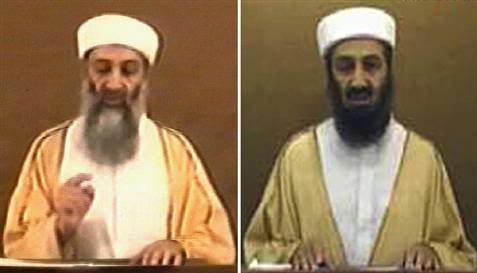
Bin Laden tapes
October 6, 2001 - audio tape released, supposedly of bin Laden saying any US attack on Muslim world would be repaid "twofold".
November 12, 2001 - apparent video tape of bin Laden warning US allies against supporting "White House gang of butchers".
December 20, 2003 - audio tape, purportedly from bin Laden, accuses Arab governments responding to US calls for democracy of being "infidel" agents of US.
May 6, 2004 - audio recording, said to be from bin Laden, calls for a holy war against the US-led occupation of Iraq.
October 30, 2004 - Days before the US presidential election, bin Laden in a video tells Americans Bush has deceived them and that the US could face more strikes like September 11.
Al Jazeera English reports:
A videotape purporting to show Osama bin Laden has been released in which the al-Qaeda leader warns George Bush that he is repeating the "mistakes of the former Soviet Union".
US officials were studying the tape, which, if proved to be genuine, would be the first message from bin Laden for nearly three years.
In the tape, bin Laden purportedly said that US Democrats had failed to stop the Iraq war because of the power of US corporations.
"The mistakes of Brezhnev are being repeated by Bush," says Bin Laden on the tape, in a reference to the former Soviet invasion of Afghanistan, Reuters reported.
Bin Laden said that the war in Iraq was continuing for "the same reasons which led to the failure of former president [John F] Kennedy to stop the Vietnam war - those with real power and influence are those with the most capital", the Reuters news agency reported.
The tape, released on Friday, purportedly shows Bin Laden telling US citizens that they should join Islam if they want the war in Iraq to end, though it is said to contain no specific threats.
The videotape was issued just days before the 6th anniversary on the September 11 attacks on New York.
Commenting on the video, Bush said the tape was "a reminder about the dangerous world in which we live, and it is a reminder that we must pull together to protect our people against these extremists who murder the innocent in order to achieve their political objective."
Authenticity
In the video bin Laden is shown with his beard much shorter and darker than in his last appearance, when it was streaked with grey.
A banner on the screen reads in English: "A message from Sheikh Osama bin Laden to the American people."
References in the video to Nicolas Sarkozy, the French president, and Gordon Brown, the British prime minister, are believed to suggest the video is only a few weeks old.
Bin Laden also appeared to refer to memorial ceremonies in Hiroshima and Nagasaki that took place barely a month ago, on August 6 and on August 9.
A US official said that this could mean the video was recorded later in August.
US officials have not confirmed the authenticity of the tape, but did say that it was being analysed.
Later Reuters reported an anonymous official as saying the US was "operating under the assumption that the tape is real".
Adel Darwish, political editor of Middle East magazine, told Al Jazeera that he had "doubts" about the authenticity of the tape.
"Any kid these days with an electronic kit can alter images and edit the way that he or she likes," he said.
"There is no close up on bin Laden, the beard is thick and black and then there are large segments where the image is a still."
Website shutdown
Soon after Washington announced it had the video, all the websites that usually carry statements from al-Qaeda went down and were inaccessible, in an unprecedented shutdown, according to the Associated Press news agency.
The reason for the shutdown was not immediately known.
Evan H Kohlmann, an expert at globalterroralert.com, said he suspected it was the work of al-Qaeda itself, trying to find how the video leaked to US officials.
Others suspected the US might be behind the shutdown.
Marwan Bishara, Al Jazeera's senior political analyst, said: "Bin Laden is telling the Americans that he is still there and leading."
"It [the tape]underlines the strength of words in this new asymmetrical warfare in the 21st century between the US and al-Qaeda."
Tony Fratto, a White House spokesman, said the tape demonstrated that "terrorists are out there and they are actively trying to kill Americans and threaten our interests".
Bin Laden was last seen in a video statement shortly before the US presidential election in 2004.
Since then, he has issued a number of audio messages, the last in July 2006 when he vowed al-Qaeda would fight the US across the world.
| [+/-] |
Extracts From The Bin Laden Tape |
Al Jazeera English reports:
A videotape has emerged purportedly of a speech by Osama bin Laden, the leader of al-Qaeda, in which he refers to the Bush administration's progress in Iraq and the performance of the Democratic party in opposing it.
The following are excerpts from the recording, the first videotaped speech from bin Laden to emerge in three years.
"I am sending you important messages so lend me your ears. I will begin with the war opposing us, and some of its repercussions for both of us.
"At first, I say that despite the fact America possesses the greatest economic power and the most powerful and modern military arsenal, despite spending on this war much more than what the entire world spends on its armies, and despite it being the superpower influencing world policies - as if it has a monopoly on the unjust veto right - despite all of this, and with God's help, nineteen young men were able to change the direction of its compass.
"Any speech about the "mujahidin" is an integral part of the speech of your leader. The impact and significance of this are not hidden."
"Bush mentions his co-operation with Maliki and his government to spread freedom in Iraq, but in fact, he is co-operating with the leaders of one sect against another sect, believing that this will lead him to a quick victory.
"Thus, he spread the so-called civil war, and things worsened on his hands and got out of his control. He became like someone who ploughs the sea and gains nothing but failure.
"These are some facts pertaining to the freedom he says he is spreading. Bush's insistence not to give the United Nations an expanded mandate in Iraq is an implicit admission of his loss and defeat over there.
"Among the most important items in Bush speeches since September 11 is his statement that the Americans have no options but to continue the war. Such statements are in fact a repetition of the words of the neo-conservatives, such as [Dick] Cheney, [Donald] Rumsfeld and Richard Perle, who said earlier that the Americans have no option but to continue war, or to face a holocaust."
"However, we are a people that do not tolerate oppression, we reject humiliation and disgrace, and we take revenge on the people of tyranny and aggression.
"The blood of the Muslims will not be spilled in vain, and the morrow is nigh for he who awaits."
"The genocide of peoples and their holocaust was perpetrated on your hands. All what is left from the Red Indians is a few specimens. A short while ago, the Japanese observed the 62nd anniversary of the annihilation of Nagasaki and Hiroshima with your nuclear bombs."
"How similar is your situation today to their situation about two decades ago? The mistakes of Brezhnev are being committed by Bush"
"Yet in spite of that, you [American citizens] allowed Bush to complete his first term. And what is even stranger is that you still chose him for a second term. This was a clear and explicit mandate you gave him, with your full knowledge and consent, to continue killing our people in Iraq and Afghanistan. Then you claim to be innocent.
"This innocence of yours is similar to my innocence of the blood of your sons on the 11th, were I to claim such a thing.
"But it is impossible to humour many of you in the arrogance and indifference you show for the lives of humans outside America, or to humour your leaders in lying. The whole world knows that they have the lion's share of that."
"In answer to the question about the reasons of the Democrats' failure to stop the war, I say that these are the same reasons of the failure of former President [John] Kennedy to stop the Vietnam war.
"Those who possess real power and influence are the ones who have the biggest capital. And since the Democratic regime allows the major corporations to support candidates, be they presidential or congressional, then there should be no need for astonishment at the Democrats' failure to stop the war. You are the ones who say 'money talks'."
"I also want to bring to your attention that among the greatest reasons for the collapse of the Soviet Union was their being afflicted with their leader [Leonid] Brezhnev, who was dominated by pride and arrogance and refused to recognise the facts on the ground.
"Since the first year of Afghanistan's invasion, reports indicated that the Russians were losing the war. However, he refused to admit this so that it would not be added as a defeat in his personal history - even though refusing to acknowledge defeat not only fails to change the truth for the wise ones, but also exacerbates the problem and increases the losses.
"How similar is your situation today to their situation about two decades ago? The mistakes of Brezhnev are being committed by Bush. When asked about the date of withdrawing his troops from Iraq, he said that the withdrawal will not take place during his term, but during the term of his successor. The significance of these words is not hidden."
Thursday, September 6, 2007
| [+/-] |
Osama Bin Laden To Issue Video As 9/11 Anniversary Approaches |
CNN reports:
As al Qaeda's media production company touted the imminent release of a video from Osama bin Laden, U.S. officials began dismissing the tape as propaganda.
An Osama bin Laden video is expected by Sunday.
"Soon, God willing, video message by the Lion Sheik Osama bin laden, may God protect him," the banner ad says in Arabic script translated by CNN's senior editor for Arab affairs Octavia Nasr.
The terrorist watch group IntelCenter said Thursday it expected the video to be released within 72 hours.
It would come just days before the sixth anniversary of the 9/11 terrorist attacks -- planned and executed by al Qaeda.
There was no "credible information" about any imminent threat to the United States, said Russ Knocke, a spokesman for the Department of Homeland Security.
But he reiterated the department's stance that "we are in a period of increased risk."
"The National Intelligence Estimate cited increases in activity overseas, and we're mindful of the recent arrests in Europe," he said. "There has also been an uptick in propaganda tapes and messages coming from al Qaeda and affiliated networks over the past year."
But she stopped short of calling for the media to ignore the tape.
"I just think people have got to be clear that we're being manipulated every time that they issue a statement, because they're trying to use the media as a way to terrorize us," she said. "After all, we haven't seen an attack, and this is one way that they try to terrorize the American people."
The ad includes a photograph of bin Laden with a completely black beard, although it was most recently seen streaked with gray.
It was not clear how old the photograph was.
"I think it works for [al Qaeda's] benefit that he looks young, he looks healthy," said Rita Katz, director of SITE (Search for International Terrorist Entities) Intelligence Group, according to The Associated Press. She said bin Laden's beard may have been dyed, the AP reported.
A U.S. intelligence official said the intelligence community is waiting to see if a video is, in fact, released.
"The most telling feature is if it is recent," said the official. The content could "say a lot about his situation, his health."
The intelligence community will be looking at what it says: Whether the video is an "operational message" or whether it is merely to "establish presence, tell his followers he's large and living," the source said.
Another U.S. official said a new bin Laden videotape would be eagerly anticipated since he has not been seen in almost three years.
The official said the intelligence community would be very interested in the timeliness of the message -- whether bin Laden mentions current events, for example, or some other clue to indicate when the tape was produced -- and whether it offers new leads to his whereabouts.
Bin Laden's most recent video appearance came days before the 2004 presidential vote and was widely credited with giving a boost to President Bush's re-election campaign.
In that tape, bin Laden said he decided in 1982 to attack the twin towers of the World Trade Center after the invasion of Lebanon by Israel, which he claimed was backed by the U.S. Navy.
Although the United States launched the war in Afghanistan to find bin Laden and to deny al Qaeda a safe haven with the Taliban, which then controlled the country, he has eluded capture.
Officials have said bin Laden may be hiding in the mountainous tribal areas of Afghanistan or Pakistan. But a military official recently told said there has been no good lead on his location since about 2005.
Monday, August 27, 2007
| [+/-] |
Into Thin Air |
The hunt for bin Laden.
At Newsweek, Evan Thomas writes:
The Americans were getting close. It was early in the winter of 2004-05, and Osama bin Laden and his entourage were holed up in a mountain hideaway along the Afghanistan-Pakistan border. Suddenly, a sentry, posted several kilometers away, spotted a patrol of U.S. soldiers who seemed to be heading straight for bin Laden's redoubt. The sentry radioed an alert, and word quickly passed among the Qaeda leader's 40-odd bodyguards to prepare to remove "the Sheik," as bin Laden is known to his followers, to a fallback position. As Sheik Said, a senior Egyptian Qaeda operative, later told the story, the anxiety level was so high that the bodyguards were close to using the code word to kill bin Laden and commit suicide. According to Said, bin Laden had decreed that he would never be captured. "If there's a 99 percent risk of the Sheik's being captured, he told his men that they should all die and martyr him as well," Said told Omar Farooqi, a Taliban liaison officer to Al Qaeda who spoke to a NEWSWEEK reporter in Afghanistan.
The secret word was never given. As the Qaeda sentry watched the U.S. troops, the patrol started moving in a different direction. Bin Laden's men later concluded that the soldiers had nearly stumbled on their hideout by accident. (One former U.S. intelligence officer told NEWSWEEK that he was aware of official reporting on this incident.)
And so it has gone for six years. American intelligence officials interviewed by NEWSWEEK ruefully agree that the hunt to find bin Laden has been more a game of chance than good or "actionable" intelligence. Since bin Laden slipped away from Tora Bora in December 2001, U.S. intelligence has never had better than a 50-50 certainty about his whereabouts. "There hasn't been a serious lead on Osama bin Laden since early 2002," says Bruce Riedel, who recently retired as a South Asia expert at the CIA. "What we're doing now is shooting in the dark in outer space. The chances of hitting anything are zero."
How can that be? With all its spy satellites and aerial drones, killer commandos and millions in reward money, why can't the world's greatest superpower find a middle-aged, possibly ill, religious fanatic with a medieval mind-set? The short answer, sometimes overlooked, is that good, real-time intelligence about the enemy is hard to come by in any war, and manhunts are almost always difficult, especially if the fugitive can vanish into a remote region with a sympathetic population. (Think how long—five years—it took the FBI to track down Eric Rudolph, the Atlanta Olympic bomber, in the wilds of North Carolina.) That said, the U.S. government has made the job harder than necessary. The Iraq War drained resources from the hunt, and some old bureaucratic bugaboos—turf battles and fear of risk—undermined the effort. The United States can't just barge into Pakistan without upsetting, and possible dooming, President Pervez Musharraf, who seems to lurch between trying to appease his enemies and riling them with heavy-handed repression.
The story of the search for the men known to American spies and soldiers as high-value targets one and two (HVT 1 and HVT 2)—Osama bin Laden and his possibly more dangerous No. 2, Ayman al-Zawahiri—is a frustrating, at times agonizing, tale of missed opportunities, damned-if-you-do, damned-if-you-don't choices, and outright blunders. It has been related to NEWSWEEK by dozens of American, Pakistani and Afghan military and intelligence officials, as well as a few Qaeda sympathizers like Omar Farooqi. Capturing bin Laden "continues to be a huge priority," says Frances Fragos Townsend, President George W. Bush's chief counterterror adviser. It may be true, as Townsend points out, that Qaeda leaders do not have anything like the safe haven they enjoyed in Afghanistan before 9/11. But it is also true that Al Qaeda has been reconstituting itself in the mountains of Pakistan and Afghanistan, and that the terrorist organization is determined to stage more 9/11s, and maybe soon. "We have very strong indicators that Al Qaeda is planning to attack the West and is likely to attack, and we are pretty sure about that," says retired Vice Adm. John Redd, chief of the National Counterterrorism Center, which coordinates all U.S. intelligence in the so-called Global War on Terror (GWOT). Hank Crumpton, who ran the CIA's early hunt for bin Laden in 2001-02 as deputy chief of the agency's counterterrorism center and recently retired as the State Department's coordinator of counterterrorism, says, "It's bad; it's going to come."
Before 9/11, the hunt for bin Laden was marked by a certain tentativeness, an official reluctance to suck America into the dirty business of political assassination or to get U.S. troops killed. Within days after 9/11, President Bush was vowing to capture bin Laden "dead or alive," and Cofer Black, the CIA's counterterror chief at the time, was ordering his troops to bring back bin Laden's head "in a box." (In fact, CIA operatives in Afghanistan requested a box and dry ice, just in case.) With old-fashioned derring-do, CIA case officers, carrying millions of dollars, choppered into Afghanistan to work with tribesmen to drive out Al Qaeda and its Taliban hosts. The CIA's alacrity caused some heartburn at the Pentagon. According to Bob Woodward's "Bush at War," Defense Secretary Donald Rumsfeld steamed impatiently while the military seemed to dither, stymied by weather and fussing with complex backup and rescue arrangements before the brass would commit any troops.
Rumsfeld's foot-stamping was rewarded. By mid-October, CIA case officers and Army, Navy, and Air Force Special Operations units were working together in unusual harmony, using high-tech air support and, at one point, mounting what Rumsfeld gleefully called "the first cavalry charge of the 21st century" to kill, capture or chase away thousands of jihadists. The Taliban fled for the hills. Bin Laden, it seemed, would be cornered. Indeed, on Dec. 15, CIA operatives listening on a captured jihadist radio could hear bin Laden himself say "Forgive me" to his followers, pinned down in their mountain caves near Tora Bora.
As it happened, however, the hunt for bin Laden was unraveling on the very same day. As recalled by Gary Berntsen, the CIA officer in charge of the covert team working with the Northern Alliance, code-named Jawbreaker, the military refused his pleas for 800 Army Rangers to cut off bin Laden's escape. Maj. Gen. Dell Dailey, the Special Ops commander sent out by Central Command, told Berntsen he was doing an "excellent job," but that putting in ground troops might offend America's Afghan allies. "I don't give a damn about offending our allies!" Berntsen yelled, according to his 2005 book, "Jawbreaker." "I only care about eliminating Al Qaeda and delivering bin Laden's head in a box!" (Dailey, now the State Department's counterterror chief, told NEWSWEEK that he did not want to discuss the incident, except to say that Berntsen's story is "unsubstantiated.")
Berntsen went to Crumpton, his boss at the CIA, who described to NEWSWEEK his frantic efforts to appeal to higher authority. Crumpton called CENTCOM's commander, Gen. Tommy Franks. It would take "weeks" to mobilize a force, Franks responded, and the harsh, snowy terrain was too difficult and the odds of getting bin Laden not worth the risk. Frustrated, Crumpton went to the White House and rolled out maps of the Pakistani-Afghan border on a small conference table. President Bush wanted to know if the Pakistanis could sweep up Al Qaeda on the other side. "No, sir," Crumpton responded. (Vice President Dick Cheney did not say a word, Crumpton recalled.) The meeting was inconclusive. Franks, who declined to comment, has written in his memoirs that he decided, along with Rumsfeld, that to send troops into the mountains would risk repeating the mistake of the Soviets, who were trapped and routed by jihadist guerrilla fighters in the 1980s (helped out, it should be recalled, with Stinger missiles provided by the CIA).
To catch bin Laden, the CIA was left to lean on local tribesmen, a slender reed. NEWSWEEK recently interviewed two of the three tribal chiefs involved in the operation, Hajji Zahir and Hajji Zaman. They claimed that the CIA overly relied on the third chieftain, Hazrat Ali—and that Ali was paid off (to the tune of $6 million) by Al Qaeda to let bin Laden slip away. Ali could not be reached for comment. But Crumpton, who admits that he has no hard evidence, told NEWSWEEK he is "confident" that a payoff allowed Al Qaeda to escape. Unsure which side would win, some tribesmen apparently hedged by taking money from both sides.
Bin Laden was not so much seeking refuge as coming home when he disappeared into the jagged peaks along the frontier of northwest Pakistan. He had always liked hunting and horseback riding in the mountains, and had even built himself a crude swimming pool with a spectacular view near Tora Bora. Though a wealthy Saudi, bin Laden had long since learned to live close to the ground, abjuring his followers to learn to survive without modern comforts like plumbing or air conditioning.
Local Pashtun tribesmen were not about to turn bin Laden in for a reward, even a $25 million one. The strictly observed custom of defending guests, part of an ancient honor code called Pashtunwali, insulated Al Qaeda. The Pakistan central government could do little to crack this social system. The wilds of the Federally Administered Tribal Area (FATA) have been virtually ungovernable for centuries. The British Raj failed, and the Pakistan government never tried very hard, leaving administration up to federally appointed tribal agents and law enforcement in the hands of a local constabulary of dubious loyalty. In the 1980s, during the insurrection against Soviet rule in Afghanistan, the tribal agencies were a kind of staging area for jihadists like bin Laden. Saudi money built hundreds of madrassas—fundamentalist schools that radicalized local youth—and Pakistani intelligence (the ISI) formed alliances with the jihadists to subvert the Soviet-backed Afghan regime.
The American effort to chase bin Laden into this forbidding realm was hobbled and clumsy from the start. While the terrain required deep local knowledge and small units, career officers in the U.S. military have long been wary of the Special Operations Forces best suited to the task. In the view of the regular military, such "snake eaters" have tended to be troublesome, resistant to spit-and-polish discipline and rulebooks. Rather than send the snake eaters to poke around mountain caves and mud-walled compounds, the U.S. military wanted to fight on a grander stage, where it could show off its mobility and firepower. To the civilian bosses at the Pentagon and the eager-to-please top brass, Iraq was a much better target. By invading Iraq, the United States would give the Islamists—and the wider world—an unforgettable lesson in American power. Former House Speaker Newt Gingrich was on Rumsfeld's Defense Policy Board and, at the time, a close confidant of the SecDef. In November 2001, Gingrich told a NEWSWEEK reporter, "There's a feeling we've got to do something that counts—and bombing caves is not something that counts."
When Franks refused to send Army Rangers into the mountains at Tora Bora, he was already in the early stages of planning for the next war. By early 2002, new Predators—aerial drones that might have helped the search for bin Laden—were instead being diverted off the assembly line for possible use in Iraq. The military's most elite commando unit, Delta Force, was transferred from Afghanistan to prep for the invasion of Iraq. The Fifth Special Forces Group, including the best Arabic speakers, was sent home to retool for Iraq, replaced by the Seventh Special Forces Group—Spanish speakers with mostly Latin American experience. The most knowledgeable CIA case officers, the ones with tribal contacts, were rotated out. Replacing a fluent Arabic speaker and intellectual, the new CIA station chief in Kabul was a stickler for starting meetings on time (his own watch was always seven minutes fast) but allowed that he had read only one book on Afghanistan. One slightly bitter spook, speaking anonymously to NEWSWEEK to protect his identity, likened the station chief to Captain Queeg in "The Caine Mutiny." (CIA spokesman Paul Gimigliano insists "station chiefs go through a rigorous, multistep selection process, designed to get leaders with the right skills in the right places.")
The frustrations of the snake eaters are well illustrated by the recollections of Adam Rice, the operations sergeant of a Special Forces A-Team working out of a safe house near Kandahar in 2002. With his close-cropped orange hair and beard, wearing a yellow Hawaiian shirt around the safe house, Rice was not the sort to shine at inspections at boot camp. But he had lived in Kabul as a child (his father had been a USAID worker) and he had been a Special Forces operator for more than two decades. In July 2002, a CIA case officer told Rice that a figure believed to be Mullah Omar, the one-eyed chief of the Taliban, had been tracked by aerial drone to a location in the Shahikot Valley, a short flight to the north. The Taliban chief and his entourage would be vulnerable to a helicopter assault, but the Americans had to move quickly.
Rice was not optimistic about getting timely permission. Whenever he and his men moved within five kilometers of the safe house, he says, they had to file a request form known as a 5-W, spelling out the who, what, when, where and why of the mission. Permission from headquarters took hours, and if shooting might be involved, it was often denied. To go beyond five kilometers required a CONOP (for "concept of operations") that was much more elaborate and required approval from two layers in the field, and finally the Joint Special Operations Task Force at Baghram air base near Kabul. To get into a fire fight, the permission of a three-star general was necessary. "That process could take days," Rice recalled to NEWSWEEK. He often typed forms while sitting on a 55-gallon drum his men had cut in half to make a toilet seat. "We'd be typing in 130-degree heat while we're crapping away with bacillary dysentery and sometimes the brass at Kandahar or Baghram would kick back and tell you the spelling was incorrect, that you weren't using the tab to delimit the form correctly."
But Rice made his request anyway. Days passed with no word. The window closed; the target—whether Mullah Omar or not—moved on. Rice blames risk aversion in career officers, whose promotions require spotless ("zero defect") records—no mistakes, no bad luck, no "flaps." The cautious mind-set changed for a time after 9/11, but quickly settled back in. High-tech communication serves to clog, rather than speed the process. With worldwide satellite communications, high-level commanders back at the base or in Washington can second-guess even minor decisions.
In Pakistan, President Musharraf was wary of his American allies in the War on Terror. In 2002, he told a high-ranking British official: "My great concern is that one day the United States is going to desert me. They always desert their friends." According to this official, who declined to be identified sharing a confidence, Musharraf cited the U.S. pullouts from Vietnam in the 1970s, Lebanon in the 1980s and Somalia in the 1990s. Still, he quickly gave the Americans considerable leeway to operate inside Pakistan. He did not demand prior approval of Predator attacks, and he allowed "hot pursuit" for American forces five kilometers or more inside the border. (With a grim laugh, one U.S. officer interviewed by NEWSWEEK recalled watching on Predator video as insurgents fled across the border and stopped on what they thought was safe terrain—until a U.S. Special Ops helo reared up and blasted them.) Musharraf told the Americans he understood that they would do what they had to do to attack high-value targets, although he indicated the Pakistanis might have to issue pro forma denunciations. His one request, said a U.S. official who dealt directly with the Pakistani leader, was that bin Laden not be captured alive and be brought to trial in Pakistan.
The cooperation has resulted in some high-profile successes. Working with the Pakistani police, the CIA and FBI helped to capture "KSM"—Khalid Sheikh Mohammed, Al Qaeda's operations chief and mastermind of the 9/11 attacks—at a house in Quetta, a city near the Afghan border, on March 1, 2003. Mohammed Naeem Noor Khan, a Qaeda communications expert, was picked up in Karachi in 2004 (and released, to the immense frustration of American officials, last week by the Pakistan government without ever having been formally charged with a crime). KSM's successor as chief of operations, Abu Faraj al-Libbi, was seized in May 2005. Qaeda officials who came down out of the mountains to make contact with jihadists risked exposure, especially if they were at all careless about using cell phones that could be tracked.
But the mountains themselves have remained virtually impenetrable. After Al Qaeda twice tried to assassinate Musharraf in 2003, the Pakistani leader decided he had no choice but to go after the jihadists in their lair. Generals blustered about trapping bin Laden between a "hammer" (American forces operating out of Afghanistan) and an "anvil" (the Pakistani military). Pakistani tanks and helicopter gunships began to rumble and roar into the northwestern territories. But despite periodic claims of success, the fighting on the ground went badly. The Pakistani forces had been trained to fight on the plains of Punjab against the Indian Army. They were not well suited for guerrilla war and sustained heavy casualties. More broadly, questions remain about the loyalties of the Frontier Constabulary, the militia responsible for security in the tribal areas. A Western military officer with experience on both sides of the Pakistan-Afghanistan border says that FC troops often fail to warn U.S. units of militants crossing over into Afghanistan; in May 2006 one FC soldier even shot and killed an American officer in Pakistan. Musharraf can rightly claim to have purged the ISI of agents with lingering Taliban and Qaeda sympathies, but the Western officer claims that several of those former agents are now unofficially aiding their former charges.
The Iraq War, meanwhile, has proved to be a black hole for the Americans, devouring men and matériel and absorbing the attention of the brass in Washington. In 2005, the CIA gave President Bush a secret slide show on the hunt for bin Laden. The president was taken aback by the small number of CIA case officers posted to Afghanistan and Pakistan. "Is that all there are?" the president asked, according to a former intelligence official, who declined to be identified discussing White House meetings. The CIA had already embarked on a "surge" of sorts, and doubled the number of officers in the field. But many were inexperienced and raw recruits, and they produced little improvement in "actionable" intelligence.
CIA officials at Langley were anxiously watching their flank. At the Pentagon, Rumsfeld, vexed by the CIA's inability to provide actionable intel, had been pushing to get Special Forces into clandestine operations and gathering of human intelligence (HUMINT). Under an "execute order" approved by President Bush in July 2005, the Pentagon identified 350 Qaeda targets globally, including senior leaders, recruiters, financiers and couriers, according to a high-ranking Defense official who, like others quoted anonymously in this story, did not wish to be identified revealing such matters. The CIA naturally resisted this invasion of its turf. Congressmen and ambassadors grumbled that they were being kept in the dark about the military's black ops.
The Defense official claims that "the Horn of Africa has been a fruitful place" for missions. But when it came to going after the top Qaeda leadership along the Pakistan border, the military was still dogged by poor intelligence and risk aversion. These two chronic failings combined to undo what may have been America's best shot at killing or capturing some top Qaeda leaders since the escape at Tora Bora.
In late 2005, the CIA and the Pentagon's Joint Special Operations Command came up with intelligence that gave them "80 percent confidence" that either Zawahiri, bin Laden's longtime sidekick, or another of bin Laden's highest-ranking lieutenants would be attending a meeting in a small compound just inside Pakistan along its northern border with Afghanistan. "This was the best intelligence picture we had ever seen" about a so-called HVT, said a former intelligence official who was involved in the operation. The spooks and Special Operations Forces planned an airborne commando raid that could have been produced by Jerry Bruckheimer. Some 30 U.S. Navy SEALs were to be flown by C-130 transport planes, under cover of darkness, to a spot high above the Afghan side of the Pakistan border, about 30 to 40 miles away from the target. The SEALs would jump from the plane and use parasails—motorized hang gliders—to fly through the night sky, across the mountains, to a secret staging point close to the compound. They would attack the target and capture Zawahiri or whatever other HVTs were on the premises, killing them only if necessary. The SEALs would then spirit their captives away to another staging point, where two CH-53 helicopters awaited to airlift them back to Afghanistan.
The plan was enthusiastically endorsed by the then CIA Director Porter Goss and JSOC Commander Stanley McChrystal, who was a major at the time. But when the Pentagon's civilian leadership, including Rumsfeld and his principal intelligence adviser, Under Secretary Steve Cambone, pored over the plan, they began raising questions. Was the intelligence good enough to justify the risk to U.S. troops and the possible blowback on Musharraf if the mission went bad? "Can't you get the confidence up to 100 percent?" Pentagon officials asked their CIA counterparts, eliciting frustrated eye-rolling in return, according to the former intelligence officer interviewed by NEWSWEEK. According to a former Defense official close to Rumsfeld, a familiar Pentagon planning maxim had already kicked in: the more uncertain the intelligence, the more precautions the military wants to take. The top brass was asking, were two helicopters really sufficient to extract the SEALs? What if one was shot down or had mechanical problems? Images of the failed 1980 Iranian hostage-rescue mission came to mind. Or Rangers fighting their way through Mogadishu to rescue trapped commandos in the 1993 fiasco known as Blackhawk Down. In order to bolster the rescue part of the plan, JSOC proposed sending in teams of Army Rangers to add security. As discussions continued, the size of the Ranger team grew to 150, about five times the size of the initial commando force.
To Rumsfeld, the operations began to seem more and more like an invasion of Pakistan. Musharraf would have to be consulted, or at least informed. But did that mean his unreliable intelligence service, the ISI, would leak the plan to Al Qaeda? The official close to Rumsfeld says that the SecDef became increasingly wary as he weighed potential risk against reward.
But time was of the essence. The C-130s were circling over the border, the SEALs were ready to jump, while Rumsfeld was still deliberating with the top brass. CIA Director Goss went to the Pentagon to implore him to go ahead. At the last minute Rumsfeld called off the raid. "Believe me, if this had been easy and there were certainty, we'd have done this," says the former Rumsfeld adviser. "There just wasn't certainty."
Certainty is painfully hard to achieve in this hunt, despite America's enormous technological edge. American spy satellites, designed for the cold war against the Soviets, don't have antennas sensitive enough to pick up cell-phone or handheld radio transmissions. So Special Ops teams—known as Task Force Orange—have slipped into the tribal areas to plant listening devices on various peaks. The listening posts have been useful, in several cases pinpointing the locations of Qaeda operatives. But the jihadists have adapted, and use codes to disguise the kind of actionable information the hunters need.
The common saying among intelligence and Special Ops officers is that all the thugs have been killed by now—but the smart guys have survived, and become smarter. Predators have scored some hits, including killing Abu Hamza Rabia, another Qaeda operations chief (al-Libbi's successor), in 2005. (To cloak American involvement, the Pakistani government cooked up the story that Rabia had blown himself up experimenting with explosives.) But the jihadists have learned to avoid the drones: it's easier to hear a Predator, which sounds like a loud model airplane, in the Pakistani hill country than in an Iraqi city. And when the Americans shoot and miss, the consequences can be grave. In January 2006, a Predator fired a Hellfire missile at a house in Damadola, Pakistan, where Zawahiri was supposed to be meeting. Once again, the intel was unreliable: Zawahiri was not there, but more than a dozen civilians were killed, and the survivors were enraged.
By 2006, Musharraf was weary. American focus on Afghanistan was fading; the war in the territories was costly in terms of lives and public sentiment; the jihadists were starting to spill into the cities. The president of Pakistan decided to cut his losses, and in September 2006, his local governor signed a peace deal with tribal militants.
Al Qaeda did not hesitate to assert itself. Jihadists paraded brazenly in Waziristan, dragging "criminals" through the streets. American satellite photos soon showed single files of foreign jihadists, their feet sometimes wrapped in plastic bags against the snow, crossing the Pakistani border into Afghanistan. An Algerian man known as "the Bombmaker," a seasoned veteran of Iraq, set up shop to teach jihadists how to build IEDs. Local militants ruled through assassination and intimidation. The experienced Western military official interviewed by NEWSWEEK described how militants killed a petty merchant and his entire family simply for selling watermelons to the local constabulary. "Imagine what they'd do to the guy who sells out Osama," said the officer.
In late 2006 and early 2007, anxious top American policymakers, including Vice President Cheney and Defense Secretary Robert Gates, traveled to Pakistan to persuade Musharraf to renew his military operations along the frontier. "There is no question the peace agreement failed Pakistan and it failed us," said Townsend, the White House counterterror chief. The Pakistani president was in a difficult position, risking his unpopular and shaky regime if he cracked down on the jihadists and risking it if he didn't. Once more, Sisyphus began to roll the stone up the hill: Musharraf ordered 20,000 soldiers to march into the territories, to reinforce the 80,000 who were already there. But "I don't think the Pakistani military is going to move wholeheartedly against Al Qaeda," a knowledgeable Pakistani military source told NEWSWEEK. "I don't think their hearts are in it." The tough talk by American politicians calling for unilateral action is not helping matters, says retired Pakistani Army Lt. Gen. Talat Masood, a well-regarded moderate. "It's very humiliating for civilians and the military alike," he says. (Mahmud Ali Durrani, Pakistan's ambassador to Washington, insisted that Pakistan is doing more than the United States to attack Al Qaeda. "The threat to us is far greater," he said.)
U.S. Special Operations Forces have had considerable practice by now chasing jihadists in Iraq and Afghanistan. The JSOC headquarters at Baghram is so full of high-tech listening and tracking equipment that it resembles "something out of 'Star Wars'," says a Pentagon official who has seen the place. In recent months, says John Arquilla, a Special Ops expert at the Naval Postgraduate School in Monterey, Calif., the U.S. military has achieved a 100-to-1 kill ratio (100 dead guerrillas to every American). But by calling in airstrikes, the Americans also kill a lot of civilians, which breeds more jihadists. And according to Thomas Johnson, also at the Naval Postgraduate School, the military's continued fixation on body counts and kill ratios is irrelevant and even counterproductive. "When you kill a person it's a multiplication factor. It demands that all the male relatives join the fight."
The Americans will not find top Qaeda leaders unless they can win the trust of local tribesmen who may know their whereabouts. Johnson, an Afghan expert, spent last February at Forward Operating Base Salerno near the Pakistan border, briefing commanders on the tribal custom of Pashtunwali. He says only about 5 percent of American troops in Afghanistan ever leave their bases—a statistic, he believes, that explains better than any other why Americans are struggling in the battle for intelligence. He says most soldiers in Afghanistan don't know simple phrases like "stop," "go," or "put your hands up." Americans continually make cultural blunders, like using canine units to search people's homes (dogs are considered unclean in Muslim culture). Meanwhile the Taliban works at winning the trust and confidence of villagers—or intimidating them. "They go into villages and say, 'The Americans have the watches but we have the time. We might not come back in a week or a year, but you bet your britches we'll eventually come back'," says Johnson.
The American military, understandably, puts a high priority on "force protection," but as a practical matter that means staying behind armor and barricades. Rice, the A-Team sergeant stuck in his safe house near Kandahar, recalls that his team's frustration peaked when a memo came down from the brass at Baghram, ordering men not to initiate fire fights and even not to use words like "death" and "destruction" in their CONOPS. Among Rice's men, it became known as the "limp dick memo." (The Defense Department declined to comment specifically on Rice's memories.)
The American military is forever caught in a dilemma. During the early days of the cold war, the old boys who ran the CIA began to reason that when it came to fighting against an underhanded foe in a battle for global survival, the rules of fair play they had learned as schoolboys no longer applied. If the communists fight dirty, we must, too, they rationalized—or freedom would perish. This ends-justifying-the-means rationale led to foolish and ultimately unsuccessful assassination plots and other dirty tricks that disgraced and demoralized the CIA when the agency's so-called Crown Jewels were revealed during Watergate. After 9/11, Bush administration officials, particularly Vice President Cheney, vowed to take the gloves off against Al Qaeda. But in the aftermath of allegations of torture in secret prisons, there has been a strong push back, particularly among administration lawyers disturbed by the abuse of constitutional rights. According to knowledgeable sources, Rumsfeld's deputy for intelligence, Steve Cambone, engaged in an angry debate with the Pentagon's top lawyer, William Haynes, over the activities of U.S. Special Forces—who in the minds of some government lawyers and lawmakers have been given too much, not too little, license to roam.
The frustrations at the top are understandable. There is a certain desperate quality to the hunt for bin Laden. Some experts think he's constantly on the move; others believe he must be holed up somewhere, never using electronics, impossible to detect. After the close call in 2004, says Omar Farooqi, "the Sheik" shrank his security staff and employed only faithful Arabs. A Western military official who has worked both sides of the Afghan-Pakistani border told NEWSWEEK that bin Laden may have deployed small groups of bodyguards spread along the frontier with the same "signature": small security detail, secretive, saying little to local villagers, always moving on. That's a perfect disinformation campaign, says the official. The nearby locals start whispering that bin Laden must be nearby. "Word gets around that it must have been him," he says. "We react. It throws us off the trail and makes us waste assets following bad leads. And it's a cheap and easy way to do."
No wonder the intelligence community is reaching out to anyone who can glean even a hint of bin Laden's whereabouts. As early as November 2001, John Shroder, a geographer at the University of Nebraska, found himself addressing an audience of intelligence officials, analyzing the rock formations behind bin Laden in a video released that October. About all he could do was tell the spooks that bin Laden seemed to be in the western part of Afghanistan's Spin Ghar Mountains. "We were grasping at straws," says Michael Scheuer, who was special adviser to the head of the CIA's bin Laden unit at the time. "We called in geologists. We had the Germans bring in ornithologists because they thought they heard a bird chirping on a video and wanted to see if it was particular to certain regions of South Asia." The agency enlisted doctors to look for signs of kidney disease, which bin Laden was rumored to be suffering from at the time. A Dec. 27, 2001, video, nicknamed by analysts "the Gaunt Tape," shows a haggard-looking bin Laden, who seems to be unable to move his left arm. "But the doctors couldn't pinpoint any problems with his health," says Scheuer.
CIA analysts began calling bin Laden "Elvis" because he was here, there, but really nowhere. Some wonder if he's dead. He has not issued a video since the end of 2004, and he has not been heard on an audiotape for more than a year. It is possible he is incapacitated by disease—the rumors of kidney problems persist. There have been reports that bin Laden has sought medication to be used in the terminal stages of kidney disease. But "I don't have any reason to think he's dead," says Townsend, who sees all the intelligence coming to the office of the president. "It's inconceivable to me to think that he would expire and we wouldn't have some information, intelligence, that something had happened to him."
If he is alive, there is no doubt he means to kill as many Americans as possible. "The Sheik's desire is to strike another blow at the palaces of the West," says Sheik Said, the senior Egyptian Qaeda leader. In 2003, Scheuer points out, bin Laden even managed to gain religious sanction from a radical Saudi cleric to kill "no more than 10 million Americans" with a nuclear or biological weapon.
America remains his obsession. NEWSWEEK interviewed Nasser al Bahri, who served as bin Laden's personal bodyguard for six years. Now under very loose house arrest in Yemen, the former bodyguard still reveres "the Sheik." According to al Bahri, bin Laden used to amuse himself by chanting this bit of doggerel, part of a longer poem by a jihadist poet:
I am the enemy of America
Till this life is over and doomsday comes.
It's the root and trunk of destruction,
It's the evil on the branches of trees.
"The only thing that seems to rile him up is mention of America," says al Bahri. "I think from the very beginning of his childhood he hated America. I don't know why. He won't even drink a Pepsi."
Bin Laden's No. 2, Zawahiri, is just as baleful toward the United States. According to various accounts, it was Zawahiri, a well-educated Egyptian doctor, who before 9/11 persuaded bin Laden to turn his terrorist ambitions from the "near enemy" (the corrupt regimes of Saudi Arabia, Jordan and Egypt) to the "far enemy" (the United States). Zawahiri may represent more of a threat to the West than bin Laden. By taking himself off the grid, bin Laden may no longer be in operational control; capturing him might be more symbolic than significant. But meanwhile Zawahiri has become more visible. "In the past two years he has put out more than 30 messages," says Rita Katz, director and founder of the SITE Institute, which monitors jihadist Web sites. She notes that within hours of the storming of the Red Mosque by Pakistani forces, Zawahiri's response was uploaded on the Internet. "I believe he's in or near an urban area where he is able to get news and respond to issues quickly," says Katz. "In 2005, you'd still see videos with cheap fabric backdrops that rippled in the wind. Today, they seem to be using better equipment, complete with artificial backgrounds added postproduction." "Al Qaeda may have seventh-century ideas, but they have 21st-century acumen for communications," says Georgetown University terrorism expert Bruce Hoffman. "Al Qaeda has become a world brand and their videos are the juice that fueled that recognition."
The overarching question is whether Al Qaeda has the ability to strike the United States with another "spectacular" along the lines of 9/11, or possibly something worse. When the Qaeda leadership was driven into the hills in 2001, and many of their top operators were killed or captured, the jihadist movement was sustained by local wannabes. They set off bombs and blew up subways and discos from Indonesia to Britain. But they were not very high-tech, and some were klutzes, like the two mokes who last June failed to set off a pair of car bombs in London and then tried, unsuccessfully, to become suicide bombers at the Glasgow airport. (One eventually did die of his burns, but no civilians were injured when their car caught fire but failed to explode.)
When the United States struck Afghanistan in 2001, "there were probably 3,000 core Al Qaeda operatives," says Arquilla of the Naval Postgraduate School. "We killed or captured about 1,000; about 1,000 more ended up in distant parts of the world. And about 1,000 ended up in Waziristan. But the great terror university in Afghanistan is gone; they've relied on the Web since. They haven't had the hands-on instruction and the bonding of the camps. That's resulted in low-skill levels. Their tradecraft is really much poorer."
The danger now, says Arquilla, is that the longer the Iraq War goes on, the more skilled the new generations of jihadists will become. "They're getting re-educated," he says. "The first generation of Al Qaeda came through the [Afghan] camps. The second generation are those who've logged on [to Islamist Web sites]. The next generation will be those who have come through the crucible of Iraq. Eventually, their level of skill is going to be greater than the skill of the original generation."
It is disturbing to recall that when U.S. forces overran Qaeda training grounds, they found scientific documents discussing nuclear, chemical and biological weapons. (Zawahiri is reported to have a particular interest in chem-bio.) A true weapon of mass destruction is very hard to come by, and it may be a while before the jihadists can make, steal or buy a nuclear weapon or a germ bomb capable of killing more than a few people. But dirty bombs are less difficult to craft from conventional explosives and radioactive material, the kind that can be found in the waste bins of hospitals. Crumpton recalls that Zawahiri canceled a planned attack to set off a cyanide bomb in the New York City subways in 2003. "We don't know why," says Crumpton, or what became of the team Al Qaeda recruited to stage the attack but apparently never dispatched to the United States. "You think: Why did he call it off? Where are they?"
Intelligence officials in Europe and America have spent a jittery summer seeing signs that Al Qaeda is gearing up to hit the West in some significant way. In his interview with NEWSWEEK, Admiral Redd of the National Counterterrorism Center was guarded about details. But it was clear from his comments that the terror watchers are seeing signs and hearing chatter that have put them on alert. For an attack on Europe? America? "They would like to come west, and they would like to come as far west as they can," is how Redd puts it. The intelligence community lacks specific information about the movements of terrorists, he said. "What we do have, though, is a couple of threads which indicate, you know, some very tactical stuff, and that's what—you know, that's what you're seeing bits and pieces of, and I really can't go much more into it."
Meanwhile, the hunt for bin Laden goes on. Recently, it has gone all the way back to the beginning—to the Tora Bora region. This summer, about 500 jihadists—Taliban and Al Qaeda, increasingly indistinguishable—infiltrated the area. After three American Special Forces soldiers were killed by a roadside bomb in early August, the Americans launched a sweep of bin Laden's old hideout, backed by aerial strikes. Last week a NEWSWEEK reporter, led by a guide, hiked up into the mountains to visit the battlefield.
On the way up, they passed small convoys of American Humvees and Afghan National Army Ford Ranger pickups. Along the trail, past a few dozen unmarked Arab graves from the 2001 bombing, they saw bits of shrapnel, corroded bullets and scraps of military detritus, some of it quite old. Leaflets blew around. They warned the locals that American troops would hunt down people who sheltered terrorists. On the leaflets were garish pictures of evil-looking masked men with glaring white eyes; one had the word OSAMA in a red circle with a diagonal slash through it.
The NEWSWEEK reporter and his guide walked past a series of burned-out Soviet tanks, scrawled with triumphalist Arab graffiti, leftovers from the struggle against the Russian occupation of Afghanistan. Eventually, they came to bin Laden's old cave complex, just above a gorge known as the Malawa Valley. On a wide ledge was Osama's old swimming pool, dry now, but with its still spectacular view. There had been rumors of sightings of the Sheik and his entourage. But they were just rumors.
Sunday, July 15, 2007
| [+/-] |
Osama Bin Laden Makes Rare Appearance In Video |
Mail & Guardian reports:
Osama bin Laden praises martyrdom in a new videotape posted on a militant website on Sunday by al-Qaeda's media-production wing.
The Bin Laden clip, which lasted less than a minute, was undated and part of a 40-minute video featuring purported al-Qaeda fighters in Afghanistan paying tribute to fellow militants who had been killed in the country.
Bin Laden glorifies those who die in the name of Jihad, or holy war, saying even the Prophet Muhammad "had been wishing to be a martyr".
"The happy [man] is the one that God has chosen him to be a martyr," adds Bin Laden, who appears weary and is shown outdoors wearing army fatigues.
Bin Laden was last heard from in a July 1 2006 audio tape in which he voiced support for the new leader of al-Qaeda in Iraq and warned nations not to send troops to fight a hard-line Islamic regime that had seized power in Somalia.
Sunday's video, dedicated to Muslims who have left their homes to fight jihad, included a series of animated scenes showing green fields overlaid with Arabic names written in gold, representing Arab fighters who had died in Afghanistan.
Following one such sequence, the self-proclaimed leader of al-Qaeda in Afghanistan appears praising his fellow fighters.
"Your hero sons, courageous knights have left to the land of Afghanistan ... the land of jihad and martyrdom, answering the call for the sake of God to kick out the occupier who has desecrated the pure soil of Afghanistan," says Mustafa Abu al-Yazeed.
In another clip, a man identified as Mujahid Haidarah al-Hawn is shown sitting in front of a tree with an AK-47 paying tribute to a Syrian fighter, Osama al-Hamawi, who died in an air raid in Afghanistan.
"I lived with him for four years," says al-Hawn, who wears a black scarf to cover his face. "He used to be my emir [commander] ... he was a brother with extreme modesty."
A photo of al-Hamawi's face, apparently taken after his death, was broadcast, showing bruises around his eye and a red gash on his forehead.
A bearded man identified as Abu Yahia al-Libi, a Libyan al-Qaeda operative in Afghanistan, appears in the video wearing a black turban, saying the Muslim world is "offering the best of its men and sacrificing the good of its sons ... to protect its ideology".
Al-Libi escaped United States custody in 2005 and is believed to be behind a suicide bombing that killed 23 people outside the main US base in Afghanistan during a February visit by US Vice-President Dick Cheney.
Several other al-Qaeda operatives from various countries who had apparently committed suicide attacks in Afghanistan were shown reading statements lashing out at the West before their deaths.
The video also contained a series of clips with militants wearing traditional Afghan dress and carrying rifles and rocket launchers through the mountains. Militants could also be seen exercising in training camps.
At the end of the broadcast, images of the September 11 attacks are shown, and a voice can be heard saying: "In a few days, the crusaders' landmarks were flattened."
The authenticity of the video could not be verified, but it appeared on a website commonly used by Islamic militants and carried the logo of as-Sahab, al-Qaeda's media-production wing.
| [+/-] |
Osama Bin Laden Appears in 'New' Al Qaeda Video |
A new videotaped message purportedly from Osama bin Laden has surfaced on a radical Islamist website. The al Qaeda leader is dressed in army fatigues during a one-minute message praising martydom.
The Christian Science Monitor reports:
A new video from Al Qaeda's media arm, with previously unseen and undated footage of Osama bin Laden praising the group's "martyrs," underscores the extent to which the group's propaganda campaign has improved in both production quality and volume over the past year.
Experts on the group say that nothing in the video indicates that Al Qaeda is, or is not, planning a major strike on Western targets, despite comments from US Homeland Security chief Michael Chertoff last week saying that he has a "gut feeling" that Al Qaeda may stage a spectacular attack this summer.
But there is no question that Al Qaeda propaganda outlets have been working at a high rate over the past year, with frequent and timely broadcasts from the group's No. 2, the Egyptian doctor Ayman al-Zawahiri, who, like Mr. bin Laden, is believed to live in either Afghanistan or the tribal areas of neighboring Pakistan.
"It's a drumbeat. If they disappear for a while people say, 'Oh, they're dead or they're gone.' So they want to keep up with the drumbeat," says Evan Kohlmann, an author who closely tracks the propaganda efforts of Al Qaeda and other jihadi groups.
Mr. Kohlmann attributes the increased media output to three causes: better technology, a more secure position, and competition from other jihadi groups.
When the Al Qaeda media wing, known as As Sahab, became active at the end of 2005, it might have been worried that producing too many videos would lead to capture. But when that didn't happen, he says, they were encouraged to produce more of them, in addition to outsourcing the distribution and improving their technological savvy.
Sahab has released at least 63 audio and video messages so far this year, compared with 58 in 2006, according to the Associated Press. In many of those, Mr. Zawahiri has been able to respond to the news events within days, getting his group's perspective on radical Islamic websites.
Zawahiri has issued at least 10 messages since January on events such as Hamas's takeover of Gaza to the recent siege on a Pakistani mosque.
Some analysts say that this new technological prowess by Al Qaeda indicates that its leadership has recaptured the reins and it is far from being cut off and on the run.
This assessment is bolstered by a report from the US intelligence establishment that Al Qaeda has been gaining strength in many areas. Last week, AP reported a leak of a US intelligence summary titled "Al Qaeda better positioned to strike the West." That summary effectively declared that US operations against Al Qaeda since 9/11 have been a failure.
It says the organization has "regrouped to an extent not seen since 2001," that it has established effective havens in Pakistan for training and operational planning and that it has improved its ability to infiltrate operatives into Europe.
This newest video has attracted a fair degree of interest because of the footage of bin Laden. According to a translation by CNN, bin Laden asked in the video, "What is this status that the best of mankind wished for himself?" "He wished to be a martyr. He himself said: 'By Him in whose hands my life is! I would love to attack and be martyred.' "
But experts say there's nothing up-to-date in his brief and vague comments incorporated there and that his contribution could be months, if not years, old.
"If you look at the video, a lot of it looks rehashed, looks like it's from the archive. There's nothing in the video so new and unusual," says Kohlmann. "I don't really understand what it is about this video [that's attracting attention] other than it's coming in a week when Michael Chertoff said he had a 'gut feeling' Al Qaeda will attack again."
He said there have been other videos released in the past year with short clips of bin Laden taken from around the same period as the latest clip, which he suspects is pre-9/11.
Rita Katz, who runs the Search for International Terrorist Entities (SITE) institute, the world's most active tracker of jihadi propaganda, agrees that the latest video is no departure from the norm. "The phones have been ringing off the hook [but] there's nothing in this video. It's just another propaganda video. The video of bin Laden is old."
The only point of interest in the latest tape, from Ms. Katz's perspective, is its focus on "martyrs" from Afghanistan.
Al Qaeda's media arm has put out similarly slick montages of men who have died in Iraq and other locations in the past, but she said as far as she knows this is the first one focusing on Afghanistan.
The 40-minute video, dedicated to Muslims who have left their homes to fight, included a series of animated scenes showing green fields overlaid with Arabic names written in gold, representing Arab fighters who had died in Afghanistan. Following one such sequence, the self-proclaimed leader of Al Qaeda in Afghanistan appeared, praising his fellow fighters.
"Your hero sons, courageous knights have left to the land of Afghanistan ... the land of jihad and martyrdom, answering the call for the sake of God to kick out the occupier who has desecrated the pure soil of Afghanistan," said Mustafa Abu al-Yazeed.
The Islamic hadith, or sayings attributed to the prophet Muhammad, make a number of references of praise for those who fight and die for God and Islam, promising them paradise.
Where the debate arises for Muslims is in the matter of what causes are merited, and whether the killing of civilians is allowed, whether the cause is just or not.
Most mainstream Muslims believe that acceptable jihads are defensive ones. Al Qaeda has, in turn, created a narrative in which all of Islam is under constant attack by the US and the "West" and, therefore, almost any act that they interpret as hurting the US or its allies is, in their view, allowed.
