At AlterNet.org, Tara Lohan writes:
From Chile to the Philippines to South Africa to her home country of Canada, Maude Barlow is one of a few people who truly understands the scope of the world's water woes. Her newest book, Blue Covenant: The Global Water Crisis and the Coming Battle for the Right to Water, details her discoveries around the globe about our diminishing water resources, the increasing privatization trend and the grassroots groups that are fighting back against corporate theft, government mismanagement and a changing climate.
If you want to know where the water is running low (including 36 U.S. states), why we haven't been able to protect it and what we can do to ensure everyone has the right to water, Barlow's book is an essential read. It is part science, part policy and part impassioned call. And the information in Blue Covenant couldn't come from a more reliable source. Barlow is the national chairperson of the Council of Canadians and co-founder of the Blue Planet Project, which is instrumental in the international community in working for the right to water for all people. She also authored Blue Gold: The Fight to Stop Corporate Theft of the World's Water with Tony Clarke. And she's the recipient of the Right Livelihood Award (known as the "Alternative Nobel") for her global water justice work.
She took a moment to talk to AlterNet in between the Canadian and U.S. legs of a book tour for Blue Covenant:Tara Lohan: This year in the U.S. there has been a whole lot press about the drought in Atlanta and the Southeast, and I think for a lot of people in the U.S. it is the first they are hearing about drought, but the crisis here in North America is really pretty extreme isn't it?
Maude Barlow: It really is, and it kind of surprises me when I hear people, for instance in Atlanta say, "We didn't know it was coming." I don't know how that could be possible, and I do have to say that I blame our political leaders. I don't understand how they could not have been reading what I've been reading and what anyone who is watching this has been reading.
I remember attending a conference in Boise, Idaho, three years ago and hearing a lot of scientists get up and say, "Read my lips, this isn't a drought, this is permanent drying out." We are overpumping the Ogallala, Lake Powell and Lake Meade. The back up systems are now being depleted. This is by no means a drought ...
The thing that I'm trying to establish with the first chapter, which is called "Where Has All the Water Gone," is that what we learned in grade five about the hydrologic cycle being a closed, fixed cycle that could never be interrupted and could never go anywhere, is not true. They weren't lying to us, but they weren't aware of the human capacity to destroy it, and the reality is that we've interrupted the hydrologic cycle in many parts of the world and the American Southwest is one of them.
TL: How is this happening?
MB: By farming in deserts and taking up water from aquifers or watersheds. Or by urbanizing -- massive urbanization causes the hydrologic cycle to not function correctly because rain needs to fall back on green stuff -- vegetation and grass -- so that the process can repeat itself. Or we are sending huge amounts of water from large watersheds to megacities and some of them are 10 to 20 million people, and if those cities are on the ocean, some of that water gets dumped into the ocean. It is not returned to the cycle.
We are massively polluting surface water, so that the water may be there, but we can't use it. And we are also mining groundwater faster than it can be replenished by nature, which means we are not allowing the cycle to renew itself. The Ogallala aquifer is one example of massive overpumping. There are bore wells in the Lake Michigan shore that go as deep into the ground as Chicago skyscrapers go into the ground and they are sucking groundwater that should be feeding the lake so hard that they are pulling up lake water now, and they are reversing the flow of water in Lake Michigan for the first time.
We are interrupting the natural cycle. And another thing we are doing is something called virtual water trade. That is where you send water out of the watershed in the form of products or agriculture. You've used the water to produce something and then you export it, and about 20 percent of water used in the world is exported out of watershed in this way, because so much of our economy is about export. In the U.S. you are sending about one-third of your water out of watersheds -- it is not sustainable.
This is not a cyclical drought. We are actually creating hot stains, as I and some scientists call them, around the world. These are parts of the world that are running out of water and will be, or are, in crisis. Which means that millions more people will be without water. I argue that this is one of the causes of global warming. We usually hear water being a result of climate change, and it is, particularly with the melting of the glaciers. But our abuse, mismanagement and treatment of water is actually one of the causes, and we have not placed that analysis at the center of our thinking about climate change and environmental destruction, and until we do, we are only addressing half the question.
I do blame in a very big way, the political leadership in most of our countries for having failed to heed the call of scientists and ecologists and water managers who've been telling us for years now there is a crisis coming -- there are 36 states in the U.S. in some form of water stress, from serious to severe. Thirty-six states! Most Americans don't know this -- why is this not part of people's everyday concerns? That is what I'm hoping this book will help do.
TL: Do you think governments, like the U.S. or Canada, have any kind of a contingency plan?
MB: No. There are people in the U.S. who believe Canada is the contingency plant. Or Northeast water or Alaska water. So, moving water is one of the contingency plans, likely by pipeline. You could also ship it by tanker. Other than that, no. And not only are there no backup plans, but there is not even an understanding that you've got to stop increasing the demand on water. In the U.S., people are moving into the very area of the country that has no water -- a huge migration is taking place to to the American Southwest where they're building more golf courses.
I just read about a new water theme park in Arizona that will have waves so big you can have serious surfers, like real surfing in the desert. There is just this lack of understanding about how nature works, how the hydrologic cycle needs to be protected and how watersheds need to be protected, and when you start playing god by moving this stuff around like this we are just creating this massive crisis. There is not enough water for the demands being made on it in the American Southwest.
TL: You said 36 states in the U.S. are water stressed -- what does that actually mean for the people who live there?
MB: Well, in a dire case, literally running out of water. In many other cases, the predictions are that the demand will increase seriously and they've got to start planning. I quote in the book that the demand in Florida is growing so much and overpumping is happening so much that there are actually sink holes opening up and swallowing homes and streets and sometimes whole shopping centers. It is called subsidence. Mexico City is sinking in on itself because all the water under the city has been taken out and now they are going farther afield pumping water.
It can go from that kind of crisis, or as in some communities in the Midwest, you face having no water to the Chicago area, where the demand is going to grow hugely, and therefore the demand will be on the Great Lakes, which are already in trouble. There are four trillion liters taken out of the Great Lakes every single day and believe me, nature is not putting a trillion gallons back in. It is not rocket science that we are not allowing nature to refill and replenish. And now there are new demands on the Great Lakes because communities and industries off the basin are now demanding access to it.
TL: You mentioned global warming earlier, and I just want to come back to that for a moment. Are we approaching climate change in the wrong way by not recognizing its connection to water?
MB: Yes.
TL: So what should we be doing?
MB: Well, we have to put it into the equation. I've found that some politicians are actually using global warming as an excuse not to do anything, and I'll give you an example. It is the polar opposite of the Bush administration, which is that global warming doesn't exist. In Australia, which thankfully has gone through a government change, they are disengaging the water from the countryside and letting farmers sell it through brokers, they are disrupting streams and aquifers. They are draining the wetlands. They are privatizing. They are doing all sorts of things wrong, including overusing and polluting it, and so on. And what did the prime minister say? "It's got nothing to do with anything we're doing; it's global warming, and it blew here from away -- we didn't even create it."
I think global warming is becoming a little bit of a catch all for some governments to do nothing or to put off a solution to other things until they find a solution to global warming, and there is no excuse. Right now we have got to stop the abuse of water. The single most important thing that we can do for global warming, aside from stopping the overpumping of greenhouse gas emissions, but the twin to that is to retain water in watersheds. Because the hydrologic cycle is what cools the temperature.
Global warming can be averted through a great extent if we could maintain watersheds and maintain the cycle in its purest form. That means keeping green spaces, building green rings around urban centers -- everything from parks and gardens -- stop polluting, stop overmining groundwater and retain water in watersheds, which means we have to live more sustainably, we have to grow our food differently, we have to stop believing in unlimited growth and more stuff and more competition, and all of that.
I find that global warming is such a crisis that we won't do anything on any other front because all our attention is going there. I think we are terribly missing the boat on this, and I'm very interested in getting a debate going on this in the climate-change community so that when people are talking about the causes of climate change, our drying up of the earth from below will be considered as serious a cause as the trapping of heat from greenhouse gas emissions. It is not only part of the analysis we are missing, but part of the solution.
TL: That is interesting. I haven't heard a lot of people talking about it from that angle.
MB: Nobody.
I'm working with a group of scientists in Slovakia and a few other places, voices in the wilderness, but when you start putting it together, honestly, it makes such sense. I mean if you start to look at the growth of deserts -- in the last 30 years we've doubled the growth of deserts in the world, and it will double again in 20 years. Well, if you are creating deserts and you've got heat rising from the earth with urban heat islands, the inability for the hydrologic cycle to be maintained because of urbanization, it makes a lot of sense. Of course that is all exacerbated by melting glaciers and the lowering of the ice packs, which protects from evaporation. It is kind of a deadly combination. I spoke at a conference about this recently in London, England, and was received by people from the climate change world, really, really well, and I thought "This is a good sign."
TL: You spent a lot of time in this book, and also in Blue Gold, talking about privatization. Can you talk a little about why we should be concerned about it?
MB: Well, as water dwindles in the world and available fresh water is becoming more scarce, the demand is growing, water is becoming a commodity, it is becoming valuable to those who want to put a price on it, which is why I called the first book Blue Gold. And this blue gold is attracting private sector interest in many, many ways, and there is a private sector interest coming together to control every level of water, from when we take it out of the ground, bottle it, to how we deliver it, to wastewater treatment, and now the biggest and newest is water reuse and recycling. That sounds benign at first, but when you really start to look at it, really it is about big, big corporations like GE, Dow Chemical, Proctor & Gamble getting into the ownership, control, and recycling of dirty water, which because there are billions of dollars at stake, in my opinion, becomes a disincentive to protect source water. And you can start to understand why governments, in collusion with these companies, are starting to spend millions of dollars on cleanup technology but will not enforce rules to stop pollution in the first place.
And then we have desalination. There are 30 desal plants planned for California alone. They are now talking about nuclear-powered desalination. They are talking about building those plants as we speak. The people in the anti-nuclear movement had better dust off and come back because it is all coming back with desalination. And then there is nanotechnology, which they want to be totally deregulated. I've got a great quote in the book where this guy says, "We are going to do to water what we did to telecommunications in the 1990s," which is total deregulation. They want governments out of the business of water.
I have a whole section in the book on how water has become such a hot commodity. When I wrote Blue Gold there was no water being exchanged on the Stock Exchange, now there are over a dozen indexes just for trading water. It has become a multi-multibillion-dollar industry just overnight. A lot of it is this water reuse -- it is the fast-growing section of the water industry. I argue that there is a race going on over who's going to control water, whether it will be seen as a public commons, a public trust, and part of our collective heritage that also belongs to the earth -- or whether it will be controlled by private corporations, and I don't know who will win.
TL: But it is not all bad news.
MB: No, we are making good inroads in the bottled water area -- a lot of universities, high schools, are having drives to reject bottled water. We're getting restaurants now taking the challenge up to not serve bottled water, and we're getting people to take a pledge not to drink bottled water.
There has been a huge fight back from the big utility companies, particularly in the global south, to the extent that Suez has basically announced it is going to leave Latin America because people are so furious with them, which has been the result of fabulous grass-roots activism. So, it is not that this is a done deal, but most of the our governments are supportive of these private-sector incursions.
It is all about technology and not about lifestyle and alternative ways and decreasing growth and stuff -- they are saying we are not going to challenge the model, it is unlimited growth, continued competition, continued economical globalization, continued privatization, continued deregulation -- we'll just continue to find ways to clean up the mess as we go along.
TL: Water is not just an environmental issue, but a national security issue, you discovered with this book.
MB: Yes, water has become an issue of national security in the U.S. Six years ago I couldn't find any inkling at the national level -- the Pentagon or White House -- of a coming water crisis, either globally or in the U.S. But in the last, two to three years, this has been hugely changed. There is now a consortium advising the Bush administration and the Pentagon -- it is called Global Water Futures. It is made up of this think tank called the Center for International Studies and Sandia Laboratories. Then I dug deeper and found it is being contracted out to be run by Lockheed Martin. And this consortium involves Coke and Proctor & Gamble and others. So you finally have the U.S. government saying, "Holy crap, we're in trouble here, you can't be a super power if you don't have energy and water." Now they've got this advisory body that not only has this think tank and the corporate side too, and the high technology side, and the military side. It becomes very clear what you are dealing with.
TL: Can you talk more about the grass-roots resistance to all of this?
MB: The thing that is so stunning, especially in the global south, is that when you are dealing with water, you are dealing with life and death. For a lot of people it is like, "Well, we didn't know what to do when they privatized our education or shut down our public hospitals -- but water is different." They are willing to go the wall for it -- as one person said to me, "You may as well kill me with a bullet as dirty water." People just take a stand and are determined they are not going to compromise.
We took the time as a movement ... whenever anybody always asks me how to build a campaign, I always include these steps. We took the time to find language that we all jointly agreed on -- that water is not a commodity, that it belongs to the earth and all species, it is a public trust and human right, and so on. We've taken the time to work this out so that if you ask any of us around the world, you are going to hear the same kind of language. There is a trust that we have built in this shared philosophy and shared vision.
TL: How is it that you've managed to create such as worldwide message and come together?
MB: Part of the origin was when I wrote a report for the International Forum on Globalization back in 1999. It was called Blue Gold: The Global Water Crisis and the Commodification of the World's Water Supply. It took off, and a bunch of people from around the world started reading it. We got it translated into many, many languages, and I started hearing from people saying, "I thought this was personal and we were fighting this particular company in our community, and we didn't know that this was a global fight."
So, to my knowledge, that was the first analysis, and that morphed into the book. I started traveling and meeting people and Food & Water Watch got set up in the U.S. And then there was meeting people in Europe who were fighting big water companies, coming together at the big World Water Forum and bringing folks together from the global south to challenge what we call the "lords of water." And, of course, technology has been incredible. You don't have to have a computer in every house -- you just have to have somebody on the other end who has the capacity to receive this information.
TL: What else do we need to be doing?
MB: We need laws. Martin Luther King Jr. said, "Legislation won't change the heart, but it will restrain the heartless." We need legislation at every level of our government. It is all well for grass-roots people to do all their wonderful work -- but they shouldn't have to do all the work. We need laws at every level, from municipal up to state to national to international, that protect water ecologically on one hand and protect the notion of a human right and right of the earth, and not a commodity, and that is so fundamental.
That is why I call the book "blue covenant" -- we need a covenant of three parts -- from humans to the earth to stop destroying the lifeblood of the earth, from the rich to the poor (global north to the south) for water justice, not charity -- justice. Water should be a fundamental right for all generations, and no one should be allowed to sell it for profit. We want this right up to the United Nations. It is a struggle at every level. But we just keep going. The fight back around the world is claiming space, but we have to have the weight of law behind us. We have to make, as a society, decisions about what matters. And if we believe that people shouldn't die because they can't afford water, then we have to bring things to bear to make that happen -- we have to change things. If the World Bank has money to give to Suez or Veolia, they've got the money to give to a public agency.
TL: So are you hopeful we can move change in the right direction?
MB: I'm always hopeful -- it is part of my job. I consider hope to be a moral imperative, and I also don't think you have any right to go around alarming people with these facts unless you are also prepared to talk about what needs to be done, and success stories, and be hopeful. I am very very hopeful that we can collectively do this.
If I'm worried -- it is about the exponential abuse of water -- can we catch this and stop it fast enough?
List of stops and dates for Barlow's book tour.
Thursday, February 14, 2008
| [+/-] |
The Growing Battle for the Right to Water |
Saturday, January 19, 2008
| [+/-] |
A New, Global Quandary: Costly Fuel Means Costly Calories |
The New York Times reports:
Rising prices for cooking oil are forcing residents of Asia’s largest slum, in Mumbai, India, to ration every drop. Bakeries in the United States are fretting over higher shortening costs. And here in Malaysia, brand-new factories built to convert vegetable oil into diesel sit idle, their owners unable to afford the raw material.
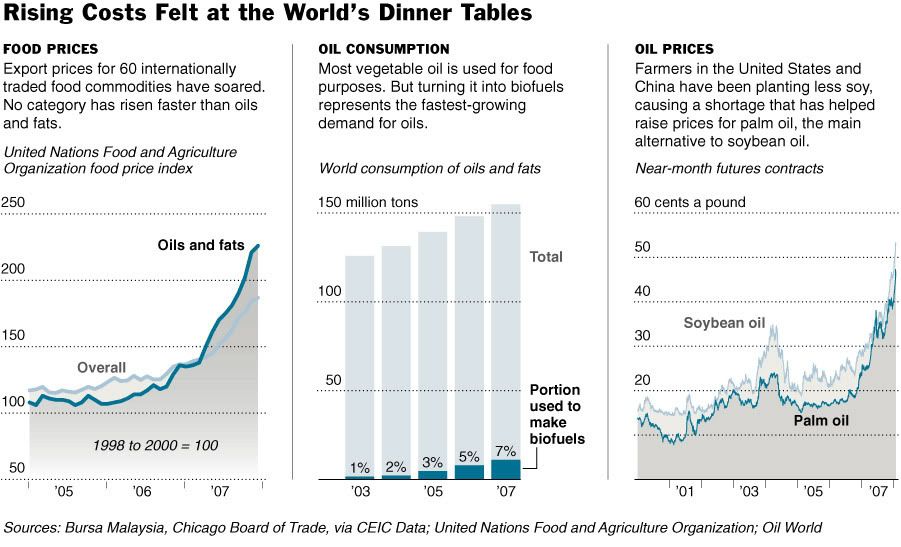
The food price index of the Food and Agriculture Organization of the United Nations, based on export prices for 60 internationally traded foodstuffs, climbed 37 percent last year. That was on top of a 14 percent increase in 2006, and the trend has accelerated this winter.
In some poor countries, desperation is taking hold. Just in the last week, protests have erupted in Pakistan over wheat shortages, and in Indonesia over soybean shortages. Egypt has banned rice exports to keep food at home, and China has put price controls on cooking oil, grain, meat, milk and eggs.
According to the F.A.O., food riots have erupted in recent months in Guinea, Mauritania, Mexico, Morocco, Senegal, Uzbekistan and Yemen.
“The urban poor, the rural landless and small and marginal farmers stand to lose,” said He Changchui, the agency’s chief representative for Asia and the Pacific.
A startling change is unfolding in the world’s food markets. Soaring fuel prices have altered the equation for growing food and transporting it across the globe. Huge demand for biofuels has created tension between using land to produce fuel and using it for food.
A growing middle class in the developing world is demanding more protein, from pork and hamburgers to chicken and ice cream. And all this is happening even as global climate change may be starting to make it harder to grow food in some of the places best equipped to do so, like Australia.
In the last few years, world demand for crops and meat has been rising sharply. It remains an open question how and when the supply will catch up. For the foreseeable future, that probably means higher prices at the grocery store and fatter paychecks for farmers of major crops like corn, wheat and soybeans.
There may be worse inflation to come. Food experts say steep increases in commodity prices have not fully made their way to street stalls in the developing world or supermarkets in the West.
Governments in many poor countries have tried to respond by stepping up food subsidies, imposing or tightening price controls, restricting exports and cutting food import duties.
These temporary measures are already breaking down. Across Southeast Asia, for example, families have been hoarding palm oil. Smugglers have been bidding up prices as they move the oil from more subsidized markets, like Malaysia’s, to less subsidized markets, like Singapore’s.
No category of food prices has risen as quickly this winter as so-called edible oils — with sometimes tragic results. When a Carrefour store in Chongqing, China, announced a limited-time cooking oil promotion in November, a stampede of would-be buyers left 3 people dead and 31 injured.
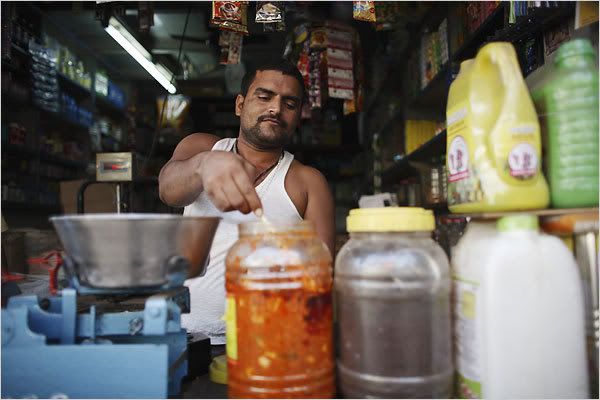
Cooking oil may seem a trifling expense in the West. But in the developing world, cooking oil is an important source of calories and represents one of the biggest cash outlays for poor families, which grow much of their own food but have to buy oil in which to cook it.
Few crops illustrate the emerging problems in the global food chain as well as palm oil, a vital commodity in much of the world and particularly Asia. From jungles and street markets in Southeast Asia to food companies in the United States and biodiesel factories in Europe, soaring prices for the oil are drawing environmentalists, energy companies, consumers, indigenous peoples and governments into acrimonious disputes.
The oil palm is a stout-trunked tree with a spray of frilly fronds at the top that make it look like an enormous sea anemone. The trees, with their distinctive, star-like patterns of leaves, cover an eighth of the entire land area of Malaysia and even greater acreage in nearby Indonesia.
An Efficient Producer
The palm is a highly efficient producer of vegetable oil, squeezed from the tree’s thick bunches of plum-size bright red fruit. An acre of oil palms yields as much oil as eight acres of soybeans, the main rival for oil palms; rapeseed, used to make canola oil, is a distant third. Among major crops, only sugar cane comes close to rivaling oil palms in calories of human food per acre.
Palm oil prices have jumped nearly 70 percent in the last year because supply has grown slowly while demand has soared.
Farmers and plantation companies are responding to the higher prices, clearing hundreds of thousands of acres of tropical forest to replant with rows of oil palms. But an oil palm takes eight years to reach full production. A drought last year in Indonesia and flooding in Peninsular Malaysia helped constrain supply. Worldwide palm oil output climbed just 2.7 percent last year, to 42.1 million tons.
At the same time, palm oil demand is growing steeply for a variety of reasons around the globe. They include shifting decisions among farmers about what to plant, rising consumer demand in China and India for edible oils, and Western subsidies for biofuel production.
American farmers have been planting more corn and less soy because demand for corn-based ethanol has pushed up corn prices. American soybean acreage plunged 19 percent last year, producing a drop in soybean oil output and inventories.
Chinese farmers also cut back soybean acreage last year, as urban sprawl covered prime farmland and the Chinese government provided more incentives for grain.
Yet people in China are also consuming more oils. China not only was the world’s biggest palm oil importer last year, holding steady at 5.2 million tons in the first 11 months of the year, but it also doubled its soybean oil imports to 2.9 million tons, forcing buyers elsewhere to switch to palm oil.
Concerns about nutrition used to hurt palm oil sales, but they are now starting to help. The oil was long regarded in the West as unhealthy, but it has become an attractive option to replace the chemically altered fats known as trans fats, which have lately come to be seen as the least healthy of all fats.
New York City banned trans fats in frying at food service establishments last summer and will ban them in bakery goods this summer. Across the country, manufacturers are trying to replace trans fats. American palm oil imports nearly doubled in the first 11 months of last year, rising by 200,000 tons.
“Four years ago, when this whole no-trans issue started, we processed no palm here," said Mark Weyland, a United States product manager for Loders Croklaan, a Dutch company that supplies palm oil. “Now it’s our biggest seller.”
Last year, conversion of palm oil into fuel was a fast-growing source of demand, but in recent weeks, rising prices have thrown that business into turmoil.
Here on Malaysia’s eastern shore, a series of 45-foot-high green and gray storage tanks connect to a labyrinth of yellow and silver pipes. The gleaming new refinery has the capacity to turn 116,000 tons a year of palm oil into 110,000 tons of a fuel called biodiesel, as well as valuable byproducts like glycerin. Mission Biofuels, an Australian company, finished the refinery last month and is working on an even larger factory next door at the base of a jungle hillside.
But prices have spiked so much that the company cannot cover all its costs and has idled the finished refinery while looking for a new strategy, such as asking a biodiesel buyer to pay a price linked to palm oil costs, and someday switching from palm oil to jatropha, a roadside weed.
“We took a view that palm oil prices were already high; we didn’t think they could go even higher, and then they did,” said Nathan Mahalingam, the company’s managing director.
Growth in Biofuels
Biofuels accounted for almost half the increase in worldwide demand for vegetable oils last year, and represented 7 percent of total consumption of the oils, according to Oil World, a forecasting service in Hamburg, Germany.
The growth of biodiesel, which can be mixed with regular diesel, has been controversial, not only because it competes with food uses of oil but also because of environmental concerns. European conservation groups have been warning that tropical forests are being leveled to make way for oil palm plantations, destroying habitat for orangutans and Sumatran rhinoceroses while also releasing greenhouse gases.
The European Union has moved to restrict imports of palm oil grown in unsustainable ways. The measure has incensed the Malaysian palm oil industry, which had plunged into biofuel production in part to satisfy European demand.
Another controversy involves the treatment of indigenous peoples whose lands have been seized by oil plantations. This has been a particular issue on Borneo.
Anne B. Lasimbang, executive director of the Pacos Trust in the Malaysian state of Sabah in northern Borneo, said that while some indigenous people had benefited from selling palm oil that they grow themselves, many had lost ancestral lands with little to show for it, including lands that used to provide habitats for endangered orangutans.
“Finally, some of the pressures internationally have trickled down. Some of the companies are more open to dialogue; they want to talk to communities,” said Ms. Lasimbang, a member of the Dusun indigenous group. “On our side, we are still suspicious.”
Demand Outstrips Supply
As the multiple conflicts and economic pressures associated with palm oil play out in the global economy, the bottom line seems to be that the world wants more of the oil than it can get.
Even in Malaysia, the center of the global palm oil industry for half a century, spot shortages have cropped up. Recently, as wholesale prices soared, cooking oil refiners complained of inadequate subsidies and cut back production of household oil, sold at low, regulated prices.
Street vendors in the capital, Kuala Lumpur, complain that they cannot find enough cooking oil to prepare roti canai, the flatbread that is the national snack. “It’s very difficult; it’s hard to find,” said one vendor who gave only his first name, Palani, after admitting that he was secretly buying cooking oil intended for households instead of paying the much higher price for commercial use.
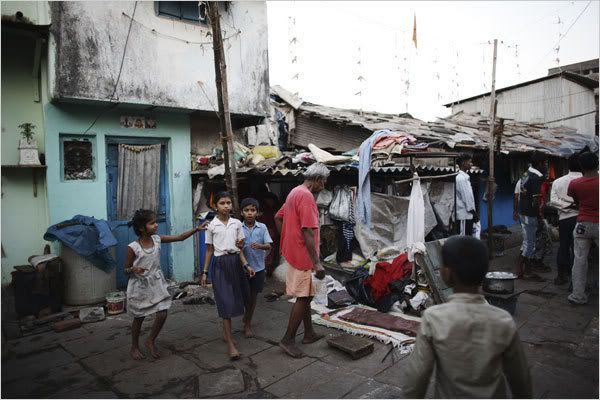
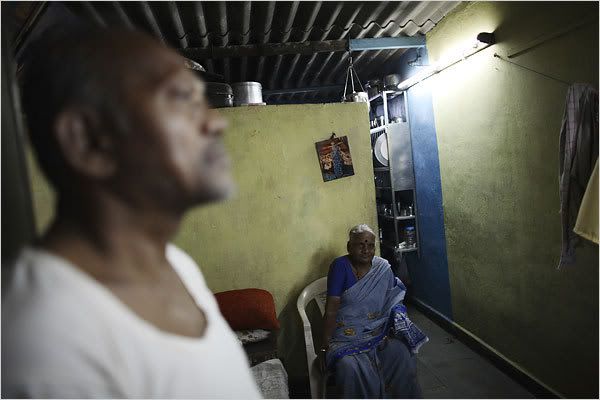
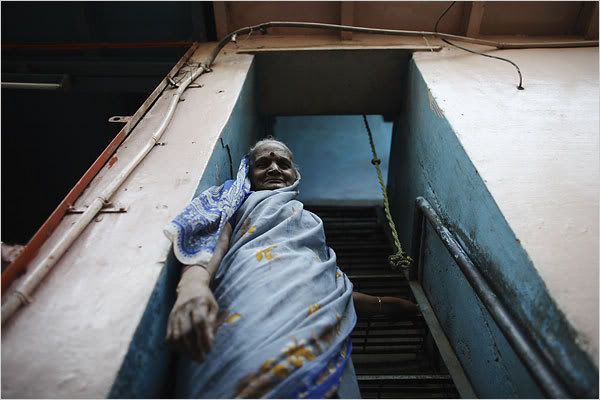
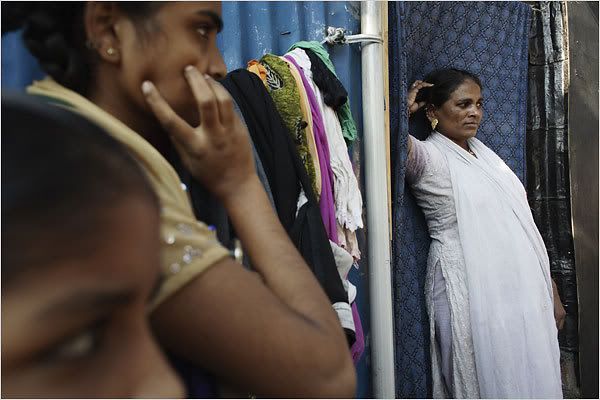
Many of the hardest-hit victims of rising food prices are in the vast slums that surround cities in poorer Asian nations. The Kawle family in Mumbai’s sprawling Dharavi slum, a household of nine with just one member working as a laborer for $60 a month, is coping with recent price increases for palm oil.
The family has responded by eating fish once a week instead of twice, seldom cooking vegetables and cutting its monthly rice consumption. Next to go will be the weekly smidgen of lamb.
“If the prices go up again,” said Janaron Kawle, the family patriarch, “we’ll cut the mutton to twice a month and use less oil.”"The Struggle for Palm Oil" (photos by Michael Rubenstein for The New York Times) In the developing world, cooking oil is an important source of calories and represents one of the biggest cash outlays for poor households. A steep rise in prices for palm oil has forced many families in Dharavi, a sprawling slum in Mumbai, India, to use less oil or even cut back on food:



Thursday, January 3, 2008
| [+/-] |
Forests Soak Up Less and Less CO2 |
Canada's trees getting worse at filtering gases, researchers say
The Ottawa Citizen reports:
Last year brought glum news that Canada's forests were only a so-so defence against global warming. Now, we find out our forests are getting worse at soaking up greenhouse gases.
A study by Canadian, Chinese and European researchers shows that, as the climate gets warmer, northern forests aren't soaking up extra carbon dioxide from the air after all.
Forests may, in fact, become worse at storing carbon if climate trends continue.
Canada has always argued that our forests strongly "offset" some of the fossil fuels we burn. Our official position is that Kyoto-style climate plans should give Canada credit for the good work our forests do.
However, a series of studies in the past two years and continuing today in the journal Nature call that into question.
Forests soak up less pollution that we'd hoped. Even as Canada realized it had over-hyped the air-cleaning work done by forests, though, one apparent piece of good news emerged.
Scientists noticed that the global warming trend was waking up trees earlier each spring. As well, the trees were staying green longer into the autumn.
This longer growing season, they reasoned, meant trees should work longer at building new branches and leaves, the process that soaks up carbon from the air. So, shouldn't that get rid of more carbon dioxide?
No, says today's study by the Global Carbon Project, a multinational science network that includes Canada. The study focuses on years of data-gathering -- largely from Canadian forests -- that record precisely how much carbon dioxide is in the air of a forest day by day.
In the past 20 years, two things have happened. The autumn in many forests of Canada, Europe and China has warmed by 1.1 degrees. The autumn forests are also releasing carbon dioxide back into the air faster than they soak it up.
This trend is so strong, University of Colorado atmospheric scientist John Miller writes in Nature, that it "seems to largely cancel" gains made through the earlier arrival of spring and its extra forest growth.
Shilong Piao and colleagues at the Laboratory of Sciences on Climate and the Environment in France's national science agency said although plants' respiration (emitting carbon dioxide) and photosynthesis (storing carbon dioxide) are both stepped up, the respiration outstrips the photosynthesis to cause a net loss of carbon from plants into the air.
"If warming in autumn occurs at a faster rate than in spring, the ability of northern ecosystems to sequester carbon will diminish in the future," Mr. Piao says in a written announcement of his results.
Saturday, December 29, 2007
| [+/-] |
Global Warming to Alter California Landscape |
The AP reports:
California is defined by its scenery, from the mountains that enchanted John Muir to the wine country and beaches that define its culture around the world.
But as scientists try to forecast how global warming might affect the nation's most geographically diverse state, they envision a landscape that could look quite different by the end of this century, if not sooner.
Where celebrities, surfers and wannabes mingle on Malibu's world-famous beaches, there may be only sea walls defending fading mansions from the encroaching Pacific. In Northern California, tourists could have to drive farther north or to the cool edge of the Pacific to find what is left of the region's signature wine country.
Abandoned ski lifts might dangle above snowless trails more suitable for mountain biking even during much of the winter. In the deserts, Joshua trees that once extended their tangled, shaggy arms into the sky by the thousands may have all but disappeared.
"We need to be attentive to the fact that changes are going to occur, whether it's sea level rising or increased temperatures, droughts and potentially increased fires," said Lisa Sloan, a scientist who directs the Climate Change and Impacts Laboratory at the University of California, Santa Cruz. "These things are going to be happening."
Among the earliest and most noticeable casualties is expected to be California's ski season.
Snow is expected to fall for a shorter period and melt more quickly. That could shorten the ski season by a month even in wetter areas and perhaps end it in others.
Whether from short-term drought or long-term changes, the ski season already has begun to shrivel in Southern California, ringed by mountain ranges that cradle several winter resorts.
"There's always plenty of snow, but you may just have to go out of state for it," said Rinda Wohlwend, 62, who belongs to two ski clubs in Southern California. "I'm a very avid tennis player, so I'd probably play more tennis."
---
Because California has myriad microclimates, covering an area a third larger than Italy, predicting what will happen by the end of the century is a challenge.
But through a series of interviews with scientists who are studying the phenomenon, a general description of the state's future emerges.
By the end of the century, temperatures are predicted to increase by 3 to 10 degrees Fahrenheit statewide. That could translate into even less rainfall across the southern half of the state, already under pressure from the increased frequency of wildfires and relentless population growth.
Small mammals, reptiles and colonies of wildflowers in the deserts east of Los Angeles are accustomed to periodic three-year dry spells. But they might not be able to withstand the 10-year drought cycles that could become commonplace as the planet warms.
Scientists already are considering relocating Joshua tree seedlings to areas where the plants, a hallmark of the high desert and namesake of a national park, might survive climate change.
"They could be wiped out of California depending on how quickly the change happens," said Cameron Barrows, who studies the effects of climate change for the Center for Conservation Biology in Riverside.
Farther north, where wet, cold winters are crucial for the water supply of the entire state, warmer temperatures will lead to more rain than snow in the Sierra Nevada and faster melting in the spring.
Because 35 percent of the state's water supply is stored annually in the Sierra snowpack, changes to that hydrologic system will lead to far-reaching consequences for California and its ever-growing population.
Some transformations already are apparent, from the Sierra high country to the great valleys that have made California the nation's top agricultural state.
The snow line is receding, as it is in many other alpine regions around the world. Throughout the 400-mile-long Sierra, trees are under stress, leading scientists to speculate that the mix of flora could change significantly as the climate warms. The death rate of fir and pine trees has accelerated over the past two decades.
In the central and southern Sierra, the giant sequoias that are among the biggest living things on Earth might be imperiled.
"I suspect as things get warmer, we'll start seeing sequoias just die on their feet where their foliage turns brown," said Nate Stephenson, a U.S. Geological Survey ecologist who is studying the effects of climate change in the Sierra Nevada. "Even if they don't die of drought stress, just think of the wildfires. If you dry out that vegetation, they're going to be so much more flammable."
Changes in the mountain snowpack could lead to expensive water disputes between cities and farmers. Without consistent water from rivers draining the melting snow, farmers in the Central and Salinas valleys could lose as much as a quarter of their water supply.
Any drastic changes to the state's $30 billion agriculture industry would have national implications, since California's fertile valleys provide half the country's fresh fruits, nuts and vegetables, according to the Union of Concerned Scientists' study.
"Obviously, it's going to mean that choices are going to be made about who's going to get the water," said Brian Nowicki, a biologist with the Center for Biological Diversity in Tucson, Ariz.
Among the biggest unknowns is what will happen along California's coast as the world's ice sheets and glaciers melt. One scenario suggests the sea level could rise by more than 20 feet.
Will the rising sea swamp the ports of Long Beach and Los Angeles, the nation's busiest harbor complex, turning them into a series of saltwater lakes? Will funky Ocean Beach, an island of liberalism in conservative San Diego County, become, literally, its own island?
Among the more sobering projections is what is in store for marine life.
The upwelling season, the time when nutrient-rich water is brought from the ocean's depths to the surface, nourishes one of the world's richest marine environments.
That period, from late spring until early fall, is expected to become weaker earlier in the season and more intense later. Upwelling along the Southern California coast will become weaker overall.
As a result, sea lions, blue whales and other marine mammals that follow these systems up and down the coast are expected to decline.
The changing sea will present trouble for much of the state's land-dwelling population, too. A sea level rise of 3 to 6 feet would inundate the airports in San Francisco and Oakland. Many of the state's beaches would shrink.
"If you raise sea level by a foot, you push a cliff back 100 feet," said Jeff Severinghaus, professor of geosciences at the Scripps Institution of Oceanography in San Diego. "There will be a lot of houses that will fall into the ocean."
| [+/-] |
Pricey Hay Imperils Horses |
Neglected horses abound as drought shrivels supply, spikes price
The News & Observer reports:
Rescue agencies are taking in record numbers of horses across the state, many emaciated because of the drought-related hay shortage.
In the most recent case, a Randolph County woman was charged Thursday with 11 counts of animal abuse and eight counts of disposing of a dead animal improperly, after county officials investigated separate reports of a large number of dead horses scattered on the ground and of 11 live horses jammed into an undersize corral with no water and little hay.
The U.S. Equine Rescue League normally accepts about 100 neglected or abused horses a year in the three states where it operates, which include North Carolina. This year, the agency has taken in about 170 -- 90 in this state alone -- said Jennifer Malpass, director of the league's Triangle chapter.
Horse rescue groups nationally -- even those in states not stricken with a severe drought -- are being inundated with pleas to take neglected horses.
One group in Florida is fielding daily calls, up from bimonthly requests early this year. A rescue group in south central Kentucky had to turn away 13 horses this month. Kathy Grant, an equine cruelty investigator who runs a rescue group, says the rural roads in her eastern Tennessee community are lined with pastures dotted with emaciated horses.
"A lot of the farmers around here have hay, but they're holding on to it," said Grant. "When they're releasing it, they're charging exorbitant rates. A normal person can't afford it."
A round bale jumped from $12 to $100 since the summer, Grant said. In South Carolina, rescue volunteers noticed the price triple. In Texas, struck by a severe drought last year, hay prices haven't leveled off; horse owners are paying double what they did three years ago.
High prices are leaving owners with tough choices. Some are voluntarily forfeiting their animals. In other cases, horses are seized after county officials determine they have been abused or neglected.
County officials typically don't have holding facilities for large animals and so depend on agencies such as the rescue league to assume responsibility for horses. The league nurses them back to health, then places them in foster homes until someone adopts them, Malpass said.
The flood of rescues this year is a double blow to the volunteers.
Even before the drought, they were struggling to find space for foster horses. Now, they not only have to find shelter for more horses but also feed them when hay is expensive and scarce, Malpass said.
Hay donations drop
Her chapter normally receives about 300 bales of donated hay before winter, mostly from big horse operations clearing spring hay from their storage barns to make room for the fall cutting. But there was so little to spare that hay donations this year were only about a third the normal amount.
That means the volunteer rescuers are having to pull money out of their own pockets -- and a lot of it -- for hay, which has doubled in price in many areas.
The hay crisis also has increased the severity of the cases they are seeing, said Amy Woodard, a volunteer who leads the league's efforts in the northeastern corner of the state.
As the expense of feeding them has risen, the selling prices of horses have dropped. That has made purchase possible for people who might not be able to afford proper food and health care, or who didn't have the knowledge to keep horses healthy, Malpass said.
'Pieces everywhere'
The horse owner in the Randolph County case, Jauvanna Craven, 51, of Groom Road, Sophia, surrendered her horses. That saved time in court and allowed the county to get the surviving horses more quickly into the hands of rescuers.
Randolph County Health Director MiMi Cooper was so shocked at the animals' condition that she went to Craven to issue the charges herself. Craven could have faced more counts of improper disposal, said Cooper, who owns four horses herself.
"There were probably more than eight, but there were pieces [of dead horses] everywhere," she said. "Do you know what I had to do? I had to count heads."
Craven could not be reached for comment.
She had kept the horses on a 22-acre tract but sold it recently, Cooper said. The new owners discovered a number of horse carcasses and called the health department Dec. 21 to report them.
On the same day, the department got what it thought was an unrelated call about the 11 living horses, which were in a different location. They were confined in a pen that was big enough for only one or two horses, Cooper said. The horses were clearly starving, with every rib showing and their hip and shoulder bones jutting. One had an injury and had to be euthanized.
"She said that she was running a rescue operation," Cooper said. "That's not how you rescue horses."
The Equine Rescue League's Triad chapter took four of the horses, and another agency took three. The other three were apparently owned by someone else, who hadn't known about their health problems, and he took them away.
Shortage hits everyone
The hay shortage is so bad, though, that even conscientious owners are getting into trouble, Malpass said.
Marilyn Kille, who is taking care of three foster horses just outside Chapel Hill, said that people who own only one or two horses don't often have the massive dry storage space required for a whole winter supply of hay.
Normally, hay is abundant enough that suppliers keep plenty on hand, and horse owners can drop by every couple of weeks to buy more. Now, horse owners are competing for the scant supply against beef and dairy operations. Often, the only way to get it is to buy full truckloads from as far away as Ohio or New York.
Randolph County has fielded at least half a dozen calls this year from owners who didn't know where to turn, Cooper said, and area veterinarians have been getting similar calls.
Depending on the situation, Cooper said, the county steers them to hay sources like the on-line list kept by the state agriculture department, or links them with a rescue agency. Instead of suggesting that owners give up horses, the rescue agency prefers to teach them how to keep horses healthy, Malpass said.
Usually that approach works, she said. When it doesn't, the county or the rescuers ask the owner to give up the horse, or the county takes the owner to court to force the issue.
Normally rescues taper off in summer, when horses can graze. That's when the rescuers get a breather and start to build up their stores of hay.
This past summer, though, there was no break in rescues and the hay donations didn't come. So now, Malpass' group finds itself starting winter -- when livestock rely more on hay and less on grazing -- with an unusual number of horses to feed, not nearly enough hay and predictions that hay crops next year might be poor, too.
"It's really worrying because it can only get worse from here," she said.
Friday, December 14, 2007
| [+/-] |
Climate Change Blamed As Thousands Of Walruses Die In Stampedes |
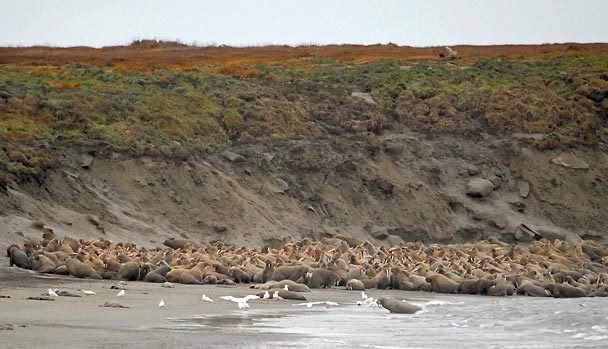
 This photo provided by Pacific Institute of Fisheries and Oceanography shows a dead walrus, foreground, after a stampede on Cape Vankarem, Russia in March, 2007.
 Climate change blamed as thousands of walruses die in stampedes
Thousands of Pacific walruses above the Arctic Circle died in stampedes earlier this year after the disappearance of sea ice caused them to crowd onto the shoreline in extraordinary numbers.
The Seattle Times reports:
In what some scientists see as another alarming consequence of global warming, thousands of Pacific walruses above the Arctic Circle were killed in stampedes earlier this year after the disappearance of sea ice caused them to crowd onto the shoreline in extraordinary numbers.
The deaths took place during the late summer and fall on the Russian side of the Bering Strait, which separates Alaska from Russia.
"It was a pretty sobering year — tough on walruses," said Joel Garlach-Miller, a walrus expert for the U.S. Fish and Wildlife Service.
Unlike seals, walruses cannot swim indefinitely. The giant, tusked mammals typically clamber onto the sea ice to rest, or haul themselves onto land for just a few weeks at a time.
But ice disappeared in the Chukchi Sea this year because of warm summer weather, ocean currents and persistent eastern winds, Garlach-Miller said.
As a result, walruses came ashore earlier and stayed longer, congregating in extremely high numbers, with herds as big as 40,000 at Point Shmidt, a spot that had not been used by walruses as a "haulout" for a century, scientists said.
Walruses are vulnerable to stampedes when they gather in such large numbers. The appearance of a polar bear, a hunter or a low-flying airplane can send them rushing to the water.
Sure enough, scientists received reports of hundreds and hundreds of walruses dead of internal injuries suffered in stampedes. Many of the youngest and weakest animals, mostly calves born in the spring, were crushed.
Biologist Anatoly Kochnev of Russia's Pacific Institute of Fisheries and Oceanography estimated 3,000 to 4,000 walruses out of population of perhaps 200,000 died, or two or three times the usual number on shoreline haulouts.
He said the animals only started appearing on shore for extended periods in the late 1990s, after the sea ice receded.
"The reason is the global warming," Kochnev said.
The reports match predictions of what might happen to walruses if the ice receded, said wildlife biologist Tony Fischbach of the U.S. Geological Survey.
"We were surprised that this was happening so soon, and we were surprised at the magnitude of the report," he said.
Scientists said the death of so many walruses — particularly calves — is alarming in itself. But if the trend continues, and walruses no longer have summer sea ice from which to dive for clams and snails, they could strip coastal areas of food, and that could reduce their numbers even further.
No large-scale walrus die-offs were seen in Alaska during the same period, apparently because the animals congregated in smaller groups on the American side of the Bering Strait, with the biggest known herd at about 2,500.
Thursday, December 6, 2007
| [+/-] |
More Than Half of Amazon Will Be Lost By 2030, Report Warns |
The Guardian reports:
Climate change could speed up the large-scale destruction of the Amazon rainforest and bring the "point of no return" much closer than previously thought, conservationists warned today.
Almost 60% of the region's forests could be wiped out or severely damaged by 2030, as a result of climate change and deforestation, according to a report published today by WWF.
The damage could release somewhere between 55.5bn-96.9bn tons of carbon dioxide into the atmosphere from the Amazon's forests and speed up global warming, according to the report, Amazon's Vicious Cycles: Drought and Fire.
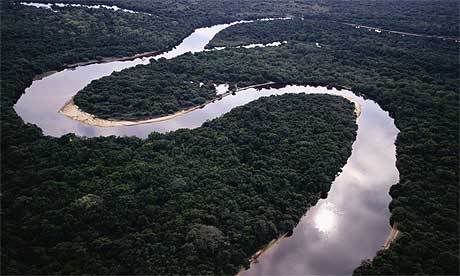
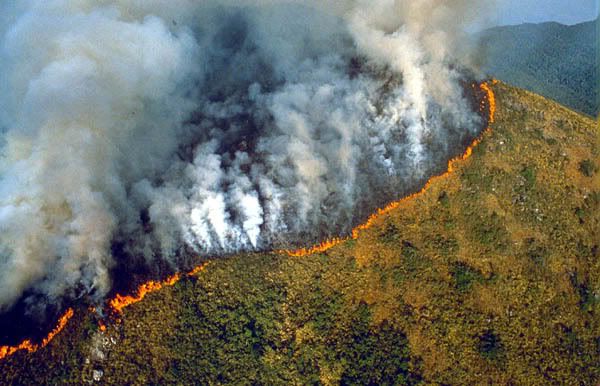 June 1989, Brazil: The forest burns. The Amazon is the largest rainforest in the world and is home to 15% of the world’s known land-based plant species, and nearly 10% of the world’s mammals. It has as many as 300 species of tree in a single hectare. Photograph: Sipa Press/Rex Features
Trends in agriculture and livestock expansion, fire, drought and logging could severely damage 55% of the Amazon rainforest by 2030, the report says. And, in turn, climate change could speed up the process of destruction by reducing rainfall by as much as 10% by 2030, damaging an extra 4% of the forests during that time.
By the end of the century, global warming is likely to reduce rainfall by 20% in eastern Amazonia, pushing up temperatures by more than 2C and causing forest fires, the report said.
 September 1988, Rondonia State, Brazil: Newly cleared land. Soya farming is one of the primary drivers of deforestation in the Amazon.
Photograph: Stephen Ferry/Liaison/Getty Images
Destroying almost 60% of tropical rainforest by 2030 would do away with one of the key stabilisers of the global climate system, it warned.
Such damage could have a knock-on effect on rainfall in places such as central America and India, and would also destroy livelihoods for indigenous people and some 80% of habitats for animal species in the region.
The "point of no return", in which extensive degradation of the rainforest occurs and conservation prospects are greatly reduced, is just 15-25 years away - much sooner than some models suggest, the report warns.
Releasing the report at the UN conference in Bali, which aims to begin negotiations on a new international climate change deal, the WWF called for a strategy to reduce emissions from forests and stop deforestation.
Beatrix Richards, the head of forests at WWF-UK, said: "The Amazon is on a knife-edge due to the dual threats of deforestation and climate change.
"Developed countries have a key role to play in throwing a lifeline to forest around the world. At the international negotiations currently underway in Bali governments must agree a process which results in ambitious global emission reduction targets beyond the current phase of Kyoto which ends in 2012.
"Crucially this must include a strategy to reduce emissions from forests and help break the cycle of deforestation."
The report's author, Dan Nepstead, senior scientist at the Woods Hole research centre in Massachusetts, said: "The importance of the Amazon forest for the globe's climate cannot be underplayed.
"It's not only essential for cooling the world's temperature but such a large source of freshwater that it may be enough to influence some of the great ocean currents, and on top of that it's a massive store of carbon."
Sunday, October 21, 2007
| [+/-] |
Rising Seas Threaten 21 Mega-Cities |
The Associated Press reports:
Cities around the world are facing the danger of rising seas and other disasters related to climate change.
Of the 33 cities predicted to have at least 8 million people by 2015, at least 21 are highly vulnerable, says the Worldwatch Institute.
They include Dhaka, Bangladesh; Buenos Aires, Argentina; Rio de Janeiro, Brazil; Shanghai and Tianjin in China; Alexandria and Cairo in Egypt; Mumbai and Kolkata in India; Jakarta, Indonesia; Tokyo and Osaka-Kobe in Japan; Lagos, Nigeria; Karachi, Pakistan; Bangkok, Thailand, and New York and Los Angeles in the United States, according to studies by the United Nations and others.
More than one-tenth of the world's population, or 643 million people, live in low-lying areas at risk from climate change, say U.S. and European experts. Most imperiled, in descending order, are China, India, Bangladesh, Vietnam, Indonesia, Japan, Egypt, the U.S., Thailand and the Philippines.
| [+/-] |
The Future is Drying Up |
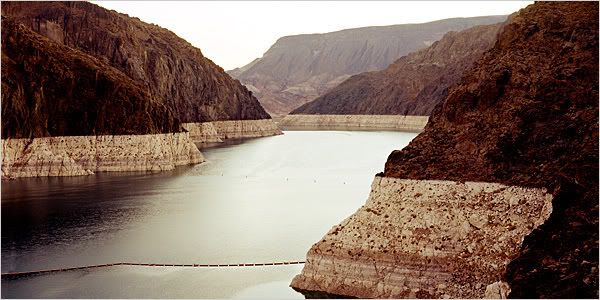 Draining The 100-foot-high bathtub ring left by the dwindling waters of Lake Mead, behind Hoover Dam.
The New York Times reports:
Scientists sometimes refer to the effect a hotter world will have on this country’s fresh water as the other water problem, because global warming more commonly evokes the specter of rising oceans submerging our great coastal cities. By comparison, the steady decrease in mountain snowpack — the loss of the deep accumulation of high-altitude winter snow that melts each spring to provide the American West with most of its water — seems to be a more modest worry. But not all researchers agree with this ranking of dangers. Last May, for instance, Steven Chu, a Nobel laureate and the director of the Lawrence Berkeley National Laboratory, one of the United States government’s pre-eminent research facilities, remarked that diminished supplies of fresh water might prove a far more serious problem than slowly rising seas. When I met with Chu last summer in Berkeley, the snowpack in the Sierra Nevada, which provides most of the water for Northern California, was at its lowest level in 20 years. Chu noted that even the most optimistic climate models for the second half of this century suggest that 30 to 70 percent of the snowpack will disappear. “There’s a two-thirds chance there will be a disaster,” Chu said, “and that’s in the best scenario.”
In the Southwest this past summer, the outlook was equally sobering. A catastrophic reduction in the flow of the Colorado River — which mostly consists of snowmelt from the Rocky Mountains — has always served as a kind of thought experiment for water engineers, a risk situation from the outer edge of their practical imaginations. Some 30 million people depend on that water. A greatly reduced river would wreak chaos in seven states: Colorado, Utah, Wyoming, New Mexico, Arizona, Nevada and California. An almost unfathomable legal morass might well result, with farmers suing the federal government; cities suing cities; states suing states; Indian nations suing state officials; and foreign nations (by treaty, Mexico has a small claim on the river) bringing international law to bear on the United States government. In addition, a lesser Colorado River would almost certainly lead to a considerable amount of economic havoc, as the future water supplies for the West’s industries, agriculture and growing municipalities are threatened. As one prominent Western water official described the possible future to me, if some of the Southwest’s largest reservoirs empty out, the region would experience an apocalypse, “an Armageddon.”
One day last June, an environmental engineer named Bradley Udall appeared before a Senate subcommittee that was seeking to understand how severe the country’s fresh-water problems might become in an era of global warming. As far as Washington hearings go, the testimony was an obscure affair, which was perhaps fitting: Udall is the head of an obscure organization, the Western Water Assessment. The bureau is located in the Boulder, Colo., offices of the National Oceanographic and Atmospheric Administration, the government agency that collects obscure data about the sky and seas. Still, Udall has a name that commands some attention, at least within the Beltway. His father was Morris Udall, the congressman and onetime presidential candidate, and his uncle was Stewart Udall, the secretary of the interior under Presidents John F. Kennedy and Lyndon Johnson. Bradley Udall’s great-great-grandfather, John D. Lee, moreover, was the founder of Lee’s Ferry, a flyspeck spot in northern Arizona that means nothing to most Americans but holds near-mythic status to those who work with water for a living. Near Lee’s Ferry is where the annual flow of the Colorado River is measured in order to divvy up its water among the seven states that depend on it. To many politicians, economists and climatologists, there are few things more important than what has happened at Lee’s Ferry in the past, just as there are few things more important than what will happen at Lee’s Ferry in the future.
The importance of the water there was essentially what Udall came to talk about. A report by the National Academies on the Colorado River basin had recently concluded that the combination of limited Colorado River water supplies, increasing demands, warmer temperatures and the prospect of recurrent droughts “point to a future in which the potential for conflict” among those who use the river will be ever-present. Over the past few decades, the driest states in the United States have become some of our fastest-growing; meanwhile, an ongoing drought has brought the flow of the Colorado to its lowest levels since measurements at Lee’s Ferry began 85 years ago. At the Senate hearing, Udall stated that the Colorado River basin is already two degrees warmer than it was in 1976 and that it is foolhardy to imagine that the next 50 years will resemble the last 50. Lake Mead, the enormous reservoir in Arizona and Nevada that supplies nearly all the water for Las Vegas, is half-empty, and statistical models indicate that it will never be full again. “As we move forward,” Udall told his audience, “all water-management actions based on ‘normal’ as defined by the 20th century will increasingly turn out to be bad bets.”
A few weeks after his testimony, I flew to Boulder to meet with Udall, and we spent a day driving switchback roads high in the Rockies in his old Subaru. It had been a wet season on the east slope of the Rockies, but the farther west we went, the drier it became. Udall wanted to show me some of the local reservoirs and water systems that were built over the past century, so I could get a sense of their complexity as well as their vulnerability. As he put it, he wants to connect the disparate members of the water economy in a way that has never really been done before, so that utility executives, scientists, environmentalists, business leaders, farmers and politicians can begin discussing how to cope with the inevitable shortages of fresh water. In the American West, whose huge economy and political power derive from the ability of 20th-century engineers to conquer rivers like the Colorado and establish a reliable water supply, the prospect that there will be less water in the future, rather than the same amount, is unnerving. “We have a very short period of time here to get people educated on what this means,” Udall told me as we drove through the mountains. “Then once that occurs, perhaps we can start talking about how do we deal with it.”
Udall suggested that I meet a water manager named Peter Binney, who works for Aurora, Colo., a city — the 60th-largest in the United States — that sprawls over an enormous swath of flat, postagricultural land south of the Denver airport. It may be difficult for residents of the East Coast to understand the political celebrity of some Western water managers, but in a place like Aurora, where water, not available land, limits economic growth, Binney has enormous responsibilities. In effect, the city’s viability depends on his wherewithal to conjure new sources of water or increase the output of old ones. As Binney told me when we first spoke, “We have to find a new way of meeting the needs of all this population that’s turning up and still satisfy all of our recreational and environmental demands.” Aurora has a population of 310,000 now, Binney said, but that figure is projected to surpass 500,000 by 2035.
I asked if he had enough water for that many people. “Oh, no,” he replied. He seemed surprised that someone could even presume that he might. In fact, he explained, his job is to figure out how to find more water in a region where every drop is already spoken for and at a moment when there is little possibility that any more will ever be discovered.
Binney and I got together outside Dillon, a village in the Colorado Rockies 75 miles from Aurora and just a few miles west of the Continental Divide. We met in a small parking lot beside Dillon Reservoir, which sits at the bottom of a bowl of snow-capped mountains. Binney, a thickset 54-year-old with dark red hair and a fair complexion, had driven up in a large S.U.V. He still carries a strong accent from his native New Zealand, and in conversation he comes across as less a utility manager than a polymath with the combined savvy of an engineer, an economist and a politician. As we moved to a picnic table, Binney told me that we were looking at Denver’s water, not Aurora’s, and that it would eventually travel 70 miles through tunnels under the mountains to Denver’s taps. He admitted that he would love to have this water, which is pure snowmelt. To people in his job, snowmelt is the best source of water because it requires little chemical treatment to bring it up to federal drinking standards. But this water wasn’t available. Denver got here before him. And in Colorado, like most Western states, the rights to water follow a bloodline back to whoever got to it first.
One way to view the history of the American West is as a series of important moments in exploration or migration; another is to consider it, as Binney does, in terms of its water. In the 20th century, for example, all of our great dams and reservoirs were built — “heroic man-over-nature” achievements, in Binney’s words, that control floods, store water for droughts, generate vast amounts of hydroelectric power and enable agriculture to flourish in a region where the low annual rainfall otherwise makes it difficult. And in constructing projects like the Glen Canyon Dam — which backs up water to create Lake Powell, the vast reservoir in Arizona and Utah that feeds Lake Mead — the builders went beyond the needs of the moment. “They gave us about 40 to 50 years of excess capacity,” Binney says. “Now we’ve gotten to the end of that era.” At this point, every available gallon of the Colorado River has been appropriated by farmers, industries and municipalities. And yet, he pointed out, the region’s population is expected to keep booming. California’s Department of Finance recently predicted that there will be 60 million Californians by midcentury, up from 36 million today. “In Colorado, we’re sitting at a little under five million people now, on our way to eight million people,” Binney said. Western settlers, who apportioned the region’s water long ago, never could have foreseen the thirst of its cities. Nor, he said, could they have anticipated our environmental mandates to keep water “in stream” for the benefit of fish and wildlife, as well as for rafters and kayakers.
The West’s predicament, though, isn’t just a matter of limited capacity, bigger populations and environmental regulations. It’s also a distributional one. Seventy-five years ago, cities like Denver made claims on — and from the state of Colorado received rights to — water in the mountains; those cities in turn built reservoirs for their water. As a result, older cities have access to more surface water (that is, water that comes from rivers and streams) than newer cities like Aurora, which have been forced to purchase existing water rights from farmers and mining companies. Towns that rely on groundwater (water pumped from deep underground) face an even bigger disadvantage. Water tables all over the United States have been dropping, sometimes drastically, from overuse. In the Denver area, some cities that use only groundwater will almost certainly exhaust their accessible supplies by 2050.
The biggest issue is that agriculture consumes most of the water, as much as 90 percent of it, in a state like Colorado. “The West has gone from a fur-trapping, to a mining, to an agricultural, to a manufacturing, to an urban-centric economy,” Binney explained. As the region evolved, however, its water ownership for the most part did not. “There’s no magical locked box of water that we can turn to,” Binney says of cities like Aurora, “so it’s going to have to come from an existing use.” Because the supply of water in the West can’t really change, water managers spend their time looking for ways to adjust its allocation in their favor.
Binney knew all this back in 2002, when he took the job in Aurora after a long career at an engineering firm. Over the course of a century, the city had established a reasonable water supply. About a quarter of its water is piped in from the Colorado River basin about 70 miles away; another quarter is taken from reservoirs in the Arkansas River basin far to the south. The rest comes from the South Platte, a lazy, meandering river that runs north through Aurora on its way toward Nebraska. Binney says he believes that a city like his needs at least five years of water in storage in case of drought; his first year there turned out to be one of the worst years for water managers in recorded history, and the town’s reservoirs dropped to 26 percent of capacity, meaning Aurora had at most nine months of reserves and could not endure another dry spring. During the summer and fall, Binney focused on both supply and demand. He negotiated with neighboring towns to buy water and accelerated a program to pay local farmers to fallow their fields so the city could lease their water rights. Meanwhile, the town asked residents to limit their showers and had water cops enforce new rules against lawn sprinklers. (“It’s interesting how many people were watering lawns in the middle of the night,” Binney said.)
Water use in the United States varies widely by region, influenced by climate, neighborhood density and landscaping, among other things. In the West, Los Angelenos use about 125 gallons per person per day in their homes, compared with 114 for Tucson residents. Binney’s customers generally use about 160 gallons per person per day. “In the depths of the drought,” he said, “we got down to about 123 gallons.”
Part of the cruelty of a Western drought is that a water manager never knows if it will last 1 year or 10. In 2002, Binney was at the earliest stages of what has since become a nearly continuous dry spell. Though he couldn’t see that at the time, he realized Aurora faced a permanent state of emergency if it didn’t boost its water supplies. But how? One option was to try to buy water rights in the mountains (most likely from farmers who were looking to quit agriculture), then build a new reservoir and a long supply line to Aurora. Obvious hurdles included environmental and political resistance, as well as an engineering difficulty: water is heavy, far heavier than oil, and incompressible; a system to move it long distances (especially if it involves tunneling through mountains or pumping water over them) can cost billions. Binney figured that without the help of the federal government, which has largely gotten out of the Western dam-and-reservoir-building business, Aurora would be unwise to pursue such a project. Even if the money could be raised, building a system would take decades. Aurora needed a solution within five years.
Another practice, sometimes used in Europe, is to drill wells alongside a river and pull river water up though them, using the gravel of the riverbank as a natural filter — sort of like digging a hole in the sand near the ocean’s edge as it fills from below. Half of Aurora’s water rights were on the South Platte already; the city also pours its treated wastewater back into the river, as do other cities in the Denver metro area. This gives the South Platte a steady, dependable flow. Binney and the township reasoned that they could conceivably, and legally, go some 20 or 30 miles downstream on the South Platte, buy agricultural land near the river, install wells there and retrieve their wastewater. Thus they could create a system whereby Aurora would use South Platte water; send it to a treatment plant that would discharge it back into the river; go downstream to recapture water from the same river; then pump it back to the city for purification and further use. The process would repeat, ad infinitum. Aurora would use its share of South Platte water “to extinction,” in the argot of water managers. A drop of the South Platte used by an Aurora resident would find its way back to the city’s taps as a half-drop in 45 to 60 days, a quarter-drop 45 to 60 days after that and so on. For every drop the town used from the South Platte, over time it would almost — as all the fractional drops added up — get another.
Many towns have a supply that includes previously treated water. The water from the Mississippi River, for instance, is reused many times by municipalities as it flows southward. But as far as Binney knew, no municipality in the United States had built the kind of closed loop that Aurora envisioned. Water from wells in the South Platte would taste different, because of its mineral and organic content, so Binney’s engineers would have to make it mimic mountain snowmelt. More delicate challenges involved selling local taxpayers on authorizing a project, marketed to them as “Prairie Waters,” that would capitalize on their own wastewater. The system, which meant building a 34-mile-long pipeline from the downstream South Platte riverbanks to a treatment facility in Aurora, would cost three-quarters of a billion dollars, making it one of the most expensive municipal infrastructure projects in the country.
When Binney and I chatted at the reservoir outside Dillon, he had already finished discussions with Moody’s and Fitch, the bond-rating agencies whose evaluations would help the town finance the project. Groundbreaking, which would be the next occasion we would see each other, was still a month away. “What we’re doing now is trading high levels of treatment and purification for building tunnels and chasing whatever remaining snowmelt there is in the hills, which I think isn’t a wise investment for the city,” he told me. “I would expect that what we’re going to do is the blueprint for a lot of cities in California, Arizona, Nevada — even the Carolinas and the Gulf states. They’re all going to be doing this in the future.”
Water managers in the West tend to think in terms of “acre-feet.” One acre-foot, equal to about 326,000 gallons, is enough to serve two typical Colorado families for one year. When measurements of the Colorado River began near Lee’s Ferry in the early 1920s, the region happened to be in the midst of an extremely wet series of years, and the river was famously misjudged to have an average flow of 17 million acre-feet per year — when in fact its average flow would often prove to be significantly less. Part of the legacy of that misjudgment is that the seven states that divided the water in the 1920s entered into a legal partnership that created unrealistic expectations about the river’s capacity. But there is another, lesser-known legacy too. As the 20th century progressed, many water managers came to believe that the 1950s, which included the most severe drought years since measurement of the river began, were the marker for a worst-case situation.
But recent studies of tree rings, in which academics drill core samples from the oldest Ponderosa pines or Douglas firs they can find in order to determine moisture levels hundreds of years ago, indicate that the dry times of the 1950s were mild and brief compared with other historical droughts. The latest research effort, published in the journal Geophysical Research Letters in late May, identified the existence of an epochal Southwestern megadrought that, if it recurred, would prove calamitous.
When Binney and I met at Dillon Reservoir, he brought graphs of Colorado River flows that go back nearly a thousand years. “There was this one in the 1150s,” he said, tracing a jagged line downward with his finger. “They think that’s when the Anasazi Indians were forced out. We see drought cycles here that can go up to 60 years of below-average precipitation.” What that would mean today, he said, is that states would have to make a sudden choice between agriculture and people, which would lead to bruising political debates and an unavoidable blow to the former. Binney says that as much as he believes that some farmers’ water is ultimately destined for the cities anyway, a big jolt like this would be tragic. “You hope you never get to that point,” he told me, “where you force those kinds of discussions, because they will change for hundreds of years the way that people live in the Western U.S. If you have to switch off agriculture, it’s not like you can get back into it readily. It took decades for the agricultural industry to establish itself. It may never come back.”
An even darker possibility is that a Western drought caused by climatic variation and a drought caused by global warming could arrive at the same time. Or perhaps they already have. This coming spring, the United Nations’ Intergovernmental Panel on Climate Change will issue a report identifying areas of the world most at risk of droughts and floods as the earth warms. Fresh-water shortages are already a global concern, especially in China, India and Africa. But the I.P.C.C., which along with Al Gore received the 2007 Nobel Peace Prize earlier this month for its work on global-warming issues, will note that many problem zones are located within the United States, including California (where the Sierra Nevada snowpack is threatened) and the Colorado River basin. These assessments follow on the heels of a number of recent studies that analyze mountain snowpack and future Colorado River flows. Almost without exception, recent climate models envision reductions that range from the modest to the catastrophic by the second half of this century. One study in particular, by Martin Hoerling and Jon Eischeid, suggests the region is already “past peak water,” a milestone that means the river’s water supply will now forever trend downward.
Climatologists seem to agree that global warming means the earth will, on average, get wetter. According to Richard Seager, a scientist at Columbia University’s Lamont Doherty Earth Observatory who published a study on the Southwest last spring, more rain and snow will fall in those regions closer to the poles and more precipitation is likely to fall during sporadic, intense storms rather than from smaller, more frequent storms. But many subtropical regions closer to the equator will dry out. The models analyzed by Seager, which focus on regional climate rather than Colorado River flows, show that the Southwest will ultimately be subject to significant atmospheric and weather alterations. More alarming, perhaps, is that the models do not only concern the coming decades; they also address the present. “You know, it’s like, O.K., there’s trouble in the future, but how near in the future does it set in?” he told me. “In this case, it appears that it’s happening right now.” When I asked if the drought in his models would be permanent, he pondered the question for a moment, then replied: “You can’t call it a drought anymore, because it’s going over to a drier climate. No one says the Sahara is in drought.”
Climate models tend to be more accurate at predicting temperature than precipitation. Still, it’s hard to avoid the conclusion that “something is happening,” as Peter Binney gently puts it. Everyone I spoke with in the West has noticed — less snow, earlier spring melts, warmer nights. Los Angeles this year went 150 days without a measurable rainfall. One afternoon in Boulder, I spent some time with Roger Pulwarty, a highly regarded climatologist at the National Oceanographic Atmospheric Administration. Pulwarty, who has spent the past few years assessing adaptive solutions to a long drought, has a light sense of humor and an air of optimism about him, but he acknowledged that the big picture is worrisome. Even if the precipitation in the West does not decrease, higher temperatures by themselves create huge complications. Snowmelt runoff decreases. The immense reservoirs lose far more water to evaporation. Meanwhile, demand increases because crops are thirstier. Yet importing water from other river basins becomes more difficult, because those basins may face shortages, too.
“You don’t need to know all the numbers of the future exactly,” Pulwarty told me over lunch in a local Vietnamese restaurant. “You just need to know that we’re drying. And so the argument over whether it’s 15 percent drier or 20 percent drier? It’s irrelevant. Because in the long run, that decrease, accumulated over time, is going to dry out the system.” Pulwarty asked if I knew the projections for what it would take to refill Lake Powell, which is at about 50 percent of capacity. Twenty years of average flow on the Colorado River, he told me. “Good luck,” he said. “Even in normal conditions we don’t get 20 years of average flow. People are calling for more storage on the system, but if you can’t fill the reservoirs you have, I don’t know how more storage, or more dams, is going to help you. One has to ask if the normal strategies that we have are actually viable anymore.”
Pulwarty is convinced that the economic impacts could be profound. The worst outcome, he suggested, would be mass migrations out of the region, along with bitter interstate court battles over the dwindling water supplies. But well before that, if too much water is siphoned from agriculture, farm towns and ranch towns will wither. Meanwhile, Colorado’s largest industry, tourism, might collapse if river flows became a trickle during summertime. Already, warmer temperatures have brought on an outbreak of pine beetles that are destroying pine forests; Pulwarty wonders how many tourists will want to visit a state full of dead trees. “A crisis is an interesting thing,” he said. In his view, a crisis is a point in a story, a moment in a narrative, that presents an opportunity for characters to think their way through a problem. A catastrophe, on the other hand, is something different: it is one of several possible outcomes that follow from a crisis. “We’re at the point of crisis on the Colorado,” Pulwarty concluded. “And it’s at this point that we decide, O.K., which way are we going to go?”
It is all but imposible to look into the future of the Western states without calling on Pat Mulroy, the head of the Southern Nevada Water Authority. Mulroy has no real counterpart on the East Coast; her nearest analog might be Robert Moses, the notorious New York City planner who built massive infrastructure projects and who almost always found a way around institutional obstructions and financing constraints. She is arguably the most influential and outspoken water manager in the country — a “woman without fear,” as Pulwarty describes her. Pulwarty and Peter Binney respect her willingness to challenge historical water-sharing agreements that, in Mulroy’s view, no longer suit the modern West (meaning they don’t suit Las Vegas). According to Binney, however, Nevada’s scant resources give Mulroy little choice. She has to keep her city from drying out. That makes hers the most difficult job in the water business, he told me.
Las Vegas is almost certainly more vulnerable to water shortages than any metro area in the country. Partly that’s a result of the city’s explosive growth. But the state of Nevada has the historical misfortune of receiving a smaller share of Colorado River water (300,000 acre-feet annually) than the other six states with which it signed a water-sharing compact in the 1920s. That modest share, stored in Lake Mead along with water destined for Southern California, Arizona and northern Mexico, now means everything to Las Vegas. I traveled to Lake Mead on a 99-degree day last June. The narrow, 110-mile-long lake, which at full capacity holds 28 million acre-feet of water (making it the largest reservoir in the United States), was at 49 percent of capacity. When riding into the valley and glimpsing it from afar — an astonishing slash of blue in the desert — my guide for the day, Bronson Mack of the Southern Nevada Water Authority, remarked that he had never seen it so low. The white bathtub ring on the sides of the canyon that marks the level of full capacity was visible about 100 feet above the water. “I have a photograph of my mother on her honeymoon, standing in front of the lake,” Mack, a Las Vegas native, said. That was in 1970. “It was almost that low, but not quite.”
Over the past year, it has become conceivable that the lake could eventually drop below the level of the water authority’s intake pipes, the straws that suck the water out for the Las Vegas Valley. The authority recently hired an engineering firm to drill through several miles of rock and create a deeper intake pipe near the bottom of the lake. To say the project is being fast-tracked is an understatement. The day after visiting Lake Mead, I met with Mulroy in her Las Vegas office. “We have everything in line to get it running by 2012,” she said of the new intake. But she added that she is looking to cut as much time off construction as possible. Building the new intake is a race against the clock, or rather a race against a lake that keeps going down, down, down.
Mulroy is not gambling the entire future of Las Vegas on this project. One catchphrase of the water trade is that water flows uphill toward money, which is another way of saying that a city with ample funds can, at least theoretically, augment its supplies indefinitely. In a tight water market like that of the West, this isn’t an absolute truth, but in many instances money can move rivers. The trade-off is that new water tends to be of lower quality (requiring more expensive purification) or far away (requiring more expensive transport). Thanks to Las Vegas’s growth — the metro area is now at 1.8 million people — cost is currently no object. The city’s cash reserves have made it possible for Mulroy to pay Arizona $330 million for water she can use in emergencies and to plan a controversial multibillion-dollar pipeline to east-central Nevada, where the water authority has identified groundwater it wants to extract and transport. Wealth allows for the additional possibility of a sophisticated trading scheme whereby Las Vegas might pay for a desalination plant on the Pacific Coast that would transform seawater into potable water for use in California and Mexico. In exchange, Nevada could get a portion of their Colorado River water in Lake Mead.
So money does make a kind of sustainability possible for Las Vegas. On the other hand, buying water is quite unlike buying anything else. At the moment, water doesn’t really function like a private good; its value, which Peter Binney calls “infinite,” is often only vaguely related to its price, which can vary from 50 cents an acre-foot (what Mulroy pays to take water from Lake Mead) to $12,000 an acre-foot (the most Binney has paid farmers in Colorado for their rights). Moreover, water is so necessary to human life, and hence so heavily subsidized and regulated, that it can’t really be bought and sold freely across state lines. (Enron tried to start a water market called Azurix in the late 1990s, only to see it fail spectacularly.) The more successful water markets have instead been local, like one in the late 1980s in California, where farmers agreed to reduce their water use and sell the savings to a state water bank. Mulroy and Binney each told me they think a true free-market water exchange would create too many winners and losers. “What you would have is affluent communities being able to buy the lifeblood right out from under those that are less well heeled,” Mulroy said. More practical, in her mind, would be a regional market that gives states, cities and farmers greater freedom to strike mutually beneficial agreements, but with protections so that municipalities aren’t pitted against one another.
More-efficient water markets might ease shortages, but they can’t replace a big city’s principal source. What if, I asked Mulroy, Lake Mead drained nearly to the bottom? Even if drought conditions ease over the next year or two, several people I spoke with think the odds are greater that Lake Powell, the 27-million-acre-foot reservoir that supplies Lake Mead, will drop to unusable levels before it ever fills again. Mulroy didn’t immediately dismiss the possibility; she is certain that the reduced circumstances of the two big Western reservoirs are tied to global warming and that Las Vegas is this country’s first victim of climate change. An empty Lake Mead, she began, would mean there is nothing in Lake Powell.
“It’s well outside probabilities,” she said — but it could happen. “In that case, it’s not just a Las Vegas problem. You have three entire states wiped out: Arizona, California and Nevada. Because you can’t replace those volumes with desalted ocean water.” What seems more likely, she said, is that the legal framework governing the Colorado River would preclude such a dire turn of events. Recently, the states that use the Colorado reached a tentative agreement that guarantees Lake Mead will remain partly full under current conditions, even if upstream users have to cut back their withdrawals as a result. The deal supplements a more fundamental understanding that dates to the 1920s. If the river is failing to carry a certain, guaranteed volume of water to Lee’s Ferry, which is just below Lake Powell, the river’s lower-basin states (Nevada, Arizona and California) can legally force the upper-basin states (Colorado, Wyoming, New Mexico and Utah) to reduce or stop their water withdrawals. This contingency, known as a “compact call,” sets the lower-basin states against the upper, but it has never occurred; it is deeply feared by many water managers, because it would ravage the fragile relationship among states and almost certainly lead to a scrum of lawsuits. Yet, last year water managers in Colorado began meeting for the first time to discuss the possibility. In our conversations, Mulroy denied that there would be a compact call, but she pointed out that Las Vegas’s groundwater and desalination plans were going ahead anyway for precautionary reasons.
I asked if limiting the growth of the Las Vegas metro area wouldn’t help. Mulroy bristled. “This country is going to have 100 million additional people in it in the next 25 to 30 years,” she replied. “Tell me where they’re supposed to go. Seriously. Every community says, ‘Not here,’ ‘No growth here,’ ‘There’s too many people here already.’ For a large urban area that is the core economic hub of any particular area, to even attempt to throw up walls? I’m not sure it can be done.” Besides, she added, the problem isn’t growth alone: “We have an exploding human population, and we have a shrinking clean-water supply. Those are on colliding paths. This is not just a Las Vegas issue. This is a microcosm of a much larger issue.” Americans, she went on to say, are the most voracious users of natural resources in the world. Maybe we need to talk about that as well. “The people who move to the West today need to realize they’re moving into a desert,” Mulroy said. “If they want to live in a desert, they have to adapt to a desert lifestyle.” That means a shift from the mindset of the 1930s, when the federal government encouraged people to settle in the West, plant water-intensive crops and make it look like the East Coast. It means landscapes of parched dirt. It means mesquite bushes and palo verde trees for vegetation. It means recycled water. It means gravel lawns. It is the West’s new deal, she seemed to be saying, and I got the feeling that for Mulroy it means that every blade of grass in her state would soon be gone.
The first impulse when confronted with the West’s water problems may be to wonder how, as scarcity becomes more acute, the region will engineer its way back to health. What can be built, what can technology accomplish, to ease any shortages? Yet this is almost certainly the wrong way to think about the situation. To be sure, construction projects like a pipeline from east-central Nevada could help Las Vegas. But the larger difficulty facing Pat Mulroy and Peter Binney, as they describe it, is re-engineering the culture and conventions of the West before it becomes too late. Whether or not there is enough water in the region for, say, the next 30 or 50 years isn’t necessarily a question with a yes-or-no answer. The water managers I spoke with believe the total volume of available water could be great enough to sustain the cities, many farms and perhaps the natural flow of the area’s rivers. But it’s not unreasonable to assume that if things continue as they have — with so much water going to agriculture; with conservation only beginning to take hold among residents, industry and farmers; with supplies diminishing slowly but steadily as the Earth warms; with the population growing faster than anywhere else in the United States; and with some of our most economically vital states constricted by antique water agreements — the region will become a topography of crisis and perhaps catastrophe. This is an old prophecy, dating back more than a century to one of the original American explorers of the West, John Wesley Powell, who doubted the territory could support large populations and intense development. (Powell presciently argued that river basins, not arbitrary mapmakers, should determine the boundaries of the Western states, in order to avoid inevitable conflicts over water.) An earlier explorer, J. C. Ives, visited the present location of Hoover Dam, between Arizona and Nevada, in 1857. The desiccated landscape was “valueless,” Ives reported. “There is nothing there to do but leave.”
Roger Pulwarty, for his part, rejects the notion of environmental determinism. Nature, in other words, isn’t inexorably pushing the region into a grim, suffering century. Things can be done. Redoubling efforts to prevent further climate change, Pulwarty says, is one place to start; another is getting the states that share the Colorado River to reach cooperative arrangements, as they have begun to discuss, for coping with long-term droughts. Other parts of the solution are less obvious. To Peter Gleick, head of the Pacific Institute, a nonprofit based in Oakland, Calif., that focuses on global water issues, whether we can adapt to a drier future depends on whether we can rethink the functions, and value, of fresh water. Can we can do the same things using less of it? How we use our water, Gleick believes, is considerably more complex than it appears. First of all, there are consumptive and nonconsumptive uses of water. Consumptive use, roughly speaking, refers to water taken from a reservoir that cannot be recovered. “It’s embedded in a product like a liter of Coca-Cola, or it’s contaminated so badly we can’t reuse it,” Gleick says. In agriculture, the vast majority of water use is also consumptive, because it evaporates or transpires from crops into the atmosphere. Evaporated water may fall as rain 1,000 miles away — that’s how Earth’s water cycle works — but it is gone locally. A similar consumptive process characterizes the water we put on our lawns or gardens: it mostly disappears. Meanwhile, most of the water used by metropolitan areas is nonconsumptive. It goes down the drain and empties into nearby rivers, like Colorado’s South Platte, as treated wastewater.
Gleick calls the Colorado River “the most complicated water system in the world,” and he isn’t convinced it will be easy, or practical, to change the laws that govern its usage. “But I think it’s less hard to change how we use water,” he says. He accepts that climate change is confronting the West with serious problems. (He was also one of the country’s first scientists, in the mid-1980s, to point out that reductions in mountain snowpack could present huge challenges.) He makes a persuasive case, however, that there are immense opportunities — even in cities like Las Vegas, which has made strides in conservation — to reduce both consumptive and nonconsumptive demand for water. These include installing more low-flow home appliances and adopting more efficient irrigation methods. And they include economic tools too: for example, many municipalities have reduced consumption by making water more expensive (the more you use, the higher your per-gallon rate). The United States uses less water than it did 25 years ago, Gleick points out: “We haven’t even paid too much attention to it, and we’ve accomplished this.” To go further, he says he believes we could alter not only demand but also supply. “Treated wastewater isn’t a liability, it’s an asset,” he says. We don’t need potable water to flush our toilets or water our lawns. “One might say that’s a ridiculous use of potable water. In fact, I might say that. But that’s the way we’ve set it up. And that’s going to change, that’s got to change, in this century.”
Among Colorado’s water managers, Peter Binney’s Prairie Waters project is considered both innovative and important not on account of its technology but because it seems to mark a new era of finding water sources in the drying West. It also proves that the next generation’s water will not come cheap, or come easy. In late July, I went to Aurora to meet up again with Binney. It was the groundbreaking day for Prairie Waters, which had been on the local television news: Binney and several other officials grinned for the cameras and signed a section of six-foot steel pipe, the same kind that would transport water from the South Platte wells to the Aurora treatment facility. That evening, Binney and I had dinner together at a steakhouse in an Aurora shopping mall. When he remarked that we may have exceeded what he calls the “carrying capacity” of the West, I asked him whether our desert civilizations could last. Binney seemed dubious. “Not the way we’ve got it set up,” he said. “We’ve decoupled land use from water use. Water is the limiting resource in the West. I think we need to match them back together again.” There was a decent amount of water out there, he went on to explain, but it was a false presumption that it could sustain all the farms, all the cities, all the rivers. Something will have to give. It was also wrong to assume, he said, that cities could continue to grow without experiencing something akin to a religious awakening about the scarcity of water. Soon, he predicted, we would talk about our “water footprint” just as we now talk about our carbon footprint.
Indeed, any conversations about the one will in short order expand to include the other, Binney went on to say. Many water managers have known this for a while. The two problems — water and energy — are so intimately linked as to make it exceedingly difficult to tackle one without the other. It isn’t just the matter of growing corn for ethanol, which is already straining water supplies. The less water in our rivers, for instance, the less hydropower our dams produce. The further the water tables sink, the more power it takes to pump water up. The more we depend on coal and nuclear power plants, which require huge amounts of water for cooling, the larger the burden we place on supplies.
Meanwhile, it is a perverse side effect of global warming that we may have to emit large volumes of carbon dioxide to obtain the clean water that is becoming scarcer because of the carbon dioxide we’ve already put into the atmosphere. A dry region that turns to desalination, for example, would need vast amounts of energy (and money) to purify its water. While wind-powered desalination could perhaps meet this challenge — such a plant was recently built outside Perth, Australia — it isn’t clear that coastal residents in, say, California would welcome such projects. Unclear, too, is how dumping the brine that is a by-product of the process back into the ocean would affect ecosystems.
Similar energy challenges face other plans. In past years, various schemes have arisen to move water from Canada or the Great Lakes to arid parts of the United States. Beyond the environmental implications and construction costs (probably hundreds of billions of dollars), such continental-scale plumbing would require stupendous amounts of electricity. And yet, fears that such plans will resurface in a drier, more populous world are partly behind current efforts by the Great Lakes states to certify a pact that protects their fresh water from outside exploitation.
Just pumping water from the Prairie Waters site to Aurora will cost a small fortune. Binney told me this the day after the groundbreaking, as we drove north from Aurora to the site. Along the 45-minute journey, Binney narrated where his pipeline would go — along the edge of the highway here, over in that field there and so on. Eventually we turned off the highway and onto a small country road, and Binney slowed down so I could take in the surroundings. “Here’s where you see it all coming together and all of it coming into conflict,” he told me. To him, it was a perfect tableau of the West in the 21st century. There was a housing development on one side of the road and fields of irrigated crops on the other. Farther ahead was a gravel pit, a remnant of the old Colorado mineral-extraction economy.
He drove on, and soon we turned onto a dirt road that bisected some open fields. We rumbled along for a quarter mile or so, spewing dust and passing over the South Platte in the process. Binney parked by a wire fence near a sign marking it as Aurora property. We got out of the truck, hopped over a locked gate and walked into a farm field.
For miles along the highway, we passed barren acreage that formerly grew winter wheat but was now slated for new houses. The land we stood on once grew corn, but tangles of weeds covered it now. As we walked, Binney explained that the collection wells on the South Platte would soon be dug a few hundred yards away; that water would be pumped into collection basins on this field, where sand and gravel would purify it further. Then it would be pumped back to the chemical treatment plants in Aurora before being piped to residents. “We’re standing 34 miles from there,” Binney said.
It was a location as ordinary as I could have imagined, an empty place, far from anything, and yet Binney saw it as something else. Earlier, when we crossed over the gravel banks of the South Platte, I found the river disappointing: broad and shallow, dun-colored and slow-moving, its unimpressive flow somehow incorporating water Aurora had already used upstream. James Michener, in writing about this region years ago, was dead-on in calling it “a sad, bewildered nothing of a river.” Still, the South Platte was dependable. It was also Aurora’s lifeline, buying the city 20 or 30 years of time. “What I really like about it,” Binney said, smiling as we walked from the field back to his truck, “is that it’s wet.”
