The International Herald Tribune reports:
The police chief here, Colonel Faisal Ismail Hussein, waved aloft a picture of a severed head in a bucket as a reminder of the brutality of the fundamentalist Sunni militias that once controlled this city.
But he also described an uncertain future without "my only supporters," the U.S. Marine Corps.
Nearly three years after invading and seizing Falluja from insurgents, the corps is engaged in another struggle here: trying to build up a city and police force that seem to get little help from the Shiite-dominated national government.
Falluja's residents complain that they are starved of generator fuel and medical care because of a citywide vehicle ban imposed in May by the mayor, a Sunni. But in recent months, violence has fallen sharply, a byproduct of the vehicle ban, the wider revolt by Sunni Arab tribes against militants and a new strategy by the corps to divide Falluja into 10 tightly controlled precincts, each walled off by concrete barriers and guarded by a new armed Sunni force.
Security has improved enough that the corps is planning to largely withdraw from the city by next spring. But the plan hinges on the performance of the Shiite-dominated Iraqi government, which has failed to provide Falluja's police force with even the most routine supplies, U.S. Marine Corps officers say.
The improved security in Falluja, neighboring Ramadi and other areas in Anbar Province, once the most violent area in Iraq and the heart of the Sunni Arab insurgency, is often described as a success story, a possible model for the rest of Iraq. But interviews with marines and Iraqi officials in Falluja suggest that the recent relative calm here is fragile and that the same sectarian rivalries that have divided the Iraqi government could undermine security as soon as the marines leave.
Some rank-and-file marines question how security forces here would fare on their own, especially when the vehicle ban is lifted.
If Falluja were left unsupervised too soon, "there is a good chance we would lose everything we have gained," said Sergeant Chris Turpin, an intelligence analyst with a military training team here.
Marine commanders emphasize there is no hard-and-fast date for leaving the city. "A lot of people say that without the Americans it's all going to collapse," said Colonel Richard Simcock, commander of Marine Regimental Combat Team 6 in eastern Anbar. "I'm not that negative. I've seen too much success here to believe that."
Most of the fuel, ammunition and vehicle maintenance for the Falluja police is still supplied by the U.S. military, said Major Todd Sermarini, the marine officer in charge of police training here.
Some police officers have been forced to buy gasoline from black-market roadside vendors. "Ammunition is a big problem, weapons are a problem, and wages are a problem," said Captain Al Cheng, a company commander working with the police here.
Many Sunni leaders here contend that the Shiite-dominated government is neglecting them for sectarian reasons, and the bad feelings at times boil over into angry accusations. In interviews conducted in early August some said that factions in the Interior Ministry were taking orders from Iran, or that the government was withholding money and support because it did not want to build up Sunni security forces that it could end up fighting after an eventual U.S. withdrawal from Iraq.
Iraqi officials in Baghdad deny shortchanging Falluja, saying they have authorized more than enough police forces for Anbar. "We'd like to support them, but that does not mean we can respond to their requests or demands," said Sadiq al-Rikabi, political adviser to Prime Minister Nuri Kamal al-Maliki. He said the government had problems supplying the police throughout Iraq.
The marines operate as a "shock absorber" between the locals and the central government, said Brigadier General John Allen, the deputy marine commander in Anbar Province. The animosity toward Baghdad among the Sunnis here "worries me, but I don't despair of it," he said, adding that he thought the government's lack of support was more the result of bureaucratic inefficiency than sectarian hostility. "The challenge for us is to connect the province to the central government."
But first, marines in Falluja have to connect residents with their own police force. On a recent weekend, that involved establishing a joint U.S.-Iraqi security outpost in Andalus, one of the city's worst neighborhoods, where the pockmarked buildings still bear the scars of a counterinsurgency in 2004.
In just 24 hours, marines cut enough electrical cable and plywood to turn a shell of a building into a functioning outpost, one of the 10 they are building, one for each precinct, and to wall off the precinct behind concrete barriers, leaving just a few ways in or out.
The next step was to recruit an auxiliary force to help the police. They hired 200 Iraqis to serve in a neighborhood watch for the precinct, part of an effort to bolster the undersized force of slightly more than 1,000 police officers for the city and surrounding area. The corps pays members of the new force $50 a month by to stand guard, mostly at checkpoints at the entrances to the neighborhood, with weapons they bring from home, typically AK-47s.
Seven of the city's 10 precincts have now gotten the same treatment as Andalus. The idea behind the outposts was to roust the Iraqi police from their central headquarters, which they seldom left, and get them into the neighborhood outposts.
The new plan makes it easier for marines to act as mentors for the police officers, whose heavy-handed tactics are a continuing concern. The police need to learn not to arrest "a hundred people" for a single crime, Simcock said. "What's going to stop Al Qaeda is not having 99 people angry at the police because they were wrongfully arrested," he said, referring to Al Qaeda in Mesopotamia.
Despite the marines' best efforts to screen recruits, Cheng said, "it wouldn't surprise me that a lot of the guys we used to fight are in the neighborhood watch." But he says the new force has already made a difference, turning in active insurgents and guarding precincts that have only 10 or 20 police officers on patrol at any one time.
Sunday, August 19, 2007
| [+/-] |
Calmer Fallujah Can't Be Maintained Without U.S. Marines On Site |
Monday, April 4, 2005
| [+/-] |
2005 Pulitzer Prize Winners - Breaking News Photography |
For a distinguished example of breaking news photography in black and white or color, which may consist of a photograph or photographs, a sequence or an album, Ten thousand dollars ($10,000).
Awarded to the Associated Press Staff for its stunning series of photographs of bloody yearlong combat inside Iraqi cities.
Also nominated as finalists in this category were: Arko Datta of Reuters for his picture that captured a woman’s anguish in the aftermath of the Indian Ocean tsunami, and The Palm Beach Post Staff for its imaginative and panoramic coverage of hurricanes that struck Florida.
A team of Associated Press photographers – including five Iraqis covering the war in their homeland – have won The Pulitzer Prize for breaking news photography. It's the 48th Pulitzer for the world's oldest and largest news cooperative and the 29th awarded for AP photos.
The AP won for a series of graphic and heartbreaking pictures of bloody combat in Iraq. Some of the photos had already won prizes. Many were taken at great personal risk to the photographers, including pictures of gunmen executing Iraqi election workers in the midst of morning traffic, and the charred remains of U.S. contractors who had been killed, dismembered, burned and hung from a bridge in Fallujah.
"These photographers showed extraordinary courage," said AP President and CEO Tom Curley, who celebrated the first Pulitzer AP has won since he became leader of the news cooperative June 1, 2003.
"This is a real testament to the best that AP can be that this prize was won by photographers who came into Iraq on assignment, and five Iraqis who work in the most dangerous place on the earth, to tell the story." said AP Senior Vice President and Executive Editor Kathleen Carroll.
"Their images have a power that will last through history. When we want to look back at what happened in 2004, we'll look at their images."
The photographers cited were Bilal Hussein, Karim Kadim, Brennan Linsley, Jim MacMillan, Samir Mizban, Khalid Mohammed, John B. Moore, Muhammad Muheisen, Anja Niedringhaus, Murad Sezer and Mohammed Uraibi. An unnamed stringer was credited in the photo package for the picture of a daytime execution of vote workers, with the anonymity due to security concerns.
The Iraqi team included Hussein, Kadim, Mizban, Mohammed and Uraibi. The photographers who were on assignment in Iraq were Linsley, from Jerusalem; MacMillan, who is returning to the Philadelphia Daily News from Baghdad; Niedringhaus from Geneva; and Moore, who has since left the AP. All the Iraqi photographers have been recruited, tested and trained on an ongoing basis by the visiting photographers.
The Iraqi photojournalists risked their lives in frequently dangerous situations to get all sides of the story for the AP and to provide readers, listeners and viewers around the world with a level of access to their homeland unmatched by any other news organization.
As a crowd gathered around the photo desk at AP headquarters in New York on Monday, April 4, to hear an announcement, CEO Curley stood atop a chair beside Executive Editor Carroll to congratulate the staff. "They took some extraordinary pictures, they captured some incredible moments in history and they did it in a way that made all of us proud," he said.
Here are abbreviated bios:
Khalid Mohammed, Baghdad, worked with AP for the past two years, spent
significant time in Fallujah and at great personal risk, took the photos of the U.S. contractors killed, then dismembered, burned and their charred remains hung from a bridge. Mohammed said he was threatened immediately after taking the picture and had to escape quickly by car. "I told the driver to keep the engine running, just in case," he said.
Bilal Hussein remained behind in his hometown neighborhood so he could
document the events of the battle for Fallujah, obtaining for AP a stunning and exclusive photo showing Iraqi insurgents firing their weapons. When he was forced to flee to Baghdad, his house – and his cameras – were destroyed in the fighting.
Mohammed Uraibi, Baghdad was hired and trained by AP's visiting
non-Iraqi photographers.
Samir Mizban and Karim Kadim, Baghdad, navigated the hostile areas in the Iraqi capital, including the Sadr City neighborhood.
Jim MacMillan, a Philadelphia Daily News photographer who is wrapping up a one-year assignment for AP in Iraq at the end of April, has been primarily embedded with U.S. forces, and involved in editing the work of Iraqi photographers from the field. Of the Pulitzer notification, MacMillan said he found out when AP Director of Photography Santiago Lyon sent him an instant message saying he should call New York – now.
"I didn't suppose he wanted a call immediately to tell us we lost," MacMillan said.
Brennan Linsley, Jerusalem, was on assignment in central Iraq. On another assignment, he was lightly wounded – scratched by shrapnel.
Muhammed Muheisen, Jerusalem, based in West Bank, was on his first assignment in Iraq.
Murad Sezer, Istanbul, has the versatility to shoot sports, news and feature work, and has been on several tours in Iraq.
Anja Niedringhaus, Geneva-based photographer, has spent many tours in Iraq, and covered the U.S. Marines in their assault on Fallujah.
John B. Moore, who had been based in Cairo, got exclusive access to the U.S. military hospital in Baghdad and took a memorable shot of medics attempting to resuscitate a dying soldier.
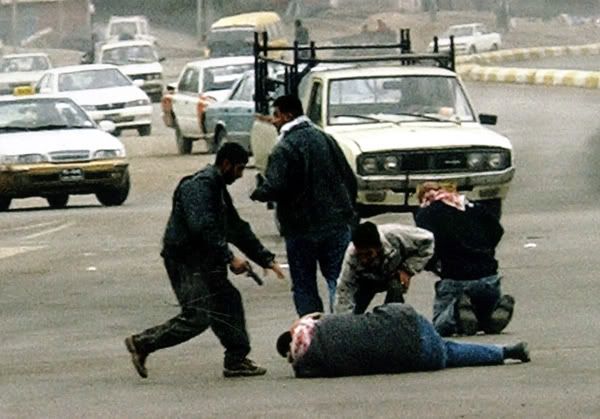 Baghdad - A gunman, left, shoots an Iraqi election worker during an attack on Haifa Street, a base of Sunni Arab insurgents. About 30 men attacked a car carrying five of the workers, executing three at point blank range. (Photo by AP stringer, December 19, 2004)
 Baghdad - An Iraqi man celebrates atop a burning U.S. Humvee after an explosion that destroyed a building and set four Humvees on fire, killing at least one U.S. soldier. (Photo by Muhammad Muheisen, April 26, 2004)
 Karbala - Moments after a series of bomb blasts on the Muslim day of Ashoura, a youth runs past victims and debris in a busy area of the holy city. (Photo by Brennan Linsley, March 2, 2004)
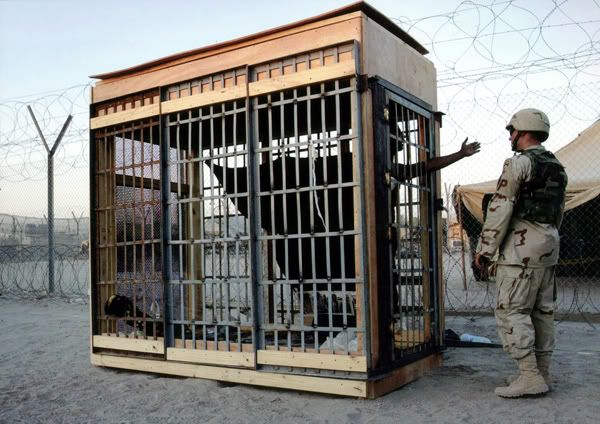 Baghdad - A detainee in a solitary confinement cage talks with a military policeman at Abu Ghraib prison. U.S. soldiers said the prisoner had frequently fought with other inmates. (Photo by John Moore, June 22, 2004)
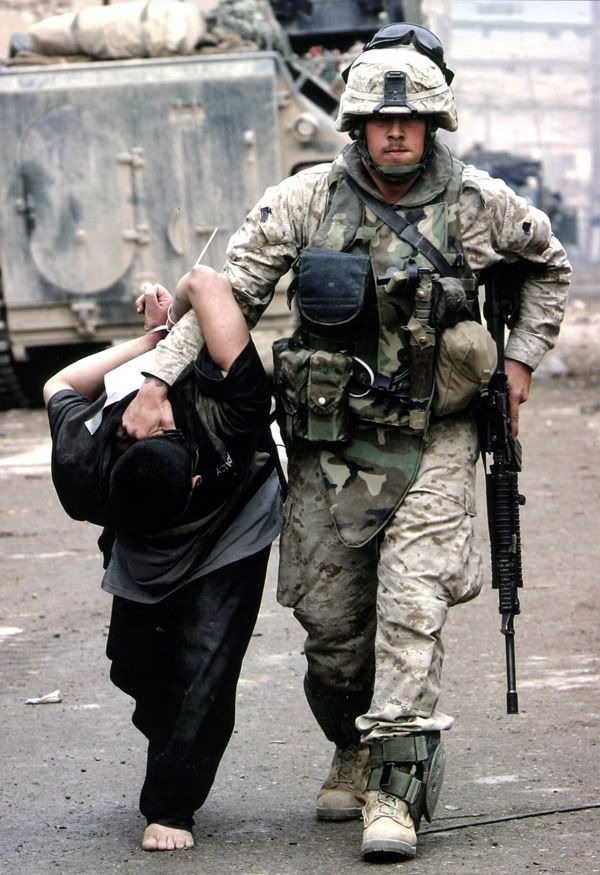 Fallujah - A U.S. Marine leads an Iraqi prisoner during fighting in the center of the city. (Photo by Anja Niedringhaus, November 12, 2004)
 Fallujah - Iraqi insurgents fire a mortar and small arms during the U.S.-led offensive against insurgents in the city. (Photo by Bilal Hussein, November 8, 2004)
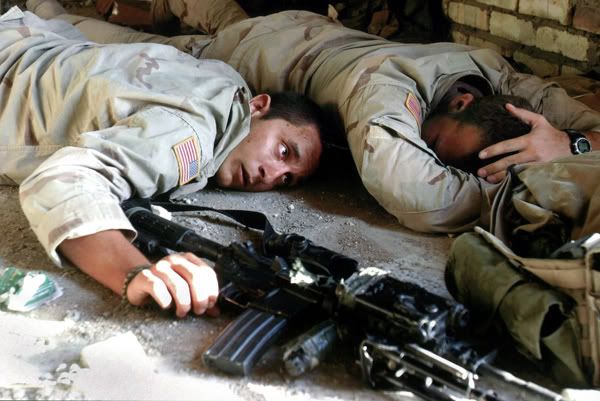 Najaf - U.S. soldiers take cover in a fortified position after a second week of fighting against Shiite militiamen in the holy city. (Photo by Jim MacMillan, August 20. 2004)
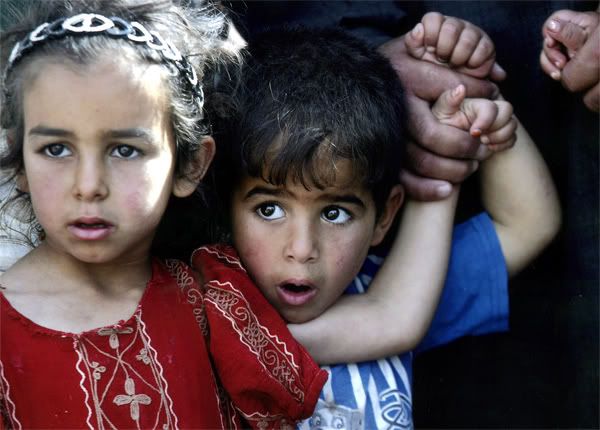 Fallujah - Displaced Iraqi children watch U.S. soldiers while waiting at a checkpoint before returning to their home in Fallujah. (Photo by John Moore, April 27, 2004)
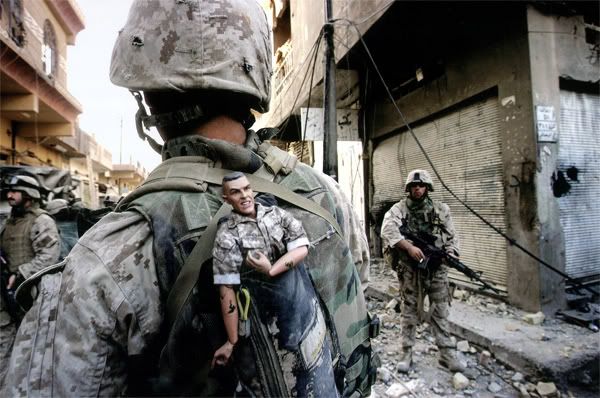 Fallujah - A 1st Division Marine carries a good luck mascot in his backpack as his unit pushed into western neighborhoods of Fallujah. Coalition forces launched a major November offensive for control of the city. (Photo by Anja Niedringhaus, November 14, 2004)
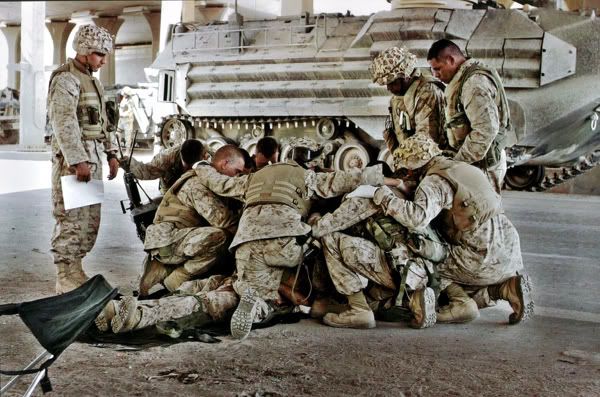 Fallujah - U.S. Marines pray over a fellow Marine killed while fighting insurgent strongholds. (Photo by Murad Sezer, April 8, 2004)
 Baqouba - At a hospital morgue, relatives mourn the death of Iraqi national guardsman Ryaad Khudayar, one of at least four guardsmen killed in a car bombing at a checkpoint outside Baqouba. (Photo by Khalid Mohammed, August 3, 2004)
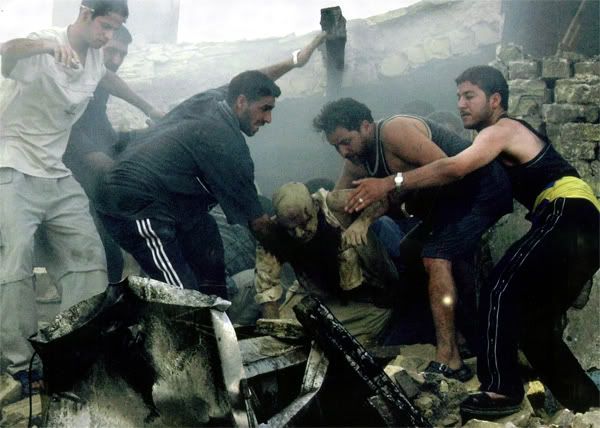 Baghdad - Iraqis rescue a man from the ruins of a building after a car bombing in central Baghdad. At least 10 people were killed, including three foreigners working to rebuild Iraqi power plants. (Photo by Mohammed Uraibi, June 14, 2004)
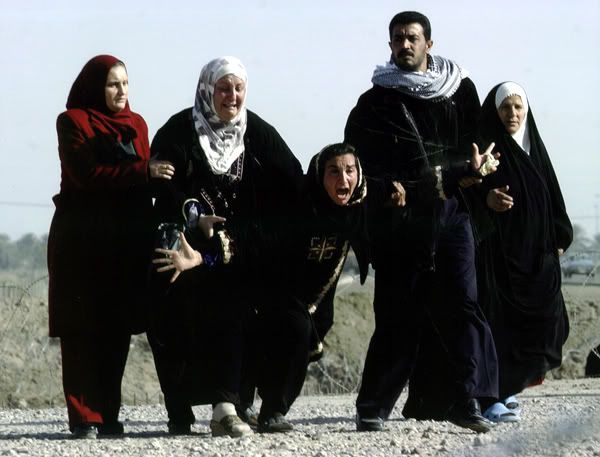 Baghdad - An Iraqi woman reacts as she waits for the release of a family member from Abu Ghrab prison. Hundreds of people waited in frustration for hours, hoping relatives would be among the first detainees freed under a much-publicized amnesty. (Photo by Muhammed Muheisen, January 8, 2004)
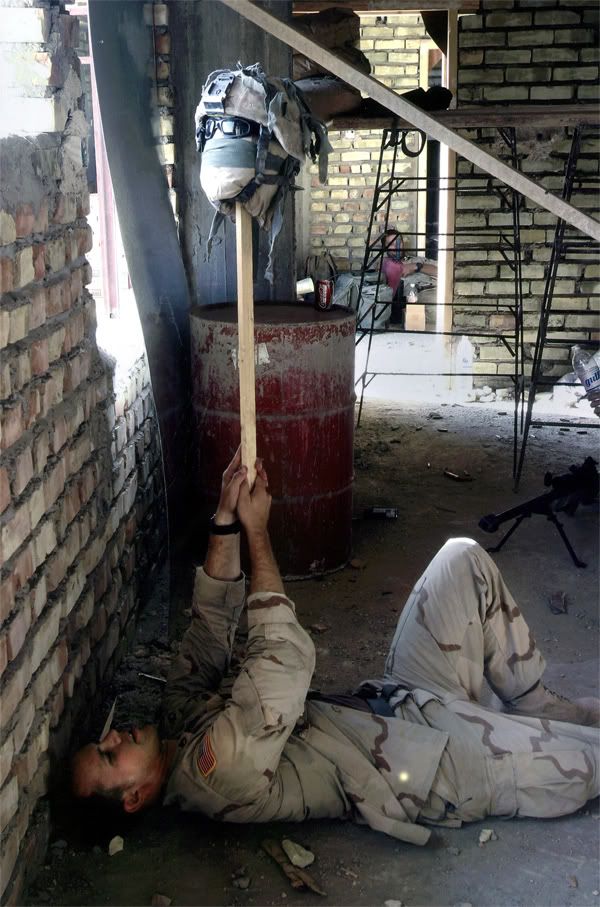 Najaf - A U.S. soldier uses a dummy to draw an insurgent sniper into view. (Photo by Jim MacMillan, August 20, 2004)
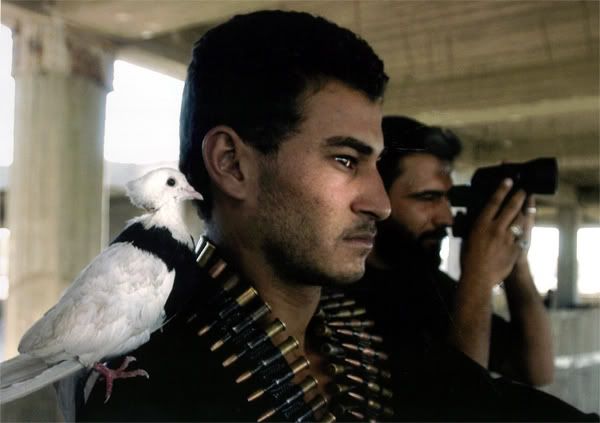 Najaf - A dove sits on the shoulder of a Mahdi Army soldier standing guard near the ancient Imam Ali mosque. The Mahdi Army, a Shiite militia, was fighting U.S.-Iraqi forces for control of the holy city. (Photo by Khalid Mohammed, August 15, 2004)
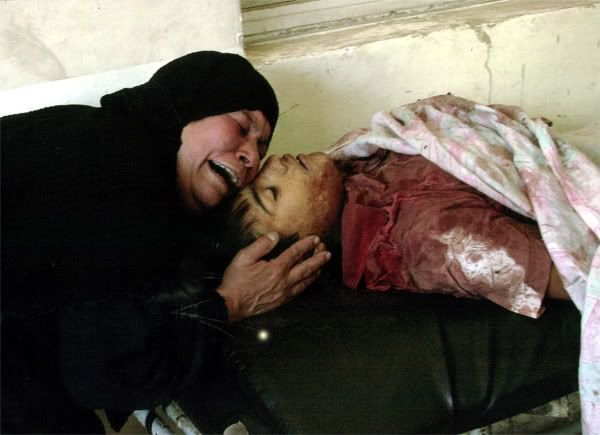 Baghdad - The mother of Samah Hussein grieves over the body at a Baghdad morgue. The boy was among 12 people reportedly killed by a suicide car bombing outside the U.S. military's Camp Cuervo. (Photo by Samir Mizban, June 13, 2004)
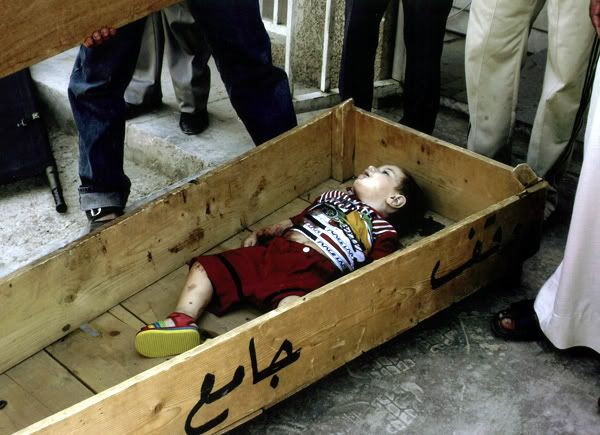 Baghdad - Mohammed Saleem, 18 months, lies in a coffin at a Sadr City morgue. Relatives said the boy and four other family members were killed in their car when U.S. forces opened fire overnight. (Photo by Karim Kadim, June 6, 2004)
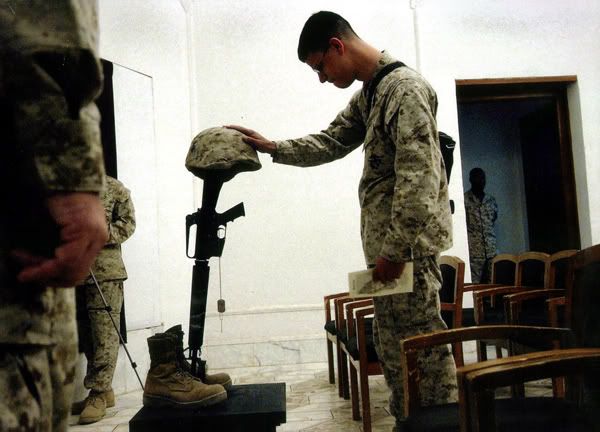 Ramadi - U.S. Marines pay their respects at a memorial service for 1st Marine Division Combat Photographer Cpl. William Salazar, 26, at Camp Blue Diamond. Salazar, of Las Vegas, Nev., was killed in action in Anbar Province. (Photo by Jim MacMillan, October 18, 2004)
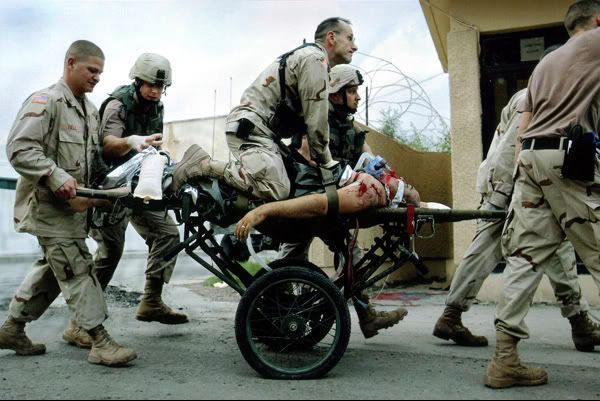 Baghdad - Nurse supervisor Patrick McAndrew kneels over Army Spc. Travis S. Babbit, 24, administering CPR upon arrival at the 31st Combat Support Hospital. Spc. Babbit, of Uvalde, Texas, later died of his wounds. His patrol was attacked in Baghdad by a rocket-propelled grenade and small arms fire, the Pentagon said. (Photo by John Moore, November 9, 2004)
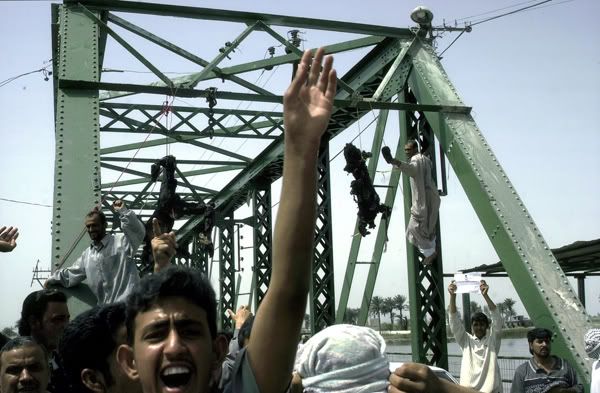 Fallujah - Iraqis chant anti-American slogans as the charred bodies of four U.S. contractors hang from a bridge over the Euphrates River. The incident marked increased violence by insurgents based in Fallujah. (Photo by Khalid Mohammed, March 31, 2004)