The Hill reports:
The Pentagon pays an average of $400 to put a gallon of fuel into a combat vehicle or aircraft in Afghanistan.
The statistic is likely to play into the escalating debate in Congress over the cost of a war that entered its ninth year last week.
Pentagon officials have told the House Appropriations Defense Subcommittee a gallon of fuel costs the military about $400 by the time it arrives in the remote locations in Afghanistan where U.S. troops operate.
“It is a number that we were not aware of and it is worrisome,” Rep. John Murtha (D-Pa.), the chairman of the House Appropriations Defense panel, said in an interview with The Hill. “When I heard that figure from the Defense Department, we started looking into it.”
The Pentagon comptroller’s office provided the fuel statistic to the committee staff when it was asked for a breakdown of why every 1,000 troops deployed to Afghanistan costs $1 billion. The Obama administration uses this estimate in calculating the cost of sending more troops to Afghanistan.
The Obama administration is engaged in an internal debate over its future strategy in Afghanistan. Part of this debate concerns whether to increase the number of U.S. troops in that country.
The top U.S. general in Afghanistan, Stanley McChrystal, reportedly has requested that about 40,000 additional troops be sent.
Democrats in Congress are divided over whether to send more combat troops to stabilize Afghanistan in the face of waning public support for the war.
Any additional troops and operations likely will have to be paid for through a supplemental spending bill next year, something Murtha has said he already anticipates.
Afghanistan — with its lack of infrastructure, challenging geography and increased roadside bomb attacks — is a logistical nightmare for the U.S. military, according to congressional sources, and it is expensive to transport fuel and other supplies.
A landlocked country, Afghanistan has no seaports and a shortage of airports and navigable roads. The nearest port is in Karachi, Pakistan, where fuel for U.S. troops is shipped.
From there, commercial trucks transport the fuel through Pakistan and Afghanistan, sometimes changing carriers. Fuel is then transferred to storage locations in Afghanistan for movement within the country. Military transport is used to distribute fuel to forward operating bases. For many remote locations, this means fuel supplies must be provided by air.
One of the most expensive ways to supply fuel is by transporting it in bladders carried by helicopter; the amount that can be flown at one time can barely satisfy the need for fuel.
The cheapest way to transport fuel is usually by ship. Other reasonable methods to provide fuel are by rail and pipeline. The prices go up exponentially when aircraft are used, according to congressional sources.
The $400 per gallon reflects what in Pentagon parlance is known as the “fully burdened cost of fuel.”
“The fully burdened cost of fuel is a recognition that there are a lot of other factors that come into play,” said Mark Iden, the deputy director of operations at the Defense Energy Support Center (DESC), which provides fuel and energy to all U.S. military services worldwide.
The DESC provides one gallon of JP8 fuel, which is used for both aircraft and ground vehicles, at a standard price of $2.78, said Iden.
The Commandant of the Marine Corps, Gen. James Conway, told a Navy Energy Forum this week that transporting fuel miles into Afghanistan and Iraq along risky and dangerous routes can raise the cost of a $1.04 gallon up to $400, according to Aviation Week which covered the forum.
“These are fairly major problems for us,” Conway said, according to the publication.
The fully burdened cost of fuel accounts for the cost of transporting it to where it is needed, said Kevin Geiss, program director for energy security in the Office of the Assistant Secretary of the Army for Installations and Environment.
And moving fuel by convoy or even airlift is expensive, according to the Army news release from July 16, which quoted Geiss. In some places, Geiss said, analysts have estimated the fully burdened cost of fuel might even be as high as $1,000 per gallon.
Energy consumed by a combat vehicle may not even be for actual mobility of the vehicle, Geiss said, but instead to run the systems onboard the vehicle, including the communications equipment and the cooling systems to protect the electronics onboard.
Some 8o percent of U.S. military casualties in Afghanistan are due to improvised explosive devices, many of which are placed in the path of supply convoys — making it even more imperative to use aircraft for transportation.
According to a Government Accountability Office report published earlier this year, 44 trucks and 220,000 gallons of fuel were lost due to attacks or other events while delivering fuel to Bagram Air Field in Afghanistan in June 2008 alone.
High fuel demand, coupled with the volatility of fuel prices, also have significant implications for the Department of Defense’s operating costs, the GAO said. The fully burdened cost of fuel — that is, the total ownership cost of buying, moving and protecting fuel in systems during combat — has been reported to be many times higher than the price of a gallon of fuel itself, according to the report.
The Marines in Afghanistan, for example, reportedly run through some 800,000 gallons of fuel a day. That reflects the logistical challenges of running the counterinsurgency operations but also the need for fuel during the extreme weather conditions in Afghanistan — hot summers and freezing winters.
With the military boosting the number of the all-terrain-mine resistant ambush-protected vehicles (M-ATVs) in Afghanistan meant to survive roadside bombs, the fuel consumption will likely rise even higher, since those vehicles are considered gas-guzzlers.
The Pentagon comptroller’s office did not return requests for comment by press time.
Friday, October 16, 2009
| [+/-] |
$400 Per Gallon Gas To Drive Debate Over Cost Of War In Afghanistan |
Thursday, April 9, 2009
| [+/-] |
Pentagon Preps for Economic Warfare |
Politico reports:
The Pentagon sponsored a first-of-its-kind war game last month focused not on bullets and bombs — but on how hostile nations might seek to cripple the U.S. economy, a scenario made all the more real by the global financial crisis.
The two-day event near Ft. Meade, Maryland, had all the earmarks of a regular war game. Participants sat along a V-shaped set of desks beneath an enormous wall of video monitors displaying economic data, according to the accounts of three participants.
“It felt a little bit like Dr. Strangelove,” one person who was at the previously undisclosed exercise told POLITICO.
But instead of military brass plotting America’s defense, it was hedge-fund managers, professors and executives from at least one investment bank, UBS – all invited by the Pentagon to play out global scenarios that could shift the balance of power between the world’s leading economies.
Their efforts were carefully observed and recorded by uniformed military officers and members of the U.S. intelligence community.
In the end, there was sobering news for the United States – the savviest economic warrior proved to be China, a growing economic power that strengthened its position the most over the course of the war-game.
The United States remained the world’s largest economy but significantly degraded its standing in a series of financial skirmishes with Russia, participants said.
The war game demonstrated that in post-Sept. 11 world, the Pentagon is thinking about a wide range of threats to America’s position in the world, including some that could come far from the battlefield.
And it’s hardly science fiction. China recently shook the value of the dollar in global currency markets merely by questioning whether the recession put China’s $1 trillion in U.S. government bond holdings at risk – forcing President Barack Obama to issue a hasty defense of the dollar.
“This was an example of the changing nature of conflict,” said Paul Bracken, a professor and expert in private equity at the Yale School of Management who attended the sessions. “The purpose of the game is not really to predict the future, but to discover the issues you need to be thinking about.”
Several participants said the event had been in the planning stages well before the stock market crash of September, but the real-world market calamity was on the minds of many in the room. “It loomed large over what everybody was doing,” said Bracken.
“Why would the military care about global capital flows at all?” asked another person who was there. “Because as the global financial crisis plays out, there could be real world consequences, including failed states. We’ve already seen riots in the United Kingdom and the Balkans.”
The Office of the Secretary of Defense hosted the two-day event March 17 and 18 at the Warfare Analysis Laboratory in Laurel, MD. That facility, run by the Johns Hopkins University Applied Physics Laboratory, typically hosts military officials planning intricate combat scenarios.
A spokesperson for the Applied Physics Laboratory confirmed the event, and said it was the first purely economic war game the facility has hosted. All three participants said they had been told it was the first time the Pentagon hosted a purely economic war game. A Pentagon spokesman would say only that he was not aware of the exercise.
The event was unclassified but has not been made public before. It is regarded as so sensitive that several people who participated declined to discuss the details with POLITICO. Said Steven Halliwell, managing director of a hedge fund called River Capital Management, “I’m not prepared to talk about this. I’m sorry, but I can’t talk to you.”
Officials at UBS also declined to comment.
Participants described the event as a series of simulated global calamities, including the collapse of North Korea, Russian manipulation of natural gas prices, and increasing tension between China and Taiwan. “They wanted to see who makes loans to help out, what does each team do to get the other countries involved, and who decides to simply let the North Koreans collapse,” said a participant.
There were five teams: The United States, Russia, China, East Asia and “all others.” They were overseen by a “White Cell” group that functioned as referees, who decided the impact of the moves made by each team as they struggled for economic dominance.
At the end of the two days, the Chinese team emerged as the victors of the overall game – largely because the Russian and American teams had made so many moves against each other that they damaged their own standing to the benefit of the Chinese.
Bracken says he left the event with two important insights – first, that the United States needs an integrated approach to managing financial and what the Pentagon calls “kinetic” – or shooting – wars. For example he says, the U.S. Navy is involved in blockading Iran, and the U.S. is also conducting economic war against Iran in the form of sanctions. But he argues there isn’t enough coordination between the two efforts.
And second, Bracken says, the event left him questioning one prevailing assumption about economic warfare, that the Chinese would never dump dollars on the global market to attack the US economy because it would harm their own holdings at the same time. Bracken said the Chinese have a middle option between dumping and holding US dollars – they could sell dollars in increments, ratcheting up economic uncertainty in the United States without wiping out their own savings. “There’s a graduated spectrum of options here,” Bracken said.
For those who hadn’t been to a Pentagon event before, the sheer technological capacity of the Warfare Analysis Laboratory was impressive. “It was surprisingly realistic,” said a participant.
Still, the event conjures images of the ultimate Hollywood take on computer strategizing: the 1983 film “War Games” in which a young computer hacker nearly triggers a nuclear apocalypse.
The film and the reality had one similarity: The characters in the movie used a computer called WOPR, or War Operation Plan Response. The computer system used by the real life war-gamers? It was called WALRUS, or Warfare Analysis Laboratory Registration and User Website.
Monday, February 11, 2008
| [+/-] |
Army Buried Study Faulting Iraq Planning |
The NY Times reports:
The Army is accustomed to protecting classified information. But when it comes to the planning for the Iraq war, even an unclassified assessment can acquire the status of a state secret.
That is what happened to a detailed study of the planning for postwar Iraq prepared for the Army by the RAND Corporation, a federally financed center that conducts research for the military.
After 18 months of research, RAND submitted a report in the summer of 2005 called “Rebuilding Iraq.” RAND researchers provided an unclassified version of the report along with a secret one, hoping that its publication would contribute to the public debate on how to prepare for future conflicts.
But the study’s wide-ranging critique of the White House, the Defense Department and other government agencies was a concern for Army generals, and the Army has sought to keep the report under lock and key.
A review of the lengthy report — a draft of which was obtained by The New York Times — shows that it identified problems with nearly every organization that had a role in planning the war. That assessment parallels the verdicts of numerous former officials and independent analysts.
The study chided President Bush — and by implication Secretary of State Condoleezza Rice, who served as national security adviser when the war was planned — as having failed to resolve differences among rival agencies. “Throughout the planning process, tensions between the Defense Department and the State Department were never mediated by the president or his staff,” it said.
The Defense Department led by Donald H. Rumsfeld was given the lead in overseeing the postwar period in Iraq despite its “lack of capacity for civilian reconstruction planning and execution.”
The State Department led by Colin L. Powell produced a voluminous study on the future of Iraq that identified important issues but was of “uneven quality” and “did not constitute an actionable plan.”
Gen. Tommy R. Franks, whose Central Command oversaw the military operation in Iraq, had a “fundamental misunderstanding” of what the military needed to do to secure postwar Iraq, the study said.
The regulations that govern the Army’s relations with the Arroyo Center, the division of RAND that does research for the Army, stipulate that Army officials are to review reports in a timely fashion to ensure that classified information is not released. But the rules also note that the officials are not to “censor” analysis or prevent the dissemination of material critical of the Army.
The report on rebuilding Iraq was part of a seven-volume series by RAND on the lessons learned from the war. Asked why the report has not been published, Timothy Muchmore, a civilian Army official, said it had ventured too far from issues that directly involve the Army.
“After carefully reviewing the findings and recommendations of the thorough RAND assessment, the Army determined that the analysts had in some cases taken a broader perspective on the early planning and operational phases of Operation Iraqi Freedom than desired or chartered by the Army,” Mr. Muchmore said in a statement. “Some of the RAND findings and recommendations were determined to be outside the purview of the Army and therefore of limited value in informing Army policies, programs and priorities.”
Warren Robak, a RAND spokesman, declined to talk about the contents of the study but said the organization favored publication as a matter of general policy.
“RAND always endeavors to publish as much of our research as possible, in either unclassified form or in classified form for those with the proper security clearances,” Mr. Robak said in a statement. "The multivolume series on lessons learned from Operation Iraqi Freedom is no exception. We also, however, have a longstanding practice of not discussing work that has not yet been published."
When RAND researchers began their work, nobody expected it to become a bone of contention with the Army. The idea was to review the lessons learned from the war, as RAND had done with previous conflicts.
The research was formally sponsored by Lt. Gen. James Lovelace, who was then the chief operations officer for the Army and now oversees Army forces in the Middle East, and Lt. Gen. David Melcher, who had responsibility for the Army’s development and works now on budget issues.
A team of RAND researchers led by Nora Bensahel interviewed more than 50 civilian and military officials. As it became clear that decisions made by civilian officials had contributed to the Army’s difficulties in Iraq, researchers delved into those policies as well.
The report was submitted at a time when the Bush administration was trying to rebut building criticism of the war in Iraq by stressing the progress Mr. Bush said was being made. The approach culminated in his announcement in November 2005 of his “National Strategy for Victory in Iraq.”
One serious problem the study described was the Bush administration’s assumption that the reconstruction requirements would be minimal. There was also little incentive to challenge that assumption, the report said.
“Building public support for any pre-emptive or preventative war is inherently challenging, since by definition, action is being taken before the threat has fully manifested itself,” it said. “Any serious discussion of the costs and challenges of reconstruction might undermine efforts to build that support.”
Another problem described was a general lack of coordination. “There was never an attempt to develop a single national plan that integrated humanitarian assistance, reconstruction, governance, infrastructure development and postwar security,” the study said.
One result was that “the U.S. government did not provide strategic policy guidance for postwar Iraq until shortly before major combat operations commenced.” The study said that problem was compounded by General Franks, saying he took a narrow view of the military’s responsibilities after Saddam Hussein was ousted and assumed that American civilian agencies would do much to rebuild the country.
General Franks’s command, the study asserted, also assumed that Iraq’s police and civil bureaucracy would stay on the job and had no fallback option in case that expectation proved wrong. When Baghdad fell, the study said, American forces there “were largely mechanized or armored forces, well suited to waging major battles but not to restoring civil order. That task would have been better carried out, ideally, by military police or, acceptably, by light infantry trained in urban combat.”
A “shortfall” in American troops was exacerbated when General Franks and Mr. Rumsfeld decided to stop the deployment of the Army’s First Cavalry Division when other American forces entered Baghdad, the study said, a move that reflected their assessment that the war had been won. Problems persisted during the occupation. In the months that followed, the report said, there were “significant tensions, most commonly between the civilian and military arms of the occupation.”
The poor planning had “the inadvertent effort of strengthening the insurgency,” as Iraqis experienced a lack of security and essential services and focused on “negative effects of the U.S. security presence.” The American military’s inability to seal Iraq’s borders, a task the 2005 report warned was still not a priority, enabled foreign support for the insurgents to flow into Iraq.
In its recommendations, the study advocated an “inverted planning process” in which military planners would begin by deciding what resources were needed to maintain security after an adversary was defeated on the battlefield instead of treating the postwar phase as virtually an afterthought. More broadly, it suggested that there was a need to change the military’s mind-set, which has long treated preparations to fight a major war as the top priority. The Army has recently moved to address this by drafting a new operations manual which casts the mission of stabilizing war-torn nations as equal in importance to winning a conventional war.
As the RAND study went through drafts, a chapter was written to emphasize the implications for the Army. An unclassified version was produced with numerous references to newspaper articles and books, an approach that was intended to facilitate publication.
Senior Army officials were not happy with the results, and questioned whether all of the information in the study was truly unclassified and its use of newspaper reports. RAND researchers sent a rebuttal. That failed to persuade the Army to allow publication of the unclassified report, and the classified version was not widely disseminated throughout the Pentagon.
Neither General Lovelace nor General Melcher agreed to be interviewed for this article, but General Lovelace provided a statement through a spokesman at his headquarters in Kuwait.
“The RAND study simply did not deliver a product that could have assisted the Army in paving a clear way ahead; it lacked the perspective needed for future planning by the U.S. Army,” he said.
A Pentagon official who is familiar with the episode offered a different interpretation: Army officials were concerned that the report would strain relations with a powerful defense secretary and become caught up in the political debate over the war. “The Army leaders who were involved did not want to take the chance of increasing the friction with Secretary Rumsfeld,” said the official, who asked not to be identified because he did not want to alienate senior military officials.
The Army has asked that the entire RAND series be resubmitted and has said it will decide on its status thereafter.
Tuesday, November 6, 2007
| [+/-] |
Commanders Pushed To Make Bomb Disposal Choices |
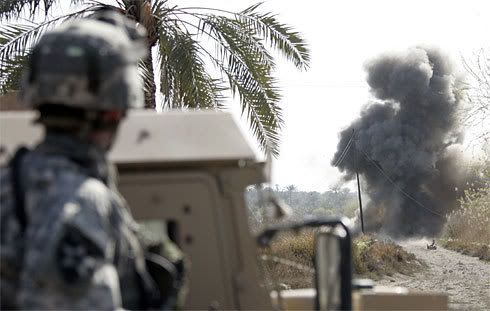 A U.S. soldier takes cover as an improvised explosive device is detonated near Baghdad. A new order lets officers decide whether to blow up IEDs or have technicians dismantle them.
USA Today reports:
During their last six months in Baghdad last year, Navy Lt. Sarah Wilson and her team of explosive ordnance disposal technicians said goodbye to each other more than 70 times.
Each time they were called to dismantle a roadside bomb, they'd bump fists. Then, Wilson says, "we'd all say we love each other because if we never got to say anything else" — if the bomb ended up exploding — "we wanted to be able to say goodbye."
After they arrived at the scene, they would often begin a perilous, painstaking task: taking apart the bombs, bagging the components and sending the parts back to a unit that analyzes them, much as investigators do on the television show CSI.
They were willing to take such risks, Wilson says, because "it's the best shot our guys on the ground have of … catching the bad guys." If forensic teams can lift a fingerprint or identify materials used in a series of bombs, "we can connect him," says Wilson, 27. "We know he's a bombmaker."
When roadside bombs became the insurgency's weapon of choice in Iraq, explosives disposal teams became increasingly important in efforts to protect U.S. troops and crack the bombmaking networks. But now, top military officials appear to be compromising efforts to catch bombmakers in favor of expedience and mobility, a USA TODAY investigation shows.
 U.S. Marine Sgt. Raphael Hernandez, an explosives technician, examines a device that was fired from an improvised rocket launcher near a bridge in Habaniyah, Iraq, last January.
A classified order, issued May 30 and reviewed by USA TODAY, gives commanders the authority to forgo calling in explosives technicians like Wilson to glean intelligence from improvised explosive devices, or IEDs. Instead, commanders may use engineers traveling with their regular units to simply detonate the bombs — without gathering evidence from them. Engineers receive about 10% of the explosives training of technicians, and they're not allowed to dismantle bombs.
Commanders and others see the process, dubbed "blow and go," as a way to keep convoys and combat teams moving and safe from snipers and ambushes. But the Army's new approach also runs counter to military doctrine — and to the Pentagon's long-term goal of getting one step ahead of the insurgency by learning about the networks that build, plant and trigger IEDs. The weapon is responsible for at least 60% of U.S. casualties in Iraq.
"The blow-and-go strategy undermines and compromises those overall efforts by losing key biometrics and evidence needed to identify and capture the network of insurgents," says Rep. Solomon Ortiz, D-Texas, a senior member of the House Armed Services Committee and chairman of the subcommittee on military readiness.
"This is a huge step backward in the long-term effort to prevent IED attacks from occurring in the first place," Ortiz says, "and puts the troops at risk of facing more IED attacks for a long time to come."
The head of the Army Asymmetric Warfare Office, which helps combat forces counter IEDs, also is concerned. "What are we accomplishing by blowing and going?" asks Col. Dick Larry. "You rid yourself of that one device, but the problem is … you have not gotten any kind of exploitative information off it."
In July, a USA TODAY investigation showed that, until last year, the Pentagon balked at pleas from officers in the field for safer vehicles to protect against IEDs. One of the explanations offered by Defense officials for not spending more money on the life-saving armor: that the military's focus was on stopping bombmaking networks before they planted the explosives.
In its annual report last year, the military's Joint IED Defeat Organization (JIEDDO), called attacking the networks "the lynchpin of our success." Its deputy director, Robin Keesee, estimated last month that as many as 160 such insurgent cells have been identified in Iraq.
And the organization's report listed forensic analysis of bombs — determining how the devices were manufactured, and what parts and types of explosives were used — among the efforts that were providing "unprecedented" intelligence capability.
Among the successes touted by the Pentagon: linking Iran to a particularly dangerous incarnation of the IED, the explosively formed penetrator. "Iranian TNT blocks removed from their packages have been seen on numerous occasions as IED components," according to a Feb. 11 Pentagon PowerPoint presentation in Baghdad.
"I don't want to give away the king's secrets here, but yes, (forensic analysis) was fruitful," says Paul Plemmons, a retired Army colonel who used to command a task force that dismantled bombs. "A bomber is a bomber, and they leave signatures. We saw patterns. We could track patterns."
"We know the engineers are not going to collect forensic data, and the way you defeat that weapon is getting at the forensics," Plemmons says. "We may lose the one device that will lead us to take a whole cell down if you blow and go."
JIEDDO spokeswoman Christine DeVries would not characterize the importance of such analysis, saying that the group is wary about giving too much information to the enemy. But she did say it is "one of the tools that have enabled forces in theater to eliminate a significant number of IED cells."
The need for mobility
When U.S. forces invaded Iraq in March 2003, few foresaw how prevalent or deadly roadside bombs would become. But by that fall, IEDs had emerged as the biggest threat to troops, and the teams that would dismantle the bombs — the explosives technicians — were stretched thin.
In the first months of the war, only a few dozen technicians were in Iraq. Today, including commanders, more than 500 are deployed, many embedded within units.
"When we were first there, the rules of engagement were, 'Let's just destroy all these IEDs,' " recalls Marine Master Sgt. Michael Burghardt, an explosives technician.
During the past two years, Burghardt says, that approach changed. When he was working in Ramadi, Burghardt says, he was collecting intelligence from about 90% of the IEDs he handled.
Today, explosives technician teams try to collect evidence from "every scene," says Army Col. Karl Reinhard, who commands the Army, Navy and Air Force explosives disposal teams in Iraq. From December 2006 through September 2007, he says technicians have handled more than 6,000 IEDs. Since the war began, he says, records show about 80,000 such bombs were planted.
"Some of the information we would glean would be negligible. Other times, it would be important," Reinhard says. The danger of blowing and going, he says, is that "you never know which needle in the haystack is going to be an important needle."
Military doctrine — specifically, a publication titled Barriers, Obstacles and Mine Warfare for Joint Operations and prepared by the Joint Chiefs of Staff — reinforces the unique role of explosives disposal teams. The document, dated April 26, characterizes the work of those teams as "an essential part of the overall effort to develop a detailed forensic database to target centers of gravity in the IED system."
"In addition to developing actionable intelligence to support future operations," the document says, reports from explosives disposal teams have "an immediate impact on refining unit level force protection-related tactics, techniques and procedures."
Since 2006, the military has taken significant steps to get more explosives disposal teams throughout the war zone.
Col. Kevin Lutz, an explosives technician set to replace Reinhard next year, says the military has tripled the number of explosives disposal teams in Iraq during the past 18 months — going from about 50 to about 150 three-person teams. Even so, when the tech teams are called to an IED, getting them to the site and letting them gather the intelligence often takes time. Sometimes, the delay is 30 minutes. Occasionally, it extends for hours.
Engineers have been lobbying to take a more active approach in destroying roadside bombs for the past few years, Lutz and others say. The engineers' traditional mission — to breach obstacles to keep units mobile — was arguably more important during the invasion of Iraq than it is now, given the military's current role policing the country.
Nevertheless, officials set up a training course, taught by explosives technicians, to help prepare engineers to detonate IEDs. Reinhard says those engineers receive less than 100 hours of training. Explosives technicians train for more than 1,100 hours, he says.
On May 30, Lt. Gen. Raymond Odierno, the second-ranking U.S. commander in Iraq, issued the order that empowers commanders to let engineers blow and go.
"The intent of the order was to allow qualified individuals to detonate explosives rather than waiting for others who may not be readily available," explains Brig. Gen. Michael Silva, an Army engineer who says he lobbied Odierno for the change. "It was a way to improve the efficiency of the route clearing team operations so we were actually enabling the soldiers to do the job that they needed to get done."
IEDs 'just an obstacle'
An instructor who teaches engineers at Fort Leonard Wood in Missouri says the order makes sense.
"If you look at IEDs as just an obstacle, one of the engineer functions is just to remove obstacles," says Maj. Eric Goser, executive officer of the Counter Explosive Hazard Center. "Bottom line: The IED to an engineer is no different than a log obstacle," Goser says. "A log … is an obstacle. You deal with that obstacle in a certain way."
Goser's logic troubles explosives technicians. "The difference is, the log obstacle won't kill you," says Reynold Hoover, a former explosives technician who worked as a special agent with the Bureau of Alcohol, Tobacco and Firearms and served in the first Gulf War.
"You're gaining mobility," Hoover says, "but what you're losing is the ability to find the bombmaker and the supply chain."
Moreover, the amount of time saved by blowing and going may not be much, Reinhard says. He says a study done this year by his task force estimates "the expected value of the time they could save would be 20 minutes, on average."
"Nobody wants to sit out on the battlefield for three to four hours," he says. "Two or three years ago, they were waiting that long. It's definitely not like that any more."
Statistics on response times are classified, but Reinhard says explosives technicians are now able to arrive relatively quickly at IED sites. "For instance, in the north, 85% of the responses in the last week of September were 90 minutes or less," he says. Lutz says a long wait for explosives technicians today is "an outlier."
Engineer Silva, who is no longer on active duty, is skeptical. He believes information released by the explosives technicians may be "skewed" against giving engineers more of a role.
"My belief is that there was a parochialism engaged there — parochial in the fact that they want to be the only ones … blowing" IEDs, Silva says of explosives technicians.
Do risks outweigh benefits?
It's unclear how often commanders have used the blow-and-go approach. Reinhard says records he reviewed showed engineers detonated "approximately 120" IEDs from June through mid-October — about one a day.
But Army Col. Peter DeLuca, commander of the 20th Engineering Brigade, estimates engineers he oversees blow and go at least three or four IEDs each day — far more than the records reviewed by Reinhard indicate.
"There's been a ramp-up," Reinhard explains. "They may both be true" he says of the figures.
Others aren't certain. "No one is keeping good track of that," says Larry, who heads the Army's anti-IED efforts. "How do we know what they're doing," he says of engineers, "if they don't report it?"
Odierno's order specifies that engineers can only detonate relatively simple IEDs, using devices such as robots and the robotic arm of Mine Resistant Ambush Protected vehicles — machines that keep troops out of harm's way.
"We have very, very strict limitations about what we are and what we're not supposed to blow up," says Army Spc. Walter Hayden, the 1st Platoon team leader with the 1203rd Engineer Battalion. "If I ever have any kind of doubt," he says, he calls in explosives technicians.
Silva says he can see the amount handled by engineers growing — and the limitations on engineers being lifted as training improves. To date, neither DeLuca nor Reinhard believes any engineers have been hurt while blowing and going.
Despite reservations, Reinhard says he doesn't "object to the engineers doing this provided that they can live within the bounds that sometimes you need to pause and take the time to exploit."
But some explosives technicians fear that engineers will overstep their mission — and make deadly mistakes. Burghardt says he and his team dismantled more than 900 IEDs during his three tours in Iraq. The one that detonated — the one that left six holes in his body, cracked his tailbone, threw him 10 feet and knocked him unconscious in September 2005, despite the protective gear he wore — was unlike any he had seen.
"It was the first time we saw the tactic of where they double stacked it," says Burghardt, 37, now stationed at Camp Fuji, Japan. "I was standing on top of the device when I was clearing it … and they just leave enough earth in between" that the device beneath the other IED was difficult to spot.
Burghardt's experience is what makes explosives technicians wary of the new order — particularly, the idea that engineers will be able to discern a simple IED from a more sophisticated one. "What's simple?" Burghardt asks rhetorically. "You're not going to know that until it's too late."
Such mistakes put troops and civilians at risk. In a 2005 paper for the Marine Corps War College, Lutz chronicled cases in which mistakes by engineers cost lives.
Two different cases during the first Gulf War in 1991 "led to the massive chemical exposure and contamination of thousands of coalition forces and non-combatants, and the loss of seven United States soldiers," Lutz wrote. The reason for one of the mishaps at As Salman Airfield in Iraq: "Engineers were clearing munitions they were unfamiliar with and that turned out to be some of the most deadly unexploded ordnance our inventory can produce."
He wrote that, "buried within the … investigations, point papers, after-action reports, lessons learned from the various units (now in Iraq) … one can find repetitive incidents where the improper destruction of (explosives) led to severe contamination of the surrounding area and caused injury, death and destruction of equipment and facilities to both United States Armed Forces and to the local Iraqi civilian population."
Explosives technician Plemmons put it more tersely. He says the difference between an engineer and an explosives technician handling an IED is like the difference between "your physician's assistant" and "an orthopedic surgeon."
Thursday, October 18, 2007
| [+/-] |
Anti-IED Drills Improve, But Not Every Soldier Goes Through Them |
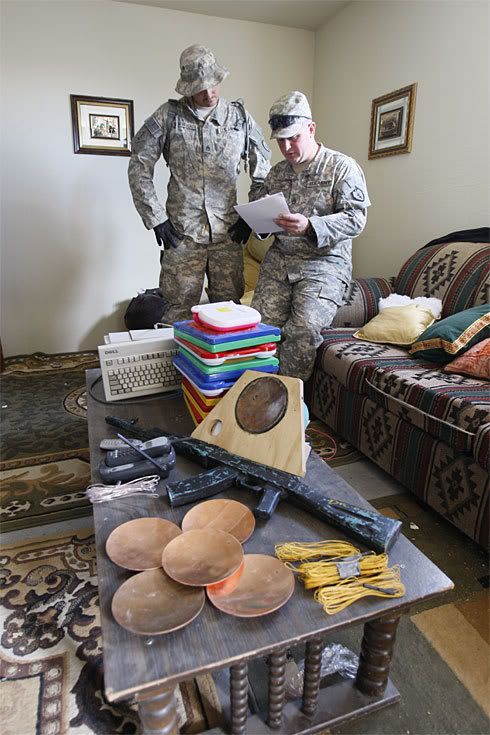 Soldiers from Schofield Barracks, Hawaii, practice house searches for IED components during training at Ft. Irwin, Calif. The U.S. Army's National Training Center in Death Valley replicates Iraqi houses and villages and even hires Iraqis living in the United States to act as role players.
USA Today reports:
The troops arrive to pure chaos. The Humvee lies smoking on the road, blown apart by a roadside bomb. One soldier moans on the ground, a leg torn off at the knee. Another slumps unconscious nearby. Iraqis crowd in, pointing and yelling. Snipers lurk on every roof.
Some soldiers secure the area; others provide first aid. They call for support. As they load the injured for evacuation, sniper fire rains down.
Fortunately, the wounded soldiers are only lifelike mannequins. And the entire episode is a training exercise aimed at preparing soldiers for the chief threat they'll face in combat: improvised explosive devices, or IEDs.
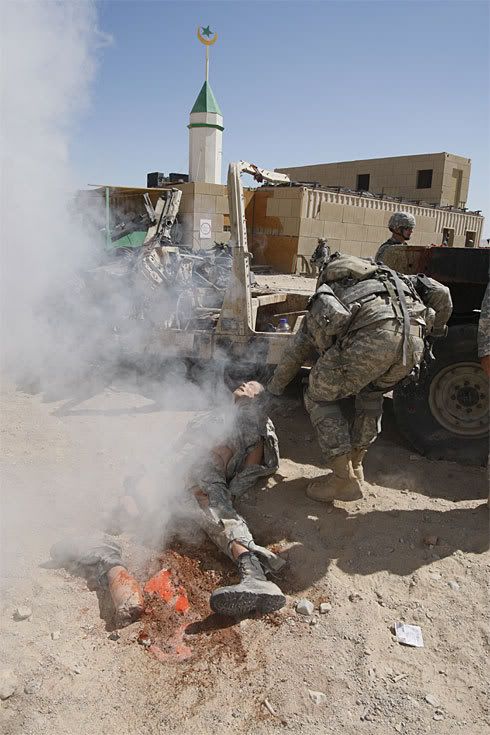 A medical simulation mannequin lies next to a smoking HUMVEE to simulate an IED attack, creating a realistic training for units preparing to deploy to Iraq.
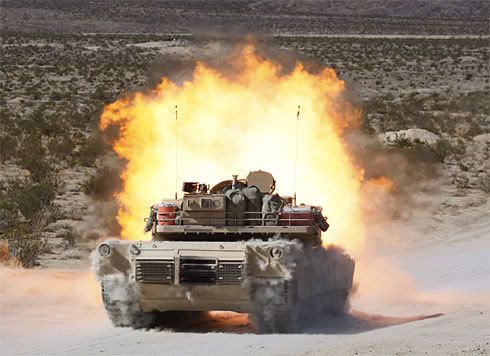 Soldiers from the 11th Armored Cavalry Regiment fire at targets with their M1A1 Abrams tanks, during a live-fire exercise at Ft. Irwin, Calif.
In the war's early years, troops were deployed with little or no knowledge of IEDs, even as the devices came to account for 60% of combat deaths.
Today, many troops still head to Iraq without the best available training. Three of the 20 Army combat brigades now in Iraq — nearly 15,000 troops — didn't have time to visit Fort Irwin or one of the two other combat training centers where brigades are supposed to do final pre-deployment exercises. Regardless of where they train, most soldiers and Marines still practice without the armored vehicles, electronic equipment and other tools they will rely on to avoid and survive IEDs in combat.
Fort Irwin has almost no armored Humvees, though commanders concede that the top-heavy vehicles are far harder to control than standard Humvees in the abrupt maneuvers often needed to survive an IED attack. Camp Shelby, Miss., a National Guard training site, uses fake "surrogates" to simulate the electronic jammers that block the wireless signals insurgents use to detonate IEDs.
Across the Pentagon's entire training complex, there are no more than a few of the new Mine Resistant Ambush Protected vehicles, known as MRAPs, that are being rushed to Iraq as the latest response to the IED threat.
Marine Corps Lt. Gen. James Mattis, selected in September to head the U.S. Joint Forces Command, told Congress in confirmation testimony that all troops are prepared when they reach combat.
But Mattis acknowledged that "units are challenged in their readiness by equipment needs … and (lack of) time to train." Many don't get to practice with the equipment they'll use in combat because there's only enough to supply troops already in the theater, he said, and they don't reach a combat-ready state until "just in time" for their deployment.
It's impossible to assess the costs of inadequate training: There are no statistics on how many of the 1,600 troops killed by IEDs might have lived if they had been better prepared. Commanders and rank-and-file troops alike acknowledge that they've had to play catch-up in training for the IED threat.
In recent years, that training has evolved and improved dramatically, but "it hasn't been quick enough," says Lt. Gen. Russel Honore, commander of the 1st Army, which trains all National Guard and reserve troops in the mainland USA. "It's gotten better and better, but we're still a long way from perfect."
A father haunted
Army Spc. Stephen Castner's complaints about his pre-deployment training still haunt his father. Castner, 27, a veteran of four years active duty in the Air Force, was back in uniform in the spring of 2006 as a National Guardsman doing exercises at Camp Shelby.
Castner's calls home were full of concerns, especially about the lack of realistic training for IEDs and the shortage of Humvees. His father, a former Army reservist also named Stephen, was so troubled that he wrote to his congressman, Rep. F. James Sensenbrenner, R-Wis.
Two months after the letter went out, Spc. Castner was dead.
On his first mission in Iraq, his Humvee was hit by a roadside bomb while providing security for a long convoy. Blown into a marshy ditch, the truck went unseen in the smoke as the rest of the convoy passed. A short time later, commanders noticed it missing, but by the time they returned and called for a medical evacuation, 25 minutes had passed. Castner's pulse stopped just as the helicopter got to the hospital; he died from blood loss.
Prodded by Sensenbrenner, the Pentagon's inspector general is investigating whether Castner's unit was properly trained and equipped. Regardless of whether such problems were decisive factors in Castner's death, the training concerns Castner raised reflect the Pentagon's continuing struggle to properly prepare troops for IEDs.
First anti-IED training
The Army began to set substantive servicewide IED training requirements for all soldiers in May 2004 — more than six months after attacks with the devices reached 100 per month.
Within weeks after the order from Maj. Gen. Raymond Barrett, the Army's Training and Doctrine Command began releasing IED "training support packages" to commanders. They've continued since, as often as every two months, tracking the constant changes in the ways insurgents make and trigger IEDs.
But change came slowly.
At the end of 2004, when Staff Sgt. Scott Molle deployed, his training at Fort Benning, Ga., included "some IEDs, but … most of the (IED) training we got you could pretty much throw out the window as soon as you got (to Iraq). It just didn't compare to what was happening" there.
The lag in IED training mirrored the reluctance of top Pentagon officials to acknowledge the potency of the insurgency — and the persistence of IEDs.
"We had a period there where the Pentagon wouldn't even acknowledge that there was an insurgency," says Rep. Vic Snyder, D-Ark., who chairs the House Armed Services subcommittee on military oversight. "So we were behind every step of the way — on training, equipment, technology."
These days, with far more robust instructional programs in place, there still isn't enough time and money to make sure that all war fighters get all the best possible IED training.
The three brigade combat teams that skipped training at Fort Irwin didn't have the 10 days it takes to get soldiers and equipment to and from the base. Instead, the training center dispatched trainers and equipment to put the three 4,500-soldier units through final exercises at their home bases.
"It's not quite as good as being at one of the combat training centers," says Dennis Tighe, deputy director of the Army's Combined Arms Center for Training. "But it was as good as we could make it given the time and resource constraints."
Then there are the equipment problems. The conventional Humvees that soldiers use for training at Fort Irwin were replaced in Iraq more than two years ago by a new, armored version that is thousands of pounds heavier, making it more unwieldy and prone to rollovers. But as the Pentagon struggles to provide enough armored Humvees just for units in combat, there aren't enough for training.
Now, many of the armored Humvees in Iraq are being replaced by the more IED-resistant MRAP vehicles. But there are no plans to move them into the training system.
Lt. Col. Tom Perison, a training chief at Army Forces Command at Fort McPherson, Ga., says all soldiers get some exposure to armored Humvees and other equipment as they rotate through Kuwait on their way to Iraq. "Certainly, if you (train on) the exact same thing you're taking to theater, that's the best thing," Perison says. But equipment has to go where "it's most needed," in Iraq.
There's evidence that the services' increased emphasis on IED training makes a difference. In the early months of the war, nearly every IED that exploded caused casualties, but today only about one in six IED detonations produce a death or injury, the Pentagon says. U.S. troops detect about half of all IEDs before they go off.
Dramatic change
In November 2004, Rep. Gene Taylor, D-Miss., visited Camp Shelby in his district where National Guard soldiers get final training before heading to Iraq.
Taylor pulled aside a soldier in a Humvee and asked whether he was training with jammers. "He kind of looked at me and said, 'Huh?' " Taylor recalls. "So I said, 'Jammers: The things that block the signals they use to set off IEDs.' And he said, 'Oh, yeah,' and pointed inside the Humvee to a cigar box on the dashboard with 'JAMMER' written on it."
Much would change in the next two years. The base's technicians fitted Humvees with plywood sides to simulate the restricted sight lines and shooting space of the armored versions.
They set up a mock Iraqi village and built fake IEDs that explode with small charges when soldiers fail to detect them — a big change from earlier years, when the fakes lacked the smoke and sound of the real thing. This year, the camp also received three dozen "surrogate" jammers.
But Congress remains concerned about resources at Shelby and other training sites across the services.
"Equipment and personnel shortfalls in non-deployed units limit their ability to fully train for combat," said a congressional staff report prepared in September 2006 for Rep. John Murtha, D-Pa., who now chairs the House Appropriations subcommittee. A bill the House passed this year on a bipartisan vote authorized a $250 million increase in Pentagon spending on training. That bill must be reconciled with a Senate version, which also called for increases in training budgets. The bills are being reconciled in conference.
Since 2006, the Pentagon has dramatically expanded an office called the Joint IED Defeat Organization, or JIEDDO, which has spent $500 million on IED training initiatives in the past two years. Among other things, the office has developed simulated jammers, IED "smart cards" that give troops tips on how to spot and handle different types of devices, and websites where troops can get the latest information on IEDs. JIEDDO also has helped funnel intelligence on IEDs from Iraq to units at home that are training for deployment.
"JIEDDO has an extraordinary flexibility to react quickly to emerging needs, including training," because it isn't subject to rules requiring that the services plan their spending far in advance, says Col. Michael Mahoney, JIEDDO's operations chief.
These days, training centers get the latest IED intelligence from Iraq on a near-daily basis.
At Fort Irwin, trainers "get (information from war zones) on training Day 2, and on training Day 5, it's in the (exercise) rotation," says Maj. Brent Dixon, a training coordinator at the Army's Combined Arms Center. Some changes are as simple as adding a new type of IED to the "petting zoo," a hands-on display where soldiers study explosive devices used by insurgents.
The bigger goal is to make training at Fort Irwin — with its mock Iraqi villages and 110-degree heat — even more realistic. Native Arabic speakers are hired by the Army to play roles as insurgents, as Iraqi troops and as bystanders during training exercises. They interact with soldiers training to interrogate troublemakers or to search Iraqi homes for IED components.
"This is the best training in the world," says Col. Steven Salazar, who heads operations at the training center. The emphasis on IEDs, he adds, "is huge."
Conflict over Castner's death
It will be up to the Pentagon's inspector general to sort through the conflicting accounts to determine whether better IED training would have saved Stephen Castner.
Sensenbrenner called the soldier's complaints about training "chillingly prophetic." In a statement, the congressman said, "No American soldier should be sent to Iraq with inadequate training."
In the initial investigation into Castner's death, several soldiers spoke of confusion in the convoy after the IED blew his Humvee into the roadside marsh. Castner's crewmates, two of whom also were injured, struggled to get him out of the vehicle, but he was stuck. After other troops from the convoy returned and pulled him out, they did not put a tourniquet above the deep shrapnel wound on his thigh.
One soldier in the Humvee with Castner — the Pentagon blacked out his name in the report — told investigators in a sworn statement that he would have been better prepared if he'd had "training on what to do when the vehicle is in water, and more medical training."
The initial report on the attack, written by Col. James Haun, a commander with an Army transportation unit, found that training was not a factor. "The soldiers at the scene reacted by the book," Haun's report said. "There is no relationship to Spc. Castner's death and any training he could receive or any training by the other soldiers that might have saved him."
Castner's father, a lawyer in Cedarburg, Wis., disputes that, citing witness statements, conversations with his son's crewmates and lapses in the investigation.
"There were a lot of training failures," he says. "The commanders lost command and control. … They relied on extremely undisciplined, helter-skelter broadcasts over the radio to make assumptions that were totally incorrect about whether all vehicles were accounted for.
"If they'd handled it properly, they would have been back (at the explosion site) in just a few minutes, there would have been people there who could have given Stephen proper medical attention, and the medevac would have been there a lot sooner."
It's unclear when the inspector general will finish its review. But the elder Castner, who supports the war, says it's important to see the probe through to its conclusion.
"I want to make sure the right lessons are learned from Stephen's death," he says. "Our mission in Iraq is important, but we have a responsibility to make sure that our (troops) are trained and prepared properly. That's our obligation."
Eisler reported from Camp Shelby, Miss., and Fort Leavenworth, Kan.; Vanden Brook from Milwaukee and Fort Irwin, Calif.; Morrison from Fort McPherson, Ga.
Wednesday, October 3, 2007
| [+/-] |
From the State Department, All the News for Inquiring Minds |
From the Washington Post, Al Kamen writes:
Fox News, launched with such high hopes 11 years ago as the "fair and balanced" network, apparently hasn't lived up to its billing. CNN never had a chance. The other networks? Please. No citizen could dare trust the agenda-driven print media -- The Washington Post, the Wall Street Journal, the New York Times -- to figure out, let alone accurately tell, the "real" story.
But now the State Department is in the blogosphere, and says it "offers the public an alternative source to mainstream media for U.S. foreign policy information." The blog, launched last week and called "Dipnote," is "taking you behind the scenes."
This is what we've all been waiting for! No more media filters and distortions. Unbiased news directly from the federal government, a news source long noted for truthful, unbiased reporting. The Clinton administration and most all its predecessors vowed to end-run the media, and they finally have the new electronic media to help them to do it.
One of the first diplo-bloggers last week was the assistant secretary for international organizations, Kristen Silverberg, who blogged from the United Nations.
"Another busy day in New York!" she gushed Tuesday. ("I'm exhausted!" she wrote in a later dispatch that day.) "First thing this morning, President Bush met with President Karzai" to discuss progress in Afghanistan.
"We have a lot of hope," she wrote, "for the future of Afghanistan," where child mortality has declined 20 percent in the past five years and 80 percent of the public has access to basic health care and "primary school enrollment for both boys and girls has increased by five hundred percent over the past five years."
But that's not all! "Later in the morning," Silverberg reported, "Secretary Rice attended a meeting" and "issued a joint statement calling on the government of Burma to end violence against the peaceful demonstrators."
"The Security Council this afternoon issued a statement of concern about the events in Burma, which were also discussed at today's G8 Foreign Ministers lunch," Silverberg reported, and Rice "raised the issue of Burma when she met this afternoon" with India's foreign minister. She also met with the Korean foreign minister about North Korea's nukes.
"While Secretary Rice will be back in Washington, D.C., for part of the day tomorrow to open the President's meeting of major economies on energy security and climate, I'll still be in New York and will keep you updated!" Thank goodness.
Public diplomacy czarina Karen Hughes's blog from the United Nations yesterday gave us a real insider's view of diplomacy in action.
"This morning I spoke live with hundreds of thousands of people in the Arab world by appearing on Al Arabiya," she wrote, "one of the leading television networks in the Middle East. Whenever I visit a country, and I've been to about 40 during the last two years, I usually do television and radio interviews (I've even appeared on what was described as the Indonesian version of 'Oprah')."
Would the conservative or liberal media give you that insight? Hardly.
Meanwhile, the blog appears to be getting a tremendous response worldwide and -- with the exception of people complaining that the type is too small and that the white print on a black background makes it hard to read -- readers have been overwhelmingly positive.
The first comment to one of Silverberg's blogs was refreshing. "Wong in China writes: 'Hello, I come from China. I hate such countries: North Korea, Iran, Burma, Cuba and Iraq (before liberated by US army).' " Well, thank you, Wong, for your informed perspective. Please report immediately to the embassy in Beijing for your free visa and green card.
State Department folks may be feeling good about their official blog, but the Pentagon, as is usually the case, has been working that venue for a while. In fact it has, within the New Media Directorate, an office that's being called "Blogosphere Initiatives," and one of the truly unsung heroes of the Bush Florida recount machine has been tapped to help out.
He's Michael Allan Leach, who, "it could be argued, played a more direct role" than most anyone else in George W. Bush's victory in Florida in 2000, the St. Petersburg Times reported at the time. Leach, an Air Force veteran, then-recent Florida State graduate and state GOP field worker, "used a laptop computer to salvage hundreds of Republican absentee votes which were in danger of not being counted because they didn't have voter identification numbers."
The Times reported that Leach blamed President Clinton and media liberals for a decline in morals, and wrote in a 1998 Internet posting: "I can no longer sit idly by while liberals in Washington with seven brain cells drag this country into the muck and mire of stupidity."
So, after the election, Leach spent six years as a political appointee as special assistant to the administrator of the Agriculture Department's rural development office, minus time out to handle press duties for the CPA in Iraq. He also picked up a master's degree in international affairs from Georgetown and worked most recently in public affairs at the Department of Homeland Security.
Saturday, September 1, 2007
| [+/-] |
Pentagon 'Three-Day Blitz' Plan For Iran |
Times Online reports:
The Pentagon has drawn up plans for massive airstrikes against 1,200 targets in Iran, designed to annihilate the Iranians’ military capability in three days, according to a national security expert.
Alexis Debat, director of terrorism and national security at the Nixon Center, said last week that US military planners were not preparing for “pinprick strikes” against Iran’s nuclear facilities. “They’re about taking out the entire Iranian military,” he said.
Debat was speaking at a meeting organised by The National Interest, a conservative foreign policy journal. He told The Sunday Times that the US military had concluded: “Whether you go for pinprick strikes or all-out military action, the reaction from the Iranians will be the same.” It was, he added, a “very legitimate strategic calculus”.
President George Bush intensified the rhetoric against Iran last week, accusing Tehran of putting the Middle East “under the shadow of a nuclear holocaust”. He warned that the US and its allies would confront Iran “before it is too late”.
One Washington source said the “temperature was rising” inside the administration. Bush was “sending a message to a number of audiences”, he said to the Iranians and to members of the United Nations security council who are trying to weaken a tough third resolution on sanctions against Iran for flouting a UN ban on uranium enrichment.
The International Atomic Energy Agency (IAEA) last week reported “significant” cooperation with Iran over its nuclear programme and said that uranium enrichment had slowed. Tehran has promised to answer most questions from the agency by November, but Washington fears it is stalling to prevent further sanctions. Iran continues to maintain it is merely developing civilian nuclear power.
Bush is committed for now to the diplomatic route but thinks Iran is moving towards acquiring a nuclear weapon. According to one well placed source, Washington believes it would be prudent to use rapid, overwhelming force, should military action become necessary.
Israel, which has warned it will not allow Iran to acquire nuclear weapons, has made its own preparations for airstrikes and is said to be ready to attack if the Americans back down.
Alireza Jafarzadeh, a spokesman for the National Council of Resistance of Iran, which uncovered the existence of Iran’s uranium enrichment plant at Natanz, said the IAEA was being strung along. “A number of nuclear sites have not even been visited by the IAEA,” he said. “They’re giving a clean bill of health to a regime that is known to have practised deception.”
Mahmoud Ahmadinejad, the Iranian president, irritated the Bush administration last week by vowing to fill a “power vacuum” in Iraq. But Washington believes Iran is already fighting a proxy war with the Americans in Iraq.
The Institute for the Study of War last week released a report by Kimberly Kagan that explicitly uses the term “proxy war” and claims that with the Sunni insurgency and Al-Qaeda in Iraq “increasingly under control”, Iranian intervention is the “next major problem the coalition must tackle”.
Bush noted that the number of attacks on US bases and troops by Iranian-supplied munitions had increased in recent months “despite pledges by Iran to help stabilise the security situation in Iraq”.
It explains, in part, his lack of faith in diplomacy with the Iranians. But Debat believes the Pentagon’s plans for military action involve the use of so much force that they are unlikely to be used and would seriously stretch resources in Afghanistan and Iraq.
Wednesday, August 22, 2007
| [+/-] |
Pentagon Missing Goal of Delivering Armored Vehicles To Iraq |
Reuters reports:
U.S. troops in Iraq will receive at least 1,000 fewer special armored vehicles than expected this year due to the amount of time needed for shipment, the Pentagon said on Wednesday.
Pentagon spokesman Geoff Morrell said the Defense Department expected defense contractors to produce 3,900 Mine Resistant Ambush Protected (MRAP) vehicles this year. But only 1,500 would make it to the war zone -- down from the Pentagon's previous shipment target of 2,500 to 3,000.
"If we could get 1,500 to theater by the end of this year, that would be a positive development," Morrell said.
The new goal of 1,500 was first reported by Stars & Stripes, the newspaper for troops overseas that is partially funded by the Defense Department.
The MRAP vehicle is one of the Pentagon's top acquisition priorities and the Defense Department's aim has been to buy as many as can be produced. It follows years of criticism directed at the Pentagon for not providing adequate armor to troops.
The MRAPs' V-shaped hull is designed to protect occupants from roadside bombs, which have killed many U.S. troops in Iraq and Afghanistan.
Morrell said it takes about 50 days to equip and ship a finished MRAP into the war zone. That includes 15 days for equipping and 35 for transport by ship.
The Pentagon was already flying some MRAPs to the war zone, Morrell said.
But given the numbers to be produced, it will quickly become more cost effective to send them by ship, he said, noting November and December would be the highest production months to date.
Morrell said he did not know which units in Iraq would be affected by the production shortfall this year.
MRAP contractors include:
-- Navistar International Corp.'s International Military and Government LLC;
-- Force Protection Inc., which is partnered with General Dynamics Corp.'s Land Systems business arm;
-- a General Dynamics Canadian unit;
-- BAE Systems Plc;
-- Oshkosh Truck Corp.;
-- closely held Protected Vehicles Inc. of North Charleston, South Carolina
Friday, August 17, 2007
| [+/-] |
Missing U.S. Arms Probe Goes Global |
At Asia Times Online, David Isenberg writes:
The issue of missing US weapons in Iraq is getting, as Alice said in Wonderland, curiouser and curiouser. What started out as a mere report documenting improper bookkeeping procedures for assault rifles and pistols given by the Pentagon to Iraqi security forces in 2004 and 2005 is turning into an international scandal.
It started on July 31, when the US Government Accountability Office (GAO) released a report "Stabilizing Iraq: DOD [Department of Defense] Cannot Ensure That US-Funded Equipment Has Reached Iraqi Security Forces". A classified version of the report will be submitted to Congress next month.
The report found that since 2003, the United States has provided about US$19.2 billion to develop Iraqi security forces. As part of that effort, components of the Multinational Force-Iraq (MNF-I), are responsible for implementing the US program to train and equip Iraqi forces. The report found that as of July, the DOD and MNF-I had not specified which DOD accountability procedures, if any, apply to the train-and-equip program for Iraq.
As Congress funded the train-and-equip program for Iraq outside traditional security assistance programs, the Pentagon had a large degree of flexibility in managing the program. Normally, the traditional security assistance programs are operated by the State Department. Since the funding did not go through traditional security assistance programs, the DOD accountability requirements normally applicable to these programs did not apply. Thus the DOD and MNF-I cannot fully account for Iraqi forces' receipt of US-funded equipment.
As a result, the GAO found a discrepancy of at least 190,000 weapons between data reported by the former commander of the Multinational Security Transition Command-Iraq (MNSTC-I) and the property books. The GAO report indicates that US military officials do not know what happened to 30% of the weapons the United States distributed to Iraqi forces from 2004 through early this year.
The highest previous estimate of unaccounted-for weapons was 14,000, in a report issued last year by the inspector general for Iraq reconstruction. According to that report, 13,180 Glock automatic pistols were unaccounted for. The more recent GAO study puts the total figure for missing pistols closer to 80,000. In addition, the report found that US officials in Iraq could not account for 751 M1F assault rifles and 99 MP5 machine-guns.
It seems a virtual certainty that many of the Glocks have been diverted to the black market. An article in the current issue of Newsweek magazine quotes a senior Turkish security official, who said his government estimates that some 20,000 US-bought Glock pistols have been brought from Iraq into his country over the past three years.
The GAO reached the estimate of 190,000 missing arms - 110,000 AK-47s and 80,000 pistols - by comparing the property records of the MNSTC-I against records US General David Petraeus maintained of the arms and equipment he had ordered, after he was brought in in June 2004 to build up Iraqi security forces.
The gaps between the two records are enormous. Petraeus reported that about 185,000 AK-47 rifles, 170,000 pistols, 215,000 pieces of body armor and 140,000 helmets were issued to Iraqi security forces from June 2004 through September 2005. But the property books contained records for 75,000 AK-47 rifles, 90,000 pistols, 80,000 pieces of body armor and 25,000 helmets.
The fact that the weapons are not fully accounted for does not necessarily mean they are all missing. It is possible that the US military simply does not have the supporting records confirming the dates the equipment was received, the quantities of equipment delivered, or the Iraqi units receiving the items.
On the other hand it seems fairly likely that some of the missing weapons are being used against US forces in Iraq. Given that the most readily accessible black market for those stolen weapons is in Iraq, some of those are going to be bought by the insurgents.
In fact, the problem could be considerably worse than the GAO report indicates.
According to Amnesty International research, additional hundreds of thousands of US-approved arms transfers from Bosnia-Herzegovina to Iraq could also be missing. In a May 2006 report, Amnesty revealed that Taos Inc, a US company with multiple DOD contracts, subcontracted to a Moldovan/Ukrainian company called Aerocom to transport hundreds of thousands of arms, more than 90 tonnes of AK-47s, and other weapons from Bosnia to Iraq between July 31, 2004, and June 31, 2005, for Iraqi security forces.
US military air-traffic controllers in Iraq, however, said Aerocom never requested landing slots to touch down in the country. Aerocom smuggled weapons to Liberia in 2002 and was operating without a valid license in 2004, according to the United Nations Security Council.
As of August, Amnesty was still awaiting a reply from the Pentagon regarding its investigation into the Bosnia-to-Iraq weapons shipments.
And, in a move that can only be likened to the fox guarding the hen-house, it turns out, as the Los Angeles Times reported on August 13, that there may have been another factor at work, namely the US government's use of Viktor Bout - a Russian air transporter who also happens to be the world's most notorious arms dealer.
When the US government needed to fly four planeloads of seized weapons from Bosnia to Iraqi security forces in Baghdad in August 2004, it used Aerocom. But Aerocom is tied to Bout's aviation empire. The problem is that the planes apparently never arrived. US officials admitted they had no record of the flights landing in Baghdad.
Why the US government would have used Bout-controlled Aerocom - which had already been linked to supplying arms to Liberia when it was ruled by Charles Taylor and to drug traffickers in Belize - is a mystery in and of itself, considering that by 2004 Bout was very well known to the US government as a global gun-runner whom they wanted to put out of business.
The latest development occurred this week when it was reported that that Italian anti-Mafia investigators had uncovered an alleged shipment of 105,000 rifles of which the US military command in Iraq was unaware. The Italian team, in an investigation code-named Operation Parabellum, stopped the $40 million sale and made four arrests. The consignment appears to have been ordered by the Iraqi Interior Ministry. The US high command in Baghdad admitted it had no knowledge of any such order, even though the ministry is supposed to inform the US before purchasing arms.
An Iraqi Interior Ministry official insisted the weapons were mostly for Iraqi police in al-Anbar province. But given the close relationship between the Shi'ite-led government and Shi'ite militias and the irregular nature of the arms order, the disclosure prompted suspicion that the eventual destination could have been the militias, or police units close to them.
Furthermore, why the police in Anbar would need more weapons raises more questions. The Pentagon has issued 169,280 AK-47s, 167,789 pistols and 16,398 machine-guns to the 161,000 police in Iraq and 28,000 border police.
Monday, August 6, 2007
| [+/-] |
Weapons Given to Iraq Are Missing |
GAO Estimates 30% of Arms Are Unaccounted For
The Washington Post reports:
The Pentagon has lost track of about 190,000 AK-47 assault rifles and pistols given to Iraqi security forces in 2004 and 2005, according to a new government report, raising fears that some of those weapons have fallen into the hands of insurgents fighting U.S. forces in Iraq.
The author of the report from the Government Accountability Office says U.S. military officials do not know what happened to 30 percent of the weapons the United States distributed to Iraqi forces from 2004 through early this year as part of an effort to train and equip the troops. The highest previous estimate of unaccounted-for weapons was 14,000, in a report issued last year by the inspector general for Iraq reconstruction.
The United States has spent $19.2 billion trying to develop Iraqi security forces since 2003, the GAO said, including at least $2.8 billion to buy and deliver equipment. But the GAO said weapons distribution was haphazard and rushed and failed to follow established procedures, particularly from 2004 to 2005, when security training was led by Gen. David H. Petraeus, who now commands all U.S. forces in Iraq.
The Pentagon did not dispute the GAO findings, saying it has launched its own investigation and indicating it is working to improve tracking. Although controls have been tightened since 2005, the inability of the United States to track weapons with tools such as serial numbers makes it nearly impossible for the U.S. military to know whether it is battling an enemy equipped by American taxpayers.
"They really have no idea where they are," said Rachel Stohl, a senior analyst at the Center for Defense Information who has studied small-arms trade and received Pentagon briefings on the issue. "It likely means that the United States is unintentionally providing weapons to bad actors."
One senior Pentagon official acknowledged that some of the weapons probably are being used against U.S. forces. He cited the Iraqi brigade created at Fallujah that quickly dissolved in September 2004 and turned its weapons against the Americans.
Stohl said insurgents frequently use small-arms fire to force military convoys to move in a particular direction -- often toward roadside bombs. She noted that the Bush administration frequently complains that Iran and Syria are supplying insurgents but has paid little attention to whether U.S. military errors inadvertently play a role. "We know there is seepage and very little is being done to address the problem," she said.
Stohl noted that U.S. forces, focused on a fruitless search for weapons of mass destruction after Baghdad fell, did not secure massive weapons caches. The failure to track small arms given to Iraqi forces repeats that pattern of neglect, she added.
The GAO is studying the financing and weapons sources of insurgent groups, but that report will not be made public. "All of that information is classified," said Joseph A. Christoff, the GAO's director of international affairs and trade.
In an unusual move, the train-and-equip program for Iraqi forces is being managed by the Pentagon. Normally, the traditional security assistance programs are operated by the State Department, the GAO reported. The Defense Department said this change permitted greater flexibility, but as of last month it was unable to tell the GAO what accountability procedures, if any, apply to arms distributed to Iraqi forces, the report said.
Iraqi security forces were virtually nonexistent in early 2004, and in June of that year Petraeus was brought in to build them up. No central record of distributed equipment was kept for a year and a half, until December 2005, and even now the records are on a spreadsheet that requires three computer screens lined up side by side to view a single row, Christoff said.
The GAO found that the military was consistently unable to collect supporting documents to "confirm when the equipment was received, the quantities of equipment delivered, and the Iraqi units receiving the equipment." The agency also said there were "numerous mistakes due to incorrect manual entries" in the records that were maintained.
The GAO reached the estimate of 190,000 missing arms -- 110,000 AK-47s and 80,000 pistols -- by comparing the property records of the Multi-National Security Transition Command for Iraq against records Petraeus maintained of the arms and equipment he had ordered. Petraeus's figures were compared with classified data and other records to ensure that they were accurate enough to compare against the property books.
In all cases, the gaps between the two records were enormous. Petraeus reported that about 185,000 AK-47 rifles, 170,000 pistols, 215,000 pieces of body armor and 140,000 helmets were issued to Iraqi security forces from June 2004 through September 2005. But the property books contained records for 75,000 AK-47 rifles, 90,000 pistols, 80,000 pieces of body armor and 25,000 helmets.
A military commander involved in the program at the time, speaking on the condition of anonymity because he was not authorized to discuss the report, acknowledged in an e-mail, "We did issue some items, including weapons, body armor, etc. to new Iraqi units that were literally going into battle."
But, the commander argued, "there was, frankly, not much of a choice early on: We had very little staff and could have held the weapons until every piece of the logistical and property accountability system was in place, or we could issue them, in bulk on some occasions, to the U.S. elements supporting Iraqi units who were needed in the battles of Najaf, Fallujah, Mosul, Samarra, etc."
The GAO plans to look for similar problems in the training of Afghan security forces.
During the Bosnian conflict, the United States provided about $100 million in defense equipment to the Bosnian Federation Army, and the GAO found no problems in accounting for those weapons.
Much of the equipment provided to Iraqi troops, including the AK-47s, originates from countries in the former Soviet bloc. In a report last year, Amnesty International said that in 2004 and 2005 more than 350,000 AK-47 rifles and similar weapons were taken out of Bosnia and Serbia, for use in Iraq, by private contractors working for the Pentagon and with the approval of NATO and European security forces in Bosnia.
Saturday, July 21, 2007
| [+/-] |
Pentagon Gets A Lesson From Madison Avenue |
U.S. Needs to Devise a Different 'Brand' to Win Over the Iraqi People, Study Advises
At the Washington Post, Karen DeYoung writes:
In the advertising world, brand identity is everything. Volvo means safety. Colgate means clean. IPod means cool. But since the U.S. military invaded Iraq in 2003, its "show of force" brand has proved to have limited appeal to Iraqi consumers, according to a recent study commissioned by the U.S. military.
The key to boosting the image and effectiveness of U.S. military operations around the world involves "shaping" both the product and the marketplace, and then establishing a brand identity that places what you are selling in a positive light, said clinical psychologist Todd C. Helmus, the author of "Enlisting Madison Avenue: The Marketing Approach to Earning Popular Support in Theaters of Operation." The 211-page study, for which the U.S. Joint Forces Command paid the Rand Corp. $400,000, was released this week.
Helmus and his co-authors concluded that the "force" brand, which the United States peddled for the first few years of the occupation, was doomed from the start and lost ground to enemies' competing brands. While not abandoning the more aggressive elements of warfare, the report suggested, a more attractive brand for the Iraqi people might have been "We will help you." That is what President Bush's new Iraq strategy is striving for as it focuses on establishing a protective U.S. troop presence in Baghdad neighborhoods, training Iraq's security forces, and encouraging the central and local governments to take the lead in making things better.
Many of the study's conclusions may seem as obvious as they are hard to implement amid combat operations and terrorist attacks, and Helmus acknowledged that it could be too late for extensive rebranding of the U.S. effort in Iraq. But Duane Schattle, whose urban operations office at the Joint Forces Command ordered the study, said that "cities are the battlegrounds of the future" and what has happened in Baghdad provides lessons for the future. "This isn't just about going in and blowing things up," Schattle said. "This is about working in a very complex environment."
In an urban insurgency, for example, civilians can help identify enemy infiltrators and otherwise assist U.S. forces. They are less likely to help, the study says, when they become "collateral damage" in U.S. attacks, have their doors broken down or are shot at checkpoints because they do not speak English. Cultural connections -- seeking out the local head man when entering a neighborhood, looking someone in the eye when offering a friendly wave -- are key.
The most successful companies, the Rand study notes, are those that study their clientele and shape their workplace and product in ways that incorporate their brand into every interaction with consumers.
Wal-Mart's desired identity as a friendly shop where working-class customers can feel comfortable and find good value, for example, would be undercut if telephone operators and sales personnel had rude attitudes, or if the stores offered too much high-end merchandise. For the U.S. military and U.S. officials, understanding the target customer culture is equally critical.
Helmus recommends expanding military training to include shaping and branding concepts such as cultural awareness, and the study underscores the perils of failing to understand your consumer.
"Certain things do not translate well," the study warned. "Danger lies behind assumptions of similarity." A gesture Bush made during his 2005 inaugural parade -- the University of Texas "hook 'em horns" salute with raised index and pinkie fingers -- stands for the "sign of the devil" in some cultures and an indication of marital infidelity in others. A leaflet dropped to intimidate Iraqi insurgents, the study noted, "also reached noncombatants" and "gave everyone who picked it up the 'evil eye.' "
"Words cause similar cultural confusion," it said. The Arabic word "jihad," for example, has religious connotations for Muslims; its repeated use to connote terrorism is insulting and also perversely lends legitimacy to violent acts.
Schattle acknowledged that much of what works for consumer advertising in the United States might not translate well in Baghdad. But urban ops, he said, is all about experimenting and adapting to new realities.
"We want to look at new concepts, new business practices, to see if there are things that we can learn," he said. Since his office was established after the U.S. military issued a new doctrine for urban warfare in 2002, "we've been collecting lessons learned from all over the world," he said. "Not just Iraq and Afghanistan, but places like the Philippines and South America. Wherever there have been fights, we went out and looked at them."
The challenge for the advertising study, he said, was to find "something we can learn from Madison Avenue or from the marketers, the best in the world, that might help us when we're trying to deliver a message about what democracy is." In Iraq, Schattle said, the "urban population is the center of gravity" and the problem is "how we influence them to be on our side, or at least not be an enemy" when "what they see is armor." The goal of such studies, Schattle said, is to distill what works and incorporate it into future training.
Adversaries are doing their own shaping on Iraq's urban battlefields. While intimidation, coercion and assassination might not make them beloved, such techniques effectively limit public outreach to U.S. forces, the Rand study notes. Enemy forces have also learned that "doing good works is a classic approach to winning friends and influencing people" and frequently provide basic services that the U.S. military is unable to match.
At the same time, Helmus said, U.S. military and civilian authorities must stop thinking of themselves as a "good-idea factory" whose every thought has greater merit than those of their customers. "Procter & Gamble doesn't even do that," he said.
| [+/-] |
Gates Steps In To Defuse Clinton-Pentagon Dispute |
The Washington Post reports:
Defense Secretary Robert M. Gates sought to defuse a row between a top Pentagon aide and Sen. Hillary Rodham Clinton yesterday over her request for details of plans to withdraw U.S. troops from Iraq.
In May, the New York Democrat sought information about the Pentagon's plans for pulling troops out of the war zone. In response to her inquiry, Undersecretary Eric S. Edelman dispatched a letter accusing her of reinforcing "enemy propaganda that the United States will abandon its allies" by discussing a timetable, an answer that Clinton deplored yesterday as "an unacceptable and outrageous political attack."
Clinton, the front-runner for the Democratic presidential nomination, capitalized on the contretemps all day, announcing that she will introduce legislation with Sen. John F. Kerry (D-Mass.) that would require the military to plan for a troop withdrawal from Iraq and issuing a letter to Gates demanding further answers about the military's exit strategy. Though Clinton voted for the war and has never apologized for her vote, she has sharpened her criticism of its execution while playing catch-up on the issue with Democratic rivals, particularly Sen. Barack Obama (Ill.), who opposed the invasion from the start.
In a statement, Gates said that he had not seen Clinton's original letter, but he added that he welcomes congressional involvement.
"I have long been a staunch advocate of Congressional oversight, first at the CIA and now at the Defense Department," Gates said. "I have said on several occasions in recent months that I believe that Congressional debate on Iraq has been constructive and appropriate. I had not seen Senator Clinton's reply to Ambassador Edelman's letter until today. I am looking into the issues she raised and will respond to them early next week."
"Redeploying out of Iraq will be difficult and requires careful planning," Clinton said. "I continue to call on the Bush administration to immediately provide a redeployment strategy that will keep our brave men and women safe as they leave Iraq -- instead of adhering to a political strategy to attack those who rightfully question their competence and preparedness after years of mistakes and misjudgments."
| [+/-] |
Daily Attacks In Iraq Hit New High |
Reuters reports:
Attacks in Iraq last month reached their highest daily average since May 2003, showing a surge in violence as President George W. Bush completed a buildup of U.S. troops, Pentagon statistics show.
The data, obtained by Reuters from the Defense Department, showed an upward trend in daily attacks over the past four months, when U.S. and Iraqi forces were ramping up operations against insurgents and militants, including al Qaeda, in Iraq.
Pentagon officials were not immediately available to comment on the statistics.
The June numbers showed 5,335 attacks against coalition troops, Iraqi security forces, civilians and infrastructure.
June's total was 2.5 percent below an October 2006 peak of 5,472 attacks and slightly lower than the 5,365 attacks in May.
But because June has only 30 days, the average daily number of attacks was 177.8, higher than the 176.5 last October and 173.1 in May.
The Pentagon statistics, which come as pressure mounts in the U.S. Congress for a troop withdrawal from Iraq, depicted the most intensive month for daily attacks since Bush declared major combat operations at an end in May 2003.
Daily attacks rose as the Bush administration moved the last combat battalions into place for a security clampdown in Baghdad, part of a controversial U.S. strategy to stabilize Iraq with an additional 28,000 troops.
Bush and other senior officials have predicted that a rise in violence from insurgents and al Qaeda in Iraq would occur this summer as the so-called "surge" strategy takes hold.
A crucial report expected in September from U.S. Ambassador to Iraq Ryan Crocker and the top U.S. commander in Iraq, Gen. David Petraeus, could force a change in U.S. policy if it suggests the strategy is not working.
U.S. military commanders have sought to paint a more upbeat picture of events on the ground while pleading for additional time to determine whether the Bush strategy can succeed.
The statistics showed the 177.8 attacks per day in June were above the 157.5 in March, the lowest daily average for any month in 2007. Total monthly attack figures have also climbed to well over 5,000 from a low in February of 4,561.
Attacks last month were up 46 percent from a year earlier, with the statistics showing 3,642 attacks or 121.4 per day on average in June 2006.
The June 2007 statistics confirmed a significant decline in the targeting of Iraqi civilians, with such attacks falling 18 percent to 763 from a 2007 high of 932 in May.
Attacks on Iraqi security forces fell to 889 in June from 987 in May, while attacks on coalition forces rose about 7 percent to 3,671 from 3,423.
Thursday, July 19, 2007
| [+/-] |
Pentagon Aide Says Hillary Clinton Helps Enemy |
The NYTimes reports:
A Pentagon official has told Senator Hillary Rodham Clinton that questions she has raised about how the United States would withdraw from Iraq feed enemy propaganda.
The stinging wording of the message, from Under Secretary of Defense Eric S. Edelman, was unusual, particularly because it was directed at a member of the Senate Armed Services Committee.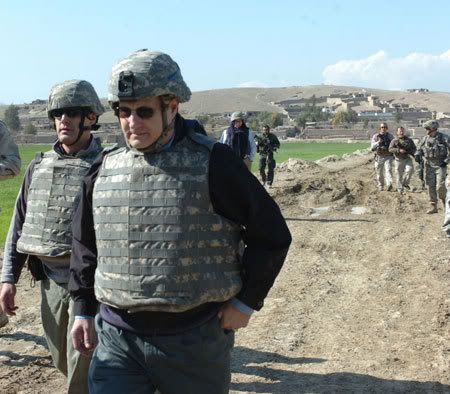
Mr. Edelman’s July 16 message, in response to questions Mrs. Clinton raised in May, was obtained Thursday by The Associated Press.
“Premature and public discussion of the withdrawal of U.S. forces from Iraq,” he wrote, “reinforces enemy propaganda that the United States will abandon its allies in Iraq, much as we are perceived to have done in Vietnam, Lebanon and Somalia.”
A Clinton spokesman, Philippe Reines, said the senator would respond to Mr. Edelman’s boss, Defense Secretary Robert M. Gates. Mr. Reines said military leaders should offer a withdrawal plan rather than “a political plan to attack those who question them.”
While Mrs. Clinton has pushed the Pentagon for information about withdrawal plans, so have others lawmakers, including Senator Richard G. Lugar of Indiana, the ranking Republican on the Foreign Relations Committee.
Saturday, June 16, 2007
| [+/-] |
"We were in a Cougar, so we survived" |
 Colomer writes, "It's such a good idea to replace Humvees with Cougars. They can do all the stuff the Humvees do. A Cougar can outrun a Humvee off the line, no problem at all, an armored Humvee, and probably can keep up with a normal tactical Humvee. And the difference in protection is incomparable."
USA Today reports:
Marine Gunnery Sgt. Timothy Colomer, 32, was leading an explosive ordnance disposal (EOD) team on a mission last December when his Mine Resistant Ambush Protected vehicle, a Cougar, hit a massive IED. Everyone in the vehicle was knocked unconscious by the blast, but all survived. Here is his story:
I was deployed to Iraq in August of '06, my first tour. I had seen Cougars at Quantico before I deployed. I didn't drive them or train on them — the new ones were getting shipped straight out to Iraq. But I'd done my homework, and I knew its capabilities.
Each EOD team essentially got its own Cougar (built by Force Protection Inc.). It was our main response vehicle. We kept our tools in there — our robots, our explosives, a certain amount of food and water. It was just a large mobile home for us. Inside the Cougar, we'd have four people. The team had a total of 12-15 guys — two were EOD techs and the rest were support and security. One corpsman, a medical guy, and the rest of the Marines were for security. I was the team leader.
We were operating out of Forward Operating Base Habaniyah (about 50 miles west of Baghdad) when we got a call to a weapons cache that had been found by Marines. We chose a route that was a dirt road. I decided we would go out first in the Cougar. The dirt makes it a lot easier for an insurgent with a shovel to go out in the sand and bury (an IED). That's why I decided to lead from the front.
I can't talk much about what we hit — a type of anti-tank land mine. It was daisy chained (with a second IED set to explode seconds after the first). The net explosive weight ended up being over 100 pounds. It was the biggest crater I've seen from an IED.
From the moment we got blown up, we were knocked out. We've speculated on how long we were out; our consensus was about 20 seconds. The security vehicle behind us (an armored Humvee) was about 20 meters back, and the Marine on the turret got knocked out by the blast wave. Everyone else was OK.Gunnery Sgt. Colomer took this picture of his MRAP right after the explosion.
One of the insurgent tactics is to lure Marines to the vehicle that has hit the IED, and then they blow up another IED. So my game plan was, if a vehicle gets hit, you don't get out of your own vehicle until you hear from me (that it's safe). And if you don't hear from me, the next senior Marine takes over.
After about 20-30 seconds, I got on the radio — we all wear personal radios — and I told them to stand by for an assessment. I had two guys who were injured a bit more than I was. I could get up and move on my own.
The two guys in the back seat had some injuries. I told my security guys that we were all alive. The other EOD tech and I had to jump out of the truck and look for that secondary IED if there was one. That was hell. We searched for 10-15 minutes.
At that point, the Marines who had called us up for that weapons cache had shown up. They were about 400 meters away when the explosion happened. So they heard it; they saw it. By the time my sergeant and I were out looking for the secondary device, they were there to provide more protection.
We assessed the vehicle. We couldn't move it. At that point, we all got pretty sick. I had some projectile vomiting because of the concussion. My three security Humvees did a medevac so we could all get to the hospital. Then, the other security guys, the ones who had come along, stayed there with our truck. They called in a second EOD team to recover our truck and to still respond to that weapons cache. But on their way, (that team) also got hit by an IED, and that wound up killing one guy.
In response to that, they sent out another EOD team, a third, and that was the one that actually accomplished the mission.
It's like the Wild West out there.
We had complete confidence in the Cougars. We had Cougars that were blown up by anti-tank land mines. We had an incident where a car bomb was driven at one of our Cougars and blew up, and (the vehicle) protected everybody inside.
Our job is to render safe or neutralize IEDs, so we constantly had explosions around us, sometimes just feet away. The Cougars take a beating. They're absolutely tough, like a tank on wheels.
It's such a good idea to replace Humvees with Cougars. They can do all the stuff the Humvees do. A Cougar can outrun a Humvee off the line, no problem at all, an armored Humvee, and probably can keep up with a normal tactical Humvee. And the difference in protection is incomparable.
Had we been in a Humvee when we got hit, we would have been dead, no question about it. We were in a Cougar, so we survived.
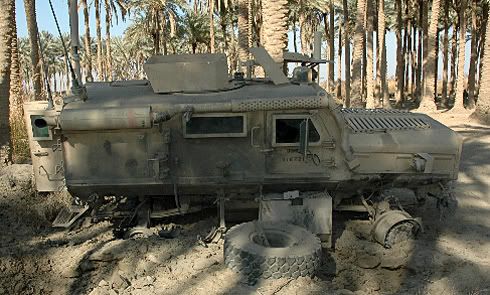
SOURCES: AP, USA TODAY research and wire reports
REPORTING BY: Pete Eisler, Blake Morrison, Dave Teeuwen and Tom Vanden Brook, USA TODAY
DATABASE ANALYSIS: Paul Overberg, USA TODAY
DESIGNED BY: David Evans and Jerry Mosemak, USA TODAY
PRODUCED BY: Anne Carey, Scott Cunningham, Denny Gainer, Linda Matthews, Chad Palmer, Rhyne Piggott, Juan Thomassie, Alan Turransky and Larry Webb, USA TODAY
