The NY Times reports:
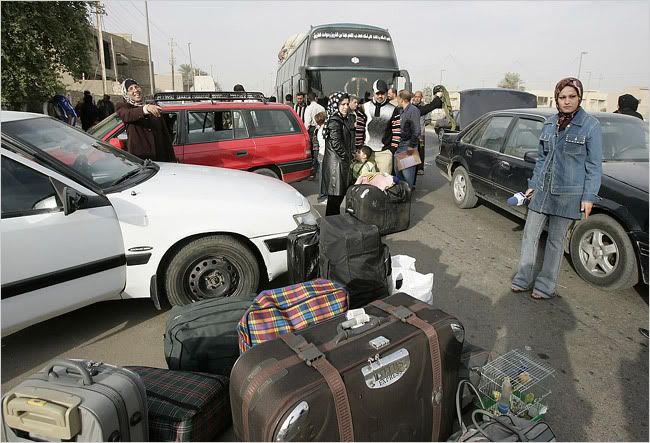
At a row of travel agencies near the highway to Syria, the tide of migration has reversed: the buses and GMC Suburban vans filled with people heading to Damascus run infrequently, while those coming from the border appear every day.
By all accounts, Iraqi families who fled their homes in the past two years are returning to Baghdad.
The description of the scope of the return, however, appears to have been massaged by politics. Returnees have essentially become a currency of progress.
Under intense pressure to show results after months of political stalemate, the government has continued to publicize figures that exaggerate the movement back to Iraq and Iraqis’ confidence that the current lull in violence can be sustained.
On Nov. 7, Brig. Gen. Qassim al-Moussawi, the Iraqi spokesman for the American-Iraqi effort to pacify Baghdad, said that 46,030 people returned to Iraq from abroad in October because of the “improving security situation.”
Last week, Iraq’s minister of displacement and migration, Abdul-Samad Rahman Sultan, announced that 1,600 Iraqis were returning every day, which works out to a similar, or perhaps slightly larger, monthly total.
But in interviews, officials from the ministry acknowledged that the count covered all Iraqis crossing the border, not just returnees. “We didn’t ask them if they were displaced and neither did the Interior Ministry,” said Sattar Nowruz, a spokesman for the Ministry of Displacement and Migration.
As a result, the tally included Iraqi employees of The New York Times who had visited relatives in Syria but were not among the roughly two million Iraqis who have fled the country.
The figures apparently also included three people suspected of being insurgents arrested Saturday near Baquba in Diyala Province. The police described them as local residents who had fled temporarily to Syria, then returned.
Some Iraqi lawmakers said that overly broad figures were being used intentionally.
“They are using this number because they want to show that Maliki is succeeding,” said Salim Abdullah, a lawmaker and member of the largest Sunni bloc, known as the Accordance Front, referring to Prime Minister Nuri Kamal al-Maliki. “But this does not make the number correct. I think dozens of Iraqis return home daily, but not 1,600.”
A half-dozen owners of Iraqi travel agencies and drivers who regularly travel to Syria agreed that the numbers misrepresented reality.
They said that the flow of returnees peaked last month, with more than 50 families arriving daily from Syria at Baghdad’s main drop-off point. Since Nov. 1, they said, the numbers have declined, and on Sunday morning, during a period when several buses used to appear, only one came.
The travel agents said that they believed that Iraqis would continue to return to Baghdad from Syria and Jordan but that the initial rush appeared to be over.
A United Nations survey released last week, of 110 Iraqi families leaving Syria, also seemed to dispute the contentions of officials in Iraq that people are returning primarily because they feel safer.
The survey found that 46 percent were leaving because they could not afford to stay; 25 percent said they fell victim to a stricter Syrian visa policy; and only 14 percent said they were returning because they had heard about improved security.
Underscoring a widely held sense of hesitation, many of those who come back to Iraq do not return to their homes. Clambering off the bus on Sunday, a woman who gave her name as Um Dima, mother of Dima, said that friends were still warning her not to go back to her house in Dora, a violent neighborhood in south Baghdad. So for now, she said, she will move in with her parents in southern Iraq.
Raad al-Kihani, a prominent Shiite tribal leader in Baghdad and supporter of the prime minister, said that most people returning were still restricted by the fear of sectarian violence. “There are no Shiite families moving back to Sunni neighborhoods and no Sunnis moving back to Shiite neighborhoods,” he said.
The Iraqi government is using incentives and aggressive public relations to try to bring more people home. Iraqi officials plan to pay for buses to transport Iraqis from Syria. Prominent government figures recently visited Saab al-Bor, a largely abandoned town near Baghdad, to emphasize that families should feel safe enough to return.
The Displacement Ministry offers 1 million Iraqi dinar, about $800, to internally displaced families who can prove they have returned home with a letter from the police and their neighborhood council. But the movement has been limited. As of Thursday, 4,358 internally displaced families, about 25,000 people, had returned to their homes in Baghdad, the ministry’s registry of payments to returnees said.
Furthermore, people are still leaving their homes — 28,017 were internally displaced in October, according to the latest United Nations figures. In all, the United Nations estimates that 2.4 million Iraqis are still internally displaced, with many occupying someone else’s home.
Greater numbers will not return to their neighborhoods, some Iraqi lawmakers and independent migration specialists say, until a clear legal framework has been established to help them get their houses back without evicting other displaced families.
“The actions are slow and so many things needs to be done, said Ayaed al-Sammaraie, a member of Parliament and a leader of its largest Sunni Arab bloc. “The main thing people would like is to return to their spots, and it seems there isn’t a plan for that.”
Monday, November 26, 2007
| [+/-] |
Numbers of Iraqi Refugees Returning Home Exaggerated |
Friday, November 2, 2007
| [+/-] |
'U.S. Air Force Struck Syrian Nuclear Site' |
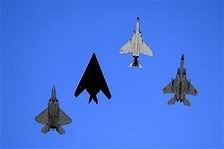 A US Air Force F-22 Raptor, an F-117 Nighthawk, an F-4 Phantom and an F-15 Eagle fly over Holloman Air Force Base, N.M. Photo: US Air Force
The Jerusalem Post reports:
The September 6 raid over Syria was carried out by the US Air Force, the Al-Jazeera Web site reported Friday. The Web site quoted Israeli and Arab sources as saying that two US jets armed with tactical nuclear weapons carried out an attack on a suspected nuclear site under construction.
The sources were quoted as saying that Israeli F-15 and F-16 jets provided cover for the US planes.
The sources added that each US plane carried one tactical nuclear weapon and that the site was hit by one bomb and was totally destroyed.
At the beginning of October, Israel's military censor began to allow the local media to report on the raid without attributing their report to foreign sources. Nevertheless, details of the strike have remained clouded in mystery.
On October 28, Prime Minister Ehud Olmert told the cabinet that he had apologized to Turkish Prime Minister Recep Tayyip Erdogan if Israel violated Turkish airspace during a strike on an alleged nuclear facility in Syria last month.
In a carefully worded statement that was given to reporters after the cabinet meeting, Olmert said: "In my conversation with the Turkish prime minister, I told him that if Israeli planes indeed penetrated Turkish airspace, then there was no intention thereby, either in advance or in any case, to - in any way - violate or undermine Turkish sovereignty, which we respect."
The New York Times reported on October 13 that Israeli planes struck at what US and Israeli intelligence believed was a partly constructed nuclear reactor in Syria on September 6, citing American and foreign officials who had seen the relevant intelligence reports.
According to the report, Israel carried out the report to send a message that it would not tolerate even a nuclear program in its initial stages of construction in any neighboring state.
On October 17, Syria denied that one of its representatives to the United Nations told a panel that an Israeli air strike hit a Syrian nuclear facility and added that "such facilities do not exist in Syria."
A UN document released by the press office had provided an account of a meeting of the First Committee, Disarmament and International Security, in New York, and paraphrased an unnamed Syrian representative as saying that a nuclear facility was hit by the raid.
However, the state-run Syrian Arab News Agency, SANA said media reports, apparently based on a UN press release, misquoted the Syrian diplomat.
Friday, September 21, 2007
| [+/-] |
Netanyahu Confirms Secret Attack on Syria |
The Guardian reports:
Israel's opposition leader, Binyamin Netanyahu, has given the first confirmation from his country of a mysterious air strike on an unknown target deep in Syria earlier this month - fuelling frenzied speculation about exactly what happened.
The leader of the rightwing Likud party said he had given the prime minister, Ehud Olmert, his backing for the attack, which Damascus said took place on September 6. Before that, the Israeli government had enforced a news blackout on the story.
Asked during a TV interview, Mr Netanyahu said: "When a prime minister does something that is important and necessary to Israel's security ... I give my backing." He refused to give further details.
Syria protested to the UN about the "flagrant violation" of its airspace. Officials in Damascus have reported that their air defences forced Israeli F15 jets to flee, dropping "munitions" and fuel tanks in the desert near the Turkish border.
US and other officials have claimed that Israel hit Syrian targets that may have had links to North Korean nuclear arms - dismissed by Damascus as "a big lie".
Meanwhile, Mr Olmert last night confronted critics within his centrist Kadima party who fear he may concede too much to Palestinians, and urged them to seize an opportunity to make peace after 60 years of conflict. Mr Olmert said he would free more Palestinian prisoners as part of "measured gestures" toward President Mahmoud Abbas as they try to agree terms for a US-sponsored peace conference.
Thursday, September 20, 2007
| [+/-] |
Israel, U.S. Shared Data On Suspected Nuclear Site |
The Washington Post reports:
Israel's decision to attack Syria on Sept. 6, bombing a suspected nuclear site set up in apparent collaboration with North Korea, came after Israel shared intelligence with President Bush this summer indicating that North Korean nuclear personnel were in Syria, U.S. government sources said.
The Bush administration has not commented on the Israeli raid or the underlying intelligence. Although the administration was deeply troubled by Israel's assertion that North Korea was assisting the nuclear ambitions of a country closely linked with Iran, sources said, the White House opted against an immediate response because of concerns it would undermine long-running negotiations aimed at persuading North Korea to abandon its nuclear program.
Ultimately, however, the United States is believed to have provided Israel with some corroboration of the original intelligence before Israel proceeded with the raid, which hit the Syrian facility in the dead of night to minimize possible casualties, the sources said.
The target of Israel's attack was said to be in northern Syria, near the Turkish border. A Middle East expert who interviewed one of the pilots involved said they operated under such strict operational security that the airmen flying air cover for the attack aircraft did not know the details of the mission. The pilots who conducted the attack were briefed only after they were in the air, he said. Syrian authorities said there were no casualties.
U.S. sources would discuss the Israeli intelligence, which included satellite imagery, only on condition of anonymity, and many details about the North Korean-Syrian connection remain unknown. The quality of the Israeli intelligence, the extent of North Korean assistance and the seriousness of the Syrian effort are uncertain, raising the possibility that North Korea was merely unloading items it no longer needed. Syria has actively pursued chemical weapons in the past but not nuclear arms -- leaving some proliferation experts skeptical of the intelligence that prompted Israel's attack.
Syria and North Korea both denied this week that they were cooperating on a nuclear program. Bush refused to comment yesterday on the attack, but he issued a blunt warning to North Korea that "the exportation of information and/or materials" would affect negotiations under which North Korea would give up its nuclear programs in exchanges for energy aid and diplomatic recognition.
"To the extent that they are proliferating, we expect them to stop that proliferation, if they want the six-party talks to be successful," he said at a news conference, referring to negotiations that also include China, Japan, South Korea and Russia.
Unlike its destruction of an Iraqi nuclear reactor in 1981, Israel made no announcement of the recent raid and imposed strict censorship on reporting by the Israeli media. Syria made only muted protests, and Arab leaders have remained silent. As a result, a daring and apparently successful attack to eliminate a potential nuclear threat has been shrouded in mystery.
"There is no question it was a major raid. It was an extremely important target," said Bruce Riedel, a former intelligence officer at Brookings Institution's Saban Center for Middle East Policy. "It came at a time the Israelis were very concerned about war with Syria and wanted to dampen down the prospects of war. The decision was taken despite their concerns it could produce a war. That decision reflects how important this target was to Israeli military planners."
Israel has long known about Syria's interest in chemical and even biological weapons, but "if Syria decided to go beyond that, Israel would think that was a real red line," Riedel said.
Edward Djerejian, a former U.S. ambassador to Syria and founding director of Rice University's Baker Institute for Public Policy, said that when he was in Israel this summer he noticed "a great deal of concern in official Israeli circles about the situation in the north," in particular whether Syria's young ruler, Bashar al-Assad, "had the same sensitivity to red lines that his father had." Bashar succeeded his Hafez al-Assad as president of Syria in 2000.
The Israeli attack came just three days after a North Korean ship docked at the Syrian port of Tartus, carrying a cargo that was officially listed as cement.
The ship's role remains obscure. Israeli sources have suggested it carried nuclear equipment. Others have maintained that it contained only missile parts, and some have said the ship's arrival and the attack are merely coincidental. One source suggested that Israel's attack was prompted by a fear of media leaks on the intelligence.
The Bush administration's wariness when presented with the Israeli intelligence contrasts with its reaction in 2002, when U.S. officials believed they had caught North Korea building a clandestine nuclear program in violation of a nuclear-freeze deal arranged by the Clinton administration.
After the Bush administration's accusation, the Clinton deal collapsed and North Korea restarted a nuclear reactor, stockpiled plutonium and eventually conducted a nuclear test. Secretary of State Condoleezza Rice convinced Bush this year to accept a deal with North Korea to shut down the reactor, infuriating conservatives inside and outside the administration.
But for years, Bush has also warned North Korea against engaging in nuclear proliferation, specifically making that a red line that could not be crossed after North Korea tested a nuclear device last year. The Israeli intelligence therefore suggested North Korea was both undermining the agreement and crossing that line.
Conservative critics of the administration's recent diplomacy with North Korea have seized on reports of the Israeli intelligence as evidence that the White House is misguided if it thinks it can ever strike a lasting deal with Pyongyang. "However bad it might be for the six-party talks, U.S. security requires taking this sort of thing seriously," said John R. Bolton, the former U.S. ambassador to the United Nations who was a top arms control official in Bush's first term.
But advocates of engagement have accused critics of trying to sabotage the talks. China on Monday abruptly postponed a round of six-party talks scheduled to begin this week, but U.S. officials now say the talks should start again Thursday.
Some North Korean experts said they are puzzled why, if the reports are true, Pyongyang would jeopardize the hard-won deal with the United States and the other four countries. "It does not make any sense at all in the context of the last nine months," said Charles "Jack" Pritchard, a former U.S. negotiator with North Korea and now president of the Korea Economic Institute.
| [+/-] |
Shock Waves From Syria |
Did Israel bomb a secret nuclear facility equipped by North Korea?:
There's been no official confirmation of the targets or results of an Israeli air raid in northeastern Syria on Sept. 6. Yet, like a subterranean explosion, the event is sending shock waves through the Middle East and beyond. Syria has protested to the United Nations, though it hasn't been very clear about what it's protesting. On Tuesday, a front-page editorial in Damascus's main government-run newspaper criticized the United States for not condemning the attack. An Israeli newspaper, meanwhile, noted triumphantly that no nation other than North Korea had come to Syria's defense, rhetorically or otherwise.
What happened? Media accounts are beginning to converge on a report that Israel bombed a facility where it believed Syria was attempting to hatch its own nuclear weapons program with North Korea's assistance. The Post's Glenn Kessler reported that the strike came three days after a ship carrying material from North Korea docked at a Syrian port and delivered containers that Israel believes held nuclear materials. It's not clear whether U.S. intelligence agencies concur with Israel's conclusion, and independent experts have said that Syria lacks the resources for a credible nuclear weapons program.
TOOLBOX
Resize Text
Save/Share +
Print This
E-mail This
COMMENT
washingtonpost.com readers have posted 9 comments about this item.
View All Comments »
POST A COMMENT
Your washingtonpost.com User ID, maxthesabre, will be displayed with your comment.
Discussion Policy
It nevertheless is beginning to look as if Israel may have carried out the boldest act of nuclear preemption since its own 1981 raid against Iraq's Osirak nuclear complex. If so, its silence is shrewd. It has allowed Syria to avoid a military response and every other Arab state to pretend that nothing happened. So far, the most serious fallout may be China's abrupt and unexplained postponement of scheduled "six-party" talks on North Korea's nuclear program.
The non-news has boosted the previously rock-bottom poll numbers of Israeli Prime Minister Ehud Olmert. This week he jauntily announced that he was open to peace talks with Syria. Still, the lasting repercussions of the raid have yet to become clear. One question is how the government of Bashar al-Assad will respond to what may have been a devastating Israeli blow -- coupled with what can only be interpreted as silent approval by Syria's neighbors and most of the rest of the world. Will Mr. Assad be frightened out of the cocky aggressiveness that has caused him to sponsor or facilitate terrorism in Israel, Iraq and Lebanon? Or will he choose to escalate?
Another choice is faced by the Bush administration, which hopes to complete an accord with North Korea by the end of the year under which North Korea will disclose all of its nuclear programs and disable its facilities. Secretary of State Condoleezza Rice said this week that concerns about proliferation only added to the urgency of moving ahead on the deal. That's true -- but it doesn't mean U.S. negotiators can ignore the possibility that North Korea was shipping nuclear equipment to Syria even while promising to dismantle its own program. Pyongyang's dealings with Syria are a legitimate and necessary subject of inquiry when the six-party talks resume -- and they ought to be part of North Korea's promised disclosure.
Tuesday, September 18, 2007
| [+/-] |
Syria, N. Korea Deny Nuclear Cooperation |
The Associated Press reports:
Syria and North Korea denied Tuesday they are cooperating on a Syrian nuclear program, and they accused U.S. officials of spreading the allegations for political reasons -- either to back Israel or to block progress on a deal between Washington and Pyongyang.
A front-page editorial in the government newspaper Tishrin also criticized the United States for failing to condemn a Sept. 6 Israeli air incursion, which it called a violation of international law.
Details of the incursion remain unclear. Israel clamped a news blackout on the raid, while Syria said only that warplanes entered its airspace, came under fire from anti-aircraft defenses and dropped munitions and fuel tanks to lighten their loads while they fled.
U.S. officials have said Israeli warplanes struck a target. A military officer said Israel targeted weapons being shipped to Hezbollah militants in Lebanon, but another official's comments raised speculation the Israelis targeted a nuclear installation.
Andrew Semmel, acting U.S. deputy assistant secretary of state for nuclear nonproliferation policy, said Syria may have had contacts with "secret suppliers" to obtain nuclear equipment. He did not identify the suppliers, but said that North Koreans were in Syria and that he could not exclude involvement by the network run by the disgraced Pakistan nuclear scientist A.Q. Khan.
North Korea strongly denied it secretly helped Syria develop a nuclear program, maintaining the charge was fabricated by U.S. hard-liners to block progress in the North's relations with the United States.
A Syrian Cabinet minister ridiculed the speculation about any cooperation with North Korea.
"All this rubbish is not true. I don't know how their imagination has reached such creativity," Bouthaina Shaaban said.
"Regretfully, the international press is busy justifying an aggression on a sovereign state and the world should be busy condemning it instead of inventing reasons and aims of this aggression," he told Lebanon's Hezbollah TV station Al-Manar.
Syria's nuclear program has long been considered minimal, and the country is known to have only a small research reactor.
In Vienna, Austria, officials for the International Atomic Energy Agency declined comment. But a diplomat associated with the agency said the IAEA "didn't know anything about any nuclear facility in Syria, and if there is something there, we should know."
Syria was the subject of an IAEA investigation in 2004 on suspicions it could have been a customer of the nuclear black market run by the Khan network -- the same operation that supplied Iran and Libya for their clandestine atomic projects. The diplomat in Vienna, who insisted on anonymity, said the IAEA found no concrete evidence of such activity.
Israeli incursions into Syrian airspace are uncommon, unlike in neighboring Lebanon where Israeli warplanes have regularly made reconnaissance flights since last year's war with Hezbollah. Such flights were reported late Tuesday over southern Lebanon.
W. Patrick Lang, former head of Mideast intelligence at the U.S. Defense Intelligence Agency, said Israel's incursion over Syria may have been staged to convince the Syrians that its forces are still formidable despite the inconclusive war with Hezbollah. Syria may have tempered its response for fear of escalation, he added.
"The Syrians are really worried because of the hostility of the Bush administration," said Lang. "If things degenerate, they could end up on the receiving end of a strike from Israel, with the go-ahead from the U.S."
The editorial in Tishrin, which reflects Syrian government thinking in a country where the media is tightly controlled, said the U.S. accusations show Washington's pro-Israel bias and have no credibility.
It said Washington was "busy on behalf of Israel circulating claims" that the incursion involved "possible nuclear facilities supplied by (North) Korea."
"The strange thing is that the Americans are talking on behalf of Israel and are providing excuses and concocting new false spins such as talking about presumed Syrian nuclear activity and completely turning a blind eye about the Israeli nuclear danger," the Syrian editorial said.
Israel is widely believed to have nuclear weapons but has never acknowledged it.
The Syrian newspaper said the accusations "recall those false claims that the Americans and the British circulated about Iraq's nuclear programs."
Tishrin was referring to Saddam Hussein's alleged weapons of mass destruction program, one reasons cited by the U.S. for the invasion of Iraq in 2003. No such weapons were found.
Israeli President Shimon Peres, meanwhile, sought to calm tensions with Syria.
"The nervousness in relations between Syria and ourselves is over," Peres told foreign reporters in Jerusalem. "We are clearly ready to negotiate directly with Syria for peace."
Peres' comment followed similar remarks Monday by Prime Minister Ehud Olmert, who said he has "a lot of respect for the Syrian leader (President Bashar Assad) and for Syrian behavior."
Olmert said he is prepared for peace negotiations with Syria if the conditions are right. He made the offer of peace talks before, but it was the first time he had mentioned Syria since the reported airstrike. In 2000, Israel-Syria talks neared agreement but broke down over final border and peace arrangements.
Friday, September 14, 2007
| [+/-] |
Is Serious Trouble Brewing Between Syria and Israel? |
Speculation Centers on Fears of Missiles and Nuclear Weapons
Peace Talks Seem Impossible as Tensions Grow Between Syrians and Israelis. ABC News reports:
Eight days ago, the Syrian government announced that Israeli military jets had been spotted flying through Syrian airspace. The Syrians said the jets had been fired upon and had fled. The Israelis said nothing at all.
Ever since, the region and its media have been engaged in a frenzy of speculation as to what really happened. As soon as news of the reported incident broke, the Israeli government imposed a complete media blackout.
That blackout has muzzled Israeli journalists who have been frustrated by the silence of their usually talkative defense sources. In one bulletin an Israeli radio announcer sarcastically told his audience to log onto the Web site of a government-sponsored Syrian newspaper to find out what really happened.
In the strange atmosphere that has followed last week's incident, the region's bloggers have been working overtime to fill the void. What seems clear is that something important did happen, and far from the Israeli mission being limited to probing, or reconnaissance, the consensus view is that the Israelis flew a mission that had a real target.
This speculation has been supported by a number of anonymous defense sources in the United States. One such source is quoted in The New York Times saying, "The strike I can confirm, the target, I can't."
Judging by the extraordinary secrecy attached to the target, it was highly sensitive. Another unnamed U.S. source said the Israeli strike "left a big hole in the desert." Meanwhile the Syrians are sticking to their story that the Israelis turned and ran once they were detected. Syrian U.N. ambassador Bashar al Ja'afari told reporters: "There was no target. They dropped their munitions. They were running away."
Here are the leading theories about the target, in no particular order of credibility or importance:
The Israelis, presumably with U.S. knowledge and backing, targeted a transfer of weapons destined for the Lebanese group Hezbollah. This trafficking of weapons has long been an issue for the Israelis, and now is in direct contravention of U.N. Security Council Resolution 1701, which was drawn up at the end of last year's conflict between Israel and Hezbollah. Israeli intelligence has been warning that Hezbollah is trying to rearm and the usual suspects are Syria and Iran.
The rest of this article is not available at the ABC website.
Wednesday, September 12, 2007
| [+/-] |
U.S. Official Confirm Israel Strike on Syria |
Reuters reports:
U.S. officials on Wednesday confirmed Israel launched air strikes against Syria last week and said they were to target weapons Israel believes were headed for the militant group Hezbollah.
One defense official dismissed speculation Israel had aimed for any nuclear-related target. Two others said the target included weapons Israeli and U.S. officials have said Iran provides to Hezbollah through Syria.
"They saw a weapons flow," one official said, referring to weapons caches intended for Hezbollah, which fired thousands of rockets into Israel during a 36-day conflict last year.
It was still unclear whether Israel hit its targets in the September 6 air strikes.
Israel has declined comment on the strikes. Syria says the munitions dropped by Israel did no damage.
One U.S. defense official, speaking only on condition of anonymity, said the significance of the strikes was not whether Israel hit its targets, but rather that it displayed a willingness to take military action.
Syria has protested to the United Nations about the air strikes. On Wednesday, Syria's U.N. ambassador said Israel's motive was to torpedo peace moves.
SYRIA AT U.N.
"We think the Israeli purpose behind such an aggressive act is to torpedo the peace process, to torpedo the idea of holding an international conference," Syrian Ambassador Bashar Ja'afari told reporters.
Asked about Hezbollah's weapons, Ja'afari said, "This is blah, blah. This is nonsense, this is an unfounded statement. It is not up to the Israelis or anyone else to assess what we have in Syria."
"There was no target," he added. "They dropped their munitions. They were running away after they were confronted by our air defense."
Israeli public radio stations, which like all media in the country are under military censorship, led morning news bulletins with a New York Times report that U.S. officials had said Israel carried out the strikes -- and that U.S. officials believed Syria may have obtained nuclear material.
While some officials speculated that Syria and North Korea had opened some form of cooperation on nuclear weapons, other U.S. officials and former intelligence officials told Reuters that seemed unlikely and technically difficult.
A European diplomat speaking on condition of anonymity told Reuters satellite surveillance of an alleged nuclear site in Syria had been inconclusive due to poor weather. However, he said monitoring of this site would continue.
Israeli jets last struck in 2003 across a border that remains tense but quiet 34 years after the last war between the two neighbors ended in an edgy ceasefire. In June last year Syrian guns opened fire on Israeli aircraft over Syria.
Israel has urged Syria to stop supporting militant Palestinian groups and the Lebanese movement Hezbollah.
Some Israeli intelligence officials also have suggested Syria's government might be ready to try to take by force parts of the Golan Heights captured by Israel in the war of 1967.
Syrian officials have said Syria was seeking peaceful means to recover the Golan, although some also have suggested force remained an option if diplomacy failed. Israeli-Syrian peace efforts have been stalled for seven years.
Thursday, September 6, 2007
| [+/-] |
Syria Accuses Israel of Bombing Its Territory |
Reuters reports:
Syria accused Israel of bombing its territory on Thursday and said it could respond to the Jewish state's "aggression and treachery."
Israel declined to comment on the charge by Syria, which said no casualties or damage were caused. The Syrian accusation was partly responsible for triggering a rise in world oil prices of more than $1.40 a barrel.
"It appears that the Israeli planes were on a reconnaissance mission when they got caught by Syrian defenses and were forced to drop their bombs and extra fuel tanks," said a Western diplomat in Syria's capital Damascus. He declined to be named.
After months in which talk of reviving long-stalled peace negotiations between neighboring Israel and Syria has been mixed with speculation on both sides that the other was preparing a surprise attack, Syrian officials hit out.
"This shows that Israel cannot give up aggression and treachery," Syrian Information Minister Mohsen Bilal told Al Jazeera television.
Another Syrian official said: "They dropped bombs on an empty area while our air defenses were firing heavily at them." The official news agency SANA said Syria "reserves the right to respond according to what it sees fit."
The Israeli military spokesman's office said in a statement: "It is not our custom to respond to these kinds of reports."
The office has typically commented on such charges, but a security source said the government had imposed a news blackout on the issue. A spokeswoman for Prime Minister Ehud Olmert said there would be no comment beyond the military statement.
In Washington, the White House declined to comment.
Russia urged Israel to respect international law.
"The reports have caused extreme concern in Moscow," the Russian foreign ministry said in a statement. "Particularly troubling is that this is the Middle East, a region already heavy with serious conflicts and tension."
Iran again criticized its foe Israel.
"The aims of that ... provocative move by the Zionist regime was to shift its domestic crisis into areas other than Palestine, spreading insecurity in the region and covering up its failure in the 33-day war against Lebanon," said Foreign Ministry spokesman Mohammad Ali Hosseini.
Iran's ambassador to Damascus had contacted Syrian security officials and said that "Iran is ready to provide every kind of assistance to Syria," the official IRNA news agency reported.
RECONNAISSANCE FLIGHTS
It is more than a year since Syrian guns opened fire on Israeli aircraft and Israeli jets last struck in 2003 across a border that remains tense but largely quiet 34 years after the last war between the two neighbors ended in an edgy ceasefire.
Military analysts said Israel has conducted reconnaissance flights over Syria to probe its defenses.
Witnesses said several planes crossed deep into Syrian territory and flew over the oil centre of Deir al Zor on the Euphrates river.
Residents in the Tal al-Abiad area on Syria's border with Turkey said they spotted several fuel tanks.
Turkish and Israeli officials denied a report from an Israeli military source that the Israeli air force had trained in Turkey as recently as this week. The last exercises concluded last month, officials in Ankara said.
Tensions between Israel and Syria have been high in the past few months.
Some Israeli intelligence officials have suggested Syrian President Bashar al-Assad's government might be ready to try to take by force parts of the Golan Heights, which Israel captured in the war of 1967 and held on to in fighting in 1973.
Syrian officials have said Syria was seeking peaceful means to liberate the territory, although some have also suggested force remained an option if diplomacy failed.
Some Israeli military officials have expressed alarm at what they say are reinforcements of Syrian posts and arms purchases.
But Olmert, who launched his forces against Syrian-allied Hezbollah guerrillas in Lebanon a year ago, has been at pains to say he has no hostile intentions toward Damascus.
He has also said he would like to reopen peace negotiations that have been stalled for seven years. Syrian officials too have said they would like peace. But there has been little sign of any concrete steps towards rapprochement.
Monday, August 20, 2007
| [+/-] |
Joe Lieberman Calls Syria, "Al Qaeda's Travel Agent" |
"Damascus International Airport is a hub for terrorists."
In the Wall Street Journal, Joe Lieberman writes:
The United States is at last making significant progress against al Qaeda in Iraq--but the road to victory now requires cutting off al Qaeda's road to Iraq through Damascus.
Thanks to Gen. David Petraeus's new counterinsurgency strategy in Iraq, and the strength and skill of the American soldiers fighting there, al Qaeda in Iraq is now being routed from its former strongholds in Anbar and Diyala provinces. Many of Iraq's Sunni Arabs, meanwhile, are uniting with us against al Qaeda, alienated by the barbarism and brutality of their erstwhile allies.
As Gen. Petraeus recently said of al Qaeda in Iraq: "We have them off plan."
But defeating al Qaeda in Iraq requires not only that we continue pressing the offensive against its leadership and infrastructure inside the country. We must also aggressively target its links to "global" al Qaeda and close off the routes its foreign fighters are using to get into Iraq.
Recently declassified American intelligence reveals just how much al Qaeda in Iraq is dependent for its survival on the support it receives from the broader, global al Qaeda network, and how most of that support flows into Iraq through one country--Syria. Al Qaeda in Iraq is sustained by a transnational network of facilitators and human smugglers, who replenish its supply of suicide bombers--approximately 60 to 80 Islamist extremists, recruited every month from across the Middle East, North Africa and Europe, and sent to meet their al Qaeda handlers in Syria, from where they are taken to Iraq to blow themselves up to kill countless others.
Although small in number, these foreign fighters are a vital strategic asset to al Qaeda in Iraq, providing it with the essential human ammunition it needs to conduct high-visibility, mass-casualty suicide bombings, such as we saw last week in northern Iraq. In fact, the U.S. military estimates that between 80% and 90% of suicide attacks in Iraq are perpetrated by foreign fighters, making them the deadliest weapon in al Qaeda's war arsenal. Without them, al Qaeda in Iraq would be critically, perhaps even fatally, weakened.
That is why we now must focus on disrupting this flow of suicide bombers--and that means focusing on Syria, through which up to 80% of the Iraq-bound extremists transit. Indeed, even terrorists from countries that directly border Iraq travel by land via Syria to Iraq, instead of directly from their home countries, because of the permissive environment for terrorism that the Syrian government has fostered. Syria refuses to tighten its visa regime for individuals transiting its territory.
Coalition forces have spent considerable time and energy trying to tighten Syria's land border with Iraq against terrorist infiltration. But given the length and topography of that border, the success of these efforts is likely to remain uneven at best, particularly without the support of the Damascus regime.
Before al Qaeda's foreign fighters can make their way across the Syrian border into Iraq, however, they must first reach Syria--and the overwhelming majority does so, according to U.S. intelligence estimates, by flying into Damascus International Airport, making the airport the central hub of al Qaeda travel in the Middle East, and the most vulnerable chokepoint in al Qaeda's war against Iraq and the U.S. in Iraq.
Syrian President Bashar al Assad cannot seriously claim that he is incapable of exercising effective control over the main airport in his capital city. Syria is a police state, with sprawling domestic intelligence and security services. The notion that al Qaeda recruits are slipping into and through the Damascus airport unbeknownst to the local Mukhabarat is totally unbelievable.
This is not the first use of the Damascus airport by terrorists. It has long been the central transit point for Iranian weapons en route to Hezbollah, in violation of United Nations Security Council sanctions, as well as for al Qaeda operatives moving into and out of Lebanon.
Now the Damascus airport is the point of entry into Iraq for most of the suicide bombers who are killing innocent Iraqi citizens and American soldiers, and trying to break America's will in this war. It is therefore time to demand that the Syrian regime stop playing travel agent for al Qaeda in Iraq.
When Congress reconvenes next month, we should set aside whatever differences divide us on Iraq and send a clear and unambiguous message to the Syrian regime, as we did last month to the Iranian regime, that the transit of al Qaeda suicide bombers through Syria on their way to Iraq is completely unacceptable, and it must stop.
We in the U.S. government should also begin developing a range of options to consider taking against Damascus International, unless the Syrian government takes appropriate action, and soon.
Responsible air carriers should be asked to stop flights into Damascus International, as long as it remains the main terminal of international terror. Despite its use by al Qaeda and Hezbollah terrorists, the airport continues to be serviced by many major non-U.S. carriers, including Alitalia, Air France, and British Airways.
Interrupting the flow of foreign fighters would mean countless fewer suicide bombings in Iraq, and countless fewer innocent people murdered by the barbaric enemy we are fighting there. At a time when the al Qaeda network in Iraq is already under heavy stress thanks to American and Iraqi military operations, closing off the supply line through which al Qaeda in Iraq is armed with its most deadly weapons--suicide bombers--would be devastating to the terrorists' cause.
Simply put, for the U.S. and our Iraqi allies, defeating al Qaeda in Iraq means locking shut Syria's "Open Door" policy to terrorists. It is past time for Syria to do so.
Sunday, July 15, 2007
| [+/-] |
Saudis' Role In Iraq Insurgency Outlined |
Sunni extremists from Saudi Arabia make up half the foreign fighters in Iraq, many suicide bombers, a U.S. official says.
The LATimes reports:
Although Bush administration officials have frequently lashed out at Syria and Iran, accusing it of helping insurgents and militias here, the largest number of foreign fighters and suicide bombers in Iraq come from a third neighbor, Saudi Arabia, according to a senior U.S. military officer and Iraqi lawmakers.
About 45% of all foreign militants targeting U.S. troops and Iraqi civilians and security forces are from Saudi Arabia; 15% are from Syria and Lebanon; and 10% are from North Africa, according to official U.S. military figures made available to The Times by the senior officer. Nearly half of the 135 foreigners in U.S. detention facilities in Iraq are Saudis, he said.
Fighters from Saudi Arabia are thought to have carried out more suicide bombings than those of any other nationality, said the senior U.S. officer, who spoke on condition of anonymity because of the subject's sensitivity. It is apparently the first time a U.S. official has given such a breakdown on the role played by Saudi nationals in Iraq's Sunni Arab insurgency.
He said 50% of all Saudi fighters in Iraq come here as suicide bombers. In the last six months, such bombings have killed or injured 4,000 Iraqis.
The situation has left the U.S. military in the awkward position of battling an enemy whose top source of foreign fighters is a key ally that at best has not been able to prevent its citizens from undertaking bloody attacks in Iraq, and at worst shares complicity in sending extremists to commit attacks against U.S. forces, Iraqi civilians and the Shiite-led government in Baghdad.
The problem casts a spotlight on the tangled web of alliances and enmities that underlie the political relations between Muslim nations and the U.S.
Complicated past
In the 1980s, the Saudi intelligence service sponsored Sunni Muslim fighters for the U.S.-backed Afghan mujahedin battling Soviet troops in Afghanistan. At the time, Saudi intelligence cultivated another man helping the Afghan fighters, Osama bin Laden, the future leader of Al Qaeda who would one day turn against the Saudi royal family and mastermind the Sept. 11 attacks on New York and the Pentagon. Indeed, Saudi Arabia has long been a source of a good portion of the money and manpower for Al Qaeda: 15 of the 19 hijackers in the Sept. 11 attacks were Saudi.
Now, a group that calls itself Al Qaeda in Iraq is the greatest short-term threat to Iraq's security, U.S. military spokesman Brig. Gen. Kevin Bergner said Wednesday.
The group, one of several Sunni Muslim insurgent groups operating in Baghdad and beyond, relies on foreigners to carry out suicide attacks because Iraqis are less likely to undertake such strikes, which the movement hopes will provoke sectarian violence, Bergner said. Despite its name, the extent of the group's links to Bin Laden's network, based along the Afghan-Pakistani frontier, is unclear.
The Saudi government does not dispute that some of its youths are ending up as suicide bombers in Iraq, but says it has done everything it can to stop the bloodshed.
"Saudis are actually being misused. Someone is helping them come to Iraq. Someone is helping them inside Iraq. Someone is recruiting them to be suicide bombers. We have no idea who these people are. We aren't getting any formal information from the Iraqi government," said Gen. Mansour Turki, spokesman for the Saudi Interior Ministry.
"If we get good feedback from the Iraqi government about Saudis being arrested in Iraq, probably we can help," he said.
Defenders of Saudi Arabia pointed out that it has sought to control its lengthy border with Iraq and has fought a bruising domestic war against Al Qaeda since Sept. 11.
"To suggest they've done nothing to stem the flow of people into Iraq is wrong," said a U.S. intelligence official in Washington, who spoke on condition of anonymity. "People do get across that border. You can always ask, 'Could more be done?' But what are they supposed to do, post a guard every 15 or 20 paces?"
Deep suspicions
Others contend that Saudi Arabia is allowing fighters sympathetic to Al Qaeda to go to Iraq so they won't create havoc at home.
Iraqi Shiite lawmaker Sami Askari, an advisor to Prime Minister Nouri Maliki, accused Saudi officials of a deliberate policy to sow chaos in Baghdad.
"The fact of the matter is that Saudi Arabia has strong intelligence resources, and it would be hard to think that they are not aware of what is going on," he said.
Askari also alleged that imams at Saudi mosques call for jihad, or holy war, against Iraq's Shiites and that the government had funded groups causing unrest in Iraq's largely Shiite south. Sunni extremists regard Shiites as unbelievers.
Other Iraqi officials said that though they believed Saudi Arabia, a Sunni fundamentalist regime, had no interest in helping Shiite-ruled Iraq, it was not helping militants either. But some Iraqi Shiite leaders say the Saudi royal family sees the Baghdad government as a proxy for its regional rival, Shiite-ruled Iran, and wants to unseat it.
With its own border with Iraq largely closed, Saudi fighters take what is now an established route by bus or plane to Syria, where they meet handlers who help them cross into Iraq's western deserts, the senior U.S. military officer said.
He suggested it was here that Saudi Arabia could do more, by implementing rigorous travel screenings for young Saudi males. Iraqi officials agreed.
"Are the Saudis using all means possible? Of course not…. And we think they need to do more, as does Syria, as does Iran, as does Jordan," the senior officer said. An estimated 60 to 80 foreign fighters cross into Iraq each month, according to the U.S. military.
"It needs to be addressed by the government of Iraq head on. They have every right to stand up to a country like Saudi Arabia and say, 'Hey, you are killing thousands of people by allowing your young jihadists to come here and associate themselves with an illegal worldwide network called Al Qaeda."
Both the White House and State Department declined to comment for this article.
Turki, the Saudi spokesman, defended the right of his citizens to travel without restriction.
"If you leave Saudi Arabia and go to other places and find somebody who drags them to Iraq, that is a problem we can't do anything about," Turki said. He added that security officials could stop people from leaving the kingdom only if they had information on them.
U.S. officials had not shared with Iraqi officials information gleaned from Saudi detainees, but this has started to change, said an Iraqi source, who asked not to be identified. For example, U.S. officials provided information about Saudi fighters and suicide bombers to Iraqi security officials who traveled to Saudi Arabia last week.
Iraqi advisor Askari asserted that Vice President Dick Cheney, in a visit to Saudi Arabia in May, pressured officials to crack down on militant traffic to Iraq. But that message has not yet produced results, Askari said.
The close relationship between the U.S. and oil-rich Saudi Arabia has become increasingly difficult.
Saudi leaders in early February undercut U.S. diplomacy in the Israeli-Palestinian dispute by brokering, in Mecca, an agreement to form a Fatah-Hamas "unity" government in the West Bank and Gaza Strip. And King Abdullah took Americans by surprise by declaring at an Arab League gathering that the U.S. presence in Iraq was illegitimate.
U.S. officials remain sensitive about the relationship. Asked why U.S. officials in Iraq had not publicly criticized Saudi Arabia the way they had Iran or Syria, the senior military officer said, "Ask the State Department. This is a political juggernaut."
Last week when U.S. military spokesman Bergner declared Al Qaeda in Iraq the country's No. 1 threat, he released a profile of a thwarted suicide bomber, but said he had not received clearance to reveal his nationality. The bomber was a Saudi national, the senior military officer said Saturday.
Would-be suicide bomber
The fighter, a young college graduate whose mother was a teacher and father a professor, had been recruited in a mosque to join Al Qaeda in Iraq. He was given money for a bus ticket and a phone number to call in Syria to contact a handler who would smuggle him into Iraq.
Once the young Saudi made it in, he was under the care of Iraqis who gave him his final training and indoctrination. At the very last minute, the bomber decided he didn't want to blow himself up. He was supposed to have been one of two truck bombers on a bridge outside Ramadi. When the first truck exploded, he panicked and chose not to trigger his own detonator, and Iraqi police arrested him.
Al Qaeda in Iraq and its affiliate groups number anywhere from 5,000 to 10,000 individuals, the senior U.S. military officer said. Iraqis make up the majority of members, facilitating attacks, indoctrinating, fighting, but generally not blowing themselves up. Iraqis account for roughly 10% of suicide bombers, according to the U.S. military.
Tuesday, May 22, 2007
| [+/-] |
Seymour Hersh: "Bush Administration Arranged Support For Militants Attacking Lebanon |
Raw Story reports:
In an interview on CNN International's Your World Today, veteran journalist Seymour Hersh explains that the current violence in Lebanon is the result of an attempt by the Lebanese government to crack down on a militant Sunni group, Fatah al-Islam, that it formerly supported.
Last March, Hersh reported that American policy in the Middle East had shifted to opposing Iran, Syria, and their Shia allies at any cost, even if it meant backing hardline Sunni jihadists.A key element of this policy shift was an agreement among Vice President Dick Cheney, Deputy National Security Advisor Elliot Abrams, and Prince Bandar bin Sultan, the Saudi national security adviser, whereby the Saudis would covertly fund the Sunni Fatah al-Islam in Lebanon as a counterweight to the Shia Hezbollah.
Hersh points out that the current situation is much like that during the conflict in Afghanistan in the 1980's – which gave rise to al Qaeda – with the same people involved in both the US and Saudi Arabia and the "same pattern" of the US using jihadists that the Saudis assure us they can control.
When asked why the administration would be acting in a way that appears to run counter to US interests, Hersh says that, since the Israelis lost to them last summer, "the fear of Hezbollah in Washington, particularly in the White House, is acute."
As a result, Hersh implies, the Bush administration is no longer acting rationally in its policy. "We're in the business of supporting the Sunnis anywhere we can against the Shia. ... "We're in the business of creating ... sectarian violence." And he describes the scheme of funding Fatah al-Islam as "a covert program we joined in with the Saudis as part of a bigger, broader program of doing everything we could to stop the spread of the Shia world, and it just simply -- it bit us in the rear."
Transcript:HALA GORANI: Well, investigative journalist Seymour Hersh reported back in March that in order to defeate Hezbollah, the Lebanese government supported a Sunni militant group, the same ones they're fighting today. Seymour joins us live from Washington. Thanks for being with us. What is the source of the financing according to your reporting on these groups, such as Fatah al-Islam in these camps of Nahr el Bared, for instance? Where are they getting the money and where are they getting the arms?
SEYMOUR HERSH: The key player is the Saudis. What I was writing about was sort of a private agreement that was made between the White House, we're talking about Richard -- Dick -- Cheney and Elliott Abrams, one of the key aides in the White House, with Bandar. And the idea was to get support, covert support from the Saudis, to support various hard-line jihadists, Sunni groups, particularly in Lebanon, who would be seen in case of an actual confrontation with Hezbollah -- the Shia group in the southern Lebanon -- would be seen as an asset, as simple as that.
GORANI: The Senora government, in order to counter the influence of Hezbollah in Lebanon would be covertly according to your reporting funding groups like Fatah al-Islam that they're having issues with right now?
HERSH: Unintended consequences once again, yes.
GORANI: And so if Saudi Arabia and the Senora government are doing this, whether it's unintended or not, therefore it has the United States must have something to say about it or not?
HERSH: Well, the United States was deeply involved. This was a covert operation that Bandar ran with us. Don't forget, if you remember, you know, we got into the war in Afghanistan with supporting Osama bin Laden, the mujahadin back in the late 1980s with Bandar and with people like Elliott Abrams around, the idea being that the Saudis promised us they could control -- they could control the jihadists so we spent a lot of money and time, the United States in the late 1980s using and supporting the jihadists to help us beat the Russians in Afghanistan and they turned on us. And we have the same pattern, not as if there's any lessons learned. It's the same pattern, using the Saudis again to support jihadists, Saudis assuring us they can control these various group, the groups like the one that is in contact right now in Tripoli with the government.
GORANI: Sure, but the mujahadin in the '80s was one era. Why would it be in the best interest of the United States of America right now to indirectly even if it is indirect empower these jihadi movements that are extremists that fight to the death in these Palestinian camps? Doesn't it go against the interests not only of the Senora government but also of America and Lebanon now?
HERSH: The enemy of our enemy is our friend, much as the jihadist groups in Lebanon were also there to go after Nasrullah. Hezbollah, if you remember, last year defeated Israel, whether the Israelis want to acknowledge it, so you have in Hezbollah, a major threat to the American -- look, the American role is very simple. Condoleezza Rice, the secretary of state, has been very articulate about it. We're in the business now of supporting the Sunnis anywhere we can against the Shia, against the Shia in Iran, against the Shia in Lebanon, that is Nasrullah. Civil war. We're in a business of creating in some places, Lebanon in particular, a sectarian violence.
GORANI: The Bush administration, of course, officials would disagree with that, so would the Senora government, openly pointing the finger at Syria, saying this is an offshoot of a Syrian group, Fatah al-Islam is, where else would it get its arms from if not Syria.
HERSH: You have to answer this question. If that's true, Syria which is close -- and criticized greatly by the Bush administration for being very close -- to Hezbollah would also be supporting groups, Salafist groups -- the logic breaks down. What it is simply is a covert program we joined in with the Saudis as part of a bigger broader program of doing everything we could to stop the spread of the Shia, the Shia world, and it bit us in the rear, as it's happened before.
GORANI: Sure, but if it doesn't make any sense for the Syrians to support them, why would it make any sense for the U.S. to indirectly, of course, to support, according to your reporting, by giving a billion dollars in aid, part of it military, to the Senora government -- and if that is dispensed in a way that that government and the U.S. is not controlling extremist groups, then indirectly the United States, according to the article you wrote, would be supporting them. So why would it be in their best interest and what should it do according to the people you've spoken to?
HERSH: You're assuming logic by the United States government. That's okay. We'll forget that one right now. Basically it's very simple. These groups are seeing -- when I was in Beirut doing interviews, I talked to officials who acknowledged the reason they were tolerating the radical jihadist groups was because they were seen as a protection against Hezbollah. The fear of Hezbollah in Washington, particularly in the White House, is acute. They just simply believe that Hassan Nasrallah is intent on waging war in America. Whether it's true or not is another question. There is a supreme overwhelming fear of Hezbollah and we do not want Hezbollah to play an active role in the government in Lebanon and that's been our policy, basically, which is support the Senora government, despite its weakness against the coalition. Not only Senora but Mr. Ahun, former military leader of Lebanon. There in a coalition that we absolutely abhor.
GORANI: All right, Seymour Hersh of "The New Yorker" magazine, thanks for joining us there and hopefully we'll be able to speak a little bit in a few months' time when those developments take shape in Lebanon and we know more. Thanks very much.
HERSH: glad to talk to you.
Tuesday, January 9, 2007
| [+/-] |
Iraqis Escaping Abroad |
The United Nations estimates two million Iraqis have fled to neighbouring countries to escape sectarian violence. It's estimated that 50,000 Iraqis flee the country every month. Many of them choose Syria and Jordan, where they often face extreme hardship. Their refugee status gives them no automatic benefits.
With help from the charity, Refugees International, the BBC spoke to four Iraqis about fleeing religious and professional persecution in their country:
FATIMA, DAMASCUS
Fatima is a single woman working as a hairdresser in Damascus.
She fled Baghdad three years ago after armed militants attacked the salon where she worked.
They disapproved of women having their hair cut in a public place.
They had also threatened to attack the building where she lived with several other women. The militiamen disapprove of women living alone.
"It's impossible to live as a single woman in Iraq; you are treated very badly and it's dangerous," says Fatima, a Shia Muslim.
She sold her jewellery to raise cash, and together with three other women, headed for Damascus.
"In Syria it's OK. Nobody interferes with my life if I just do my job and go home."
Fatima styles hair for women in their own homes; most of her customers are Iraqi. But she says her earnings barely cover the rent.
Every six months she has to leave Syria to renew her tourist visa. She hires a taxi to take her to the border.
"One taxi driver wanted to charge me 25,000 Syrian Lira (about US $480) for the journey. I said that was too much.
"He said that I must be making lots of money, that as an Iraqi woman in Syria, I must be working in a nightclub."
Some Iraqi women in Damascus have turned to prostitution to make ends meet.
"People judge me because of what they see in clubs in Syria, they assume every Iraqi woman is doing the same thing."
Fatima has no family to help her out so she feels isolated - especially in a society which is sceptical of single women.
"I want to be independent. I don't want to be judged badly; I don't want to be humiliated by anything.
"I just want to feel settled and to know I can survive."
KHALIL AND DALAL, DAMASCUS
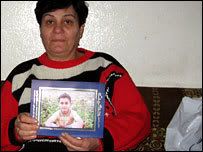 Dalal holds a photo of a nephew who was killed in Iraq
Only Dalal agreed to be photographed. Khalil, a painter, was afraid the people who attacked him would find out he is now in Syria.
In 2004 he began to receive anonymous threats from someone who objected to his painting of a woman, calling it blasphemous.
He was also threatened because he had been asked to paint portraits for American troops in Baghdad.
Three weeks after the first threat, his gallery was burned to the ground. Shortly afterwards, someone threw a firebomb into the couple's living room in the middle of the night, while they slept upstairs.
It took them two months to raise the money to leave.
The couple have three grown up children. Their youngest son lives with them and their daughter lives in Canada.
Their oldest son, Ziad, lives in Sweden. He was visiting his parents for the first time in five years and explained, from Damascus, their situation:
"They can't work and they don't have much money. They have a little from what they brought over from Iraq, but there's not much left because they have to pay for their food and rent out of it."
The couple know a few Iraqi families in Damascus and Ziad says his 19-year-old brother plays football in the street with some Iraqi friends.
But, he says his mother misses having her wider family around her and "feels lonely inside".
The couple appear to have taken on the informal role of community activists in Damascus. Khalil teaches art at the local church and Dalal helps orient new arrivals from Iraq to life in Syria.
Ziad says his parents cannot return to Iraq and are trying to move either to Canada, or Sweden, to join one of their other children.
AHMED and MAYYADA ABDEL SALAM, AMMAN
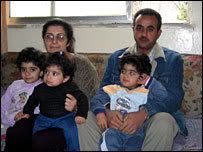
Ahmed is a doctor and his wife Mayyada is a pharmacist. They belong to the Sabian faith, a monotheistic non-Muslim minority in Iraq.
They left Baghdad in 2005 after Mayyada's pharmacy was attacked when she refused to wear a headscarf.
Ahmed explains: "One of the radical Muslims came into the pharmacy and asked Mayyada why she was unveiled. She explained she was not Muslim and that there was no hijab in her religion.
"He told her she was an infidel and that she should leave Iraq."
A few days later the radicals targeted the pharmacy in a drive-by shooting. Ahmed says they had a lucky escape.
"I, my wife and children were in the pharmacy when the attack happened. They shot several rounds, smashing the shop window and the shelves of drugs.
"We were terrified. My wife was injured in the leg, but only superficially."
The family didn't return to the pharmacy, but stayed at home preparing to leave Iraq.
They arrived in Jordan less than two months later. Ahmed says they chose Jordan because it was close and at the time it was easy to get to.
But life is difficult in Amman.
"We arrived as refugees; we have no rights. We can't work and we can't send the children to school. We have three daughters, aged six, three and one. We are considered illegal residents in Amman, although we are refugees."
They arrived with their life savings which Ahmed reckons will last another four or five months. After that, they will have to ask for help from relatives abroad.
Ahmed's parents are living in their family home in Baghdad.
"We speak to them on the phone, we are very anxious about them because it is so dangerous."
They family is renting a two-bedroom apartment in Amman and educating their six-year-old at home.
They are in touch with other Iraqis in the city and they also know a few Jordanians.
"We do have some contact with them, but it's usually superficial. There's no time for anything deeper and we are not in the right frame of mind to reach out to others.
"We keep it superficial because we are depressed and we don't know what the future holds."
Ahmed and his wife want to move to Australia. They have already had one application rejected, but they are putting in another.
"We want to start a new life for our children. They are more important than us."
SAAD MOHAMED AND FAMILY, AMMAN
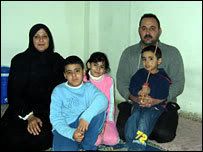
Saad brought his family to Jordan in June 2006, after narrowly escaping two direct attempts on his life.
Under Saddam's regime Saad, a Sunni, was a soldier in the army and his ID card identifies him as a veteran of the Iran-Iraq war. He is therefore considered a "Saddamist".
"I received letters at my house, telling me to leave within 24 hours or be killed.
"One time, I was driving the car - with our three young children - and somebody started shooting at us. I managed to drive away quickly and we escaped. That was in Baghdad."
The family fled with no possessions. They had money sent from home after they arrived in Amman - but it was stolen within 24 hours.
Saad believes someone followed them from Iraq and stole the money as soon as it was safe to do so.
He has no work permit and was unemployed for the first five months in Jordan.
"About three weeks ago someone gave me a job. I'm working as a porter, guarding a building. The pay barely covers the rent, food and water. It's hardly enough to live on."
After Saddam's regime was toppled, Saad used to work in a shop, selling electric cables and lighting equipment.
He has no friends or family in Jordan. He says he chose Amman because it was the only place he could escape to.
"Our children are aged seven, six and four. They need to go to school, but I can't afford to send them."
Saad is applying for asylum in Europe. He says he has contacted the Spanish embassy, but he hasn't heard from them yet.
One of his children was born with a disability and has already had several operations. Saad has applied to children's organisations to see if his son can be offered a place in school.
He says he has no idea what happened to his house in Baghdad.
"All I know is that the Mehdi Army have now got hold of many houses in the area where I used to live."
Would he ever think of going back?
"I don't even think about it. It's highly unlikely. I have a psychological block about it.
"Five of my cousins were killed in front of my eyes immediately before I left."
Saad says he conjures up the memory of Iraq to try to get his children to behave: "If they're playing up, I threaten them with moving back to Iraq."
