No OK from Congress seen; Constitutional issues raised
The Boston Globe reports:
President Bush's plan to forge a long-term agreement with the Iraqi government that could commit the US military to defending Iraq's security would be the first time such a sweeping mutual defense compact has been enacted without congressional approval, according to legal specialists.
After World War II, for example - when the United States gave security commitments to Japan, South Korea, the Philippines, Australia, New Zealand, and NATO members - Presidents Truman and Eisenhower designated the agreements as treaties requiring Senate ratification. In 1985, when President Ronald Reagan guaranteed that the US military would defend the Marshall Islands and Micronesia if they were attacked, the compacts were put to a vote by both chambers of Congress.
By contrast, Bush and Iraqi Prime Minister Nouri Al-Maliki have already agreed that a coming compact will include the United States providing "security assurances and commitments" to Iraq to deter any foreign invasion or internal terrorism by "outlaw groups." But a top White House official has also said that Bush does not intend to submit the deal to Congress.
"We don't anticipate now that these negotiations will lead to the status of a formal treaty which would then bring us to formal negotiations or formal inputs from the Congress," General Douglas Lute, Bush's deputy national security adviser for Iraq and Afghanistan, said in November when the White House announced the plan.
Lute's disclosure initially attracted little scrutiny. Most of the attention has instead focused on whether the pact could make it more difficult for the United States to withdraw from Iraq after Bush leaves office. Although the next president could scrap the agreement, reneging on the compact would create diplomatic problems by showing that the nation does not live up to its obligations, specialists say.
But there is now also growing alarm about the constitutional issues raised by Bush's plan. Legal specialists and lawmakers of both parties are raising questions about whether it would be unconstitutional for Bush to complete such a sweeping deal on behalf of the United States without the consent of the legislative branch.
"There is literally no question that this is unprecedented," said Oona Hathaway, a Yale Law School professor who has written a forthcoming law journal article about the proposed Iraq agreement. "The country has never entered into this kind of commitment without Congress being involved, period."
At a House hearing on the pact on Wednesday, Representative Dana Rohrabacher, Republican of California and a former Reagan administration official, accused the Bush administration of "arrogance" for not consulting with Congress about the pact. If it includes any guarantees to Iraq, he said, Congress must sign off.
"We are here to fulfill the constitutional role established by the founding fathers," Rohrabacher said, adding, "It is not all in the hands of the president and his appointees. We play a major role."
Bush and Maliki have said they intend to complete the agreement by July 31. The two countries need to reach some kind of an agreement this year in order to create a legal framework for the continued presence of US troops in Iraq after Dec. 31, when a United Nations Security Counsel mandate is due to expire.
But the "long-term relationship of cooperation and friendship" outlined in November goes far beyond an ordinary status-of-forces agreement. It would include promises of debt forgiveness, economic and technical aid, facilitating "especially American investments" in Iraq - and the security commitments, according to Bush and Maliki's joint declaration last November.
Facing mounting criticism over its assertion that Bush can reach such an agreement on his own, the administration has sent mixed signals about whether it intends to follow through on the plan. The New York Times today reported that administration officials told a reporter that the final pact may not have security guarantees after all, but the article did not identify its sources.
Officially, the administration has not changed the plans it announced in November. Asked to respond to the critics who say that such a pact must be approved by Congress, White House National Security Council spokesman Gordon Johndroe and Secretary of Defense Robert Gates each said that it was premature to talk about the pact because its final text has not yet been negotiated.
"I haven't been involved in any discussions of what kind of form the agreement would take or anything else," Gates said at press conference yesterday. "I do know there's a strong commitment inside the administration to consult very closely with the Congress on this."
But Representative Bill Delahunt, Democrat of Massachusetts, who chaired the hearing on Wednesday, asked four top administration officials - Lute, Undersecretary of Defense for Policy Eric Edelman, and the State Department's top legal and Iraq advisers, John Bellinger and David Satterfield - to appear and explain the administration's intentions. All four declined.
However, Lute may have offered a clue to the administration's legal arguments during the November press conference when he noted that "We have about a hundred agreements similar to the one envisioned for the US and Iraq already in place, and the vast majority of those are below the level of a treaty." Johndroe, the White House spokesman, also mentioned the existence of such agreements in a Globe interview this week.
Legal specialists, however, say that the numerous pacts that were completed without congressional consent are not similar to the agreement Bush and Maliki outlined in November.
Other such "status-of-forces agreements" are far more limited contracts with countries that host US military bases, covering comparatively minor issues such as leasing arrangements and which country will prosecute any US soldiers accused of committing a crime.
By contrast, Senate Foreign Relations Committee Chairman Joe Biden told Bush in a letter released yesterday, "As a matter of constitutional law, and based on over 200 years of practice," Bush could not commit the US military to protecting Iraq's security without congressional consent.
"A commitment that the United States will act to assist Iraq, potentially through the use of our armed forces in the event of an attack on Iraq, could effectively commit the nation to engage in hostilities," Biden wrote. "Such a commitment cannot be made by the executive branch alone under our Constitution."
Biden said yesterday he had received no reply to the letter, which he sent late last month.
Adding to the pressure, Democratic presidential candidate Hillary Clinton has also repeatedly raised the topic in recent days. The New York senator has filed legislation that would block the expenditure of funds to implement any agreement with Iraq that was not submitted to Congress for approval. Her rival, Senator Barack Obama of Illinois, became a cosponsor to the bill on Tuesday.
"We've got to rein in President Bush," Clinton said Monday in a South Carolina debate. "We need legislation in a hurry."
Friday, January 25, 2008
| [+/-] |
Bush Plan For Iraq Would Be A First |
Wednesday, January 16, 2008
| [+/-] |
Congress Reaches Deal On New Defense Bill After Bush Veto |
The Hill reports:
Congress has reached a compromise with the White House over a defense authorization bill provision that had drawn complaints from the Iraqi government.
Those complaints prompted President Bush to veto the defense bill last month. He complained that a provision in the bill that allowed victims of terrorism to be awarded compensation from frozen foreign assets of state sponsors of terror could have crippled the fledgling Iraqi government with billions of dollars in liability.
Under the compromise, Iraq is excluded from the provision, but other state sponsors of terrorism, such as Iran and Syria, could see frozen assets used as compensation. The compromise is likely to leave American victims taken hostage and tortured by Saddam Hussein’s regime during the first Gulf War without recourse in U.S. federal court.
The new language allows the president to waive the entire provision with regards to claims against Iraq for acts of terrorism that happened before or on the date of the enactment of the 2008 defense authorization bill. The president is required to make a national security determination before issuing a waiver and must notify Congress 30 days prior to issuing it.
However, the changed provision does give a nod to those who had wanted Iraq to be covered by the provision. It includes a sense of the Congress that the secretary of State should work with the government of Iraq to ensure compensation for any meritorious cases based on terrorist acts committed by Saddam’s regime against U.S. citizens or members of the military whose cases can’t be addressed in U.S. courts.
The Bush administration had argued that freezing Iraq’s assets, even temporarily, would deter Iraqis from working with U.S. businesses and could invite other nations to freeze American assets abroad.
The House is expected to vote on the revised defense authorization bill Wednesday night and send it to the Senate for approval.
Wednesday, January 2, 2008
| [+/-] |
Democrats Say Bush Can't Pocket Veto Defense Bill |
The Hill reports:
House Democrats and the Bush administration appear on the verge of a new constitutional fight over whether President Bush can pocket-veto the defense authorization bill.
The White House on Monday said it was pocket-vetoing the measure, but a spokesman for House Speaker Nancy Pelosi (D-Calif.) said the president cannot use such a measure when Congress is in session. The distinction over whether the president can pocket-veto the bill is important because such a move would prevent Congress from voting on an override.
“Congress vigorously rejects any claim that the president has the authority to pocket-veto this legislation, and will treat any bill returned to the Congress as open to an override vote,” said Nadeam Elshami, a spokesman for Pelosi. He said the Speaker is keeping all legislative options on the table.
White House Spokesman Tony Fratto responded by saying that the president returned the bill in an appropriate way and is looking forward to working with congressional leaders to fix it when Congress returns this month.
The defense bill passed both the House and Senate with veto-proof majorities. Still, it’s unclear whether those majorities would hold, since House Republican leaders have called on Pelosi and Senate Majority Leader Harry Reid (D-Nev.) to make changes to the bill demanded by the president.
A pocket veto occurs when the president neither vetoes nor signs a bill within 10 days, excluding Sundays, after its passage while Congress is adjourned. When Congress is in session, any bill that the president does not act on becomes law, according to the Constitution. The Senate has been in pro forma session over the last two weeks, while the House has been out of session.
The White House argues it pocket-vetoed the defense bill on Dec. 28 by sending it back to the House with a message of disapproval. It argues that a pocket veto was possible because the House, where the bill originated, was out of session.
“A pocket veto, as you know, is essentially putting it in your pocket and not taking any action whatsoever. And when Congress — the House is out of session — in this case it’s our view that bill then would not become law,” White House Spokesman Scott Stanzel told reporters Monday.
He said Congress should move quickly to send Bush a new defense bill with the demanded changes after it returns in January, and noted the White House had taken the “additional step” of returning the bill to the House with a message of disapproval.
Bush opposes parts of the bill that would allow lawsuits against Iraqis for acts committed when Saddam Hussein was in power to move forward in U.S. courts. Those lawsuits could slow down the Iraqi government’s reconstruction efforts, Bush has said.
Pelosi and Reid released a statement last week decrying Bush’s announcement that he intended to veto the bill, saying that it would delay the disbursement of money that troops needed. They also noted that the White House should have raised its objections to the bill before Congress had passed it.
In announcing the president planned to veto the bill last week, the White House did not specify it intended to use a pocket veto.
Louis Fisher, a constitutional scholar at the Library of Congress, said that the president is inviting a constitutional fight in trying a pocket veto.
“The administration would be on weak grounds in court because they would be insisting on what the Framers decidedly rejected: an absolute veto,” Fisher said.
True pocket vetoes are available only when Congress is away for months and unable to vote on an override, he said.
Thursday, December 20, 2007
| [+/-] |
Do U.S. Prisons in Iraq Breed Insurgents? |
The Christian Science Monitor reports:
American officials have detained thousands of insurgents in the months since the surge of forces began this spring, in an effort that most agree has improved security in Iraq. But now the commander of the American detention facilities in Iraq is wondering aloud if holding all those detainees is breeding a "micro-insurgency" and asking whether it's time to begin releasing thousands of people.
The two main detention facilities operated by the US military in Iraq, at Camp Bucca near Basra and Camp Cropper in Baghdad, have swollen to hold nearly 30,000 detainees. That's not the 40,000 individuals Army Gen. David Petraeus allotted for when American forces began to implement the Baghdad security plan this spring. But it may be too many, says Marine Maj. Gen. Doug Stone, who oversees detainees for the US-led force.
Holding thousands of "moderate detainees," marked by green jumpsuits at Camp Bucca, runs counter to the notion of winning over a population in a classic counterinsurgency, he says. General Stone believes many of these Iraqi insurgents were never motivated by anything more than money and most only desire to live peacefully. Many can be safely released back to society, back to their families and in their neighborhoods without straining security or their communities, he says.
Stone believes that there should be debate about how many detainees US forces continue to hold and how many should now be freed.
"I am of the strong viewpoint that there is [now] enough confidence in the process that I'm a champion for releasing those for whom the process has worked and who are essentially a reduced security threat to the coalition," says Stone in a phone interview from Camp Bucca.
Indeed, the nature of the war may be shifting. The Pentagon's quarterly assessment of security and stability in Iraq, released on Tuesday, shows that violence is down across the country. Roadside bombings, for example, have dropped by 68 percent since June.
Stone, a Marine reservist who has headed a number of software development firms, is known for his passion and deliberate approach to understanding the nature of insurgencies. He is calling attention to the issue because he thinks it's time to rethink holding so many detainees at this phase of the war. As the commander of detention operations, he can provide input on the release of detainees through a new board process, but the commanders in the field who send individuals to him have the ultimate input on whether someone should be held or let go. But some commanders are resistant to letting detainees go.
Stone, who doesn't participate in field operations, recognizes that his perspective is from "inside the wire."
Commanders whose troops detain insurgents and other criminals for activities against their own men may have another way of looking at it.
"I'm not on the ground looking at their situation, and they're not in the detention facility seeing these people," says Stone.
He made an impassioned plea recently when Marine Commandant Gen. James Conway paid a visit to Bucca in November. General Conway came away impressed with the programs Stone has implemented there and is concerned that the growing number of detainees doesn't make sense anymore.
"If you roll up 150 guys in a village and you don't have probable cause, you've just created 150 little terrorists," says Conway, who says the US must review the process.
"I think there has to be more of a reason to hold a detainee or, send them away," says Conway.
In many ways, Iraq's increased security could be attributed to higher numbers of detainees. But much of the success stems from the changing attitudes of Iraqi citizens toward their own security and, to a lesser extent, their views of the American presence.
"You're always worried about 'Do you have the right guys?'" says Brig. Gen. Joe Anderson, chief of staff for the Multi-National Corps Iraq. The American military has been releasing as many as 80 detainees per week, and is looking to release more, says General Anderson, who notes that releasing detainees and getting them back to where they belong is "a major logistical task."
"You don't just open the gates and let them go," he says. "It is a deliberate methodical operation."
General Petraeus is deeply concerned about fighting the insurgency in Iraq, both on the ground and inside the walls of detainee facilities, says a senior military official in Baghdad. In the meantime, holding Iraqis is all about "legitimacy," says the official.
"We're not out arresting Iraqis [at random], we're out detaining individuals for whom we have reasonable grounds [to believe] that they are an imperative for security in Iraq," says the official, who asked not to be named due to the sensitivity of the issue. "Everything we do is within the law."
After the Abu Ghraib prison scandal, the US military transferred many detainees to Bucca and set about creating a model prison system.
Since arriving in April, Stone is credited for spearheading an innovative detainee program in which education, respect, and vocational and religious programs are a primary focus.
Stone brought imams from Baghdad to teach detainees, many of whom are illiterate, about the teachings of the Koran with the aim to foster a more moderate outlook among the population.
For the first time, detainees participate in boards that allow them to better understand why they are being held under lock and key, Stone says, to getting them to learn how their conduct affects their situation.
Stone says that on his watch, more than 3,000 detainees have been released using his methods. So far, he's seen a very slight recidivism rate and only a few former detainees were recaptured and brought back to the detention facility.
There are still hard-core insurgents and terrorists living inside the yards. In contrast to the green-clad detainees determined to be more moderate, those individuals are given red jumpsuits to wear and are largely segregated from the rest of the detainee population. Amber-colored jumpsuits indicate the wearer is "changing" to a more moderate stance.
But Bucca has had its problems, giving rise to Stone's concern that if not done right, a microinsurgency could be growing within the American-run facility, an irony that has emerged as the facility grows.
Before Stone took command, there was a riot in March, followed by another in May, that may have involved as many as 10,000 detainees. There are also a series of tunnels that have been dug in and outside the facility that have been used, in some cases, to target guards, Stone says.
Sunday, December 16, 2007
| [+/-] |
5 Million Iraqi Orphans, Anti-Corruption Board Reveals |
Uruknet.info reports:
Iraq's anti-corruption board revealed on Saturday that there were five million Iraqi orphans as reported by official government statistics, urging the government, parliament, and NGOs to be in constant contact with Iraq's parentless children.
"The government should set up an institutional or legislative program to help the Iraqi orphans. Iraqi is an oil-rich country and it is not acceptable that its orphans remain groaning in this tragedy," the anti-corruption board chief, Moussa Faraj, said during a conference in Baghdad dedicated to orphans in Iraq.
"The board on its own cannot meet the Iraqi orphans' needs, but there should be an organization or even a ministry to provide care for orphans," he said.
The Iraqi parliament's women & family committee had proposed a draft law to set up a fund for the orphans.
During the conference, Wijdan Salem Mikhail, the Iraqi minister of human rights, said in a speech that the phenomenon "is one of the most passive things that grew immensely during the past few years due to destructive wars and unbridled violence in the country to unprecedented heights."
"These factors have logically caused the number of widows and orphans to greatly increase," she said.
Sunday, December 9, 2007
| [+/-] |
Baghdad Safer, But It's A Life Behind Walls |
Mini fortified 'green zones' are cropping up, improving security but leaving many residents feeling penned in.
The Christian Science Monitor reports:
Abu Nawas, Baghdad's storied riverbank thoroughfare, reopened amid much official fanfare two weeks ago. But three years since they last saw business, merchants on the street are facing a new challenge, say some local merchants: overwhelming security.
Abu Nawas – once witness to frequent suicide car bombs and mortar attacks – now hums with activity of a different sort. The newly fortified area is patrolled by Humvees and guarded by US-funded private security companies that search every entering vehicle and scrupulously monitor shopkeepers and residents – and occasional intrepid visitors.
For Hassan Abdullah, a cabinetmaker, that spells bad business. "It's worse than the Green Zone," he exclaims. No customers come in. He can't even deliver orders, he says.
It's not just Abu Nawas that's starting to resemble a fortress. Walls like those around the ultrasecure Green Zone, where US officials and Iraqi dignitaries live and work, are rising around neighborhoods all over Baghdad – new "Green Zones" protected by US-paid Iraqi neighborhood guards.
Creating civilian havens is a cornerstone of the US counterinsurgency campaign in Iraq. While many here are grateful for the newfound calm, they say the price is an increasingly segregated city that is starting to feel like a collective cage. In many cases, the US military is keeping tabs on male residents by collecting fingerprints and retinal scans.
"One road in and one road out, that's it," says Ghazaliya resident Muhammad Rajab. "Iraq is a prison, and now I live in my own little prison," he adds wryly.
Violence has fallen to its lowest level since February 2006, and attacks on US forces are down 55 percent since June, according to the US military. But the top US commander, Gen. David Petraeus, warned against complacency last week, a day after Baghdad saw its worst car bombing since September. Sunday, the police chief of Babil Province, a US ally, was killed. Two days after, suicide attacks against US-funded neighborhood guards in Diyala killed 26, and a shooting in Mosul killed two prominent US tribal allies.
In Baghdad, the extent of the transformation is clear from driving along main arteries. Western areas – Adel, Ameriyah, Ghazaliya, and Jamiaa, until recently stomping grounds for Sunni insurgents and Al Qaeda-linked fighters, are ringed with concrete walls at least 12-feet high.
The western highway is secured by numerous Iraqi Army checkpoints. Reminders of this zone's violent recent history are everywhere: a gutted flyover bridge, bullet-riddled homes, and graffiti that reads, "Down with Bin Laden and his miserable bunch." A battered sign reads: "Welcome to Baghdad."
The landscape resembles that of other western and southern neighborhoods like Amel, Dora, and Saidiyah. The perimeter sometimes includes wire fences, favored spots to hang black funeral banners or white ones advertising holidays abroad.
Wednesday, November 28, 2007
| [+/-] |
Journalists Believe Conditions in Iraq Have "Gotten Worse" |
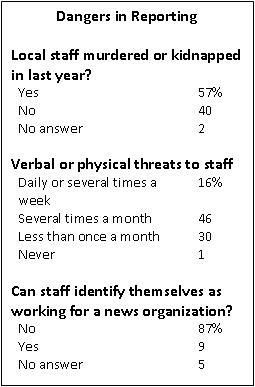
Journalists in Iraq - A Survey of Reporters on the Front Lines
After four years of war in Iraq, the journalists reporting from that country give their coverage a mixed but generally positive assessment, but they believe they have done a better job of covering the American military and the insurgency than they have the lives of ordinary Iraqis. And they do not believe the coverage of Iraq over time has been too negative. If anything, many believe the situation over the course of the war has been worse than the American public has perceived, according to a new survey of journalists covering the war from Iraq.
Above all, the journalists—most of them veteran war correspondents—describe conditions in Iraq as the most perilous they have ever encountered, and this above everything else is influencing the reporting.
Tuesday, November 27, 2007
| [+/-] |
Effort To Turn Sunnis To U.S. Questioned |
Star-Telegram.com reports:
The U.S. campaign to turn Sunni Muslims against Islamic extremists is growing so quickly that Iraq's Shiite Muslim leaders fear that it's out of control and threatens to create a potent armed force that will turn against the government one day.
The U.S., which credits much of the drop in violence to the campaign, is enrolling hundreds of people daily in "concerned local citizens" groups. Nearly 6,000 Sunni Arabs joined a security pact with U.S. forces Wednesday, reportedly the largest single volunteer mobilization since the war began.
About 77,000 Iraqis nationwide, mostly Sunnis, have broken with the insurgents and joined U.S.-backed self-defense groups. As many as 10 groups were created in the past week, bringing the total to 192, according to the U.S.
U.S. officials said they were screening new members, who are generally paid $300 a month to patrol their neighborhoods, and were subjecting them to tough security measures. The officials said they planned to cap membership in the groups at 100,000.
But that hasn't calmed mounting concerns among aides to Prime Minister Nouri al-Maliki, who charge that some of the groups include terrorists who attack Shiite residents in their neighborhoods. Some of the new "concerned citizens" are occupying houses abandoned by terrified Shiite families, they said.
It also hasn't quieted criticism that the program is trading long-term Iraqi stability for short-term security gains.
"We have tens of thousands of people who are carrying weapons on a contract basis, and when their contracts are finished where will they go?" asked Dr. Safa Hussein, al-Maliki's deputy national security adviser.
At a glance
The latest news in the war in Iraq:
Suicide bombing: Seven U.S. soldiers and five Iraqi civilians were wounded when a female suicide bomber blew herself up near Baqouba, the U.S. military said.
Cholera worries: The U.N. raised new concerns Wednesday about a possible outbreak in Baghdad ahead of the rainy season.
Journalists surveyed: American journalists covering Iraq say they face unprecedented dangers, and many have worked closely with Iraqi colleagues who have been killed or kidnapped, according to a survey by the Project for Excellence in Journalism. Most of the 111 survey participants, veteran war correspondents with experience in Afghanistan, Gaza and Lebanon, called the war in Iraq their most dangerous assignment ever.
Monday, November 26, 2007
| [+/-] |
Baath Reconciliation Bill Draws Anger of Shiite Bloc |
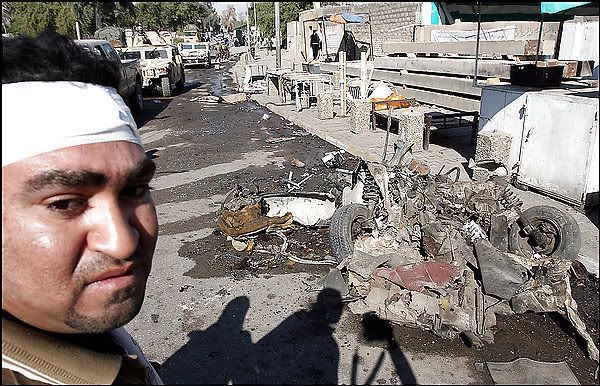 A wounded man stands at the scene of a suicide car bomb attack that killed 10 people in Baghdad. (By Hadi Mizban -- Associated Press)
The Washington Post reports:
A draft law that would ease restrictions on former members of Saddam Hussein's Baath Party, a measure seen by the Bush administration as crucial to national reconciliation, was presented in parliament on Sunday for the first time.
A powerful Shiite faction quickly objected to any moves to bring the Baathists back into government jobs, and a table-pounding argument erupted in the closed-door session, forcing postponement of the debate.
Meanwhile Sunday, a suicide attacker using a car bomb killed 10 people and wounded 29 near the Health Ministry building in central Baghdad, Iraqi police said. It was the latest assault to shatter a relative lull in Iraq's violence.
On Friday, a bomb hidden in a box containing birds detonated in the al-Ghazl animal market, killing 15 people and injuring 55, the deadliest attack in the capital in more than two months.
But violence on average is still down, and U.S. commanders and politicians are increasingly concerned that Iraq's government, riven by sect and competing visions, is not taking advantage of the lull to seek political reconciliation. In particular, the measure on Baathists is viewed as key to bridging the rift between Iraq's majority Shiites and minority Sunni Arabs.
In the wake of the 2003 U.S.-led invasion, thousands of members of the Sunni-dominated Baath Party were dismissed from military and government jobs, retaliation for years of persecuting Shiites. The proposed law would allow them to return to certain positions and collect pensions; thousands have already managed to do so unofficially.
Sunday's objections were raised by politicians loyal to Shiite cleric Moqtada al-Sadr, who withdrew his supporters from the Shiite-led government of Nouri al-Maliki earlier this year.
The argument was ostensibly triggered by claims that the draft law was improperly presented to the legislative body, without first going to its legal committee. But it was clear that the objections rose from deep-rooted sentiments dating to Iraq's turbulent past.
"We reject the return of Baathists to any executive position, not even a hospital manager," said Shiite lawmaker Liwa Smaysim, the head of Sadr's parliamentary bloc. "Our goal is to prosecute the Baath as a party and regime, not only as a regime."
"The Sadrists see the draft law as permissive with Baathists and it would bring them back their jobs. They think it's an amnesty for them," said Mahmoud Othman, an independent Kurdish lawmaker who attended the session.
"We are against the idea of revenge, we want a real reconciliation. The judiciary decides who committed crimes against Iraqis," he added. "Flexibility and forgiveness are needed to reach this goal."
Aside from the law on Baathists, reconciliation legislation to distribute oil revenue among Iraq's sects, reform the constitution and set a date for provincial elections also remain stalled.
Also Sunday, Iraq's most influential Shiite politician, Abdul Aziz al-Hakim, said the United States needed to back up its claims that Iran is fomenting violence inside Iraq, which Iran has denied. The U.S. military has accused an Iranian-backed Shiite cell in Friday's market bombing.
"These are only accusations raised by the multinational forces, and I think these accusations need more proof," Hakim, leader of the Supreme Islamic Iraqi Council, told reporters.
Friday, November 23, 2007
| [+/-] |
Democrats' Iraq Plan Could Leave Many Troops In Place For Years |
Democrats' Iraq pullout plan allows for long-term presence
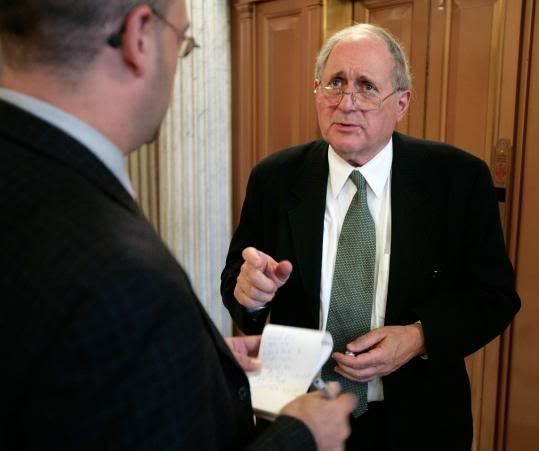 According to Senator Carl Levin of Michigan, discussing an Iraq troop-cut plan last month, US policymakers must consider a multitude of variables when planning reductions. (Alex Wong/Getty Images)
The Boston Globe reports:
The Democrats' flagship proposal on Iraq is aimed at bringing most troops home. Yet if enacted, the law would still allow for tens of thousands of US troops to stay deployed for years to come.
This reality - readily acknowledged by Democrats, who say it's still their best shot at curbing the nearly five-year war - has drawn the ire of antiwar groups and bolstered President Bush's prediction that the United States will probably wind up maintaining a hefty long-term presence in Iraq, much as it does in South Korea.
For those who want troops out, "you've got more holes in here than Swiss cheese," said Tom Andrews, national director of the war protest group Win Without War and a former congressman from Maine.
The Democratic proposal would order troops to begin leaving Iraq within 30 days, a requirement Bush is already on track to meet as he begins reversing this year's 30,000 troop buildup. The proposal also sets a goal of ending combat by Dec. 15, 2008.
After that, troops remaining in Iraq would be restricted to three missions: counterterrorism, training Iraqi security forces, and protecting US assets, including diplomats.
This month, Senate Republicans blocked the measure, even though it was tied to $50 billion needed by the military, because they said it would impose an artificial timetable on a war that has been showing signs of progress.
Despite the GOP's fierce opposition and a White House veto threat, military officials and analysts say the proposal leaves open the door for a substantial force to remain behind. Estimates range from as few as 2,000 troops to as many as 70,000 or more to accomplish those three missions.
There are about 164,000 troops in Iraq now.
Major General Michael Barbero, deputy chief of staff for operations in Iraq, declined to estimate how many troops might be needed under the Democrats' plan but said it would be hard to accomplish any of the stated missions without a significant force.
"It's a combination of all of our resources and capabilities to be able to execute these missions the way that we are," Barbero said in a recent phone interview from Baghdad.
For example, Barbero said that "several thousand" troops are assigned to specialized antiterrorism units focused on capturing high-profile terrorist targets. But they often rely on the logistics, security, and intelligence provided by conventional troops, he said.
"When a brigade is operating in a village, meeting with locals, asking questions, collecting human intelligence on these very same [terrorist] organizations, that intelligence comes back and is merged and fed into this counterterrorism unit," Barbero said. "So are they doing counterterrorism operations?
"It's all linked and simultaneous. You can't separate it cleanly like that."
It's also difficult to say precisely how many US troops are tasked with training the Iraqi security forces.
Christine Wormuth, who served as staff director of General James Jones's commission on training Iraqi security forces, said she estimates some 8,000 to 10,000 troops are dedicated to training. These "transition teams" are tasked solely with training and equipping Iraqi police, army, air force, maritime, and intelligence forces.
But an undetermined number of additional troops provide "on the job" training for Iraqi security forces by conducting daily patrols and other combat missions alongside them, she said.
Last year, the Iraq Study Group, a bipartisan commission whose findings were the basis for the Democratic proposal, recommended that 10,000 to 20,000 troops should be embedded with Iraqi combat units.
Senate Democrats who championed the party's proposal say it was written deliberately to give the military flexibility and not cap force levels. Unlike their counterparts in the House, many Senate Democrats have opposed stronger measures that would set firm deadlines on troop withdrawals or effectively force an end to the war by cutting off money for combat.
"There's no way to say down the line how many insurgency threats there will be, how many militia threats there will be, how many Al Qaeda and other terrorist threats there will be," said Senator Carl Levin, Democrat of Michigan, chairman of the Armed Services Committee.
Still, Levin and other Democrats say the United States could still launch effective antiterrorism strikes in Iraq using elite special operations forces without the massive footprint of conventional forces.
"We've been told now that 90 percent of the Iraqi units are capable of taking the lead, so six or nine months from now we would expect those units would not only be taking the lead, they would be handling those missions," he said.
Saturday, November 17, 2007
| [+/-] |
Inside the Surge |
At the New Yorker, Jon Lee Anderson writes:
Joint Security Station Thrasher, in the western Baghdad suburb of Ghazaliya, is housed in a Saddam-era mansion with twenty-foot columns and fountain, now dry, that looks like a layer cake of concrete and limestone. The mansion and two adjacent houses have been surrounded by blast walls. J.S.S Thrasher was set up last March and is part of the surge in troops engineered by General David Petraeus, the American commander in Iraq. Moving units out of large bases and into Joint Security Stations—small outposts in Baghdad’s most dangerous districts—has been crucial to Petraeus’s counterinsurgency strategy, and Thrasher is now home to a hundred American soldiers and a few hundred Iraqis. This fall, on the roof of the mansion, amid sandbags, communications gear, and exercise equipment protected by a sniper awning, Captain Jon Brooks, Thrasher’s commander, pointed out some of the local landmarks. “This site was selected because it was the main body drop in Ghazaliya,” he said, indicating a grassy area nearby. “There were up to eleven bodies a week. Most were brutally mutilated.
The Mother of All Battles Mosque, with its unmistakable phalanx of minarets shaped like Scud missiles, is nearby. Saddam Hussein hid in Ghazaliya during the American bombing in the first Gulf War, and built the mosque to show his gratitude to the neighborhood. (“Ghazaliya used to have—still does—a lot of retired Saddam military people,” Brooks said.) In April, 2004, wounded gunmen taking part in the battle for Falluja took refuge in the mosque. Ghazaliya borders the eastern edge of Anbar province, the center of the Sunni insurgency, and it became a strategic gateway to Baghdad for insurgents and foreign jihadis. On a previous visit to Ghazaliya, in December, 2003, I had met insurgents at a safe house in the neighborhood. They told me that they were intent on killing Americans. Since those days, with few exceptions, Ghazaliya had been a no-go area for Westerners, including journalists, who ran the risk of being kidnapped and killed. American patrols in Ghazaliya were regularly ambushed.
Captain Brooks is twenty-eight, of medium height and a stocky build, with close-cropped brown hair. From the roof, he pointed to where Sergeant Robert Thrasher, for whom the J.S.S. was named, had been killed by a sniper, last February. At the time, the company was working out of Camp Victory, the American base encompassing a large swath of Baghdad, including the airport. Thrasher was twenty-three; he had joined the Army out of high school.
Despite the insurgency’s influence, Ghazaliya remained, at first, what it had been for decades—a middle-class Baghdad neighborhood in which sectarian tensions were more or less held in check. The vast majority of the estimated hundred thousand residents were Sunni, but, Brooks said, “there were a lot of professionals, college-educated Sunnis, and Shias, too, and mosques for both.” The neighborhood changed after February, 2006, when Sunni militants bombed the ninth-century Askariya shrine, in Samarra, one of the Shiites’ holiest sites, and sectarian violence flared up across Iraq. Shiite militias, foremost among them the Mahdi Army, pushed deeper into Ghazaliya from Shulla, a poor, sprawling Shiite neighborhood just to the north. The Sunnis responded by turning to hard-line insurgents and to the foreign jihadis of Al Qaeda in Mesopotamia, whom the U.S. Army called Al Qaeda in Iraq.
“You had Sunni extremists in the area before Samarra. After Samarra, though, Al Qaeda in Iraq came on strong,” Captain Brooks said. “They had death squads. They systematically selected people because of the locations of their houses, or their relationships. They brutally tortured them, killed them, and dumped their bodies.” Shia families, and many Sunnis—those who had the financial means—fled the neighborhood. By the beginning of this year, southern Ghazaliya was under the de-facto control of Al Qaeda in Mesopotamia, while the northern part of the neighborhood was besieged by Shiite militiamen. “Twenty dollars and a phone card could get you an I.E.D. placed,” Captain Brooks said, referring to the improvised explosive devices that have caused the majority of American military deaths in Iraq. “The people realized they had let something in that they couldn’t control.”
President Bush, after securing Secretary of Defense Donald Rumsfeld’s resignation, in November, gave his new war team—Secretary of Defense Robert Gates and General Petraeus—an opportunity to change the strategy in Iraq, and in February the surge began. The plan called for thirty thousand extra troops; estimates of the actual number run as high as fifty thousand. Thirty-four Joint Security Stations were opened in Baghdad, three of them in Ghazaliya: the first, J.S.S. Casino, in northern Ghazaliya; next, in the southwest, J.S.S. Thrasher; and, last May, J.S.S. Maverick, in the southeast.
Brooks pointed to a large house with broken windows across from the base. His men called it the Cannister-Round House, because when they were first moving in snipers had fired on them from inside, and they responded by lobbing tank shells into the house. “We don’t get shot at anymore,” he said. Brooks’s men began the manpower-intensive work of conducting systematic patrols by day and aggressive raids at night; William Bushnell, a sergeant in Brooks’s company, was killed on one of those patrols in April. Previously, Brooks’s men had headed back to the heavily fortified Camp Victory after roving through Ghazaliya. With the surge, the Americans became a permanent presence in the neighborhood. After they moved in, the U.S. Army erected twenty miles of concrete walls in Ghazaliya, both to separate Shiite and Sunni residents from each other and to establish secure perimeters. Brooks said that his unit’s success had been made possible by his colleagues at J.S.S. Casino, who kept Shiite militiamen from Shulla out of the neighborhood.
By midsummer, Ghazaliya’s violence had abated significantly. This fall, when I stood on the roof of J.S.S. Thrasher at night, I occasionally saw explosions in the distance, fireballs flaring up in the sky. One night, a large blast shook the building, followed by automatic-weapons fire that momentarily illuminated the streets. But most of the explosions were so far away from Ghazaliya that they could not even be heard. The number of bodies found in the neighborhood had fallen steeply, “to practically zero, to pre-Samarra levels,” Brooks said. His company had not lost any more men. When Petraeus spoke before Congress in September, he cited Ghazaliya as an example of the progress the military was making in Iraq.
The new strategy is also meant to prepare the ground for Iraqi security forces to replace the Americans, and all the Joint Security Stations, as the name suggests, involve Americans and Iraqis. But the Iraqis do not all belong to the official, government forces. With American assistance, several hundred armed Sunni volunteers called the Ghazaliya Guardians were gradually assuming police duties. Such U.S.-approved Sunni forces had begun to sprout up everywhere. Many of them, to the dismay of some Shiites, included former insurgents. An official with one of the major Shiite political parties told me, “Some of these armed groups were, until yesterday, hostile forces that attacked the Iraqi government, Coalition forces, and anyone who was involved in the government. They were considered terrorists. What happened?”
It was a question I heard often in Iraq. Colonel J. B. Burton is a good-natured bull of a man who commands the First Infantry’s Dagger Brigade, covering most of northwest Baghdad, with fourteen J.S.S.s, including the three in Ghazaliya. “We began by asking ourselves the question: What is facilitating the entry of Al Qaeda into an area populated by moderate secular Arabs?” Colonel Burton said. The answer, he said, was fear of Shiite militias. “I think we’re in a time of increasing opportunity to bring in people who want to be part of the solution. It’s done by talking to people. Hell, it’s no different than Tullahoma, Tennessee, where I’m from. It’s sitting on the back porch, drinking tea, listening to the crickets, and talking.” Colonel Burton went on, “You’re talking with people who’ve pulled a trigger against American forces? Hell, yeah! Because we’re fighting a common enemy—Al Qaeda.”
His brigade’s mission, Burton said, was “to defeat Al Qaeda and effect the transition to Iraqi authorities, and that’s full-spectrum operations, which means everything from fighting terrorism to fixing sewage lines.” Whether those goals could be accomplished ultimately hinged on political progress toward national reconciliation among Iraqis, Burton said. “We’re in a window that’s very narrow, and we have some important decisions to make. Which way Iraq goes will depend on what we do.”
At Thrasher, Captain Brooks told me, “The new buzzword is ‘sustainability.’ We’ve learned from our experiences—for sustainable development here we need security. If they can have a local security force that can do the job, then that allows us to return home.”
Ghazaliya is not the only area of Iraq in which the landscape has changed. On my previous visit to the country, ten months before, the violence seemed uncontrollable, with mass abductions and killings taking place in broad daylight. Most of the Iraqis I knew spoke bitterly about how the Americans and Iraq’s political leaders were safely ensconced in the Green Zone, while mayhem raged around them. According to the Pentagon, in February the war took the lives of nearly two thousand Iraqi civilians; by October, that number had dropped to under a thousand. As with all body-count statistics in Iraq, these figures are disputed, but no one denies that the violence has waned considerably. The deaths of American soldiers have also fallen sharply, from a high of a hundred and twenty-six last May, as the surge intensified, to thirty-eight last month. For the moment, at least, it looked as if the surge might be working.
In a sense, the surge was belated emergency triage. Some of Baghdad’s most dangerous Sunni neighborhoods, like Ghazaliya and Amiriya, have been tackled, but much of Diyala province, stretching from Baghdad northeast to the Iranian border, and Kirkuk, which has become a flashpoint because of Kurdish claims to the city and its oil resources, remain horrific battlegrounds. On October 29th, the same day that the decapitated bodies of twenty men were found outside Baquba, in Diyala, a suicide bomber on a bicycle killed twenty-nine policemen in the city.
And there has yet to be any significant U.S. troop presence in Baghdad’s Shiite slums, such as Sadr City and Shulla, which are controlled by Shiite militiamen. Many of them claim to be members of the Mahdi Army, led by Moqtada al-Sadr, whose political brinkmanship and tactical use of violence have been an enduring source of bewilderment to the Pentagon’s war planners. Indeed, analysts credit much of the recent drop in Iraqi civilian deaths not to the surge but to Sadr’s decision, in August, to order the Mahdi Army, which is believed to have been responsible for much of the Shiite-on-Sunni sectarian killing in and around Baghdad, to “freeze” its activities for six months. Sadr’s apparent aim was to ward off an escalation of a two-day gun battle between the Mahdi and another Shiite militia, and to reassert his control over his men.
The surge also coincided with the so-called Sunni Awakening, the decision by some Anbar tribesmen to ally themselves with the Americans and to fight against Al Qaeda in Mesopotamia—a shift that was not foreseen in Petraeus’s plan. Sunnis in other areas have since joined them, though many have not; Al Qaeda in Mesopotamia is still active, and foreign jihadis remain in the country. On September 13th, Abu Risha, the Sunni tribal leader regarded as the catalyst of the alliance, whom President Bush had met in Anbar ten days before, was assassinated. Abu Risha was an influential and charismatic figure, and although his brother stepped in to take his place, most of the Iraqis I spoke to viewed his death as a serious loss and wondered how long his brother would survive. Still, there was hope that Al Qaeda might eventually be neutralized, thus removing at least one vicious aspect of the multifaceted war.
Some combination of the surge, the Sunni Awakening, and Sadr’s freeze has helped to stabilize troubled areas of the capital and Anbar; it is unclear whether the gains can be expanded upon—or even sustained—with fewer troops, but further increases alone will not win the war. And no more troop additions are planned; instead, President Bush has promised to withdraw, by next July, almost as many troops as were brought in for the surge. Iraq’s future, for the moment, is in limbo. The best one can say, perhaps, is that the U.S. has bought or borrowed a little space to work with. But there have been costs, some more obvious than others.
A few days before General Petraeus testified before Congress, I met with Sheikh Zaidan al-Awad, a prominent Sunni tribal leader from Anbar. The last time I had seen him, in 2004, he was full of hostile bluster about the U.S., and made no secret of his identification with the “resistance,” as he described the hard-line Sunni insurgents Sheikh Zaidan was a fugitive, suspected by the Americans of being a sponsor of the insurgency, and he was living in voluntary exile in Jordan. But when we spoke this fall, in an apartment in Amman, Zaidan told me that he had recently met for informal talks with American military and intelligence officials, because he approved of what they were now doing—allowing Sunni tribesmen to police themselves.
I asked Zaidan what sort of deal had led to the Sunni Awakening. “It’s not a deal,” he said, bristling. “People have come to realize that our fate is tied to the Americans’, and theirs to ours. If they are successful in Iraq, it will depend on Anbar. We always said this. Time was lost. America was lost, but now it’s woken up; it now holds a thread in its hand. For the first time, they’re doing something right.”
Zaidan said that Anbar’s Sunni tribes no longer had any need to exact blood vengeance on U.S. forces. “We’ve already taken our revenge,” he said. “We’re the ones who’ve made them crawl on their stomachs, and now we’re the ones to pick them up.” He added, “Once Anbar is settled, we must take control of Baghdad, and we will.” There would have to be a lot more fighting before the capital was taken back from the Shiites, he said. “The Anbaris will take charge of the purge. What the whole world failed to do in Anbar, we have done overnight. Baghdad will be a lot easier.”
Many of the players in Iraq seemed, like Zaidan, to be positioning themselves for the next battle. While the Shiites issued warnings about the Sunnis’ intentions, nearly all the talk among the Americans was of the Mahdi Army and its reputed sponsor, Iran, which Petraeus accused of waging a “proxy war” in Iraq; there were dismissive references to Al Qaeda as a spent force.
Colonel Burton said, “Al Qaeda is relatively easy to fight. You just fight them, deny them access.” The Mahdi Army, he said, “was harder.” By all accounts, the Mahdi Army and other Shiite militias had penetrated the Iraqi security forces, and Sadr’s political party was an on-again, off-again partner in Prime Minister Nuri al-Maliki’s Shiite-dominated coalition government. “We began investigating the Iraqi security forces and began to target them, their leaders, and members of the Iraqi government,” Burton said. (One notorious case of official involvement in sectarian killings concerns the former deputy health minister and the ministry’s security chief. In February, the men, who are Shiites and loyalists of Moqtada al-Sadr, were arrested on charges of organizing the murders of hundreds of Sunnis in Baghdad’s hospitals—including patients, their relatives, and medical staff.)
Referring to the Mahdi Army by the acronym of its Arabic name, Jaish al- Mahdi, Colonel Burton said, “I talk to some of these JAM guys, you know. I have e-mail contact with some of them. Recently, a JAM sheikh in Khadamiya told me that if I released three of his guys there’d be no more attacks on U.S. forces there.” He raised his eyebrows.
The Shiite authorities’ control over many government services meant that there was a great deal of institutional discrimination against Sunni communities. When I was there, for example, Ghazaliya residents complained of receiving half as much electricity a day as a neighboring Shiite area. The Americans were doing a lot of politicking to alleviate the situation, but it hadn’t been easy. “On the Shia side, there’s lots of money moving around, and essential services are doing really well,” Burton said. “But on the Sunni side—not so well.”
The new strategy, like most of the previous strategies employed in Iraq, had the drawback of having been imposed by the Americans. Many of the Shiite politicians in Iraq’s government were angry about the U.S. decision to wall off Baghdad neighborhoods and to recruit and arm Sunni volunteer organizations without consulting them. There were fears that the U.S. was simply arming a new set of militias—undermining the authority of the fragile coalition government. This may have been part of the goal. Iraq, with a hundred and seventy thousand U.S. troops on its soil, is not a sovereign country, and the U.S. uses its military power to shape the Iraqi political scene. By strengthening the hand of the Sunnis, the U.S. effectively forced the Maliki government to incorporate more Sunnis into the security forces—a step toward national reconciliation.
Shiite political parties and militias are so interwoven that a Shiite equivalent of the Sunni Awakening seems unlikely—it would probably require a split within the Shiite community, a civil war within a civil war. Iran would also be a major factor. Given Sadr’s alleged close links to Iranian hard-liners, and the growing hostility between Iran and the United States, his future moves are virtually impossible to predict. A largely covert conflict is already taking place between Iran and the United States. Iran has intervened in Iraq by providing financial and military support for Shiite militia groups, and, more directly, by sending agents and officials there. Iraq’s Shiite leaders have long had close ties to Iran, where many of them lived in exile during Saddam’s rule, and they and the Kurds have, without visible success, sought greater cooperation between Iran and the U.S. over security in Iraq. Many Sunnis, meanwhile, are distrustful of any dealings with Iran, and are unabashed about their hostility.
Sheikh Zaidan offered a vision of how the conflict in Iraq could escalate to the advantage of the Sunnis: “I think America will be able to start a Shia-Shia civil war in the south—with the Arab Shia, the tribes, being supported by the U.S., and the Persian Shiites supported by Iran.” He said that this would be an opportunity for the Americans to “cut off the head of Iran’s government and its militias in Iraq.” The Sunnis could help in this fight, he suggested.
The likelihood of Zaidan’s scenario being played out depends, to a large extent, on how the Iranians, the Americans, and the Iraqi Shiites choose to shape their ongoing competition for influence. Political moderates may broker a settlement. But Zaidan’s views are shared by many in the Sunni community, where extremist positions still have a hold. At one roadblock in Ghazaliya, I spoke with a Ghazaliya Guardian, a twenty-six-year-old Sunni who identified himself as Officer Ahmed. He told me that he thought a purge of Shiites from power in Baghdad, such as that proposed by Zaidan, was a good idea. When I asked Officer Ahmed how his neighborhood had gone from being a bastion of the insurgency to a model of cooperation, his response was vague. “When the Ghazaliya Guardians started, the terrorists disappeared,” he said. “We don’t know where they are now.” He had been elsewhere during the fighting, he said, and returned only when it was over.
I found the young Guardian’s story of the recent past—in which he had merely tried to keep his head down until things blew over—unconvincing. In most of my conversations with the Iraqis working with the Americans, their true motivations struck me as unknowable. The Americans, no doubt driven by an urgent need to establish greater security, to be able to draw down troops, seemed all too willing to take their new allies at face value.
At J.S.S. Thrasher, Brooks and his men conducted raids several times a week, usually after dark. The raids were generally the result of tips from residents who called in to a hotline manned twenty-four hours a day by Iraq interpreters, known as Terps; during daily patrols, Brooks’s men passed out flyers with the phone number. “We say, ‘If anyone threatens you, give a call.’ The foot patrols are key: when you see someone walking down your street, when you see a face—it’s different,” Brooks said. “As a tank commander, I found it funny—the first thing I had to do was tell my tankers to get out and walk.
Brooks said that he had wanted to be a tank commander ever since he was a boy (“I love tanks”). After high school, in Springdale, Arkansas, he had gone to the New Mexico Military Institute, in Roswell, and afterward joined the Kansas Army National Guard. He was in the U.S. Armor Officer Basic Course during the attacks of September 11th, and in 2003 was sent to Iraq. He was eleven months into his second fifteen-month deployment. Brooks and his men had been told that they might be home for Christmas, but nobody was getting his hopes up too much yet.
One night, I went along on a raid, which Brooks designated Operation Muttonchops, because the main target was a man with a lot of facial hair. We drove from Thrasher in a Bradley Fighting Vehicle. The Americans had superimposed their own lexicon on the neighborhood’s geography, to make it comprehensible to themselves. Just as Ghazaliya had been divided into three areas—Casino, Thrasher, and Maverick—all the major road arteries were referred to in Pentagonese: Red Falcon, Caradine, Vernon, Cecil, R.P.G. Alley, High Tension Road, and so forth. Few of the American soldiers knew how the locals referred to those same streets.
When the hydraulic rear hatch of the Bradley opened, I saw Iraqi and American soldiers running here and there, shouting, guns drawn. I followed some soldiers into a house. In the kitchen, a young American in full combat gear was bending over a man who was lying face down on the floor. The soldier cursed as he struggled to tie the man’s hands behind his back with plastic handcuffs. A couple of half-eaten plates of food were on a table, along with a mobile phone, which rang repeatedly. In an adjacent room, another prone man was being trussed. A teen-age Iraqi, the younger brother of the two men, entered the kitchen and began to object; the American soldier handcuffed him as well. Pushing the teen-ager’s face toward the floor, the soldier shouted, in English, “Shut the fuck up! Move your fucking head!”
A middle-aged woman in a flower-patterned smock emerged, sobbing, as the three brothers were moved outside. They were made to kneel, their cuffed hands behind their heads. A masked Terp held a photograph up next to each of the men’s faces. As American soldiers inspected the teen-ager, who had peach fuzz on his chin, one muttered, “This isn’t Muttonchops.”
The three men were shoved down the street aggressively by the young soldier. (He was the only soldier I saw behave in that way; later, when he began berating women in another home, an officer told him to cool down.) After further consultation between the Americans and their masked Terps, it was decided that none of the three detainees were targets of the raid. Their handcuffs were cut, and they were told to go home.
The Americans now turned their attention to three other men, who were seated on a curb. One was a chubby adolescent. With him was a thin, scraggly-bearded youth in his early twenties and a man in his thirties. They explained that they had been sitting outside in the cool air, chatting and smoking. Their families, with several small children, were roused from bed. The Americans released the boy—he was fourteen years old—into his father’s custody, but decided to take the two other men back to Thrasher.
I climbed into the Bradley, along with the older of the detainees, who was seated on the bench across from me. His hands had been bound, and he was trembling. The gunner of the Bradley leaned back, grabbed the detainee’s T-shirt, and forced it over his head, like a hood. The disoriented man sat stiffly upright, and held his mouth open against the cloth around his face, as if to help himself breathe.
As it happened, an Iraqi whom I knew well had begun working for the Americans at a base under Colonel Burton’s jurisdiction. I will call him Karim. He is a Shiite, and lives in a mixed Baghdad neighborhood just east of Ghazaliya. Karim said that he and a friend, whom I will call Amar (other names in their account have also been changed), had called in more than forty American raids, which had resulted in the capture of several dozen terrorists.
Karim said that, at first, he had welcomed the Mahdi Army, because it offered a measure of protection against Sunni extremists. But the militia had transformed itself into something like a Mafia organization, extorting money and abducting and murdering his neighbors—Shiites and Sunnis alike. The Mahdi Army men in their neighborhood, who regarded Karim and Amar as friends, had no idea that they were turning them in. Then Karim told me that it wasn’t only the Mahdi Army that he was deceiving but the Americans, too.
Amar was a lifelong friend of Karim’s. Three months earlier, Amar and his older brother, Jafaar, had been riding in the van of a friend, Sayeed, when a group of gunmen hailed them. Amar recognized them as Mahdi Army men, and assumed that they were coming to say hello. As Sayeed braked, the car was riddled with gunfire. Amar crouched as low as he could, as the Mahdi Army men emptied their Kalashnikovs. He was unhurt, but Jafaar and Sayeed were dead.
That night, Amar told Karim that, at the morgue, he had sworn over his brother’s body to take revenge. He had vowed to kill a hundred Mahdi men—ten for each of Jafaar’s fingers. His mother, Um Jafaar, supported him, and begged Karim to help her son. He agreed.
Their first concern was to make sure that the Mahdi militiamen didn’t suspect them. During Jafaar’s funeral procession, they shouted angry denunciations of a Sunni tribe that lived nearby. Word soon spread that Jafaar’s family and friends blamed the Sunnis for his death.
Karim and Amar also decided that it would be easier to carry out the killings if they won the Americans’ trust. Karim went to a nearby U.S. military base, and spoke to a captain. “I told the captain, ‘You help me, I help you. I love my country, my neighbors. The Mahdi have killed many of my friends, and American soldiers, too. I want to cooperate.’ ” Karim gave the captain the names of two of the men who had killed Jafaar. The captain said that, if they were detained, Karim would get some money. He refused: “If I take it, it makes me a spy, and I am a gentleman, not a spy.’”
Karim put the captain in touch with Amar, who directed American soldiers to the houses where the two gunmen were staying. The operation was a success. “They found many guns and pistols,” Karim said. “They took them, investigated, and they were convinced about what they were—killers. One was young, fifteen or sixteen, and had killed five or six people. He was just starting out. He is now in Bucca—a U.S. prison camp in southern Iraq.
“Then the killing started,” Karim told me. Their first victim was the father of the younger gunman. When I asked him whether the father had anything to do with Jafaar’s killing, he looked nonplussed, and said no, but that the man had been an intelligence officer under Saddam, and had probably killed people, too. (In Iraq’s tribal vendettas, male relatives are often seen as legitimate targets.) The father was now working as a taxi-driver. Karim told Amar’s sister to wave him down as he left his house, and ask to be dropped off at a warehouse on the outskirts of a Sunni district. “Amar and I followed,” he said. “She got out, and crossed the street. I told Amar, ‘Do it now.’”
Amar drove in front of the taxi-driver, cutting him off. “Amar got out of the car and he shot him in the face. I had put five dumdums and four normal bullets in the gun, a SIG Sauer. One dumdum is enough to kill one man. I told him to shoot only four and keep some back, just in case, but he shot them all.” (Afterward, according to Karim, Amar apologized. “He said, ‘I couldn’t help it. I became crazy.”)
Next, they went to a Sunni sheikh whom Karim knew, whose brother was in the insurgency. The brother and his men kidnapped six Mahdi militiamen, including four who had been in the group that killed Jafaar. They took them to a house in Mansour, a Sunni district, where Karim and Amar met them. “They were tied up and their heads were covered. Amar beat them too much—not me,” Karim said. “We were pretending to be Sunni mujahideen. We told them, ‘If you tell the truth we release you, but if not we will kill you.’ Of course, this was not the truth.”
The men said that Sayeed had been their target; Jafaar just happened to be in the car. “They said they had killed Sayeed because he was a member of Badr”—the military wing of the Islamic Supreme Council of Iraq, a major rival of the Mahdi Army—“and worked with Americans. But this is not true. They killed him because he was rich and didn’t respect the Mahdi Army. They were jealous.”
Karim told me that he left before the interrogation was over, and didn’t talk to Amar until the next day. “When I saw him, he kissed me. He said, ‘I left three bodies near the train track, and two in Canal Street, to be taken to the morgue.’
“I said, ‘No. 6, where is he?’ Amar said, ‘The sheikh’s brother took him, because he thinks he killed his cousin.’”
The killing continued. After fifteen days, they went to Um Jafaar, Amar’s mother. “I told her who was dead and who was in jail. She was very happy,” Karim said. “Then she said, ‘Do you want me to be completely comforted?’ ” Um Jafaar asked them to bring her parts of the dead men’s bodies. Amar did what she asked.
“One man, he cut off his ear when he was still alive,” Karim said. “But I swear that Amar has never killed anyone who was innocent.”
Karim said that Amar had killed eighteen or twenty men. “After a while, I told Amar to stop this. My wife, also, was angry with me. I didn’t like to do this, either, but we had to. We had to kill these guys, because they were killing too many people. When some of them were killed, my neighbors celebrated—sometimes even the Mahdi Army guys did.”
Karim mentioned the American captain with whom Amar worked. “Amar is a friend of the captain, but he doesn’t know about this.” He added, “Amar was friends of the Mahdi—real friends. I have to be honest with you. If not for Jafaar’s killing, he still would be.”
Amar told Karim that he would not stop killing until he reached his goal of a hundred victims. “He is hungry for killing now,” Karim said. “Sometimes I think maybe he has gone a little crazy.”
In the next days, I confirmed that Amar was working with the American military; I also heard that he had been employed by a large private military contractor. Amar’s case underscores one of the many dangers of fighting a war in a land where the culture and the language are incomprehensible to most of the soldiers. The U.S. military can do little without the assistance of local allies at every level, from collaborators like Amar to political leaders Paradoxically, it is during the Americans’ well-armed raids that their vulnerability in Iraq is most acutely on display. The Americans are always accompanied by their spectral Terps. They often act on tips whose sources are opaque without knowing what lies behind them. Among the Iraqis I met who were working with the Americans, motives seemed to range from the pecuniary—a job and a good wage—to the patriotic, or a combination of both. But, in great measure, their ultimate loyalties must be taken on faith.
There have been some well-publicized embarrassments, such as when the U.S. Marines named a former Iraqi general to lead a militia, the so-called Falluja Brigade, to combat insurgents there in 2004. The general, it turned out, had been accused of involvement in Saddam-era atrocities against the Kurds. He was quickly replaced; months later, the brigade fell under suspicion of aiding insurgents, and was disbanded.
Amar’s killing spree may not pose that sort of problem for the U.S. military—assuming that his victims really are all “bad guys.” In wars, killing acquires a kind of perverse logic, and at times can come to be seen as part of the solution. Colonel Burton made it clear to me that he hadn’t been sorry to hear that in the area under his command a notorious Shiite militia leader had been, as he put it, “whacked”: “If he is gone, then it means that a big area that was influenced by him has been lifted from his control.” Burton acknowledged, however, that the assassination of the Shiite militia leader had sparked a series of sectarian revenge killings; the neighborhood had to be placed under a “no-move policy.” (I learned that the militia leader had been killed by the same man who had helped Amar kidnap six of his victims—the ones they had tortured before killing.)
Later, I told Colonel Burton that I had heard about Iraqis working with the U.S. who engaged in revenge killings. He responded, “Let me put it this way: I know that we do work with people who have provided information that has led to the capture of criminals and weapons caches. They have also called us and said they know where we can find the remains of people that we’re looking for. There is a form of justice in Iraq that is traditional, but we do our best to get ahead of it.”
Tribal vendettas have been an underlying feature of the Iraq war since it began. Amar’s story may be unusual in the scale of his ambitions—a hundred men for his brother—but such crimes are common. At least some of the initial impetus for Iraq’s insurgency came in the spring of 2003, when American troops in Falluja shot and killed seventeen demonstrators, and kinsmen of the dead sought revenge by killing Americans. In tribal families, it is often the matriarch who encourages the vendetta, as Amar’s mother did.
Um Jafaar is a handsome, elderly woman. When I arrived at her home, with Karim, she was wearing a black abaya, and I noticed blue tribal tattoos on her chin and her hands. She invited me to sit down on a couch, and sat next to me in an armchair. Jafaar’s three young daughters were watching us. When I asked Um Jafaar if she wanted revenge for her son’s death, she got up from her chair, came over, and kissed the top of my head.
“Yes, I want revenge,” she said. “I am a mother, and I lost my son for nothing.” She began weeping, great wracking sobs. When she recovered, Um Jafaar pointed to her granddaughters. “Look, they have no father,” she said. “Why?”
Um Jafaar went on to tell me that she took the body parts of Amar’s victims, wrapped in cloth, to his grave, in the holy city of Najaf, and buried them there. “I talk to my son, I tell him, ‘Here, this is from those who killed you, I take revenge.’ ” Moving one hand in a horizontal circle, she said, “I put them around the grave. So far, I have taken one hand, one eye, an Adam’s apple, toes, fingers, ears, and noses.” (Karim told me that the hand had made the house stink for days.) I asked her how many Mahdi men Amar had killed. “I don’t know: eighteen, twenty? But still my heart hurts. Even if we kill all of them, I won’t have comfort,” she said.
“The Americans catch them and put them in jail,” Um Jafaar went on. “This is not a solution, they have to be killed!” She turned to me: “Tell the American forces I am ready to fight with them against the Jaish al-Mahdi. I am a woman but I am ready. When you come here, we will sacrifice everything for you, because you did not kill my son. I pray for the Americans—even if they are Christians and Jews—and to the Prophet Muhammad, to protect you.”
A few days earlier, Um Jafaar told me, she had been at the funeral of a Mahdi fighter, and had heard one of his comrades vow to avenge him: “He said, ‘If before I decapitated them at the neck, now I will do it at their mouths.’ ” She made a hacking motion across her mouth.
Karim’s cell phone rang. He answered it, and began speaking in Arabic. Afterward, he told me that it was Amar, who was out on an American patrol. “They have caught two Jaish al-Mahdi, and the Americans’ Terps are making them dance at gunpoint,” Karim said, laughing.
I asked if I could meet Amar. Karim said that he would see.
J·S.S. Maverick, in the southeast corner of Ghazaliya, was the quietest of the neighborhood’s three Joint Security Stations. When I visited, in September, it had been two months since the last I.E.D. explosion. There was still danger but a certain tedium had set in to the soldiers’ routines. “They hate the daily shit, like all soldiers do,” an officer told me. “But they love not getting shot at or blown up by I.E.D.s every day”—which, until midsummer, was how it had been in Ghazaliya. “It’s like going from cocaine to weed,” he said.
I drove through Maverick with a crew in a Humvee. There were no people on the streets, and the senior soldier in the unit said, “I don’t like it. Makes me expect something to go boom.” The Humvee cut across a field, and halted where a suspicious-looking metal cannister lay in our path; the driver gave it a wide berth. As we made our way, very slowly because of the armored Humvee’s weight—six tons—we approached a street that was covered in raw sewage. “Doo-doo water!” one of the men yelled. “Ooooh!” the others in the Humvee shouted in disgusted unison.
That evening, units from Maverick went on a “census mission”—part of a program aimed at creating a central register with the biometric profile of every military-age man living within its area, to help identify infiltrators. Iraqi police closed off either end of the street, as Americans and Terps searched each house. The residents seemed to know what was expected of them. The men came forward politely and handed over their identification cards; an Army man took their photographs with an iris-scanning camera.
In theory, operations like this represent the advantage of moving U.S. soldiers into neighborhoods like Ghazaliya, where they can build relationships and glean intelligence, and that night’s census was civil enough. But the constant raids and patrols can also alienate local residents, and reinforce the impression of the Americans as a coercive force with the overweening power to invade the homes of Iraqis, and detain them at will. The Army’s tactics can become the catalyst that leads Iraqis to the insurgency.
Maverick’s area of Ghazaliya did not yet have a contingent of Guardians, and so the soldiers were using the Iraqi National Police, which is predominantly Shiite, as their auxiliaries. The national police in Ghazaliya, however, were suspected of being under the control of the Mahdi Army. The local police commander had recently been arrested and charged with helping carry out kidnappings and murders. A new police commander, Lieutenant Colonel Ahsin al-Khazragee, had been appointed, but the detachment remained a matter of concern. “No one trusts ’em,” Lieutenant Matthew Holtzendorff, who led the census mission, told me. (The complaints go in both directions: while I was there, a truck belonging to Kellogg, Brown, and Root, the military contractor, had ploughed through barriers manned by the national police in Maverick’s area, killing one policeman and badly injuring another, and then sped on without stopping. An Army officer told me that the incident was being investigated; K.B.R., when asked for comment, denied any knowledge of it.)
On the way back to Maverick, the convoy drove past a group of sullen-looking Iraqi police at a barricade, then pulled up in front of a well-tended middle-class home. A young boy opened the door, smiling when he saw Lieutenant Holtzendorff. We went inside, and were greeted warmly by a man in his thirties whom I will call Sabah, and who worked as a civil engineer inside the Green Zone. A few months earlier, Holtzendorff had saved Sabah from being kidnapped by the Iraqi police detachment down the street—the ones we had just passed. They had beaten him badly, and, most likely, had planned to kill him. Holtzendorff made a point of visiting Sabah regularly, to make it clear that he was under American protection.
Sabah was sweating, and he chainsmoked. He anxiously asked Holtzendorff where he had been; it had been two weeks since his previous visit. Holtzendorff explained that he had been called away, but said that he had asked his men to stop by every few days. They had, hadn’t they? Sabah nodded and smiled, but his hands shook. After thirty minutes or so, despite Sabah’s entreaties to stay longer, Holtzendorff stood up, promising to return.
Later, I discussed Sabah’s case with one of the unit’s officers. Developing a nonsectarian national police force is an essential part of the U.S. military’s plan to disengage its own troops, but, as the officer saw it, the police were still part of the problem. “Please don’t print my name, or Petraeus will kill me,” he said. “The national police are supposed to be our salvation; all our hopes are pinned on them!” He added, “Balancing the Shia and the Sunni—the politics of it—that’s the hardest part of my job. ‘Hunt bad guy, kill bad guy’—O.K., that’s what I’m trained to do. But they don’t train you for this.”
Colonel Ahsin, the newly appointed police chief in Maverick’s area, is a punctilious man in his late thirties; when I joined him for an evening walkabout, on a street a few blocks from Maverick, I picked up the aroma of cologne. Ahsin was accompanied by Major Robert O’Brien, the American officer in charge of Maverick’s National Police Transition Team, or N.P.T.T.s, known by all as Nip-its.
Three bodyguards moved around Colonel Ahsin like a protective fan. As we headed down the street, a mixture of homes and shops, Ahsin made a great display of courteousness to the stall keepers. At one stand, he popped a sweetmeat in his mouth. He bent down to tousle the hair of some small boys. As he walked on, an older man approached, and the bodyguards immediately huddled around him. The man complained that an Iraqi police car had collided with his car. Ahsin listened and then, in a loud voice, called out, “Maaa-jor!”
O’Brien trotted over, saying deferentially, “Na’m, sayyidi?” (“Yes, sir?”). Colonel Ahsin told O’Brien that he wanted to have the offending policeman arrested. “Na’m, sayyidi,” O’Brien said, scribbling in his notebook. As we proceeded, this scene was repeated again and again: Ahsin gave orders to O’Brien, who obsequiously wrote them down. At one point, O’Brien smiled in my direction, and said, “This is the magic. Yeah!”
Later, I asked O’Brien what he knew about Colonel Ahsin. “All I know is that he was thirteen years in the special forces with Saddam’s Army, and joined the national police in 2004,” O’Brien said. They had known each other only a week and a half, but he thought that Ahsin was “fantastic.”
I said that Ahsin seemed to enjoy the role of the Big Man.
O’Brien flashed me a look. “Look, it works,” he said quietly. “That’s what I want. I want him to take charge. Some advisers want to take command, and we need them to.” He paused. “It’s like surfing, except that here we’re surfing on top of a shit tidal wave, and we’re just trying not to fall in.” O’Brien laughed. “Saddam Hussein once said that the trick of counterinsurgency is to separate the people from the insurgents. That’s what we’re trying to do here. If the people like what you do more than what the others do, then you have a chance.”
The Americans hoped that the Ghazaliya Guardians, the Sunni volunteer group, would serve as a new police force Here, too, there were complications: General Petraeus had singled out the Guardians as a positive development, bu the Shiites had a very different view. “The policy adopted by the Iraqi government, along with the Coalition, has bee to disband armed militia groups,” an official of the Islamic Supreme Council of Iraq said. He acknowledged that Iraq’s security force was a “weak and sick body,” ridden with militias, and needed to be reformed. “But the solution is not to bring new forces onto the scene, ones that people have doubts about.”
The Americans, the Shiite official said, were arming the Sunni volunteers without adequately looking into their backgrounds. “There are a lot of stories now that some of those involved in the Awakening were known to be very dangerous criminals in their areas,” he said. He mentioned hard-line insurgent groups like the 1920 Revolution Brigades and the Islamic Army, whose members have joined volunteer groups. “Now they’re walking around armed, with uniforms and badges that allow them to go into places normally permitted only to Iraqi security forces.” He added, “There must be mechanisms put into place to insure that these people’s loyalties are to Iraq and its government—before they get stronger and have their own controlled territories.”
On a clear morning in late September, about a dozen members of the Ghazaliya Guardians mustered at a small public marketplace to meet Captain Brooks. Dressed in matching cream-colored shirts, khaki pants, and beige baseball caps, they resembled security guards for a golf course. Their only noticeable insignia were small shoulder badges showing the Iraqi flag. (Colonel Burton had told me, “The guys in Ghazaliya, now, they’re militaristic, pretty well dressed, pretty professional; a lot of them are former Iraqi Army guys.”) Their leader, a portly middle-aged man with a notebook, greeted Captain Brooks attentively.
This was an important day for the Guardians. After three months under Iraqi Army supervision, they were about to be allowed to man roadblocks on their own—just the sort of transition that the Shiite official worried about. Their leader conducted Brooks to several spots around the intersection, which he proposed as the Guardians’ checkpoints. At the first, Brooks said, “You wouldn’t want to fight from here; you need a place you can retreat to.” The Guardian pointed to a row of buildings, and suggested that it might be an ideal place for a Guardian office, where his men could rest. Brooks said, “I don’t want you hunkered down,” and that, instead, they should set up a stall in the market, with an awning.
As Captain Brooks walked around, a shopkeeper came up to him and pointed to the sewage in the street. Brooks said that he would send in the “suck truck” to remove it. Another man complained about electricity, and a third said that the neighborhood needed a water truck, “to keep the dust down.” Brooks rolled his eyes. “I can fix a lot of things,” he said. “But I can’t do much about dust.”
After he moved on, Brooks was approached by a woman who said that her son, a member of the Guardians, had recently been arrested. She had heard nothing more of him since.
As she was speaking, gunshots rang out from the other side of the marketplace: a Guardian had fired off warning shots when a vehicle did not heed his command to halt. Brooks sent his men over with orders to check out the position: “See if it can be fixed so people have more time to react.” Turning back to the woman, he told her that he would try and find out about her son. He said that, in a few days, an office would open nearby, where residents could get information about detainees.
It was now midday; the heat was intense, and Brooks was getting impatient. He was besieged by another group of shopkeepers, who complained about a trash-strewn field next to their stalls. Brooks pointed to a large wire-mesh basket; it was one of several that his soldiers had placed in vacant lots around Ghazaliya. He noted that it was nearly empty, and that garbage had been dumped all around it. He challenged them: “Why should I care about your garbage if the people here don’t?”
We climbed back into the Humvee and drove off. As we were leaving the marketplace, Brooks yelled for the driver to stop, and leaped out of the Humvee, cursing loudly. He strode up to a man who sat under a tree behind a table that was laden with chocolate, potato chips, cigarettes, and some cheap plastic toys. Brooks grabbed a plastic pistol and a toy AK-47 off the table and brandished them in the face of the vender. “What are these?” he shouted. The vender, who had smiled anxiously as Brooks approached, now crumpled with apprehension. “They’re just toys, for babies,” he said placatingly, still forcing himself to smile. A tall masked Terp named Leo was translating for Brooks.
“You’re an idiot!” Brooks shouted. Leo said something to the man in Arabic. “What do you think will happen if one of my soldiers sees this pointed at him at night?” Brooks waved the toy pistol in the man’s face. “You will kill more children in this area than Al Qaeda!” Brooks demanded a reply. Leo spoke again to the vender, who said that he was not the only person selling toy guns; there was a stall in front of Ghazaliya’s municipal offices. “Everyone sells them,” he said.
Brooks listened stonily. Then he stepped back and spat on the ground in front of the vender’s table. Shaking a fist, he said, “You make me sick, you killer of children,” and wheeled around to leave. Stopping a few feet away, he turned back again and kicked a cloud of dust toward the vender. “Let’s go!” he shouted. Brooks was silent for the return journey to J.S.S. Thrasher.
Back at the base, I asked Leo about the exchange. He said that he had not translated “exactly” what Captain Brooks had said: “His words were very insulting, you know. If I had told him exactly, the man would have been very offended.”
Several days after I saw Um Jafaar, Karim arranged a meeting for me with Amar. A stocky man in his mid-thirties Amar had a close-shaven head and a lumpy, fleshy face with a thick mustache. There was an unnervingly serene air about him, and I found it difficult to look him in the eye for very long.
Amar spoke in a matter-of-fact monotone. “Jafaar had ten fingers; each one of his fingers was worth ten Jaish al- Mahdi guys,” he said. “So I decided to take my revenge against a hundred of them. So far, I have taken my revenge against twenty.”
Did he count those he had helped the Americans capture? I asked.
Amar shook his head. “Some are now in prison,” he said. “If they are released, I will kill them. If they are not released, I will kill their brothers or their fathers. Today, I have one in my mind. ” He and Karim spoke in Arabic for a moment. Turning to me, Karim said, “Yes, this man deserves it. He’s killed, like, three hundred people in Baghdad.”
Amar mentioned a nearby neighborhood. “I take most of the people and kill them there,” he said. “It’s two minutes from Hay al-Adil, a Sunni district. The Jaish al-Mahdi think the people of Hay al-Adil are killing them.” Amar smiled wanly. “They come with me, as my friends. They trust me, the Jaish al- Mahdi.” Amar said that he would also invite the Mahdi men to a warehouse he owned—“to eat or to drink, or to race pigeons. I make up different stories.” Once there, he usually put a drug in their tea or sprinkled it on dates he offered them. “They fall asleep, then I shoot them in the head.” Sometimes, he slit their throats.
“Americans are too honorable, too clean,” he said. “They have to kill these people. They are dirty. Anyway, if they don’t kill them, I will. But helping the Americans arrest them helps them not suspect me.”
Before Jafaar’s death, Amar had made mistakes—drinking, women. In seeking revenge, he had become closer to God, and that, he said, had kept him going. “God wants me to kill these people. It is haram to kill cats, but it is good to kill the Jaish al-Mahdi,” he said. “They have strangled honest Sunni people in front of me. I feel no difference between me and the Sunni; I feel very angry about that. The Mahdi are not like they were before; they kill Shia or Sunni, for whatever reason. If I go to Hell, I will be comfortable, because I took my revenge.” He added, “Honestly, it was only after the first one that I didn’t sleep well, because I had not killed before. But afterward it felt normal.”
Last week, I spoke again to Karim. He told me that something had happened—there was now reason to believe that the Mahdi Army had become aware of Amar’s involvement in the killings. Karim was urging him to leave Baghdad, at least for a while. If he didn’t, there was a good chance that he would be a target. For the moment, though, Amar was simply lying low.
One afternoon, sitting with Captain Brooks in Thrasher’s rooftop gym, I asked if he felt that what he was doing in Iraq was appreciated by the people back home. “Oh, yeah,” he said. Turning to one of his N.C.O.s, who was seated nearby, smoking a cigar, he asked, “What do you think, Sergeant Cochran?
Lowering his voice, Cochran replied, “When that bullet goes by my head, all the politics goes right out the window. My only thought is to get my men out of there alive.”
“Thanks for quoting ‘Black Hawk Down,’ Sergeant Cochran,” Brooks drawled. Turning back to me, he said, “When I went home the last time, we went skiing in Colorado. Everywhere we went, people thanked me. One man said, ‘I don’t support the war but I support the soldiers.’ I can accept that. We have a system that allows freedom of speech. Hell, I put on the uniform to defend that.”
Brooks seemed to feel that what he and his men were doing in Iraq was worthwhile. He felt that, for now, the country needed the U.S. military, as much for its peacekeeping duties as for its combat role. “In the Sunni population, there is still fear of Shia militias, and fear that violence will start again,” Captain Brooks said. “We’ve seen efforts by Al Qaeda in Iraq to reignite sectarian violence, but, to the people’s credit, nothing really reignited, and has not yet.” He knocked on a wooden table in front of him. “There’s still a lot of work to be done on national
reconciliation in this area. Ghazaliya is a microcosm of what Iraq faces as a whole. The Iraq Study Group said national reconciliation was essential, and I agree. Until Iraqis work out the Sunni-Shia sectarian issues, they’re going to have a very tough time making meaningful or lasting progress.”
I asked Brooks if he planned to stay in the Army after his tour ended. He gave me a candid look, and said he hadn’t made up his mind yet. “I want to go on vacation when I get home and then decide,” he said.
When I asked how long he thought the U.S. would remain in Iraq, Brooks thought for a while, and said, “I’m not just blowing smoke up your ass, but it really depends on what the U.S. civilian-controlled government decides its goals are and what it tells the military to do.”
Brooks continued, “Things are going well. Just about everything we wanted to achieve on a local level, we’ve achieved. It’s counterinsurgency, it’s different from what one would normally associate with war—i.e., ‘victory is won.’ I feel that winning will be a point you never realize that you’re there—that at some indeterminate point you’ll look back and realize that you’ve won.”
Thursday, November 15, 2007
| [+/-] |
Basra Militants Targeting Women |
 "We warn against immodest dress. Violators will be punished. God is witness that we have conveyed the message"
 The BBC reports:
The chief of police in the southern Iraqi city of Basra has warned of a campaign of violence against women carried out by religious extremists.
It has, Maj-Gen Abdul Jalil Khalaf said, included threats, intimidation and even murder.
Some victims were dressed in indecent clothes by their killers or had notices attached to them, he said.
Women interviewed by the BBC said they no longer dared venture on to Basra's streets without strict Islamic attire.
"There is a terrible repression against women in Basra," Maj-Gen Khalaf told the BBC.
"They kill women, leave a piece of paper on her or dress her in indecent clothes so as to justify their horrible crimes."
Forty-two women were killed between July and September this year, although the number dropped slightly in October, he said.
In one case, he added, a woman was killed in her home along with her six-year-old son, who was rumoured to have been conceived in an adulterous relationship.
Maj-Gen Khalaf, sent to Basra this year by Iraqi Prime Minister Nouri Maliki to impose order in the city, said the police were often too scared to conduct proper investigations into the killings.
"The relatives are reluctant to report the crimes for fear of a scandal or because they despair of the police's ability to solve them," he added.
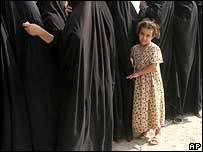 Women are being targeted amid a local power struggle
'Shot in the legs'
A female lawyer in Basra contacted by the BBC by phone from London, who asked not to be named for fear of reprisals, said attacks on women in the city were occurring "every two or three days".
She told the BBC about a university student who had been shot in the legs for not wearing an Islamic headscarf, or hijab.
The lawyer also said that graffiti was painted on walls warning women to cover their heads or "be punished".
She said she had been told by a group of men that she should be at home and get married instead of working.
"They said to me: 'If anyone's willing to offer a good price for you, we wouldn't think twice about selling you'," she said.
"When they see a woman going out to work and being successful, I'm sorry, but they feel inferior to her."
'Killed before their kids'
A mother-of-six and government employee in Basra, who wished to be identified only as Um Zeinab, told the BBC she had almost been run down by a motorcyclist one day while waiting for her bus to work.
"I was wearing a shirt with a skirt and some make-up, as I usually do," she said.
"I was waiting at the bus stop when the motorbike headed straight at me, full speed."
Luckily, the motorcyclist skidded and fell before reaching her.
She said she had heard of other women attacked but who had not been as lucky.
"Two women were killed in al-Makal district two days ago. People said they had received warnings before and then gunmen came to their homes and killed them, one in front of their kids."
Warring factions
Given the continuing power struggle in Basra between rival Shia militias, it was perhaps understandable that Gen Khalaf would not be drawn into naming names.
He blamed "dangerous criminals" trying to undermine stability in the city.
He also said that repression against women had been going on while British forces were still in the city, prior to their withdrawal to Basra airport in September.
Others were more direct in pointing the finger of blame at the rival Shia militias, known to have infiltrated the police and vying for control of Basra.
Um Zeinab called them "dark, fundamentalist extremists".
A spokesman for one of the largest Shia groups, the Sadrists of the radical cleric Moqtada Sadr, told the BBC that its members did not attack women or try to enforce Islamic law on women by violence.
But he did not rule out that others were doing so.
