William K. Black, associate professor of economics and law at the University of Missouri in Kansas City writes:
My comments in the Bill Moyers Journal interview about the “Prompt Corrective Action” (PCA) law (adopted in 1991) have sparked considerable comment in the blogsphere.
Here is the portion of the interview transcript that discusses the PCA law:WILLIAM K. BLACK: Well, certainly in the financial sphere, I am. I think, first, the policies are substantively bad. Second, I think they completely lack integrity. Third, they violate the rule of law. This is being done just like Secretary Paulson did it. In violation of the law. We adopted a law after the Savings and Loan crisis, called the Prompt Corrective Action Law. And it requires them to close these institutions. And they're refusing to obey the law.
I first published an article about the PCA law over a month ago entitled: “Why is Geithner Continuing Paulson’s Policy of Violating the Law?” (February 23, 2009).
BILL MOYERS: In other words, they could have closed these banks without nationalizing them?
WILLIAM K. BLACK: Well, you do a receivership. No one -- Ronald Reagan did receiverships. Nobody called it nationalization.
BILL MOYERS: And that's a law?
WILLIAM K. BLACK: That's the law.
BILL MOYERS: So, Paulson could have done this? Geithner could do this?
WILLIAM K. BLACK: Not could. Was mandated-
BILL MOYERS: By the law.
WILLIAM K. BLACK: By the law.
I was the staff leader for Federal Home Loan Bank Board Chairman Ed Gray’s successful reregulation of the S&L industry. That reregulation provided the tools that allowed the agency to place in receivership many of the worst control frauds. Gray inherited (and for a time supported) a dominant strategy of covering up the scale of the S&L industry’s insolvency. He personally recruited vigorous senior regulators such as Michael Patriarca and Joe Selby to reverse that strategy. The PCA law was adopted largely in response to the enormous cost to the taxpayers of our predecessor’s failed strategy of not closing insolvent S&Ls.
The new law had an impressive start, thanks in great part to the transformed reregulatory spirit. How many readers recall the 1991-92 subprime crisis? It didn’t happen because we took prompt regulatory action against subprime S&L lenders that were following practices (e.g., qualifying borrowers at the teaser rate, offering “neg am” mortgages, etc) that we knew would lead to widespread failures.
The broadcast of Bill Moyers Journal interview has raised enormously the public’s awareness of the PCA. A commentator has responded by arguing that the PCA law does not mandate that the regulators place insolvent banks into receivership. I am delighted that the debate has turned to focus in part on the issue of why virtually all economists and white-collar criminologists believe that it is essential to take prompt regulatory action to resolve failed banks, particularly ones that are insolvent due to “control fraud”, i.e., where the person that controls a seemingly legitimate entity uses it as a “weapon” to defraud. In the financial world accounting fraud is the “weapon of choice.”
Banks owned by holding companies are fully subject to the law
The commentator’s primary concern can be answered briefly because it criticizes a claim I never made. S(he) notes that banking holding companies and insurance companies are not subject to PCA. I did not say that they were. As the interview excerpt shows, we were talking about “[savings] institutions” and “banks” that can be put into “receivership” (I’m going to use “bank” here to refer to any FDIC-insured depository institution.) The FDIC (and if it lacks the funds, the U.S. Treasury) is only legally obligated to pay depositors of FDIC-insured banks up to the deposit insurance limits. The federal banking regulators have receivership powers only over federally insured depository institutions. The FDIC and the U.S. Treasury have no obligation to pay the debts of bank holding companies or insurance companies – and shouldn’t be paying those debts.
The commentator uses this strawman argument (refuting a claim no one made) to imply that the fact that PCA doesn’t apply to bank holding companies means that the federal financial regulators did not have to comply with the PCA law. S(he) lists a series of companies, primarily large bank holding companies (BHCs) and declares that their existence means: “So, pretty much all of the really big players don't fall under the PCA in the first place.” Bank holding companies, of course, are called that because they own banks – and the U.S. banks they own are subject to PCA. The fact that a bank is owned by a holding company is irrelevant to the PCA’s requirements; it provides no immunity from the PCA. BHCs are “really big players” because they own massive banks subject to the PCA. The banks are the “really big players” and they are subject to the PCA law. When we put insolvent banks into receivership their BHCs and affiliates lose all control of the bank. The FDIC has sole control of it.
PCA does not apply to the corporate owners of banks or their non-bank affiliates.
However, the bank subsidiaries are the dominant assets of almost all holding companies that own banks. As such, the failure of the banking within the group is likely to trigger the failure of the holding company.
To sum up the first point: banks are the issue. U.S. banks have FDIC insurance and are subject to the PCA law, regardless of whether they are owned by a BHC. Deposit insurance covers only insured banks, not BHCs, so the FDIC, the Treasury and the taxpayers do not owe any obligation to pay their creditors. If the commentator is worried that BHCs will escape receivership, s(he) need not fear. BHCs and insurance companies such as AIG are subject to the bankruptcy laws, which can be used to block and even “claw back” excessive and fraudulent executive compensation. (Treasury is also requesting Congress to grant it authority to place BHCs and some insurers into receivership.)
The PCA law mandates receivership in these circumstances
The commentator’s secondary argument is that the PCA law does not mandate that deeply insolvent banks be placed in receivership. S(he) points to several discretionary exceptions in the law, but none of the exceptions apply to insolvent banks that cannot be promptly corrected (recapitalized). They must be placed in receivership to comport with the stated purpose and language of the law. Moreover, neither the Bush nor the Obama administration has purported to act in accordance with the inapplicable exceptions.
I will respond to the argument primarily by citing other scholars on the PCA that were writing at an earlier time and in an apolitical context. The scholarly literature on the PCA is fairly extensive and quite consistent. I’ve drawn on Nieto & Wall (2007) (see n. 2) for the quotations in the following discussion (other than statutory language), but other sources do not differ materially on the origins, singular purpose, and provisions of the PCA law.
The PCA law, as I noted in the interview, arose as a corrective to problems exposed during the S&L debacle. The consensus was that the central problem was that regulators, sometimes bowing to political or industry pressure (“regulatory capture”), were delaying placing failed banks into receivership and greatly raising the cost to taxpayers.
The US has a long history with the basics required to implement PCA: binding capital adequacy standards and the ability to take substantial actions against banks that failed to meet the standards. The supervisors had the authority to adopt many of the provisions of PCA using their pre-existing powers if they had so chosen. However, the experience of the 1980s had clearly indicated that US supervisors valued discretionary responses targeted at keeping some banks (especially thrifts and large banks) in operation after they had became financially distressed. (p. 12)
Economists and white-collar criminologists broadly agree that prompt receiverships of failed banks reduce taxpayer costs and systemic risk.
[A]llowing insolvent banks to continue in operation runs the risk that they will accumulate even larger losses leading to even greater market disruption when the bank’s continued operation is no longer tenable. In contrast, if a bank is required to be closed before its losses exceed the bank’s equity and subordinated debt then depositors and other creditors should not be exposed to any loss. Moreover, prompt resolution reduces the probability that more than one systemically important bank will be insolvent at the same time. In sum, a supervisory focus on limiting deposit insurance costs is unlikely to result in significantly higher expected losses due to systemic financial problems and may well result in lower expected costs. (p. 18)
Leaving the senior officers that caused bank failure in control creates particularly severe risks to the taxpayers.
Prompt corrective supervisory action seeks to minimize expected losses to the deposit insurer and taxpayer by limiting supervisors’ ability to engage in forbearance. Along with reducing taxpayer losses, PCA should also reduce banks’ incentive to engage in moral hazard behavior by reducing or eliminating the subsidy to risk-taking provided by mispriced deposit insurance. These potential benefits from PCA appear to have been recognized, as reflected in the increasing number of recommendations to policy makers to introduce PCA type of provisions in their national legislation. Japan, Korea and, more recently Mexico have adopted this prudential policy. (p. 31).
“Moral hazard” can lead to both “reactive” control fraud and wildly imprudent risks. Either can cause a dramatic increase in taxpayer losses. As I explained in the interview, leaving the managers in place that caused the failure also prevents us from obtaining honest evaluation of assets and the criminal referrals that are essential to resolve this crisis.
The PCA law states its sole, express purpose:
(1) Purpose
The purpose of this section is to resolve the problems of insured depository institutions at the least possible long-term loss to the Deposit Insurance Fund. (1831o (a) (1)).
The administration’s duty, under the rule of law, is to administer the law to achieve that purpose. Prompt receiverships “resolve the problems” of insolvent and failing banks “at the least possible long-term loss.”
Because the problem prompting passage of the PCA law was supervisory delay in closing insolvent banks, the law mandated “prompt corrective action.” This, of course, need not mean receivership for troubled banks that can promptly recapitalize themselves by raising equity. The mandate to the regulators is that either the bank or the regulator must promptly correct the capital inadequacy.
In 1991 the Congress moved to limit taxpayer exposure to losses at failed banks with the passage of FDICIA. The PCA provisions of FDICIA create a structured system of supervisory responses to declines in bank capital, culminating in the bank being forced into receivership within 90 days after its tangible equity capital dropped below two percent of total assets. (pp. 11-12)
Note that two percent tangible capital (the point below which a bank is “critically undercapitalized”) is a much higher number than it may appear, for many banks have large amounts of “goodwill” (an intangible) on their books as an asset. The authors emphasize the regulators “forc[ing]” the bank into receivership if it does not promptly restore its capital. They expressly tie these provisions to the PCA law’s intent to combat regulatory forbearance through “mandatory” supervisory intervention.
The key innovation of PCA is that it recommends a reduction of supervisory discretion to exercise forbearance by proposing a series of capital adequacy tranches with a set of mandatory supervisory actions for each of the undercapitalized tranches. Mandatory supervisory actions are intended to override the incentives supervisors would otherwise have to engage in forbearance. (p. 19)
The authors also explain that the PCA law was intended to protect the regulators “independence” from the common political pressures to keep failing banks open by “requir[ing] them to intervene.
The US supervisors did not need political or judicial approval prior to PCA to intervene at a troubled bank or to force an insolvent bank into resolution. The major change in supervisory practice resulting from PCA is that after PCA the supervisors were required to intervene as a bank’s supervisory capital ratios deteriorated. The independence of supervisory action provided to supervisors before PCA is critical to the effective operation of PCA. A system that requires the prior approval of political authorities creates the potential for delay and forbearance in supervisory intervention to the extent that the political authorities do not follow the supervisors´ recommendations. Moreover, if this condition is not met, the requirement of prior political approval reduces the effectiveness of PCA in discouraging banks from taking excessive risk. (p. 22)
If the bank cannot promptly raise capital on its own to return to health it must be placed in receivership. Nieto & Wall explain that such receiverships are the normal U.S. means of dealing with failed banks, lead to the removal of the bank officers that caused the failure, are not remotely akin to “nationalization”, and substantially reduce the cost to the taxpayers.
2.3 Should banks be closed with positive regulatory capital?
Both SEIR [the academic proposal of Drs. Kaufman and Benston that led to the adoption of the PCA law] and PCA call for timely resolution, which is a policy where banks with sufficiently low, but still positive, equity capital are forced into resolution. In the US context, resolution is understood to include: (1) the government assuming control of the failed bank, firing the senior managers and removing equity holders from any governance role, and (2) the government returning the bank’s assets to private control through some combination of sale to a healthy bank or banks, new equity issue, or liquidation. Timely resolution provides two important benefits. First, forcing a bank into resolution while it still has positive regulatory capital truncates if not eliminates the value of the deposit insurance put option, reducing the incentive of the bank’s shareholders to support excess risk taking. Second, timely resolution is critical to limiting deposit insurance losses. If insolvent banks are allowed to continue in operation then the potential losses from failure can be very large. (pp. 20-21)
These mandatory provisions of the PCA law are “critical” to its effectiveness. Note the scholars’ emphasis on the provisions that “require minimum and automatic supervisory action” and subject banks to “mandatory closure” before they become insolvent.
Three aspects of the philosophy underlying SEIR/PCA are critical to its effective operation. First, the primary goal of prudential supervisors should be to minimize deposit insurance losses, a goal which is also likely to result in a reduction in the expected social costs of systemic financial problems.
The PCA policy applied in the US goes beyond those three principles of Basle II in that it limits even further supervisory discretion as to when to forbear from intervening by specifying capital/asset ratios that require minimum and automatic supervisory action.
The third critical part of PCA follows from the first two parts, banks should be subject to mandatory closure at positive levels of regulatory capital ratio. This provides an incentive to banks’ managers to recapitalize the bank or look for a healthy merger partner and, ultimately, contribute to reduce the cost of deposit insurance. (p. 31)
The authors also explain provisions of the PCA law that make its requirements anathema to the bankers that caused the failures (i.e., firing managers and restricting management “bonuses and raises”) and the regulators whose laxity permitted widespread frauds.
No bank may make a capital distribution (dividend or stock repurchase) if after the payment the bank would fall in any of the three undercapitalized categories unless the bank has prior supervisory approval. All undercapitalized banks must submit a capital restoration plan and that plan must be approved by the bank’s supervisor. All undercapitalized banks also face growth restrictions. Significantly undercapitalized banks must restrict bonuses and raises to management. Critically undercapitalized banks must be placed in receivership within 90 days unless some other action would better minimize the long-run losses to the deposit insurance fund. Supervisors are also given a variety of discretionary actions they may take. For example, the supervisors may dismiss any director or senior officer at a significantly undercapitalized bank and may further require that their successor be approved by the supervisory agency. (p. 13)
PCA requires that the inspector general of the appropriate supervisory agency prepare a report whenever a bank failure results in material losses. The report addresses why the loss occurred and what should be done to prevent such losses in the future. A copy of the report is to be provided to the Comptroller General and to any member of Congress requesting the report.21 FDICIA also provides for public release of the reports upon request…. (p. 14)
Recent IG reports of this nature have led to the removal of two of the most senior Office of Thrift Supervision (OTS) leaders. Regulators that place fraudulent banks that they have failed to supervise properly into receivership risk their reputations and careers. One can well understand why senior regulators are so hostile to complying with the PCA law. (As Treasury Secretary, and as a leading colleague of then Secretary Paulson, I have concentrated on Mr. Geithner’s role, but each of the top federal banking regulators is complicit in failing to comply with the PCA law.)
Before the legal minutia, let’s not lose sight of the policy issue
To review the bidding to date: there is a consensus among economists and white-collar criminologists (and senior regulators that have successfully resolved prior crises such as William Seidman, Edwin Gray, and Paul Volcker) that failing banks should be placed promptly into receivership if they cannot recapitalize. So the fundamental question, even if the PCA law was never passed, is what can the nation do to end the disastrous Paulson/Geithner policy of covering up the largest banks’ losses and leaving the CEOs and senior officers that caused their failures, often through fraud, in power? How many of those of us that voted for Mr. Obama believed that they were voting for a continuation of Bush’s failed financial regulatory policies? Given the terrible cost to taxpayers during the early years of the S&L debacle of “forbearance” for failed S&Ls, the horrific failure of Japan’s embrace of the cover up of its bank losses, and the great success of the vigorous reregulation of the S&L industry why would we adopt the failed strategy instead of the proven success? The way we reregulated the S&L industry was not simply an economic success, it was vital to restoring at least some integrity. We insisted on honest accounting, used prompt receiverships, and rooted out the control frauds. This led to over 1000 felony convictions related to the debacle – the greatest criminal justice success in history against elite white-collar criminals.
On to the legal specifics
The commentator argues that the PCA law does not mandate receiverships, citing exceptions to the mandatory language. None of the exceptions apply in the circumstances we are discussing and neither the Bush nor the Obama administration purports to be following such exceptions. Instead, what is occurring is a coverup designed to evade the PCA that relies on abusive accounting to hide the banks’ losses that arose due to mortgage and accounting fraud. There is a certain awful symmetry to thinking that the cure for accounting fraud is greater accounting fraud countenanced, even arguably mandated, by the government. Governmental abuse of accounting makes it far harder to prosecute bank officials that enriched themselves through accounting fraud.
To begin, we need to review the context of the discussion during the interview. Here’s the relevant portion of interview that led to the discussion about the PCA law:BILL MOYERS: Why are they firing the president of G.M. and not firing the head of all these banks that are involved?
The context then is Geithner saying that it would cost the taxpayers $2 trillion to bail out the insolvent banks, yet virtually all the banks are reporting they are solvent and “well capitalized.” I noted that both statements could not be true. Geithner has every incentive to understate, not overstate, the cost of bailing out the banks and his $2 trillion estimate is materially lower than most analysts, so there is every reason to believe that the banks are not recognizing at least $2 trillion in losses. We know that the big banks hold a greatly disproportionate share of the worst assets. That means that many, probably most, of the big banks are massively insolvent (because $2 trillion far exceeds what they claim to hold as capital). We know that many large bank stocks (before the announcement of the huge TARP II subsidy for banks) were trading at prices that indicated market expectations that they had suffered massive capital losses and were essentially high risk options capitalizing the value of moral hazard. (Remember, the worst thing we can do is to maximize moral hazard. We are maximizing moral hazard by leaving open insolvent banks under the control of managers that caused the failure, often through fraud.)
WILLIAM K. BLACK: There are two reasons. One, they're much closer to the bankers. These are people from the banking industry. And they have a lot more sympathy. In fact, they're outright hostile to autoworkers, as you can see. They want to bash all of their contracts. But when they get to banking, they say, ‘contracts, sacred.' But the other element of your question is we don't want to change the bankers, because if we do, if we put honest people in, who didn't cause the problem, their first job would be to find the scope of the problem. And that would destroy the cover up.
BILL MOYERS: The cover up?
WILLIAM K. BLACK: Sure. The cover up.
BILL MOYERS: That's a serious charge.
WILLIAM K. BLACK: Of course.
BILL MOYERS: Who's covering up?
WILLIAM K. BLACK: Geithner is charging, is covering up. Just like Paulson did before him. Geithner is publicly saying that it's going to take $2 trillion — a trillion is a thousand billion — $2 trillion taxpayer dollars to deal with this problem. But they're allowing all the banks to report that they're not only solvent, but fully capitalized. Both statements can't be true. It can't be that they need $2 trillion, because they have masses losses, and that they're fine.
These are all people who have failed. Paulson failed, Geithner failed. They were all promoted because they failed, not because...
BILL MOYERS: What do you mean?
WILLIAM K. BLACK: Well, Geithner has, was one of our nation's top regulators, during the entire subprime scandal, that I just described. He took absolutely no effective action. He gave no warning. He did nothing in response to the FBI warning that there was an epidemic of fraud. All this pig in the poke stuff happened under him. So, in his phrase about legacy assets. Well he's a failed legacy regulator.
BILL MOYERS: But he denies that he was a regulator. Let me show you some of his testimony before Congress. Take a look at this:
| TIMOTHY GEITHNER:I've never been a regulator, for better or worse. And I think | you're right to say that we have to be very skeptical that regulation can solve | all of these problems. We have parts of our system that are overwhelmed by
| regulation.
Overwhelmed by regulation! It wasn't the absence of regulation that was the problem, it was despite the presence of regulation you've got huge risks that build up.
WILLIAM K. BLACK: Well, he may be right that he never regulated, but his job was to regulate. That was his mission statement.
BILL MOYERS: As?
WILLIAM K. BLACK: As president of the Federal Reserve Bank of New York, which is responsible for regulating most of the largest bank holding companies in America. And he's completely wrong that we had too much regulation in some of these areas. I mean, he gives no details, obviously. But that's just plain wrong.
BILL MOYERS: How is this happening? I mean why is it happening?
WILLIAM K. BLACK: Until you get the facts, it's harder to blow all this up. And, of course, the entire strategy is to keep people from getting the facts.
BILL MOYERS: What facts?
WILLIAM K. BLACK: The facts about how bad the condition of the banks is. So, as long as I keep the old CEO who caused the problems, is he going to go vigorously around finding the problems? Finding the frauds?
If Geithner is right about the scale of the banks’ insolvency many of the large banks have to be hopelessly insolvent, but engaging in accounting fraud to hide that insolvency. That was the context for our PCA discussion. These large banks have not been able to recapitalize. They have been deeply insolvent since, at the latest, March 2007 when the secondary market in nonprime assets collapsed. (If we are fortunate it will never be restored because it was inherently dangerous. If it is it will cause future crises.)
The PCA law is characterized by mandates that the regulators ensure that a bank, well before, insolvency, is recapitalized – promptly. Failing that action, the PCA law requires the regulators to act to correct the problem by selling the bank or putting it in receivership. In the context we are discussing – the deep insolvency of many large banks that means that the law mandates receivership.
Here are the specifics:
Immediately after the “purpose” clause quoted above comes the mandate (“shall”) to act in accordance with that purpose to achieve prompt corrective action:
(2) Prompt corrective action required
Each appropriate Federal banking agency and the Corporation (acting in the Corporation’s capacity as the insurer of depository institutions under this chapter) shall carry out the purpose of this section by taking prompt corrective action to resolve the problems of insured depository institutions.
Well before insolvency, as soon as a bank becomes “undercapitalized”, it must (“shall”) file a plan to promptly restore its capital adequacy and that plan must meet strict standards.
(IV) Capital restoration plan required
(IV) In general
Any undercapitalized insured depository institution shall submit an acceptable capital restoration plan to the appropriate Federal banking agency within the time allowed by the agency under subparagraph (D).
(B) Contents of plan
The capital restoration plan shall—
(IV) specify—
(IV) the steps the insured depository institution will take to become adequately capitalized;
(II) the levels of capital to be attained during each year in which the plan will be in effect;
(III) how the institution will comply with the restrictions or requirements then in effect under this section; and
(IV) the types and levels of activities in which the institution will engage; and
Subsection (C) (1) of the law mandates (“shall not accept … unless”) tough standards on the agency in terms of capital restoration plans it is permitted to approve.
(C) Criteria for accepting plan
The appropriate Federal banking agency shall not accept a capital restoration plan unless the agency determines that—
(i) the plan—
(I) complies with subparagraph (B);
(II) is based on realistic assumptions, and is likely to succeed in restoring the institution’s capital; and
(III) would not appreciably increase the risk (including credit risk, interest-rate risk, and other types of risk) to which the institution is exposed; and
(ii) if the insured depository institution is undercapitalized, each company having control of the institution has—
(I) guaranteed that the institution will comply with the plan until the institution has been adequately capitalized on average during each of 4 consecutive calendar quarters; and
(II) provided appropriate assurances of performance
No deeply insolvent large U.S. bank could provide, “based on realistic assumptions” a plan to return itself to adequate capitalization. That means that the bank is prohibited to pay any bonus or give any raise to any senior executive official.
(4) Senior executive officers’ compensation restricted
(A) In general
The insured depository institution shall not do any of the following without the prior written approval of the appropriate Federal banking agency:
(i) Pay any bonus to any senior executive officer.
(ii) Provide compensation to any senior executive officer at a rate exceeding that officer’s average rate of compensation (excluding bonuses, stock options, and profit-sharing) during the 12 calendar months preceding the calendar month in which the institution became undercapitalized.
(B) Failing to submit plan
The appropriate Federal banking agency shall not grant any approval under subparagraph (A) with respect to an institution that has failed to submit an acceptable capital restoration plan.
Deeply insolvent banks, however, fall into a more severe category under the PCA law. They are “severely undercapitalized,” and the law mandates that the bank or the regulators promptly restore them to adequate capital or place them in conservatorship or receivership (and prohibit a wide range of business activities).
(h) Provisions applicable to critically undercapitalized institutions
(1) Activities restricted
Any critically undercapitalized insured depository institution shall comply with restrictions prescribed by the Corporation under subsection (i) of this section.
(2) Payments on subordinated debt prohibited
(A) In general
A critically undercapitalized insured depository institution shall not, beginning 60 days after becoming critically undercapitalized, make any payment of principal or interest on the institution’s subordinated debt.
(B) Exceptions
The Corporation may make exceptions to subparagraph (A) if—
(i) the appropriate Federal banking agency has taken action with respect to the insured depository institution under paragraph (3)(A)(ii); and
(ii) the Corporation determines that the exception would further the purpose of this section.
(3) Conservatorship, receivership, or other action required
(A) In general
The appropriate Federal banking agency shall, not later than 90 days after an insured depository institution becomes critically undercapitalized—
(i) appoint a receiver (or, with the concurrence of the Corporation, a conservator) for the institution; or
(ii) take such other action as the agency determines, with the concurrence of the Corporation, would better achieve the purpose of this section, after documenting why the action would better achieve that purpose.
(B) Periodic redeterminations required
Any determination by an appropriate Federal banking agency under subparagraph (A)(ii) to take any action with respect to an insured depository institution in lieu of appointing a conservator or receiver shall cease to be effective not later than the end of the 90-day period beginning on the date that the determination is made and a conservator or receiver shall be appointed for that institution under subparagraph (A)(i) unless the agency makes a new determination under subparagraph (A)(ii) at the end of the effective period of the prior determination.
(C) Appointment of receiver required if other action fails to restore capital
(i) In general Notwithstanding subparagraphs (A) and (B), the appropriate Federal banking agency shall appoint a receiver for the insured depository institution if the institution is critically undercapitalized on average during the calendar quarter beginning 270 days after the date on which the institution became critically undercapitalized.
(ii) Exception Notwithstanding clause (i), the appropriate Federal banking agency may continue to take such other action as the agency determines to be appropriate in lieu of such appointment if—
(I) the agency determines, with the concurrence of the Corporation, that (aa) the insured depository institution has positive net worth, (bb) the insured depository institution has been in substantial compliance with an approved capital restoration plan which requires consistent improvement in the institution’s capital since the date of the approval of the plan, (cc) the insured depository institution is profitable or has an upward trend in earnings the agency projects as sustainable, and (dd) the insured depository institution is reducing the ratio of nonperforming loans to total loans; and
(II) the head of the appropriate Federal banking agency and the Chairperson of the Board of Directors both certify that the institution is viable and not expected to fail.
(i) Restricting activities of critically undercapitalized institutions
To carry out the purpose of this section, the Corporation shall, by regulation or order—
(1) restrict the activities of any critically undercapitalized insured depository institution; and
(2) at a minimum, prohibit any such institution from doing any of the following without the Corporation’s prior written approval:
(A) Entering into any material transaction other than in the usual course of business, including any investment, expansion, acquisition, sale of assets, or other similar action with respect to which the depository institution is required to provide notice to the appropriate Federal banking agency.
(B) Extending credit for any highly leveraged transaction.
(C) Amending the institution’s charter or bylaws, except to the extent necessary to carry out any other requirement of any law, regulation, or order.
(D) Making any material change in accounting methods.
(E) Engaging in any covered transaction (as defined in section 371c (b) of this title).
(F) Paying excessive compensation or bonuses.
(G) Paying interest on new or renewed liabilities at a rate that would increase the institution’s weighted average cost of funds to a level significantly exceeding the prevailing rates of interest on insured deposits in the institution’s normal market areas.
Parsing through this legalese yields the following:
• The regulators must place an insolvent bank into receivership or conservatorship
• Normally, this should be done no later than 90 days after becoming “critically undercapitalized”, i.e., well before the bank became insolvent.
• The 90 day limit can only be pushed back if the FDIC and the primary regulator agree in writing that doing so would best serve the purposes of the Act – which is to minimize the cost of resolving the insolvent bank – and “document” that the delay would reduce that cost. To our knowledge, the FDIC and the OCC (the primary regulator of most of the largest banks) have not made such joint determinations for any of the large, deeply insolvent banks. Given the fact that delaying receiverships of deeply insolvent banks typically increases the cost of resolving the failure, it is unlikely that the regulators could provide honest documentation to support a failure to act.
• Even if we were to assume, counterfactually, that they provided such documentation, they would have to place the big insolvent banks in receivership or conservatorship. After being insolvent for 270 days (and many of the big banks will have been insolvent for roughly two years), the regulators can no longer extend the clock. They cannot extend the clock for an insolvent bank beyond 270 days. A “critically undercapitalized” bank’s clock extension can only be extended if it meets each of four criteria:
(I) the agency determines, with the concurrence of the Corporation, that (aa) the insured depository institution has positive net worth, (bb) the insured depository institution has been in substantial compliance with an approved capital restoration plan which requires consistent improvement in the institution’s capital since the date of the approval of the plan, (cc) the insured depository institution is profitable or has an upward trend in earnings the agency projects as sustainable, and (dd) the insured depository institution is reducing the ratio of nonperforming loans to total loans; and
A deeply insolvent bank (recall, that is what we were discussing) has negative net worth. It will also typically fail the other minimum requirements. The bank must meet all four of the requirements. To sum it all up, the interview explained why Geithner’s statements about a $2 trillion bailout cost means that many large banks have to be deeply insolvent. The PCA law mandates that deeply insolvent banks be placed in receivership or conservatorship. The exceptions to PCA’s mandatory closure directives do not apply to insolvent banks. Indeed, it does not appear that the regulators have complied with the provision that delays the requirement to appoint a receiver. The regulators could not, in good faith, invoke that delay provision for a deeply insolvent bank.
The PCA’s Achilles’ heel has always been accounting fraud
Nieto & Wall note the vulnerability of the PCA law to accounting fraud by banks and regulators.
3.4 Accurate and timely financial information
Arguably, the biggest weakness of PCA is its reliance on regulatory capital measures of a bank’s capital, measures which may significantly deviate from the bank’s economic capital. Banks that are threatened by PCA mandated supervisory actions have a strong incentive to report inflated estimates of the value of their portfolios. The extent to which banks are allowed to overestimate their capital under PCA depends in part on the accounting rules and in part on the enforcement of the rules. Thus, if bank prudential supervisors want to preserve their discretion despite the requirements for mandatory actions in PCA, supervisors need only accept a troubled bank’s inflated estimates of its regulatory capital adequacy ratio. In the US, PCA is vulnerable to problems both in the accounting principles and their enforcement. (p. 27)
To the extent that outside auditors are unable or unwilling to force banks to recognize losses in their asset portfolios, PCA depends on the effectiveness of bank examinations by the supervisory agencies. Yet relying on the supervisors to enforce honest accounting creates a contradiction in PCA. PCA is designed to limit supervisory discretion in enforcing capital adequacy, yet PCA will only be fully effective if the bank supervisors use their discretion in conducting on-site examinations to force timely recognition of declines in portfolio value. The vulnerability in enforcement is highlighted by Eisenbeis and Wall’s (2002) finding that deposit insurance losses at failed banks in the US did not decrease as a proportion of the failed bank’s assets after the adoption of PCA as should have happened if the supervisors were following timely resolution. (p. 28)
These are the points I was making in the interview. We need honest accounting and honest asset values. We will not get them if we allow the failed bankers and regulators to remain in charge. They have strong incentives to inflate asset values in order to escape the consequences of PCA. The people of America, however, have a compelling interest in demanding that the government comply with that law and resolve cases at the least cost to the taxpayers.
Secretary Geithner is not simply writing the PCA law effectively out of existence; he is creating an unprecedented (and unauthorized) rival system in place that will maximize fraudulent bank CEOs’ perverse incentives. The transcript of his press conference rolling out the TARP II bill contains two separate references to his creation of “capital insurance” for favored banks.
PRESS BRIEFING
BY
SECRETARY OF THE TREASURY TIMOTHY GEITHNER
U.S. Department of Treasury
Washington, D.C.
8:56 A.M. EDT
But the critical part of that program is to make it clear that they will be able to raise capital from the government if they can't raise in the markets so that they can get through a deeper recession. That will help reduce the odds of a deeper recession, help make sure, again, they can provide a level of lending that will be necessary to support recovery.
****
And a program of insurance -- you could call it capital insurance for the banking system so that banks have the cushion of capital necessary to lend and expand even if the economy goes through a broader -- a deeper recession.
This program is dangerous because it optimizes moral hazard, but it also violates the express purpose of the PCA law to resolve bank problems at the lowest cost to the FDIC and the taxpayers. Providing taxpayer “capital insurance” subsidies to insolvent or troubled banks increases the taxpayers’ costs. TARP II is designed to provide a federal subsidy to insolvent and failing banks.
Additional reading on this subject:
"How to Clean a Dirty Bank", by Andrew Rosenfield, The New York Times, April 5, 2009.
Monday, April 6, 2009
| [+/-] |
William K. Black on The Prompt Corrective Action Law: Section 1831o |
Wednesday, February 13, 2008
| [+/-] |
Senate Votes To Expand Spy Powers |
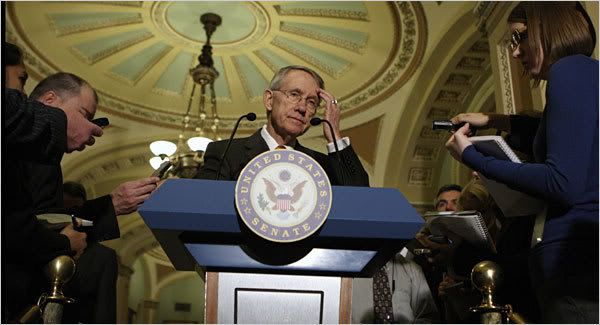
The New York Times reports:
After more than a year of wrangling, the Senate handed the White House a major victory on Tuesday by voting to broaden the government’s spy powers and to give legal protection to phone companies that cooperated in President Bush’s program of eavesdropping without warrants.
One by one, the Senate rejected amendments that would have imposed greater civil liberties checks on the government’s surveillance powers. Finally, the Senate voted 68 to 29 to approve legislation that the White House had been pushing for months. Mr. Bush hailed the vote and urged the House to move quickly in following the Senate’s lead.
The outcome in the Senate amounted, in effect, to a broader proxy vote in support of Mr. Bush’s wiretapping program. The wide-ranging debate before the final vote presaged discussion that will play out this year in the presidential and Congressional elections on other issues testing the president’s wartime authority, including secret detentions, torture and Iraq war financing.
Republicans hailed the reworking of the surveillance law as essential to protecting national security, but some Democrats and many liberal advocacy groups saw the outcome as another example of the Democrats’ fears of being branded weak on terrorism.
“Some people around here get cold feet when threatened by the administration,” said Senator Patrick J. Leahy, the Vermont Democrat who leads the Judiciary Committee and who had unsuccessfully pushed a much more restrictive set of surveillance measures.
Among the presidential contenders, Senator John McCain, Republican of Arizona, voted in favor of the final measure, while the two Democrats, Senator Barack Obama of Illinois and Senator Hillary Rodham Clinton of New York, did not vote. Mr. Obama did oppose immunity on a key earlier motion to end debate. Mrs. Clinton, campaigning in Texas, issued a statement saying she would have voted to oppose the final measure.
The measure extends, for at least six years, many of the broad new surveillance powers that Congress hastily approved last August just before its summer recess. Intelligence officials said court rulings had left dangerous gaps in their ability to intercept terrorist communications.
The bill, which had the strong backing of the White House, allows the government to eavesdrop on large bundles of foreign-based communications on its own authority so long as Americans are not the targets. A secret intelligence court, which traditionally has issued individual warrants before wiretapping began, would review the procedures set up by the executive branch only after the fact to determine whether there were abuses involving Americans.
“This is a dramatic restructuring” of surveillance law, said Michael Sussmann, a former Justice Department intelligence lawyer who represents several telecommunication companies. “And the thing that’s so dramatic about this is that you’ve removed the court review. There may be some checks after the fact, but the administration is picking the targets.”
The Senate plan also adds one provision considered critical by the White House: shielding phone companies from any legal liability for their roles in the eavesdropping program approved by Mr. Bush after the Sept. 11 attacks. The program allowed the National Security Agency to eavesdrop without warrants on the international communications of Americans suspected of having ties to Al Qaeda.
AT&T and other major phone companies are facing some 40 lawsuits from customers who claim their actions were illegal. The Bush administration maintains that if the suits are allowed to continue in court, they could bankrupt the companies and discourage them from cooperating in future intelligence operations.
The House approved a surveillance bill in November that intentionally left out immunity for the phone companies, and leaders from the two chambers will now have to find a way to work out significant differences between their two bills.
Democratic opponents, led by Senators Russ Feingold of Wisconsin and Christopher J. Dodd of Connecticut, argued that the plan effectively rewarded phone companies by providing them with legal insulation for actions that violated longstanding law and their own privacy obligations to their customers. But immunity supporters said the phone carriers acted out of patriotism after the Sept. 11 attacks in complying with what they believed in good faith was a legally binding order from the president.
“This, I believe, is the right way to go for the security of the nation,” said Senator John D. Rockefeller, the West Virginia Democrat who leads the intelligence committee. His support for the plan, after intense negotiations with the White House and his Republican colleagues, was considered critical to its passage but drew criticism from civil liberties groups because of $42,000 in contributions that Mr. Rockefeller received last year from AT&T and Verizon executives.
Senator Olympia J. Snowe, a Maine Republican on the intelligence panel, said the bill struck the right balance between protecting the rights of Americans and protecting the country “from terrorism and other foreign threats.”
Democratic opponents, who six months ago vowed to undo the results of the August surveillance vote, said they were deeply disappointed by the defection of 19 Democrats who backed the bill.
Mr. Dodd, who spoke on the floor for more than 20 hours in recent weeks in an effort to stall the bill, said future generations would view the vote as a test of whether the country heeds “the rule of law or the rule of men.”
But with Democrats splintered, Mr. Dodd acknowledged that the national security argument had won the day. “Unfortunately, those who are advocating this notion that you have to give up liberties to be more secure are apparently prevailing,” he said. “They’re convincing people that we’re at risk either politically, or at risk as a nation.”
There was a measure of frustration in the voice of Harry Reid, the Senate majority leader, as he told reporters during a break in the daylong debate, “Holding all the Democrats together on this, we’ve learned a long time ago, is not something that’s doable.”
Senate Republicans predict that they will be able to persuade the House to include immunity in the final bill, especially now that the White House has agreed to give House lawmakers access to internal documents on the wiretapping program. But House Democrats vowed Tuesday to continue opposing immunity.
Congress faces a Saturday deadline for extending the current law, but Democrats want to extend the deadline for two weeks to allow more time for talks. The White House has said it opposes a further extension.
Meanwhile, Senate Democrats hope to put some pressure on Republicans on Wednesday over another security-related issue by bringing up an intelligence measure that would apply Army field manual prohibitions against torture to civilian agencies like the Central Intelligence Agency.
Republicans plan to try to eliminate that provision, a vote that Democrats say will force Republicans to declare whether they condone torture. Democrats also say it could show the gap between Mr. McCain, who has opposed torture, and the administration on the issue.
“We know how we would feel if a member of the armed services captured by the enemy were, for example, waterboarded,” Mr. Reid said. “So I think that we’re headed in the right direction, and I hope that we’ll get Republican support on this.”
Senate roll call vote here.
Friday, November 16, 2007
| [+/-] |
Iraq Bill With Fewer Strings Weighed |
At CQ, Josh Rogin writes:
Senate Democrats appear ready to omit Iraq withdrawal timelines from a supplemental spending bill in hopes of clearing in December funds for the troops — but House leaders have no intentions of following suit.
The next partial-year war funding bill, although by no means finalized, would still include the Democrats’ call for a change of mission in Iraq, but without controversial withdrawal dates — a move that is intended to draw enough Republican votes to advance legislation in the Senate.
That plan places Senate Democratic leaders in conflict with their House counterparts, who have gone to great lengths to assure rank-and-file members that no more war spending bills would be enacted before January.
Meanwhile, Republicans seem content to let the Democrats negotiate among themselves, waiting for them to move incrementally toward what they regard as the forgone conclusion that Congress eventually will send President Bush a “clean” supplemental bill without policy restrictions.
The Senate on Nov. 16 rejected two war funding bills — a Democratic proposal and a Republican alternative — sending leaders back to the drawing board for a plan to get money to the troops.
Two of the most powerful voices on Defense in the Senate — Armed Services Chairman Carl Levin, a Michigan Democrat, and Daniel K. Inouye, a Democrat representing Hawaii who is chairman of the Defense Appropriations subcommittee — both said Democrats would offer a less restrictive version of the their party’s bill in December.
“There’s going to be a modification of the bridge fund,” Levin said.
The war spending bill is often referred to as a “bridge fund” because it is only a down payment on the $196.4 billion Bush requested in war spending for fiscal 2008. The bridge fund is intended to keep money flowing to the troops until Congress considers the balance of Bush’s request.
Levin said one option being discussed was a bill that still would require a change of mission in Iraq but doesn’t include specific dates, something the Republicans have repeatedly focused on in their criticisms.
“These are possibilities, I’m not predicting outcomes,” Levin added.
Inouye said, “We’ve got to build another bridge.”
But the senior senator from Hawaii said he was uncertain that Republicans would buy it.
“We’ll see,” he said.
Proposals Rejected
On Nov. 16, two war funding bills fell well short of the 60 votes need to advance in the Senate.
First, a Republican bill (S 2340), which would provide $70 billion without restrictions, was rejected, 45-53.
Later, the supplemental spending bill (HR 4156) that had passed the House two days earlier fell on a 53-45 vote.
Speaker Nancy Pelosi, a Democrat from California, has said she would not bring another war funding bill to the floor this year, a concession she made to liberal caucus members in order to pass the House bill.
But Senate Majority Leader Harry Reid, D-Nev., pointedly refused to rule out a December war funding bill in the Senate when speaking to reporters Nov. 16.
“The House has made its position clear. Speaking for the Senate, we’re going to continue doing the right thing,” Reid said.
Ben Nelson, a Nebraska Democrat and member of the Senate Armed Services Committee, said he was aware there is a plan for the next war spending bill to lack a withdrawal timeline.
But he said his own proposal, which would provide the full $196.4 billion requested — but require a change of mission and calls for a series of reports in March — could come after that.
Nelson has been working with Susan Collins, R-Maine, on that language. He said he is waiting in line for Democratic leadership to support his idea, if and when the next plan goes down.
“Sometimes, everything else has to fail before something gets resolved,” Nelson said.
Nelson pitched his plan as a “starting point,” acknowledging that even more concessions might be necessary if Republicans reject his proposal, whenever it gets a hearing.
Democrats have been unable to strike the right tone in their legislative attempts to attract enough Republicans to achieve meaningful change to the president’s war policy.
“I don’t know what it really takes in this political, partisan environment right now to get ‘yes’ for an answer from enough people,” Nelson said.
The GOP Digs In
Senate Republicans, sensing vulnerability in the Democrats’ resolve, seemed ready to dig in their heels.
Ted Stevens of Alaska, the Senate Appropriations Defense Subcommittee ranking Republican, reacted harshly to the idea of a modified bill that would preserve some restrictions on the president.
“That’s a non-starter!” he exclaimed.
Stevens reiterated that Republicans would support no constraints on the power of the executive to execute military policy.
“We don’t negotiate missions. That’s for the commander in chief, and that’s all there is to it,” Stevens said.
Senate Minority Leader Mitch McConnell, R-Ky., declared that he would not let up on his pressure to debate and pass another war funding bill next month.
“That clearly must be done some time before we adjourn . . . for this session,” he said.
Jeff Sessions, R-Ala., a Senate Armed Services Committee member, indicated that Republicans would continue to point to recent successes on the ground in Iraq, attack the Democrats for seeking political gain at the expense of troops, and defer to the advice of the generals.
“We should not, as a group of politicians, take for ourselves the responsibility of mandating how we should be prosecuting this war,” Sessions said.
Meanwhile, moderates from both parties are left without support from their leadership as they try to find a middle ground that would lead to congressional unity regarding Iraq policy.
“We should be sitting down and working on a compromise,” said Olympia J. Snowe of Maine, one of only a few Republicans to vote for withdrawal timelines.
The environment on Capitol Hill is “so partisan, so polarizing, and so poisonous, that it’s impeding our ability to solve the problems of our nation, with monumental consequences,” she said.
Friday, November 9, 2007
| [+/-] |
War Funding Plan Faces Uphill Fight |
Josh Rogin writes:
Democrats are poised to propose a $50 billion war funding bill that has little chance of becoming law, making it likely the military will be fighting on borrowed money into next year.
The House is expected next week to take up the new partial-year “bridge fund,” which would pay for the wars in Iraq and Afghanistan for four months. Democratic leaders, caught between the demands of liberals who want tight restrictions on war funding and members who want the troops to get whatever they need quickly, have come up with a plan that is likely to satisfy neither.
Even if the House passes the bill, it would probably stall in the Senate, where similar measures have failed to draw the 60 votes needed to reach President Bush, who would probably veto it anyway.
Moreover, since the Senate cleared the regular Defense spending bill and the next continuing resolution Thursday night, Republicans and hawkish Democrats lost their two best chances to add some war funding to another legislative vehicle this year.
House Speaker Nancy Pelosi, D-Calif., announced the details of the bridge fund on Thursday. The measure would require the immediate start of troop withdrawals from Iraq, with a goal of extricating most troops by Dec. 15, 2008. The money in the bill would be limited for the missions of force protection, counterterrorism and training of the Iraqi security forces.
It also contains several Iraq policy measures that the House has tried to enact before. The bill would mandate home stays for returning troops equal to the length of their combat deployments; prohibit the deployment of troops who are not fully trained and equipped; and extend strict rules against torture found in the Army Field Manual to all government agencies and employees.
Although the final bill has not materialized, Pelosi told reporters Thursday that the Iraqi withdrawal language was similar to the language in an early version of the fiscal 2007 supplemental (HR 2206).
That language was vetoed and Congress failed to override.
When asked whether she thought the new war funding bill had a chance of being signed by Bush, or even making it to his desk, Pelosi demurred. “We are restating the differentiation between ourselves and the president of the United States,” she said.
After initially considering a vote on the plan as early as Friday, top Democrats said the House would take it up next week, perhaps on Nov. 13.
“I think we have the votes. Now, we will have a little time to get the proper drafting and vetting on the Iraq bill,” said Majority Leader Steny H. Hoyer, D-Md.
Liberals, Blue Dogs Skeptical
Initial reaction to the proposed bridge fund among Democrats was mixed.
In a private meeting Thursday afternoon with the liberal Out of Iraq and Progressive caucuses, Pelosi pledged not to cave in and provide the war funding without strings if Bush vetoes the new bridge fund.
But even with that assurance, Lynn Woolsey, D-Calif., left the meeting unconvinced. She hoped that the bill would be postponed to give members a chance to study it carefully before deciding how to vote. “We are saying we want to see it. . . . I want a much bigger commitment than that.”
Members of the Democratic Blue Dog Coalition were equally skeptical but for different reasons.
Gene Taylor, D-Miss., a member of the House Armed Services Committee, said he was concerned the military would be placed under greater strain while Congress wrangled over the funding.
“My initial reaction is, gee, I wish they wouldn’t do this,” said Taylor, adding that planners and suppliers need to know where their funding is coming from.
James P. Moran, D-Va., a member of the House Appropriations Defense Subcommittee and an outspoken war critic, was more supportive of the strategy. “Let it go to the president,” he said. “If he vetoes it, then he has no funding for Iraq,”
Few Republicans are expected to support the new bridge fund. Minority Leader John A. Boehner, R-Ohio, attacked the proposal, saying it was “about trying to handcuff our generals and our soldiers in harm’s way in Iraq.”
Senate Majority Leader Harry Reid, D-Nev., said the chamber would take up the bridge fund next week, but didn’t feel confident it could muster the 60 votes needed to overcome a likely filibuster.
“It’s not a question of us finding enough votes to pass it. We support this,” he said, referring to Senate Democrats. “It’s up to the Republicans whether they will help with a few votes in the Senate.”
The Senate cleared the fiscal 2008 Defense appropriations conference report (HR 3222 — H Rept 110-434) by voice vote Thursday night, after Ted Stevens of Alaska, the ranking Republican on the Senate Appropriations Defense panel, abandoned his bid to split the bill from the next continuing resolution (CR).
Because the new CR doesn’t contain any war funding, the Pentagon will have to borrow from its regular budget to pay for war operations beginning Nov. 17.
The House voted, 400-15, to adopt the conference report. (Appropriations, p. 3)
Overall, the conference report would provide the Pentagon $459.3 billion in discretionary funding, $3.5 billion less than Bush’s request and $39.7 billion, or 9.5 percent, more than in fiscal 2007.
It also would provide $11.6 billion in emergency spending for mine-resistant vehicles to protect U.S. forces in Iraq.
Friday, October 19, 2007
| [+/-] |
Bush's Spying Hits Americans Abroad |
At Consortium News, Robert Parry writes:
In August after the Democratic-controlled Congress caved in to George W. Bush’s demands for broader surveillance powers, I noted that the new authority went far beyond what was advertised and that the President could obtain year-long spying orders on Americans who ventured outside the United States.
My analysis, which was based on a reading of the law’s language, wasn’t shared by commentators in the major U.S. news media and even drew some reader criticism as alarmist for failing to take into account secret “minimization” provisions that supposedly would protect American citizens.
However, the Bush administration’s hostile reaction to a seemingly innocuous amendment added to a new surveillance bill by Sen. Ron Wyden, D-Oregon, suggests that targeting Americans who travel abroad was a key goal of Bush’s “Protect America Act of 2007.”
Wyden told the New York Times that his amendment would require the government to get a warrant whenever it wants to wiretap an American outside the country, such as a U.S. soldier serving overseas or an American on a business trip.
“The individual freedom of an American shouldn’t depend on their physical geography,” Wyden told the Times. He said his amendment passed on a 9-6 vote in a closed Senate Intelligence Committee meeting on Oct. 18. [NYT, Oct. 19, 2007]
After the committee vote, the Bush administration and a key Senate Republican took direct aim at Wyden’s provision.
“We have strong concerns about that amendment,” said White House spokesman Tony Fratto. “We certainly could not accept it.”
Sen. Christopher Bond of Missouri, the ranking committee Republican, said Wyden’s amendment was “problematic” and could scuttle the entire bill if not changed.
In other words, the seemingly loose phrasing of the Protect America Act wasn’t just an oversight or something that would be cleaned up with some internal technical adjustments. Rather, it was an important feature of the legislation that was slipped past the Democratic leadership and most of the Washington press corps in August.
The law states: “Notwithstanding any other law, the Director of National Intelligence and the Attorney General may for periods of up to one year authorize the acquisition of foreign intelligence information concerning persons reasonably believed to be outside the United States.”
The law’s advocates claimed that this provision was intended to intercept communications when at least one party was linked to a terrorist group or a terrorist affiliate and was outside the United States.
No Terrorist Wording
But the law’s language didn’t limit the surveillance to “terrorists” or “enemy combatants” – indeed those words were not mentioned in the legislation.
Nor does the Protect America Act, which was drafted by the Bush administration’s national security team, specify what happens to a one-year surveillance order against a target if the person then enters – or returns – to the United States.
In the rush to wrap up legislative business before the August recess – and to avoid “soft on terror” accusations – Democratic congressional leaders offered only cursory attention to what this provision meant and what new abuses might become possible.
For instance, could a one-year surveillance order be issued against an American attorney who was representing a Guantanamo detainee and who traveled to Europe for a legal conference? Could the surveillance order follow that person back home? How about an outspoken peace activist who visited a friend in Canada, or a senator meeting with a foreign leader, or a journalist filing stories from overseas?
The only limitation on the administration’s authority is the need to be seeking “foreign intelligence information.” Though the term does cover information about possible hostile acts by a foreign power or an agent of a foreign power, such as terrorism or clandestine intelligence activities, the phrase can be interpreted in a far looser way.
The term can be defined broadly as information about a foreign power that relates to U.S. national defense, national security or the conduct of foreign affairs. In today’s world, those categories could mean pretty much anything.
Other supposed safeguards in the Protect America Act might not be reassuring to its targets, either.
While the targets are kept in the dark about the surveillance, their communications providers – such as phone companies or e-mail services – can challenge the government’s order if they’re willing to absorb the expense and offend the Executive Branch, which often has giant contracts with the same providers.
Even then, the service providers, which aren't told the classified basis for the surveillance order, can only contest the surveillance on procedural grounds through the secret channels of the court created by the Foreign Intelligence Surveillance Act, with appeals of adverse rulings allowed by either side up to the U.S. Supreme Court.
Lawsuit Immunity
But service providers get a strong incentive not to challenge the government’s order. While a legal challenge on behalf of an unsuspecting client could be expensive – especially if the Bush administration retaliates by shifting contracts to a competitor – the legislation grants immunity from liability to any service provider who complies.
“Notwithstanding any other law, no cause of action shall lie in any court against any person for providing any information, facilities, or assistance in accordance with a directive under this section,” the law states.
In other words, if spying targets later discover that their service providers gave the government access to their phone calls and e-mails, they have no grounds to sue, regardless of how unjustified the surveillance may have been.
Initially, administration officials said their goal in pushing through the new law was to address a glitch related to cases in which two terror suspects, both abroad, have their communication routed through a U.S. switching point and thus might require a warrant.
Citing this vulnerability, President Bush demanded that Democrats revise FISA before leaving for the August recess. Democrats thought they had reached a compromise that would address the administration’s narrow concern, but the White House and the congressional Republicans then demanded more sweeping changes.
The Senate caved in first, voting 60-28 to authorize Bush’s broader spying powers, with many centrist Democrats joining a solid phalanx of Republicans. (Presidential contenders – Sens. Hillary Clinton, Barack Obama, Chris Dodd and Joe Biden – voted no.)
On Aug. 4, Bush then turned up the heat on the House. He called the spying powers contained in the bill crucial weapons in the fight against terrorism and declared that “protecting America is our most solemn obligation.”
Many Americans would disagree, arguing that the most solemn obligation is to protect the Constitution and the Bill of Rights. But the Democratic congressional leaders acted as if their highest priorities were getting away for the August recess and avoiding ugly attacks on their patriotism from Fox News and the right-wing media.
Instead of canceling the recess – and using the month of August to fight over both Bush’s extraordinary expansion of presidential powers and the Iraq War – House Democratic leaders brought the Senate-approved Protect America Act to the floor. It carried, 227-183, with 41 Democrats backing Bush’s bill.
Trying to put the best spin on their defeat, Democratic leaders pointed to their one concession: a sunset provision that required Bush to seek renewal of his powers in six months. Still, the Democratic “base” and many other Americans were furious at the latest cave-in, sending House Speaker Nancy Pelosi more than 200,000 angry e-mails.
Stung by the reaction, Democratic leaders promised that the spying law would be revisited immediately after the August recess, rather than waiting around for a required reauthorization in February 2008.
New Concessions
Now, however, the Senate Democrats appear headed toward another major concession to Bush, making retroactive the legal immunity for telecommunications companies that collaborated with the administration’s warrantless surveillance over the past six years.
Sen. Jay Rockefeller, D-West Virginia, Senate Intelligence Committee chairman, shepherded this new concession through his panel, which approved a revised version of the Protect America Act on a 13-2 vote with Wyden and Sen. Russ Feingold, D-Wisconsin, voting no.
The bill now goes to the Senate Judiciary Committee, which also has jurisdiction. Sen. Dodd, D-Connecticut, has vowed to put a hold on the bill to block the retroactive immunity provision.
But the Democrats will face the same dilemma that has stymied their attempts to end the Iraq War. The Republicans are in the driver’s seat because they can filibuster in the Senate, forcing the Democrats to round up 60 votes on anything that restricts the President’s powers, such as Wyden’s amendment.
The GOP also has used parliamentary maneuvers in the House to delay its consideration of a different surveillance bill that includes more constraints on Bush and leaves out the amnesty for telecommunications companies.
Even if a new bill not to Bush’s liking can clear those hurdles, he can veto it, requiring two-thirds majorities in both houses to override.
An impasse would leave the Democrats back where they started. Then, with the law set to expire in February 2008, Bush and his political allies would taunt them as “soft on terror” – and there’s little reason to believe that congressional Democrats will show more backbone in an election year.
Sunday, October 14, 2007
| [+/-] |
Getting Around Rules on Lobbying |
Despite New Law, Firms Find Ways To Ply Politicians
The Washington Post reports:
In recent days, about 100 members of Congress and hundreds of Hill staffers attended two black-tie galas, many of them as guests of corporations and lobbyists that paid as much as $2,500 per ticket.
Because accepting such gifts from special interests is now illegal, the companies did not hand the tickets directly to lawmakers or staffers. Instead, the companies donated the tickets back to the charity sponsors, with the names of recipients they wanted to see and sit with at the galas.
The arrangement was one of the most visible efforts, but hardly the only one, to get around new rules passed by Congress this summer limiting meals, travel, gifts and campaign contributions from lobbyists and companies that employ them.
Last week, Senate Majority Leader Harry M. Reid (D-Nev.) and Republican leader Mitch McConnell (Ky.) found bipartisan agreement on maintaining one special privilege. Together they put language into a defense appropriations bill that would keep legal the practice of some senators of booking several flights on days they return home, keeping the most convenient reservation and dumping the rest without paying cancellation fees -- a practice some airlines say could violate the new law.
Senators also have granted themselves a grace period on requirements that they pay pricey charter rates for private jet travel. Lobbyists continue to bundle political contributions to lawmakers but are now making sure the totals do not trigger new public reporting rules. And with presidential nominating conventions coming next summer, lawmakers and lobbyists are working together to save another tradition endangered by the new rules: the convention party feting one lawmaker.
"You can't have a party honoring a specific member. It's clear to me -- but it's not clear to everybody," said Barbara Boxer (D-Calif.), chairman of the Senate ethics committee. She said the committee is getting "these questions that surround the edges -- 'If it's midnight the night before,' 'If I wear one shoe and not the other.' "
Democrats touted the new ethics law as the most thorough housecleaning since Watergate, and needed after a host of scandals during 12 years of Republican rule. Prompted by disgraced lobbyist Jack Abramoff's wheeling and dealing and the jailing of three members of Congress on corruption charges in recent years, the law, signed by President Bush on Sept. 14, was heralded by congressional leaders as a real change in Washington's influence game.
But the changes have prompted anxiety about what perks are still permissible. In recent months, the House and Senate ethics committees have fielded more than 1,000 questions from lobbyists and congressional staffers seeking guidance -- or an outright waiver -- for rules banning weekend trips and pricey wedding gifts, five-course dinners and backstage passes.
Looking for ways to keep spreading freebies legally, hundreds of lobbyists have been attending seminars at Washington law firms to learn the ins and outs of the new law.
At a recent American League of Lobbyists briefing, Cleta Mitchell of the Foley & Lardner law firm said that while the law bans lobbyists from buying lawmakers or staffers a meal, it is silent on picking up bar tabs. A woman in the third row asked hopefully, "You can buy them as many drinks as you want, as often as you want?"
No, Mitchell said, not unless the drinkers are the lobbyist's personal friends, and she pays from her own pocket.
If that rule was clear to some, two charity dinners allowed hazier interpretations.
Most of the 40 lawmakers dining on red snapper ceviche and beef tenderloin at the recent Hispanic Caucus Institute gala at the Washington Convention Center got their tickets from corporations, said Paul Brathwaite, a principal with the Podesta Group lobbying firm.
Brathwaite said about a dozen of Podesta's corporate clients bought tables of 10 for $5,000 to $25,000 for the Hispanic dinner and the Congressional Black Caucus Foundation gala over the past three weeks. The companies then gave the tickets back to the foundations -- along with lists of lawmakers and staff members they wanted to invite. Some lawmakers did buy their own tickets, Brathwaite said, but many did not.
The rules require that charity sponsors do the inviting and decide who sits where. But "at the end of the night, everyone is happy," said Hispanic Caucus Institute spokesman Scott Gunderson Rosa.
"The corporate folks want us at their tables, of course," said Rep. Raul M. Grijalva (D-Ariz.), who sat at a Fannie Mae-sponsored table at the Hispanic dinner.
Another provision of the new ethics law bans House members from flying on corporate jets. But senators, including the half-dozen presidential candidates among them, can still do so. Previously they were required to reimburse plane owners the equivalent of a first-class ticket, but now they must pay charter rates, which can increase travel costs tenfold.
The Senate ethics committee decided not to enforce that rule for at least 60 days after it took effect Sept. 14, citing "the lack of experience in many offices in determining 'charter rates.' "
The decision surprised some Senate staffers, Mitchell said, one of whom e-mailed her to say, "Welcome to the world of skirting around the rules we pass."
"Breathtaking. . . . In my view, they're not complying with the plain language of the law," Mitchell said. "I think it should be easier for members of Congress to travel, not harder. But what I don't appreciate as a citizen is Congress passing something but then interpreting it so it doesn't mean what the law clearly says."
The law has dragged into view several such perks that members long enjoyed but didn't reveal -- until they sought exemptions to the new rules.
Lawmakers for years have booked several flights for a day when they plan to leave town. When they finish work, they take the most convenient flight and cancel the rest without paying fees, a privilege denied others. But after the new law passed, some airlines stopped the practice, worried that it violates the gift ban.
Sens. Dianne Feinstein (D-Calif.) and Robert F. Bennett (R-Utah) appealed to the Senate ethics committee to allow multiple bookings. Then Reid and McConnell added language to the defense bill that, if it passes, would extend the perk to staffers, too.
New bans on corporate-paid fun could hit hardest at the 2008 presidential nominating conventions. The law prohibits parties honoring a lawmaker on convention days; some lobbyists say the wording means such parties before or after those days are okay. House and Senate members have asked the ethics committees for guidance.
"That's one of the issues that's going to need some clarification," said Senate ethics panelist Ken Salazar (D-Colo.), whose home state will host the Democrats in August.
Meanwhile, lobbyists are booking up Denver's trendy warehouse district and Minnesota's Mall of America, near the GOP convention site in Minneapolis-St. Paul, for the pre-convention weekends. Host committees for both conventions say they will honor state delegations, including members of Congress who take part.
"I think you'll see a lot of umbrella invitations," said Patrick Murphy, lobbyist for Capitol Management, who is planning Democratic convention parties. "Invite 'Friends of Montana' and see who shows up."
One of the most fought-over parts of the law requires that lobbyists who bundle multiple campaign contributions totaling more than $15,000 file reports every six months. But lawyers say that a fundraiser for Hillary Rodham Clinton signals a way to avoid public reporting when that rule kicks in Jan. 1.
Female politicos have been e-mailing each other a slick online invitation to "Make History With Hillary," a summit and fundraiser on Wednesday. The invitation encourages women to bundle for Clinton by promising them online credit for each ticket they sell. Women who have already donated their legal individual limit of $2,300 cannot attend unless they bring in another $4,000.
"It's a universe of junior bundlers under the radar screen," said Kenneth Gross, a campaign finance lawyer at Skadden, Arps, Slate, Meagher & Flom. For the lobbyists among them, the amounts are so small that "you don't have to worry about tracking them, and it would add up to a material sum over time" -- but less than the $15,000 limit.
If a lobbyist asked his advice on the practice, Gross said, "I'd say 'Go for it.' "
| [+/-] |
Chertoff May Void Judge's Order to Halt Border Fence |
AzStarNet.com reports:
The nation's top security official may use his power to unilaterally trump a federal court order halting construction of a fence on a stretch of the Arizona-Mexico border.
Homeland Security Secretary Michael Chertoff is weighing whether to invoke a section of federal law that allows him to exempt border construction projects from any law, his press aide, Russ Knocke, told Capitol Media Services. That includes requirements for studies on environmental impacts of federally funded projects.
The move would not be unprecedented: Chertoff used the power at least twice since it was granted.
In 2005 he decided to build fencing near San Diego without conducting environmental studies. And in January he issued a waiver from all laws for a project along the edge of the Barry M. Goldwater Air Force Range in Southwestern Arizona.
The possibility of Chertoff again exempting his agency from environmental laws comes days after a federal judge in Washington stopped construction of a nearly two-mile stretch of fence at the foot of the San Pedro Riparian National Conservation Area southeast of Tucson. The conservation area, designated by Congress in 1988, is described on the U.S. Bureau of Land Management's Web site as ecologically "one of the most important riparian areas in the United States."
The restraining order gives two environmental groups time to convince Judge Ellen Huvelle that plans for vehicle barriers in the river's floodway and washes leading into it will cause erosion and sedimentation that will harm the environment and affect species dependent on the river.
Defenders of Wildlife and the Sierra Club also contend the BLM, which controls the area, did not seek public input on the project in performing an environmental assessment that took just three weeks. They contend the BLM should have prepared a more formal environmental impact statement.
Chertoff, however, can make the lawsuit, and judge's ruling, disappear simply by declaring the project exempt from the law the groups used to sue.
Knocke said Chertoff believes the lawsuit is without merit, saying the BLM's assessment concluded the project would not harm the area.
"We care about the border environment as much as anyone," Knocke said. "But when weighing a lizard in the balance with human lives, this border infrastructure project is the obvious choice."
Attorneys for Chertoff also argue that environmental damage from illegal border crossers is greater than anything that would occur from the barriers.
Nothing short of congressional action could stop Chertoff from exempting the San Pedro project from the environmental laws if he decides to do so.
Rep. Gabrielle Giffords, D-Ariz., whose district includes the river, does not support repeal of Chertoff's power.
"Border security has to be a top concern in a state like this," said C.J. Karamargin, Giffords' press aide. He said the congresswoman believes federal officials "should have the tools they need to do the job."
Bob Dreher, vice president for conservation law for Defenders of Wildlife, said what might stop Chertoff from exempting the project from federal laws is, "They have to do, I think, the politically costly thing of publicly saying, 'We're above the law.' " He said that might be what kept Chertoff from waiving environmental laws for a similar border project in Texas.
While Giffords is unwilling to repeal the law, she is willing to apply pressure.
She is one of five members of Congress who wrote Chertoff last week asking him to delay further work on the project, prepare a full environmental impact statement and conduct public hearings, something not done before construction began late last month.
"Our communities support safe and secure borders and simply ask for adequate time to share their concerns with their government, as they have a right to do," reads the letter signed by Giffords as well as Rep. Raúl Grijalva, also a Tucson Democrat. Three members of the Texas congressional delegation also signed that letter.
In his January decision dealing with the Goldwater bombing range, a military training ground, Chertoff declared that the high number of people entering the country illegally through that stretch of the desert create an immediate need to build not just fencing but also vehicle barriers, towers, sensors and cameras.
That, he said, justified exemptions from the National Environmental Policy Act — the law being used by the two environmental groups to sue over the San Pedro project — as well as the Endangered Species Act, the Clean Water Act, the Wilderness Act, the National Historic Preservation Act and the National Wildlife Refuge Systems Administration Act.
Chertoff also exempted the project from another law, which requires his agency to follow certain administrative procedures.
Monday, October 8, 2007
| [+/-] |
Democrats Expected To Concede on Wiretapping |
The New York Times reports:
Two months after vowing to roll back broad new wiretapping powers won by the Bush administration, Congressional Democrats appear ready to make concessions that could extend some of the key powers granted to the National Security Agency.
Bush administration officials say they are confident they will win approval of the broadened wiretapping authority that they secured temporarily in August as Congress rushed toward recess, and some Democratic officials admit that they may not come up with the votes to rein in the administration.
As the debate over the N.S.A.’s wiretapping powers begins anew this week, the emerging legislation reflects the political reality confronting the Democrats. While they are willing to oppose the White House on the conduct of the war in Iraq, they remain nervous that they will be labeled as soft on terrorism if they insist on strict curbs on intelligence gathering.
A Democratic bill to be proposed Tuesday in the House would maintain for several years the type of broad, blanket authority for N.S.A. wiretapping that the administration secured in August for just six months. But in an acknowledgment of civil liberties concerns, the measure would also require a more active role by the special foreign intelligence court that oversees the N.S.A.’s interception of foreign-based communications.
A competing proposal in the Senate, still being drafted, may be even closer in line with the administration’s demands, with the possibility of including retroactive immunity for telecommunications companies that took part in the N.S.A.’s once-secret program to wiretap without court warrants.
No one is willing to predict with certainty how the issue will play out. But some Congressional officials and others monitoring the debate over the legislation said the final result may not be much different than it was two months ago, despite Democrats’ insistence that they would not let stand the August extension of the N.S.A.’s powers.
“Many members continue to fear that if they don’t support whatever the president asks for, they’ll be perceived as soft on terrorism,” said William Banks, a professor specializing in terrorism and national security law at Syracuse University who has written extensively on federal wiretapping law.
The August bill, known as the Protect America Act, was approved by Congress in the final hours before its summer recess after heated warnings from the Bush administration that legal loopholes in wiretapping coverage had left the country vulnerable to another terrorist attack. The legislation significantly reduced the role of the foreign intelligence court and broadened the N.S.A.’s ability to listen in on foreign-based communications without a court warrant.
“We want the statute made permanent,” Dean Boyd, a spokesman for the Justice Department, said today. “We view this as a healthy debate. We also view it as an opportunity to inform Congress and the public that we can use these authorities responsibly. We’re going to go forward and look at any proposals that come forth, but we’ll look at them very carefully to make sure they don’t have any consequences that hamper our abilities to protect the country.”
House Democrats overwhelmingly opposed the interim legislation in August and believed at the time they had been forced into a corner by the Bush administration.
As Congress takes up the new legislation, a senior Democratic aide said House leaders are working hard to make sure the administration does not succeed in pushing through a bill that would make permanent all the powers it secured in August for the N.S.A. “That’s what we’re trying to avoid,” the aide said. “We have that concern too.”
The bill to be proposed Tuesday by the Democratic leaders of the House Intelligence and Judiciary Committees would impose more controls over the N.S.A.’s powers, including quarterly audits by the Justice Department’s inspector general. It would also give the foreign intelligence court a role in approving, in advance, “basket” or “umbrella” warrants for bundles of overseas communications, according to a Congressional official.
“We are giving the N.S.A. what it legitimately needs for national security but with far more limitations and protections than are in the Protect America Act,” said Brendan Daly, a spokesman for Speaker Nancy Pelosi, Democrat of California.
Perhaps most important in the eyes of Democratic supporters, the House bill would not give retroactive immunity to the telecommunications companies that took part in the N.S.A.’s domestic eavesdropping program — a proposal that had been a top priority of the Bush administration. The August legislation granted the companies immunity for future acts, but not past deeds.
A number of private groups are trying to prove in federal court that the telecommunications companies violated the law by taking part in the program. A former senior Justice Department lawyer, Jack Goldsmith, seemed to bolster their case last week when he told Congress that the program was a “legal mess” and strongly suggested it was illegal.
In the Senate, the Democratic chairman of the Intelligence Committee, John D. Rockefeller IV of West Virginia, is working with his Republican counterpart, Christopher S. Bond of Missouri, who was one of the main proponents of the August plan, to come up with a compromise wiretapping proposal. Wendy Morigi, a spokeswoman for Mr. Rockefeller, said that retroactive immunity for the telecommunications companies is “under discussion,” but that no final proposal had been developed.
The immunity issue may prove to be the key sticking point between whatever proposals are ultimately passed by the House and the Senate. Representative Jerrold Nadler, a New York Democrat who was among the harshest critics of the legislation passed in August, said he would vigorously oppose any effort to grant retroactive legal protection to telecommunications companies. “There is heavy pressure on the immunity and we should not cave an inch on that,” he said in an interview.
Mr. Nadler said he was worried that the Senate would give too much ground to the administration in its proposal, but he said he was satisfied with the legislation to be proposed Tuesday in the House.
“It is not perfect, but it is a good bill,” he said. “It makes huge improvements in the current law. In some respects it is better than the old FISA law,” referring to the Foreign Intelligence Surveillance Act.
Civil liberties advocates and others who met with House officials today about the proposed bill agreed that it was an improvement over the August plan, but they were not quite as charitable in their overall assessment.
‘This still authorizes the interception of Americans’ international communications without a warrant in far too many instances and without adequate civil liberties protections,” said Kate Martin, director of the Center for National Security Studies, who was among the group that met with House officials.
Caroline Frederickson, director of the Washington legislative office of the American Civil Liberties Union, said she was troubled by the Democrats’ acceptance of broad, blanket warrants for the N.S.A., rather than the individualized warrants traditionally required by the intelligence court.
“The Democratic leadership, philosophically, is with us, but we need to help them realize the political case, which is that Democrats will not be in danger if they don’t reauthorize this Protect America Act,” Ms. Frederickson said. “They’re nervous. There’s a ‘keep the majority’ mentality, which is understandable. But we think they’re putting themselves in more danger by not standing on principle.”
Monday, October 1, 2007
| [+/-] |
Court Rules Delay in Release of Presidential Papers is Illegal |
Fails to Address Authority of Former Vice Presidents to Hold Up Disclosure of Papers
A District Court in the District of Columbia has ruled that an Executive Order issued by President George W. Bush in 2001, which severely slowed or prevented the release of historic presidential papers is, in part, invalid. In a carefully constructed decision, the court held that the Archivist of the United States acts arbitrarily, capriciously, and contrary to law by relying on the Executive Order to delay release of the records of former presidents. The court did not reach the issue of whether it was permissible for President Bush to extend the authority over disclosure of presidential papers to a former president’s heirs or to former vice presidents.
The underlying lawsuit, which was filed in November 2001 by the National Security Archive and other plaintiffs, challenges President Bush's Executive Order 13,233 that gave former Presidents and their heirs (as well as former Vice-Presidents for the first time) indefinite authority to hold up release of White House records. In finding that the plaintiffs have standing to pursue the claim, the court specifically referenced the delays experienced by the National Security Archive for requests pending at the Ronald Reagan Presidential Library. As the Archive’s Director Thomas Blanton testified in Congress this past March, those delays have grown from 18 months in 2001 to “an estimate of 78 months (six and a half years!) [in 2007].”
Archive General Counsel Meredith Fuchs commented, “The court is enforcing procedural standards, but has avoided the hard questions about the role former presidents, former vice presidents, and their heirs can play when it comes to disclosure of presidential records.” She noted, “Unless the Executive Order is reversed or withdrawn, decisions about the release of records from this administration may ultimately be made by the Bush daughters.”
The decision comes at a time when a bill that would overturn Executive Order 13,233 is stalled in the U.S. Senate, reportedly due to a hold placed on the measure by Senator Jim Bunning (R-KY). The bill, H.R. 1255, was approved in the U.S. House of Representatives on March 14, 2007 by a vote of 333-93. The White House has threatened to veto the bill if it is passed in the Senate.
BACKGROUND
The Presidential Records Act of 1978 (PRA) emerged from the scandals of the Nixon presidency to require former presidents to release their records no later than 12 years after they leave office. Under the PRA, as amended, the U.S. government asserts complete "ownership, possession, and control" of all Presidential and Vice-Presidential records. Upon conclusion of the President's term in office, the National Archivist is required to assume custody of the records, and to make them available to the public when permissible under the PRA. Access to the records can be denied after the end of the 12-year embargo only if a former or incumbent president claims an exemption based on a "constitutionally based" executive privilege or continuing national security concern.
On February 8, 2001, shortly after President Bush came into office, he was notified of a scheduled release of Reagan presidential records (68,000 pages of records). His legal counsel requested two successive 90-day extensions of time to review the records prior to their release followed by a third request for an indefinite extension of time so that the White House could evaluate the legal framework and process that would govern release of the records. This was followed on November 1, 2001 with the issuance of Executive Order (E.O. 13,233) that gives the White House and former presidents uncontrolled discretion in deciding whether to deny the release of documents requested by journalists and scholars.
