At Huffington Post, Thomas Edsall writes:
Hillary Clinton, who for seven weeks has crawled, kicked and bitten her way back into contention, suffered a blow on Tuesday, halting the momentum behind her bid for the nomination just when she had begun to regain credibility.
In the universe of political clichés, she is on life support, her oxygen choked off, her knees buckling, unable to stanch the bleeding, down for an eight count, on the ropes, praying for the bell to ring, desperate to get her wind back.
The results yesterday were a split decision, with Obama winning big in North Carolina and Clinton apparently carrying Indiana by a few percentage points. Clinton was widely viewed as needing a double-digit win in Indiana, and either a close loss or actual victory in North Carolina.
In North Carolina, she suffered a crushing, 15-point-plus defeat at the hands of Barack Obama with 115 convention delegates at stake. He won black voters, who are roughly a third of the state's Democratic primary electorate, by a 91-7 margin. White voters, who make up just over 60 percent of the state's Democratic voters, backed Clinton 61-37.
In Indiana, Clinton appeared headed for a more modest 2 point or less victory. There, she won 60-40 among white voters, who made up 80 percent of the turnout, while losing black voters 8-92.
Clinton's success among white voters is very likely to continue to raise questions concerning Obama's viability among whites, who play a larger role in general elections than in Democratic primaries.
For Hillary, the outcome in Tuesday's primaries was particularly painful, coming after an extraordinary revival of her campaign with solid victories in Texas, Ohio and Pennsylvania.
"After the Reverend Wright controversy, Hillary Clinton had the nomination in her hands. Obama was suffering the worst press month of his campaign," said Republican media consultant Alex Castellanos. "Then she had a choice. She could have gotten bigger, more presidential, less political, could have risen to defend Obama. 'This is outrageous and has no place in politics.' She didn't do that. Instead, she chose to become smaller, more political, less presidential. Her own political instincts betrayed her."
The demographic patterns on Tuesday suggest an intensification of racially polarized voting.
In the March 4 Texas primary, Clinton won whites (46 percent of the total), by 55-44; she won Latinos (32 percent of the total) by 66-32, while Obama carried blacks by 84-16.
In Ohio, also on March 4, white Democrats (76 percent of the primary turnout) backed Hillary 64-34, while blacks (18 percent of primary voters) supported Obama 87-13.
Seven weeks later, in the April 22 Pennsylvania primary, white Democrats (80 percent of primary turnout) voted 63-37 for Clinton while blacks (15 percent of the total) votes 90-10 for Obama.
"It looks like a big win for Obama in North Carolina and a narrow win for Clinton in Indiana," said Emory political scientist Alan Abramowitz as the first exit polls were released. "That's not good for Hillary. She needed a breakthrough -- a big win in Indiana and a win or a narrow loss in North Carolina. It looks like she's not going to get either. Obama will add to his delegate lead."
It is unlikely, however, that Clinton will give up at this stage.
"I can tell you right now [what the Clinton people will argue]. The battle goes on, a fight to the death, one delegate at a time, never say die, millions of Democratic voters yet to be heard, white working class people will vote for McCain instead of 'him,' blah, blah, blah," declared Lawrence F. O'Brien, Democratic lobbyist, donor, and the son and namesake of the Democratic National Committee chair in the late 1960s and early 1970s.
Open Left's Chris Bowers wrote: "Given that Obama was already ahead... and that there are now very few states remaining, that is a very good night for him....it is just what he needed to help turn around the media narrative."
Clinton has demonstrated an extraordinary will to win, and a refusal to quit when she was losing primary after caucus after primary. Her campaign is now arguably at the stage where it is dependent on miracles -- like the surfacing of a new, and worse, Jeremiah Wright controversy or a Chicago scandal implicating Obama.
Norman Ornstein, of the American Enterprise Institute, contended, in effect, that it's all over but the shouting:
"I have long viewed this in a simple way: two things matter, delegates and popular votes. If Obama wins both, he cannot be denied the nomination. If these numbers [early returns] hold up, he will erase her gains in Pennsylvania and have a near-insurmountable popular vote lead. That will do it, and I expect a stream of superdelegates to move to him in the coming week-plus."
While it was clearly Obama's night, there were some small glimmers of hope for Clinton in the exit poll data.
In Indiana, she very narrowly beat Obama (51-49) among men, held her own (56-44) with working and lower middle class voters without college degrees, and won among the one in five white, self-described "independents" -- often an Obama constituency -- by a slim, 52-48 margin.
In addition, the 67 percent of Indiana voters primarily concerned with the economy now completely eclipse the 18 percent who give top priory to the Iraq war. Hillary wins the economy voters by 53-47, while Obama carries the Iraq-priority voters by 54-46.
Conversely, the significance of Clinton's victory in Indiana was undermined by indications that a statistically significant number of Republicans, perhaps as many as 7 percent of all the votes cast, were following the suggestion of conservative talk show host Rush Limbaugh to cast ballots for her in the Democratic primary.
Further elaboration can be found in the analysis of my colleague Sam Stein. Just over one in ten Indiana Democratic primary voters was a Republican, a constituency that has backed Obama on other contests, but in Indiana Clinton won them 53-47, possibly as a result of Limbaugh's exhortations.
Wednesday, May 7, 2008
| [+/-] |
Obama Victorious, Clinton On The Ropes |
Saturday, November 10, 2007
| [+/-] |
Voters Split on Spending Initiatives on States' Ballots |
The NY Times reports:
In Texas, voters were in a spending mood on Tuesday. In New Jersey and Oregon, they were not.
Five statewide bond initiatives were approved by Texas residents this week, including $3 billion for cancer research and prevention that was championed by Lance Armstrong and up to $5 billion for highway improvement projects.
But in New Jersey voters rejected $450 million in new spending for stem cell research, and in Oregon they blocked a plan for increased taxes for health care.
Backing an effort for increased fiscal restraint, Washington residents approved statewide measures to require a two-thirds vote by the Legislature for fee increases and a constitutional amendment requiring that 1 percent of general state revenue for each fiscal year be placed in a budget stabilization account.
Heading the other direction, voters in Maine approved a total of $134 million in bonds for research and development, campus improvements and land conservation.
Isolated voting problems were reported in Colorado, Georgia, Maryland and Pennsylvania because of a combination of poll worker error and machine failures.
Contests in three states offered clues to how certain hot-button issues might play in the 2008 presidential race.
In Virginia, concerns about illegal immigration did not produce the voter turnout and fervor that Republicans sought. The state has become a national testing ground for some of the strictest anti-immigration policies, and Republican lawmakers promised to crack down with plans in some counties to deny services to illegal immigrants.
But Democrats picked up four seats in the State Senate, to take the majority for the first time in more than a decade. They also gained three seats in the House, cutting into the Republican majority.
In Utah, voters resoundingly rejected a school voucher program that was supported by the Republican governor and Republican-controlled Legislature. The measure was controversial because, rather than focusing on low-income students in poor-performing schools, the program would have been available to families regardless of income or school performance.
Supporters said the measure would widen options for parents, but critics, including national teachers unions, faulted it as undercutting money for public education. Had the measure been approved, political strategists say, it would probably have been pushed in other Republican-leaning states next year.
Oregon voters approved a measure that curbs the land-use rights of developers of subdivisions and industrial and commercial sites. Supporters of the measure, especially environmental groups, raised twice as much money as opponents, who received most of their money from timber companies and related interests.
Property rights measures that empowered large landowners were blocked in 2006 in California, Idaho and Washington but passed in Arizona, according to the Ballot Initiative Strategy Center, a liberal advocacy group that tracks ballot trends.
Plenty of new spending was approved on local initiatives. For example, voters in Mecklenburg County, N.C., home of Charlotte, approved $582 million in municipal bonds for public school construction, community colleges and open-space projects.
County and city voters in Denver approved $430 million in bonds for transportation, parks, cultural centers, public safety and libraries.
For poll workers in some counties, low turnouts prevented voting problems from escalating.
The most serious failures occurred in Rockville, Md., where thousands of voters were mistakenly identified as having already voted by absentee ballot when they arrived at the polls. Poll workers kept handwritten lists of the names of everyone who voted. To ensure that no one voted twice, they said they planned to compare the list to the names of those who cast absentee ballots.
More than 60 touch-screen machines failed in Marion County, Ind., for several hours, possibly because of battery problems or the memory cards’ being inserted upside-down, election officials said.
Voting officials in southwest Fulton County, Ga., received court approval on Tuesday afternoon to extend the voting day by an hour after machines did not work because of poll workers’ error, election officials said. Eighteen to 30 voters left without voting before the machines were repaired.
Voters in Weld County, Colo., were given paper ballots for about an hour in the morning until officials repaired a handful of voting machines.
When poll workers in Denver starting falling behind deadline in counting ballots, the county called in several dozen SWAT and other police officers to help. Election officials said the police had assisted in past elections because they had undergone the background checks required to count votes.
Technicians in Bedford County, Pa., had to visit all 40 precincts to repair every optical scanning machine used to read ballots.
Tuesday, June 12, 2007
| [+/-] |
Camp Lejeune Water Pollution, Cancer Link Investigated |
• 75,000 Marines, families exposed to toxic tap water, health official said
• Chemicals in water may be carcinogens
• Children on based have had cancer and other disorders
• 850 former Camp Lejeune residents have filed legal claims
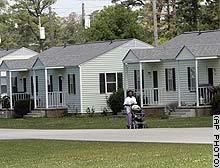 Base housing at Midway Park neighborhood at Camp Lejeune. Government investigators are trying to determine how toxins in their water affected Marines and their families.
CNN reports:
Some 75,000 Marines and their families at Camp Lejeune in North Carolina were exposed to toxic tap water that may have caused cancer and birth defects, a federal health official testified Tuesday.
Results of a new study of the base's water were released Tuesday, the same day lawmakers heard emotional testimony from families who were affected by the water, which contained 40 times the amount of toxins considered safe by today's standards.
Camp Lejeune's water supply was polluted from 1957 until 1987 by TCE, a degreasing solvent, and PCE, a dry cleaning agent. The chemicals apparently came from a dry cleaning store near the base, according to the government.
The substances are possible carcinogens.
Camp kids have cancer, disorders
Jerry Ensminger, a 24-year Marine Corps veteran, said his daughter, Jane, born in 1976 at Camp Lejeune, was diagnosed with leukemia at age 6 and died at age 9.
Jeff Byron, a former Marine air traffic controller, moved with his family into base housing in 1982, three months after his first daughter Andrea was born and two years before his daughter Rachel was born.
Rachel is developmentally disabled, has spina bifida and was born with a cleft palate, he said. Andrea has a rare bone marrow syndrome known as aplastic anemia, according to Byron's testimony.
Dr. Michael Gros, a Navy obstetrician at Camp Lejeune in the early 1980s, was diagnosed with lymphoma after living in Camp Lejeune housing, he said.
Gros said he has had to give up his medical practice and his treatment has cost more than $4.5 million.
Thomas Sinks, deputy director of the National Center for Environmental Health at the Centers for Disease Control and Prevention, said the reports are anecdotal and that there has been no proven link between specific cases of illness and the contaminated water.
At least 850 former Camp Lejeune residents have filed legal claims.
Pollution discovered in 1982
In 1992, federal regulators set the maximum allowable amount at 5 micrograms of PCE per liter, Sinks told CNN in a telephone interview after he testified before the House Oversight and Investigations Subcommittee.
But residents at Camp Lejeune were exposed to an average of 70 micrograms of PCE per liter, with the highest levels around 200 micrograms per liter.
The contamination was discovered in 1982 in several wells that fed into two of the base's eight water systems, according to the Agency for Toxic Substances and Disease Registry, a federal public health agency.
The agency, which has been studying the contamination since 1993, blamed leaking underground storage tanks, spills and drum disposal as well as solvent-disposal practices at an off-base dry cleaners.
The agency has also initiated a study on whether 12,000 offspring of women who drank the base's water while pregnant are at increased risk of developing certain birth defects or illnesses.
No study has been undertaken on how the Marines themselves may have been affected, Sinks said.
For the moment, the agency is recommending only that people who lived on the base from 1957 to 1987 check with their doctors.
Its Web site, www.atsdr.cdc.gov/sites/lejeune, lets Marines enter the dates they lived on the base and learn about their exposure.
"The purpose of the hearing today is to get some answers," said the committee's chairman, Democratic Rep. Bart Stupak of Michigan, in prepared remarks.
He then ticked through a list of questions he wanted answered:
"When did the Marine Corps learn that the drinking water at Camp Lejeune, a military base with nearly 100,000 residents, was contaminated with dangerous chemicals?
"Why were the 'closed' wells not immediately capped and abandoned, but continued to be used to supply water at various points at least into 1987?
"When and how were the residents told about the contamination? Was the notification adequate?
"Did exposure to the drinking water cause cancer and birth defects in children conceived at the base? What about adults who drank the water?
"How has the Marine Corps responded to those affected? Has it taken care of its own?"
The chairman of the committee, Democratic Rep. John Dingell of Michigan, said he will examine handling of the water investigation in 2005 by the Environmental Protection Agency's criminal division.
An EPA investigator, Tyler Amon, acknowledged Tuesday that officials had considered accusing some civilian Navy employees of obstruction of justice.
Amon, who testified despite objections from the Bush administration, said some employees interviewed during the criminal investigation appeared coached and were not forthcoming with details.
Rep. Ed Whitfield of Kentucky, the panel's ranking Republican, said he was puzzled why criminal charges weren't pursued.
"We have many people who have died," Whitfield said. "We have many people who have suffered significant health problems."
