Vice President's email lost for key week in CIA leak probe
MSNBC reports:
When Special Counsel Patrick Fitzgerald wanted to find out what was going on inside Vice President Dick Cheney's office, the prosecutor in the CIA leak probe made a logical move. He dropped a grand jury subpoena on the White House for all the relevant e-mail.
One problem: Even though White House computer technicians hunted high and low, an entire week's worth of e-mail from Cheney's office was missing. The week was Sept. 30, 2003, to Oct. 6, 2003, the opening days of the Justice Department's probe into whether anyone at the White House leaked the identity of CIA operative Valerie Plame.
That episode was part of the picture that unfolded Tuesday on Capitol Hill, where Democrats on a House committee released new information about one of the Bush White House's long-running issues, its problem-plagued e-mail system.
For the first time, a former White House computer technician went public with the details. Steven McDevitt revealed in written statements submitted to Congress how a plan was developed to try to recover the missing e-mail for Fitzgerald.
Ultimately, 250 pages of electronic messages were retrieved from the personal e-mail accounts of officials in Cheney's office, but whether that amounted to all the relevant e-mail is a question that may never be answered.
McDevitt made clear that it was a sensitive issue inside the White House.
"I worked with ... White House Counsel on efforts to provide an explanation to the special prosecutor," McDevitt wrote. "This included providing a briefing to the special prosecutor's staff on this subject."
McDevitt provided no details of the meetings with White House Counsel Harriet Miers and others in the counsel's office in late 2005 and early 2006. The White House refused to comment on those meetings.
White House on defensive
The White House put the best face on a bad hearing Tuesday of the House Oversight and Government Reform Committee, defending the administration's handling of its electronic messages.
McDevitt said that one estimate from a 2005 analysis was that more than 1,000 days of e-mail were missing from January 2003 to Aug. 10, 2005. McDevitt said "the process by which e-mail was being collected and retained was primitive and the risk that data would be lost was high." The "low end" estimate was about 470 days, he added.
The White House says a substantial amount of what had been believed to be missing e-mail had been located.
"We are very energized about getting to the bottom of this" issue, Theresa Payton, chief information officer at the White House Office of Administration, testified to the committee.
"This is a form of sandbagging," replied Oversight Committee Chairman Henry Waxman, D-Calif., who pointed out that by the time the White House fixes its e-mail problems, "you'll be out of office."
E-mail shortcomings
McDevitt's statements detailed shortcomings that he said have plagued the White House e-mail system for six years. He said:* The White House had no complete inventory of e-mail files.
* There was no automatic system to ensure that e-mail was archived and preserved.
* Until mid-2005 the e-mail system had serious security flaws, in which "everyone" on the White House computer network had access to e-mail. McDevitt wrote that the "potential impact" of the security flaw was that there was no way to verify that retained data had not been modified.
* A new e-mail archiving system that would have addressed the problems was "ready to go live" on Aug. 21, 2006.
Payton told Waxman's committee she canceled the new system in late 2006 because it would have required modifications and additional spending. An alternative system is under way, she said.
Payton's predecessor, Carlos Solari, told the House committee that he was puzzled that the new system had been rejected and that he had "absolutely" believed that the system Payton rejected would be implemented.
When President Bush leaves office, presidential records and federal records at the White House will be turned over to the National Archives. Waxman produced a memo pointing to a lack of cooperation between the White House and the Archives.
"We still know virtually nothing about the status of the alleged missing White House e-mails," the Archives' general counsel, Gary Stern, wrote to his boss last September.
Wednesday, February 27, 2008
| [+/-] |
Cheney's Subpoenaed E-Mails Missing |
Saturday, January 19, 2008
| [+/-] |
White House Emails Missing in CIA Leak Probe? |
The Associated Press reports:
Apparent gaps in White House e-mail archives coincide with dates in late 2003 and early 2004 when the administration was struggling to deal with the CIA leak investigation and the possibility of a congressional probe into Iraq intelligence failures.
The gaps — 473 days over a period of 20 months — are cited in a chart prepared by White House computer technicians and shared in September with the House Reform and Government Oversight Committee, which has been looking into reports of missing e-mail.
Among the times for which e-mail may not have been archived from Vice President Dick Cheney's office are four days in early October 2003, just as a federal probe was beginning into the leak of Valerie Plame's CIA identity, an inquiry that eventually ensnared Cheney's chief of staff.
Contents of the chart — which the White House now disputes — were disclosed Thursday by Rep. Henry Waxman, a California Democrat who chairs the House committee, as he announced plans for a Feb. 15 hearing.
Waxman said he decided to release details from the White House-prepared chart after presidential spokesman Tony Fratto declared "we have absolutely no reason to believe that any e-mails are missing."
Among the periods of time for which the chart indicates e-mail is missing is a five-day span starting on Jan. 29, 2004, when the White House was dealing with the possibility of an election-year probe by Congress into Iraq intelligence failures.
Not archived by the office of the vice president is e-mail for Jan. 29-31, 2004, according to chart information released by Waxman. In addition, all e-mail from the White House Office in the Executive Office of the President was listed as missing for one of those days.
The chart indicates that e-mail also was not archived by the White House on the following Monday — Feb. 2, 2004 — the day President Bush took a big step in averting what could have been a politically troublesome congressional inquiry. He ordered an independent investigation into intelligence failures in Iraq.
The president conferred that day with former chief weapons inspector David Kay, declaring, "I want to know all the facts."
The commission named by Bush reached a harsh verdict about the U.S. intelligence community's performance, but the panel stopped short of addressing the White House's use of the intelligence data to support the idea of war with Iraq.
The White House says computer back-up tapes should contain substantially all e-mails between 2003 and 2005. However, the White House recycled backup tapes until sometime in October 2003, taping over existing data. That could mean some e-mail is gone forever if it is also missing from archives.
An example might be any missing e-mail from Cheney's office in the early days of the CIA leak probe. The White House has not said when in October 2003 it halted the recycling of backup tapes.
E-mails in early October 2003 could reveal key discussions between White House personnel in the week after the Justice Department opened a criminal investigation into the leak of Plame's CIA identity. The White House denied that Cheney chief of staff I. Lewis "Scooter" Libby or top presidential adviser Karl Rove were involved in the leak, an assertion that turned out to be false.
"Can it be a mere coincidence that some of the missing e-mail correspond to a key period during the Valerie Plame investigation?" asked Melanie Sloan, executive director of Citizens for Responsibility and Ethics in Washington. "Given everything else we know, that is nearly impossible to believe."
Her organization is one of two private advocacy groups suing the White House in the e-mail controversy.
At issue on Oct. 1, 2003, was the push by congressional Democrats for Attorney General John Ashcroft to step aside and appoint an independent prosecutor to investigate the White House.
Ashcroft eventually recused himself, and at the end of 2003 U.S. Attorney Patrick Fitzgerald was appointed by a Justice Department official to head the probe. Two years later, Libby was indicted, and he was later convicted of obstructing the investigation. His 30-month prison sentence was commuted by Bush. Rove was questioned by a federal grand jury five times but was never charged.
In January 2006, shortly after Libby was indicted, a letter from Fitzgerald to Libby's lawyers was the first public disclosure that the White House was having a problem with its e-mail system.
Fitzgerald wrote: "We have learned that not all e-mail of the Office of Vice President and the Executive Office of the President for certain time periods in 2003 was preserved through the normal archiving process on the White House computer system."
The White House says the e-mail matter arose in October 2005 in connection with the Justice Department's CIA leak probe, in which Fitzgerald later that month obtained a grand jury indictment against Libby for perjury, obstruction and lying to the FBI.
Thursday, July 19, 2007
| [+/-] |
Federal Judge Dismisses Valerie Plame's Lawsuit |
A federal judge appointed by George W. Bush throws out Valerie Plame's lawsuit.
The LATimes reports:
A federal judge today dismissed a lawsuit by former CIA operative Valerie Plame and her husband seeking damages against Vice President Dick Cheney, former Cheney aide I. Lewis "Scooter" Libby and two others she accused of conspiring to disclose her identity.
Plame and her husband, former diplomat Joseph C. Wilson IV, had alleged that Cheney, Libby, White House political advisor Karl Rove and former State Department official Richard L. Armitage had violated their constitutional rights in the events that led to Plame being identified in news reports in the summer of 2003.
U.S. District Judge John Bates rejected the lawsuit in a 41-page ruling today.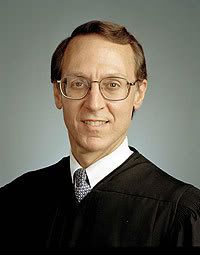
Without offering an opinion on the merits of the case, Bates said it was barred by other statutes that Congress had enacted to cover instances of alleged harm to CIA operatives and other federal employees.
"The court finds that, under controlling Supreme Court precedent, special factors — particularly the remedial scheme established by Congress in the Privacy Act — counsel against the recognition of an implied damages remedy for plaintiffs' constitutional claims," the judge ruled.
Bates also wrote that he was concerned about "creating a private right of action for the disclosure of covert identity," and that such lawsuits could "inevitably require judicial intrusion into matters of national security."
Lawyers for Cheney and the other defendants had argued in court filings that the lawsuit would be "inimical" to the ability of the executive branch to protect national security information.
Libby was convicted in March of lying to a grand jury and federal investigators about his role in the CIA leak case, and was sentenced to 30 months in prison. President Bush commuted his prison sentence this month, but left in place a $250,000 fine and two years' supervisory release.
Lawyers for Wilson and Plame said they would appeal the decision.
Melanie Sloan, executive director of Citizens for Responsibility and Ethics, and one of the couple's lawyers, said Bates' decision recognized that the Wilsons' claims posed "important questions relating to the propriety of actions undertaken by our highest government officials."
But, she said, the judge dismissed their lawsuit on a threshold legal issue centered on the difficulty of suing a federal official.
"While we are obviously very disappointed by today's decision, we have always expected that this case would ultimately be decided by a higher court." Sloan said. "We disagree with the court's holding and intend to pursue this case vigorously to protect all Americans from vindictive government officials who abuse their power for their own political ends."
Monday, July 2, 2007
| [+/-] |
Bush's Statement On The Libby Commutation |
Bush's statement on Monday in sparing former White House aide I. Lewis "Scooter" Libby from a 2 1/2-year prison term:
The United States Court of Appeals for the D.C. Circuit today rejected Lewis Libby's request to remain free on bail while pursuing his appeals for the serious convictions of perjury and obstruction of justice. As a result, Mr. Libby will be required to turn himself over to the Bureau of Prisons to begin serving his prison sentence.
I have said throughout this process that it would not be appropriate to comment or intervene in this case until Mr. Libby's appeals have been exhausted. But with the denial of bail being upheld and incarceration imminent, I believe it is now important to react to that decision.
From the very beginning of the investigation into the leaking of Valerie Plame's name, I made it clear to the White House staff and anyone serving in my administration that I expected full cooperation with the Justice Department. Dozens of White House staff and administration officials dutifully cooperated.
After the investigation was under way, the Justice Department appointed United States Attorney for the Northern District of Illinois Patrick Fitzgerald as a special counsel in charge of the case. Mr. Fitzgerald is a highly qualified, professional prosecutor who carried out his responsibilities as charged.
This case has generated significant commentary and debate. Critics of the investigation have argued that a special counsel should not have been appointed, nor should the investigation have been pursued after the Justice Department learned who leaked Ms. Plame's name to columnist Robert Novak. Furthermore, the critics point out that neither Mr. Libby nor anyone else has been charged with violating the Intelligence Identities Protection Act or the Espionage Act, which were the original subjects of the investigation. Finally, critics say the punishment does not fit the crime: Mr. Libby was a first-time offender with years of exceptional public service and was handed a harsh sentence based in part on allegations never presented to the jury.
Others point out that a jury of citizens weighed all the evidence and listened to all the testimony and found Mr. Libby guilty of perjury and obstructing justice. They argue, correctly, that our entire system of justice relies on people telling the truth. And if a person does not tell the truth, particularly if he serves in government and holds the public trust, he must be held accountable. They say that had Mr. Libby only told the truth, he would have never been indicted in the first place.
Both critics and defenders of this investigation have made important points. I have made my own evaluation. In preparing for the decision I am announcing today, I have carefully weighed these arguments and the circumstances surrounding this case.
Mr. Libby was sentenced to 30 months of prison, two years of probation and a $250,000 fine. In making the sentencing decision, the district court rejected the advice of the probation office, which recommended a lesser sentence and the consideration of factors that could have led to a sentence of home confinement or probation.
I respect the jury's verdict. But I have concluded that the prison sentence given to Mr. Libby is excessive. Therefore, I am commuting the portion of Mr. Libby's sentence that required him to spend 30 months in prison.
My decision to commute his prison sentence leaves in place a harsh punishment for Mr. Libby. The reputation he gained through his years of public service and professional work in the legal community is forever damaged. His wife and young children have also suffered immensely. He will remain on probation. The significant fines imposed by the judge will remain in effect. The consequences of his felony conviction on his former life as a lawyer, public servant and private citizen will be long-lasting.
The Constitution gives the president the power of clemency to be used when he deems it to be warranted. It is my judgment that a commutation of the prison term in Mr. Libby's case is an appropriate exercise of this power.
