The New York Times reports:
An internal Justice Department inquiry has concluded that Bush administration lawyers committed serious lapses of judgment in writing secret memorandums authorizing brutal interrogations but that they should not be prosecuted, according to government officials briefed on its findings.
The report by the Office of Professional Responsibility, an internal ethics unit within the Justice Department, is also likely to ask state bar associations to consider possible disciplinary action, which could include reprimands or even disbarment, for some of the lawyers involved in writing the legal opinions, the officials said.
The conclusions of the 220-page draft report are not final and have not yet been approved by Attorney General Eric H. Holder Jr. The officials said that it is possible that the final report might be subject to further revision but that they did not expect major alterations in its main findings or recommendations.
The findings, growing out of an inquiry that started in 2004, would represent a stinging rebuke of the lawyers and their legal arguments.
But they would stop short of the criminal referral sought by some human rights advocates, who have suggested that the lawyers could be prosecuted as part of a criminal conspiracy to violate the anti-torture statute. President Obama has said the Justice Department would have to decide whether the lawyers who authorized the interrogation methods should face charges, while pledging that interrogators would not be investigated or prosecuted for using techniques that the lawyers said were legal.
The draft report is described as very detailed, tracing e-mail messages between the Justice Department lawyers and officials at the White House and the Central Intelligence Agency. Among the questions it is expected to consider is whether the memos were an independent judgment of the limits of the federal anti-torture statute or were deliberately skewed to justify the use of techniques proposed by the C.I.A.
At issue is the question of whether the lawyers acted ethically and competently in writing a series of Justice Department legal opinions from 2002 to 2007.
The opinions permitted the Central Intelligence Agency to use a number of methods that human rights groups and legal experts have condemned as torture, including waterboarding, wall-slamming and shackling for hours in a standing position. The opinions allowed many of these practices to be used repeatedly and in combination.
The main targets of criticism are John Yoo, Jay S. Bybee and Steven G. Bradbury, who, as senior officials of the department’s Office of Legal Counsel, were principal authors of the opinions.
It was unclear whether all three would be the subject of bar association referrals. One person who saw the report said it did not recommend bar action against Mr. Bradbury.
Mr. Bradbury, and lawyers for Mr. Yoo, now a law professor at Berkeley, and for Mr. Bybee, now a federal appeals court judge in Nevada, all declined to comment Tuesday, saying Justice Department rules require confidentiality for ethics reviews.
The work of other lawyers in the counsel’s office was also questioned in the report, the officials said, but none are believed to be the subject of disciplinary recommendations. The report reaches no conclusions about the role of lawyers at the White House or the C.I.A. because the jurisdiction of the ethics unit does not extend beyond the Justice Department.
The draft report on the interrogation opinions was completed in December and provoked controversy inside the Bush administration Justice Department. But criticism of the legal work in the memos has intensified since last month when the Obama administration disclosed one previously secret opinion from 2002, drafted mainly by Mr. Yoo and signed by Mr. Bybee, and three from 2005, signed by Mr. Bradbury, which for the first time described the coercive interrogation methods in detail.
Michael B. Mukasey, attorney general when the draft report was first completed, was said by colleagues to have been critical of its quality and upset over its scathing conclusions. He wrote a 10-page rebuttal to its findings, and, in his farewell speech to employees, warned against second-guessing the legal work of the department’s lawyers.
Several legal scholars have remarked that in approving waterboarding, the near-drowning method Mr. Obama and his aides have described as torture, the Justice Department lawyers did not cite cases in which the United States government previously prosecuted American law enforcement officials and Japanese World War II interrogators for using the procedure.
In a letter on Monday, the Justice Department advised two Democratic senators on the Judiciary committee, Richard J. Durbin of Illinois and Sheldon Whitehouse of Rhode Island, that the former department lawyers who wrote the opinions had until May 4 to submit written appeals to the findings.
The letter, written by Ronald Weich, an assistant attorney general, also said the report had been given to the C.I.A. for review and declassification, and some officials said they expected a version to be made public, probably late this month.
Mr. Durbin and Mr. Whitehouse, who have criticized the Bush administration’s interrogation policies, have repeatedly demanded the release of the report. Mr. Whitehouse is scheduled to hold a hearing on May 13, to examine issues related to the report.
The professional responsibility office first began examining the actions of the lawyers nearly five years ago. Recently, Mr. Holder named Mary Patrice Brown, a senior federal prosecutor in Washington to head the office, moving its longtime chief, H. Marshall Jarrett, to another job within the Justice Department.
Tuesday, May 5, 2009
| [+/-] |
Torture Memos: Inquiry Suggests No Prosecutions |
Friday, March 6, 2009
| [+/-] |
Is Bagram Obama's Guantanamo? |
The first and last legacy of the Bush detention era is the prison at Bagram Air Base. But torture expert Karen Greenberg writes that there are no signs so far that the Obama administration is going to make any changes there. And still unclear: Who is being held there? Were all the prisoners captured in Aghanistan, or were some brought from other countries? What status do they have? Are they classified as 'prisoners of war' or as Bushian 'unlawful enemy combatants'? How are they being treated?
At Neiman Watchdog, Karen Greenberg writes:
Just when you think you've woken up from a bad dream…When it comes to offshore injustice and secret prisons, especially our notorious but little known prison at Bagram Air Base in Afghanistan, let's hope the Obama years mean never having to complete that sentence.
In the Bush era, those of us who followed his administration's torture, detention, and interrogation policies often felt like we were unwilling participants in a perverse game of hide-and-seek. Whenever one of us stumbled upon a startling new document, a horrific new practice, a dismal new prison environment, or yet another individual implicated in torture policy, the feeling of revelation would soon be superseded by a sneaking suspicion that we were once again looking in the wrong direction, that the Bush administration was playing a Machiavellian game of distraction with us.
Okay, call it paranoia -- a state of mind well suited to the Age of Cheney -- but when Abu Ghraib finally came to light, it turned out that our real focus should have been on the administration's program of "extraordinary rendition" and the CIA secret flights to the foreign countries that were serving as proxy torturers for the United States. And when one case of torture by proxy, that of Maher Arar, achieved some prominence, we began looking at proxy torturers for the United States, when we should have been looking at legalized policies of torture by the U.S.
Several years ago, British human rights lawyer Clive Stafford Smith placed that jewel in the Bush administration's offshore crown of injustice, Guantanamo, in the category of distraction as well -- distraction, that is, from the far grimmer and more important American detention facility at Bagram Air Base in Afghanistan.
Distracted or not, for at least five years some of us have been seeking the hidden outlines of the torture story. Now, President Obama has given it a visible shape by providing a potential endpoint if not to our investigations, then to our focus. Much of what we focused on in these last years he's declared to be history. Guantanamo will be closed within a year and the American role in the war in Iraq will end as well; torture will once again be banned; a new task force, already assembled, will review all the Bush administration's detention policies; and people like me will, assumedly, finally be out of work and able to write those novels we used to dream about. For us, no more unwelcome obsessions with detention, abuse, and torture.
Bad Times at Bagram
Still, ever since the Oval Office changed hands in January, I've had a nagging feeling that something was amiss. And when I finally focused on it, a single question kept coming to mind: Whatever happened to the U.S. prison at Bagram?
I knew that it had been opened in 2002 on an abandoned Soviet air base the U.S. had occupied and was being massively upgraded after the invasion of Afghanistan, and that its purpose was to hold prisoners in the Global War on Terror at a place as far removed as possible from the prying eyes of American courts or international oversight bodies of any sort. In fact, many of those eventually transported to Guantanamo were originally held under even worse conditions at Bagram and, from early on, they had reported beatings, abuse, and a startlingly wide range of other forms of mistreatment there.
But what else did I know? Thanks to New York Times reporters Carlotta Gall, David Rohde, Tim Golden, and Eric Schmitt, as well as to Alex Gibney's documentary film Taxi to the Dark Side, I knew that two Afghans, Dilawar and Jullah Habibullah, had been beaten to death by U.S. Army interrogators at the prison in December 2002. I also knew that the use of such beatings, as well as various other forms of torture, had been normalized at Bagram at the very beginning of the Bush administration's long march of pain that led to Guantanamo and then on to Abu Ghraib and other prisons in Iraq as well as foreign torture chambers.
From the 2004 Church Report (written by Naval Inspector General Admiral T. Church), I knew that military interrogators and guards at Bagram had been given next to no relevant training for the mission of detention and interrogation. I knew as well that a secret CIA prison was allegedly located apart from the regular detention cells at Bagram. I knew that military officials had declared that the interrogation techniques at Bagram seemed to work better than those being used at Guantanamo in the same period. And that, after the Supreme Court issued a decision in 2004 to allow prisoners at Guantanamo to challenge their detentions, the prison population at Bagram began to grow.
What We Don't Know About a Prison Nightmare
But that was the past. What did I know about the situation in the first weeks of the Obama era?
The unnerving answer was precious little. So, as I had done with Guantanamo and Abu Ghraib, I began by asking the simple questions that had once been so difficult to answer about so many offshore detention facilities of the Bush era: Who was being held at Bagram? How many prisoners were there and from which countries? What status did they have? Were they currently classified as "enemy prisoners of war" or -- in the phrase the Bush administration had so favored in an attempt to confound U.S. courts -- "unlawful enemy combatants"? How were they being treated? What reports on prison conditions had either the U.S. government or interested non-governmental organizations released?
Setting aside the frustrations of the past seven years, I naively tried a basic Google search to see just what was instantly available, only to discover that the answer was essentially nothing.
It turns out that we can say very little with precision or confidence about that prison facility or even the exact number of prisoners there. News sources had often reported approximately 500-600 prisoners in custody at Bagram, but an accurate count is not available. A federal judge recently asked for "the number of detainees held at Bagram Air Base; the number of Bagram detainees who were captured outside Afghanistan; and the number of Bagram detainees who are Afghan citizens," but the information the Obama administration offered the court in response remains classified and redacted from the public record.
We don't even know the exact size of the prison or much about the conditions there, although they have been described as more spartan and far cruder than Guantanamo's in its worst days. The International Committee of the Red Cross has visited the prison, but it remains unclear whether they were able to inspect all of it. A confidential Red Cross report from 2008 supposedly highlighted overcrowding, the use of extreme isolation as a punishment technique, and various violations of the Geneva Convention.
We do know that a planned expansion of the facility is underway and will -- if President Obama chooses to continue the Bush project there -- enable up to 1,100 prisoners to be held (a step which will grimly complement the "surge" in American troops now underway in Afghanistan). There are no figures available on how long most of Bagram's prisoners have been held -- although some, it seems, have been imprisoned without charges or recourse for years -- or how legal processes are being applied there, if at all. Last spring, the International Herald Tribune reported that Afghans from Bagram were sometimes tried in Afghan criminal proceedings where little evidence and no witnesses were presented.
To students of Guantanamo, this sounds uncomfortably familiar. And there's more that's eerily reminiscent of Gitmo's bleak history. According to the New York Times, even four years after Bagram was established, wire cages were being used as cells, with buckets for toilets -- as was also true of the original conditions at Camp X-Ray, the first holding facility at Guantanamo. Similarly, as with Guantanamo, the U.S. has no status of forces agreement with Afghanistan, and so the base and prison can be closed or turned over to the Afghans only on U.S. say-so. Above all, while some Bagram detainees do have lawyers, most do not.
The Prison Where It All Began
While I was wondering about the state of our black hole of incarceration in Afghanistan, the Obama administration issued its first terse statement on the subject. When it came to granting Bagram detainees habeas rights (that is, the right to challenge their detention in U.S. courts), the administration simply stated that it "adheres to [the Justice Department's] previously articulated position": habeas would not be granted.
After all, reasoned the new government lawyers (like their predecessors), Bagram is in an indisputable war zone and different legal considerations should apply. But here's the catch neither the Bush administration, nor evidently the Obama administration, has cared to consider: It's quite possible that these four individuals, like others at Bagram, were not captured on an Afghan battlefield (as the prisoners claim), but elsewhere on what Bush officials liked to think of as the "global battlefield" of the War on Terror, and then conveniently transported to Bagram to be held indefinitely.
The U.S. government refuses to make public any documentation that would support its case and the new court documents, submitted by the lawyers of the Obama Justice Department, are frustratingly blacked out just as those of the Bush era Justice Department always were. At least for the moment then, when it comes to Bagram, tactics and arguments remain unchanged from the Bush years. No wonder journalists and human rights lawyers have lately taken to referring to that prison as the "other Guantanamo," or "Guantanamo II," or more combatively, "Obama's Guantanamo."
Sadly, however, even this is inaccurate. From the get-go, Guantanamo was actually the "other Bagram." The obvious question now is: How will the Obama administration deal with this facility and, in particular, with matters of detention, "enforced disappearance," and coerced testimony? Will these be allowed to continue into the future, Bush-style, or will the Obama administration extend its first executive orders on Guantanamo and torture practices to deal in new ways with the prison where it all began?
Facing Crimes of the Bush Era
President Obama has given a newly convened task force six months -- a long time when people are being held in harsh conditions without charges or recourse -- to consider the matter of Bush administration detention practices and formulate new policies (or, of course, retain old ones). Here are some guidelines that may prove helpful when it comes to Bagram:
1. On secrecy: The appeal to secrecy and national security has been an all-purpose refuge of official rogues for the last seven years. Reconsider it. A sunshine policy should apply, above all else, to detention practices. Ideally, the U.S. should simply release full information on Bagram and the prisoners being held there. When, in specific cases, information is not divulged, the reasons for not doing so should be fully revealed. Otherwise, the suspicion will always arise that such withheld information might be part of a cover-up of government incompetence or illegality. That must be ruled out. It is imperative that President Obama's administration not double down on the Bush administration's secrecy policy from a desire not to look back and so to avoid future prosecutions of Bush officials.
2. On classification of prisoners: The Obama administration should seriously consider declaring the prisoners at Bagram to be "prisoners of war," and so subject to the Geneva Conventions. Currently, they are classified as enemy combatants, as are the prisoners at Guantanamo, and so, in the perverse universe of the Bush administration, free from any of the constraints of international law. The idea that the Conventions are too "rigid" for our moment and need to be put aside for this new extra-legal category has always been false and pernicious, primarily paving the way for the use of "enhanced interrogation techniques."
3. On "ghost prisoners": The Obama administration should reject out of hand the idea that prisoner invisibility is acceptable anywhere, including at Bagram. The International Committee of the Red Cross must be granted access to all of the prisons or prison areas at Bagram, while conditions of detention there should be brought into accordance with humane treatment and standards. No "ghost prisoners" should be allowed to exist there.
4. On guilt and innocence: The belief that there is a categorical difference between guilt and innocence, which went by the wayside in the last seven years, must be restored. All too often, the military brass still assumes that if you were rounded up by U.S. forces, you are, by definition, guilty. It's time to change this attitude and return to legal standards of guilt.
In the Bush years, we taught the world a series of harmful lessons: Americans can be as cruel as others. Americans can turn their backs on law and reciprocity among nations as efficiently as any tribally organized dictatorship. Americans, relying on fear and the human impulse toward vengeance, can dehumanize other human beings with a fervor equal to that of others on this planet.
It's time for a change. It's time, in fact, to face the first and last legacy of Bush detention era, our prison at Bagram Air Base, and deal with it.
Call me a perpetual optimist, but President Obama has the right team in place to address this nightmarish legacy in a wise and timely way. We should expect no less from them than a full restoration of a government responsible to the law, and confident of its power to deter enemies legally -- be it on the battlefield or in the courtroom. So, too, we must expect them to possess the courage to confront truths, even if those truths mean heading down the path towards the prosecution of crimes of the Bush years.
Karen J. Greenberg is the Executive Director of the Center on Law and Security at New York University School of Law. She is the author of The Least Worst Place: Guantanamo's First 100 Days, the editor of the NYU Review of Law and Security, co-editor of The Torture Papers: The Road to Abu Ghraib, and editor of Al Qaeda Now and The Torture Debate in America (Cambridge University Press).
Thursday, June 12, 2008
| [+/-] |
Army Spreads Partisan Attacks Against Obama |
At the Washington Post, Phillip Carter writes, Army Shows Its Colors:
The Army's public affairs office publishes a daily roundup of Army-related news called "Stand To" -- named for the set of procedures combat units do just prior to dawn, when they go to full alert for a possible enemy attack. The daily wrapup contains links to mainstream media articles, Army press releases, foreign media stories and blogs. It's similar to the Defense Department's Early Bird -- but much briefer, and obviously more focused on the Army.
Tuesday's edition contained an entry under "WHAT'S BEING SAID IN BLOGS" that struck me as unusual -- both for its headline and its patent political bias:
Obama: World peace thru surrender (KDIHH)
The link goes to a milblog called "Knee Deep in the Hooah." The author is a former Army officer whose son is serving in Iraq now. After citing a column on some curious Pentagon planning for an Obama administration, he goes on to write:
Roger that Redleg six, throwing away all ammo now and preparing to surrender ... Redleg five, out.Seriously? Have any of these people actually read the Obama defense policy papers or speeches-- or are they simply going on what they hear on Fox News and the Limbaugh network?
After all, what better time to surrender than when we are winning? The article cited above also includes a Youtube link so that you can see the end for yourself in the end makers own words. Sure. This is all old news for those of us who care. But it still ticks me off anyway. So I thought to myself,"Why not share the wealth?" Now I can be ticked off in good company. Enjoy.
Mr.Hooah!, out.
And more to the point, why is the Army's official in-house public affairs shop linking to this kind of stuff? Just a few weeks ago, the chairman of the Joint Chiefs of Staff told all hands to stay out of politics: "As the nation prepares to elect a new president, we would all do well to remember the promises we made: to obey civilian authority, to support and defend the Constitution and to do our duty at all times.... Keeping our politics private is a good first step." He added: "The only things we should be wearing on our sleeves are our military insignia."
Unfortunately, the message didn't get to through to the Army.
Let's be clear: It is okay for the services to have a message. Both the Early Bird and Stand To speak for the Pentagon and the Army as institutions, and that's okay. They generally support the troops, the military, the chain of command, and the current endeavors in Iraq and Afghanistan. Nothing wrong with that.
And I have no objections to what Mr. Hooah wrote, besides the fact that I think it's factually wrong. He has his opinion; I have mine.
But the Stand To page is different -- and Tuesday's edition crosses the line. This isn't some citizen's blog or website. It's the in-house public affairs digest of the United States Army. It should not be amplifying partisan political attacks, nor should it be airing them at all. This appears like yet another example of the unusually cozy relationship which has developed over the last generation or so between the military and the right wing of American politics -- an unhealthy development, to say the least.
Last time I checked, soldiers and civilian officials didn't swear an oath to either political party or to their current president. Rather, they swear their fidelity to the Constitution, and the ideals it embodies, including the subordination of the military to civil authority. Adm. Mullen is right: As we enter a contentious election year, where issues of national security are likely to dominate the debate, the military needs to stay on the sidelines.
Tuesday, February 26, 2008
| [+/-] |
Politicos Squabble Over 'Missing' White House E-Mails |
At NewsBlog, Anne Broache reports:
Democrats and Republicans were warring Tuesday over reports that the White House has "lost"--or simply failed to keep--archives of e-mails belonging to the president and his advisers.
Since last spring, the U.S. House of Representatives Committee on Oversight and Government Reform has been investigating reports that an estimated 5 million messages from 473 days between 2003 and 2005 allegedly vanished from e-mail servers housed within the president's office.
A hearing convened by the committee gave Democratic leaders a new chance to press White House officials publicly on how and when they expect to recover the files.
"We still know virtually nothing about the status of the alleged missing White House e-mails," said Committee Chairman Henry Waxman (D-Calif.).
Allen Weinstein, archivist of the United States, said the National Archives and Records Administration had similarly gotten no response from the White House to its queries about what's going on. "I'm concerned about maintaining the fullest possible presidential records," he told the committee.
Republican leaders said they were also concerned about the prospect of missing nuggets of presidential history, but they accused the Democrats of failing to acknowledge the White House's ongoing efforts to retrieve the messages. Republican Ranking Member Tom Davis (R-Va.) said the White House has said it has since reduced the number of days' worth of missing e-mails from 473 to 202 after discovering that those messages had been filed "in the wrong digital drawer" as part of a switch from the Lotus Notes to Microsoft Exchange e-mail system in 2002.
White House Chief Information Officer Theresa Payton assured the committee that her office is working actively on a multi-step restoration process. Their early results have identified an unspecified number of the previously "missing" messages, though those results still have to be validated.
When pressed by Davis, Payton also said she felt "very comfortable" that they would be able to reconstruct any remaining lost documents from "disaster recovery backup tapes," although she said that process would be time-consuming and could cost at least $15 million.
Did advisers use Republican National Committee accounts?
A separate issue under scrutiny revolves around charges that Karl Rove and some 50 other presidential advisers were using Republican National Committee accounts to conduct official business and thus subvert federal record-keeping laws. The RNC has said it had virtually no records of e-mails sent on its servers by Rove and others before November 2003, which Democrats argue is troubling because those messages may contain important official information about the president's decision to go to war in Iraq.
Waxman said he heard from RNC officials as recently as Monday that the White House had made no effort to request backup tapes from the committee that may contain those files. He scolded White House officials for their inaction. Both Payton and her boss, White House Office of Administration director Alan Swendiman, said they wouldn't be responsible for making such requests but would look into who is.
Republicans accused the Democrats of pursuing the investigation simply to dig up dirt on Rove and waste hundreds of thousands of dollars of money that the RNC could be using to shore up its candidates' campaigns.
"Are we simply going on a fishing expedition at $40,000 to $50,000 a month?" Rep. Darrell Issa (R-Calif.) asked National Archives and White House officials at the hearing. "Do any of you know of a single document, because this committee doesn't, that should've been in the archives but in fact was done at the RNC?"
"I think the issue is always, were there official government public records on that system?" responded Gary Stern, general counsel to the National Archives.
The loss of documents in either case is potentially significant because federal laws, including the Presidential Records Act, requires the White House to preserve all documents related to the president and vice president's official business and turn them over to the National Archives. Personal records, including political campaign-related materials, are expected to be filed separately and not subject to the same restrictions. The matter has already sparked a lawsuit from an advocacy group called Citizens for Responsibility and Ethics in Washington.
Clinton administration's archiving problems
The Bush administration isn't the first to encounter problems with missing e-mails. During the mid-1990s, the Clinton administration at one point relied on a flawed e-mail archiving system that failed, among other things, to preserve e-mails sent by people whose names began with the letter D. The situation resulted in congressional hearings and some $11 million spent on reconstructing the some 200,000 missing e-mails, Waxman said.
The problems for the Bush administration apparently started soon after the White House decided to shift its e-mail system from Lotus Notes to Microsoft Exchange in 2002. It also replaced the automated records storage system devised by the Clinton administration with a system that one of its own experts described as "primitive," according to Waxman.
According to the committee, the archive system is an "ad hoc" process called "journaling," in which a White House staffer or contractor manually copies e-mails and saves them on various White House servers. Democrats cast more than a little suspicion on that practice. They cited testimony outside the hearing from a former White House technology worker who said, at least during some points in 2005, those files and directories were available to all 3,000 employees under the umbrella of the executive office of the president.
White House CIO Payton, who began her job in May 2006, said she was unaware of anything of the sort. She also said she had no knowledge of anyone intentionally deleting or tampering with files and later said the copying of messages is automatic, not manual.
"We want to make sure we get all the e-mails over to the (National Archives) at transition" to the next president, she told the committee.
Sunday, February 24, 2008
| [+/-] |
The Prosecution of Governor Siegelman |
CBS News reports:
Is Don Siegelman in prison because he’s a criminal or because he belonged to the wrong political party in Alabama? Siegelman is the former governor of Alabama, and he was the most successful Democrat in that Republican state. But while he was governor, the U.S. Justice Department launched multiple investigations that went on year after year until, finally, a jury convicted Siegelman of bribery.
Now, many Democrats and Republicans have become suspicious of the Justice Department’s motivations. As correspondent Scott Pelley reports, 52 former state attorneys-general have asked Congress to investigate whether the prosecution of Siegelman was pursued not because of a crime but because of politics.
Ten years ago life was good for Don Siegelman. After he became governor, many believed he was headed to a career in national politics. In 1999, Siegelman’s pet project was raising money to improve education, so he started a campaign to ask voters to approve a state lottery. He challenged Republicans to come up with a better idea.
“You tell us how you’re going to pay for college scholarships. You tell us how you’re going to put state of the art computers inside every school in this state,” he said.
But now the applause has long faded. Today, Siegelman is at a federal prison camp in Louisiana. He’s doing seven years. The main charge against him was that he took a bribe, giving a position on a state board to businessman Richard Scrushy, who had made a big donation to that lottery campaign. There was a star witness, Nick Bailey, a Siegelman aide who had a vivid story to tell.
“Mr. Bailey had indicated that there had been a meeting with Governor Siegelman and Mr. Scrushy, a private meeting in the Governor's office, just the two of them,” says Doug Jones, who was one of Siegelman’s lawyers. “And then, as soon as Mr. Scrushy left, the governor walked out with a $250,000 check that he said Scrushy have given him for the lottery foundation.”
“Had the check in his hand right then and there? “ Pelley asks.
“Had the check in his hand right then,” Jones says.
“That Scrushy had just handed to him, according to Bailey's testimony?” Pelley asks.
“That's right, showed it to Mr. Bailey. And Nick asked him, ‘Well, what does he want for it?’ And Governor Siegelman allegedly said, ‘A seat on the CON Board.’ Nick asked him, ‘Can we do that?’ And he said, ‘I think so,’” Jones says.
The CON board regulates hospital construction, and Scrushy ran a healthcare company. Both Siegelman and Scrushy were convicted in federal court.
But, as 60 Minutes found out, the imprisonment of Don Siegelman is not nearly as simple as that.
“I haven't seen a case with this many red flags on it that pointed towards a real injustice being done,” says Grant Woods, the former Republican attorney general of Arizona.
Woods is one of the 52 former state attorneys-general, of both parties, who’ve asked Congress to investigate the Siegelman case.
“I personally believe that what happened here is that they targeted Don Siegelman because they could not beat him fair and square. This was a Republican state and he was the one Democrat they could never get rid of,” Woods says.
Now a Republican lawyer from Alabama, Jill Simpson, has come forward to claim that the Siegelman prosecution was part of a five-year secret campaign to ruin the governor. Simpson told 60 Minutes she did what’s called “opposition research” for the Republican party. She says during a meeting in 2001, Karl Rove, President Bush’s senior political advisor, asked her to try to catch Siegelman cheating on his wife.
"Karl Rove asked you to take pictures of Siegelman?" Pelley asks.
"Yes," Simpson replies.
"In a compromising, sexual position with one of his aides," Pelley clarifies.
"Yes, if I could," Simpson says.
She says she spied on Siegelman for months but saw nothing. Even though she was working as a Republican campaign operative, Simpson says she wanted to talk to 60 Minutes because Siegelman’s prison sentence bothers her conscience.
Simpson says she wasn’t surprised that Rove made this request. Asked why not, she tells Pelley, “I had had other requests for intelligence before.”
“From Karl Rove?” Pelley asks.
“Yes,” Simpson says.
Rove was a strategist in Alabama. Simpson says she worked with him on several campaigns.
60 Minutes contacted Rove. Through his lawyer, he denied Simpson’s allegations. One of Rove’s close Alabama associates was Republican consultant Bill Canary. Simpson says she was on a conference call in 2002 when Canary told her she didn’t have to do more intelligence work because, as Canary allegedly said, “My girls” can take care of Siegelman. Simpson says she asked “Who are your girls?”
“And he says, ‘Oh, my wife, Leura. You know, she's the Middle District United States Attorney.’ And he said, ‘And then Alice Martin. She is the Northern District Attorney, and I've helped with her campaign,’” Simpson says.
“Federal prosecutors?” Pelley asks.
“Yes, Sir,” she says.
Bill Canary denies the conversation ever happened. He told 60 Minutes he never tried to influence any government official in the case. His wife Leura Canary and Alice Martin are top federal prosecutors in the state. Both were appointed by President Bush, and their offices investigated Siegelman. Details of some of those investigations leaked to the press. And Siegelman lost his 2002 re-election campaign narrowly to Republican Bob Riley.
Two years later, as Siegelman geared up to run again, the Justice Department took one of its Siegelman investigations to trial-an indictment involving an alleged Medicaid scam.
“He’s indicted. He goes to trial. That's a pretty big deal to have your former governor on trial. Everybody's there. The government gives their opening argument. The judge says, ‘I want to see you in chambers because this case, there's no case here,’" Grant Woods says.
Woods says the judge threw the case out, without a witness testifying. “The case is so lame that he throws it out,” he says.
Vindicated, Siegelman focused on winning the 2006 election. And that’s when Jill Simpson says she heard the Justice Department was going to try again. She says she heard it from a former classmate and work associate Rob Riley, the son of the new Republican governor.
“Rob said that they had gotten wind that Don was going to run again,” she says.
“And Rob Riley said what about that?” Pelley asks.
“They just couldn't have that happen,” Simpson says.
Asked how they were going to prevent that from happening, she says, “Well, they had to re-indict him, is what Rob said.”
Simpson told this same story, under oath, to Congressional investigators in a closed session. Rob Riley told 60 Minutes he never talked to Jill Simpson about this.
Four months after Simpson says they spoke, Siegelman was indicted on new charges. Doug Jones, Siegelman’s lawyer, says one of the prosecutors told him that Justice Department headquarters in Washington had ordered a top to bottom review of the case. Today, the Alabama prosecutors deny that it was Washington - but whoever ordered it, there was a big boost to the investigation.
“They started over. People started getting subpoenas that had never gotten subpoenas before, for testimony, for records. The governor's brother, his bank records started getting subpoenaed. The net was cast much wider than had ever been cast before,” Jones says.
“You know, on the other hand, what's wrong with the Department of Justice vigorously investigating a case if they think there is an indictment to be made on public corruption charges?” Pelley asks.
“Well, you still have to investigate crimes, not people. It undermines the entire system of justice because at that point anybody can be a target. Any prosecutor can look across the table and say, ‘You know what? I just don't like you,’” Jones says.
The prosecution was handled by the office of U.S. Attorney Leura Canary, whose husband Bill Canary had run the campaign of Siegelman’s opponent, Gov. Riley.
“Why would you do it that way?” Woods asks. “Why wouldn't you say, ‘You know what? We're going to bring in someone from another jurisdiction to do it. There's a lot of United States attorneys around the country. We'll have somebody come in and do this case.’ That's not what happened in Alabama. Every time they had the chance to go the extra mile to be independent and objective, they didn't do it.”
Leura Canary handled the case for eight months. When defense attorneys objected, she turned it over to her assistants and says that she had nothing further to do with it.
In this new investigation, prosecutors zeroed in on that vivid story told by Siegelman’s aide, Nick Bailey, who said he saw the governor with a check in his hand after meeting Richard Scrushy. Trouble was, Bailey was wrong about the check, and Siegelman’s lawyer says prosecutors knew it.
“They got a copy of the check. And the check was cut days after that meeting. There was no way possible for Siegelman to have walked out of that meeting with a check in his hand,” Jones explains.
“That would seem like a problem with the prosecution's case,” Pelley remarks.
“It was a huge problem especially when you've got a guy who's credibility was going to be the lynch pin of that case. It was a huge problem,” Jones says.
And there was another problem with the prosecutor’s star witness: Nick Bailey was a crook. Unknown to Siegelman, Bailey had been extorting money from Alabama businessmen. Facing ten years in prison, Bailey agreed to cooperate with prosecutors to get a lighter sentence.
60 Minutes went to talk to Bailey. The Justice Department wouldn’t let our cameras into the prison, but we met with him for hours.
Bailey told 60 Minutes that before the Siegelman trial, he spoke to prosecutors more than 70 times, and he admitted that during those conversations he had trouble remembering details. He told 60 Minutes the prosecutors were so frustrated, they made him write his proposed testimony over and over to get his story straight.
If Bailey’s telling the truth, his notes, by law, should have been turned over to the defense. But Siegelman’s lawyers tell 60 Minutes they never saw any such notes and never had a chance to show the jury just how much Bailey’s story had changed.
No one at the Justice Department would be interviewed for this story, but they did send a statement which read, in part, "This case was brought by career prosecutors … based upon the law and the evidence alone. After considering that evidence … a jury of Mr. Siegelman's peers found him guilty beyond a reasonable doubt.”
But Grant Woods, the former attorney general of Arizona, says the case should never have gone to trial. “The prosecutor's gotta look at it and say, ‘Hey, is this the sort of thing that we're really talking about when we're talking about bribery?’ Because what the public needs to know here is there is no allegation that Don Siegelman ever put one penny in his pocket,” he says.
Richard Scrushy did make donations totaling $500,000 to that education lottery campaign, and after serving on the hospital board under three previous governors, Scrushy was re-appointed by Siegelman.
But Woods says that’s politics, not bribery. “You do a bribery when someone has a real personal benefit. Not, ‘Hey, I would like for you to help out on this project which I think is good for my state.’ If you're going to start indicting people and putting them in prison for that, then you might as well just build nine or ten new federal prisons because that happens everyday in every statehouse, in every city council, and in the Congress of the United States,” he says.
“What you seem to be saying here is that this is analogous to giving a great deal of money to a presidential campaign. And as a result, you become ambassador to Paris,” Pelley remarks.
“Exactly. That's exactly right,” Woods says.
Siegelman was campaigning in the 2006 Democratic primary as he went to trial. “We’re going to turn this bus into what we call the night shift, because after the trial every day we’re gonna be hittin the trail every day,” he said.
But he lost in the primary. After two months, the jury deadlocked twice, then, voted to convict on its third deliberation. Many legal minds were shocked when federal judge Mark Fuller, at sentencing, sent Siegelman directly to prison without allowing the usual 45 days before reporting.
“He had him manacled around his legs like we do with crazed killers. And whisked off to prison just like that. Now what does that tell you? That tells you that this was personal. You would not do that to a former governor,” Woods says.
“Would you do that to any white collar criminal?” Pelley asks.
“No, I haven't seen it done,” Woods says.
“Help me understand something. You're blaming the Republican administration for this prosecution. You're saying it was a political prosecution. You are a Republican. How do I reconcile that?” Pelley asks.
“We're Americans first. And you got to call it as you see it. And you got to stand up for what's right in this country,” Woods says.
Karl Rove and others at the White House were subpoenaed to testify before Congress but they refused to appear. And the Justice Department has refused to turn over hundreds of documents in the case.
Saturday, February 23, 2008
| [+/-] |
Governors Oppose New Medicaid Rules |
The New York Times reports:
Governors of both parties strongly objected on Saturday to a half-dozen new federal Medicaid regulations that they said would shift billions of dollars in costs to the states, forcing them to consider cutbacks in services.
The rules, scheduled to take effect in the next few months, would reduce federal payments for public hospitals, teaching hospitals and services for the disabled, among others.
State officials voiced their concerns as they arrived here for the winter meeting of the National Governors Association.
Federal health officials said the new rules were needed to end creative financing techniques that states had used to obtain excessive amounts of federal Medicaid money.
But governors said the Bush administration was unilaterally reshaping Medicaid in ways that would harm some of their most vulnerable citizens. Moreover, they said, the rules are taking effect at a time when the national economic slowdown is cutting into state tax revenues.
“Governors strongly oppose the changes,” said Gov. Jim Douglas of Vermont, a Republican who is chairman of the association’s Health and Human Services Committee. “The timing could not be worse.”
One of the rules would ban the use of federal Medicaid money to help pay for the training of doctors, a use that has been allowed since the inception of Medicaid more than 40 years ago. Another would set new limits on Medicaid payments to hospitals and nursing homes operated by states, cities, counties and other units of government.
A third rule would limit Medicaid coverage of rehabilitation services for people with disabilities, including serious mental illnesses.
Federal officials estimate that the rules will save the federal government $15 billion over five years. But that figure may be low. California alone says it could lose $12 billion over five years.
Congress delayed some of the rules last year, but they will soon take effect unless Congress intervenes again.
Gov. Arnold Schwarzenegger of California, a Republican, said the rule changes “would effectively end the federal government’s participation in many crucial components of the Medicaid program.”
Dr. Rhonda M. Medows, commissioner of the Georgia Department of Community Health, said: “We understand the need for financial safeguards, but these rules, taken together, would have a tremendous adverse impact. They would undermine the health care safety net for the entire state of Georgia, reducing federal Medicaid payments for hospitals, nursing homes and school clinics.”
The National Conference of State Legislatures joined governors in criticizing what it described as “the regulatory activism” displayed in the new rules.
The federal government and the states share the cost of Medicaid, which provides health insurance to more than 60 million low-income people, including 30 million children.
Dennis G. Smith, director of the federal Center for Medicaid and State Operations, said the rules were needed to “protect the fiscal integrity of the Medicaid program.” Since 2003, he said, federal officials have persuaded 30 states to end “questionable Medicaid financing arrangements.” The purpose of such arrangements is to maximize the use of federal money while holding down the use of state and local revenue.
Although the most blatant problems have been corrected, the administration says, many states still use federal Medicaid money for purposes unrelated to Medicaid.
“We believe that paying for graduate medical education is outside the scope of Medicaid’s role, which is to provide medical care to low-income people,” Mr. Smith said. “There is no explicit authorization under the Medicaid statute to subsidize the training of physicians.”
Robert M. Dickler, chief health care officer at the Association of American Medical Colleges, said, “It’s a little surprising that the federal government would just now discover that there’s no legal basis for the Medicaid payments it’s been making for medical education since 1965.”
Stan Rosenstein, the Medicaid director in California, said the payments were justified because “interns and residents provide a tremendous amount of care to Medicaid beneficiaries.”
The federal government says this rule would save $1.8 billion over five years. But New York, which trains 15 percent of the nation’s doctors, says it would lose more than that alone. State officials are also concerned about a rule that would eliminate federal contributions for a whole category of public spending on health care for the poor — specifically, spending by autonomous units of local government like the Denver Health and Hospital Authority.
“As a result of this rule, we will lose $60 million a year,” said Dr. Patricia A. Gabow, chief executive of the Denver agency, which operates a 477-bed public hospital, the city’s public health department and its ambulance service. “We were part of the city government for more than 130 years. In 1997, we became an independent governmental entity, but we don’t have taxing authority. So we don’t qualify as a public provider, and we can’t draw down critically important subsidies for services we provide to the entire community.”
Larry S. Gage, president of the National Association of Public Hospitals, said the rule’s importance went far beyond Medicaid because it would compromise the ability of public hospitals to provide vital services like trauma care and burn treatment.
New York City Health and Hospitals Corporation, the largest municipal health care system in the country, which gets 60 percent of its budget from Medicaid, said the rules would have “a potentially devastating impact” and could force cutbacks in services.
A group of 17 states, including Connecticut, Michigan and New Jersey, told the administration that the new restrictions were “simply awful public policy.” Senators Jeff Bingaman, Democrat of New Mexico, and Elizabeth Dole, Republican of North Carolina, are fighting the rule on public hospitals.
The rule “would have a devastating effect on North Carolina’s Medicaid system, costing our hospitals hundreds of millions of dollars annually,” Mrs. Dole said.
The Medicaid rules were overshadowed last year by a battle over insurance for children.
“We can have a legitimate discussion about expanding the Children’s Health Insurance Program,” said Governor Douglas of Vermont. “But the Medicaid rules are different. They renege on commitments already made.”
In Vermont, Mr. Douglas said, “we’ve come to rely on Medicaid to help pay for special education and other services to children with disabilities.”
Medicaid is a crucial part of the foundation on which many states were planning to build coverage for the uninsured.
Deborah S. Bachrach, a deputy commissioner in the New York State Health Department, said, “The new Medicaid rules make it difficult to pay for current programs and nearly impossible to expand coverage to all.”
Wednesday, February 20, 2008
| [+/-] |
Rigged Trials at Gitmo |
The Nation reports:
Secret evidence. Denial of habeas corpus. Evidence obtained by waterboarding. Indefinite detention. The litany of complaints about the legal treatment of prisoners at Guantánamo Bay is long, disturbing and by now familiar. Nonetheless, a new wave of shock and criticism greeted the Pentagon's announcement on February 11 that it was charging six Guantánamo detainees, including alleged 9/11 mastermind Khalid Shaikh Mohammed, with war crimes--and seeking the death penalty for all of them.
Now, as the murky, quasi-legal staging of the Bush Administration's military commissions unfolds, a key official has told The Nation that the trials are rigged from the start. According to Col. Morris Davis, former chief prosecutor for Guantánamo's military commissions, the process has been manipulated by Administration appointees in an attempt to foreclose the possibility of acquittal.
Colonel Davis's criticism of the commissions has been escalating since he resigned this past October, telling the Washington Post that he had been pressured by politically appointed senior defense officials to pursue cases deemed "sexy" and of "high-interest" (such as the 9/11 cases now being pursued) in the run-up to the 2008 elections. Davis, once a staunch defender of the commissions process, elaborated on his reasons in a December 10, 2007, Los Angeles Times op-ed. "I concluded that full, fair and open trials were not possible under the current system," he wrote. "I felt that the system had become deeply politicized and that I could no longer do my job effectively."
Then, in an interview with The Nation in February after the six Guantánamo detainees were charged, Davis offered the most damning evidence of the military commissions' bias--a revelation that speaks to fundamental flaws in the Bush Administration's conduct of statecraft: its contempt for the rule of law and its pursuit of political objectives above all else.
When asked if he thought the men at Guantánamo could receive a fair trial, Davis provided the following account of an August 2005 meeting he had with Pentagon general counsel William Haynes--the man who now oversees the tribunal process for the Defense Department. "[Haynes] said these trials will be the Nuremberg of our time," recalled Davis, referring to the Nazi tribunals in 1945, considered the model of procedural rights in the prosecution of war crimes. In response, Davis said he noted that at Nuremberg there had been some acquittals, something that had lent great credibility to the proceedings.
"I said to him that if we come up short and there are some acquittals in our cases, it will at least validate the process," Davis continued. "At which point, [Haynes's] eyes got wide and he said, 'Wait a minute, we can't have acquittals. If we've been holding these guys for so long, how can we explain letting them get off? We can't have acquittals, we've got to have convictions.'"
Davis submitted his resignation on October 4, 2007, just hours after he was informed that Haynes had been put above him in the commissions' chain of command. "Everyone has opinions," Davis says. "But when he was put above me, his opinions became orders."
Reached for comment, Defense Department spokesperson Cynthia Smith said, "The Department of Defense disputes the assertions made by Colonel Davis in this statement regarding acquittals."
"That he [Haynes] said there can be no acquittals will stain the entire [tribunal] process," says Scott Horton, who teaches law at Columbia University Law School and who has written extensively about Haynes's conflicts with the Judge Advocate General's (JAG) corps, the judicial arm of the Armed Forces, which is charged with implementing the military commissions. According to Horton, Haynes tried to cut the JAG corps out of internal debates over the detention and prosecution of detainees, knowing it was critical of the Administration's views. In private memos and in public Senate testimony, high-ranking officers of the corps have repeatedly expressed concerns about the Administration's advocacy of "extreme interrogation techniques."
"The JAG corps consists of a group of rigorous professionals, but Haynes never trusted them to do their job," says Horton. "His clashes have always had the same subtext--they want to be independent, he wants them to do political dirty-work."
Haynes, a political appointee and chief legal adviser to Defense secretaries Donald Rumsfeld and Robert Gates, was nominated in 2006 by the Bush Administration for a lifetime seat as a judge in the Court of Appeals for the Fourth Circuit. But his nomination never got out of committee, primarily because of the opposition of Republican Senator (and former military lawyer) Lindsey Graham and other members alarmed over Haynes's role in writing or supervising the writing of Pentagon memos advocating the use of harsh interrogation techniques the Geneva Conventions classify as torture.
Currently, in his capacity as Pentagon general counsel, Haynes oversees both the prosecution and the defense for the commissions. "You would think a person in that position wouldn't be favoring one side," says Colonel Davis.
Told of Davis's story about Haynes, Clive Stafford Smith, a defense attorney who has represented more than seventy Guantánamo clients, said, "Hearing it makes me think I'm back in Mississippi representing a black man in front of an all-white jury."
He adds, "It confirms what people close to the system have always said," noting that when three prosecutors--Maj. Robert Preston, Capt. John Carr and Capt. Carrie Wolf--requested to be transferred out of the Office of Military Commissions in 2004, they claimed they'd been told the process was rigged. In an e-mail to his supervisors, Preston had said that there was thin evidence against the accused. "But they were told by the chief prosecutor at the time that they didn't need evidence to get convictions," says Stafford Smith.
At the time, the military wrote it off as "miscommunication" and "personality conflicts." And then there were changes in personnel. "They told us that the system had been cleaned up...but I guess the more things change, the more they stay the same," says Stafford Smith.
The terrible irony is that even if acquittals were possible, the government has declared that it can continue to detain anyone deemed an "enemy combatant" for the duration of hostilities--no matter the outcome of a trial. And most of the 275 men held at Guantánamo are classified as "enemy combatants" while the hostilities in the "war on terror" could be never-ending.
Says ACLU staff attorney Ben Wizner, "The trial doesn't make a difference. They can hold you there forever until they decide to let you out." The one person to be released from Guantánamo through the judicial process, Australian David Hicks, pleaded guilty. As Wizner wrote in the Los Angeles Times in April 2007, "In an ordinary justice system, the accused must be acquitted to be released. In Guantánamo, the accused must plead guilty to be released."
Still, the trials serve a purpose for the government, in providing the semblance of a legitimate judicial process. According to defense attorneys involved--and many of the former prosecutors, like Davis--the process is political, not legal.
"If someone was acquitted, then it would suggest we did the wrong thing in the first place. That can't happen," says Horton sardonically. "When the government decides to clear someone, it calls the person 'no-longer an enemy combatant' instead of just saying they made a mistake."
He adds, "For people like Haynes, justice is meant to serve the party."
Thursday, February 14, 2008
| [+/-] |
An Accountability Moment That Must Not End |
In the Nation, John Nichols writes:
There have been far too few accountability moments since Democrats retook control of the U.S. House and Senate in January, 2007.
But one came Thursday, when the House voted 223-32 to hold former White House Counsel Harriet Miers and White House Chief of Staff Josh Bolten in contempt of Congress for refusing to comply with subpoenas to testify before Congress in relation to the firing of nine United States Attorneys in 2006.
A pair of resolutions -- one that directs the U.S. Attorney in Washington, D.C. to bring criminal contempt charges against Bolten and Miers to a grand jury and another that authorizes the House general counsel to bring a civil suit against the White House to settle the question of whether the testimony of Bolten and Miers should be covered by executive privilege -- received the backing of 220 Democrats and three anti-war Republicans (Ron Paul, the renegade presidential candidate from Texas; Wayne Gilchrest, who lost his seat in a Maryland primary Tuesday; and Walter Jones of North Carolina).
The move was opposed by 31 Republicans and one Democrat (Texan Henry Cuellar, who backed Bush for reelection in 2004 and this year backs Hillary Clinton.) At the behest of House Minority Leader John Boehner, R-Ohio, 163 Republicans were recorded as "not voting." Ten Democrats did the same.
Thursday's House decision was historic, not just for its specific response to the lawlessness of two prominent members of the Bush-Cheney administration but for its broader message. With this action, Congress is beginning to reassert itself as a separate and equal branch of the federal government.
If the imperial presidency is to be ended, however, it will take more than an accountability moment.
The House Judiciary Committee and the House as a whole – which delayed the contempt vote for far too many months because of Speaker Nancy Pelosi's misguided caution about confronting the administration – must now aggressively pursue Miers and Bolten.
As American Freedom Campaign campaigns director Steve Fox correctly notes, "In order for our system of checks and balances to be effective, Congress must have oversight over the executive branch. When Bolten and Miers – with the encouragement of the President – refused to comply with the congressional subpoenas last summer, they were tacitly saying that this oversight power no longer existed. If they are not held in contempt -– and prosecuted in the courts -– our Constitution will have been defiled."
But nothing that is wrong with the Bush-Cheney administration or the federal government began with Miers and Bolten. And no fix will be complete if it stops with them.
The Judiciary Committee must hold to account the president and vice president who encouraged Miers and Bolten to disregard the rule of law.
Miers and Bolten refused to testify not as individuals but as members of an administration that has assaulted the constitutionally-defined system of checks and balances at every turn. They acted always, and in every way, at the behest of President Bush and Vice President Cheney.
It is important to hold the former counsel and the current chief of staff to account. Certainly, as People For the American Way Director of Public Policy Tanya Clay House says, "Congress has a responsibility to enforce its congressional powers, and moving forward with contempt citations is the appropriate response to this administration's stonewalling and arrogance."
But this "appropriate response" must not be seen as an end in itself.
For there to be accountability, more than a moment is required. And more than Miers and Bolten must be held to account for the high crimes and misdemeanors of an administration that has treated the Constitution and the Congress as afterthoughts.
"Members of the Bush administration have spent the last seven years pretending that the law doesn't apply to them," says House, who musters proper passion to add, "Congress has a responsibility to enforce its congressional powers, and moving forward with contempt citations is the appropriate response to this administration's stonewalling and arrogance."
Wednesday, February 13, 2008
| [+/-] |
Senate Votes To Expand Spy Powers |
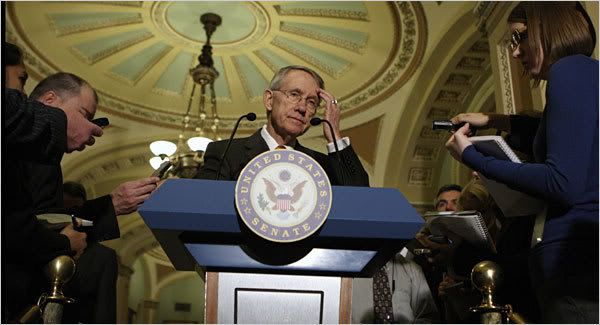
The New York Times reports:
After more than a year of wrangling, the Senate handed the White House a major victory on Tuesday by voting to broaden the government’s spy powers and to give legal protection to phone companies that cooperated in President Bush’s program of eavesdropping without warrants.
One by one, the Senate rejected amendments that would have imposed greater civil liberties checks on the government’s surveillance powers. Finally, the Senate voted 68 to 29 to approve legislation that the White House had been pushing for months. Mr. Bush hailed the vote and urged the House to move quickly in following the Senate’s lead.
The outcome in the Senate amounted, in effect, to a broader proxy vote in support of Mr. Bush’s wiretapping program. The wide-ranging debate before the final vote presaged discussion that will play out this year in the presidential and Congressional elections on other issues testing the president’s wartime authority, including secret detentions, torture and Iraq war financing.
Republicans hailed the reworking of the surveillance law as essential to protecting national security, but some Democrats and many liberal advocacy groups saw the outcome as another example of the Democrats’ fears of being branded weak on terrorism.
“Some people around here get cold feet when threatened by the administration,” said Senator Patrick J. Leahy, the Vermont Democrat who leads the Judiciary Committee and who had unsuccessfully pushed a much more restrictive set of surveillance measures.
Among the presidential contenders, Senator John McCain, Republican of Arizona, voted in favor of the final measure, while the two Democrats, Senator Barack Obama of Illinois and Senator Hillary Rodham Clinton of New York, did not vote. Mr. Obama did oppose immunity on a key earlier motion to end debate. Mrs. Clinton, campaigning in Texas, issued a statement saying she would have voted to oppose the final measure.
The measure extends, for at least six years, many of the broad new surveillance powers that Congress hastily approved last August just before its summer recess. Intelligence officials said court rulings had left dangerous gaps in their ability to intercept terrorist communications.
The bill, which had the strong backing of the White House, allows the government to eavesdrop on large bundles of foreign-based communications on its own authority so long as Americans are not the targets. A secret intelligence court, which traditionally has issued individual warrants before wiretapping began, would review the procedures set up by the executive branch only after the fact to determine whether there were abuses involving Americans.
“This is a dramatic restructuring” of surveillance law, said Michael Sussmann, a former Justice Department intelligence lawyer who represents several telecommunication companies. “And the thing that’s so dramatic about this is that you’ve removed the court review. There may be some checks after the fact, but the administration is picking the targets.”
The Senate plan also adds one provision considered critical by the White House: shielding phone companies from any legal liability for their roles in the eavesdropping program approved by Mr. Bush after the Sept. 11 attacks. The program allowed the National Security Agency to eavesdrop without warrants on the international communications of Americans suspected of having ties to Al Qaeda.
AT&T and other major phone companies are facing some 40 lawsuits from customers who claim their actions were illegal. The Bush administration maintains that if the suits are allowed to continue in court, they could bankrupt the companies and discourage them from cooperating in future intelligence operations.
The House approved a surveillance bill in November that intentionally left out immunity for the phone companies, and leaders from the two chambers will now have to find a way to work out significant differences between their two bills.
Democratic opponents, led by Senators Russ Feingold of Wisconsin and Christopher J. Dodd of Connecticut, argued that the plan effectively rewarded phone companies by providing them with legal insulation for actions that violated longstanding law and their own privacy obligations to their customers. But immunity supporters said the phone carriers acted out of patriotism after the Sept. 11 attacks in complying with what they believed in good faith was a legally binding order from the president.
“This, I believe, is the right way to go for the security of the nation,” said Senator John D. Rockefeller, the West Virginia Democrat who leads the intelligence committee. His support for the plan, after intense negotiations with the White House and his Republican colleagues, was considered critical to its passage but drew criticism from civil liberties groups because of $42,000 in contributions that Mr. Rockefeller received last year from AT&T and Verizon executives.
Senator Olympia J. Snowe, a Maine Republican on the intelligence panel, said the bill struck the right balance between protecting the rights of Americans and protecting the country “from terrorism and other foreign threats.”
Democratic opponents, who six months ago vowed to undo the results of the August surveillance vote, said they were deeply disappointed by the defection of 19 Democrats who backed the bill.
Mr. Dodd, who spoke on the floor for more than 20 hours in recent weeks in an effort to stall the bill, said future generations would view the vote as a test of whether the country heeds “the rule of law or the rule of men.”
But with Democrats splintered, Mr. Dodd acknowledged that the national security argument had won the day. “Unfortunately, those who are advocating this notion that you have to give up liberties to be more secure are apparently prevailing,” he said. “They’re convincing people that we’re at risk either politically, or at risk as a nation.”
There was a measure of frustration in the voice of Harry Reid, the Senate majority leader, as he told reporters during a break in the daylong debate, “Holding all the Democrats together on this, we’ve learned a long time ago, is not something that’s doable.”
Senate Republicans predict that they will be able to persuade the House to include immunity in the final bill, especially now that the White House has agreed to give House lawmakers access to internal documents on the wiretapping program. But House Democrats vowed Tuesday to continue opposing immunity.
Congress faces a Saturday deadline for extending the current law, but Democrats want to extend the deadline for two weeks to allow more time for talks. The White House has said it opposes a further extension.
Meanwhile, Senate Democrats hope to put some pressure on Republicans on Wednesday over another security-related issue by bringing up an intelligence measure that would apply Army field manual prohibitions against torture to civilian agencies like the Central Intelligence Agency.
Republicans plan to try to eliminate that provision, a vote that Democrats say will force Republicans to declare whether they condone torture. Democrats also say it could show the gap between Mr. McCain, who has opposed torture, and the administration on the issue.
“We know how we would feel if a member of the armed services captured by the enemy were, for example, waterboarded,” Mr. Reid said. “So I think that we’re headed in the right direction, and I hope that we’ll get Republican support on this.”
Senate roll call vote here.
Tuesday, February 12, 2008
| [+/-] |
Government Supresses Major Public Health Report |
The public has been denied important information on the link between pollution and health problems including lung, colon and breast cancer.
At Health Beat), Maggie Mahar reports:
The Center for Public Integrity, a public interest investigative journalism organization, has obtained copies of a Centers for Disease Control and Prevention (CDC) study of environmental and health data in eight Great Lakes states that was scheduled for publication in July 2007. The report, which pointed to elevated rates of lung, colon, and breast cancer; low birth weight; and infant mortality in several of the geographical areas of concern has not yet been made public.
A few days before the report was slated to be released, it was pulled. Meanwhile, at precisely the same time, its lead author, Christopher De Rosa, has been removed from the position he held since 1992. The Center for Public Integrity is asking why.
The study, "Public Health Implications of Hazardous Substances in Twenty-Six U.S. Great Lakes Areas of Concern" was developed by the CDC's Agency for Toxic Substances and Disease Registry (ATSDR) at the request of the International Joint Commission, an independent U.S-Canadian organization that monitors and advises both governments on the use and quality of boundary waters.
The CDC report brings together two sets of data: environmental data on known "areas of concern" -- including superfund sites and hazardous waste dumps -- and separate health data collected by county or, in some cases, smaller geographical regions.
The study does not try to prove cause and effect. Instead, it outlines areas for further study and data collection on the link between pollution and health.
"Let's say we have a superfund site and we also find elevated risk of leukemia in the county -- is that related? We don't know, but people living in the area can logically argue that we ought to find out," Dr. Peter Orris, a professor at the University of Illinois School of Public Health and one of the peer reviewers of the study told Oneworld.net.
Since 2004, dozens of experts have reviewed various drafts of the study, including senior scientists at the CDC, Environmental Protection Agency, and other federal agencies, as well as scientists from universities and state governments, according to consumeraffairs.com. Orris is just one of the several experts who reviewed the study and who, along with the International Joint Committee in a December letter to the CDC, have called for the report's publication.
Canadian biologist Michael Gilbertson, a second peer reviewer, told the Center for Public Integrity that he felt the findings were being suppressed because they were "inconvenient." On the record, he added: "The whole problem with all this kind of work is wrapped up in that word 'injury.' If you have injury, that implies liability. Liability, of course, implies damages, legal processes, and costs of remedial action. The governments, frankly, in both countries are so heavily aligned with, particularly, the chemical industry, that the word amongst the bureaucracies is that they really do not want any evidence of effect or injury to be allowed out there."
Orris also raised concerns that the publication may have been halted based on orders outside the CDC. Once again, it seems that the Bush administration is trying to shrink government by making sure that a federal agency doesn't do its job-a problem that I wrote about here in a post titled "The FDA-- What Happens When You Starve the Beast." Corporate interests are protected--at the expense of the nation's citizens.
"I have an overall concern with respect to the culture of this administration, which permeates all levels of the scientific wing of the government," Orris said. "The administration has regularly cut funds so that they don't find statistics that could be potentially politically embarrassing -- for instance, the sampling of toxins in fish in the Great Lakes has been cut way back."
"If the messenger doesn't come with the message, no one knows it's there," he added.
CDC spokesperson Bernadette Burden told OneWorld that the report was held back because internal and external reviewers -- including the Environmental Protection Agency and several state health departments -- identified "numerous discrepancies and deficiencies" and determined a rigorous review was needed. She added that the CDC plans to release the report after the review is completed, in "weeks rather than months."
Burden cited several examples of "discrepancies", including the fact that the county-level health data "reflected people's illnesses from 1988 to 1997, while much of the environmental data used in the report came from the EPA's Toxic Release Inventory dated 2001 and the National Pollutant Discharge Elimination system with 2004 data."
As Oneworld.net points out, CDC did not clarify why these issues were not identified until July 2007 despite several years of review.
A new director of CDC's National Center for Environmental Health and ATSDR, Howard Frumkin, was appointed in July 2007, shortly before the report was due to be released. He replaced De Rosa, who had served as director of the Division of Toxicology for fifteen years. De Rosa was named special assistant in Frumkin's office -- a position that appears to carry "no real responsibilities" according to a Feb. 2008 letter from members of the Congressional Committee on Science and Technologies to CDC director Julie Gerberding. The letter called the move an apparent retaliation.
As many as 9 million people -- including residents of Chicago, Cleveland, Detroit, and Milwaukee -- may be at risk from exposure to pollutants including pesticides, dioxin, PCBs (Polychlorinated Biphenyls), and mercury, according to Sheila Kaplan, an investigative journalist who covered the story for the Center for Public Integrity.
Kaplan has read all three drafts of the study, from 2004 to 2007.
"It's important for this work to be followed up on," she told OneWorld. "What I hope from this report is that communities will say, 'We deserve to know this information and whether exposure to these chemicals and metals is killing us.' More work needs to be done."
Kaplan's full report here.
Monday, February 11, 2008
| [+/-] |
Army Buried Study Faulting Iraq Planning |
The NY Times reports:
The Army is accustomed to protecting classified information. But when it comes to the planning for the Iraq war, even an unclassified assessment can acquire the status of a state secret.
That is what happened to a detailed study of the planning for postwar Iraq prepared for the Army by the RAND Corporation, a federally financed center that conducts research for the military.
After 18 months of research, RAND submitted a report in the summer of 2005 called “Rebuilding Iraq.” RAND researchers provided an unclassified version of the report along with a secret one, hoping that its publication would contribute to the public debate on how to prepare for future conflicts.
But the study’s wide-ranging critique of the White House, the Defense Department and other government agencies was a concern for Army generals, and the Army has sought to keep the report under lock and key.
A review of the lengthy report — a draft of which was obtained by The New York Times — shows that it identified problems with nearly every organization that had a role in planning the war. That assessment parallels the verdicts of numerous former officials and independent analysts.
The study chided President Bush — and by implication Secretary of State Condoleezza Rice, who served as national security adviser when the war was planned — as having failed to resolve differences among rival agencies. “Throughout the planning process, tensions between the Defense Department and the State Department were never mediated by the president or his staff,” it said.
The Defense Department led by Donald H. Rumsfeld was given the lead in overseeing the postwar period in Iraq despite its “lack of capacity for civilian reconstruction planning and execution.”
The State Department led by Colin L. Powell produced a voluminous study on the future of Iraq that identified important issues but was of “uneven quality” and “did not constitute an actionable plan.”
Gen. Tommy R. Franks, whose Central Command oversaw the military operation in Iraq, had a “fundamental misunderstanding” of what the military needed to do to secure postwar Iraq, the study said.
The regulations that govern the Army’s relations with the Arroyo Center, the division of RAND that does research for the Army, stipulate that Army officials are to review reports in a timely fashion to ensure that classified information is not released. But the rules also note that the officials are not to “censor” analysis or prevent the dissemination of material critical of the Army.
The report on rebuilding Iraq was part of a seven-volume series by RAND on the lessons learned from the war. Asked why the report has not been published, Timothy Muchmore, a civilian Army official, said it had ventured too far from issues that directly involve the Army.
“After carefully reviewing the findings and recommendations of the thorough RAND assessment, the Army determined that the analysts had in some cases taken a broader perspective on the early planning and operational phases of Operation Iraqi Freedom than desired or chartered by the Army,” Mr. Muchmore said in a statement. “Some of the RAND findings and recommendations were determined to be outside the purview of the Army and therefore of limited value in informing Army policies, programs and priorities.”
Warren Robak, a RAND spokesman, declined to talk about the contents of the study but said the organization favored publication as a matter of general policy.
“RAND always endeavors to publish as much of our research as possible, in either unclassified form or in classified form for those with the proper security clearances,” Mr. Robak said in a statement. "The multivolume series on lessons learned from Operation Iraqi Freedom is no exception. We also, however, have a longstanding practice of not discussing work that has not yet been published."
When RAND researchers began their work, nobody expected it to become a bone of contention with the Army. The idea was to review the lessons learned from the war, as RAND had done with previous conflicts.
The research was formally sponsored by Lt. Gen. James Lovelace, who was then the chief operations officer for the Army and now oversees Army forces in the Middle East, and Lt. Gen. David Melcher, who had responsibility for the Army’s development and works now on budget issues.
A team of RAND researchers led by Nora Bensahel interviewed more than 50 civilian and military officials. As it became clear that decisions made by civilian officials had contributed to the Army’s difficulties in Iraq, researchers delved into those policies as well.
The report was submitted at a time when the Bush administration was trying to rebut building criticism of the war in Iraq by stressing the progress Mr. Bush said was being made. The approach culminated in his announcement in November 2005 of his “National Strategy for Victory in Iraq.”
One serious problem the study described was the Bush administration’s assumption that the reconstruction requirements would be minimal. There was also little incentive to challenge that assumption, the report said.
“Building public support for any pre-emptive or preventative war is inherently challenging, since by definition, action is being taken before the threat has fully manifested itself,” it said. “Any serious discussion of the costs and challenges of reconstruction might undermine efforts to build that support.”
Another problem described was a general lack of coordination. “There was never an attempt to develop a single national plan that integrated humanitarian assistance, reconstruction, governance, infrastructure development and postwar security,” the study said.
One result was that “the U.S. government did not provide strategic policy guidance for postwar Iraq until shortly before major combat operations commenced.” The study said that problem was compounded by General Franks, saying he took a narrow view of the military’s responsibilities after Saddam Hussein was ousted and assumed that American civilian agencies would do much to rebuild the country.
General Franks’s command, the study asserted, also assumed that Iraq’s police and civil bureaucracy would stay on the job and had no fallback option in case that expectation proved wrong. When Baghdad fell, the study said, American forces there “were largely mechanized or armored forces, well suited to waging major battles but not to restoring civil order. That task would have been better carried out, ideally, by military police or, acceptably, by light infantry trained in urban combat.”
A “shortfall” in American troops was exacerbated when General Franks and Mr. Rumsfeld decided to stop the deployment of the Army’s First Cavalry Division when other American forces entered Baghdad, the study said, a move that reflected their assessment that the war had been won. Problems persisted during the occupation. In the months that followed, the report said, there were “significant tensions, most commonly between the civilian and military arms of the occupation.”
The poor planning had “the inadvertent effort of strengthening the insurgency,” as Iraqis experienced a lack of security and essential services and focused on “negative effects of the U.S. security presence.” The American military’s inability to seal Iraq’s borders, a task the 2005 report warned was still not a priority, enabled foreign support for the insurgents to flow into Iraq.
In its recommendations, the study advocated an “inverted planning process” in which military planners would begin by deciding what resources were needed to maintain security after an adversary was defeated on the battlefield instead of treating the postwar phase as virtually an afterthought. More broadly, it suggested that there was a need to change the military’s mind-set, which has long treated preparations to fight a major war as the top priority. The Army has recently moved to address this by drafting a new operations manual which casts the mission of stabilizing war-torn nations as equal in importance to winning a conventional war.
As the RAND study went through drafts, a chapter was written to emphasize the implications for the Army. An unclassified version was produced with numerous references to newspaper articles and books, an approach that was intended to facilitate publication.
Senior Army officials were not happy with the results, and questioned whether all of the information in the study was truly unclassified and its use of newspaper reports. RAND researchers sent a rebuttal. That failed to persuade the Army to allow publication of the unclassified report, and the classified version was not widely disseminated throughout the Pentagon.
Neither General Lovelace nor General Melcher agreed to be interviewed for this article, but General Lovelace provided a statement through a spokesman at his headquarters in Kuwait.
“The RAND study simply did not deliver a product that could have assisted the Army in paving a clear way ahead; it lacked the perspective needed for future planning by the U.S. Army,” he said.
A Pentagon official who is familiar with the episode offered a different interpretation: Army officials were concerned that the report would strain relations with a powerful defense secretary and become caught up in the political debate over the war. “The Army leaders who were involved did not want to take the chance of increasing the friction with Secretary Rumsfeld,” said the official, who asked not to be identified because he did not want to alienate senior military officials.
The Army has asked that the entire RAND series be resubmitted and has said it will decide on its status thereafter.
Monday, February 4, 2008
| [+/-] |
Bush Budget Would Bring Record Deficits |
From the Associated Press:
The record $3.1 trillion budget proposed by President Bush on Monday would produce eyepopping federal deficits, despite his attempts to impose politically wrenching curbs on Medicare and eliminate scores of popular domestic programs.
The Pentagon would receive a $36 billion, 8 percent boost for the 2009 budget year beginning Oct. 1, even as programs aimed at the poor would be cut back or eliminated. Half of domestic Cabinet departments would see their budgets cut outright.
Slumping revenues and the cost of an economic rescue package will combine to produce a huge jump in the deficit to $410 billion this year and $407 billion in 2009, the White House says, just shy of the record $413 billion set four years ago.
But even those figures are optimistic since they depend on rosy economic forecasts and leave out the full costs of the war in Iraq. The White House predicts the economy will grow at a 2.7 percent clip this year, far higher than congressional and private economists expect, and the administration's $70 billion figure for military operations in Iraq and Afghanistan is simply a placeholder until the next president takes office.
Bush's lame-duck budget plan is likely to be ignored by Congress, which is controlled by Democrats and already looking ahead to November elections. His long-term projections are mostly academic since he's leaving office next January.
The president forecasts a $48 billion surplus by 2012, keeping a promise he made two years ago when strong revenue predictions made it look far easier. Now, he's relying on spending cuts — for everything from transportation to Medicare and Medicaid to nonprofit groups that help the poor — to do the job in order to keep his signature 2001 and 2003 tax cuts intact instead of expiring at the end of 2010.
"Our formula for achieving a balanced budget is simple: create the conditions for economic growth, keep taxes low and spend taxpayer dollars wisely or not at all," Bush said in his budget message.
Democrats said the forecast of a budget surplus in 2012 was based on flawed math that included only $70 billion for the wars in Iraq and Afghanistan in 2009 and no money after that. The budget plan also fails to include any provisions after this year for keeping the alternative minimum tax, originally aimed at the wealthy, from ensnaring millions of middle-class taxpayers. The Congressional Budget Office estimates that fixing the AMT in 2012 would cost $118 billion, more than double the surplus Bush is projecting for that year.
Jim Nussle, the White House budget director, said the softening economy, continuing war costs and the deficit-financed economic stimulus measure soon to clear Congress were responsible for the worsening deficit picture. And he said that the deficits experienced during the Reagan years and Bush's father's administration were far worse when compared to the size of the economy.
"It's a manageable deficit — it isn't the largest in history by any stretch of the imagination — and it's one that can be managed if we get economic growth back on track," Nussle said.
Bush is leaving his successor an enormous fiscal dilemma. The deficit numbers will mean pressure to allow some tax cuts to expire, especially the 35 percent bracket for wealthy taxpayers, which will revert to 39.6 percent at the end of 2010 unless renewed. Pressure from Wall Street to trim the deficit may cause even Democrats to go after the spiraling growth of Medicare and the Medicaid health care program for the poor and disabled.
"There was an assumption that in the short term that the budget would start to correct and that we could balance in the short term," said Sen. Judd Gregg of New Hampshire, top Republican on the Budget Committee. "But with the stimulus package and with the continuing war costs, that's not going to happen. In fact it's going to get very serious when you're hitting $400 billion deficits."
"We've been able to close the deficit gap with good economic growth, therefore good revenue growth. Those days are coming to an end, and we're going to have to do it the old fashioned way, through real spending discipline," said top House Budget Committee Republican Paul Ryan of Wisconsin.
Bush proposes killing or cutting back sharply 151 programs to save $18 billion next year. Many of those cuts have been proposed and rejected by Congress before, such as moves to eliminate community services grants to nonprofit groups that help the poor, a food program aimed at low-income seniors and grants to help states keep illegal immigrants convicted of felonies in jail. Lawmakers will surely restore proposed cuts to clean water grants, funding for local law enforcement and homeland security grants to states and local governments.
"Today's budget bears all the hallmarks of the Bush legacy — it leads to more deficits, more debt, more tax cuts, more cutbacks in critical services," said House Budget Committee Chairman John Spratt, D-S.C.
Overall, Bush proposes a five-year freeze on domestic programs funded by Congress each year. For 2009, that means just a 1 percent boost in a universally supported food program for poor pregnant women and their children, despite rapidly rising food costs. Health research funded by the National Institutes of Health would be frozen, which is likely to mean fewer research grants.
Some of Bush's proposals are hopelessly unrealistic, such as cutting veterans' medical programs for four years in a row after awarding them a small increase next year. Their costs have nearly doubled during Bush's tenure.
Bush's budget does contain some increases, for abstinence education, Pell Grants for college students from low-income families and grants to school districts. The Food and Drug Administration would get a larger-than-average budget increase to send staff overseas to inspect food and drugs imported into the United States.
Foreign aid would grow by 10.3 percent, to $22.7 billion, with big increases for HIV/AIDS programs, anti-drug and -crime programs in Mexico and Latin America, development aid, and security packages mainly for Israel, Egypt, Colombia and Lebanon.
Funding for the State Children's Health Insurance Program, the subject of an intense battle with Democrats last year, would increase by almost $20 billion over the next five years. That still falls short of a bipartisan plan passed twice by Congress.
The budget proposes eliminating the $283 million federal program to help people make their homes more energy efficient and would cut energy aid to poor households by $500 million, a 22 percent drop over this year's spending. Sen. Jeff Bingaman, D-N.M., called scrapping the home weatherization program "completely wrong headed" at a time of high heating costs.
Seven years ago, Bush took over a government predicted to generate $5.6 trillion in surpluses over 10 years. Those estimates were flawed, but there's no question he's leaving his successor a budget in far weaker fiscal shape than he inherited.
For instance, when he took office the total federal debt held by the public was $3.3 trillion, and some policymakers actually worried that investors might not be able to get their hands on enough federal bonds unless taxes were cut. Now, debt held by the public — including foreign governments — is expected to reach $5.4 trillion this year and $5.9 trillion in 2009, according to Bush's budget submission. Some $2.3 trillion is foreign held.
