The Guardian reports:
The head of the CIA moved yesterday to formalise the new Obama administration's break with the past in its approach to national security, when he ordered the final decommissioning of secret overseas sites where the US had held, and in some cases tortured, al-Qaida prisoners.
Leon Panetta told the agency's staff that he was overturning one of the causes of complaint of human rights groups about detentions of terrorist suspects under the Bush regime: the use of private contractors to secure prisoners. From now on private security firms will no longer have any role in the sites, a shift that has the added benefit of saving the CIA some $4m (£2.7m).
The rejection of the services of private security firms in itself marks a clean break with past practices. During the Bush era, contractors enjoyed a bonanza – particularly in Iraq, where they were used to perform many of the roles of the overstretched military.
Panetta said that the sites – which are now empty, having received no new detainees since he took over the agency in February – would be decommissioned under the auspices of the agency itself. His announcement puts into practice the signal given by President Obama on the second day of his administration that he would have the facilities closed.
The overseas detention sites, in Afghanistan, eastern Europe, Thailand and elsewhere, became one of the most potent symbols of George Bush's controversial reign in the White House. Human rights groups protested that they were used for "renditions" of suspects to locations where they were withheld habeas corpus and subjected to harsh interrogations, in some cases amounting to torture.
Up to 100 suspects were held in the sites, about a third of whom were put through interrogation methods that were toughened up after 9/11 well beyond the limitations previously laid down in the army field manual. That included the technique known as water-boarding in which the prisoner has water poured over a cloth placed over his face, inducing the sensation of drowning.
In his email statement to CIA employees, Panetta also made clear that suspects would no longer be "renditioned" to foreign security forces in order for them to be tortured outside the ethical rules set by the US. Under the Bush administration, several suspects are understood to have been flown to countries such as Syria and put at the mercy of their interrogators.
"CIA officers do not tolerate, and will continue to promptly report, any inappropriate behaviour or allegations of abuse. That holds true whether a suspect is in the custody of an American partner or a foreign liaison service," he said.
This week the Red Cross issued a report in which it said that CIA doctors had been used to monitor the health impacts of torture, which it condemned as a "gross breach of medical ethics".
Waterboarding aside, the methods used included slamming prisoners heads against walls and making them stand naked with arms above their heads for two or three days.
Friday, April 10, 2009
| [+/-] |
CIA Chief Leon Panetta Orders Closure of Secret Rendition Sites |
Wednesday, March 4, 2009
| [+/-] |
Transcript of Democracy Now! Interview with Jeremy Scahill, March 4, 2009 |
Blackwater CEO Erik Prince Resigns in Latest Attempt to Rebrand Tarnished Mercenary Firm
Erik Prince, the founder of Blackwater, has announced his resignation as the company’s CEO. The move comes weeks after the company changed its name to Xe in an attempt to rebrand the firm. Jeremy Scahill, author of Blackwater: The Rise of the World’s Most Powerful Mercenary Army, assesses the latest developments.
Transcript:
AMY GOODMAN: Well, let’s go from the issue of whether there are a permanent bases, which he did not address, to another issue he didn’t address: mercenaries, or the paramilitaries, the private contractors. I had a chance to question Senator Obama a year ago when he was on the campaign trail. He spoke at Cooper Union here in New York. As he was walking out, I asked him why he wasn’t calling for a total withdrawal of US troops from Iraq in accordance with the 70 percent of Iraqis who say they want the US out.AMY GOODMAN: Senator Obama, quick question: 70 percent of Iraqis say they want the US to withdraw completely; why don’t you call for a total withdrawal?
AMY GOODMAN: That’s Senator Barack Obama a year ago at Cooper Union here in New York. Lawrence Korb, I know you have to leave for another appointment, but I did want to ask about the mercenaries, about the private contractors. They number, what, about the same as the US soldiers right now in Iraq.
SEN. BARACK OBAMA: Well, I do, except for our embassy. I call for amnesty and protecting our civilian contractors there.
AMY GOODMAN: You’ve said a residual force—
SEN. BARACK OBAMA: Yeah, but—
AMY GOODMAN: —which would be tens of thousands of troops.
SEN. BARACK OBAMA: Well, no. I mean, I don’t think that you’ve read exactly what I’ve said. What I said is that we do need to have a strike force in the region. It doesn’t necessarily have to be in Iraq; it could be in Kuwait or other places. But we do have to have some presence in order to not only protect them, but also potentially to protect the territorial integrity.
AMY GOODMAN: Would you call for a ban on the private military contractors like Blackwater?
SEN. BARACK OBAMA: I’ve actually—I’m the one who sponsored the bill that called for the investigation of Blackwater and those folks, so—
AMY GOODMAN: But would you support the Sanders one now?
SEN. BARACK OBAMA: Here’s the problem: we have 140,000 private contractors right there, so unless we want to replace all of or a big chunk of those with US troops, we can’t draw down the contractors faster than we can draw down our troops. So what I want to do is draw—I want them out in the same way that we make sure that we draw out our own combat troops. Alright? I mean, I—
AMY GOODMAN: Not a total ban?
SEN. BARACK OBAMA: Well, I mean, I don’t want to replace those contractors with more US troops, because we don’t have them, alright? But this was a speech about the economy.
AMY GOODMAN: The war is costing $3 trillion, according to Stiglitz.
SEN. BARACK OBAMA: That’s what—I know, which I made a speech about last week. Thank you.
LAWRENCE KORB: Troops, yeah. That’s correct. But again, as you draw down the troops, you’ll need less of them, because one of the things that they’re doing is providing logistic support, you know, for the troops, and you will need, obviously, less of that.
Remember, under the Status of Forces Agreement, they no longer have immunity. If these people act up again, they are going to be subject to the Iraqi justice system. And obviously, you’re going to need some sort of private contractors to guard the number of personnel that are in the country in this embassy. And again, I would not have built such a big embassy, but it is there, and hopefully, over the years, we can get that back to a normal size, if we ever get back to having a normal relationship with Iraq.
AMY GOODMAN: Well, Lawrence Korb, I want to thank you for being with us, from the Center for American Progress, former Assistant Secretary of Defense under President Reagan. And, Jeremy Scahill, if you would just stay with us for a few more minutes, I want to stay on this issue of the private contractors.
JEREMY SCAHILL: Can I say something about what—about this issue first? I mean, on the issue of the US embassy, I think that the Obama administration should turn it over to the Iraqi people and let them decide what they want to use that massive city within their city for. And the fact is that—
AMY GOODMAN: We’re talking about like a four mile square area in downtown Baghdad.
JEREMY SCAHILL: Yeah, I mean, you’re talking—yeah, you’re talking about a small city unto itself that’s going to have 1,200 employees and hundreds of CIA operatives, was the initial plan for it. And all these people are going to necessitate deadly and lethal security. So that would be a real message of change to send to the Iraqi people, to say this was an embassy built on slave labor as part of an illegal occupation of your country—
AMY GOODMAN: Why do you say “slave labor”?
JEREMY SCAHILL: Because there were people that were brought in. It was essentially indentured servitude. There were people that were brought in from other countries that worked on the construction of that project, much like Africans abducted from the African continent and brought here as slaves, they and their descendants were building the White House in this country. Here we are, years later, with the US government having the embassy built largely on labor that was forced labor or dramatically underpaid labor by people that were essentially forced by their economic conditions or by being taken into the country under false pretenses to participate in the construction of that embassy. And this is the subject of a major congressional investigation that I don’t know is going to go anywhere now that Obama is in the White House.
But on the issue of the contractors, I mean, what you asked Obama about a year ago is very, very important, because Obama said in his answer to you that he didn’t want to draw down contractors at a faster rate than he drew down US troops. So, even when Obama is talking about 50,000 troops remaining in the country, presumably that would mean 50,000 contractors to support them. So we’re always talking about deflated numbers when we hear them come out of the mouths of administration officials.
On the issue of the mercenaries, though, the armed security contractors, Blackwater, the company formerly known as Blackwater, now, you know, called Xe, which is—you know, I mean, it’s very, very interesting, this—
AMY GOODMAN: Spelled X-e.
JEREMY SCAHILL: X-e—you know, in the midst of a major rebranding campaign. What happened with Blackwater is that the Obama administration, through the State Department, informed Xe, Blackwater, that they were not going to renew their highly lucrative contract in Iraq. I think this was a result, in large part, of massive public pressure. I think that activists and concerned people and journalists who were exposing this really made it politically untenable for the Obama administration to at least publicly continue that kind of a relationship with this company, Blackwater, and I think the people who took this seriously should take heart in that.
Hillary Clinton, as Secretary of State, did make a pledge on the campaign trail that she was going to endorse legislation to ban Blackwater’s operations, and she took a lot of heat for that. Whether or not this was a decision that she influenced, I don’t know. I mean, it seemed like it was sort of a cynical decision on the campaign trail aimed at outflanking Obama from the left. But the fact is that Blackwater’s contract has not been renewed.
Having said that, Blackwater is firmly entrenched in Afghanistan, continues with many lucrative US government contracts, has now changed its name. Erik Prince, the owner of Blackwater and the CEO, this week announced that he was stepping down as the CEO but will remain as the chairman. So, you know, I mean, Erik Prince is not in control of Blackwater, the same way that Vladimir Putin is not in control of Russia; he is in control of it, he just isn’t officially the head of it.
AMY GOODMAN: Well, wait. So, let’s explain all of this. Let’s really talk about Blackwater now. I think it astonished many when first they heard that Blackwater’s new name would be Xe.
JEREMY SCAHILL: Xe, right.
AMY GOODMAN: X-e.
JEREMY SCAHILL: It’s a kind of gas.
AMY GOODMAN: And then, that Erik Prince was stepping down as CEO.
JEREMY SCAHILL: Right.
AMY GOODMAN: But his position now?
JEREMY SCAHILL: He’s the chair, remains the chairman of Blackwater. And he appointed a guy named Joseph Yorio, who was a former vice president at the international shipping company DHL, to be the president of Blackwater. And what’s interesting about that is Erik Prince has consistently said that his vision for Blackwater is that it’s going to be like the Federal Express of the national security apparatus. So he didn’t hire a FedEx VP; he went with DHL, which has more of an international reputation. It’s all very fascinating. But—
AMY GOODMAN: Erik Prince is still there.
JEREMY SCAHILL: So, Erik Prince, right, he stepped down from the running of the day-to-day operations of Blackwater, but he’s still the owner, and he’s still the chairman of the company. He still has his private intelligence company that is marketing CIA-type services to—
AMY GOODMAN: Headed by…?
JEREMY SCAHILL: —Fortune 1000 corporations. Well, it’s been headed by Cofer Black and Robert Richer, both CIA veterans, although in Prince’s statement announcing his stepping down, he indicated that there have been sweeping either resignations or departures at the company. Gary Jackson, the president of Blackwater, is out. This was a guy who just a few months ago had said that they would have to carry him out of Blackwater if he was ever going to leave there, essentially saying he was going to be at that company for life. He’s gone. Other vice chairmen have left. Other people—there’s clearly been a major shake-up there.
AMY GOODMAN: And their symbol is changed.
JEREMY SCAHILL: Right, their symbol—well, now they don’t even call—it used to be that Blackwater was the name of all of Prince’s network of security companies and training companies. Now they’ve changed the name of their training facilities just to the “US Training Center.” That’s what it’s called. And instead of the sort of more sexy, you know, red-and-black bear paw in the sniper scope logo, they now have this crude drawing, that looks like it was like done by a high school art student, of an American bald eagle with a yellow beak. I mean, it’s really strange. Maybe Prince stopped spending money on all of these PR firms or rebranding agencies or what have you. But it all appears very crude.
One thing that hasn’t been crude, though, is that Blackwater clearly has learned at least some semblance of a lesson about the power of activist campaigns and bringing out into the light their activities, because there’s been a group operating under the banner of Blackwater Watch for a couple of years now, and it’s from San Diego, where they have it, to Coeur d’Alene, Idaho, all the way to North Carolina, Blackwater’s home state. And they have blackwaterwatch.net. A year ago, Amy, last April, Blackwater registered the domain names for Xe Watch dot org, dot com, dot net, as a—this was a year before they basically even announced that the company was changing its name, although Blackwater Watch now has rebranded itself, and they call themselves Xe Watch, but they’re still operating at blackwaterwatch.net.
So, I think that Blackwater got what it needed from Iraq. It made a lot of money. It secured a reputation that, in its world, is actually a good reputation, because they may have killed a lot of people, but they never lost a principal, as they say.
AMY GOODMAN: Well, I want to talk about “killed a lot of people.” Let’s go back to Nisoor Square.
JEREMY SCAHILL: Right.
AMY GOODMAN: I think people will be surprised to hear that Blackwater is not banned from Iraq by the Iraqi government.
JEREMY SCAHILL: Yeah. Well, I mean, the fact is, and Mr. Korb said this earlier when he was on, that the immunity has been taken away. I will believe that the immunity has been taken away from these killers when the first one of them appears in Iraqi court. The fact is, the US government is not going to hand over its citizens, especially former Navy Seals working for these kinds of companies, to an Iraqi court. It’s just not going to happen. So, you know, the Iraqi government can talk until it’s blue in the face about not renewing licenses and all that; the US has made it clear, Democrat and Republican, that it’s going to do what it needs to do to protect its forces and personnel in Iraq, and if that meant keeping Blackwater there, the Obama administration would keep Blackwater there.
AMY GOODMAN: Could you explain, though, if Barack Obama says he’s keeping 50,000 troops—there’s a lot of troops leaving then—why doesn’t he have enough troops to protect the embassy? Why do mercenaries, do private contractors, have to protect the embassy?
JEREMY SCAHILL: I mean, this is a debate now that, as a result of the radical privatization of the State Department’s Diplomatic Security division—that’s where these mercenary companies primarily work; they work for the State Department doing what’s called diplomatic security. There has never been a mission of the size of this for diplomatic security.
This actually—this program started in the ’90s. When the US restored Jean-Bertrand Aristide to power in Haiti, they hired private companies through the State Department to serve as his protective force and to protect US diplomats that were going in there with Aristide. That started this whole mercenary industry being a part of the US State Department. So, Bush turned it into a paramilitary force in Iraq, and what that meant was that the people that were specifically trained to do this kind of executive protection were largely private contractors. And so, the State Department does not currently have full-time employees that would be able to do that job, and the military has said it doesn’t want to be body guarding US diplomats. So the US has painted itself into a corner. The Democrats have aggressively funded this program, along with the Bush administration. And, of course, it started and expanded under Clinton. And so, it’s now a Catch-22. The Obama administration says it wants to make them all full-time employees. It will take years to do that. Private contractors are going to be in Iraq for a very long time.
AMY GOODMAN: And you mentioned Afghanistan, but, of course, not only private contractors. There is a surge going on now that President Obama has announced, talking about escalating the war in Afghanistan. Just before we went on air, word of a car bomb exploding outside the main US military base in Kabul, wounding three people on Wednesday. The Taliban have claimed responsibility. The blast outside the main base at Bagram wounded three civilian contractors working for a US company, wasn’t clear what the nationalities of the three were.
JEREMY SCAHILL: Well, I mean, the last thing I’ll say is this: You can look at the direction of US policy like this: We have a president now who said he’ll use preemptive military action inside of the borders of another country without informing the leadership of that country, if he deems it’s in the interests of the US, as in the case of Pakistan; a president who’s just delivered what, for all practical purposes, sounded like the victory speech of the previous president for his war based on lies and illegal acts of aggression, and who is surging, beyond the wildest hopes of the Republicans, in Afghanistan, putting more troops than almost any other politician was calling for, and is going to get the US further just sunk into the hole of a very violent and bloody war of occupation in Afghanistan.
This is, once again, an imperial presidency, and I think it’s cause for great, great concern. And unfortunately, the spines of many people that actually have the ear of Obama seem to have been surgically removed now that he is president. And I think it’s very disturbing that people don’t speak truth to power. This is a very dangerous course this president is continuing.
AMY GOODMAN: The alternative in Afghanistan?
JEREMY SCAHILL: Well, I think that, you know, Representative Marcy Kaptur, who you had on recently discussing the fact that people should squat in their homes if these banks are trying to take their homes away from them and say, “Produce the note,” I think put it best when she said that President Obama should call Russia and ask them what happened in Afghanistan. I think the United States has no respect for self-determination or independence of these countries. And I think that there are international diplomats who have wide experience in both Iraq and Afghanistan whose counsel should be sought out, because the United States should be about the business of paying reparations to these countries that it has participated in the destruction of and looking for regional diplomatic solutions that inherently are non-military in their scope and are aimed at actual self-determination for the people of those countries. There’s no internationalization of US policy. There’s no listening to indigenous voices. It’s been military solutions first.
AMY GOODMAN: Jeremy Scahill, I want to thank you for being with us. I think it’s interesting, Jeremy, the book for which you won the George Polk Award, Blackwater: The Rise of the World’s Most Powerful Mercenary Army, when it came out in paperback, it was going to be released on the day that Erik Prince’s book, long delayed, was also going to be released, but they pulled it.
JEREMY SCAHILL: Right. Yeah, I haven’t—there were a couple of times that Erik Prince’s book was supposed to come out. Instead, this executive producer at CNN, Suzanne Simons, who’s been an apologist for the mercenary industry, she seems to have written it for him. Her book comes out in June. I think it’s called Master of War.
AMY GOODMAN: Jeremy, thanks for being with us. Jeremy Scahill, award-winning investigative journalist, author of the New York Times bestseller Blackwater and Democracy Now! correspondent.
| [+/-] |
Transcript of Democracy Now! For March 4, 2009 |
Despite Celebrated Speech, Has Obama Really Ordered an End to US Occupation of Iraq?
President Obama’s plan to withdraw US combat troops from Iraq has both been hailed by some as a signal of the coming end of the war while criticized by others as an extension of the occupation. We host a debate between Lawrence Korb, the former assistant secretary of defense under President Reagan, and Jeremy Scahill, award-winning author and investigative journalist.
Lawrence Korb, Senior Fellow at the Center for American Progress and a former assistant secretary of defense under President Reagan. He is author of more than twenty books. His latest article is “The Promised Withdrawal from Iraq”.
Jeremy Scahill, Award-winning investigative journalist and author of the New York Times bestseller, Blackwater: The Rise of the World’s Most Powerful Mercenary Army. He extensively reported from Iraq in the run-up to the 2003 invasion. His latest article is “All Troops Out By 2011? Not So Fast; Why Obama’s Iraq Speech Deserves a Second Look”.
Partial transcript:
AMY GOODMAN: One of the main themes of President Obama’s campaign was his opposition to the war in Iraq. He heavily criticized the Bush administration for the 2003 invasion and vocally opposed the war from the very beginning, when he was still an Illinois state senator. Now, as President of the United States, Obama has finally announced his plan to pull US troops out of Iraq. In a speech at Camp Lejeune in North Carolina on Friday, Obama appeared to spell out a clear date for a withdrawal. [Video]:
PRESIDENT BARACK OBAMA: As a candidate for president, I made clear my support for a timeline of sixteen months to carry out this drawdown, while pledging to consult closely with our military commanders upon taking office to ensure that we preserve the gains we’ve made and to protect our troops. These consultations are now complete, and I have chosen a timeline that will remove our combat brigades over the next eighteen months.
AMY GOODMAN: Under President Obama’s plan, up to 50,000 US troops would remain in Iraq through 2011. [Video]:
PRESIDENT BARACK OBAMA: As I have long said, we will retain a transitional force to carry out three distinct functions: training, equipping and advising Iraqi Security Forces as long as they remain non-sectarian; conducting targeted counterterrorism missions; and protecting our ongoing civilian and military efforts within Iraq. Initially, this force will likely be made up of 35,000 to 50,000 US troops.
AMY GOODMAN: But President Obama’s decision to keep 50,000 troops in Iraq has angered some critics of the war. Iraq Veterans Against the War described Obama’s proposal as a “plan for almost three more years of an unjustified military occupation.”
Obama’s speech on Iraq left several major questions unanswered. He did not address whether the US will keep permanent military bases in Iraq, and he made no promise to withdraw the over 100,000 private US military contractors and mercenaries stationed in Iraq.
For a debate today on President Obama’s Iraq plan, we’re joined by two guests. Lawrence Korb is a senior fellow at the Center for American Progress. He’s a former Assistant Secretary of Defense under President Reagan. He’s the author of more than twenty books. His latest article is called “The Promised Withdrawal from Iraq.” He’s joining us from Washington, D.C.
And joining me here in our firehouse studio is Jeremy Scahill, award-winning investigative journalist and author of the New York Times bestseller, Blackwater: The Rise of the World’s Most Powerful Mercenary Army. He reported extensively from Iraq in the run-up to the 2003 invasion. His latest article, called “All Troops Out by 2011? Not So Fast; Why Obama’s Iraq Speech Deserves a Second Look.” It appeared at alternet.org.
Lawrence Korb, can you assess the plan laid out by President Obama and why you support it?
LAWRENCE KORB: Well, basically, the plan is exactly what he laid out in the campaign. He said he was going to withdraw all combat troops within sixteen months, so he put it up by two months. And he said he would leave a residual force in there to carry out the three missions that he mentioned: going after the remnants of al-Qaeda, helping the Iraqi Security Forces deal with any type of violence other than sectarian, and to protect Americans there.
In many ways, what—the campaign promise that Obama made was actually overcome by events, because President Bush, who for the longest time had resisted a timeline, agreed in the Status of Forces Agreement with the Iraqis in December of 2008 that all forces would be out by the end of 2011. So, what President Obama is just doing is carrying out that agreement, because these residual forces have to be out by the end of 2011.
AMY GOODMAN: Jeremy Scahill, your assessment?
JEREMY SCAHILL: Well, I mean, I agree with something that Larry said there at the end. I mean, Obama essentially gave Bush’s victory in Iraq speech when he appeared in front of Camp Lejeune. I mean, this, for all practical purposes, was policy the day that Bush left office. So we’re not seeing any radical departure from official US policy at the end of the Bush administration. And, of course, as Lawrence indicates, that was the result of a very complicated process where the Bush administration was outright criminal in its refusal to recognize anything even vaguely resembling the sovereignty of the people of Iraq.
But let’s be clear here on three major problems with the Obama Iraq plan. First of all, this residual force that Obama is going to be implementing, right now the numbers they’re discussing are 35,000 to 50,000 troops. I’ve long spoken out against this residual force, and there are many activist groups in this country that, when Obama was running for president, called his office and said, “No residual forces remaining in Iraq.” The scope of the mission of these residual forces, while it sounds specific to some—phrases such as “counterterrorism” have become almost meaningless in the America we now live in when uttered by politicians. We see how they’ve been applied over the past eight years and, quite frankly, under the Clinton administration, as well. So I’m very concerned about the type of operations that this 35,000 to 50,000—if it actually gets down to that number under the timeline Obama has stated.
Secondly, Obama has refused to scrap this massive, monstrous US embassy that was built on basically slave labor, a $700 million embassy that’s the size of Vatican City. The Vatican has embassies of its own around the world. And the US has built this abomination in Iraq on slave labor, and the Obama administration is going to maintain a staff of over a thousand people there who are going to necessitate heavily armed security to go anywhere inside of the country. That’s been a cocktail for death and destruction in Iraq. Blackwater has been the company that primarily has been guarding US diplomats. Now it’s probably going to be a different company, although many of the same operatives will probably jump over to that company. So, change in name, but not necessarily in policy. Even if Obama hires these people through the State Department officially and says there’s some system of accountability, they’re still going to be putting US lives at a premium over Iraqi lives.
And the third problem that I have with the Obama Iraq plan is that it’s full of loopholes. The Status of Forces Agreement, first of all, Article 27 allows the United States and the Iraqi government to agree that the United States can stay in the country, can engage in any kind of military operations and also can take action, including military action, to address any, quote, “threat,” internal or external. Well, what’s a threat? The wrong people win an election? We’ve seen that happen before. Look at the case of Hamas in Palestine.
So, the fact of the matter is, you take these three, combined with the fact that senior military officials have told journalists, such as Jim Miklashevski of NBC News, that the Pentagon is preparing for US forces to remain in Iraq potentially for twenty more years, and I think we have reason to be very concerned about the fact that Obama basically is giving Bush’s final Iraq speech.
AMY GOODMAN: Lawrence Korb, your response?
LAWRENCE KORB: Well, I think a couple of things are important. And there’s no doubt about the fact that any agreement can be abused. But remember, it was the Iraqis who wanted us out. The Iraqis never really wanted us there, and they’re the ones who insisted on the timeline.
The other is the Iraqi people get to vote this summer on a referendum about whether they want to support the Status of Forces Agreement. If they decide not to, all the forces have to be out within a year. So I think that’s the key thing to keep in mind. And I know our military commanders have talked about, and Secretary Gates has talked about, staying there, but we could only do that with the permission of the Iraqis.
The final thing is, come 1 July, our forces are out of the cities, they’re out of the towns. They’re basically back on their bases. They can only go out with the permission of the Iraqi government. Now, I agree, there can be abuses, and I do worry that Prime Minister Maliki might try get US forces to go against some of his enemies. That’s why I think in President Obama’s speech, when he said not to deal with sectarian issues—I mean, they can ask us, but we don’t have to do that, and I would hope that the President and his national security team make that clear to our military commanders, exactly what they can and cannot do.
JEREMY SCAHILL: Well, see, one of the issues I have here is, going back to this issue of what if the wrong people win an election, the Iraqi people have a right to choose leaders that are hostile to the United States, that are hostile to US corporate aims in the Middle East, more broadly, and in Iraq, specifically. And I think that US history has shown that when the wrong people win elections, the US will intervene militarily, overtly, covertly, behind-the-scenes, in front of the world public. And I think that the fact that Thomas Ricks, one of the most well-informed journalists covering this war, has indicated that it’s very likely that a leader will emerge in Iraq that is hostile to US interests, that is close to Tehran and is not going to be someone that’s perceived by the United States to be a friend—so the fact is that the Maliki government could be substantially weakened by indigenous forces within Iraq, and the Obama administration could step in and say, “We’re going to defend this flailing regime.”
What I found very disturbing about Obama’s speech, among other things, was the fact that he officially co-signed Bush’s major lies on Iraq. When he talked about the mission of US troops in Iraq, he said, “I want to be very clear: We sent our troops to Iraq to do away with Saddam Hussein’s regime, and you got the job done.” I’m sorry, Mr. Obama, the troops were sent to Iraq on the lie of weapons of mass destruction. And he co-signed that Bush administration lie.
He also said, “We will leave the Iraqi people with a hard-earned opportunity to live a better life. That is your achievement,” he said to the US troops. “That is the prospect that you have made possible.” Again, no, not a better life. We’re talking about upwards of a million Iraqis that have been killed, their lives decimated, 20 percent of the country either in need of desperate medical attention, internally displaced, another 20 percent living outside of the country. And this has been an utter mess. And he talks about a better future. Iraq has never been in more shambles than it has been over the course of the US military occupation.
AMY GOODMAN: We’re going to come back to this discussion, Jeremy Scahill, author of Blackwater: The Rise of the World’s Most Powerful Mercenary Army, has written a piece on Alternet, online at alternet.org. Lawrence Korb, with the Center for American Progress, has also written a piece called "The Promised Withdrawal from Iraq.” He’s former Assistant Secretary of Defense under President Reagan. Back in a minute.
[BREAK]
AMY GOODMAN: Our guests, Jeremy Scahill, author of Blackwater: The Rise of the World’s Most Powerful Mercenary Army—and I want to get to talking about Blackwater—well, it’s now called Xe. We’re also joined by President Reagan’s former Assistant Secretary of Defense. He is now with the Center for American Progress. He’s written a piece called “The Promised Withdrawal from Iraq.”
Lawrence Korb, the last point that Jeremy made about President Obama—well, he called President Bush right before he gave his Camp Lejeune speech, and then telling the troops at Camp Lejeune that they had succeeded in their mission in removing Saddam Hussein.
LAWRENCE KORB: Well, I think it’s very important, because the troops did what they were told. I agree that the war was fought under false pretences. We should never have gone there. It was probably the greatest strategic blunder in US history. But that’s not the fault of the troops. They were sent there. Their mission was overthrow the regime, and that’s—you know, that’s what they did. We can’t fault them, however much we want to be opposed to this war.
The other point he made is certainly true, that there are potential for abuses. I have enough confidence in Senator Obama that he will not let that happen. But yes, there certainly is the potential for us to make some of the mistakes we’ve made in previous—our previous history when we didn’t like the results of the election.
But I think it is important—and I did like that part, because as a young man, I went and got involved in a—you know, another terrible war. But the people I went with in Vietnam, we did what we were told. Then, when you come back and you find out, for example, that the Gulf of Tonkin Resolution was a sham, that’s not our fault. And that’s what—and I was glad that he did that, because it is true that these people have suffered—not only the Iraqis, but our men and women have been asked to do something that no other military in our history has been asked to do, to go back two, three, four times into a combat zone with very little, you know, time in between. And what it has done to them and their families, I think, is something that we’re going to be paying for a long time—for a long time.
AMY GOODMAN: Jeremy Scahill?
JEREMY SCAHILL: Well, I mean, part of the problem here, though, it’s not about faulting the troops. I mean, I agree with Lawrence in the sense that troops are given orders, and then they can decide whether they’re going to follow out those orders or not follow them out. We’ve seen many soldiers through IVAW, Iraq Veterans Against the War, and others who have actually resisted or have refused to participate in a war they consider to be illegal or immoral. And that, though, is separate from what President Obama did.
What President Obama did is he completely reformed his position on Iraq, co-signed the lies of the Bush administration, and cast aside his campaign rhetoric, where he did talk about this being a fraudulent war, where he did criticize the prosecution of this war. To listen to President Obama at Camp Lejeune, you would think that this war was prosecuted beautifully and that the point of it was to liberate the people of Iraq. That was not the point of this administration—of the Bush administration’s occupation of Iraq. That came like two or three justifications later, after the fraud and the lies.
So, the fact that Obama gives this speech, does not mention the fact that Iraqis have suffered under the US occupation, doesn’t mention the incredible price that the Iraqis have paid as a result of US military action in Iraq, to me, I think that sends a very disturbing message to the Iraqi people and the region, more generally.
AMY GOODMAN: Jeremy Scahill, I wanted to ask about the response of the Democratic leaders to President Obama’s speech, like Nancy Pelosi, like Harry Reid.
JEREMY SCAHILL: Right. Well, first of all, yeah, you look at Obama’s top allies, it’s people like John McCain, it’s people like Mitch McConnell, who praised Obama for implementing the Bush administration’s Iraq strategy at the end. And, I mean, some of this is partisan politics. And, please, the Republicans have no credibility on this. I mean, if we can be critical of Barack Obama, I mean, the Republicans are just merciless criminals when it comes to, you know, US policy in Iraq and toward the world, more broadly.
But the fact that Harry Reid and Nancy Pelosi and Chuck Schumer all acted like astonished that there’s going to be 35,000 to 50,000 troops in a residual capacity in Iraq and were criticizing this, I mean, this is a classic example of what’s wrong with the Democratic Party when it comes to foreign policy and what’s been wrong with this party for a long time. And that is that when it actually mattered, when Pelosi or Reid could have said to candidate Obama, “Back off that residual force,” as many activists were calling for, they were deafeningly silent. We were at the Democratic convention, Amy, walking around, trying to find anyone to criticize that aspect of the Obama policy, and not even antiwar Democrats, who were firmly against the war from the beginning, would dissent from the policy positions of the dear leader. This is cult activity, when you refuse to go after someone to try to criticize their policies when it matters and then later act like you’ve been hoodwinked. They knew exactly what was going on.
AMY GOODMAN: Lawrence Korb?
LAWRENCE KORB: Well, I think in the speech, as I read it, he did make reference to the suffering of the Iraqi people and talked about, you know, the refugee problem, so I think he did that. But again, I think Jeremy is right. I mean, you got to go back. Obama mentioned this in the campaign. So, if people are upset, they should have, you know, made these views known during the primaries. And again, while I thought the war was the greatest strategic disaster, remember that the Congress voted to approve this, including some of the other people who ran against Obama, and I think they—you know, they should be held accountable for this, as well. So I think there’s a lot of blame to go—that got to go round.
The question is, OK, we are where we are; are we, you know, doing the right thing? And I just hope that the President carries out what he says, and we’re completely out of there, no permanent bases, and that he does not allow Americans to participate in any type of operations that are done solely to deal with one ethnic group being concerned about what the other is doing.
AMY GOODMAN: Well, let’s go from the issue of whether there are a permanent bases, which he did not address, to another issue he didn’t address: mercenaries, or the paramilitaries, the private contractors. I had a chance to question Senator Obama a year ago when he was on the campaign trail. He spoke at Cooper Union here in New York. As he was walking out, I asked him why he wasn’t calling for a total withdrawal of US troops from Iraq in accordance with the 70 percent of Iraqis who say they want the US out.AMY GOODMAN: Senator Obama, quick question: 70 percent of Iraqis say they want the US to withdraw completely; why don’t you call for a total withdrawal?
SEN. BARACK OBAMA: Well, I do, except for our embassy. I call for amnesty and protecting our civilian contractors there.
AMY GOODMAN: You’ve said a residual force—
SEN. BARACK OBAMA: Yeah, but—
AMY GOODMAN: —which would be tens of thousands of troops.
SEN. BARACK OBAMA: Well, no. I mean, I don’t think that you’ve read exactly what I’ve said. What I said is that we do need to have a strike force in the region. It doesn’t necessarily have to be in Iraq; it could be in Kuwait or other places. But we do have to have some presence in order to not only protect them, but also potentially to protect the territorial integrity.
AMY GOODMAN: Would you call for a ban on the private military contractors like Blackwater?
SEN. BARACK OBAMA: I’ve actually—I’m the one who sponsored the bill that called for the investigation of Blackwater and those folks, so—
AMY GOODMAN: But would you support the Sanders one now?
SEN. BARACK OBAMA: Here’s the problem: we have 140,000 private contractors right there, so unless we want to replace all of or a big chunk of those with US troops, we can’t draw down the contractors faster than we can draw down our troops. So what I want to do is draw—I want them out in the same way that we make sure that we draw out our own combat troops. Alright? I mean, I—
AMY GOODMAN: Not a total ban?
SEN. BARACK OBAMA: Well, I mean, I don’t want to replace those contractors with more US troops, because we don’t have them, alright? But this was a speech about the economy.
AMY GOODMAN: The war is costing $3 trillion, according to Stiglitz.
SEN. BARACK OBAMA: That’s what—I know, which I made a speech about last week. Thank you.
AMY GOODMAN: That’s Senator Barack Obama a year ago at Cooper Union here in New York. Lawrence Korb, I know you have to leave for another appointment, but I did want to ask about the mercenaries, about the private contractors. They number, what, about the same as the US soldiers right now in Iraq.
LAWRENCE KORB: Troops, yeah. That’s correct. But again, as you draw down the troops, you’ll need less of them, because one of the things that they’re doing is providing logistic support, you know, for the troops, and you will need, obviously, less of that.
Remember, under the Status of Forces Agreement, they no longer have immunity. If these people act up again, they are going to be subject to the Iraqi justice system. And obviously, you’re going to need some sort of private contractors to guard the number of personnel that are in the country in this embassy. And again, I would not have built such a big embassy, but it is there, and hopefully, over the years, we can get that back to a normal size, if we ever get back to having a normal relationship with Iraq.
AMY GOODMAN: Well, Lawrence Korb, I want to thank you for being with us, from the Center for American Progress, former Assistant Secretary of Defense under President Reagan. And, Jeremy Scahill, if you would just stay with us for a few more minutes, I want to stay on this issue of the private contractors.
JEREMY SCAHILL: Can I say something about what—about this issue first? I mean, on the issue of the US embassy, I think that the Obama administration should turn it over to the Iraqi people and let them decide what they want to use that massive city within their city for. And the fact is that—
AMY GOODMAN: We’re talking about like a four mile square area in downtown Baghdad.
JEREMY SCAHILL: Yeah, I mean, you’re talking—yeah, you’re talking about a small city unto itself that’s going to have 1,200 employees and hundreds of CIA operatives, was the initial plan for it. And all these people are going to necessitate deadly and lethal security. So that would be a real message of change to send to the Iraqi people, to say this was an embassy built on slave labor as part of an illegal occupation of your country—
AMY GOODMAN: Why do you say “slave labor”?
JEREMY SCAHILL: Because there were people that were brought in. It was essentially indentured servitude. There were people that were brought in from other countries that worked on the construction of that project, much like Africans abducted from the African continent and brought here as slaves, they and their descendants were building the White House in this country. Here we are, years later, with the US government having the embassy built largely on labor that was forced labor or dramatically underpaid labor by people that were essentially forced by their economic conditions or by being taken into the country under false pretenses to participate in the construction of that embassy. And this is the subject of a major congressional investigation that I don’t know is going to go anywhere now that Obama is in the White House.
But on the issue of the contractors, I mean, what you asked Obama about a year ago is very, very important, because Obama said in his answer to you that he didn’t want to draw down contractors at a faster rate than he drew down US troops. So, even when Obama is talking about 50,000 troops remaining in the country, presumably that would mean 50,000 contractors to support them. So we’re always talking about deflated numbers when we hear them come out of the mouths of administration officials.
On the issue of the mercenaries, though, the armed security contractors, Blackwater, the company formerly known as Blackwater, now, you know, called Xe, which is—you know, I mean, it’s very, very interesting, this—
AMY GOODMAN: Spelled X-e.
JEREMY SCAHILL: X-e—you know, in the midst of a major rebranding campaign. What happened with Blackwater is that the Obama administration, through the State Department, informed Xe, Blackwater, that they were not going to renew their highly lucrative contract in Iraq. I think this was a result, in large part, of massive public pressure. I think that activists and concerned people and journalists who were exposing this really made it politically untenable for the Obama administration to at least publicly continue that kind of a relationship with this company, Blackwater, and I think the people who took this seriously should take heart in that.
Hillary Clinton, as Secretary of State, did make a pledge on the campaign trail that she was going to endorse legislation to ban Blackwater’s operations, and she took a lot of heat for that. Whether or not this was a decision that she influenced, I don’t know. I mean, it seemed like it was sort of a cynical decision on the campaign trail aimed at outflanking Obama from the left. But the fact is that Blackwater’s contract has not been renewed.
Having said that, Blackwater is firmly entrenched in Afghanistan, continues with many lucrative US government contracts, has now changed its name. Erik Prince, the owner of Blackwater and the CEO, this week announced that he was stepping down as the CEO but will remain as the chairman. So, you know, I mean, Erik Prince is not in control of Blackwater, the same way that Vladimir Putin is not in control of Russia; he is in control of it, he just isn’t officially the head of it.
"The Promised Withdrawal from Iraq" by Lawrence Korb
"All Troops Out By 2011? Not So Fast; Why Obama's Iraq Speech Deserves a Second Look" by Jeremy Scahill
Sunday, December 30, 2007
| [+/-] |
Bhutto Tried To Hire U.S. Security Guards |
The Washington Times reports:
Benazir Bhutto was so fearful for her life that she tried to hire British and American security firms, including Blackwater, to protect her, but Pakistani President Pervez Musharraf refused to allow the foreign contractors to operate in Pakistan, her aides said.
"She asked to bring in trained security personnel from abroad," said Mark Siegel, her U.S. representative. "In fact, she and her husband repeatedly tried to get visas for such protection, but they were denied by the government of Pakistan."
Her entourage discussed deals with North Carolina-based Blackwater Corp., sources said.
"We were approached to provide [former] Prime Minister Bhutto's security, but an agreement was unfortunately never reached," a Blackwater spokeswoman said, confirming the negotiations. She declined to go into the precise details.
Sources within the British private security industry said she also had negotiations with the London-based firm Armor Group, which guards British diplomats in the Middle East. The company, however, said last night it had no knowledge of any talks.
Mrs. Bhutto frantically contacted officials, diplomats and friends in the United States, Europe and the Persian Gulf to urge Mr. Musharraf to improve her security in the wake of the suicide bomb attack that killed more than 140 during her homecoming parade on Oct 18.
Indeed, U.S. diplomats took the highly unusual step of providing her directly with confidential U.S. intelligence about terrorist threats to her life, knowledgeable sources said. Pakistan's Interior Ministry also passed on details of plots against her, and aides said letters containing death threats had been smuggled into her home.
Husain Haqqani, a U.S.-based Bhutto adviser, director of the Center for International Relations and a professor at Boston University, confirmed that she wanted to use private international security contractors but said the Musharraf regime would not approve the plan.
He said the United States, which has arranged for private contractors to guard Afghan President Hamid Karzai and top leaders in Iraq, was reluctant to pressure Mr. Musharraf, an ally in the war on terrorism, to change his mind, despite the view that U.S. officials considered Mrs. Bhutto a linchpin in their crucial diplomatic bid to encourage Pakistan to return to democracy.
Officials from Mrs. Bhutto's Pakistan Peoples Party have complained that security arrangements for her were woefully inadequate, given the seriousness of the threats against her from al Qaeda, the Taliban and others. She relied largely on using a "human shield" of loyal followers who would form a ring around her, but as the attack Thursday proved, it was little protection against a determined assailant.
Some security industry specialists have suggested, however, that there may have been other reasons why the help of foreign security firms was not enlisted.
To be surrounded by an entourage of foreign bodyguards would have added to criticisms that Mrs. Bhutto was in the pocket of the West — an accusation leveled at Mr. Karzai — and might not have been welcomed by her own Pakistani security staff. But the firms could have taken a background role as consultants and trained locals in bodyguarding techniques to maintain a Pakistani face to her entourage.
"It's odd and disturbing that the Pakistan government did not do a better job of protecting her and that the U.S. apparently could not do more to persuade them," said Bruce Riedel, a former CIA officer and former National Security Council director for South Asia. "She made it very clear privately and publicly that she did not have enough security. That was abundantly clear after the attack on her return."
Thursday, November 1, 2007
| [+/-] |
Blackwater Sneak Silencers into Iraq? |
Security firm under investigation for allegedly sidestepping export controls
 A Blackwater employee shows off a silencer-equipped rifle in Iraq in a photo obtained by NBC News. The picture has been digitally altered to protect the identity of the subject.
MSNBC.com reports:
Federal agents are investigating allegations that the Blackwater USA security firm illegally exported dozens of firearms sound suppressors — commonly known as silencers — to Iraq and other countries for use by company operatives, sources close to the investigation tell NBC News.
Investigators from various federal agencies, including the Bureau of Alcohol, Tobacco and Firearms, Immigration and Customs Enforcement, the State Department and the Commerce Department, are digging into the allegations that the company exported the silencers without getting necessary export approval, according to law enforcement sources, who spoke to NBC News on condition of anonymity. The sources said the investigation is part of a broader examination of potential firearms and export violations.
Coincidentally, the company’s main responsibility in Iraq is protecting officials of the State Department, the agency that regulates exports of arms. The firm had more than $500 million in federal contracts in 2006.
Anne Tyrrell, a Blackwater spokeswoman, refused to comment on any specific allegations of the firearms investigation but said that “of course we would cooperate as we do in any investigation.”
The company has come under intense scrutiny since the Sept. 16 shooting deaths of 17 Iraqi civilians by Blackwater employees in an attack the Iraqi government contends was unjustified. Since then, other instances where company employees appeared to operate outside the law — including an incident in which a Blackwater employee allegedly killed a guard to Iraqi Vice President Adel Abdul Mahdi and was removed from the country with the help of the U.S. Embassy — have surfaced
The sources tell NBC News that Blackwater purchased the silencers legally from SWR Manufacturing, formerly of Georgia and now located in Pickens, S.C. SWR manufactures the devices for pistols, rifles and machine guns. The purchases took place over several years, the sources say.
Ex-official confirms Blackwater a customer
A former official at SWR Manufacturing of South Carolina, also speaking on condition of anonymity, confirmed that Blackwater had been a customer. The former SWR official would not say how many suppressors Blackwater purchased, but another source said law-enforcement officials have been told that the number was more than 100.
The former SWR official said he faxed copies of all paperwork relating to Blackwater’s business with SWR to the ATF more than a year ago after federal investigators contacted him. The former official said investigators told him that Blackwater sent the silencers overseas with its employees without getting the necessary export approval.
Maarten Sengers, an expert on arms export compliance in Washington, who is not involved in the investigation, said the criminal penalties for exporting silencers without proper paperwork can be stiff — up to 10 years in prison and fines up to $1 million per count.
While silencers are rare in America because their possession is highly restricted, they are common props in movies and television programs, used by actors playing hit men or members of the special forces. The military uses them for covert action and nighttime tactical assaults where stealth and surprise are required, but experts say it is not clear why Blackwater guards would need them for missions such as personal protection of diplomats.
Details of case slow to emerge
It has been reported that two former Blackwater employees who pleaded guilty to firearms violations earlier this year are cooperating with federal investigators in a firearms investigation, but the specifics of the case, including the details about the silencers, have not previously been disclosed.
Getting permission from the State Department to export such items is extremely difficult. Several sources involved in the investigation said that in the rush to prepare for war and execute federal contracts, private security companies sometimes have overlooked the requirements for their licenses.
Controversy over Blackwater's overseas operations erupted after a major shootout in Iraq on Sept. 16 that left 17 Iraqis dead. The company claimed its guards were fired on first, but witnesses and the Iraqi government say that Blackwater operatives fired without provocation. That incident is now under FBI investigation.
The export investigation is separate from that case. A spokeswoman for the U.S. Attorney’s Office for the Eastern District of North Carolina, the district where Blackwater is based, refused to comment on the matter.
Thursday, October 18, 2007
| [+/-] |
Odds & Ends on Blackwater |
The Malta Independent Online reports:
A European Parliament working document drawn up by Giovanni Claudio Fava has claimed “Malta is the operational base of Blackwater, the organiser of private military militia which are increasingly taking on more and more roles which used to be undertaken by US forces in Iraq and elsewhere”.
American left-wing and anti-war media are in full cry about the underhand and subtle changes, which have made Blackwater the new symbol of American claimed supremacy, carried out by forces other than the regular military.
California Democratic Senator Henry Waxman has been holding a number of hearings on the spread of Blackwater but even they, the more anti-war media claims, have held back from seeing the whole wide picture.
Thus the four-hour interrogation of Blackwater director Eric Prince got lost in details, even discovering for instance a December 2006 “arrangement” negotiated by the State Department as compensation for an Iraqi policeman killed by a Blackwater employee.
But it was only Republican Darrell Issa from California who documented the intimate links between Prince and the Bush administration. On the eve of the hearings, Oliver North, the former colonel who had been condemned for exchanging arms with cocaine in the fight against communism in Nicaragua, accused Senator Waxman of a huge “witch-hunt”.
Dennis Kucinich, a Democrat from Ohio, argued that since the military functions had been privatised, it was in Blackwater’s interest to prolong the war, rather than end it.
An article on Salon.com carried the charges by Jeremy Scahill that the Christian fundamentalists behind Blackwater were the hard core in favour of the war of George Bush and Dick Cheney and their “patron”, former Secretary of State George Schultz.
Eric Prince’s parents, Edgar Prince and his wife Elsa Prince Broekhuizen, through their foundation finance the Council for National Policy, an ultra-secret society which met in Salt Lake City on 28 September to hear Dick Cjheney argue the case for an attack on Iran.
Prince Senior is one of the pillars of Christian Coalition of Gary Bauer and of the Family Research Council of James Dobson.
Eric Prince, through his own foundation, the Freiheit Foundation, finances Christendom College, the Institute for World Politics, Crisis Magazine and the Prison Fellowship of Chuck Colson. Prince also finances the Legionnaires du Christ and Christian Freedom International.
When still 27 years old, Eric Prince founded Blackwater USA. He and those who soon joined him have profited from the more than $1,000 million they have taken as contracts from 2000 to 2006.
In 2004, Cofer Black passed from CIA to the State Department and thence became Blackwater’s vice-president. While still in the CIA, Black was in charge of the “special extraditions” organising the secret transfer of prisoners from Iraq or Afghanistan to countries less rigid against the practice of torture, such as Poland, Romania, Egypt, and so on.
These planes, which travelled between Abu Ghraib, Guantanamo and Afghanistan often made stopovers in many European countries such as the UK, Italy, France, Germany and Malta many times without the countries themselves being informed what was going on.
Now the Swiss procurator Dick Marty has sent documents regarding the “CIA’s flying prisons” to the European Parliament and names two Blackwater subsidiaries – Presidential Airways and Aviation Worldwide Services.
The Giovanni Claudio Fava document on behalf of the European Parliament says the two companies used CASA C-212 planes, usually used to transport paratroops and big cargoes and also able to land on improvised landing spots.
Wednesday, October 17, 2007
| [+/-] |
Blackwater's Eric Prince: "I Won't Allow Iraqis to Arrest My Employees" |
The Washington Times reports:
A defiant Blackwater Chairman Erik Prince said yesterday he will not allow Iraqi authorities to arrest his contractors and try them in Iraq's faulty justice system.
"We will not let our people be taken by the Iraqis," Mr. Prince told editors and reporters at The Washington Times. At least 17 of 20 Blackwater guards being investigated for their roles in a Sept. 16 shooting incident are still in a secure compound in Baghdad's Green Zone and carrying out limited duties.
Two or three others have been allowed by the State Department to leave the country as part of their scheduled rotation out of Iraq and are expected to return.
"In an ideal sense, if there was wrongdoing, there could be a trial brought in the Iraqi court system. But that would imply that there is a valid Iraqi court system where Westerners could get a fair trial. That is not the case right now," said Mr. Prince.
Mr. Prince also expressed his disappointment that the State Department has not come to the company's defense, even though it has never lost a State Department client in years of protecting them.
"For the last week and a half, we have heard nothing from the State Department," said Mr. Prince. "From their senior levels, their PR folks, we've heard nothing — radio silence.
"It is disappointing for us. We have performed to the line, letter and verse of their 1,000-page contract," he said. "Our guys take significant risk for them. They've taken a pounding these last three years."
A number of Blackwater contractors, most of whom come from military and law-enforcement backgrounds, have been killed in action or grievously wounded in Iraq while running more than 16,500 security missions in the past three years.
Iraq's government, outraged by the Sept. 16 incident in which up to 17 Iraqis were killed as Blackwater staff tried to clear a crowded traffic circle, has accused the U.S. firm of unprovoked and random killings. Blackwater says its men were defending themselves after coming under fire.
The State Department has since ordered that cameras be placed in Blackwater security vehicles and that Diplomatic Security agents accompany Blackwater staff on missions. Mr. Prince said his company had recommended both those steps in 2005 and that the proposals were "buried" by the department.
Iraqi Prime Minister Nouri al-Maliki demanded yesterday that Blackwater leave Iraq and pay $8 million to the family of each of the 17 victims. Iraqi Human Rights Minister Wijdan Salim said the American guards responsible should stand trial in Iraq, the British Broadcasting Corp. reported.
Mr. Prince, a 38-year-old former Navy SEAL, said if there was any evidence of wrongdoing, his employees could be tried in the United States by a jury of their peers under the Uniform Code of Military Justice.
He said the hostility toward Blackwater was partly driven by partisan politics from the Democrat-led Congress and the news media.
"The far left was unsuccessful in attacking [Army Gen. David H.] Petraeus and defunding the war, forcing a pullback of the U.S. troops," he said. "I think part of the strategy might be to undermine some other part of the support infrastructure, and that would be contractors that are an important part of the supporting package there in Iraq."
He said the scrutiny by Congress, which Democrats say is aimed at better oversight, may have backfired.
"What has happened in the last six to nine months is we've seen the U.S. government, [Department of Defense] in particular, awarding a lot more work to non-U.S. companies ... because it is harder to drag those guys before Congress," Mr. Prince said.
"And there is less oversight, there is less accountability, there is less visibility into those operations."
Mr. Prince has been caught in a partisan crossfire since shortly after last year's election, when a trial lawyer targeting Blackwater lobbied then-House Speaker-elect Nancy Pelosi, California Democrat, for hearings on the "extremely Republican" company.
Mr. Prince emphasized that his guards are proven professionals, recruited on the basis of their prior military, special operations and law-enforcement experiences.
"They go through extensive vetting, training, 160 plus hours of security training, psychological evaluations, security clearances, background checks" and cultural training, he said.
Iraqis and other expatriate security companies on the ground in Iraq have complained that Blackwater guards have been overly and unnecessarily aggressive in their attitudes.
Monday, October 8, 2007
| [+/-] |
U.S. Blames Tehran For Escalating Iraq Violence |
The commander of US forces in Iraq, General David Petraeus, yesterday sharpened America's confrontation with Iran, claiming that a leader of its Revolutionary Guard corps was in direct charge of policy in Baghdad.
The Guardian reports:
The charge that Tehran's ambassador to Baghdad, Hassan Kazemi-Qomi, was a member of the Quds force, a unit of Iran's Revolutionary Guard, takes US accusations of Iranian meddling in Iraq's violence to a new level. It strengthens suggestions that Washington is ratcheting up the rhetoric against Tehran in preparation for military strikes against Revolutionary Guard facilities in Iran.
"The ambassador is a Quds force member," Gen Petraeus told reporters at the weekend. "Now he has diplomatic immunity and therefore he is obviously not subject [to scrutiny]."
Hours after Gen Petraeus spoke to CNN and Reuters at a US military base near the Iranian border, the US military said it had arrested three members of an Iranian-backed militia believed to be responsible for the kidnapping of five Britons.
The Britons - a computer expert and four bodyguards - were taken from the finance ministry in Baghdad last May by gunmen dressed in police commander uniforms without a shot being fired.
The general, who told Congress last month that Iran was playing an increasingly dangerous role in Iraq by providing arms to Shia militia, provided no evidence that Mr Kazemi-Qomi was a member of the Revolutionary Guard. The Iranian ambassador has held two sessions with the top US diplomat in Baghdad, Ryan Crocker, to discuss the violence in Iraq.
Responding to the accusations at a news conference, the Iranian foreign ministry spokesman, Mohammad Ali Hosseini, said: "His remarks are not new and what he said was in line with the previous accusations against Iran."
Tehran denies US accusations that it plays a role in Iraq's violence, as well as western allegations that its nuclear programme is aimed at developing atomic weapons.
In August, officials revealed that the Bush administration was considering designating the entire Revolutionary Guard corps a terrorist organisation. However, reports last month said the state department had decided instead to single out the Quds force as a terrorist entity, which would enable the Bush administration to impose financial measures against the elite unit.
Gen Petraeus said at the weekend that he had few doubts about the role of the Quds force in the violence in Iraq, accusing the unit of supplying material for roadside bombs which have killed US troops as well as provincial governors. "There should be no question about the malign, lethal involvement and activities of the Quds force in this country," he said.
Also yesterday an Iraqi government inquiry found that guards working for the private security contractor Blackwater had opened fire without provocation on Iraqi civilians. A spokesman for the prime minister, Nuri al-Maliki, said 17 people had been killed in the incident, and that the convoy under Blackwater's protection "wasn't even hit by a stone" when the guards opened fire.
Friday, September 28, 2007
| [+/-] |
Blackwater Faced Bedlam, Embassy Finds |
'First Blush' Report Raises New Questions on Shooting
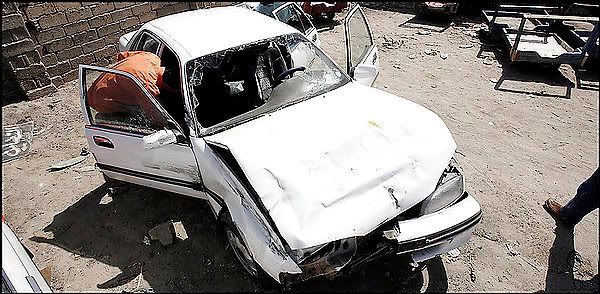 Hussam Hassan inspects his father's car several days after it was heavily damaged in the disputed shooting at Nisoor Square in Baghdad. (By Khalid Mohammed -- Associated Press)
The Washington Post reports:
The initial U.S. Embassy report on a Sept. 16 shooting incident in Baghdad involving Blackwater USA, a private security firm, depicts an afternoon of mayhem that included a car bomb, a shootout in a crowded traffic circle and an armed standoff between Blackwater guards and Iraqi security forces before the U.S. military intervened.
The two-page report, described by a State Department official as a "first blush" account from the scene, raises new questions about what transpired in the intersection. According to the report, the events that led to the shooting involved three Blackwater units. One of them was ambushed near the traffic circle and returned fire before fleeing the scene, the report said. Another unit that went to the intersection was then surrounded by Iraqis and had to be extricated by the U.S. military, it added.
Separately, a U.S. official familiar with the investigation said that participants in the shooting have reported that at least one of the Blackwater guards drew a weapon on his colleagues and screamed for them to "stop shooting." This account suggested that there was some effort to curb the shooting, with at least one Blackwater guard believing it had spiraled out of control. "Stop shooting -- those are the words that we're hearing were used," the official said.
The report, by the State Department's Bureau of Diplomatic Security, details the events as described by Blackwater guards -- details that are now at the center of an intense debate in Iraq and in Congress over the larger role of private security firms in Iraq. Tens of thousands of armed, private guards operate in Iraq, protecting everything from U.S. and Iraqi officials to supply convoys. The shooting incident is being scrutinized in at least three separate investigations.
Witnesses and the Iraqi government have insisted that the shooting by the private guards was unprovoked. Blackwater has claimed that its guards returned fire only after they were shot at. The document makes no reference to civilian casualties. Eleven Iraqi civilians were killed and 12 wounded in the incident. The report said Blackwater sustained no casualties.
According to the report, which was obtained by The Washington Post, the incident occurred shortly after noon as three Blackwater teams moved to escort one "principal" back to Baghdad's Green Zone. The official had been visiting a "financial compound" when a car bomb detonated about 25 yards outside the entrance, the report said.
Two of the Blackwater teams returned to the Green Zone with the official, who was apparently unharmed. But the third team came under fire from "8-10 persons" who "fired from multiple nearby locations, with some aggressors dressed in civilian apparel and others in Iraqi police uniforms," the report said.
A State Department official cautioned that the "spot report" is only an initial account. "They're not intended to be authoritative reports of what occurred in any given incident." The report was drafted by the watch officer for the embassy's regional security office and approved by the deputy regional security officer in Baghdad.
The official, who declined to be identified because of the ongoing investigations into the shooting, said the report, which was dated the same day as the attack, reflected only what embassy officers were told by the Blackwater guards immediately after the incident. He said details could change as the investigations move forward.
According to the document, Blackwater's guards were completing written statements and the embassy's regional security officer had launched an investigation. Previous press accounts have alluded to the spot report's existence, but the full report had not been made public.
The report, which is designated sensitive but unclassified, differs significantly from the account of the Iraqi Interior Ministry and several witnesses interviewed at the scene. According to those accounts, the Blackwater guards moved into the traffic circle in a convoy of armored vehicles, halting traffic and then firing on a white sedan that had failed to slow down as it entered the area. The car burst into flames, killing the occupants, according to these accounts. The Blackwater team then unleashed a barrage of fire into the surrounding area as people tried to flee in the pandemonium.
Sarhan Thiab, a traffic policeman who was in the circle at the time, said Iraqi police did not fire on Blackwater. "Not a single bullet. They were the only ones shooting," said Thiab, who said he and other traffic officers fled to nearby bushes once the shooting began.
"All the vehicles were shooting. They were shooting in every direction," said a senior Iraqi police official who spoke on condition of anonymity because of the ongoing investigations. "They used a rocket launcher or grenade launcher to hit the car. They were supported by two helicopters who were shooting from the air."
After about 15 minutes, the guards sped away under cover of the smoke, eyewitnesses said.
A joint U.S.-Iraqi government investigation is expected to examine the incident, along with at least a half-dozen other shooting incidents involving Blackwater.
According to the report, the sequence of events leading up to the shooting began at 11:53 a.m., when a car bomb exploded 25 yards outside of the Izdihar financial compound, just over a mile northwest of the Green Zone. One principal was inside, accompanied by a Blackwater personal security detail identified as Team 4. A Blackwater team normally consists of three or four armored vehicles manned by multiple security contractors armed with assault rifles and pistols.
A Blackwater tactical support team, identified as TST 22, drove to the location to help Team 4 extract the principal. The two teams escorted the official back to the Green Zone "without incident," according to the report. "It is unknown who was the target of the" car bomb.
According to the report, a third Blackwater team, identified as TST 23, was dispatched from the Green Zone to assist after the car bomb detonated. Upon arriving at Nisoor Square, in Baghdad's affluent Mansour neighborhood, the report said, TST 23 was "engaged with small arms fire" from "multiple nearby locations."
The report said TST 23 returned fire and tried to drive out of the ambush site. However, one of the company's tactical armored vehicles, a BearCat, became disabled during the shooting. In the middle of the firefight, according to the report, the other tactical support team, TST 22, was ordered back out of the Green Zone to assist TST 23 in Nisoor Square, identified in the document as Gray 87.
Before TST 22 could arrive, according to the report, TST 23 had towed the BearCat and returned to the Green Zone. TST 22 found itself alone in the congested traffic circle and confronted by an Iraqi quick-reaction force. "Over the next several minutes, additional Iraqi Army and Iraqi Police units arrived and began to encircle TST 22 with vehicles," according to the report. "The Iraqis had large caliber machine guns pointed at TST 22."
The Blackwater team contacted the tactical operations center for the U.S. Embassy's regional security office, which oversees private security movements, according to the report. The report said the embassy's regional security office deployed the embassy's air assets, believed to be Blackwater's armed "Little Bird" helicopters, for "route reconnaissance and additional coverage."
"The U.S. Army QRF" -- quick-reaction force -- "arrived on scene at 12:39 hours and mediated the situation," the report said. "They escorted TST 22 out of the area and successfully back to the [Green Zone] without further incident."
Some U.S. officials have questioned why the Blackwater team decided to evacuate the principal and return to the Green Zone, rather than remaining inside the compound. "It doesn't make sense," said one U.S. official. "Why would they go back out there when they were already safe?"
The report said Blackwater's armored vehicles incurred superficial damage from small-arms fire. Although the report made no mention of civilian casualties, the document added, "The nature of the Bearcat malfunction is under investigation."
Wednesday, July 18, 2007
| [+/-] |
Silent Surge in Contractor 'Armies' |
The Christian Science Monitor reports:
There are two coalition armies in Iraq: the official one, which fights the war, and the private one, which supports it.
This latter group of civilians drives dangerous truck convoys, cooks soldiers' meals, and guards facilities and important officials. They rival in size the US military force there, and thousands have become casualties of the conflict. If this experience is any indication, they may change the makeup of US military forces in future wars.
Having civilians working in war zones is as old as war itself. But starting with US military action in the Balkans and Colombia in the mid-1990s and accelerating rapidly in Afghanistan and Iraq, the number and activity of contractors has greatly increased. Coming from dozens of countries, hired by hundreds of companies, contractors have seen their numbers rise faster than the Pentagon's ability to track them.
Now, the challenges of this privatization strategy are becoming clear.
Everything from who controls their activities to who cares for them when wounded remains unresolved, say experts in and out of the military. This has led to protests from families in the United States as well as concerns in military ranks about how contractors fit into the chain of command.
"This is a very murky legal space, and simply put we haven't dealt with the fundamental issues," says Peter Singer, a foreign policy specialist at the Brookings Institution in Washington. "What is their specific role, what is their specific status, and what is the system of accountability? We've sort of dodged these questions."
As the inevitable drawdown of US military forces in Iraq occurs, the importance of civilian workers there is likely to grow.
"In my view, the role of contractors is just going to continue to escalate, probably at an ever-increasing rate," says Deborah Avant, a political scientist at the University of California, Irvine, whose research has focused on civil-military relations.
For example, the new US Embassy now being completed in Baghdad – 21 buildings on 104 acres, an area six times larger than the United Nations complex in New York – is likely to be a permanent fixture needing hundreds if not thousands of civilian contractors to maintain it and provide services.
In Iraq, up to 180,000 contractors
Estimates of the number of private security personnel and other civilian contractors in Iraq today range from 126,000 to 180,000 – nearly as many, if not more than, the number of Americans in uniform there. Most are not Americans. They come from Fiji, Brazil, Scotland, Croatia, Hungary, New Zealand, Pakistan, South Africa, Australia, and other countries.
"A very large part of the total force is not in uniform," Scott Horton, who teaches the law of armed conflict at Columbia University School of Law, said in congressional testimony last month. In World War II and the Korean War, contractors amounted to 3 to 5 percent of the total force deployed. Through the Vietnam War and the first Gulf War, the percentage grew to roughly 10 percent, he notes. "But in the current conflict, the number appears to be climbing steadily closer to parity" with military personnel. "This represents an extremely radical transformation in the force configuration," he says.
Until recently, there has been little oversight of civilian contractors operating in Iraq. The Defense Department is not adequately keeping track of contractors – where they are or even how many there are, the Government Accountability Office concluded in a report last December. This is especially true as military units rotate in and out of the war zone (as do contractors) and institutional memory is lost.
This lack of accountability has begun to change with a Democrat-controlled Congress. As part of the 2007 National Defense Authorization Act passed last year, Congress now requires that civilian contractors who break the law – hurt or kill civilians, for example – come under the legal authority of the Uniform Code of Military Justice. So far, however, the Pentagon has not issued guidance to field commanders on how to do this.
Proposed bills in the House and Senate would require "transparency and accountability in military and security contracting." For example, companies would be required to provide information on the hiring and training of civilian workers, and the chairman of the Joint Chiefs of Staff would have to issue rules of engagement regarding the circumstances under which contractors could use force.
Senior commanders acknowledge the value of contractors, especially those that are armed and ready to fight if attacked.
At his Senate confirmation hearing in January, Army Gen. David Petraeus, commander of the multinational force in Iraq, said that the "surge" by US forces in Iraq might not include enough American troops. "However, there are tens of thousands of contract security forces and [Iraqi] ministerial security forces that do, in fact, guard facilities and secure institutions," he added. "That does give me the reason to believe that we can accomplish the mission in Baghdad."
Still, many senior military officers worry about the impact that relying on so many civilian contractors – especially armed private security forces – will have on the conduct of future conflicts. This past Christmas Eve, for example, a Blackwater USA contractor shot and killed an Iraqi security guard. The contractor was fired and returned to the US. The FBI and Justice Department are investigating.
The US military needs to take "a real hard look at security contractors on future battlefields and figure out a way to get a handle on them so that they can be better integrated – if we're going to allow them to be used in the first place," Col. Peter Mansoor, a deputy to General Petraeus, recently told Jane's Defence Weekly.
"I meet with a lot of O-5s and O-6s [lieutenant colonels and colonels] at the war colleges, and you hear a lot of that discomfort with how far it's gone," says Mr. Singer of Brookings.
Opinions differ over whether the trend in using more contractors is here to stay.
"Every war is unique, but the heavy use of private contractors in Iraq and Afghanistan is likely to persist in future conflicts," says military analyst Loren Thompson of the Lexington Institute in Arlington, Va. "Relying on market sources is intrinsically more flexible than using government workers, and nobody seriously believes that the market will fail to respond to multibillion dollar opportunities even when danger is involved."
"In addition," says Dr. Thompson, "modern military technology often requires support that only the original makers can provide."
A new military-industrial complex?
Other observers also foresee an increase in military contractors – for darker reasons.
The "military-industrial complex" that former President Eisenhower warned of has been overshadowed by the "war-service industry," says Dina Rasor, coauthor of the recent book "Betraying Our Troops: The Destructive Results of Privatizing War." The complex relied on the cold war to keep its budgets high, knowing that the weapons it produced probably would never be used. The war-service industry, by contrast, "doesn't build weapons but has to have a hot war or an occupation going on in order to keep its budgets high," says Ms. Rasor. Constituencies will be built within the military and in Congress to promote this growing industry, she predicts.
Lawrence Korb, a former assistant secretary of Defense, takes a different view. He predicts that the number of contractors providing military logistics support will shrink, in part because the US effort in Iraq will wind down at some point and in part because the US plans to increase the armed forces by 92,000 soldiers and marines over the next five years.
Looking ahead to the need for peacekeeping and stabilization in future conflicts, Dr. Korb says, "I can't imagine doing it again without thinking it through."
After trials of war, a lone helping hand in the US
Contrary to popular perception, most contractors are not the beefy, grim guys wearing scary sunglasses and carrying guns. But in a war like Iraq, every one from mechanics to translators has become a target. At least 916 contractors have been killed in the four-year war and more than 12,000 wounded, according to official statistics and Labor Department figures provided to the New York Times and Reuters. An unknown number experience symptoms of post-traumatic stress disorder (PTSD).
But unless they have previous military service, contractors are not eligible for help from the US Department of Veterans Affairs. Many have been denied treatment by insurance companies. In some cases, the companies they worked for have successfully fought legal efforts to declare the firms liable for physical or mental injury resulting from work in Iraq.
Enter Jana Crowder, a "stay-at-home mom with four kids" who started a website for moral support during the seven months her husband was an engineering contractor in Iraq.
"I had no idea what I was getting into," says Mrs. Crowder, who lives in Knoxville, Tenn. "I found a whole different war zone out there – contractors coming home physically and mentally damaged. I didn't even know what PTSD was, but I had guys calling me up saying they had nightmares, that they couldn't sleep, that they were hallucinating and crying."
Today, through her website (www.americancontractorsiniraq.com), Crowder is a liaison between troubled contractors and those who can help them. She organizes conferences and guides contractors through the bureaucratic and legal maze they face in filing workers' compensation claims.
As Congress and government agencies look deeper into the use of US military contractors in Iraq and Afghanistan, the families and supporters of civilian workers in the war zones are hopeful that their loved ones will get more and better treatment – especially for the mental and emotional shocks that remain.
Says Crowder, who's grateful that her husband came home in good shape: "PTSD doesn't know whether you're wearing a uniform or not."
Sunday, July 8, 2007
| [+/-] |
Blackwater Manager Blamed For 2004 Massacre In Fallujah |
Military contractors write that a site manager sent four Americans on an ill-advised, fatal mission
Blackwater's rise has coincided with the increasing use of private security companies in the Iraq war. Erik Prince, heir to a Michigan auto parts fortune, started the company in 1997; it has received millions of dollars' worth of no-bid contracts. Blackwater has had 27 contractors killed during the war.
The men killed in Fallujah were guarding a convoy for food services contractor ESS. Under the contract, the company charged $815 a day for the work of a basic security guard, who was paid $600 a day. Blackwater was also reimbursed for expenses, such as room and board, insurance, and overhead. The company worked under two other subcontractors, including the food company ESS, which added their profit to the work. The general contractor was Halliburton, which charged overhead and a 2 percent profit.
The contracts sparked questions in Congress, which has conducted hearings. But the company is still active in Iraq and is starting to build armored vehicles, hoping to sell them to the military.
From the NewsObserver.com:
When four Blackwater USA security guards were ambushed and massacred in Fallujah in 2004, graphic images showed the world exactly what happened: four men killed, their bodies burned and dragged through the streets. A chanting mob hung two mutilated corpses from a bridge.
Since then, Congress and the families of the murdered private security contractors have been demanding answers: Why did the lightly armed and undermanned team go through the heart of one of Iraq's most hostile cities? Why did the two teams sent out that day have four members, not the usual six?
Some answers can be found in memos from a second team for Blackwater operating around Fallujah on March 31, 2004.
Blackwater, based in North Carolina, sent two squads through Fallujah without maps, according to memos obtained by The News & Observer. Both of the six-man teams, named Bravo 2 and November 1, were sent out two men short, leaving them more vulnerable to ambush.
The Bravo 2 team members had protested that they were not ready for the mission and had not had time to prepare their weapons, but they were commanded to go, according to memos written by team members. The team disregarded directions to drive through Fallujah and instead drove around it and returned safely to Baghdad that evening.
The November 1 team went into Fallujah and was massacred.
The Bravo 2 team memos, in emotional, coarse and damning language, placed the blame squarely on Blackwater's Baghdad site manager, Tom Powell.
"Why did we all want to kill him?" team member Daniel Browne wrote the following day. "He had sent us on this [expletive] mission and over our protest. We weren't sighted in, we had no maps, we had not enough sleep, he was taking 2 of our guys cutting off [our] field of fire. As we went over these things we new the other team had the same complaints. They too had their people cut."
The memos surface amid heightened congressional scrutiny of Blackwater, a private security firm based in Moyock, and the private security industry, which grows ever more valuable to the Pentagon. Reports last week indicate that there are now more private contractors than troops operating in Iraq. Blackwater has received hundreds of millions of dollars in federal contracts.
The aftermath of the killings shows one difference between contractors and the military. Had an officer sent four lightly armed soldiers into Fallujah, he would likely have faced public scrutiny in the military justice system. In this case, the House Committee on Oversight and Government Reform has been trying to get documents such as these memos from Blackwater without success.
The families of the four men killed in the ambush -- Jerry Zovko, Wesley Batalona, Scott Helvenston and Michael Teague -- sued Blackwater in Wake County Superior Court in an effort to find out what happened. Blackwater countersued the estates of the four men in federal court, successfully arguing for arbitration, in which the proceedings are closed to the public and the investigation of the incident can be much more limited.
Powell, the site manager, left Blackwater shortly after the Fallujah incident. He will not discuss the event while litigation is pending, said his attorney, Clifford Higby of Panama City, Fla. Efforts to reach the other Blackwater contractors for comment were unsuccessful.
Blackwater, owned by former Navy SEAL Erik Prince, did not respond to requests for comment starting in early June. A company lawyer, John W. Phillips of Seattle, sent a letter protesting the paper's possession of the memos and suggesting possible legal action if they were used in a news report.
Mission under protest
Team Bravo 2 arrived in Baghdad late on the night of March 30, 2004, according to the memo written by team leader Jason Shupe. The team members had just driven up from Kuwait after flying in from the United States.
At that point in the war, attacks on the U.S. military had been growing steadily. Still, aid workers and journalists could travel throughout Iraq. Today, by contrast, they are largely confined to safe zones in Baghdad.
Then, as now, the U.S. was leaning more heavily on private security contractors than in any previous war. Many of the contractors are paid far more than soldiers for their work guarding U.S. officials or, in the case of the four who were killed, empty flatbed trucks.
In a meeting held just before midnight, Powell -- the Blackwater site manager -- told Shupe that his team would likely go on a mission the next morning. Shupe protested; his team members were fighting jet lag and had not "sighted" their weapons, or adjusted the scopes so that the bullets would hit the targets sighted in the cross hairs.
The next morning, Powell said the mission was on, according to memos from three team members. Bravo 2 was ordered to go to the Jordanian border and pick up an executive for ESS, a food catering company, and escort him to Baghdad. The team would go in two vehicles, with two men in each vehicle. Two team members would stay in Baghdad.
Shupe protested, calling it "a bad idea" to send out the crew shorthanded: "Tom disregarded our concern and stated, 'The guys in Falluja only have four guys, you can do this mission with four guys.' " Shupe and the other team members were concerned that vehicles with a driver and one passenger could not protect themselves against attack from the rear.
Powell said he was keeping two men from the squad in Baghdad.
Shupe argued back, according to his memo: "I stated very sarcastically, 'you are going to split my team so you can have an admin guy and a phone watch. ... [M]y guys were fighting jet lag, we have not sighted our weapons in, we have no maps of the route, and no one is familiar with the route.' "
Powell responded: "The route is easy you just drive to Falluja, then through Fallujah to Al Ramiadia then to the boarder."
Do the job or go home
Shupe wrote that he continued to argue against the mission and noted that Blackwater's contract with ESS didn't start until April 3.
"Tom stated 'everything is not a debate you do your job and I will do mine,' " Shupe wrote. Powell gave him an ultimatum, Shupe wrote: Do the job, or go home.
Shupe briefed his team. Like Shupe, they thought the mission was a bad idea, according to the written accounts of two other team members.
Shupe and his three teammates left Baghdad in two vehicles, with four extra cans of fuel. Shupe wrote that he had no idea where or when he would be able to refuel.
As Bravo 2 drove into Fallujah on Highway 10, the team came to an interchange and passed a road sign that pointed to Fallujah. They made a U-turn to go back into Fallujah, as Powell had instructed. But Shupe then decided to pull off the highway. He wrote that he found a map with Highway 10 on it and consulted a global positioning system device.
"I made the call to stay on the highway," Shupe wrote. "The road that we would have got on would have taken us into downtown Falluja. This was at approx. 1000 hrs."
A deadly ambush
Unknown to Shupe, about a half-hour before, Blackwater's November 1 squad had driven into Fallujah, on its way to Camp Ridgeway, an American base west of town. Two team members had been kept behind in Baghdad.
Batalona and Zovko were in the front vehicle, followed by three empty flatbed trucks, followed by Helvenston and Teague in the rear vehicle. Gunmen approached the rear of the convoy and shot Helvenston and Teague. When the lead vehicle doubled back, the gunmen shot and killed Batalona and Zovko. A crowd gathered, set the cars on fire, pulled the men out and dragged their bodies through the street.
Oblivious of the massacre, Bravo 2 drove to the Jordanian border.
Back in Baghdad, Troy James Lewis, one of the Bravo 2 members kept behind, was handed several boxes of maps and told to sort them out, he wrote.
"I came across a small bundle of maps, approximately 5-6, that were listed at the tops as Al Falluja," Lewis wrote. "I thought this to be an important find as I remembered that my team had gone out without any maps of Al Falluja because they were told there were not any to be had."
Lewis finished his task and sat around drinking coffee. After lunch, Lewis wrote, the other Bravo 2 team member who stayed behind, Jay Suits, pounded on his door, visibly upset. He said a Blackwater team had been hit. The two men ran into Powell's office. Powell told them that a Blackwater team had been attacked and that Powell would lead a "quick reaction force" of five men to Fallujah.
"I immediately thought this to be a very bad idea as it sounded tactically unsound as we were obviously out numbered and out gunned," Lewis wrote. "The mission was later scrubbed."
Meanwhile, Bravo 2 arrived at the Jordanian border and picked up the ESS executive, who had been waiting for hours. While filling up the vehicles, Shupe got a phone call from Kuwait telling him that a Blackwater team had been ambushed. Shupe spoke with Powell: "The conversation was very vague and he was still trying to figure out what the situation was."
After the call, Shupe decided he wasn't going to take any more information or orders from Powell. The team stopped at an American military base for information, then drove back safely to Baghdad, taking care to skirt Fallujah.

The next day, Browne typed up an angry report on the day: "If [Powell] had been right and by treating us like children had saved our lives I would be eternally grateful. As it is he [expletive] up and the mission that he sent them out on with no planning and preparation went bad and all aboard died."
Browne later wrote a second report in a more analytical tone. He did not, however, back away from his initial report: "While it is not cool, calm and collected it is accurate."
