The NY Times reports:
The Army is accustomed to protecting classified information. But when it comes to the planning for the Iraq war, even an unclassified assessment can acquire the status of a state secret.
That is what happened to a detailed study of the planning for postwar Iraq prepared for the Army by the RAND Corporation, a federally financed center that conducts research for the military.
After 18 months of research, RAND submitted a report in the summer of 2005 called “Rebuilding Iraq.” RAND researchers provided an unclassified version of the report along with a secret one, hoping that its publication would contribute to the public debate on how to prepare for future conflicts.
But the study’s wide-ranging critique of the White House, the Defense Department and other government agencies was a concern for Army generals, and the Army has sought to keep the report under lock and key.
A review of the lengthy report — a draft of which was obtained by The New York Times — shows that it identified problems with nearly every organization that had a role in planning the war. That assessment parallels the verdicts of numerous former officials and independent analysts.
The study chided President Bush — and by implication Secretary of State Condoleezza Rice, who served as national security adviser when the war was planned — as having failed to resolve differences among rival agencies. “Throughout the planning process, tensions between the Defense Department and the State Department were never mediated by the president or his staff,” it said.
The Defense Department led by Donald H. Rumsfeld was given the lead in overseeing the postwar period in Iraq despite its “lack of capacity for civilian reconstruction planning and execution.”
The State Department led by Colin L. Powell produced a voluminous study on the future of Iraq that identified important issues but was of “uneven quality” and “did not constitute an actionable plan.”
Gen. Tommy R. Franks, whose Central Command oversaw the military operation in Iraq, had a “fundamental misunderstanding” of what the military needed to do to secure postwar Iraq, the study said.
The regulations that govern the Army’s relations with the Arroyo Center, the division of RAND that does research for the Army, stipulate that Army officials are to review reports in a timely fashion to ensure that classified information is not released. But the rules also note that the officials are not to “censor” analysis or prevent the dissemination of material critical of the Army.
The report on rebuilding Iraq was part of a seven-volume series by RAND on the lessons learned from the war. Asked why the report has not been published, Timothy Muchmore, a civilian Army official, said it had ventured too far from issues that directly involve the Army.
“After carefully reviewing the findings and recommendations of the thorough RAND assessment, the Army determined that the analysts had in some cases taken a broader perspective on the early planning and operational phases of Operation Iraqi Freedom than desired or chartered by the Army,” Mr. Muchmore said in a statement. “Some of the RAND findings and recommendations were determined to be outside the purview of the Army and therefore of limited value in informing Army policies, programs and priorities.”
Warren Robak, a RAND spokesman, declined to talk about the contents of the study but said the organization favored publication as a matter of general policy.
“RAND always endeavors to publish as much of our research as possible, in either unclassified form or in classified form for those with the proper security clearances,” Mr. Robak said in a statement. "The multivolume series on lessons learned from Operation Iraqi Freedom is no exception. We also, however, have a longstanding practice of not discussing work that has not yet been published."
When RAND researchers began their work, nobody expected it to become a bone of contention with the Army. The idea was to review the lessons learned from the war, as RAND had done with previous conflicts.
The research was formally sponsored by Lt. Gen. James Lovelace, who was then the chief operations officer for the Army and now oversees Army forces in the Middle East, and Lt. Gen. David Melcher, who had responsibility for the Army’s development and works now on budget issues.
A team of RAND researchers led by Nora Bensahel interviewed more than 50 civilian and military officials. As it became clear that decisions made by civilian officials had contributed to the Army’s difficulties in Iraq, researchers delved into those policies as well.
The report was submitted at a time when the Bush administration was trying to rebut building criticism of the war in Iraq by stressing the progress Mr. Bush said was being made. The approach culminated in his announcement in November 2005 of his “National Strategy for Victory in Iraq.”
One serious problem the study described was the Bush administration’s assumption that the reconstruction requirements would be minimal. There was also little incentive to challenge that assumption, the report said.
“Building public support for any pre-emptive or preventative war is inherently challenging, since by definition, action is being taken before the threat has fully manifested itself,” it said. “Any serious discussion of the costs and challenges of reconstruction might undermine efforts to build that support.”
Another problem described was a general lack of coordination. “There was never an attempt to develop a single national plan that integrated humanitarian assistance, reconstruction, governance, infrastructure development and postwar security,” the study said.
One result was that “the U.S. government did not provide strategic policy guidance for postwar Iraq until shortly before major combat operations commenced.” The study said that problem was compounded by General Franks, saying he took a narrow view of the military’s responsibilities after Saddam Hussein was ousted and assumed that American civilian agencies would do much to rebuild the country.
General Franks’s command, the study asserted, also assumed that Iraq’s police and civil bureaucracy would stay on the job and had no fallback option in case that expectation proved wrong. When Baghdad fell, the study said, American forces there “were largely mechanized or armored forces, well suited to waging major battles but not to restoring civil order. That task would have been better carried out, ideally, by military police or, acceptably, by light infantry trained in urban combat.”
A “shortfall” in American troops was exacerbated when General Franks and Mr. Rumsfeld decided to stop the deployment of the Army’s First Cavalry Division when other American forces entered Baghdad, the study said, a move that reflected their assessment that the war had been won. Problems persisted during the occupation. In the months that followed, the report said, there were “significant tensions, most commonly between the civilian and military arms of the occupation.”
The poor planning had “the inadvertent effort of strengthening the insurgency,” as Iraqis experienced a lack of security and essential services and focused on “negative effects of the U.S. security presence.” The American military’s inability to seal Iraq’s borders, a task the 2005 report warned was still not a priority, enabled foreign support for the insurgents to flow into Iraq.
In its recommendations, the study advocated an “inverted planning process” in which military planners would begin by deciding what resources were needed to maintain security after an adversary was defeated on the battlefield instead of treating the postwar phase as virtually an afterthought. More broadly, it suggested that there was a need to change the military’s mind-set, which has long treated preparations to fight a major war as the top priority. The Army has recently moved to address this by drafting a new operations manual which casts the mission of stabilizing war-torn nations as equal in importance to winning a conventional war.
As the RAND study went through drafts, a chapter was written to emphasize the implications for the Army. An unclassified version was produced with numerous references to newspaper articles and books, an approach that was intended to facilitate publication.
Senior Army officials were not happy with the results, and questioned whether all of the information in the study was truly unclassified and its use of newspaper reports. RAND researchers sent a rebuttal. That failed to persuade the Army to allow publication of the unclassified report, and the classified version was not widely disseminated throughout the Pentagon.
Neither General Lovelace nor General Melcher agreed to be interviewed for this article, but General Lovelace provided a statement through a spokesman at his headquarters in Kuwait.
“The RAND study simply did not deliver a product that could have assisted the Army in paving a clear way ahead; it lacked the perspective needed for future planning by the U.S. Army,” he said.
A Pentagon official who is familiar with the episode offered a different interpretation: Army officials were concerned that the report would strain relations with a powerful defense secretary and become caught up in the political debate over the war. “The Army leaders who were involved did not want to take the chance of increasing the friction with Secretary Rumsfeld,” said the official, who asked not to be identified because he did not want to alienate senior military officials.
The Army has asked that the entire RAND series be resubmitted and has said it will decide on its status thereafter.
Monday, February 11, 2008
| [+/-] |
Army Buried Study Faulting Iraq Planning |
Tuesday, October 30, 2007
| [+/-] |
Attacking Iran for Israel? |
At Consortium News, Ray McGovern writes:
Secretary of State Condoleeza Rice is at her mushroom-cloud hyperbolic best, and this time Iran is the target.
Her claim last week that “the policies of Iran constitute perhaps the single greatest challenge to American security interests in the Middle East and around the world” is simply too much of a stretch.
To gauge someone’s reliability, one depends largely on prior experience. Sadly, Rice’s credibility suffers in comparison with that of the head of the International Atomic Energy Agency (IAEA), Mohammed ElBaradei, who insists there is no evidence of an active nuclear weapons program in Iran.
If this sounds familiar, ElBaradei said the same thing about Iraq before it was attacked. But three days before the invasion, American nuclear expert Dick Cheney told NBC’s Tim Russert, “I think Mr. ElBaradei is, frankly, wrong.”
Here we go again. As in the case of Iraq, U.S. intelligence has been assiduously looking for evidence of a nuclear weapons program in Iran; but, alas, in vain.
Burned by the bogus “proof” adduced for Iraq—the uranium from Africa, the aluminum tubes—the administration has shied away from fabricating nuclear-related “evidence.”
Are Bush and Cheney again relying on the Rumsfeld dictum, that “the absence of evidence is not evidence of absence?” There is a simpler answer.
Cat Out of the Bag
The Israeli ambassador to the U.S., Sallai Meridor, let the cat out of the bag while speaking at the American Jewish Committee luncheon on Oct. 22. In remarks paralleling those of Rice, Meridor said Iran is the chief threat to Israel.
Heavy on the chutzpah, he served gratuitous notice on Washington that effectively countering Iran’s nuclear ambitions will take a “united United States in this matter,” lest the Iranians conclude, “come January ’09, they have it their own way.”
Meridor stressed that “very little time” remained to keep Iran from obtaining nuclear weapons. How so?
Even were there to be a nuclear program hidden from the IAEA, no serious observer expects Iran to obtain a nuclear weapon much sooner than five years from now.
Truth be told, every other year since 1995 U.S. intelligence has been predicting that Iran could have a nuclear weapon in about five years.
It has become downright embarrassing — like a broken record, punctuated only by so-called “neo-conservatives” like James Woolsey, who last summer publicly warned that the U.S. may have no choice but to bomb Iran in order to halt its nuclear weapons program.
Woolsey, self-described “anchor of the Presbyterian wing of the Jewish Institute for National Security Affairs,” put it this way: “I’m afraid that within, well, at worst, a few months; at best, a few years; they [the Iranians] could have the bomb.”
The day before Meridor’s unintentionally revealing remark, Vice President Dick Cheney reiterated, “We will not allow Iran to have a nuclear weapon.”
That remark followed closely on President George W. Bush’s apocalyptic warning of World War III, should Tehran acquire the knowledge to produce a nuclear weapon.
The Israelis appear convinced they have extracted a promise from Bush and Cheney that they will help Israel nip Iran’s nuclear program in the bud before they leave office.
Never mind that there is no evidence that the Iranian nuclear program is any more weapons-related than the one Cheney and Donald Rumsfeld persuaded President Gerald Ford to approve in 1976 for Westinghouse and General Electric to install for the Shah (price tag $6.4 billion).
With 200-300 nuclear weapons in its arsenal, the Israelis enjoy a nuclear monopoly in the Middle East. They mean to keep that monopoly and are pressing for the U.S. to obliterate Iran’s fledgling nuclear program.
Anyone aware of Iran’s ability to retaliate realizes this would bring disaster to the whole region and beyond. But this has not stopped Cheney and Bush before.
The rationale is similar to that revealed by Philip Zelikow, confidant of Condoleezza Rice, former member of the President’s Foreign Intelligence Advisory Board, and later executive director of the 9/11 Commission. On Oct. 10, 2002, Zelikow told a crowd at the University of Virginia:
“Why would Iraq attack America or use nuclear weapons against us? I’ll tell you what I think the real threat is—it’s the threat to Israel. And this is the threat that dare not speak its name...the American government doesn’t want to lean too hard on it rhetorically, because it is not a popular sell.”
Harbinger?
The political offensive against Iran coalesced as George W. Bush began his second term, with Cheney out in front pressing for an attack on its nuclear-related facilities.
During a Jan. 20, 2005, interview with MSNBC, just hours before Bush’s second inauguration, Cheney put Iran “right at the top of the list of trouble spots,” and noted that negotiations and UN sanctions might fail to stop Iran’s nuclear program.
Cheney then added with remarkable nonchalance:“Given the fact that Iran has a stated policy that their objective is the destruction of Israel, the Israelis might decide to act first, and let the rest of the world worry about cleaning up the diplomatic mess afterwards.”
Does this not sound like the so-called “Cheney plan” being widely discussed in the media today? An Israeli air attack; Iranian retaliation; Washington springing to the defense of its “ally” Israel?
A big fan of preemption, Cheney has done little to disguise his attraction to Israel’s penchant to preempt, such as Israel's air strike against the Iraqi nuclear reactor at Osirak in 1981.
Ten years after the Osirak attack, then-Defense Secretary Cheney reportedly gave Israeli Maj. Gen. David Ivri, commander of the Israeli Air Force, a satellite photo of the Iraqi nuclear reactor destroyed by U.S.-built Israeli aircraft. On the photo Cheney penned, “Thanks for the outstanding job on the Iraqi nuclear program in 1981.”
Nothing is known of Ivri’s response, but it is a safe bet it was along the lines of “we could not have done it without U.S. help.”
Indeed, though the U.S. officially condemned the attack (the Reagan administration was supporting Saddam Hussein’s Iraq at that point), the intelligence shared by the Pentagon with the Israelis made a major contribution to the success of the Israeli raid.
With Vice President Cheney calling the shots now, similar help may be forthcoming prior to any Israeli air attack on Iran.
It is no secret that former Israeli Prime Minister Ariel Sharon began to press for an early preemptive strike on Iran in 2003, claiming that Iran was likely to obtain a nuclear weapon much earlier than what U.S. intelligence estimated.
Sharon made a habit of bringing his own military adviser to brief Bush with aerial photos of Iranian nuclear-related installations.
More troubling still, in the fall of 2004, retired Gen. Brent Scowcroft, who served as national security adviser to President George H.W. Bush and as Chair of the younger Bush’s Foreign Intelligence Advisory Board, made some startling comments to the Financial Times.
A master of discretion with the media, Scowcroft nonetheless saw fit to make public his conclusion that Sharon had Bush “mesmerized;” that he had our president “wrapped around his little finger.”
Needless to say, Scowcroft was immediately removed from the advisory board.
An Unstable Infatuation
George W. Bush first met Sharon in 1998, when the Texas governor was taken on a tour of the Middle East by Matthew Brooks, then executive director of the Republican Jewish Coalition. Sharon was foreign minister and took Bush on a helicopter tour over the Israeli occupied territories.
An Aug. 3, 2006, McClatchy wire story by Ron Hutcheson quotes Matthew Brooks:
“If there’s a starting point for George W. Bush’s attachment to Israel, it’s the day in late 1998, when he stood on a hilltop where Jesus delivered the Sermon on the Mount, and, with eyes brimming with tears, read aloud from his favorite hymn, ‘Amazing Grace.’ He was very emotional. It was a tear-filled experience. He brought Israel back home with him in his heart. I think he came away profoundly moved.”
Bush made gratuitous but revealing reference to that trip at the first meeting of his National Security Council on Jan. 30, 2001.
After announcing he would abandon the decades-long role of “honest broker” between Israelis and Palestinians and would tilt pronouncedly toward Israel, Bush said he would let Sharon resolve the dispute however he saw fit.
At that point he brought up his trip to Israel with the Republican Jewish Coalition and the flight over Palestinian camps, but there was no sense of concern for the lot of the Palestinians.
In Ron Suskind’s Price of Loyalty, then-Treasury Secretary Paul O’Neill, who was at the NSC meeting, quotes Bush: “Looked real bad down there,” the president said with a frown. Then Bush said it was time to end America’s efforts in the region. “I don’t see much we can do over there at this point,” he said.
O’Neill also reported that Colin Powell, the newly minted but nominal secretary of state, was taken completely by surprise at this nonchalant jettisoning of longstanding policy.
Powell demurred, warning that this would unleash Sharon and “the consequences could be dire, especially for the Palestinians.” But according to O’Neill, Bush just shrugged, saying, “Sometimes a show of strength by one side can really clarify things.” O’Neill says that Powell seemed “startled.”
It is a safe bet that the vice president was in no way startled.
What Now?
The only thing that seems to be standing in the way of a preemptive attack on Iran’s nuclear facilities is foot-dragging by the U.S. military.
It seems likely that the senior military have told the president and Cheney: This time let us brief you on what to expect on Day 2, on Week 4, on Month 6—and on the many serious things Iran can do to Israel, and to us in Iraq and elsewhere.
CENTCOM commander Admiral William Fallon is reliably reported to have said, “We are not going to do Iran on my watch.” And in an online Q-and-A, award-winning Washington Post reporter Dana Priest recently spoke of a possible “revolt” if pilots were ordered to fly missions against Iran. She added:
“This is a little bit of hyperbole, but not much. Just look at what Gen. [George] Casey, the Army chief, has said...that the tempo of operations in Iraq would make it very hard for the military to respond to a major crisis elsewhere. Beside, it's not the ‘war’ or ‘bombing’ part that's difficult; it's the morning after and all the days after that. Haven't we learned that (again) from Iraq?”
How about Congress? Could it act as a brake on Bush and Cheney? Forget it.
If the American Israel Public Affairs Committee (AIPAC) with its overflowing coffers supports an attack on Iran, so will most of our spineless lawmakers. Already, AIPAC has succeeded in preventing legislation that would have required the president to obtain advance authorization for an attack on Iran.
And for every Admiral Fallon, there is someone like the inimitable, retired Air Force Lt. Gen. Thomas McInerney, a close associate of James Woolsey and other “neo-cons.”
The air campaign “will be easy,” says McInerney, a Fox News pundit who was a rabid advocate of shock and awe over Iraq. “Ahmadinejad has nothing in Iran that we can’t penetrate,” he adds, and several hundred bombers, including stealth bombers, will be enough to do the trick:
“Forty-eight hours duration, hitting 2,500 aim points to take out their nuclear facilities, their air defense facilities, their air force, their navy, their Shahab-3 retaliatory missiles, and finally their command and control. And then let the Iranian people take their country back.”
And the rationale? Since it will be a hard sell to promote the idea, against all evidence, of an imminent threat that Iran is about to have a nuclear weapon, the White House PR machine is likely to focus on other evidence showing that Iran is supporting those “killing our troops in Iraq.”
The scary thing is that Cheney is more likely to use the McInerneys and Woolseys than the Fallons and Caseys in showing the president how easily it can be done.
Madness
It is not as though we have not had statesmen wise enough to warn us against foreign entanglements, and about those who have difficulty distinguishing between the strategic interests of the United States and those of other nations, even allies:“A passionate attachment of one nation for another produces a variety of evils. Sympathy for the favorite nation facilitates the illusion of an imaginary common interest in cases where no real common interest exists, infuses into one the enmities of the other, and betrays the former into participation in the quarrels and wars of the latter without adequate inducement or justification.”
Saturday, October 13, 2007
| [+/-] |
Rice Worried by Putin's Broad Powers |
Rice Criticizes Putin's Concentration of Power, Says It Interferes With Move to Democracy
ABC News reports:
The Russian government under Vladimir Putin has amassed so much central authority that the power-grab may undermine Moscow's commitment to democracy, Secretary of State Condoleezza Rice said Saturday.
"In any country, if you don't have countervailing institutions, the power of any one president is problematic for democratic development," Rice told reporters after meeting with human-rights activists.
"I think there is too much concentration of power in the Kremlin. I have told the Russians that. Everybody has doubts about the full independence of the judiciary. There are clearly questions about the independence of the electronic media and there are, I think, questions about the strength of the Duma," said Rice, referring to the Russian parliament.
Telephone messages left with Kremlin spokesman Dmitry Peskov were not immediately returned Saturday evening.
The top American diplomat encouraged the activists to build institutions of democracy. These would help combat arbitrary state power amid increasing pressure from the Kremlin, she said.
The U.S. is concerned about the centralization of power and democratic backsliding ahead of Russia's legislative and presidential elections in December and March. Putin will step down next year as president. He has said he would lead the ticket of the main pro-Kremlin party in the parliamentary elections and could take the prime minister's job later.
Rice sought opinions and assessments of the situation from eight prominent rights leaders.
"I talked to people about the coming months and how they see the coming months. How these two elections are carried out will have an effect on whether Russia is making the next step on toward democracy," Rice said after the private sessions at Spaso House, the residence of the U.S. ambassador in Moscow.
Rice and Defense Secretary Robert Gates on Friday received a chilly reception from Putin and senior Russian officials on U.S. proposals for cooperating on a missile defense system in Eastern Europe that Russia vehemently opposes.
But as she has in the past, Rice declined comment on Putin's possible political future and said she did not raise the matter in her official discussions.
Although she would not speculate about Putin's ambitions, Rice said there were signs that whatever transition occurs could be smooth.
"To the degree that anyone can predict, it looks like it will be fairly stable," she said. "But, I would just caution that change is change."
Earlier, Rice said she hoped the efforts of rights activists would promote universal values of "the rights of individuals to liberty and freedom, the right to worship as you please, and the right to assembly, the right to not have to deal with the arbitrary power of the state."
In the meeting with business, media and civil society leaders, Rice said she was "especially interested in talking about how you view (the) political evolution of Russia, the economic evolution of Russia."
"Russia is a country that's in transition and that transition is not easy and there are a lot of complications and a lot of challenges," Rice said. "If Russia is to emerge as a democratic country that can fully protect the rights of its people, it is going to emerge over years and you have to be a part of helping the emergence of that Russia."
Participants in the meetings said they outlined their concerns but that she did not offer any judgments about the state of human rights and democracy under Putin.
Lyudmila Alexeyeva of the Moscow Helsinki Group told the Interfax news agency her organization sees "the purposeful construction of an authoritarian society and an onslaught on the people's rights, elections are being turned into farce, and human rights and opposition organizations are experiencing pressure."
Alexander Brod, head of the Moscow Human Rights Bureau, said the discussions touched on "authoritarianism and the crisis of human rights." He said he disagreed with "the opinion that we had a flourishing democracy in the 1990s and that we have a setback now."
"Not all is ideal in America, either. We see protests against the war in Iraq and violations of human rights on the part of security services and violations of human rights in countering terrorism," Brod said.
Vladimir Lukin, the government-appointed human rights ombudsman, was quoted by Interfax as saying he told Rice that human rights should be discussed in a dialogue rather lecturing in a "doomsday" style.
The State Department frequently has criticized what Washington regards as creeping authoritarianism among Putin and other top Russian leaders.
Its most recent human-rights report on Russia notes continuing centralization of power in the Kremlin, a compliant legislature, political pressure on the judiciary, intolerance of ethnic minorities, corruption and selectivity in enforcement of the law, and media restrictions and self-censorship.
Rice and Gates later met with Prime Minister Viktor Zubkov for talks on trade and economic relations, including negotiations for Russia's accession to the World Trade Organization.
Moscow and Washington signed a trade agreement last November that removed the last major obstacle in Moscow's 13-year journey to join the 149-member group. Moscow must still conclude other outstanding bilateral deals and assuage the European Union's concerns about energy supplies.
The Russian government press service said Zubkov also pressed the Americans to work to abolish the Jackson-Vanik amendment. The 1974 measure ties Russia's trade status to whether it freely allows Jewish emigration.
Sunday, July 15, 2007
| [+/-] |
Cheney Pushes Bush To Act On Iran |
Military Solution Back in Favour as Rice Loses Out; Bush 'Not Prepared To Leave Conflict Unresolved'
The Guardian reports:
The balance in the internal White House debate over Iran has shifted back in favour of military action before President George Bush leaves office in 18 months, the Guardian has learned.
The shift follows an internal review involving the White House, the Pentagon and the state department over the last month. Although the Bush administration is in deep trouble over Iraq, it remains focused on Iran. A well-placed source in Washington said: "Bush is not going to leave office with Iran still in limbo."
The White House claims that Iran, whose influence in the Middle East has increased significantly over the last six years, is intent on building a nuclear weapon and is arming insurgents in Iraq and Afghanistan.
The vice-president, Dick Cheney, has long favoured upping the threat of military action against Iran. He is being resisted by the secretary of state, Condoleezza Rice, and the defence secretary, Robert Gates.
Last year Mr Bush came down in favour of Ms Rice, who along with Britain, France and Germany has been putting a diplomatic squeeze on Iran. But at a meeting of the White House, Pentagon and state department last month, Mr Cheney expressed frustration at the lack of progress and Mr Bush sided with him. "The balance has tilted. There is cause for concern," the source said this week.
Nick Burns, the undersecretary of state responsible for Iran and a career diplomat who is one of the main advocates of negotiation, told the meeting it was likely that diplomatic manoeuvring would still be continuing in January 2009. That assessment went down badly with Mr Cheney and Mr Bush.
"Cheney has limited capital left, but if he wanted to use all his capital on this one issue, he could still have an impact," said Patrick Cronin, the director of studies at the International Institute for Strategic Studies.
The Washington source said Mr Bush and Mr Cheney did not trust any potential successors in the White House, Republican or Democratic, to deal with Iran decisively. They are also reluctant for Israel to carry out any strikes because the US would get the blame in the region anyway.
"The red line is not in Iran. The red line is in Israel. If Israel is adamant it will attack, the US will have to take decisive action," Mr Cronin said. "The choices are: tell Israel no, let Israel do the job, or do the job yourself."
Almost half of the US's 277 warships are stationed close to Iran, including two aircraft carrier groups. The aircraft carrier USS Enterprise left Virginia last week for the Gulf. A Pentagon spokesman said it was to replace the USS Nimitz and there would be no overlap that would mean three carriers in Gulf at the same time.
No decision on military action is expected until next year. In the meantime, the state department will continue to pursue the diplomatic route.
Sporadic talks are under way between the EU foreign policy chief, Javier Solana, and Iran's top nuclear negotiator, Ali Larijani, on the possibility of a freeze in Iran's uranium enrichment programme. Tehran has so far refused to contemplate a freeze, but has provisionally agreed to another round of talks at the end of the month.
The head of the International Atomic Energy Agency, Mohamed ElBaradei, has said that there are signs of Iran slowing down work on the enrichment plant it is building in Natanz. Negotiations took place in Tehran last week between Iranian officials and the IAEA, which is seeking a full accounting of Iran's nuclear activities before Tehran disclosed its enrichment programme in 2003. The agency's deputy director general, Olli Heinonen, said two days of talks had produced "good results" and would continue.
At the UN, the US, Britain and France are trying to secure agreement from other security council members for a new round of sanctions against Iran. The US is pushing for economic sanctions that would include a freeze on the international dealings of another Iranian bank and a mega-engineering firm owned by the Iranian Revolutionary Guard. Russia and China are resisting tougher measures.
Monday, June 11, 2007
| [+/-] |
Foreign Policy Showdown |
Condoleezza Rice has steered the administration back toward diplomacy, but she's still being harried by hard-liners.
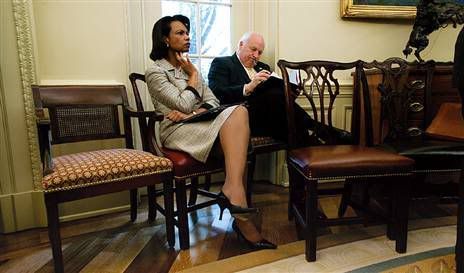 Body language
[photo: Khue Bul for Newsweek]
Newsweek reports:
Condoleezza Rice seems in control of everything—except events. As she paused for a few minutes in the cabin of her Boeing 757 last week, winging her way to her 63rd country in two and a half years (Spain this time), the secretary of State calmly swatted away questions about the apparent stalemates she faces on so many fronts: Israeli-Palestinian talks, out-of-control nuclear programs in Iran and North Korea, and an emerging cold-war-like confrontation with Russia. (That's without even bringing up the quagmire in Iraq.) Rice gets through controversy by snubbing it, smiling it out of existence. She's particularly dismissive when asked whether, at this late date, she is still fighting rear-guard actions against hard-liners in Washington—especially those in Vice President Dick Cheney's office who don't like her diplomatic approach to Iran. "There's always noise in any large system," Rice told NEWSWEEK in an interview.
She's not being glib: administration officials universally acknowledge that her views are dominant in Washington. But the rumbling has been getting louder. A NEWSWEEK investigation shows that Cheney's national-security team has been actively challenging Rice's Iran strategy in recent months. "We hear a completely different story coming out of Cheney's office, even now, than what we hear from Rice on Iran," says a Western diplomat whose embassy has close dealings with the White House. Officials from the veep's office have been openly dismissive of the nuclear negotiations in think-tank meetings with Middle East analysts in Washington, according to a high-level administration official who asked for anonymity because of his position. Since Tehran has defied two U.N. resolutions calling for a suspension of its uranium-enrichment program, "there's a certain amount of schadenfreude among the hard-liners," says a European diplomat who's involved in the talks but would not comment for the record. And NEWSWEEK has learned that the veep's team seems eager to build a case that Iran is targeting Americans not just in Iraq but along the border of its other neighbor, Afghanistan.
In the last few weeks, Cheney's staff have unexpectedly become more active participants in an interagency group that steers policy on Afghanistan, according to an official familiar with the internal deliberations. During weekly meetings of the committee, known as the Afghanistan Interagency Operating Group, Cheney staffers have been intensely interested in a single issue: recent intelligence reports alleging that Iran is supplying weapons to Afghanistan's resurgent Islamist militia, the Taliban, according to two administration officials who asked for anonymity when discussing internal meetings.
Historically, Iran and the Taliban have been more often bitter enemies than allies; in the wake of the 9/11 attacks, Iran's Supreme Leader, Ayatollah Ali Khamenei, cooperated with U.S. efforts to oust the Afghan regime that harbored Osama bin Laden. Tehran went so far as to round up Qaeda suspects transiting or residing in Iran for possible deportation to countries (like Saudi Arabia or Egypt) aligned more closely with Washington. In early April, however, British forces operating under NATO command in Afghanistan's wild-west Helmand province stopped a convoy carrying what appeared to be ordnance of Iranian origin intended for delivery to the Taliban. The explosives bore suspected Iranian markings similar to those found on weapons confiscated from Shiite militias in Iraq—and the Brits intercepted another shipment a month later.
An official familiar with the interagency group's deliberations said that Cheney's aides kept asking what sounded like leading questions, demanding to know whether there was any Iranian entity other than the Islamic Revolutionary Guard Corps—the state security force Washington accuses of arming Iraqi insurgents—that could be responsible for the arms shipments. Cheney's aides, the official added, appeared less interested in other more mundane items on the Afghanistan policy committee's agenda. British officials who asked for anonymity because of the nature of their work emphasize that they lack hard evidence linking the shipments to the Revolutionary Guards, and that the weapons could just as easily have been bought on the black market in Iran. But according to one official familiar with the intelligence on Iranian interference in Iraq, Cheney earlier this year began exhibiting particular interest in any evidence detailing Tehran's aid to anti-American insurgents there. Asked about the vice president's allegedly keen interest in Iran's activities in Afghanistan, Cheney spokeswoman Megan McGinn said, "We do not discuss intelligence matters or internal deliberations."
Rice has more directly clashed with Cheney's office on issues like Mideast peace, where according to administration sources who declined to be named discussing internal deliberations, she's found herself stymied in efforts to push for more engagement with Syria and the Palestinian radical group Hamas. A senior White House official concedes that even on what should be the simplest-to-achieve deal—a new relationship with Syria that would help stabilize Iraq—Cheney's office is blocking Rice's efforts to bring Bush around. The secretary has also fought with the veep's office in seeking to soften detention policies at Guantánamo. In the interview, however, Rice insisted her relationship with Cheney himself is good. "The vice president has never been somebody who tries to [undermine others] on the sidelines, behind the scenes. He really doesn't," she said. "In fact we have a kind of friendly banter about it, in which I'll tease him about the image that he doesn't like diplomacy."
Rice has reason to be confident. She maintains a tight relationship with Bush, with whom she talks twice a day. "We have been together a long time, the president and I, in any number of different incarnations, and when I'm speaking, I'm speaking on his behalf," she says. Even one of Rice's fiercest current critics, former U.N. ambassador John Bolton—a key Cheney ally who was her subordinate only a few months ago—says that her views are ascendant in the administration. "I think those who support [the policy of nuclear negotiations with Iran] ... are riding high," Bolton told NEWSWEEK, adding that he left the administration because he believed his hard-line views toward Iran and North Korea were being eclipsed by Rice's State Department (there was also the small matter of the Democrat-controlled Congress refusing to confirm him).
Bolton admits that the hard-liners are not what they were in the first term, when Cheney's office was accused of cherry-picking intel to make the case for war against Iraq. One by one, the Cheneyites have been losing significant supporters in the top ranks of the administration—most recently White House deputy national-security adviser J. D. Crouch, a conservative former Pentagon official and academic who left last week. To thwart the hard-liners once and for all, though, Rice knows that she must start to deliver. Even as Tehran has made technical strides in its enrichment program, negotiations have been stalled: on Thursday the chief Iranian and European negotiators announced they would meet again in two weeks.
In the end, the administration's few remaining hard-liners may be the least of Rice's problems. In her NEWSWEEK interview, she acknowledged how hard it would be to achieve the kind of "breakthrough" agreement that traditionally defines a successful secretary of State. "I wouldn't rule it out," she said. But, Rice added: "we're laying the foundations for someone else to succeed in the future, and I think that's fine." As long as she can keep things under control.
Editor's Note: After this story appeared in print, John Bolton contacted Newsweek to further address the circumstances under which he left the Bush administration. According to Bolton, he left when his recess appointment ended; Bush asked him to stay at the UN "without Senate confirmation, using a second recess appointment and the Vacancies Act," but Bolton says he declined. Bolton added that White House lawyers had used this approach in another case at an earlier juncture in the administration.
