The Washington Post reports:
In August 1980, with no hope left of winning the nomination, Sen. Edward M. Kennedy conceded defeat to incumbent Jimmy Carter in the Democratic presidential race.
"For me, a few hours ago, this campaign came to an end," Kennedy said at the Democratic National Convention in New York. "For all those whose cares have been our concern, the work goes on, the cause endures, the hope still lives, and the dream shall never die."
And with that, at age 48, Kennedy returned to the Senate, where he committed himself to a career as a legislator, crafting landmark bills on health care, education and immigration. Many Democrats are now pointing to the Kennedy model as a path for Sen. Hillary Rodham Clinton to reshape her own political career, assuming she is unable to wrest the nomination from Sen. Barack Obama.
"I loved the Senate before I ran for the president," Kennedy explained in an interview before his recent cancer diagnosis. Losing to Carter, he said, made him appreciate the opportunities in Congress all the more. "I think I became a better senator, with greater focus and attention," Kennedy said. But he added: "It all depends on the attitude, what's in the mind of the person."
Clinton, Kennedy continued, must decide where her heart lies. "She's got great capacity -- she was a good senator before, and she can be a great senator in the future," he said. The question, he said, is "what she does with this experience."
When Kennedy returned to Capitol Hill before the 1980 election, the Massachusetts Democrat was in a similar fix. Like Clinton, he was the heir to a powerful political legacy. But the climate was volatile, and voters were in the mood for change. Kennedy was rejected by many of his Senate colleagues, despite Carter's sagging popularity, and he won just 10 primary states. But like Clinton, he hung on until the bitter end.
Yet Kennedy was an 18-year Senate veteran who had already risen to chairman of the Judiciary Committee and a health subcommittee. Clinton faces few options for quick advancement should she give up her presidential bid, prompting some to speculate that she may look elsewhere for a prominent political post, possibly the governorship of New York.
The climate on Capitol Hill has changed considerably in the 18 months since Clinton began her presidential campaign. The Senate leadership path that she had once viewed as a viable alternative is now all but blocked. Senate Majority Leader Harry M. Reid (Nev.) has gained clout in his role, and he will grow even more powerful if Democrats succeed in expanding their narrow majority in November by up to half a dozen seats.
Reid's deputies, Majority Whip Richard J. Durbin (Ill.) and Democratic Caucus Vice Chairman Charles E. Schumer (N.Y.), also have enhanced their status in recent months and are quietly laying the groundwork to succeed Reid whenever he decides to step down.
"Within the caucus, there's strong support for Senator Reid, and those who speculate otherwise don't understand the Senate," said Durbin, who was the first senator to endorse Obama. When Clinton returns to her old job, assuming she does not win the nomination, Durbin added, "she will be an important part of the future. But I can't tell you that anyone has approached me, or anyone in the caucus, with any specific suggestions about what she would do."
When Clinton announced her bid in January 2007, she was the prohibitive favorite, and most of her Senate colleagues appeared ready to rally to her side. But as her primary battle with Obama draws to an end, with the senator from Illinois almost certain to emerge the victor, Clinton has discovered that the reservoir of Senate goodwill was not so deep after all.
Clinton collected 13 endorsements from her Senate colleagues, compared with 15 for Obama, and she has not added a name to her list since early February, even though she has won significant contests since then.
"I'm sure she'll remember, for the rest of her life, who was with her and who wasn't," said Sen. Christopher J. Dodd (D-Conn.), who ran unsuccessfully this year and then endorsed Obama.
Speaking on the condition of anonymity, many Democratic senators said they expect Clinton to work doggedly for Obama this summer and fall, and they agreed that if she does, whatever hard feelings that linger from the primary race will vanish.
But a bigger question is whether, like Kennedy, she will shelve her presidential ambitions, especially if Sen. John McCain (R-Ariz.) wins in November. The 2012 election would coincide with the end of Clinton's second Senate term, effectively turning her into a lame duck. A run for New York governor would hasten Clinton's departure by two years.
But if Obama wins in November, her next likely opportunity for the presidency would be in 2016, when she would be 69. If Clinton makes it clear her future is in the Senate, she could find several paths open to her, aides and colleagues said.
One would be to champion a major piece of legislation, such as the health-care bill Obama has promised early in his first term.
A member of three prominent committees, Clinton remains a junior member on all three panels and does not stand to become a committee chairman for at least another decade.
But another option would be to assume the chairmanship of the Democratic Senatorial Campaign Committee, a demanding but high-profile post that is an appointment by Reid. Sen. Robert Menendez (N.J.) is a potential successor to Schumer, who has led the committee for four years, but Democratic sources said Clinton could get the job if she wanted it.
Sen. Patrick J. Leahy (Vt.) pointed to the late Hubert H. Humphrey (D-Minn.) as one example of life in the Senate after a losing White House bid. A senator in the 1950s and '60s, Humphrey became vice president in 1965 and then narrowly lost to Richard M. Nixon in the 1968 presidential election. He won another Senate term in 1970 and returned as the most junior member. "He realized he could command an audience anywhere in the world. He threw himself into the issues. He had the time of his life," Leahy said.
On the other hand, Sen. Joseph R. Biden Jr. (Del.) returned to the Senate after his failed 1988 presidential bid and became a formidable voice on both the Judiciary and Foreign Relations committees.
With or without a prominent post, Clinton will possess unrivaled clout, her colleagues said. "She is the single most powerful woman in America, and that will be solidified by this race, not diminished by it," said Biden, who has not endorsed a candidate after dropping his own bid earlier this year.
As the former first lady, Clinton arrived in the Senate in January 2001 already a political celebrity, and her status was acknowledged with an appointed leadership position as head of the Steering Committee, with the task of interacting with outside liberal groups.
But colleagues said Clinton showed no interest in using her perch to work toward more powerful posts inside the Senate. Rather, she spent much of her time traveling the country to help Democrats in presidential battleground states, and raising money through her leadership political action committee, HillPAC. She also committed herself to advancing New York state interests, numerous colleagues and senior aides said.
Regardless of which route she now chooses, colleagues who have run failed campaigns said she must first readjust to life in the Senate.
"When you're out on the campaign, you've got to make decisions every hour, every minute," said Sen. Tom Harkin (D-Iowa). "Then you come back to the Senate and it's like a cocoon."
Tuesday, May 27, 2008
| [+/-] |
No Clear Map For Clinton's Political Future |
Monday, February 11, 2008
| [+/-] |
The Chicken Doves |
Elected to end the war, Democrats have surrendered to Bush on Iraq and betrayed the peace movement for their own political ends
At the Rolling Stone, Matt Taibbi writes:
Quietly, while Hillary Clinton and Barack Obama have been inspiring Democrats everywhere with their rolling bitchfest, congressional superduo Harry Reid and Nancy Pelosi have completed one of the most awesome political collapses since Neville Chamberlain. At long last, the Democratic leaders of Congress have publicly surrendered on the Iraq War, just one year after being swept into power with a firm mandate to end it.
Solidifying his reputation as one of the biggest pussies in U.S. political history, Reid explained his decision to refocus his party's energies on topics other than ending the war by saying he just couldn't fit Iraq into his busy schedule. "We have the presidential election," Reid said recently. "Our time is really squeezed."
There was much public shedding of tears among the Democratic leadership, as Reid, Pelosi and other congressional heavyweights expressed deep sadness that their valiant charge up the hill of change had been thwarted by circumstances beyond their control — that, as much as they would love to continue trying to end the catastrophic Iraq deal, they would now have to wait until, oh, 2009 to try again. "We'll have a new president," said Pelosi. "And I do think at that time we'll take a fresh look at it."
Pelosi seemed especially broken up about having to surrender on Iraq, sounding like an NFL coach in a postgame presser, trying with a straight face to explain why he punted on first-and-goal. "We just didn't have any plays we liked down there," said the coach of the 0-15 Dems. "Sometimes you just have to play the field-position game...."
In reality, though, Pelosi and the Democrats were actually engaged in some serious point-shaving. Working behind the scenes, the Democrats have systematically taken over the anti-war movement, packing the nation's leading group with party consultants more interested in attacking the GOP than ending the war. "Our focus is on the Republicans," one Democratic apparatchik in charge of the anti-war coalition declared. "How can we juice up attacks on them?"
The story of how the Democrats finally betrayed the voters who handed them both houses of Congress a year ago is a depressing preview of what's to come if they win the White House. And if we don't pay attention to this sorry tale now, while there's still time to change our minds about whom to nominate, we might be stuck with this same bunch of spineless creeps for four more years. With no one but ourselves to blame.
The controversy over the Democratic "strategy" to end the war basically comes down to whom you believe. According to the Reid-Pelosi version of history, the Democrats tried hard to force President Bush's hand by repeatedly attempting to tie funding for the war to a scheduled withdrawal. Last spring they tried to get him to eat a timeline and failed to get the votes to override a presidential veto. Then they retreated and gave Bush his money, with the aim of trying again after the summer to convince a sufficient number of Republicans to cross the aisle in support of a timeline.
But in September, Gen. David Petraeus reported that Bush's "surge" in Iraq was working, giving Republicans who might otherwise have flipped sufficient cover to continue supporting the war. The Democrats had no choice, the legend goes, but to wait until 2009, in the hopes that things would be different under a Democratic president.
Democrats insist that the reason they can't cut off the money for the war, despite their majority in both houses, is purely political. "George Bush would be on TV every five minutes saying that the Democrats betrayed the troops," says Sen. Bernie Sanders of Vermont. Then he glumly adds another reason. "Also, it just wasn't going to happen."
Why it "just wasn't going to happen" is the controversy. In and around the halls of Congress, the notion that the Democrats made a sincere effort to end the war meets with, at best, derisive laughter. Though few congressional aides would think of saying so on the record, in private many dismiss their party's lame anti-war effort as an absurd dog-and-pony show, a calculated attempt to score political points without ever being serious about bringing the troops home.
"Yeah, the amount of expletives that flew in our office alone was unbelievable," says an aide to one staunchly anti-war House member. "It was all about the public show. Reid and Pelosi would say they were taking this tough stand against Bush, but if you actually looked at what they were sending to a vote, it was like Swiss cheese. Full of holes."
In the House, some seventy Democrats joined the Out of Iraq caucus and repeatedly butted heads with Reid and Pelosi, arguing passionately for tougher measures to end the war. The fight left some caucus members bitter about the party's failure. Rep. Barbara Lee of California was one of the first to submit an amendment to cut off funding unless it was tied to an immediate withdrawal. "I couldn't even get it through the Rules Committee in the spring," Lee says.
Rep. Lynn Woolsey, a fellow caucus member, says Democrats should have refused from the beginning to approve any funding that wasn't tied to a withdrawal. "If we'd been bold the minute we got control of the House — and that's why we got the majority, because the people of this country wanted us out of Iraq — if we'd been bold, even if we lost the votes, we would have gained our voice."
An honest attempt to end the war, say Democrats like Woolsey and Lee, would have involved forcing Bush to execute his veto and allowing the Republicans to filibuster all they wanted. Force a showdown, in other words, and use any means necessary to get the bloodshed ended.
"Can you imagine Tom DeLay and Denny Hastert taking no for an answer the way Reid and Pelosi did on Iraq?" asks the House aide in the expletive-filled office. "They'd find a way to get the votes. They'd get it done somehow."
But any suggestion that the Democrats had an obligation to fight this good fight infuriates the bund of hedging careerists in charge of the party. In fact, nothing sums up the current Democratic leadership better than its vitriolic criticisms of those recalcitrant party members who insist on interpreting their 2006 mandate as a command to actually end the war. Rep. David Obey, chair of the House Appropriations Committee and a key Pelosi-Reid ally, lambasted anti-war Democrats who "didn't want to get specks on those white robes of theirs." Obey even berated a soldier's mother who begged him to cut off funds for the war, accusing her and her friends of "smoking something illegal."
Rather than use the vast power they had to end the war, Democrats devoted their energy to making sure that "anti-war activism" became synonymous with "electing Democrats." Capitalizing on America's desire to end the war, they hijacked the anti-war movement itself, filling the ranks of peace groups with loyal party hacks. Anti-war organizations essentially became a political tool for the Democrats — one operated from inside the Beltway and devoted primarily to targeting Republicans.
This supposedly grass-roots "anti-war coalition" met regularly on K Street, the very capital of top-down Beltway politics. At the forefront of the groups are Thomas Matzzie and Brad Woodhouse of Americans Against the Escalation in Iraq, the leader of the anti-war lobby. Along with other K Street crusaders, the two have received iconic treatment from The Washington Post and The New York Times, both of which depicted the anti-war warriors as young idealist-progressives in shirtsleeves, riding a mirthful spirit into political combat — changing the world is fun!
But what exactly are these young idealists campaigning for? At its most recent meeting, the group eerily echoed the Reid-Pelosi "squeezed for time" mantra: Retreat from any attempt to end the war and focus on electing Democrats. "There was a lot of agreement that we can draw distinctions between anti-war Democrats and pro-war Republicans," a spokeswoman for Americans Against the Escalation in Iraq announced.
What the Post and the Times failed to note is that much of the anti-war group's leadership hails from a consulting firm called Hildebrand Tewes — whose partners, Steve Hildebrand and Paul Tewes, served as staffers for the Democratic Senatorial Campaign Committee (DSCC). In addition, these anti-war leaders continue to consult for many of the same U.S. senators whom they need to pressure in order to end the war. This is the kind of conflict of interest that would normally be an embarrassment in the activist community.
Worst of all is the case of Woodhouse, who came to Hildebrand Tewes after years of working as the chief mouthpiece for the DSCC, where he campaigned actively to re-elect Democratic senators who supported the Iraq War in the first place. Anyone bothering to look — and clearly the Post and the Times did not before penning their ardent bios of Woodhouse — would have found the youthful idealist bragging to newspapers before the Iraq invasion about the pro-war credentials of North Carolina candidate Erskine Bowles. "No one has been stronger in this race in supporting President Bush in the War on Terror and his efforts to effect a regime change in Iraq," boasted the future "anti-war" activist Woodhouse.
With guys like this in charge of the anti-war movement, much of what has passed for peace activism in the past year was little more than a thinly veiled scheme to use popular discontent over the war to unseat vulnerable Republicans up for re-election in 2008. David Sirota, a former congressional staffer whose new book, The Uprising, excoriates the Democrats for their failure to end the war, expresses disgust at the strategy of targeting only Republicans. "The whole idea is based on this insane fiction that there is no such thing as a pro-war Democrat," he says. "Their strategy allows Democrats to take credit for being against the war without doing anything to stop it. It's crazy."
Justin Raimondo, the uncompromising editorial director of Antiwar.com, regrets contributing twenty dollars to Americans Against the Escalation in Iraq. "Not only did they use it to target Republicans," he says, "they went after the ones who were on the fence about Iraq." The most notorious case involved Lincoln Chafee, a moderate from Rhode Island who lost his Senate seat in 2006. Since then, Chafee has taken shots at Democrats like Reid, Hillary Clinton and Chuck Schumer, all of whom campaigned against him despite having voted for the war themselves.
"Look, I understand partisan politics," says Chafee, who now concedes that voters were correct to punish him for his war vote. "I just find it amusing that those who helped get us into this mess now say we need to change the Senate — because we're in a mess."
The really tragic thing about the Democratic surrender on Iraq is that it's now all but guaranteed that the war will be off the table during the presidential campaign. Once again — it happened in 2002, 2004 and 2006 — the Democrats have essentially decided to rely on the voters to give them credit for being anti-war, despite the fact that, for all the noise they've made to the contrary, in the end they've done nothing but vote for war and cough up every dime they've been asked to give, every step of the way.
Even beyond the war, the Democrats have repeatedly gone limp-dick every time the Bush administration so much as raises its voice. Most recently, twelve Democrats crossed the aisle to grant immunity to phone companies who participated in Bush's notorious wiretapping program. Before that, Democrats caved in and confirmed Mike Mukasey as attorney general after he kept his middle finger extended and refused to condemn waterboarding as torture. Democrats fattened by Wall Street also got cold feet about upsetting the country's gazillionaires, refusing to close a tax loophole that rewarded hedge-fund managers with a tax rate less than half that paid by ordinary citizens.
But the war is where they showed their real mettle. Before the 2006 elections, Democrats told us we could expect more specifics on their war plans after Election Day. Nearly two years have passed since then, and now they are once again telling us to wait until after an election to see real action to stop the war. In the meantime, of course, we're to remember that they're the good guys, the Republicans are the real enemy, and, well, go Hillary! Semper fi! Yay, team!
How much of this bullshit are we going to take? How long are we supposed to give the Reids and Pelosis and Hillarys of the world credit for wanting, deep down in their moldy hearts, to do the right thing?
Look, fuck your hearts, OK? Just get it done. Because if you don't, sooner or later this con is going to run dry. It may not be in '08, but it'll be soon. Even Americans can't be fooled forever.
Wednesday, January 23, 2008
| [+/-] |
Cheney Wants Surveillance Law Expanded |
The Associated Press reports:
Vice President Dick Cheney prodded Congress on Wednesday to extend and broaden an expiring surveillance law, saying "fighting the war on terror is a long-term enterprise" that should not come with an expiration date.
"We're reminding Congress that they must act now," Cheney told the Heritage Foundation, a conservative think tank. The law, which authorizes the administration to eavesdrop on phone calls and see the e-mail to and from suspected terrorists, expires on Feb. 1. Congress is bickering over terms of its extension.
On Tuesday, Senate Republicans blocked an effort by Senate Majority Leader Harry Reid to extend the stopgap Protect America Act without expanding it, raising stakes for an expected showdown in the Senate later this week on a new version of the law.
"This cause is bigger than the quarrels of party and the agendas of politicians," Cheney said. "And if we in Washington, all of us, can only see our way clear to work together, then the outcome should not be in doubt."
Congress hastily adopted the stopgap act last summer in the face of warnings from the administration about dangerous gaps in the government's ability to gather intelligence in the Internet age.
Administration allies in Congress not only want the expiring law made permanent but amended to give telephone companies and other communications providers immunity from being sued for helping the government eavesdropping and other intelligence-gathering efforts.
Cheney said such providers "face dozens of lawsuits."
"The intelligence community doesn't have the facilities to carry out the kind of international surveillance needed to defend this country since 9-11. In some situations, there is no alternative to seeking assistance from the private sector. This is entirely appropriate," Cheney said.
At the White House, press secretary Dana Perino defended the proposal to protect phone companies from liability. "These are companies who helped their country right after 9-11," she said. She also criticized Democratic plans for a one-month extension of the current law. "Look, there's been six months to hash out the differences. Actually, there's been a whole year-and-a-half worth ... And there was robust debate, a hearty debate back in August when we got the bill that we have now."
At the heart of the controversy is whether the government's wireless surveillance program violated provisions of the original FISA law that requires warrants for wiretaps whenever one of the parties involved in the communication resides in the United States.
Cheney also said the administration "feels strongly that an updated FISA law should be made permanent, not merely extended again. ... There is no sound reason to pass critical legislation like the Protect America Act and slap an expiration date on it."
Reid plans to bring to the Senate floor on Thursday competing versions of the legislation.
If a bill is not approved then, Reid said he would require the Senate to work through the weekend to get a bill passed.
The original FISA law requires the government to get permission from a special court to listen in on the phone calls and e-mails of people in the United States. Changes in communications technology mean many purely foreign to foreign communications now pass through the United States and therefore require the government to get court orders to intercept them.
The Protect America Act, adopted in August, eased that restriction. Privacy and civil liberties advocates say it went too far, giving the government far more power to eavesdrop on American communications without court oversight.
Thursday, December 13, 2007
| [+/-] |
Democrats Bow To Bush's Demand in House Spending Bill |
Billions Trimmed From New Requests
The Washington Post reports:
House Democratic leaders yesterday agreed to meet President Bush's bottom-line spending limit on a sprawling, half-trillion-dollar domestic spending bill, dropping their demands for as much as $22 billion in additional spending but vowing to shift funds from the president's priorities to theirs.
The final legislation, still under negotiation, will be shorn of funding for the war in Iraq when it reaches the House floor, possibly on Friday. But Democratic leadership aides concede that the Senate will probably add those funds. A proposal to strip the bill of spending provisions for lawmakers' home districts was shelved after a bipartisan revolt, but Democrats say the number and size of those earmarks will be scaled back.
When defense spending is added to the total, discretionary spending for fiscal 2008 would reach a tentative total of $936.5 billion, $3.7 billion more than the president's request, said House Appropriations Committee staff members. All of the additional money would be spent on veterans affairs.
The agreement signaled that congressional Democrats are ready to give in to many of the White House's demands as they try to finish the session before they break for Christmas -- a political victory for the president, who has refused to compromise on the spending measures.
The House last night also approved a new version of legislation that would stave off the spread of the alternative minimum tax, a parallel tax system originally targeted at the very rich, to millions of middle-class families. The House version would not add to the federal budget deficit.
The progress yesterday on Capitol Hill did not mean that lawmakers will be rushing to the exits in the next few days. The AMT bill, which was approved 226 to 193, pays for the $50 billion tax fix largely by preventing hedge fund managers from deferring compensation by shifting their pay to offshore tax shelters. The White House issued a fresh veto threat, reiterating Bush's opposition to any tax increases to pay for an AMT fix.
The threat virtually ensured that the Senate will not muster the 60 votes needed to break a threatened Republican filibuster. It moved Congress further toward shattering a Democratic pledge not to pass tax cuts that are not fully offset by tax increases or spending reductions.
Senate Democratic leaders, backed by key Republicans, finalized a new version of a comprehensive energy bill. It would raise automotive fuel-efficiency standards and preserve a package of conservation and renewable-energy tax incentives, to be funded largely by revoking tax breaks given to the largest oil companies in recent years.
The Senate is to vote today on the revised energy bill, and senators from both parties said proponents are close to reaching the 60-vote threshold. Majority Leader Harry M. Reid (D-Nev.) summoned from the campaign trail the five senators seeking the presidential nomination for this morning's vote.
The new version of the bill meets a key White House demand by stripping out a requirement that utilities move toward generating 15 percent of their electricity from renewable energy sources. It also pares back tax increases on oil companies by exempting independent energy companies from a provision that would end a manufacturer's tax credit awarded in 2005.
But the White House is also threatening to veto that legislation. "It seems that Senator Reid wants to keep the tax title in there, which the president has been very clear that he won't sign," White House spokesman Dana Perino said.
Bush may also veto the spending package, even though Democrats shaved $22 billion from federal domestic programs to meet his demands, said Rep. Jerry Lewis (Calif.), the ranking Republican on the House Appropriations Committee. He added, "And I think we'll have enough Republicans to sustain a veto."
White House spokesman Tony Fratto emphasized last night, "The White House is not part of any deal, full stop."
The veto threats in the face of Democratic compromises left party lawmakers in disbelief. Because of Bush's intransigence, Sen. Patty Murray (D-Wash.) said that "we're going to have some horrific decisions to make over the next week."
Democratic leaders tried to put the best face on their surrender on domestic spending levels, promising that the final bill will reflect their priorities, if not their preferred funding -- "the president's number, our priorities," said House Speaker Nancy Pelosi (D-Calif.). She noted that the bill would increase funding for children's health programs, nutrition and medical research at the National Institutes of Health.
Democrats will also increase spending on heating assistance for the poor, health care for veterans, local law enforcement and border security, Democratic leadership aides said last night.
To meet those goals, staff members on the House Appropriations Committee will probably target the president's "Millennium Challenge" international aid program, his abstinence-education efforts and the scandal-plagued "Reading First" education effort.
Senate Republicans will seek to add as much as $70 billion in war funding to the bill, without strings on the withdrawal of U.S. troops from Iraq attached. Pelosi indicated she would vote against the final bill if such funds are included but made clear that Democrats are ready to make the concessions needed to avoid a veto.
"This is a negotiation about a bill that will be signed by the president," she said.
The retooled version of the energy bill still includes higher standards for motor vehicle and appliance efficiency, as well as a requirement for vastly expanded use of ethanol and other biofuels. The tax package would offset expanded energy conservation incentives by trimming tax breaks and depreciation allowances for the biggest oil firms.
The House AMT bill would prevent 21 million middle-income American households from being hit with a tax increase that could average $2,000 per family from a levy designed in 1969 to target only the super-rich. The proposal would also increase the number of low-income families that could benefit from a refundable tax credit for children.
The plan's outlook in the Senate is not good. The ranking Republican on the House Ways and Means Committee, Rep. Jim McCrery (La.), called it "dead on arrival."
"What we are watching is a Kabuki dance," he said. "The Senate made it clear, with a bipartisan 88 to 5 vote last Thursday, that it will pass an AMT patch without unnecessary tax increases." Bush also opposes the House measure.
Friday, July 20, 2007
| [+/-] |
Senate Tied In Knots By Filibusters |
McClatchy reports:
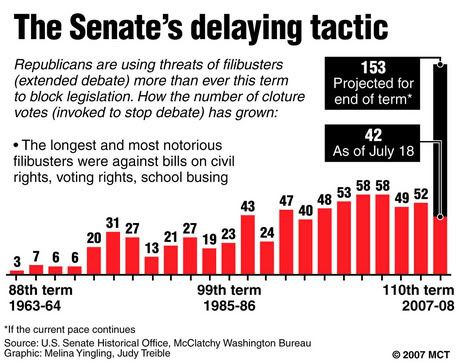
This year Senate Republicans are threatening filibusters to block more legislation than ever before, a pattern that's rooted in — and could increase — the pettiness and dysfunction in Congress.
The trend has been evolving for 30 years. The reasons behind it are too complex to pin on one party. But it has been especially pronounced since the Democrats' razor-thin win in last year's election, giving them effectively a 51-49 Senate majority, and the Republicans' exile to the minority.
Seven months into the current two-year term, the Senate has held 42 "cloture" votes aimed at shutting off extended debate — filibusters, or sometimes only the threat of one — and moving to up-or-down votes on contested legislation. Under Senate rules that protect a minority's right to debate, these votes require a 60-vote supermajority in the 100-member Senate.
Democrats have trouble mustering 60 votes; they've fallen short 22 times so far this year. That's largely why they haven't been able to deliver on their campaign promises.
By sinking a cloture vote this week, Republicans successfully blocked a Democratic bid to withdraw combat troops from Iraq by April, even though a 52-49 Senate majority voted to end debate.
This year Republicans also have blocked votes on immigration legislation, a no-confidence resolution for Attorney General Alberto Gonzales and major legislation dealing with energy, labor rights and prescription drugs.
Nearly 1 in 6 roll-call votes in the Senate this year have been cloture votes. If this pace of blocking legislation continues, this 110th Congress will be on track to roughly triple the previous record number of cloture votes — 58 each in the two Congresses from 1999-2002, according to the Senate Historical Office.
Senate Majority Leader Harry Reid, D-Nev., forced an all-night session on the Iraq war this week to draw attention to what Democrats called Republican obstruction.
"The minority party has decided we have to get to 60 votes on almost everything we vote on of substance," said Sen. Claire McCaskill, D-Mo. "That's not the way this place is supposed to work."
Even Sen. Trent Lott, R-Miss., who's served in Congress since 1973, complained that "the Senate is spiraling into the ground to a degree that I have never seen before, and I've been here a long time. All modicum of courtesy is going out the window."
But many Republicans say the Senate's very design as a more deliberative body than the House of Representatives is meant to encourage supermajority deal-making. If Democrats worked harder to seek bipartisan deals, Republicans say, there wouldn't be so many cloture votes.
"You can't say that all we're going to do around here in the United States Senate is have us govern by 51 votes — otherwise we might as well be unicameral, because then we would have the Senate and the House exactly the same," said Sen. John McCain, R-Ariz.
To which Reid responds: "The problem we have is that we don't have many moderate Republicans. I don't know what we can do to create less cloture votes other than not file them, just walk away and say, 'We're not going to do anything.' That's the only alternative we have."
Some Republicans say that Reid forces cloture votes just so he complain that they're obstructing him.
Sen. Arlen Specter, R-Pa., called the all-nighter on Iraq "meaningless, insulting" and "an indignity." "There is no doubt that there are not 67 votes present to override a veto. There is little doubt that there are not 60 votes present to bring the issue to a vote."
Republicans also say that Democrats are forgetting how routinely they threatened filibusters only a few years ago when they were the minority, especially to block many of President Bush's judicial nominees. Back then, Republicans were so mad that they considered trying to change Senate rules to eliminate filibusters — but didn't.
"The suggestion that it's somehow unusual in the Senate to have controversial matters decided by 60 votes is absurd on its face," said Senate Minority Leader Mitch McConnell, R-Ky.
Although this year's Congress is taking it to a new level, the frequency of cloture votes has been climbing for decades — the result of more polarized politics in Congress and also evolving Senate rules and practices.
Associate Senate Historian Don Ritchie said that since the nation's start, dissident senators have prolonged debate to try to kill or modify legislation. The word "filibuster" — a translation of the Dutch word for "free-booter" or pirate — appears in the record of an 1840s Senate dispute about a patronage job.
From Reconstruction to 1964, the filibuster was largely a tool used by segregationists to fight civil rights legislation. Even so, filibusters were employed only rarely; there were only three during the 88th Congress, which passed the landmark Civil Rights Act of 1964 after two months of filibustering.
Filibusters were infrequent partly because the Senate custom of civility prompted consideration of minority views — and partly because they were so hard to overcome that compromises were struck. In 1917 cloture rules for ending filibusters were put in place, but required a two-thirds vote — so high it was rarely tested.
Post-Watergate, in 1975, the bar was lowered to three-fifths, or 60 votes, and leaders began to try it more often.
By the early 1990s, tensions between then-Majority Leader George Mitchell of Maine and Minority Leader Bob Dole of Kansas upped the ante, and the filibuster-cloture spiral has soared ever since as more partisan politics prevailed. The use of filibusters became "basically a tool of the minority party," Ritchie said.
The current Senate has two other complications: the 51-49 Democratic majority, which includes a pro-war independent and an absent Democrat recuperating from brain surgery, makes it harder to find 60 votes. And the presidency and Congress are controlled by opposing parties, which increases confrontation.
The Senate "has always been a cumbersome and frustrating and slow body because that's what the Constitution wanted," Ritchie said. The new majority's decisions are: "How often are you willing to lose on these issues? Would you rather campaign on the other side being obstructionists? What's a tolerable compromise? They're still working these things out."
Republican Senate leader McConnell said Friday in a news conference that when he became minority leader, "it was not my goal to see us do nothing. I mean, you can always use the next election as a rationale for not doing anything. But as you all know, we've had a regularly scheduled election every two years since 1788, so there's always an election right around the corner."
"A divided government has frequently done important things: Social Security in the Reagan period, when (Democrat) Tip O'Neill was speaker; welfare reform when Bill Clinton was in the White House when there was a Republican Congress. There's no particular reason why divided government can't do important things. We haven't yet, but it's not too late.
"And I think clearly the way to accomplish things is in the political middle, and I would challenge our friends on the other side of the aisle to step up and take a chance on something big and important for our country."
Of course, Democrats say similar things — but then neither side often compromises.
| [+/-] |
Broader Privilege Claimed In U.S. Attorney Firings |
The Washington Post reports:
Bush administration officials unveiled a bold new assertion of executive authority yesterday in the dispute over the firing of nine U.S. attorneys, saying that the Justice Department will never be allowed to pursue contempt charges initiated by Congress against White House officials once the president has invoked executive privilege.
The position presents serious legal and political obstacles for congressional Democrats, who have begun laying the groundwork for contempt proceedings against current and former White House officials in order to pry loose information about the dismissals.
Under federal law, a statutory contempt citation by the House or Senate must be submitted to the U.S. attorney for the District of Columbia, "whose duty it shall be to bring the matter before the grand jury for its action."
But administration officials argued yesterday that Congress has no power to force a U.S. attorney to pursue contempt charges in cases, such as the prosecutor firings, in which the president has declared that testimony or documents are protected from release by executive privilege. Officials pointed to a Justice Department legal opinion during the Reagan administration, which made the same argument in a case that was never resolved by the courts.
"A U.S. attorney would not be permitted to bring contempt charges or convene a grand jury in an executive privilege case," said a senior official, who said his remarks reflect a consensus within the administration. "And a U.S. attorney wouldn't be permitted to argue against the reasoned legal opinion that the Justice Department provided. No one should expect that to happen."
The official, who spoke on the condition of anonymity because he was not authorized to discuss the issue publicly, added: "It has long been understood that, in circumstances like these, the constitutional prerogatives of the president would make it a futile and purely political act for Congress to refer contempt citations to U.S. attorneys."
Mark J. Rozell, a professor of public policy at George Mason University who has written a book on executive-privilege issues, called the administration's stance "astonishing."
"That's a breathtakingly broad view of the president's role in this system of separation of powers," Rozell said. "What this statement is saying is the president's claim of executive privilege trumps all."
The administration's statement is a dramatic attempt to seize the upper hand in an escalating constitutional battle with Congress, which has been trying for months, without success, to compel White House officials to testify and to turn over documents about their roles in the prosecutor firings last year. The Justice Department and White House in recent weeks have been discussing when and how to disclose the stance, and the official said he decided yesterday that it was time to highlight it.
Yesterday, a House Judiciary subcommittee voted to lay the groundwork for contempt proceedings against White House chief of staff Joshua B. Bolten, following a similar decision last week against former White House counsel Harriet E. Miers.
The administration has not directly informed Congress of its view. A spokeswoman for Rep. John Conyers Jr. (D-Mich.), the Judiciary Committee's chairman, declined to comment . But other leading Democrats attacked the argument.
Senate Majority Leader Harry M. Reid (D-Nev.) called it "an outrageous abuse of executive privilege" and said: "The White House must stop stonewalling and start being accountable to Congress and the American people. No one, including the president, is above the law."
Sen. Charles E. Schumer (N.Y.) said the administration is "hastening a constitutional crisis," and Rep. Henry A. Waxman (D-Calif.) said the position "makes a mockery of the ideal that no one is above the law."
Waxman added: "I suppose the next step would be just disbanding the Justice Department."
Under long-established procedures and laws, the House and Senate can each pursue two kinds of criminal contempt proceedings, and the Senate also has a civil contempt option. The first, called statutory contempt, has been the avenue most frequently pursued in modern times, and is the one that requires a referral to the U.S. attorney in the District.
Both chambers also have an "inherent contempt" power, allowing either body to hold its own trials and even jail those found in defiance of Congress. Although widely used during the 19th century, the power has not been invoked since 1934 and Democratic lawmakers have not displayed an appetite for reviving the practice.
In defending its argument, administration officials point to a 1984 opinion by the Justice Department's Office of Legal Counsel, headed at the time by Theodore B. Olson, a prominent conservative lawyer who was solicitor general from 2001 to 2004. The opinion centered on a contempt citation issued by the House for Anne Gorsuch Burford, then administrator of the Environmental Protection Agency.
It concluded: "The President, through a United States Attorney, need not, indeed may not, prosecute criminally a subordinate for asserting on his behalf a claim of executive privilege. Nor could the Legislative Branch or the courts require or implement the prosecution of such an individual."
In the Burford case, which involved spending on the Superfund program, the White House filed a federal lawsuit to block Congress's contempt action. The conflict subsided when Burford turned over documents to Congress.
The Bush administration has not previously signaled it would forbid a U.S. attorney from pursuing a contempt case in relation to the prosecutor firings. But officials at Justice and elsewhere say it has long held that Congress cannot force such action.
David B. Rifkin, who worked in the Justice Department and White House counsel's office under presidents Ronald Reagan and George H.W. Bush, praised the position and said it is consistent with the idea of a "unitary executive." In practical terms, he said, "U.S. attorneys are emanations of a president's will." And in constitutional terms, he said, "the president has decided, by virtue of invoking executive privilege, that is the correct policy for the entire executive branch."
But Stanley Brand, who was the Democratic House counsel during the Burford case, said the administration's legal view "turns the constitutional enforcement process on its head. They are saying they will always place a claim of presidential privilege without any judicial determination above a congressional demand for evidence -- without any basis in law." Brand said the position is essentially telling Congress: "Because we control the enforcement process, we are going to thumb our nose at you."
Rozell, the George Mason professor and authority on executive privilege, said the administration's stance "is almost Nixonian in its scope and breadth of interpreting its power. Congress has no recourse at all, in the president's view. . . . It's allowing the executive to define the scope and limits of its own powers."
Friday, June 15, 2007
| [+/-] |
Senate Strikes Deal To Revive Immigration Bill |
The LAT reports:
Senate leaders reached a deal Thursday night to revive stalled immigration legislation after days of intense talks and a rare presidential salvage mission to the Capitol.
Majority Leader Harry Reid (D-Nev.) and Minority Leader Mitch McConnell (R-Ky.) issued a brief joint statement, saying they had met with key lawmakers and the bill would return to the Senate floor.
The Senate could resume debate next week, as soon as it finishes an energy bill, and would aim to complete it before the end of the month.
The bill kicked up fierce objections among conservatives across the country who derided it as amnesty for illegal immigrants, emboldening Senate opponents who thwarted attempts to debate the bill.
Senate leaders agreed Thursday to a list of amendments to be considered, clearing the way for debate to resume. The decision followed President Bush's announcement that he supports a move to immediately set aside more than $4 billion to beef up enforcement of immigration laws.
The two actions significantly improve the chances that the Senate will pass the comprehensive bill, which would provide a path to citizenship for many of the nation's estimated 12 million illegal immigrants. "We believe that there are enough votes," White House spokesman Tony Snow said Thursday.
A senior Democratic aide said that Senate leaders agreed to specific amendments, with 11 for each side, but did not describe them.
One will certainly be the amendment drafted by Sen. Lindsey Graham (R-S.C.) to guarantee that the federal government spends billions of dollars to improve border security and crack down on businesses that hire illegal workers. The measure is intended as an answer to conservatives who doubt the administration's commitment to enforcement.
The president made his announcement two days after he urged Senate Republicans at their weekly policy lunch to pass the bill, his first such visit to the Capitol in nearly six years.
"I understand Americans are skeptical about immigration reform," Bush said in a speech to a construction trade association, recalling the last time large-scale immigration legislation was passed in 1986. "There's a lot of people saying, 'Well, there's just no possible way that they can achieve important objectives. After all, they tried in '86 and they failed.' "
The president insisted his administration was already doing a better job of catching illegal border-crossers, but said he would support the Graham amendment as a way to ensure that there was adequate funding to improve even more. "We're going to show the American people that the promises in this bill will be kept," Bush said.
Under the proposal, the U.S. Treasury would immediately set aside $4.4 billion to step up border security and workplace enforcement. The funds would be repaid from the fines collected over two years from illegal immigrants who go through the legalization process.
"The moment the presidential signing pen meets the paper these funds will be available," Graham said in a statement.
"The funds will be ready to use in our efforts to construct miles of new fencing, miles of new vehicle barriers, utilize new cutting-edge technology at the border, build surveillance towers, institute an [employer verification system] to ensure workers are legal, and other enforcement measures."
The president's announcement appeared to sideline a move to put together a separate funding measure for the same purpose. Conservative opponents of the bill had asked for an emergency budget bill — similar to those used to pay for the wars in Iraq and Afghanistan — to show the administration's resolve.
Sen. John Cornyn (R-Texas), a key opponent of the legislation, described Bush's support as a "welcome development," noting that he had proposed a similar plan as part of a defense spending bill last year.
"I do think it's the right position, but it may be too late to revive this bill," Cornyn said in a conference call with reporters. "Whether this is enough to satisfy members of the Senate, we'll have to see."
Snow suggested that the president and other backers of the bill wanted the funding to be a part of the immigration package, not a separate measure.
"All the pieces have to work together," he said. "If you disaggregate, things fall apart."
Reid pulled the bill from the floor last week in a dispute with Republicans over how many amendments he would permit to be debated and voted on. Opponents had offered more than 300 amendments, a common tactic designed to indefinitely prolong debate on a bill.
A bipartisan group of a dozen senators met for months with two Cabinet secretaries to craft the complex bill, defying deep opposition from within their own parties. Those same senators had met almost daily since the bill's collapse to rescue it, saying the immigration crisis is too dire to abandon the bill.
Most observers believe the approach of the 2008 election means it could be years before the right climate exists again to tackle the emotional issue.
Calling immigration "one of the most pressing national security issues facing our nation," Sen. Ken Salazar (D-Colo.) said Thursday in a statement: "Failure is not an option. And those who are using this opportunity to divide us instead of bringing real solutions to the table will be to blame if comprehensive immigration reform is not accomplished."
Sen. Jeff Sessions (R-Ala.), one of the main opponents, dismissed the move to set aside billions of dollars for enforcement, saying: "It will do little to change the fundamental flaws of this legislation."
"I can't fathom why they seem so obsessed to ram through this flawed bill that the American people overwhelming reject," he said in a statement.
The administration has insisted that an immigration overhaul be comprehensive and include programs that would address the country's immigration problems.
Those elements include enhanced enforcement, a system to verify that employees are legal, a guest worker program, provisional legalization for illegal workers already in the country and a path to citizenship for those immigrants who wish to pursue it.
It would also restructure future immigration criteria to give more weight to language and job skills and less weight to family ties.
Illegal immigrants who want to become citizens would have to pay back taxes, learn English and meet other requirements. The process would be expected to take eight years or more.
The legislation would require improvements in border security and work-site enforcement to be in place before the legalization process could begin.
"By moving forward with this bill in the Senate, we will make our border more secure," Bush said. "In other words, if you're worried about border security, you ought to be supporting this bill."
Monday, May 14, 2007
| [+/-] |
Senate To Vote On Ending War Funding |
The AP reports:
The Senate is expected to vote as early as this week on whether to cut off money for the Iraq war next year, as well as on a softer measure calling for troops to leave this fall.
Senate Majority Leader Harry Reid, D-Nev., said Monday the two measures would be offered as amendments to a water projects funding bill being debated this week. While the Senate had planned to debate Iraq this week, it had previously been unclear what specifics members would consider.
The first amendment, backed by Reid and Sen. Russ Feingold, would require that combat operations end by March 31, 2008, by cutting off money after that date.
The second measure would provide more than $120 billion to fund the wars in Iraq and Afghanistan, as well as various domestic projects. It would call for troops to begin leaving Iraq by Oct. 1, but allow the president to waive that requirement.
Passage of the $120 billion in war spending would allow the Senate to begin negotiating with the House and send President Bush a bill by the end of the month.
The House last week approved, 221-205, legislation that would fund the war in two-month installments, giving Congress a chance to cut off money for the war after July. The House measure was considered unlikely to survive in the Senate, where Democrats wanted to fund the war through September.
"On our side of the aisle, Democrats believe they should do something very very close to what was done in the bill that was sent to the president to be vetoed," said Reid.
Tuesday, May 1, 2007
| [+/-] |
Transcript of Hardball with Chris Matthews, May 1, 2007, 7 PM |
Guests Paul Eaton, Steve McMahon join host Chris Matthews
Transcript:
CHRIS MATTHEWS, HOST: Roger and I are back.
The president is going to be speaking. He‘s going to be speaking from what is called the Cross Hall in the U.S.—in the White House, actually. It‘s a long hallway you see oftentimes in the backdrop of a presidential press conference, when you look at it from the point of the view of the East Room, looking down towards the state dining room. That‘s the hallway that connects the main part of the White House.
I‘m not sure why that spot has been chosen. I imagine he will have his back to the doorway that opens in to the very historic East Room.
Roger, what do you think of this setting? The president really is setting up a very historic occasion to explain his veto late this afternoon of the war spending bill.
ROGER SIMON, CHIEF POLITICAL COLUMNIST, THEPOLITICO.COM: He wants this to be momentous. He wants this to be a defining moment of his presidency and a defining moment for the Republican party.
He is saying he is standing up to a party of defeat. He is standing up to Democrats, who, as John McCain said, you know, are celebrating defeat, who want to wave the white flag. And this is where he draws his line in the sand, between the Republican Party, who supports this war, and the Democratic Party, who is against this war.
MATTHEWS: That was a strong political position several months ago. But the latest NBC/”Wall Street Journal” poll shows that the public, by 2-1, is more nervous about the president being stubborn than they are about the Congress overreaching.
SIMON: I think it‘s a real concern. I think his veto will be upheld this time. But this is a clash, an issue the Democrats are going to revisit time and time again.
And barring some momentous change on the ground in Iraq, a great disaster on the one hand, a great victory on the other, it‘s hard to believe—it‘s hard to see how the president‘s position doesn‘t erode over time, and how, eventually, he doesn‘t give ground to Democrats and to Republicans.
As November of next year draws closer, Republicans are going to get very, very nervous about this war...
(CROSSTALK)
SIMON: ... and more and more of them are going to slide over.
(CROSSTALK)
MATTHEWS: The position of the American Indian, the Native American, in fighting the settlers eroded over time, of course, but they won the Battle of the Little Bighorn. And they beat Custer.
Could it be that we‘re looking at a rerun of the old Newt Gingrich mistake? Which is, yes, the country wanted less government; they supported the conservatives when they came in ‘74 -- or ‘94 and ‘95, when they won that big Gingrich revolution, the Contract with America, until it reached the point where the Republicans in Congress challenged the executive authority of the president with the government shutdown.
And, all of a sudden, the country shifted and said, wait a minute. Whatever problems we have with Bill Clinton, he is the only president we have got. Could that happen here, where the issue shifts from, should there be a deadline for the war, which the public supports now, to, are we funding the troops or not?
SIMON: Well, it‘s possible. I think part of the Bill Clinton victory was that he was a far more likable candidate and better salesman than Newt Gingrich was in selling his positions.
But you‘re right. He spoke with one clear voice, and the Republicans had scattered voices. On this issue, the hope of George Bush and the Republican Party is to sell two things. One, we are protecting the troops by providing these funds, and the Democrats are turning their back on the troop.
And, two, by fighting this war, by fighting terror in Iraq, we keep the terrorists from coming home and killing Americans in their beds as they sleep or as they go to work.
(CROSSTALK)
MATTHEWS: And this is the horrible conundrum we face, because, when you talk to people who support the war heartily with the president, all the way with him, like Ken Blackwell a few moments ago, the former secretary of state from Ohio, they admit—well, it‘s not a matter of admitting.
They point out, as everybody does, that a lot of the people we‘re killing are coming in from out of Iraq, from other countries. They‘re suicide terrorists being recruited out of that sea of hostility against us over in that part of the world.
And how do you stop that recruitment? It‘s almost like, you know, the
the NFL draft. They just keep recruiting these people to commit suicide. And it‘s very hard to stop a person by killing them if being killed is what they are seeking to get done. It‘s a real conundrum, isn‘t it, to win a war against people who are running at you to get—to blow themselves up?
SIMON: It‘s extremely difficult when these insurgencies are based in
on religious grounds.
Classically, you end insurgencies not by defeating them militarily, but by making them part of the process. Take a look at Ireland.
MATTHEWS: Yes.
SIMON: You power-share. You make them part of the mainstream. When the mainstream turns against the insurgents, the insurgents can‘t exist anymore. They are not enough insurgents...
(CROSSTALK)
MATTHEWS: Well, unfortunately, that is not happening, because, just today, we are looking at the possible resignation from the Maliki government...
(CROSSTALK)
MATTHEWS: ... of a good number of Sunnis. And they‘re the only people that can represent their people, that minority of 20 percent who are waging this war against the majority Shia.
Most Americans don‘t want to deal with this—these issues of these sectarian groups over there. But we have got to deal with the fact this is the war we‘re fighting.
Let‘s bring in Pat Buchanan and Steve McMahon.
Pat, I want to ask you to try to analyze this—it‘s a horrible word for it, but game that is going on. It is heavy stakes, 100 Americans killed this month. More will be killed in the future as this war goes on. But this political back-and-forth—the president vetoes the bill this time. Two weeks from now, they get another bill back at the president, perhaps, and then the president has to veto it again.
At what point does he say, wait a minute, you are cutting off funds for the troops?
PAT BUCHANAN, NBC POLITICAL ANALYST: I think he‘s going to say tonight that this bill is basically a formula for an American defeat in Iraq by an immediate withdrawal, or withdrawal beginning in October, that this cuts off the troops, that it gives the enemy a message.
Look, I think the president of the United States is deadly sincere. I agree with Roger. This is historic. The president is saying, you stand with us or you stand with them, and they are the party of defeat here, all those who voted for this. I want no deadlines.
And I think, in the short term, Chris, the president of the United States will, as you suggest, win this battle. I think the Democratic Congress will split inside its caucuses. They will give him the money. There will be some deadlines. But I doubt that they will binding, in the sense, if something really terrible happens, if they‘re not met—I think he wins in the short term. I believe this, though.
(CROSSTALK)
MATTHEWS: No. Let me—no, don‘t agree with me too quickly.
I think the Democrats win tonight. I believe, when it gets down to the short hairs, when it gets down to the question, are we actually cutting off vital funding of our soldiers in the field, their reinforcements, their fighting ability, when is that going to happen?
Let me bring in Steve McMahon here.
Steve, it seems to me the president has mentioned the date May 15 a couple weeks ago. When that happens, when he says, at this point forward, not enough training, not enough equipment is going to the troops, what do the Democrats say then about getting a bill to him that is clean?
STEVE MCMAHON, DEMOCRATIC STRATEGIST: Well, I think the Democrats are going to get funding—going to get a bill that is going to provide funding for the troops, but they are going to do it incrementally.
And this is going to—this is going to all come home to roost on the president when the Republicans cave in on him. And you now have Congressman Blunt and Congressman Boehner talking about specific benchmarks that the Iraqi government will have to meet. And the conditions that they‘re placing on the benchmarks if they‘re not met are things like where the troops can be positioned inside the country.
So, this is a situation that is coming to a head partly because the Democrats won Congress and are forcing it, but also partly because the Republicans in Congress are reading the same polls, Chris, that you and I are.
They know. Anybody who has to stand for election in November of ‘08 knows that this is going to be the issue against which they are measured. And, if they don‘t heed the call of the American people to find a way out of this conflict, everybody on that ballot is going to be in trouble.
(CROSSTALK)
MATTHEWS: I agree with that.
(CROSSTALK)
MATTHEWS: I think being a Republican now, in this war fever right now, it‘s almost impossible to get victory east of the Mississippi. And that measure, Pat, that may be moving further west as this war goes on...
(CROSSTALK)
MATTHEWS: ... where it becomes almost impossible to win.
BUCHANAN: Chris...
MATTHEWS: Yes, sir.
BUCHANAN: ... you look at the debaters Thursday night, when you are talking to them. Almost all will support the president, because I will tell you what is going on here.
This is even larger. This is Bush‘s war. It‘s Cheney‘s war. It‘s Rumsfeld‘s war. It‘s the neocons‘ war. What is being set up now is that these guys who voted us into the war in the Congress turned around and took a walk and cut off the troops when we were late in the battle. That‘s right. And he‘s setting it up for the Democrats‘ defeat: They lost the war.
MATTHEWS: Right.
BUCHANAN: That is what is being set up here. And that is why the president—his cards—he‘s only got so many cards. And they‘re not that high. And, in the long run, the country, I think, is turning against the war. But that is what he is setting up for the future debate on who lost Iraq.
(CROSSTALK)
MATTHEWS: Are you saying that he is willing to throw the game?
BUCHANAN: Oh, no, I think he wants to win it. But he does believe, if this goes through, we are going to lose it. And he‘s going to say so.
(CROSSTALK)
MATTHEWS: Steve, do you think that is true? Does anybody—let me go—let‘s bring in General Paul Eaton just for a second.
Major General, you have written a letter to the president, questioning his claim that he is speaking for the troops.
MAJOR GENERAL PAUL EATON (RET.), U.S. ARMY: I have, Chris.
MATTHEWS: Well, make your case, General.
EATON: This—this bill, and, when you attach a timeline to it, the audience is not the American people. The audience is not the—our enemy. The audience is really the al-Maliki government.
And, throughout my career and throughout most soldiers‘ career, there is a timeline discipline. You attach a timeline to discipline the process. And, right now, we have got an open-ended situation. The Iraqis are playing us along, the Iraqi government. And they are not pursuing the benchmarks that they agreed to and the timelines that they agreed to.
We‘re talking about the reinstatement of the...
(CROSSTALK)
MATTHEWS: OK.
General—hold on, General.
We have the president coming right now to the lectern.
Here is, the president of the United States.
GEORGE W. BUSH, PRESIDENT OF THE UNITED STATES: ... the Congress to pass an emergency war spending bill that would provide our brave young men and women in uniform with the funds and flexibility they need.
Instead, members of the House and the Senate passed a bill that substitutes the opinions of politicians for the judgment of our military commanders. So a few minutes ago, I vetoed the bill.
Tonight, I will explain the reasons for this veto and my desire to work with Congress to resolve this matter as quickly as possible.
We can begin tomorrow with a bipartisan meeting with the congressional leaders here at the White House.
Here‘s why the bill Congress passed is unacceptable. First, the bill
the bill would mandate a rigid and artificial deadline for American troops to begin withdrawing from Iraq. That withdrawal could start as early as July 1, and it would have to start no later than October 1, regardless of the situation on the ground.
It makes no sense to tell the enemy when you plan to start withdrawing. All the terrorists would have to do is mark their calendars and gather their strength and begin plotting how to overthrow the government and take control of the country of Iraq.
I believe setting a deadline for withdrawal would demoralize the Iraqi people, would encourage killers across the broader Middle East, and send a signal that America will not keep its commitments. Setting a deadline for withdrawal is setting a date for failure. And that would be irresponsible.
Second, the bill would impose impossible conditions on our commanders in combat. After forcing most of our troops to withdraw, the bill would dictate the terms on which the remaining commanders and troops could engage the enemy. That means America‘s commanders in the middle of a combat zone would have to take fighting directions from politicians 6,000 miles away in Washington, D.C. This is a prescription for chaos and confusion. And we must not impose it on our troops.
Third, the bill is loaded with billions of dollars in non-emergency spending that has nothing to do with fighting the war on terror. Congress should debate these spending measures on their own merits, and not as a part of an emergency funding bill for our troops.
The Democratic leaders know that many in Congress disagree with their approach and that there are not enough votes to override the veto. I recognize that many Democrats saw this bill as an opportunity to make a political statement about their opposition to the war. They have sent their message, and now it is time to put politics behind us and support our troops with the funds they need.
Our troops are carrying out a new strategy with a new commander, General David Petraeus. The goal of this new strategy is to help the Iraqis secure their capital, so they can make progress toward reconciliation and build a free nation that respects the rights of its people, upholds the rule of law, and fights extremists and radicals and killers alongside the United States in this war on terror.
In January, General Petraeus was confirmed by a unanimous vote in the United States Senate. In February, we began sending the first of the reinforcements he requested. Not all these reinforcements have arrived in Baghdad. And, as General Petraeus has said, it will be the end of the summer before we can assess the impact of this operation.
Congress ought to give General Petraeus‘ plan a chance to work. In the month since our military has been implementing this plan, we have begun to see some important results. For example, Iraqi and coalition forces have closed down an al Qaeda car bomb network. They have captured a Shia militia leader implicated in the kidnapping and killing of American soldiers. They have broken up a death squad that had terrorized hundreds of residents in a Baghdad neighborhood.
Last week, General Petraeus was in Washington to brief me. And he briefed members of Congress on how the operation is unfolding. He noted that one of the most important indicators of progress is the level of sectarian violence in Baghdad. And he reported that, since January, the number of sectarian murders has dropped substantially.
Even as sectarian attacks have declined, we continue to see spectacular suicide attacks that have caused great suffering. These attacks are largely the work of al Qaeda, the enemy that everyone agrees we should be fighting.
The objective of these al Qaeda attacks is to subvert our efforts by reigniting the sectarian violence in Baghdad and breaking support for the war here at home. In Washington last week, General Petraeus explained it this way: Iraq is, in fact, the central front of all al Qaeda‘s global campaign.
Al Qaeda—al Qaeda‘s role makes the conflict in Iraq far more complex than a simple fight between Iraqis. It‘s true that not everyone taking innocent life in Iraq wants to attack America here at home. But many do. Many also belong to the same terrorist network that attacked us on September the 11th, 2001, and wants to attack us here at home again.
We saw the death and destruction al Qaeda inflicted on our people when they were permitted a safe haven in Afghanistan. For the security of the American people, we must not allow al Qaeda to establish a new safe haven in Iraq.
We need to give our troops all the equipment and the training and protection they need to prevail. That means that Congress needs to pass an emergency war-spending bill quickly.
I have invited leaders of both parties to come to the White House tomorrow and to discuss how we can get these vital funds to our troops. I‘m confident that, with goodwill on both sides, we can agree on a bill that gets our troops the money and flexibility they need, as soon as possible.
The need to act is urgent. Without a war-funding bill, the military has to take money from some other account or training program, so the troops in combat have what they need. Without a war-funding bill, the armed forces will have to consider cutting back on buying new equipment or repairing existing equipment.
Without a war-funding bill, we add to the uncertainty felt by our military families. Our troops and their families deserve better, and their elected leaders can do better.
Here in Washington, we have our differences on the way forward in Iraq, and we will debate them openly. Yet, whatever our differences, surely we can agree that our troops are worthy of this funding, and that we have a responsibility to get it to them without further delay.
Thank you for listening.
May God bless our troops.
MATTHEWS: That was the president of the United States laying it on the line there. He has vetoed the bill, which would have required a timetable for the removal of U.S. forces over six months from Iraq.
Let me bring in General Paul Eaton again. We‘re going to also have Pat Buchanan joining us, Roger Simon, and Steve McMahon.
But, first of all, General Eaton, once again, the president said it‘s a battle between the Democrats on Capitol Hill, the congressional leadership, that wants to substitute, as he put it, the opinions of politicians for the judgments of our military leaders.
What is he saying there that make sense to do? Or how do you disagree with him?
EATON: Chris, I come at it from a perspective, this bill puts discipline in a process that has demanded discipline for the last three-and-a-half years.
The—the real intent is to get after the al-Maliki government and to get them to start the settling of the benchmarks that they agreed to, the reinstatement of Baath leadership, as—as we vet them and bring them in, the distribution of mineral resources, to do those things that they have agreed to, to begin a legitimate government, to reestablish a legitimate government in Iraq that the Iraqi security forces can look to for legitimacy.
Right now, that is absent. And what we are seeing right now, the—the withdrawal—the—he has stood down some very successful Sunni generals and a couple of Shia generals who are having marked success working in the arena of—with—of drawing down the sectarian violence.
And you are going to have a continued defection of Sunni leaders from his parliament with—without a sense of inclusion and bringing the Sunnis in there in a vital context.
MATTHEWS: Yes, especially if they keep arresting them, these generals.
Let me bring in Pat Buchanan here.
Pat, one of the problems over there is that this political goal we have of a unified government doesn‘t seem to be working. You see people—the Maliki—rather, the Muqtada al-Sadr crowd, where they withdrew from the government. They‘re still in parliament, I believe. You—you see now the threatened removal of several Sunni members of the government.
You wonder. And then you see they are arresting Sunni military people who are acting against the Shia militia. It doesn‘t look like any steps are being taken to build this unity that we are having our guys killed for.
BUCHANAN: Yes, that‘s exactly right, Chris.
And there‘s a real sense of frustration on the part of everybody with the Maliki government and its seeming inability to be broad-minded and bring in the Sunnis and share the oil revenues.
(CROSSTALK)
BUCHANAN: But the key question here is what the president did just now. He called this a date for failure. That‘s what this bill set.
MATTHEWS: Yes.
BUCHANAN: He almost went to say it was a date for defeat. So, he is framing this argument. And this bill is dead. I do believe the next bill is coming down. The Democratic Party, or a significant slice of it, will vote to give the president of the United States the $100 dollars. I think it would be a mistake for them to parcel it out every two months.
MATTHEWS: Yes.
BUCHANAN: And I think there will be some benchmarks, but they will not be linked to any withdrawal. And this is going to be an immediate victory for the president. And it‘s going to divide the Democratic Party.
MATTHEWS: OK, let me ask Steve McMahon.
Steve, are you—are you sensing any defections? As these two trucks get close to bashing into each other, do you sense any defections on the Democrat side, where they are saying: “Wait a minute, we have made our case. Let‘s stop it here. We don‘t have to keep going back to the president. We made our case. He vetoed the bill. Everybody knows where the Democrats stand. They know where the president stands, but we only have one commander in chief”?
Why do they keep going back into the pit against the president at this point?
(CROSSTALK)
MATTHEWS: I guess I don‘t know the answer to that. Why do they want to do it again? They made their point. He‘s going to veto. Nobody thinks the Democrats have enough votes to override. Leave it at that. Let him feed the troops.
MCMAHON: Because that is what the American people elected the Democrats to do, to hold this president accountable and to change direction in Iraq.
You know, it‘s ironic Chris. As we sit here today, it‘s the fourth anniversary of the president landing on the aircraft carrier, announcing mission accomplished. And now he is saying, we need more time. We need a blank check. We don‘t want any benchmarks. We want don‘t any timetables.
And, frankly, I just think the American people are tired of it. And you talked about defections. And I think the interesting defections are not going to be on the Democratic side. I have mentioned this before. They‘re going to be the Republican side.
It‘s people like Boehner and Blunt, and Inglis from South Carolina, the people who are openly talking about benchmarks, the very benchmarks the president doesn‘t want.
But—but he‘s going to have benchmarks. The only question is, what is the nature of the benchmarks? What is the nature of the accountability? This Congress is tired of the blank check. And the American people are forcing, frankly, not just the Democrats, but the Republicans, to take some action to find a new way in Iraq.
And the Republicans are getting the message, just as the Democrats have.
MATTHEWS: We have got NBC‘s Chip Reid joining us from Congress.
Chip, it‘s amazing to watch the president. They set up the shot tonight so that the—the Jefferson Memorial could appear in the back of the president as he was speaking from the Cross Hall at the White House.
And, yet, I have to ask myself, wasn‘t Jefferson the one who believed that Congress should have the major authority in making war or making peace?
CHIP REID, NBC CORRESPONDENT: Well, that‘s certainly true, Chris.
And let me add something to what you were talking about just now, the question, why are the Democrats pushing this so hard? Why not just leave it there?
MATTHEWS: Yes.
C. REID: They believe you have to just push it for every inch that you can get all the way, partly because they believe—take, for example, a lot of people said they were not going to be able to pass timelines in the first place, because they knew it would be filibustered or they knew it would be vetoed. So, why bother?
Well, they believe that, by passing it, even though they know it can‘t become law, by having this unified Democratic position, they have really made clear to the nation that they are making progress.
And the reason—I think one reason they are going ahead with the veto vote—override vote, even though they know it is going to fail, in the House tomorrow is because Democrats, especially on the House side, have been just—been getting hammered by the left wing of their party, saying, you have got to do more. You have got to bring the troops home. So, they have got to show them they are doing everything that they possibly can.
MATTHEWS: What happens when the point comes where the president goes on television, and says, it‘s May 15, or whatever date; we will now be unable to provide the full training and resources our troops get normally because of what Congress is doing to me?
What happens, then, to that Democrat solidarity?
C. REID: Boy.
Well, I think you‘re going to still going to—I think you‘re going to still going to have—they are going to find a way. They are going to find a way to keep—we saw this time—I mean, Democratic solidarity a number of weeks ago looked impossible.
They got it, because the alternative is to give the president a victory. And, so, the Democrats have managed to find ways to—to get some solidarity.
Now, I should say, on this benchmarks issue, Democrat have been telling us up here that they do understand this is going to split the Democrats, because a lot of Democrats, this next time around, are not going to vote for this thing. Even Democrats concede that, because they are not going to vote for something that doesn‘t have some form of timeline in it. They say it just gives too much.
MATTHEWS: Oh.
C. REID: So, Democrats realize they have to get Republicans votes here. They‘re going to have to get people from both sides.
MATTHEWS: So, in other words, the Democrats—the Democrats have to thread the needle here.
C. REID: Absolutely.
MATTHEWS: They have to have a bill that somewhat—puts up benchmarks for the president to achieve with regard to the Maliki government. But, if they give it too easy, then they lose their—their real anti-war base.
C. REID: That‘s right. Exactly.
And they are going to lose some of that base on this one, some Democrats have predicted to us, Democrats in a position to know. And they have got make up for that by getting Blunt and people like that on—and Inglis and people like that, people who are willing to do something on benchmarks that may even have a little bit of teeth.
MATTHEWS: Do you think Nancy Pelosi can fine-tune this?
C. REID: Fine-tune, fine-tune...
MATTHEWS: Fine-tune a bill that requires some action by the president, but also keeps aboard enough Democrats and wins enough Republican support to get the 218 in the House she needs.
C. REID: It‘s possible, but she can‘t do it with a magic wand herself. It‘s got to something that people like Blunt and some other Republicans are willing to do, that they want to—they realize moderate Republicans are in a real fix here. And they have got to give them something to vote for that isn‘t just red meat from the Republican side, some kind of benchmarks.
I mean, everybody, from the president all the way to the left side, everybody has supported, in concept, the idea of benchmarks for a long time now.
MATTHEWS: Right.
C. REID: So, a lot of Republicans, moderates in particular, are saying, well, then, let‘s do some serious benchmarks. Let‘s not just have talk.
And people like Blunt understand, you have got to give those moderate Republicans something to vote for here.
MATTHEWS: Well, we‘re watching history in the making, as Pat Buchanan said, Chip.
Let‘s go back to Pat on this point now, where we‘re—obviously, what we say on television, we are stretching a bit here, waiting to hear the two top leaders. Harry Reid of the Senate, the Democratic majority leader, and the speaker of the House, Nancy Pelosi, are about to come on and tell us exactly what their next move is.
It‘s going to—here they come. It‘s going to be, apparently, another attempt—or an attempt to override, followed by perhaps another bill with some new strings attached.
Pat, again, I recall that Thomas Jefferson played a role in creating the Congress as the first branch of government with regard to war-making powers. Is this a challenge to that? Is the end of that, or what?
(CROSSTALK)
BUCHANAN: Well, Jefferson was in Paris when they wrote the Constitution. And he himself violated the Constitution when he grabbed the Louisiana Purchase he had no right to do. And, of course, he overthrew the Alien and Sedition Acts on is own volition. He was a very strong president when he got in here.
The Democratic problem, Chris, is threading the needle between taking a principled stand with the country and setting benchmarks or guidelines to get out, and appearing to obstruct the American forces in battle in Iraq. If they are perceived as the latter, with two months of spending and so much here, and the troops have got to do this, they are setting themselves up to be held accountable for what is going to happen at the end game, which does not look good right now.
MATTHEWS: Well, I wonder, Steve, whether you can put an ankle bracelet on the president. I mean, how much can you hobble the president as commander in chief and not look like you‘re—you‘re hurting his ability to win the war he is trying to win?
MCMAHON: Well, there is a legitimate question, Chris, about whether or not the conditions on the ground are going to significantly improve, regardless of how much time the president has.
Remember, four years ago, mission accomplished, and, today, he is asking for more time. The American people have said clearly that they expect some accountability, some standards, some benchmarks, benchmarks that the president himself said the Maliki government was willing to meet. And now the president doesn‘t want to ask the government to meet it.
I just think that the American people have spoken. The Congress is tired of being ignored. The voters are tired of being ignored. They want to apply some pressure. And the Democrats and moderate Republicans now are going to start to apply pressure every way they can.
It‘s not an effort to necessarily hamstring the president. It‘s an effort to change direction in Iraq, to let the president recognize that there is a co-equal branch of government involved here, and that the voters have spoken, and they are looking something different. And, as long as...
(CROSSTALK)
MCMAHON: ... as long as...
(CROSSTALK)
MCMAHON: ... elections, there‘s going to be pressure.
MATTHEWS: Let me read you a poll fact that we just got from the NBC/”Wall Street Journal” poll.
This is what public opinion is right now, and reflected—it‘s being reflected in what we‘re watching here politically between this back-and-forth between the Republican president, George Bush, and, of course, the Democratic leadership in Congress.
What concerns you more, the poll question was, that Congress will go too far in pressing the president to reduce troop levels in Iraq, or that President Bush will not make enough changes in his Iraq policy?
Well, guess what the results are? Congress will go too far, 31 percent. Something less than a third of the people are worried Congress will go too far in hobbling the president here. President Bush will not make enough changes, 61 percent.
Pat, that is shifting toward the Democratic or anti-war position.
BUCHANAN: A snapshot will say that is exactly correct. I don‘t dispute the poll.
But what the Democrats know is that this is early May of 2007. And, if American withdrawal, let‘s say, had completely happened by next April, my prediction would be, by June and July, the Iraqis who supported us there will be suffering the fate of the Cambodians and the Vietnamese and the Harkis in Algeria.
And, at that point, a snapshot might say, especially if the president of the United States is saying, these guys lost this war, would be dramatically different. The Democrats know this. That‘s why they‘re deeply apprehensive, even though they‘re sitting there with what looks like...
(CROSSTALK)
MATTHEWS: That argument did not help Jerry Ford in 1976, Pat.
Here is Nancy Pelosi, the speaker of the House. And there‘s Harry Reid, the majority leader, the Democratic leader of the Senate, coming in, with Chuck Schumer and Dick Durbin and some others, and Jim Clyburn.
(JOINED IN PROGRESS)
SEN. HARRY REID (D-NV), MAJORITY LEADER: ... mired in the middle of an open-ended civil war. But we‘re not. And neither are most Americans.
A bipartisan majority of Congress sent the president a bill to fully fund our troops and change the mission in Iraq. The president refused to sign this bill. That‘s his right, but now he has an obligation to explain his plan to responsibly end this war.
In the coming days, we will continue to reach out to the president, and we hope congressional Republicans who remained silent—congressional Republicans through this whole debate—will work with us as well.
But, if the president thinks, by vetoing this bill, he will stop us from working to change the direction of the war in Iraq, he is mistaken.
REP. NANCY PELOSI (D-CA), SPEAKER OF THE HOUSE: Thank you, Mr. Leader.
Earlier today, the leader and I sent to the president a bill that made a strong commitment to support our men and women in uniform and a strong commitment to honor our promises to our veterans. This is a bill that was worthy of the sacrifice of our men and women in uniform.
It was a bill that honored and respected the wishes of the American people to have benchmarks, to have guidelines, to have standards for what is happening in Iraq, again, out of respect for the wishes of the American people.
We had hoped that the president would have treated it with the respect that a bipartisan—bipartisan legislation, supported overwhelmingly by the American people, deserved.
Instead, the president vetoed the bill outright, and, frankly, misrepresented what this legislation does. This bill supports the troops. In fact, it gives the president more than he asked for, for our troops.
And well they deserve it. They have done their duties excellently. They have done everything that has been asked of them, all of this without, in some cases, the training, the equipment, and a plan for success for them.
The president wants a blank check. The Congress is not going to give it to him. The president said in his comments that he did not believe in timelines, and he spoke out very forcefully against them.
Yet, in 1999, on June 5, then-Governor Bush said, about President Clinton, “I think it‘s important for the president to lay out a timetable as to how long they will be involved and when they would be withdrawn.”
Despite his past statements, President Bush refuses to apply the same standards to his own activities.
Standards, that‘s the issue. If the president thinks that what is happening on the ground in Iraq now is progress, as he said in his comments tonight, then, it is clear to see why we have a disagreement on policy with him.
I agree with Leader Reid. We look forward to working with the president to find common ground. But there is great distance between us right now.
Thank you.
QUESTION: Senator Reid, would you be willing to consider...
MATTHEWS: OK. Well, they are not taking questions. That‘s Harry Reid, had a statement. And then he was followed by the speaker of the House.
Pat Buchanan, your thoughts on the way they handled it, the Democratic leadership?
BUCHANAN: That did not sound like to me Alamo defiance, Chris.
I mean, I thought Harry Reid...
(LAUGHTER)
BUCHANAN: ... was very abbreviated, and, frankly, fairly weak. And she into a long, elaborate explanation: We‘re going to work together. We‘re not going to give him a blank check.
I didn‘t get any sense here that they have a clear-cut strategy or that they have made a hard decision—“We‘re going to defy this president, no matter what it takes, to make sure we get deadlines in there”—at all.
I think the president—if you looked at simply the body language and the tone of the two sides tonight, this looks to me like the president feels that he is the one that has got the winning hand in this short-term battle.
MATTHEWS: Well, let me to go Steve.
I think the Democrats have the winning hand, but I think it may well turn about in the near future, once the funding runs out.
I go back to my question, Steve. Once the president can come to the country and say, I need funding for my troops, give me a clean bill, or else they will be short, I don‘t see how the Democrats can say to him, no, we are not going to give you what you need to feed the troops.
I don‘t see how you win that. We have been through this so many times. It is like a game of chicken, where the two trucks are coming at each other. And the Democrats look great, until they hit the other truck. And then, I think...
(LAUGHTER)
MATTHEWS: ... one side gets blamed. And that is the guys who started this fight.
MCMAHON: Well, Chris, I think...
(CROSSTALK)
MATTHEWS: I guess I‘m not going to convince you.
MCMAHON: Well, no, but...
(CROSSTALK)
MATTHEWS: ... because it‘s not your job to agree with me.
MCMAHON: I think...
MATTHEWS: But I just that the timing—it‘s like a guy sits down at the blackjack table in Vegas, and he‘s winning three or four hands in a row. Get out of there. You won. Leave.
(CROSSTALK)
MCMAHON: But, Chris, hold on a second...
MATTHEWS: Go ahead.
MCMAHON: ... because there is another—there is another path. And, if the president wants his funding, he can sign the bill. The Democrats sent him a bill that gave him the money that he asked for.
MATTHEWS: No, he can‘t, because that ties his hands.
MCMAHON: No, no, no. Because he is being stubborn and obstinate—that‘s why. And it‘s exactly what the American people have figured out.
There‘s a lot of ways for the Congress to apply pressure. One way to announce a hard deadline for the troops to be removed from Iraq. Another way is for the Congress to impose some accountability on the Maliki government, benchmarks that the Maliki agreed to, and start to apply the pressure to the—to moderate Republicans in the middle, who are worried about their reelection prospects.
MATTHEWS: OK.
MCMAHON: And those people are going to come...
(CROSSTALK)
MATTHEWS: That is different than what they are doing.
Steve, you‘re prospecting here on what—what the Democrats might do.
What they are doing now is saying, the president doesn‘t get his funding unless he agrees to sort of a six-month timetable for removing our troops from Iraq. That‘s what they have done.
Now, you‘re speculating that, somewhere down the road, they‘re going to be smart to say, OK, you can have the funding for our troops, Mr. President, if you simply tell the Maliki government, you don‘t get any money for ship-building—I‘m sorry—for building projects over there, no more sewer construction, no electric grids anymore, none of the money, unless you agree to do certain things in terms of building a unity government, right? That is what you are saying?
MCMAHON: Yes.
I‘m saying that this the first step in applying pressure to change direction in Iraq. It‘s just the first step. There will be more. There will be more pressure. And there will be more Republicans who are applying it. It‘s not just going to be the Democrats alone. The American people want a new course. The Republicans know it. The Democrats know of it. Everybody knows it but George Bush. And this Congress is going to make sure that, at—in one way or another, he figures it out.
BUCHANAN: But, Chris, exactly when you get the benchmarks—and let‘s say they withhold $5 billion in foreign aid if the benchmarks are not met.
MATTHEWS: Right.
BUCHANAN: One hundred billion dollars is voted by the Congress to continue the war, and every hard-core liberal in the Democratic Party—and it‘s an anti-war party—they say, the Congress we elected to defund the war has refunded the war, to a tune of $100 billion, given the president what we wanted. And what we got are a couple of benchmarks and maybe a reduction in foreign aid, and the war goes on.
MATTHEWS: Yes.
BUCHANAN: So, the division moves into the Democratic Party.
MATTHEWS: So, you say the Democrats are trapped?
BUCHANAN: Yes.
MCMAHON: Well, Pat is a Republican. Of course he‘s going to say that.
(CROSSTALK)
BUCHANAN: I was against the war.
MCMAHON: I would say the Republicans are trapped.
And the American people did not vote the Democrats into Congress to defund the war. The American people voted the Democrats into Congress to find a new direction and to find a way out of the war. That‘s what the Democratic Congress is going to do.
MATTHEWS: OK.
MCMAHON: And I suspect it‘s going to do it with a lot of Republican support.
MATTHEWS: Let‘s go to Chip Reid.
Chip, are you still with us? Chip Reid?
Not still with us.
Roger—oh, there is Chip.
Chip, what do you hear, in terms of hard reporting, as for the Democrats‘ next move, after the—they fail to override, fail to get the two-thirds in both houses?
OK. We are not going to hear from him.
Roger Simon, do you have any reporting on that? What will the Democrats do once they fail to override tomorrow?
SIMON: I think this is going to be short-term defeat for the Democrats. The president will get his funding. But, in the end, it‘s probably a long-term victory for the Democrats.
I have to disagree with Pat when he says—I think he said that the issue is going to get to, in the end, who lost Iraq? I don‘t think that is the issue for the American people. The issue is going to be that, when this war ends—and we all know it‘s going to come to end—mothers and fathers and husbands and wives and children are going to be very happy that those troops are home.
And that is going to be the dominant force in American politics, getting the troops home, and being happy once they are here. And, if the Maliki government fails to want a secular, democratic government more than we do—right now, we want this more than the Iraqi people want it. If they fail at it, it‘s going to be their failure. This has got to be a Iraqi success or an Iraqi failure, not an American-imposed one.
(CROSSTALK)
MATTHEWS: General Eaton—General Eaton—let‘s go to General Eaton, a man who is a military expert.
General, the troops in the field, men and women, are they rooting for the president in this battle when they read the paper, when they read “Stars and Stripes” or they check with Armed Services Radio? Are they checking in on this dispute back here, or are they just fighting the war?
EATON: Chris, they are just fighting the war. They—the effort at squad level is very focused on getting the mission done.
But I will tell you that Secretary of Defense Gates has extended tour lengths from 12 to 15 months. We have not yet increased the recruiting goals for United States Army Recruiting Command to grow the force to meet the foreign policy demands of this country.
We have a timeline on the table. It‘s January 2009. It is coming. And what the American people did last November was vote to accelerate that timeline. That is what we need to do, in order to discipline this war and put spine in the foreign policy in the State Department to get after a diplomatic solution, to get this al-Maliki government to produce.
MATTHEWS: Do the—does the Maliki government in Iraq that we up put there and are helping to stay up, do they have a calendar? Do they know that this president leaves office in January 2009, and he is their last committed friend?
EATON: The country of Iraq is a country that has had 1,000 years of eternal Muslim domination and 30 years of Saddam brutality.
They don‘t think like we do. And they have got to be absolutely disciplined. This bill helps do that. They have got to put markers on the ground to meet in order to—to survive as a nation in its concept.
MATTHEWS: Well, what makes you think that they want to do what we want them to do, that Maliki wants to put together a government which shares the oil revenues among the three groups, that gives the Sunnis, who were running the show for all those 30 years, a piece of the power, that tells the Shia they can‘t have a mullah-led government, that it‘s going to be something of a secular state in the middle of Arabia? All those conditions are American goals. Who says they are Iraqi goals?
EATON: Chris, you have defined the problem.
The whole issue is the performance of the al-Maliki government that is
not deemed legitimate by the Kurds in the north or the Sunnis in the
center. And, until you get a legitimate government operating—and that
legitimate government could be something on the line of Peter Galbraith‘s
book “The end of Iraq,” or it could be Senator Biden‘s plan of a
tripartition—this—victory, as defined by President Bush, is not out -
it is not possible with this current government.
MATTHEWS: OK. Let me—thank you very much, General Paul Eaton.
And let‘s bring in—Major General.
Let me bring in right now Pat Buchanan, and then Steve McMahon, in order.
Quickly, your assessment of where this heads in the future?
Pat first.
BUCHANAN: In the future, I think, Chris, we are headed down the road.
We are coming out of Iraq. We‘re at the beginning of the end of America‘s involvement in Iraq. But that is not the end of the war in Iraq.
I believe the war is going to turn into a disaster. I think it could spread down the peninsula. And it‘s at that point that I disagree with Roger. I agree with him. The American people want their guys home. They have had enough of this. That‘s going to get stronger and stronger.
But, at the end of this, if there is the gathering disaster in the—in Saudi Arabia, in Jordan, and the Sunni-Shia war in Iran, and all the rest of it, people are then going to say, who was responsible for the disaster?
MATTHEWS: OK.
Your assessment, Steve.
MCMAHON: I think Pat is right. People are going to say, who was responsible for the disaster? This is George Bush‘s war. This is George Bush‘s puppet government in Iraq. And it‘s George Bush...
MATTHEWS: OK.
MCMAHON: ... who is responsible for the disaster. And the American people have already reached that judgment.
MATTHEWS: OK.
The only problem is, the Democratic candidate Hillary Clinton may have had her fingerprints on this.
We are going to be right back.
In fact, we are going right now to Tucker. And we‘re going to catch him in progress.
