The New York Times reports:
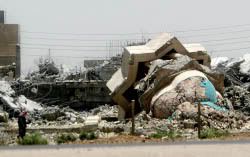
A powerful explosion that reduced a large Sunni Arab mosque to rubble in the southern city of Basra this morning signaled that the cycle of revenge violence following the destruction of the Shiite shrine in Samarra has not entirely unfolded.
Although there had been scattered reprisal attacks on Sunni shrines on Wednesday and early Thursday in the hours after the Samarra shrine’s minarets were demolished, strenuous calls for restraint by political and religious figures as well as strict security measures appeared to halt broader violence.
That contrasted with the spate of violence a year ago when 15 people were killed in the immediate aftermath of the destruction of the shrine’s golden dome and three imams were killed and a fourth kidnapped. That set off a cycle of sectarian attacks that has yet to stop.
However, it could be that this time, the worst violence occurs once curfews are lifted in Baghdad and elsewhere over the weekend and, that much like last year, the cycle of reprisal killings will unwind over weeks and months.
“We won’t see so much right away,” predicted an official in the office of Prime Minister Nuri Kamal al-Maliki, “It will come later.”
Mr. Maliki ordered an indefinite curfew in Basra, using a strategy that has worked elsewhere since Wednesday’s shrine explosion. He also imposed curfews in Baghdad and several other Iraqi cities, and he heightened security across the country.
Those measures were taken as the American military announced that the Baghdad security plan was now fully staffed with 28,500 additional troops on the ground.
Defense Secretary Robert M. Gates was in Baghdad today in an unannounced visit to meet with Iraqi leaders and American generals.
“Frankly we’re disappointed with the progress so far and hope that this most recent bombing by Al Qaeda won’t further disrupt or delay the process," he told Agence France-Presse during the flight to Baghdad. In recent weeks, Vice President Dick Cheney and Secretary of State Condoleezza Rice visited Baghdad to urge Iraqi leaders to hit benchmarks for political progress set by the United States.
With the exception of Basra, most of Iraq was calm today.
Five American soldiers died in three separate incidents on Thursday. Three were killed by an explosion near their vehicle in Kirkuk province. One died from small arms fire in Diyala and a fifth died from a non-combat related injury, the military said in a statement.
On Thursday, five unidentified bodies were found in Baghdad, far fewer than the police have found daily for several weeks, according to an Interior Ministry official.
But there were several mortar attacks in Baghdad on Thursday. The most damaging occurred in mid-afternoon in the Green Zone, where most American and high-ranking Iraqi officials live, when seven mortar shells rained down, the Interior Ministry said. One exploded near the gate to the Rashid hotel, just across the street from the Convention Center, where Parliament meets.
The blast occurred just 50 minutes before a news conference with the deputy secretary of state, John D. Negroponte; the United States ambassador to Iraq, Ryan C. Crocker; and the secretary of state’s coordinator for Iraq, David M. Satterfield. It killed one person and wounded two others, according to the Interior Ministry official. An American military official would say only that there were casualties, and that no Americans were hit.
Mr. Negroponte and Mr. Crocker praised the efforts of Mr. Maliki and his government, including Sunni Arab and Kurdish leaders, to handle the situation in Samarra and their efforts to bring about a broader reconciliation.
Echoing that message, Mr. Maliki, a Shiite, reacted harshly to today’s Sunni mosque blast, calling it “a serious crime to inflame sectarian tension among the Iraqi people,” according to Reuters.
Showing posts with label Samarra. Show all posts
Showing posts with label Samarra. Show all posts
Friday, June 15, 2007
| [+/-] |
Sunni Mosque Is Destroyed In Retalliation |
Thursday, June 14, 2007
| [+/-] |
Efforts to Avert Sectarian Reprisals After Shrine Attacks |
 Left, a file photo from December 2003 shows the two minarets and the Golden Dome of the al-Askari mosque in Samarra. At right, the mosque after the attack on the minarets on Wednesday. The dome was destroyed in a 2006 attack.
Two explosions on Wednesday that appeared to have been set by Sunni extremists with links to Al Qaeda toppled the twin golden minarets that were most of what remained of one of Iraq’s most revered Shiite shrines after a devastating bombing by Al Qaeda last year.
That bombing 16 months ago proved a watershed, engulfing the country in a wave of sectarian killing that pushed Sunnis and Shiites toward civil war. With American and Iraqi forces unable to restrain soaring levels of killing that saw as many as 3,000 Iraqi civilians dying every month by the end of 2006, President Bush ordered nearly 30,000 additional American troops deployed here, aimed at pulling the country back from the abyss.
But after Wednesday’s renewed attack on the shrine at Samarra, 75 miles north of Baghdad, appeals for calm by Shiite political and religious leaders, as well as by moderate Sunni politicians and the top two American officials in Iraq, appeared to have headed off the risk of a new sectarian convulsion, at least for now.
By nightfall, with emergency curfews in Baghdad and several other cities, and Iraqi forces moving in to protect mosques across the country, there were only scattered reports of reprisal attacks.
The new attack on the shrine came at what American commanders acknowledged to be a now-or-never point in the war here, with only months for the fresh troops deployed here to begin driving down insurgent attacks. Without significant progress by September, when the top American military commander here is to report to the president and Congress, the generals appear to have little prospect of holding off pressure at home for withdrawal.
The Samarra bombing appeared to be aimed at derailing the American hopes for a turnaround by setting off renewed Shiite reprisals and refocusing the conflict on sectarian tensions, away from recent infighting between Sunni tribal groups and the Sunni insurgents who have links to Al Qaeda in Mesopotamia.
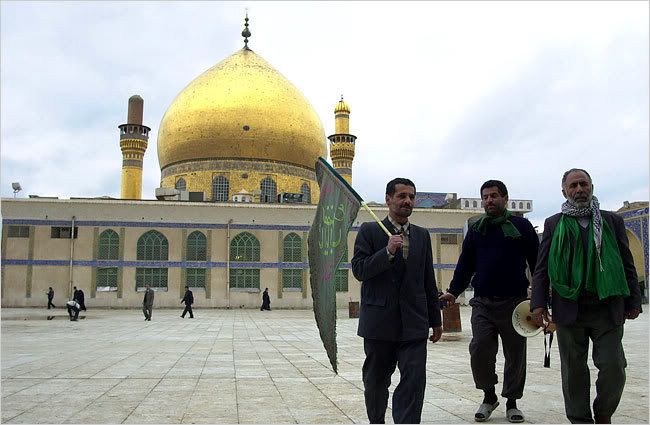 The Imam al-Askari mosque in Samarra, one of Iraq’s most sacred Shiite shrines, pictured in February 2004 with its dome and minarets intact.
[photo: Khalid Mohammed/Associated Press]
The explosions that destroyed the 120-foot-high minarets of the Askariya shrine occurred about 9 a.m. A statement by the American military command, quoting the Iraqi police, said that they “did not see any attackers in the vicinity,” suggesting that the bombings were an inside job.
 The al-Askari shrine on February 22, 2006, after the bombing by Sunni insurgents.
[photo: Hameed Rasheed/Associated Press]
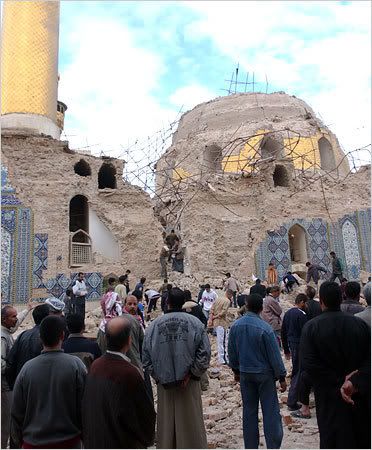 The damaged shrine on February 22, 2006.
[photo: Hameed Rasheed/Associated Press]
Suspicion fell immediately on the guards protecting the shrine, a unit of a few dozen local men, almost all Sunnis, the population group that predominates in Samarra and has controlled the shrine since it was built in 1905. American and Iraqi commanders in the area had suspected the guard force of harboring Qaeda sympathizers.
Iraqis shopping in a local market said they heard the explosions, ran to look toward the shrine and saw as a cloud of dust and debris cleared that the minarets, used traditionally as the place from which Muslims are called to prayer, had vanished.
The bombings left the shrine, its soaring golden dome destroyed in the initial attack in February last year, with little left of its former grandeur but rubble overlooked by a blue-tiled archway and a golden clock tower. The mosque is located atop what is said to have been the burial site, in the 9th-century A.D., of two of the 12 imams, the apostles of the Shiite faith.
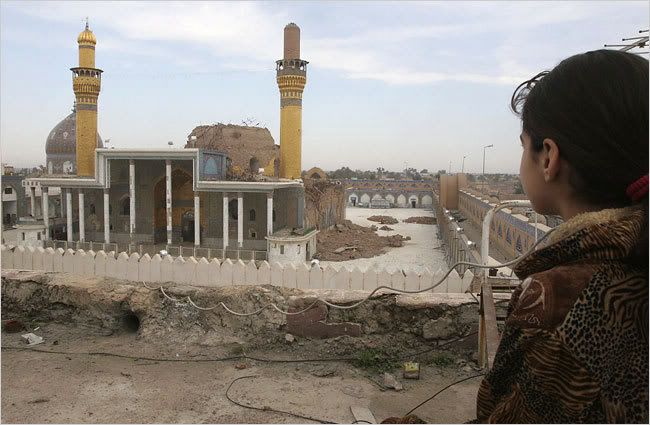 The Golden Dome of the mosque was destroyed in the 2006 bombing, but the two minarets were left standing.
[photo: Sabah al-Bazee/Reuters]
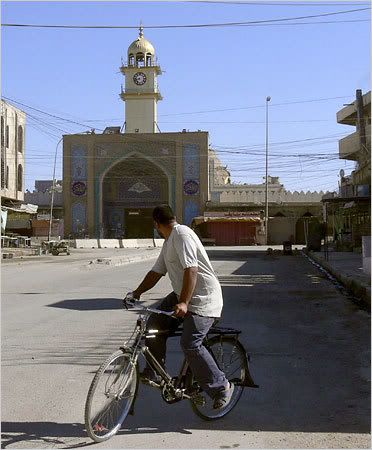 The shrine after Wednesday's explosion destroyed the minarets.
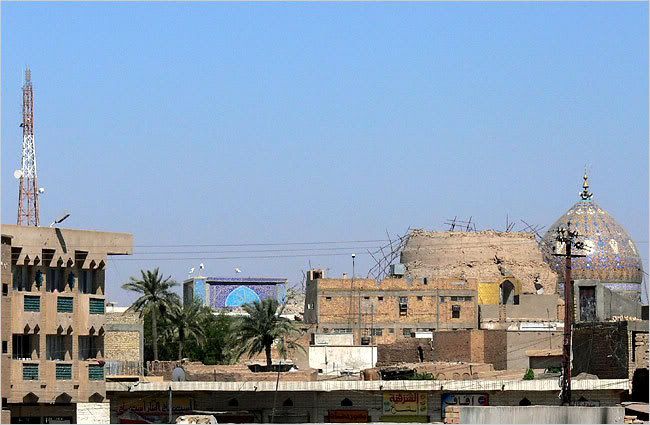 The official Iraqia television station reported that local officials said that two mortar rounds were fired at the two minarets.
 [photo: Getty images]
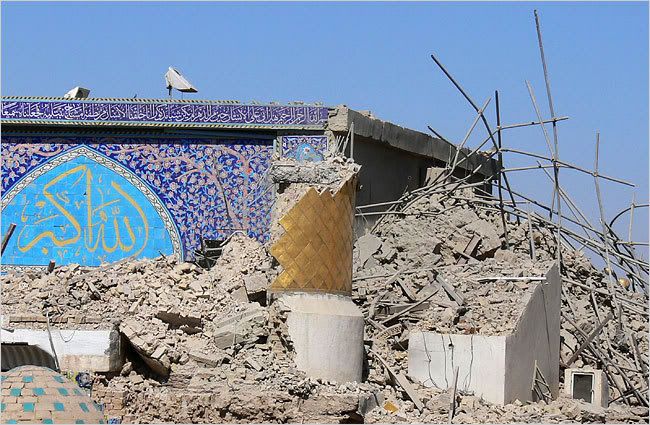 The destruction of the remaining two minarets is expected to have powerful symbolic importance to Iraqis.
[photo: Getty images]
Prime Minister Nuri Kamal al-Maliki, a Shiite who heads a fractious and increasingly dysfunctional coalition government of Shiites, Sunnis and Kurds, said in a hastily prepared television address from Baghdad that he had ordered the arrest of “all officials who were responsible for guarding the holy shrine.” Reports from Samarra said that at least 15 members of the guard force, most of them nominally employees of the Interior Ministry, were detained.
Mr. Maliki later flew to the site aboard an American military helicopter accompanied by Lt. Gen. Raymond T. Odierno, the second-ranking American commander in Iraq.
A statement by Ambassador Ryan C. Crocker and Gen. David H. Petraeus, the top American officials in Iraq, described the attack as a new effort by Al Qaeda to provoke sectarian conflict. Putting a positive construction on an event that appeared to have shaken the Americans more than any event in recent months, the two officials said, “It is an act of desperation by an increasingly beleaguered enemy seeking to obstruct the peaceful political and economic development of a democratic Iraq.”
Across the main war zones, American formations bolstered by the troop increase are reaching full operational readiness for what the commanders have described as a summer offensive against Qaeda-linked insurgents and Shiite death squads. But the commanders have spoken of intelligence reports pointing to plans by Al Qaeda for a “catastrophic” attack similar to the one at Samarra last year, setting off a new round of mass sectarian killings, driving a deeper wedge between Sunnis and Shiites and thwarting American hopes for greater stability.
The insurgents appeared to have chosen a target that was relatively accessible, but less powerful in its potential impact on Iraq’s majority Shiite population than a strike on one of the major shrines elsewhere.
Apart from the Samarra site, Iraq’s Shiites have shrines of transcending significance in the Baghdad district of Kadhimiya and in Karbala and Najaf. All have been the targets of foiled attacks this year.
One attack, on April 28, killed 58 people and wounded nearly 170 only a few hundred yards from the Imam Abbas shrine in Karbala. Two weeks before that, another car bomb in Karbala exploded near the Imam Hussain shrine, killing 36 people and wounding nearly 170. There have been dozens of other attacks on lesser Shiite shrines, killing scores.
On Wednesday Shiite leaders called for restraint — a plea that went largely unheeded last year after the first bombing at the shrine. Grand Ayatollah Ali al-Sistani, Iraq’s most revered Shiite religious leader, asked Shiites to “stay calm and avoid any retaliatory actions that target the innocent and the sacred places of others.”
Perhaps equally important, the young Shiite cleric who has been a turbulent force in Iraqi politics, Moktada al-Sadr, issued a statement calling on Shiites not to strike back. His followers were implicated in many of the reprisal attacks after the first bombing. Characteristically, he based his appeal on an interpretation of the latest attack that made villains not of the Sunnis, but of the United States and Israel, whom he accused or organizing the bombing. “The Iraqi people should know that there is no Sunni, and no Muslim, who would attack a shrine that is the burial place of our two imams,” he said.
The authorities imposed indefinite curfews in several major cities, including Baghdad, the southern oil hub of Basra, the mixed Sunni-Shiite city of Hilla in south-central Iraq and Karbala and Najaf.
American troop reinforcements requested by Prime Minister Maliki effectively sealed off Samarra, and the police fired in the air to disperse Shiite demonstrators gathered near the shrine in the aftermath of the bombing. Witnesses reported American fighter jets roaring low over rooftops, a tactic often used when American commanders, lacking enough troops to dominate a trouble spot, need to deter potential attacks.
Within hours of the bombing, there were reports of scattered attacks on Sunni mosques in Baghdad, Basra and other cities. In Baghdad, the police said Shiite gunmen set fire to a Sunni mosque in the Baya district, and they reported attacks on three other neighborhood mosques.
In Basra, with a heavy Shiite majority, police said three Sunni mosques came under sporadic fire from groups of masked gunmen. In Khalis, a town in Diyala Province about 40 miles north of Baghdad, the police reported the bombing of a small Shiite shrine.
Subscribe to:
Posts (Atom)
