At ConsortiumNews.com, Robert Parry reports:
Even as Hillary Clinton’s operatives were dropping hints that Republicans would exploit Barack Obama’s youthful drug use, some Clinton insiders privately worried about her own vulnerability because the Bush administration possesses detailed knowledge of her movements – and her husband’s – over the past seven years.
Because of Sen. Clinton’s unique status as the first former First Lady to run for President – and because her husband was succeeded by a Republican – she is the first candidate to have both her and her spouse be subject to regular, long-term surveillance by an Executive Branch agency controlled by the opposing political party.
Since they left the White House in 2001, Bill and Hillary Clinton have been under the protection of the Secret Service, formerly a branch of the Treasury Department and now part of the Homeland Security Department. Records are maintained showing where they go and whom they meet.
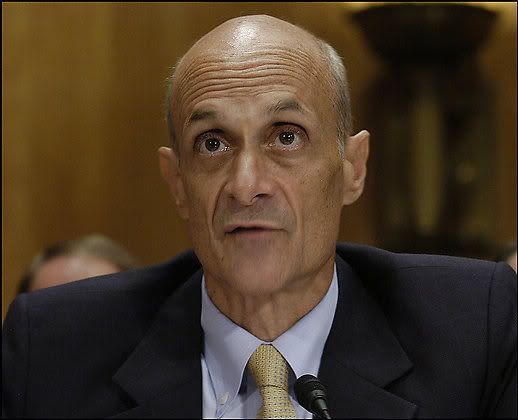
Homeland Security is under the control of Michael Chertoff, a longtime Clinton nemesis dating back to his work as a Republican lawyer on the Senate’s Whitewater investigation in the 1990s. In 2003, Sen. Clinton cast the sole dissenting vote against Chertoff’s nomination as a federal judge in protest against his abrasive conduct during the Whitewater inquiry.
Though Secret Service records are supposed to be closely held secrets, a source close to the Clintons told me that it is believed that senior Republicans have received regular briefings about movements of the Clintons that might prove embarrassing if released during the general election campaign.
Given this possibility, Clinton operatives were walking a tightrope when they began raising questions about what bare-knuckled Republican operatives might do with Sen. Obama’s public acknowledgement that he experimented with drugs, including cocaine, as a young man.
As part of the Clinton campaign’s broader effort to raise doubts about Obama’s electability, Clinton’s New Hampshire co-chairman Bill Shaheen told the Washington Post that “one of the things [the Republicans are] certainly going to jump on is his drug use. …
“It’ll be, ‘When was the last time? Did you ever give drugs to anyone? Did you sell them to anyone?’ … There are so many openings for Republican dirty tricks. It’s hard to overcome.”
Though an uproar over the remarks soon forced Shaheen’s resignation, Clinton’s chief strategist Mark Penn managed to slip the word “cocaine” into a denial that the Clinton campaign was playing its own dirty trick.
"The issue related to cocaine use is not something the campaign is in any way raising," Penn said on MSNBC’s "Hardball."
The Clinton campaign’s gamesmanship prompted more protests from the Obama camp and a satire by New York Times columnist Maureen Dowd who recounted a mock Iowa debate in which Hillary Clinton inserted drug references at every possible opportunity. [NYT, Dec. 16, 2007]
Clinton/Bush Ties
But there is a history to the Clinton and Bush families possessing damaging secrets about the other, a kind of balance of terror in which the Bushes usually have the upper hand and the Clintons have chosen mostly to make concessions and seek favors from the more powerful family.
On Dec. 17 in South Carolina, Bill Clinton demonstrated that tendency, saying Hillary Clinton’s first act as President would be to send Bill Clinton and George H.W. Bush on an around-the-world mission to repair America’s image.
“The first thing she intends to do is to send me and former President Bush and a number of other people around the world to tell them that America is open for business and cooperation again,” said Bill Clinton, who is proud that he has accompanied the senior Bush on many international humanitarian missions.
Clinton’s comment could be viewed as both a slap at George W. Bush and a kiss-up to his father. But the elder Bush responded icily through a spokesman, saying he supports his son’s foreign policy and “never discussed an ‘around-the-world mission’ with either former President Bill Clinton or Sen. Clinton.”
It was not the first time that the senior Bush, the patriarch of America’s most prominent political family, had put down the upstart Clinton.
In 1992 when Clinton – as Arkansas governor – sought the White House, then-President Bush encouraged his subordinates to find a “silver bullet” that would kill off Clinton’s presidential hopes.
The senior Bush later acknowledged to FBI investigators that he was “nagging” his aides to push for more information about Bill Clinton’s student travels to the Soviet Union and Czechoslovakia and about right-wing rumors that Clinton had sought to renounce his U.S. citizenship.
“Hypothetically speaking, President Bush advised that he would not have directed anyone to investigate the possibility that Clinton had renounced his citizenship because he would have relied on others to make this decision,” according to an FBI report on its interview with the elder Bush. “He [Bush] would have said something like, ‘Let’s get it out’ or ‘Hope the truth gets out.’” [For details, see Robert Parry’s Secrecy & Privilege.]
With such high-level urging, White House chief of staff James Baker instructed his aide, Janet Mullins, to ask Steven Berry, assistant secretary of state for legislative affairs, about progress on right-wing press requests for information about Clinton’s student travel.
Eventually, the White House interest was communicated to State Department official Elizabeth Tamposi, a Bush political appointee who saw it as a green light to move ahead with the legally questionable search.
On the night of Sept. 30, 1992, Tamposi dispatched three aides to the federal records center in Suitland, Maryland, where they searched Clinton’s passport file as well as his mother’s, presumably because they thought it might contain some references to Clinton.
In a later press interview, Tamposi asserted that she ordered the search after Berry had pressured her to “dig up dirt on Clinton” for the Bush White House.
Press Leak
Though finding no letter renouncing citizenship, the State Department officials still made use of Clinton’s passport application, which had staple holes and a slight tear in the corner.
The tear was easily explained by the routine practice of stapling a photo or money order to the application, but Tamposi seized on the ripped page to justify a new suspicion, that a Clinton ally at the State Department had removed the renunciation letter.
Tamposi shaped that speculation into a criminal referral which was forwarded to the Justice Department. Thin as the case was, George H.W. Bush’s reelection campaign had its official action so the renunciation rumor could be turned into a public issue.
Within hours of the criminal referral, someone from the Bush camp leaked word about the confidential FBI investigation to reporters at Newsweek magazine.
The Newsweek story about the tampering investigation hit the newsstands on Oct. 4, 1992. The article suggested that a Clinton backer might have removed incriminating material from Clinton’s passport file, precisely the spin that the Bush people wanted.
Immediately, President George H.W. Bush took the offensive, using the press frenzy over the tampering story to attack Clinton’s patriotism on a variety of fronts, including his student trip to Moscow in 1970. With his patriotism challenged, Clinton saw his once-formidable lead shrink.
Clinton’s campaign ultimately was saved by quick-thinking Democrats on Capitol Hill who exposed the passport leak as a political dirty trick. That forced the elder Bush into a quasi-apology for the scandal, which became known as “Passport-gate.”
After Clinton won the election, however, the criminality of the dirty trick was swept under the rug by Republican special prosecutor Joseph DiGenova, who was appointed to investigate by a federal judicial panel run by right-wing appellate judge David Sentelle.
(Showing what a small world political Washington can be, DiGenova is married to Republican lawyer Victoria Toensing, a key figure in the public attacks on former U.S. Ambassador Joseph Wilson and his wife, CIA officer Valerie Plame, over Wilson’s criticism of the WMD intelligence that George W. Bush used to justify invading Iraq.)
Unearthing Dirt
As President, Clinton not only turned the other cheek in regard to “Passport-gate” but made sure that federal investigators averted their eyes from other scandals implicating former President Bush. Clinton presumably thought that his magnanimity could gain some reciprocity from Republicans when it came to his own scandals.
As Clinton was taking office in 1993, three important investigations were underway, all of which Clinton could have helped by ordering key documents declassified or giving other backing to the investigators.
Special prosecutor Lawrence Walsh was still battling the cover-up that had surrounded the Iran-Contra scandal of the 1980s; Democratic congressmen were digging into the “Iraqgate” scandal, the covert supplying of dangerous weapons to Iraq’s Saddam Hussein in the 1980s; and a House task force was suddenly inundated with evidence pointing to Republican guilt in the “October Surprise” case, alleged interference by the Reagan-Bush campaign in 1980 to undermine President Jimmy Carter’s efforts to free 52 American hostages then held in Iran.
Combined, those three investigations could have rewritten the history of the 1980s, exposing serious wrongdoing by Republicans who had held the White House for a dozen years. The full story also would likely have terminated the presidential ambitions of the powerful Bush family, since George H.W. Bush was implicated in all three scandals.
However, Clinton and the leaders of the Democratic majorities in Congress didn’t care enough about the truth to fight for it. Instead, they saw the truth as a bargaining chip that could be cheaply traded away.
Clinton agreed to let George H.W. Bush retreat gracefully into retirement despite Bush’s brazen attempt to destroy Walsh’s criminal investigation by issuing six pardons to Iran-Contra defendants on Christmas Eve 1992.
In his 2004 memoir, My Life, Clinton wrote that he “disagreed with the pardons and could have made more of them but didn’t.” Clinton cited several reasons for giving his predecessor a pass.
“I wanted the country to be more united, not more divided, even if that split would be to my political advantage,” Clinton wrote. “Finally, President Bush had given decades of service to our country, and I thought we should allow him to retire in peace, leaving the matter between him and his conscience.”
By his choice of words, Clinton revealed how he saw information – not something that belonged to the American people and that had intrinsic value to the democratic process – but as a potential weapon that could be put to “political advantage.”
Joining the Cover-ups
On the Iran-Contra pardons, Clinton saw himself as generously passing up a club that he could have wielded to bludgeon an adversary. He chose instead to join in a cover-up in the name of national unity.
Similarly, the Democratic congressional leadership ignored the flood of incriminating evidence pouring into the “October Surprise” task force in December 1992.
Chief counsel Lawrence Barcella told me later that he urged task force chairman Lee Hamilton to extend the investigation several months to examine this new evidence of Republican guilt, but Hamilton ordered Barcella simply to wrap up the probe with a finding that the Reagan-Bush campaign had done nothing wrong.
Some of the new incriminating evidence – including an unprecedented report from the Russian government about its knowledge of illicit Republican contacts with Iran – was simply hidden away in boxes that I discovered two years later and dubbed “The October Surprise X-Files.”
The “Iraqgate” investigation met a similar fate under Clinton’s Justice Department, which chose to ignore or dismiss evidence of covert shipments of dangerous war materiel to Saddam Hussein during the 1980s.
When former Reagan national security official Howard Teicher came forward with an affidavit describing secret U.S.-backed arms shipments to Iraq, Clinton’s Justice Department went on the offensive – against Teicher, bullying him into silence.
Even as Republicans pounded Clinton over his Whitewater real estate deal and other alleged misdeeds, his administration continued to see no evil when it came to criminal acts implicating Ronald Reagan or George H.W. Bush.
True to form, the Clinton administration did nothing when Reagan’s 1984 campaign chief Ed Rollins wrote in his 1996 memoir Bare Knuckles and Back Rooms that a top Filipino politician had admitted delivering an illegal $10 million cash payment to Reagan from Philippine dictator Ferdinand Marcos.
"I was the guy who gave the ten million from Marcos to your campaign," the Filipino told Rollins in 1991, according to the memoir. "I was the guy who made the arrangements and delivered the cash personally. ...It was a personal gift from Marcos to Reagan."
However, Rollins has refused since to divulge the name of either the Filipino politician or the Republican lobbyist who allegedly handled the pay-off. The stunning anecdote did attract some press coverage in 1996 but the story died because the Clinton administration made no effort to follow it up.
(Rollins is now chairman of Republican Mike Huckabee’s presidential campaign.) [For details on Marcos-Reagan case, see Consortiumnews.com’s “Huckabee’s Chairman Hid Payoff Secret.”]
Off the Radar
During Clinton’s presidency, I approached then-deputy White House chief of staff John Podesta and other senior officials to ask whether they had any plans to pursue important investigations that had been left undone in 1993. I was told those issues simply weren’t “on the radar scopes.”
However, if Clinton thought that his collaboration in keeping the Reagan-Bush secrets from the American people would earn him some bipartisan help from the Republicans, he was mistaken.
Clinton saw his prized domestic agenda, including Hillary Clinton’s health care reform, defeated; his party lose control of Congress in 1994; the House vote to impeach him in 1998 for lying about an extramarital sexual relationship; and George H.W. Bush’s oldest son steal the 2000 election from Clinton’s Vice President, Al Gore.
Now, as Campaign 2008 begins to unfold, a similar dynamic is in place.
George W. Bush has engaged in a variety of acts that appear to be illegal, extra-legal or unconstitutional, while the Clintons are again signaling that they have no intention of holding the Bush family accountable.
If Bill Clinton is right – that his wife’s first act as President would be to ask him and George H.W. Bush to go on an around-the-world goodwill mission – Hillary Clinton is making it clear that she has no intention of holding George W. Bush accountable for any wrongdoing.
There is no way that George H.W. Bush would help the Clintons on the diplomatic front if they were taking action against his eldest son.
So, the stage seems set for another Bush-Clinton revolving door where the Bushes get a free pass as they leave in exchange for the Clintons hoping against hope that the powerful family will show them a little respect and maybe a touch of mercy.
Or, as the Clinton friend suggested to me last week, maybe their real hope is that the Bushes won’t reveal what they’ve learned from the Secret Service records detailing where the Clintons have gone and with whom.
While “Passport-gate” is now only a little-remembered chapter of Campaign 1992, it does show how easily a sitting President can get subordinates to stretch – or even break – the law to unearth information that can serve a political purpose.
In George W. Bush’s case, the temptation will be strong to use whatever means he has at his disposal to ensure that his successor continues his “war on terror” policies and doesn’t authorize serious investigations into controversies such as torture and illegal wiretapping.
The Clintons also have to be nervous because the Republicans have the advantage of an ideologically committed news media, from popular talk-radio hosts and Internet bloggers to Rev. Sun Myung Moon’s Washington Times and Rupert Murdoch’s Fox News.
If Sen. Clinton wins the Democratic nomination, any information, especially some tidbit that suggests sexual improprieties, could be leaked to any number of right-wing media outlets and quickly jump into the mainstream press.
A scandal would prove especially devastating if backed by real information, like what might be available in Secret Service records.
One reason that civil libertarians have been alarmed about Bush’s assertion of nearly unlimited executive authority over such tactics as wiretapping, data-mining and domestic spy satellites is that it has coincided with a Republican goal for near-permanent political control of the U.S. government.
While the Clinton campaign is surely right that the Republicans will exploit whatever they can to discredit Sen. Obama, it appears to be equally true that they will use whatever they have to gain an advantage with the Clintons, too.
Wednesday, December 19, 2007
| [+/-] |
Is Hillary or Barack More Vulnerable? |
Sunday, October 14, 2007
| [+/-] |
Chertoff May Void Judge's Order to Halt Border Fence |
AzStarNet.com reports:
The nation's top security official may use his power to unilaterally trump a federal court order halting construction of a fence on a stretch of the Arizona-Mexico border.
Homeland Security Secretary Michael Chertoff is weighing whether to invoke a section of federal law that allows him to exempt border construction projects from any law, his press aide, Russ Knocke, told Capitol Media Services. That includes requirements for studies on environmental impacts of federally funded projects.
The move would not be unprecedented: Chertoff used the power at least twice since it was granted.
In 2005 he decided to build fencing near San Diego without conducting environmental studies. And in January he issued a waiver from all laws for a project along the edge of the Barry M. Goldwater Air Force Range in Southwestern Arizona.
The possibility of Chertoff again exempting his agency from environmental laws comes days after a federal judge in Washington stopped construction of a nearly two-mile stretch of fence at the foot of the San Pedro Riparian National Conservation Area southeast of Tucson. The conservation area, designated by Congress in 1988, is described on the U.S. Bureau of Land Management's Web site as ecologically "one of the most important riparian areas in the United States."
The restraining order gives two environmental groups time to convince Judge Ellen Huvelle that plans for vehicle barriers in the river's floodway and washes leading into it will cause erosion and sedimentation that will harm the environment and affect species dependent on the river.
Defenders of Wildlife and the Sierra Club also contend the BLM, which controls the area, did not seek public input on the project in performing an environmental assessment that took just three weeks. They contend the BLM should have prepared a more formal environmental impact statement.
Chertoff, however, can make the lawsuit, and judge's ruling, disappear simply by declaring the project exempt from the law the groups used to sue.
Knocke said Chertoff believes the lawsuit is without merit, saying the BLM's assessment concluded the project would not harm the area.
"We care about the border environment as much as anyone," Knocke said. "But when weighing a lizard in the balance with human lives, this border infrastructure project is the obvious choice."
Attorneys for Chertoff also argue that environmental damage from illegal border crossers is greater than anything that would occur from the barriers.
Nothing short of congressional action could stop Chertoff from exempting the San Pedro project from the environmental laws if he decides to do so.
Rep. Gabrielle Giffords, D-Ariz., whose district includes the river, does not support repeal of Chertoff's power.
"Border security has to be a top concern in a state like this," said C.J. Karamargin, Giffords' press aide. He said the congresswoman believes federal officials "should have the tools they need to do the job."
Bob Dreher, vice president for conservation law for Defenders of Wildlife, said what might stop Chertoff from exempting the project from federal laws is, "They have to do, I think, the politically costly thing of publicly saying, 'We're above the law.' " He said that might be what kept Chertoff from waiving environmental laws for a similar border project in Texas.
While Giffords is unwilling to repeal the law, she is willing to apply pressure.
She is one of five members of Congress who wrote Chertoff last week asking him to delay further work on the project, prepare a full environmental impact statement and conduct public hearings, something not done before construction began late last month.
"Our communities support safe and secure borders and simply ask for adequate time to share their concerns with their government, as they have a right to do," reads the letter signed by Giffords as well as Rep. Raúl Grijalva, also a Tucson Democrat. Three members of the Texas congressional delegation also signed that letter.
In his January decision dealing with the Goldwater bombing range, a military training ground, Chertoff declared that the high number of people entering the country illegally through that stretch of the desert create an immediate need to build not just fencing but also vehicle barriers, towers, sensors and cameras.
That, he said, justified exemptions from the National Environmental Policy Act — the law being used by the two environmental groups to sue over the San Pedro project — as well as the Endangered Species Act, the Clean Water Act, the Wilderness Act, the National Historic Preservation Act and the National Wildlife Refuge Systems Administration Act.
Chertoff also exempted the project from another law, which requires his agency to follow certain administrative procedures.
Saturday, September 22, 2007
| [+/-] |
Collecting Details on Travelers Documented |
The Washington Post:
The U.S. government is collecting electronic records on the travel habits of millions of Americans who fly, drive or take cruises abroad, retaining data on the persons with whom they travel or plan to stay, the personal items they carry during their journeys, and even the books that travelers have carried, according to documents obtained by a group of civil liberties advocates and statements by government officials.
The personal travel records are meant to be stored for as long as 15 years, as part of the Department of Homeland Security's effort to assess the security threat posed by all travelers entering the country. Officials say the records, which are analyzed by the department's Automated Targeting System, help border officials distinguish potential terrorists from innocent people entering the country.
But new details about the information being retained suggest that the government is monitoring the personal habits of travelers more closely than it has previously acknowledged. The details were learned when a group of activists requested copies of official records on their own travel. Those records included a description of a book on marijuana that one of them carried and small flashlights bearing the symbol of a marijuana leaf.
The Automated Targeting System has been used to screen passengers since the mid-1990s, but the collection of data for it has been greatly expanded and automated since 2002, according to former DHS officials.
Officials yesterday defended the retention of highly personal data on travelers not involved in or linked to any violations of the law. But civil liberties advocates have alleged that the type of information preserved by the department raises alarms about the government's ability to intrude into the lives of ordinary people. The millions of travelers whose records are kept by the government are generally unaware of what their records say, and the government has not created an effective mechanism for reviewing the data and correcting any errors, activists said.
The activists alleged that the data collection effort, as carried out now, violates the Privacy Act, which bars the gathering of data related to Americans' exercise of their First Amendment rights, such as their choice of reading material or persons with whom to associate. They also expressed concern that such personal data could one day be used to impede their right to travel.
"The federal government is trying to build a surveillance society," said John Gilmore, a civil liberties activist in San Francisco whose records were requested by the Identity Project, an ad-hoc group of privacy advocates in California and Alaska. The government, he said, "may be doing it with the best or worst of intentions. . . . But the job of building a surveillance database and populating it with information about us is happening largely without our awareness and without our consent."
Gilmore's file, which he provided to The Washington Post, included a note from a Customs and Border Patrol officer that he carried the marijuana-related book "Drugs and Your Rights." "My first reaction was I kind of expected it," Gilmore said. "My second reaction was, that's illegal."
DHS officials said this week that the government is not interested in passengers' reading habits, that the program is transparent, and that it affords redress for travelers who are inappropriately stymied. "I flatly reject the premise that the department is interested in what travelers are reading," DHS spokesman Russ Knocke said. "We are completely uninterested in the latest Tom Clancy novel that the traveler may be reading."
But, Knocke said, "if there is some indication based upon the behavior or an item in the traveler's possession that leads the inspection officer to conclude there could be a possible violation of the law, it is the front-line officer's duty to further scrutinize the traveler." Once that happens, Knocke said, "it is not uncommon for the officer to document interactions with a traveler that merited additional scrutiny."
He said that he is not familiar with the file that mentions Gilmore's book about drug rights, but that generally "front-line officers have a duty to enforce all laws within our authority, for example, the counter-narcotics mission." Officers making a decision to admit someone at a port of entry have a duty to apply extra scrutiny if there is some indication of a violation of the law, he said.
The retention of information about Gilmore's book was first disclosed this week in Wired News. Details of how the ATS works were disclosed in a Federal Register notice last November. Although the screening has been in effect for more than a decade, data for the system in recent years have been collected by the government from more border points, and also provided by airlines -- under U.S. government mandates -- through direct electronic links that did not previously exist.
The DHS database generally includes "passenger name record" (PNR) information, as well as notes taken during secondary screenings of travelers. PNR data -- often provided to airlines and other companies when reservations are made -- routinely include names, addresses and credit-card information, as well as telephone and e-mail contact details, itineraries, hotel and rental car reservations, and even the type of bed requested in a hotel.
The records the Identity Project obtained confirmed that the government is receiving data directly from commercial reservation systems, such as Galileo and Sabre, but also showed that the data, in some cases, are more detailed than the information to which the airlines have access.
Ann Harrison, the communications director for a technology firm in Silicon Valley who was among those who obtained their personal files and provided them to The Post, said she was taken aback to see that her dossier contained data on her race and on a European flight that did not begin or end in the United States or connect to a U.S.-bound flight.
"It was surprising that they were gathering so much information without my knowledge on my travel activities, and it was distressing to me that this information was being gathered in violation of the law," she said.
James P. Harrison, director of the Identity Project and Ann Harrison's brother, obtained government records that contained another sister's phone number in Tokyo as an emergency contact. "So my sister's phone number ends up being in a government database," he said. "This is a lot more than just saying who you are, your date of birth."
Edward Hasbrouck, a civil liberties activist who was a travel agent for more than 15 years, said that his file contained coding that reflected his plan to fly with another individual. In fact, Hasbrouck wound up not flying with that person, but the record, which can be linked to the other passenger's name, remained in the system. "The Automated Targeting System," Hasbrouck alleged, "is the largest system of government dossiers of individual Americans' personal activities that the government has ever created."
He said that travel records are among the most potentially invasive of records because they can suggest links: They show who a traveler sat next to, where they stayed, when they left. "It's that lifetime log of everywhere you go that can be correlated with other people's movements that's most dangerous," he said. "If you sat next to someone once, that's a coincidence. If you sat next to them twice, that's a relationship."
Stewart Verdery, former first assistant secretary for policy and planning at DHS, said the data collected for ATS should be considered "an investigative tool, just the way we do with law enforcement, who take records of things for future purposes when they need to figure out where people came from, what they were carrying and who they are associated with. That type of information is extremely valuable when you're trying to thread together a plot or you're trying to clean up after an attack."
Homeland Security Secretary Michael Chertoff in August 2006 said that "if we learned anything from Sept. 11, 2001, it is that we need to be better at connecting the dots of terrorist-related information. After Sept. 11, we used credit-card and telephone records to identify those linked with the hijackers. But wouldn't it be better to identify such connections before a hijacker boards a plane?" Chertoff said that comparing PNR data with intelligence on terrorists lets the government "identify unknown threats for additional screening" and helps avoid "inconvenient screening of low-risk travelers."
Knocke, the DHS spokesman, added that the program is not used to determine "guilt by association." He said the DHS has created a program called DHS Trip to provide redress for travelers who faced screening problems at ports of entry.
But DHS Trip does not allow a traveler to challenge an agency decision in court, said David Sobel, senior counsel with the Electronic Frontier Foundation, which has sued the DHS over information concerning the policy underlying the ATS. Because the system is exempted from certain Privacy Act requirements, including the right to "contest the content of the record," a traveler has no ability to correct erroneous information, Sobel said.
Zakariya Reed, a Toledo firefighter, said in an interview that he has been detained at least seven times at the Michigan border since fall 2006. Twice, he said, he was questioned by border officials about "politically charged" opinion pieces he had published in his local newspaper. The essays were critical of U.S. policy in the Middle East, he said. Once, during a secondary interview, he said, "they had them printed out on the table in front of me."
Friday, July 20, 2007
| [+/-] |
GAO Audit: "DHS May Have Misled Congress On Radiation Detectors" |
Radiation monitor program delayed.
The Washington Post reports:
A $1.2 billion program to deploy new radiation monitors to screen trucks, cars and cargo containers for signs of nuclear devices has been delayed by questions over whether Department of Homeland Security officials misled Congress about the effectiveness of the detectors.
Homeland Security Secretary Michael Chertoff announced the contracts for monitors with cutting-edge technology a year ago. He said they would improve radiation scans at borders and ports, while sharply reducing the number of false alarms. Congress had allowed the five-year project to move ahead after Homeland Security assured appropriators that the $377,000 machines would detect highly enriched uranium 95 percent of the time.
"What this next generation of detection equipment is going to let us do is make those determinations much more precisely, much more easily and much more quickly," Chertoff said.
But the department's Domestic Nuclear Detection Office did not know whether the detectors would work effectively, according to documents and interviews.
Auditors from the Government Accountability Office later found that the detection rates of machines tested by the department were as low as 17 percent and no higher than about 50 percent. The auditors said the department's optimistic report to Congress on the cost and benefits of the machines was based on assumptions instead of facts -- a finding that prompted lawmakers to put the project on hold last year.
Last week, the GAO told Congress that Homeland Security officials did not follow their own guidelines for ensuring that the cost-benefit report was accurate and complete. The GAO also said the director of the nuclear detection office was incorrect when he testified in March that the office was not aware of any specifics about whether officials followed the guidelines. A GAO official said auditors would release a report about the monitors next month.
Senate Homeland Security and Government Affairs Committee Chairman Joseph I. Lieberman (I-Conn.) said Congress will continue pressing officials for more verifiable details about the monitors before they allow the project to proceed.
"As DHS develops costly new technology critical to the nation's security, Congress must be able to rely on DNDO's claims about the technology," Lieberman said in an e-mailed statement. "DNDO's estimates of costs and benefits must be based on facts, not assumptions. And, while taking into account the effects this technology will have on commerce, it must be based first and foremost on how best to prevent nuclear smuggling."
Vayl Oxford, director of the nuclear detection office, defended the high detection rate cited in the report to Congress last year as a "high-water goal" the agency hoped to achieve, not an assessment of the monitors' capabilities. Oxford said recent tests of the monitors in New York show a "dramatic decrease" in false alarms. Oxford said eight monitors will be deployed at four border crossings and ports for further performance tests this week.
The government has had difficulty getting independent, reliable technical assessments about the plausibility, cost and benefits of advanced technology before Congress and agencies commit to spending. It has always struggled when buying new technology, which is why Congress created the Office of Technology Assessment in 1972. For two decades, scientists and engineers in that office helped sort out technical truths from wishful thinking in project proposals. But the office was killed in 1995 in an effort to streamline federal programs.
Since then, as government spending on new technology rose to record levels, the primary technical advisers to federal officials often have been the contractors themselves. Billions of dollars have been wasted on failed, flawed or speculative projects.
A new computer system for tracking imports and exports was delayed by years because of technical problems, and the cost rose by $1 billion, to $3.1 billion. A computer system for the FBI to track criminal cases was abandoned after more than $100 million was spent. A system designed to track the entry and exit of foreign visitors featured a "prototype" network for recording visitor exits that cost $146 million but does not work.
The radiation portal monitors were envisioned as the nation's key bulwark against attacks with radioactive material. After the terrorist attacks of Sept. 11, 2001, the government spent more than $200 million on detection equipment that could not distinguish nuclear devices from more benign sources of radiation, such as ceramic tiles and cat litter.
President Bush directed the establishment of the nuclear detection office in spring 2005 to be the main resource for assessing and buying monitors. Its mission includes providing technical advice to other agencies.
The office immediately began testing machines that, according to GAO estimates, cost about six times as much as current monitors. The Advanced Spectroscopic Portal radiation monitors rely on sensitive detection technology that had not previously been used in the field in the way officials envisioned.
Homeland Security officials tested monitors made by 10 companies. But before the results of those tests were made available to Congress, auditors from the GAO, in March 2006, raised questions about the procurement process.
The auditors predicted cost overruns of as much as $596 million and said the "prototypes of this equipment have not yet been shown to be more effective than the portal monitors now in use." The auditors concluded that it "is not clear that the dramatically higher cost of this equipment would be worth the investment."
In response, Congress told Chertoff and officials at the nuclear detection office to produce a "cost-benefit" analysis, comparing the existing machines with the proposed replacements.
In June 2006, the department delivered a report that said that the new machines "can correctly detect and identify highly enriched uranium (HEU) 95 percent of the time," according to the GAO. Congressional appropriators then approved the spending.
On July 14, 2006, Chertoff and Oxford announced that they had ordered the first 80 of 1,400 new monitors. The monitors, manufactured by three companies, were to be deployed last fall under a deal that officials said involved up to a year of research and development and up to four years of full-scale deployment.
In the meantime, the GAO auditors examined the detection office's cost-benefit report. In a private meeting last August, the auditors told lawmakers that the report used optimistic assumptions and overstated the acquisition costs of the existing detection machines, distorting any cost comparison.
The auditors concluded that "DNDO's cost-benefit analysis does not justify its recent decision to purchase and deploy" the new machines and that the nuclear detection office should not spend more money buying the machines "until it conducts realistic testing," according to documents included with a GAO report last fall.
That finding prompted Congress to tell Chertoff that deployment of the new monitors should not occur until he vouched for a new round of tests his department conducted in January and February, the results of which have yet to be released.
In March, Oxford testified before a House homeland security subcommittee that the GAO misunderstood the cost-benefit report. He said "we stand behind the basic conclusions" of the report, which he said was done to justify research and development, not full-scale production. Oxford said his office followed department guidelines in drafting the report.
That assertion was contradicted last week by the GAO letter, which said that Oxford's nuclear detection office did not meet seven of eight department guidelines. The letter also said that DHS officials were briefed on the requirements just days before the cost-benefit report was delivered to Congress.
During that March hearing, the GAO's Eugene E. Aloise warned lawmakers that "the data used in the [cost-benefit] analysis was incomplete and unreliable, and as a result, we do not have any confidence in it."
Lawmakers in both parties were also openly skeptical of Oxford's testimony.
Rep. Dan Lungren (R-Calif.) told Oxford that Aloise's testimony suggested that "you screwed up big time. You did what you weren't supposed to do."
In an interview this week, Oxford said the contracts for the project were written in a way to give his office flexibility to continue studying the performance of the monitors before they were deployed. He defended last year's cost-benefit report as a "preliminary" document that did not mean his office was prepared to authorize full production.
Oxford stood by his assertion that his office was not told by the GAO precisely what to include in the cost-benefit report. "We were never given the specific details of what they thought was flawed in our methodology," he said.
Tuesday, July 10, 2007
| [+/-] |
DHS Secretary Chertoff Warns of Increased Risk of Attack |
The AP reports:
U.S. counterterror officials are warning of an increased risk of an attack this summer, given al-Qaida's apparent interest in summertime strikes and increased al-Qaida training in the Afghan-Pakistani border region.
On Tuesday, Homeland Security Secretary Michael Chertoff told the editorial board of The Chicago Tribune that he had a ``gut feeling'' about a new period of increased risk.
He based his assessment on earlier patterns of terrorists in Europe and intelligence he would not disclose.
``Summertime seems to be appealing to them,'' Chertoff said in his discussion with the newspaper about terrorists. ``We worry that they are rebuilding their activities.''
Other U.S. counterterrorism officials, who spoke on condition of anonymity, shared Chertoff's concern and said that al-Qaida and like-minded groups have been able to plot and train more freely in the tribal areas along the Afghan-Pakistani border in recent months. Osama bin Laden and his top deputy, Ayman al-Zawahri, are believed to be hiding in the rugged region.
Thursday, May 10, 2007
| [+/-] |
Bush Changes Continuity Plan |
Administration, Not DHS, Would Run Shadow Government
The Washington Post reports:
President Bush issued a formal national security directive yesterday ordering agencies to prepare contingency plans for a surprise, "decapitating" attack on the federal government, and assigned responsibility for coordinating such plans to the White House.
The prospect of a nuclear bomb being detonated in Washington without warning, whether smuggled in by terrorists or a foreign government, has been cited by many security analysts as a rising concern since the Sept. 11, 2001, attacks.
The order makes explicit that the focus of federal worst-case planning involves a covert nuclear attack against the nation's capital, in contrast with Cold War assumptions that a long-range strike would be preceded by a notice of minutes or hours as missiles were fueled and launched.
"As a result of the asymmetric threat environment, adequate warning of potential emergencies that could pose a significant risk to the homeland might not be available, and therefore all continuity planning shall be based on the assumption that no such warning will be received," states the 72-paragraph order. It is designated National Security Presidential Directive 51 and Homeland Security Presidential Directive 20.
The statement added, "Emphasis will be placed upon geographic dispersion of leadership, staff, and infrastructure in order to increase survivability and maintain uninterrupted Government Functions."
After the 2001 attacks, Bush assigned about 100 senior civilian managers to rotate secretly to locations outside of Washington for weeks or months at a time to ensure the nation's survival, a shadow government that evolved based on long-standing "continuity of operations plans."
Since then, other agencies including the Pentagon, the Office of the Director of National Intelligence and the CIA have taken steps to relocate facilities or key functions outside of Washington for their own reasons, citing factors such as economics or the importance of avoiding Beltway "group-think."
Norman J. Ornstein, a scholar at the American Enterprise Institute and an adviser to an independent Continuity of Government Commission, said the order "is a more explicit embrace of what has been since 9/11 an implicit but fairly clear set of assumptions."
He added, "My frustration is that those assumptions have not gripped the Congress in the same way."
Other former Bush administration officials said the directive formalizes a shift of authority away from the Department of Homeland Security to the White House.
Under an executive order dating to the Reagan administration, responsibility for coordinating, implementing and exercising such plans was originally charged to the Federal Emergency Management Agency and later DHS, the Congressional Research Service noted in a 2005 report on a pending DHS reorganization.
The new directive gives the job of coordinating policy to the president's assistant for homeland security and counterterrorism -- Frances Fragos Townsend, who will assume the title of national continuity coordinator -- in consultation with Bush's national security adviser, Stephen J. Hadley, with the support of the White House's Homeland Security Council staff. Townsend is to produce an implementation plan within 90 days. Homeland Security Secretary Michael Chertoff will continue to coordinate operations and activities, the directive said.
