At the Wall Street Journal, Amy Schatz reports:
The fight over immunity for telecom companies in domestic-spying legislation is creating an unexpected side effect: unity among liberal bloggers and Ron Paul supporters.
Liberal activists and supporters of the Texas Republican and former presidential candidate plan to join forces Thursday and begin a "money bomb" protest of lawmakers who support telecom immunity in the Foreign Surveillance Intelligence Act. During a "money bomb," grassroots activists donate money during a short period of time -- usually a day -- to create buzz and raise money for their candidate.
The effort is timed to coincide with a planned Senate vote on the bill. Libertarians and liberal activists have blasted Democratic lawmakers, including presidential hopeful Sen. Barack Obama of Illinois, for supporting the legislation.
Both groups are upset about a provision in the bill that would provide retroactive immunity from civil actions for telecom companies alleged to have provided information to the government as part of its secret, warrantless wiretapping program. The House passed the legislation on June 20 and a Senate vote could come as soon as Thursday.
"There's entrenched power in Washington that protects itself and there are people on both sides who don't feel like they're having their rights protected," says Jane Hamsher, one of the organizers behind the effort and founder of the popular Democratic blog Firedoglake. "It's really about right and left coming together to fight the entrenched power and take their power away."
The fund-raiser represents a novel partnership between the two groups, which have separately proven themselves adept at organizing activists and readers to take action. If it goes well, organizers say it could mark the beginning of a more far-reaching partnership between the two groups, which agree on issues from ending the Iraq war to protection of civil liberties.
"For us, it's a natural alliance," says Trevor Lyman of BreaktheMatrix.com, and one of the organizers behind the famous Ron Paul "money bombs" which stunned the political establishment by raising about $14 million total for the Texas congressman's now-suspended presidential campaign.
"When it comes to civil liberties, we're absolutely aligned" with liberal activists, he says, although he notes the two groups remain far apart on other matters such as economic issues. "We stand so closely on this issue."
Mr. Paul missed the recent House vote on the domestic-spying legislation but later released a statement that he "strongly opposed every previous FISA overhaul attempt and I certainly would have voted against this one as well."
Discussions between the liberal bloggers and Mr. Paul's supporters for a joint venture only began about a week ago, but took off as anger about the telecom immunity increased in both communities. The two groups agreed to form a bipartisan political action committee, Accountability Now, and to use the Democratic fund-raising site ActBlue.com to handle the paperwork involved in legally processing political donations.
Beginning Thursday, blogs associated with both groups plan to begin plugging the joint-fundraising effort, asking their readers to pledge donations for the "money bomb" event.
Organizers say they'd like to raise "as much as possible," perhaps several million dollars, during their one-day "money bomb," which is likely to be held in August. They say they're not yet sure what they'd do with proceeds from the fund-raiser. Most likely it will be used to fund advertisements against Democratic and Republican lawmakers who supported the warrantless wiretapping legislation. It would also likely be used to fund ads supporting congressional challengers who are against the bill.
Saturday, July 26, 2008
| [+/-] |
Paul Camp, Liberals Unite On Spy Bill |
Friday, June 20, 2008
| [+/-] |
Transcript of 'Countdown with Keith Olbermann' for June 20, 2008 |
Guests: Dana Milbank, John Cusack, John Dean, Jonathan Alter, Chris Kofinis
Transcript:
KEITH OLBERMANN, HOST (voice over): Which of these stories will you be talking about tomorrow?
The Friday night polling stunner. “Newsweek” last month: Obama, 46; McCain, 46. Newsweek tonight: Obama, 51; McCain, 36, Obama by 15. Plus, he gets feed (ph) in our time, Senator Clinton to campaign with Obama one week from today.“86-ing the 527.” Moveon.org says its liberal 527 group will go dark, inspired by Obama‘s call that both sides should shutter the unchecked advertising of the groups, not that his holding his breath about McCain -
(BEGIN VIDEO CLIP)
SEN. BARACK OBAMA, (D) PRESUMPTIVE PRES. NOMINEE: You and I both know that 527 pop up pretty quickly.
(END VIDEO CLIP)
OLBERMANN: The Democratic sell-out. The House votes aye and key senators, Obama included, say they‘ll vote yes if telecom immunity is still in the FISA bill.
(BEGIN VIDEO CLIP)
REP. DENNIS KUCINICH, (D) OHIO: Under this bill, large corporations and big government can work together to violate the United States Constitution.
(END VIDEO CLIP)
OLBERMANN: The McClellan hearings. Outing Valerie Plame, did the president know it was being done? Absolutely not. The vice president? No comment.
(BEGIN VIDEO CLIP)
SCOTT MCCLELLAN, FMR. WHITE HOUSE PRESS SECRETARY: It was wrong to reveal her identity, because it compromised the effectiveness of a covert official for political reasons.
(END VIDEO CLIP)
OLBERMANN: And the ranking Republican Lamar Smith says -
(BEGIN VIDEO CLIP)
REP. LAMAR SMITH, ® TEXAS: It‘s hard to take Mr. McClellan or this hearing too seriously. Scott McClellan alone will have to wrestle with whether it was worth selling out the president and his friends for a few pieces of silver.
(END VIDEO CLIP)
OLBERMANN: Strong words, Mr. Smith, unless it‘s coming from a man like you who sold out his country.
Worst Persons: Rupert Murdoch‘s latest gaffe, the actual number in question is 2,202,000, the number he reports is 300,000. Close.
And, he‘s an activist. He doesn‘t just lay one on TV.
(BEGIN VIDEO CLIP)
JOHN CUSACK, ACTOR: You think you can tell President Bush apart from John McCain, really?
(END VIDEO CLIP)
OLBERMANN: John Cusack joins us tonight.
All of that and more: Now on COUNTDOWN.
(on camera): Good evening. This is Friday, June 20th, 137 days until the 2008 presidential election.
Even though it‘s fully deserving the title of “Obama maniacs” did not dare to dream, even though as faithful among the “McCaininites,” did not have such nightmares. A new addition of the “Newsweek” Poll in which the men were tied a month ago, anything but at the hour, this summer formally begins.
Our fifth story on the COUNTDOWN: Obama by 15, but the caveat that Michael Dukakis had a similar lead at this point in his race 20 years ago. The poll shows Obama bounding away from McCain by a margin of 51 to 36. McCain getting barely more than one out of three registered voters, and Clinton voters, specifically women, the majority of electorate is now backing Obama over McCain by even bigger margin, 54 to 33, that is a 21-point lead.
That 54 percent, of course, now includes Senator Clinton herself. She will make her first public appearance, we learned today, with Obama next Friday. Logistical details still to come. This, following a private joint meeting next Thursday with 100 of her top fundraisers to make them his top fundraisers.
Last night, Senator Clinton held a private conference call with other big fundraisers, telling them to start giving to Obama and asking them to help her with her own campaign debt.
(INAUDIBLE) specifically, Obama‘s money is still an issue of contention for the new frontrunner, he‘s decision to opt out a public financing, still generating questions, at least, among reporters who asked him today to explain what was so bad about the existing system that he became the first major party candidate in decades not to opt into it.
(BEGIN VIDEO CLIP)
OBAMA: Well, what we got of the system, as I said yesterday, that where we see 527s, the RNC, or the DNC, outside groups, raising vast amount of money, much of it undisclosed, from special interests, from PACs, from lobbyists, and that amount of money last election cycle dwarfed some of the money that were spent within the system.
(END VIDEO CLIP)
OLBERMANN: A report at Politico.com today says there are literally no serious anti-Obama 527s yet—the independent groups with no caps on donations, not now in existence, none in the pipeline. Politico reporting that Karl Rove approached wealthy GOP veterans of past smear campaigns, with none so far opening their wallets, even T. Boone Pickens, the patron of the swiftboats, like others, either sitting out 2008, or focusing on other issues.
Obama, however, said the lack of 527s now does not guarantee a lack of them tomorrow.
(BEGIN VIDEO CLIP)
OBAMA: You and I both know that 527s pop up pretty quickly and have enormous influence and we‘ve already seen them—there was an ad, one in South Dakota by Floyd Brown, I think, were it took a speech that I‘d made extolling faith and made it seem as if I have said that America was a Muslim nation.
(END VIDEO CLIP)
OLBERMANN: We should note also that Politico reported—
Republicans believe there will be third-party groups attacking Obama. McCain, of course, while criticizing such efforts, has also said he will not play referee on the ads. He also failed to get his own party in North Carolina to stop running anti-Obama ads there in the primaries.
On the left, Moveon.org today shut down it‘s 527, saying it is honoring Obama‘s request, saying it believes it can do better relying on its political action group which is limited, like 527s, unlike 527s, rather, to donations of $5,000 or less.
Let‘s turn now to MSNBC political analyst, Jonathan Alter, also, of course, senior editor at “Newsweek” magazine.
Thanks for coming in, Jon.
JONATHAN ALTER, MNSBC POLITICAL ANALYST: Hi, Keith.
OLBERMANN: Your magazine‘s poll numbers, they‘re a better sign for Obama than they were for Dukakis for what reason?
ALTER: Well, you can argue that it‘s baked in the cake more this time. But we do have to stipulate a few things. First of all, this is only one poll, even though it is a “Newsweek” Poll. I‘d like to see some others before I‘m willing to say that this is a super ball bounce. You know, a huge, huge bounce the way it looks tonight. But the indications are pretty strong right now that the Democratic Party is coming together behind Obama and independents are moving in his direction.
A lot can happen. You can have another terrorist attack, return to a fear campaign that really connected, if that were to happen, Reverend Wrights‘ memoirs might be coming out between now and the election.
So, you know, I‘ve covered enough of these to know that it‘s very premature to declare this over, but it is much different than Mike Dukakis‘ race. First of all, Dukakis wasn‘t anywhere close to the candidate that Obama is. Second of all, he‘s running against incumbent Vice President George H.W. Bush, who was running for a third Reagan term at a time when the incumbent was very popular. The incumbent right now to whom John McCain is lashed is extraordinarily unpopular.
OLBERMANN: There‘s also a danger of looking back as to what this indicates in the past, in the recent past, but a lot of inferring is being done here that this had something to do with, or at least backs up those who say—well, this toughened - the primary season did, in fact, toughen Obama up and this is the result of it, when that finally was sealed over when the waters covered the p-quad (ph), suddenly, it‘s a 15-point lead. Anything to that?
ALTER: I think there is something to that and you can make the argument, I think Obama himself understood this, and actually mentioned it to me during the South Carolina primary, that he thought that the tough race with Hillary Clinton could help him long term, puts a little more mileage on him, shows that he can take a punch, and meanwhile, his organization was growing all of these different primary states. So they got a kind of a dress rehearsal for November by going through these bruising primaries.
Notice that one state that he‘s not doing so well in this is Michigan. He didn‘t campaign there during the primaries. So, I think that we all will look back on—if he goes on to win, that the primary season as having actually helped him.
OLBERMANN: This meeting of the minds next Friday, a week from now, with Clinton and Obama in some kind of joint appearance, Lord knows where the news was so important that the details seem to be irrelevant until we come upon the point. Is it political reconciliation or is this actually more debt reconciliation?
ALTER: Well, you know, I think it‘s some of both. You know, he will go to his fundraisers and ask them to help her erase her debt. She is getting on board as an enthusiastic member of the Obama team which she did in her concession speech.
So, they have mutual interests here but the bigger Obama‘s lead is in the polls, particularly among women, the less likely it is that Hillary Clinton herself will go on the ticket. So, I think at this point, we should be starting to talk about the chance of her going on the ticket is something of a long shot.
OLBERMANN: Which, it almost lends a different air to her support. Yes, there are financial considerations in both directions because her supporters, her financial supporters can now work for him in ways that they could not even have work for her anymore, especially the big donors, and his supporters can help her out and help her campaign out of that campaign debt, those are givens.
But having said that, there are other ways out for her. She does not necessarily have to be doing even what she‘s doing now and we‘re all forget that so much has happened. It‘s two weeks tomorrow since she dropped out, it‘s not like it was six weeks ago.
ALTER: Yes, you know, the thing that so peculiar about the campaign finance laws is that she can‘t have her own people erase her debt. He has to have his people do it. And he needs her people to give what‘s expected to be as much as $30 million for his general election campaign. So that‘s the twisted nature of our system, which he, today, was just objecting to and thinking that we need to redo when he becomes president.
OLBERMANN: Well, sincerity and financial self-interest are not necessarily mutually exclusive. They can both run on parallel tracks.
ALTER: That‘s right.
OLBERMANN: Jonathan Alter, political analyst for MSNBC, senior editor at “Newsweek” magazine, as always, thanks for coming in. Have a good weekend.
ALTER: Thanks, Keith. You, too.
OLBERMANN: Today‘s news about the disarmed 527s on the right, and the unilateral disarmament of one of the left‘s most powerful 527s, Moveon.org, comes at the same point of the campaign where a last time out the swiftboaters and other mudslingers were already up and running. It leaves a vacuum of uncertainty about if and when, and from whom the mud comes this time.
Let‘s turn to Democratic strategist, Chris Kofinis, whose job was to anticipate the mud, while communications director for the campaign of John Edwards.
Great thanks for your time tonight, sir.
CHRIS KOFINIS, FMR. EDWARDS CAMPAIGN SPOKESMAN: Thanks, Keith.
OLBERMANN: The political assessment here, are the mudslingers on the disabled list this season?
KOFINIS: More like playing possum. I mean, let‘s be realistic. They are going to unleash, you know, their 527 groups. It‘s a question of if, not when.
If you read the Politico story, you know, it‘s maybe we will, might do it, could do it. I can answer the question. They will do it. My guess is you‘re going to see it probably closer to the convention as well as after.
The real interesting question for me is why even do they need 527s? I mean, people forget that John McCain was the first online grassroots candidate. I mean, he raised $1 million back in 2000, which was an unprecedented number.
What‘s happened? And what‘s happened if you look at it is his message. He has none. He‘s changed who he is as candidate. He‘s flip-flopped on major issues. Neither his base nor his supporters know exactly who he is. And so, I mean, that‘s, I think, become a real problem for him in terms of being able to raise money online.
And so, when you kind of step back, you kind of look at it, the reality is, that John McCain of 2000 would neither donate nor support the John McCain of 2008. That‘s his problem.
OLBERMANN: But let‘s turn that on its head here, Chris, with Obama‘s statement about 527s and Moveon.org dropping its, could that be as much about the fact that he has this money spigot available to him? The number came in from May, $22 million, it‘s $43 million on hand for the general election campaign for Obama. Is it not just the question of whether or not 527s are right but whether or not they are necessary for the left side of this equation?
KOFINIS: Listen, you know, in the past, the reason why the 527s and these independent groups were playing such an active role was because, one, the Republicans tended to just crush us in terms of fundraising. That started changing in 2004 when grassroots fundraising, online fundraising just exploded. You saw that with Howard Dean, and now, you‘re seeing that with Barack Obama at another level. It‘s unprecedented.
I mean, I think, the reality is the reason why Senator Obama and his campaign just want to basically shun the 527s is they want to be able to control their campaign and the message and it actually is the right thing to do. You want to be able to fund your campaign through small dollar donations. Ninety percent of his donors give $100 or less. That is a public financed campaign by definition.
The real problem here is John McCain‘s inability to tap the millions of supporters out there that he clearly in theory has. I mean, if you have 1 million supporters and in theory he does, you‘ve got $100 from them, you $100 million, you have unlimited resources. What does this say about the McCain campaign that they can‘t tap that? That‘s a real failure.
OLBERMANN: So, in a weird way, these “Newsweek” numbers with a 15-point slippage, he goes with a tie with Obama in May to 15 points behind as of tonight in this “Newsweek” Poll. Is that good news for fundraising for McCann or do people bail out at 15 points, or just, other people say, “Oh, my God, we‘re really in huge trouble, we better get in”?
KOFINIS: You know, I don‘t know. It‘s a good question. I mean, the problem is, if you read that, a Politico story and you read between the lines, at least, one read, I don‘t buy it, but, you know, arguably you can look at it this way. I mean, the Republicans are almost looking at John McCain as a bad investment for 2008, like why waste our money.
I mean, I‘m not going to bet on that. And I think any Democrat that‘s going to sit there and pretend that the 527s are not going to come, the Republicans aren‘t going to mobilize to attack Senator Obama and the campaign like crazy, it‘s going to happen. I think, the problem right now is John McCain is a flawed candidate with a flawed message and that is impossible at a year when people have seen the last eight years and the damage the Bush administration has done.
So, for McCain to go out there and consistently embrace it and change positions that actually made him a unique candidate in 2000, to become a Bush acolyte just doesn‘t make any sense. That‘s what‘s hurting him.
OLBERMANN: Chris Kofinis, Democratic strategist, former spokesman for the Edwards campaign. As always, sir, our great thanks.
KOFINIS: Thanks, Keith.
OLBERMANN: The Obama test in the Senate. Next, the House approves the FISA fold-up. Obama promises to fight telecom immunity but he may vote yes any way next week.
John McClellan testifies, John Cusack joins us, and Murdoch‘s minions of darkness smear Tim Russert‘s memory again.
(COMMERCIAL BREAK)
OLBERMANN: By 164 votes, many of them are shifting suddenly just a way a pack of flies will mindlessly (ph) all shift two feet to the left for no apparent reason in summer, the House gave the president what he wanted on FISA.
Later in Worst: John Bolton loses track who was president on 9/11, Chris Wallace loses track of who was anchoring on FOX on primary nights, and the “New York Post” loses track of, well, everything.
Not to oversell it, but also just in tonight, we may have the greatest piece of videotape of George Bush in action ever, seriously. Press, play, and record now.
(COMMERCIAL BREAK)
OLBERMANN: It is the last thing a man says before he becomes president, a catechism between him and the chief justice which concludes with him swearing he, quote, “will to the best of my ability, preserve, protect, and defend the Constitution of the United States, so help me God.”
Nothing in there about ignoring the Constitution or gutting it, yet in our fourth story tonight: There is Mr. Bush doing it again and being aided and abetted by Democrats who outnumber his people on Capitol Hill. The bill, a bipartisan compromise on FISA was rubber-stamped this morning, 293 to 129, this, after impassioned debate even between members of the same party.
(BEGIN VIDEO CLIP)
REP. DENNIS KUCINICH, (D) OHIO: Let‘s stand up for the Fourth Amendment. Let‘s remember when this country was founded, Benjamin Franklin said, “Those who give up their essential liberties to achieve a measure of security deserve neither.”
REP. NANCY PELOSI, (D) CALIFORNIA: We have to fight the war on terrorism, the fight against terrorism, wherever it may exist. Good intelligence is necessary for us to know the plan of the terrorist and to defeat those plans. So we can‘t go without a bill. That‘s just simply not an option.
But to have a bill, we must have a bill that does not violate the Constitution of the United States. And this bill does not.
(END VIDEO CLIP)
OLBERMANN: The bill stands not only to corrupt the Constitution but will immunize telecom communities that spied on American citizens at the behest of President and keep them from any legal liability. As the Senate prepares to take this up, FISA 2008 is already a campaign issue. Senator Obama offered qualified support, warning that as president, he would monitor the program closely, which is nice, but not really close enough. John McCain, after blaming the ACLU and trial lawyers for delaying the passage of this bill, said he will support the measure.
John Dean is White House counsel under Richard Nixon, author of “Broken Government,” joins us tonight from Los Angeles for a comment on this.
John, good evening.
JOHN DEAN, FMR. NIXON WHITE HOUSE COUNSEL: Good evening, Keith.
OLBERMANN: What happened here, do you suppose? Is this—is this some sort of prophyllactic gesture for the election on behalf of Democrats or how did this transpire?
DEAN: Well, I think, you‘ve got to give one for the terrorists on our Fourth Amendment. They really did some damage today in this so-called compromise, contrary to what the speaker said that really does hurt the Constitution. So, it‘s very troubling and it‘s not a good day for civil liberties, particularly.
OLBERMANN: We have seen before, learned way after the fact that before several critical bills like this and votes, that the Democrats were shown harrowing secrets from the supposed terror threats—terror threats that later turned out to be exaggerated, even fabricated. I don‘t have any evidence whatsoever that this happened this time or suggesting that. But given the suddenness of the Democrats fold, does it not feel like this has happened again this time?
DEAN: Well, it wouldn‘t surprise me if it had happened. You know, they have used fear very effectively. This is somewhat sudden in finally reaching a conclusion on what to do with a very troublesome problem that they have been resisting on.
It would not surprise me also if it really is what I‘ve been told, is that the conservative elements of the Democratic Party lean on the leadership and said, “Listen, we‘ve got some really tough opponents from Republicans in closed districts. We need this. We don‘t want to have this hanging over our head. Let‘s get it solved now before it‘s too late.”
OLBERMANN: Senator Obama‘s position on this confuses me. He loathes the telecom immunity, he says that he would fight it immediately and he would monitor it carefully as president. The vote though is next week. He better do that part of the fight quick.
If this gets in through the Senate, there‘s no way to get it out again, is there? I mean, the history of this nation in terms of lost civil liberties is pretty bad about restoring them.
DEAN: Well, I spent a lot of time reading that bill today, and it‘s a very poorly-drafted bill. One of the things that is not clear is whether it‘s not possible later to go after the telecoms for criminal liability. And that something that Obama has said during this campaign he would do, unlike prior presidents who come in and really give their predecessor a pass, he said, “I won‘t do that.” And that might be why he‘s just sitting back saying, “Well, I‘m going to let this go through. But that doesn‘t mean I‘m going to give the telecoms a pass.” I would love it if he gets on the Senate floor and says, “I‘m keeping that option opened.”
OLBERMANN: In other words, let the private suits drop and get somebody in there who‘ll actually use the laws that still exist to prosecute and make the actual statement and maybe throw a few people in jail.
DEAN: Exactly. And it looks to me, as I read this bill and talk to a number of people in Washington familiar with the bill, some who are involved in the negotiations, and they say, “You know - we just didn‘t think about this issue.” So, as it goes to the Senate, maybe Obama‘s got a shot to take, you know, a future look at this thing and not let them have the pass that they think they‘re getting.
OLBERMANN: That would be a nice symmetry to that—that everybody had been so lulled into a sense of complacency because of the Bush success on this that they‘ve left out anything that protected anybody legally, if you had a president who actually believed in the Constitution. That would be a nice touch. To that point, Jonathan Turley suggested last night though, that this is as much about immunizing Congress for its complicity with the president as it is about anything else to use the play on (ph) acronyms that I used last night, this is not FISA, it‘s CYA.
DEAN: I caught your acronym and I listened to Jonathan last night. And while I—you know, it wouldn‘t be the first time or the last time that there‘s been a CY action in Washington. That isn‘t what I‘ve heard. And so I‘m not sure, but it‘s one of the things I know we‘ll never learn the answer to, for this reason—those people were all briefed on a classified basis, so they really can‘t explain it.
OLBERMANN: How convenient that is.
John Dean, author of “Broken Government,” giving us a little hope in here that perhaps a President Obama or some future Democrat might be able to still pursue this within the courts. Thank you, John. Have a good weekend.
DEAN: Thanks, Keith.
OLBERMANN: There is ice on Mars. Unfortunately, there doesn‘t appear to be any whiskey.
And, poor Chris Wallace. We‘re going to have to break the bad news to him. Apparently, they have told him some people don‘t get to do election night over there, even though they do get to do election over there.
Ahead on COUNTDOWN.
(COMMERCIAL BREAK)
OLBERMANN: Best Persons in a moment and the greatest piece of non-speaking George Bush videotape ever.
First, on this day, 20 years ago, a brand new camera operator on the game show, “The Price is Right,” put a little too much English on one of his moves, swinging the camera abruptly and forcibly enough to send model, Janice Pennington, flying 10 feet off the stage into the audience and knocking her out cold. She was OK but thus was born the game “Plinko” (ph). It sounds she (ph).
Let‘s play Oddball.
To COUNTDOWN to Mars bureau where scientists working on NASA‘s Phoenix Mars Lander think they have found evidence of ice on Mars. This is a ditch dug by the lander‘s robotic arm. In a before (ph) picture taken on Sunday, there are diced-size formations in the lower left corner of the ditch.
NASA figured it was ice but they were not sold until they saw this picture taken Thursday, four days later, the formations have disappeared, leaving little doubt the formations were made of frozen water vaporized when exposed to the Martian atmosphere. Of course, those scientists are unsure of the ice theory, we‘re finally convinced when the lander sent this picture back to Houston.
And now here it is, Raleigh, North Carolina. A 26 percent approval rating feels like. Watch the two guys behind the fence waiting for Marine One to land. As the president disembarks, he waves hello to them and nothing. So he tries a bigger wave. Yoohoo, hey. Nothing. Eventually he gives us and saunters out of screen. Next time, give him a couple no-bid contracts. We‘ll show that to you again later in the hour.
The Scott McClellan hearing—it is not much but it‘s on the record. Sometimes the only way to start is to say the truth out loud. We‘ll ask John Cusack about that after his role in a new ad hammering home the links between John McCain and George Bush.
These stories, the “Countdown‘s” three best persons of the world. Number three, best dumb sports fans. Dutch soccer supporters, visiting Bern in Switzerland to watch their team play. The railway worker was dumbfounded when he realized the large group of Dutch fans was following him on to the tracks like lemmings as he went to make a repair. He was wearing an orange safety vest. Their team‘s official color is orange. So they followed him. Swiss rail authorities are temporarily switching to yellow safety vests until the tournament is over.
Number two, best smack down. Bernard Goldberg on FOX Noise, as Bill O. went all projection over a European mayonnaise ad in which the mayo is so authentic it temporarily turns a housewife into a New York City deli counter man. The husband then kisses him briefly.
It was obviously a gay thing, Bill O. bellowed. I don‘t know what the message is besides gay people like mayonnaise. Goldberg‘s response, Bill, if you think a major corporation like Heinz is trying to sell a product like mayonnaise by appealing to gay people—and I say this in the best possible sense—you‘re nuts. This is not a gay issue. It‘s a mayonnaise issue.
Number one best dumb criminal. The Botox bandit of Port St. Lucie, Florida, has been busted. A woman was going into the offices of cosmetic surgeons, getting injections and then making excuses about having to go out to her card for her credit card and never coming back and never paying. 23-yeawr-old Kelly Thomas, recognized because she had before and after pictures at one of the clinics. Apparently, it never dawned on her that somebody might release the photos. Ms. Thomas, I know you‘re in jail and I know the free Botox treatments are a thing of the past, but still, why the long face?
(COMMERCIAL BREAK)
OLBERMANN: “Only those who know the underlying truth can bring this to an ends. Sadly, they remain silent,” the words of former White House Press Secretary Scott McClellan, this time under oath, in our third story on “Countdown,” describing the Bush administration‘s overstated and over-packaged selling of prewar intelligence and facing critics like Ranking Republican Lamar Smith, who snidely welcomed McClellan to the Judiciary Committee of the book of the month club. Appearing voluntarily before the House Judiciary Committee at its request, Mr. McClellan said he did not think President Bush knew about the leak of CIA officer Valarie Plame‘s identity. As for the vice president, quote, “I do not know. There‘s a lot of suspicion there.”
Pay attention to how McClellan‘s own unwitting lie in the matter came about, September 29th, 2003, right after the leak investigation was launched.
(BEGIN VIDEO CLIP)
SCOTT MCCLELLAN, FORMER WHITE HOUSE PRESS SECRETARY: That Saturday morning I received a call from the White House chief of staff, Andy Card, and he said that the president and vice president had spoken that morning and they wanted me to provide the same assurances for Scooter Libby that I had for Karl Rove. I was reluctant to do it but I headed into the White House that Saturday morning. I talked with Andy Card. I said I would provide the same assurances for Scooter Libby given that he would give me the same assurance that Karl Rove had. I got on the phone with Scooter Libby and asked him point blank, were you involved in this in any way, and he assured me in unequivocal terms that he was not, meaning the leaking of Valarie Plame‘s identity to any reporters.
(END VIDEO CLIP)
OLBERMANN: Also notable that the leak of Valerie Plame‘s name and the distorted prewar intel of which it was a part may never fully be addressed.
(BEGIN VIDEO CLIP)
MCCLELLAN: I think that the problem here is that this White House promised or assured the American people that at some point when this was behind us, they would talk publicly about it. And they have refused to. and that‘s why I think, more than any other reason, we are here today and this suspicion still remains.
(END VIDEO CLIP)
OLBERMANN: So when Congressman Smith says, quote, “Scott McClellan alone will have to wrestle with whether it was worth selling out the president and his friends for a piece of silver,” he should consider exactly what he himself was selling and the consequences far more grave than a few pieces of silver.
Dana Milbank, the national political reporter of “Washington Post,” MSNBC political analyst, attended today‘s hearings.
Dana, good evening.
DANA MILBANK, MSNBC POLITICAL ANALYST & NATIONAL POLITICAL REPORTER,
“WASHINGTON POST”: Good evening, Keith.
OLBERMANN: The reception for Mr. McClellan before judiciary today sounds like it was varying wildly between the book critics and the Democrats and one of the Democrats, at least one of them, invoked impeachment?
MILBANK: Actually, three of them invoked impeachment. One of them was Robert Wexler, who has been a key surrogate for Barack Obama. Basically, all of that is is invoking impeachment. The Democratic leaders, as you know, have taken it off the table. Really, all they can do in this sort of a forum is make some noise. It really actually did become sort of a book club gathering of where he was getting raves from the Democrats and rather harsh reviews from the other side.
OLBERMANN: Those who raved on his behalf, was there any sense there today that this great body of discontent about pre-war intel, about selling the war, about the lies, the attacking of the critics of the war, that all of this is going to be in some mysterious way resolved after Mr. Bush leaves office or is it going to sit there like an historical exhibit of the Smithsonian?
MILBANK: Yes, it will be an exhibit in the Smithsonian and Joe Wilson will donate his body to the exhibit. Usually this sort of thing would come out. The National Archives would get the note and they‘d eventually be released for the benefit of historians. But as we know, a lot of the crucial e-mails and things will have been deleted by that time any way. There‘s not a lot of hope here, either, that this committee will get anywhere, since it‘s an actual prosecutor, Patrick Fitzgerald, could not get any further than this. Who knows in a quarter century we may be able to write a footnote in history.
OLBERMANN: About Fitzgerald, the chairman of the Judiciary, John Conyers said that the incidents in McClellan‘s book—let me quote him exactly—“may constitute obstruction of justice beyond what Scooter Libby was convicted for.”
The book is essentially—the key elements of the book, they‘re now on the congressional record. Does it move the Judiciary Committee‘s investigation forward? What is the nature of that investigation or are they just, as we said before, the only stage right here is telling the truth on the record allowed and hoping something good will happen of it some day?
MILBANK: Yeah. Well, you see, Keith, there‘s no accident that the contempt of Congress is a misdemeanor. Carl and Scooter and the whole gang know that they can stone wall and avoid this committee. All they can do is scream and yell about it. and there‘s not a whole lot of time that they have that they have to worry about. It will be very easy for them to runoff the clock.
Clearly, as you saw from Lamar Smith and his book of the month club remark that they are not going to get a lot of support there. Yeah, they can call a few more hearings. Hard to see, as Scott McClellan himself said today, how they get much beyond this without other people coming to talk.
OLBERMANN: Even though this is a Rosetta Stone—I‘ve used that term for like the 15th time about trying to understand the last few years. His point, he may be the last one to speak. Is there any possibility, that anyone is going to follow down this path even if it is later on if Karl Rove needs 5 million bucks?
MILBANK: No, I don‘t think. Plenty of people are talking about Tony Fratto, who said today that Scott McClellan has said everything that he doesn‘t know, so why not say some more. No, I think—I saw the puffy bags under Scott‘s eyes there. He‘s been under a great deal of strain because so many of his old friends have been so loyal to the president and so tough on him. I see no cracks occurring where others are going to follow him.
OLBERMANN: The cracks may be going to occur if the Republicans don‘t get the White House bank and the rest of these people don‘t have a source of income after January of next year. We‘ll see.
Dana Milbank of the “Washington Post” and MSNBC, permitting me to talk about that while he sits there and nods knowingly.
Thank you, Dana. Have a good weekend.
MILBANKS: Thanks, Keith.
OLBERMANN: Polls show John McCain‘s key chance at winning is to separate himself from President Bush. John Cusack has other ideas. He will join us.
And anybody out there remember who was president on 9/11? Because former unconfirmed U.N. Ambassador John Bolton can‘t seem to remember. Worst Persons next on “Countdown.”
(COMMERCIAL BREAK)
OLBERMANN: John Cusack on his MoveOn.org ad, his film “War, Inc.” a satire which looks surprisingly like a documentary about the Bush administration in Iraq. The first, the worst, the “New York Post” actually does not know, the rest of us know, they fabricate their own gossip updates. The latest insertion of foot into mouth from the unfortunate Paula Froelich, next on “Countdown.”
(COMMERCIAL BREAK)
OLBERMANN: Actors speaking out. That‘s one thing. An actor actually appearing in a political commercial, that‘s a new level. John Cusack joins us.
But first, “Countdown‘s” number two story, tonight‘s Worst Persons in the World.
The bronze, former unconfirmed U.N. Ambassador John Bolton, telling John Gibson, apparently on the streets since John doesn‘t have a TV show anymore, that the election of Barack Obama, quote, “Will simply be a replay of the Clinton administration. It will simply have more embassy bombings, more bombings of our warships like the Cole, more World Trade Center attacks. That will be the best outcome from that perspective.”
Mr. Unconfirmed Ambassador, I don‘t know how to break this to you, but the World Trade Center attacks occurred on September 2001, your watch, Mr. Bush‘s administration, not Mr. Clinton‘s. This crew will blame George Bush. Sorry.
Our Runner up, Chris Wallace, of Fixed News. speaking at Thousand Oaks, California, according to coverage in the local paper there, “The Acorn,” he, quote, “distanced himself from right wing Fox shows hosted by Bill O‘Reilly and Sean Sanity by calling them opinion shows and said that, unlike MSNBC‘s fiery liberal, Keith Olbermann, O‘Reilly and Hannity are never permitted to anchor newscasts.”
Chris, you‘re 60. Stop being naive. Everything on FOX is an opinion show and, of course, FOX permits them to anchor newscasts. They let O‘Reilly anchor on primary nights. They let Hannity & Colmes anchor on primary nights. They let you anchor on primary nights.
Paula Froelich, of the gossip section of Rupert Murdoch‘s “New York Post,” who‘s writers are divided into those who have been found taking bribes and those that have not yet been found taking bribes. As we told you last night, she made up a story about Chris Matthews and me seeking to succeed our friend, the late Tim Russert. Even as a work of fiction, it was pretty dam weak. They had Chris lobbying for the job at the reception after Tim‘s memorial service, which not only isn‘t true, but which only somebody working for Rupert Murdoch would be classless and self destructive enough to do.
Her hallucination had me threatening to quit if I didn‘t get the job, which not only isn‘t true but, as I said last night, does not account for the fact that I am not qualified for Tim Russert‘s job.
Mr. Froelich, however, knowingly and maliciously printed the falsehoods and has now had Bill Hoffman make something else up. He‘s another staffer at page 6, who‘s writers are divided into those who have been found taking bribes and those that have not yet been found taking bribes. Mr. Hoffman was told to make something up for tomorrow‘s paper about my supposed recent diagnosis of Witmack Echbaum‘s Syndrome (ph), a neurological condition in which sleep is sometimes interrupted by odd nerve sensations in the limbs. He‘s been told to talk about the sexual side effects of a new drug prescribed for the disease and to make up something about whether or not the drug is affecting me, which gives him a hobby. But unfortunately, with dead on inaccuracy—has nothing to do with me, since my diagnosis was not recent. It was in the mid-1990s. And I‘ve never taken the drug he‘s going to be making stuff up about tomorrow.
Returning to Ms. Froelich meantime, she told an online gossip site, quote, “Perhaps, Keith, who is as infantile as he is narcissistic, should preach to his viewers about things that actually matter to him rather than himself. But then again, there are only 300,000 of them.”
Actually, we had 2,202,000 viewers last night and every time you‘ve written about me, that number has gone up. So congratulations to Paula and the “Post” for getting yet one more thing wrong by a factor of 1,900,000.
And congratulations on the “Post‘s” daily circulation of nearly 725,000. Well, there‘s been a toilet paper shortage lately.
Paula Froelich, of the “New York Post,” nearly one day without a factual accident, today‘s Worst Person in the World.
(COMMERCIAL BREAK)
OLBERMANN: He‘s acted in at least 57 films, produced eight of them and produced three, but on our number one story on the “Countdown,” John Cusack now has a new role—political polemicist. He joins us presently.
First, his debut commercial for MoveOn.org.
(BEGIN VIDEO CLIP)
JOHN CUSACK, ACTOR & FILM PRODUCER: Do you think you can tell him apart? Pop quiz. Who supports the bipartisan bill of rights to support them when they return home? Who tried to privatize our Social Security and opposed health care for uninsured children last year? And the answer is both. Go to MoveOn.org and take the Bush-McCain challenge. Bet you can‘t tell them apart.
ANNOUNCER: MoveOn.Org Political Action is responsible for the content of this advertisement.
(END VIDEO CLIP)
OLBERMANN: That ad, released just months after the premier of Cusack‘s new film, “War, Inc.” set in the fictional Terakistan (ph), where tanks carry advertising banners, journalists are confined to the Emerald City, the movie satires the enormous influence that companies like Halliburton and Blackwater have in Iraq. Indeed, the fictional corporation that runs Terakistan (ph) is itself run by a former vice president of the United States, who, in publishing or push, rather, for his company‘s latest big sale in that war-torn country, is a familiar rational, “It‘s our big launch, bringing democracy to this part of the world. Plus, now that we‘ve bombed the blank out of them, well, there‘s a lot of building to do.”
As promised, we‘re joined by John Cusack who is in London.
Thanks for you time tonight, John.
CUSACK: Thanks for having me. I‘m a big fan of the show.
OLBERMANN: Thank you for your time this evening.
We‘ll get to the film in a moment but, first, this ad. Acting is one thing producing is one thing. Interview‘s one thing. There are protests, but protests are still art. Why go to a situation where, you know, the MoveOn ad is literally and utterly you out there?
CUSACK: Well, you know, I‘ve been sort of politically active in the same way I think for a long time. And I think maybe in 2008, if you‘re not going to be an activist now, I don‘t know when you ever are going to be. And I think we‘re in a place now where—if torture if a for-profit business, if the Bush administration and the Republican ideology that it represents is going to outsource interrogation and the very core functions of state and military, and if we‘re so far down the rabbit hole that that‘s true, I think your conscience dictates that you speak out. So in this case, I agreed with MoveOn and everything I said in the ad is true. So I‘m happy to do it.
OLBERMANN: Well said. I need to welcome you to this vast society of fear mongering smear merchants or smear mongering fear merchants, and whatever we‘re called. Bill O‘Reilly has attacked you, said this is propaganda. Just swing away. What‘s your reaction?
CUSACK: Well, you know, it‘s—as I said, if you‘re not going to speak out now—I think maybe when folks like that attack you it means that you‘re probably somewhere close to the truth. And as I said before, when asked about that, you beat his head in every night. So I think it would be just piling on, to be honest.
I wouldn‘t know where—where would one begin?
OLBERMANN: Don‘t blame his condition on my beating his head in. He came to us this way.
When celebrities and performers get involved in politics, obviously there can be an impact. You know, the obvious example, Oprah Winfrey with Barack Obama. Is there any concern that they sometimes blow back, that it could be hurtful to a candidate or to a cause?
CUSACK: Yeah. I think when you say something is as important as what you say in some ways. And I certainly wouldn‘t want a lecture the electorate or American people about anything.
But on the same token, I have a right to speak out and speak my mind and democracy requires participation. And some things are so egregious and I think that this administration, as you‘ve chronicled it for seven years, as been so criminal and lawless that I think morality compels you to speak. So I think what you say is important, but when you say it is also important. And I felt now is the time to say it.
OLBERMANN: Reality versus fiction. In the film you play an assassin who has gone to Terakistan (ph) to protect the corporation‘s oil interest by killing a Middle Eastern oil executive who wants to build his own pipeline. Given that, it‘s kind of—it seems far fetched. and then comes the news this week that four U.S. oil companies are now on the verge of getting back into Iraq to manage the Iraqi oil 36 years after Saddam Hussein nationalized their wells. There‘s such a blur here. Anytime somebody gets a good imaginative idea on how to satirize this war, it seems like the Bush administration beats you to it.
CUSACK: Yeah. It‘s very true, you know. In a way I think what satire and absurdity does is take the current trends to their logical conclusions. Even if you go out there on the limb and get way out there and stay out there, it‘s hard to stay ahead of this crew.
This is such a corrupt ideology. And it‘s been such a disaster and I really think that this idea that government really—the job of government is to preside over a corporate feeding frenzy and give total liberations for corporations. And that‘s the core of Heritage Foundation and Cato and the Project for the New American Century. Many of the signatories on that are now working for John McCain. So it‘s the same—it‘s the same crew. They go in this revolving door between corporations and the government and, you know, it‘s a pretty dark reality. So I agree.
OLBERMANN: Are you hopeful—and I say this as a precursor to showing this tape again, which you‘ll see on a five-second delay from Raleigh, North Carolina this afternoon. First off, we have the “Newsweek” poll that shows Obama is up 15 points after one month of a general campaign.
Let‘s play this tape, boys. This is President Bush‘s arrival in Raleigh, North Carolina. And he waves to the two guys who are waiting to see him and they don‘t even move. There‘s no reaction whatsoever.
When you see something like this, are you encouraged, are you hopeful about the state of the United States?
CUSACK: You know, I‘m—I am hopeful about it. And I—that‘s pretty funny. Yep, that‘s our president.
I am hopeful about it, but I do think that, you know, we have to call on all well-meaning Libertarians, Republicans and Democrats to sort of expose and shame the last seven years. And I do think if the Democrats say impeachment is off the table, I think that‘s very troubling. So I do—I think that if that sends out a signal that the rule of law doesn‘t mean anything if we‘re within striking distance of the White House.
And I think you have to also take a hard look at Democrats and not only the people who have stood by and enabled George Bush, but also the Democrats who would allow this to continue and allow these crimes to stand. I think that‘s deeply, deeply troubling as well.
But to give you a more coherent answer, I do—I am still optimistic. And I do think Obama‘s going to win. And I think the country‘s going to change, which I‘m grateful, grateful for.
OLBERMANN: John Cusack, actor and activist. We are grateful for you staying up late with us here in London. Good luck and safe travels.
CUSACK: Yeah, I‘m always happy to have an excuse to be incoherent so it‘s late at night, but...
OLBERMANN: Take care.
CUSACK: Thanks, Keith.
OLBERMANN: That‘s “Countdown” for this, the 1,878th day since the declaration of mission accomplished in Iraq. I‘m Keith Olbermann. Good night and good luck.
Wednesday, February 13, 2008
| [+/-] |
Senate Votes To Expand Spy Powers |
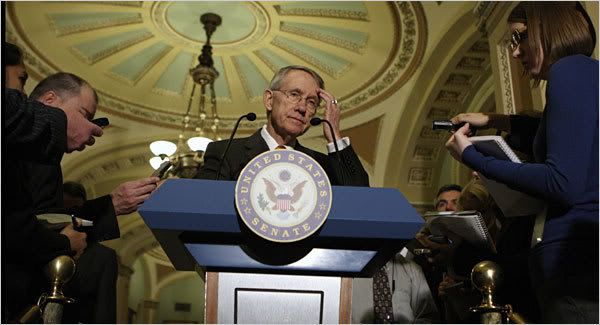
The New York Times reports:
After more than a year of wrangling, the Senate handed the White House a major victory on Tuesday by voting to broaden the government’s spy powers and to give legal protection to phone companies that cooperated in President Bush’s program of eavesdropping without warrants.
One by one, the Senate rejected amendments that would have imposed greater civil liberties checks on the government’s surveillance powers. Finally, the Senate voted 68 to 29 to approve legislation that the White House had been pushing for months. Mr. Bush hailed the vote and urged the House to move quickly in following the Senate’s lead.
The outcome in the Senate amounted, in effect, to a broader proxy vote in support of Mr. Bush’s wiretapping program. The wide-ranging debate before the final vote presaged discussion that will play out this year in the presidential and Congressional elections on other issues testing the president’s wartime authority, including secret detentions, torture and Iraq war financing.
Republicans hailed the reworking of the surveillance law as essential to protecting national security, but some Democrats and many liberal advocacy groups saw the outcome as another example of the Democrats’ fears of being branded weak on terrorism.
“Some people around here get cold feet when threatened by the administration,” said Senator Patrick J. Leahy, the Vermont Democrat who leads the Judiciary Committee and who had unsuccessfully pushed a much more restrictive set of surveillance measures.
Among the presidential contenders, Senator John McCain, Republican of Arizona, voted in favor of the final measure, while the two Democrats, Senator Barack Obama of Illinois and Senator Hillary Rodham Clinton of New York, did not vote. Mr. Obama did oppose immunity on a key earlier motion to end debate. Mrs. Clinton, campaigning in Texas, issued a statement saying she would have voted to oppose the final measure.
The measure extends, for at least six years, many of the broad new surveillance powers that Congress hastily approved last August just before its summer recess. Intelligence officials said court rulings had left dangerous gaps in their ability to intercept terrorist communications.
The bill, which had the strong backing of the White House, allows the government to eavesdrop on large bundles of foreign-based communications on its own authority so long as Americans are not the targets. A secret intelligence court, which traditionally has issued individual warrants before wiretapping began, would review the procedures set up by the executive branch only after the fact to determine whether there were abuses involving Americans.
“This is a dramatic restructuring” of surveillance law, said Michael Sussmann, a former Justice Department intelligence lawyer who represents several telecommunication companies. “And the thing that’s so dramatic about this is that you’ve removed the court review. There may be some checks after the fact, but the administration is picking the targets.”
The Senate plan also adds one provision considered critical by the White House: shielding phone companies from any legal liability for their roles in the eavesdropping program approved by Mr. Bush after the Sept. 11 attacks. The program allowed the National Security Agency to eavesdrop without warrants on the international communications of Americans suspected of having ties to Al Qaeda.
AT&T and other major phone companies are facing some 40 lawsuits from customers who claim their actions were illegal. The Bush administration maintains that if the suits are allowed to continue in court, they could bankrupt the companies and discourage them from cooperating in future intelligence operations.
The House approved a surveillance bill in November that intentionally left out immunity for the phone companies, and leaders from the two chambers will now have to find a way to work out significant differences between their two bills.
Democratic opponents, led by Senators Russ Feingold of Wisconsin and Christopher J. Dodd of Connecticut, argued that the plan effectively rewarded phone companies by providing them with legal insulation for actions that violated longstanding law and their own privacy obligations to their customers. But immunity supporters said the phone carriers acted out of patriotism after the Sept. 11 attacks in complying with what they believed in good faith was a legally binding order from the president.
“This, I believe, is the right way to go for the security of the nation,” said Senator John D. Rockefeller, the West Virginia Democrat who leads the intelligence committee. His support for the plan, after intense negotiations with the White House and his Republican colleagues, was considered critical to its passage but drew criticism from civil liberties groups because of $42,000 in contributions that Mr. Rockefeller received last year from AT&T and Verizon executives.
Senator Olympia J. Snowe, a Maine Republican on the intelligence panel, said the bill struck the right balance between protecting the rights of Americans and protecting the country “from terrorism and other foreign threats.”
Democratic opponents, who six months ago vowed to undo the results of the August surveillance vote, said they were deeply disappointed by the defection of 19 Democrats who backed the bill.
Mr. Dodd, who spoke on the floor for more than 20 hours in recent weeks in an effort to stall the bill, said future generations would view the vote as a test of whether the country heeds “the rule of law or the rule of men.”
But with Democrats splintered, Mr. Dodd acknowledged that the national security argument had won the day. “Unfortunately, those who are advocating this notion that you have to give up liberties to be more secure are apparently prevailing,” he said. “They’re convincing people that we’re at risk either politically, or at risk as a nation.”
There was a measure of frustration in the voice of Harry Reid, the Senate majority leader, as he told reporters during a break in the daylong debate, “Holding all the Democrats together on this, we’ve learned a long time ago, is not something that’s doable.”
Senate Republicans predict that they will be able to persuade the House to include immunity in the final bill, especially now that the White House has agreed to give House lawmakers access to internal documents on the wiretapping program. But House Democrats vowed Tuesday to continue opposing immunity.
Congress faces a Saturday deadline for extending the current law, but Democrats want to extend the deadline for two weeks to allow more time for talks. The White House has said it opposes a further extension.
Meanwhile, Senate Democrats hope to put some pressure on Republicans on Wednesday over another security-related issue by bringing up an intelligence measure that would apply Army field manual prohibitions against torture to civilian agencies like the Central Intelligence Agency.
Republicans plan to try to eliminate that provision, a vote that Democrats say will force Republicans to declare whether they condone torture. Democrats also say it could show the gap between Mr. McCain, who has opposed torture, and the administration on the issue.
“We know how we would feel if a member of the armed services captured by the enemy were, for example, waterboarded,” Mr. Reid said. “So I think that we’re headed in the right direction, and I hope that we’ll get Republican support on this.”
Senate roll call vote here.
Friday, October 19, 2007
| [+/-] |
Bush's Spying Hits Americans Abroad |
At Consortium News, Robert Parry writes:
In August after the Democratic-controlled Congress caved in to George W. Bush’s demands for broader surveillance powers, I noted that the new authority went far beyond what was advertised and that the President could obtain year-long spying orders on Americans who ventured outside the United States.
My analysis, which was based on a reading of the law’s language, wasn’t shared by commentators in the major U.S. news media and even drew some reader criticism as alarmist for failing to take into account secret “minimization” provisions that supposedly would protect American citizens.
However, the Bush administration’s hostile reaction to a seemingly innocuous amendment added to a new surveillance bill by Sen. Ron Wyden, D-Oregon, suggests that targeting Americans who travel abroad was a key goal of Bush’s “Protect America Act of 2007.”
Wyden told the New York Times that his amendment would require the government to get a warrant whenever it wants to wiretap an American outside the country, such as a U.S. soldier serving overseas or an American on a business trip.
“The individual freedom of an American shouldn’t depend on their physical geography,” Wyden told the Times. He said his amendment passed on a 9-6 vote in a closed Senate Intelligence Committee meeting on Oct. 18. [NYT, Oct. 19, 2007]
After the committee vote, the Bush administration and a key Senate Republican took direct aim at Wyden’s provision.
“We have strong concerns about that amendment,” said White House spokesman Tony Fratto. “We certainly could not accept it.”
Sen. Christopher Bond of Missouri, the ranking committee Republican, said Wyden’s amendment was “problematic” and could scuttle the entire bill if not changed.
In other words, the seemingly loose phrasing of the Protect America Act wasn’t just an oversight or something that would be cleaned up with some internal technical adjustments. Rather, it was an important feature of the legislation that was slipped past the Democratic leadership and most of the Washington press corps in August.
The law states: “Notwithstanding any other law, the Director of National Intelligence and the Attorney General may for periods of up to one year authorize the acquisition of foreign intelligence information concerning persons reasonably believed to be outside the United States.”
The law’s advocates claimed that this provision was intended to intercept communications when at least one party was linked to a terrorist group or a terrorist affiliate and was outside the United States.
No Terrorist Wording
But the law’s language didn’t limit the surveillance to “terrorists” or “enemy combatants” – indeed those words were not mentioned in the legislation.
Nor does the Protect America Act, which was drafted by the Bush administration’s national security team, specify what happens to a one-year surveillance order against a target if the person then enters – or returns – to the United States.
In the rush to wrap up legislative business before the August recess – and to avoid “soft on terror” accusations – Democratic congressional leaders offered only cursory attention to what this provision meant and what new abuses might become possible.
For instance, could a one-year surveillance order be issued against an American attorney who was representing a Guantanamo detainee and who traveled to Europe for a legal conference? Could the surveillance order follow that person back home? How about an outspoken peace activist who visited a friend in Canada, or a senator meeting with a foreign leader, or a journalist filing stories from overseas?
The only limitation on the administration’s authority is the need to be seeking “foreign intelligence information.” Though the term does cover information about possible hostile acts by a foreign power or an agent of a foreign power, such as terrorism or clandestine intelligence activities, the phrase can be interpreted in a far looser way.
The term can be defined broadly as information about a foreign power that relates to U.S. national defense, national security or the conduct of foreign affairs. In today’s world, those categories could mean pretty much anything.
Other supposed safeguards in the Protect America Act might not be reassuring to its targets, either.
While the targets are kept in the dark about the surveillance, their communications providers – such as phone companies or e-mail services – can challenge the government’s order if they’re willing to absorb the expense and offend the Executive Branch, which often has giant contracts with the same providers.
Even then, the service providers, which aren't told the classified basis for the surveillance order, can only contest the surveillance on procedural grounds through the secret channels of the court created by the Foreign Intelligence Surveillance Act, with appeals of adverse rulings allowed by either side up to the U.S. Supreme Court.
Lawsuit Immunity
But service providers get a strong incentive not to challenge the government’s order. While a legal challenge on behalf of an unsuspecting client could be expensive – especially if the Bush administration retaliates by shifting contracts to a competitor – the legislation grants immunity from liability to any service provider who complies.
“Notwithstanding any other law, no cause of action shall lie in any court against any person for providing any information, facilities, or assistance in accordance with a directive under this section,” the law states.
In other words, if spying targets later discover that their service providers gave the government access to their phone calls and e-mails, they have no grounds to sue, regardless of how unjustified the surveillance may have been.
Initially, administration officials said their goal in pushing through the new law was to address a glitch related to cases in which two terror suspects, both abroad, have their communication routed through a U.S. switching point and thus might require a warrant.
Citing this vulnerability, President Bush demanded that Democrats revise FISA before leaving for the August recess. Democrats thought they had reached a compromise that would address the administration’s narrow concern, but the White House and the congressional Republicans then demanded more sweeping changes.
The Senate caved in first, voting 60-28 to authorize Bush’s broader spying powers, with many centrist Democrats joining a solid phalanx of Republicans. (Presidential contenders – Sens. Hillary Clinton, Barack Obama, Chris Dodd and Joe Biden – voted no.)
On Aug. 4, Bush then turned up the heat on the House. He called the spying powers contained in the bill crucial weapons in the fight against terrorism and declared that “protecting America is our most solemn obligation.”
Many Americans would disagree, arguing that the most solemn obligation is to protect the Constitution and the Bill of Rights. But the Democratic congressional leaders acted as if their highest priorities were getting away for the August recess and avoiding ugly attacks on their patriotism from Fox News and the right-wing media.
Instead of canceling the recess – and using the month of August to fight over both Bush’s extraordinary expansion of presidential powers and the Iraq War – House Democratic leaders brought the Senate-approved Protect America Act to the floor. It carried, 227-183, with 41 Democrats backing Bush’s bill.
Trying to put the best spin on their defeat, Democratic leaders pointed to their one concession: a sunset provision that required Bush to seek renewal of his powers in six months. Still, the Democratic “base” and many other Americans were furious at the latest cave-in, sending House Speaker Nancy Pelosi more than 200,000 angry e-mails.
Stung by the reaction, Democratic leaders promised that the spying law would be revisited immediately after the August recess, rather than waiting around for a required reauthorization in February 2008.
New Concessions
Now, however, the Senate Democrats appear headed toward another major concession to Bush, making retroactive the legal immunity for telecommunications companies that collaborated with the administration’s warrantless surveillance over the past six years.
Sen. Jay Rockefeller, D-West Virginia, Senate Intelligence Committee chairman, shepherded this new concession through his panel, which approved a revised version of the Protect America Act on a 13-2 vote with Wyden and Sen. Russ Feingold, D-Wisconsin, voting no.
The bill now goes to the Senate Judiciary Committee, which also has jurisdiction. Sen. Dodd, D-Connecticut, has vowed to put a hold on the bill to block the retroactive immunity provision.
But the Democrats will face the same dilemma that has stymied their attempts to end the Iraq War. The Republicans are in the driver’s seat because they can filibuster in the Senate, forcing the Democrats to round up 60 votes on anything that restricts the President’s powers, such as Wyden’s amendment.
The GOP also has used parliamentary maneuvers in the House to delay its consideration of a different surveillance bill that includes more constraints on Bush and leaves out the amnesty for telecommunications companies.
Even if a new bill not to Bush’s liking can clear those hurdles, he can veto it, requiring two-thirds majorities in both houses to override.
An impasse would leave the Democrats back where they started. Then, with the law set to expire in February 2008, Bush and his political allies would taunt them as “soft on terror” – and there’s little reason to believe that congressional Democrats will show more backbone in an election year.
Thursday, October 18, 2007
| [+/-] |
Rockefeller, Pushing Immunity, Is Newly Flush With Telecomm Cash |
Senator Jay Rockefeller (D-West Virginia) is reportedly steering the secretive Senate Intelligence Committee to give retroactive immunity to telecoms that helped the government secretly spy on Americans.
He has also recently benefited from some interesting political contributions.
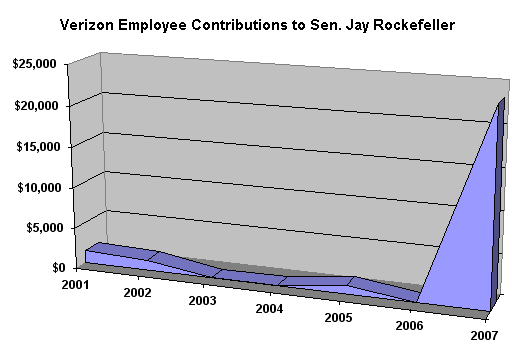
Top Verizon executives, including CEO Ivan Seidenberg and President Dennis Strigl, wrote personal checks to Rockefeller totaling $23,500 in March, 2007. Prior to that apparently coordinated flurry of 29 donations, only one of those executives had ever donated to Rockefeller (at least while working for Verizon).
In fact, prior to 2007, contributions to Rockefeller from company executives at AT&T and Verizon were mostly non-existent.
But that changed around the same time that the companies began lobbying Congress to grant them retroactive immunity from lawsuits seeking billions for their alleged participation in secret, warrantless surveillance programs that targeted Americans.
The Spring '07 checks represent 86 percent of money donated to Rockefeller by Verizon employees since at least 2001.
AT&T executives discovered a fondness for Rockefeller just a month after Verizon execs did and over a three-month span, collectively made donations totaling $19,350.
AT&T Vice President Fred McCallum began the giving spree in May with a $500 donation. 22 other AT&T high fliers soon followed with their own checks.
Prior to that burst of generosity, the only AT&T employee donation to Rockefeller was a $300 contribution in 2001. That supporter did not identify herself as a company executive.
When asked about the contributions, an AT&T spokesman told THREAT LEVEL: "AT&T employees regularly and voluntarily participate in the political process with their own funds."
Both companies are being sued for allegedly turning over billions of calling records to the government, while AT&T is also accused of letting the National Security Agency wiretap phone calls and its internet backbone. A federal judge in California allowed the suits regarding the eavesdropping to continue despite the government's attempt to have the suits thrown out on the grounds they will endanger national security. The 9th Circuit Court of Appeals reviewed that decision in August. The judges seemed reluctant to toss the cases, but have yet to issue a ruling.
On Thursday evening, the Rockefeller-led Senate Intelligence Committee is marking up a bill to re-amend the nation's spy laws. While the text of the bill has not yet been released, the bill reportedly includes a way for the telecoms to escape the litigation against them.
Rockefeller's commitment to getting the telecoms out of court surprises some who remember that Rockefeller was originally disturbed enough about the secret spying programs that he hand-wrote a letter to Dick Cheney in 2003, expressing his concerns about the program's legality.
In a fairly stunning related news, Democratic Senator Chris Dodd went all in with his political capital Thursday, announcing he would unilaterally put a hold on the bill, which would stop the bill from being voted on.
Representatives for Verizon and Rockefeller did not respond to requests for comment.
The contributions and the following tables were found thanks to OpenSecrets.org.
UPDATE: Reader Theo writes in to say why the money, though tiny in comparison to Rockefeller's fortune, is not negligible.Rockefeller is believed to have a personal fortune over $100 million. He spent $12 million of personal funds on his first Senate campaign. (http://www.encyclopedia.com/doc/1G1-3521561.html)
However "in recent campaigns, he has downplayed his personal wealth in one of the nation's poorest states. 'I will not spend one single dime of any money that I have,' he said in 2002. 'So that I if I don't raise money, I won't spend money. I am on exactly the same playing field, so to speak, with anybody else who runs for office.'" AP
He's up for election in 2008. The cost of Senate races has increased several times over the last two decades. With a serious Republican challenger in WV, which Bush won twice, such as Rep. Shelley Moore Capito, he could be forced to raise tens of millions of dollars. That, or break his promise not to use his personal fortune, which wouldn't play very well in one of the country's poorest states.
So yes, even a Rockefeller has to raise money. And in West Virginia, $50,000 is a lot of money. It's about 2% of all the money he raised last year. (But I'll bet he's slightly more worried about being red-baited for suppurtin' terrists.)

| [+/-] |
Mukasey says, "Bush Can Ignore the Law" |
Democrats Expected To Vote For Bush's Nominee For Attorney General
The Washington Post reports:
Attorney general nominee Michael B. Mukasey suggested today that the president could ignore federal surveillance law if it infringes on his constitutional authority as commander in chief.
Under sharp questioning about the Bush administration's warrantless eavesdropping program, Mukasey said there may be occasions when the president's wartime powers would supersede legal requirements to obtain a warrant to conduct wiretaps.
In such a case, Mukasey said, "the president is not putting somebody above the law; the president is putting somebody within the law. . . . The president doesn't stand above the law. But the law emphatically includes the Constitution."
Sen. Patrick J. Leahy (D-Vt.), chairman of the Senate Judiciary Committee, said he was "troubled by your answer. I see a loophole big enough to drive a truck through."
During a second day of hearings on his nomination, Mukasey defended several of the Bush administration's most controversial legal policies, prompting a drop in temperature in his previously warm relations with Democrats on the committee.
Mukasey, for example, endorsed the administration's views of expansive presidential authority in the use of executive privilege, saying it would be inappropriate for a U.S. attorney to press for contempt charges against a White House official protected by a claim of executive privilege.
Mukasey also demurred when he was repeatedly asked whether a simulated drowning technique known as waterboarding constitutes unlawful torture. Mukasey had strongly condemned the use of harsh interrogation tactics yesterday and said that the president could not order treatment that violated constitutional prohibitions.
But Mukasey said he could not elaborate on what techniques might be allowed, and specifically refused to answer questions from Democrats about whether waterboarding specifically was unconstitutional, saying he did know enough about what the technique entailed.
"If it is torture as defined by the Constitution, or defined by constitutional standards, it can't be authorized," Mukasey said.
Mukasey's remarks stood in sharp contrast to his comments during his first day of testimony yesterday, when he stopped short of embracing the Bush administration's legal views on several important topics and criticized its policies or legal reasoning in several areas.
The apparent shift prompted criticism from several committee Democrats, who largely showered Mukasey with praise yesterday and have predicted that he will be easily confirmed to replace former attorney general Alberto R. Gonzales.
During a break in testimony, Leahy told reporters that he was concerned about a "sudden change" in Mukasey's answers regarding the limits of presidential power.
"There were far clearer answers yesterday than there were today," Leahy said.
Yesterday, Sen. Russell Feingold (D-Wis.) pressed Mukasey on the limits of federal surveillance law with little success. Today, after Mukasey more clearly embraced the argument that such a law might infringe on presidential authority, Feingold complained that Mukasey had gone from being "agnostic" to holding a "disturbing view."
"You suggest that I've gone overnight from being an agnostic to being a heretic; I haven't," Mukasey responded, though he did not elaborate.
Mukasey also amplified his opposition to a proposed federal shield law for journalists, which has been approved by the Judiciary Committee in the wake of several high-profile cases in which reporters were jailed or threatened with contempt charges for refusing to divulge sources. Mukasey said that the current system has worked "passably well" and that any problems could likely be solved by changes to internal Justice Department rules.
Mukasey, who worked briefly as a wire service reporter and later represented media organizations as an attorney in private practice, echoed Bush administration arguments that such a law could be used to protect journalists who also are acting as spies or terrorists.
Yesterday, Mukasey said that he would chart an independent path for the Justice Department after Gonzales's tumultuous tenure, testifying that he would not be afraid to disagree with the president and would resign rather than implement policies that he believed violated the Constitution.
Mukasey also said the president cannot use his powers as commander in chief to override prohibitions against using torture or cruel, inhuman and degrading conduct in the interrogation of prisoners.
"Are you prepared to resign if the president were to violate your advice and in your view violate the Constitution?" asked Sen. Arlen Specter (R-Pa.). Mukasey responded: "That would present me with a difficult but not a complex problem. I could either try to talk him out of it or leave."
These and other strongly worded remarks reflected the former federal judge and prosecutor's desire to position himself as an independent legal thinker who, unlike Gonzales, has no long-standing ties to the current White House. "I'm not a bashful person, and I'm not going to become a bashful person if I'm confirmed," Mukasey said late in the day.
But Mukasey also declined to directly answer some questions related to controversial surveillance, detention and interrogation issues, and he suggested that in some policy areas his views might differ little from those of his predecessor.
During a sparring session with Feingold, for example, Mukasey declined to say whether the president could order a violation of federal surveillance law.
Mukasey said he could not provide an informed analysis without being briefed on the classified program but noted that some lawyers think the law does not entirely limit the president.
"I find your equivocation here somewhat troubling," Feingold responded.
Mukasey also expressed conservative views on social issues as divergent as obscenity and immigration, saying he would consider more robust prosecution of those caught being in the country illegally.
Most of the committee's Democrats, including Leahy, yesterday nonetheless repeated earlier predictions that Mukasey will be confirmed easily and with strong bipartisan support. "I'm encouraged by the answers," Leahy told reporters.
Yesterday's session was interrupted for several hours by a congressional ceremony for the Dalai Lama.
Sen. Charles E. Schumer (D-N.Y.), who had recommended that the White House nominate Mukasey, said Mukasey needs to rescue the Justice Department from its "greatest crisis since Watergate."
Much of the praise for Mukasey was accompanied by barely disguised swipes at Gonzales. "I think it's time for a steady hand, for a professional," said Sen. Jeff Sessions (R-Ala.). Schumer was more critical, saying Gonzales "was not much more than a potted plant" as attorney general.
Gonzales, a longtime friend and confidant of President Bush, resigned in August amid allegations that he bowed to White House demands in the firing of nine U.S. attorneys and on controversial national security policies, and then misrepresented his role during testimony on Capitol Hill.
Gonzales, who has hired a private defense attorney, is under investigation by the Justice Department over whether he lied to Congress or improperly tried to influence a congressional witness.
Democrats had earlier threatened to hold up the Mukasey hearings until they received more documents from the White House related to congressional investigations of the prosecutor firings and other issues. Those demands were put on hold, but Democrats say they will not abandon their probes.
Mukasey avoided a question about whether he would allow a U.S. attorney to pursue contempt charges against the White House if it refused to hand over the documents at issue, as Justice Department procedures provide.
Mukasey, 66, was calm and soft-spoken during much of his testimony, witnessed in the hearing room by family members and friends, including former FBI director Louis J. Freeh. Leahy and other lawmakers described Mukasey as candid and direct compared with Gonzales, who was widely accused of giving vague and evasive testimony.
When questioned about a Justice Department legal opinion issued early in the Bush administration, and since rescinded, that narrowly defined the acts that constitute torture, Mukasey replied differently than Gonzales had at his own confirmation hearing in early 2005.
Although Gonzales had repudiated that document, he repeatedly declined to directly answer questions about the limits of executive branch legal authority to undertake harsh interrogation methods that could be used on terrorism suspects. Mukasey said flatly that the president's commander-in-chief powers do not give him the authority to order torture or cruel treatment, which are prohibited by U.S. laws and international treaties.
At the same time, Mukasey essentially agreed with Gonzales's contention that a president can find a law unconstitutional.
While Gonzales had strongly defended the detention of terrorism suspects at Guantanamo Bay, Cuba, Mukasey called it a "black eye" for the United States because "we are detaining people apparently without end." He also suggested that it would be difficult to close Guantanamo Bay soon and defended an earlier comment that prisoners there were treated better than many U.S. citizens.
Under questioning from Leahy, Mukasey promised to recuse himself from any investigations that might touch on the GOP presidential campaign of former New York mayor Rudolph W. Giuliani, a longtime friend and political ally. Mukasey also vowed to limit contact between Justice Department officials and "political figures," and to discourage bringing charges close to an election.
In response to questions about rising crime rates, Mukasey said he would consider reallocating resources for anti-gang programs and other efforts. The Justice Department has diverted funds and personnel from crime-fighting to focus on counterterrorism and immigration cases, shortchanging anti-gang and anti-crime efforts.
"We can't turn our society into something not worth preserving in order to preserve it," he said.
| [+/-] |
Pat Leahy: "Intelligence Committee About to 'Cave' on Survellance" |
The Hill reports:
Senate Judiciary Committee Chairman Patrick Leahy (D-Vt.) on Thursday condemned Intelligence Committee Democrats for brokering a deal with the White House that would provide retroactive immunity for telephone companies that assisted the Bush administration’s controversial warrantless wiretapping program.
At the second day of confirmation hearings for President Bush’s Attorney General-nominee Michael Mukasey, Leahy warned that “the Intelligence Committee is about to cave on this,” citing pressure from the White House and press reports suggesting the administration had gotten its way.
“[Administration officials] know that it was illegal conduct and that there is no saving grace for the president to say, ‘Well, I was acting with authority,’ ” said Leahy. “Otherwise there wouldn't be so much pressure on us to immunize illegal conduct by either people acting within our government or within the private industry.”
Leahy’s remarks signal that a bipartisan accord to overhaul the 1978 Foreign Intelligence Surveillance Act (FISA), reached Wednesday by the Intelligence panel’s leaders and the White House, could divide Democrats and hit a roadblock on his panel as well. The Intelligence Committee marks up the bill Thursday afternoon, after which it will be referred to Judiciary, where more Democrats have openly opposed retroactive immunity language.
His comments also come as House Democratic efforts to overhaul the law are falling into disarray, after House Republicans used parliamentary maneuvers to force leaders to pull the Democrats’ FISA rewrite from the floor late Wednesday.
Attempting to resolve a central point of contention, Senate Intelligence panel Chairman Jay Rockefeller (D-W.Va.) reportedly reached a deal Wednesday with Director of National Intelligence Mike McConnell to give full retroactive immunity to telephone companies if they can demonstrate they were cooperating lawfully with the secret wiretapping program when suits were levied against them.
Not all Democrats on the Judiciary Committee appeared to share Leahy’s concerns. Sen. Dianne Feinstein (D-Calif.), who sits on both the Judiciary and Intelligence panels, signaled she was likely to support the bipartisan approach.
“At this stage, it is a bipartisan bill,” Feinstein said. “I’m absolutely convinced that the only way we can legislate on this is on a bipartisan basis. This bill so far is bipartisan — that’s good news.”
During the hearing, Democrats launched fresh criticism at Mukasey’s interpretation of FISA. After the nominee indicated that Bush was not acting illegally by going beyond that statute in authorizing eavesdropping without court warrants, Leahy called that argument “a loophole big enough to drive a truck [through].”
Whether the president is acting illegally “would have to depend on whether what goes outside the statute nonetheless lies within the authority of the president to defend the country,” Mukasey said.
Wednesday, August 22, 2007
| [+/-] |
Transcript: Interview with Mike McConnell on the Foreign Intelligence Surveillance Act |
From the El Paso Times, the following is the transcript of a question and answer session with National Intelligence Director Mike McConnell:
Question: How much has President Bush or members of his administration formed your response to the FISA debate?
Answer: Not at all. When I came back in, remember my previous assignment was director of the NSA, so this was an area I have known a little bit about. So I came back in. I was nominated the first week of January. The administration had made a decision to put the terrorist surveillance program into the FISA court. I think that happened the 7th of Jan. So as I come in the door and I'm prepping for the hearings, this sort of all happened. So the first thing I want to know is what's this program and what's the background and I was pretty surprised at what I learned. First off, the issue was the technology had changed and we had worked ourselves into a position that we were focusing on foreign terrorist communications, and this was a terrorist foreigner in a foreign country. The issue was international communications are on a wire so all of a sudden we were in a position because of the wording in the law that we had to have a warrant to do that. So the most important thing to capture is that it's a foreigner in a foreign country, required to get a warrant. Now if it were wireless, we would not be required to get a warrant. Plus we were limited in what we were doing to terrorism only and the last time I checked we had a mission called foreign
intelligence, which should be construed to mean anything of a foreign intelligence interest, North Korea, China, Russia, Syria, weapons of mass destruction proliferation, military development and it goes on and on and on. So when I engaged with the administration, I said we've gotten ourselves into a position here where we need to clarify, so the FISA issue had been debated and legislation had been passed in the house in 2006, did not pass the Senate. Two bills were introduced in the Senate, I don't know if it was co-sponsorship or two different bills, but Sen. (Dianne Feinstein, D-Calif.) had a bill and Sen. Specter had a bill and it may have been the same bill, I don't know, but the point is a lot of debate, a lot of dialogue. So, it was submitted to the FISA court and the first ruling in the FISA court was what we needed to do we could do with an approval process that was at a summary level and that was OK, we stayed in business and we're doing our mission. Well in the FISA process, you may or may not be aware ...
Q: When you say summary level, do you mean the FISA court?
A: The FISA court. The FISA court ruled presented the program to them and they said the program is what you say it is and it's appropriate and it's legitimate, it's not an issue and was had approval. But the FISA process has a renewal. It comes up every so many days and there are 11 FISA judges. So the second judge looked at the same data and said well wait a minute I interpret the law, which is the FISA law, differently. And it came down to, if it's on a wire and it's foreign in a foreign country, you have to have a warrant and so we found ourselves in a position of actually losing ground because it was the first review was less capability, we got a stay and that took us to the 31st of May. After the 31st of May we were in extremis because now we have significantly less capability. And meantime, the community, before I came back, had been working on a National Intelligence Estimate on terrorist threat to the homeland. And the key elements of the terrorist threat to the homeland, there were four key elements, a resilient determined adversary with senior leadership willing to die for the cause, requiring a place to train and develop, think of it as safe haven, they had discovered that in the border area between Pakistan and Afghanistan. Now the Pakistani government is pushing and pressing and attempting to do something about it, but by and large they have areas of safe haven. So leadership that can adapt, safe haven, intermediate leadership, these are think of them as trainers, facilitators, operational control guys. And the fourth part is recruits. They have them, they've taken them. This area is referred to as the FATA, federally administered tribal areas, they have the recruits and now the objective is to get them into the United States for mass casualties to conduct terrorist operations to achieve mass casualties. All of those four parts have been carried out except the fourth. They have em, but they haven't been successful. One of the major tools for us to keep them out is the FISA program, a significant tool and we're going the wrong direction. So, for me it was extremis to start talking not only to the administration, but to members of the hill. So from June until the bill was passed, I think I talked to probably 260 members, senators and congressmen. We submitted the bill in April, had an open hearing 1 May, we had a closed hearing in May, I don't remember the exact date. Chairman (U.S. Rep. Silvestre Reyes, D-Texas) had two hearings and I had a chance to brief the judiciary committee in the house, the intelligence committee in the house and I just mentioned the Senate, did not brief the full judiciary committee in the Senate, but I did meet with Sen. (Patrick Leahy, D-Vt.) and Sen. (Arlen Specter, R-Pa.), and I did have an opportunity on the Senate side, they have a tradition there of every quarter they invite the director of national intelligence in to talk to them update them on topics of interest. And that happened in (June 27). Well what they wanted to hear about was Iraq and Afghanistan and for whatever reason, I'm giving them my review and they ask questions in the order in which they arrive in the room. The second question was on FISA, so it gave me an opportunity to, here I am worrying about this problem and I have 41 senators and I said several things. The current threat is increasing, I'm worried about it. Our capability is decreasing and let me explain the problem.
Q: Can't you get the warrant after the fact?
A: The issue is volume and time. Think about foreign intelligence. What it presented me with an opportunity is to make the case for something current, but what I was really also trying to put a strong emphasis on is the need to do foreign intelligence in any context. My argument was that the intelligence community should not be restricted when we are conducting foreign surveillance against a foreigner in a foreign country, just by dint of the fact that it happened to touch a wire. We haven't done that in wireless for years.
Q: So you end up with people tied up doing paperwork?
A: It takes about 200 man hours to do one telephone number. Think about it from the judges standpoint. Well, is this foreign intelligence? Well how do you know it's foreign intelligence? Well what does Abdul calling Mohammed mean, and how do I interpret that? So, it's a very complex process, so now, I've got people speaking Urdu and Farsi and, you know, whatever, Arabic, pull them off the line have them go through this process to justify what it is they know and why and so on. And now you've got to write it all up and it goes through the signature process, take it through (the Justice Department), and take it down to the FISA court. So all that process is about 200 man hours for one number. We're going backwards, we couldn't keep up. So the issue was ...
Q: How many calls? Thousands?
A: Don't want to go there. Just think, lots. Too many. Now the second part of the issue was under the president's program, the terrorist surveillance program, the private sector had assisted us. Because if you're going to get access you've got to have a partner and they were being sued. Now if you play out the suits at the value they're claimed, it would bankrupt these companies. So my position was we have to provide liability protection to these private sector entities. So that was part of the request. So we went through that and we argued it. Some wanted to limit us to terrorism. My argument was, wait a minute, why would I want to limit it to terrorism. It may be that terrorists are achieving weapons of mass destruction, the only way I would know that is if I'm doing foreign intelligence by who might be providing a weapon of mass destruction.
Q: And this is still all foreign to foreign communication?
A: All foreign to foreign. So, in the final analysis, I was after three points, no warrant for a foreigner overseas, a foreign intelligence target located overseas, liability protection for the private sector and the third point was we must be required to have a warrant for surveillance against a U.S. person. And when I say U.S. person I want to make sure you capture what that means. That does not mean citizen. That means a foreigner, who is here, we still have to have a warrant because he's here. My view is that that's the right check and balances and it's the right protection for the country and lets us still do our mission for protection of the country. And we're trying to fend off foreign threats.
Q: So are you satisfied with it the way it is now?
A: I am. The issue that we did not address, which has to be addressed is the liability protection for the private sector now is proscriptive, meaning going forward. We've got a retroactive problem. When I went through and briefed the various senators and congressmen, the issue was alright, look, we don't want to work that right now, it's too hard because we want to find out about some issues of the past. So what I recommended to the administration is, 'Let's take that off the table for now and take it up when Congress reconvenes in September.'
Q: With an eye toward the six-month review?
A: No, the retroactive liability protection has got to be addressed.
Q: And that's not in the current law?
A: It is not. Now people have said that I negotiated in bad faith, or I did not keep my word or whatever...
Q: That you had an agenda that you weren't honest about.
A: I'll give you the facts from my point of view. When I checked on board I had my discussion with the president. I'm an apolitical figure. I'm not a Republican, I'm not a Democrat. I have voted for both. My job is as a professional to try to do this job the best way I can in terms of, from the intelligence community, protect the nation. So I made my argument that we should have the ability to do surveillance the same way we've done it for the past 50 years and not be inhibited when it's a foreigner in a foreign country. The president's guidance to me early in the process, was, 'You've got the experience. I trust your judgement. You make the right call. There's no pressure from anybody here to tell you how to do it. He did that early. He revisited with me in June. He did it again in July and he said it publicly on Friday before the bill was passed. We were at the FBI, it's an annual thing, we go to the FBI and do a homeland security kind of update. So he came out at noon and said, 'I'm requesting that Congress pass this bill. It's essential. Do it before you go on recess. I'm depending on Mike McConnell's recommendations. And that was the total sum and substance of the guidance and the involvement from the White House with regard to how I should make the call. Now, as we negotiated, we started with 66 pages, were trying to get everything cleaned up at once. When I reduced it to my three points, we went from 66 pages to 11. Now, this is a very, very complex bill. I had a team of 20 lawyers working. You can change a word in a paragraph and end up with some major catastrophe down in paragraph 27, subsection 2c, to shut yourself down, you'll be out of business. So when we send up our 11 pages, we had a lot of help in making sure we got it just right so it would come back and we'd say wait a minute we can't live with this or one of the lawyers would say, 'Wait we tried that, it won't work, here's the problem.' So we kept going back and forth, so we sent up a version like Monday, we sent up a version on Wednesday, we sent up a version on Thursday. The House leadership, or the Democratic leadership on Thursday took that bill and we talked about it. And my response was there are some things I can't live with in this bill and they said alright we're going to fix them. Now, here's the issue. I never then had a chance to read it for the fix because, again, it's so complex, if you change a word or phrase, or even a paragraph reference, you can cause unintended ...
Q: You have to make sure it's all consistent?
A: Right. So I can't agree to it until it's in writing and my 20 lawyers, who have been doing this for two years, can work through it. So in the final analysis, I was put in the position of making a call on something I hadn't read. So when it came down to crunch time, we got a copy and it had some of the offending language back in it. So I said, 'I can't support it.' And it played out in the House the way it played out in the House. Meantime on the Senate side, there were two versions being looked at. The Wednesday version and the Thursday version. And one side took one version and the other side took the other version. The Thursday version, we had some help, and I didn't get a chance to review it. So now, it's Friday night, the Senate's voting. They were having their debate and I still had not had a chance to review it. So, I walked over, I was up visiting some senators trying to explain some of the background. So I walked over to the chamber and as I walked into the office just off the chamber, it's the vice president's office, somebody gave me a copy. So I looked at the version and said, 'Can't do it. The same language was back in there.'
Q: What was it?
A: Just let me leave it, not too much detail, there were things with regard to our authorities some language around minimization. So it put us in an untenable position. So then I had another version to take a look at, which was our Wednesday version, which basically was unchanged. So I said, well certainly, I'm going to support that Wednesday version. So that's what I said and the vote happened in the Senate and that was on Friday. So now it rolled to the House on Saturday. They took up the bill, they had a spirited debate, my name was invoked several times, not in a favorable light in some cases. (laughs) And they took a vote and it passed 226 to 182, I think. So it's law. The president signed it on Sunday and here we are.
Q: That's far from unanimous. There's obviously going to be more debate on this.
A: There are a couple of issues to just be sensitive to. There's a claim of reverse targeting. Now what that means is we would target somebody in a foreign country who is calling into the United States and our intent is to not go after the bad guy, but to listen to somebody in the United States. That's not legal, it's, it would be a breach of the Fourth Amendment. You can go to jail for that sort of thing. And If a foreign bad guy is calling into the United States, if there's a need to have a warrant, for the person in the United States, you just get a warrant. And so if a terrorist calls in and it's another terrorist, I think the American public would want us to do surveillance of that U.S. person in this case. So we would just get a warrant and do that. It's a manageable thing. On the U.S. persons side it's 100 or less. And then the foreign side, it's in the thousands. Now there's a sense that we're doing massive data mining. In fact, what we're doing is surgical. A telephone number is surgical. So, if you know what number, you can select it out. So that's, we've got a lot of territory to make up with people believing that we're doing things we're not doing.
Q: Even if it's perception, how do you deal with that? You have to do public relations, I assume.
A: Well, one of the things you do is you talk to reporters. And you give them the facts the best you can. Now part of this is a classified world. The fact we're doing it this way means that some Americans are going to die, because we do this mission unknown to the bad guys because they're using a process that we can exploit and the more we talk about it, the more they will go with an alternative means and when they go to an alternative means, remember what I said, a significant portion of what we do, this is not just threats against the United States, this is war in Afghanistan and Iraq.
Q. So you're saying that the reporting and the debate in Congress means that some Americans are going to die?
A. That's what I mean. Because we have made it so public. We used to do these things very differently, but for whatever reason, you know, it's a democratic process and sunshine's a good thing. We need to have the debate. The reason that the FISA law was passed in 1978 was an arrangement was worked out between the Congress and the administration, we did not want to allow this community to conduct surveillance, electronic surveillance, of Americans for foreign intelligence unless you had a warrant, so that was required. So there was no warrant required for a foreign target in a foreign land. And so we are trying to get back to what was the intention of '78. Now because of the claim, counterclaim, mistrust, suspicion, the only way you could make any progress was to have this debate in an open way.
Q. So you don't think there was an alternative way to do this?
A. There may have been an alternative way, but we are where are ...
Q. A better way, I should say.
A. All of my briefs initially were very classified. But it became apparent that we were not going to be able to carry the day if we don't talk to more people.
Q. Some might say that's the price you pay for living in a free society. Do you think that this is necessary that these Americans die?
A. We could have gotten there a different way. We conducted intelligence since World War II and we've maintained a sensitivity as far as sources and methods. It's basically a sources and methods argument. If you don't protect sources and methods then those you target will choose alternative means, different paths. As it is today al-Qaida in Iraq is targeting Americans, specifically the coalition. There are activities supported by other nations to import electronic, or explosively formed projectiles, to do these roadside attacks and what we know about that is often out of very sensitive sources and methods. So the more public it is, then they take it away from us. So that's the tradeoff.
DIVERSITY IN THE INTELLIGENCE COMMUNITY
Q: I wanted to ask you about the diversity question. This has major ramifications here, we have this center of excellence program that's recruiting high school kids, many of whom wouldn't qualify if first generation American citizens weren't allowed.
A: So you agree with me?
Q: It does sound like something that would benefit this area that would also allow you to get people from here who are bicultural and have an openness to seeing things ...
A: You're talking about Hispanics?
Q: Yes.
A: Hispanics are probably the most under-represented group if you think of America, what the ethic makeup of America, Hispanics are the most under-represented group in my community. Now, that said, and should increase that Hispanic population and programs like this will do that. That's why the outreach. But also we need, particularly with the current problem of terrorism, we need to have speakers of Urdu and Farsi and Arabic and people from those cultures that understand the issues of tribes and clans and all the things that go with understanding that part of the world. Varying religions and so on. Because it is, it's almost impossible, I've had the chance to live in the Middle East for years, I've studied it for years, it's impossible to understand it without having some feel for the culture and so on. So while I'm all for increasing the diversity along the lines we talked about, I'm also very much in favor of first generation Americans from the countries that are causing issues and problems.
Q: What is the status of that program.
A: It is not in statue. It is not in policy. It has been habit. So we've stated, as a matter of policy, that we're not going to abide by those habits.
Q: And that's already the case?
A: Yes, and are we making progress? Not fast enough, but we will make progress over time.
Q: How do you measure that?
A: Very simple, you get to measure what are you and where are you trying go and are you making progress. I wrestled with this years ago when I was NSA ....
Q: You don't want quotas, though?
A: Quotas are forbidden so we set goals. My way of thinking about it is what is your end state? Now some would say that federal governments should look like America, whatever that is. OK, that sounded like a reasonable metric, so I said, 'Alright, what does America look like?' So I got a bunch of numbers. I said, 'Alright, what do we look like?' and it didn't match, and as I just told you, the one place where there's the greatest mismatch is Hispanic. It's much closer, as matter of fact, people would be surprised how close it is across, at least my community among the other minorities. Now, that said, numbers don't necessarily equal positioning in the organization. So that's another feature we have to work on, is placement of women and minorities in leadership positions.
Q: So, you're quantifying that as well?
A: Yes.
TERRORIST ACTIVITY ON THE NATION'S SOUTHWEST BORDER
Q: There seems to be very little terrorist-related activity on the Southwest border, which is watched very closely because of the illegal immigration issue. Can you talk about why it's important to be alert here?
A: Let me go back to my NIE, those are unclassified key judgements, pull them down and look at them. You've got committed leadership. You've got a place to train. They've got trainers and they've got recruits. The key now is getting recruits in. So if the key is getting recruits in. So, if you're key is getting recruits in, how would you do that? And so, how would you do that?
Q: I'd go to the northern border where there's nobody watching.
A: And that's a path. Flying in is a path. Taking a ship in is a path. Coming up through the Mexican border is a path. Now are they doing it in great numbers, no. Because we're finding them and we're identifying them and we've got watch lists and we're keeping them at bay. There are numerous situations where people are alive today because we caught them (terrorists). And my point earlier, we catch them or we prevent them because we've got the sources and methods that lets us identify them and do something about it. And you know the more sources and methods are compromised, we have that problem.
Q: And in many cases we don't hear about them?
A: The vast majority you don't hear about. Remember, let me give you a way to think about this. If you've got an issue, you have three potential outcomes, only three. A diplomatic success, an operational success or an intelligence failure. Because all those diplomatic successes and operations successes where there's intelligence contribution, it's not an intelligence success. It's just part of the process. But if there's an intelligence failure ...
Q: Then you hear about it.
A: So, are terrorists coming across the Southwest border? Not in great numbers.
Q: There are some cases?
A: There are some. And would they use it as a path, given it was available to them? In time they will.
Q: If they're successful at it, then they'll probably repeat it.
A: Sure. There were a significant number of Iraqis who came across last year. Smuggled across illegally.
Q: Where was that?
A: Across the Southwest border.
Q: Can you give me anymore detail?
A: I probably could if I had my notebook. It's significant numbers. I'll have somebody get it for you. I don't remember what it is.
Q: The point is it went from a number to (triple) in a single year, because they figured it out. Now some we caught, some we didn't. The ones that get in, what are they going to do? They're going to write home. So, it's not rocket science, word will move around. There's a program now in South America, where you can, once you're in South American countries, you can move around in South America and Central America without a visa. So you get a forged passport in Lebanon or where ever that gets you to South America. Now, no visa, you can move around, and with you're forged passport, as a citizen of whatever, you could come across that border. So, what I'm highlighting is that something ...
Q: Is this how it happened, the cases you're talking about?
A: Yes.
