The Washington Post reports:
In August 1980, with no hope left of winning the nomination, Sen. Edward M. Kennedy conceded defeat to incumbent Jimmy Carter in the Democratic presidential race.
"For me, a few hours ago, this campaign came to an end," Kennedy said at the Democratic National Convention in New York. "For all those whose cares have been our concern, the work goes on, the cause endures, the hope still lives, and the dream shall never die."
And with that, at age 48, Kennedy returned to the Senate, where he committed himself to a career as a legislator, crafting landmark bills on health care, education and immigration. Many Democrats are now pointing to the Kennedy model as a path for Sen. Hillary Rodham Clinton to reshape her own political career, assuming she is unable to wrest the nomination from Sen. Barack Obama.
"I loved the Senate before I ran for the president," Kennedy explained in an interview before his recent cancer diagnosis. Losing to Carter, he said, made him appreciate the opportunities in Congress all the more. "I think I became a better senator, with greater focus and attention," Kennedy said. But he added: "It all depends on the attitude, what's in the mind of the person."
Clinton, Kennedy continued, must decide where her heart lies. "She's got great capacity -- she was a good senator before, and she can be a great senator in the future," he said. The question, he said, is "what she does with this experience."
When Kennedy returned to Capitol Hill before the 1980 election, the Massachusetts Democrat was in a similar fix. Like Clinton, he was the heir to a powerful political legacy. But the climate was volatile, and voters were in the mood for change. Kennedy was rejected by many of his Senate colleagues, despite Carter's sagging popularity, and he won just 10 primary states. But like Clinton, he hung on until the bitter end.
Yet Kennedy was an 18-year Senate veteran who had already risen to chairman of the Judiciary Committee and a health subcommittee. Clinton faces few options for quick advancement should she give up her presidential bid, prompting some to speculate that she may look elsewhere for a prominent political post, possibly the governorship of New York.
The climate on Capitol Hill has changed considerably in the 18 months since Clinton began her presidential campaign. The Senate leadership path that she had once viewed as a viable alternative is now all but blocked. Senate Majority Leader Harry M. Reid (Nev.) has gained clout in his role, and he will grow even more powerful if Democrats succeed in expanding their narrow majority in November by up to half a dozen seats.
Reid's deputies, Majority Whip Richard J. Durbin (Ill.) and Democratic Caucus Vice Chairman Charles E. Schumer (N.Y.), also have enhanced their status in recent months and are quietly laying the groundwork to succeed Reid whenever he decides to step down.
"Within the caucus, there's strong support for Senator Reid, and those who speculate otherwise don't understand the Senate," said Durbin, who was the first senator to endorse Obama. When Clinton returns to her old job, assuming she does not win the nomination, Durbin added, "she will be an important part of the future. But I can't tell you that anyone has approached me, or anyone in the caucus, with any specific suggestions about what she would do."
When Clinton announced her bid in January 2007, she was the prohibitive favorite, and most of her Senate colleagues appeared ready to rally to her side. But as her primary battle with Obama draws to an end, with the senator from Illinois almost certain to emerge the victor, Clinton has discovered that the reservoir of Senate goodwill was not so deep after all.
Clinton collected 13 endorsements from her Senate colleagues, compared with 15 for Obama, and she has not added a name to her list since early February, even though she has won significant contests since then.
"I'm sure she'll remember, for the rest of her life, who was with her and who wasn't," said Sen. Christopher J. Dodd (D-Conn.), who ran unsuccessfully this year and then endorsed Obama.
Speaking on the condition of anonymity, many Democratic senators said they expect Clinton to work doggedly for Obama this summer and fall, and they agreed that if she does, whatever hard feelings that linger from the primary race will vanish.
But a bigger question is whether, like Kennedy, she will shelve her presidential ambitions, especially if Sen. John McCain (R-Ariz.) wins in November. The 2012 election would coincide with the end of Clinton's second Senate term, effectively turning her into a lame duck. A run for New York governor would hasten Clinton's departure by two years.
But if Obama wins in November, her next likely opportunity for the presidency would be in 2016, when she would be 69. If Clinton makes it clear her future is in the Senate, she could find several paths open to her, aides and colleagues said.
One would be to champion a major piece of legislation, such as the health-care bill Obama has promised early in his first term.
A member of three prominent committees, Clinton remains a junior member on all three panels and does not stand to become a committee chairman for at least another decade.
But another option would be to assume the chairmanship of the Democratic Senatorial Campaign Committee, a demanding but high-profile post that is an appointment by Reid. Sen. Robert Menendez (N.J.) is a potential successor to Schumer, who has led the committee for four years, but Democratic sources said Clinton could get the job if she wanted it.
Sen. Patrick J. Leahy (Vt.) pointed to the late Hubert H. Humphrey (D-Minn.) as one example of life in the Senate after a losing White House bid. A senator in the 1950s and '60s, Humphrey became vice president in 1965 and then narrowly lost to Richard M. Nixon in the 1968 presidential election. He won another Senate term in 1970 and returned as the most junior member. "He realized he could command an audience anywhere in the world. He threw himself into the issues. He had the time of his life," Leahy said.
On the other hand, Sen. Joseph R. Biden Jr. (Del.) returned to the Senate after his failed 1988 presidential bid and became a formidable voice on both the Judiciary and Foreign Relations committees.
With or without a prominent post, Clinton will possess unrivaled clout, her colleagues said. "She is the single most powerful woman in America, and that will be solidified by this race, not diminished by it," said Biden, who has not endorsed a candidate after dropping his own bid earlier this year.
As the former first lady, Clinton arrived in the Senate in January 2001 already a political celebrity, and her status was acknowledged with an appointed leadership position as head of the Steering Committee, with the task of interacting with outside liberal groups.
But colleagues said Clinton showed no interest in using her perch to work toward more powerful posts inside the Senate. Rather, she spent much of her time traveling the country to help Democrats in presidential battleground states, and raising money through her leadership political action committee, HillPAC. She also committed herself to advancing New York state interests, numerous colleagues and senior aides said.
Regardless of which route she now chooses, colleagues who have run failed campaigns said she must first readjust to life in the Senate.
"When you're out on the campaign, you've got to make decisions every hour, every minute," said Sen. Tom Harkin (D-Iowa). "Then you come back to the Senate and it's like a cocoon."
Tuesday, May 27, 2008
| [+/-] |
No Clear Map For Clinton's Political Future |
Tuesday, November 6, 2007
| [+/-] |
Senate Judiciary Committee Approves Mukasey Nomination |
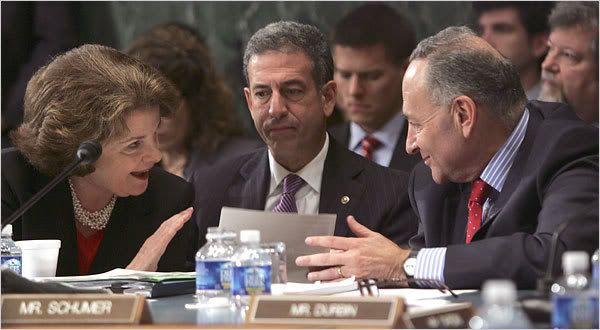 Senators Dianne Feinstein, Russ Feingold and Chuck Schumer after the vote on Tuesday.
The NY Times reports:
The Senate Judiciary Committee voted on Tuesday to approve the nomination of Michael B. Mukasey as attorney general despite opposition from most of the committee’s Democrats over Mr. Mukasey’s refusal to label a harsh interrogation technique used on terrorist suspects as torture.
Protesters opposed the Mukasey nomination and votes of two Democratic senators.
The vote, 11 to 8, with two Democrats joining all of the committee’s Republicans in supporting Mr. Mukasey, all but assured him of final confirmation by the full Senate. The Senate’s Democratic leaders are expected to schedule a vote by next week.
Mr. Mukasey, a retired federal judge from New York, ultimately owed his approval by the Judiciary Committee to the two Democrats who broke with their party to support him, Senators Dianne Feinstein of California and Charles E. Schumer, a fellow New Yorker who had initially recommended Mr. Mukasey to the White House.
The nomination of Mr. Mukasey was almost derailed by his refusal at his confirmation hearings to define as torture the interrogation technique known as waterboarding, which simulates drowning and is reported to have been used by the Central Intelligence Agency on a handful of Qaeda leaders since the Sept. 11 terror attacks.
In a letter to senators last week, Mr. Mukasey said the practice of waterboarding was “repugnant” but added that he could not judge its legality until he had been given access to classified information about interrogation techniques.
The White House welcomed the Judiciary Committee’s vote and urged that the nomination be moved quickly to the Senate floor. “Judge Mukasey has clearly demonstrated that he will be an exceptional attorney general at this critical time,” the White House spokeswoman, Dana Perino, said Tuesday.
Even some of Mr. Mukasey’s supporters said at the hearing to vote on the nomination that they were troubled by the way Mr. Mukasey handled questions about waterboarding, which the United States has fiercely condemned when carried out by other nations and had prosecuted as a war crime after World War II.
“I understand and greatly respect the view of some of my colleagues that the torture question trumps all other considerations,” Mr. Schumer said. But in explaining his vote for the nomination, Mr. Schumer said rejection of an otherwise highly praised nominee like Mr. Mukasey would allow the White House to appoint a caretaker attorney general who would not end the management turmoil and political scandals that plagued the Justice Department under Attorney General Alberto R. Gonzales.
“Judge Mukasey would be more likely than a caretaker to find on his own that waterboarding is illegal,” Mr. Schumer said.
In voting against Mr. Mukasey, the committee’s chairman, Patrick J. Leahy, and other Democrats portrayed their opposition as a defining moment for Congress in standing up to the Bush administration in upholding basic human rights and constitutional values in battling terrorism.
“America, the great and good nation that has been a beacon to the world on human rights, does not torture and should stand against torture,” Mr. Leahy said.
Senator Richard J. Durbin of Illinois, the Senate’s No. 2 Democratic leader, accused Mr. Mukasey of a “legal dodge” in refusing to repudiate “a cruel, abusive technique that has been regarded as torture in the civilized world for over 500 years.”
“When the history of this time is written, the issue of torture will define America’s values in the age of terrorism,” he continued. “Judge Mukasey’s responses to our questions on the issue of torture make it clear that he does not understand the challenge of this moment in history.”
The committee’s ranking Republican, Arlen Specter of Pennsylvania, said he had also been disturbed by Mr. Mukasey’s responses to the committee’s questions on torture, as well as on the nominee’s embrace of the Bush administration’s expansive view of the powers of the executive branch in wartime.
Mr. Specter said Mr. Mukasey’s assertion that he could not address the legality of waterboarding because he had not been briefed about it was “an excuse, and a flimsy excuse.”
But he said he decided to support the nomination after talking on Monday with Mr. Mukasey, who said he believed that if Congress outlawed waterboarding, which the Senate is now considering, the president would have no authority to overrule it. Mr. Specter said: “All factors considered, I think that the balance is decisively in favor of confirming Judge Mukasey. And I look forward to Congressional consideration of this issue of waterboarding. We’re the people who ought to decide it.”
Monday, November 5, 2007
| [+/-] |
Schumer & Feinstein Coordinate Efforts To Thwart Democrats' Base |
The Hill reports:
The coordinated statements released late Friday afternoon by two Democratic senators that they would break ranks and support President Bush’s attorney general nominee largely muted opposition from a Democratic base that has become increasingly frustrated with Congress, activist leaders said Monday.
Sens. Charles Schumer (D-N.Y.) and Dianne Feinstein (D-Calif.) effectively thwarted plans by the activist left to use the weekend to mobilize ahead of Tuesday’s Judiciary Committee vote and pressure wayward senators to reject the nominee, activists said.
“It was a surprise attack,” said Caroline Fredrickson, director of the Washington legislative office for the American Civil Liberties Union, which wants the Judiciary Committee to defeat the nomination. “There was a limited opportunity to say much about what Schumer and Feinstein had done because the timing was very cleverly calculated to avoid scrutiny.”
With the support of Schumer, Feinstein and the committee’s nine Republicans, Mukasey has garnered enough support to clear the panel and move to the Senate floor.
Before Feinstein’s announcement, sent to the media by e-mail at about 4:28 p.m., the nomination had seemed in doubt, especially after Judiciary Chairman Patrick Leahy (D-Vt.) announced his opposition to Mukasey at a 3 p.m. news conference in Burlington, Vt. Leahy became the fifth Judiciary Committee Democrat to announce his opposition over Mukasey’s refusal to state explicitly that the interrogation technique known as waterboarding constitutes torture.
Hours before Leahy’s press conference, however, Schumer in a telephone call already had laid out his thoughts to the chairman and also relayed a message that Feinstein had planned to support the nominee, according to aides.
But Schumer and Feinstein withheld announcing their decisions until late that afternoon. For Schumer, a decisive meeting came later in the day, around the same time as Leahy’s press conference. Mukasey assured him he would enforce any law Congress passes to explicitly state that certain interrogation techniques — such as waterboarding — are illegal under U.S. torture laws.
“Judge Mukasey is a lawyer’s lawyer. He will not leap to quick judgments,” Schumer said in his statement. “When we want him to do so, such as on torture, we will be disappointed. But when he resists those in the administration who want quick and facile answers . . . it is they who will be disappointed.”
The New Yorker, one of the most outspoken critics of the Bush administration, had been in an awkward position because he recommended Mukasey for the post before Democratic opposition grew. Both Schumer and Feinstein said they believed a Mukasey Justice Department would be markedly better than the tumultuous tenure of the resigned Alberto Gonzales.
Feinstein had made up her mind Thursday that she would support the nomination, but her office was still finalizing a statement when they caught wind of Schumer’s decision on Friday, one of her aides said. They decided to withhold the statement until Schumer was ready to make his announcement after both his afternoon meeting with Mukasey and the Leahy press conference. She followed up with a guest column explaining her views in Saturday’s edition of the Los Angeles Times.
“Judge Mukasey’s answers were quick and to the point, and reflected an independent mind,” Feinstein said in the column. “I truly believe he will be a strong advocate for the American people.”
By issuing coordinated statements late on a Friday afternoon, the senators employed the old Washington trick of breaking news at the end of a news cycle. Simultaneously, they undermined efforts by both the left and the right to pressure them into voting either for or against the nominee.
But they also undermined Leahy’s announcement, which would have dominated the weekend’s news. A Judiciary Committee aide, however, said there was no ill-will towards the senators for doing that.
“As you know, Sen. Leahy and Sen. Reid have not made this a caucus vote,
and as chairman, Sen. Leahy has not twisted any arms,” the aide said, referring to Senate Majority Leader Harry Reid (D-Nev.). What he does feel strongly about is knocking down, during this debate, the falsehood that waterboarding is not already torture and illegal.”
One leader of an activist group opposed to the nomination said the coordinated statements by the senators had a “chilling effect” on efforts to drum up opposition over the weekend.
“They wanted to decrease the intense focus on the two of them, and each reinforces the other by doing this together,” said Carl Tobias, a law professor at the University of Richmond. “It takes some of the heat off of each of them.”
Feinstein is familiar with being the lone Democrat to side with Republicans on the Judiciary Committee. She did so in August by joining all nine Republicans in voting for the nomination of Leslie Southwick for a lifetime seat on a New Orleans-based appeals court – over the strong objections of the other nine committee Democrats because of the nominee’s civil rights record.
Among some activist groups, the feelings are still raw with Feinstein for not joining Democrats to defeat the Southwick nomination in the committee. More broadly, the base has grown increasingly angry at Democrats for capitulating to Republicans on major issues, such as the Iraq war and Bush’s domestic spying program.
One leading Democratic activist expected Schumer to get earfuls during fundraisers for the Democratic Senatorial Campaign Committee, which he chairs. Also, one grassroots group, Democrats.com, has called for a moratorium on donations to the committee, which is trying to expand the Democratic majority in the Senate.
It’s unlikely that calls to cut off donating to the DSCC will pick up steam, activists said.
Even though Mukasey’s nomination is virtually assured, activists are still planning on airing their concerns. The Leadership Conference on Civil Rights is putting together a letter laying out its opposition and the concerns of a slew of other left-leaning groups.
Friday, November 2, 2007
| [+/-] |
Schumer and Feinstein Back Mukasey |
The NY Times reports:
The nomination of Michael B. Mukasey to be attorney general seemed all but assured late this afternoon when Senators Charles E. Schumer and Dianne Feinstein, two Democrats on the Senate Judiciary Committee, announced that they would vote in favor of the nominee.
Mr. Schumer announced his support after meeting with Mr. Mukasey this afternoon. “Judge Mukasey is not my ideal choice,” Mr. Schumer said in a statement afterward. “However, Judge Mukasey, whose integrity and independence is respected even by those who oppose him, is far better than anyone could expect from this administration.”
The statement from Mr. Schumer of New York, and late word from the office of Senator Feinstein of California that she too would endorse Mr. Mukasey, virtually assured that he would win the backing of the Judiciary Committee when it meets on Tuesday, and in all probability confirmation by the full Senate.
There are nine Republicans on the Judiciary Committee, versus 10 Democrats. So with the support of Mr. Schumer and Ms. Feinstein, the numbers are on Mr. Mukasey’s side, even though Senator Patrick J. Leahy, the Vermonter who heads the Judiciary Committee, this afternoon became the fifth Democrat on the panel to announce that he would vote against the nominee.
Mr. Schumer said his decision had been “extremely difficult,” and that a big factor was Mr. Mukasey’s opinion, conveyed to him this afternoon, that “were Congress to pass a law banning certain interrogation techniques, we would clearly be acting within our constitutional authority.”
The responses of Mr. Mukasey, a former federal judge from New York City, to committee questions about the definition of torture in interrogating suspected terrorists, and the bounds of presidential authority, have been the main obstacles to his cause.
For Mr. Leahy, those questions have not been satisfactorily answered.
“I like Michael Mukasey; I wish that I could support his nomination,” Mr. Leahy said this afternoon in Montpelier, Vt. “But I cannot.”
The senator went on to say that “no American should need a classified briefing to determine whether waterboarding is torture.”
The four other committee Democrats who have announced their opposition are Senators Edward M. Kennedy of Massachusetts, Joseph R. Biden Jr. of Delaware, Richard J. Durbin of Illinois and Sheldon Whitehouse of Rhode Island. But it seems clear now that there is not enough Democratic opposition to be fatal to the nomination.
The declarations of Senators Feinstein and Schumer would be enough to combine with the votes of the body’s 49 Republicans to win the nomination for Mr. Mukasey, barring some startling turn of events in the next several days.
Another committee Democrat, Senator Russell D. Feingold of Wisconsin, said today that he was undecided. “He may be the best nominee we can get from this administration,” Mr. Feingold said, calling Mr. Mukasey “a marked improvement” over former Attorney General Alberto R. Gonzales.
The remaining two Democrats on the panel — Herb Kohl of Wisconsin and Benjamin L. Cardin of Maryland — have yet to state their positions in advance of the committee vote.
All four Democrats running for president have said they will vote against Mr. Mukasey. In addition to Mr. Biden, Senators Hillary Rodham Clinton of New York, Barack Obama of Illinois and Christopher J. Dodd of Connecticut have said they will vote “no.”
President Bush showed his concern by campaigning again today for his embattled nominee, envisioning a “fight on the Senate floor coming next week,” and declaring that Mr. Mukasey must win for the good of the country.
“He’s a good man, he’s a fair man, he’s an independent man, and he’s plenty qualified to be the attorney general,” Mr. Bush said at the airport in Columbia, S.C. “And I strongly urge the United States Senate to confirm this man, so that I can have an attorney general to work with to protect the United States of America from further attack.”
Mr. Bush spoke just before heading to a campaign fund-raiser for Senator Lindsey Graham, a member of the Judiciary Committee, who is running for re-election.
Mr. Bush began his campaign to save the candidacy of Mr. Mukasey on Thursday, defending him in a speech and in an Oval Office interview, where he complained that Mr. Mukasey was “not being treated fairly” on Capitol Hill.
Thursday, November 1, 2007
| [+/-] |
Undecided Schumer May Be Key to Mukasey's Chances |
Judiciary Chairman Endorsed Justice Nominee but Says He, Like Other Democrats, Is Concerned About Torture Question
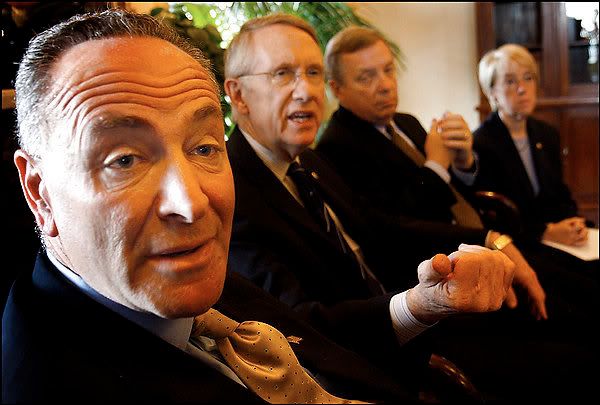 Sen. Charles Schumer, foreground, said he is "wrestling" with the decision of whether to recommend a full Senate confirmation vote for Michael Mukasey. Schumer talked to reporters about Mukasey and other topics yesterday with fellow Senate Democrats, from left, Harry Reid, Richard Durbin and Patty Murray. (By Melina Mara -- The Washington Post)
The Washington Post reports:
As Democratic opposition builds over attorney general nominee Michael B. Mukasey, no Democratic lawmaker has found himself in a tighter spot than Sen. Charles E. Schumer (N.Y.), who had eagerly recommended the former federal judge as a consensus candidate.
After Mukasey refused to say whether an interrogation technique called waterboarding amounts to illegal torture, Schumer has watched a growing number of his colleagues announce their opposition to the judge.
Schumer, who has remained uncharacteristically quiet throughout the furor, said in an interview yesterday that he is now "wrestling" with whether to vote against a nomination that he was instrumental in bringing about. He compared the controversy to the 2005 nomination battle over Chief Justice John G. Roberts Jr.
"From this administration, we will never get somebody who agrees with us on issues like torture and wiretapping," Schumer said at one point, suggesting an argument in favor of Mukasey, who faces a Senate Judiciary Committee vote on Tuesday. "The best thing we can hope for is someone who will depoliticize the Justice Department and put rule of law first."
But Schumer said minutes later that his mind is not made up: "He's the best we can get, but that doesn't necessarily ensure a yes vote. I thought John Roberts was the best we could get, but I voted no."
The outcome of Schumer's internal struggle could prove pivotal to Mukasey's chances, as a growing number of Democrats, including four other members of the Judiciary Committee, have announced their opposition to the nominee, as have all four senators who are seeking the Democratic presidential nomination.
The deteriorating political situation led President Bush yesterday to mount a vigorous defense of Mukasey, saying that Democrats are subjecting the former federal judge to standards that no candidate for attorney general could meet.
"It's wrong for congressional leaders to make Judge Mukasey's confirmation dependent on his willingness to go on the record about details of a classified program he has not been briefed on," Bush said in a speech at the Heritage Foundation in Washington. "If the Senate Judiciary Committee were to block Judge Mukasey on these grounds, they would set a new standard for confirmation that could not be met by any responsible nominee for attorney general. That would guarantee that America would have no attorney general during this time of war."
But key Democrats continued to signal opposition to the suddenly controversial nominee. Senate Majority Leader Harry M. Reid (D-Nev.) said his position is not "much of a secret," saying Mukasey's attempt at explaining his view on waterboarding has left his nomination in doubt.
Sen. Edward M. Kennedy (D-Mass.) announced his opposition yesterday, becoming the fourth Democrat on the Judiciary Committee to promise a no vote. Judiciary Chairman Patrick J. Leahy (D-Vt.), who originally predicted easy confirmation but has since become deeply critical of Mukasey, is expected to announce his position today in Vermont.
All nine Republicans on the committee are likely to support Mukasey, but if all 10 Democrats oppose the nominee, the confirmation would die in committee.
Republicans privately say that the nominee's prospects hang on a few votes, particularly those of Schumer and Sen. Dianne Feinstein (D-Calif.), who has broken ranks with her party in the past. Should Schumer and Feinstein side with other Democrats in opposition, Judiciary Republicans are likely to seek to forward the nomination with a neutral or negative recommendation to the full Senate for a confirmation vote.
Schumer originally suggested Mukasey to head the Justice Department eight months ago, after the senator became the first Democrat to call for the resignation of then-Attorney General Alberto R. Gonzales over his handling of the firings of nine U.S. attorneys. Schumer, whose chief counsel is a former federal prosecutor in the Manhattan courts that were overseen by Mukasey, had also recommended him as a worthy Supreme Court candidate in 2005.
But Mukasey, who was sailing to an easy confirmation, alarmed many Democrats on Oct. 18 when he repeatedly refused to say whether waterboarding is torture. The technique, which simulates drowning, has been used by the CIA but is barred by the U.S. military and has been widely condemned as torture by human rights groups.
Mukasey tried to mollify Democrats by saying in a letter earlier this week that he found the technique personally "repugnant," but he reiterated that he could not determine whether it is illegal without being privy to classified details.
Mukasey's response has been deemed insufficient by many Democrats and sparked an outcry among antiwar liberals who provided much of the political energy -- and financial contributions -- that propelled Democrats to the majority. Schumer, who chairs the Democratic Senatorial Campaign Committee, needs those supporters as he tries to expand the majority next year. One group, Democrats.com, began an e-mail campaign last night urging its supporters to withhold donations to Schumer if he votes for Mukasey.
During yesterday's telephone interview, Schumer said that his decision will hinge largely on whether he believes Mukasey would be independent of the White House. He said that was "called into question" by some of Mukasey's views.
"The question is whether he will show the requisite independence," Schumer said. "That's what I want to clear in my own head. . . . If Congress passes a law forbidding waterboarding, would he enforce that?"
Schumer's colleagues are keenly aware of his awkward position. In announcing his opposition to Mukasey on Wednesday, Majority Whip Richard J. Durbin (D-Ill.) said he could not predict the outcome of the close vote and noted the undecided posture of Schumer, with whom Durbin lives in a group house of Democrats. "I haven't polled my colleagues, including the one I live with," Durbin said.
Some Republicans, meanwhile, are openly chortling at Schumer's dilemma.
"Mukasey and Schumer, aren't they partners? Wasn't that the Schumer pick?" Sen. Trent Lott (R-Miss.) said yesterday. "It's become a problem for him."
Friday, July 20, 2007
| [+/-] |
Broader Privilege Claimed In U.S. Attorney Firings |
The Washington Post reports:
Bush administration officials unveiled a bold new assertion of executive authority yesterday in the dispute over the firing of nine U.S. attorneys, saying that the Justice Department will never be allowed to pursue contempt charges initiated by Congress against White House officials once the president has invoked executive privilege.
The position presents serious legal and political obstacles for congressional Democrats, who have begun laying the groundwork for contempt proceedings against current and former White House officials in order to pry loose information about the dismissals.
Under federal law, a statutory contempt citation by the House or Senate must be submitted to the U.S. attorney for the District of Columbia, "whose duty it shall be to bring the matter before the grand jury for its action."
But administration officials argued yesterday that Congress has no power to force a U.S. attorney to pursue contempt charges in cases, such as the prosecutor firings, in which the president has declared that testimony or documents are protected from release by executive privilege. Officials pointed to a Justice Department legal opinion during the Reagan administration, which made the same argument in a case that was never resolved by the courts.
"A U.S. attorney would not be permitted to bring contempt charges or convene a grand jury in an executive privilege case," said a senior official, who said his remarks reflect a consensus within the administration. "And a U.S. attorney wouldn't be permitted to argue against the reasoned legal opinion that the Justice Department provided. No one should expect that to happen."
The official, who spoke on the condition of anonymity because he was not authorized to discuss the issue publicly, added: "It has long been understood that, in circumstances like these, the constitutional prerogatives of the president would make it a futile and purely political act for Congress to refer contempt citations to U.S. attorneys."
Mark J. Rozell, a professor of public policy at George Mason University who has written a book on executive-privilege issues, called the administration's stance "astonishing."
"That's a breathtakingly broad view of the president's role in this system of separation of powers," Rozell said. "What this statement is saying is the president's claim of executive privilege trumps all."
The administration's statement is a dramatic attempt to seize the upper hand in an escalating constitutional battle with Congress, which has been trying for months, without success, to compel White House officials to testify and to turn over documents about their roles in the prosecutor firings last year. The Justice Department and White House in recent weeks have been discussing when and how to disclose the stance, and the official said he decided yesterday that it was time to highlight it.
Yesterday, a House Judiciary subcommittee voted to lay the groundwork for contempt proceedings against White House chief of staff Joshua B. Bolten, following a similar decision last week against former White House counsel Harriet E. Miers.
The administration has not directly informed Congress of its view. A spokeswoman for Rep. John Conyers Jr. (D-Mich.), the Judiciary Committee's chairman, declined to comment . But other leading Democrats attacked the argument.
Senate Majority Leader Harry M. Reid (D-Nev.) called it "an outrageous abuse of executive privilege" and said: "The White House must stop stonewalling and start being accountable to Congress and the American people. No one, including the president, is above the law."
Sen. Charles E. Schumer (N.Y.) said the administration is "hastening a constitutional crisis," and Rep. Henry A. Waxman (D-Calif.) said the position "makes a mockery of the ideal that no one is above the law."
Waxman added: "I suppose the next step would be just disbanding the Justice Department."
Under long-established procedures and laws, the House and Senate can each pursue two kinds of criminal contempt proceedings, and the Senate also has a civil contempt option. The first, called statutory contempt, has been the avenue most frequently pursued in modern times, and is the one that requires a referral to the U.S. attorney in the District.
Both chambers also have an "inherent contempt" power, allowing either body to hold its own trials and even jail those found in defiance of Congress. Although widely used during the 19th century, the power has not been invoked since 1934 and Democratic lawmakers have not displayed an appetite for reviving the practice.
In defending its argument, administration officials point to a 1984 opinion by the Justice Department's Office of Legal Counsel, headed at the time by Theodore B. Olson, a prominent conservative lawyer who was solicitor general from 2001 to 2004. The opinion centered on a contempt citation issued by the House for Anne Gorsuch Burford, then administrator of the Environmental Protection Agency.
It concluded: "The President, through a United States Attorney, need not, indeed may not, prosecute criminally a subordinate for asserting on his behalf a claim of executive privilege. Nor could the Legislative Branch or the courts require or implement the prosecution of such an individual."
In the Burford case, which involved spending on the Superfund program, the White House filed a federal lawsuit to block Congress's contempt action. The conflict subsided when Burford turned over documents to Congress.
The Bush administration has not previously signaled it would forbid a U.S. attorney from pursuing a contempt case in relation to the prosecutor firings. But officials at Justice and elsewhere say it has long held that Congress cannot force such action.
David B. Rifkin, who worked in the Justice Department and White House counsel's office under presidents Ronald Reagan and George H.W. Bush, praised the position and said it is consistent with the idea of a "unitary executive." In practical terms, he said, "U.S. attorneys are emanations of a president's will." And in constitutional terms, he said, "the president has decided, by virtue of invoking executive privilege, that is the correct policy for the entire executive branch."
But Stanley Brand, who was the Democratic House counsel during the Burford case, said the administration's legal view "turns the constitutional enforcement process on its head. They are saying they will always place a claim of presidential privilege without any judicial determination above a congressional demand for evidence -- without any basis in law." Brand said the position is essentially telling Congress: "Because we control the enforcement process, we are going to thumb our nose at you."
Rozell, the George Mason professor and authority on executive privilege, said the administration's stance "is almost Nixonian in its scope and breadth of interpreting its power. Congress has no recourse at all, in the president's view. . . . It's allowing the executive to define the scope and limits of its own powers."
Monday, May 21, 2007
| [+/-] |
Bush Calls Vote on Gonzales, "Pure Political Theater" |
Bloomberg.com reports:
President George W. Bush said Attorney General Alberto Gonzales continues to have his full support and called an attempt by Senate Democrats to hold a no-confidence vote on the embattled Justice Department chief ``pure political theater.''
``He has got my confidence, he has done nothing wrong,'' Bush said today in response to a question during a news conference at his Texas ranch. ``I stand by Al Gonzales.''
The Senate and House Judiciary committees are investigating whether the firings of eight federal prosecutors last year were the result of improper political influence. At least six Republicans have joined with Democrats in calling for Gonzales to step down because of the way the situation was handled.
Democratic Senators Charles Schumer of New York and Dianne Feinstein of California are proposing the Senate vote on a no- confidence resolution as soon as this week.
``It is this kind of political theater that has caused the American people to lose confidence in how Washington operates,'' Bush said today. He didn't directly address a question about whether he wants Gonzales to stay through the end of his term.
Schumer, responding to Bush's comments, said Gonzales should be replaced to restore the public's faith in the Justice Department.
``The president should understand that while he has confidence in Attorney General Gonzales, very few others do,'' Schumer said in a statement.
While a largely symbolic gesture, a vote of no confidence would add to the political pressure on Gonzales, 51, a longtime adviser to Bush who the president appointed as attorney general in 2005.
Senator Arlen Specter, the ranking Republican on the Judiciary Committee, said yesterday that Gonzales may resign rather than face a ``very substantial'' no-confidence vote. Specter is among the Republicans who have questioned whether Gonzales can continue to be effective in his job as the nation's chief law enforcement officer.
Friday, May 18, 2007
| [+/-] |
Early Warning - A National Security Sea Change? |
In the Washington Post, William Arkin blogs:
Let me clarify the sea change I identified yesterday in the op-ed by the two generals calling for an end to torture: Beyond the war in Iraq, there are an increasing number of voices, public and private, asking whether we are approaching this "war" against terrorism in the right way, and whether we are organized properly for the future. Congress has directed the Pentagon to shift the focus of special operations away from "direct action" and toward a holistic unconventional warfare model. A prominent senator is broaching the subject of breaking up the Department of Homeland Security.
These calls for new directions go beyond the proposals of the presidential candidates, all of whom support a larger Army and Marine Corps -- even those who support the war in Iraq. Yet ending that war would alleviate the very strain on the armed forces that justifies more troops.
The House Armed Services Committee has directed the military to place more emphasis on unconventional warfare and less on "direct action" missions aimed at individual terrorists. (Thanks to Richard Lardner of the Tampa Tribune for the reporting.)
The committee, in its report on the fiscal 2008 defense budget, proposes a change in legislation that would give greater priority to the indirect mission. The new legislation ranks 12 missions for special operations forces, moving direct action from atop the current list to No. 5. Unconventional warfare, the new top mission, includes the "softer side" of special operations, from training to engaging local populations in the battle for hearts and minds.
Almost four years ago, I wrote in the Los Angeles Times:Though special operators are known for their regional focus, language skills and maturity, the community is actually divided between "raids, rescue and Rambo" types, that is, those focused on "kinetic kill and direct action," and the "softer" types, who focus on psychological warfare, civil affairs and building popular support.
No one on the House Committee is suggesting that special operations forces cease their "direct action" operations. The legislative change is merely a reminder to the military that it needs to give equal emphasis to the cultural and indirect approaches.
A retired Air Force special operator and counter-terrorism expert, Col. Wray R. Johnson, says the administration, as well as the Special Operations Command, has clearly focused on the direct-action side at the expense of the softer side in the war on terrorism. "I myself side with the softer side of SOF," Johnson says. "Kill terrorists when and where we find them, but, thinking strategically, we should emphasize ameliorating if not eliminating the conditions that generate support for
the bad guys."
Retired Gen. Wayne Downing, the former commander of all special operations, agrees: "We're knocking them off and interdicting operations, but every day another 10, 15, 20 recruits are coming into the training camps."
Meanwhile, Sen. Charles Schumer (D-NY) told Newsday that the Department of Homeland Security should be dismantled. "I would be for breaking it up and it's something we're going to talk about," said Schumer. "It's a mess. There's no focus, it's a conglomerate and it's too large."
It's rare for the federal government to actually eliminate a department. But more important than just rearranging the organizational blocks should be a thoughtful reexamination of the name and concept of "homeland security."
Everything about the name connotes unilateralism and isolationism. DHS is also a department pushed upon America amid the fear of 9/11. At this point, the whole is not greater than the sum of the parts.
Finally, an exchange in Congress yesterday demonstrates that a lot of reeducation is necessary.
According to National Journal's CongressDailyAM, Gen. Bantz Craddock, commander of U.S. European Command, was arguing on Capitol Hill not just that the Army needed more troops, but that the United States needed to send more forces back to Europe. Craddock says he just does not have enough bodies to fulfill his "cooperative security" responsibilities with NATO nations. Sen. Carl Levin (D-Mich.), chairman of Senate Armed Services Committee, didn't seem to question the proposition of the need for the United States to have more troops in Europe, nor does he question the notion that more troops are needed overall.
Craddock also took the sly tack of arguing that a shortage of ground forces could result in a greater reliance on airpower and special operations, which he associated with increased civilian casualties, referring to recent incidents in Afghanistan. Not only is Craddock wrong in his assertion that airpower is somehow responsible for the mess in Afghanistan, but he is also wrong that ground forces somehow represent a softer touch in warfare.
I know, I know: I said there was a sea change afoot. But clearly everyone is still protecting their turf and promoting whatever they know best as the solution to our long-term security needs.
Wednesday, January 4, 2006
| [+/-] |
Bush steps up Patriot Act campaign |
IHT reports:
President George W. Bush assembled a phalanx of U.S. attorneys at the White House on Tuesday to bolster his calls for Congress to renew the anti-terrorism bill known as the USA Patriot Act, intensifying a coming clash with Capitol Hill over civil liberties and national security.
Surrounded in the Roosevelt Room by 19 of the attorneys, Bush charged that Congress was holding up the law because of politics.
"When it came time to renew the act, for partisan reasons, in my mind, people have not stepped up and have agreed that it's still necessary to protect the country," Bush said. "The enemy has not gone away - they're still there. And I expect Congress to understand that we're still at war and they've got to give us the tools necessary to win this war."
The president's remarks and an appearance by the U.S. attorneys in the West Wing driveway afterward were part of a stepped-up White House campaign to make permanent the anti-terrorism bill, which expanded the government's investigative powers after the attacks on Sept. 11, 2001.
The law was originally passed with bipartisan support, but with time limits built in because many lawmakers were nervous about its broad reach; many critics have said that the legislation impinges on civil liberties. In December, with major provisions of the bill set to expire on Dec. 31, the White House aggressively pushed to make the law permanent, but Democrats and a handful of Republicans balked and extended the law for only five weeks, to Feb. 3.
The White House efforts were further complicated by a simultaneous uproar in Congress in December over revelations that Bush authorized a secret spying program to monitor international phone calls and international e-mail messages of people in the United States.
The U.S. attorneys, all Bush presidential appointees summoned to Washington by the Justice Department, echoed Bush when they appeared en masse in front of television cameras on the driveway moments after the president spoke.
Rosalynn Mauskopf, the U.S. attorney for the Eastern District of New York, said the law had made it easier for the Eastern District "to choke off the supply of money to terrorists." Specifically, Mauskopf said, prosecutors had used the law, which broadened federal powers to obtain financial records, to convict the spiritual adviser to Osama bin Laden, Sheik Muhammad Ali Hassan al-Mouyad, as well as Mouyad's assistant, for funneling millions of dollars to Al Qaeda and the militant Islamic group Hamas.
Administration and congressional officials said they expected a compromise on the bill between the White House and members of both parties on Capitol Hill. In mid-December, the House did pass a measure to make 14 of 16 expiring provisions in the Patriot Act permanent, but that bill got bottled up in the Senate, eventually leading Congress to enact only the five-week extension.
Senator Charles Schumer, Democrat of New York, who had voted to block the permanent renewal of the Patriot Act in part because of the revelations about the spying program, said Tuesday that there was room for a deal.
"Look, this is one that should be able to be worked out, because the sides are relatively close," Schumer said.
One of the main sticking points is a provision giving the federal government the power to demand access to library records on what material people have borrowed and other information showing reading habits. The provision was challenged in a lawsuit in Connecticut by the American Civil Liberties Union.
The other main sticking point is an administrative subpoena, called a national security letter, that lets the federal government demand records without a judge's approval.
