The New York Times reports:
Governors of both parties strongly objected on Saturday to a half-dozen new federal Medicaid regulations that they said would shift billions of dollars in costs to the states, forcing them to consider cutbacks in services.
The rules, scheduled to take effect in the next few months, would reduce federal payments for public hospitals, teaching hospitals and services for the disabled, among others.
State officials voiced their concerns as they arrived here for the winter meeting of the National Governors Association.
Federal health officials said the new rules were needed to end creative financing techniques that states had used to obtain excessive amounts of federal Medicaid money.
But governors said the Bush administration was unilaterally reshaping Medicaid in ways that would harm some of their most vulnerable citizens. Moreover, they said, the rules are taking effect at a time when the national economic slowdown is cutting into state tax revenues.
“Governors strongly oppose the changes,” said Gov. Jim Douglas of Vermont, a Republican who is chairman of the association’s Health and Human Services Committee. “The timing could not be worse.”
One of the rules would ban the use of federal Medicaid money to help pay for the training of doctors, a use that has been allowed since the inception of Medicaid more than 40 years ago. Another would set new limits on Medicaid payments to hospitals and nursing homes operated by states, cities, counties and other units of government.
A third rule would limit Medicaid coverage of rehabilitation services for people with disabilities, including serious mental illnesses.
Federal officials estimate that the rules will save the federal government $15 billion over five years. But that figure may be low. California alone says it could lose $12 billion over five years.
Congress delayed some of the rules last year, but they will soon take effect unless Congress intervenes again.
Gov. Arnold Schwarzenegger of California, a Republican, said the rule changes “would effectively end the federal government’s participation in many crucial components of the Medicaid program.”
Dr. Rhonda M. Medows, commissioner of the Georgia Department of Community Health, said: “We understand the need for financial safeguards, but these rules, taken together, would have a tremendous adverse impact. They would undermine the health care safety net for the entire state of Georgia, reducing federal Medicaid payments for hospitals, nursing homes and school clinics.”
The National Conference of State Legislatures joined governors in criticizing what it described as “the regulatory activism” displayed in the new rules.
The federal government and the states share the cost of Medicaid, which provides health insurance to more than 60 million low-income people, including 30 million children.
Dennis G. Smith, director of the federal Center for Medicaid and State Operations, said the rules were needed to “protect the fiscal integrity of the Medicaid program.” Since 2003, he said, federal officials have persuaded 30 states to end “questionable Medicaid financing arrangements.” The purpose of such arrangements is to maximize the use of federal money while holding down the use of state and local revenue.
Although the most blatant problems have been corrected, the administration says, many states still use federal Medicaid money for purposes unrelated to Medicaid.
“We believe that paying for graduate medical education is outside the scope of Medicaid’s role, which is to provide medical care to low-income people,” Mr. Smith said. “There is no explicit authorization under the Medicaid statute to subsidize the training of physicians.”
Robert M. Dickler, chief health care officer at the Association of American Medical Colleges, said, “It’s a little surprising that the federal government would just now discover that there’s no legal basis for the Medicaid payments it’s been making for medical education since 1965.”
Stan Rosenstein, the Medicaid director in California, said the payments were justified because “interns and residents provide a tremendous amount of care to Medicaid beneficiaries.”
The federal government says this rule would save $1.8 billion over five years. But New York, which trains 15 percent of the nation’s doctors, says it would lose more than that alone. State officials are also concerned about a rule that would eliminate federal contributions for a whole category of public spending on health care for the poor — specifically, spending by autonomous units of local government like the Denver Health and Hospital Authority.
“As a result of this rule, we will lose $60 million a year,” said Dr. Patricia A. Gabow, chief executive of the Denver agency, which operates a 477-bed public hospital, the city’s public health department and its ambulance service. “We were part of the city government for more than 130 years. In 1997, we became an independent governmental entity, but we don’t have taxing authority. So we don’t qualify as a public provider, and we can’t draw down critically important subsidies for services we provide to the entire community.”
Larry S. Gage, president of the National Association of Public Hospitals, said the rule’s importance went far beyond Medicaid because it would compromise the ability of public hospitals to provide vital services like trauma care and burn treatment.
New York City Health and Hospitals Corporation, the largest municipal health care system in the country, which gets 60 percent of its budget from Medicaid, said the rules would have “a potentially devastating impact” and could force cutbacks in services.
A group of 17 states, including Connecticut, Michigan and New Jersey, told the administration that the new restrictions were “simply awful public policy.” Senators Jeff Bingaman, Democrat of New Mexico, and Elizabeth Dole, Republican of North Carolina, are fighting the rule on public hospitals.
The rule “would have a devastating effect on North Carolina’s Medicaid system, costing our hospitals hundreds of millions of dollars annually,” Mrs. Dole said.
The Medicaid rules were overshadowed last year by a battle over insurance for children.
“We can have a legitimate discussion about expanding the Children’s Health Insurance Program,” said Governor Douglas of Vermont. “But the Medicaid rules are different. They renege on commitments already made.”
In Vermont, Mr. Douglas said, “we’ve come to rely on Medicaid to help pay for special education and other services to children with disabilities.”
Medicaid is a crucial part of the foundation on which many states were planning to build coverage for the uninsured.
Deborah S. Bachrach, a deputy commissioner in the New York State Health Department, said, “The new Medicaid rules make it difficult to pay for current programs and nearly impossible to expand coverage to all.”
Saturday, February 23, 2008
| [+/-] |
Governors Oppose New Medicaid Rules |
Monday, February 18, 2008
| [+/-] |
10 Things Your Restaurant Won't Tell You |
Competition is fierce, and eateries work every angle to capture your dining dollars. Here are some angles for you to work.
From Smart Money:
1. "It's more about the sizzle than the steak."
Business is good for the restaurant industry. Americans now spend roughly half their food budget dining out, and restaurants expect revenue of more than $537 billion in 2007. That's a 67% increase since 1997.
But it's not just our collective avoidance of the kitchen that's pumping profits: Restaurants work every angle these days, using marketing psychology to get you to spend more.
At legendary Aureole Las Vegas, spandex-clad "wine angels" retrieve bottles from a 42-foot-tall spirits tower. The thinking behind the spectacle: "Anything that gets patrons' attention will get them to spend," says restaurant designer Mark Stech-Novak.
Fast-food outlets use a high-stimulus environment to maximize the source of their profit: "It encourages faster turnover," says Stephani Robson, a senior lecturer at the Cornell School of Hotel Administration. "Specifically, the use of bright light, bright colors, upbeat music and seating that does not encourage lolling."
Even menus are rigged. "We list the item that makes the most profit first so it catches your eye," says restaurant consultant Linda Lipsky, "and bury the highest-cost item in the middle."
2. "Eating here could make you sick."
The 2006 E. coli outbreak that started at a New Jersey Taco Bell and sickened more than 60 people was traced to green onions. But food-borne illness isn't the only cause for concern: In a separate December incident, 373 people in Indianapolis got sick after eating at an Olive Garden where three employees tested positive for the highly contagious norovirus.
"You don't call out (sick) unless you're on your deathbed," says freelance chef Leah Grossman. Indeed, according to a recent study, 58% of salaried New York City restaurant workers reported going to work when sick; the number is even higher for those without benefits.
"A lot of poor, transient people work in restaurants," says Peter Francis, a co-author of industry exposé "How to Burn Down the House." "They're not giving up the $100 they'd make in a shift because they're sick."
How can you protect yourself? Check inspection results, which are often posted online by local departments of public health. Or just visit the restroom; it "tells you everything you need to know about a restaurant," Francis says.
3. "Our markups are ridiculous."
It's no secret that restaurants enjoy huge markups on certain items: Coffee, tea and sodas, for example, typically cost restaurants 15 to 20 cents per serving, and pasta, which costs pennies, can be dressed up with more expensive fare and sold for $25 a dish or more. At a fine-dining restaurant, the average cost of food is 38% to 42% of the menu price, says Kevin Moll, the CEO and president of National Food Service Advisors. In other words, most restaurants are making roughly 60% on anything they serve.
It's not all gravy though. Restaurants keep only 4 cents of every dollar spent by a customer, says Hudson Riehle, the vice president of research and information services at the National Restaurant Association. The remainder of the money, he says, is divided among food and beverage purchases, payroll, occupancy and other overhead costs.
Given the slim profit margin, many restaurants rely on savvy pricing to create the illusion of value. Putting a chicken dish on the menu for $21 will make a $15 pasta dish, where the restaurant is making a big profit, seem like a bargain, says Gregg Rapp, the owner of consulting firm MenuTechnologies.net.
4. "Big Brother is watching you . . . eat."
No one likes having their every move scrutinized, but that may be just what's happening at your favorite restaurant. Cameras are popping up everywhere, from four-star eateries to the place where you grab your lunchtime sandwich.
At historic Randy's Steakhouse in Frisco, Texas, where checks average $45 to $50, co-owner Don Burks has installed 12 cameras around the premises. Of those, two pick up activity in the dining rooms, and two are aimed at the bar.
"We've had customers stand on chairs to try to take out a camera," Burks says. "But the cameras aren't even pointed at them; they're pointed at the wine rack." Their primary purpose: deterring employee theft.
At some restaurants, however, the cameras are indeed trained on the tables. At New York City's four-star Daniel, for example, four closed-circuit cameras monitor the dining rooms, offering a bird's-eye view of every plate.
"It's about maintaining a quality of service," says Daniel spokeswoman Georgette Farkas. "With the cameras, the chef can tell when each course needs to be plated and served." So much for that romantic dinner for two.
Yelling may feel good, but when it comes to getting resolution to your consumer complaint, there are better ways to succeed.
5. "There's something fishy about our seafood."
Even when you pay top dollar for a seafood dish, you might not get what you're expecting. About 70% of the time, for example, those Maryland crab cakes on the menu weren't made using crabs from Chesapeake Bay, says James Anderson, the chairman of the Department of Environmental and Natural Resource Economics at the University of Rhode Island. Because of high demand, crabs are often from other Eastern states or imported from Thailand and Vietnam. (Look closely at the menu: "Maryland-style" crab is the giveaway.)
There's also the problem of outright substitution -- inexpensive fish, such as pollack, getting passed off as something pricier, like cod. How widespread is the problem? In 2006 the Daytona Beach (Fla.) News-Journal sent fish samples to a lab to prove that four out of 10 local restaurants were pawning a cheaper fish as grouper. The same lab also checked seafood from 24 U.S. cities and found that, overall, consumers have less than a 50-50 shot at being served the fish they ordered.
What can you do? Ask where the fish comes from. "If they're not sure if the fish is from Alaska or Asia, I order the beef," Anderson says.
6. "Reservation? What reservation?"
When Timothy Dillon, 34, showed up at new Chicago trattoria Terragusto for his friend's birthday, he wasn't expecting a wait. He'd made a reservation for four, then called the day of to confirm and add one more. The restaurant told him no problem, but when the party showed up, they were met with a long wait.
"After almost an hour of standing by the bar being ignored, we ended up leaving for another restaurant," Dillon says. Terragusto says it was its first week open: "We were probably working out a lot of glitches," a spokesperson says.
As Dillon discovered, a reservation isn't a guarantee. "Overbooking is almost a necessary evil," says John Fischer, associate professor of table service at the Culinary Institute of America. Restaurants calculate their average no-show percentage for any given night, then overbook the restaurant by that much, hoping it will come out even.
How to avoid Dillon's fate? It's considered poor taste to offer a tip before you're seated, Fischer says, so if it's your first time, inquire politely after 15 minutes. But go ahead and slip the manager or maître d' $10 or $20 on the way out; it should ensure you're seated promptly next time.
7. "Our specials are anything but."
"I'm very careful about ordering my food," says Rick Manson, the owner of Chef Rick's restaurant in Santa Maria, Calif. If he orders oysters, Manson says, he'll offer multiple dishes on the menu that use oysters, "to make sure I use every one of them." Nonetheless, countless variables can leave surplus ingredients at the end of the day -- which often become tomorrow's special.
"It could be the chef legitimately wants to try out something new," says Stephen Zagor, the founder of consulting firm Hospitality & Culinary Resources. "But it could also be something nearing the end of its shelf life that needs to get out of the kitchen."
How can you tell a good special from a bad one? Watch out for "an expensive item used in a way that's minimizing its flavor," Zagor says, such as a lamb chop that's been cut, braised and put into a dish where it's a supporting player.
Pastas, stews and soups containing expensive meats are also suspect. "There's an old saying in the restaurant industry," says David A. Holmes, the vice president and director of Out East Restaurant Consultants. "'Sauce and gravy cover up a lot of mistakes.'"
8. "There's no such thing as too much butter."
Think that salmon fillet you ordered for dinner is good for you? Think again. Restaurants load even their healthiest fare with butter and other calorie-heavy add-ons. Restaurant meals average 1,000 to 1,500 calories, says Milton Stokes, a registered dietitian and spokesman for the American Dietetic Association. That's roughly two-thirds of the daily average calories recommended by the U.S. Department of Agriculture. And according to a recent study, women who eat out five times a week consume an average of 290 additional calories per day.
Though most Americans assume that fast food is the worst offender, similar fare at casual sit-down restaurants can be even more caloric. The classic burger at Ruby Tuesday, for example, has a whopping 1,013 calories and 71 grams of fat. The McDonald's Big Mac, with its 540 calories and 29 grams of fat, seems downright diet-worthy by comparison.
"We butter our hamburger buns," says Julie Reid, the vice president of culinary for Ruby Tuesday, "so we tell people if they're looking to cut calories, they shouldn't eat the bun." If that sounds less than appetizing, try splitting an entrée with someone, or order an appetizer instead of a main dish.
9. "Nice tip -- too bad your waiter won't get it."
Just because you tip your waitress 10 bucks, it doesn't mean she's going home with that money. More than likely, she'll have to pass on some of it to the people who helped her serve you: The bartender might get $2, and the busboy $3 to $5. It's called a tip pool, and it's becoming standard practice in many restaurants. "It happens often that if someone leaves a voluntary tip (for their server), a significant portion of that money is going to other people," Zagor says.
According to federal law, only employees who customarily receive tips -- wait staff, hosts, bartenders and bussers -- can participate in the tip pool. But sometimes management takes a cut. In 2006, waitstaff from the Hilltop Steak House in Saugus, Mass., won $2.5 million in damages after complaining that managers dipped into their tips.
Mandatory gratuities are also divvied up. At high-end restaurants such as New York City's Per Se and Napa Valley's French Laundry, both owned by chef Thomas Keller, the practice is called service compris.
"The 20% service charge is clearly stated on the menu, and it's equally divided among the staff," says a spokesperson for both restaurants. Though the tip pool is designed to foster a team environment among staff, for customers it means something else entirely: that your gratuity isn't specifically rewarding the waiter or sommelier who provided you with exemplary service.
Wednesday, February 13, 2008
| [+/-] |
Unique Mating Photo of Wild Gorillas Face to Face |
 Western gorillas mating 'face-to-face' in Mbeli Bai in the Republic of Congo.
(Credit: Copyright Thomas Breuer – WCS/MPI-EVA)
Scientists from the Wildlife Conservation Society and Max Planck Institute for Evolutionary Anthropology have released the first known photographs of gorillas performing face-to-face copulation in the wild. This is the first time that western gorillas have been observed and photographed mating in such a manner.
The photographs were part of a study conducted in a forest clearing in Nouabalé-Ndoki National Park in the Republic of Congo that appeared in a recent issue of The Gorilla Gazette.
"Understanding the behavior of our cousins the great apes sheds light on the evolution of behavioral traits in our own species and our ancestors," said Thomas Breuer, a researcher at the Max Planck Institute for Evolutionary Anthropology and WCS and lead author of the study. "It is also interesting that this same adult female has been noted for innovative behaviors before."
The western lowland gorilla is listed as Critically Endangered as a result of hunting by humans, habitat destruction, and health threats such as the Ebola virus.
The female gorilla in the photograph, nicknamed "Leah" by researchers, made history in 2005 when she was observed using tools -- another never-before-seen behavior for her kind in the wild. Breuer and others witnessed Leah using a stick to test the depth of a pool of water before wading into it in Mbeli Bai, where researchers have been monitoring the gorilla population since 1995.
Researchers say that few primates mate in a face-to-face position, known technically as ventro-ventral copulation; most primate species copulate in what's known as the dorso-ventral position, with both animals facing in the same direction. Besides humans, only bonobos have been known to frequently employ ventro-ventral mating positions. On a few occasions, mountain gorillas have been observed in ventro-ventral positions, but never photographed. Western gorillas in captivity have been known to mate face-to-face, but not in the wild, which makes this observation a noteworthy first.
"Our current knowledge of wild western gorillas is very limited, and this report provides information on various aspects of their sexual behavior," added Breuer, whose study is funded by the Brevard Zoo, Columbus Zoo and Aquarium, Cincinnati Zoo and Botanical Garden, Max Planck Society, Sea World & Busch Gardens Conservation Fund, Toronto Zoo, Wildlife Conservation Society and Woodland Park Zoo. "We can't say how common this manner of mating is, but it has never been observed with western gorillas in the forest. It is fascinating to see similarities between gorilla and human sexual behavior demonstrated by our observation."
Scientists estimate that western gorillas have declined 60 percent in recent years due to habitat loss, illegal hunting, and Ebola hemorrhagic fever. The Wildlife Conservation Society, which is the only organization working to protect all four gorilla sub-species (also including the Cross River Gorilla, the mountain gorilla, and the Grauer's gorilla), has been studying gorillas and other wildlife in the Republic of Congo since the 1980s. In 1993, the Congolese Government, working in tandem with technical assistance from WCS, established Nouabalé-Ndoki National Park.
Tuesday, February 12, 2008
| [+/-] |
Government Supresses Major Public Health Report |
The public has been denied important information on the link between pollution and health problems including lung, colon and breast cancer.
At Health Beat), Maggie Mahar reports:
The Center for Public Integrity, a public interest investigative journalism organization, has obtained copies of a Centers for Disease Control and Prevention (CDC) study of environmental and health data in eight Great Lakes states that was scheduled for publication in July 2007. The report, which pointed to elevated rates of lung, colon, and breast cancer; low birth weight; and infant mortality in several of the geographical areas of concern has not yet been made public.
A few days before the report was slated to be released, it was pulled. Meanwhile, at precisely the same time, its lead author, Christopher De Rosa, has been removed from the position he held since 1992. The Center for Public Integrity is asking why.
The study, "Public Health Implications of Hazardous Substances in Twenty-Six U.S. Great Lakes Areas of Concern" was developed by the CDC's Agency for Toxic Substances and Disease Registry (ATSDR) at the request of the International Joint Commission, an independent U.S-Canadian organization that monitors and advises both governments on the use and quality of boundary waters.
The CDC report brings together two sets of data: environmental data on known "areas of concern" -- including superfund sites and hazardous waste dumps -- and separate health data collected by county or, in some cases, smaller geographical regions.
The study does not try to prove cause and effect. Instead, it outlines areas for further study and data collection on the link between pollution and health.
"Let's say we have a superfund site and we also find elevated risk of leukemia in the county -- is that related? We don't know, but people living in the area can logically argue that we ought to find out," Dr. Peter Orris, a professor at the University of Illinois School of Public Health and one of the peer reviewers of the study told Oneworld.net.
Since 2004, dozens of experts have reviewed various drafts of the study, including senior scientists at the CDC, Environmental Protection Agency, and other federal agencies, as well as scientists from universities and state governments, according to consumeraffairs.com. Orris is just one of the several experts who reviewed the study and who, along with the International Joint Committee in a December letter to the CDC, have called for the report's publication.
Canadian biologist Michael Gilbertson, a second peer reviewer, told the Center for Public Integrity that he felt the findings were being suppressed because they were "inconvenient." On the record, he added: "The whole problem with all this kind of work is wrapped up in that word 'injury.' If you have injury, that implies liability. Liability, of course, implies damages, legal processes, and costs of remedial action. The governments, frankly, in both countries are so heavily aligned with, particularly, the chemical industry, that the word amongst the bureaucracies is that they really do not want any evidence of effect or injury to be allowed out there."
Orris also raised concerns that the publication may have been halted based on orders outside the CDC. Once again, it seems that the Bush administration is trying to shrink government by making sure that a federal agency doesn't do its job-a problem that I wrote about here in a post titled "The FDA-- What Happens When You Starve the Beast." Corporate interests are protected--at the expense of the nation's citizens.
"I have an overall concern with respect to the culture of this administration, which permeates all levels of the scientific wing of the government," Orris said. "The administration has regularly cut funds so that they don't find statistics that could be potentially politically embarrassing -- for instance, the sampling of toxins in fish in the Great Lakes has been cut way back."
"If the messenger doesn't come with the message, no one knows it's there," he added.
CDC spokesperson Bernadette Burden told OneWorld that the report was held back because internal and external reviewers -- including the Environmental Protection Agency and several state health departments -- identified "numerous discrepancies and deficiencies" and determined a rigorous review was needed. She added that the CDC plans to release the report after the review is completed, in "weeks rather than months."
Burden cited several examples of "discrepancies", including the fact that the county-level health data "reflected people's illnesses from 1988 to 1997, while much of the environmental data used in the report came from the EPA's Toxic Release Inventory dated 2001 and the National Pollutant Discharge Elimination system with 2004 data."
As Oneworld.net points out, CDC did not clarify why these issues were not identified until July 2007 despite several years of review.
A new director of CDC's National Center for Environmental Health and ATSDR, Howard Frumkin, was appointed in July 2007, shortly before the report was due to be released. He replaced De Rosa, who had served as director of the Division of Toxicology for fifteen years. De Rosa was named special assistant in Frumkin's office -- a position that appears to carry "no real responsibilities" according to a Feb. 2008 letter from members of the Congressional Committee on Science and Technologies to CDC director Julie Gerberding. The letter called the move an apparent retaliation.
As many as 9 million people -- including residents of Chicago, Cleveland, Detroit, and Milwaukee -- may be at risk from exposure to pollutants including pesticides, dioxin, PCBs (Polychlorinated Biphenyls), and mercury, according to Sheila Kaplan, an investigative journalist who covered the story for the Center for Public Integrity.
Kaplan has read all three drafts of the study, from 2004 to 2007.
"It's important for this work to be followed up on," she told OneWorld. "What I hope from this report is that communities will say, 'We deserve to know this information and whether exposure to these chemicals and metals is killing us.' More work needs to be done."
Kaplan's full report here.
Tuesday, January 22, 2008
| [+/-] |
High Mercury Levels Are Found in Tuna Sushi |
The New York Times reports:
Recent laboratory tests found so much mercury in tuna sushi from 20 Manhattan stores and restaurants that at most of them, a regular diet of six pieces a week would exceed the levels considered acceptable by the Environmental Protection Agency.
Sushi from 5 of the 20 places had mercury levels so high that the Food and Drug Administration could take legal action to remove the fish from the market. The sushi was bought by The New York Times in October.
“No one should eat a meal of tuna with mercury levels like those found in the restaurant samples more than about once every three weeks," said Dr. Michael Gochfeld, professor of environmental and occupational medicine at the Robert Wood Johnson Medical School in Piscataway, N.J.
Dr. Gochfeld analyzed the sushi for The Times with Dr. Joanna Burger, professor of life sciences at Rutgers University. He is a former chairman of the New Jersey Mercury Task Force and also treats patients with mercury poisoning.
The owner of a restaurant whose tuna sushi had particularly high mercury concentrations said he was shocked by the findings. “I’m startled by this,” said the owner, Drew Nieporent, a managing partner of Nobu Next Door. “Anything that might endanger any customer of ours, we’d be inclined to take off the menu immediately and get to the bottom of it.”
Although the samples were gathered in New York City, experts believe similar results would be observed elsewhere.
“Mercury levels in bluefin are likely to be very high regardless of location,” said Tim Fitzgerald, a marine scientist for Environmental Defense, an advocacy group that works to protect the environment and improve human health.
Most of the restaurants in the survey said the tuna The Times had sampled was bluefin.
In 2004 the Food and Drug Administration joined with the Environmental Protection Agency to warn women who might become pregnant and children to limit their consumption of certain varieties of canned tuna because the mercury it contained might damage the developing nervous system. Fresh tuna was not included in the advisory. Most of the tuna sushi in the Times samples contained far more mercury than is typically found in canned tuna.
Over the past several years, studies have suggested that mercury may also cause health problems for adults, including an increased risk of cardiovascular disease and neurological symptoms.
Dr. P. Michael Bolger, a toxicologist who is head of the chemical hazard assessment team at the Food and Drug Administration, did not comment on the findings in the Times sample but said the agency was reviewing its seafood mercury warnings. Because it has been four years since the advisory was issued, Dr. Bolger said, “we have had a study under way to take a fresh look at it.”
No government agency regularly tests seafood for mercury.
Tuna samples from the Manhattan restaurants Nobu Next Door, Sushi Seki, Sushi of Gari and Blue Ribbon Sushi and the food store Gourmet Garage all had mercury above one part per million, the “action level” at which the F.D.A. can take food off the market. (The F.D.A. has rarely, if ever, taken any tuna off the market.) The highest mercury concentration, 1.4 parts per million, was found in tuna from Blue Ribbon Sushi. The lowest, 0.10, was bought at Fairway.
When told of the newspaper’s findings, Andy Arons, an owner of Gourmet Garage, said: “We’ll look for lower-level-mercury fish. Maybe we won’t sell tuna sushi for a while, until we get to the bottom of this.” Mr. Arons said his stores stocked yellowfin, albacore and bluefin tuna, depending on the available quality and the price.
At Blue Ribbon Sushi, Eric Bromberg, an owner, said he was aware that bluefin tuna had higher mercury concentrations. For that reason, Mr. Bromberg said, the restaurant typically told parents with small children not to let them eat “more than one or two pieces.”
Koji Oneda, a spokesman for Sushi Seki, said the restaurant would talk to its fish supplier about the issue. A manager at Sushi of Gari, Tomi Tomono, said it warned pregnant women and regular customers who “love to eat tuna” about mercury levels. Mr. Tomono also said the restaurant would put warning labels on the menu “very soon.”
Scientists who performed the analysis for The Times ran the tests several times to be sure there was no mistake in the levels of methylmercury, the form of mercury found in fish tied to health problems.
The work was done at the Environmental and Occupational Health Sciences Institute, in Piscataway, a partnership between Rutgers and the Robert Wood Johnson Medical School.
Sunday, January 20, 2008
| [+/-] |
A Cutting Tradition |
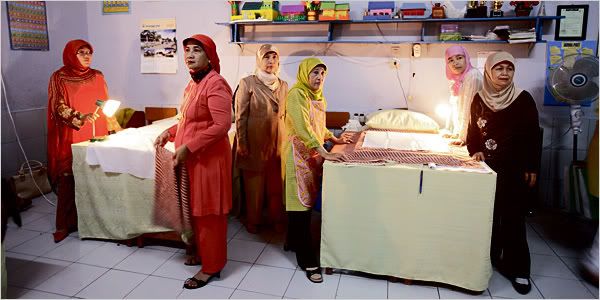 Female circumcisers and their attendants waiting in an elementary-school classroom, where they do their work.
The New York Times reports:
When a girl is taken — usually by her mother — to a free circumcision event held each spring in Bandung, Indonesia, she is handed over to a small group of women who, swiftly and yet with apparent affection, cut off a small piece of her genitals. Sponsored by the Assalaam Foundation, an Islamic educational and social-services organization, circumcisions take place in a prayer center or an emptied-out elementary-school classroom where desks are pushed together and covered with sheets and a pillow to serve as makeshift beds. The procedure takes several minutes. There is little blood involved. Afterward, the girl’s genital area is swabbed with the antiseptic Betadine. She is then helped back into her underwear and returned to a waiting area, where she’s given a small, celebratory gift — some fruit or a donated piece of clothing — and offered a cup of milk for refreshment. She has now joined a quiet majority in Indonesia, where, according to a 2003 study by the Population Council, an international research group, 96 percent of families surveyed reported that their daughters had undergone some form of circumcision by the time they reached 14.
These photos were taken in April 2006, at the foundation’s annual mass circumcision, which is free and open to the public and
held during the lunar month marking the birth of the prophet Muhammad. The Assalaam Foundation runs several schools and a mosque in Bandung, Indonesia’s third-largest city and the capital of West Java. The photographer Stephanie Sinclair was taken to the circumcision event by a reproductive-health observer from Jakarta and allowed to spend several hours there. Over the course of that Sunday morning, more than 200 girls were circumcised, many of them appearing to be under the age of 5. Meanwhile, in a nearby building, more than 100 boys underwent a traditional circumcision as well.
According to Lukman Hakim, the foundation’s chairman of social services, there are three “benefits” to circumcising girls.
“One, it will stabilize her libido,” he said through an interpreter. “Two, it will make a woman look more beautiful in the eyes of her husband. And three, it will balance her psychology.”
Female genital cutting — commonly identified among international human rights groups as female genital mutilation — has been outlawed in 15 African countries. Many industrialized countries also have similar laws. Both France and the U.S. have prosecuted immigrant residents for performing female circumcisions.
In Indonesia, home to the world’s largest Muslim population, a debate over whether to ban female circumcision is in its early stages. The Ministry of Health has issued a decree forbidding medical personnel to practice it, but the decree which has yet to be backed by legislation does not affect traditional circumcisers and birth attendants, who are thought to do most female circumcisions. Many agree that a full ban is unlikely without strong support from the country’s religious leaders. According to the Population Council study, many Indonesians view circumcision for boys and girls as a religious duty.
Female circumcision in Indonesia is reported to be less extreme than the kind practiced in other parts of the globe — Africa, particularly. Worldwide, female genital cutting affects up to 140 million women and girls in varying degrees of severity, according to estimates from the World Health Organization. The most common form of female genital cutting, representing about 80 percent of cases around the world, includes the excision of the clitoris and the labia minora. A more extreme version of the practice, known as Pharaonic circumcision or infibulation, accounts for 15 percent of cases globally and involves the removal of all external genitalia and a stitching up of the vaginal opening.
Studies have shown that in some parts of Indonesia, female circumcision is more ritualistic — a rite of passage meant to purify the genitals and bestow gender identity on a female child — with a practitioner rubbing turmeric on the genitals or pricking the clitoris once with a needle to draw a symbolic drop of blood. In other instances, the procedure is more invasive, involving what WHO classifies as “Type I” female genital mutilation, defined as excision of the clitoral hood, called the prepuce, with or without incision of the clitoris itself. The Population Council’s 2003 study said that 82 percent of Indonesian mothers who witnessed their daughters’ circumcision reported that it involved “cutting.” The women most often identified the clitoris as the affected body part. The amount of flesh removed, if any, was alternately described by circumcisers as being the size of a quarter-grain of rice, a guava seed, a bean, the tip of a leaf, the head of a needle.
At the Assalaam Foundation, traditional circumcisers say they learn the practice from other women during several years of apprenticing. Siti Rukasitta, who has been a circumciser at the foundation for 20 years, said through an interpreter that they use a small pair of sterilized scissors to cut a piece of the clitoral prepuce about the size of a nail clipping. Population Council observers who visited the event before the 2003 study, however, reported that they also witnessed some cases of circumcisers cutting the clitoris itself.
Any distinction between injuring the clitoris or the clitoral hood is irrelevant, says Laura Guarenti, an obstetrician and WHO’s medical officer for child and maternal health in Jakarta. “The fact is there is absolutely no medical value in circumcising girls,” she says. “It is 100 percent the wrong thing to be doing.” The circumcision of boys, she adds, has demonstrated health benefits, namely reduced risk of infection and some protection against H.I.V.
Nonetheless, as Western awareness of female genital cutting has grown, anthropologists, policy makers and health officials have warned against blindly judging those who practice it, saying that progress is best made by working with local leaders and opinion-makers to gradually shift the public discussion of female circumcision from what it’s believed to bestow upon a girl toward what it takes away. “These mothers believe they are doing something good for their children,” Guarenti, a native of Italy, told me. “For our culture that is not easily understandable. To judge them harshly is to isolate them. You cannot make change that way.”
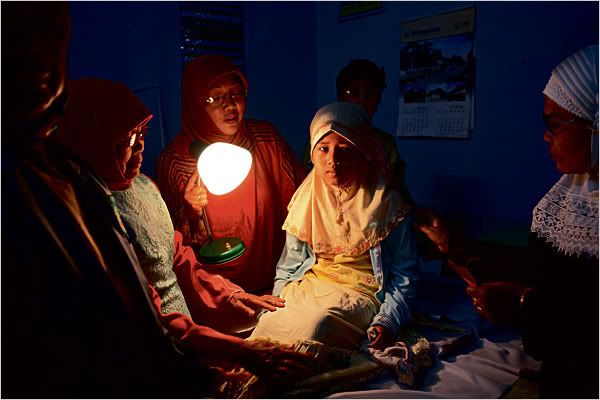 The girl who was being soothed in the second photograph, after her circumcision.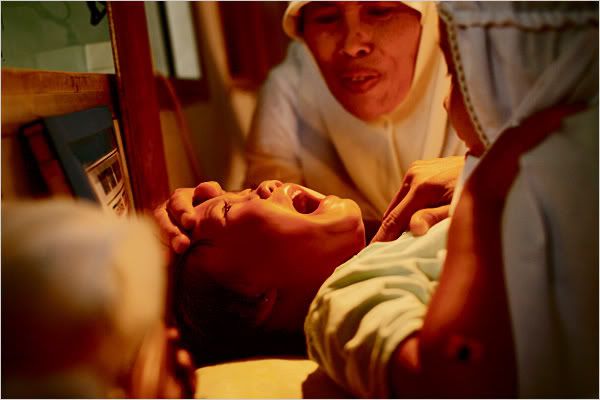
 A girl pulls on her undergarments after being circumcised.
 Tears are wiped from the face of a 9-month-old following her circumcision.
 The annual circumcision event begins and ends with prayer services.
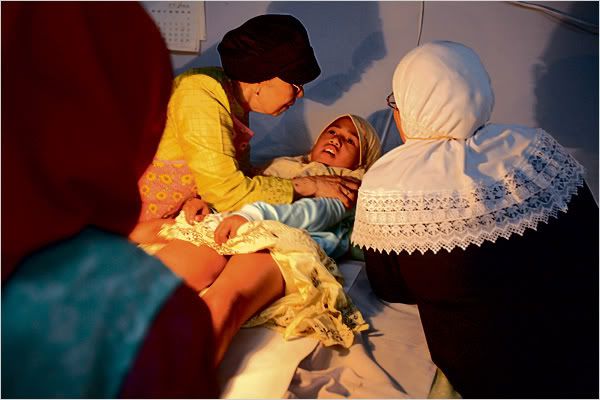 A girl is soothed by an attendant before her circumcision.
Monday, December 3, 2007
| [+/-] |
Fresh Pain for the Uninsured |
As doctors and hospitals turn to GE, Citi, and smaller rivals to finance patient care, the sick pay much more
BusinessWeek reports:
In a lucrative new form of fiscal alchemy, a growing number of hospitals, working with a range of financial companies, are squeezing revenue from patients with little or no health insurance. April Dial's dealings with Hot Spring County Medical Center in Malvern, Ark., illustrate how the transformation of medical bills into consumer debt means quicker cash for medical providers but tougher times for many patients of modest means.
Dial, a 23-year-old truck-stop waitress who earns $17,000 a year plus tips, suffers from Type 1 diabetes. Sudden drops in her blood sugar level have sent her to the emergency room four times in the past three years. In September she spent three days at Hot Spring, including two in intensive care, fighting complications from her ailment. The bills came to more than $14,000. Dial's job offers no health insurance.
Until recently her mother, Carolyn, who waits tables at the same roadside diner, sent Hot Spring $100 a month under the nonprofit hospital's longstanding zero-interest payment plan. Dial says she couldn't make payments herself because she spends more than $150 a month for other treatment and insulin. In October she learned that Hot
Spring had transferred her account to a company called CompleteCare, one of the many small firms fueling the little-known medical debt revolution. Enticed by the enormous potential market of uninsured and poorly insured patients, financial giants such as General Electric (GE ), U.S. Bancorp (USB ), Capital One, and Citigroup (C ) are rapidly expanding in the field or joining the fray for the first time.
CompleteCare informed Dial that under the complicated terms of her newly financed debt, her minimum monthly payment had shot up more than fourfold, to $455. Dial says she doesn't have anywhere close to that amount left over after rent, food, and other doctor visits: "Every extra dime I have goes to paying medical bills."
Sophisticated Help
Collecting from "self-pay" patients like Dial has long been the bane of medical administrators. When they don't get paid immediately, hospitals typically recover around 10 cents on the dollar owed, even when they hire collection specialists. So hospitals and clinics are bringing in more sophisticated help. They are transferring patient accounts wholesale to finance experts, banks, credit-card companies, and even private equity firms. Many of these third parties use credit scores and risk-analysis software to price the debt and impose interest rates as high as 27% on past-due bills.
Among hospitals, nonprofits like Hot Spring County Medical Center are more likely than for-profit rivals to join forces with finance firms. Fewer nonprofits have effective in-house collection departments, and in many regions a higher proportion of patients at nonprofits lack insurance. "Hospitals can't just be an interest-free finance vehicle," says Todd Cole, director of patient accounting at TriHealth, a $2 billion pair of nonprofit hospitals in Cincinnati. "The world of $5 sent to the hospital and they will never send me to collections, never sue me—that world has gone away," he adds. TriHealth sells patient accounts at a steep discount to firms that specialize in collecting delinquent consumer debt. "Hospitals need their cash," Cole says. "It is the lifeblood that supports the doctors, the nurses."
For hospitals and outside firms to obtain that cash, someone has to pay. The people most likely to feel the pain are often those least able to afford it—patients who lack private insurance but who are not poor enough to qualify for charity care or government benefit programs. The pool of self-pay patients is mammoth: Some are among the nation's 47 million uninsured; others among the 16 million whose plans offer scant coverage or have deductibles as high as $10,000. Several recent studies have shown that medical debt is a leading cause of personal bankruptcy filings.
A host of nimble firms like CompleteCare in North Little Rock, Ark., began exploring this terrain years ago. Bigger players have jumped in more recently, although the market remains fragmented and reliable market share information isn't available. U.S. Bank, a U.S. Bancorp unit, finances about $2 million in patient debt per month through a medical-benefit firm, charging most customers annual interest of 13.5%, and as much as 24% on late bills. General Electric's powerful financial arm markets its CareCredit card to dentists, plastic surgeons, and some hospitals, with loan volume expected to hit $5 billion this year, up 40% from 2006. Citigroup and Capital One now offer similar cards. "Everybody is saying [medical finance] is the next horizon—whether it is lines of credit or credit cards," says June St. John, a senior vice-president at Wachovia (WB ), which is exploring the business. Whetting all these appetites is the $250 billion consumers pay in medical expenses out of their pockets, an amount that doesn't include insurance premiums. That's an estimate for 2005 from the consulting firm McKinsey & Co. The figure could hit $420 billion by 2015.
BusinessWeek's investigation of the fast-expanding medical-finance field has uncovered hazards, however. Many patients say they don't realize their debts are being shifted to such interest-charging middlemen as GE Money Bank, the unit that issues the CareCredit card. That's what happened to Alice Diltz when she visited Hillside Dental Care in Queens, N.Y., in October, 2005. Diltz, a 68-year-old part-time hospital aide, needed implants for two rotting teeth and three missing ones. The Hillside staff told her she would have to pay $7,450. But her dental insurance, provided by her retiree husband's policy, offered only $200 for extractions. Diltz paid $250 from her pocket and signed up for what she says she thought was an installment plan directly with the clinic. In fact, she signed an application for CareCredit, which was labeled as such, but in small print. Diltz says neither Hillside dentist Ben Mokhtar nor his staff mentioned a credit card.
While having her teeth pulled, Diltz began to bleed heavily. She got scared and left the dental office after the extractions. Four days later she canceled the implants, assuming her dealings with Hillside were over. But several weeks later she received a bill from CareCredit for $7,000. Hillside had transferred that amount to the credit-card company, which in turn paid the clinic about $6,300 up front. Diltz says she called CareCredit to dispute the charge, but bills kept arriving. Several weeks later, she says she called again and objected in writing. But GE told her she had missed a 60-day deadline and couldn't reverse the charge.
The GE card typically comes with an introductory 0% interest rate, but after Diltz didn't make her initial payment, the rate leapt to 26.99% on an annual basis. In August, 2006, GE Money Bank sued her in state court in Queens. With the help of the nonprofit Elder Law Clinic at St. John's University School of Law, she contested the debt, which grew to $10,175. "It was horrible to get those letters from GE," says Diltz. She and her husband live on $18,000 a year from her part-time job and social security benefits. "It was so stressful from day to day."
Outside Scrutiny
A GE spokeswoman, Cristy F. Williams, said in an e-mail that the vast majority of CareCredit's 6 million customers are satisfied. In the Diltz case, "we provided her with a dispute form and discussed the dispute process with her a number of times," Williams added. "She did not respond for several months." However, on Nov. 12, after BusinessWeek inquired about the case, GE said it had changed its stance. Williams said the company would erase Diltz's debt and remove any reference to it on her credit report. The spokeswoman said GE had begun to reassess Diltz's account on its own initiative. "We could have and should have been more sensitive to Ms. Diltz," she said.
Diltz's lawyer, Gina Calabrese, said she was skeptical that GE would have reversed itself absent a reporter's asking questions. "They knew about all these facts almost a year ago," the attorney said. "Imagine what is happening to all the unrepresented people who have valid cases." Mokhtar and his staff declined to comment.
In another instance, BusinessWeek's questions prompted GE to acknowledge that a medical clinic had pressured uninsured patients into using the CareCredit card. Dawn Shelly, 33, visited the Christie Clinic in Urbana, Ill., in late 2003 for a sinus infection. She told a staff member she couldn't afford to pay the $90 bill in cash. At the time she earned $7.50 an hour as a part-time school bus monitor; the job didn't offer insurance. The clinic, Shelly says, told her the only option was to apply for CareCredit. She says she thought she was signing up for a program similar to insurance, under which she would owe only a modest co-payment. "I never would have signed up if I knew it was really a credit card," she says.
Her CareCredit balance mounted with several additional visits to the clinic and a local emergency room, where she was treated by a clinic doctor. Unable to keep up with payments, Shelly, now unemployed, owes $3,485 to CareCredit, according to an Oct. 24 collection letter. Much of that balance comes from late fees and finance charges of 26.99%.
Until recently, the Christie Clinic's Web site stated that patients who couldn't pay in full "must apply for CareCredit." After BusinessWeek asked GE about the clinic's policy, the company said it would correct the situation. "We are instructing the provider to remove the language and change their policy for soliciting applicants for CareCredit," said GE's Williams. She added that GE would drop all fees and finance charges from Shelly's bill. The company also will try to resolve the concerns of any other patients who were required to use CareCredit, she said.
In early November the Christie Clinic removed all references to payment policies from its Web site. Anni McClellan, the clinic's director of financial services, said it is reviewing the policies. Christie discusses a variety of payment options with patients, she said. "There are so many specific circumstances surrounding each patient's financial conditions."
The Fine Print
Early experiments with financing self-pay medical bills began in the 1980s, when consumer-credit executives saw an opportunity in soaring debt levels and inefficient hospital billing practices. Most patients think that "your doctor will probably see you again and the hospital will not turn you away if you don't pay the bill," says Richard L. Clarke, chief executive of the Healthcare Financial Management Assn., an industry group. "On the other hand, with the credit card or a loan [from] the bank, people will be more concerned about defaulting because that is almost certain to cut them off from credit."
That's precisely the strategy that drives CompleteCare, the small Arkansas firm, which says it works with 40 hospitals and more than 400 physician practices across the country. Addressing potential health-industry clients, the company boasts on its Web site that it "pioneered the concept that patients become consumers the minute they walk out of your facility." April Dial, the diabetic waitress, says she didn't realize she had been transformed in this manner until weeks after leaving Hot Spring Medical Center in September.
Dial says a hospital financial counselor told her mother by phone in October that Hot Spring had discounted her debt by roughly 50%, to $7,300, before transferring the balance to CompleteCare under a contract the company signed with the hospital in June. Although she was surprised to learn about the transfer, Dial in fact had signed an admission-consent form at Hot Spring that included a small-print section authorizing the hospital to turn over her account. In contrast to the hospital's former zero-interest payment plan, CompleteCare charged Dial 5.75% interest on the first $2,500 of her balance, with a minimum monthly payment of 10% of the outstanding debt. CompleteCare initially applied the 10% rate to only $4,545 of the total bill, and required that Dial pay $455 a month.
After BusinessWeek contacted CompleteCare in early November, and Dial asked to have her case reviewed, the company said it would lower her minimum payment to $125, interest-free. CompleteCare President Steven C. Owen said the company changed the terms because Dial's "situation is so dire in terms of the balance owed. Our whole philosophy is trying to make it easy to pay."
Hot Spring's chief financial officer, Sheila Williams, said the hospital switched to CompleteCare hoping that patients "would pay a little faster if they were charged interest. It would become like a credit card." CompleteCare ran an ad in a local newspaper this summer to announce the change. But in recent weeks, she said, the hospital has reconsidered the arrangement in response to a complaint from a patient other than Dial. Hot Spring decided that effective Nov. 9, patients using CompleteCare would no longer be charged interest. "We just rethought it and decided that maybe it is not in the best interest of our patients," the hospital executive said.
Dubious innovations in medical financing are beginning to gain attention in Washington. Lawmakers and the IRS are investigating more broadly whether nonprofit hospitals provide sufficient free care to the uninsured to warrant more than $50 billion in annual tax breaks. Senator Charles Grassley (R-Iowa), the ranking Republican on the Senate Finance Committee, says some new financing arrangements appear to undermine the justification for tax-exempt status enjoyed by more than half of the country's 5,700 hospitals. "I'm very troubled by what we're seeing with some nonprofit hospitals' cozying up to banks, debt buyers, and credit-card companies over patients' medical bills," Grassley said in a statement responding to questions from BusinessWeek. The American Hospital Association said it hasn't studied the financing in question, but the trade group has repeatedly asserted that nonprofits provide ample community service to justify their tax benefits.
One of the leaders in this new field, HELP Financial, says that it merely makes the health-care business run more smoothly. The privately held Plymouth (Mich.) firm, whose initials stand for Hospital Expense Loan Program, says it has financed close to $300 million in medical bills at 100 hospitals nationwide. HELP purchases the debt at a discount and then charges patients interest of 10% to 18% over periods of one to five years. "The motivation for the hospital is really to keep them in the health-care business and out of the banking business," says HELP Vice-President Steve Posa.
Mia and Jase Redick reluctantly became HELP customers earlier this year and then discovered that they owed the company a hefty 14.5% on a bill of $6,293. In January, Mia, 36, had been rushed to Satilla Regional Medical Center in Waycross, Ga., after suffering a mild stroke. Tests revealed a small hole in her heart, a congenital defect that eventually required surgery. Mia, a pharmacy worker, and Jase, a job trainer for the state of Georgia, earn a combined $90,000 a year and have two small children. They lost state-provided insurance when Jase became an independent contractor in 2005, and had chosen to save money by going without coverage at the time Mia had the stroke. The couple assumed they would be able to pay the $6,293 tab for emergency care and tests in monthly interest-free installments. For years that's how Mia's family, Waycross natives, had used Satilla's in-house payment program. "It's what we always did," she says.
But on the winter morning when Mia arrived at the emergency room, a hospital administrator informed the Redicks that Satilla no longer offered its old payment plan. Jase says he was distraught and refused to discuss money that day. At a meeting the next week, the Redicks say they were told they had two options: retire the debt within 90 days and receive a 15% discount, or finance through HELP. With insufficient cash in the bank, the Redicks chose HELP. Distracted by Mia's condition, they didn't ask about having to pay interest. The bill arrived in March with the 14.5% rate, which translates into a monthly payment of $148. On top of $24,000 they owe to another hospital where Mia had surgery in February, "the overall cost of the debt is a lot to handle," says Jase.
Discounted Debt
Officials at Satilla say they brought in HELP in 2002 to reduce bad debt levels among the large population of uninsured patients in the hospital's rural south Georgia region. Through October, HELP had acquired $718,000 in Satilla debts. HELP pays 92 cents per dollar owed to the hospital. Satilla could trim the firm's 14.5% interest rate by selling debts at a greater discount but has chosen not to, according to Brenda Williamson, the hospital's accounts-receivable supervisor.
Barbara G. Albert, Satilla's patient financial services manager, stressed that the Redicks turned down Satilla's discounted 90-day payment plan. With more uninsured patients failing to pay medical bills, she said Satilla has to rely on HELP. "When you go to the dentist or the vet, you know you have to pay. If you go to the hospital, why should it be different?" said Katrina Wheeler, Satilla's chief financial officer. HELP's Posa said that it's up to Satilla and other hospitals to decide on appropriate interest rates: "What is right in one market may not be right for another."
Melvin Johnson, 55, another Satilla patient, has insurance, but his low-cost policy with AARP, the retiree-advocacy group, didn't cover the colonoscopy his doctor ordered in September. Johnson turned out not to have cancer, but the visit produced a bill for $3,304. He and his wife, Dolores, earn about $35,000 a year from her work as an outreach coordinator at a community health center and his construction job. Satilla's cut-off for charity care is twice the federal poverty level, or $27,380 for a two-person household. Unable to pay in cash, the Johnsons chose HELP. The 14.5% interest rate means their monthly payment comes to $125. "It has caused us to rearrange our budget," says Dolores, 35. "We've had to cut other expenses and reduce our savings."
Satilla's Albert said the couple could have bought better private coverage. "They're saving money," the hospital manager said. HELP imposes a cost on the hospital, her colleague Williamson added, in that Satilla gives HELP an 8 cents-per-dollar discount on patient debt.
Some medical financing programs manage to turn a profit without charging patients conventional interest. Aequitas Capital Management, a Portland (Ore.) private equity firm, provides financing through its CarePayment card to 50,000 patients treated at two dozen hospitals. CarePayment charges no interest on debts repaid over 25 months. Aequitas Chief Executive Robert Jesenik says his firm makes money by buying patient debts for about 80 cents on the dollar and then seeking to recover the full amount.
But patients aren't necessarily better off with CarePayment because they sometimes forgo discounts hospitals offer to people who pay in cash. At Spectrum Health, a nonprofit group of seven hospitals in Grand Rapids, Mich., self-pay patients who can write a check within 30 days receive a 20% discount; those who pay within six months get 10% off. Patients who charge their debts to CarePayment get no discount. Referring to CarePayment, Kathleen Engel, an associate professor at Cleveland-Marshall College of Law, asserts: "This is a markup, not a markdown." Engel, a consumer law expert, says that because hospitals effectively charge more when patients use CarePayment, the hospitals should disclose the price difference as the equivalent of an interest rate under the federal Truth in Lending Act.
Joseph Fifer, Spectrum's vice-president of finance, said its disclosure is legally sufficient. Steven M. Wright, Aequitas' senior managing director for health markets, agreed. Wright said Aequitas complies with the law by disclosing its payment terms when it sends CarePayment charge cards to new customers.
From his position as chief financial officer of Methodist Le Bonheur Healthcare, a $1.2 billion nonprofit network in Memphis, Chris McLean has grown increasingly skeptical of all these developments. Five of his seven hospitals serve a large portion of Memphis' poor population. Instead of selling medical debt, Methodist gives self-pay patients a 50% discount. Many are then allowed to pay over five years, interest-free. The debts of many others are immediately written off. One of Methodist's facilities serves a wealthier clientele and another is the city's only children's hospital; those units subsidize the other five.
"We get a lot of tax breaks, and for that we should produce some community benefit," says McLean. "If we heal somebody medically, but we break them financially, have we really done what is in the best interest of the patient?"
Sunday, December 2, 2007
| [+/-] |
Business Lobby Presses Agenda Before '08 Vote |
The NY Times reports:
Business lobbyists, nervously anticipating Democratic gains in next year’s elections, are racing to secure final approval for a wide range of health, safety, labor and economic rules, in the belief that they can get better deals from the Bush administration than from its successor.
Ivan H. Adler, an executive recruiter, says Democratic lobbyists are in demand.
Hoping to lock in policies backed by a pro-business administration, poultry farmers are seeking an exemption for the smelly fumes produced by tons of chicken manure. Businesses are lobbying the Bush administration to roll back rules that let employees take time off for family needs and medical problems. And electric power companies are pushing the government to relax pollution-control requirements.
“There’s a growing sense, a growing probability, that the next administration could be Democratic,” said Craig L. Fuller, executive vice president of Apco Worldwide, a lobbying and public relations firm, who was a White House official in the Reagan administration. “Corporate executives, trade associations and lobbying firms have begun to recalibrate their strategies.”
The Federal Register typically grows fat with regulations churned out in the final weeks of any administration. But the push for such rules has become unusually intense because of the possibility that Democrats in 2009 may consolidate control of the White House, the Senate and the House of Representatives for the first time in 14 years.
Even as they try to shape pending regulations, business lobbies are also looking beyond President Bush. Corporations and trade associations are recruiting Democratic lobbyists. And lobbyists, expecting battles over taxes and health care in 2009, are pouring money into the campaigns of Democratic candidates for Congress and the White House.
Randel K. Johnson, a vice president of the United States Chamber of Commerce, said, “I am beefing up my staff, putting more money aside for economic analysis of regulations that I foresee coming out of a possible new Democratic administration.”
At the Transportation Department, trucking companies are trying to get final approval for a rule increasing the maximum number of hours commercial truck drivers can work. And automakers are trying to persuade officials to set new standards for the strength of car roofs — standards far less stringent than what consumer advocates say is needed to protect riders in a rollover.
Business groups generally argue that federal regulations are onerous and needlessly add costs that are passed on to consumers, while their opponents accuse them of trying to whittle down regulations that are vital to safety and quality of life. Documents on file at several agencies show that business groups have stepped up lobbying in recent months, as they try to help the Bush administration finish work on rules that have been hotly debated and, in some cases, litigated for years.
At the Interior Department, coal companies are lobbying for a regulation that would allow them to dump rock and dirt from mountaintop mining operations into nearby streams and valleys. It would be prohibitively expensive to haul away the material, they say, and there are no waste sites in the area. Luke Popovich, a vice president of the National Mining Association, said that a Democratic president was more likely to side with “the greens.”
A coalition of environmental groups has condemned the proposed rule, saying it would accelerate “the destruction of mountains, forests and streams throughout Appalachia.”
A priority for many employers in 2008 is to secure changes in the rules for family and medical leave. Under a 1993 law, people who work for a company with 50 or more employees are generally entitled to 12 weeks of unpaid leave to care for newborn children or sick relatives or to tend to medical problems of their own. The Labor Department has signaled its interest in changes by soliciting public comments.
The National Association of Manufacturers said the law had been widely abused and had caused “a staggering loss of work hours” as employees took unscheduled, intermittent time off for health conditions that could not be verified. The use of such leave time tends to rise sharply before holiday weekends, on the day after Super Bowl Sunday and on the first day of the local hunting season, employers said.
Debra L. Ness, president of the National Partnership for Women and Families, an advocacy group, said she was “very concerned that the Bush administration will issue new rules that cut back on family and medical leave for those who need it.”
That could be done, for example, by narrowing the definition of a “serious health condition” or by establishing stricter requirements for taking intermittent leave for chronic conditions that flare up unexpectedly.
The Chamber of Commerce is seeking such changes. “We want to get this done before the election,” Mr. Johnson said. “The next White House may be less hospitable to our position.”
Indeed, most of the Democratic candidates for president have offered proposals to expand the 1993 law, to provide paid leave and to cover millions of additional workers. Senator Christopher J. Dodd of Connecticut was a principal author of the law. Senator Hillary Rodham Clinton of New York says it has been “enormously successful.” And Senator Barack Obama of Illinois says that more generous family leave is an essential part of his plan to “reclaim the American dream.”
Susan E. Dudley, administrator of the White House Office of Information and Regulatory Affairs, said, “Research suggests that regulatory activity increases in the final year of an administration, regardless of party.”
Whoever becomes the next president, Democrat or Republican, will find that it is not so easy to make immediate and sweeping changes. The Supreme Court has held that a new president cannot arbitrarily revoke final regulations that already have the force of law. To undo such rules, a new administration must provide a compelling justification and go through a formal rule-making process, which can take months or years.
Within hours of taking office in 2001, Mr. Bush slammed the brakes on scores of regulations issued just before he took office, so his administration could review them. A study in the Wake Forest Law Review found that one-fifth of those “midnight regulations” were amended or repealed by the Bush administration, while four-fifths survived.
Some of the biggest battles now involve rules affecting the quality of air, water and soil.
The National Chicken Council and the U.S. Poultry and Egg Association have petitioned for an exemption from laws and rules that require them to report emissions of ammonia exceeding 100 pounds a day. They argue that “emissions from poultry houses pose little or no risk to public health” because the ammonia disperses quickly in the air.
Perdue Farms, one of the nation’s largest poultry producers, said that it was “essentially impossible to provide an accurate estimate of any ammonia releases,” and that a reporting requirement would place “an undue and useless burden” on farmers.
But environmental groups told the Bush administration that “ammonia emissions from poultry operations pose great risk to public health.” And, they noted, a federal judge in Kentucky has found that farmers discharge ammonia from their barns, into the environment, so it will not sicken or kill the chickens.
On another issue, the Environmental Protection Agency is drafting final rules that would allow utility companies to modify coal-fired power plants and increase their emissions without installing new pollution-control equipment.
The Edison Electric Institute, the lobby for power companies, said the companies needed regulatory relief to meet the growing demand for “safe, reliable and affordable electricity.”
But John D. Walke, director of the clean air program at the Natural Resources Defense Council, said the rules would be “the Bush administration’s parting gift to the utility industry.”
If Democrats gain seats in Congress or win the White House, that could pose problems for all-Republican lobbying firms like Barbour, Griffith & Rogers, whose founders include Gov. Haley Barbour of Mississippi, a former chairman of the Republican National Committee.
Loren Monroe, chief operating officer of the Barbour firm, said: “If the right person came along, we might hire a Democrat. And it’s quite possible we could team up in an alliance with a Democratic firm.”
Two executive recruiters, Ivan H. Adler of the McCormick Group and Nels B. Olson of Korn/Ferry International, said they had seen a growing demand for Democratic lobbyists. “It’s a bull market for Democrats, especially those who have worked for the Congressional leadership” or a powerful committee, Mr. Adler said.
Few industries have more cause for concern than drug companies, which have been a favorite target of Democrats. Republicans run the Washington offices of most major drug companies, and a former Republican House member, Billy Tauzin, is president of their trade association, the Pharmaceutical Research and Manufacturers of America.
The association has hired three Democrats this year, so its lobbying team is split evenly between Republicans and Democrats.
Loren B. Thompson, a military analyst at the Lexington Institute, a policy research organization, said: “Defense contractors have not only begun to prepare for the next administration. They have begun to shape it. They’ve met with Hillary Clinton and other candidates.”
Sunday, November 18, 2007
| [+/-] |
Love in the Time of Dementia |
So this, in the end, is what love is.
The NY Times reports:
Former Justice Sandra Day O’Connor’s husband, suffering from Alzheimer’s disease, has a romance with another woman, and the former justice is thrilled — even visits with the new couple while they hold hands on the porch swing — because it is a relief to see her husband of 55 years so content.
What culture tells us about love is generally young love. Songs and movies and literature show us the rapture and the betrayal, the breathlessness and the tears. The O’Connors’ story, reported by the couple’s son in an interview with a television station in Arizona, where Mr. O’Connor lives in an assisted-living center, opened a window onto what might be called, for comparison’s sake, old love.
Of course, it illuminated the relationships that often develop among Alzheimer’s patients — new attachments, some call them — and how the desire for intimacy persists even when dementia steals so much else. But in the description of Justice O’Connor’s reaction, the story revealed a poignancy and a richness to love in the later years, providing a rare model at a time when people are living longer, and loving longer.
“This is right up there in terms of the cutting-edge ethical and cultural issues of late life love,” said Thomas R. Cole, director of the McGovern Center for Health, Humanities and the Human Spirit at the University of Texas, and author of a cultural history of aging. “We need moral exemplars, not to slavishly imitate, but to help us identify ways of being in love when you’re older.”
Historically, love in older age has not been given much of a place in culture, Dr. Cole said. It once conjured images that were distasteful or even scary: the dirty old man, the erotic old witch.
That is beginning to change, Dr. Cole said, as life expectancy increases, and a generation more sexually liberated begins to age. Nursing homes are being forced to confront an increase in sexual activity.
And despite the stereotypes, researchers who study emotions across the life span say old love is in many ways more satisfying than young love — even as it is also more complex, as the O’Connors’ example shows.
“There’s a difference between love as it is presented in movies and music as this jazzy sexy thing that involves bikini underwear and what love actually turns out to be,” said the psychologist Mary Pipher, whose book “Another Country” looked at the emotional life of the elderly. “The really interesting script isn’t that people like to have sex. The really interesting script is what people are willing to put up with.”
“Young love is about wanting to be happy,” she said. “Old love is about wanting someone else to be happy.”
That’s one way to look at it, at any rate. And it’s not just that relationships are seasoned by time and shared memories — although that’s part of it, as is the inertia the researchers call the familiarity effect, which keeps people from leaving a longtime relationship even though he nags and she won’t ask for directions.
It’s also that brain researchers say older people may simply be better able to deal with the emotional vicissitudes of love. As it ages, the brain becomes more programmed to be happy in relationships.
Researchers trying to understand aging and emotion performed brain scans on people across a range of ages, gauging their reactions to positive and negative scenes. Young people tended to respond to the negative scenes. Those in middle age took in a better balance of the positive. And older people responded only to the positive scenes.
“As people get older, they seem to naturally look at the world through positivity and be willing to accept things that when we’re young we would find disturbing and vexing,” said John Gabrieli, a professor of cognitive neuroscience at the Massachusetts Institute of Technology and one of the researchers.
It is not rationalization: the reaction is instantaneous. “Instead of what would be most disturbing for somebody, feeling betrayed or discomfort, the other thoughts — about how from his perspective it’s not betrayal — can be accommodated much more easily,” Dr. Gabrieli said. “It paves the way for you to be sympathetic to the situation from his perspective, to be less disturbed from her perspective.”
Young brains tend to go to extremes — the swooning or sobbing so characteristic of young love. Old love puts things in soft focus.
“As you get older you begin to recognize that this isn’t going to last forever, for better or for worse,” said Laura L. Carstensen, director of the Stanford Center on Longevity and a research counterpart of Dr. Gabrieli’s in the brain imaging research. “You understand that the bad times pass, and you understand that the good times pass,” Dr. Carstensen said. “As you experience them, they’re more precious, they’re richer.”
Of course, not everyone would show the emotionally generous response that Justice O’Connor did. As Dr. Cole said, “I have many examples in my mind of people who are just as jealous, just as infantile, just as filled with irrationality when they fall in love in their 70s and 80s as she is self-transcendent.”
And it still is possible to have a broken heart in old age. But in general, Dr. Carstensen said: “A broken heart looks different in somebody old. You don’t yell and scream and cry all day long like you might if you were 20.”
In one of the few cultural examples exploring old love — the film “Away From Her,” based on an Alice Munro short story and released in the spring — the starting point is similar to the O’Connors’ story. A man who cannot imagine life without his sparkling wife of some decades watches her slip into Alzheimer’s and then a romance with another patient in a nursing home. In the fictional example, the spousal devotion is such that he arranges for her new boyfriend to return to the nursing home after seeing how crushed she is when the man moves away.
But the story is more complex. The husband had a series of affairs years earlier, so what seems like devotion is also a desire to pay her back and to ease his own remorse.
For Olympia Dukakis, whose mother had Alzheimer’s and who played the wife of the other man in the film, that wrinkle explains the resonance of Ms. Munro’s story.
“She was very aware that contradictory things live together,” Ms. Dukakis said. “You can’t look at it and say he did it purely for love. It’s a complicated issue, because there’s a lot of life that has been lived. It’s not going to be simple.”
Still, for all those kinds of complications, those who study aging can only smile at young lovers who say they never want to become like an old married couple. Despite the popular preference for young love, the O’Connors’ example suggests that we should all aspire to old love, for better and for worse.
“Young love is very privileged, and as a culture that may be a mistake,” Dr. Pipher said. “If you want a communal culture where people make sacrifices for each other and work for the common good, you would have a culture that privileges the stories of older people.”
Those stories would not be without their troubles. But nor would they be without rewards. “If you stay married,” Dr. Pipher said, “there’s riches in store that nobody 25 years old can imagine.”
Monday, November 12, 2007
| [+/-] |
John Edwards To Congress on Universal Health Care |
"If you don't pass universal health care by July, 2009, I'm going to use my power as president to take your health care away from you. There's no excuse for politicians in Washington having health care when American citizens don't have health care."
Thursday, November 8, 2007
| [+/-] |
FEMA Won't Let Its Workers Enter Risky Trailers |
WDAM.com reports:
A FEMA spokeswoman says the agency is barring its employees from entering thousands of stored travel trailers amid concerns they could be exposed to elevated levels of a carcinogen.
Mary Margaret Walker says the directive doesn't apply to the more than 48,000 trailers occupied by hurricane victims in Mississippi and Louisiana.
FEMA postponed plans last week to test for formaldehyde levels in the air inside occupied trailers.
FEMA has suspended the sale of used trailers and says it won't shelter victims of future disasters in them until safety worries are resolved.
There are thousands of unoccupied trailers at staging areas in Purvis, Columbia, and other sites in south Mississippi.
Some Mississippi officials are critical of the apparent double standard: FEMA barring its own employees from entering unoccupied trailers while allowing residents to live in thousands of the units.
Sunday, November 4, 2007
| [+/-] |
Pollution From China's Coal-Fired Plants Take Only 5 To 10 Days To Reach U.S. |
World's growing dependence on coal leaving a trail of environmental devastation
 Chinese coal workers load coal unto trucks in Baotou, nestled in the sand-sculpted ravines of Inner Mongolia, China, Tuesday, May 8, 2007. (AP Photo/Elizabeth Dalziel)
The Associated Press reports:
It takes five to 10 days for the pollution from China's coal-fired plants to make its way to the United States, like a slow-moving storm.
It shows up as mercury in the bass and trout caught in the Willamette River in the western U.S. state of Oregon. It increases cloud cover and raises ozone levels. And along the way, it contributes to acid rain in Japan and South Korea and health problems everywhere from Taiyuan to the United States.
This is the dark side of the world's growing use of coal.
Cheap and abundant, coal has become the fuel of choice in much of the world, powering economic booms in China and India that have lifted millions of people out of poverty. Worldwide demand is projected to rise by about 60 percent through 2030 to 6.9 billion tons a year, most of it going to electrical power plants.
But the growth of coal-burning is also contributing to global warming, and is linked to environmental and health issues ranging from acid rain to asthma. Air pollution kills more than 2 million people prematurely, according to the World Health Organization.
"Hands down, coal is by far the dirtiest pollutant," said Dan Jaffe, an atmospheric scientist at the University of Washington who has detected pollutants from Asia at monitoring sites on Mount Bachelor in Oregon and Cheeka Peak in Washington state. "It is a pretty bad fuel on all scores."
To understand the conflict over coal, look at Taiyuan and the surrounding Shanxi Province, the country's top coal-producing region — and one of its most polluted.
Almost overnight, coal has turned poor farmers in this city of 3 million people into Mercedes-driving millionaires, known derisively as "baofahu" or the quick rich. Flashy hotels display chunks of coal in the lobby, and sprawling malls advertise designer goods from Versace and Karl Lagerfeld. Real estate prices have doubled, residents say, and construction cranes fill the skyline.
A museum in Taiyuan celebrates all things coal. Amid photos of smiling miners, coal is presented as the foundation of the country's economic development, credited with making possible everything from the railroad to skin care products.
"Today, coal has penetrated into every aspect of people's lives," the museum says in one of many cheery pronouncements. "We can't live comfortably without coal."
Yet the cornstalks lining a highway outside the city 410 kilometers (255 miles) southwest of Beijing are covered in soot. The same soot settles on vegetables sold at the roadside, and the thick, acrid smoke blots out the morning sun. At its worst, the haze forces highway closures and flight delays.
With pressure to clean up major cities such as Shanghai and Beijing, particularly in the run-up to next year's Beijing Olympics, the central government is turning increasingly to provinces such as Shanxi to meet the country's power demands.
"They look at polluted places like Taiyuan and say it's so polluted there so it doesn't matter if they have another five power plants," said Ramanan Laxminarayan, a senior fellow at Resources For the Future, an American think tank that found links between air pollution and rising hospital admissions in Taiyuan.
"I visited these power plants and there is no concept of pollution control," he said. "They sort of had a laugh and asked, 'Why would you expect us to install pollution control equipment?'"
China is home to 20 of the world's 30 most polluted cities, according to a World Bank report.
Health costs related to air pollution total US$68 billion (€47 billion) a year, nearly 4 percent of the country's economic output, the report said. And acid rain has contaminated a third of the country, Sheng Huaren, a senior Chinese parliamentary official, said last year. It is said to destroy some US$4 billion (€2.8 billion) worth of crops every year.
"What we are facing in China is enormous economic growth, and ... China is paying a price for it," said Henk Bekedam, the country representative for the World Health Organization. "Their growth is not sustainable from an environmental perspective. The good news is that they realize it. The bad news is they're dependent on coal as an energy source."
But the costs go far beyond China. The soot from power plants boosts global warming because coal emits almost twice as much carbon dioxide as natural gas. And researchers from Texas A&M University found that air pollution from China and India has increased in cloud cover and major Pacific Ocean storms by 20 percent to 50 percent over the past 20 years.
"We know dust from factories in China, India, Mexico and Africa does not simply disappear; the wind brings it here," said the U.S. Chamber of Commerce's Bill Kovacs.
Kovacs said overseas dust is adding to the number of counties that do not qualify for federal transportation funds because they are out of compliance with ozone standards. More than 100 counties do not meet the limit of 84 parts per billion. China alone contributes 3 to 5 parts per billion, estimates Daniel J. Jacob, professor of atmospheric chemistry and environmental engineering at Harvard University.
Mercury, a byproduct of some coal-mining, is another major concern. The potent toxin falls into waterways and shows up in fish. Asia's contribution to U.S. mercury levels has shot up over the past 20 years. Jacob estimated half of the mercury in the United States comes from overseas, especially China.
"It's a global problem and right now China is a source on the rise," he said. "If we want to bring down mercury levels in fish, then we have to go after emissions in East Asia."
A fifth of the mercury in the Willamette River came from China and other foreign sources, said Bruce K. Hope of the Oregon Department of Environmental Quality. Pregnant or nursing women who eat the fish put their babies at risk of neurological damage.
"It's frustrating to realize that part of your problem is someone else's behavior and you can't really go to them and say, 'Can you do something different?'" Hope said.
China has closed some polluting factories and says it will retire 50 gigawatts of inefficient power plants, or 8 percent of the total power grid, by 2010, according to the Pew Center for Global Climate Change. The government has also mandated that solar, wind, hydroelectric and other forms of renewable energy provide 10 percent of the nation's power by 2010, and ordered key industries to reduce energy consumption by 20 percent.
President Hu Jintao, in a speech to a key party congress last month, promised a cleanup. But China has fallen short of its national targets for using energy more efficiently, and coal remains a major energy source.
"Everyone knows coal is dirty, but there is no way that China can get rid of coal," the World Bank's Zhao Jianping said in Beijing. "It must rely on it for years to come, until humans can find a new magic solution."
Robert N. Schock, the director of studies for the World Energy Council, agreed that coal, cheap and abundant, will remain a crucial source of energy for many years and be crucial to improving living standards in developing countries.
"Twenty-five percent of the world's electric power is now generated by coal, and those plants are not likely to disappear overnight," Schock said.
In Shanxi province, authorities have pledged to close 900 coal mines and dozens of makeshift factories that process coal for the steel industry, according to the official Xinhua News Agency. The Asian Development Bank is providing more than US$200 million (€139 million) in loans to improve air quality in the province, through programs to shift to cleaner-burning natural gas for household heating and a demonstration project to capture methane, a greenhouse gas released in coal mining.
Taiyuan, dubbed the world's most polluted city in the 1990s, is no longer thought to be the worst, thanks to various efforts including phasing out coal-burning boilers. But the level of pollutants in the air remains five to 10 times higher than levels in New York or London. Residents say they see blue skies fewer than 120 days a year.
Australians Paul and Helen Douglas, who work for Evergreen in Taiyuan, an American social service agency, said their 21-month-old daughter Rose has been found in tests to have elevated lead levels. She has developed a chronic cough, Paul Douglas said, and the family will likely return to Australia before their contract ends if their daughter's toxin levels rise further.
"People say we are irresponsible and that we are making decisions that are injuring our children," he said of coming under fire from relatives and church members for staying in Taiyuan.
Taiyuan residents, though, shrug wearily when the talk turns to pollution, fearful that speaking out could get them in trouble. But when pressed, the complaints tumble forth and expose a community held hostage by the soot.
Residents seal their windows to keep out the dirty air. Parents are warned not to let their toddlers play outside, for fear of being covered in coal dust. Fruits and vegetables must be washed in detergent.
"I'm worried about my children," said a woman who lives in the shadow of a power plant and fertilizer factory. She would only give her surname, Zhang. "We worry about everything. If you get sick seriously, you will die."
Many complain of chronic sore throats, bronchitis, lung cancer and pulmonary fibrosis. One study, by researchers at Norway's Center for International Climate and Environmental Research, found Taiyuan's pollution increased death rates by 15 percent and chronic respiratory ailments by 40 to 50 percent.
"I feel terrible and I'm coughing all the time," said William Li, a retired engineer from Taiyuan. His father died of lung cancer and his son has tracheitis, an upper respiratory condition. "The coal, it produces electric power that we send to other provinces. But we are left with the pollution."
Thursday, October 11, 2007
| [+/-] |
ConAgra Recalls Pot Pies |
Business Week reports:
ConAgra Foods Inc. recalled all its Banquet pot pies and store brand varieties Thursday after the products were linked to a nationwide salmonella outbreak.
The company included beef pot pies in the recall after initially saying only the chicken and turkey pot pies should not be eaten.
ConAgra issued a consumer alert Tuesday and asked stores nationwide to stop selling the poultry pot pies, but the company stopped short of a recall until Thursday evening.
ConAgra spokeswoman Stephanie Childs said the decision to recall the pies wasn't based on new information, but an abundance of caution.
"We want to make sure there's no confusion with consumers, that these pot pies shouldn't be eaten," Childs said.
She said she knew of no indication of a link between cases of salmonella and the beef pot pies, but the company wanted to be careful as it collects information.
The pot pies made by ConAgra have been linked to at least 165 cases of salmonella in 31 states. The federal Centers for Disease Control and Prevention said at least 30 people have been hospitalized as part of the ongoing outbreak, but so far no deaths have been linked to the pot pies.
The company and federal officials warned customers not to eat the pot pies and to throw them away, and ConAgra is offering refunds. The store brand versions are sold under the names of Albertson's, Hill Country Fare, Food Lion, Great Value (sold at Wal-Mart stores), Kirkwood, Kroger, Meijer and Western Family.
Childs said she could not say how many pot pies are affected by the recall or how many ConAgra produces.
ConAgra officials have said some of the illnesses may be linked to undercooked pot pies, but Childs said the pot pies should not be eaten even if consumers think they have cooked them correctly. The company is revising the cooking directions on its pot pie packages to clarify how long the pies should be cooked in different microwaves.
Amanda Eamich, a spokeswoman for the USDA's Food Safety and Inspection Service, said three investigators are at the ConAgra plant looking for problems with a specific product or production date. ConAgra's recall is voluntary, and Eamich said without a specific connection, a recall wouldn't be ordered.
ConAgra shut down the pot pie production line at its Marshall, Mo., plant, but the rest of the plant, which employs about 650 people, has continued operating, Childs said Wednesday.
Salmonella sickens about 40,000 people a year in the U.S. and kills about 600. Most of the deaths are among people with weaker immune systems such as the elderly or very young.
Salmonella poisoning can cause diarrhea, fever, dehydration, abdominal pain and vomiting. Most cases are caused by undercooked eggs and chicken.
A Minnesota couple sued ConAgra Foods Inc. Thursday for selling the pot pies they believe made their young daughter ill with salmonella. The federal suit, filed in U.S. District Court in St. Paul, seeks damages of more than $75,000 and reimbursement for medical costs.
Consumers who want a refund for their pot pie should send the side panel of the package that contains the UPC code to the following address: ConAgra Foods, Dept. BQPP, P.O. Box 3768, Omaha, NE 68103-0768. Consumers with questions can call the company toll free at 866-484-8671.
